Open access in chemistry:information wants to be free?Jan Kuras, Deborah Kahn, Bryan VickeryChemistry CentralLondon, UKAmerican Chemical Society National Meeting, March 27-31, 2011Technical session: Internet and Chemistry
Information wants to be free?   Free of access restrictions?  Free of charge?  Free of standards and organization?
Objective:“An honest and philosophical assessment of open access in chemistry”A good time to review...20 years of more widespread interest in OA...Over 10 years since BioMed Central, PubMed Central, PLoS started...(10 years since Internet Journal of Chemistry launched...)About 5 years since PubChem, Chemistry Central, ChemSpider, eMolecules started...A major Study of Open Access Publishing (SOAP) undertaken in 2010 No scientific concepts were harmed in the making of this presentation
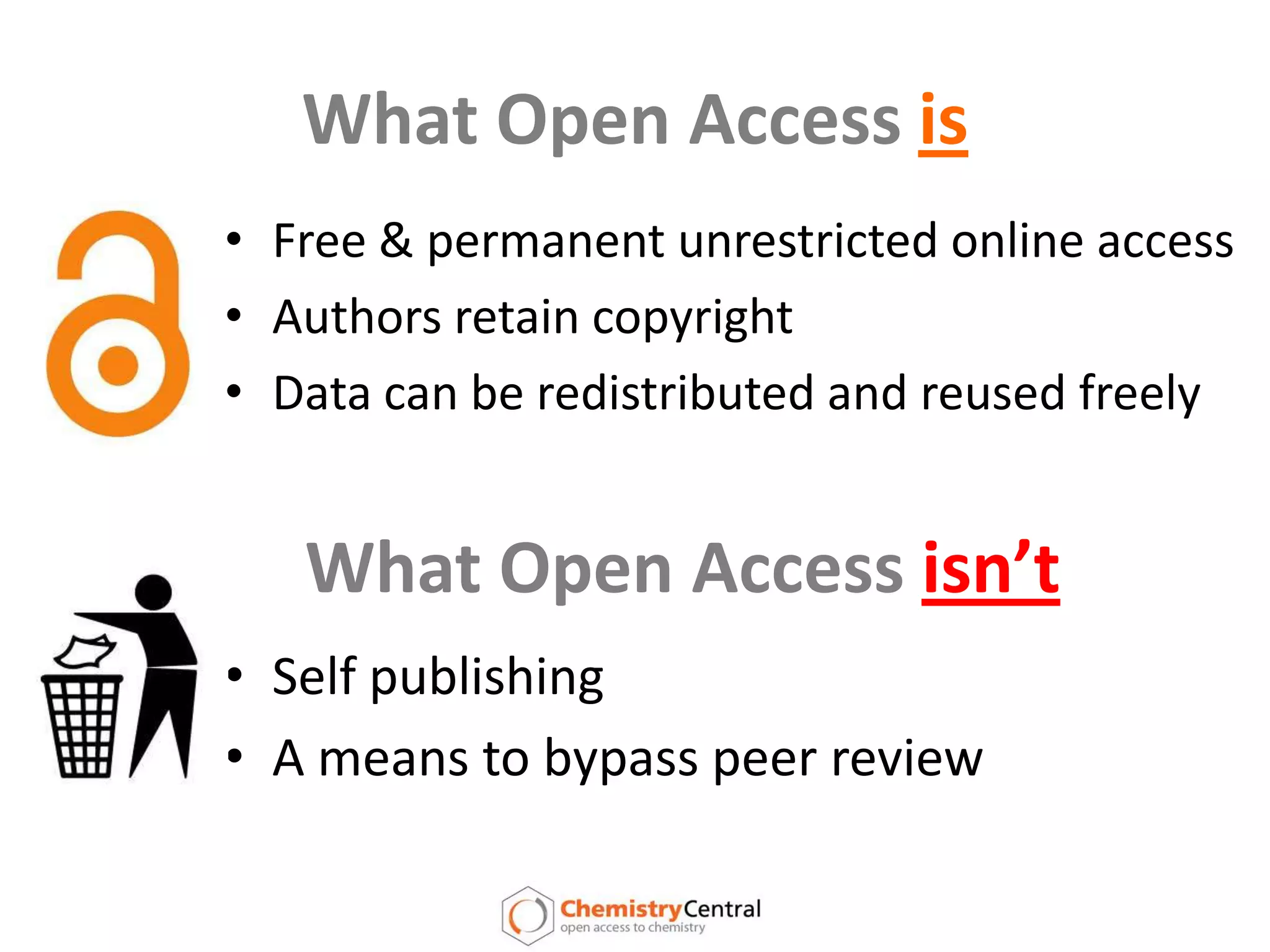
What Open Access isFree & permanent unrestricted online accessAuthors retain copyrightData can be redistributed and reused freelyWhat Open Access isn’tSelf publishing
A means to bypass peer reviewWhat motivated open access?Serials crisis: rising subscription prices, decreasing library budgetsOnline publishing opportunities & technologies, and subsequent data linking, integration, reuse and miningThe “Open” movement: open data, open source, open standards, open accessUnrestricted access to publicly funded research to maximize impact
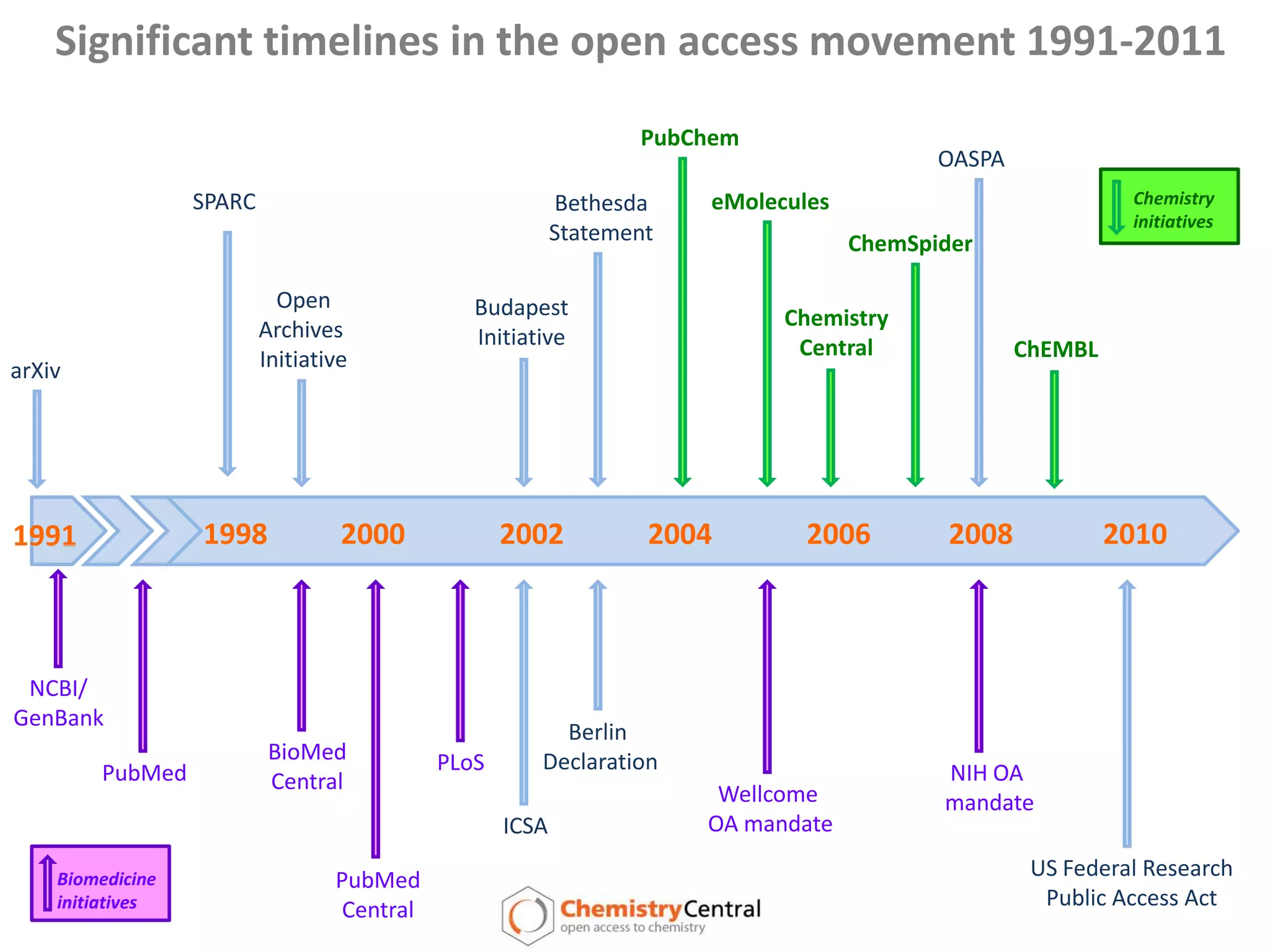
Significant timelines in the open access movement 1991-2011PubChemOASPASPARCeMoleculesChemistryinitiativesBethesdaStatementChemSpiderOpenArchives InitiativeBudapestInitiativeChemistryCentralChEMBLarXiv20102004200219982000200820061991NCBI/GenBankBerlin DeclarationBioMedCentralPLoSPubMedNIH OA mandateWellcome OA mandateICSAUS Federal ResearchPublic Access ActPubMedCentralBiomedicineinitiatives
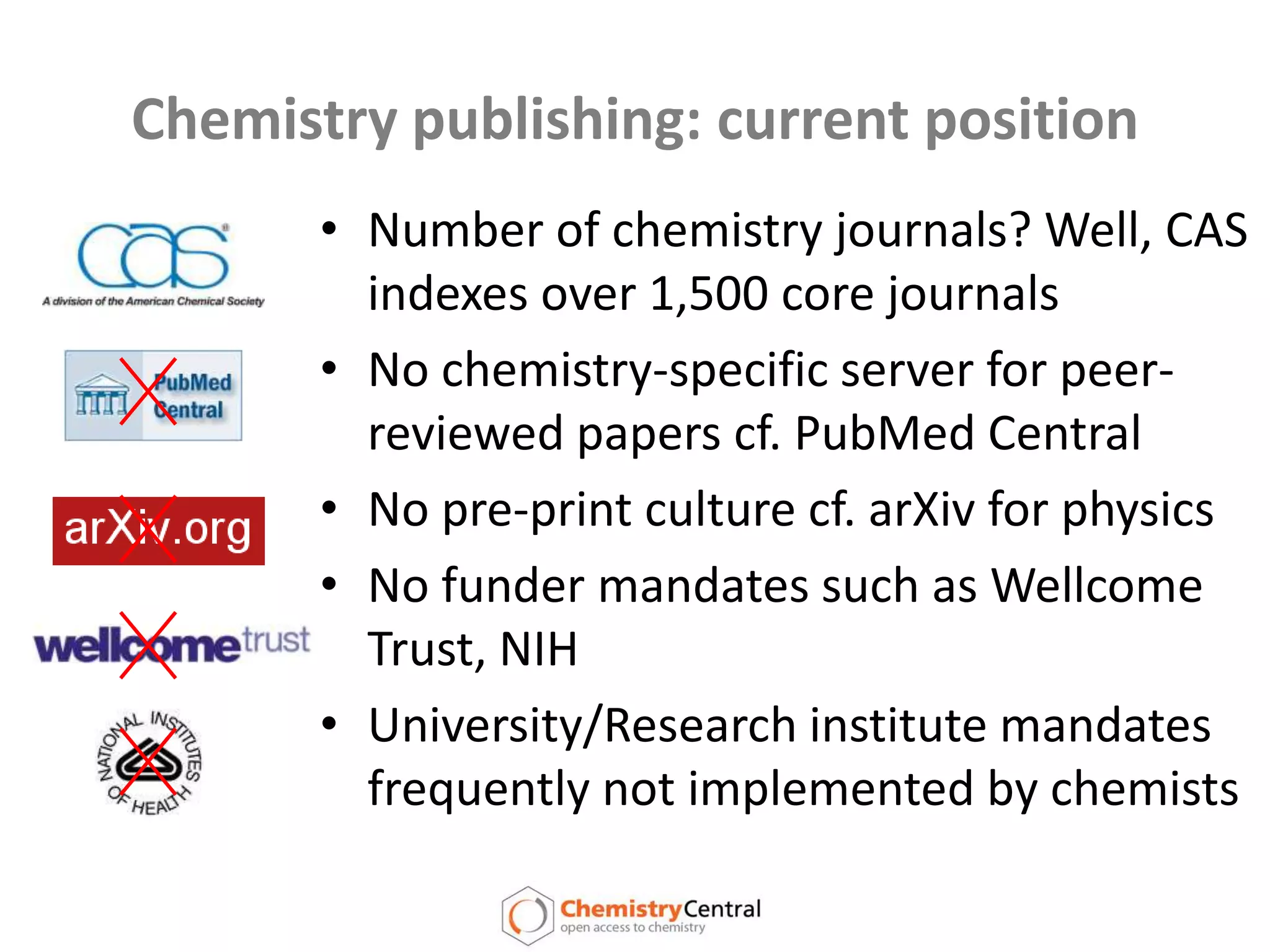
Chemistry publishing: current positionNumber of chemistry journals? Well, CAS indexes over 1,500 core journalsNo chemistry-specific server for peer-reviewed papers cf. PubMed CentralNo pre-print culture cf. arXiv for physicsNo funder mandates such as Wellcome Trust, NIHUniversity/Research institute mandates frequently not implemented by chemists
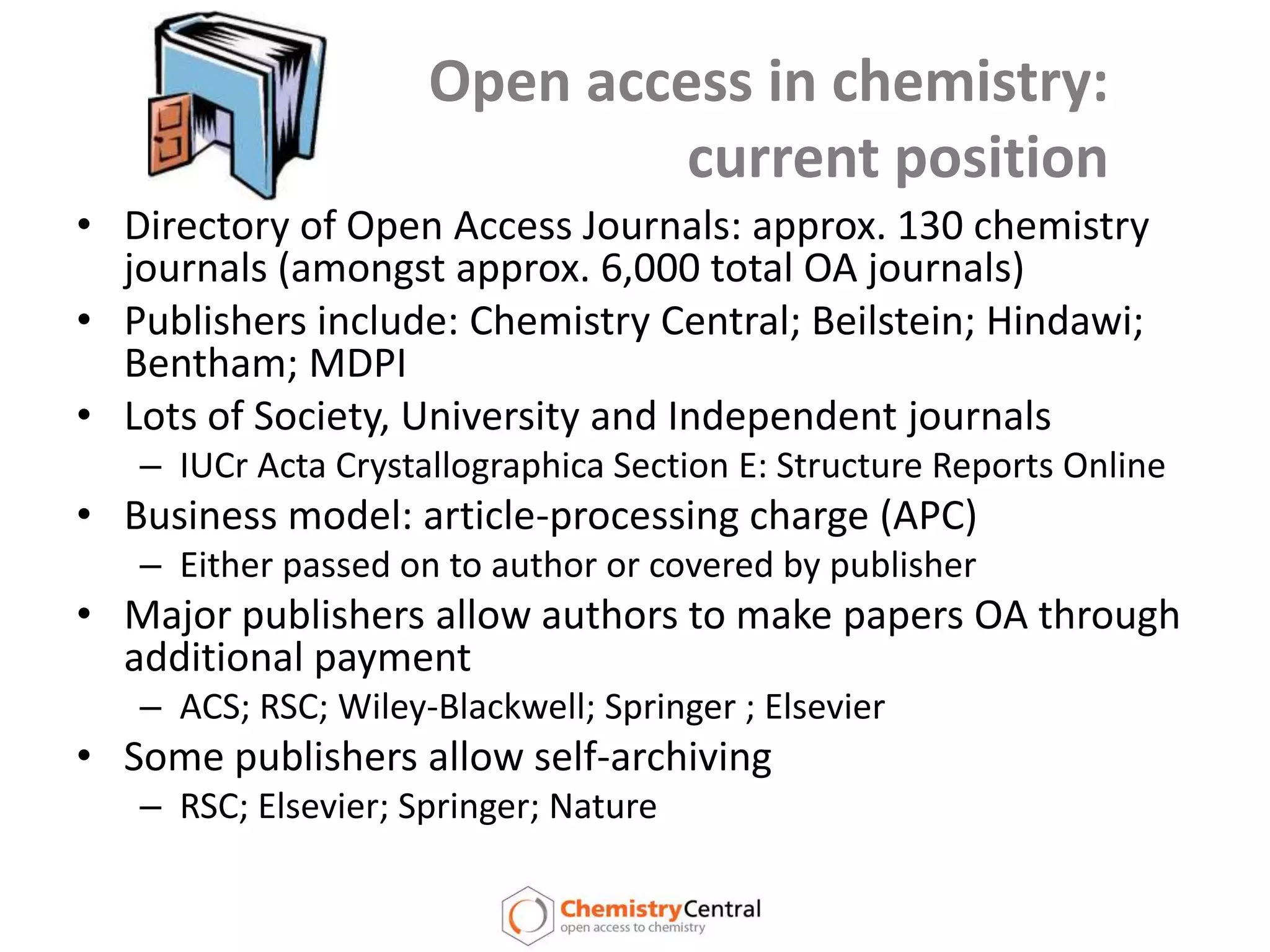
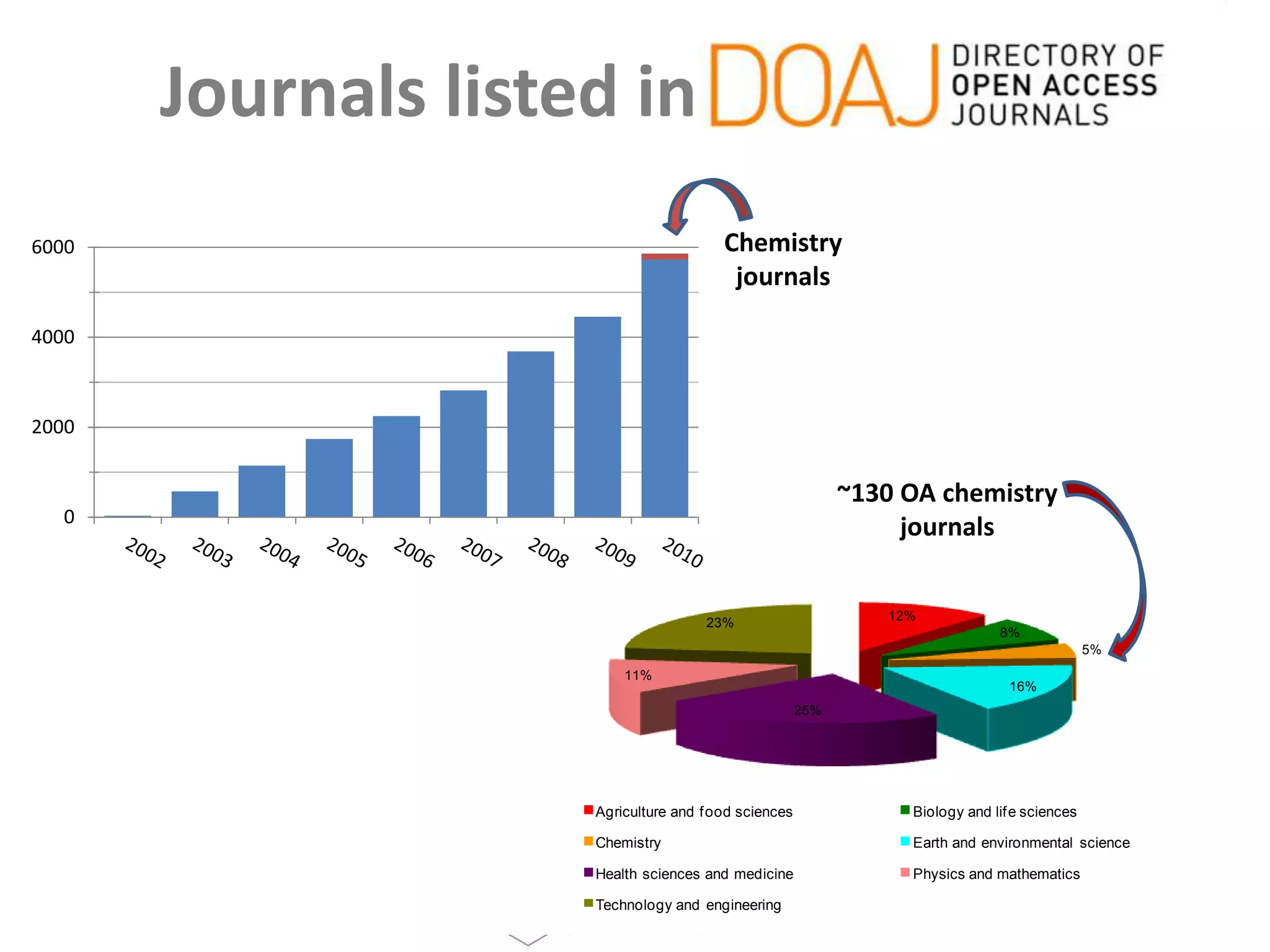
Open access in chemistry: current positionDirectory of Open Access Journals: approx. 130 chemistry journals (amongst approx. 6,000 total OA journals)Publishers include: Chemistry Central; Beilstein; Hindawi; Bentham; MDPILots of Society, University and Independent journalsIUCr Acta Crystallographica Section E: Structure Reports OnlineBusiness model: article-processing charge (APC)Either passed on to author or covered by publisherMajor publishers allow authors to make papers OA through additional paymentACS; RSC; Wiley-Blackwell; Springer ; Elsevier Some publishers allow self-archivingRSC; Elsevier; Springer; Nature
Journals listed inChemistryjournals~130 OA chemistry journals
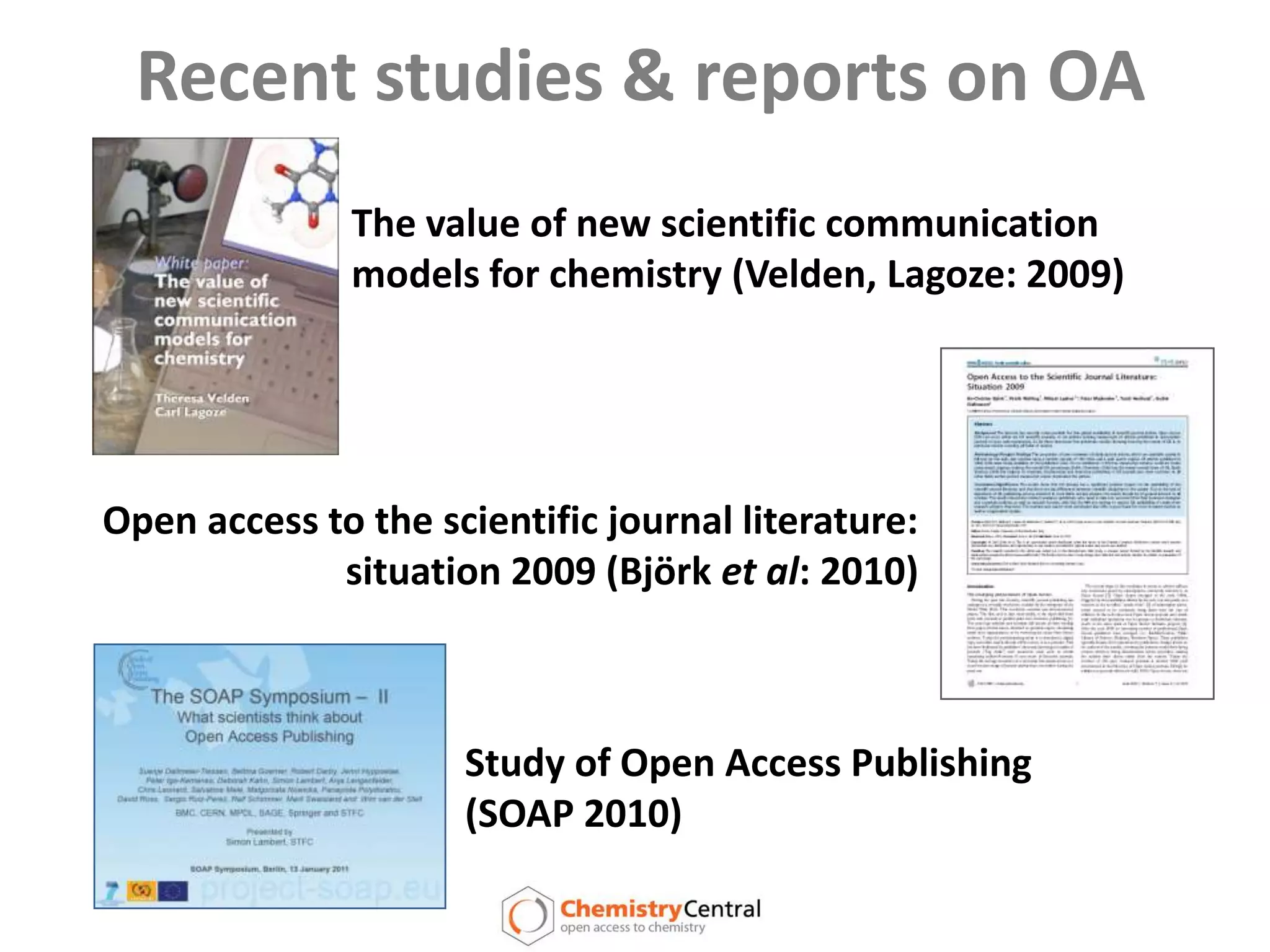
Recent studies & reports on OAThe value of new scientific communication models for chemistry (Velden, Lagoze: 2009)Open access to the scientific journal literature: situation 2009 (Björk et al: 2010)Study of Open Access Publishing (SOAP 2010)
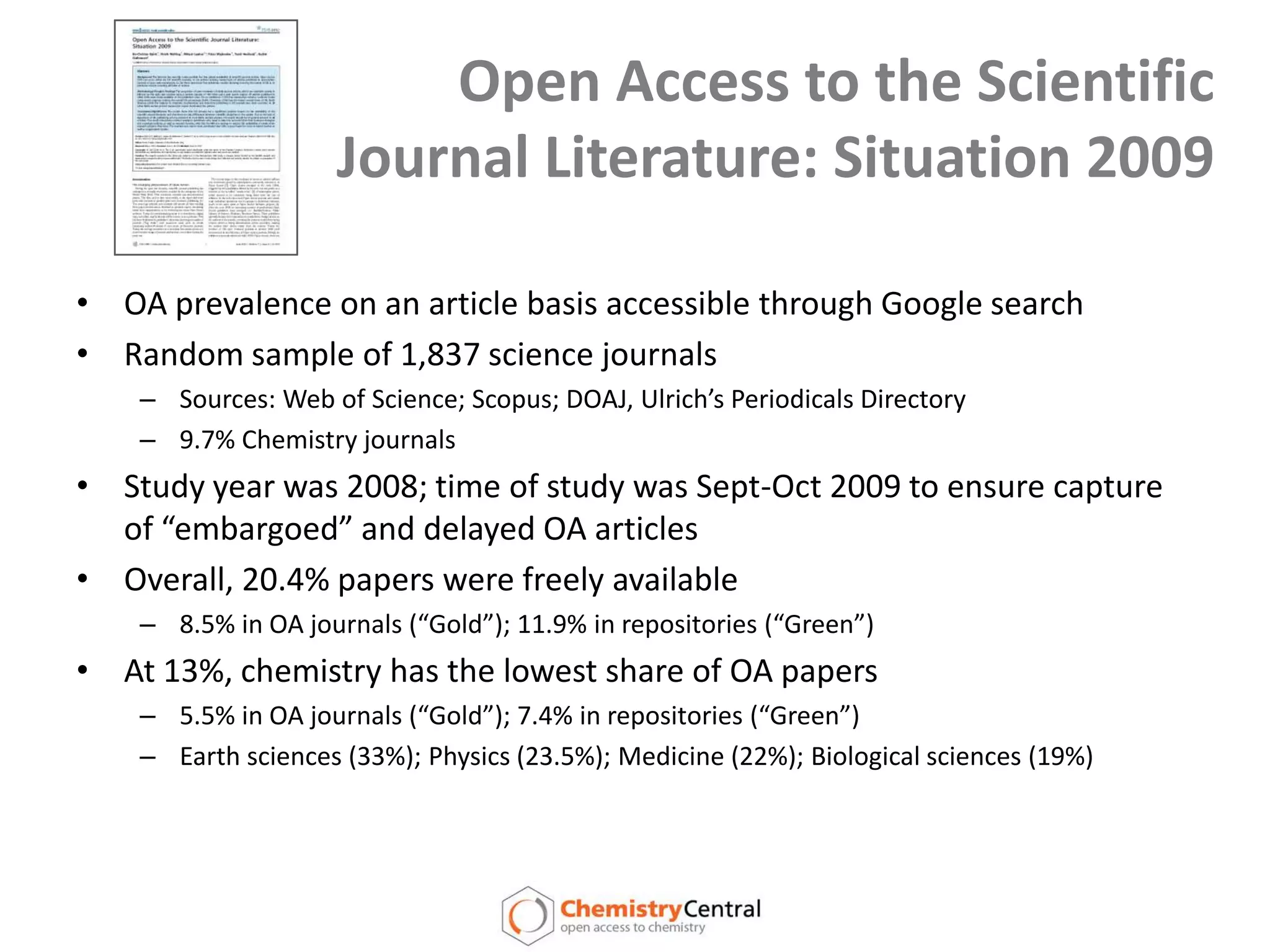
Open Access to the Scientific Journal Literature: Situation 2009OA prevalence on an article basis accessible through Google searchRandom sample of 1,837 science journalsSources: Web of Science; Scopus; DOAJ, Ulrich’s Periodicals Directory9.7% Chemistry journalsStudy year was 2008; time of study was Sept-Oct 2009 to ensure capture of “embargoed” and delayed OA articlesOverall, 20.4% papers were freely available 8.5% in OA journals (“Gold”); 11.9% in repositories (“Green”)At 13%, chemistry has the lowest share of OA papers5.5% in OA journals (“Gold”); 7.4% in repositories (“Green”)Earth sciences (33%); Physics (23.5%); Medicine (22%); Biological sciences (19%)
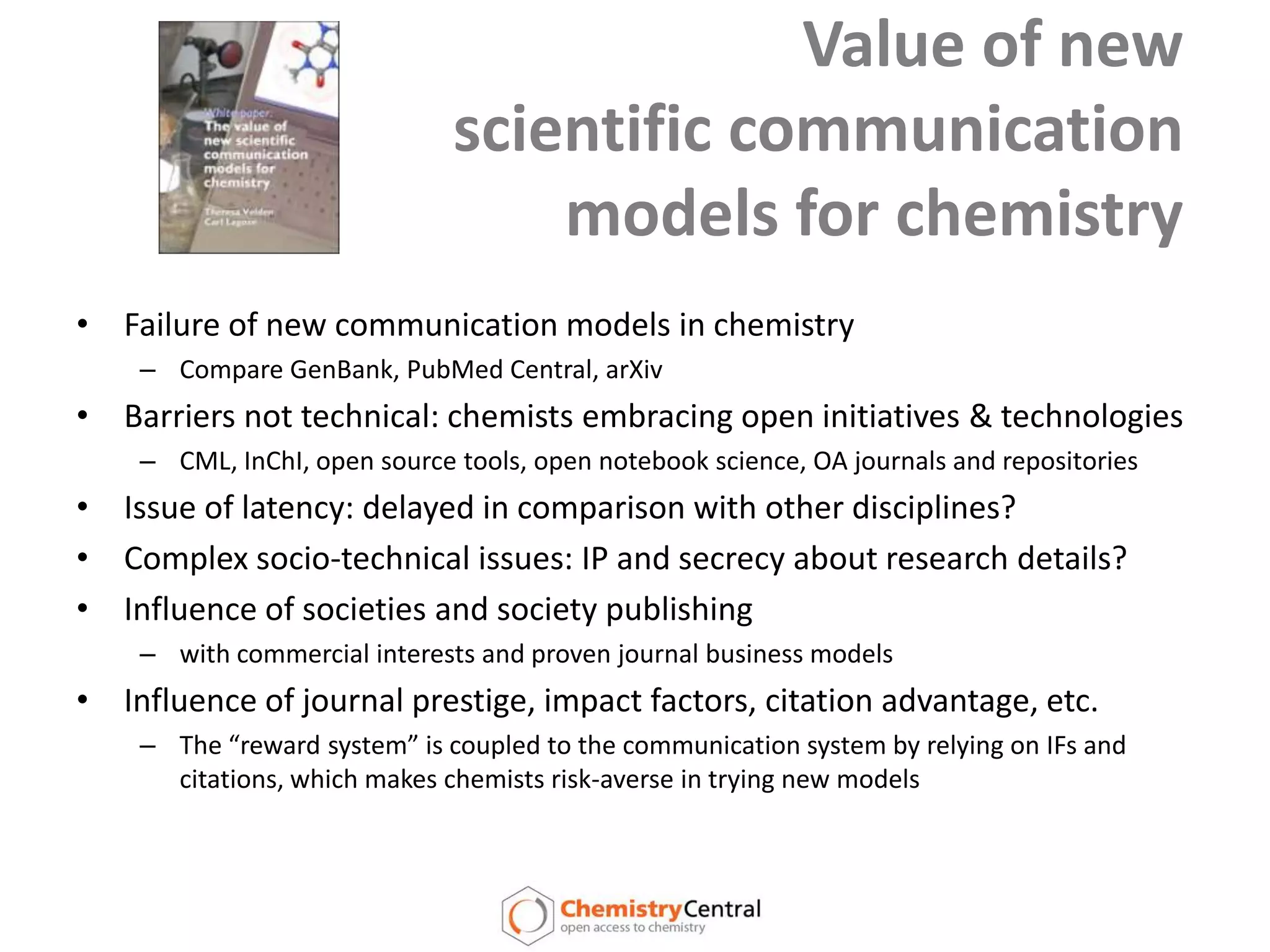
Value of new scientific communication models for chemistryFailure of new communication models in chemistryCompare GenBank, PubMed Central, arXivBarriers not technical: chemists embracing open initiatives & technologiesCML, InChI, open source tools, open notebook science, OA journals and repositoriesIssue of latency: delayed in comparison with other disciplines?Complex socio-technical issues: IP and secrecy about research details?Influence of societies and society publishing with commercial interests and proven journal business modelsInfluence of journal prestige, impact factors, citation advantage, etc.The “reward system” is coupled to the communication system by relying on IFs and citations, which makes chemists risk-averse in trying new models
Study of Open Access Publishing (SOAP)Multidisciplinary study including physical, life and social sciences, financed by the European CommissionCoordinated by CERN with Springer, SAGE & BioMed Central; Max Planck Digital Library; and UK Science & Technology Facilities CouncilTo “describe and compare the offering and demand for open access publishing in peer-reviewed journals”Assessment by large scale multidiscipline international surveyReached over 1.5 million recipients with over 54,000 respondents42,000 Responses analyzed, including over 2,300 chemistsCaveat: “self-selection” bias in favour of scientists with an interest in OA
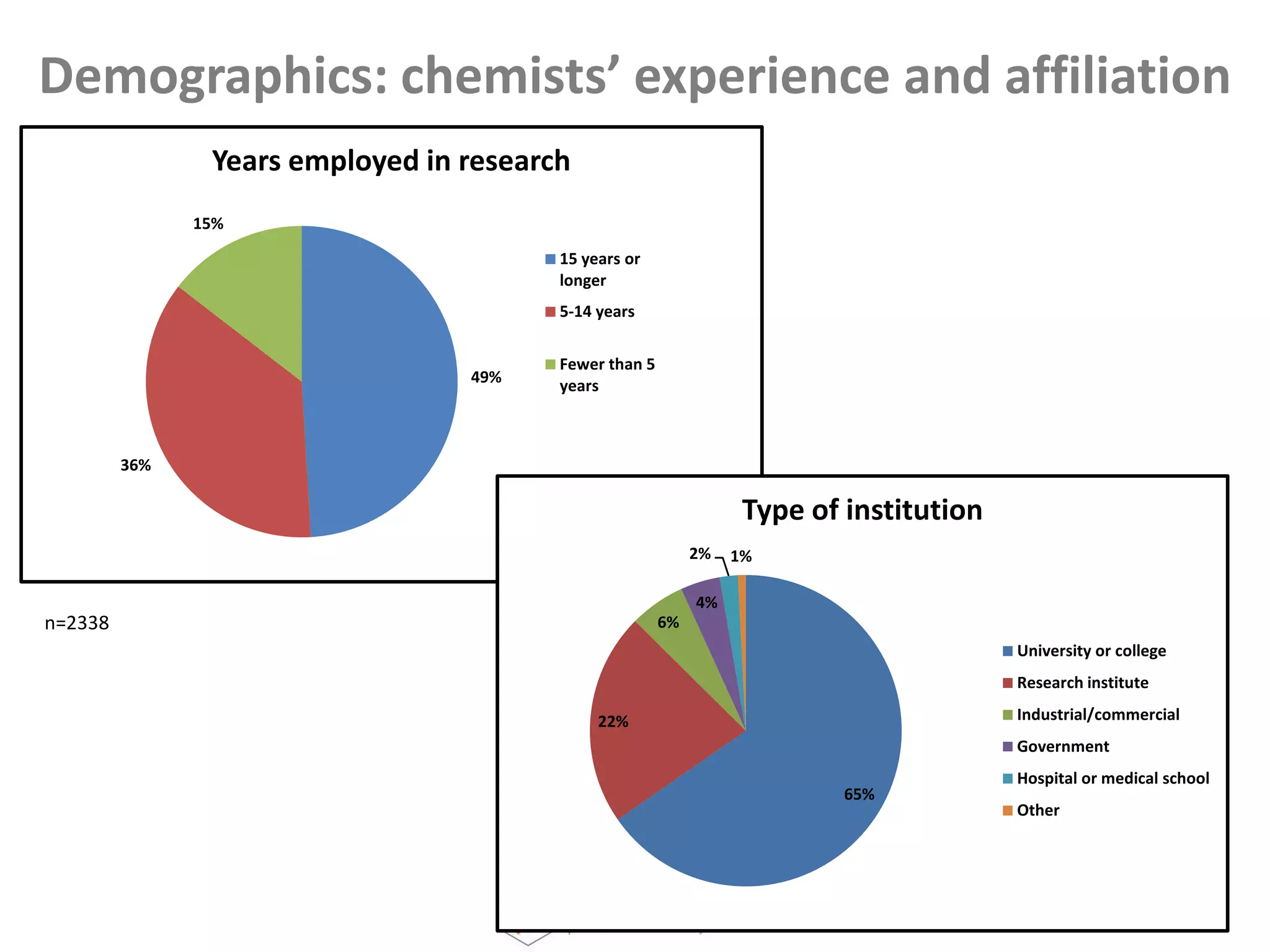
Demographics: chemists’ experience and affiliationn=2338
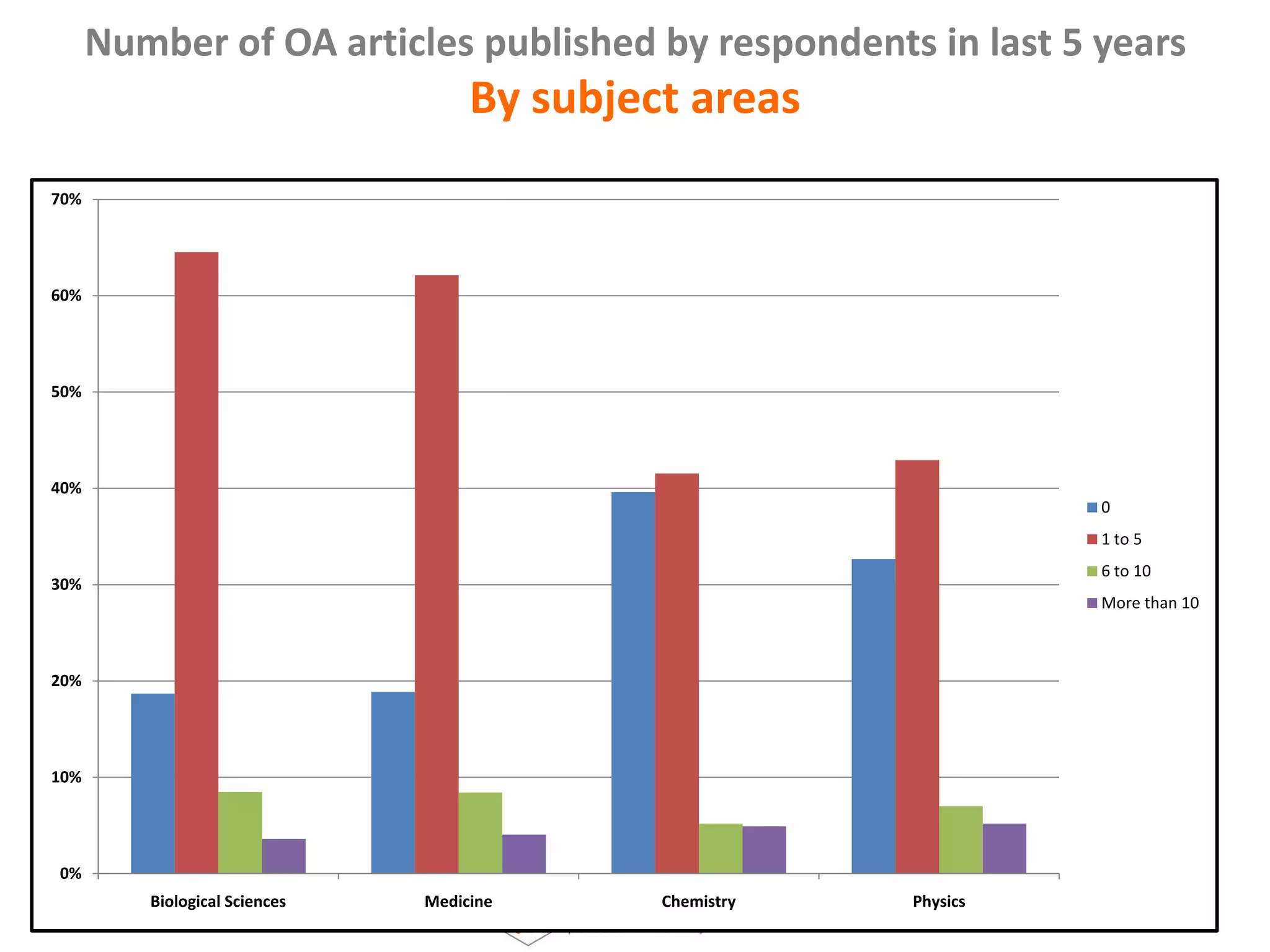
Number of OA articles published by respondents in last 5 yearsBy subject areas
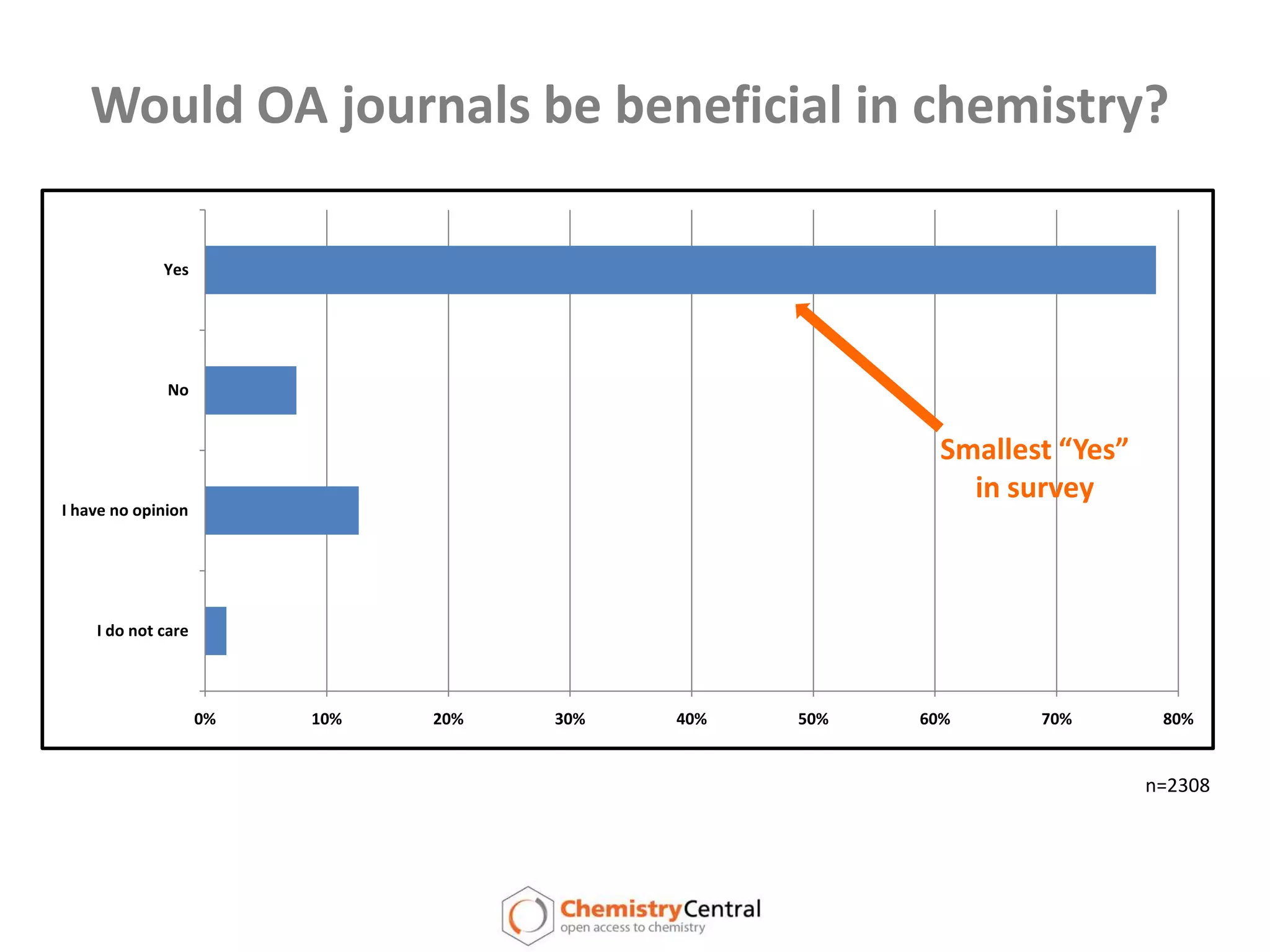
Would OA journals be beneficial in chemistry?Smallest “Yes”in surveyn=2308
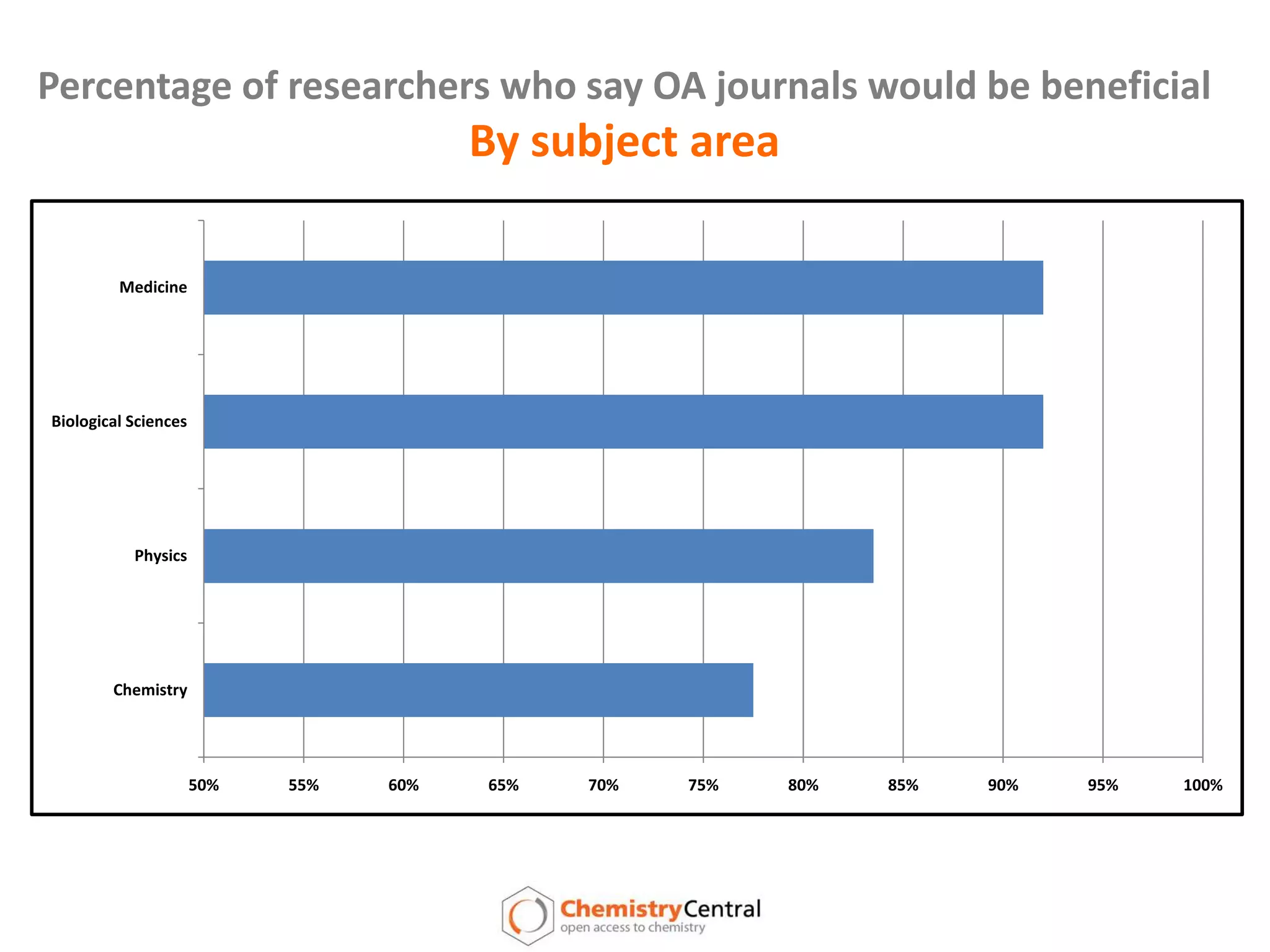
Percentage of researchers who say OA journals would be beneficialBy subject area
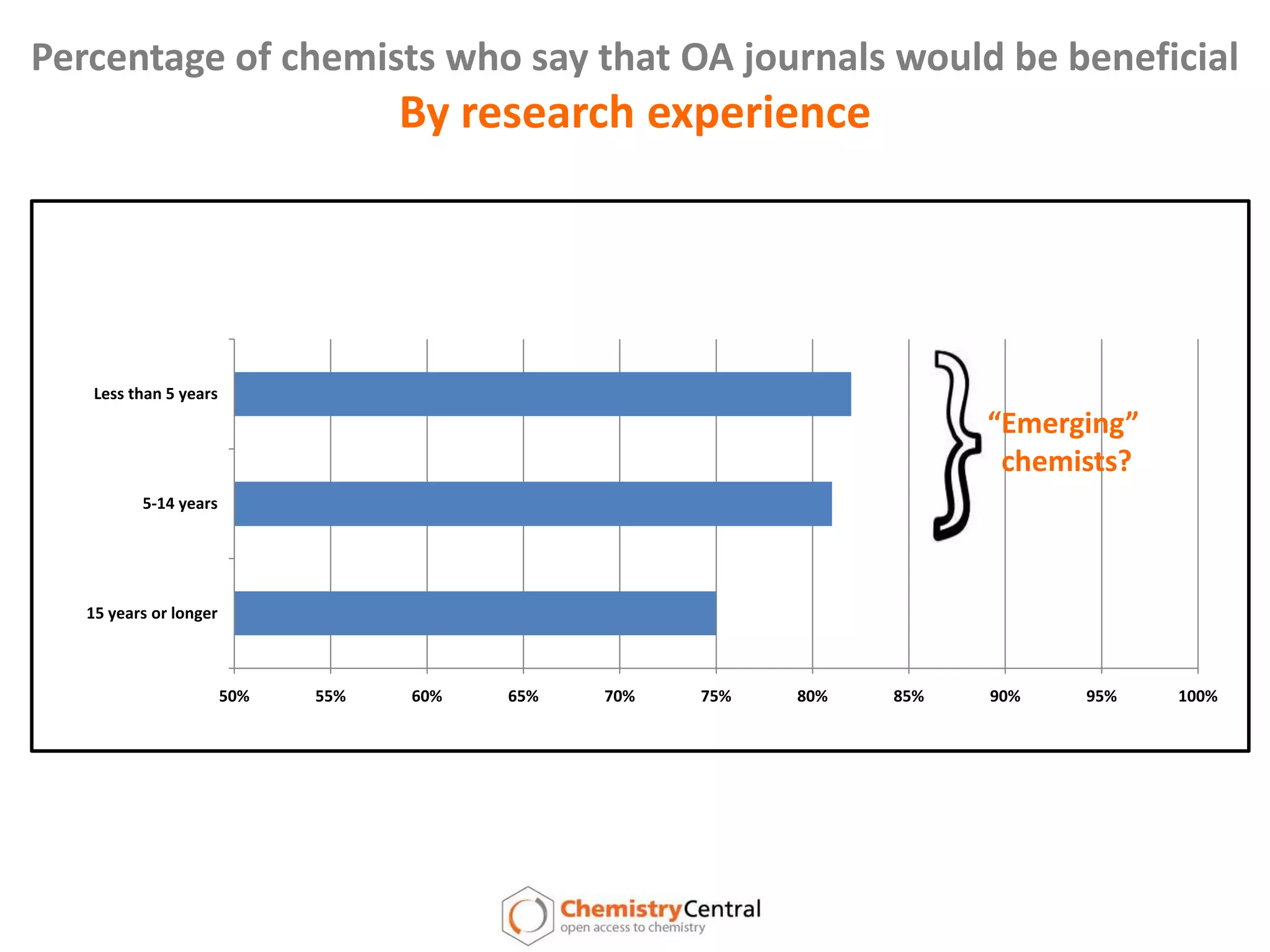
Percentage of chemists who say that OA journals would be beneficialBy research experience“Emerging” chemists?
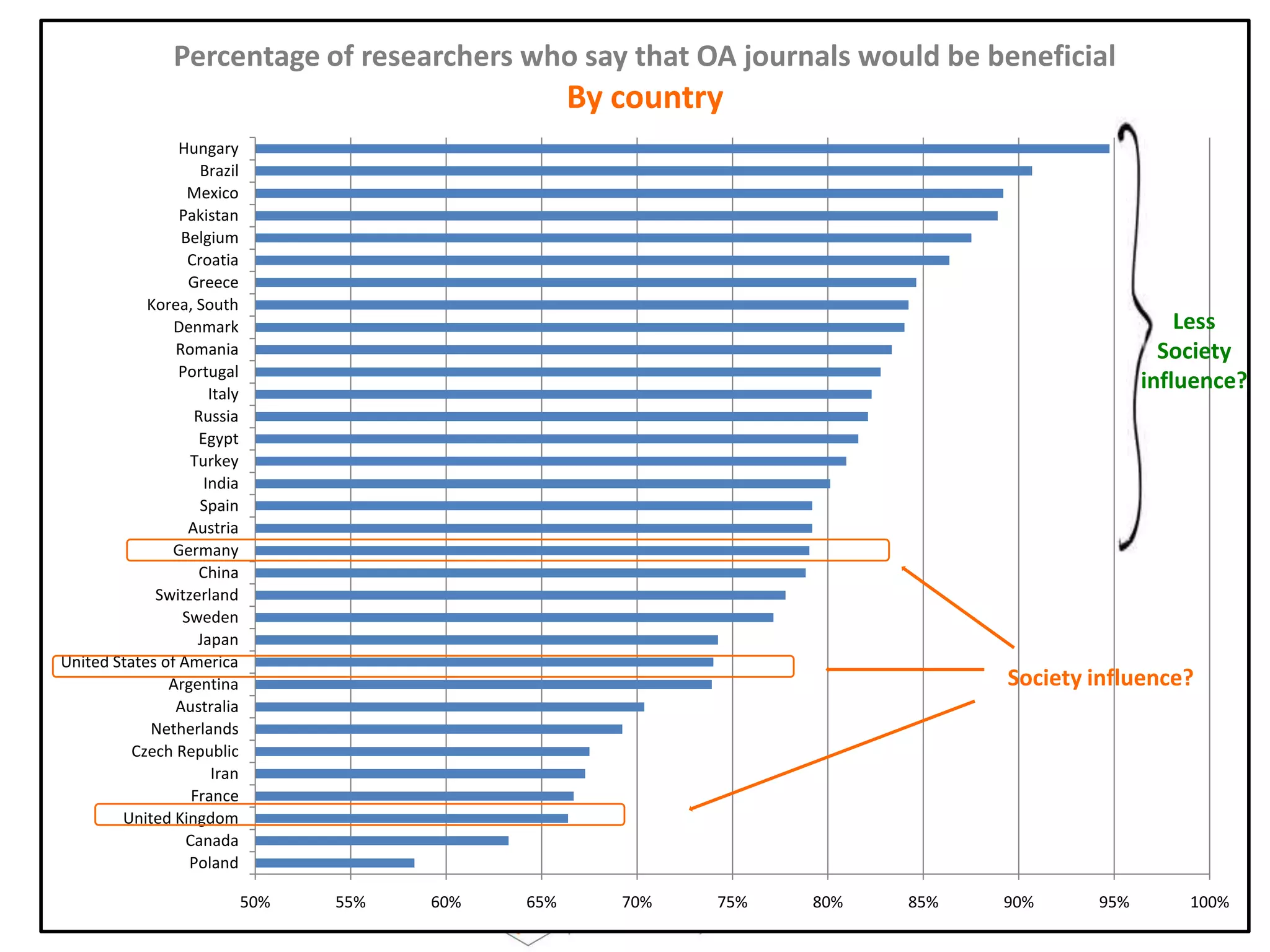
LessSocietyinfluence?
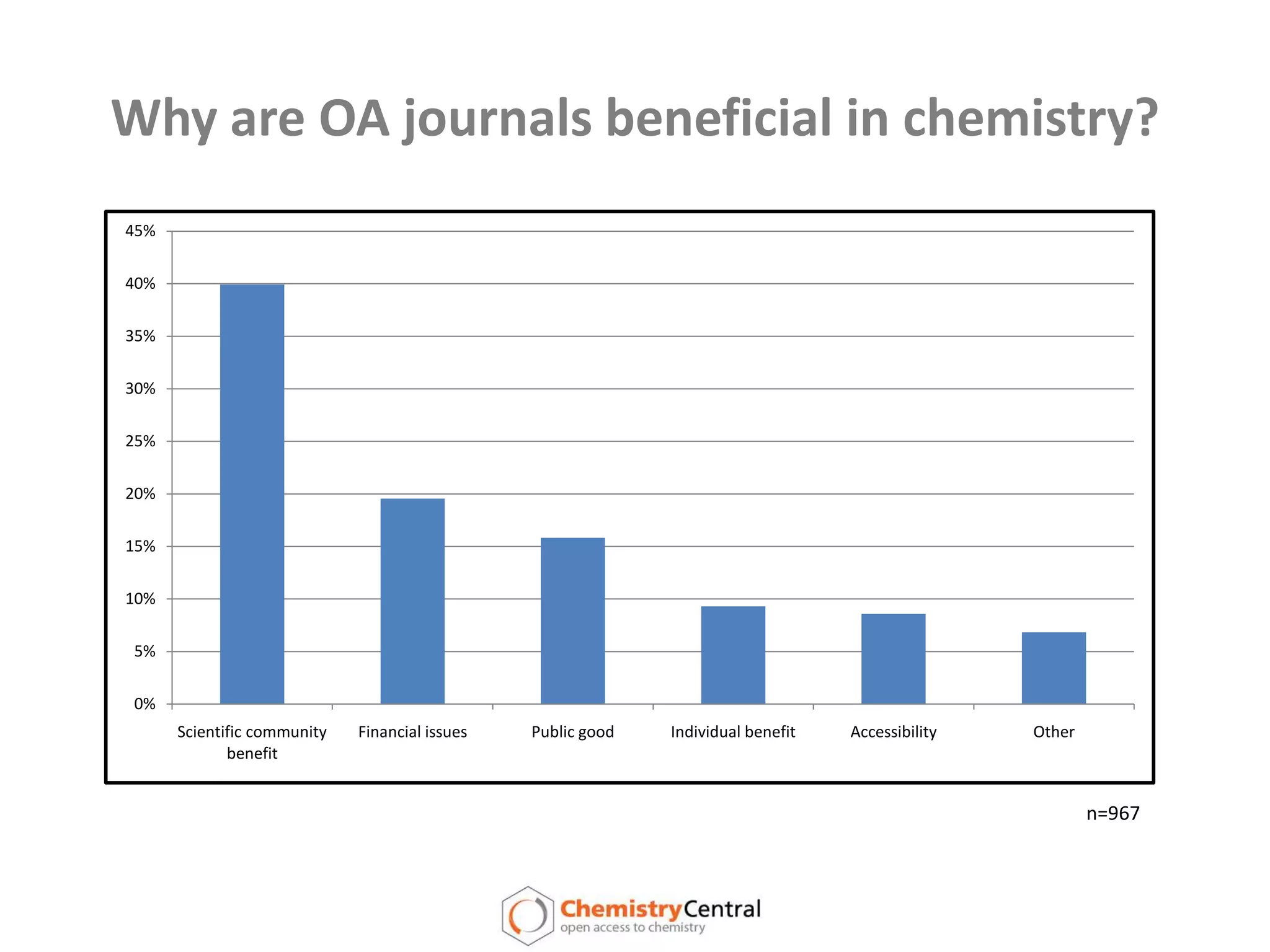
Why are OA journals beneficial in chemistry?n=967
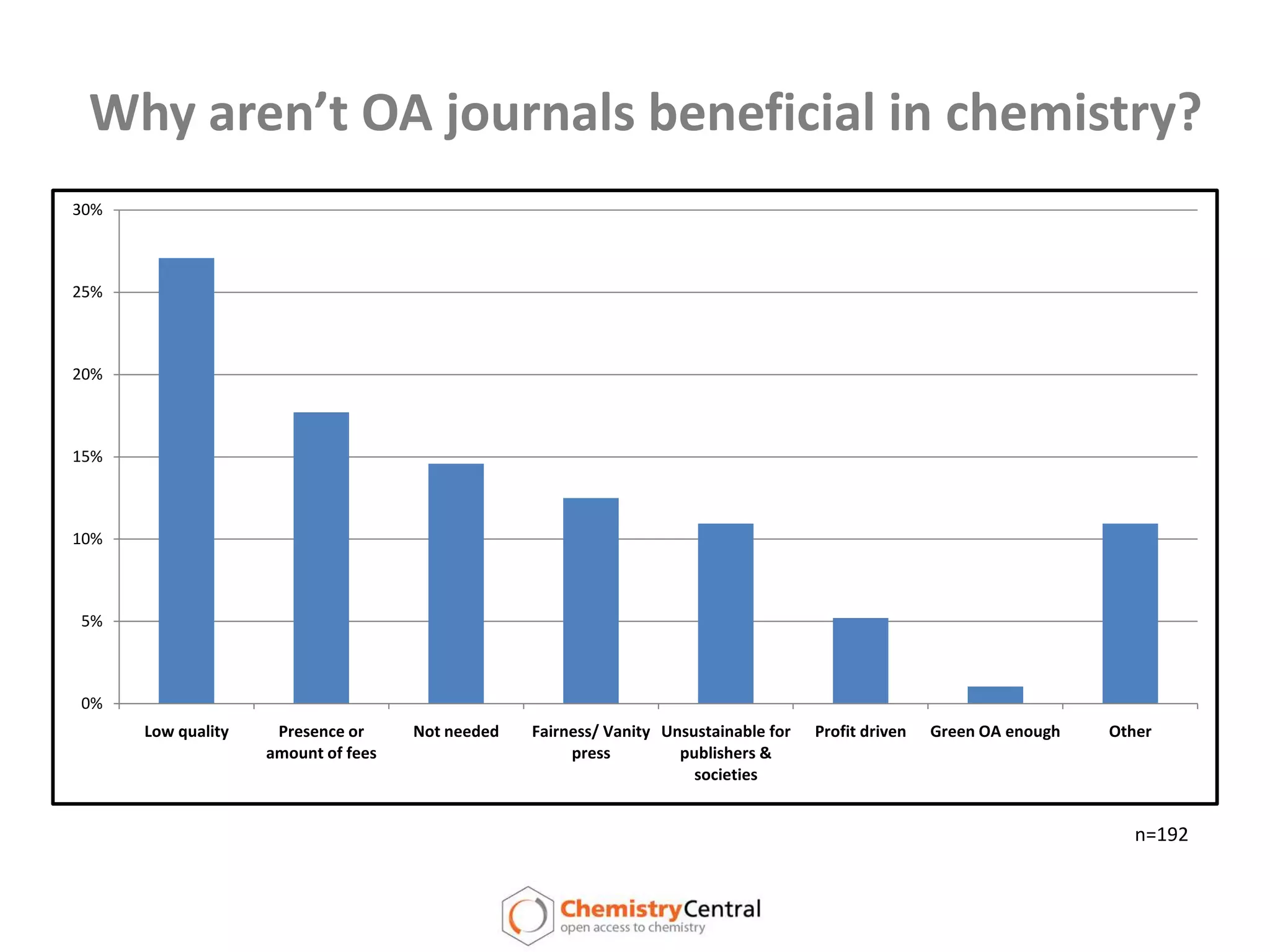
Why aren’t OA journals beneficial in chemistry?n=192
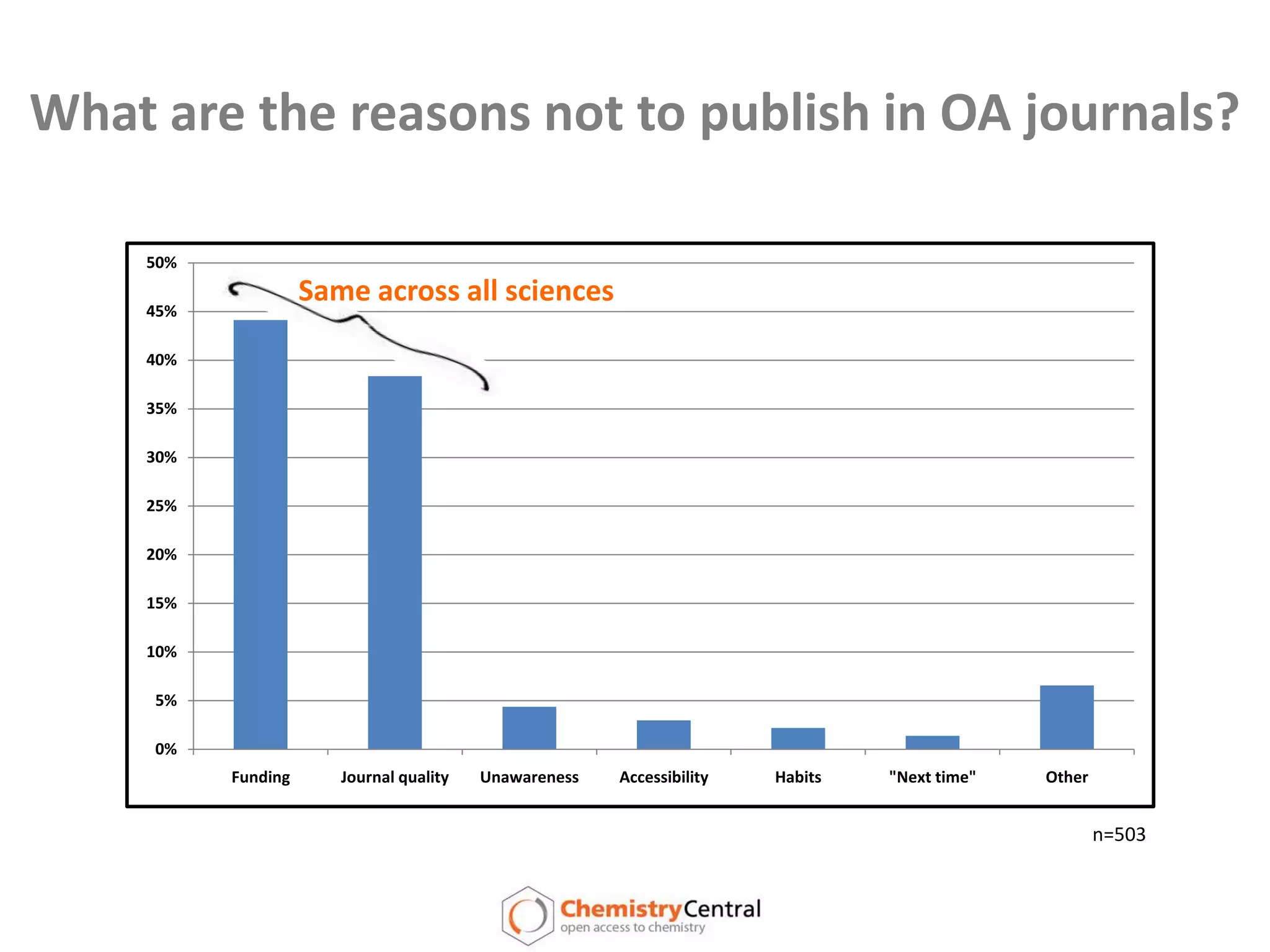
What are the reasons not to publish in OA journals?Same across all sciencesn=503
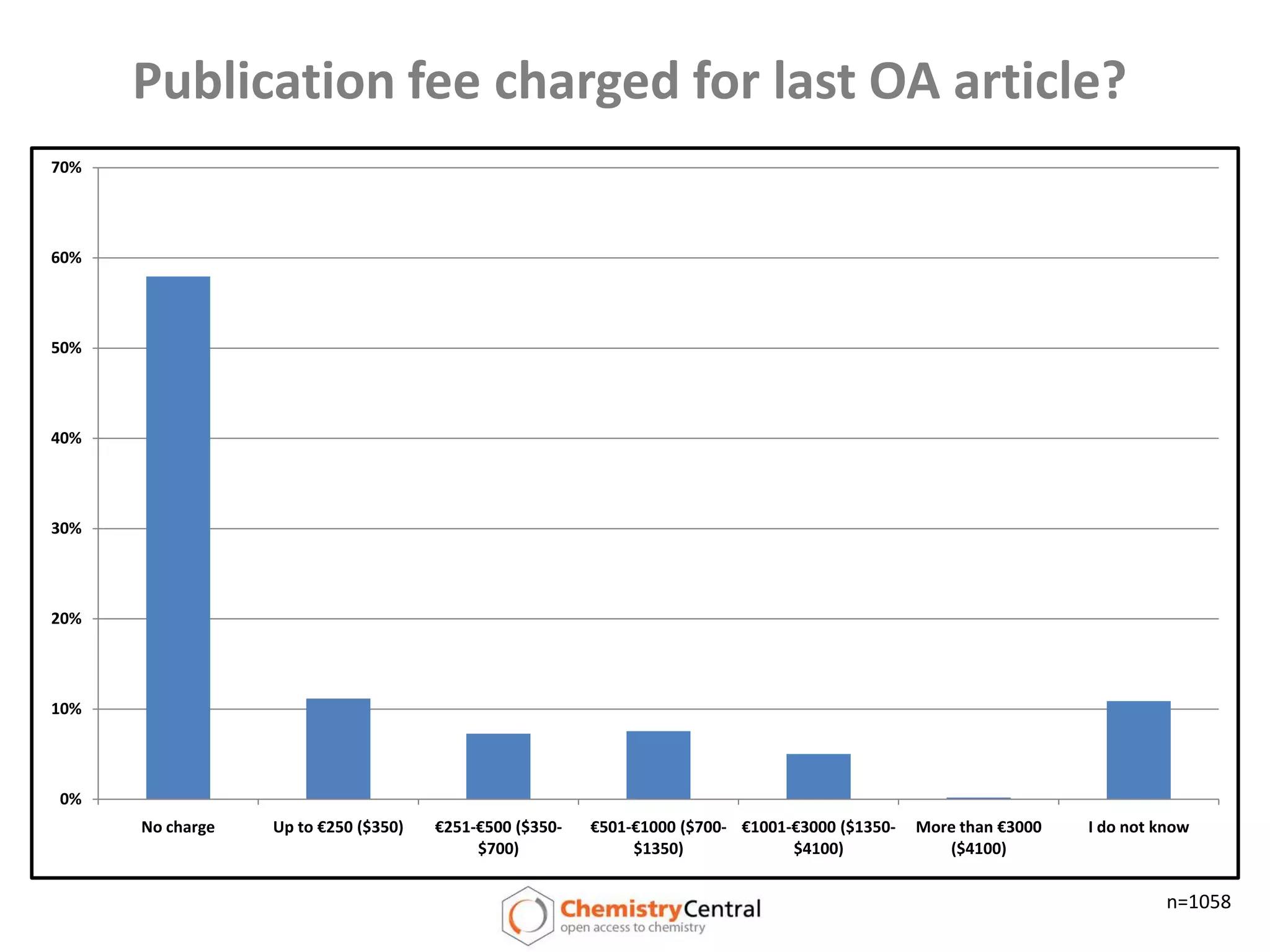
Publication fee charged for last OA article?n=1058
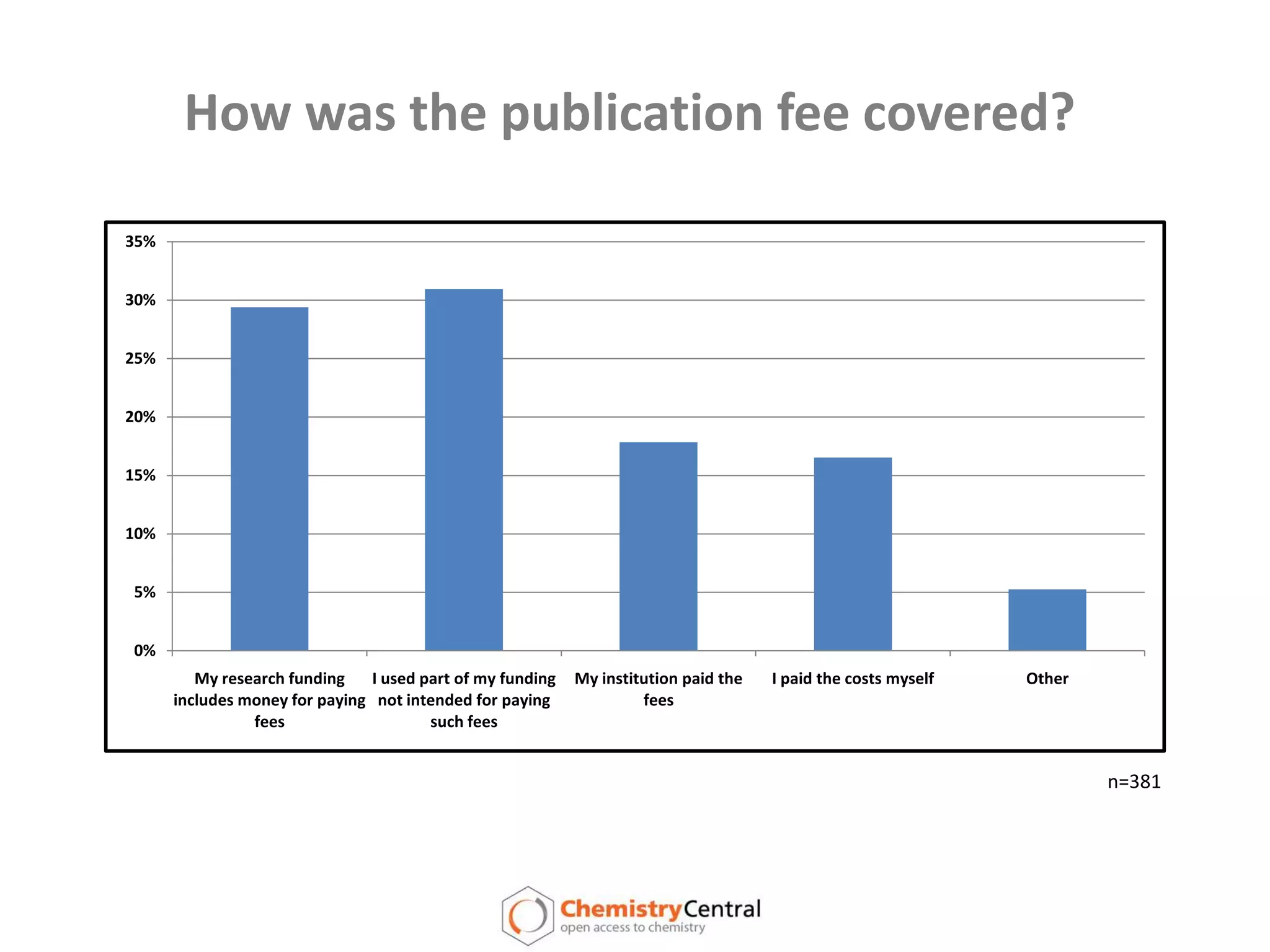
How was the publication fee covered?n=381
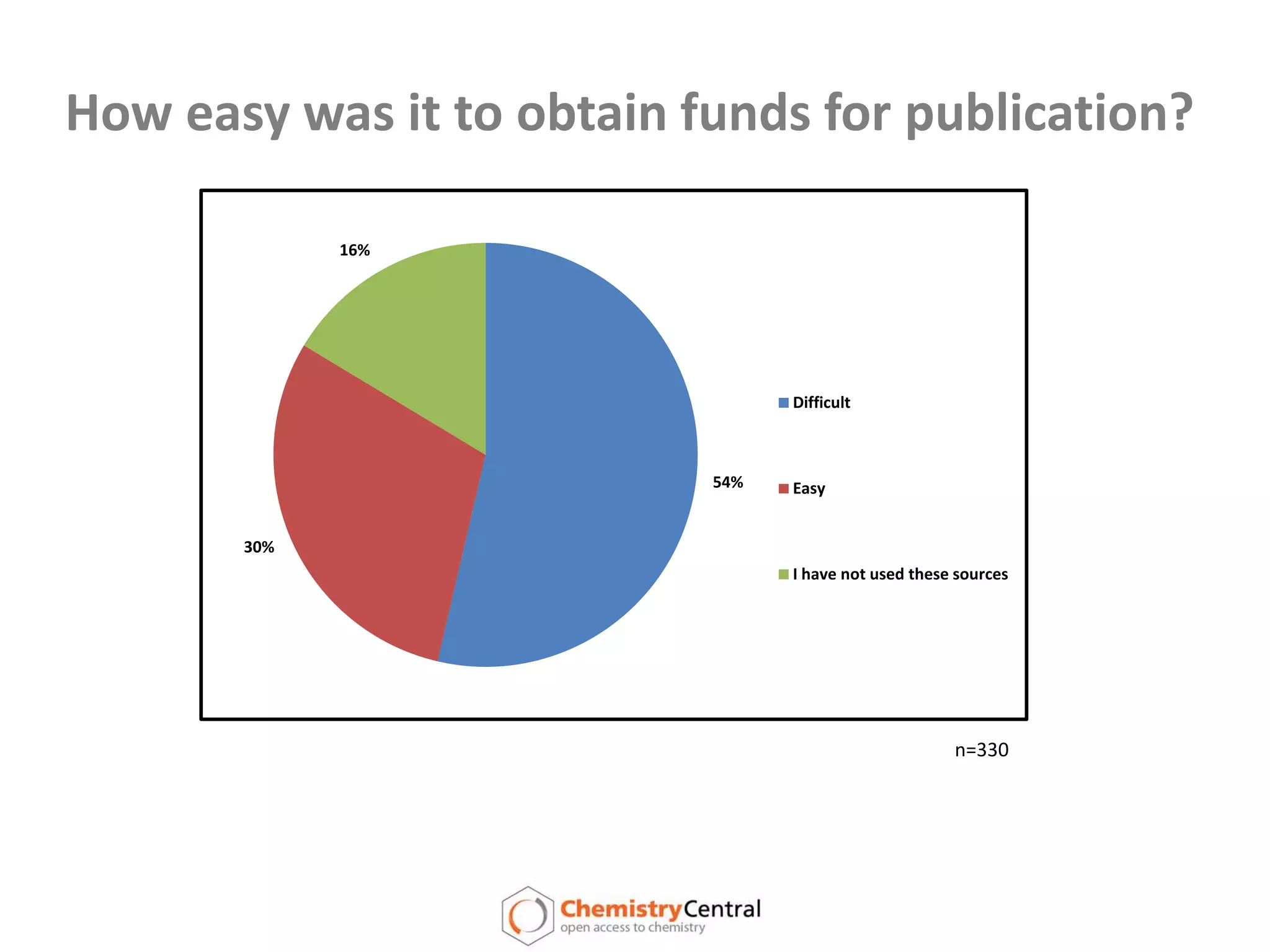
How easy was it to obtain funds for publication?n=330
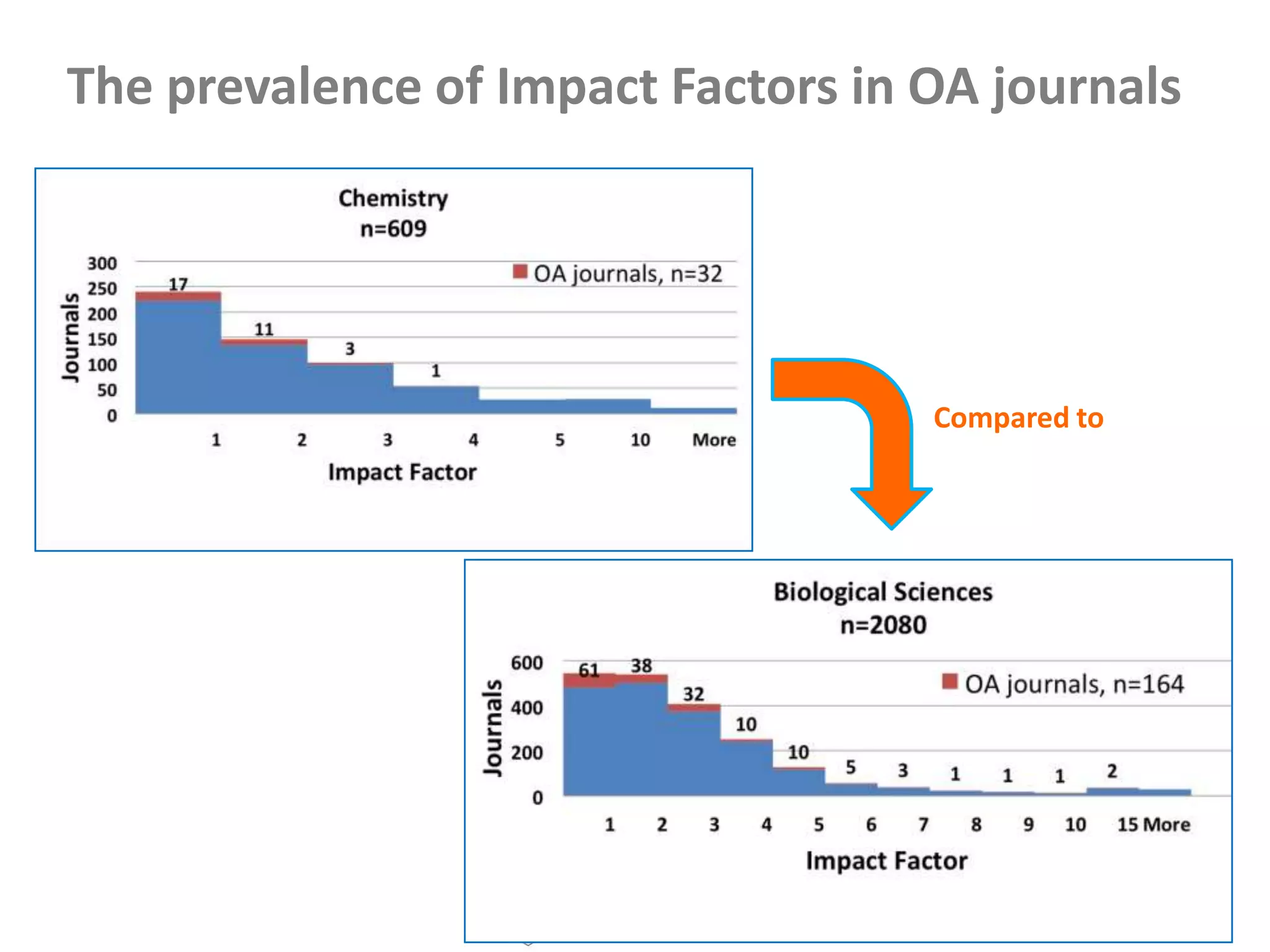
The prevalence of Impact Factors in OA journalsCompared to
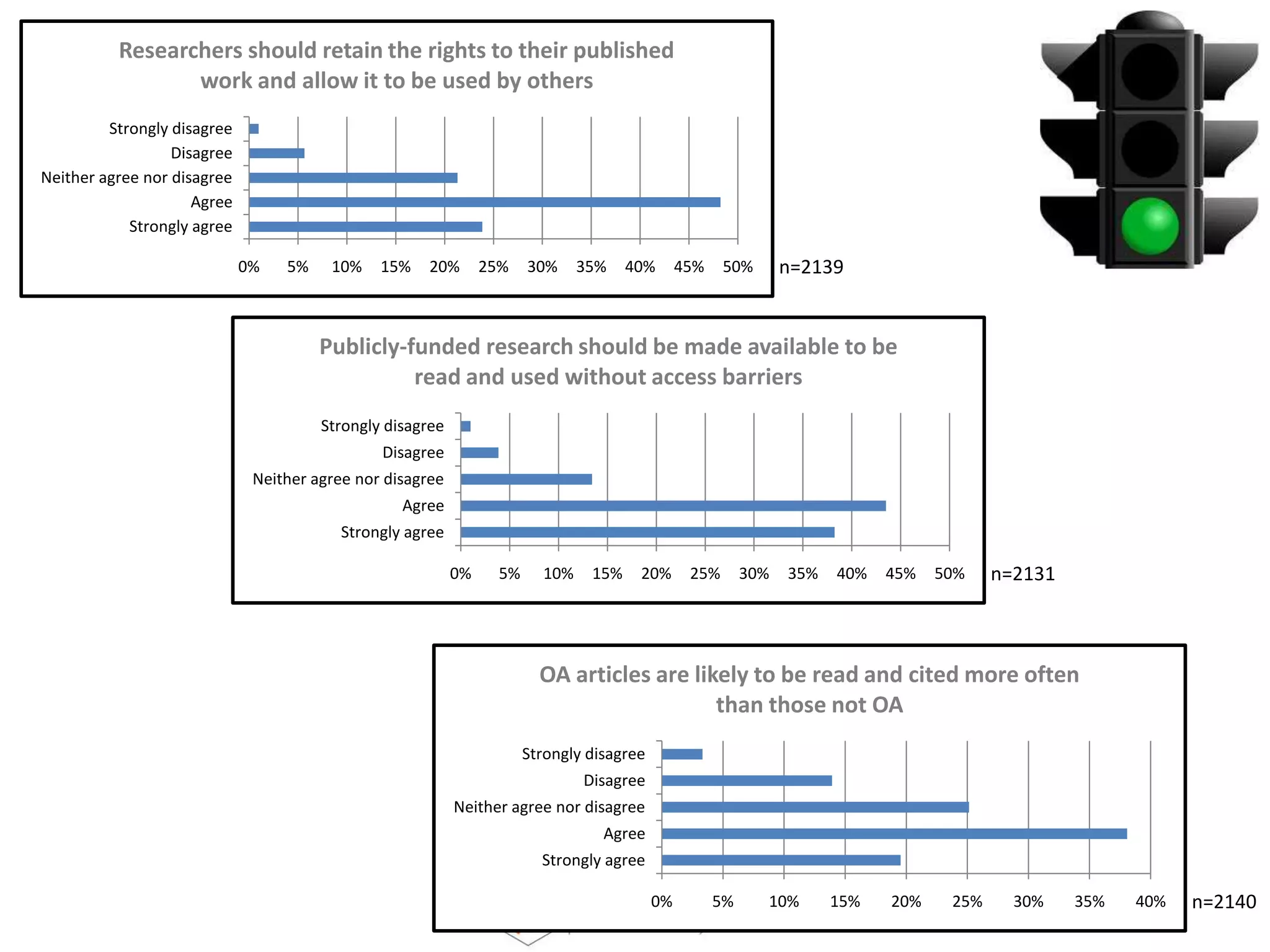
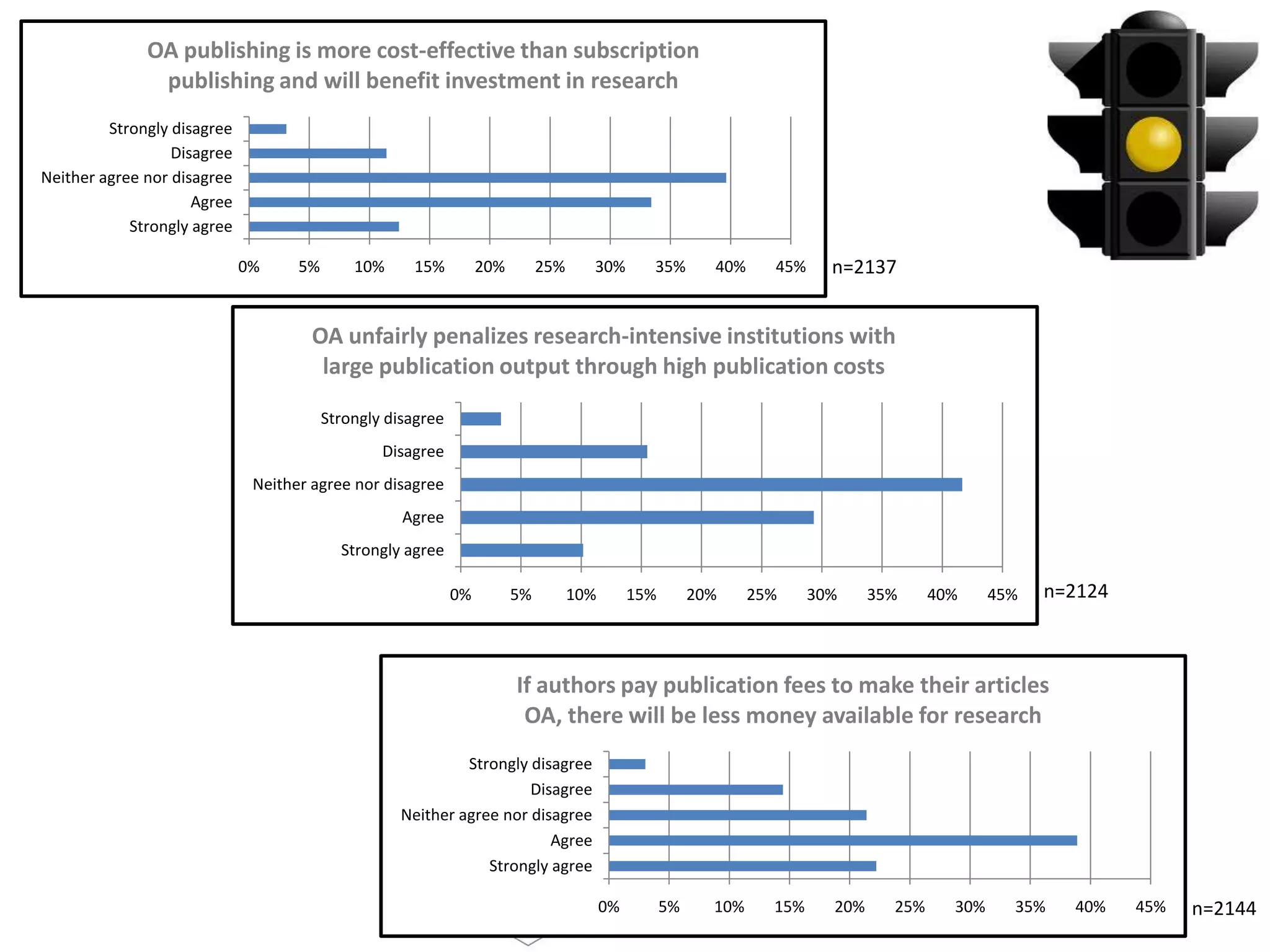
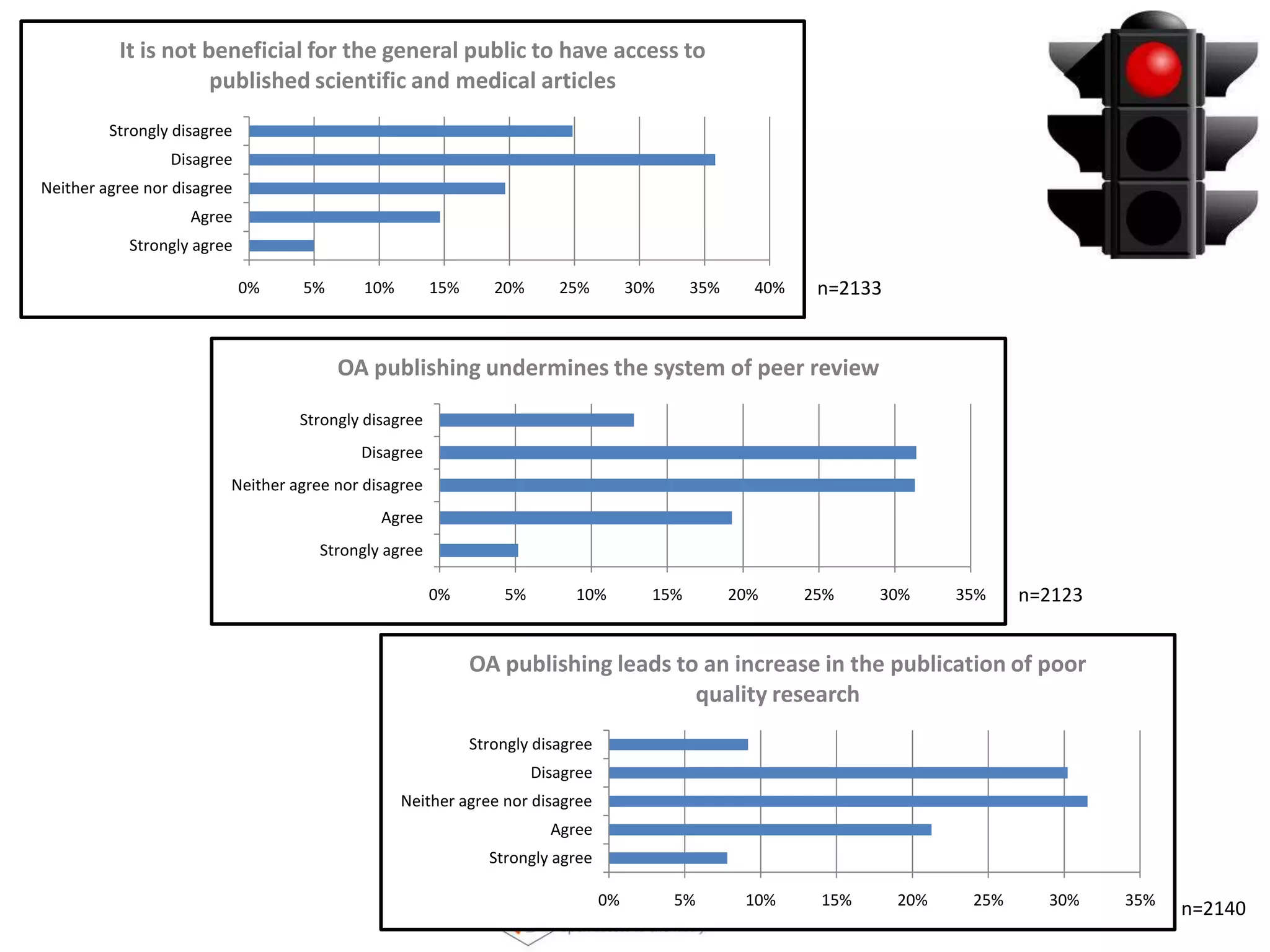
Finally, responses from chemists on positive, neutral and negative statements about open access
n=2139n=2131n=2140
n=2137n=2124n=2144
n=2133n=2123n=2140
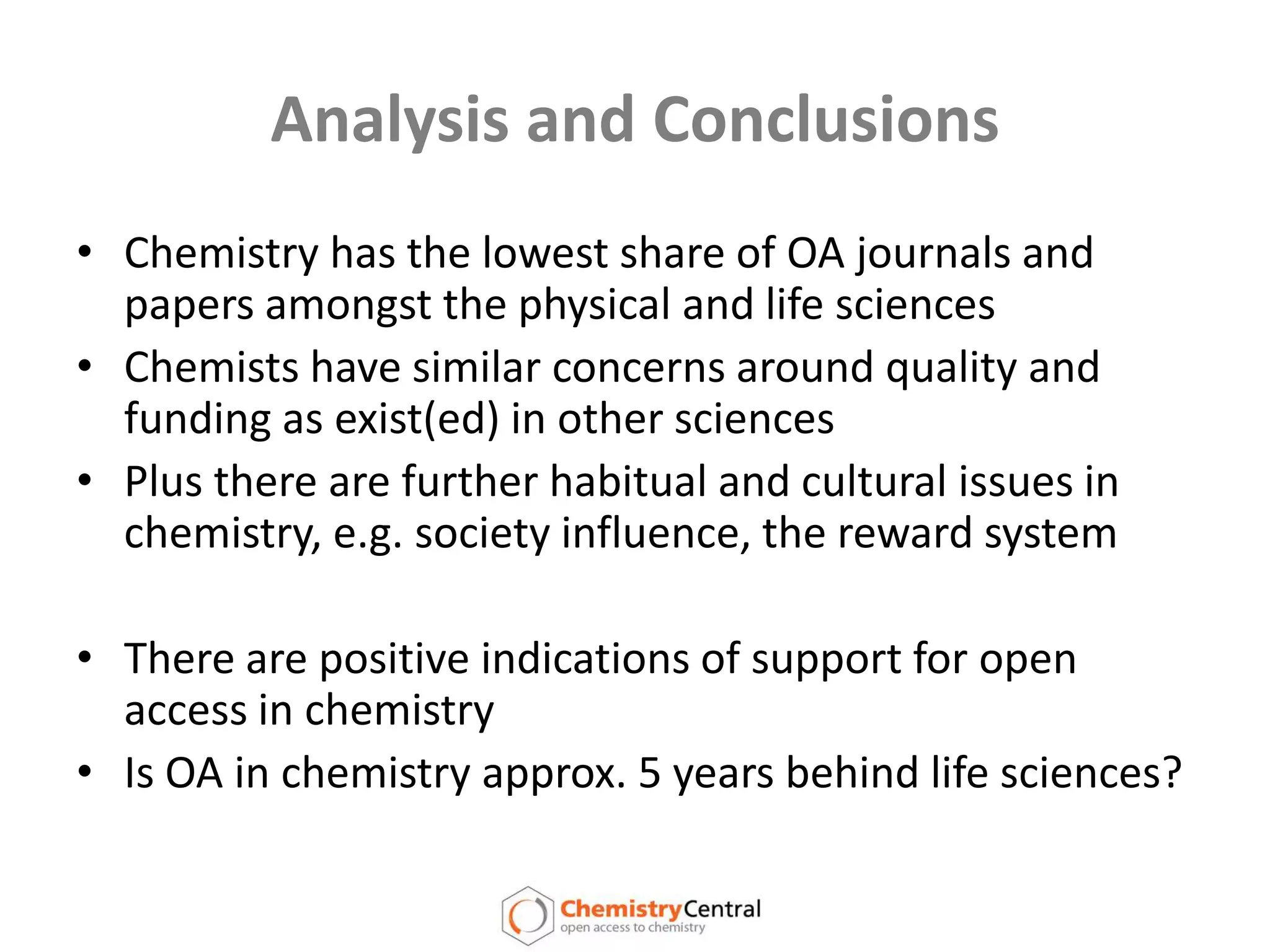
Analysis and ConclusionsChemistry has the lowest share of OA journals and papers amongst the physical and life sciencesChemists have similar concerns around quality and funding as exist(ed) in other sciencesPlus there are further habitual and cultural issues in chemistry, e.g. society influence, the reward systemThere are positive indications of support for open access in chemistryIs OA in chemistry approx. 5 years behind life sciences?
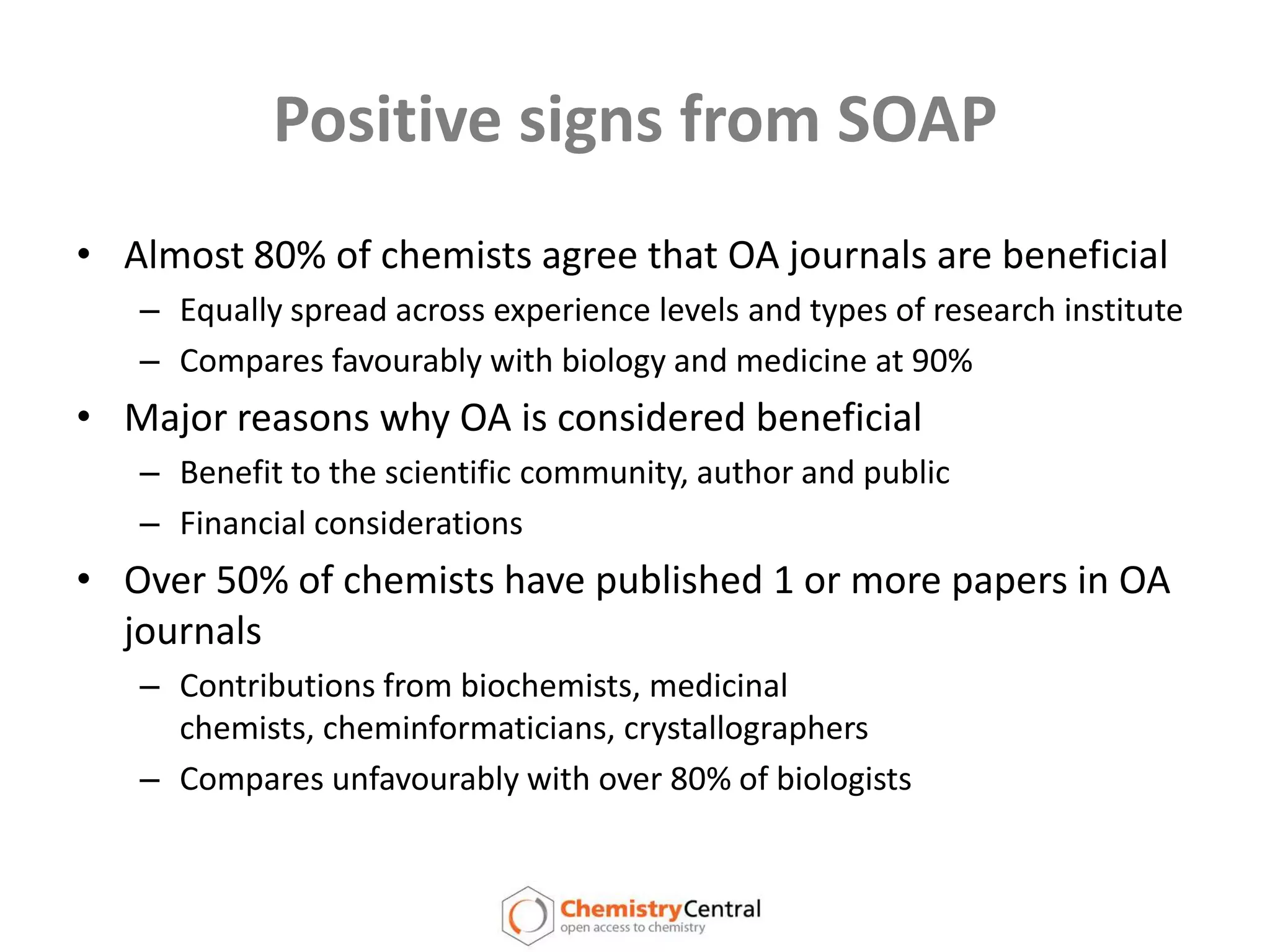
Positive signs from SOAPAlmost 80% of chemists agree that OA journals are beneficial Equally spread across experience levels and types of research instituteCompares favourably with biology and medicine at 90%Major reasons why OA is considered beneficialBenefit to the scientific community, author and publicFinancial considerationsOver 50% of chemists have published 1 or more papers in OA journalsContributions from biochemists, medicinal chemists, cheminformaticians, crystallographersCompares unfavourably with over 80% of biologists
The obstaclesMajor reasons for not publishing in OA journals for chemists:Lack of funding , presence of publication fees (44%)Perception of journal quality (38%)Publication fee charged:Almost 60% were not chargedFor remainder: fee included in research funds (30%) or unassigned research funds used (30%)Over 50% of chemists state it is difficult to obtain fundsFewer than 50% of chemists in universities and research institutes are likely to publish in OA journals
Changes for OA to grow in chemistryChange in habits, culture and the conservatism amongst chemistsSatisfaction with current model – no appetite for changeSupport for university/research institute OA mandatesAttitudes of societies, influence of society publishing with commercial interests and proven journal business modelsPerceptions of journal prestige, and influence of impact factors, citation advantage, etc.The “reward system” is coupled to the communication system by relying on IFs and citations, making chemists risk-averse in trying new modelsAvailability and provision of publication fundsFrom funding bodies and universities/research institutes OA Mandates from funding agencies and universities/research institutes
Factors to accelerate progressAdvocacy amongst key opinion leaders in chemistryOA chemistry journals obtaining Impact FactorsTransfer of high quality journals to OA modelMore chemists supporting open initiatives and technologiesIn outliers e.g. cheminformatics, crystallographyEmbracing mainstream chemistryThe growth of the “Open” movement: Open data, open source, open access, open notebooks
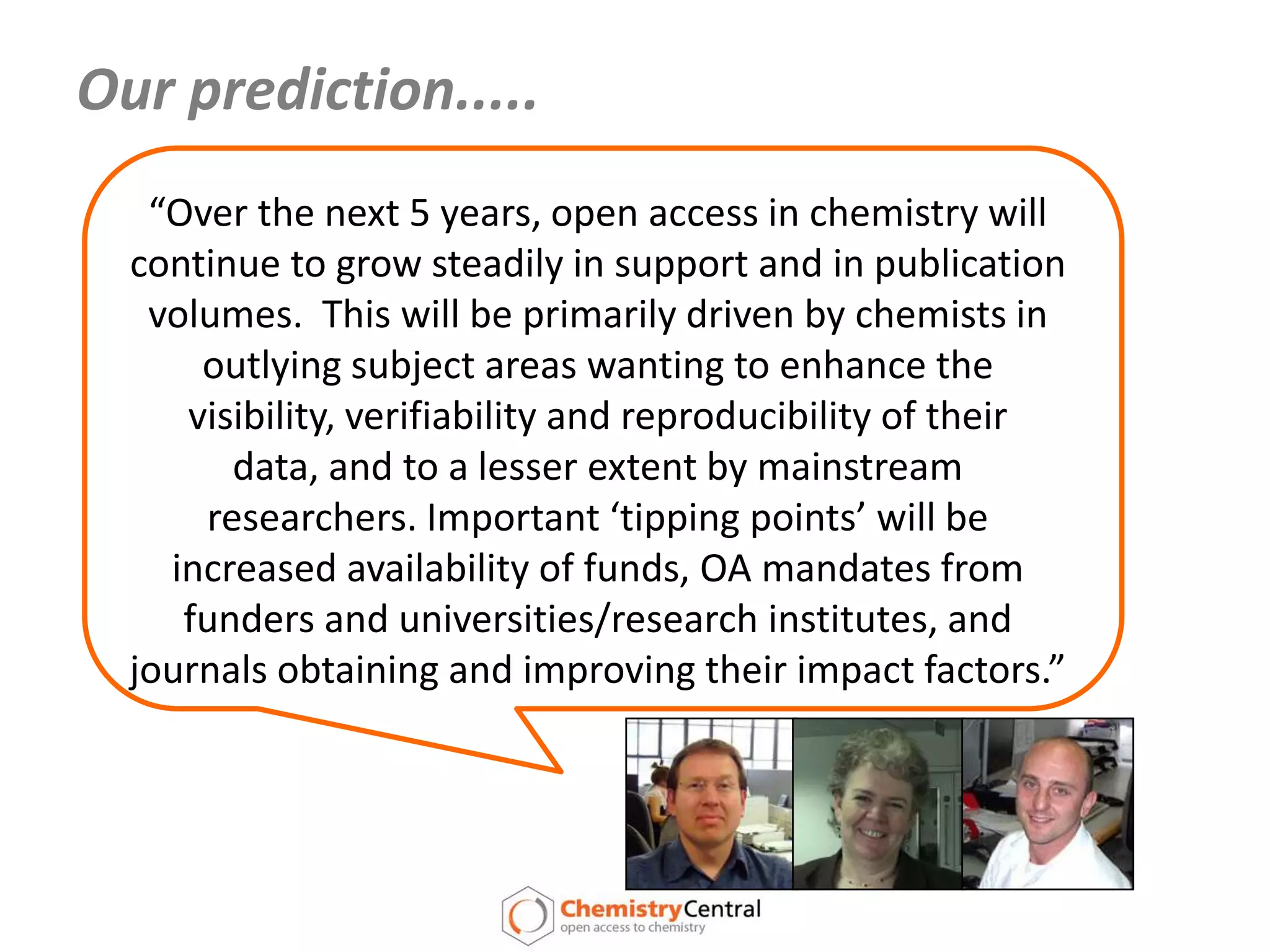
Our prediction.....“Over the next 5 years, open access in chemistry will continue to grow steadily in support and in publication volumes.  This will be primarily driven by chemists in outlying subject areas wanting to enhance the visibility, verifiability and reproducibility of their data, and to a lesser extent by mainstream researchers. Important ‘tipping points’ will be increased availability of funds, OA mandates from funders and universities/research institutes, and journals obtaining and improving their impact factors.”
Thank you for your attentionJan Kurasjan.kuras@chemistrycentral.comwww.chemistrycentral.comwww.chemistrycentral.com/blogtwitter @Chem_Central...come talk to me...

Open access in chemistry: from ACS Spring Meeting 2011

  • 1.
    Open access inchemistry:information wants to be free?Jan Kuras, Deborah Kahn, Bryan VickeryChemistry CentralLondon, UKAmerican Chemical Society National Meeting, March 27-31, 2011Technical session: Internet and Chemistry
  • 2.
    Information wants tobe free? Free of access restrictions? Free of charge? Free of standards and organization?
  • 3.
    Objective:“An honest andphilosophical assessment of open access in chemistry”A good time to review...20 years of more widespread interest in OA...Over 10 years since BioMed Central, PubMed Central, PLoS started...(10 years since Internet Journal of Chemistry launched...)About 5 years since PubChem, Chemistry Central, ChemSpider, eMolecules started...A major Study of Open Access Publishing (SOAP) undertaken in 2010 No scientific concepts were harmed in the making of this presentation
  • 4.
    What Open AccessisFree & permanent unrestricted online accessAuthors retain copyrightData can be redistributed and reused freelyWhat Open Access isn’tSelf publishing
  • 5.
    A means tobypass peer reviewWhat motivated open access?Serials crisis: rising subscription prices, decreasing library budgetsOnline publishing opportunities & technologies, and subsequent data linking, integration, reuse and miningThe “Open” movement: open data, open source, open standards, open accessUnrestricted access to publicly funded research to maximize impact
  • 6.
    Significant timelines inthe open access movement 1991-2011PubChemOASPASPARCeMoleculesChemistryinitiativesBethesdaStatementChemSpiderOpenArchives InitiativeBudapestInitiativeChemistryCentralChEMBLarXiv20102004200219982000200820061991NCBI/GenBankBerlin DeclarationBioMedCentralPLoSPubMedNIH OA mandateWellcome OA mandateICSAUS Federal ResearchPublic Access ActPubMedCentralBiomedicineinitiatives
  • 7.
    Chemistry publishing: currentpositionNumber of chemistry journals? Well, CAS indexes over 1,500 core journalsNo chemistry-specific server for peer-reviewed papers cf. PubMed CentralNo pre-print culture cf. arXiv for physicsNo funder mandates such as Wellcome Trust, NIHUniversity/Research institute mandates frequently not implemented by chemists
  • 8.
    Open access inchemistry: current positionDirectory of Open Access Journals: approx. 130 chemistry journals (amongst approx. 6,000 total OA journals)Publishers include: Chemistry Central; Beilstein; Hindawi; Bentham; MDPILots of Society, University and Independent journalsIUCr Acta Crystallographica Section E: Structure Reports OnlineBusiness model: article-processing charge (APC)Either passed on to author or covered by publisherMajor publishers allow authors to make papers OA through additional paymentACS; RSC; Wiley-Blackwell; Springer ; Elsevier Some publishers allow self-archivingRSC; Elsevier; Springer; Nature
  • 9.
  • 10.
    Recent studies &reports on OAThe value of new scientific communication models for chemistry (Velden, Lagoze: 2009)Open access to the scientific journal literature: situation 2009 (Björk et al: 2010)Study of Open Access Publishing (SOAP 2010)
  • 11.
    Open Access tothe Scientific Journal Literature: Situation 2009OA prevalence on an article basis accessible through Google searchRandom sample of 1,837 science journalsSources: Web of Science; Scopus; DOAJ, Ulrich’s Periodicals Directory9.7% Chemistry journalsStudy year was 2008; time of study was Sept-Oct 2009 to ensure capture of “embargoed” and delayed OA articlesOverall, 20.4% papers were freely available 8.5% in OA journals (“Gold”); 11.9% in repositories (“Green”)At 13%, chemistry has the lowest share of OA papers5.5% in OA journals (“Gold”); 7.4% in repositories (“Green”)Earth sciences (33%); Physics (23.5%); Medicine (22%); Biological sciences (19%)
  • 12.
    Value of newscientific communication models for chemistryFailure of new communication models in chemistryCompare GenBank, PubMed Central, arXivBarriers not technical: chemists embracing open initiatives & technologiesCML, InChI, open source tools, open notebook science, OA journals and repositoriesIssue of latency: delayed in comparison with other disciplines?Complex socio-technical issues: IP and secrecy about research details?Influence of societies and society publishing with commercial interests and proven journal business modelsInfluence of journal prestige, impact factors, citation advantage, etc.The “reward system” is coupled to the communication system by relying on IFs and citations, which makes chemists risk-averse in trying new models
  • 13.
    Study of OpenAccess Publishing (SOAP)Multidisciplinary study including physical, life and social sciences, financed by the European CommissionCoordinated by CERN with Springer, SAGE & BioMed Central; Max Planck Digital Library; and UK Science & Technology Facilities CouncilTo “describe and compare the offering and demand for open access publishing in peer-reviewed journals”Assessment by large scale multidiscipline international surveyReached over 1.5 million recipients with over 54,000 respondents42,000 Responses analyzed, including over 2,300 chemistsCaveat: “self-selection” bias in favour of scientists with an interest in OA
  • 14.
  • 15.
    Number of OAarticles published by respondents in last 5 yearsBy subject areas
  • 16.
    Would OA journalsbe beneficial in chemistry?Smallest “Yes”in surveyn=2308
  • 17.
    Percentage of researcherswho say OA journals would be beneficialBy subject area
  • 18.
    Percentage of chemistswho say that OA journals would be beneficialBy research experience“Emerging” chemists?
  • 19.
  • 20.
    Why are OAjournals beneficial in chemistry?n=967
  • 21.
    Why aren’t OAjournals beneficial in chemistry?n=192
  • 22.
    What are thereasons not to publish in OA journals?Same across all sciencesn=503
  • 23.
    Publication fee chargedfor last OA article?n=1058
  • 24.
    How was thepublication fee covered?n=381
  • 25.
    How easy wasit to obtain funds for publication?n=330
  • 26.
    The prevalence ofImpact Factors in OA journalsCompared to
  • 27.
    Finally, responses fromchemists on positive, neutral and negative statements about open access
  • 28.
  • 29.
  • 30.
  • 31.
    Analysis and ConclusionsChemistryhas the lowest share of OA journals and papers amongst the physical and life sciencesChemists have similar concerns around quality and funding as exist(ed) in other sciencesPlus there are further habitual and cultural issues in chemistry, e.g. society influence, the reward systemThere are positive indications of support for open access in chemistryIs OA in chemistry approx. 5 years behind life sciences?
  • 32.
    Positive signs fromSOAPAlmost 80% of chemists agree that OA journals are beneficial Equally spread across experience levels and types of research instituteCompares favourably with biology and medicine at 90%Major reasons why OA is considered beneficialBenefit to the scientific community, author and publicFinancial considerationsOver 50% of chemists have published 1 or more papers in OA journalsContributions from biochemists, medicinal chemists, cheminformaticians, crystallographersCompares unfavourably with over 80% of biologists
  • 33.
    The obstaclesMajor reasonsfor not publishing in OA journals for chemists:Lack of funding , presence of publication fees (44%)Perception of journal quality (38%)Publication fee charged:Almost 60% were not chargedFor remainder: fee included in research funds (30%) or unassigned research funds used (30%)Over 50% of chemists state it is difficult to obtain fundsFewer than 50% of chemists in universities and research institutes are likely to publish in OA journals
  • 34.
    Changes for OAto grow in chemistryChange in habits, culture and the conservatism amongst chemistsSatisfaction with current model – no appetite for changeSupport for university/research institute OA mandatesAttitudes of societies, influence of society publishing with commercial interests and proven journal business modelsPerceptions of journal prestige, and influence of impact factors, citation advantage, etc.The “reward system” is coupled to the communication system by relying on IFs and citations, making chemists risk-averse in trying new modelsAvailability and provision of publication fundsFrom funding bodies and universities/research institutes OA Mandates from funding agencies and universities/research institutes
  • 35.
    Factors to accelerateprogressAdvocacy amongst key opinion leaders in chemistryOA chemistry journals obtaining Impact FactorsTransfer of high quality journals to OA modelMore chemists supporting open initiatives and technologiesIn outliers e.g. cheminformatics, crystallographyEmbracing mainstream chemistryThe growth of the “Open” movement: Open data, open source, open access, open notebooks
  • 36.
    Our prediction.....“Over thenext 5 years, open access in chemistry will continue to grow steadily in support and in publication volumes. This will be primarily driven by chemists in outlying subject areas wanting to enhance the visibility, verifiability and reproducibility of their data, and to a lesser extent by mainstream researchers. Important ‘tipping points’ will be increased availability of funds, OA mandates from funders and universities/research institutes, and journals obtaining and improving their impact factors.”
  • 37.
    Thank you foryour attentionJan Kurasjan.kuras@chemistrycentral.comwww.chemistrycentral.comwww.chemistrycentral.com/blogtwitter @Chem_Central...come talk to me...