OPEN ACCESS 101
Michaela Voigt | openaccess@ub.tu-berlin.de
University Library of TU Berlin | Workshop at IPODI Office on June 15th 2015
If not indicated otherwise content is licensed under CC BY 4.0
Creative Commons Attribution 4.0 International | https://creativecommons.org/licenses/by/4.0
Copyright, Open Access & free licensing
Agenda
I. German Copyright: Core principles
II. Open Access: Basics
a. Green Road
b. Golden Road
III. Creative Commons licenses
Open Access 101 | Michaela Voigt | Workshop at IPODI Office on June 15th 2015
Page 2
GERMAN COPYRIGHT: CORE
PRINCIPLES
Page 3
Copyright protection
Page 4
• Author = creator of a work
• Supervisors of theses, student papers etc. are not considered to be creators
• Only natural persons (creators) can claim full copyright
• vs. rights holder: natural or legal person
WHO
• Protection of original works
• Ideas, concepts etc. are not protectable
• Work = intellectually created by a natural person (§ 2 UrhG)  a.o.t
• Literary works
• Photographic works
• Cinematographic works
WHAT
• Protected by law
• No further registration necessary (in contrast to patents, trademarks, logos etc.)
• Copyright term: 70 years after the creator‘s death
HOW
Open Access 101 | Michaela Voigt | Workshop at IPODI Office on June 15th 2015
Authors‘ Rights
• Right of first publication
• Recognition of authorship
• Right prohibit distortions of the work
Moral rights
(§§ 12–14)
• Reproduction
• Distribution
• Making available to the public
• Performance, presentation
• …
Exploitation
rights
(§§ 15–24)
Page 5
Open Access 101 | Michaela Voigt | Workshop at IPODI Office on June 15th 2015
Transfer of rights
Page 6
• Rights of use can be transfered (§ 31 UrhG)
• … for each type of use individually
• … limited in time (e.g. timespan of 5 years)
• … geographically limited (e.g. distribution within Europe)
• … as exclusive or non-exclusive right
Exploitation
rights
• Rights holder can use the work exclusively
• Even creator has to obtain rights for further use(s)Exclusive
• Rights holder can use the work
• Creator can transfer non-exclusive rights to different
(natural or legal) persons
Non-
exclusive
Open Access 101 | Michaela Voigt | Workshop at IPODI Office on June 15th 2015
Publishing Agreements
 Creator grants
 Non-exclusive / exclusive rights
 Rights to certain / all uses
 Freedom of contract: contract partners negotiate terms
 NB: inalienable right to self-archiving (cf. § 38 (4) UrhG)
 Read your publication agreement and modify it if necessary!
 Cross out sections where transfer of exclusive rights is
demanded
 Retain rights with help of Author Addendum (SPARC Author's
Addendum recommended)
Open Access 101 | Michaela Voigt | Workshop at IPODI Office on June 15th 2015
Page 7
OPEN ACCESS: THE BASICS
Page 8
Open Access Declarations
Page 10
Open Access 101 | Michaela Voigt | Workshop at IPODI Office on June 15th 2015
Budapest
Open Access
Initiative:
Budapest
Declaration
Feb 2002
Bethesda
Statement on
Open Access
Publishing
June 2003
Berlin
Declaration
on Open
Access to
Knowledge in
the Sciences
and
Humanities
Oct 2003
Berlin Declaration
Open access contributions must satisfy two conditions:
1) The author(s) and right holder(s) of such contributions grant(s) to all users a free,
irrevocable, worldwide, right of access to, and a license to copy, use, distribute,
transmit and display the work publicly and to make and distribute derivative works, in
any digital medium for any responsible purpose, subject to proper attribution of
authorship (community standards, will continue to provide the mechanism for
enforcement of proper attribution and responsible use of the published work, as they
do now), as well as the right to make small numbers of printed copies for their
personal use.
2) A complete version of the work and all supplemental materials, including a copy of the
permission as stated above, in an appropriate standard electronic format is deposited
(and thus published) in at least one online repository using suitable technical
standards (such as the Open Archive definitions) that is supported and maintained by
an academic institution, scholarly society, government agency, or other well-
established organization that seeks to enable open access, unrestricted distribution,
inter operability, and long-term archiving.
Page 11
Open Access 101 | Michaela Voigt | Workshop at IPODI Office on June 15th 2015
Berlin Declaration
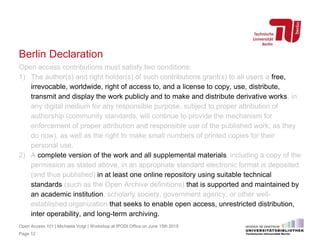
Open access contributions must satisfy two conditions:
1) The author(s) and right holder(s) of such contributions grant(s) to all users a free,
irrevocable, worldwide, right of access to, and a license to copy, use, distribute,
transmit and display the work publicly and to make and distribute derivative works, in
any digital medium for any responsible purpose, subject to proper attribution of
authorship (community standards, will continue to provide the mechanism for
enforcement of proper attribution and responsible use of the published work, as they
do now), as well as the right to make small numbers of printed copies for their
personal use.
2) A complete version of the work and all supplemental materials, including a copy of the
permission as stated above, in an appropriate standard electronic format is deposited
(and thus published) in at least one online repository using suitable technical
standards (such as the Open Archive definitions) that is supported and maintained by
an academic institution, scholarly society, government agency, or other well-
established organization that seeks to enable open access, unrestricted distribution,
inter operability, and long-term archiving.
Page 12
Open Access 101 | Michaela Voigt | Workshop at IPODI Office on June 15th 2015
Benefits of Open Access
Increased
visibility and
citation
advantage
Free access
to publicly
financed
research
results
Authors
retain
exploitation
rights
Good
findability by
search
engines &
other
indexing
services
Promote
international
and inter-
disciplinary
cooperation
Promote
research
efficiency by
rapid
discussion of
research
results
Improved
supply of
information
& response
to serials
crisis
Page 13
Open Access 101 | Michaela Voigt | Workshop at IPODI Office on June 15th 2015
Roads to Open Access
Golden Road Green Road
Open Access 101 | Michaela Voigt | Workshop at IPODI Office on June 15th 2015
Page 14
Happiness Is Only Real When Shared, by Jose Roberto V Moraes, licensed
under CC BY 2.0
muhuhuhuhuh, by Alex4739924, licensed under CC BY-SA 3.0
OPEN ACCESS: GREEN ROAD
Page 15
Roads to Open Access: Green OA
In addition to
traditional Closed
Access publication
Deposit on
• Institutional repository
• Disciplinary repository
Usually no transfer
of further rights to
public
• Restricted re-use
Dependant on rights
holder‘s policy
• Embargo?
• Version?
Open Access 101 | Michaela Voigt | Workshop at IPODI Office on June 15th 2015
Page 16
The choice is yours…
(1) Insitutional repository
Page 17
 Text publications
Articles, book chapters
Conference contributions,
proceedings
Preprints, project reports
Theses
…
 Research Data
 Audio
 Images
 Software
 Video
 …
https://opus4.kobv.de/opus4-tuberlin
https://depositonce.tu-berlin.de/
Open Access 101 | Michaela Voigt | Workshop at IPODI Office on June 15th 2015
The choice is yours…
(2) Cross-institutional and/or disciplinary repository
Page 18
And many more
 Directory of Open Access Repositories (OpenDOAR) http://www.opendoar.org
 Registry of Open Access Repositories (ROAR) http://roar.eprints.org/
 Registry of Research Data Repositories (re3data) http://re3data.org/
Open Access 101 | Michaela Voigt | Workshop at IPODI Office on June 15th 2015
https://www.econstor.eu/
http://biorxiv.org/
http://www.ncbi.nlm.nih.gov/pubmed
http://figshare.com/
http://arxiv.org/
http://datadryad.org/
http://cogprints.org/
http://zenodo.org/
http://www.ssoar.info/
Consider your institutional repository!
Page 19
 Persistent Identifier (URN / DOI)
 Objects are retrievable via
 Library catalogue (e.g. TU Library,
KOBV, German National Library)
 Search engines (the usual suspects)
 Academic search engines (e.g. BASE,
Google Scholar)
 Services for authors
 Rights clearance service
 Depositing service
 Advise on free licenses
 PDF/A support
Open Access 101 | Michaela Voigt | Workshop at IPODI Office on June 15th 2015
Self-archiving
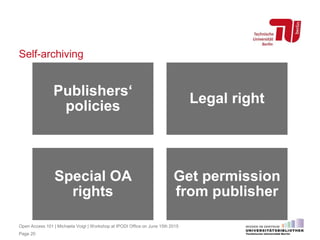
Publishers‘
policies
Legal right
Special OA
rights
Get permission
from publisher
Page 20
Open Access 101 | Michaela Voigt | Workshop at IPODI Office on June 15th 2015
Publishers‘ policies
Page 21
 Many publishers allow self-archiving
 Conditions can differ
 Preprint, postprint or publisher‘s PDF?
 Personal website, institutional repository, disciplinary repository?
 Embargo of 6, 12 oder 24 month?
Open Access 101 | Michaela Voigt | Workshop at IPODI Office on June 15th 2015
Publishers‘ policies II
Page 22
 General information,
not legally binding
 Database on journal
publishers‘ policies on
self-archiving
 Policies for
monographic works
have to be checked
separately
http://www.sherpa.ac.uk/romeo/
Open Access 101 | Michaela Voigt | Workshop at IPODI Office on June 15th 2015
Page 23
Authors may self-archive the author’s accepted
manuscript of their articles on their own websites.
Authors may also deposit this version of the article
in any repository, provided it is only made publicly
available 12 months after official publication or
later. He/ she may not use the publisher's
version (the final article), which is posted on
SpringerLink and other Springer websites, for the
purpose of self-archiving or deposit. Furthermore,
the author may only post his/her version provided
acknowledgement is given to the original source of
publication and a link is inserted to the published
article on Springer's website. The link must be
provided by inserting the DOI number of the
article in the following sentence: “The final
publication is available at Springer via
http://dx.doi.org/[insert DOI]”
Open Access 101 | Michaela Voigt | Workshop at IPODI Office on June 15th 2015
Legal right to self-archive
§ 38 (4) German Copyright Law
Page 24
 Can not be revoked as part of a publishing agreement
 Periodical contributions only
 Postprint only
 12 month embargo
 Valid for publications dating vom January 2014 or later
(…) scientific contribution which is the result of a research activity publicly funded by at least fifty
percent and which has appeared in a collection which is published periodically at least twice per
year (…)
(translated by Ute Reusch / juris GmBH)
Open Access 101 | Michaela Voigt | Workshop at IPODI Office on June 15th 2015
Special Open Access rights
Page 25
 Some publishers grant special open access rights as part of a licensing
agreement
 Germany: e.g. „Allianz-Lizenz“ and „Nationallizenz“
 Conditions can differ
 Postprint or publisher‘s PDF?
 Personal website, institutional repository, disciplinary repository?
 Embargo of 6, 12 oder 24 month?
Open Access 101 | Michaela Voigt | Workshop at IPODI Office on June 15th 2015
Get permission from publisher
 Publisher does not have official OA policy?
 Legal right to self-archive does not apply?
 No special OA rights known or in existance?
 It does not hurt to ask!
 Often, not always, publishers grant the right when asked directly…
Page 26
Open Access 101 | Michaela Voigt | Workshop at IPODI Office on June 15th 2015
Self-archiving
Publishers‘
policies
Legal right
Special OA
rights
Get permission
from publisher
Page 27
It‘s often difficult to decide whether the legal right to self-archiving
applies or what a publisher‘s policy on self-archiving is exactly.
We are happy to help. Please contact us:
openaccess@ub.tu-berlin.de
Open Access 101 | Michaela Voigt | Workshop at IPODI Office on June 15th 2015
OPEN ACCESS: GOLDEN
ROAD
Page 28
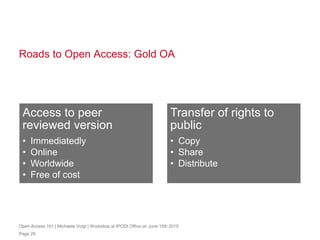
Roads to Open Access: Gold OA
Page 29
Access to peer
reviewed version
• Immediatedly
• Online
• Worldwide
• Free of cost
Transfer of rights to
public
• Copy
• Share
• Distribute
Open Access 101 | Michaela Voigt | Workshop at IPODI Office on June 15th 2015
Again, the choice is yours…
Page 30
And many more
 Directory of Open Access Journals (DOAJ) http://doaj.org/
 Directory of Open Access Books (DOAB) http://www.doabooks.org/
Open Access 101 | Michaela Voigt | Workshop at IPODI Office on June 15th 2015
Business and publication models
 Publication types
 Journals, series,
monographs, …
 Publishing models
 E-only
 Hybrid
 OA is not free of cost
 Business models e.g.
 Article processing charge (APC)
 Membership models
 Institutional sponsorship
 Subscription fees for hybrid
model
Open Access 101 | Michaela Voigt | Workshop at IPODI Office on June 15th 2015
Page 31
What about quality?
 OA is not per se indicator on quality
 OA = publishing model
 Just like in closed access world: publishers and editors have to
ensure quality
 When choosing a publisher make sure…
 Professional management
 Proper peer review
 Proper license
 Check out Beall‘s List on predatory OA publishers (esp. Criteria for
determining…)
Page 32
Open Access 101 | Michaela Voigt | Workshop at IPODI Office on June 15th 2015
Recommendations
• Check out OA alternatives in your
discipline
• Ask library or programm manager for
help
Publish Open Access!
• Proper licensing (CC BY)
• Professional publisherGo Gold OA!
• Read publishing contracts &
negotiate terms
• Retain rights to self-archive
• Keep post prints
Gold OA not possible?
Go Green OA!
Page 33
Open Access 101 | Michaela Voigt | Workshop at IPODI Office on June 15th 2015
CREATIVE COMMONS
Page 34
CC in a nutshell
 Non-profit organization
 Founded in 2001 in USA
 Version 1.0 of licenses released in 2002
 Licenses developed in the US
 Intended for international use
 License modules evolved over the years
 Latest version is 4.0 of 2013
Page 35
Open Access 101 | Michaela Voigt | Workshop at IPODI Office on June 15th 2015
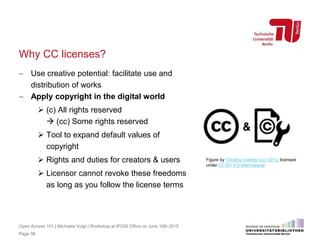
Why CC licenses?
 Use creative potential: facilitate use and
distribution of works
 Apply copyright in the digital world
 (c) All rights reserved
 (cc) Some rights reserved
 Tool to expand default values of
copyright
 Rights and duties for creators & users
 Licensor cannot revoke these freedoms
as long as you follow the license terms
Page 36
Figure by Timothy Vollmer (cc) 2013, licensed
under CC BY 4.0 International
Open Access 101 | Michaela Voigt | Workshop at IPODI Office on June 15th 2015
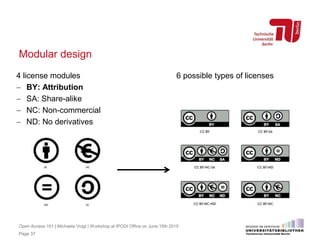
Modular design
Page 37
4 license modules 6 possible types of licenses
 BY: Attribution
 SA: Share-alike
 NC: Non-commercial
 ND: No derivatives
Open Access 101 | Michaela Voigt | Workshop at IPODI Office on June 15th 2015
License elements
 Legal code
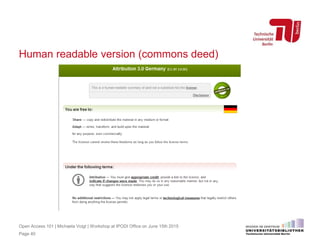
 Human readable version (commons
deed)
 Machine readable version
Page 38
Open Access 101 | Michaela Voigt | Workshop at IPODI Office on June 15th 2015
Three “Layers” Of Creative
Commons Licenses by Creative
Commons, licensed under CC
BY 3.0 Unported
Legal code
Page 39
Open Access 101 | Michaela Voigt | Workshop at IPODI Office on June 15th 2015
Human readable version (commons deed)
Page 40
Open Access 101 | Michaela Voigt | Workshop at IPODI Office on June 15th 2015
Machine readable version
Page 41
Open Access 101 | Michaela Voigt | Workshop at IPODI Office on June 15th 2015
License terms
Page 42
Always
allowed
• Reproduce
and distribute
• Perform
publicly
Always
mandatory
• Give
attribution
• Link to source
• Link to
license
Possibly further
restrictions
• Example 1:
commercial
use
• Example 2:
derivatives
Open Access 101 | Michaela Voigt | Workshop at IPODI Office on June 15th 2015
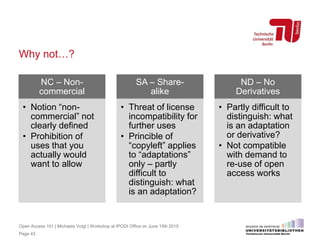
Why not…?
NC – Non-
commercial
• Notion “non-
commercial” not
clearly defined
• Prohibition of
uses that you
actually would
want to allow
SA – Share-
alike
• Threat of license
incompatibility for
further uses
• Princible of
“copyleft” applies
to “adaptations”
only – partly
difficult to
distinguish: what
is an adaptation?
ND – No
Derivatives
• Partly difficult to
distinguish: what
is an adaptation
or derivative?
• Not compatible
with demand to
re-use of open
access works
Page 43
Open Access 101 | Michaela Voigt | Workshop at IPODI Office on June 15th 2015
Why not…?
NC – Non-
commercial
• Notion “non-
commercial” not
clearly defined
• Prohibition of
actually desired
uses
SA – Share-
alike
• Threat of license
incompatibility for
further uses
• Princible of
“copyleft” applies
to “adaptions”
only – partly
difficult to
distinguish: what
is an adaptation?
ND – No
Derivatives
• Partly difficult to
distinguish: what
is an adaptation
or derivative?
• Not compabtible
with demand to
reuse of open
access works
Page 44
Only CC BY complies with demands to re-use
open access works.
Open Access 101 | Michaela Voigt | Workshop at IPODI Office on June 15th 2015
NC – Non-commercial
 Legal code does not define “commercial” clearly
 So far there is no clear (German) court ruling to interprete term “non-commercial”
 When in doubt it‘s better to abstain from using a NC-licensed work
 Recommendation: avoid NC modul when licensing own (scholarly) works
Page 45
You may not exercise any of the rights granted to You in Section 3 above in any manner that is primarily intended
for or directed toward commercial advantage or private monetary compensation. The exchange of the Work for
other copyrighted works by means of digital file-sharing or otherwise shall not be considered to be intended for or
directed toward commercial advantage or private monetary compensation, provided there is no payment of any
monetary compensation in connection with the exchange of copyrighted works.
(see 4. b of CC BY NC 3.0 legal code)
A commercial use is one primarily intended for commercial advantage or monetary compensation.
(see tool tip for “commercial purpose“ in CC BY NC 3.0 commons deed)
Open Access 101 | Michaela Voigt | Workshop at IPODI Office on June 15th 2015
SA – Share-alike
 SA module applies to adaptations “only”
 Goal: extend pool of freely licensed works
 Most commonly known user: Wikipedia
 NB: what does “adaptation” mean?
Page 46
You may Distribute or Publicly Perform an Adaptation only under the terms of:
(i) this License;
(ii) a later version of this License with the same License Elements as this License;
(iii) a Creative Commons jurisdiction license (either this or a later license version) that contains the same License
Elements as this License (e.g., Attribution-ShareAlike 3.0 US));
(iv) a Creative Commons Compatible License.
(see 4. b of CC BY SA 3.0 legal code)
Open Access 101 | Michaela Voigt | Workshop at IPODI Office on June 15th 2015
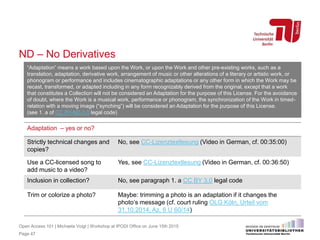
ND – No Derivatives
Page 47
“Adaptation” means a work based upon the Work, or upon the Work and other pre-existing works, such as a
translation, adaptation, derivative work, arrangement of music or other alterations of a literary or artistic work, or
phonogram or performance and includes cinematographic adaptations or any other form in which the Work may be
recast, transformed, or adapted including in any form recognizably derived from the original, except that a work
that constitutes a Collection will not be considered an Adaptation for the purpose of this License. For the avoidance
of doubt, where the Work is a musical work, performance or phonogram, the synchronization of the Work in timed-
relation with a moving image (“synching”) will be considered an Adaptation for the purpose of this License.
(see 1. a of CC BY-ND 3.0 legal code)
Adaptation – yes or no?
Strictly technical changes and
copies?
No, see CC-Lizenztextlesung (Video in German, cf. 00:35:00)
Use a CC-licensed song to
add music to a video?
Yes, see CC-Lizenztextlesung (Video in German, cf. 00:36:50)
Inclusion in collection? No, see paragraph 1. a CC BY 3.0 legal code
Trim or colorize a photo? Maybe: trimming a photo is an adaptation if it changes the
photo‘s message (cf. court ruling OLG Köln, Urteil vom
31.10.2014, Az. 6 U 60/14)
Open Access 101 | Michaela Voigt | Workshop at IPODI Office on June 15th 2015
Contact
openaccess@ub.tu-berlin.de
Michaela Voigt 030 314 76130
Dagmar Schobert 030 314 76127
www.ub.tu-berlin.de/
http://blogs.ub.tu-berlin.de/openaccess/
@UB_TU_Berlin
http://de.slideshare.net/UB_TU_Berlin
Page 48
Open Access 101 | Michaela Voigt | Workshop at IPODI Office on June 15th 2015
Source credits
 “What Is the Problem?” graphic, content by Jill Cirasella / graphic design by Les LaRue,
http://www.leslarue.com/, licensed under a Creative Commons Attribution-ShareAlike 3.0
Unported License
 Happiness Is Only Real When Shared, by Jose Roberto V Moraes, licensed under CC BY 2.0
 muhuhuhuhuh, by Alex4739924, licensed under CC BY-SA 3.0
 Fix copyright figure by Timothy Vollmer (cc) 2013, licensed under CC BY 4.0 International
 Three “Layers” Of Creative Commons Licenses by Creative Commons, licensed under CC BY 3.0
Unported
Page 49
Open Access 101 | Michaela Voigt | Workshop at IPODI Office on June 15th 2015
Further reading
 Information provided by the University Press: http://verlag.tu-berlin.de/
 TU Berlin, Referat V D: Leitfaden Urheberrecht der Technischen Universität Berlin (13.11.2014)
 Beall, Jeffrey
 Beall‘s List on predatory OA publishers
 Criteria for Determining Predatory Open-Access Publishers
 Creative Commons:
 Frequently Asked Questions
 Best practices for attribution  instruction incl. Examples for how to mark CC-licensed works
 License Versions  information on backround, history and differences between the different
versions of CC licenses
 SHERPA/RoMEO  Database on journal publishers‘ policies on self-archiving
 Directory of Open Access Journals (DOAJ)
 February 2015: more than 10000 scholarly OA journals documented
 Directory of Open Access Books (DOAB)
 February 2015: more than 2700 OA books by approx. 90 publishers documented
 Allows search for publishers that publish OA books
Page 50
Open Access 101 | Michaela Voigt | Workshop at IPODI Office on June 15th 2015
Further reading (2)
 SPARC Author's Addendum
 Klimpel, Paul: Freies Wissen dank Creative-Commons-Lizenzen. Folgen, Risiken und
Nebenwirkungen der Bedingung »nicht-kommerziell - NC« (2012)
 Kreutzer, Till: Open-Content-Lizenzen. Ein Leitfaden für die Praxis (2011)
 pb21.de: CC-Lizenztextlesung – Juristen und Pädagogen erklären die Creative Commons
Lizenzen (2014)  legal experts Till Kreutzer and John H. Weitzmann comment on and explain
legal code of CC licenses (Video in German, approx. 2 h 10 min)
 Search for Creative Commons-licensed content
 Wikimedia Commons: search for freely licensed images, audio and video material
 Flickr: allows filtering for CC licensed content (see Advanced search)
 Google Bilder: after submitting a query select “search tools” and filter for “usage rights”
 open-access.net  Information platform about Open Access
 a.o.t. information on legal issues and business models
 see FAQ for authors
Page 51
Open Access 101 | Michaela Voigt | Workshop at IPODI Office on June 15th 2015

Open Access 101: Copyright, Open Access and free licensing

  • 1.
    OPEN ACCESS 101 MichaelaVoigt | openaccess@ub.tu-berlin.de University Library of TU Berlin | Workshop at IPODI Office on June 15th 2015 If not indicated otherwise content is licensed under CC BY 4.0 Creative Commons Attribution 4.0 International | https://creativecommons.org/licenses/by/4.0 Copyright, Open Access & free licensing
  • 2.
    Agenda I. German Copyright:Core principles II. Open Access: Basics a. Green Road b. Golden Road III. Creative Commons licenses Open Access 101 | Michaela Voigt | Workshop at IPODI Office on June 15th 2015 Page 2
  • 3.
  • 4.
    Copyright protection Page 4 •Author = creator of a work • Supervisors of theses, student papers etc. are not considered to be creators • Only natural persons (creators) can claim full copyright • vs. rights holder: natural or legal person WHO • Protection of original works • Ideas, concepts etc. are not protectable • Work = intellectually created by a natural person (§ 2 UrhG)  a.o.t • Literary works • Photographic works • Cinematographic works WHAT • Protected by law • No further registration necessary (in contrast to patents, trademarks, logos etc.) • Copyright term: 70 years after the creator‘s death HOW Open Access 101 | Michaela Voigt | Workshop at IPODI Office on June 15th 2015
  • 5.
    Authors‘ Rights • Rightof first publication • Recognition of authorship • Right prohibit distortions of the work Moral rights (§§ 12–14) • Reproduction • Distribution • Making available to the public • Performance, presentation • … Exploitation rights (§§ 15–24) Page 5 Open Access 101 | Michaela Voigt | Workshop at IPODI Office on June 15th 2015
  • 6.
    Transfer of rights Page6 • Rights of use can be transfered (§ 31 UrhG) • … for each type of use individually • … limited in time (e.g. timespan of 5 years) • … geographically limited (e.g. distribution within Europe) • … as exclusive or non-exclusive right Exploitation rights • Rights holder can use the work exclusively • Even creator has to obtain rights for further use(s)Exclusive • Rights holder can use the work • Creator can transfer non-exclusive rights to different (natural or legal) persons Non- exclusive Open Access 101 | Michaela Voigt | Workshop at IPODI Office on June 15th 2015
  • 7.
    Publishing Agreements  Creatorgrants  Non-exclusive / exclusive rights  Rights to certain / all uses  Freedom of contract: contract partners negotiate terms  NB: inalienable right to self-archiving (cf. § 38 (4) UrhG)  Read your publication agreement and modify it if necessary!  Cross out sections where transfer of exclusive rights is demanded  Retain rights with help of Author Addendum (SPARC Author's Addendum recommended) Open Access 101 | Michaela Voigt | Workshop at IPODI Office on June 15th 2015 Page 7
  • 8.
    OPEN ACCESS: THEBASICS Page 8
  • 10.
    Open Access Declarations Page10 Open Access 101 | Michaela Voigt | Workshop at IPODI Office on June 15th 2015 Budapest Open Access Initiative: Budapest Declaration Feb 2002 Bethesda Statement on Open Access Publishing June 2003 Berlin Declaration on Open Access to Knowledge in the Sciences and Humanities Oct 2003
  • 11.
    Berlin Declaration Open accesscontributions must satisfy two conditions: 1) The author(s) and right holder(s) of such contributions grant(s) to all users a free, irrevocable, worldwide, right of access to, and a license to copy, use, distribute, transmit and display the work publicly and to make and distribute derivative works, in any digital medium for any responsible purpose, subject to proper attribution of authorship (community standards, will continue to provide the mechanism for enforcement of proper attribution and responsible use of the published work, as they do now), as well as the right to make small numbers of printed copies for their personal use. 2) A complete version of the work and all supplemental materials, including a copy of the permission as stated above, in an appropriate standard electronic format is deposited (and thus published) in at least one online repository using suitable technical standards (such as the Open Archive definitions) that is supported and maintained by an academic institution, scholarly society, government agency, or other well- established organization that seeks to enable open access, unrestricted distribution, inter operability, and long-term archiving. Page 11 Open Access 101 | Michaela Voigt | Workshop at IPODI Office on June 15th 2015
  • 12.
    Berlin Declaration Open accesscontributions must satisfy two conditions: 1) The author(s) and right holder(s) of such contributions grant(s) to all users a free, irrevocable, worldwide, right of access to, and a license to copy, use, distribute, transmit and display the work publicly and to make and distribute derivative works, in any digital medium for any responsible purpose, subject to proper attribution of authorship (community standards, will continue to provide the mechanism for enforcement of proper attribution and responsible use of the published work, as they do now), as well as the right to make small numbers of printed copies for their personal use. 2) A complete version of the work and all supplemental materials, including a copy of the permission as stated above, in an appropriate standard electronic format is deposited (and thus published) in at least one online repository using suitable technical standards (such as the Open Archive definitions) that is supported and maintained by an academic institution, scholarly society, government agency, or other well- established organization that seeks to enable open access, unrestricted distribution, inter operability, and long-term archiving. Page 12 Open Access 101 | Michaela Voigt | Workshop at IPODI Office on June 15th 2015
  • 13.
    Benefits of OpenAccess Increased visibility and citation advantage Free access to publicly financed research results Authors retain exploitation rights Good findability by search engines & other indexing services Promote international and inter- disciplinary cooperation Promote research efficiency by rapid discussion of research results Improved supply of information & response to serials crisis Page 13 Open Access 101 | Michaela Voigt | Workshop at IPODI Office on June 15th 2015
  • 14.
    Roads to OpenAccess Golden Road Green Road Open Access 101 | Michaela Voigt | Workshop at IPODI Office on June 15th 2015 Page 14 Happiness Is Only Real When Shared, by Jose Roberto V Moraes, licensed under CC BY 2.0 muhuhuhuhuh, by Alex4739924, licensed under CC BY-SA 3.0
  • 15.
    OPEN ACCESS: GREENROAD Page 15
  • 16.
    Roads to OpenAccess: Green OA In addition to traditional Closed Access publication Deposit on • Institutional repository • Disciplinary repository Usually no transfer of further rights to public • Restricted re-use Dependant on rights holder‘s policy • Embargo? • Version? Open Access 101 | Michaela Voigt | Workshop at IPODI Office on June 15th 2015 Page 16
  • 17.
    The choice isyours… (1) Insitutional repository Page 17  Text publications Articles, book chapters Conference contributions, proceedings Preprints, project reports Theses …  Research Data  Audio  Images  Software  Video  … https://opus4.kobv.de/opus4-tuberlin https://depositonce.tu-berlin.de/ Open Access 101 | Michaela Voigt | Workshop at IPODI Office on June 15th 2015
  • 18.
    The choice isyours… (2) Cross-institutional and/or disciplinary repository Page 18 And many more  Directory of Open Access Repositories (OpenDOAR) http://www.opendoar.org  Registry of Open Access Repositories (ROAR) http://roar.eprints.org/  Registry of Research Data Repositories (re3data) http://re3data.org/ Open Access 101 | Michaela Voigt | Workshop at IPODI Office on June 15th 2015 https://www.econstor.eu/ http://biorxiv.org/ http://www.ncbi.nlm.nih.gov/pubmed http://figshare.com/ http://arxiv.org/ http://datadryad.org/ http://cogprints.org/ http://zenodo.org/ http://www.ssoar.info/
  • 19.
    Consider your institutionalrepository! Page 19  Persistent Identifier (URN / DOI)  Objects are retrievable via  Library catalogue (e.g. TU Library, KOBV, German National Library)  Search engines (the usual suspects)  Academic search engines (e.g. BASE, Google Scholar)  Services for authors  Rights clearance service  Depositing service  Advise on free licenses  PDF/A support Open Access 101 | Michaela Voigt | Workshop at IPODI Office on June 15th 2015
  • 20.
    Self-archiving Publishers‘ policies Legal right Special OA rights Getpermission from publisher Page 20 Open Access 101 | Michaela Voigt | Workshop at IPODI Office on June 15th 2015
  • 21.
    Publishers‘ policies Page 21 Many publishers allow self-archiving  Conditions can differ  Preprint, postprint or publisher‘s PDF?  Personal website, institutional repository, disciplinary repository?  Embargo of 6, 12 oder 24 month? Open Access 101 | Michaela Voigt | Workshop at IPODI Office on June 15th 2015
  • 22.
    Publishers‘ policies II Page22  General information, not legally binding  Database on journal publishers‘ policies on self-archiving  Policies for monographic works have to be checked separately http://www.sherpa.ac.uk/romeo/ Open Access 101 | Michaela Voigt | Workshop at IPODI Office on June 15th 2015
  • 23.
    Page 23 Authors mayself-archive the author’s accepted manuscript of their articles on their own websites. Authors may also deposit this version of the article in any repository, provided it is only made publicly available 12 months after official publication or later. He/ she may not use the publisher's version (the final article), which is posted on SpringerLink and other Springer websites, for the purpose of self-archiving or deposit. Furthermore, the author may only post his/her version provided acknowledgement is given to the original source of publication and a link is inserted to the published article on Springer's website. The link must be provided by inserting the DOI number of the article in the following sentence: “The final publication is available at Springer via http://dx.doi.org/[insert DOI]” Open Access 101 | Michaela Voigt | Workshop at IPODI Office on June 15th 2015
  • 24.
    Legal right toself-archive § 38 (4) German Copyright Law Page 24  Can not be revoked as part of a publishing agreement  Periodical contributions only  Postprint only  12 month embargo  Valid for publications dating vom January 2014 or later (…) scientific contribution which is the result of a research activity publicly funded by at least fifty percent and which has appeared in a collection which is published periodically at least twice per year (…) (translated by Ute Reusch / juris GmBH) Open Access 101 | Michaela Voigt | Workshop at IPODI Office on June 15th 2015
  • 25.
    Special Open Accessrights Page 25  Some publishers grant special open access rights as part of a licensing agreement  Germany: e.g. „Allianz-Lizenz“ and „Nationallizenz“  Conditions can differ  Postprint or publisher‘s PDF?  Personal website, institutional repository, disciplinary repository?  Embargo of 6, 12 oder 24 month? Open Access 101 | Michaela Voigt | Workshop at IPODI Office on June 15th 2015
  • 26.
    Get permission frompublisher  Publisher does not have official OA policy?  Legal right to self-archive does not apply?  No special OA rights known or in existance?  It does not hurt to ask!  Often, not always, publishers grant the right when asked directly… Page 26 Open Access 101 | Michaela Voigt | Workshop at IPODI Office on June 15th 2015
  • 27.
    Self-archiving Publishers‘ policies Legal right Special OA rights Getpermission from publisher Page 27 It‘s often difficult to decide whether the legal right to self-archiving applies or what a publisher‘s policy on self-archiving is exactly. We are happy to help. Please contact us: openaccess@ub.tu-berlin.de Open Access 101 | Michaela Voigt | Workshop at IPODI Office on June 15th 2015
  • 28.
  • 29.
    Roads to OpenAccess: Gold OA Page 29 Access to peer reviewed version • Immediatedly • Online • Worldwide • Free of cost Transfer of rights to public • Copy • Share • Distribute Open Access 101 | Michaela Voigt | Workshop at IPODI Office on June 15th 2015
  • 30.
    Again, the choiceis yours… Page 30 And many more  Directory of Open Access Journals (DOAJ) http://doaj.org/  Directory of Open Access Books (DOAB) http://www.doabooks.org/ Open Access 101 | Michaela Voigt | Workshop at IPODI Office on June 15th 2015
  • 31.
    Business and publicationmodels  Publication types  Journals, series, monographs, …  Publishing models  E-only  Hybrid  OA is not free of cost  Business models e.g.  Article processing charge (APC)  Membership models  Institutional sponsorship  Subscription fees for hybrid model Open Access 101 | Michaela Voigt | Workshop at IPODI Office on June 15th 2015 Page 31
  • 32.
    What about quality? OA is not per se indicator on quality  OA = publishing model  Just like in closed access world: publishers and editors have to ensure quality  When choosing a publisher make sure…  Professional management  Proper peer review  Proper license  Check out Beall‘s List on predatory OA publishers (esp. Criteria for determining…) Page 32 Open Access 101 | Michaela Voigt | Workshop at IPODI Office on June 15th 2015
  • 33.
    Recommendations • Check outOA alternatives in your discipline • Ask library or programm manager for help Publish Open Access! • Proper licensing (CC BY) • Professional publisherGo Gold OA! • Read publishing contracts & negotiate terms • Retain rights to self-archive • Keep post prints Gold OA not possible? Go Green OA! Page 33 Open Access 101 | Michaela Voigt | Workshop at IPODI Office on June 15th 2015
  • 34.
  • 35.
    CC in anutshell  Non-profit organization  Founded in 2001 in USA  Version 1.0 of licenses released in 2002  Licenses developed in the US  Intended for international use  License modules evolved over the years  Latest version is 4.0 of 2013 Page 35 Open Access 101 | Michaela Voigt | Workshop at IPODI Office on June 15th 2015
  • 36.
    Why CC licenses? Use creative potential: facilitate use and distribution of works  Apply copyright in the digital world  (c) All rights reserved  (cc) Some rights reserved  Tool to expand default values of copyright  Rights and duties for creators & users  Licensor cannot revoke these freedoms as long as you follow the license terms Page 36 Figure by Timothy Vollmer (cc) 2013, licensed under CC BY 4.0 International Open Access 101 | Michaela Voigt | Workshop at IPODI Office on June 15th 2015
  • 37.
    Modular design Page 37 4license modules 6 possible types of licenses  BY: Attribution  SA: Share-alike  NC: Non-commercial  ND: No derivatives Open Access 101 | Michaela Voigt | Workshop at IPODI Office on June 15th 2015
  • 38.
    License elements  Legalcode  Human readable version (commons deed)  Machine readable version Page 38 Open Access 101 | Michaela Voigt | Workshop at IPODI Office on June 15th 2015 Three “Layers” Of Creative Commons Licenses by Creative Commons, licensed under CC BY 3.0 Unported
  • 39.
    Legal code Page 39 OpenAccess 101 | Michaela Voigt | Workshop at IPODI Office on June 15th 2015
  • 40.
    Human readable version(commons deed) Page 40 Open Access 101 | Michaela Voigt | Workshop at IPODI Office on June 15th 2015
  • 41.
    Machine readable version Page41 Open Access 101 | Michaela Voigt | Workshop at IPODI Office on June 15th 2015
  • 42.
    License terms Page 42 Always allowed •Reproduce and distribute • Perform publicly Always mandatory • Give attribution • Link to source • Link to license Possibly further restrictions • Example 1: commercial use • Example 2: derivatives Open Access 101 | Michaela Voigt | Workshop at IPODI Office on June 15th 2015
  • 43.
    Why not…? NC –Non- commercial • Notion “non- commercial” not clearly defined • Prohibition of uses that you actually would want to allow SA – Share- alike • Threat of license incompatibility for further uses • Princible of “copyleft” applies to “adaptations” only – partly difficult to distinguish: what is an adaptation? ND – No Derivatives • Partly difficult to distinguish: what is an adaptation or derivative? • Not compatible with demand to re-use of open access works Page 43 Open Access 101 | Michaela Voigt | Workshop at IPODI Office on June 15th 2015
  • 44.
    Why not…? NC –Non- commercial • Notion “non- commercial” not clearly defined • Prohibition of actually desired uses SA – Share- alike • Threat of license incompatibility for further uses • Princible of “copyleft” applies to “adaptions” only – partly difficult to distinguish: what is an adaptation? ND – No Derivatives • Partly difficult to distinguish: what is an adaptation or derivative? • Not compabtible with demand to reuse of open access works Page 44 Only CC BY complies with demands to re-use open access works. Open Access 101 | Michaela Voigt | Workshop at IPODI Office on June 15th 2015
  • 45.
    NC – Non-commercial Legal code does not define “commercial” clearly  So far there is no clear (German) court ruling to interprete term “non-commercial”  When in doubt it‘s better to abstain from using a NC-licensed work  Recommendation: avoid NC modul when licensing own (scholarly) works Page 45 You may not exercise any of the rights granted to You in Section 3 above in any manner that is primarily intended for or directed toward commercial advantage or private monetary compensation. The exchange of the Work for other copyrighted works by means of digital file-sharing or otherwise shall not be considered to be intended for or directed toward commercial advantage or private monetary compensation, provided there is no payment of any monetary compensation in connection with the exchange of copyrighted works. (see 4. b of CC BY NC 3.0 legal code) A commercial use is one primarily intended for commercial advantage or monetary compensation. (see tool tip for “commercial purpose“ in CC BY NC 3.0 commons deed) Open Access 101 | Michaela Voigt | Workshop at IPODI Office on June 15th 2015
  • 46.
    SA – Share-alike SA module applies to adaptations “only”  Goal: extend pool of freely licensed works  Most commonly known user: Wikipedia  NB: what does “adaptation” mean? Page 46 You may Distribute or Publicly Perform an Adaptation only under the terms of: (i) this License; (ii) a later version of this License with the same License Elements as this License; (iii) a Creative Commons jurisdiction license (either this or a later license version) that contains the same License Elements as this License (e.g., Attribution-ShareAlike 3.0 US)); (iv) a Creative Commons Compatible License. (see 4. b of CC BY SA 3.0 legal code) Open Access 101 | Michaela Voigt | Workshop at IPODI Office on June 15th 2015
  • 47.
    ND – NoDerivatives Page 47 “Adaptation” means a work based upon the Work, or upon the Work and other pre-existing works, such as a translation, adaptation, derivative work, arrangement of music or other alterations of a literary or artistic work, or phonogram or performance and includes cinematographic adaptations or any other form in which the Work may be recast, transformed, or adapted including in any form recognizably derived from the original, except that a work that constitutes a Collection will not be considered an Adaptation for the purpose of this License. For the avoidance of doubt, where the Work is a musical work, performance or phonogram, the synchronization of the Work in timed- relation with a moving image (“synching”) will be considered an Adaptation for the purpose of this License. (see 1. a of CC BY-ND 3.0 legal code) Adaptation – yes or no? Strictly technical changes and copies? No, see CC-Lizenztextlesung (Video in German, cf. 00:35:00) Use a CC-licensed song to add music to a video? Yes, see CC-Lizenztextlesung (Video in German, cf. 00:36:50) Inclusion in collection? No, see paragraph 1. a CC BY 3.0 legal code Trim or colorize a photo? Maybe: trimming a photo is an adaptation if it changes the photo‘s message (cf. court ruling OLG Köln, Urteil vom 31.10.2014, Az. 6 U 60/14) Open Access 101 | Michaela Voigt | Workshop at IPODI Office on June 15th 2015
  • 48.
    Contact openaccess@ub.tu-berlin.de Michaela Voigt 030314 76130 Dagmar Schobert 030 314 76127 www.ub.tu-berlin.de/ http://blogs.ub.tu-berlin.de/openaccess/ @UB_TU_Berlin http://de.slideshare.net/UB_TU_Berlin Page 48 Open Access 101 | Michaela Voigt | Workshop at IPODI Office on June 15th 2015
  • 49.
    Source credits  “WhatIs the Problem?” graphic, content by Jill Cirasella / graphic design by Les LaRue, http://www.leslarue.com/, licensed under a Creative Commons Attribution-ShareAlike 3.0 Unported License  Happiness Is Only Real When Shared, by Jose Roberto V Moraes, licensed under CC BY 2.0  muhuhuhuhuh, by Alex4739924, licensed under CC BY-SA 3.0  Fix copyright figure by Timothy Vollmer (cc) 2013, licensed under CC BY 4.0 International  Three “Layers” Of Creative Commons Licenses by Creative Commons, licensed under CC BY 3.0 Unported Page 49 Open Access 101 | Michaela Voigt | Workshop at IPODI Office on June 15th 2015
  • 50.
    Further reading  Informationprovided by the University Press: http://verlag.tu-berlin.de/  TU Berlin, Referat V D: Leitfaden Urheberrecht der Technischen Universität Berlin (13.11.2014)  Beall, Jeffrey  Beall‘s List on predatory OA publishers  Criteria for Determining Predatory Open-Access Publishers  Creative Commons:  Frequently Asked Questions  Best practices for attribution  instruction incl. Examples for how to mark CC-licensed works  License Versions  information on backround, history and differences between the different versions of CC licenses  SHERPA/RoMEO  Database on journal publishers‘ policies on self-archiving  Directory of Open Access Journals (DOAJ)  February 2015: more than 10000 scholarly OA journals documented  Directory of Open Access Books (DOAB)  February 2015: more than 2700 OA books by approx. 90 publishers documented  Allows search for publishers that publish OA books Page 50 Open Access 101 | Michaela Voigt | Workshop at IPODI Office on June 15th 2015
  • 51.
    Further reading (2) SPARC Author's Addendum  Klimpel, Paul: Freies Wissen dank Creative-Commons-Lizenzen. Folgen, Risiken und Nebenwirkungen der Bedingung »nicht-kommerziell - NC« (2012)  Kreutzer, Till: Open-Content-Lizenzen. Ein Leitfaden für die Praxis (2011)  pb21.de: CC-Lizenztextlesung – Juristen und Pädagogen erklären die Creative Commons Lizenzen (2014)  legal experts Till Kreutzer and John H. Weitzmann comment on and explain legal code of CC licenses (Video in German, approx. 2 h 10 min)  Search for Creative Commons-licensed content  Wikimedia Commons: search for freely licensed images, audio and video material  Flickr: allows filtering for CC licensed content (see Advanced search)  Google Bilder: after submitting a query select “search tools” and filter for “usage rights”  open-access.net  Information platform about Open Access  a.o.t. information on legal issues and business models  see FAQ for authors Page 51 Open Access 101 | Michaela Voigt | Workshop at IPODI Office on June 15th 2015