CONSTRUCTORS
&
DESTRUCTORS
#109 Rimsha Nasrallah
#118 shamsa Nawaz
#139 Sana Khalid
Constructors
• C++ requires a construct call for each object it has created
• This ensure that object is initialized properly before it is used
• If there is no constructor, the compiler provides a default constructor that is, a
constructor with no parameters
• Name of constructor function is same as name of class
A counter example
• Data member
• Count
• Member function
• Constructor
• void inc_count()
• int get_count()
Automatic initialization
• An object of type Counter is first created, we want its count to be
initialized to 0
• Options are
• set_count() function (call it with an argument of 0)
• zero_count() function, to set count to 0.
• Such functions would need to be executed every time we created a
Counter object
Cont.
• A programmer may forget to initialize the object after creating it
• It’s more reliable and convenient to cause each object to initialize implicitly when
it is created
• In the Counter class, the constructor Counter() is called automatically whenever a
new object of type Counter is created
• Counter c1, c2;
creates two objects. Constructor is called with each object separately
Constructor Name
• First, constructor name must be same as the name of class
• This is one way the compiler knows they are constructors
• Second, no return type is used for constructors
• Why not? Since the constructor is called automatically by the system, there’s no
program for it to return anything to; a return value wouldn’t make sense
• This is the second way the compiler knows they are constructors
Initializer List
• One of the most common tasks a constructor carries out is initializing data members
• In the Counter class the constructor must initialize the count member to 0
• The initialization takes place following the member function declarator but before the function body.
• Initialization in constructor’s function body
Counter()
{ count = 0; }
this is not the preferred approach
Cont.
• It’s preceded by a colon.The value is placed in parentheses following the member
data.
Counter() : count(0)
{ }
• If multiple members must be initialized, they’re separated by commas.
• someClass() : m1(7), m2(33), m3(4) ←initializer list { }
Destructors
• Destructor is a function called implicitly when an object is destroyed
• The name of the destructor for a class is the tilde character (~) followed by the
class name
• No arguments and no return type for a destructor
• The most common use of destructors is to deallocate memory that was allocated
for the object by the constructor
Validating Data with set Functions
• A set function should validate the value before assigning to private data member
• Set function can return a value or may display a message if invalid data is assign to
object
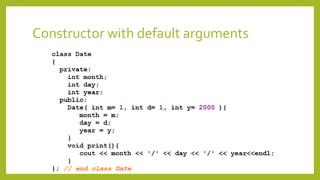
Constructor with default arguments
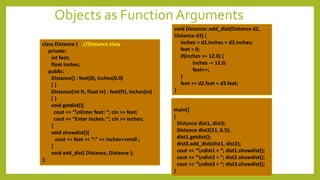
Objects as Function Arguments
class Distance { //Distance class
private:
int feet;
float inches;
public:
Distance() : feet(0), inches(0.0)
{ }
Distance(int ft, float in) : feet(ft), inches(in)
{ }
void getdist(){
cout << “nEnter feet: “; cin >> feet;
cout << “Enter inches: “; cin >> inches;
}
void showdist(){
cout << feet << “:” << inches<<endl ;
}
void add_dist( Distance, Distance );
};
void Distance::add_dist(Distance d2,
Distance d3) {
inches = d2.inches + d3.inches;
feet = 0;
if(inches >= 12.0) {
inches -= 12.0;
feet++;
}
feet += d2.feet + d3.feet;
}
main()
{
Distance dist1, dist3;
Distance dist2(11, 6.5);
dist1.getdist();
dist3.add_dist(dist1, dist2);
cout << “ndist1 = “; dist1.showdist();
cout << “ndist2 = “; dist2.showdist();
cout << “ndist3 = “; dist3.showdist();
}
feet
inches
dist1
0
0.0
`feet
inches
dist3
0
0.0
feet
inches
dist2
11
6.5
5
7.0
feet
inches
d1
feet
inches
d2
5
7.0
11
6.5
13.5
0
1.5
117
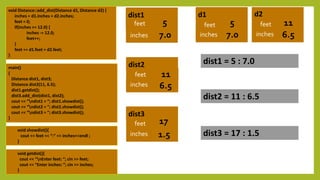
main()
{
Distance dist1, dist3;
Distance dist2(11, 6.5);
dist1.getdist();
dist3.add_dist(dist1, dist2);
cout << “ndist1 = “; dist1.showdist();
cout << “ndist2 = “; dist2.showdist();
cout << “ndist3 = “; dist3.showdist();
}
void getdist(){
cout << “nEnter feet: “; cin >> feet;
cout << “Enter inches: “; cin >> inches;
}
void Distance::add_dist(Distance d1, Distance d2) {
inches = d1.inches + d2.inches;
feet = 0;
if(inches >= 12.0) {
inches -= 12.0;
feet++;
}
feet += d1.feet + d2.feet;
}
void showdist(){
cout << feet << “:” << inches<<endl ;
}
dist1 = 5 : 7.0
dist2 = 11 : 6.5
dist3 = 17 : 1.5
Overloaded Constructors
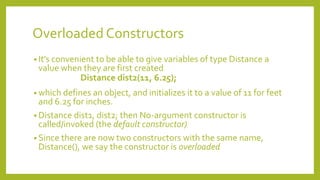
• It’s convenient to be able to give variables of type Distance a
value when they are first created
Distance dist2(11, 6.25);
• which defines an object, and initializes it to a value of 11 for feet
and 6.25 for inches.
• Distance dist1, dist2; then No-argument constructor is
called/invoked (the default constructor)
• Since there are now two constructors with the same name,
Distance(), we say the constructor is overloaded
Member Functions Defined Outside the
Class
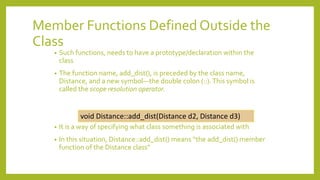
• Such functions, needs to have a prototype/declaration within the
class
• The function name, add_dist(), is preceded by the class name,
Distance, and a new symbol—the double colon (::).This symbol is
called the scope resolution operator.
• It is a way of specifying what class something is associated with
• In this situation, Distance::add_dist() means “the add_dist() member
function of the Distance class”
void Distance::add_dist(Distance d2, Distance d3)
Questions??

Oop presentation

  • 1.
  • 2.
    Constructors • C++ requiresa construct call for each object it has created • This ensure that object is initialized properly before it is used • If there is no constructor, the compiler provides a default constructor that is, a constructor with no parameters • Name of constructor function is same as name of class
  • 3.
    A counter example •Data member • Count • Member function • Constructor • void inc_count() • int get_count()
  • 4.
    Automatic initialization • Anobject of type Counter is first created, we want its count to be initialized to 0 • Options are • set_count() function (call it with an argument of 0) • zero_count() function, to set count to 0. • Such functions would need to be executed every time we created a Counter object
  • 5.
    Cont. • A programmermay forget to initialize the object after creating it • It’s more reliable and convenient to cause each object to initialize implicitly when it is created • In the Counter class, the constructor Counter() is called automatically whenever a new object of type Counter is created • Counter c1, c2; creates two objects. Constructor is called with each object separately
  • 6.
    Constructor Name • First,constructor name must be same as the name of class • This is one way the compiler knows they are constructors • Second, no return type is used for constructors • Why not? Since the constructor is called automatically by the system, there’s no program for it to return anything to; a return value wouldn’t make sense • This is the second way the compiler knows they are constructors
  • 7.
    Initializer List • Oneof the most common tasks a constructor carries out is initializing data members • In the Counter class the constructor must initialize the count member to 0 • The initialization takes place following the member function declarator but before the function body. • Initialization in constructor’s function body Counter() { count = 0; } this is not the preferred approach
  • 8.
    Cont. • It’s precededby a colon.The value is placed in parentheses following the member data. Counter() : count(0) { } • If multiple members must be initialized, they’re separated by commas. • someClass() : m1(7), m2(33), m3(4) ←initializer list { }
  • 9.
    Destructors • Destructor isa function called implicitly when an object is destroyed • The name of the destructor for a class is the tilde character (~) followed by the class name • No arguments and no return type for a destructor • The most common use of destructors is to deallocate memory that was allocated for the object by the constructor
  • 10.
    Validating Data withset Functions • A set function should validate the value before assigning to private data member • Set function can return a value or may display a message if invalid data is assign to object
  • 11.
  • 12.
    Objects as FunctionArguments class Distance { //Distance class private: int feet; float inches; public: Distance() : feet(0), inches(0.0) { } Distance(int ft, float in) : feet(ft), inches(in) { } void getdist(){ cout << “nEnter feet: “; cin >> feet; cout << “Enter inches: “; cin >> inches; } void showdist(){ cout << feet << “:” << inches<<endl ; } void add_dist( Distance, Distance ); }; void Distance::add_dist(Distance d2, Distance d3) { inches = d2.inches + d3.inches; feet = 0; if(inches >= 12.0) { inches -= 12.0; feet++; } feet += d2.feet + d3.feet; } main() { Distance dist1, dist3; Distance dist2(11, 6.5); dist1.getdist(); dist3.add_dist(dist1, dist2); cout << “ndist1 = “; dist1.showdist(); cout << “ndist2 = “; dist2.showdist(); cout << “ndist3 = “; dist3.showdist(); }
  • 13.
    feet inches dist1 0 0.0 `feet inches dist3 0 0.0 feet inches dist2 11 6.5 5 7.0 feet inches d1 feet inches d2 5 7.0 11 6.5 13.5 0 1.5 117 main() { Distance dist1, dist3; Distancedist2(11, 6.5); dist1.getdist(); dist3.add_dist(dist1, dist2); cout << “ndist1 = “; dist1.showdist(); cout << “ndist2 = “; dist2.showdist(); cout << “ndist3 = “; dist3.showdist(); } void getdist(){ cout << “nEnter feet: “; cin >> feet; cout << “Enter inches: “; cin >> inches; } void Distance::add_dist(Distance d1, Distance d2) { inches = d1.inches + d2.inches; feet = 0; if(inches >= 12.0) { inches -= 12.0; feet++; } feet += d1.feet + d2.feet; } void showdist(){ cout << feet << “:” << inches<<endl ; } dist1 = 5 : 7.0 dist2 = 11 : 6.5 dist3 = 17 : 1.5
  • 14.
    Overloaded Constructors • It’sconvenient to be able to give variables of type Distance a value when they are first created Distance dist2(11, 6.25); • which defines an object, and initializes it to a value of 11 for feet and 6.25 for inches. • Distance dist1, dist2; then No-argument constructor is called/invoked (the default constructor) • Since there are now two constructors with the same name, Distance(), we say the constructor is overloaded
  • 15.
    Member Functions DefinedOutside the Class • Such functions, needs to have a prototype/declaration within the class • The function name, add_dist(), is preceded by the class name, Distance, and a new symbol—the double colon (::).This symbol is called the scope resolution operator. • It is a way of specifying what class something is associated with • In this situation, Distance::add_dist() means “the add_dist() member function of the Distance class” void Distance::add_dist(Distance d2, Distance d3)
  • 16.