Reforms in Indian
Capital Market
Submitted by
Adhiroop B
Karan Mishra
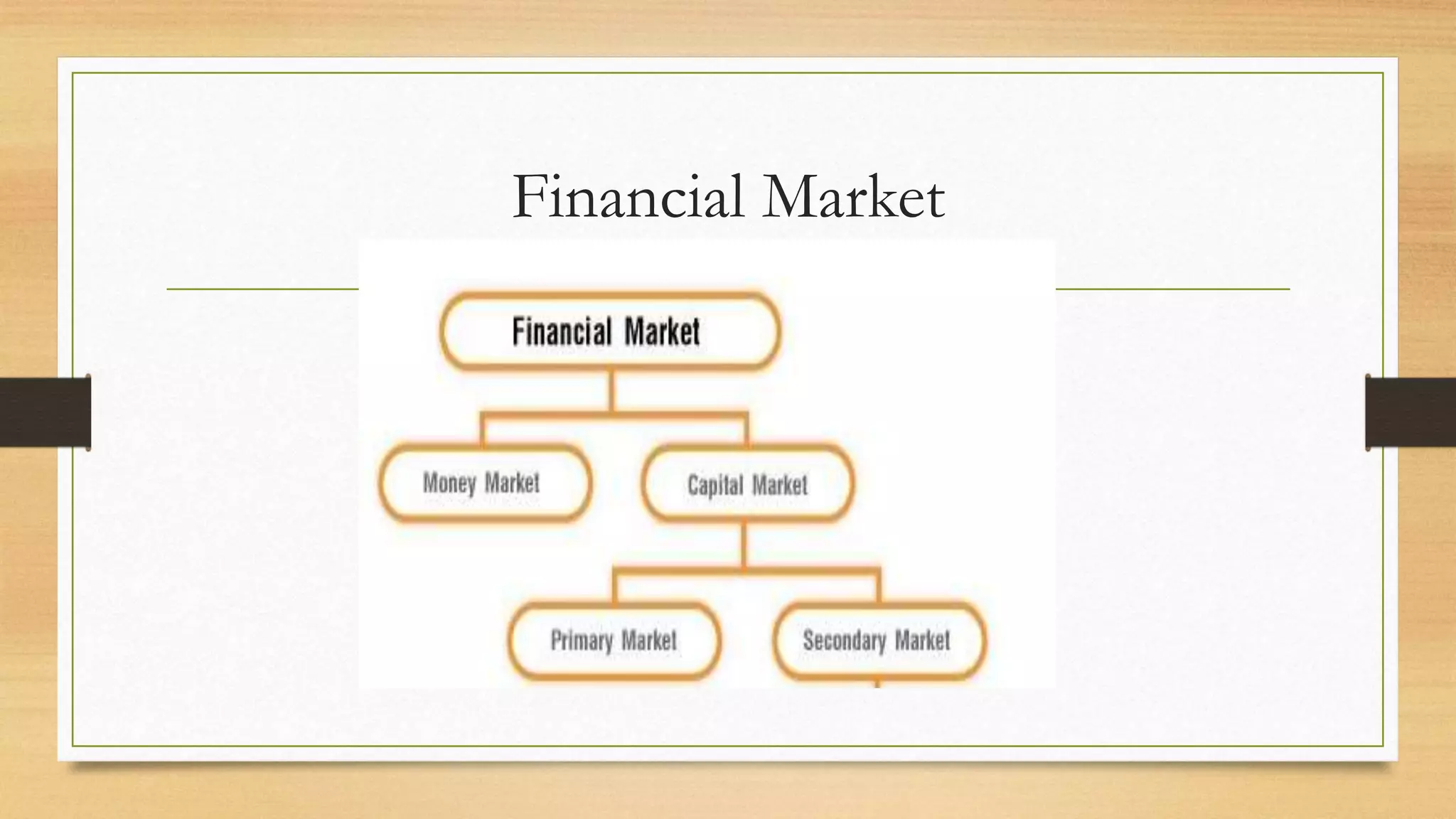
Financial Market
Capital Market
Capital market is a market where buyers and sellers
engage in trade of financial securities like bonds,
stocks, etc. The buying/selling is undertaken by
participants such as individuals and institutions.
Primary Market
• It is that market in which shares, debentures and
other securities are sold for the first time for
collecting long term capital.
• This market is concerned with new issues.
Therefore, the primary market is also called New
Issue Market.
Secondary Market
• The secondary market is that market in which the
buying and selling of the previously issued securities is
done.
• The transactions of the secondary market are generally
done through the medium of stock exchange.
• The chief purpose of the secondary market is to create
liquidity in securities.
Reforms
1. Establishment of SEBI: The Securities and Exchange Board of
India(SEBI) was established in 1988. It was primarily set up to regulate the
activities of the merchant banks, to control mutual funds, and to act as a
regulatory authority of new issue activities of companies. The SEBI was
set up with the fundamental objective, “to protect the interest of investors
in securities market and for matters connected therewith or incidental
thereto.”
2. Establishment of Creditors Rating Agencies : Three creditors rating agencies
viz. The Credit Rating Information Services of India Limited (CRISIL-1988),
the Investment Information and Credit Rating Agency of India Limited
(ICRA-1991) and Credit Analysis and Research Limited (CARE) were set up in
order to assess the financial health of different financial institutions and
agencies related to the stock market activities. It is a guide for the investors also
in evaluating the risk of their investments.
3. Increasing of Merchant Banking Activities : These divisions provide financial
services such as underwriting facilities, issue organizing, consultancy services,
etc. It has proved as a helping hand to factors relating to the capital market.
4. Candid Performance of Indian Economy : Indian economy is growing at a
good speed. It has attracted a huge inflow of Foreign Institutional Investments
(FII). The massive entry of FIIs in the Indian capital market has given good
appreciation for the Indian investors in recent times.
5. Rising Electronic Transactions : Due to technological development in the last
few years. The Physical transaction with more paper work is reduced. Now
paperless transactions are increasing at a rapid rate. It saves money, time and
energy of investors.
6. Growing Mutual fund Industry : The growing of mutual funds in India has
certainly helped the capital market to grow. Public sector banks, foreign banks,
financial institutions and joint mutual funds between the Indian and foreign
firms have launched many new funds. A big diversification in terms of
schemes, maturity, etc. has taken place in mutual funds in India.
7. Growing Stock Exchanges : The number of various Stock Exchanges in India are
increasing. Initially the BSE was the main exchange, but now after the setting up of the
NSE and the OTCEI, stock exchange have spread across the country. Recently a new
Inter-connected Stock Exchange of India has joined the existing stock exchanges.
8. Investor’s Protection : Under the purview of the SEBI the central Government of
India has set up the Investors Education and Protection Fund (IEPF) in 2001. It
works in educating and guiding investors. It tries to protect the interest of the small
investors from frauds and malpractices in the capital market.
9. Growth of Derivative Transactions : Since June 2000, the NSE has
introduced the derivatives trading in the equities. In November 2001 it also
introduced the future and options transactions. These innovative products have
given variety for the investment leading to the expansion of the capital market.
10. Insurance Sector Reforms : The Insurance Regulatory and Development
Authority (IRDA) was set up in 2000. It paved the entry of the private
insurance firms in India. As many insurance companies invest their money in
the capital market, it has expanded.
11. Commodity Trading : Along with the trading of ordinary securities, the
trading in commodities is also recently encouraged. The Multi Commodity
Exchange (MCX) is set up. The volume of such transactions is growing at a
splendid rate.
Thank you

Reforms in indian capital market

  • 1.
    Reforms in Indian CapitalMarket Submitted by Adhiroop B Karan Mishra
  • 2.
  • 3.
    Capital Market Capital marketis a market where buyers and sellers engage in trade of financial securities like bonds, stocks, etc. The buying/selling is undertaken by participants such as individuals and institutions.
  • 4.
    Primary Market • Itis that market in which shares, debentures and other securities are sold for the first time for collecting long term capital. • This market is concerned with new issues. Therefore, the primary market is also called New Issue Market.
  • 5.
    Secondary Market • Thesecondary market is that market in which the buying and selling of the previously issued securities is done. • The transactions of the secondary market are generally done through the medium of stock exchange. • The chief purpose of the secondary market is to create liquidity in securities.
  • 6.
    Reforms 1. Establishment ofSEBI: The Securities and Exchange Board of India(SEBI) was established in 1988. It was primarily set up to regulate the activities of the merchant banks, to control mutual funds, and to act as a regulatory authority of new issue activities of companies. The SEBI was set up with the fundamental objective, “to protect the interest of investors in securities market and for matters connected therewith or incidental thereto.”
  • 7.
    2. Establishment ofCreditors Rating Agencies : Three creditors rating agencies viz. The Credit Rating Information Services of India Limited (CRISIL-1988), the Investment Information and Credit Rating Agency of India Limited (ICRA-1991) and Credit Analysis and Research Limited (CARE) were set up in order to assess the financial health of different financial institutions and agencies related to the stock market activities. It is a guide for the investors also in evaluating the risk of their investments.
  • 8.
    3. Increasing ofMerchant Banking Activities : These divisions provide financial services such as underwriting facilities, issue organizing, consultancy services, etc. It has proved as a helping hand to factors relating to the capital market. 4. Candid Performance of Indian Economy : Indian economy is growing at a good speed. It has attracted a huge inflow of Foreign Institutional Investments (FII). The massive entry of FIIs in the Indian capital market has given good appreciation for the Indian investors in recent times.
  • 9.
    5. Rising ElectronicTransactions : Due to technological development in the last few years. The Physical transaction with more paper work is reduced. Now paperless transactions are increasing at a rapid rate. It saves money, time and energy of investors. 6. Growing Mutual fund Industry : The growing of mutual funds in India has certainly helped the capital market to grow. Public sector banks, foreign banks, financial institutions and joint mutual funds between the Indian and foreign firms have launched many new funds. A big diversification in terms of schemes, maturity, etc. has taken place in mutual funds in India.
  • 10.
    7. Growing StockExchanges : The number of various Stock Exchanges in India are increasing. Initially the BSE was the main exchange, but now after the setting up of the NSE and the OTCEI, stock exchange have spread across the country. Recently a new Inter-connected Stock Exchange of India has joined the existing stock exchanges. 8. Investor’s Protection : Under the purview of the SEBI the central Government of India has set up the Investors Education and Protection Fund (IEPF) in 2001. It works in educating and guiding investors. It tries to protect the interest of the small investors from frauds and malpractices in the capital market.
  • 11.
    9. Growth ofDerivative Transactions : Since June 2000, the NSE has introduced the derivatives trading in the equities. In November 2001 it also introduced the future and options transactions. These innovative products have given variety for the investment leading to the expansion of the capital market. 10. Insurance Sector Reforms : The Insurance Regulatory and Development Authority (IRDA) was set up in 2000. It paved the entry of the private insurance firms in India. As many insurance companies invest their money in the capital market, it has expanded.
  • 12.
    11. Commodity Trading: Along with the trading of ordinary securities, the trading in commodities is also recently encouraged. The Multi Commodity Exchange (MCX) is set up. The volume of such transactions is growing at a splendid rate.
  • 13.