
Online Reputation Management By Antonio Silano 16th  March 2009
Contents 1. Introduction 2. Delving Deeper: What is Trust? 3. A focus on Online Reputation Management 4. ORM in Action Online reputation management
Online reputation management Introduction Through our research, we have identified 5 key pillars that we believe connect brand experience to eCommerce:  - Experience - Value - Simplicity - Inspiration - Trust This presentation focuses on  Trust
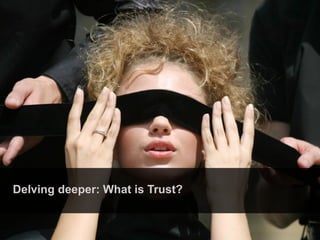
Delving deeper: What is Trust?
Trust What do we mean by ‘Trust’? Belief in your product and brand message; people want to know you mean  what you say Reliability – Your brand must consistently deliver a high measure of quality
Trust How do you get it? Deliver on your promises and  manage your reputation in an effective manner - ORM Practice what you preach – you must show tangible results of the service you offer By realising nothing escapes attention anymore; the truth will always out! Listen and act according to your users’ needs –neglect does not serve to instill trust
Trust What does it mean for your brand? It makes sure you retain a positive reputation on a global basis, not just locally  Trust is a precious commodity, moreso given the growth of social media and WOM  One bad word, if mismanaged, can lead to disaster:  ‘Trust’ - via ORM – controls this Immortalization – once a record of an incident exists, it does so forever. People forget; search engines do not. Employing specific techniques to effectively manage these records is crucial to maintaining trust.
A Focus on Online Reputation Management - ORM
ORM What is Online Reputation Management? Online Reputation Management or ORM is ensuring you achieve and maintain a positive reputation through the careful management of online information pertaining to your brand.
ORM What does it require? Careful management of content  you  create that is related to your brand Consideration and awareness of  3 rd  parties’ comments  related to your brand Permitting interplay of these aspects whilst monitoring  public reaction   to your brand Avoid being seen influencing online reputation through censorship or  ‘cyber-bullying’ Tact and intelligence dealing with negativity Analytics – track keywords and tagging applied to your brand, and act  upon them
ORM What can it achieve for your brand? SEO – very few people go beyond the first page of results using a given search engine; successful ORM ensures that what they see is entirely positive in tone A positive, trustworthy reputation Consumer confidence and, hopefully, an increase in sales
ORM in Action:   The Good, the Bad and the (potentially) Ugly
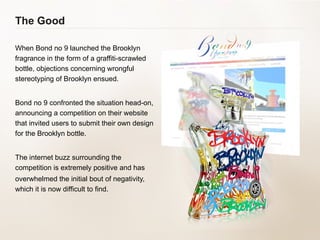
The Good When Bond no 9 launched the Brooklyn fragrance in the form of a graffiti-scrawled bottle, objections concerning wrongful stereotyping of Brooklyn ensued. Bond no 9 confronted the situation head-on, announcing a competition on their website that invited users to submit their own design for the Brooklyn bottle.  The internet buzz surrounding the competition is extremely positive and has overwhelmed the initial bout of negativity, which it is now difficult to find.
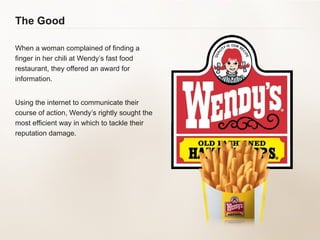
The Good When a woman complained of finding a finger in her chili at Wendy’s fast food restaurant, they offered an award for information. Using the internet to communicate their course of action, Wendy’s rightly sought the most efficient way in which to tackle their reputation damage.
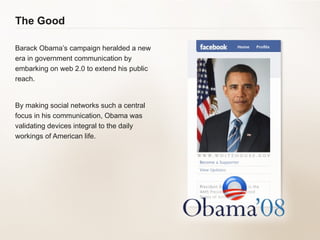
The Good Barack Obama’s campaign heralded a new era in government communication by embarking on web 2.0 to extend his public reach. By making social networks such a central focus in his communication, Obama was validating devices integral to the daily workings of American life.
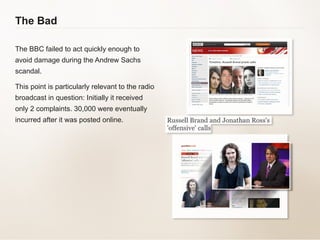
The Bad The BBC failed to act quickly enough to avoid damage during the Andrew Sachs scandal.  This point is particularly relevant to the radio broadcast in question: Initially it received only 2 complaints. 30,000 were eventually incurred after it was posted online.
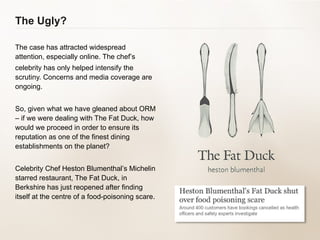
The Ugly? The case has attracted widespread attention, especially online. The chef’s celebrity has only helped intensify the scrutiny. Concerns and media coverage are ongoing. So, given what we have gleaned about ORM – if we were dealing with The Fat Duck, how would we proceed in order to ensure its reputation as one of the finest dining establishments on the planet? Celebrity Chef Heston Blumenthal’s Michelin starred restaurant, The Fat Duck, in Berkshire has just reopened after finding itself at the centre of a food-poisoning scare.
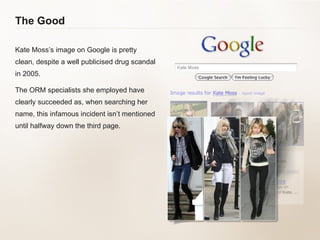
The Good Kate Moss’s image on Google is pretty clean, despite a well publicised drug scandal in 2005.  The ORM specialists she employed have clearly succeeded as, when searching her name, this infamous incident isn’t mentioned until halfway down the third page.
For more information on this presentation, the 5 pillars linking brand engagement to eCommerce, or to see what we do at Critical Mass, please feel free to stop by our stand for a chat. Thank you Online reputation management

Online Reputation Management

  • 1.
    Online Reputation ManagementBy Antonio Silano 16th March 2009
  • 2.
    Contents 1. Introduction2. Delving Deeper: What is Trust? 3. A focus on Online Reputation Management 4. ORM in Action Online reputation management
  • 3.
    Online reputation managementIntroduction Through our research, we have identified 5 key pillars that we believe connect brand experience to eCommerce: - Experience - Value - Simplicity - Inspiration - Trust This presentation focuses on Trust
  • 4.
  • 5.
    Trust What dowe mean by ‘Trust’? Belief in your product and brand message; people want to know you mean what you say Reliability – Your brand must consistently deliver a high measure of quality
  • 6.
    Trust How doyou get it? Deliver on your promises and manage your reputation in an effective manner - ORM Practice what you preach – you must show tangible results of the service you offer By realising nothing escapes attention anymore; the truth will always out! Listen and act according to your users’ needs –neglect does not serve to instill trust
  • 7.
    Trust What doesit mean for your brand? It makes sure you retain a positive reputation on a global basis, not just locally Trust is a precious commodity, moreso given the growth of social media and WOM One bad word, if mismanaged, can lead to disaster: ‘Trust’ - via ORM – controls this Immortalization – once a record of an incident exists, it does so forever. People forget; search engines do not. Employing specific techniques to effectively manage these records is crucial to maintaining trust.
  • 8.
    A Focus onOnline Reputation Management - ORM
  • 9.
    ORM What isOnline Reputation Management? Online Reputation Management or ORM is ensuring you achieve and maintain a positive reputation through the careful management of online information pertaining to your brand.
  • 10.
    ORM What doesit require? Careful management of content you create that is related to your brand Consideration and awareness of 3 rd parties’ comments related to your brand Permitting interplay of these aspects whilst monitoring public reaction to your brand Avoid being seen influencing online reputation through censorship or ‘cyber-bullying’ Tact and intelligence dealing with negativity Analytics – track keywords and tagging applied to your brand, and act upon them
  • 11.
    ORM What canit achieve for your brand? SEO – very few people go beyond the first page of results using a given search engine; successful ORM ensures that what they see is entirely positive in tone A positive, trustworthy reputation Consumer confidence and, hopefully, an increase in sales
  • 12.
    ORM in Action: The Good, the Bad and the (potentially) Ugly
  • 13.
    The Good WhenBond no 9 launched the Brooklyn fragrance in the form of a graffiti-scrawled bottle, objections concerning wrongful stereotyping of Brooklyn ensued. Bond no 9 confronted the situation head-on, announcing a competition on their website that invited users to submit their own design for the Brooklyn bottle. The internet buzz surrounding the competition is extremely positive and has overwhelmed the initial bout of negativity, which it is now difficult to find.
  • 14.
    The Good Whena woman complained of finding a finger in her chili at Wendy’s fast food restaurant, they offered an award for information. Using the internet to communicate their course of action, Wendy’s rightly sought the most efficient way in which to tackle their reputation damage.
  • 15.
    The Good BarackObama’s campaign heralded a new era in government communication by embarking on web 2.0 to extend his public reach. By making social networks such a central focus in his communication, Obama was validating devices integral to the daily workings of American life.
  • 16.
    The Bad TheBBC failed to act quickly enough to avoid damage during the Andrew Sachs scandal. This point is particularly relevant to the radio broadcast in question: Initially it received only 2 complaints. 30,000 were eventually incurred after it was posted online.
  • 17.
    The Ugly? Thecase has attracted widespread attention, especially online. The chef’s celebrity has only helped intensify the scrutiny. Concerns and media coverage are ongoing. So, given what we have gleaned about ORM – if we were dealing with The Fat Duck, how would we proceed in order to ensure its reputation as one of the finest dining establishments on the planet? Celebrity Chef Heston Blumenthal’s Michelin starred restaurant, The Fat Duck, in Berkshire has just reopened after finding itself at the centre of a food-poisoning scare.
  • 18.
    The Good KateMoss’s image on Google is pretty clean, despite a well publicised drug scandal in 2005. The ORM specialists she employed have clearly succeeded as, when searching her name, this infamous incident isn’t mentioned until halfway down the third page.
  • 19.
    For more informationon this presentation, the 5 pillars linking brand engagement to eCommerce, or to see what we do at Critical Mass, please feel free to stop by our stand for a chat. Thank you Online reputation management