INSIGHTS
INTO
GLOBAL
ONLINE
PAYMENTS
AND
ECOMMERCE
MARKET
ONLINE
PAYMENTS
MARKET
GUIDE
2014 The payments industry is ever-changing,
with a plethora of diverse issues. It is vital
for merchants to stay abreast of the latest
payments initiatives. The Online Payments
Market Guide is that positive reinforcement
needed for the many professionals that en-
dure these daily industry challenges
Danielle Nagao - Chief Executive Officer
MRC
Merchants and consumers benefit from
safe and user-friendly online payments so-
lutions. One-click buy solutions will profit
significantly from an interoperable e-ID
system. Given its importance for safety
and consumer trust, Ecommerce Europe
is pleased that The Paypers highlights the
development of e-ID
Elaine Oldhoff - Policy Advisor
Ecommerce Europe
ONLINE PAYMENTS
MARKET GUIDE 2014
INSIGHTS
INTO
GLOBAL
ONLINE
PAYMENTS
AND
ECOMMERCE MARKET
AUTHORS
Mirela Amariei
Tiberiu Avram
Ionela Barbuta
Simona Cristea
Sebastian Lupu
Mihaela Mihaila
Andreea Nita
Adriana Screpnic
RELEASE
VERSION 1.0
NOVEMBER 2014
COPYRIGHT © THE PAYPERS BV
ALL RIGHTS RESERVED
4 ONLINE PAYMENTS MARKET GUIDE 2014
Introduction
The Paypers is pleased to offer you for reading the Online
Payments Market Guide 2014, a state of-the-art overview of
the global online transaction services ecosystem and the most
complete and up-to-date reference source for online payments,
ecommerce and online banking-related information at global
level. This guide is published on a yearly basis by The Paypers,
the leading independent source of news and analyses for
professionals in the payment industry.
The fifth edition of the Online Payments Market Guide provides
an in-depth look at the global online transaction services
ecosystem, by combining insight from key stakeholders and top-
level industry thought leaders with a comprehensive overview of
market players. Voices from all areas of the online ecosystem –
payment service providers (PSPs), technology companies, banks,
industry associations, as well as top industry experts, have shared
in the present guide their vision on the main developments, current
and upcoming trends in the online payments and ecommerce
space or shared their experiences with specific online payment
services implementations.
From an ecommerce perspective, cross-border and multi-channel
remain essential strategies with significant impact on capturing
and harnessing the market potential. Cross-border ecommerce
has been developing at such a rapid pace that it has already
become one of the key generators of future business growth for
all participants in the industry, including payment gateways or
technology providers, merchants, postal and logistics companies.
The current unprecedented growth ecommerce is going through,
coupled with changing customer preferences, is reshaping the
traditional business models of retailers, blurring the (once very
clearly drawn) lines between online/mobile and offline commerce.
It is a generally acknowledged fact among the industry players
that retail has gone beyond store, mobile, tablet and even
language barriers. In a context in which buyers have become
increasingly more confident and comfortable shopping online and
the mobile device is becoming a key and popular shopping tool,
retailers must reshape their offerings in order to accommo­­date for
consumers’ new preferences. They should also focus on how the
bulk of their efforts could come to fruition by making a successful
offline-to-online transition or convergence, while also boosting
their revenues and looking to lower their costs.
As the omni-channel experience continues to change the way
businesses think about “channels”, PSPs continue to play a vital
role in the companies’ ecommerce process by leveraging their
business. As many online merchants are critical about the services
of their PSP, given the greater challenge of handling payments,
both online and offline, payment service providers need to
constantly re-examine the basis on which they deliver customer
propositions.
This year`s edition features a 2-part structure. Part 1 is dedicated
to thought leadership contributions and initiatives in the field of
online financial services, featuring various contextual approaches
for online transactions, as presented by key industry players,
either in the form of an exclusive interview or an elaborate article.
Cross-border ecommerce (with a particular focus on its drivers,
challenges and opportunities), omni-channel payments and
innovations, as well as the use and benefits of cryptocurrencies,
one-click buy developments, the regulatory landscape in Europe
and Asia, globalizing merchant strategies and building customer
loyalty are among the main topics to be addressed by these
industry players.
5KEY TRENDS AND DEVELOPMENTS IN THE ONLINE PAYMENTS & ECOMMERCE SPACE
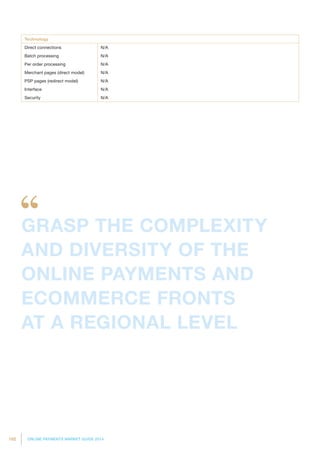
In order to grasp the complexity and diversity of the online
payments and ecommerce fronts, at a regional level, we have
dedicated a special section in our guide to the most recent trends
and developments in Asia-Pacific and Latin America. In Europe,
Russia definitely remains among the most interesting markets to
watch, due to its vast market harbouring enormous potential for
online and mobile commerce. Special attention has been given to
this particular country in order to offer in-depth insights into what
Russia has achieved so far on the online financial services front
and where the country is heading next.
As merchants, consumers and businesses will continue to try and
make the most out of this opportunity, online fraud stands out as
an important issue that all market players have to face. Due to
the increased sophistication of hackers and the proliferation of
stolen identities, industry players must protect themselves with
better mechanisms for mitigating fraud and reducing risks. Against
this backdrop, building trust online becomes key for the further
development of ecommerce. In December 2014, The Paypers will
publish the third edition of the Web Fraud Prevention, Security &
Digital Identity Market Guide, which includes the latest insights
into the online fraud, security and digital identity space. This report
will be featured in our Reports section here.
Part 2 presents in-depth company profiles mapping out key
players in the global online payments space, including processors,
acquirers and alternative payment methods. Furthermore, compa­
nies will also be featured in our most comprehensive PSP and
Alternative Payment Methods database which includes almost 500
players globally, allowing readers unprecedented access to global
industry players.
The Online Payments Market Guide 2014 is a great means
to stay informed and keep up to date with the latest industry
perspectives, trends and developments, a highly useful document
that should be kept at hand at all times. Finally, this document has
been put together with the utmost care. If you discover that, despite
our efforts, it features information that is unclear or erroneous, we
very much appreciate your feedback.
Adriana Screpnic,
Editor-in-Chief, The Paypers
For any feedback, please feel free to drop us a line at any time at
editor@thepaypers.com
6 ONLINE PAYMENTS MARKET GUIDE 2014
4 	 INTRODUCTION
8	 THOUGHT LEADERSHIP SECTION
9	 FINANCIAL COMPLEXITY IN A MULTI-CHANNEL WORLD
10	 Omni-Channel Payments: Jet Fuel for Retailers | Roelant Prins, Chief Commercial Officer, Adyen
12	 How White Label Solutions can Help mPOS and Omni-Channel Payments | Ralf Gladis, CEO, Computop
14	 Payments & Omni-Channel Innovations: How to Stay Ahead of the Curve | Wendy Dobson, Director of Sales, DataCash
16	 Exclusive interview with Thomas Staudt & Philippe Lazare | CEOs GlobalCollect & Ingenico
18	 Advanced Fulfilment Models Shape European Retail | Miya Knights, Senior Research Analyst  Luca Bonacina,
Senior Research Analyst, IDC Retail Insights
21	 ECOMMERCE. A CROSS-BORDER STORY
22	 How to Make Cross-Border Ecommerce Profitable | Gijs op de Weegh, COO, Payvision
24	 Global Cross-Border B2C Ecommerce: Growth Potential and Challenges | Yuecel Yelken, CEO and Founder, yStats.com
26	Ten Factors in Finding the Right People to Expand your Business | Jordan Lawrence, Commercial Director,
Payments and Cards Network
29	 ALTERNATIVE PAYMENT METHODS - IN FOCUS
30	Ecommerce Merchants Enjoy Borderless Expansion with Online Banking | Stefan Backlund, Head of Marketing 
Communications, Trustly
32	 The Payment Revolution is Underway | Christophe Duquenne, CTO, Worldline
34	 Going Global by Acting Local | Souheil Badran, Senior Vice President  General Manager, Digital River World Payments
37	 CONVERSION AND RETENTION - KEY ELEMENTS FOR A DIGITAL STRATEGY
38	 How to Make the Checkout Process Easy for Online Customers | Kostas Papageorgiou, Content Marketing Manager, Paymill
40	 Three Ways to Improve Recurring Revenue | Craig Vodnik, Co-founder and Vice President of Operations, cleverbridge
42	 Influencing Behaviour and Inspiring Change to Build Customer Loyalty | Shane Fitzpatrick, President and Managing Director,
Chase Paymentech
44	 PAYONE's Payment Solutions for the German Online Retailer Blutsgeschwister | Jan Sperber, Sales Director, PAYONE
46	 Exclusive interview with Elaine Oldhoff | Policy Advisor, Ecommerce Europe
48	 Why You Need a Payment Manager and the Impact It Has on Revenue | Victor Bacre, Online Payments Professional
51	 MOBILE PAYMENTS: REVOLUTION OR EVOLUTIONARY PROCESS?
52	 Exclusive interview with Christian von Hammel-Bonten | Executive Vice President Telecommunications, Wirecard
54	On the Verge of a Mobile Payment Revolution. Debunking the Myths that Are Hampering Widespread Adoption of M-payment
Solutions | Nils Winkler, Board Member, EPIF
Table of contents
7KEY TRENDS AND DEVELOPMENTS IN THE ONLINE PAYMENTS  ECOMMERCE SPACE
57	 WHAT WE NEED TO KNOW ABOUT CRYPTOCURRENCIES
58	 Exclusive interview with David Berger | Founder  CEO Digital Currency Council
60	 Cryptocurrency is not about the currency: Finding Bitcoin’s Killer App | Jacob Boersma, Senior Consultant, Innopay
62	 Why Russia Plays a Key Role in Bitcoin Development, What to Expect Next | Vladimir Grankin, Chairman, Ocean Bank
65	 THE REGULATORY LANDSCAPE IN EUROPE AND CHINA
66	 Lowering Consumer Protection Standards Defeats Payment Innovation | Javier Santamaría, Chair, European Payments Council
68	 7 Legal Challenges for Ecommerce in Europe | Edwin Jacobs, Partner, time.lex
70	‘Payments Legislative Package’ –Status and Challenges from the New EU Regulators | Martin Bresson, Senior Policy Advisor 
Mandy Shi Lai, Public Affairs Specialist, FleishmanHillard Brussels
72	 Ecommerce in China and Its Legal Options | Lac Tran, EVP Global Ecommerce, Web2Asia
75	 REGIONAL/ LOCAL DEVELOPMENTS: A SNAPSHOT: LATIN AMERICA
76	 Braspag: Aware of Its Role in Improving Customers' Ecommerce Experience | Gastão Mattos, CEO, Braspag
78	 The Secret to Success in Latin America | Martin Schrimpff, Co-founder and VP of Business Development, PayU Latam
81	 REGIONAL/ LOCAL DEVELOPMENTS: A SNAPSHOT: ASIA PACIFIC
82	 Globalising Merchant Strategy and Why Asia-Pacific Needs Attention | Christoph Tutsch, CEO and Founder, ONPEX
84	 Australian Payments – Is It All Beer and Skittles? | Duane Smith, Brisbane Lead, Australia, Payments Consulting Network
87	 REGIONAL/ LOCAL DEVELOPMENTS: A SNAPSHOT: RUSSIA
88	 The “Russian Payment Jungle” | Adrien Henni, Chief Editor and Co-founder, East-West Digital News
90	The Growing Internationalisation of Russian Ecommerce | Alexander Ivanov, President, National Association of Mail Ordering
and Distance Selling of Russia
92	Unique and Universal: Russian E-payment Market in a Global Perspective | Dr. Victor Dostov, President, Russian Electronic
Money Association
95	 THE PAYMENTS INDUSTRY WITHIN ECOMMERCE - WHERE TO?
96	 Exclusive interview with Danielle Nagao, Chief Executive Officer and Michaela Verstraeten, Chair MRC Benchmarking
Committee | MRC
98	 Where Is the Ecommerce-Related Payments Ecosystem Heading to? | Adriana Screpnic, Editor-in-Chief, The Paypers
100	 UK Digital Payment Innovation | Masha Cilliers, Digital Payments Consultant, IMRG
102	COMPANY PROFILES
208 	 GLOSSARY
THOUGHT
LEADERSHIP:
KEY TRENDS
AND
DEVELOPMENTS
IN THE ONLINE
PAYMENTS 
ECOMMERCE
SPACE
FINANCIAL
COMPLEXITY
IN A
MULTI-CHANNEL
WORLD
10 ONLINE PAYMENTS MARKET GUIDE 2014
Omni-Channel Payments: Jet Fuel for Retailers
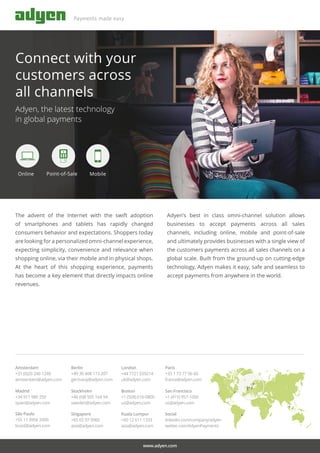
Adyen
Omni-channel is the macro trend shaking up the retail world,
and almost every retailer in the market is now making a serious
effort to implement a considered omni-channel offering. But while
plenty of retailers understand the value of providing a consistent
shopper experience across channels, less well understood is how
an omni-channel approach to payments fits in with the broader
omni-channel trend.
With this in mind, read on to find out three key ways that an omni-
channel approach to payments can benefit retailers, all the way to
the bottom line.
Release the Infinite Aisle…and improve shopper
experience
The Infinite Aisle is the concept that a shopper is able to purchase
whatever they want, without restrictions on time, location, channel,
or even what is available in store.
In a store environment, this might mean that a shopper wants a
different colour shirt to what is currently in stock. With an omni-
channel approach, they can go to the in-store tablet-assisted
sales terminal that carries the entire web-based inventory, choose
the colour they want, make the payment on the spot, and have
it delivered to the address of their choice. Adyen enables many
retailers to accept chip-and-PIN payments for these kind of orders
in store with the Adyen mobile point-of-sale (mPOS) solution.
The Infinite Aisle improves the shopper experience by giving the
shopper maximum control of when and how to make a purchase.
And the benefit for retailers is clear – they never have to refuse a
customer who wants to make a purchase again.
Access a treasure trove of cross-channel shopper data
Scenario one: A shopper downloads a retailer’s mobile app and
makes a purchase from the in-app inventory. The next time this
shopper visits a bricks-and-mortar store, an iBeacon picks up
that he is on the location by recognizing the app, and sends a
personalised marketing message to his phone.
Scenario two: A shopper makes a number of purchases from an
ecommerce website. Several months later, she goes shopping
while on vacation. At the checkout, the terminal recognizes the
shopper’s card, and the staff member adds a discount and a
personal thank you.
Scenario three: A shopper makes a purchase in-store and opts in to
allow the retailer to store his payment details for future use. A month
later, the shopper visits the merchant’s website, logs on, and uses
his stored card details to make a purchase with a single click.
Having access to cross-channel shopper data gives merchants
a treasure trove of information that can be analysed for patterns
across online and offline, and utilised for customer retention
and loyalty marketing purposes. As merchants are now moving
past planning and into reality with their omni-channel offerings,
this particular aspect of the omni-channel trend has enormous
potential to significantly improve the shopper experience in the
near future.
Slash finance and operations costs
Before, international merchants needed a terminal provider, an
integrator and a payment partner in each country of operation, for
each sales channel. This meant multiple contracts and relationships
to manage, and reporting and money flows to consolidate. In fact,
even now many retailers have over 40 acquiring bank contracts and
relationships across Europe to manage, each of which provides
part of the company’s in-store payment solution. This represents an
enormous investment in managing reports and financial flows.
However, with a single centralised platform such as Adyen that
enables businesses to accept and process payments across
multiple markets, retailers can drastically simplify these processes
and cut down on the human and financial investments needed to
manage their payment acceptance.
11KEY TRENDS AND DEVELOPMENTS IN THE ONLINE PAYMENTS  ECOMMERCE SPACE
Roelant Prins
Chief Commercial Officer
Adyen
About the author: Roelant is the Chief
Commercial Officer at Adyen and an omni-
channel payments evangelist for global
businesses. Prior to joining Adyen, he managed
the team responsible for corporate sales in
the UK for the payments division within Royal
Bank of Scotland Group.
About Adyen: Adyen is a global provider
of international and omni-channel payment
solutions. It holds full acquiring licenses for
Visa, MasterCard, American Express, Diners,
Discover, JCB, and UnionPay schemes, and
processes over 250 local payment methods
and 187 transaction currencies, working
with merchants including Airbnb, Groupon,
Evernote, Yelp, Spotify, Vodafone, Mango,
Booking, Indiegogo, and KLM.
www.adyen.com
Grow sales across social media and other channels
In terms of payments, omni-channel is often thought of as
the sweet spot between mobile (including in-app and mobile-
optimised websites), ecommerce, and in-store. But social media
is an underutilised channel to connect with shoppers and grow
sales. For example, KLM accepts requests for upgrades, flight
changes, and add-on services across Twitter and Facebook, as
well as e-mail. Once a request is received, KLM responds with
a link to a payment page. Merchants that are deploying social
media payment strategies, such as KLM, are achieving significant
additional revenue through this new sales channel.
How to choose a true omni-channel payments plat­
form
The benefits of a mature omni-channel payments strategy are
enormous. But not all Payment Service Providers (PSPs) are built
the same. While many offer desktop/mobile functionality, they
either do not offer an in-store point-of-sale integration, or if they
do, it is with a separate integration that does not allow for easy
cross-channel analytics and reporting.
However, the Adyen platform is changing payments by bringing
its internet-based technology to in-store as well, making it a true
omni-channel solution. Because it has one single solution and
back-office that operates seamlessly across desktop, mobile, and
in-store, all backed up by best-in-class analytics and reporting, it
gives retailers two game changing advantages. These are:
1. The ability to operate seamless cross-channel payments on a
global scale.
2. An equally valuable ability to have this rich, global cross-channel
shopper data available in a single back-office and reporting
system.
With the Adyen platform in place, merchants such as Superdry,
Moss Bros, de Bijenkorf, KLM, and Mango are adding jet fuel to
their omni-channel offerings by not just reducing costs and giving
customers the power of choice, but also unlocking tremendously
valuable cross-channel shopper data and using it to craft
exceptional shopper experiences.
12 ONLINE PAYMENTS MARKET GUIDE 2014
How White Label Solutions can Help mPOS and Omni-Channel Payments
Computop
Even if we find ways to connect to many acquirers, the number
of end-to-end approval procedures with those acquirers will take
a lot of time and resources. The truth is that we may have good
solutions out there, but our industry can’t really cover omni-
channel requirements, yet.
Let’s face it: This is a major challenge for the payments industry,
and there are more requirements to add For acquiring banks,
ISOs and PSPs, this represents a costly challenge that requires
significant upfront investment and effort - encompassing not only
data security requirements but also everything from delivering
appropriate domestic payment options to managing other local,
legal and regulatory requirements, risk management and fraud
prevention in the payment process. All of which inhibits time to
market and makes Do‐It‐Yourself solutions risky and potentially
expensive. Let’s explore this further.
Managing complex payment landscapes and preven­
ting fraud
The global payment landscape is complex, especially in
geographies like Europe, Asia or Latin America. Banks and PSPs
have to consider and navigate an array of payment options that
include online payments to wallet systems, local debit card
schemes or immediate transfers and secure invoice payment.
Resolving this means establishing bank relations and connecting
to dozens of payment solutions, potentially managing up to
30 contractual relationships to ensure the payment methods
European consumers and businesses expect, for example, are
available. Also, prices have to be posted in EUR, GBP and a range
of non‐EU currencies that take into account the Nordics as well as
Central and Eastern European countries.
For banks and PSPs, getting it wrong risks seriously inhibiting
the ability of customers they serve to successfully transact in
their target country markets. But it doesn’t end there. Ensuring
customer data security, preventing fraud and guaranteeing
payments is critical when conducting business across borders or
overseas.
Finally, all of the bits and pieces are falling into place: tablets,
smartphones, apps, retail grade mPOS devices, cash register
software and ecommerce platforms are ready for multichannel
commerce, including in-store sales. Years after we started preach­
ing multi-channel strategies the technology is now available, and
our industry is busy knitting everything together. Some of us already
have retail customers up-and-running with mPOS solutions. That’s
great, isn’t it?
We better think twice because opportunities and challenges are
huge. The context we now work in is omni-channel, including
in-store business. Retailers will use their online shops on tablets
in-store, and sales personnel will not only sell online shop items
but also use tablets as mobile cash registers. Easy, right?
Three good reasons to be concerned
Not so fast. Omni-channel payments are challenging on three
different levels. First, we have to cover all online payments
globally over all channels. Only a few payment service providers
(PSPs) are close to covering that requirement. Second, we have to
introduce Point-to-Point-Encryption (P2PE) technology because it
is mandatory for mPOS payments. At Computop, it took us over
EUR 1 million for hardware and software and more than a year of
implementation efforts to introduce and certify EMV with P2PE.
That’s costly and a time-to-market issue. However, P2PE is worth
the effort because it takes our retailers’ POS activities out of the
PCI scope which significantly reduces their efforts and costs.
And third, POS payments are domestic solutions, but online shops
are global. An omni-channel merchant needs a PSP who can
handle all payments on all channels globally. To provide merchants
with omni-channel reports, loyalty solutions and fraud intelligence
a PSP needs to run online, mobile and POS payments in each and
every country. And if that’s not enough, then try to find an acquirer
with global card processing for ecommerce and POS – there is
no such thing. In order to cover retail customers’ multi-channel
requirements including POS - PSPs have to connect to dozens of
acquirers worldwide and run approval procedures for every POS
device or Kernel with each and every acquirer.
13KEY TRENDS AND DEVELOPMENTS IN THE ONLINE PAYMENTS  ECOMMERCE SPACE
About the author: Ralf Gladis is the co-founder
and CEO of Computop, a leading global payment
service provider.
About Computop: Computop is a leading global
payment service provider (PSP) that provides
compliant and secure payment and fraud
management for ecommerce, MOTO, Point of
Sale (PoS) and mobile solutions.
For more information, about Computop’s white
label solution, contact psp@computop.com
www.computop.com
Ralf Gladis
CEO
Computop
The maintenance and continuous changes of software, the
observation of new banking rules and the requirements of
verification services demand more time, effort and money.
Yet, opera­ting multiple systems and interfaces makes it difficult
to undertake effective data security and fraud prevention in the
payment process and ensure seamless payment processing.
The good news is there is a better way.
Partnering with Computop
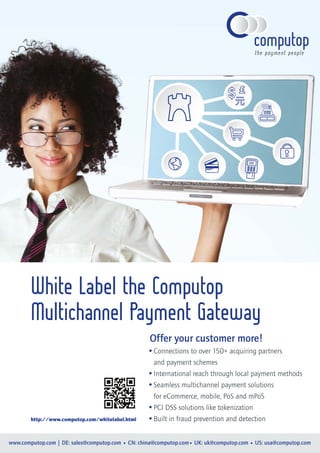
Available as a white label solution, Computop Paygate platform is
a powerful payment solution with one interface but incorporates all
relevant local payment methods plus data security and extensive
fraud prevention capabilities. Computop Paygate delivers instant
access to over 150 payment methods and financial institutions,
including local and international payment options for ecommerce,
mobile payment and POS solutions, giving banks and PSPs the
ability to support their customers’ omni-channel transactions
anywhere in the world.
Examining the gains
The Computop Paygate white label solution makes it easy for
banks and PSPs to achieve significant cost savings while rapidly
facilitating payment processing and access to new geographies.
All of which is important for expanding their payment portfolio and
generating additional revenue streams.
With our ‘one‐stop‐shop’ to managing all the payment related
issues involved – including instant access to a technology platform
and eradicating the need to manage regulatory requirements,
processing, SSL certificates and encryption, customer facing
support or fraud management – Computop makes it easy for
customers to do business, wherever they may be, while ensuring
the brand stays uppermost in their mind.
14 ONLINE PAYMENTS MARKET GUIDE 2014
Payments  Omni-Channel Innovations: How to Stay Ahead of the Curve
DataCash
and eventually pay via the same mobile device online. It allows
customers to check out quicker by avoiding queues, but also
reduces staff costs. Some other retailers have also introduced
interactive kiosks inside their shops, enabling customers to easily
access additional product information and shop online while
in-store by simply selecting desired items on a touch screen kiosk
device, paying for them and even ordering items that are not
currently stocked.
With almost five billion mobile phones in the world, which actually
outstrips the number of plastic payment cards in issue, mobile
payments are certainly set to dominate the future of omni-channel
retail.
Emerging channels
While some retailers are still catching up with the latest mobile
developments and innovations, it is now becoming apparent that
consumers are very quick to actively look for new, more exciting
and fun ways to shop. We have noticed that new emerging
channels like TV-commerce and game console commerce are also
growing in popularity. With smart TVs entering the market just a
few years ago it was only a matter of time before consumers could
actually purchase things online directly from their TVs. Additionally,
according to a study released by Delivery Agent, a San Francisco-
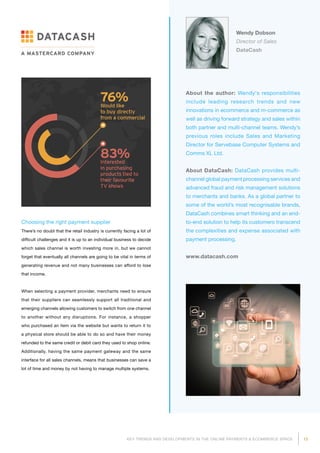
based provider of shopping-enabled entertainment, 82% of
respondents are interested in purchasing products tied to their
favourite TV shows and 76% of survey takers said they would like
to buy directly from a commercial.
If we look into general buying habits and existing TV sales channels
like QVC, we see that buying something through a TV actually
isn’t anything new. The new trend in TV-commerce, however, is all
about innovation, convenience and fun as it allows consumers to
browse their favourite products, compare them and finally make
a purchase in a few clicks via a remote control or a smartphone,
instead of having to contact the call centre. Pretty much the same
process applies to buying through a game console, as long as it’s
connected to the internet.
In today’s retail environment, various economic forces and
financial constraints have made innovation-driven growth more
essential than at any other time in history. Businesses face the
need to stay ahead of continuously accelerating changes in buying
behaviour, strong pressure for rapid results, and a threat from
competitors that are aggressively pursuing their own innovation-
driven achievements.
However, to achieve true innovation in improving the customer
experience, merchants need to constantly focus their efforts on
making the digital purchasing journey even quicker and more
convenient. Smooth personalised customer experience has been
the norm for many web-based retailers for years and this is now
expected to transcend into physical stores, creating a truly omni-
channel retail environment that unites ecommerce, m-commerce
and the in-store shopping experience into one consistent
interaction with the brand.
Even though customers constantly seek for easier ways to shop
across different channels, they can often remain very cautious
towards new and unusual ways of payment. It is therefore important
to build their trust and confidence by ensuring that the process is
easy, secure and that selected payment provider is reliable, fully PCI
compliant and understands the latest industry trends.
Online, mobile and in-store becoming one
With Forrester expecting about 70% of all ecommerce purchases
to be made on mobile phones and tablets by 2018, having a
sound mobile strategy should be seen as a priority. Additionally,
it is estimated that in the next few years the percentage of tablet
buyers will outgrow the percentage of smartphone shoppers,
simply due to the fact that browsing on a larger screen is easier.
With this in mind, it is increasingly important for retailers to start
looking for ways to use mobile devices to deliver even more value
and convenience to customers regardless of whether they are
shopping in-store, online at home or online from within the physical
store. Some high-street chains already encourage shoppers to
‘check-in’ on their mobile phones or tablets when entering the
physical store, select items off the shelves by scanning barcodes
15KEY TRENDS AND DEVELOPMENTS IN THE ONLINE PAYMENTS  ECOMMERCE SPACE
Wendy Dobson
Director of Sales
DataCash
About the author: Wendy's responsibilities
include leading research trends and new
innovations in ecommerce and m-commerce as
well as driving forward strategy and sales within
both partner and multi-channel teams. Wendy’s
previous roles include Sales and Marketing
Director for Servebase Computer Systems and
Comms XL Ltd.
About DataCash: DataCash provides multi-
channel global payment processing services and
advanced fraud and risk management solutions
to merchants and banks. As a global partner to
some of the world’s most recognisable brands,
DataCash combines smart thinking and an end-
to-end solution to help its customers transcend
the complexities and expense associated with
payment processing.
www.datacash.com
Choosing the right payment supplier
There’s no doubt that the retail industry is currently facing a lot of
difficult challenges and it is up to an individual business to decide
which sales channel is worth investing more in, but we cannot
forget that eventually all channels are going to be vital in terms of
generating revenue and not many businesses can afford to lose
that income.
When selecting a payment provider, merchants need to ensure
that their suppliers can seamlessly support all traditional and
emerging channels allowing customers to switch from one channel
to another without any disruptions. For instance, a shopper
who purchased an item via the website but wants to return it to
a physical store should be able to do so and have their money
refunded to the same credit or debit card they used to shop online.
Additionally, having the same payment gateway and the same
interface for all sales channels, means that businesses can save a
lot of time and money by not having to manage multiple systems.
16 ONLINE PAYMENTS MARKET GUIDE 2014
Ingenico Group CEO Philippe Lazare and GlobalCollect CEO
Tom Staudt spoke with The Paypers about key trends in the
marketplace, the rationale for the acquisition, and the benefits it
creates for merchants.
Philippe, what was the strategic rationale for Ingenico
Group’s decision to acquire GlobalCollect?
Philippe Lazare: By acquiring GlobalCollect, we accelerate the
deployment of our strategy across all channels on a global scale,
especially in payment services and mobile payment. Thus we
consolidate our position as a global leader in seamless payment.
By adding GlobalCollect, a well-established full-service online
payment provider with a global footprint, we expand our time-
to-market advantage within the payment space, and rapidly
reinforce our position in cross-border ecommerce beyond Europe,
on a global scale. Adding GlobalCollect to Ingenico Group, helps
us create an unrivalled combination of geographical coverage,
acquirer and bank networks, and payment methods, in both
the physical and digital worlds. But most importantly, we gain
two decades of expertise in cross-border payment processing,
including services such as FX conversion or fraud management,
combined with a deep regional knowledge.
Tom, why did you consider Ingenico Group the best
candidate to take over GlobalCollect?
Tom Staudt: The global ecommerce market is rapidly growing in
size and complexity. We see new economies emerging and joining
the online marketplace. At the same time, consumers in mature
markets are increasingly comfortable with paying online, driven
by seamless, invisible means of online payment. We’re seeing
more and more devices connected and driving commerce, from
game consoles to smart TVs and from connected cars to wearable
devices such as the Apple Watch. The traditional line between
Card-Present and Card-Not-Present is increasingly blurred.
At the same time, we continue to focus on our full-service model,
which removes a layer of complexity for merchants. GlobalCollect’s
strategy as the most knowledgeable Payment Service Provider has
been to take a consultative approach and add value to merchants
by helping them optimise their payments strategy.
Combining our global cross-border payment processing expertise
with Ingenico Group’s multi-channel services will create great
opportunities for our clients by reducing payment complexity
across all channels and providing more payment alternatives to
drive new sale opportunities.
Philippe, with Ogone and now GlobalCollect, Ingenico
Group has acquired two PSP’s. How do you see these
work together?
Philippe Lazare: With GlobalCollect, Ingenico Group continues to
do two things: (1) expand further beyond payment terminals into
digital payments and (2) to simplify payment for our customers,
across all channels - in store, online and mobile – everywhere
across the world.
We believe that GlobalCollect is highly complementary to Ogone,
the leading pan-European online payment services provider we
acquired last year, whether in terms of geographical footprint,
customers or as a value proposition towards cross border
ecommerce solutions. For example, it will be a real game changer
in North America where we will provide payment solutions
across all sales channels, beyond smart terminals. In Europe, our
comprehensive value proposition for online payments benefits both
small and large customers increasing their business on a cross
border basis.
GlobalCollect
On September 30th, 2014, French payments company Ingenico Group closed the acquisition of GlobalCollect, one of the
few global full service payment providers. As such, the joint companies have a unique position in the payments space,
with an unrivalled presence in 170 countries, connections to more than 1,000 banks and acquirers, and acceptance of
more than 250 traditional and alternative payment methods, from in-store terminals to online and mobile solutions.
17KEY TRENDS AND DEVELOPMENTS IN THE ONLINE PAYMENTS  ECOMMERCE SPACE
About Thomas Staudt: Thomas Staudt is
CEO of GlobalCollect. Mr. Staudt is a business
veteran with over 25 years of experience in
leading global companies to success.
About Philippe Lazare: Philippe Lazare is the
Chairman and CEO of Ingenico. Before joining
Ingenico in 2007, he was EVP of La Poste and
CEO of its Retail activity.
About GlobalCollect: GlobalCollect, part
of Ingenico Group (Euronext: FR0000125346
- ING), is the most knowledgeable global
Payment Service Provider in the world. For more
information please visit: www.globalcollect.com
www.globalcollect.com
About Ingenico Group: Ingenico Group
(Euronext: FR0000125346 - ING) is the global
leader in seamless payment. Learn more at
www.ingenico.com and twitter.com/ingenico
www.ingenico.com
All in all, with the acquisition of GlobalCollect, we further move the
needle towards the online payment sphere, with more than one
third of our revenues derived from software / payment services.
How do you see payments evolving in the coming
years?
Philippe Lazare: Payment remains the universal and decisive
element connecting merchants and consumers in the purchase
act. Today, consumers dictate the rules: whether they are in
store, at home or on the street, and whatever the technology,
they want a fast, simple and secure purchasing experience using
their preferred payment method (a card, a device, a wallet such
as ApplePay or QR code based payment). All this drives more
complexity for the merchants eager to secure the sale as soon as
the consumer has made his purchasing decision.
In this context, merchants are looking for a trusted partner to
reduce payment complexity across all channels, in store, online
and mobile and provide more payment alternatives to create new
sales opportunities whilst enhancing consumer experience.
By leveraging our leading position in payment terminals, we have
expanded our services across the value chain towards digital
payment through key acquisitions in both the mobile and online
space with acquisitions such as Ogone and GlobalCollect. Today,
Ingenico Group has a unique position to provide merchants,
directly or indirectly, with a comprehensive portfolio of payment
solutions across all channels: in store, online and mobile.
Because we are agnostic, we open our universal network to any
merchant, bank/financial institution, or any innovative player
looking to enhance consumer experience.
Thomas Staudt
CEO
GlobalCollect
Philippe Lazare
Chairman and CEO
Ingenico
Today, consumers dictate the rules:
whether they are in store, at home or on
the street, and whatever the technology,
they want a fast, simple and secure
purchasing experience Philippe Lazare
18 ONLINE PAYMENTS MARKET GUIDE 2014
Advanced Fulfilment Models Shape European Retail
IDC Retail Insights
Earlier this year, the UK government announced plans to ease
restrictions on retailers extending their High Street shops to
facilitate ‘click-and-collect’ services. The move responds to
growing consumer-driven demand for omni-channel shopping
experiences crossing multiple sales channels. Click-and-collect
services span both offline and online channels, enabling the omni-
channel customer to shop whenever they want and obtain their
purchases wherever they want, at a time that is convenient for
them.
According to statistics compiled by UK telecomwatchdog, Ofcom,
UK consumers already spend more online than any other nation
in terms of online shopping as a percentage of total domestic
retail sales. Almost three-quarters also said they felt secure when
paying for products online (The International Communications
Market Report, Ofcom, December 2013 [PDF]). Although
industry estimates put online consumer spending at around
10% of retail sales worldwide, they point to rapid growth in this
channel. The UK plans, therefore, target the cannibalisation of
store-based sales to online channels or competitors, favouring
those merchants with both an online and physical presence. They
also support omni-channel retail models that make it possible
for customers to buy/reserve online (or ‘click’), and collect their
purchases from a collection point, like a store or locker.
Payments have a key role to play
Payments have also had a key role to play in the omni-channel
retail trends in the UK. As an early and widespread adopter
of credit and debit card payment facilities, as well as card-not-
present security mechanisms and distance selling regulations, the
UK has created an environment of consumer trust within which
online sales could flourish. This is evidenced by healthy CAGR of
21% in the number of cards with a payment function issued in the
country from 2010 to 2013 (European Central Bank, Payment
Statistics Data, 2010-2013). Given the geographic density of
its High Streets, retailers have gone on to embrace click-and-
collect as way of maximising digital investments by driving online
customers into their stores.
In return, consumers like it because it can offer them a cheaper
and more convenient local fulfilment and returns options,
while retailers can also exploit the added potential to increase
conversion rates and basket size, as well as boost store footfall.
The latest IDC research into the business initiatives and IT
priorities of Western European retailers suggests that increasing
pressure to source and fulfil against omni-channel customer
demand in shorter and shorter timeframes is leading merchants
to reassess their execution and distribution capabilities, including
delivery and shipment services (Business Strategy: Western
European Retailers' Business Initiatives and IT Priorities in
2014, IDC Retail Insights, September 2014). This area currently
represents approximately USD 700 million worth of IT investments
among merchants operating in Western Europe (EMEA Retail
2014 Top 10 Predictions, IDC Retail Insights, January 2014).
It also complements their work around commerce and payment
capabilities to make the omni-channel basket a reality.
Regional variation mirrors demand
In Western Europe, the landscape from country to country is more
heterogeneous. In fact, IDC research confirms that the UK is not
only the most mature country as far as omni-channel operations
are concerned, but it is also a pioneer when it comes to click-and-
collect services. France is also trying to capitalise on this demand,
but lags behind the UK. French omni-channel retailers (such as
Carrefour, Auchan, Leclerc, Leroy Merlin, Galeries Lafayette and
Oxylane being the most representative examples) have taken a
slight different approach to click-and collect services, investing
in drive-through models (either through stores or warehouses)
for large collections. Traditional store-based picking is also used
for deliveries as well. In contrast to the UK government, however,
its French counterpart has evaluated the possibility of forcing
retailers offering click-and-collect services to pay for a license
(‘Loi Duflot’). Moreover, the Tascom tax may negatively impact the
further development of click-and-collect services in this country
for medium and large-sized stores.
19KEY TRENDS AND DEVELOPMENTS IN THE ONLINE PAYMENTS  ECOMMERCE SPACE
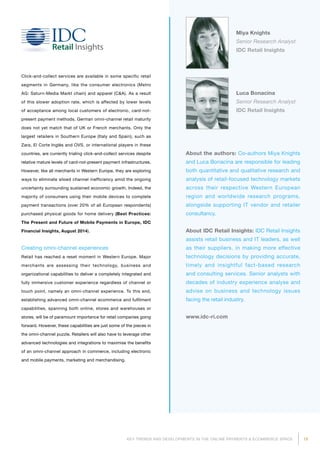
About the authors: Co-authors Miya Knights
and Luca Bonacina are responsible for leading
both quantitative and qualitative research and
analysis of retail-focused technology markets
across their respective Western European
region and worldwide research programs,
alongside supporting IT vendor and retailer
consultancy.
About IDC Retail Insights: IDC Retail Insights
assists retail business and IT leaders, as well
as their suppliers, in making more effective
technology decisions by providing accurate,
timely and insightful fact-based research
and consulting services. Senior analysts with
decades of industry experience analyse and
advise on business and technology issues
facing the retail industry.
www.idc-ri.com
Miya Knights
Senior Research Analyst
IDC Retail Insights
Luca Bonacina
Senior Research Analyst
IDC Retail Insights
Click-and-collect services are available in some specific retail
segments in Germany, like the consumer electronics (Metro
AG: Saturn-Media Markt chain) and apparel (CA). As a result
of this slower adoption rate, which is affected by lower levels
of acceptance among local customers of electronic, card-not-
present payment methods, German omni-channel retail maturity
does not yet match that of UK or French merchants. Only the
largest retailers in Southern Europe (Italy and Spain), such as
Zara, El Corte Inglés and OVS, or international players in these
countries, are currently trialing click-and-collect services despite
relative mature levels of card-not-present payment infrastructures.
However, like all merchants in Western Europe, they are exploring
ways to eliminate siloed channel inefficiency amid the ongoing
uncertainty surrounding sustained economic growth. Indeed, the
majority of consumers using their mobile devices to complete
payment transactions (over 20% of all European respondents)
purchased physical goods for home delivery (Best Practices:
The Present and Future of Mobile Payments in Europe, IDC
Financial Insights, August 2014).
Creating omni-channel experiences
Retail has reached a reset moment in Western Europe. Major
merchants are assessing their technology, business and
organizational capabilities to deliver a completely integrated and
fully immersive customer experience regardless of channel or
touch point, namely an omni-channel experience. To this end,
establishing advanced omni-channel ecommerce and fulfilment
capabilities, spanning both online, stores and warehouses or
stores, will be of paramount importance for retail companies going
forward. However, these capabilities are just some of the pieces in
the omni-channel puzzle. Retailers will also have to leverage other
advanced technologies and integrations to maximise the benefits
of an omni-channel approach in commerce, including electronic
and mobile payments, marketing and merchandising.
CROSS-BORDER ECOMMERCE
RESEARCH SECTION
THE COUNTRY REPORTS CAN BE DOWNLOADED FOR FREE VIA THE PAYPERS
The Paypers, in close collaboration with the Cross-Border Ecommerce Community (CBEC), a strategic
initiative started by Payvision, PAY.ON, ReD and WorldItLawyers has launched a new section called
Cross-border Ecommerce Research.
Through The Paypers, the CBEC enables Merchants, Payment Service Providers, ISOs and Acquiring
Banks to access country and regional ecommerce facts, figures and insights - valuable content about
mature and developing markets that can support strategic decision-making. The obstacles which hinder
cross-border expansion are explored, and the payment methods, ecommerce law, online fraud and risk
issues that affect individual countries are addressed.
The newly introduced section currently offers Cross-border ecommerce Reports  Infographics for
major countries from all over the world. Research consists of country-specific Ecommerce facts  figures,
mature and emerging markets, preferred payment methods, payment service providers, risk and fraud as
well as ecommerce legislation  regulation.
The section will be continuously updated with all the major and emerging ecommerce countries.
Cross-border ecommerce is a topic of interest to merchants across the globe. There is
much to play for, but the challenges are also significant and this initiative will help merchants
to gain a better understanding of the countries and payment environments into which they
are seeking to expand. The contributing companies bring complementary experience to the
table and the initial outputs combine a wealth of data and insight that isn’t available in one
place anywhere else. I salute the companies involved in bringing this together
Johannes Ditterich, CEO Limango - Germany's leading web merchant, and part of Otto Group
ECOMMERCE. A
CROSS-BORDER
STORY
22 ONLINE PAYMENTS MARKET GUIDE 2014
How to Make Cross-Border Ecommerce Profitable
Payvision
Growth slowing in established markets
Ecommerce, as an industry, is now two decades old and it is
booming. In 2013, global ecommerce sales topped USD 1.25
trillion, according to reports by eMarketer.com. Sales are forecast
to hit USD 1.5 trillion by the end of 2014.
But the engines driving global ecommerce are shifting gear.
Established markets are witnessing a growth downturn, while
emerging markets are now taking centre stage. In North America
and Western and Central Europe, ecommerce growth is tailing
off where saturation points are being reached. For the first time,
China outstripped the US in ecommerce sales; USD 296 billion
and USD 262 billion, respectively.
Merchants in the West are more frequently pursuing cross-border
ecommerce to maintain their online business momentum.
Our latest Payvision research, an annual white paper entitled Key
Business Drivers and Opportunities in Cross-Border Ecommerce,
is the product of a collaborative survey with CardNotPresent.com.
Merchants, PSPs, acquirers and consultants were polled on their
cross-border strategies, drivers and challenges. In 2014, industry
experts from HSBC, Realex and EBANX, as well as executives
from a major card brand and a successful mobile payment app
were also interviewed, giving their candid opinions on cross-border
ecommerce as a profitable business.
The growth of cross-border ecommerce as a viable
business driver
Our annual, in-depth research on this topic indicates that cross-
border ecommerce is no longer an unexplored landscape for
merchants.
We can see a significantly greater uptake of cross-border expansion
since the 2013 survey. Merchants have identified how to truly drive
profit in overseas markets by exploring preferred payment methods,
local cultures and favoured customer experiences. Our 2014 white
paper outlines these strategic business decisions, offering advice
to merchants who are still deterred by the complexities of entering
overseas markets.
The year of the mobile
In the 2014 white paper, mobile commerce is universally
identified as a true game changer to cross-border ecommerce,
compared to previous years. Established, convenience-driven
markets such as the US and the UK are enjoying more accessible,
on-the-go shopping. Emerging Asian and Latin American markets
are witnessing phenomenal growth, thanks to mobile Internet
connectivity, opening up some markets for the first time.
In both cases, transparency and access to overseas brands has
never been easier for consumers, presenting real opportunities for
international expansion.
The potential of the East – strike while the iron’s hot
Despite an increasing number of merchants embracing cross-
border ecommerce, our survey revealed the majority prefer to
drive growth via markets in which language and culture are similar
to their own. This opinion is corroborated by the large flow of
cross-border ecommerce occurring between the US and the UK,
countries united by similar language and cultural preferences.
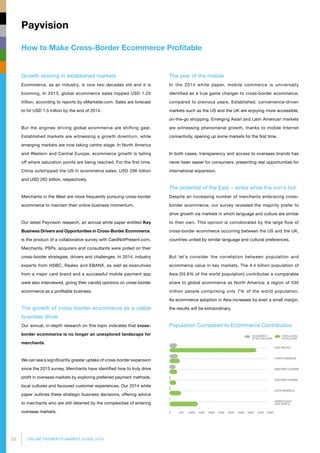
But let’s consider the correlation between population and
ecommerce value in key markets. The 4.4 billion population of
Asia (55.6% of the world population) contributes a comparable
share to global ecommerce as North America; a region of 530
million people comprising only 7% of the world population.
As ecommerce adoption in Asia increases by even a small margin,
the results will be extraordinary.
Population Compared to Ecommerce Contribution
23KEY TRENDS AND DEVELOPMENTS IN THE ONLINE PAYMENTS  ECOMMERCE SPACE
About the author: Gijs’s experience and great
knowledge in the complexity of Card Payment
Solutions have been fundamental in enabling
Payvision to develop innovative technical solu­tions
and strategic business alliances, which have
led to consistent business growth in terms of
geographical expansion and increasing profit.
About Payvision: As one of the fastest-growing
global acquiring networks in the world, Payvision
provides international payment solutions based
on ONE Secure Full-Service Payment Platform
for all ecommerce transactions. Enhanced with
innovative technology, Payvision serves over
300 Acquiring Banks, PSPs, ISOs and ~ 5,000
web merchants, processing over 100 million
transaction a year.
www.payvision.com
Gijs op de Weegh
COO
Payvision
The 2014 survey, however, indicates a reluctance by European
and North American merchants to tackle the emerging markets
in the East. This is despite recent government trade initiatives,
such as the Shanghai Free Trade Zone, to open up China to cross-
border import and export. With more Asian consumers buying
online, largely thanks to mobile Internet penetration, opportunities
in this region are now in abundance while competition, as it stands
today, is relatively limited.
By leveraging key insights from our latest Payvision research,
merchants with overseas aspirations can pursue a more profitable
cross-border ecommerce business.
To contribute to the growth and global expansion of our businesses
and industry, Payvision is constantly investing in market research.
As a founding partner of the Cross-Border Ecommerce
Communi­ty, Payvision focuses on sharing research and knowledge,
thus educating the ecommerce market in a variety of disciplines
and industries. This will ultimately boost (cross-border) ecommerce
globally for the benefit of all the companies and stakeholders in the
value chain.
Find out more information on the latest cross-border ecommerce
trends, drivers and challenges, as well as data on preferred payment
methods, domestic and cross-border ecommerce in the 2014 white
paper. Key Business Drivers and Opportunities in Cross-Border
Ecommerce is available to download from the Payvision website.
24 ONLINE PAYMENTS MARKET GUIDE 2014
Global Cross-Border B2C Ecommerce: Growth Potential and Challenges
yStats.com
Moreover, an important role in cross-border online sales is played
by online marketplaces, such as Rakuten, which allow smaller
merchants also to internationalise.
Even with recent growth, the potential for cross-border B2C
ecommerce remains largely untapped. Germany and France
rank next to the UK in Europe in terms of cross-border online
shoppers buying from these countries. But large German online
merchants such as Zalando and Bonprix focus on expanding local
operations to more countries and normally do not deliver across
the borders, while in France slightly below half of B2C ecommerce
companies choose not to sell internationally and of those who
do, a substantial share do not sell directly from France, working
instead through local subsidiaries abroad.
In order to exploit the opportunities offered by the booming cross-
border B2C ecommerce, online retailers need to take some key
points into account. First, tailoring the website to suit the targeted
foreign market, such as offering the website and customer service
in local language, could boost the number of foreign customers.
This point may be vital especially in emerging markets with lower
rates of English language knowledge. For example, despite the
known affiliation of wealthier consumers in the Middle East for
luxury products, less than 10% of luxury brands have Arabic
content on their website and still less have local websites in the
Middle East.
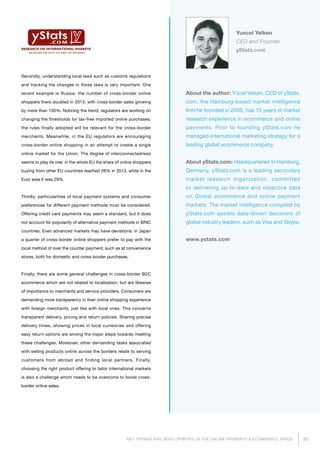
Cross-border B2C ecommerce is growing to a multi-billion global
market, providing both opportunities and challenges for players
on all sides - online merchants, payment providers, delivery
companies and online consumers.
Spurred by growth in online shopping globally and increased
inter­connectedness of the world, cross-border B2C ecommerce
between the key markets is growing at rates of over 20% annually
according to various estimates, faster than the global B2C
ecommerce taken in total. Those key markets feature both emerging
and advanced countries in terms of online retail on the side of
imports, as well as exports. For example, China and the US are
among the major destinations for cross-border online shoppers
worldwide, while Chinese and US online shoppers also actively buy
from abroad.
Hurrying to embark on the cross-border opportunities, online
merchants worldwide take different approaches: some operate
from a central location across all destinations, others prefer to
launch local online and offline stores to internationalise, while
still others carry out operations from a central location but have
marketing activities spread throughout international markets.
For instance, the US pure players Amazon and eBay, apart from
having local operations, also offer global shipping on eligible items
from central locations, while UK-based online clothing retailer
Asos and online book seller Book Depository offer worldwide
standard delivery free of charge for their product ranges.
25KEY TRENDS AND DEVELOPMENTS IN THE ONLINE PAYMENTS  ECOMMERCE SPACE
About the author: Yücel Yelken, CEO of yStats.
com, the Hamburg-based market intelligence
firm he founded in 2005, has 15 years of market
research experience in ecommerce and online
payments. Prior to founding yStats.com he
managed international marketing strategy for a
leading global ecommerce company.
About yStats.com: Headquartered in Hamburg,
Germany, yStats.com is a leading secondary
market research organization, committed
to delivering up-to-date and objective data
on Global ecommerce and online payment
markets. The market intelligence compiled by
yStats.com assists data-driven decisions of
global industry leaders, such as Visa and Skype.
www.ystats.com
Yuecel Yelken
CEO and Founder
yStats.com
Secondly, understanding local laws such as customs regulations
and tracking the changes in those laws is very important. One
recent example is Russia: the number of cross-border online
shoppers there doubled in 2013, with cross-border sales growing
by more than 100%. Noticing the trend, regulators are working on
changing the thresholds for tax-free imported online purchases;
the rules finally adopted will be relevant for the cross-border
merchants. Meanwhile, in the EU regulators are encouraging
cross-border online shopping in an attempt to create a single
online market for the Union. The degree of interconnectedness
seems to play its role: in the whole EU the share of online shoppers
buying from other EU countries reached 26% in 2013, while in the
Euro area it was 29%.
Thirdly, particularities of local payment systems and consumer
preferences for different payment methods must be considered.
Offering credit card payments may seem a standard, but it does
not account for popularity of alternative payment methods in BRIC
countries. Even advanced markets may have deviations: in Japan
a quarter of cross-border online shoppers prefer to pay with the
local method of over the counter payment, such as at convenience
stores, both for domestic and cross-border purchases.
Finally, there are some general challenges in cross-border B2C
ecommerce which are not related to localisation, but are likewise
of importance to merchants and service providers. Consumers are
demanding more transparency in their online shopping experience
with foreign merchants, just like with local ones. This concerns
transparent delivery, pricing and return policies. Sharing precise
delivery times, showing prices in local currencies and offering
easy return options are among the major steps towards meeting
these challenges. Moreover, other demanding tasks associated
with selling products online across the borders relate to serving
customers from abroad and finding local partners. Finally,
choosing the right product offering to tailor international markets
is also a challenge which needs to be overcome to boost cross-
border online sales.
26 ONLINE PAYMENTS MARKET GUIDE 2014
Ten Factors in Finding the Right People to Expand Your Business
Payments  Cards Network
4. Understand the market
The environment that you need to create for people to succeed
varies from person to person so it is important to be honest with
yourself as to what you can offer as an employer. For example, are
you a 3-man startup with funding trying to attract an international
sales director? If so, keep in mind that someone who has been
working for a bank or large corporate for 15 years may not be the
best fit.
5. Salary knowledge	
Do you know what it takes, financially speaking, to attract the
best people? If not, it is worth spending the money on a recent
salary survey to make sure you are not on the under or the over
paying side. This can be a real let down to the candidate in the
final rounds when you make an offer that is totally out of line with
market conform and it happens more than you think. Hiring a
professional recruitment company will take the headache out of
this also. You may think you cannot afford to work with agencies
but, with the right one, you will soon realize you cannot afford not
to work with them.
6. Local knowledge
It is important to understand the difference in cost of living
differentials from country to country. Many times, expanding
companies do not take this into account and offer a candidate
something they think is fair but do not take into account NET
earnings. Ensure you have this covered early in your budget and
remember to take into account local best practices in order to hire
top talent (ie. company cars, phones, relocation etc.). Again, a
global, professional recruitment company focusing on your niche,
should be able to provide you with the necessary tools to explore
the details varying from country to country.
Having the right people in place is crucial to the successful
expansion of any business, but finding them (and keeping them)
can be time consuming and challenging.
The payments industry is a small world but growing fast. So how
do you make sure you are attracting the top talent who fits within
your company?
1. Have clear goals
This seems obvious but unless you know exactly what you need
your new hire to achieve in the first 6 months, 1 year or 3 years,
do not even start looking. When you begin interviewing potential
candidates, you should be able to explain to them exactly what is
expected so you can ask them how they will set about achieving
the goals you have defined.
2. Get company-wide commitment
As your teams are the most vital aspect of expansion, ensure that
everyone is in agreement with and bought in to the expansion
move, as well as their understanding of the extra workload that
comes along with the move.
3. KNOW your USPs
You may think you have the best story on why top talent should
join your quest for global domination. However, you will be amazed
how many other businesses out there share similar thoughts. As
such, make sure you, your team and the entire company know
exactly why they joined teams, why you are perfect as a company
and how to spread the word in the best possible light.
27KEY TRENDS AND DEVELOPMENTS IN THE ONLINE PAYMENTS  ECOMMERCE SPACE
About the author: Jordan is the founder of the
Payments  Cards Network. Jordan has been
in ecommerce since 2002 owning large online
stores throughout the UK where he is originally
from. Switching to recruitment in 2007, Jordan
and his team have successfully built the largest
network in the Payments  Cards industry in
the world.
About Payments  Cards Network:
The Payments  Cards Network is dedicated
to the Payments industry. Adding value to
clients by offering innovative executive search,
recruitment and RPO solutions to international
clients. With offices in Cape Town, Hong
Kong and Amsterdam, a global outlook and
understanding of the market is in place to offer
the best advice and service on the market.
www.paymentsandcardsnetwork.com
Jordan Lawrence
Commercial Director
Payments  Cards
Network
7. Listen to your customers / targets
Make personal contact with your potential customers in the new
regions, explaining them that you are hiring in the area and would
like to hear what their specific needs are. Your goal is not only
hiring the right people, but also entering a different culture and
adapting seamlessly.
8. Incentivize your team
Offering your existing staff a bonus, if they successfully refer a
friend / contact who is then hired, is a good idea as they are then
incentivized to talk to their own network and, generally, are talking
to similar candidates as themselves.
9. Use an agency with a strong global network
The Payments  Cards Network have been working in the global
Payments  ecommerce space with major international companies
and the best names in the business for seven years. We have
helped our clients grow in many regions and can add value by
bridging the knowledge gap covering the above topics and adding
deep insight into your hiring process. We are committed to the
industry and passionate about the people in it.
10. Enjoy the journey
Expanding globally means you are achieving your goals and
making a success of all the effort you have put in so enjoy it!
Finding the right people is now a key task in moving forward but
be confident that the reason you are looking to hire is because you
have done amazingly well so far and will continue to do so moving
forward.
STAY INFORMED WITH THE PAYPERS!
editor@thepaypers.com
Your subscription package includes:
Full-year personal subscription to any 2 / all 3 Paypers premium newsletters
Newsletters with news, analysis, opinions and interviews
News | Paypers (daily/weekly headlines) with news and events
Newsletters delivered to 1-2 email addresses within your company
Also available on iPhone and Android!
Online | Paypers Mobile | Paypers E-invoicing | Paypers
ALTERNATIVE
PAYMENT
METHODS -
IN FOCUS
30 ONLINE PAYMENTS MARKET GUIDE 2014
Ecommerce Merchants Enjoy Borderless Expansion with Online Banking
Trustly
Trustly is a Fintech company that offers OBeP (Online Bank
e-Payment), similar to iDeal and enables consumers to execute
fast and secure payments directly from their bank accounts in 8
European markets.
Trustly’s view on global online bank payments
OBeP grows in importance as the means of authentication
become more user-friendly, simple and safe. OBeP has had a
strong position in Northern European countries like the Nordics,
Benelux and the DACH region and has manifested its position with
solid market shares. We can also see that consumers in Poland
and other eastern European countries have a strong preference
for OBeP as well. Similarities with European countries are found
in South America where the preference for OBeP in ecommerce is
strong in markets like Mexico and Brazil; two huge and relatively
untapped emerging ecommerce markets. China is a booming
ecommerce market and OBeP does not play a significant role there.
One of the striking similarities between Eastern Europe and parts
of South Americas is a higher penetration of banks but a lower
credit and debit card adoption. The unbanked population however
remains high still in SA. But with the growth of Internet on mobile
devices in South America, which is much higher than internet
on fixed lines, OBeP has the potential to capture the mobile
digital natives if the applications are meeting the consumer’s
expectations on the user experience. It will be interesting to follow.
At Trustly we are currently experiencing a fast European shift from
desktop to mobile and currently 20% of all transactions processed
by Trustly originates from a mobile device. The mobile share has
doubled over the course of 2014.
Marketing online bank payment successfully
For OBeP in ecommerce, consumer awareness is created by
accessibility in the market foremost. A shining example is from
the Netherlands where the banks joined forces and launched the
OBeP service iDeal in 2006. Seven years later, when 2013 was
summarized iDeal could enjoy a market share of 55% and 142.5
million historic transactions. Trustly see a similar growth pattern as
iDeal did in 2013 but spanning 9 geographies so far.
The success for OBeP is partly driven by providing a service that
has obvious value for the merchants, like real-time settlement. It
is also partly driven by a basic consumer need of safety and trust
in the authentication method the banks offer. Consideration to
use OBeP is created by offering a wide portfolio of bank brands
combined with the higher perceived ease of use against other
payment methods. Preference comes later when the service has
been tested and when the attributes of the product align with the
consumer experience of them.
What is important to remember is that Trustly offers OBeP, similar
to iDeal and is a type of payment method that the consumers
already have confidence in. The consumer is already customer of
the bank, thus he know how to log-in and to sign-off the purchase.
The basic understanding is already in place, and costly education
of the market can be avoided.
Furthermore, no registration is needed which in turn decreases the
friction and increases the conversion. The technology works as an
enabler for the consumer to establish a connection with his or her
bank on the merchant website, the consumer is never redirected
to another place for the actual payment.
Technology enables rapid expansion
The cooperation between banks, like with iDeal in the Netherlands
and Swish (money transfer) in Sweden is unique and but as taken
a long time to be developed. In Europe, partly because of the
traditionally strong competition within the banking sphere. And on
the global ecommerce arena there are even bigger challenges with
the lack of a harmonized financial sector.
Trustly can offer its services in any market as it operates freely
with an in-house developed proprietary overlay technology that
is independent of the banks. This means a low threshold when
entering a new market. It goes faster and faster. By the beginning
of 2015, Trustly will be enabled in 14 European countries. In the
beginning of 2014 we started off with 6.
31KEY TRENDS AND DEVELOPMENTS IN THE ONLINE PAYMENTS  ECOMMERCE SPACE
About the author: Stefan Backlund is Head
of Marketing and Communications at Trustly
since 2014 and has previously had consumer
marketing positions at Klarna and Philips.
About Trustly: Trustly is a Sweden-based
Fintech company that develops secure online
bank solutions for ecommerce. Founded in
2008, it currently processes more than 7 million
payments annually. It was ranked as one
of Sweden's fastest growing technology
compa­nies by 2013. Trustly is licensed and
supervised by the Swedish FSA.
www.trustly.com
Stefan Backlund
Head of Marketing
and Communications
Trustly
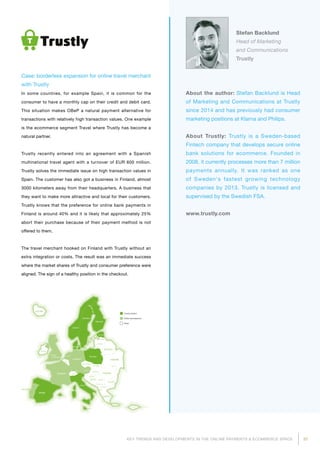
Case: borderless expansion for online travel merchant
with Trustly
In some countries, for example Spain, it is common for the
consumer to have a monthly cap on their credit and debit card.
This situation makes OBeP a natural payment alternative for
transactions with relatively high transaction values. One example
is the ecommerce segment Travel where Trustly has become a
natural partner.
Trustly recently entered into an agreement with a Spanish
multinational travel agent with a turnover of EUR 600 million.
Trustly solves the immediate issue on high transaction values in
Spain. The customer has also got a business in Finland, almost
3000 kilometers away from their headquarters. A business that
they want to make more attractive and local for their customers.
Trustly knows that the preference for online bank payments in
Finland is around 40% and it is likely that approximately 25%
abort their purchase because of their payment method is not
offered to them.
The travel merchant hooked on Finland with Trustly without an
extra integration or costs. The result was an immediate success
where the market shares of Trustly and consumer preference were
aligned. The sign of a healthy position in the checkout.
Trustly market
Under development
Other
32 ONLINE PAYMENTS MARKET GUIDE 2014
The Payment Revolution is Underway
Worldline
Due to the proliferation of payment means, connected objects and
new consumer habits, payment players’ strategies have evolved.
There is now a customer experience for every situation or even a
terminal for each type of product or service purchased.
As technology promotes new shopping experiences, innovation
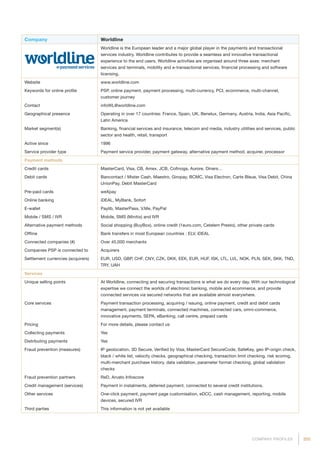
must also apply to payment methods. Today, two emerging means
of payment, namely online banking ePayment (OBeP) and wallets,
provide powerful complementarity to shape new, smart shopping
ergonomics thanks to which busy customers can order everyday
items whenever and wherever it suits them best.
Smart online banking security
Online banking ePayment (OBeP) provides a safe, simple way of
paying for online products and services, using the customer’s web
banking system. Its benefits are threefold.
First, OBeP enables customers to pay online relying solely on their
banks. This proves particularly suitable for customers who feel more
comfortable using a web banking environment to make payments,
are not keen on disclosing payment details online, or simply do not
want to adopt yet another payment instrument only to feel safe
while shopping on the internet. Additionally, it enables customers
who do not have access to cards to shop online.
Second, with OBeP, online merchants can take advantage of SEPA
payment instruments, such as Credit Transfers and SEPA Direct
Debits. When using OBeP for SEPA Credit Transfers, merchants
rely on a means of payment that is irrevocable, and when using
OBeP to authorise e-mandates, they can provide customers
with a very convenient way of payment for recurring goods and
services. MyBank, the pan-European OBeP solution, is available
to merchants through the Worldline payment gateway, Sips.
Third, OBeP places the bank at the heart of the online experience.
As the customer refers to their bank to make the payment, not only
can the bank authenticate its customer, but it can also cross-check
profile information and provide them with value-added services.
As online payments evolve mostly from goods to services purchases
and, ultimately, recurring purchases, merchants have to promote
payment methods that adapt to these trends. OBeP is certainly a
good way of achieving it.
From ecommerce to mobile
The digital wallet has existed for almost 15 years now, but its
expansion has only really taken off recently with the massive
adoption of smartphones. Since the beginning, it has evolved from
being a tool that makes online purchases easier and secure to
being the core element of a customer journey, regardless of the
place and type of customer interaction (remotely or in store).
Vault security for card data
Various wallet providers — merchants, telcos, banks and digital
players — have started designing easy enrolment and storage
services for cards using cloud-based vault containers. The concept
for the customer is quite simple: they register their banking card
credentials in a secure wallet, and the latter will trigger them off
to pay merchants whenever the customer needs it. Once one or
several card-based payment instruments are registered by the
customer, wallet providers can accurately analyse cardholders’
activity and prepare efficient, highly relevant marketing offers.
33KEY TRENDS AND DEVELOPMENTS IN THE ONLINE PAYMENTS  ECOMMERCE SPACE
About the author: Christophe Duquenne is
the Worldline Chief Technology Officer and
Director of the Merchant Services  Terminals
global business line. After directing the Group’s
French activities for six years, he joined the
global management team in July 2011. He is a
member of the executive committee of Atos SE
and has been CTO of the company since July
2013.
About Worldline: Worldline [Euronext:WLN] is
the European leader and a major global player in
the payments and transactional services industry.
Worldline contributes to provide a seamless and
innovative transactional experience to the end
users. Worldline activities are organised around
three axes: merchant services  terminals,
mobility  e-transactional services, financial
processing  software licensing.
www.worldline.com
Christophe Duquenne
CTO
Worldline
Using data anonymisation techniques, the right offers can reach
the right customers without any disclosure of sensitive data.
In addition to the third-party wallets like Paylib, a French wallet
created by 3 major French banks (Société Générale, BNP Paribas
and Banque Postale), Worldline enables merchants to offer their
own wallets, and thus provide one-click payment or facilitate
recurring payments. This key feature is very likely to increase
loyalty and repeat sales.
Not only cards in your wallet
Wallets for card storage are just the first stage of a broader
advanced customer identity service. Worldline has designed a full
set of value-added services based on card management and the
embedded PCI-DSS policy to make the user experience richer
before, during and after the payment. This includes micropayment
facilities, instalment payment facilities, budget monitoring, P2P
transfers, trusted authentication, couponing and ticketing storage,
store location service, generation of receipts serving as proof of
warranty.
To assist organisations with their wallet strategies, Worldline advises
them on how to set up these value-added services in a modular and
progressive way.
Worldline’s experience with live wallet projects enables its expert
teams to offer a forward-looking, scalable vision of the means of
pay­ment that best suit each particular ecommerce experience to
build long-lasting relationships with customers.
At Worldline, connecting and securing transactions for clients is
what our experts do on a daily basis. With technological expertise
that covers the whole payment value chain, and with billions of
highly critical transactions processed by its systems, Worldline
connects the electronic banking, mobile and ecommerce worlds,
and provides services through secure networks that are available
almost everywhere.
34 ONLINE PAYMENTS MARKET GUIDE 2014
Going Global by Acting Local
Digital River
Consumer demand for online commerce continues to grow
worldwide. The US, Western Europe and China, put together,
will generate more than USD 800 billion in online sales in 2014
(Wigder et al, 2014). To capture a slice of this online sales market,
merchants must adjust their globalisation strategies by localising
an international product or service for the culture where it is sold –
a concept that can be termed “glocalisation”.
To go “glocal”, merchants must do much more than translate
“shopping basket” to “warenkorb”. To establish a credible and
compliant presence in each country and find success in global
ecommerce, online stores, as well as associated support services,
must be extensively localised. Key regional differences to consider
include product offerings, currencies, taxation, payment methods
and even cultural values, which may vary from location to location.
Adjustments must also be made to ensure product fulfilment,
customer service, online marketing and export regulations
compliance function smoothly. The failure to localise sufficiently
will ultimately result in basket abandonment and loss of sales as
customers grow frustrated by unconventional practices used in an
online store.
Despite the complexities, merchants need to grab their share of
the growing global marketplace. Even when merchants’ efforts to
sell online are well executed in every way, they will only succeed
if their customers can pay them. Nowhere are online buyers more
nervous and vigilant than during the payment process when their
money is at risk. To gain the trust of shoppers, merchants need to
behave like a local company and make sure their online payment
and checkout processes, as well as fraud screening settings, are
adapted to local and regional purchase behaviours. Further, online
shoppers will likely abandon carts – and in turn a sale – if they
cannot use familiar currencies, whether conversion fees are too
high, or if merchants do not offer the payment methods that local
consumers prefer.
To gain consumers’ trust and lower cart abandonment rates
while increasing global reach, merchants must offer alternative
payments that are beyond traditional credits cards payments.
They must think in broader terms, plan ahead and optimise for
cross-border traffic. The end result is wider global reach and
better conversion rates.
Differences in payment preferences are deeply rooted in culture,
economics and politics. Shoppers in Brazil, as well as in Australia
and the Netherlands, for example, absolutely require the local
bank payment scheme. Whilst merchants can conduct ecommerce
in these regions without this option, they risk alienating potential
customers. Similarly, the majority of shoppers in Germany prefers
to pay using the local ELV solution; in France, debit cards are
preferred whereas shoppers in the Nordics often opt to pay by
invoice. The Asia-Pacific region favours payment options that are
often only relevant and useable in their domestic countries versus
more internationally accepted and recognised brands like PayPal
and bank transfers. Cash-on-delivery is popular in China and India
while many Europeans use online banking as a form of transferring
payments, something Americans often resist.
35KEY TRENDS AND DEVELOPMENTS IN THE ONLINE PAYMENTS  ECOMMERCE SPACE
About the author: Souheil Badran is the senior
vice president and general manager of Digital
River World Payments, leading all aspects of the
company’s global payments strategy, including
strategic development, sales and marketing,
product management, operations, mergers and
acquisitions.
About Digital River: Backed by 20 years
of ecommerce experience, Digital River is a
recognized leading global provider of Commerce-
as-a-Service solutions. All-sized companies rely
on Digital River’s multi-tenant, SaaS commerce,
payments and marketing services to manage
and grow online businesses. In 2013, Digital
River processed over USD 30 billion in online
transactions.
www.digitalriver.com
Souheil Badran
Senior Vice President and
General Manager
Digital River World
Payments
As you can see, these payment preferences vary greatly and
cannot be leveraged across all regions under a one-size-fits-it-all
mentality.
In addition to the differences in online payment preferences,
the payments industry also has seen an evolution from cash-
based to cashless transactions. Cashless options have gained
popularity and became the preferred method of payment in the
UK and US – but this is not the case in other nations. In fact, only
a small proportion of the world’s population have access to credit
– a situation which is not necessarily based on how much money
shoppers have in the bank. To successfully tap into the online
opportunities in regions of the world, where cash-based payment
preferences dominate, e-merchants first need to fully understand
the financial structures and cultural payment norms to build a
successful online payments program and offer locally accepted
alternatives.
The key point is that no single set of ecommerce practices and
payments work everywhere. Glocalised ecommerce requires local
and regional expertise to get it right. By localising your payments
program, you can significantly increase your conversion rates as
well as your authorisation rates. Typically, when payment authori­
sation rates drop to 70% or sales are 5-10% below expectations,
it’s time to invest in better localisation. To access more tips
about growing your global online sales, download Digital River’s
whitepaper, “Global Strategies for your Online Business” here.
Free
Registration
now open
www.rbtexpo.com
RBTE is where retailers come to find out the latest
payments news from mobile payments to biometrics,
data security to alternative payments
RBTE IS YOUR EVENT!
Meet leading retailers; find new partners; great networking;
product launches; dedicated Payments Conference;
over 300 exhibitors all under one roof
SEE THE
FUTURE OF
PAYMENTS
www.rbtexpo.com | +44 (0) 208 874 2728
10–11th
March 2015
Olympia Grand, London
CO-LOCATED
WITH RETAIL
DESIGN
EXPO
CONVERSION
AND
RETENTION -
KEY ELEMENTS
FOR A DIGITAL
STRATEGY
38 ONLINE PAYMENTS MARKET GUIDE 2014
How to Make the Checkout Process Easy for Online Customers
PAYMILL
4. Don’t redirect people
You worked so hard to get people to your website. Why send them
away to another website to pay? This is the main disadvantage of
using services that redirect people away from your website to a
checkout page.
Since you have no control over the design of the checkout page,
customers end up feeling as if they are giving their money to a
business other than the one they are buying from. Checking out
and paying will be the last thing people do – which is why you
want your business’s name to be the last thing they remember!
5. Make errors easy to fix
In an infographic by Invesp – losing customers due to submission
errors ranked in the top 10 of conversion problems during checkout.
Some checkout pages display an error message at the top of the
page, but people don’t realise they need to scroll all the way up to
find out what went wrong. Ideally, you want an error message to
appear in the field in which it occurred. You’ll also want people to
save their information, so they don’t have to re-enter it.
6. Ask for essential information only
Similar to when you’re building an email list, you want to limit
the amount of information you request to just the essentials!
Nothing kills a conversion more than having to fill out a form with
information that is not necessary for making a purchase.
What’s more, a report published by Forrester found that 11%
of US adults abandoned an online purchase because they either
didn’t want to register or the website was asking for too much
information. But if you absolutely need that extra information, e.g.
a phone number, make sure to include an explanation why it’s
required.
A checkout page is critical to achieving a high conversion rate.
It’s the final stop for people shopping on your website. It’s the
place where they hand over their payment information and finally
part with their hard-earned cash. This is why you need to have full
control over the entire checkout process.
Below you’ll find eight tips that will help merchants make the pay­
ment process easy for their customers:
1. Provide a number of payment methods
It sounds obvious, but there are online shops which only offer one
payment method. Data highlighted in an infographic from Milo
shows that 56% of respondents expect a variety of payment
options on the checkout page. While it’s not necessary – nor
practical – to offer every conceivable payment method available,
you’ll want to take a look at your target audience to see which are
most popular means of payment for them.
2. Allow guest checkout
A usability study by Smashing Magazine found that the main
reason users hate setting up an account is that they expect to be
flooded with promotional emails. To make sure you don’t lose out
on potential business – always provide the option to checkout as a
guest. Forcing people to sign up for an account can be considered
a bit too much, especially for first time visitors.
3. Deliver a seamless design
From a branding perspective, you want to keep everything as
consistent as possible. Certain online payment providers deliver
the front-end ready-made for you, but you give up control over the
look and feel of your checkout page. It’s also perfectly reasonable
for people to be skeptical when faced with a checkout page that
looks totally different from the website they were shopping on.
Keeping your checkout page consistent with your online store is a
great way to establish trust and avoid shopping cart abandonment.
39KEY TRENDS AND DEVELOPMENTS IN THE ONLINE PAYMENTS  ECOMMERCE SPACE
Kostas Papageorgiou
Content Marketing
Manager
PAYMILL
About the author: Kostas Papageorgiou
is responsible for content marketing and
community at PAYMILL. He has worked with
startups across Europe helping them develop
their marketing and communications. His
specialty is producing content that engages
and converts people into paying customers.
About PAYMILL: PAYMILL’s API lets merchants
accept credit and debit card payments directly
in their website and mobile application.
Businesses can process online payments
globally – enabling them to scale internationally
from the get-go. The API gives merchants full
control of their checkout, which lets them build
a UX optimised for conversions.
www.paymill.com
7. Provide reassurances on security and privacy
Whenever handling personal data, always go out of your way to
showcase the security measures you have in place. A survey by
eConsultancy found that 58% of respondents dropped out of the
checkout page due to concerns about payment security.
As pointed out earlier, delivering a consistent design and not
redirecting people to a third party checkout page are important
steps in building trust with potential customers. On your checkout
page be sure to display all your security credentials and measures
you have in place that protect your customers.
8. Have clear calls to action
Don’t leave people guessing what to do next! When someone adds
an item to their basket, make it crystal clear that they can “Continue
to checkout” or “Continue Shopping.” The trick is to make it specific
and avoid being ambiguous with CTAs like “Continue,” “Checkout,”
or “Apply.” The trick is to be specific about what you want your
customers to do next.
Conclusion…
While these tips are sure to decrease shopping cart abandonment
and make it easier for people to pay, it’s always a good idea to A/B
test different designs to find out what works best. As mentioned
earlier, your checkout page is where window shoppers turn into
paying customers.
Follow the tips mentioned above and you’ll not only increase sales,
but also create an enjoyable experience people will come back to.
40 ONLINE PAYMENTS MARKET GUIDE 2014
Three Ways to Improve Recurring Revenue
cleverbridge
The task for merchants is to focus on managing customers’
expectations. When implementing potentially disruptive new
features, make sure to provide your customers advanced
communication. However, don’t look at this situation as a complete
disadvantage. There are many benefits too. Merchants have the
opportunity to consistently create new value for their customers
in the form of shorter iteration cycles to include new features.
This prevents the user experience from growing stale or out of date
before the market is disrupted by newer and more agile players.
Renewing and adjusting licenses
One of the primary things merchants have to measure and analyse
in a subscription setting is not only how many users are renewing
every billing period, but are they upgrading or downgrading
licenses? Unfortunately, analysing upgrades or downgrades is a
tricky business and the first thing to do is define exactly what an
upgrade or downgrade is.
Let’s say a customer subscribes to a merchant’s Gold Service for
one year. When the time comes to renew, the customer switches
from the Gold to the Platinum Service, which costs more. That is
an upgrade.
But what if the subscriber switches to the Copper Service
(typically of lower value than the Gold Service) but adds ten more
seats to her license? Is that an upgrade or a downgrade? Maybe
it’s an upgrade because the merchant is driving more revenue. But
maybe the merchant is more interested in viewing upgrades and
downgrades in terms of product levels and not revenue.
It is up to each merchant to decide for themselves if an upgrade
refers to a product or to revenue and then measure that performance
accordingly.
The popularity of subscription licenses has changed the rules for
software vendors who must now struggle to take advantage of
recurring revenue while retaining each new customer for as long
as possible. Why is retaining subscribers so difficult? The answer
is related to how well merchants anticipate their subscribers’
needs. Here’s a pretty well-known secret: the better the customer
experience people have while using a product, receiving support
and buying and renewing their subscriptions, the better a vendor’s
churn rate will be. This post examines three ways merchants can
improve their subscription customer’s experience with their brand.
Product support and adding new features
Since subscription billing often accompanies cloud products
whose feature set can change day-by-day, it is vital for merchants
to manage customer expectations by communicating information
about new product features. This situation has its advantages for
merchants like no longer having to support legacy products or
worry about tracking license keys.
But this situation also complicates the buyer/seller relationship,
adding features that one segment of your users like but others
don’t. Your decision not to include a certain feature may alienate
some segments of your customers. This is especially problematic
if the addition or removal of valuable features comes with a price
adjustment for which the customer has not been adequately
prepared.
41KEY TRENDS AND DEVELOPMENTS IN THE ONLINE PAYMENTS  ECOMMERCE SPACE
Craig Vodnik
Co-founder and Vice
President of Operations
cleverbridge
About the author: Craig Vodnik is a co-founder
and the vice president of operations at
cleverbridge. He is also the author of Building
Keystones, a digital ecommerce industry
focused blog. You can connect with him on
Twitter, LinkedIn and Google+.
About cleverbridge: cleverbridge is a
pro­ven leader in ecommerce expertise,
technology and services for leading software
and cloud companies that serve consumers
and businesses. For more than 300 clients –
including Avira, Corel, Dell, Malwarebytes and
Parallels – cleverbridge is a true extension
of their teams, understanding each client’s
billing models, markets, channels and specific
ecommerce requirements.
www.cleverbridge.com
Self-service
Customers and merchants are forever busy and the need for
support is often viewed as an interruption from the main task at
hand. However, subscriptions by definition are built upon ongoing
relationships, and at some point, merchants have to be available
to support their customers’ requests.
One of the biggest favours merchants can do for their customers
is to not make them completely dependent on email or phone-
based customer service. For starters, merchants can offer self-
service options for renewals. They should give their customers
different options for updating their payment methods as well as
billing intervals. Merchants don’t want a billing event to arrive and
the customer is unable to pay.
Merchants who implement this kind of self-service for recurring
customers aren’t just helping their customers. Self-service helps
merchants reduce the need for a lot of manual adjustments.
The benefit of ecommerce is that, unlike brick-and-mortar stores,
the merchant doesn’t have to be present in order to facilitate a
sale. But the more manual adjustments they have to make for
their customers, the less they are taking advantage of the benefits
of ecommerce and also the less time they have to improve their
business.
Gone are the days when your relationship with your buyers ended
after they submitted payment. More and more, customers are
empowered to demand service their way. It’s your job to make
sure that your subscription business is designed to provide the
kind of service your customers need.
42 ONLINE PAYMENTS MARKET GUIDE 2014
Influencing Behaviour and Inspiring Change to Build Customer Loyalty
Chase Paymentech
Secondly, consumers want an online shopping experience
that makes it as simple and easy as possible to make repeat
purchases, and which offers consumers a secure method through
which to make their purchases. They want to be able to find and
buy a product without experiencing problems logging into their
account or having to re-enter their personal details.
Thirdly, customers want to feel appreciated and listened to.
The way in which you market to customers, answer their questions,
respond to their complaints or reward them for their loyalty can
impact customer appreciation. Using data from loyalty programs,
social media and prior transactions can give businesses the
ability to acknowledge customers and personalise their shopping
experience based on their preferences and behaviour.
3. Embrace new ways to make the checkout process
easier
According to research carried out by Chase Paymentech, a poor
checkout experience is enough to prevent as many as eight
out of ten UK consumers from returning to a website or mobile
application again in the future.
For many e-tailers, growing a successful e-commerce business
depends on identifying new markets and profit opportunities
through customer insight. Data analytics is playing an increasingly
important role, assisting with forecasting models and predicting
future business scenarios. For example, when analysing customer
loyalty, e-tailers may use business intelligence to identify which
customers are the most loyal, and data analytics to answer why
these customers are loyal.
Below are four customer insights that may help e-tailers realise the
full potential of their revenue streams, identify new markets and
increase customer retention.
1. Attract customers with a seamless multi-channel
approach
For some businesses, the evolution from e-commerce to
m-commerce will be a gradual process, while for others, there
will be a much more rapid development. The inevitable move
towards a more multi-channelled approach raises a series of
challenges - in particular the integration of m-commerce websites
with e-commerce and legacy IT systems. Despite this, however,
features that impact the customer journey such as fraud screening
and payment processes, require a seamless integration across all
channels with the core brand delivering one holistic and consistent
shopping experience.
2. Generate profits through existing customers
Businesses should pay equal attention to looking after repeat
customers and attracting new visitors. But what are customers
looking for when they keep coming back to a favourite retailer?
Firstly, the more familiar a customer becomes with a retailer’s
brand, its products and website, the more likely they are to return.
Consumer trust and confidence is based on factors that are
important to them including quality products, competitive value,
fast and reliable delivery, exclusive or early access to products
and easy returns.
43KEY TRENDS AND DEVELOPMENTS IN THE ONLINE PAYMENTS  ECOMMERCE SPACE
About the author: Shane Fitzpatrick is
President and Managing Director of Chase
Paymentech Europe Limited. A former merchant
himself, Shane is charged with the development
of tactical strategies to penetrate new and
existing markets and channels.
About Chase Paymentech: Chase Paymentech,
the payment processing and merchant acquiring
business of JPMorgan Chase (JPMC), is a leading
provider of merchant services. Our inte­grated
suite of solutions spans pay­ments, business
analytics, fraud detection and data security.
We offer merchants immediate access to their
payments data thus aiding transaction reviews,
reconciliation, chargeback management, and
fraud reporting.
Chase Paymentech Europe Limited, trading as Chase
Paymentech, is a subsidiary of JPMorgan Chase Bank,
N.A. and is regulated by the Central Bank of Ireland. © 2014,
Chase Paymentech Europe Limited. All rights reserved. The
information herein does not take into account individual client
circumstances, objectives or needs and is not intended as a
recommendation of a particular product or strategy to particular
clients and any recipient of this document shall make its own
independent decision. This document and the information
provided herein may not be copied, published, or used, in whole
or in part, for any purpose other than expressly authorised by
Chase Paymentech Europe Limited.
www.chasepaymentech.co.uk
Shane Fitzpatrick
President and Managing
Director
Chase Paymentech
Today’s multi-channel consumers expect their checkout
experience to be fast, simple and easy with mobile payment
becoming increasingly important. Payment options such as the
one-click model offer customers ease of payment on-the-go.
4. Ensure customers’ payment data is secure
Successful multi-channel retailers rely on payment data analytics
to generate customer insights that can enable them to deliver a
more personalised, relevant and seamless customer experience.
However, this can require the capture and storing of payment
detail which in turn may trigger certain PCI-DSS compliance
requirements. The use of either tokenisation and or a hosted
payment page, may help alleviate these obligations and still
provide the business with the analytics they require.
Certainly, businesses need to remain focussed on growing their
customer-base, however, in parallel they should not lose track of
the customer base they have already worked so hard to achieve.
Improvements should be implemented across the business to
ensure that the customer multi-channel journey is seamless and
consistently of a high standard.
44 ONLINE PAYMENTS MARKET GUIDE 2014
PAYONE's Payment Solutions for the German Online Retailer Blutsgeschwister
PAYONE
As a payment service provider (PSP), PAYONE has successfully
cooperated with more than 2,500 customers from all different
areas in ecommerce for over 10 years. In recent years, the fashion
sector, for example, traditionally characterized by its distribution
network based on conventional brick-and-mortar retailing and
mail-order catalogues, has embraced modern ecommerce
services and grown considerably ever since. Many retail
merchants who have grown and made their mark in ecommerce
are among PAYONE's customers today. These include many well-
known brands and vendors such as Blutsgeschwister, Hallhuber,
mytheresa and Zalando. But what are the reasons for working with
a PSP like PAYONE?
Ecommerce and multi-channel concepts provide the potential to
significantly increase international sales through online stores.
This online trade, however, is challenging for conventional retailers
who are struggling to map their established brick-and-mortar
business processes in ecommerce setups. Online retailing does
not only require shop operators to provide a much wider range
of payment methods; they also need to deal with higher return
rates in ecommerce than what they are used to in conventional
retail. After all, customers do not have the opportunity to touch
and try on articles before they buy them. Accordingly, payment
processes are much more complex and the handling of refunds,
in particular, is very labour-intensive. Many merchants perceive
this as a restriction to the scalability of their business model,
since necessary payment processes can only be mapped poorly
or with significant manual effort. In this case, outsourcing these
processes to a PSP can be extremely helpful.
An impressive example for a successful cooperation is the
business relationship between PAYONE and the German fashion
label Blutsgeschwister. Established in a small studio in Stuttgart in
2001, Blutsgeschwister now have their own flagship stores, strong
trading partners and particularly their online shop. For many years,
PAYONE has accompanied this development.
Blutsgeschwister's customers enjoy an excellent level of service
and expect the same quality during their online shopping
experience. Among many other factors, this requires the largest
possible number of payment methods in the merchant's portfolio
because customers expect to be able to pay using the payment
method of their choice. Offering their preferred option has an
immediate effect on conversion during checkout and will therefore
directly increase sales. PSPs usually offer these payment methods
via one single interface minimizing the merchant's integration
effort. PAYONE offers many international payment methods via
one interface.
Another important aspect is the easy and cost-efficient integration
of the payment interface into the merchant's online shop.
Blutsgeschwister uses the shop software OXID eShop with a
payment extension from PAYONE which requires little technical
effort to be integrated. PAYONE provides this kind of extension
for many common shop systems such as Demandware, Intershop,
Magento or Shopware.
However, offering an extended portfolio of payment types requires
merchants to intensify their own risk management. This is particu­
larly true for relatively unsafe payment methods such as SEPA Direct
Debit or open invoices, or for high receipt values. In these cases, the
merchant should have a very critical look at the customer's credit
rating. The selected PSP needs to provide all risk management
services required to run these checks. Blutsgeschwister has
opted for PAYONE's Protect module which provides versatile risk
management services and an additional risk engine that allows
cascading the payment options offered to the customer according
to defined rules in order to minimize risk.
Processing of returns often turns out to be fairly complicated in
online trade, because return receipts must be assigned to the
respective customers and credits must be performed accordingly.
45KEY TRENDS AND DEVELOPMENTS IN THE ONLINE PAYMENTS  ECOMMERCE SPACE
About PAYONE: PAYONE is one of the leading
bank-independent payment service providers
in Europe. The modular platform offered by
PAYONE is a software as a service solution
designed to provide companies with automated
and comprehensive processing for all payment
transactions in ecommerce.
www.payone.de
Jan Sperber
Director Sales
PAYONE GmbH
Blutsgeschwister uses PAYONE's debtor management solution
to deal with this problem: PAYONE provides comprehensive
monitoring of all receivables and payment movements so that any
missing receipt of payment is automatically detected. But even
the general assignment of incoming payments to a particular order
is already quite complex. For instance, it has to be determined
whether the goods have been paid completely or only partly,
resulting in increased handling and administrative costs and
efforts, unless this procedure is fully automated. PAYONE's
debtor management is the perfect choice for the merchant, since
payments, returns and credit memos are allocated and processed
in a automated manner and across all types of payments.
For Blutsgeschwister, this complete automation of all payment
processes does not only mean significantly lower handling and
administrative costs, but also much more transparent processes.
All retailers expanding their core business with new innovative
ecommerce solutions or scaling their existing online business
need a strong and competent payment partner at their side.
Jan Sperber, Director of Sales at PAYONE, has the following
advice: When choosing the right PSP, online merchants need
to closely consider their own growth. Their future planning
should play an important role early in the selection process.
After all, the services offered by the provider should meet their
requirements in the long-term. This will allow them to scale their
offer without spending time and money on changing their provider.
The automation allows merchants to stay focussed on their
core business and competencies. The results are an improved
conversion at a much lower handling and administrative effort. It
is also important to choose a PSP with international operations.
The particular challenges of the European market should be
considered in ecommerce, if retailers plan to operate and grow on
an international scale – a good payment service provider should
provide the necessary support for this.
46 ONLINE PAYMENTS MARKET GUIDE 2014
What is your vision on the emerging European and
global online and mobile payments ecosystems?
The emergence of the online and mobile payments ecosystems is
dependent on the matter of supply and demand. Technology has
already developed to a stage that the use of world wide mobile
payments is a possibility. However, investors and web shops are
uncer­tain about where to invest or which payments solution to
offer. Moreover, a fragmented market of competing technologies
challenges interoperability and, thus, cross-border m-payments
possibilities.
In leading markets like Germany and the UK, for example,
m-payments are used widely. In these markets, pay­ments solutions
have a great market share, which will contribute to consumer trust
to make use of existing solutions. Legislative solutions, such as
the Payment Service Directive 2 and the e-identification security
framework, should foster a safe and innovative cross-border
payments infrastructure in the EU. An infrastructure that enhances
consumer trust and, therefore, accelerates developments of
mobile payment solutions, such as one-click buy options.
While mobile commerce is growing, one area
for improvement is the checkout process. Are
mobile checkouts simple enough to capture repeat
shoppers? Where are we now and how does the
one-click buy solution fit in this context?
Ecommerce Europe believes that most of the existing mobile
checkouts are too complicated to capture repeat shoppers.
Currently, consumers are expected to constantly enter the same
data and various preferences at checkout. As for mobile purchases
- usually confronting users with small screens or less operable
keypads - this could be an obstacle for capturing repeat shoppers
or even first time shoppers. It will increase the ease of use if, in
order to complete a transaction, the consumer’s authentication
data, payment data and delivery preferences, can be re-used.
A one-click buy solution ensures the re-use of formerly verified
information, delivery and payment preferences. This simplified
checkout solution adds much to the seamless shopping
experience and, at the same time, guarantees maximum reach
and conversion at fair cost for merchants and consumers.
In terms of m-payments adoption, where do the
main challenges come from? How far are consumers
willing to trust their mobile phones for financial
transactions?
Consumer trust is an important factor for a seamless implemen­
tation of m-payments. To increase consumer trust, it is important
for European regulators to remain in open dialogue with all stake­
holders. Innovation in mobile e-payments should be supported
whilst ensuring suitable security requirements.
At the same time, in a consumer oriented market, it is of great
importance that payments solutions are user-friendly. Besides
trust, consumers are keen on quick and easy-to-use payments
solutions. This is why re-using data to enable a one-click buy
solution is a suitable option for online purchases. In the end, the
better the usability, the less time consuming an online purchase
will be. As a result, more consumers will be convinced of the
added value of a solution.
Ecommerce Europe
In the payments sphere, one-click buy and e-ID systems are 2 different developments which could reinforce each other.
In this interview, Ecommerce Europe delves into such solutions that ensure conversion at a fair cost for merchants and
consumers.
47KEY TRENDS AND DEVELOPMENTS IN THE ONLINE PAYMENTS  ECOMMERCE SPACE
An effective, user-friendly one-click buy
will profit significantly from an (inter)
operable e-ID system
Elaine Oldhoff
Policy Advisor
Ecommerce Europe
About the author: Elaine Oldhoff is a
member of the e-Regulations Committee of
Ecommerce Europe. She is legal and policy
advisor in the field of e-ID, consumer rights
and telecommunications at Thuiswinkel.org,
the national ecommerce association in the
Netherlands. At Thuiswinkel.org, Elaine also
fulfils the position of secretary of the Working
Committee for Consumer Rights and Privacy.
About Ecommerce Europe: Ecommerce
Europe is the association representing
compa­nies selling products and/or services
online to consumers in Europe. Founded by
leading national ecommerce associations,
its mission is to advance the interests and
influence of ecommerce in Europe through
advocacy, communication and networking.
www.ecommerce-europe.eu
Security challenges are inherent in the e/m-
commerce space and technology providers need to
address this issue. What role do e-ID systems have
in securing customers' shopping experience?
For merchants, it is key to verify the identity of the consumer.
Properly functioning and reliable e-identification can help secure
online consumer identities. E-identification schemes, based on
real IDs verified by the government (or another trusted party),
would help reduce cybercrime and fraud and increase trust in the
ecommerce market. Verified e-ID service providers enable safe
and trustworthy exchange of data that is required for the specific
service only. As a result, unnecessary privacy intrusive data
exchange will be reduced to a minimum.
Which are the conditions that e-ID should meet to
become successful in the ecommerce sector and
what role can one-click buy solutions play in this
respect?
A holistic approach to e-identification, online authentication and
e-signatures provides benefits for both consumers and merchants.
Strong user authentication allows for reduced fraud and risk levels
and, consequently, lower prices for consumers. To be successful,
e-identification should be operable on all devices and existing
authentication methods shall be re-used to streamline user
experience. To improve security and to ensure privacy protection,
it is important that there remains an open dialogue between
European regulators and stakeholders. Governments could play a
facilitating role to ensure trustworthy identification. Pan-European,
interoperable e-identification mechanisms should subsequently
stimulate the development of cross-border purchases.
An effective and user-friendly one-click buy will profit significantly
from an (inter)operable e-ID system. In this sense, we are looking
at 2 parallel developments which mutually reinforce each other.
Eventually, this reinforcement should solve the barriers caused
by competing technologies and give a boost to the emergence of
cross-border online and mobile payments solutions.
48 ONLINE PAYMENTS MARKET GUIDE 2014
Why You Need a Payment Manager and the Impact It Has on Revenue
Victor Bacre
Step 6: Payment
Depending on where you and your product(s) are located, your
process of payment could be mixed with Step 3.
This stage is where you treasure your PYM. He / she should have
communication with IT, Marketing, Design and CRM teams, as
well as with your payment providers.
The communication with IT should be regarding the correct
implementation of payments, measure of responses from your
side and the payment provider’s side (how long does it take for a
payment to be processed?), monitoring of transactions etc.
A crucial point is the correct implementation and set-up of a
failed-payment page and of an error-page. It should be intelligent
enough to offer the user another option if what has been selected
is not available for whatever reason.
The communication with Marketing should revolve around monitor
cancellations and conversion. The communication with the design
team should be focused on creating a trustworthy page with the
icons of companies you have hired to process the payment safely.
Last but not least, you should make sure your payment page
is designed according to the laws of the territories where you
operate in. Germany, for example, has very strict laws in relation
to ecommerce.
Step 7: Result
Depending on how safe the payment method is, you might decide
to delay the product delivery. In Germany, some companies
choose to wait to make sure that a payment with Direct Debit is
as sure as it can be, before delivery. At the same time, based on
the user's scoring, you can decide to give the product even if the
payment is not successful yet: payment via invoice, for example.
The user should receive an email with the confirmation of purchase
with the exact description of the purchased item. This could be
another potential source of chargebacks if the user doesn’t get a
confirmation of payment.
I have recently had the chance to discuss with a start-up about
the role of a payment manager. I had the feeling they had not
understood the importance of a person with an overview of the
tasks involved: contract negotiation, monitoring of transactions
and failed payments, etc.
As follows, I will describe a process I have created to underline the
role a payment manager has (PYM), his / her interaction with other
departments and a series of topics that need to be monitored and
addressed and which could have a direct impact on revenue.
The process has 8 steps (there could be more or less: returning
user, a subscription model, etc):
1. (User) Acquisition
2. (User) Registration
3. Product (selection)
4. Payment Information
5. Cross Selling
6. Payment
7. Result
8. Invoicing
I will comment only on 4, 6, 7 and 8. (Get in touch with me for
more information about the other steps).
Step 4: Payment Information
The user enters his / her payment information. Depending on
which country you operate from, this is a step before confirmation
of purchase, or this step happens at the same time as Step 6.
Your PYM should prepare a page where the order of payment
options is aligned according to popularity, safety and cost;
the design of the page makes your user feel safe and doesn't
spend long time entering information; etc. The page should be in
constant improvement and A / B tests should be implemented. Is
the user more akin to proceed if logos are shown? How high is the
percentage of users that do not go further with the transaction?
How many cancel it? Why?
49KEY TRENDS AND DEVELOPMENTS IN THE ONLINE PAYMENTS  ECOMMERCE SPACE
About the author: Victor Bacre was until
recently Director of Business Development
 Payment at gamigo AG, one of the leading
publishers of free-to-play online games in
Europe and North America.
He is also Co-Founder of Plug-In Network
in Europe, a networking group dedicated
to connect high-level business payment
pro­fessionals with new partners and ideas in
the online industry.
Previously, he has worked in diverse online
gaming and payment companies, where he
developed a deep insight and understanding of
the online payments industry.
He is currently pursuing a career in online
payments in Asia.
Contact details: victor_bacre@yahoo.com
Victor Bacre
Online Payments
Professional
He / she doesn’t know what will happen with the purchase, for
example.
CRM and the payment’s department should have a record of the
successful transactions, prepare and send targeted newsletters
based on the purchase and payment behaviour. Have your PYM
discuss with payment companies for marketing campaigns and
you will be surprised how many will be more than happy to arrange
promotions. In the case of any problems (error or failure pages,
velocity rules, etc), your support team should be able to answer
every inquiry. The best practice is to have a person from support
in the payment team that knows about payments.
Your marketing team, together with your PYM, should create a
confirmation page with features such as: a cross-selling section, a
social aspect (Facebook “like” page, tell-a-friend-page), etc.
Step 8: Invoice
The user should receive an invoice and confirmation of payment.
Your PYM should make sure the information is correct and
according to the laws in the countries where you operate in. In
the email, there should also be a link to FAQ’s or to support.
This is another easier and cheaper way to avoid an unnecessary
chargeback.
These steps are, of course, not thorough and not all of them apply
to all industries. In non-digital ecommerce (meaning the process
where the goods sold are not digital), there are more steps
involved and the order of steps is different.
I have not mentioned the most obvious tasks of a good PYM:
negotiation of contracts, rates and cash-flow, daily communication
with finance, etc. These responsibilities will also have a direct
impact on revenue. Your PYM should also be dynamic and
cooperate with other teams inside your company. He / she should
make sure the mentioned steps are being taken care of, and be
able to monitor and show you how these steps have an impact of
revenue and what it has been done to improve it.
NOVEMBER 2-5, 2014
ARIA, LAS VEGAS
MOBILE
PAYMENTS:
REVOLUTION
OR
EVOLUTIONARY
PROCESS?
52 ONLINE PAYMENTS MARKET GUIDE 2014
Mobile payments are effectively not much more that
putting a card into a mobile handset. What will drive
consumer adoption of mobile payments eventually?
Usability is a key issue. Generally speaking, customers are not
interested in the technology that lies behind a payment product.
They want a solution that they can use quickly and intuitively. And in
this sense NFC is a good solution, because if you want to use it,
you do not even have to unlock your mobile phone to pay.
Once customers try it out for themselves, they will soon realize
the benefits of mobile payment. This is simply because they are
obvious. A contactless, mobile transaction is for example much
faster, much more convenient and you no longer have to wait in
long queues at the checkout. In addition, a mobile wallet provides
the advantage of being able to constantly monitor the conducted
transactions. And they have access to their general transaction
overview at all times and receive a message in real-time for each
cash movement.
What are the differences in transmission standard
(NFC, QR Code, Beacon / BLE) and where should
merchants invest in?
The widest acceptance have payments by Near Field Communication
(NFC), which will be further augmented by the introduction of
Apple Pay. NFC technology means the wireless and contactless
transmission of data over a short distance. Essentially, it can be
said that the infrastructure for contactless NFC payments already
exists today with a large number of NFC POS terminals and
is making further inroads into the market. NFC is the stipulated
open standard, allowing users to make contactless payments in
all the countries on this planet. The outstanding feature of NFC-
based approaches is that they broaden the already existing
and established acceptance of VISA, MasterCard and Maestro
to include the contactless payment option. It is easiest for high
street retailers to offer customers contactless payment via NFC-
compliant smart phones or with an NFC sticker.
For this, they only need an NFC-compatible cash terminal. New devi­ces
are already fitted with this technology as standard.
QR Codes are mostly closed systems, i.e. retailers have to be
acquired by providers for the process and the point-of-sale
environment adjusted accordingly. We will definitely see QR codes
in certain application scenarios for a long time yet, but in my view
this technology is less suited to payment processes because it
requires too many steps.
I regard Bluetooth Low Energy as a useful addition to NFC.
The push technology combined with beacons in the shopping
environment lays the groundwork for customer retention opportuni­
ties. BLE radio technology facilitates contactless data transfer
at a distance of up to 10 meters. Using micro transmitters, the
so-called beacons, BLE provides location-based services that are
communicated to the point-of-sale. As soon as a customer comes
within the range of the beacons, retailers can take advantage of an
additional communication channel and send personalized offers
to the customer’s mobile device. In this way, BLE is interesting in
marketing-led approaches that include payment, but focus on new
customer retention possibilities through voucher and loyalty point
programmes. Ultimately, BLE links the online and the offline world,
which is becoming increasingly important.
Wirecard
Wirecard, one of the world’s leading providers for electronic payments, is supporting a huge number of initiatives when
introducing innovative mobile payment solutions. The Paypers spoke to Wirecard`s EVP Telecommunications.
53KEY TRENDS AND DEVELOPMENTS IN THE ONLINE PAYMENTS  ECOMMERCE SPACE
About the author: Christian has almost a
decade of experience in the online payment
industry. In his current role he supports companies
like Deutsche Telekom, Orange, Télefonica and
Vodafone.
About Wirecard: Wirecard AG is one of the
world’s leading independent providers of
outsourcing and white label solutions for
electronic payment transactions. The Wirecard
Group has been supporting companies in
accepting electronic payments from all sales
channels. A global multi-channel platform
bundles international payment acceptances and
methods, supplemented by fraud prevention
solutions. When it comes to issuing their own
payment instruments in the form of cards or
mobile payment solutions, Wirecard provides
companies with an end-to-end infrastructure,
including the requisite licenses for card and
account products. Wirecard AG is listed on the
Frankfurt Securities Exchange (TecDAX, ISIN
DE0007472060, WDI).
www.wirecard.com
Christian
von Hammel-Bonten
Executive Vice President
Telecommunications
Wirecard
More and more consumers will discover
the benefits of mobile payment – but
this is not a revolution, it is more like an
evolutionary process
No matter how payment is made and what transmission standard is
used, all technologies have a common goal of enabling customers
to make mobile payments by mobile phone and making it an
everyday reality. As payment experts, we are technology agnostic
and drive the market forward with solutions that offer our customers
the most added value.
We hear a lot about BLE and iBeacon technology
enhancing the shopping experience. Could you give
some examples of use cases?
Near field technology such as BLE provides retailers with location-
based and personal information about their customers. They also
enable consumers to be connected on their mobile at the PoS.
There are different application possibilities, how to use BLE.
The main thing is the personalized approach: Customers check
into a shop on their smartphone when entering. Then they can
receive a personal message and check-in vouchers as a purchase
incentive or information on the latest offers. Furthermore, merchants
can use BLE for in-store navigation, which will guide customers
wirelessly to their desired products or special offers in a targeted
way. And of course, the direct connection with loyalty programmes
connected with a payment app is another important point.
Are there any trends that you find most exciting in
the omni-channel space right now that merchants
should really be watching?
I think omni-channel commerce is the overall trend. Consumers
expect a consistent brand experience. The service and advantage
of each channel must merge in such a way that consumers can
easily change the channel when they want to. The navigation in
the online store must also be supported offline; recommendation
marketing must work in all channels as well as payment and
delivery. Search online – buy offline, search offline – buy online,
delivery through store or at home, return in store or per mail etc.
All these services must be experienced without channel boun­da­ries,
combining the advantages of the channels into one, consistent
brand experience.
54 ONLINE PAYMENTS MARKET GUIDE 2014
On the Verge of a Mobile Payment Revolution - Debunking the Myths that Are
Hampering Widespread Adoption of M-payment Solutions
EPIF
Mobile payment has evolved significantly since consumers first
started paying for ringtones via SMS. According to PWC, an
estimated number of 80 companies worldwide are currently
developing mobile payment apps. However, despite research and
statistics indicating huge market potential, we are still waiting for
the mobile payment revolution to properly begin.
I believe that a number of mobile payment myths need to be
debunked for the market to realise its full potential.
Myth number 1: Mobile payment solves a problem
that does not exist
In Africa, mobile payment has provided an economic lifeline to
thousands of people, enabling cashless transactions in rural
areas. In contrast, mobile payment still struggles with commercial
adoption in developed markets. But the current payment model is
far from perfect: research shows that customers are irritated by
checkout queues and frustrated with the cash culture of ATMs etc.
Mobile payment could tackle these concerns (and more), but, in
order to be successful, it has to be an integral and convenient part
of the shopping experience. People will stick with plastic if mobile
payment fails to offer real advantages.
It has to be free-of-charge for consumers, easy to use, quick and
secure. And it must address the daily needs of users. Examples
include peer-to-peer transfer (sending money to your friends
when splitting the bill in a restaurant), full transparency and cost
control (a real-time overview of purchases and personal finances),
loyalty and reward programs and couponing deals. And, just like
consumers, retailers want checkout processes to be quick, and
payment methods to be low-cost, hassle-free and offer additional
marketing potential.
Myth number 2: Mobile payment technology is still in
its infancy
While there is currently no standard technology for mobile
transactions, mobile payment technologies are rapidly maturing.
And while it may be difficult to predict which solution will
prevail, with different providers using different technologies for
different reasons, including QR codes, NFC, BLE and others, the
only certainty is that the successful applications will be those
developed with user experience as the primary consideration.
Myth number 3: Mobile payments are not secure
Safety concerns and the consequent lack of trust are some of
the biggest hurdles the industry is facing. Not all mobile service
providers are (e)banks, and the regulatory framework is different
in each country, which fuel these concerns. Secure and worry-free
payment is a prerequisite that needs to be aggressively promoted
to mitigate consumer fears, with technologies such as fingerprint
recognition and retinal scans already being mooted as potential
replacements for PIN entry.
Myth number 4: Mobile payment is not mainstream
Mobile payment is rapidly becoming mainstream. There is a huge
array of mobile payment providers, from banks that develop
their own apps, to ecommerce giants, to start-ups, and they all
want a piece of the pie. Apple is another example of the latest
company that is jumping on the mobile payment bandwagon.
And, while Apple Pay essentially seems to be just another way
of paying by credit card and hardly revolutionary, its launch in the
US will surely help raise the profile of mobile payment, and could
well be the tipping point that will see payment by smartphone
become mainstream. Also in the US, Starbucks is very successful
with its integrated loyalty program. M-Pesa is conquering Africa
by empowering the unbanked. AliPay is a very successful online
and mobile payment provider in China. These examples show that
the market is fragmented due to different local needs, technical
infrastructure and regulation.
55KEY TRENDS AND DEVELOPMENTS IN THE ONLINE PAYMENTS  ECOMMERCE SPACE
About the author: Nils Winkler, CEO of Yapital
and board member of EPIF, is a renowned expert
in ecommerce and has extensive experience in
developing new businesses. Previous positions
include CEO of HiMedia Deutschland and Head
of Sales/Chief Business Development Officer at
ADTECH.
About European Payment Institutions
Federation: The European Payment Institutions
Federation represents the interests of the
non-banking Payment Institutions at the
European level, bringing together a broad range
of mem­bers and creating the key link between
the PI sector and European regulators. EPIF
is actively promoting innovation, competition
and quality of payment services across the EU.
www.paymentinstitutions.eu
Nils Winkler
Board Member
EPIF
We believe that a solution can only become mainstream and
successful by taking a more holistic, “cross-channel” approach.
Payment by smartphone has to be available everywhere and
across all channels: online, in the shops, even when paying a
printed invoice. Ultimately, the over-riding factor in the mainstream
adoption of mobile payment will not be technology, but ease of
use. As such, it is essential that we create an eco-system that
makes it as easy as possible for both retailers and consumers to
transact payments by phone.
Mass market smartphone usage is rising and the web is moving
from a desktop to a mobile environment. With in-app payment
becoming more and more widespread, it is only logical that
payment should become mobile, too. I believe that, in Europe,
three to five main players will be leading the way by 2020, a mere
six years from now. It is only a matter of time to see which ones
will be successful...
VOICE OF THE INDUSTRY
This Voice of the Industry section www.thepaypers.com/voice-of-the-industry is designed to
provide industry leaders with the great opportunity to share their views on specific developments
in the global payments market and to promote their innovative products or services.
The Voice of the Industry section includes:
Expert opinion
Aims to provide the world’s leading experts and industry thought leaders with the
opportunity to expose and share their vision and expertise on specific developments
in the global payments market with our readership.
Visibility:
- Added on website and daily  weekly headlines which are sent out to our  16.750
subscribers
- 2 days display in daily headlines
Case study
Is a retrospective on a successful market implementation of a product/service or
a strategic acquisition carried out by a company. This product is conceived as an
overview of a specific product or service deployment, a successful partnership or
else finalized product launch, outlining the business case, results to date and best
practices derived as a result of this implementation.
Visibility:
- Added on website and daily  weekly headlines which are sent out to our  16.750
subscribers
- 2 days display in daily headlines
The Product/Service Briefing
Allows organizations to provide existing and potential new customers as well as the
industry at large with an in-depth look at new and innovative products/services /
business models they are about to launch (the definition of innovation is: a change
in a product offering, service, business model or operations which meaningfully
improves the experience of a large number of stakeholders)
Visibility:
- Added on website and daily  weekly headlines which are sent out to our  16.750
subscribers
- 2 days display in daily headlines
WHAT WE NEED
TO KNOW
ABOUT
CRYPTO-
CURRENCIES
58 ONLINE PAYMENTS MARKET GUIDE 2014
What is the objective of The Digital Currency Council?
The Digital Currency Council (DCC) provides training, certification
and ongoing support to professionals seeking to thrive in the
digital currency economy.
What steps should be followed for the DCC to reach
its objective?
The DCC is following the same path as peer professional
associations in other industries, including the CFP, CPA, and CFA
among others. The DCC endeavours to bring value to professionals
in the digital currency economy in a similar manner to how these
organisations have brought value to the professionals they serve.
That being said, the needs of digital currency professionals today
are different – given the nascent state of the digital currency
economy. Unlike accounting or finance, digital currency curricula
are not widely provided at universities, so the DCC has stepped
in to fill that void. And connectivity to prospective clients is of
particular importance for these professionals. Therefore, the DCC
has undertaken actions to provide a client referral platform for its
members.
What is your message to merchants and consumers?
And to politicians and regulators?
Get trained. Get certified. Get connected. Before you open your
mouths, open your ears and learn. It is possible to develop an
expertise quickly and establish yourself as a leader in the digital
currency economy. Demand for professional services exceeds
supply. Get started today.
Why will DCC make a difference and catalyse a faster
change in the digital currencies landscape?
The DCC is part of the maturation process taking place in the digital
currency economy. By establishing a means for professionals
to efficiently get trained, there will be more competent advisors
available to help companies and individuals navigate the emerging
regulations and capture the opportunities.
By differentiating those professionals who have taken the time to
get educated with a certification, we are protecting consumers of
professional services from misinformation and misguidance.
What are the most pressing issues DCC is pushing
for? What will be your next move?
The DCC does not advocate on policy issues, with one exception.
We advocate that policymakers across the globe get educated
before making policy.
Despite some positive forecasts on Bitcoin going
mainstream right from its conception in 2008, it has
not reached that status yet. Against this backdrop,
what should be the preliminary strategy for digital
currencies to go mainstream?
If you compare digital currencies to other financial innovations
throughout history, digital currency adoption has been rampant.
Coins, paper money, travelers’ checks, credit cards, ATM
machines and others ,have all been met with skepticism. Yet
the benefits to the users of currency outweighed the risks and
adoption occurred.
Do cryptocurrencies have any mainstream usage
advantages over other payment methods? If yes,
which?
Certainly. There are many benefits, but let me list just a few here.
With decentralised digital currencies, there is no need to trust
an intermediary in a transaction. There is near instantaneous
confirmation of payments. It can be used to make payments
anywhere in the world, regardless of national borders. It is
available to anyone with a mobile phone. Fees are near zero.
To briefly drill down on the last two points above. More than half
of the world is unbanked. The banks can’t make money off them,
so they ignore them and other service providers charge them
exorbitant fees for simple transactions like cashing a check or
sending money.
Digital Currency Council
The Digital Currency Council (DCC), a professional association created to foster best-in-class practices for lawyers,
accountants and financial professionals in the digital currency economy, was launched in September 2014.
59KEY TRENDS AND DEVELOPMENTS IN THE ONLINE PAYMENTS  ECOMMERCE SPACE
About the author: David Berger is the Founder
 CEO of the DCC, the leading provider of
digital currency-related training, certification,
and continuing education. Mr. Berger is an
attorney with extensive experience in finance in
the US and Asia. He has a passion for building
professional networks that support members’
advancement with actionable commercial
insight.
About DCC: The Digital Currency Council
(DCC) supports the development of best in class
professional practices in the digital currency
economy through training, certification, and
ongoing practice and marketing support.
www.digitalcurrencycouncil.com
David Berger
Founder  CEO
DCC
Get trained. Get certified.
Get connected. Before you open your
mouths, open your ears and learn
If you’re working hard to support your family, but you have to pay
more than 8% to get that money to your family today, Bitcoin just
put 8% back into your pocket. That’s certainly an advantage.
Cross-border payments could be one area where
virtual currencies would also fill specific needs. Could
you mention some advantages and disadvantages
to consider when using digital currencies for
international business?
It’s seamless, immediate, and it doesn’t require trust in a counter-
party. Today, business is global and, as the saying goes ‘time is
money’, yet international business transactions currently are
hampered by currency exchange, extended payment confirmation
times and distrust amongst people or entities in far flung areas of
the world. Bitcoin has the potential to remove these barriers and
provide seamless financial connectivity between parties.
In terms of world reserve money, could Bitcoin ever
surpass the USD? Does it have any inherent feature
which may enable such a bold forecast?
Currencies remain in use for as long as there is a use case for them.
People still barter at times, because it’s useful. But do people still
use travelers’ checks? Very few, because the proliferation of credit
cards and ATM machines made them less necessary. So long as
the USD is useful, it will play an important role in our economy.
What is Bitcoin’s next breakthrough in its development
stage and when do you expect it to happen?
I’m not able to predict breakthroughs, but I’m personally excited
about the potential for passing non-currency related items of value
through the block chain. There are some very smart people working
on this currently and it will become commonplace over time.
60 ONLINE PAYMENTS MARKET GUIDE 2014
Cryptocurrency is not about the currency: Finding Bitcoin’s Killer App
Innopay
international Business-to-Business payments, which otherwise
require costly currency conversions, money transmitters or slow
and cumbersome bank transactions. But the real money for Bitcoin
is outside the traditional payments world.
Block chain technology is enabling more than just
payments
As we stated earlier this year in the Innopay cryptocurrencies
report, any transaction market or context where ownership needs
to be undisputed can benefit from this technology. Colored coins
is an example of this, working on top of the Bitcoin block chain
to transfer ownership of goods ranging from company shares to
cars. Ripple takes this even further, creating a real-time network of
exchanges for anything of value, including other cryptocurrencies,
traditional currencies and commodities.
Thinking even further outside the box are initiatives such as
Ethereum, a block chain based network to enable smart contracts,
and Adept, an IBM/Samsung partnership to create an architecture
for the internet-of-things using block chain technology.
More whimsically, the first marriage proposal and the first wedding
have already been entered into the Bitcoin block chain, illustrating
another use as a permanently shared recordkeeping tool.
Regulators still trying to regulate the coins
In some cases banks and the financial world are recognizing
and embracing the potential of cryptocurrency such as German
Fidor bank and two US banks using Ripple to replace their
inefficient correspondent banking infrastructure. Another example
is crypto-finance company Epiphyte which won the SWIFT
Innotribe Startup Competition at Sibos. But, in general, banks
and financial regulators remain slow to act. Regulators refuse to
produce legal frameworks for Bitcoin companies to function to
their full potential, claiming that the industry is too small to regulate.
Banks, meanwhile, are waiting for guidelines from the regulators,
and keeping cryptocurrency companies from fully accessing
banking services in the interim. This creates a deadlock that needs
to be broken for cryptocurrencies to become mainstream.
The hype around peer-to-peer cryptocurrencies such as Bitcoin
seems to have died down a bit, especially after Apple announced
Apple Pay in September and re-invigorated attention for NFC as
the B2C payment technology of the future. But the cryptocurrency
revolution is far from over; block chain technology is here to stay.
We just need to focus less attention on the ‘currency’ part and
more on the infrastructure as an enabler of new business solutions
for many different transaction contexts. Banks and regulators
need to change their focus too, or will be left playing catch-up.
For consumers Apple Pay is superior to Bitcoin
When Apple announced its new payment solution, many Bitcoin
enthusiasts derided the system. They claimed Bitcoin already
provided a secure payment method for mobile devices and the
internet without the risks or costs of credit cards.
But as award-winning Bitcoin journalist Ryan Selkis pointed
out, the Apple Pay system is in many ways superior to the
cryptocurrency solution: for consumers and retailers alike,
killer payment apps need to be fast, convenient and secure.
Apple provides all that. It doesn’t have Bitcoin’s anonymity, but
consumers and merchants don’t mind.
In fact, Bitcoin’s reputation for anonymous transactions is often
more of a hindrance than a selling point, associating, as it does,
the cryptocurrency with money laundering, fraud and online
criminal marketplaces in the minds of regulators and the general
public. Even though, in practice, Bitcoin is far less anonymous
than most people think, perception here is reality.
While it’s true that Bitcoin PSPs such as BitPay and Coinbase
are enabling thousands of online retailers to accept Bitcoins as
a payment method including big name web stores, for almost all
these retailers Bitcoin transactions are an insignificant fraction of
their daily total. There is simply no strong incentive for consumers
to use cryptocurrencies in this context.
Beyond the mainstream B2C context, there are still niche applica­tions
where Bitcoin can be extremely useful in payments. For example,
in cross-border transactions such as remittance payments and
61KEY TRENDS AND DEVELOPMENTS IN THE ONLINE PAYMENTS  ECOMMERCE SPACE
About the author: Jacob Boersma is active
in the areas of e-identity and electronic
payments innovations. He began working
in information management and information
security after a Master's study in Science 
Policy. He has worked on European and Dutch
e-authentication projects, the iDEAL payments
protocol and Innopay’s annual Online Payments
reports. He frequently advises both government
agencies and businesses on questions of
digital payments and online currencies such as
Bitcoin.
About Innopay: Innopay is an independent
consulting firm, specialised in online payments,
digital identity, e-business and digital innovation.
We help our clients (banks, online merchants,
PSPs, public sector) to move from the traditional
business world into the digital era. Innopay
combines in depth technical knowledge with
knowledge of the business, regulation and
online trends.
www.innopay.com
Jacob Boersma
Senior Consultant
Innopay
Figure 1: Bitcoin entrepreneurs, banks and regulators in deadlock
(Innopay 2014)
A solution could be to follow the recommendations of the European
Banking Authority in their report on Cryptocurrencies, which
suggests giving cryptocurrency businesses the status of ‘obliged
entity’ with regard to KYC and AML procedures, similar to other
high value, high risk businesses (real estate, car dealerships,
luxury goods).
Cryptocurrency isn’t about the currency
The current situation resembles the early days of the internet, when
regulators and entertainment companies were also unaware of the
technology’s disruptive potential and tried to keep infringements
in check with draconian laws and user-unfriendly DRM. It took
decades for copyright law and entertainment industry business
models to catch up to the technology, and many of the old players
were left in the dust.
Let us realize cryptocurrency is more than currency. The often-
highlighted risks can be mitigated, like any other risk in the
financial industry. The rest should be left to free and innovative
forces. Cryptocurrency should be seen as ‘distributed consensus
technologies’, of which currency is only a first application. Only then
will we avoid paying the price of history repeating itself.
62 ONLINE PAYMENTS MARKET GUIDE 2014
Why Russia Plays a Key Role in Bitcoin Development, What to Expect Next
Ocean Bank
Between 20% and 30% of those who own a cryptocurrency, Bitcoin
or others, are located in Russia or are Russian speakers. According
to the RowIT statistics service, Russia holds a firm second place,
after the US, in the number of nodes connected to the web.
Confirming Bitcoin’s popularity among Russians is the fact that
WebMoney, one of the three leading Russian e-currencies that
operate internationally, has created the special WMX wallet, for
which the unit measurement is a Bitcoin equivalent.
Russia’s role in the development of cryptocurrencies goes even
further. The BTC-e exchange was set up by Russians, as is well
known, and it was intended mainly for Russian speakers. It is now
the largest exchange operating with Russian RUB.
A number of alternative cryptocurrencies, such as Copperlark and
Novacoin, that complement Bitcoin conceptually in some original
way, have been developed by Russian programmers. It should
be noted that the development of internet software, especially
when it is open code, is always extraterritorial, and many Russian-
speaking developers who live outside Russia are part of the
Bitcoin community. The founders of companies like Bitfury,
which has made such a splash, and promising tech startups like
Ethereum, are Russian speakers.
Why cryptocurrencies are so popular in Russia
Cryptocurrencies’ popularity in Russia can be explained by
several factors. The first is the country’s traditional strength in
programming and disciplines like discrete mathematics and
computational mathematics. Second, the government’s increasing
desire to control all aspects of e-money circulation gives rise to
an increasing desire among innovators and enthusiasts to develop
alternative, decentralized technology.
Internet users in Russia have always used a wide range of alter­
na­tives to bank cards: electronic wallets, payment through mobile
operators, via cash-in kiosks and ATM terminals, etc.
So innovative means of payment in general are more likely to find
users in Russia than in countries where people traditionally only
use cards for electronic payment. This also explains Bitcoin’s
current popularity in Russia – and will fuel further growth unless
the government bans it.
Who is the Russian Bitcoin community
Russian Bitcoin users can be divided into two groups. First, there
are the professionals: developers, miners and private investors.
There are numerous cases of early miners, who obtained a
significant amount of Bitcoin comparatively cheaply, becoming
so-called ‘second-wave’ investors. Traders make up a smaller
share.
The second group consists of ordinary users, who are interested
in the latest web technology and its applications in their daily
lives. There are a number of Russian news publications devoted
to cryptocurrencies, and the Russian section of the Bitcoin
community forum is one of the most active.
Government wavering
Although there have been statements made by Central Bank
representatives and the Prosecutor General’s Office about the
risks and undesirability of cryptocurrency use, there are no formal
legal limitations on it in Russia right now.
Unfortunately, it is not ruled out that the government could move
toward banning transactions with cryptocurrency and even ban
mining, suggesting that it is the equivalent of creating ‘monetary
substitutes’. Recent statements by Russian Deputy Finance
Minister Alexei Moiseev about the upcoming passage of a law to
that effect are indicative.
Meanwhile, high-ranking Central Bank representatives have taken
a different position, at least this summer. First Deputy Chairman of
the Russian Central Bank Georgy Luntovsky said at the beginning
of July, “We mustn’t reject this instrument. It may have a future.”
63KEY TRENDS AND DEVELOPMENTS IN THE ONLINE PAYMENTS  ECOMMERCE SPACE
About the author: Vladimir Grankin is Chairman
of the Board at Ocean Bank and a partner at
Ocean Ventures. With more than 15 years of
experience, he has become an active figure
of the Russian payment industry and an
internationally recognised expert.
About Ocean Bank: Ocean Bank owns
payment aggregation services Robokassa and
Platron, which are used by more than 25,000
ecommerce sites of all sizes in Russia and
abroad. In 2014, the bank launched Ocean
Ventures in order to develop cutting-edge
financial technologies, asserting itself as a key
player in the Russian payment landscape.
www.oceanbank.ru
Vladimir Grankin
Chairman
Ocean Bank
Also indicative is the discussion of decentralized systems going on
in Russian political and banking circles lately. This includes block-
chain technologies as an alternative to traditional centralized
interbank and interstate settlement systems, since block-chain
technologies are not liable to sanction or hostile unilateral action
from the controlling side.
This gives reason to think that, after denying it for a while, the
government will likely change its attitude toward decentralized
cryptocurrencies.
Trends and prospects
The popularity of cryptocurrencies is growing, as is the number of
their users. Internet stores are extremely interested in accepting
cryptocurrencies, but they have little understanding of it and suffer
from a lack of convenient software.
Of course, much depends on legislation, but we think that scientific
progress cannot be stopped by any bans. (Cryptocurrency and
network computing in general are huge recent breakthroughs.)
Technological potential will build up and rise to the surface the first
chance it gets.
Considering that Bitcoin emission is high and will not continue at
this rapid pace, service providers, which engage in exchanging,
trading, processing payments, storage, insurance and so on for
cryptocurrency owners, have a promising future.
Russia has a unique mix of top-notch programmers working
on cryptocurrency and a significant number of miners ready to
produce any cryptocurrency. This creates excellent prospects
for starting new ‘coins’. No doubt the Bitcoin protocol is only the
beginning – the starting point – that, thanks to open sourcing,
will inspire new technology and attract new minds. Maybe the
currency of the future won’t be Bitcoin as we know it, but Bitcoin
will set the tone for many years to come with Russia playing an
important role in these developments.
THE PAYPERS - INSIGHTS IN PAYMENTS
The Paypers (www.thepaypers.com) is the leading independent source of news and analyses for professionals in the
global payment industry. Our products are created by payment professionals and cover all significant develop­ments
in financial transactions, with a special focus on online payments, online banking, mobile payments, e-invoicing,
e-identity and SEPA. Our portfolio includes headlines, newsletters, company profiles, publications, events, jobs,
buyer’s guides and advertising via multiple media channels and social networks.
Insights in payments – this is what the Paypers is all about. On the one hand readers
get deep insight into the payment industry and on the other hand for companies The Paypers
offers a great advertising portfolio. For example, with our DIMOCO hub we handle mobile
payment transactions in the Central- and Eastern European countries. That means that we
are a niche player and the Paypers is an ideal partner for us
Margit Anglmaier - Vice President Corporate Communications - DIMOCO
News and analysis
The Paypers offers a wide range of news and analysis products:
• Real-time online news on our website, with breaking news on Twitter, Linkedin, Facebook and G+
• Free daily headlines, covering the fast-paced developments in the global payment industry
• News | Paypers, weekly overview of this week’s most important news into your mailbox.
• RSS feeds for all news articles, selectable by category
• Online database with a searchable news archive dating back 7 years.
• Premium newsletters providing an overview of industry news and analysis
• Analyses on current market developments and future opportunities
• Research reports detailing developments in specific markets and industry niches
• Annual payment topic guides with a global market overview of companies, services and products.
The Paypers readership
THE
REGULATORY
LANDSCAPE IN
EUROPE AND
CHINA
66 ONLINE PAYMENTS MARKET GUIDE 2014
PSD2: Lowering Consumer Protection Standards Defeats Payment Innovation
The European Payments Council
No sharing of any personalised security credentials
with third parties
The Commission proposes abandoning the principle established
by Article 56 of the PSD currently in effect that under no circum­
stances should a consumer share his or her personalised security
credentials with third parties. Personalised security features
include, for example, passwords and personal identification
numbers (PINs) as well as mobile or indexed transaction authori­
sation numbers (TANs). Third parties are any party other than
the account servicing payment service provider issuing such
credentials to the account holder (the consumer).
The EPC strongly recommends maintaining the principle that a
consumer should never have to share his or her personal security
credentials with third parties. This is a pre-condition to ensuring
the continued security of consumers’ funds and data in the online
banking environment.
With its legal opinion on the proposed PSD2 published in February
2014, the European Central Bank (ECB) stresses: “It is a core
principle of IT security that credentials used to authenticate the
payment service user are not shared with any third party”. The
ECB legal opinion also states: “In order to combine security
requirements and customer protection with the idea of open
access to payment account services, the ECB suggests that
customers are appropriately authenticated by relying on a
strong customer authentication system. TPPs could ensure this
through either redirecting the payer in a secure manner to their
account servicing payment service provider or issuing their own
personalised security features. Both options should form part of
a standardised European interface for payment account access.
This interface should be based on an open European standard and
allow any TPP to access payment accounts at any PSP throughout
the [European] Union.” The EPC invites the EU co-legislators to
take these proposals by the ECB into consideration during the
ongoing review and further dialogue on the proposed PSD2.
With the publication of its proposal for a revised Payment Services
Directive (PSD2) in July 2013, the European Commission stated
that it aims, among other things, to “take account of new types of
payment services (such as payment initiation services offered in the
context of ecommerce)” and to ensure “a high level of consumer
protection and of payments security”. It is the task of the European
Union (EU) co-legislators, i.e. the European Parliament and the
Council of the EU representing EU governments, to determine
whether the new rules related to payment initiation or payment
account information services proposed by the Commission truly
ensure a high level of consumer protection and payments security.
In the view of the European Payments Council (EPC), this is not
the case. Rather, at a time when everyone is discussing how to
increase security and data protection in the digital world, the
Commission effectively asks the EU co-legislators to tear down the
‘firewalls’ protecting consumers when making internet payments.
With the proposed PSD2, the Commission introduces the notion
of ‘third party payment service provider (TPP)’. TPPs are described
in PSD2 as payment service providers (PSPs) pursuing business
activities which are based on access to payment accounts provided
by a PSP who is not the ‘account servicing’ PSP, in the form of (a)
payment initiation services and /or (b) account information services.
Payment account access services are now also offered by ‘third
party service providers’ that are often merely non-licensed service
providers and not PSPs. Unlike PSPs, non-licensed third party
service providers offering payment account access services are
currently not subject to supervisory requirements.
The EPC fully acknowledges the existence of a market demand
for PSPs granting third parties access to their online payment
services in a regulated and secure way to enable a wider range
of payment services to European merchants and consumers. To
achieve this goal, the EPC believes that substantial amendments
to the Commission’s PSD2 proposal will have to be agreed in the
further dialogue between the EU co-legislators.
67KEY TRENDS AND DEVELOPMENTS IN THE ONLINE PAYMENTS  ECOMMERCE SPACE
About the author: Mr Santamaría is Senior Vice
President at Banco Santander. He represents
the bank in several industry bodies: he is EPC
Chair, member of the Board of the Euro Banking
Association, of the Iberpay Board and Director
of the SWIFT Board.
About The European Payments Council
(EPC): The European Payments Council (EPC)
is the coordination and decision-making body
of the European banking industry in relation to
payments.
The EPC develops the payment schemes which
help to realise the Single Euro Payments Area
(SEPA). SEPA is a European Union integration
initiative in the area of payments.
www.epc-cep.eu
Javier Santamaría
Chair
European Payments
Council (EPC)
Further need for review of provisions regarding
authentication, authorisation and liability
With regard to the proposed new set of rules related to the activity
of TPPs offering payment initiation and/or payment account
information services, the EPC also stresses that it is of the utmost
importance that TPPs would authenticate themselves in an
unequivocal manner towards the account servicing PSP when
accessing a payment service user’s account. In addition, the EPC
recommends that all TPPs be subject to authorisation prior to
commencing the provision of their services. Moreover, an interim
solution, until the forthcoming PSD2 will be implemented in EU
Member States, would be required to address the current lack of
legal framework regarding the licensing of TPPs.
Last but not least, the EPC is of the opinion that under no
circumstances should the account servicing PSP be held liable for
the TPP’s mistakes, failures or for specific risks resulting from the
TPPs’ sphere of activities.
Convenience is a priority. Security is indispensable.
Promoting payment innovation to the benefit of both
payers and payees requires combining the two
The EPC invites the EU co-legislators to take the following into
consideration during their further negotiations on the forthcoming
PSD2: Convenience is a priority; security is indispensable.
Promoting payment innovation to the benefit of both payers and
payees requires combining the two. Anyone with an interest in
cultivating payers’ and payees’ readiness to embrace innovative
payment solutions – regardless of whether these are offered by
‘banks’ or ‘non-banks’, existing or new players – should adhere to
the principle of ‘safety first’.
68 ONLINE PAYMENTS MARKET GUIDE 2014
7 Legal Challenges for Ecommerce in Europe
time.lex
Ecommerce in the EU has developed into big business. We set out
7 of the legal challenges currently facing ecommerce in the EU.
1. Streamlining data protection policies across
Europe
While there certainly has been some harmonisation at the EU
level, this has been the minimum amount. This situation has
effectively meant that some Member States have gone beyond
what is required at the European level, while others only require
the absolute minimum. Implementing the same policy across all
of Europe is either too restrictive for some countries or is non-
compliant with the law(s) of others. The proposed new Data
Protection Regulation would be a welcomed development. Since
EU regulations are directly applicable, the rules would be the same
throughout the EU, making the streamlining of policies a much
easier task for ecommerce companies, whilst also providing the
consumer with the same protection level all over Europe.
2. Streamlining customer and consumer policies
across Europe
Much like the contrast between different countries’ data
protection policies, there is a discrepancy between the customer
and consumer policies (such as delivery policies, commercial
guarantee policies, policies on distance contracts) in various
Member States. Although there has been again some degree of
harmonisation, notably through the Consumer Sales Directive
and the recent Consumer Rights Directive, differences between
national laws remain, since these directives only provide minimum
compliance. Moreover, national contract laws have not been
reconciled and contain even bigger divergences. Implementing
the same policies all across Europe, while it may seem the easiest
solution, may therefore not always be the best strategy.
3. Taking the hurdle of language barriers
Some countries explicitly require some documents to be made
available in their local language. While localising policies, it is
useful to translate the resulting policies into the local language,
even in countries that do not require this step, or for purposes
where a translation is not normally required.
4. Allowing merchants to stay in control of applicable
law and jurisdiction
While a company can specify that the law of the country where the
company is based will apply, this statement cannot overrule the
provisions of the mandatory law of the country where the customer
is habitually resident. This situation means that a company will
need to comply with the mandatory law of all countries where
some of its customers are habitually resident. Moreover, unhappy
customers will be able to sue before the courts of the jurisdiction
in which they are based. This right is an exception to the rule that
parties to a contract can choose the courts that have jurisdiction
in case of a conflict and which cannot be contracted out.
For companies that do not wish nor need to conduct business
all over Europe, it is therefore wise to specify which countries
are being targeted for business and which are not. Geographical
restrictions can be achieved through practical measures such as a
pre-order approval process or geo-filtering. Still, as shown by the
Court of Justice of the European Union’s case-law, determining
whether a website does or does not target a certain country
remains a complex assessment. It is advisable to have the website
legally audited before making it accessible to the public.
5. Optimally regulating e-payment: access to the
account
How to strike a balance between the different interests involved
when considering the different kinds of online payment? E.g.
allowing access to and use of payment account information by
third-party payment service providers (so-called “access to the
account”) would certainly open up the market for new forms of
payment services and would most probably make electronic
payments even more convenient; yet such a decision could have
unwarranted and unwanted security implications. Up until now,
European legislators, when making this assessment through the
adoption of the Payment Services Directive, have drawn the line in
favour of protecting the consumer when making online payments.
However, there has been a proposal for a new Payment Services
Directive, which, if adopted, is likely to allow a moderate, controlled
“access to the account”, combining both convenience and security
for the consumer as well as for the other parties involved.
69KEY TRENDS AND DEVELOPMENTS IN THE ONLINE PAYMENTS  ECOMMERCE SPACE
About the author: Edwin Jacobs is a partner
at time.lex, a Brussels based law firm. He is
specialised in FinTech, ecommerce, data
privacy, intellectual property etc. He is also
lecturing at the University of Leuven and at
University of Antwerp.
About time.lex: time.lex is a law firm based
in Brussels, specialised in information and
technology law, including privacy protection,
data and information management, e-business,
intellectual property, online media and tele­
communications. Its activities cover all legal
issues encountered in the creation, management
and exploitation of information and technology.
www.timelex.eu/en
Edwin Jacobs
Partner
time.lex
6. Optimally regulating e-payment: going mobile
Creating uniform rules for the so-called “mobile payments
ecosystem”, which continues to grow, mature and change at
a dazzling speed is not a clear matter. The proposal for a new
Payment Services Directive and ECB recommendations also deal
with this matter, again trying to combine both convenience and
security for all the parties involved.
7. Staying up-to-date
Regulators and legislators, on the one hand, have to keep up with
the developments in practice, and try to regulate as well as they
can. Suppliers, on the other hand, have to make sure that they are
in full compliance with all the new rules. An illustration of the need
to stay up-to-date is provided by the entry into force of the new
Consumer Rights Directive, which also contains important new
rules for ecommerce.
70 ONLINE PAYMENTS MARKET GUIDE 2014
‘Payments Legislative Package’ – Status and Challenges from the New EU
Regulators
FleishmanHillard Brussels
After being extremely occupied in the past 5 years with post-
crisis financial regulation over prudential banking, securities
markets and the insurance sector, the 3 EU institutions – with
a new Commission and a new Parliament – are likely to give a
much stronger emphasis to the payments market and operators.
The political impetus behind this is rooted in the broader agenda
of a competitive internal market and a EU-wide digital economy,
as well as contributes to new growth and innovation, which are
priorities in the Europe 2020 strategy.
The past decade has seen significant developments in the
integration of EU payments market on the basis of a harmonised
legal framework under Payment Services Directive (PSD), rules
around electronic money and the common standards set by SEPA
migration end-date Regulation for pan-European credit transfers
and direct debit. However, in the eyes of the EU regulators, market
developments have brought a number of flaws which need to be
addressed to reduce fragmentation and release the vigor of a fully
effective payments market.
• Innovative means of payments, such as internet and mobile
payments, developed at a fast pace in past years, but are
fragmented across national markets. This makes it difficult for
consumers to fully enjoy the benefits of convenient and efficient
payments at a pan-European level.
• There are inconsistencies between existing national rules governing
payment services. New means of payments are also facing gaps
in current legal framework. Transparency, competition, security
and consumer protection need to be enhanced.
• There are, as claimed by regulators, anti-competitive or restrictive
business practices in the area of payment cards which hinder
effective competition, create an uneven playing field for new
market entrants and lead to higher costs passed on to consumers.
On some of the above mentioned issues, efforts have been taken
by anti-trust regulators both at the EU and national levels, including
Poland, Hungary, Italy, UK and Germany. At EU level, anti-trust
proceedings against the 2 leading international card schemes have
been ongoing since 2007/2008, with commitments on one of the
operators made legally binding early this year, and a final decisive
ECJ ruling on the other major operator in September 2014 which
upholds Commission’s anti-trust decision. However, given the
different time paths of national proceedings, and the unsatisfying
level of legal certainty throughout the EU markets which may lead
to an even more fragmented situation, the European Commission,
in July 2013, put forward its ‘Payments legislative package’ which
consists of a revision of the Payment Services Directive (PSD 2)
and a Regulation on Interchange fees (IF Regulation). Among the 2
files, the IF Regulation proves to be the most politically sensitive,
given that the proposed IF cap would constitute both cross-border
and domestic price regulation.
Status on the proposed legislation
Now, with EU proposals on the table, a final legal framework
can only be in place after a (usually) time-consuming legislative
process in which both Council (the 28 EU Member States)
and European Parliament have first established their positions
separately and then negotiate to reach a final agreement.
Upcoming months will be crucial to watch if Member States can
push through negotiations on both PSD2 and MIF Regulation,
so that co-decision process can start with the Parliament before
Christmas.
For Member States, whilst negotiations on the package are
expected to move fast in the coming months with a renewed
political momentum, the proposed politically controversial IF
Regulation faced a difficult start in the Council due to Member
States’ questioning of the appropriateness of regulating interchange
fees at a specific numerical cap. However, the European
Parliament has swiftly adopted its positions on the payments
package pre-elections, as there is a strong consumer angle
embedded in the ‘Payments package’ which anchored very well
with Parliamentarians’ push for a more secure and lower costs
payments market with real benefits for consumers.
71KEY TRENDS AND DEVELOPMENTS IN THE ONLINE PAYMENTS  ECOMMERCE SPACE
About Martin Bresson: Martin is a Senior Policy
Advisor to FH Brussels. Martin specialises
in delivering strategic counsel on policy and
regulatory issues impacting the financial sector.
About Mandy Shi Lai: Mandy is a public affairs
specialist who supports clients in the financial
services sector on issues relating to capital
markets and payments sector.
About FleishmanHillard: FleishmanHillard (FH)
is one of the world’s leading public relations and
communication firms, and operates throughout
the Americas, Europe, Asia, Australia, and
South-Africa. In Brussels, FH has a strong focus
on public affairs. It provides strategic consulting
services to companies across different sectors
including financial services, technology, energy,
etc.
www.fleishman-hillard.eu
Martin Bresson
Senior Policy Advisor
FH Brussels
Parliament’s positions, however, may be far from the final outcome,
in particular, around those issues with most controversies.
Topics such as – a future regulatory framework for third-party
payment services providers, the appropriate level of caps on
interchange fees and various business rules aiming to enhance
the overall functioning of payments market – will likely see some
difficult compromise process among co-legislators before final
framework can be put in place.
Looking forward
With momentum in the legislative process being gained this autumn,
we may expect an agreement by Q2 2015 – which would mean
some rules could start affecting business as early as end 2015. In a
fast developing market as the payments market is, there are many
facets beyond ‘pure’ payments regulation. Financial inclusion, data/
cyber security, technology innovation and anti-money laundering –
are all relevant topics. For the coming 5 years, the new Commission
is aiming at a more connected digital single market and will most
likely keep their eyes open for new areas of policy initiatives to keep
up with the ever-changing market, such as in the sphere of mobile
payments.
In conclusion, it will be important to keep an open eye on activities
of EU regulators in Q4 2014 where the hunting-season reopens
and the negotiations on payments legislation speed up, while
taking into account that there’s still a plethora of EU regulatory
issues that will be taken up in the coming years. As we have all
learnt in the past 5 years, there’s no rest from EU regulations.
For a similar story, please check “Payments legislative package -
the major political issues in policy debate” here.
Mandy Shi Lai
Public Affairs Specialist
FH Brussels
72 ONLINE PAYMENTS MARKET GUIDE 2014
Ecommerce in China and Its Legal Options
Web2Asia
Ecommerce in China has experienced rapid growth over the past
few years and is showing no signs of slowing down. According to
the Boston Consulting Group, China’s internet population is
estimated to reach 730 million within the next two years, with
the ecommerce population set to reach 380 million. An extensive
array of online shopping systems and platforms have emerged,
comprising everything from cross-border transactions to mobile
shopping. China’s booming ecommerce market poses tremendous
opportunities for both domestic and foreign companies, but as
with everything in China, there are a series of regulatory hoops
which must be jumped through.
In contrast to the fast growing ecommerce market, China’s
ecommerce regulations are lagging behind. Although in progress,
the legal infrastructure for ecommerce in China is still not sophisti­
cated enough to tackle major legal and regulatory issues and
despite overwhelming consumer engagement China has yet to
adopt a single comprehensive data protection law for its online
consumers. Jack Ma, founder of ecommerce giant Alibaba
Holdings, said recently: “in other countries, ecommerce is a way
to shop, in China it is a lifestyle.” Chinese consumers are highly
engaged, they frequently use review forums to read and post
product feedback. This high level of ecommerce interactivity
presents a feedback ring that makes Chinese online platforms a
great deal more advanced in terms of functionalites than their US
counterparts.
The opportunities that exist in the Chinese ecommerce market are
no doubt colossal. However, it is essential that companies wishing
to enter the market first gain a comprehensive understanding of
the business environment in China and the ecommerce legislation
that exists to date. The most relevant ecommerce regulations that
prospective companies should be aware of are as follows:
• SAIC Interim Measures for the Administration of Online Commodity
Trading and Relevant Activities 2014
• Law of the PRC on Protection of Consumer Rights and Interests 1993
• Decision on Safeguarding Internet Security 2000
• Product Quality Law of the PRC 1993
• Standardization Law of the PRC 1988
• The Price Law of the PRC 1998
• Anti-Unfair Competition Law of the PRC 1993
• Advertisement Law of the PRC 1995
• Trademark Law of the PRC 1983
In light of the rapidly expanding ecommerce market, the Chinese
government has recently made a number of amendments to the
Law of the PRC on Protection of Consumer Rights and Interests
1993. The Law was amended in March 2014 to include provisions
encompassing online shopping in China. The purpose of the
amendments to the Law was to update the content, obsolete for
almost 20 years, and to bring the general subject matter of the law
up to international standards.
The Law of the PRC on Protection of Consumer Rights and
Interests 1993 now extends to any online purchase made within
China, with the following major amendments:
1. License and registration: any online C2C business opened
by an individual must be registered under the individual's real
name and must provide a valid address and contact details.
For cosmetics and baby products, a certificate of authenticity and
licenses must also be provided.
2. False advertisement: false advertisement within any online
marketplace in China will be strictly penalised. False statement
and/or promotional activities related to human health or safety
in order to increase product sales will be subject to joint liability
between the business owner, advertisement agency and
publishers, with a penalty of three times the original product
price, with a minimum fine of CNY 500. Online marketplaces
will be responsible for communicating these risks to sellers and
monitoring advertisements.
73KEY TRENDS AND DEVELOPMENTS IN THE ONLINE PAYMENTS  ECOMMERCE SPACE
About the author: Lac Tran is a recognised
ecommerce strategist in China with the ability to
successfully sell ideas, inspire teams and drive
goals. He has built solutions at the intersection
of innovations and success. In China, he has
provided thought leadership to some of the
world's most recognised brands.
About Web2Asia: Web2asia is a Shanghai-
based full-service Business Process Outsourcing
(BPO) ecommerce and multi-channel agency.
We service clients facing non-negotiable digital
deadlines with tailor-made solutions. We work
intelligently and transparently. We make sure that
our results are measurable and accountable and
get to the core of the Chinese market.
www.web2asia.com
Lac Tran
EVP Global Ecommerce
Web2Asia
3. Return policy: customers will be able to enjoy a 7-day return
without specific reason policy for goods purchased, with the
exception of the following goods: tailor-made goods, alive and/
or perishable goods, downloaded software and/or copyrighted
materials, delivered newspapers and/or periodicals and other
products deemed unsuitable for return.
4. Use of customer information: business owners will not
collect, use and/or disclose personal information of customers
without customer consent. Violation will result in a fine of up to
CNY 500,000 depending on the level of income earned from the
violation.
China’s major ecommerce marketplaces, such as C2C plat­
form Taobao and B2C platform Tmall, have begun actively
communicating and coordinating elements of the provisions
with their users, a move that will no doubt be beneficial for their
reputation and consumer confidence. Additionally, the draft
Personal Data Law has been in circulation since 2006, although it
appears to have little chance of becoming law in the near future.
Under extreme consumer pressure, the personal data protection
regime regulating China’s ecommerce behaviour has thus far been
a piecemeal solution.
The recent explosion of ecommerce in China has sparked a great
deal of interest from companies all around the world, eager
to tap into this widely unknown, yet hugely lucrative market.
To really succeed in China, it is fundamental to first understand
the business environment and be aware of the limited legislation
surrounding ecommerce. It’s an extremely exciting time for
ecommerce, not just in China, but worldwide. Early in 2013, Jack
Ma stated the following: “what we want to do is to change China,
the next five years are the Golden Age for ecommerce,” and here
we are, right in the middle of it.
REGIONAL/
LOCAL
DEVELOPMENTS:
A SNAPSHOT
LATIN AMERICA
76 ONLINE PAYMENTS MARKET GUIDE 2014
Braspag: Aware of Its Role in Improving Customers' Ecommerce Experience
Braspag
The internet is a key aspect of our personal and professional lives.
There are many ways in which our lives have been improved by
technology and ecommerce has been evolving quickly along the
same lines.
An increasing number of people are making online purchases.
For example, 7% of purchases are made online in the US, the
largest ecommerce market, while a little over 2% shop online in
Brazil, an emerging market with massive ecommerce potential.
In the first half of 2014, Brazilian ecommerce revenues rose 26%
year compared to 2013, according to e-Bit. The growth forecast
in the second half of 2014 is 15%, reaching USD 14 million,
representing 21% more than 2013.
But even with the constant progress, the conversion rate of online
sales still requires investments to achieve a more satisfactory
percentage. According to a study developed by Braspag/
IBOPE e-Commerce, Brazil's average conversion rate is 1.46%.
For e-Marketer, this figure is close to 3% in the US.
An improved conversion rate will have a profound impact on the
market. If Brazil could achieve a 2% conversion rate, that would
increase revenues by USD 3,7 million – a larger than expected rise.
However, there are some important issues to address in order to
reach this objective: we need to reduce website response times,
simplify browsing, make customer registration easier, provide
organised menus, accurate searches and attractive promotions,
offer security, responsive customer services, clear policies and a
range of quick payment formats, in addition to a shopping cart
free of distractions. If we address all of these issues, this will
significantly increase the chances of a purchase going through,
increasing conversion rates.
Braspag's main mission is to offer payment solutions that help
improve conversion rates for its customers. The main reason
for using Braspag's solutions is that they increase sales while
guaranteeing security, driving down operating costs and allowing
clients to focus on their core business.
Using Braspag's integrated payment solutions, our clients can
offer a fast, centralised and secure experience without the need to
invest in developing and maintaining their own solutions. Braspag
offers the widest range of transaction processing services.
Pagador - a platform that receives trans­action
data in a single format and connects with
electronic payment services – clients can
evaluate each sales channel performance
based on real-time transaction returns.
Tokenization (Cartão Protegido) – a secure
system for storing credit card information
– means that companies can provide one-
click sales without having to store sensitive
data, such as card numbers and expiry
dates. Alongside with Pagador, credit card
information can be saved and tokenized
during the transaction.
Conciliador, which uses detailed information
gleaned from various acquirers and banks,
allows clients to monitor the entire transaction
cycle from authorization to settlement, providing
cash flow information, possible adjustments,
chargeback and refund reports, installment
plans and cash flow fluctuations based on
constantly updated data.
MeuCheckout was developed to reduce
store­owner costs and increase sales con­
version, facilitating purchases with a simplified
registration and one-click purchasing process,
providing a faster and more dynamic user
experience.
77KEY TRENDS AND DEVELOPMENTS IN THE ONLINE PAYMENTS  ECOMMERCE SPACE
About the author: Founder of GMATTOS
Projetos de Marketing, a consulting company
focused on ecommerce as a business. He has
previously been Chairman of the Brazilian
Trade Chamber. He holds a position as the
Braspag CEO since 2011.
About Braspag: A Cielo group company
developing payment processing, reconciliation,
antifraud, tokenization and checkout solutions.
The company offers solutions that provide its
clients with the best possible conversion rates.
Braspag is a market leader in Latin America
with access to the US through another group
enterprise and serves some of the largest
ecommerce companies.
www.braspag.com.br
Gastão Mattos
CEO
Braspag
Antifraude - using technology from Cyber­source,
a world leader in detecting ecommerce fraud,
the Antifraude tool ensures a high level of
online approval allied with quick and secure
customer service. All Braspag products have
PCI DSS 3.0 certification. Braspag was one of
the first companies on the market to obtain the
new version of the certificate, which will only
be mandatory in 2015.
Braspag Analytics is used to analyse purchases transacted through
Braspag and produce reports for analysis and comparison with
other online businesses. It can also issue warnings if it detects any
unusual activity.
Braspag is the leading ecommerce payment processor in Latin
America and has been expanding its operations worldwide.
After recently partnering with US company Merchant e-Solutions
(also part of the Cielo group), Braspag's solutions now allow
businesses to transact globally.
Braspag has a cross-border solution that accepts more than 150
currencies, processes payments through online banking systems
in 10 countries via 32 banks and has ongoing access to over 60
financial institution; it also accepts 20 international credit cards.
As a result, Braspag is now operating in the US, Canada and
throughout Central America and the Caribbean, in addition to
Latin America and Mexico. Braspag has also partnered with other
companies to extend its operations into Asia, Oceania and Europe.
Working in a constantly expanding market attracts significant
responsibilities. Braspag is committed to offering high-quality
services and is monitoring market requirements and innovations
on a daily basis, expanding its business and helping to improve
online sales. This is more than just a commitment; it is a global
economic mission.
78 ONLINE PAYMENTS MARKET GUIDE 2014
The Secret to Success in Latin America
PayU Latam
Cash payment options
PayU Latam has addressed the challenge of alternative payment
methods by offering the buyer the option to pay for his online
purchase in cash. This means that when a buyer makes an online
purchase, a reference code is generated and then the buyer can
use the code to pay in a local convenient or corner store.
Buyers that are afraid to use their credit cards online, because they
are worried of financial information theft, often use cash payment
methods. The statistics for cash payments vary by country, but in
Mexico and Argentina over 50% of the payments that PayU Latam
processes are cash payments. Therefore, companies that are only
offering credit card payment options are missing out on as much
as 50% of the online market.
Bank transfers, local credit cards and local card
acquiring
Other common payment methods are bank transfers, local credit
cards and local card acquiring. Bank transfers allow buyers to pay
directly using their bank account rather than having to have a credit
or debit card. In Argentina and Brazil this payment method accounts
for about 10% of all transactions and in Colombia it accounts for
30% of all transactions.
Local credit cards are also an important and popular payment
method. These are credit cards emitted by big retailers or specific
banks that do not use the Visa or MasterCard brands. In Brazil and
Argentina these account for 10% of all transactions.
Local card acquiring, although not a different payment method,
does account for increased approval and conversion rates.
This is due to many factors such as enabling local installment
options, eliminating extra fees for a cross-border transaction and
issuers having more reasonable fraud controls, as the transaction
is processed locally and more credit information is available.
It is no secret that ecommerce in Latin America is experiencing
double-digit growth year-on-year. In fact, over the next five years
we expect to see an average yearly growth of more than 21% in
the entire region. In addition, the region boasts more than 600
million habitants. The ecommerce growth and overall size of
the region makes it appealing to many multinational companies.
However, without fully understanding the complexities of each
local market, such companies might not be realising their full
potential in the local Latin American markets.
As PayU Latam has learned by operating in Argentina, Brazil, Chile,
Colombia, Mexico, Panama and Peru, every country and its people
have unique different behaviours that are important to understand.
For example local acquirers, installment options, and fraud differ
dramatically from country to country. Also, mobile commerce is
accele­rating at faster rates than more developed countries, making
it an important factor to take into account when expanding to this
region.
Value of alternative payment methods
While in many parts of the world including Europe and the US, it is
very common to have a credit card, in Latin America, the majority
of the population does not have a credit card or a bank product.
An estimated 65% of the population in Latin America does not
have a banking product and only about 15 - 20% of the population
has a credit card. This means that there is still a large number of
the population unable to make online purchases using traditional
online payment methods such as credit cards. However, many of
these same people want to make online purchases and need a
way to do so.
It is important to note that these trends are changing as more
people are gaining access to credit and trust continues to improve.
However, in the meantime, it is important for multinational compa­
nies to understand these complexities and offer a solution to reach
the entire population in Latin America.
79KEY TRENDS AND DEVELOPMENTS IN THE ONLINE PAYMENTS  ECOMMERCE SPACE
Martin Schrimpff
Co-founder and VP of
Business Development
PayU Latam
About the author: Martin Schrimpff is
Co-founder and VP of Business Development
for PayU Latam. With over 12 years’ experience
in the payments industry, he is responsible
for Global Sales for PayU and supports
multinational merchants to sell in the regions
where PayU operates.
About PayU Latam: PayU Latam is the leading
PSP in Latin America, allowing international
merchants to receive local payments without
local entity in most cases with 70+ payment
options in Argentina, Brazil, Chile, Colombia,
Mexico, Panama and Peru. PayU Latam is
part of PayU Group, the leader in Central and
Eastern Europe, Africa, Asia and Latin America.
www.payulatam.com
Distribution of payment methods PayU Latam
processed in 2013
Installments
The way installments work in Latin America is very different from
the US or Europe. Each country has its own uniqueness when it
comes to installments, but one thing in common is that it is key
to have them if you want to sell online. In Mexico and Brazil, more
than 50% of all transactions are processed using installments of
at least one month. In many cases, merchants assume the cost of
these installments, offering consumers the possibility to pay in six
installments free of any charges. Installments are one of the most
important aspects when considering to process credit cards locally
in each country and can increase conversions.
Therefore, the secret is…
Given the trends in Latin America, international merchants can
increase their level of success and growth in the region by offering
alternative payment methods and local card acquiring to reach the
entire population. Cash, bank transfers and local credit cards are
still an incredibly important part of online payments in the region
and can open the door to new buyers and assure a successful
entry into Latin America.
VISIT OUR ENHANCED ONLINE
COMPANY PROFILES DATABASE
ALL COMPANY PROFILES IN THE ONLINE PAYMENTS
MARKET GUIDE ARE AVAILABLE ONLINE IN AN ENHANCED
COMPANY PROFILES DATABASE, COMPLETE WITH
KEYWORDS, COMPANY LOGO AND ADVANCED SEARCH
FUNCTIONALITY
http://onlinepayments.thepaypers.com/
ASIA PACIFIC
82 ONLINE PAYMENTS MARKET GUIDE 2014
Globalising Merchant Strategy and Why Asia-Pacific Needs Attention
ONPEX
Asia-Pacific’s ecommerce is growing fast; boost
payment conversion by letting customers pay the
way they want.
Christoph Tutsch, CEO and founder of ONPEX, believes that,
given the global nature of online commerce and scale of choice
(with over 300 alternative payment options available), a merchant
must adopt a payment strategy that focuses on the needs and
payment behaviours of the customer to help maximise consumer
acceptance and expand global reach.
In particular, demand for alternative payments in the Asia-Pacific
region has grown exponentially in recent years, driven by limited
credit card penetration, customary local payment behaviours and
fraud risks. With a turnover of EUR 406.1 billion in 2013, equating
to a 16.7% global increase, the Asia-Pacific region has shown
the fastest growth in the ecommerce ecosystem, largely driven by
the exponential growth of the Chinese market. This growth is a
result of customers who embrace different ways to pay for goods
and services; merchants and payment solution providers need to
offer more than credit or debit cards as a payment method.
Overcoming challenges and regulations in the Asia-
Pacific region
With a large population, thriving economy and increasing internet
connectivity, Asia-Pacific’s B2C ecommerce is forecasted to
grow as much as 20% year-on-year between 2014 and 2018,
surpassing North America, to become the number one region
worldwide in terms of B2C online sales. Low banking and
credit card penetration have previously hindered the growth of
Asia-Pacific’s ecommerce sales. However, in today’s market,
vendors can help customers purchase products online by offering
numerous alternative payment methods.
It is important to be aware and knowledgeable about the diverse
challenges within the Asia-Pacific region. Adhering to regulation
is a key concern, especially when trading across the many
territories that make up Asia-Pacific, as the market is completely
fragmented. Some countries, like South Korea, require payment
solution providers to have a pre-existing license for technical
services, while others are completely free of any regulation.
For example, ONPEX has recently opened an office in Hong Kong
to collect funds in Asia.
Online commerce is international and merchants must make use
of the available tools that allow them to trade across borders
and maintain competitiveness. Ecommerce, m-commerce and
mobile payment maturity differ from country to country within
the Asia-Pacific region. ONPEX, like any incumbent PSP or new
PSP entering into Asia, has to face and overcome each regions’
individual regulations and fragmented payment developments.
Any successful payment platform must be designed and built for
flexibility and agility to meet the various requirements for each
country’s payment norms, ensuring the payment offerings are the
most relevant and effective in local payment standards.
Customers expect convenient and trustworthy payment methods
and are increasingly turning to mobile devices when purchasing
products, which is driving innovation in payments. With
smartphone penetration as high as 73% in South Korea, 71%
in Singapore and 62% in Hong Kong, merchants must provide
responsive online checkout that is secure, simple to use and
which reflects the interaction on mobile devices.
Research has shown that, due to poor user experiences, two
thirds of people abandon mobile purchases. Clunky mobile
apps and workflows that are not optimised for online and mobile
payments are playing a vital role in revenue loss for merchants.
The merchants reaping the rewards of online sales are those
offering a fast and simple way to accept all payment types while
providing a rich user experience.
Tips for payment success in Asia-Pacific
1. Make technology your own
Localisation and time-to-market are critical factors for deploying
a successful payment strategy in Asia-Pacific. A white label
payment platform will expand connectivity and services and,
where necessary, add a proprietary branded gateway solution.
Providers can make more profits with better merchant solutions,
more acquiring options and more payment methods.
83KEY TRENDS AND DEVELOPMENTS IN THE ONLINE PAYMENTS  ECOMMERCE SPACE
About the author: Christoph Tutsch, founder
and CEO at ONPEX, is responsible for the
direction of the business and its continuing
global growth. His goal is to create an easy-to-
use, seamless application offering connectivity
to all relevant payment products and processes.
About ONPEX: It’s time for a positive change
in the world’s payments ecosystem. ONPEX
offers a global, white-label payment solution
combining card processing and alternative
payments into one unified, omni-channel
platform. Through its innovative technology,
ONPEX simplifies the global payment world and
connects to any method, product and currency,
anywhere. If you would like to hear more about
ONPEX, please email sales@onpex.com
www.onpex.com
Christoph Tutsch
CEO and Founder
ONPEX
2. Make use of all payment methods
For payment service providers and merchants it is vital to develop
a working knowledge of alternative payment methods and the
local industry-specific requirements in order to meet shoppers’
expectations at the checkout. This, combined with an evolved
and forward thinking solutions provider, will result in higher
conversions and higher revenues.
3. Think global, act local
Stay ahead of competitors by offering a complete payment
suite to merchants with both a global and local product range.
Connectivity within a large acquirer network and providing more
payment methods will improve conversion and loyalty.
4. Protect your customers
The number of online shoppers in the Asia-Pacific region
continues to grow as internet penetration continues. However with
this, the potential for online fraud also grows, making it imperative
that merchants provide comprehensive fraud prevention solutions
that seamlessly integrate into the payment processes.
5. Support multi-lingual and multi-currency
environments
Besides cultural differences, the regions that make up Asia-
Pacific also have their own individual currencies and languages.
Therefore, to trade cross-border effectively, businesses must
accept multi-currency transactions and speak the local language.
What does the future hold for global payments?
The complex world of global payments needs to be simplified.
The barriers seeded by legacy banking institutions and payment
schemes need to be eliminated by new technologies simplifying
the interaction. The ideal solution is an easy-to-use application
offering connectivity to all relevant payment products, and includes
state-of-the-art services like cash-management, reconciliation, big
data reports and sophisticated risk management into one unified
platform. Such tools will help merchants or service providers
to develop their global payment strategy and to focus on their
core competences to maximise customer acceptance, payment
conversion and revenue.
84 ONLINE PAYMENTS MARKET GUIDE 2014
Australian Payments – Is It All Beer and Skittles?
Payments Consulting Network
A recent 2014 report by The Economist Intelligence Unit called
The G20 e-trade Readiness Index ranked Australia as the number
one G20 member with the most conducive environment of
enabling greater cross-border e-Trade across a range of 5 factors,
ahead of South Korea and the US. For e-payments and marketing
environment Australia ranked a close second to Canada. What’s
been happening in Australia and is it all rosy?
Technology savvy
Australians are typically early adopters of technology, with very high
penetration rates of broadband internet access and smartphone
device usage. Contactless payments have seen massive adoption
rates, stymied only by the speed of terminal upgrades.
However, ecommerce and mcommerce activity in Australia did not
mirror the pace of growth experienced in the US and UK until 2011
due to a combination of large retailers being slow to embrace
these new channels and digital capability gaps. A strong AUD
accelerated online shopping particularly in offshore markets over
the medium term, though this has softened.
Nowadays many industries are beginning to recognise that
proactive digital channel strategies are a must to enable closer
customer engagement.
Payment trends
Developments in the Australian payments market reflect similar
trends internationally. mPOS take-off has been hampered by
compliance issues, the slow response by Australian banks and their
own internal focus on core banking platform upgrades. Retail POS
has been preoccupied with EMV compliance and contactless roll-
out – the latter of which Australia has been an international leader.
E-wallets have been dominated by PayPal and are not yet wide­
spread but converting payments to a non-card interaction is the
next Holy Grail. Value Added Services, especially proximity based
loyalty offerings bundled with payments, are not yet a feature for
Australian merchants though banks are scrambling to identify and
implement these innovations.
Omni-channel retailing is still in its formative stages with plenty of
growth ahead. Merchants across all channels want payments to
be as quick and painless as possible without elevating fraud risks.
Low interchange rates attractive
Although the Australian cards market is small by global standards,
an increasing number of international retailers from Europe and
North America have been attracted to Australia’s strong online
retail growth, high GDP per capita and modern stable economy.
Australia has one of the lowest and most transparent interchange
rates internationally. Despite this, retailers’ industry body is
unhappy about the costs associated with mandated scheme
compliance being borne by merchants and a lack of regulatory
oversight by the Reserve Bank of Australia concerning three
party scheme card payments. Retailers would prefer to control
transaction routing, as happens in Europe under SEPA, to
minimise their processing costs.
Stable banking
Australia has a high concentration of four large domestic banks,
holding 85-90% market share. Even by global standards, these
are large, highly profitable financial institutions which dominate
as much of the value chain as possible. With only a piecemeal
approach to international expansion, most of the ‘majors’ have
been slow to support cross-border payments.
Australian banks are limited when it comes to credit card processing
in multicurrency; only the National Australia Bank (NAB) has this
capability. Most banks can however settle and remit in foreign
currencies. Nevertheless an affluent market and low scheme inter­
change rates are attracting an increasing number of internatio­nal
merchants and their global processors.
Third-party processors
Independent Sales Organisations (ISO) have not been a feature of
the Australian acquiring market with merchant account solicitation
dominated by banks. Acquirers have been reluctant to outsource
or share merchant risk with Payments Service Providers (PSPs).
Data processing payment gateway services occupy much of the
85KEY TRENDS AND DEVELOPMENTS IN THE ONLINE PAYMENTS  ECOMMERCE SPACE
About the author: Duane works as a senior
payments consultant providing strategy advice
across a range of payment methods and
channels. Duane has previously set-up and
run PSPs at CEO level and also has strong
expertise in ecommerce, merchant acquiring,
risk management and digital payments both in
Australia and abroad.
About Payments Consulting Network :
Payments Consulting Network is an internatio­
nal team of experienced payments industry
consultants working collaboratively to create
value for our clients across Asia Pacific.
We work closely with our clients throughout
the engagement - from strategy development
to project delivery - by bringing together
our network of specialist payments industry
consultants, on an as-needs basis, at a price
point well below comparable payments
consulting firms.
www.paymentsconsulting.com
Duane Smith
Brisbane Lead, Australia
Payments Consulting
Network
online market though they are largely small with limited capital
access. Payment aggregation by PSPs is more isolated to direct
debit recurring billing models.
SignificantinternationalPSPssuchasBraintree,Stripe,GlobalCollect,
Adyen and WorldPay have forged Australian bank partnerships.
Global Payments’ recent acquisition of Ezidebit illustrates
strong strategic interest. Square Inc earlier this year announced
its intention to enter the Australia market. Apple Pay is expected
in 2015 to make a considerable impact on retail payments
off the back of record demand for the iPhone 6 in Australia.
These develop­­­ments mean that offshore retailers and digital goods
vendors can make use of low processing fees and sell to Australian
customers without the need for dynamic currency conversions or
higher exchange rate costs.
Innovation coming
There are noteworthy payment industry developments in the
pipeline for Australia. The proposed implementation of the New
Payments Platform by 2016 is intended to be a catalyst for further
innovation and competition with real-time bank settlements.
Membership is open to Australian deposit taking institutions which
do include some international banks. These entities will fund the
development of a new payments hub. The core infrastructure
will be common but each member may innovate and their own
value added products in what is called the ‘overlay services’
layer. Other innovations include Australia’s eftpos network moving
toward EMV compliance on bank debit cards, its recently live
payments hub built by FIS (replacing bilateral connections) and its
digital internet and mobile payments trials with large retailers.
Summary
There remain some considerable challenges to innovation and
competition barriers for the non-banking sector in Australia.
However the real and imminent threat of disruptive new entrants
along with regulatory threats and ongoing government inquiries into
financial services has shaken the tree of incumbent players, forcing
them to embrace change. As with other G20 economies, digitisation
is becoming a critical enabler to driving convenience for consumers,
reducing barriers and accelerating payments for merchants.
The Russian E-Commerce
 E-Payment Report

•  Reliable data on the market
and its different segments with
forecasts and trends to 2020
• A thorough analysis of
consumer practices, preferences,
and expectations
•  The Russian payment scene: A
40-page overview of payment
methods with practical advice
to Russian and foreign
merchants
• In-depth analysis and practical
advice on the most sensitive
operational issues, from
marketing, to order fulfillment, to
HR and legal aspects
•  Cross-border sales: A special
report with the most recent
trends for European, US and
Chinese retailers as well as
recommendations to address all
practical issues.
To order this report or receive an executive summary at no charge,
please contact us at report@ewdn.com
E-Commerce in Russia
What brands, entrepreneurs and investors need to know
to succeed in one of the world’s hottest markets
I N P A R T N E R S H I P W I T H
W I T H T H E S U P P O R T O F
2014 EDITION • FULL VERSION
V2 • APRIL 2014
1 0  C H A P T E R S  n  4 2 0 P A G E S 
1 3 0 C H A R T S A N D I L L U S T R A T I O N S 
MORE THAN 120 PARTICIPATING EXPERTS AND COMPANIES
V2.2 Ÿ OCTOBER 2014
RUSSIA
88 ONLINE PAYMENTS MARKET GUIDE 2014
The “Russian Payment Jungle”
East-West Digital News
Since they first appeared in the early 2000s, cash-in kiosks (also
called payment terminals) have become very popular. QIWI, the
market leader, is now developing in Asia, Africa, Latin and North
America. In 2012, the company formed a global alliance with Visa
to develop the electronic “Visa QIWI Wallets” and a joint payment
card program. In 2013, QIWI successfully went public on the
NASDAQ.
E-payments
E-payments are on the rise: they grew threefold between 2008 and
2013 and are expected to grow again twofold until 2018. So far,
they have primarily been used to settle mobile phone and other
telecommunication expenses, online services or virtual goods, as
well as utilities, taxes and fines.
Bank cards
There are more bank cards than inhabitants in Russia (200 million
emitted cards in early 2013) (Russia’s central bank). 80% of bank
cards are either debit cards that do not allow overdrafts or pre-
paid cards. Bank cards are not used overwhelmingly: many card
holders still use them essentially to withdraw cash from their bank
account after receiving their salary.
Visa and MasterCard are the two leaders with 40% and 36% of
emitted cards respectively, in early 2012. However, in the current
international political context, their position is under threat – at
least for domestic transactions, which the Russian authorities
have decided to put under national control. The role of Visa and
MasterCard in the national payment system under completion
remains to be clarified. Meanwhile, China’s UnionPay and Japan’s
JCB are expanding initiatives in Russia.
The ever-changing Russian payment landscape, which a confused
foreigner might call a jungle, displays some specific features:
1. Cash has remained the predominant payment method, with approxi­
mately 90% of payment volume in 2012. (Russia’s central bank)
2. Various forms of electronic payment are on the rise. In addition
to bank cards, whose use is increasing, several new solutions
and offers appear each year.
3. Large segments of the electronic payment market are dominated
by domestic players.
Cash payments
Cash remains, by far, the most popular means of payment in both
offline and online retail. Russia's bank system is still far from maturity
and credit is underdeveloped, in spite of the immense progress
made in the last 15 years. While around one third of Russians have
no bank card, the majority of card holders use theirs essentially to
withdraw cash from their bank account. Cash still accounted for
approximately 90% of payment volume in 2012 (Russia’s central
bank). However, this proportion is decreasing slowly. In ecommerce,
cash payments dominate as far as physical goods are concerned
(from 75% to virtually 100% of orders, depending on sites). This
situation, which stems from users’ lack of trust in online payments
and e-merchants, is unlikely to change significantly in the near
future.
Offline cash collection networks
Offline cash collection channels – including banks and their ATMs,
post offices, cash-in kiosks and retail networks such as those of
Euroset and Svyaznoy – play an important role. They are used to
pay for a diversity of goods and services as well as to pay back
loans and settle taxes or fines.
Electronic payment volume (in billion rubles, 2008-2018) (USD 1 = from 30 to 40 rub. in 2009-2014)
	 2008	2011	2012	2013E	2018F
Overall e-payment volume	 695.6 	 1,464.2 	 1,876.0 	 2,294.5 	 4,382.8
E-payments for online purchases	 6.5 	 25.0 	 38.1 	 52.0 	 121.1
These figures include payments by bank cards, electronic currencies, mobile payments, internet banking, and also cash-in kiosks.
Source: J’son  Partners
89KEY TRENDS AND DEVELOPMENTS IN THE ONLINE PAYMENTS  ECOMMERCE SPACE
About the author: Adrien Henni is Chief Editor
and Co-founder of East-West Digital News
(EWDN.COM). After 10 years of experience
in the internet, mobile and venture businesses
in France, Russia and Ukraine, Mr Henni
advises a variety of startups, funds and other
organi­zations.
About East-West Digital News:
East-West Digital News is the first international
information company dedicated to the Eastern-
European digital scene. It provides news,
business analysis and market reports pertaining
to the local internet, ecommerce, e-payment,
mobile and software markets, as well as to
the related investment activity and institutional
environment.
Russia: www.ewdn.com
Ukraine: www.uadn.net
Adrien Henni
Chief Editor and
Co-founder
East-West Digital News
E-currencies
E-currencies have been developing quickly over the last few years.
Their transaction volume exceeded USD 12 billion in 2013 (up by 43%
from 2012) (J’Son  Partners). The three main players – WebMoney,
Yandex.Money and the Visa QIWI Wallet – claim user totals in the
tens of millions. PayPal claimed only 1.4 million active accounts
in late 2013. The international currency started serving Russian
cross-border consumers as early as 2006, but became available for
domestic use only in 2013. In spring 2014, just like all other online
payment companies operating in Russia, PayPal did not only have
to adapt to changes in payment legislation regarding mandatory user
identification, but it was also targeted by potential new restrictions
impacting specific foreign operators. Such changes could make the
continuation of its business in Russia expensive or complicated.
Mobile payments
Recently, Russia has seen the emergence of a new generation of
full-fledged payment platforms offered by mobile operators. Users
may use the sums that remain on their mobile accounts, or even
on their bank or e-currency accounts. Mobile payment transactions
(including only payments via mobile operators’ platforms, SMS
banking, and mobile banking) reached USD 1.06 billion in 2012, up

41% from the previous year – but less than 2% of total e-payment
transaction volume. (J’Son  Partners)
Internet banking
Although it has appeared only recently in Russia, internet banking
is already established as a rather popular payment method. In
2013, bank transfers represented around 20% of the total number
of online payment transactions (Survey by Data Insight and PayU).
Emerging payment methods
New payments methods have emerged over the past few years
on the vibrant Russian high-tech scene. Among them are mobile
acquiring solutions, one-click payments, app-based mobile
banking solutions and online purchases on credit now concern a
non-negligible part of ecommerce transactions. Several dozens of
fintech startups are trying to make their way, enjoying the support
of established venture funds, industry players, and incubators.
Some of them offer true innovations to address local market needs.
90 ONLINE PAYMENTS MARKET GUIDE 2014
The Growing Internationalisation of Russian Ecommerce
The National Association of Mail Ordering and Distance Selling (NAMO)
Far from the international turmoil, the Russian ecommerce market is
still growing – and many players across the globe continue serving
an ever-increasing number of online shoppers from this country.
Foreign retailers’ online sales of physical goods to Russia reached
an estimated USD 3 billion in 2013, and may grow to some USD
5 billion in 2014. Russian consumers appreciate foreign retailers’
diversified assortment and enjoy virtually tax-free purchases.
Nearly 38 million parcels were delivered in 2013 (up from 22 million
in 2012).
International giants eBay and Amazon, as well as a number of
Western fashion brands in the clothing segment, enjoy high trust
and popularity among Russian customers. However, since late
2013, some Western online stores have seen sales to Russia
grow more slowly, or even stagnate or decrease in specific cases.
Meanwhile – in totally different product and price categories
– sales from China reached ever higher levels. In mid-2014
AliExpress, the B2C subsidiary of Chinese giant Alibaba, became
Russia’s first ecommerce website by traffic.
Why Russians buy abroad
Even taking into account delivery costs, many products are still
cheaper if bought abroad than on the domestic market. One
reason for the price advantage in some categories is that parcels
received by inhabitants of the Customs Union (including Russia)
are not subject to customs taxation if they do not exceed 31 kg in
weight and EUR 1,000 in value per month, for each recipient. This
rule is expected to change in 2015, but in such a mild way that
cross-border flows are unlikely to be affected significantly.
True, foreign internet stores do not always have a price advantage
over Russian ones, and often the advantage will not carry across
all products the retailer offers. For example, in the electronics
segment, foreign online stores, especially in China and Germany,
offer more favourable prices for cameras, but have no clear price
advantage for smartphones.
Estimated Russian cross-border sales volume
(2012-2016)
Source: East-West Digital News, “Cross-border sales to Russia,”
Oct. 2014
A number of products offered by foreign internet stores are simply
not available, or are hard to find on the domestic market. This
concerns not only obscure collectables, but other items such as a
number of spare automobile parts and accessories.
Russian consumers have unique qualities that often necessitate
specific merchandising strategies to attract purchases. A website
marketing template that successfully caters to Western audiences
would not be as effective if simply transferred to the Russian
marketplace. In particular, Russians are anxious in regards to
international delivery and fearful of unscrupulous suppliers. High
visibility and display of postage conditions are vital.
Payments
Foreign online retailers willing to penetrate the Russian market
should keep in mind important local specificities. In this country,
cash has remained the predominant payment method – more
so than in most developed or emerging countries. True, when it
comes to shopping on foreign websites, many Russian online
consumers are ready to use bank cards, which they would be
reluctant to use on domestic websites. (See the contribution of
Adrien Henni, The Russian Payment Jungle, on page 88.
91KEY TRENDS AND DEVELOPMENTS IN THE ONLINE PAYMENTS  ECOMMERCE SPACE
About the author: A partner of several
businesses in the field of direct marketing and
logistics, Alexander Ivanov has headed NAMO
since its inception in 2003. He is also an advisor
to the Russian parliament and the ministry of
communications.
About NAMO: The National Association of Mail
Ordering and Distance Selling (NAMO) gathers
major domestic and international players
and service providers operating in Russia.
The association, which enjoys influence in
government circles, aims to improve the legal
environment of distance selling activities in the
country. NAMO also takes part in educational
and infrastructure initiatives.
www.namo.ru
This contribution contains highlights of a research study on
Russian cross-border sales published by East-West Digital
News and NAMO. To receive an executive summary at no
charge, please contact report@ewdn.com
Alexander Ivanov
President
National Association
of Mail Ordering and
Distance Selling of
Russia (NAMO)
Nevertheless, foreign websites that make available the cash-on-
delivery option – which some service providers began offering
recently – may record significant increases in sales.
As for electronic currencies, the Russian landscape is also specific.
Local players such as QIWI, WebMoney and Yandex Money
dominate the market, far ahead of PayPal.
Some specific payment tools – for instance, recurring payments
and one-click payments – are not easy to implement when working
with Russian consumers.
Customs clearance and shipment issues
Over the past few years, fast market growth has challenged the
country’s transport and customs infrastructure. In 2013, Moscow
airports were congested with up to 500 tons of parcels backed up
at customs check points.
However, a new generation of Russian and international delivery
providers and cross-border operators are emerging, thus offering
more choices to international players. Meanwhile, the Russian
Post is progressively enhancing its capacities while the customs
service is introducing simplified and faster procedures.
From cross-border sales to market entry
Some foreigners assume that they can start selling significant
volumes to Russian consumers by simply extending their existing
businesses. This is possible, but only if the foreign e-store or
brand is perceived by local consumers as having significant and
distinctive advantages (in terms of price and product assortment
in particular) and adapted to the specifics of the Russian market
and the expectations of local consumers. At a certain stage, a
stronger local presence – or full market entry – may be required to
tap the Russian market’s true potential.
On the domestic ecommerce scene, four foreign companies – or
Russian companies with foreign shareholders and management
– are among the top 10 players (Otto Group, Ozon, Lamoda and
KupiVIP). They rely on strong local teams and have developed
their own local fulfillment capacities.
92 ONLINE PAYMENTS MARKET GUIDE 2014
Unique and Universal: Russian E-payment Market in a Global Perspective
Russian Electronic Money Association
Russia has experienced a significant growth in innovative retail
payment instruments since the 2000s. The trend is especially
surprising as it has been taking place in a very conservative
ecosystem. Cashless payment instruments were virtually non-
existent during the Soviet era. Despite the high number of bank
accounts per capita, they were not used for everyday payments.
Payment cards were a prerogative of few until mid 1990-s.
Yet, massive pervasion of the mobile phones triggered introduction
of the instruments to top-up prepaid mobile accounts. Scratch-
cards, manned and unmanned payment terminals, e-money
systems soon followed. Now, there are more than 40 million
e-money users, 283,000 payment kiosks and 150% penetration rate
for payment cards. The Russian market has since been a fruitful soil
for innovations, becoming the first jurisdiction in the world to pilot
such projects as online Visa money transfer.
Unique features
There are few markets in the world that can boast the same rapid
development of a payment industry. Yet, is the Russian example
as unique as it seems? The answer is yes and no. Russia skipped
the cheques stage that was a natural step in the European and
US markets. We are only starting to see some changes in card
payment/cash withdrawal ratio. The development of innovative
payment instruments has been fuelled by the unsatisfied
demand for fast, remote and simple payments. Being a quickly
developing market, we are starting to face the same challenges
other countries had many years ago. Recent steps to localise the
payment systems within the country have been nothing unusual,
given that the same trends emerged elsewhere many years ago.
Possibly, the European or Indian examples will guide the country’s
path to some extent. We expect that Visa, MasterCard and other
international players will continue to operate in Russia. However,
they will face higher regulatory and competitive pressures. In its
turn, the introduction of the National Payment Card System will
be a good case for localisation of payment systems in an already
highly competitive market.
Another point is regulation. Russian regulators had to stick to the
existing financial legislation. Since 2011, e-payment market has
become effectively bank-based. E-money operators are to be
licensed by the Russian Central Bank and follow some strictly
bank rules. It is different from Europe where e-money operators
do not require bank licensing. Possibly, the ‘utility-style regulators’
can be a good thing to look at in the future. Some other trends
form a larger picture. We believe that these are the main points
where Russia and other countries can learn from each other.
Universal trends
First, there is a hybridisation of payment instruments. Rapid
development of the Russian payment industry created a multitude of
independent products. The ecosystem risked becoming fragmented
and unfriendly to the customer. Hence, different products started to
converge: payment cards can now be associated with e-wallets,
and e-money companies started issuing virtual cards and physical
cards to pay without opening bank accounts. Prepaid mobile
accounts were integrated in the ecosystem as well. The market
cannot handle separate products for a long time; this confuses
customers and merchants. It also aggravates the ‘chicken and
egg’ problem that is still relevant for the market. Hybridisation is
highly active in Russia, and Europe can learn from some products
that have been developed in the market. Yet, one should note the
fact that instead of the payment card, bank accounts will probably
become the point of circular force in Europe or the US.
Standardisation is the second inevitable trend. This will support
the hybridisation but can also be detrimental to implementation
of disruptive innovations. Russian regulators, as well as private
companies, are looking into the possibilities of developing industry
standards for the payments. The same issue is discussed on the
international scale, within W3C group. While such ventures as
SEPA or non-discriminatory access to customer’s funds are already
implemented to some extent in the European countries, Russia still
has a road ahead and should look at these examples closely.
93KEY TRENDS AND DEVELOPMENTS IN THE ONLINE PAYMENTS  ECOMMERCE SPACE
ELECTRONIC
MONEY
Dr. Victor Dostov
President
Russian Electronic
Money Association
About the author: Dr. Victor has been President
of the Russian Electronic Money Association
since 2009. With the background in develop­ment
and marketing of successful payment projects
both domestically and inter­natio­nally, he is one
of the leading experts in the Russian payment
market.
About Russian Electronic Money Association:
Russian Electronic Money Association is an
industrial association that represents the largest
electronic payment companies in Russia.
Founded in 2009, it specialises in providing
analytical, legal and visionary insights for
market players and regulators. Experts of
the Association contribute to a number of
consultative bodies for the legislators and
regulators.
www.npaed.ru/en
Third, there is commodisation of a payment. This is a challenge for
the payment businesses worldwide – customers become indifferent
to the provider. They really do not care for the brands and want
only to pay. This trend will call for the market concentration and
possibly challenge the competition. Smaller operators may face
difficulties staying in business. Commodisation of payments has
already happened in states with high payment card penetration
rates, and it is already happening in Russia and it will definitely
happen in other parts of the world as well.
Commodisation will ultimately change the structure of the market.
Payment professionals need to look closely at the practice of
oil and gas industry. Once it becomes highly integrated, it will
be forced to become more flexible and competitive but with
differentiated structure. In the same way, large banks and payment
systems will work just as oil extractors, supplying raw services
(e.g. bankcards or accounts), mobile operators and payment card
systems will provide infrastructure just as oil pipeline. Last mile
companies are entitled to develop customer-friendly products just
as your ordinary gas station would. One would be surprised how
much the proposed Second EU Payment Directive looks like the
EU Third Energy Package adopted back in 2009. We expect that
this trend will significantly change the market in Russia as well.
The time horizon is supposedly not less than 10 years. But why
not take a chance to prepare in advance?
KEY INSIGHTS
INTO THE
WORLDWIDE
ONLINE
TRANSACTIONS
MARKET
THE PAYMENTS
INDUSTRY
WITHIN
ECOMMERCE -
WHERE TO?
96 ONLINE PAYMENTS MARKET GUIDE 2014
The GPS surveyed 114 applicants ranging from merchants within
ticketing and traveling to high-end physical goods. It also showcases
MRC members and non-members who operate both domestically
and globally. This survey is available for industry professionals and
is downloadable at www.merchantriskcouncil.org.
What is the main purpose/objective of MRC's Global
Payments Survey?
This survey is to report to the MRC membership as well as other
industry professionals the best practices and challenges faced
by fellow merchants in the industry. The MRC GPS is designed
and executed by MRC’s Benchmarking Committee and MRC's
Payments Committee and was contracted to Edgar, Dunn and Co.
Based on the survey, where do you think the payments
industry is moving in the next year? Next few years?
The payments industry within ecommerce is an ever-evolving
challenge. Across all geographies, there are new recommendations
and regulations from the banks and issuers. Payment fraud
is an ever changing and demanding challenge to merchants
and increasingly to payments players, as well. New innovations
in payments like ApplePay and other opportunities, including
Amazon, Bill Me Later and iDEAL are great for ecommerce
businesses and focus more on the challenge of conversion. As
such, payments have become more central to the internet strategy
of companies engaged in ecommerce as a channel of distribution.
According to the survey, the biggest challenges
payments professionals see over the next year
are omni-channel (payment method), international
expansion and mobile payments. Will the industry
push towards these new platforms or stay with
current systems?
The industry will continue to evolve and new companies will
emerge to service these areas. Existing current systems will
change less rapidly and have the challenge of keeping up with
the new entrants. Evolution is always slower than innovation; the
innovative payment companies, however, need to prove their new
products in the market, which is a different kind of challenge.
Following the previous question, who will be the first to implement
these challenging systems: emerging or established merchants?
New merchants are always at an advantage when it comes to the
implementation of new technologies or systems, as they do not
have a legacy system in place to change. However, there are many
A-List ecommerce merchants who are always evolving and blazing
the trail with new payment options.
What are the main reasons for Europe's high percentage
of decline rates on average, specifically France?
Europe's high decline rates (as stated in the survey report) are
due to the complexity of cross-border acquiring in Europe. Each
country is different and cross-border solutions using one payment
processor are not always effective. This is however a problem
with the national banking systems of individual countries, rather
than any issue caused by the PSP. France is a specific example
of a country where a French acquirer seems to be the only
solution to increased acceptance rates. However, only 49% of
the participants responded to this question as not all merchants
measure their decline rates.
MRC
As the payments industry continues to grow, it is vital that merchants keep abreast of the latest trends and procedures.
The MRC survey allows for industry professionals to benchmark internal policies with others within the community.
The MRC Global Payments Survey (GPS) highlights a merchant’s ability to process payment types from digital wallets
to cash on demand. It also features the payment authorisation patterns for the participants.
97KEY TRENDS AND DEVELOPMENTS IN THE ONLINE PAYMENTS  ECOMMERCE SPACE
About Danielle Nagao: Danielle Nagao joined
the MRC from Tickets.com, a MRC member.
Nagao has held seats in both the American
Advisory Board and the Global Board of
Directors.
About Michaela Verstraeten: Michaela is
an industry specialist in fraud and payments.
She is a member of MRC’s European Advisory
Board and the chair of MRC’s Benchmarking
Committee.
About MRC: The MRC is the foremost global
organisation that fully supports and promotes
operational excellence for fraud, security, risk
and payments professionals within ecommerce.
Membership includes nearly 400 of the world’s
most prominent merchants and more than
50 category leading solution providers. MRC
members report 45% less revenue loss due to
fraud than non-members, experience more than
50% less manual reviews and boast 50% less
fraud related chargebacks.
www.merchantriskcouncil.org
The payments industry within
ecommerce is an ever-evolving
challenge
As alternative payments continue to diversify, which
payments systems stand out in terms of usage and
popularity on the global market?
Alternative payments can be viewed differently over multiple markets.
There are few truly global alternative payments. Most alternative
(i.e. non-card) payments are local to each market or country,
such as Carte Bancaire in France and Boleto in Brazil. There is
a wide spread of alternatives to consider for a global company,
but it is about having the most appropriate alternative for each
geographical marketplace. Payment professionals should be
aware of what alternative methods are preferred by the consumers
of a market before starting operations.
As noted, PSPs are greatly involved in the growth of
the payments industry. What are the most important
factors PSPs should take away from this survey?
There are clear indications that merchants would like to see more
engagement from their PSPs in their business partnership, most
particularly in reporting, but also as a more active partner in the
further development of future strategy around payments within
the merchant. This echoes many comments that we have heard
during our conferences and road shows. There is a real possibility
for PSPs to add value to each relationship they already have and
become more intricately involved in their current merchant's future
business strategy.
Danielle Nagao
Chief Executive Officer
MRC
Michaela Verstraeten
Chair
MRC Benchmarking
Committee
98 ONLINE PAYMENTS MARKET GUIDE 2014
Where Is the Ecommerce-Related Payments Ecosystem Heading to?
The Paypers
Competition is not only the basis of protection to the consumer,
but is [also] the incentive to progress, in the words of Herbert
Hoover. The statement, as in any other field of activity, is as
relevant in the payments space nowadays.
There has been a lot of recent hype in the media about the more
or less surprising strategies and tactics behind key industry
players` latest moves: eBay and PayPal splitting into two separate
companies, Apple introducing its new mobile payments tool Apple
Pay, Alibaba claiming the record for the largest US-listed initial
public offering, Russian banks issuing China UnionPay cards and
even PayPal`s continuous flirt with the idea of Bitcoin integration,
yet still shunning away from a fully-fledged commitment, to name
but only a few.
The use of the mobile device as a tool for financial transactions
has a disruptive effect on both the payments industry per se
and the way commerce is conducted. Starting from a quick and
accessible channel for banking, and moving on to a sophisticated
tool for shopping, price comparison and buying, the story of
the mobile device is ongoing, covering a progressively crowded
(and potentially fragmented) ecosystem. Mobile has the potential
to serve as a channel for merchants to customise the shopping
experience for consumers, turning itself into a true point of
interaction between the retailer and the buyer.
Thus, given the growing importance of the mobile device in the
payments context (to name only one of the factors), a complex
saga is unfolding in the payments space: the blurring distinction
between online and offline channels and its omni-channel
implications, cross-border ecommerce, disruptive innovation still
remain among the main topics in the market. Interestingly enough,
some voices claim it is new businesses those which are now
believed to be the new disruptors in the retail scene (or is this just
another myth waiting to be debunked?). This makes one wonder:
what does it take for one to innovate in online retail? Is the gradual
death of offline retail another factor to consider?
All these do happen in a time when regulatory uncertainty is said
to be stifling innovation in payments (in some regions, at least,
including the US) and in times when market attitudes towards
crypto-currencies still range from ever-growing enthusiasm that
Bitcoin will replace the USD, to its repudiation. In regards to such
matters, many countries, cities and even merchants have taken
position on the issue, either through legislation or acceptance
strategies.
It is no longer a secret that ecommerce can grow at a faster rate
if online payments are made more widely available, but simply
relying on credit cards to make all purchases online is not enough.
Therefore, one must ponder on the merchant readiness to also
integrate alternative payment systems (including mobile) within
their own business. The increasing number of such payment
options has prompted businesses and consumers to turn to
alternative payment solutions. Also, the growth in interchange fee
rates, together with an increase in the volume of card transactions,
have led to a dramatic rise in the total value of interchange fee
payments and in merchants’ cost of accepting cards as a payment
option. These cost increases have given rise to concerns among
merchants. In this context, and also given the fact that the number
of payment methods in the PSP‘s portfolio is the most important
to large merchants, we expect the latter to maintain their focus on
alternative payment methods as part of their business portfolio.
Furthermore, although generally pitched as a safer option for
online payments than credit cards, one must not forget that
alternative payment methods can also become an easy target for
fraudsters.
99KEY TRENDS AND DEVELOPMENTS IN THE ONLINE PAYMENTS  ECOMMERCE SPACE
About the author: Adriana Screpnic has been
indulging in her passion for innovation in digital
transactions by editing and enriching The
Paypers content for almost 7 years.
Experienced editor, researcher, reporter and
writer, she has been managing The Paypers
team as Editor-in-Chief since 2012.
About The Paypers: The Paypers is the
Netherlands-based leading independent source
of news and intelligence for professionals in the
global payment community.
Our products are aimed at merchants, PSPs,
processors, financial institutions, startups,
technology vendors and payment professionals
and have a special focus on all major trends and
developments in payments-related industries.
www.thepaypers.com
Adriana Screpnic
Editor-in-Chief
The Paypers
In Europe, for example, cross-border ecommerce is thriving, with
over 12% of online shoppers buying inside the EU area, and close
to 8% outside the EU. Merchants, PSPs and acquirers active in the
region need to provide consumers with confidence and security in
order to support this growing tendency of cross-border shopping.
From merchants’ perspective, even though the European borders
are of no importance, they have to pay attention to different aspects
of cross-border ecommerce that can bring about increasing
challenges, such as local habits and traditions, local preferred
payment methods, tax structures, as well as distribution and
logistics. As merchants increasingly implement cross-border
strategies, there is a need for them to make payments to accounts
in other territories. From a payments perspective, this means
creating a complex network of acquiring banks and payment
processors and making sure customers have a wide variety of
options for payment types and security. Unfortunately, what
Europe is lacking is a variety in online payment solutions for cross-
border transactions. Currently, we are witnessing card-based
payments as the most common cross-border online payment
method, but there is a lack of non-card based solution that allow
such a similar reach.
Taking all the above-mentioned factors and contexts into account
(and some more), inevitably, the retail industry is becoming more
complex and changing at an ever-increasing speed. Thus, retailing
will become an industry that comes to admit that it must tailor
its offerings to select customers, having to change the value
proposition to allow the customers to become increasingly
proactive in their purchase decisions and selective about the
merchants with whom they want to do business.
100 ONLINE PAYMENTS MARKET GUIDE 2014
UK Digital Payment Innovation
IMRG
Digital commerce saw an explosive growth over the past decade
but the basic principles of commerce still apply: you have a great
product, superb marketing strategy and sophisticated stock
management system, but it’s only when the payment is completed
that the transaction captures value for the retailer. Unfortunately,
we have seen significant customer drop offs during the checkout
process, often attributable to the ‘payment hurdle’. Some channels
are doing better than others but mobile commerce still has most
consumers not completing transactions.
Consumer adoption of new channels
The modern day consumer is getting very used to buying on the
move rather than in store. Use of portable devices is growing
rapidly for browsing, comparing and, ultimately, transacting. The
days when a consumer was afraid to purchase online are over
in most markets but the days of widespread seamless checkout
systems have not yet arrived.
Amazon paved the way with its 1-Click checkout, contributing to
a partial decline in sales volumes for some high street retailers.
A consumer doesn’t need to go to a shop to buy a book or a DVD
which has been recommended or about which he has made up his
mind. Reportedly, two-thirds of the consumers have good knowledge
about a product before they visit a retailer (virtually or physically).
We have also seen merging of channels such as ‘click-and-
collect’ or order in store and then get the product delivered. There
are also flexible checkout options such as mobile point-of-sale
(mPOS) used to pay anywhere in the store, not just at the till. It is
an invaluable tool for shops with limited space or where there is
a significant deviation of customer visits – such as lunchtime or
during sales.
Then, different purchasing scenarios require different interaction
on the part of the customer. A good example of a seamless and
easy payment process is that of Uber, where card-on-file is used
for deducting payment after each taxi ride. Arguably, consumers
may not trust many retailers in this way. What if the amount is
charged erroneously? There may be a perceived loss of control
from consumers.
Many innovators are after the same consumers and
retailers
To monetise all these new channels, there has been much
innovation in payments both globally and specifically in the UK.
There are prepaid cards, wallets, apps and so on which use
communication technologies such as QR codes, Barcodes,
NFC and Beacons. The suppliers range from small start-ups to
banks and financial schemes and technology companies such
as Google, Facebook or Apple. Consumers can transfer money
to one another via card or directly from the account using PingIt,
PayM or proprietary bank applications.
Some payment schemes have never launched (Simpay), some
have had a short lifespan (O2 Wallet, Weve), some are taking a
while to get market penetration (US solutions Softcard [Isis] and
MCX) and some are still in the making (Zapp, ApplePay). Although
there is a lot of press excitement around the recently announced
ApplePay, this option will only be available to a proportion of the
consumer population. So retailers inevitably ask: why do a costly
integration to something that is only addressing a section of the
market?
Universal acceptance is the key for a successful payment launch
and this is the reason why cards and cash will be around for a
while. The challenge in achieving this creates a ‘chicken and egg’
situation, where retailers want to wait for wide consumer adoption,
and consumers are unlikely to use something until they get used
to seeing the payment at retailers. Only a few can afford costly
marketing campaigns or other incentives such as discounts,
bonuses and similar, to lure customers on a mass scale.
There is also room for confusion: at one merchant you touch
the terminal, at another you scan the code and at the third, you
need to log into the banking app. There does not seem to be a
wide call for standardisation yet, especially given that many of the
aforementioned technologies have seen a significant amount of
investment and their unification or replacement will take some time.
101KEY TRENDS AND DEVELOPMENTS IN THE ONLINE PAYMENTS  ECOMMERCE SPACE
About the author: Masha Cilliers is a Digital
PaymentsConsultantwith20+years’experience
in the payments industry. Prior to becoming a
consultant, she played key strategic manage­
ment roles at DataCash, GlobalCollect and
Cybersource. Before that, Masha worked at
Microsoft and Visa.
About IMRG: IMRG (Interactive Media in
Retail Group) is the UK’s industry association
for e-retail. Formed in 1990, IMRG is setting
and maintaining pragmatic and robust e-retail
standards to enable fast-track industry growth,
and facilitates its commu­nity of members with
practical help, information, tools, guidance and
networking. For further information please send
an email to membership@imrg.org
www.imrg.org
Masha Cilliers
Digital Payments
Consultant
IMRG
What’s the future for UK payments
The good thing is that we are not short of innovative payment
solutions in the UK. But what does that mean for the consumers?
Will we be segmented and each group lean towards one or two
payment types or will all the different types continue to function
alongside each other?
And how do innovators get consumers and retailers to participate
in so many different projects?
Finally, has the UK nurtured a culture of early payment adopters
because consumers are used to more mature and ‘safer’ bank
and card payments and, as such, feel protected by the law and
regulation which has built up around them? After all, the UK is very
advanced in transit payments which have achieved record high
penetration in a short period of time.
Time will tell which payment methods will become successful and
universally accepted. The market is growing and we can expect
more newcomers whilst also a certain degree of consolidation,
not only by mergers and acquisitions but also by partnerships
between different payment players.
As the innovators continue to innovate for the retailers, they need
to remember to address the consumer needs for the particular
channels, products and situations and to put these needs ahead
of the desire to experiment with the new and exciting technology.
COMPANY
PROFILES
103COMPANY PROFILES
Company Adyen
Adyen is a global provider of international and omni-channel payment solutions. Adyen holds
full acquiring licenses for Visa, MasterCard, American Express, Diners, Discover and UnionPay
schemes Adyen processes over 250 local payment methods and 187 transaction currencies used
on six continents, making it the ideal partner for international expansion.
Website www.adyen.com
Keywords for online profile global acquiring, alternative payment methods, online payments, mobile payments, point-of-sale
payments, omni-channel payment platform, hosted payment pages, risk management.
Contact Roelant Prins, Chief Commercial Officer, roelant.prins@adyen.com
Geographical presence Global
Market segment(s) Active in all industries
Active since 2006
Service provider type Full service payment technology provider covering the entire payment chain including all technical,
contractual and settlement processes; payment gateway; acquirer.
Payment methods
Credit cards Visa, MasterCard, Amex, Carte Bancaire, JCB, Diners, Discover, UATP, AirPlus, UnionPay.
Many local and co-branded cards in Europe, Latin America and Asia.
Debit cards Bancontact / Mister Cash, Maestro, SEPA Direct Debit, BCMC, V-Pay, Dankort, Carte Bancaire,
CartaSi, Postepay, Visa Debit and many others worldwide
Pre-paid cards paysafecard, Postepay, cash ticket, Ukash, PayPal, local national brands
Online banking iDEAL, Sofortbank, Giropay, Nordea, SEB, POLi and many others
E-wallet PayPal, Netteller, ClickandBuy, Skrill, QIWI, CashU and many others
Mobile / SMS / IVR Fully hosted mobile solution for iOS, Android and other platforms, supporting all payment methods.
Global coverage for SMS and IVR and mobile carrier billing through partners.
Alternative payment methods Up to 251 payment methods supported worldwide.
Offline Bank transfers in over 30 countries, a selection of local voucher payment methods.
Connected companies (#) 87 acquirers. Several other connected partners for fraud checks, credit checks, SMS and other
services.
Companies PSP is connected to Acquirers, fraud services, logistic partners, credit management services, ecommerce platforms.
Settlement currencies (acquirers) AUD, CAD, CHF, CZK, DKK, EUR, GBP, HKD, JPY, NOK, NZD, PLN, SEK, SGD, USD, ZAR
Services
Unique selling points Adyen provides a single platform across online, mobile and point-of-sale channels, where payment
gateway, acquiring services and risk management are all integrated on the same infrastructure.
By being both an acquirer and a full-service PSP, Adyen maintains a completely unique position in
the industry.
Core services Payment technology provider for ecommerce, POS and mobile, acquiring, risk management,
reconciliation, reporting
Pricing Maximum per transaction fee of EUR 0,10. No setup or maintenance costs. Pricing for cards on
blend fees or interchange basis.
Collecting payments Yes
Distributing payments Yes
Fraud prevention (measures) Integrated risk prevention module with velocity checks, referral lists, persistent cookies, device
fingerprinting, proxy piercing. All checks are fully configurable and extendable. Automated system
proactively advises on optimal risk settings based on historic transaction data. Shopper level risk
system based on behavioural shopper profiles. Track and trace of sophisticated fraudsters.
Fraud prevention partners In-house
Credit management (services) Yes, via third party, but fully integrated.
104 ONLINE PAYMENTS MARKET GUIDE 2014
Other services Payment routing, dynamic 3D Secure, fully customisable payment pages, recurring and one click
payments using tokenization, native mobile payment pages, pay-out, vouchers, mobile POS
solution.
Third parties None, everything is developed and maintained in-house.
Technology
Direct connections Yes (merchant PCI compliancy required)
Batch processing Yes
Per order processing Yes
Merchant pages (direct model) Yes
PSP pages (redirect model) Yes. Full customisable in look and feel, supporting one-click shopping, tokenization, multi-
language, DCC, split payments and many other features. Optimised for conversion, supports
A/B testing.
Interface Web services, SOAP, XML. Reporting in CSV, RSS, XML, PDF and Excel. POS SDK available for
iOS, Android.
Security Adyen is fully PCI Level 1 compliant, conforming to all relevant security mechanisms.
A MUST-HAVE FOR ALL
PROFESSIONALS IN
THE E-PAYMENTS AND
ECOMMERCE INDUSTRY
Berlin
Invalidenstr. 112
10115 Berlin
+49 30 6098 79820
São Paulo
Rua Itapeva 574
01332-000 Bela Vista
+55 11 3938 5400
Mexico City
Hacienda de Zotoluca 375
53300 Naucalpan
+52 55 4161 3878
www.allpago.com
allpago international
@allpagoInt
allpago gives Merchants access to all relevant local payment methods in Latin
America, guaranteeing compliance with local law and regulations. allpago has been
nominated as finalist for the Best Innovative Emerging Technology category at the
2014 MetAwards by the Merchant Risk Council. Contact us for more information.
passionate about Latin America
107COMPANY PROFILES
Company allpago international
allpago international provides a full-spectrum of payment services in the LATAM region. With its
Level One PCI DSS certification, allpago guarantees the highest levels of security and safety by
working as a payment gateway, a white-label payment service provider (PSP) or a product and
service reseller for merchants and payment service providers interested in the LATAM markets.
Current clients include Art.com, Busuu.com, McAfee, Teamviewer, Twoo.com and many other
leading payment or digital companies.
Website www.allpago.com
Keywords for online profile Latin America, payment service provider, PSP, payment gateway, e-payments, online payments,
Boleto Bancário
Contact Invalidenstr. 112, 10115 Berlin, Germany
Phone: +49 (30) 6098 7982-0
Fax: +49 (30) 6098 7982-9
Email: sales@allpago.com
Geographical presence Brazil, Mexico, Colombia adding Chile, Peru and Argentina in 2015.
Market segment(s) Software, digital goods, payments, education, dating, social media, games, services, internet,
travel, electronic ticketing, mPOS provider and others
Active since 2008
Service provider type Payment service provider and payment gateway
Payment methods
Credit cards Brazil: Visa, MasterCard, American Express, Hipercard, Elo, Discover and JCB
Mexico: Visa, MasterCard and American Express
Colombia: Visa and MasterCard
Debit cards Brazil: Visa, MasterCard, American Express, Hipercard, Elo, Discover and JCB
Mexico: Banorte and Banamex
Pre-paid cards paysafecard
Online banking Yes
E-wallet PayPal
Mobile / SMS / IVR Full m-commerce SDK solution
Alternative payment methods Brazil: Boleto Bancário
Mexico: Oxxo and 7-Eleven
Colombia: Botón PSE and Baloto
Offline Brazil: Boleto Bancário
Mexico: Oxxo and 7-Eleven
Colombia: Botón PSE and Baloto
Connected companies (#) 177 card acquirers and 213 alternative payment methods
Companies PSP is connected to Brazil: Cielo, Rede, First Data, Stone and Elavon
Mexico: Banorte, Banamex and Amex in Mexico
Settlement currencies (acquirers) Local settlement in the local currency and multi-currency transfer of funds for selected payment
methods.
Services
Unique selling points allpago provides global payment solutions for the Latin American market always guarateeing
compliance to local law and regulations as well as offering the highest security standards for
its customers. Through allpago merchants get omni-channel access to local payment methods
through one integration. This increases revenues by at least 80%. allpago has been nominated
for “Best Innovative Emerging Technology” category at the 2014 MetAwards by the Merchant
Risk Council.
Core services Online payment processing (money collection, one-click payments, recurring payments,
instalments, dynamic descriptor and mobile payment solutions); fraud monitoring; business
intelligence platform and customised reporting; multi-currency transfer of funds.
Pricing As we tailor our solutions accordingly to the needs and specificities of each merchant, for pricing
information please contact us at sales@allpago.com.
108 ONLINE PAYMENTS MARKET GUIDE 2014
Collecting payments Yes
Distributing payments Yes
Fraud prevention (measures) Black / white list, data validation, device fingerprinting, geo IP-origin check, geographical checking,
global validation checks, IP geolocation, MasterCard SecureCode, multi-merchant purchase
history, parameter format checking, persistent cookies, risk scoring, transaction limit checking,
velocity checks, Verified by Visa
Fraud prevention partners ThreatMetrix, Ethoca, Clearsale and Merchant Risk Council (first member in Latin America)
Credit management (services) N/A
Other services LATAM presence, one connection to LATAM, incubation consulting services, tax advisory, multi-
lingual 24/7 customer support, professional services and proactive support.
Third parties PayPal
Technology
Direct connections Yes
Batch processing Yes
Per order processing Yes
Merchant pages (direct model) Yes
PSP pages (redirect model) Yes
Interface Web services, XML, POST, HTML 5 (specifications available upon request)
Security HTTPS, SSL+, PKI
THE MOST COMPREHENSIVE
OVERVIEW OF THE
GLOBAL E-PAYMENTS AND
ECOMMERCE ECOSYSTEM
109COMPANY PROFILES
Company AltaPay A / S
AltaPay is a Danish Payment Management Company providing ecommerce businesses with
global payment processing solutions. AltaPay helps clients define and implement optimal payment
solution by connecting them to a wide array of global and local financial institutions through
the AltaPay platform. AltaPay is a dedicated partner for payment related needs.
Website www.altapay.com
Keywords for online profile payment management, conversion, acquiring, technical support, uptime, financial institutions,
ecommerce
Contact info@altapay.com
Geographical presence North America, Europe, Middle East / Africa, Asia / Pacific
Market segment(s) All major industries with a focus on retail and online gaming
Active since 2008
Service provider type Payment service provider, payment gateway, acquirer, alternative payment method, fraud detector,
point of sales, gift cards, technical development, bookkeeping, automated reconciliation, full
customer support
Payment methods
Credit cards Amex, MC, VISA, CB, JCB, Visa, MasterCard, Diners, Discover, UnionPay
Debit cards Bancontact / Mister Cash, Maestro, Giropay, Maestro, Visa Electron, Dankort, Laser, Carte Bleue,
Visa Debit, UnionPay, Debit MasterCard, Carte Bancaire
Pre-paid cards paysafecard
Online banking Sofort, iDEAL, Prezelewy24, SampoBank, Swedbank, Nordea
E-wallet PayPal, V.me, MasterPass
Mobile / SMS / IVR Yes
Alternative payment methods Yes
Offline Klarna, PaybyBill, point of sales
Connected companies (#) Multiple direct acquiring integrations and financial partnerships worldwide
Companies PSP is connected to https://altapay.com/partners/our-partners
Settlement currencies (acquirers) More than 100 currencies
Services
Unique selling points AltaPay’s mission is to allow clients to gain control over their payments, get insights into the
complicated world of payments by creating transparency and enable change, growth, and
global expansion.
Core services All aspects of Payment Management – Financial, Technical, Commercial
Pricing Prices and contracts are negotiated and handled by AltaPay on behalf of clients. Pricing depends
on clients’ payments needs and will be defined and agreed by both parties. More information about
our process at https://altapay.com/how-it-works.
Collecting payments No
Distributing payments No
Fraud prevention (measures) Black / white list, data validation, IP geo-location, geographical checking, global validation
checks, MasterCard SecureCode, risk scoring, velocity checks, Verified by visa to fraud prevention
(measures)
Fraud prevention partners ReD, MaxMind
Credit management (services) N/A
Other services N/A
Third parties N/A
110 ONLINE PAYMENTS MARKET GUIDE 2014
Technology
Direct connections Yes
Batch processing Yes
Per order processing Yes
Merchant pages (direct model) Yes
PSP pages (redirect model) Yes
Interface XML, ADAPT, Hosted
Security HTTPS, PCI Level 1 compliant
INDUSTRY INSIGHTS FROM
TOP PLAYERS IN THE
ONLINE PAYMENTS AND
ECOMMERCE ECOSYSTEM
AltaPay is a Danish Payment Management Company that
provides eCommerce businesses with global payment pro-
cessing solutions. We help you define and implement your
optimal payment solution by connecting you to a wide array
of global and local financial institutions through the AltaPay
platform.
Regardless of where your business is located, AltaPay combines
IT and payment excellence with full end-to-end support services.
The process starts with a thorough analysis of your current
business model to find the most suitable payment strategy
before we negotiate the best rates with financial partners and
assist with reporting, bookkeeping and technical support.
Take the first step to improve your
payment solutions at altapay.com
STAY IN CONTROL
OF YOUR PAYMENTS
WE MAKE YOUR PAYMENT MANAGEMENT LESS COMPLICATED
112 ONLINE PAYMENTS MARKET GUIDE 2014
Company Avangate
Avangate is the leading digital commerce provider that enables the new services economy, helping
software, SaaS and online services companies sell their products and services via any channel,
acquire customers across touchpoints, increase retention, leverage smarter payments, experiment
on the fly and optimise their business in order to increase overall revenue. Avangate’s clients
include Absolute Software, Bitdefender, Brocade, FICO, HP Software, Kaspersky, Metaio and
many more companies across the globe.
Website www.avangate.com
Keywords for online profile Online payments, payment processing, multi-currency, ecommerce, complete commerce, digital
commerce, international, digital goods
Contact info@avangate.com
Geographical presence North / Latin America, Europe, Middle East / Africa, Asia / Pacific
Market segment(s) Software, SaaS, online services, cloud services, digital goods, financial services and identity
management, ebooks and self-publishing, technical support services, online legal services,
e-learning and online education, online backup and storage services,
Active since 2006
Service provider type Merchant of record, payment service provider, payment gateway
Payment methods
Credit cards Visa, MasterCard, JCB, American Express, Diners Club, Discover / Novus
Debit cards Visa Electron / Maestro / Eurocard, Postepay (Visa), Carte Bleue, Solo, Alipay, iDEAL, Dankort,
Chinese debit cards, Barcode Santander, Giropay, CartaSI, China UnionPay
Pre-paid cards N/A
Online banking directeBanking
E-wallet PayPal, Webmoney, Boleto Bancario, Konbini, Pay Easy (through Konbini), Pago Facil, QIWI
Mobile / SMS / IVR Mobile responsive cart
Alternative payment methods Trial Pay, PayNearMe, Konbini, Pay Easy (through Konbini), Pago Facil, CashU, Ukash
Offline Wire / Bank Transfer ACH / e-check, check, payment info by fax, purchase order
Connected companies (#) Not disclosable
Companies PSP is connected to Not disclosable
Settlement currencies (acquirers) EUR, GBP, USD, JPY, others available upon request
Services
Unique selling points In today’s dynamic and constantly evolving software market, and considering there are many
ecommerce platform vendors and payment service providers, Avangate is the agile commerce
solutions provider trusted by software and online services companies to grow their business
worldwide through any channel, any model, any market.
Core services Complete commerce, including: ecommerce manager, subscription billing, channel manager,
affiliate network, global payments, professional services
Pricing http://www.avangate.com/pricing/
Collecting payments Yes
Distributing payments Yes
Fraud prevention (measures) Automated risk scoring, IP geo-location checks, address checks, transaction amount checks,
velocity checks, Verified by Visa, MasterCard SecureCode, data validation, cross-platform pattern
recognition, whitelisting / blacklisting technology, region-specific fraud profiling
Fraud prevention partners Not disclosable
Credit management (services) N/A
Other services Marketing services, merchant services, managed affiliate services
Third parties N/A
113COMPANY PROFILES
Technology
Direct connections Yes (API)
Batch processing No
Per order processing Yes
Merchant pages (direct model) Yes
PSP pages (redirect model) Yes
Interface SOAP, JSON-RPC, REST, web services
Security HTTPS, PKI, PGP, Open SSL
A DETAILED, MULTI-
LAYERED INSIGHT
INTO THE GLOBAL
ONLINE PAYMENTS
AND ECOMMERCE
INDUSTRY
115COMPANY PROFILES
Company BlueSnap Inc.
BlueSnap is a smarter international payment gateway with localised shopping in 180 countries,
60 currencies, 29 languages and 110 payment types; intelligent payment bank routing with decline
retries; seamless storefront integration (hosted checkout pages and more than 20 APIs, client-
side encryption APIs); mobile optimised; eMarketing tools for upsell and cross-sell; subscription
technology, shopping cart integrations
Website www.bluesnap.com
Keywords for online profile payment gateway, PSP, cross-border payments, payment processing, global payments, alternative
payments, subscription payments, ecommerce
Contact sales@bluesnap.com, +1- 866-312-7733
Geographical presence Global
Market segment(s) Online and mobile payment processing, ecommerce, m-commerce
Active since 2001
Service provider type Payment service provider, payment gateway
Payment methods
Credit cards Visa, MasterCard, American Express, Discover, Diners, JCB, plus a wide variety of localised card
brands and payment types
Debit cards Maestro, Visa Electron, Dankort, Carte Bleue, Visa Debit, Debit MasterCard, and more.
Pre-paid cards Yes, i.e. paysafecard, Ukash, etc.
Online banking Yes, Sofort, Giropay, and iDEAL, Enets
E-wallet Yes, Apple Pay, PayPal, Skrill, Webmoney, Alipay, CashU
Mobile / SMS / IVR Yes
Alternative payment methods Yes, more than 110 payment types accepted including iDEAL, Giropay, Ukash, Boleto Bancario
Offline Bank transfers, checks
Connected companies (#) A wide variety of major banks, acquirers and technology providers worldwide.
Companies PSP is connected to A wide variety of major banks, acquirers and technology providers worldwide.
Settlement currencies (acquirers) Settlement in 13 currencies worldwide.
Services
Unique selling points Cross-border payments with intelligent payment routing between multiple acquiring banks,
including fail-overs and subscription retries to assure maximum success rate; marketing tools,
such as free trials and upsells to increase checkout order value; subscription technology offering
more payment options and easy customisation; catalog management, customisable checkout
pages; customised invoices; order management; easy third party integrations with shopping carts,
shipping companies, taxes and more.
Core services We make sure that payments will process correctly every single time a shopper wants to pay a
merchant. Payment gateway, ecommerce, cross-border payments.
Pricing Entry-level merchant pricing of 2.9% plus USD 0.30 per transaction or quote for larger merchants.
Collecting payments Yes
Distributing payments Yes
Fraud prevention (measures) Sequences of customised industry specific real-time fraud checks and other verification
parameters to authenticate a submitted transaction, which can validate an IP address, frequency of
orders and many other unique rule sets.
Device ID fingerprinting, identifying card origins, velocity checks, e-mail and phone number
authentication.
Identify the use of proxies, satellite internet and high-risk IPs. Real-time ID and KYC verification
tools, and a sophisticated DDoS protection service.
Fraud prevention partners A wide variety of fraud detection and prevention partners are employed.
Credit management (services) Purchase on credit, credit scoring, credit control, receivables management, online void and refund,
payment guarantee, and more.
Other services Subscription billing, eMarketing tools for upsell and cross-sell.
Third parties Integrated with the major shipping companies, taxes, shopping carts and many others.
116 ONLINE PAYMENTS MARKET GUIDE 2014
Technology
Direct connections Yes
Batch processing Yes
Per order processing Yes
Merchant pages (direct model) Yes
PSP pages (redirect model) Yes
Interface We make it easy with 3 ways to integrate: hosted checkout pages, best of breed library of APIs and
Client Side Enryption for iOS and Android, and with the major shopping carts.
Security Fully PCI Level 1 compliant; secure platform certified by McAfee and VeriSign, and BBB accredited;
multi-website, fully synchronised, and redundant network infrastructure; advanced, automatic fraud
protection systems, with a dedicated anti-fraud team.
GAIN GLOBAL OVERVIEW
OVER THE ONLINE
PAYMENTS  ECOMMERCE
ECOSYSTEM
117COMPANY PROFILES
Company Braspag Tecnologia em Pagamento Ltda
Braspag, founded in 2005, is the leading payment service provider for Brazil and LATAM. We are
a PCI 3.0 DSS compliant company that, through our direct connections to banks, acquirers and
other payment service providers, can offer merchants a full range of payment solutions – gateway,
reconciliation, fraud prevention, tokenization and monitoring.
Website www.braspag.com.br
Keywords for online profile payment gateway, Brazil, LATAM, PSP, online payment, local payment processing, PCI,
ecommerce, alternative payments
Contact Douglas Murdoch – dmurdoch@braspag.com.br
Geographical presence North / Latin America, Europe, Asia / Pacific
Market segment(s) Retail, tourism, travel, airlines, adult, gaming, digital goods, others
Active since 2005
Service provider type Payment service provider, payment gateway, payment reconciliation, fraud prevention, tokenization,
monitoring
Payment methods
Credit cards Amex, MC, VISA, CB, JCB, Visa, MasterCard, Diners, Discover, Elo (Brazil), Aura (Brazil), Credencial
(Colombia), Argencard (Uruguay), Cabal (Argentina), Naranja (Argentina), Nevada (Argentina)
Debit cards MasterCard Maestro, Visa Electron
Pre-paid cards Alelo
Online banking Yes
E-wallet PayPal, Stelo
Mobile / SMS / IVR Pago
Alternative payment methods OneBuy
Offline Boleto
Connected companies (#) Cielo, Rede, Santander, Credibanco, Banorte, GlobalCollect, Payvision, SafetyPay, Cybersource
Companies PSP is connected to Cielo, Rede, Santander, Credibanco, Banorte, Global Collect, Payvision, SafetyPay, Cybersource
Settlement currencies (acquirers) BRL, ARS, COP, MXN, USD
Services
Unique selling points Only PSP with full coverage in LATAM, only PSP PCI 3.0 in LATAM, segment leaders providing
a full solution.
Core services Online payment processing, financial reconciliation, monitoring and tokenization
Pricing Fixed fee per transation based on tiers and transactional volume
Collecting payments No
Distributing payments Yes
Fraud prevention (measures) Device fingerprinting, IP geolocation, multi-merchant purchase history, global validation checks,
Verified by Visa, MasterCard SecureCode, velocity checks, persistent cookies, data validation,
geographical checking, parameter format checking, transaction limit checking, risk scoring, geo
IP-origin check, black / white list, etc.
Fraud prevention partners Cybersource
Credit management (services) Purchase on credit, credit scoring, credit control, receivables management, online void and refund,
chargeback management
Other services Fraud prevention, reconciliation, tokenization, hosted payment page, monitoring, call-centers
and mobile.
Third parties For a complete list of partners, please contact us.
118 ONLINE PAYMENTS MARKET GUIDE 2014
Technology
Direct connections Yes
Batch processing Yes
Per order processing Yes
Merchant pages (direct model) Yes
PSP pages (redirect model) Yes
Interface Web services, SOAP, XML (specifications available upon request), REST, SDK, API
Security HTTPS, SSL+, PKI, PCI
A UNIQUE PERSPECTIVE
ON THE WORLDWIDE
ONLINE PAYMENTS AND
ECOMMERCE ECOSYSTEM
Powering what’s next
Contact us to learn more about our
payment processing and merchant
acquiring solutions:
UK: 0845 399 1120
www.chasepaymentech.co.uk
Germany: 0800 724 0557
www.chasepaymentech.de
Rest of Europe: +353 1 726 2950
www.chasepaymentech.co.uk
Chase Paymentech, the global payment processing and
merchant acquiring business of JPMorgan Chase  Co.
(NYSE: JPM), is a leading provider of payment, fraud and
data security, capable of authorising transactions in more
than 130 currencies.The company’s proprietary platforms
enable integrated solutions for all major credit and debit
card payments as well as mobile payment options.
Chase Paymentech has uniquely combined proven payment
technology with a long legacy of merchant advocacy that
creates quantifiable value for eCommerce companies.
© 2014, Chase Paymentech Europe Limited. All rights reserved. Chase Paymentech Europe Limited, trading as Chase Paymentech, is a subsidiary of JPMorgan Chase Bank, N.A. (JPMC) and is regulated by the
Central Bank of Ireland. Registered Office: EastPoint Plaza, East Point Business Park, Dublin 3, Ireland. Registered in Ireland. Registration No. 474128. Directors: Shane Fitzpatrick, Kevin Moran, Daniel Charron (US).
121COMPANY PROFILES
Company Chase Paymentech
Chase Paymentech, the global payment processing and merchant acquiring business of JPMorgan
Chase  Co. (NYSE: JPM), is a leading provider of payment, fraud and data security, capable
of authorising transactions in more than 130 currencies. The company’s proprietary platforms
enable integrated solutions for all major credit and debit card payments as well as mobile payment
options. Chase Paymentech has uniquely combined proven payment technology with a long legacy
of merchant advocacy that creates quantifiable value for ecommerce companies. In 2013, Chase
Paymentech processed more than 35 billion transactions with a value exceeding USD 750 billion.
Website www.chasepaymentech.co.uk
www.chasepaymentech.de
Keywords for online profile customer not present, credit card processing, payment processing, CNP, recurring billing,
ecommerce, mail order, accept credit card
Contact eumarketing@chasepaymentech.com; UK – 0845 399 1120; Germany – 0800 724 0557;
Rest of Europe – +353 1 726 2950
Geographical presence North America, Europe
Market segment(s) E-tailing (apparel, electronics, software), events, online gaming, digital downloads, social
networking, insurance, luxury goods, other
Active since 1985
Payment methods
Credit cards Yes
Debit cards Yes
Pre-paid cards Yes
Online banking No
E-wallet Yes
Mobile / SMS / IVR Yes
Alternative payment methods Yes
Offline No
Connected companies (#) N/A
Companies PSP is connected to N/A
Settlement currencies (acquirers) GBP, EUR, USD, CHF, DKK, SEK, NOK, ZAR, JPY, NZD, AUD, HKD
Services
Unique selling points Chase Paymentech is committed to its merchants and is synonymous in the payment processing
industry for secure and reliable payment solutions. Our systems and processing environments
are designed to help meet the specific needs of merchants backed by a consultative approach,
proactive relationship management, modern robust technology, and assistance in minimising fraud
and chargebacks.
Core services Customer-not-present merchant acquiring and payment processing
Pricing To discuss pricing, please contact us at +353 1 726 2950
Collecting payments Yes
Distributing payments Yes
Fraud prevention (measures) Chase Paymentech’s Safetech Fraud Tools – an innovative suite of solutions designed specifically
to combat fraud using continuous transaction monitoring, a customisable rules engine and
advanced fraud detection technologies.
Fraud prevention partners N/A
Credit management (services) No
122 ONLINE PAYMENTS MARKET GUIDE 2014
Other services Orbital Payment Gateway: secure internet processing; browser-based virtual; 24/7 application
support; software development; online authorisation; auto-close of daily; wide range of payment;
customer profile management / tokenization. Authorisation Recycling: automatic resubmission
of transactions; recovery of declines; customised merchant parameters; effective reporting
and output. Risk Management Services: monitors unmatched refunds to sales; tracks VIS and
MasterCard monitoring thresholds; monitors daily patterns; monitors charge backs to sales;
merchant shopping program; online chargeback management. Purchase Card Acceptance: Visa
and MasterCard; level I, II, III fields; full data between buyer and seller; business demand; paper
reduction; BIN ranges available weekly. Recurring Payment Support: card account update service;
MasterCard SIIP program; recurring payment indicators; multiple payment methods. Spectrum
SDK: simplifies direct integration; manages connections; eases upgrades with templates.
Third parties No
Technology
Direct connections Yes
Batch processing Yes
Per order processing Yes
Merchant pages (direct model) Yes
PSP pages (redirect model) Yes
Interface HTTPS, VPN, MPLS, web services, SOAP, XML (specifications available upon request)
Security HTTPS, SSL, SSL+, PKI
THE ONLINE PAYMENTS
INDUSTRY IN THE LOOP:
A COMPREHENSIVE
OVERVIEW, CLEARLY
STRUCTURED
123COMPANY PROFILES
Company Chexx Inc.
Chexx Inc. makes sending payments a simple and cost effective part of your operations. We issue
real-money commissions, rebates and rewards on your company’s behalf to beneficiaries around
the world. Chexx Inc. checks, local electronic payments and prepaid cards are easy to order,
quickly delivered and appreciated by beneficiaries everywhere.
Website www.chexxinc.com
Keywords for online profile payout service, rebate service, refund service, payment disbursement, international payout service,
pay affiliates, pay panellists, pay commissions
Contact Simon Venhuizen, Business Development Manager, North America
Brian Weekes, VP Sales, Europe
Geographical presence Vancouver, Canada; Shannon, Ireland
Market segment(s) Affiliate payouts, online market research, pharmaceutical research, prize fulfillment, reverse
logistics, refund issuing
Active since 2000
Service provider type Payment service provider, payout service
Payment methods
Credit cards No
Debit cards No
Pre-paid cards Chexx Inc. issues prepaid cards.
Online banking No
E-wallet No
Mobile / SMS / IVR No
Alternative payment methods No
Offline Bank transfers in most European countries.
Services
Core services Outbound payment processing: cheque issuing; electronic transfers; prepaid cards.
Pricing Upon request
Collecting payments No
Distributing payments Yes
Credit management (services) No
Other services Online payment interface allows beneficiaries to choose which payment method they prefer while
securely collecting payment details.
Third parties No
Technology
Direct connections Yes
Batch processing Yes
Per order processing Yes
Merchant pages (direct model) Yes
PSP pages (redirect model) Yes
Interface Raven Online, Raven API, QuickDraw payment selection tool.
Security All systems PCI compliant.
Earn more customers. Gain more revenue. Learn more at cleverbridge.com.
You care about more than just effectively processing payments – so does cleverbridge.
You can rely on our proven expertise and leading technology to support your big picture
e-commerce strategy.
Bigger Than
Fraud Prevention Customer Service Affiliate ManagementMarketing Services
Seamless Integration Localization Subscription ManagementMultivariate Testing
125COMPANY PROFILES
Company cleverbridge
cleverbridge is a proven leader in ecommerce expertise, technology and services for leading
software and cloud companies that serve consumers and businesses. For more than 300 clients,
cleverbridge is a true extension of their teams, understanding each client’s billing models, markets,
channels and specific ecommerce requirements.
Website www.cleverbridge.com
Keywords for online profile PCI, ecommerce, payment service provider, payment gateway, merchant of record, selling software
online
Contact inquiry@cleverbridge.com
Geographical presence North America, Europe, Asia / Pacific
Market segment(s) Digital goods, software, cloud, SaaS
Active since 2005
Service provider type Global full-service ecommerce provider, PCI, ecommerce, payment service provider, payment
gateway
Payment methods
Credit cards Amex, VISA, MasterCard, JCB, Discover
Debit cards Maestro International, Visa Electron, Dankort Visa, Carte Bleue, Visa Debit, Alipay, Debit
MasterCard, Carte Bancaire
Pre-paid cards N/A
Online banking Real Time Bank Transfers Finland and Sweden, Sofortüberweisung, iDEAL
E-wallet PayPal, Alipay, WebMoney
Mobile / SMS / IVR N/A
Alternative payment methods Yes
Offline SEPA Bank transfers, SEPA Direct Debit (Germany), Konbini (Japan), PayNearMe, International Wire
Transfers, Boleto Bancario, Purchase Order, Check
Connected companies (#) 13
Companies PSP is connected to N/A
Settlement currencies (acquirers) USD, EUR, JPY, GBP
Services
Unique selling points cleverbridge was founded by experts with decades of experience in the ecommerce industry. Our
laser focus on software and cloud companies has resulted in unmatched expertise that addresses
the unique needs of this complex market. With hundreds of clients, we have a proven track record
of success for conquering client’s evolving requirements for online sales.
Core services Payment processing, integration / APIs, localisation, subscription management, pricing
configuration, merchandising, reporting, channel management, security and compliance, fraud
prevention, customer support, affiliate management, e-mail marketing services.
Pricing For more details, please contact our sales team.
Collecting payments Yes
Distributing payments Yes
Fraud prevention (measures) Real-time fraud prevention, proxy identification, device fingerprinting, IP geolocation, global
validation checks, velocity checks, persistent cookies, data validation, geographical checking,
parameter format checking, transaction limit checking, geo IP-origin check, trustlist, negative
database, rules based fraud system, real-time adaptability and customisation, in-house proprietary
solutions, chargeback management, analysis and reporting on historical data.
Fraud prevention partners Third party providers are used for IP Geolocation, return debit prevention and e-mail validation.
Credit management (services) N/A
Other services N/A
Third parties N/A
126 ONLINE PAYMENTS MARKET GUIDE 2014
Technology
Direct connections Yes
Batch processing Yes
Per order processing Yes
Merchant pages (direct model) Yes
PSP pages (redirect model) Yes
Interface Web services, SOAP, REST, XML, JSON
Security HTTPS, SSL+, PKI, Level 1 PCI compliant, SSLv3 and TLSv1, Full PCI DSS Level 1, SAS70 type II,
SSAE 16, CAN-SPAM and EU Safe Harbor compliance.
A GREAT MEANS TO
STAY INFORMED AND
KEEP UP TO DATE WITH
THE LATEST INDUSTRY
PERSPECTIVES, TRENDS
AND DEVELOPMENTS
127COMPANY PROFILES
Company Computop – the payment people
Computop is a leading global payment solutions provider (PSP) that offers smooth, seamless and
secure payment processing and fraud prevention for merchants, banks and white-label customers.
As a global partner for recognisable international brands like Bigpoint, Fossil, Otto Group and
Samsung Computop offers an end-to-end payment management solution that helps its customers
with their payment processing needs worldwide. The Computop Paygate platform is wholly owned,
developed and operated by Computop. Today, Computop Paygate processes over 100 million
transactions with a value of USD 10 billion, growing by 30% p.a.
Website www.computop.com
Keywords for online profile payment service provider, PSP, P2PE, alternative payment methods, multi-currency, fraud
prevention, white-label solutions, tokenization, POS, mPOS
Contact Germany: +49 (951) 98009-22, sales@computop.com
UK: +44 (0) 203 755 3435, uk@computop.com
USA: +1 917 543 1630, usa@computop.com
China: +86 186 0178 3373, china@computop.com
Hong Kong: +852 67386229, china@computop.com
Geographical presence North America, Europe, Asia
Market segment(s) Retail, travel / airline, gaming, gambling, events, pharmaceutical, ticketing, hospitality, content,
digital downloads, customised B2C solutions, B2B purchasing solutions
Active since 1997
Service provider type Payment service provider (PSP)
Payment methods
Credit cards American Express, MasterCard, VISA, CB, JCB, Visa, Diners Club, Discover, China UnionPay, Aura,
Elo, HiperCard
Debit cards Bancontact / Mister Cash, Carte Bleue, Carte Bancaire, China Union Pay, Dankort, Maestro,
eMaestro, Visa Electron, V Pay, Visa Debit, Delta, Visa CPC, Debit MasterCard
Pre-paid cards paysafecard, Ukash, AstroPay Card
Online banking Alipay, AstroPay direct, eps, Giropay, iDEAL, POLi, PostFinance, Przelewy24, SafetyPay,
Sofortüberweisung / sofortbanking, TrustPay, Trustly
E-wallet Alipay, Amazon Payments, iPay Wallet, Masterpass, mpass, PayPal, PayU, PostPay, QIWI, Skrill,
Yapital
Mobile / SMS / IVR mpass / Yapital QR code payments
Alternative payment methods American Express SafeKey, International direct debit, Barzahlen, BillPay, Boleto Bancario, IKANO
card, BillSafe, Domnowski, Klarna, PayByBill, Paymorrow, Ratepay, teleingreso, TICKET ON LINE
Offline Cash on delivery, QR codes, POS and mobile POS, magnetic strip, online chip-and-PIN, offline
chip-and-PIN for Visa, MasterCard, China UnionPay, American Express, JCB, Diners, Discover
Connected companies (#) Acquirers, specialised fraud solutions, logistics partners, credit management, ecommerce platforms
Companies PSP is connected to Please contact Computop for a complete list of more than 100 connected acquiring banks and
financial institutions worldwide
Settlement currencies (acquirers) More than 100 different currencies
Services
Unique selling points Extensive Payment offerings: connected to more than 150 acquirers and financial institutions
globally – Flexibility: use collecting services worldwide or switch to cheaper processing as volumes
grow – Pre-built integrations for more than 40 ERP and ecommerce vendors like Demandware,
hybris, IBM Websphere, INTERSHOP, Magento, Oxid, ShopWare, SAP – Partner Solutions: currency
conversion, receivables management, taxes, toll, tariff, shipment – Fraud Solutions include device
fingerprinting, IP geolocation, blacklists, velocity checks – Unmatched global reach including
Europe, LATAM, Brazil, China – Chinese Datacenter: fast Chinese payment processing – P2PE
mPOS and POS.
Core services Multi-channel solution for global payment processing (ecommerce, m-commerce, POS, MOTO)
as well as “out of the box” mobile templates for iOS, Blackberry, Android, Windows and Symbian;
extensive risk management and fraud protection; standardised reconciliation globally.
128 ONLINE PAYMENTS MARKET GUIDE 2014
Pricing Provided upon request. Contact Computop for more information.
Collecting payments Yes, including credit cards, direct debit and global online bank transfers
Distributing payments Yes, with various settlement currencies in Europe, Asia, North America and Latin America.
Fraud prevention (measures) Built-in fraud prevention with device fingerprinting, IP geolocation, velocity checks, black- and
whitelisting. Full risk management:adress check, credit check, card origin check, GeoIP check,
Computop ELV Score, 3D Secure (Verified by Visa and MasterCard SecureCode), tokenization on all
channels including online, POS and mobile.
Fraud prevention partners Additional integrated fraud prevention and risk management Partners: 41st, arvato Infoscore,
Bürgel, CEG, Creditreform, deltavista, Neustar, Schufa.
Credit management (services) Credit control / receivables management
Other services P2PE POS solutions, recurring payments, subscription billing, extensive reporting and
reconciliation services, IATA DISH20 support, least cost routing for selected regions, standardised
reconciliation reports, cardholder fund transfer, tokenization, corporate paypages through
templates, Amex B2B solutions.
Third parties Computop Paygate is built and developed in-house.
Technology
Direct connections Yes
Batch processing Yes
Per order processing Yes
Merchant pages (direct model) Yes
PSP pages (redirect model) Yes
Interface Name Value Pair (NVP); Web services
Security P2PE, PCI PIN certified, PCI DSS level 1 certified, SSL, HMAC, Blowfish, certified bank data
centers
THE ONLINE PAYMENTS
INDUSTRY EXPOSED
$$$
www.computop.com | DE: sales@computop.com • CN: china@computop.com• UK: uk@computop.com • US: usa@computop.com
Offer your customer more!
Connections to over 150+ acquiring partners
and payment schemes
International reach through local payment methods
Seamless multichannel payment solutions
for eCommerce, mobile, PoS and mPoS
PCI DSS solutions like tokenization
Built in fraud prevention and detection
White Label the Computop
Multichannel Payment Gateway
http://www.computop.com/whitelabel.html
130 ONLINE PAYMENTS MARKET GUIDE 2014
Company Counting House Ltd.
Counting House provides a global range of inbound and outbound payment processing services to
the online gaming community. Funding by multi-currency credit card, cheque, direct debit and bank
transfer and cashing out by multi currency cheque or EFT makes for a simple, streamlined and
positive experience for international players.
Website www.countinghouseltd.com
Keywords for online profile PSP, credit card processing, international payout service, cashiering, igaming payments,
account funding, outbound payments
Contact Paul Davis, LLD
Geographical presence Europe, Canada
Market segment(s) Online gaming, peer to peer gaming
Active since 2008
Service provider type Payment service provider, processor
Payment methods
Credit cards MC, VISA branded cards
Debit cards MC, Visa branded cards: Maestro, Visa Electron, Carte Bleue, CartaSi, Visa Debit, Debit
MasterCard
Pre-paid cards Yes
Online banking Yes
E-wallet No
Mobile / SMS / IVR Yes
Alternative payment methods Yes
Offline Bank transfers in most European countries
Services
Unique selling points Counting House offers a global range of inbound and outbound payment processing services in
key jurisdictions and is uniquely qualified to establish bespoke services in growth markets.
Core services Inbound and outbound payment processing.
Pricing Upon request
Collecting payments Yes
Distributing payments Yes
Fraud prevention (measures) IP geolocation, multi-merchant purchase history, global validation checks, Verified by Visa,
MasterCard SecureCode, velocity checks, transaction limit checking, risk scoring, black / white list,
chargeback history.
Fraud prevention partners DataCheck, FraudPrevent, MaxMind
Other services Expert consultation on payment preferences in key markets, licensing and international banking.
Technology
Direct connections Yes
Batch processing Yes
Per order processing Yes
Merchant pages (direct model) Yes
PSP pages (redirect model) Yes
Interface API, online banking interface
Security PCI compliant services
131COMPANY PROFILES
Company DataCash
DataCash, a MasterCard company, provides multi-channel global payment processing services and
advanced fraud prevention and risk management solutions to merchants and banks. As a global
partner to some of the world’s most recognisable brands, DataCash combines smart thinking and
an end-to-end solution to help its customers transcend the complexities and expense associated
with payment processing.
Website www.datacash.com
Keywords for online profile PSP, online payments, fraud prevention and risk management, international, multi-channel
Contact DataCash Sales Team: sales@datacash.com, DataCash Partners Team: partners@datacash.com
Tel: +44 (0)870 727 4761
Geographical presence Europe, North / Latin America, Middle East / Africa, Asia / Pacific
Market segment(s) Retail, airline, travel and leisure, ticketing, gaming, digital content downloads, finance, education,
government, telecommunications and many others.
Active since 1996
Service provider type Payment service provider, payment gateway, processor, fraud and risk management system
Payment methods
Credit cards MasterCard, Visa, American Express, JCB, Diners Club International, Discover  Branded Store
Cards
Debit cards Maestro (International and Domestic), Visa Electron, Visa Debit, Laser, CarteBleue, Dankort, China
UnionPay, Mister Cash/Bancontact and much more. Please contact the DataCash sales team for
a full list (sales@datacash.com)
Pre-Paid Cards / Cash Alternatives Ukash, paysafecard, ToditoCash, TeleIngreso, Neosurf, Dineromail, Boleto Bancario, Western
Union.
Online banking Yes
E-wallet PayPass, PayPal, ClickandBuy, Moneta, Neteller, Skrill, WebMoney, Alipay, Amazon Payments,
CashU, ePay, Abaqoos, InstaDebit, EUTeller, EWire.
Mobile / SMS / IVR Yes
Alternative payment methods Over 45 alternative payment types worldwide and constantly growing (Europe, North / Latin
America, Middle East / Africa, Asia / Pacific) including: Alipay, iDEAL, Giropay, ACH, BACS, CUP,
eCheck, ELV, Sofortüberweisung, eps, WebMoney, Direct Bank Transfers and many more. Contact
the DataCash sales team for a full list and global coverage.
Offline Bank transfer solutions available in most European countries
Connected companies (#) DataCash is connected into an array of global acquirers, fraud prevention, cardholder partners,
POS systems, ecommerce platforms, alternative payment services, loyalty and prepaid card
solution partners and more.
Companies PSP is connected to Please contact the DataCash sales team for more information.
Settlement currencies (acquirers) DataCash process multiple curriences for merchants anywhere in the world. For more information
on a list of settlement currencies please contact the DataCash sales team.
Services
Unique selling points One provider for all your global multi-channel payments and fraud and risk management needs!
DataCash enables merchants to process payments efficiently, seamlessly and securely through
multiple channels in any geographic location; helping to drive business growth, revenue and ensure
a consistently positive payments experience for customers.
Core services Online payment processing, fraud and risk management
Pricing For current pricing please contact our sales team: sales@datacash.com, +44 (0)870 727 4761
Collecting payments Yes
Distributing payments Yes
132 ONLINE PAYMENTS MARKET GUIDE 2014
Fraud  Risk Management
(measures)
Full verification tools, real-time and near real-time screening of all card and alternative payment
types, globally shared negative database with integration into MasterCard’s global positive
and negative database, more than 130 rich data capture and checks, more than 350 complex
rules specific to industry, behavioural analytics, device ID, secure and dynamic web-based user
interface, third-party integrations such as Perseuss and MasterCard’s EMS (Expert Monitoring
System), full outsource fraud and risk management inclusive of screening reviews, sophisticated
fraud modelling, analytics and reports
Fraud  Risk Prevention Partners DataCash is integrated into multiple third party fraud prevention partners including but not limited
to: 192.com, Iovation, Google Maps, Perseuss, MasterCard, Electoral roll, ThreatMetrix.
Credit management (services) No
Other services Cardholder present solution, mobile payment service, hosted pages and tokenization solutions,
dynamic currency conversion, split shipment, recurring payments, payouts, chargeback
management, local acquiring and sophisticated reporting management service.
Third parties Contact the DataCash sales team for more information.
Technology
Direct connections Yes
Batch processing Yes
Per order processing Yes
Merchant pages (direct model) Yes
PSP pages (redirect model) Yes
Interface Main point of XML over HTTPS as well as Web services, SOAP + XML (specifications available
upon request)
Security HTTPS, SSL+, PKI, Digital Certificates for merchant using Java and Unique DataCash Customer
Identification which is rest on a yearly basis.
THE INFORMATION
YOU NEED AT YOUR
FINGERTIPS VIA
PAYMENTS 
ECOMMERCE
PROFESSIONALS
World Payments
GOING GLOBAL? WE HELP YOU LOCALISE YOUR PAYMENTS
PROGRAM TO DRIVE MAXIMUM CONVERSION AND SALES.
Contact us for payment processing solutions, at home or abroad:
www.digitalriver.com
europe@digitalriver.com
GET READY TO GO GLOBAL!
DOWNLOAD OUR LATEST GLOBALISATION
CONTENT TODAY
http://bit.ly/local-experts
135COMPANY PROFILES
Company Digital River
Digital River is a global growth expert building and managing online businesses worldwide.
Through the World Payments solution, we offer more than 180 international and local payment
options, and more than 170 transaction currencies. In 2013, Digital River processed more than
USD 30 billion in online transactions, connecting online brands with buyers across multiple devices
and channels, in nearly every country in the world.
Website www.digitalriver.com
Keywords for online profile payment gateway, PSP, payment processing, card acquiring, fraud management, PCI, fraud
prevention, alternative payments, Merchant of Record (MOR), payment page
Contact europe@digitalriver.com
americas@digitalriver.com
apac@digitalriver.com
European HQ: +44 (0)845 603 5070
US HQ: +1 952 253 1234
Geographical presence North / Latin America, Europe, Asia / Pacific
Market segment(s) Retail, travel, online services, software, gaming, direct selling, B2B
Active since 1994
Service provider type Full-service payments provider including card processing, card acquiring and alternative payment
solutions.
Payment methods
Credit cards Visa, MasterCard, American Express, JCB, Diners, Discover, local cards in Europe, LATAM
and APAC.
Debit cards International debit cards such as Maestro International, Visa Debit and Electron. Local cards (credit
and debit) such as Carte Bleue, Carte Aurore, 4 Étoiles, Carte Cofinoga, Dankort, CartaSi, Laser
Card and UK Maestro. More than 60 local debit cards in China, 6 local debit cards in India, more
than 20 local debit cards in South Korea and local card processing in Brazil (Visa, MC, Hypercard,
Diners, ELO and Amex).
Pre-paid cards Local cash cards in India, paysafecard.
Online banking iDEAL in the Netherlands; Sofortbanking and Giropay in Germany; EPS in Austria; Nordea in
Denmark; Swedbank, SEB, Handelsbanken and Nordea in Sweden; Nordea, Danskebank, OP,
Aktia, S-Pankki, Säästöpankki in Finland; 39 banks in India; 19 banks in South Korea.
E-wallet ClickandBuy, PayPal, AliPay, Yandex.Money, IPS, WebMoney
Mobile / SMS / IVR Local solutions in India and South Korea. In other markets a mobile checkout solution is available.
Alternative payment methods Boleto Bancario in Brazil, card installments in Brazil, Mexico and South Korea. Kombini in Japan
and Taiwan. Pay-easy in Japan. Bill Me Later in the US. Bpay in Australia. Ease2Pay (IPS) and
Alipay in China. Klarna in North / West Europe.
Offline Electronic Fund Transfers (bank transfer) in more than 20 European countries, Direct Debit
(including SEPA) in Austria, Germany (ELV), the Netherlands, Bpay in Australia, Boleto Bancario in
Brazil, Checks, ACH in the US, ATM in Taiwan.
Connected companies (#) More than 50 local card acquirers, financial schemes and institutions worldwide.
Companies PSP is connected to Digital River remains committed to a multi-channel business model. We have developed a robust
ecosystem of partners leveraging our solutions and enabling a collaborative go to market strategy.
- 400 global payments partners to extend our global reach more quickly and constantly and create
additional depth of payment capability in target markets.
- 200 locally preferred payment methods which demonstrably improve authorisation rates, fraud
and consumer acceptance.
- 85 internet banking relationships to facilitate direct banking transactions.
- 50 global bank connections creating both breadth and depth of reach, as well as consistency of
integration.
Settlement currencies (acquirers) ARS, AUD, BHD, CAD, CLP, CNY, COP, HRK, CZK, DKK, HKD, HUF, INR, IDR, ILS, PY, JOD, KRW,
KWD, LBP, MYR, MXN, MAD, OMR, NZD, NOK, PEN, PHP, QAR, RUB, SAR, SGD, ZAR, SEK, CHF,
THB, AED, EGP, GBP, USD, TWD, RON, TRY, EUR, PLN, BRL
136 ONLINE PAYMENTS MARKET GUIDE 2014
Services
Unique selling points We are a merchant serving merchants – through our commerce offering we act as the merchant
of record for tens of thousands merchants globally. As such, we have the in-house experience
and expertise needed to support merchants to efficiently build, maintain and optimise their global
payments program and quickly enter new geographical markets.
Core services Gateway services: local and global card processing, flexible and neutral bank connections,
retail bank products and third party solutions, PCI compliant, tokenization services, recurring
payments. Full Service Acquiring (ISO): managed reconciliation process, chargeback management,
standardised reporting, full card acquiring services, managed merchant accounts, simplified legal /
administrative process, single point of contact for payment related questions.
Pricing Flexible pricing options based on requirements and volumes. Please contact us for more
information.
Collecting payments Yes
Distributing payments Yes
Fraud prevention (measures) Real-time fraud prevention solution Transaction Defender which includes the following tools to aid
in fraud detection:
- Proxy Piercing
- IP Geo-location
- Device Fingerprinting
- Velocity checking
- Blocked lists
- Trusted lists
- Customizable fraud thresholds (by site, market, product, etc.)
- UTF-8 Support
- Re-screening Engine (A/B testing for new fraud rules)
Fraud prevention partners Third-party providers are used to provide data used for IP geo-location, and address
standardisation.
Credit management (services) N/A
Other services FX services, Page Builder – self service checkout page creation tool, Page Optimizer – A/B testing
for checkout page, reconciliation management services, chargeback management services,
subscription management, payouts, advanced matching engine for offline payments (bank
transfers).
Mobile point-of-sale (mPOS) solution (available in specific geographies)
Third parties 400 global partners
Technology
Direct connections Yes
Batch processing Yes
Per order processing Yes
Merchant pages (direct model) Yes
PSP pages (redirect model) Yes
Interface We make it easy for clients to engage with us – through a variety of entry points, fitting their
business and technology models:
- Payment Page: for merchants who are not or do not want to be PCI compliant.
- Through API solutions allowing PCI compliant merchants to interface directly to our payment
solutions/
- White-labelled technology – allowing Digital River to be the technology behind our merchants’
brands (available in specific geographies)
Security Level 1 PCI compliant, PSD license holder
137COMPANY PROFILES
Company Name Dotpay SA
Dotpay has been on the market since 2000 and is a leader in Poland among companies providing
online payment services in e-transfers (instant wire transfers) which are the most popular payment
methods in Poland.
Dotpay has been chosen by thousands of companies due to its a significant experience and wide
range of services like wire transfers, cash payments and e-installments.
Website www.dotpay.pl
Keywords for online profile payment gateway, PSP, online payment, payment processing, ecommerce, alternative payments,
acquirer, wire transfers
Contact Sales department: e-mail: sales@dotpay.pl, phone: +48 12 688 26 50
Geographical presence Europe (Poland)
Market segment(s) ecommerce, m-commerce, adult, dating, digital content, gambling, gaming, retail, travel, other
Active since 2001
Service provider type Payment service provider, payment gateway, acquirer, alternative payment method, alternative
acquirer, premium services provider
Payment methods
Credit cards VISA, Maestro, JCB, Visa, MasterCard, Diners Club
Debit cards Maestro, Visa Electron, Visa Debit, Debit MasterCard
Pre-paid cards Ukash
Online banking Direct integration with more than 36 banks in Poland
E-wallet PayPal, MasterPass, V.ME, SkyCash, mPay, Płacę z iKO, PeoPay
Mobile / SMS / IVR SMS Premium in Poland, IVR in Poland
Alternative payment methods Wire transfers (instant e-transfers), online installments, cash payments, PayPal, uKash
Offline Bank transfers and postal payment orders
Connected companies (#) Connected to more than 50 payment method providers, more than 20 ecommerce platforms and
other processors, banks, alternative payment methods.
Companies PSP is connected to Acquirers, ecommerce platforms, credit management services, processors and others.
Settlement currencies (acquirers) PLN
Services
Unique selling points Dotpay offers unique payment methods in Poland, among which 36 instant bank wire transfer
channels are available online. Transactions thus made constitute over 90% of all online
transactions on the Polish ecommerce market. Other payment methods cover the remainder,
assuring full support to sellers wishing to enter the Polish market.
Core services Online payment processing for ecommerce, m-commerce, with real-time online notification,
unique on Polish market fast wire transfers settlement, cards payments processing, premium
SMS services.
Pricing Please contact us for individual pricing offer.
Collecting payments Yes
Distributing payments Yes
Fraud prevention (measures) In-house security service
Fraud prevention partners Own transaction security center
Credit management (services) Purchase on credit provided by third-parties (mBank and Allior Bank).
Other services N/A
Third parties FirstData, PayPal, uKash
138 ONLINE PAYMENTS MARKET GUIDE 2014
Technology
Direct connections Yes
Batch processing No
Per order processing Yes
Merchant pages (direct model) No
PSP pages (redirect model) Yes
Interface Web services, SOAP, XML, POST/GET, REST, JSON (detailed specifications available upon request)
Security HTTPS, SSL, VPN
EXPOSURE IN THE MOST
COMPREHENSIVE PSPS
AND APMS DATABASE
140 ONLINE PAYMENTS MARKET GUIDE 2014
Company Name EBANX
EBANX is the leader for cross-border payment processing for international merchants selling online
to Brazil, Mexico, Chile, Colombia and Peru. EBANX enables consumers in Brazil and LATAM to
purchase online from merchants around the world using their preferred local payment methods in
each country. EBANX collects funds locally and makes settlements to merchants abroad.
Website www.ebanx.com
Keywords for online profile cross-border payments, social payments, Boleto Bancario, Brazil, LATAM, online payment,
ecommerce, installments, payment processor, PCI compliant, prepaid, sub-acquirer
Contact Nicole Wickswat | Director of International Sales | nicole.wickswat@ebanx.com
Geographical presence Brazil, Peru, Mexico, Chile, Colombia
Market segment(s) All industries: retail, electronics, travel / airline, content, games, digital downloads, education,
finance, payment service providers, B2B and B2C.
Active since 2011
Service provider type Cross-border payment processor in Brazil and Latin America specialized in local payment methods.
Payment methods
Credit cards Local and international credit card processing in Brazil, Mexico, Chile, Peru and Colombia
Debit cards All debit cards available for online transactions in Brazil, Mexico, Chile, Peru and Colombia
Pre-paid cards
Online banking Brazil: Itaú, Bradesco, Banco do Brasil, HSBC and Banrisul; Peru: BBVA, Interbank, BCP and
Scotiabank; Chile: BBVA, BancoBice, Banco de Chile, and many others; Colombia: Bancolombia,
Banco Caja Social, BBVA, Citi, Helm, HSBC, and others; Mexico: Banamex, BBVA, Bancomer,
Banorte, Banco Azteca, IXE, Banco del Bajio, Banco Mifel and others.
E-wallet For more details, please contact the EBANX sales team: sales@ebanx.com
Mobile / SMS / IVR
Alternative payment methods Boleto Bancario, OXXO, 7Eleven, Farmacias de Ahorro, Farmacias Benavides, Redefectiva, Baloto,
PSE / ACH, PuntoRed, PagoEfectivo, Multipay, Sencillito, Servipag
Offline Boleto Bancario, OXXO, 7Eleven, Farmacias de Ahorro, Farmacias Benavides, Redefectiva, Baloto,
PuntoRed, PagoEfectivo, Multipay, Sencillito, Servipag
Connected companies (#) More than 60 financial instiutions and credit card acquirers in LATAM.
Companies PSP is connected to All relevant banks, acquirers and alternative payment methods in Brazil and LATAM.
Settlement currencies (acquirers) EBANX settles in USD or EUR.
Services
Unique selling points EBANX is the leader for cross-border payment processing for international merchants selling online
to Brazil, Mexico, Chile Colombia and Peru. EBANX enables consumers in Brazil and LATAM to
purchase online from merchants around the world using their preferred local payment methods in
each country. EBANX collects funds locally and makes settlements to merchant abroad.
Core services Cross-border payment processing, Brazil and Latin America domestic payment methods, global
remittances, local acquiring.
Pricing For more details, please contact the EBANX sales team: sales@ebanx.com
Collecting payments EBANX collects funds locally and makes settlements to merchants abroad to any country in
the world in USD or EUR.
Distributing payments EBANX collects funds locally and makes settlements to merchants abroad daily, weekly, or
monthly.
Fraud prevention (measures) Full-risk management procedures and up-to-date risk application including consumer checks,
fraud prevention and offline manual verifications. All checks are fully configurable and extendable.
Online and offline transaction monitoring.
Fraud prevention partners All relevant fraud prevention companies in Brazil and LATAM
Credit management (services)
141COMPANY PROFILES
Other services Payments in installments, automated recurrent billing, customised checkout and direct API, local
acquiring services, automated refunds, 24/7 system maintenance, 24/7 support for merchants and
customers, FX services.
Third parties BEXS Bank | www.bexsbank.com and Boletobancario.com
Technology
Direct connections Yes
Batch processing Yes
Per order processing Yes
Merchant pages (direct model) Yes
PSP pages (redirect model) Yes
Interface JSON POST/GET, API, online banking interface.
Security HTTPS and PCI-DSS1 Compliant
STAYING UP-TO-DATE WITH
THE LATEST TRENDS IN
THE ONLINE PAYMENTS 
ECOMMERCE SPACE HAS
NEVER BEEN EASIER
FULL SERVICE FOR
NON-CASH PAYMENTS IN EUROPE
 full service solutions for international non-cash and card payment transactions
in stationary and mobile e-commerce, mail order and at point of sale
 all major non-cash payment methods from a single source
 substantial know-how coupled with a well proven technical platform
 reliable fraud prevention tools
 unique online reporting and chargeback handling
 end-to-end transaction transparency
 repeatedly named“best acquirer for international merchants”
www.EVOpayments.eu
143COMPANY PROFILES
Company EVO Payments
EVO Payments International offers international full-service solutions including debit and credit
card acceptance and other non-cash payment methods, risk minimisation and further value added
services. The acquirer and payment service provider is the exclusive card acquiring provider for
Deutsche Bank’s Global Transaction Banking in Europe and was repeatedly named ‘best acquirer
for international merchants’.
Website www.EVOpayments.eu
Keywords for online profile PSP, online payment, payment processing, multi-currency, PCI, ecommerce, m-commerce,
POS, alternative payments, after payments, acquirer, acquiring, receivables management,
liquidity management
Contact T +49 (0) 221-99577-0 F T +49 (0) 221-99577-730 E: info.EMEA@EVOpayments.com
Geographical presence Europe, North America via the EVO Payments International Group
Market segment(s) All types of trade and service provison in ecommerce, e-mail and telephone order and at the point
of sale, B2B and B2C.
Active since 2013 (1999)
Service provider type Acquirer and payment service provider (PSP)
Payment methods
Credit cards Visa, MasterCard, American Express, Diners Club, Discover, JCB, IKANO, AirPlus
Debit cards Visa, V Pay, MasterCard, Maestro, Bancontact / Mister Cash, Carte Bancaire, Dankort, Girocard,
GeldKarte
Pre-paid cards Cash-Ticket, paysafecard
Online banking Giropay (DE), eps (AT), iDEAL (NL), Przelewy24
E-wallet Amazon Payments, ClickandBuy, PayPal, PostFinance, POSTPAY, Yapital
Mobile / SMS / IVR mPass
Alternative payment methods Invoice and instalment service providers BillPay, BillSA FE, Klarna, RatePay
Offline Invoice, cash-on-delivery, prepayment, direct debit (DE, AT, NL)
Connected companies (#) Numerous
Companies PSP is connected to Numerous
Settlement currencies (acquirers) EUR, USD, GBP, CAD, CHF, CZK, DKK, HUF, JPY, NOK, PLN, SEK, ZAR and roughly
120 transaction currencies.
Services
Unique selling points Thanks to its highly qualified resources as well as detailed global and local expertise, Deutsche
Bank and its repeatedly named ‘best acquirer for international merchants’ can offer: higher sales
and lower losses, less work and complexity, flexibility and tailor-made solutions, more transparency
and leaner procedures, better liquidity, security and reliability.
Core services Acquiring for CNP, CP and ATM, payment service provision and receivables management.
Pricing Pricing is based on individual calculation, please contact sales. EMEA@EVOpayments.com.
Collecting payments Yes (acquirer)
Distributing payments Yes (acquirer)
Fraud prevention (measures) 3D Secure, Verified by Visa, MasterCard SecureCode, IP geolocation, multi-merchant purchase
history, global validation checks, velocity checks, data validation, geographical checking,
parameter format checking, transaction limit checking, risk scoring, geo IP-origin check, black /
white list, solvency checks, account checks, card checks, AVS, address verification services.
Fraud prevention partners Retail decisions (ReD), arvato infoscore, BÜRGEL, Deltavista, Domnowski, SC HUFA, KUNO.
Credit management (services) Receivables management, purchase on credit, payment guarantee, instalment payment.
Other services Comprehensive online administration tools free of charge: Automatic Information System (AIS),
Business Information System (BIS), Chargeback Information System (CIS) and Debtor Information
System (DIS); MOTO SSL terminal for easy and quick mail order transactions; extensions for
online-shop.
Third parties Numerous
144 ONLINE PAYMENTS MARKET GUIDE 2014
Technology
Direct connections Yes
Batch processing Yes
Per order processing Yes
Merchant pages (direct model) Yes
PSP pages (redirect model) Yes
Interface Several data or GUI-based payment interfaces.
Security HTT PS, SSL, HMAC, blowfish encryption, pseudo card numbers, first european acquirer to
become PCI-certified in 2004.
JOIN THE GLOBAL
PAYMENTS COMMUNITY 
GAIN VALUABLE INSIGHTS
INTO SPECIFIC MARKETS
145COMPANY PROFILES
Company First Atlantic Commerce
First Atlantic Commerce (FAC) is a secure, PCI certified payment gateway based in the LACR
that offers custom, online payment solutions to merchants and banks around the world. FAC is
connected to banks across the Caribbean, Panama, Bermuda, UK, Europe and Mauritius, and
provides merchants with online credit and debit card processing through a single, secure interface.
Website www.firstatlanticcommerce.com
Keywords for online profile payment gateway, merchant accounts, global online payments, credit card processing, website
payments, payment service provider, internet payments, online payments
Contact Tricia Lines Hill, SVP, Business Development  Marketing. E: tlineshill@fac.bm, T:+1.441.294.4625
Geographical presence Assist merchants globally through solutions in the UK, US, Europe, Panama, Bermuda, Caribbean
and Mauritius. We specialize in the Caribbean.
Market segment(s) Retail, travel (airlines, hotels, car rentals), ticketing and events, prepaid phone and VoIP, digital
content, ISPs, web hosting, social gaming, group coupons, government portals, education
Active since 1998
Service provider type Payment gateway and merchant account facilitator via partner banks.
Payment methods
Credit cards Amex, Visa, MasterCard
Debit cards Visa and MasterCard branded debit cards, Maestro, Laser
Pre-paid cards Solutions available via partners
Online banking Yes (solution dependent)
E-wallet Skrill
Mobile / SMS / IVR No
Alternative payment methods Ukash, Skrill
Offline Bank transfers (solution dependent), checks, prepaid cards
Connected companies (#) 12 Acquirers
Companies PSP is connected to Acquirers and alternative payment providers (more information available upon request).
Settlement currencies (acquirers) USD, EUR, AUD, HKD, DKK, SEK, ZAR, GBP, CAD, NZD, CHF, NOK, JPY, SGD, AED, MUR, KES,
Caribbean currencies
Services
Unique selling points - Custom, online, multi-currency payment solutions
- Secure, PCI DSS certified payment gateway
- Low transaction fees
- Global merchant accounts
- Specialise in the Caribbean
- Exceptional customer service  satisfaction
- Standalone AVS, Card ID verification, 3D Secure
- Tokenization
- Hosted payment page
- Access to alternative payments through single interface
- 16 years of experience
Core services Payment gateway, online payment processing, standalone or bundled verification services,
global merchant accounts through partner acquirers
Pricing Tiered, according to volume (very competitive)
Collecting payments FAC facilitates direct merchant accounts with acquiring banks
Distributing payments FAC facilitates direct merchant accounts with acquiring banks
Fraud prevention (measures) North American AVS, Card ID verification (CVV2 / CVC2 / CID), and 3D Secure (Verified by Visa,
MasterCard SecureCode), Bin checks, Kount – All available as stand-alone or bundled service. Also
Bin blocks, card blocks, transaction data monitoring, manual purchase history reviews, transaction
value caps, volume limits.
Fraud prevention partners Kount
Credit management (services) No
146 ONLINE PAYMENTS MARKET GUIDE 2014
Other services Cloud based payment gateway services for ecommerce acquiring banks. Bank 3D Secure
certifications, recurring payments, tokenization, real-time reporting, hosted payment page.
Third parties Multiple ecommerce platforms such as 3DCart, osCommerce, Magento, Fortune 3, Bookeo, Rezgo,
Revelex, Radixx and B4checkin.
Technology
Direct connections Yes
Batch processing Yes
Per order processing Yes
Merchant pages (direct model) Yes
PSP pages (redirect model) Yes
Interface Web services, SOAP, XML (specifications available upon request)
Security HTTPS, SSL+, SFTP, SSH encryption
REACH YOUR DESIRED
TARGET GROUP BY
PROMOTING YOUR
COMPANY’S PRODUCTS
AND SERVICES
Online Payment Solutions
Accept Credit Cards Online
Specializing in
the Caribbean
 LOW Gateway Transaction Fees
 Global Merchant Accounts
 Fraud Mitigation Services
 Hosted Payment Page  Tokenization
 3-D Secure™ as a stand-alone Solution
 Exceptional Customer Service
Tel: 441.296.5598 or 441.294.4622 | Fax: 441.295.6855 | E-mail: sales@fac.bm | Web: www.firstatlanticcommerce.com
$
R
¥
€
£San Francisco
Amsterdam
Beijing
Shanghai
Tokyo
Brisbane
Singapore
Sao Paolo
Buonos Aires
www.globalcollect.com/elevate
INSIGHT INTO PAYMENTS PERFORMANCE
BENCHMARK YOUR RESULTS WITH ELEVATE
150+ Payment
Methods
170+ Countries
Optimize payment acceptance
and benchmark against industry
standards with ELEVATE
by GlobalCollect
Visit our website to explore the possibilities and contact
the GlobalCollect office in your region now.
GlobalCollect, part of Ingenico
Group, is the most knowledgeable
PSP with 20 years of experience and a
global presence
149COMPANY PROFILES
Company GlobalCollect
GlobalCollect, part of Ingenico Group, is the most knowledgeable global payment service provider
in the world, processing international ecommerce payments for more than 600 of the world’s most
recognised ecommerce brands in the digital goods and services, travel, retail and video gaming
industries, among many others.
With two decades of payments experience, we enable our clients to efficiently and securely accept
payments from more than 170 countries in more than 150 currencies.
Website www.globalcollect.com
Keywords for online profile collecting PSP, payment gateway, fraud screening, e-payments, mobile commerce, omni-channel
Contact info@globalcollect.com
Geographical presence North / Latin America, Europe, Middle East / Africa, Asia / Pacific
Market segment(s) Travel, retail, gaming, financial services, FX, social media, telcos, ticketing, portals, digital content,
publishing and more
Active since 1994
Service provider type Payment service provider (collecting)
Payment methods
Credit cards Visa, MasterCard, American Express, Diners Club International, Discover, JCB, UnionPay
International and more than 15 local cards across the globe.
Debit cards Bancontact, Maestro, Giropay, Visa Electron, Dankort, Carte Bleue, CartaSi, Postepay, Visa Debit,
MasterCard Debit, Carte Bancaire
Pre-paid cards Ukash, paysafecard
Online banking iDEAL, Sofortüberweisung / Sofort Banking and Giropay (Germany), Nordea Solo (Sweden, Finland,
Denmark), ING HomePay (Belgium), various banks in Poland, eNETS (Singapore), bPay, Net
Banking (India)
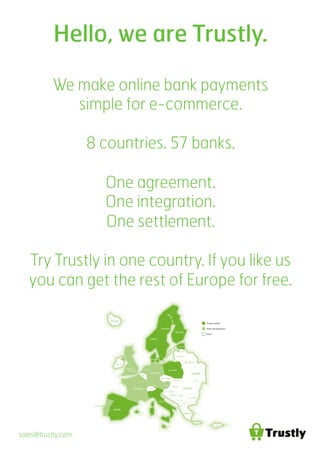
E-wallet PayPal, WebMoney, CashU, Alipay, Yandex, Moneybookers (Skrill)
Mobile / SMS / IVR Responsive hosted payment pages, native in-app payments (iOS and Android), call center
application, mobile-optimised payment products
Alternative payment methods Direct debits, virtual bank accounts, Konbini (Japan), Pay-easy (Japan), Ukash, paysafecard,
Boleto Bancario, Western Union, Pago Facil, Invoicing, Cheques, QIWI, eNETS
Offline Bank transfers worldwide acceptance, local acceptance in more than 55 countries, payouts
(cross-border payments), cash and kiosk payments
Connected companies (#) More than 20 acquirers
Companies PSP is connected to GlobalCollect is bank-independent and has partnerships with leading international financial
institutions such as First Data, AIB, BNP, HSBC, Wells Fargo, Barclays, Elavon, Euroline and others
Settlement currencies (acquirers) EUR, GBP, USD (others upon request)
Services
Unique selling points Full service processing, more than 150 local and alternative payment products, easy integration
with REST API, global reach with local expertise, payment consulting services, FX, business
intelligence, managed fraud services
Core services Online payment processing, FX, transaction processing in 28 languages, fraud screening, full
service provider facilitating all back-office processes (from payment matching / reconciliation to
refund processing and charge backs), multi-currency remittance, consultancy of local legislation
and local payment preferences, tokenization, business intelligence.
Pricing Upon request on a customised basis.
Collecting payments Yes
Distributing payments Yes
Fraud prevention (measures) IP geolocation, controls and behavioral analysis, 3D Secure (Verified by Visa, MasterCard
SecureCode), velocity checks, geographical checking, transaction limit checking, risk scoring, geo
IP origin check, black / white lists, AVS, CVV, CVC, Bin Check, Customized Rule Sets, real-time
fraud screening, lost / stolen cards.
150 ONLINE PAYMENTS MARKET GUIDE 2014
Fraud prevention partners Retail Decisions (ReD), Quova, Experian, Intercard
Credit management (services) N/A
Other services Full-service provider, REST API, Hosted Payment Pages, tokenization, PHP SDK, Java SDK,
JavaScript SDK, iOS SDK, Android SDK, currency conversion, multi-lingual 24/7 consumer
support, single-interface connection to our payment platform, professional services (checkout
conversion, FX, managed fraud services, project management), Elevate Business Intelligence
Third parties N/A
Technology
Direct connections Yes
Batch processing Yes
Per order processing Yes
Merchant pages (direct model) Yes
PSP pages (redirect model) Yes
Interface REST API / JSON Payload, XML API
Security PCI-DSS Level 1 certified. ISAE 3402 Level II compliant for processing all payment products.
Dedicated in-house Information Security team as part of Risk Management.
GAIN VALUABLE EXPOSURE
VIA THE ONLINE PAYMENTS
MARKET GUIDE
Simple, flexible and reliable with one of the most experienced payment
solution providers in the Netherlands. As one of the pioneers in the
sector (since 1995), MultiCards offers solutions that can boost your
online sales by 50-80%!
Multicurrency GBP, EUR, USD
Easy signup and implementation: one-stop show
Real-time online account stats
24/7 technical support team
Reason enough to visit the global specialist at MultiCards.com
ACCEPT ONLINE PAYMENTS:
BOOST YOUR
ONLINE SALES!
MultiCards Internet Billing is a provider of credit card
processing and payment solutions to thousands of
vendors worldwide. MultiCards offers a one-stop
solution for internet Billing, enabling you to accept
all major credit cards and other online payment
solutions. Simple and secure!
Contact MultiCards and find out how you
can easily boost your online performance!
GET
SET UP!
CALL +31 (0)40 292637
ORVISIT
MULTICARDS.COM
BOOSTYOUR
ONLINE SALES!
Accept online payments
Simple, flexible and reliable with one of the most
experienced payment solution providers in the
Netherlands. As one of the pioneers in the sector
(since 1995), MultiCards offers solutions that can boost
your online sales by 50-80%!
• Multicurrency GBP, EUR, USD
• Easy signup and implementation: a one-stop shop
• Realtime online account stats
• 24/7 technical support team
Contact MultiCards and find out how you can easily boost
your online performance on www.multicards.com!
MultiCards is a registered trademark and a division of PM International BV with international headquarters in The
Netherlands. MultiCards is PCI/DSS certified, officialVisa Merchant Agent.
FREE
TRIAL!
CALL+31(0)402926378
OR VISIT
MULTICARDS.COM
152 ONLINE PAYMENTS MARKET GUIDE 2014
Company Name MultiCards Internet Billing
MultiCards Internet Billing is a provider of online card processing and other payment options to
website businesses and retailers. MultiCards as a pioneer company has offered this type of service
since 1995 and is a PCI / DSS certified Payment Service Provider (PSP) and Payment Facilitator
(PF) operating their own gateway.
Website www.multicards.com
Keywords for online profile payment service provider, online credit card processing, online payments, payment gateway,
direct merchants
Contact Mr. Michel Hendriks, michelh@multicards.com, +1 877 292 6378/+31 40 292 6378
Geographical presence The Netherlands, Europe
Market segment(s) Retail, travel, dating, other
Active since 1995
Payment methods
Credit cards Visa, MasterCard, American Express, Diners Club
Debit cards Visa Electron, Maestro
Pre-paid cards Yes
Online banking iDEAL (Dutch), Direct E-Banking (international)
E-wallet Yes
Mobile / SMS / IVR Yes
Alternative payment methods Yes
Offline No
Connected companies (#)
Companies PSP is connected to European banks
Settlement currencies (acquirers) EUR, GBP, USD and other on request.
Services
Unique selling points Free tech support 24/7, personal service, real-time dedicated online account management,
longstanding history and expertise.
Core services Online payment processing, reconciliation information (web), third party internet payment gateway,
direct merchant accounts through European bank.
Pricing https://www.multicards.com/en/pricing/
Collecting payments Yes
Distributing payments Yes
Fraud prevention (measures) Fraud score, negative card database, bounce e-mail system, velocity checks, IP  Country
blocking and proprietary tools.
Fraud prevention partners Maxmind, IPLocation, McAfee
Credit management (services) No
Other services PCI certified gateway for other PSP
Third parties Third party internet payment gateway
Technology
Direct connections Yes
Batch processing No
Per order processing Yes
Merchant pages (direct model) Yes
PSP pages (redirect model) Yes
Interface Https post scripts and web templates, API, major shopping carts, Magento
Security McAfee and Qualys scanning
Digital information
Digital money Digital identity
Digital values
managed by Nets
Connects you to a smarter,
simpler and safer way of doing business
Nets is a Nordic company with a market leading
position in northern Europe. We connect businesses,
the public sector and consumers through the way we
manage digital payments, identity and information –
what we call “digital values”.
We work towards the vision of creating the future
of digital values. Focusing on future payments, we
offer a wide range of standard or customised end-to-
end, modular IT solutions. These build on our com-
prehensive northern European network and proven
platforms.
They also leverage our unique level of multidiscipli-
nary expertise, which enables us to provide comple-
mentary strategic consulting services.
Behind the large variety of services we offer – cards,
payments or information services, eSecurity and
merchant solutions – there is a simple promise:
Digital values managed by Nets connects you to a
simpler, smarter and safer way of doing business.
154 ONLINE PAYMENTS MARKET GUIDE 2014
Company Nets Holding A/S
Nets is one of northern Europe’s leading companies for payment solutions, information services
and digital security solutions, with one of the most extensive and innovative product portfolios in
Europe. Our ambition is to become an even stronger partner to our customers by supporting their
business nationally as well as internationally.
Website www.nets.eu
Contact Nets Holding A/S, Lautrupbjerg 10, 2750 Ballerup, Denmark, Telephone: +45 44 68 44 68
Geographical presence Denmark, Norway, Sweden, Finland, Estonia
Market segment(s) Bank sector, individual banks, merchants and corporates
Payment methods
Credit cards Amex, JCB, MasterCard, Visa, CUP
Debit cards Dankort, BankAxept, VISA Electron, Maestro
Pre-paid cards Prepaid closed loop (private label cards), gift cards
Online banking Online bank services
E-wallet No
Mobile / SMS / IVR Mobile wallet services, mobile banking services, SMS services.
Alternative payment methods Loyalty cards, giro payments, direct debit and credit transfers.
Offline Extensive views of offline in POS terminals.
Services
Fraud prevention (measures) Full risk management system including: real-time surveillance of issuer and acquirer transactions,
pro-active blocking, merchant applications, data investigation.
Credit management (services) No
Other services Domestic and SEPA direct debit and credit transfer payment scheme management, clearing
services, hot back-up 24/7.
Technology
Direct connections 10 data centrals in Denmark and Norway, more than 250 issuers, SWIFT, online infrastructure
network.
Batch processing Issuer and acquirer service providing, payment and clearing.
Per order processing No
155COMPANY PROFILES
Company ONPEX
ONPEX offers a white-label, unified payment Platform as a Service (PaaS) providing access to
hundreds of payment products worldwide and simplifying the integration and management of
international payment processing. ONPEX operates a global acquiring network for accepting card
and alternative payments to offer a complete payment suite to grow business internationally.
Website www.onpex.com
Keywords for online profile white-label payment platform, payment gateway, global acquiring network, alternative payment
methods, mobile payments, omni-channel payments, worldwide connectivity, risk management
Contact sales@onpex.com
Luxembourg +352 27 861177
Germany +49 89 41614310
UK +44 203 6089877
US +1 310 5640168
Hong Kong +85 2580 87187
Singapore +653 1 586945
Geographical presence Global
Market segment(s) Active in all merchant industry sectors and specialised in providing services to banks, PSPs, ISOs
and developers.
Active since 2010
Service provider type Payment technology provider, merchant account provider, financial services
Payment methods
Credit cards Visa, MasterCard, Amex, JCB, Diners, Discover, UnionPay
Debit cards V PAY, Maestro, Carte Bleue and many local and co-branded cards
Pre-paid cards paysafecard, Ukash
Online banking Sofort, iDEAL, Giropay, EPS, Trustpay, Trustly, Przelewy24, PostFinance, Mazooma
E-wallet PayPal, QIWI, Alipay, Tenpay, Neteller, Skrill, CashU
Mobile / SMS / IVR Hosted solutions for iOS and Android.
Global coverage for SMS / IVR / mobile carrier billing through partners.
Alternative payment methods Any alternative payment method worldwide with a reasonable business case
Offline Bank transfer, Boleto Bancario
Connected companies (#) Over 100 acquirers, risk management services and many more. Please contact us for full
connectivity list.
Companies PSP is connected to Acquirers, alternative payment methods, 3D Secure MPIs, risk management solutions, chargeback
management networks, information services, KYC checks. Please contact us for full connectivity
list.
Settlement currencies (acquirers) More than 40 different currencies
Services
Unique selling points - Advanced white-label payment platform as a service
- Omni-channel support for ecommerce, m-commerce, MOTO, mPOS and POS
- Connectivity to hundreds of payment products and solutions on one unified platform
- Multi-level hierarchy support for partner and merchant structures
- Global acquiring network for card and alternative payment methods
- Simple integration with our fully API controllable platform
Core services White-label payment platform for global payment processing
Pricing Upon request. Please contact ONPEX for your individual solution and pricing.
Collecting payments Yes
Distributing payments Yes
Fraud prevention (measures) Own risk prevention module and connectivity to external risk management service providers.
3D Secure.
Fraud prevention partners In-house plus Kount, Webshield and others
156 ONLINE PAYMENTS MARKET GUIDE 2014
Credit management (services) No
Other services White-label portal and gateway, dynamic checkout, standard and risk based 3D Secure, responsive
payment pages, recurring billing, one-click payments, tokenization, mobile POS solution. All
ONPEX solutions are made to be customised for you.
Third parties Platform is complety developed in-house. Third-parties for risk and fraud prevention.
Technology
Direct connections Yes
Batch processing Yes
Per order processing Yes
Merchant pages (direct model) Yes
PSP pages (redirect model) Yes, dynamic and responsive embedded payment forms
Interface RESTful webservice, XML, Json, Reporting CSV, XML, SDKs for Java, PHP, iOS and Android
Security PCI DSS version 3.0 compliant, ISO/IEC 27001:2005 certified datacenters
CONTEXTUAL APPROACHES
FOR ONLINE TRANSACTIONS
159COMPANY PROFILES
Company PacNet Services Ltd.
PacNet is a leading international PSP that specialises in processing cross-border transactions
in local currencies for ecommerce and direct response companies. In addition to international
merchant accounts and CNP transaction processing, PacNet also offers multi-currency cheque,
postal order, direct debit and refund processing.
Website www.pacnetservices.com
Keywords for online profile electronic payment processing, cheque processing, loan advances, loan repayments, recurring,
multi-currency, credit card processing, international payment processing
Contact Brendan Mahar, VP Sales North America; Brian Weekes, VP Sales Europe; Stuart Ballan, Head of
Sales, Middle East
Geographical presence Global
Market segment(s) Ecommerce, catalogue, mail order, nutriceutical, cosmetics, online lending, charity, not-for-profit
Active since 1994
Service provider type Payment service provider
Payment methods
Credit cards Visa, MasterCard and all international Visa, MasterCard branded credit cards.
Debit cards Maestro, Visa Electron, Carte Bleue, CartaSi, Visa Debit, Debit MasterCard, Dankort, all Visa /
MasterCard partnered brands.
Pre-paid cards Yes
Online banking Yes
E-wallet No
Mobile / SMS / IVR Yes
Alternative payment methods Yes
Offline Cheque and postal order processing, direct debit / check by phone, bank transfer collection,
cheque issuing.
Settlement currencies (acquirers) Currencies of all major and many developing markets.
Services
Unique selling points PacNet offers one-stop access to a global menu of local payment services enabling merchants to
securely accept more payments in more places without long lead times or high fees.
Core services Online payment processing, cheque processing.
Pricing Upon request
Collecting payments Yes
Distributing payments Yes
Fraud prevention (measures) Full risk management system including risk scoring and flagging, black / white list, as well as easy
integration to third-party providers.
Fraud prevention partners DataCheck, FraudPrevent, MaxMind
Credit management (services) Purchase on credit, payment guarantee
Other services No
Third parties No
160 ONLINE PAYMENTS MARKET GUIDE 2014
Technology
Direct connections Yes
Batch processing Yes
Per order processing Yes
Merchant pages (direct model) Yes
PSP pages (redirect model) Yes
Interface RAVEN online interface, RAVEN API, MarketDirect Secure Hosted Payment Page.
Security PCI compliant solutions
ONLINE PAYMENTS
IN MOTION
161COMPANY PROFILES
Company PAYMILL GmbH
PAYMILL’s journey began in 2012 when co-founders Mark Henkel, Jörg Sutara and Stefan Sambol
set out with the mission to deliver the easiest payment experience for Europe. Through a powerful
REST API, businesses have entered the global market in an instant and can process up to 100
different currencies.
Website https://www.paymill.com/
Keywords for online profile payment gateway, PSP, online payment, payment processing, multi-currency, PCI, ecommerce,
mobile payments, recurring payments, subscriptions, m-commerce, API
Contact Thomas Nöding
Geographical presence Europe
Market segment(s) Ecommerce, SaaS, online services, online businesses, startups
Active since 2012
Service provider type Payment gateway
Payment methods
Credit cards Visa, MasterCard, American Express, Discover, Diners Club, JCB
Debit cards Maestro, Visa Electron, Dankort, Carte Bleue, CartaSi, Visa Debit, China UnionPay, Visa CPC,
Debit MasterCard
Pre-paid cards For more details, please contact our sales team
Online banking For more details, please contact our sales team
E-wallet For more details, please contact our sales team
Mobile / SMS / IVR For more details, please contact our sales team
Alternative payment methods For more details, please contact our sales team
Offline For more details, please contact our sales team
Connected companies (#) Please get in touch with our sales team
Companies PSP is connected to Wirecard, Credorax
Settlement currencies (acquirers) CHF, DKK, EUR, GBP, NOK, SEK, USD
Services
Unique selling points Easy multi-currency credit and debit card payments directly in your shop with no setup or
monthly fees. Let your customers pay in a selection of payment methods to benefit from higher
conversions.
Core services Online payment processing
Pricing For current pricing, see our company profile at: https://www.paymill.com/en/pricing
Collecting payments Yes
Distributing payments Yes
Fraud prevention (measures) IP geolocation, global validation checks, Verified by Visa, MasterCard SecureCode, velocity checks,
persistent cookies, data validation, geographical checking, parameter format checking, transaction
limit checking, risk scoring, geo IP-origin check, black / white list, BIN checks
Fraud prevention partners For more details, please contact our sales team
Credit management (services) For more details, please contact our sales team
Other services For more details, please contact our sales team
Third parties For more details, please contact our sales team
Technology
Direct connections For more details, please contact our sales team
Batch processing Yes
Per order processing No
Merchant pages (direct model) No
PSP pages (redirect model) Yes
Interface Web interface and API
Security HTTPS, SSL, 256-bit encryption, PCI-DSS
Online payments made easy/
Increase conversions
Let your customers pay directly in your shop without
redirecting them away from your website.
Fast Integration
Seamlessly integrate PAYMILL using our REST API, installing
a plugin or through an ecommerce platform.
Security
Keep chargebacks under control with 3-D Secure
(Verified by VISA and MasterCard SecureCode).
Web, mobile and recurring payments all in one place
No Monthly Fees. No Setup Fees.
Sign Up Free paymill.com
AUTHORIZED
PARTNER
163COMPANY PROFILES
Company PAY.ON AG
PAY.ON delivers white-label payment infrastructure systems to payment providers to outsource
their payment processes or to integrate modules into their existing system. Platform and gateway
are available as “Platform as a Service”. The standardised processes and technical flexibility
ensure global processing. Included are: omni-channel payment platform, modular gateway,
fraud prevention.
Website www.payon.com
Keywords for online profile omnichannel processing, white-label business intelligence platform, open payment platform API,
risk and fraud management, business services, POS, global and alternative payments
Contact PAY.ON Sales Team; e-mail address: sales@payon.com, Telephone: +49 89 45230 0
Geographical presence North / Latin America, Europe, Middle East / Africa, Asia / Pacific
Market segment(s) Serving all industries
Active since 2004
Service provider type White-label payment infrastructure provider, modular payment gateway, omni-channel processor,
Platform as a Service provider
Payment methods
Credit cards Amex, VISA, JCB, China UnionPay, MasterCard, Diners, Discover, ASYAcard, Axess, Bonus,
CardFinans, maximum, World, Argencard, Cabal, Cencosud, Naranja, Nativa, Tarjeta Shopping,
ELO, Hipercard, MarcadoPago, Falabela, Magna, BC Card, Choheung Card, Citi Card, Daegu
BC, Gyungnam BC, Hana BC, HanaSK Card, Hyundai Card, IBK BC, Jeju BC, Jeonbuk Card,
KB (Kookmin) Card, KDB BC, KEB, Korea Post, Kwangju Bank Card, NH (Nonghyup), Pusan BC,
Seamaeul Cheque, Samsung Card, Savings Bank, SC BC, Shinhan Card, Suhyup Card, Woori BC
Debit cards China UnionPay, Maestro, Vpay, Visa Electron, Visa Debit, Presto, ELO, PostFinance, Carte Bleue,
CarteBancaire, Dankort
Pre-paid cards / Vouchers ELO, MangirKart, paysafecard, Ukash
Online Banking POLi II, China UnionPay, AstroPay, iDEAL, sofortbanking / sofortüberweisung, TrustPay,
Webmoney, Przelewy24 Dialcom 24 Sp.z.o.o., Skrill Direct, Giropay, Paytrail, eps, Trustly
E-wallet PayPal, Alipay, CashU, Skrill (Moneybookers), OneCard, QIWI, ClickandBuy, iPara, Yandex Money
Mobile / SMS / IVR mopay, DaoPay, Kanzaroo, paybox
Alternative payment methods Alipay, AstroPay, ASYAcard, Banelco, Bapropagos, Boleto Bancario, CashU, China UnionPay,
ClickandBuy, Cobro Express, Credit Transfer, DaoPay, Direct Debit, Domestic Money Transfer, ELO,
eps, Giropay, iDEAL, iPara, Kanzaroo, Klarna, Kriita, Link, Lufthansa Miles and More, MangirKart,
mopay, OneCard, Oxxo, paybox, Pago Facil, payolution, PAYPAL, paysafecard, Paytrail, POLi II,
PostFinance, ProvinciaNet, Przelewy24, QIWI, Rapipago, RedPagos, RIPSA, SEPA Direct Debit,
ServiPag, Skrill (Moneybookers), sofortüberweisung / sofortbanking, Trustly, TrustPay, Ukash,
Virtual currencies (credits) in online games, Webmoney, Yandex Money, 7Eleven
Offline / Cash payment Boleto Bancario, Oxxo, 7Eleven, Banelco, Bapropagos, Link, PagoFacil, Cobro Express,
ProvinciaNet, RIPSA, ServiPag, AstroPay, RedPagos, Rapipago
Connected companies (#) More than 350 connected companies, extending the network every month.
Companies PSP is connected to See our List of Global Coverage at http://globalcoverage.payon.com
Settlement currencies (acquirers) All currencies supported by connected acquirers and payment methods.
Services
Unique selling points PAY.ON offers the only true non-compete guarantee in the industry. We deliver solutions as a
white‑label product.
Our omnichannel payment platform is available as Platform as a Service and the standardized
processes ensure processing on a global scale.
Core services PAY.ON’s comprehensive portfolio consists of an omni-channel payment platform, a modular
payment gateway and risk management solutions. It provides the technology for online payments,
mobile payments and mobile point-of-sale transactions on a single platform, including guaranteed
compliance with security requirements and standards.
Pricing Transaction-based pricing
164 ONLINE PAYMENTS MARKET GUIDE 2014
Collecting payments No
Distributing payments No
Fraud prevention (measures) Active payment method selection, device fingerprinting, IP geolocation, semantic customer
validation, algorithmic and database account validation, velocity checks, payment type and ticket
size restrictions, plausibility checks, correlation checks, fraud-detection algorithms, authentications
methods, AVS verification, 3D Secure (verified by VISA, MasterCard SecureCode, Amex Safekey),
additional third-party checks.
Fraud prevention partners ReD, ThreatMetrix, Datacash, Schufa, Telego, Deltavista, Deutsche Post Address, Intercard,
Creditreform Boniversum, Arvato Infoscore, and many more.
Credit management (services) N/A
Other services Platform as a Service, ecommerce, MOTO – ready to use call-center solutions, COPYandPAY –
widget-based payment page, automated merchant on-boarding, sophisticated monitoring system,
profit optimising risk management, customisable white-label services, tokenization solutions,
business intelligence service with flexible data analysis tools, recurring billing services with ready-
to-use, PCI compliant stored billing plan implementation, modular payment gateway enabling
global payment processing for payment providers via one single interface.
Third parties No
Technology
Direct connections Yes
Batch processing Yes
Per order processing Yes
Merchant pages (direct model) Yes
PSP pages (redirect model) Yes
Interface XML, REST API, COPYandPAY, batch interface, merchant onboarding API, mPOS, in-app
m-commerce, mobile payment pages
Security PAY.ON is PCI-DSS Level 1 compliant, offering a state-of-the-art security infrastructure according
to the industry’s security standards. Our clients are automatically PCI-DSS compliant when they
use our services.
166 ONLINE PAYMENTS MARKET GUIDE 2014
Company PAYONE GmbH
PAYONE is one of the leading bank-independent payment service providers in Europe. The modular
platform is a SaaS solution designed to provide companies with an automated processing for all
payment transactions in ecommerce. PAYONE was founded in 2002 and has more than 2,500
ecommerce customers from different industries and countries.
Website www.payone.de
Keywords for online profile PSP, payment gateway, online payment, payment processing, online shop, PCI DSS, ecommerce,
integrated risk and debtor management
Contact E-mail: sales@payone.de / Phone: +49 431 25698-400
Geographical presence Europe
Market segment(s) Retail, digital content, VoD, paid services, gaming, ticketing, other
Active since 2002
Service provider type Payment service provider
Payment methods
Credit cards AmEx, JCB, Visa, MasterCard, Diners Club, Discover
Debit cards Bancontact/Mister Cash, Maestro, Visa Electron, Dankort, Laser, Delta, Carte Bleue, CartaSi,
Postepay, Visa Debit, Carte Bancaire, CartaSi, Carte Bleue etc.
Pre-paid cards Please contact PAYONE for more information.
Online banking Giropay, SOFORT Banking, iDEAL, eps – electronic payment standard, PostFinance E-Finance,
Przelewy24
E-wallet PayPal
Mobile / SMS / IVR PAYONE In-App Payment SDK for iOS, Android and Windows Phone
Alternative payment methods Virtual currency (credits) in online games
Offline Bank transfers in most European countries, prepayment, cash on delivery, invoice
Connected companies (#) More than 2500
Companies PSP is connected to Please contact PAYONE for a complete list of connected processors, acquiring banks and
other partners.
Settlement currencies (acquirers) Worldwide
Services
Unique selling points Software-as-a-Service solution, all payment methods for successful ecommerce, integrated risk
management, simple integration thanks to genuine Plug’n’Pay; only pay for what you actually use;
payment expertise for more than 10 years; highest security standards, customer service by highly
experienced and specialised employees, annual multi-billion euro clearing volume.
Core services Payment platform for online payment processing, risk and debtor management, invoicing and
subscription handling.
Pricing Interested merchants always get an individual offer that combines our services in a package
perfectly fitting the needs.
Collecting payments Please contact PAYONE for more information.
Distributing payments Please contact PAYONE for more information.
Fraud prevention (measures) PAYONE offers comprehensive risk checks and automatically analyses all payment processes in
the background to detect potential fraud patterns and risks of non-payment. We provide you with
a variety of checks to minimise payment defaults and fraud. Address checks, bank account check,
BIN check, BIN country filter, credit assessments, credit card check, IP check, IP country filter,
POS lock file, velocity check
Fraud prevention partners Please contact PAYONE for a complete list of connected partners.
Credit management (services) Yes, via partner, but fully integrated.
167COMPANY PROFILES
Other services Standardised extensions and a large number of interfaces allow an easy integration of the leading
ecommerce systems to the PAYONE platform. Software development kits for integration with PHP
and Java applications, premium customer service, consulting services including workshops and
trainings.
Third parties The PAYONE platform is developed and maintained in-house.
Technology
Direct connections Yes
Batch processing Please contact PAYONE for more information
Per order processing Yes
Merchant pages (direct model) Yes
PSP pages (redirect model) Yes. Full customisable in look and feel, supporting one-click shopping, multi-language, split
payments and many other features.
Interface Four different interfaces, including an https-based server API for platform-independent server-
to-server communication, a client API for AJAX-style integrations, a fully customisable virtual
terminal with automatic redirect capabilities, as well as a telesales interface for manual transaction
processing. In-App Payment SDK available for iOS, Android and Windows.
Security PCI DSS Level 1 certified, SSL/TLS 1.2, ECDH, PFS, ISO27001 certified data centers
PAYMENT METHODS –
IN FOCUS
PAYMENT FOR YOUR ONLINE SHOP
Request your quote now!
Phone +49 431 25968 400
sales@payone.de
www.payone.de
ü All payment methods for successful e-commerce
ü Integrated risk management
ü Fully automated and on a single platform
ü Simple integration thanks to genuine Plug‘n‘Pay
ü Only pay for what you actually use
Why complicate matters?
You are looking for the ideal payment solution for your
online store? You want a partner who can handle your
entire payment process in an easy and automated way
via one single platform? For both you and for your
customers? Then PAYONE‘s payment solutions are
the right choice for you.
169COMPANY PROFILES
Company Paytrail Plc
Paytrail Plc is the leading online payment service provider in Finland. We cooperate with banks and
other financial institutions as well as software service providers enabling more efficient payment
transfers online. Our payment service offers a straightforward solution for companies, organisations
and consumers.
Website www.paytrail.com
Keywords for online profile payment gateway, PSP, online payments, ecommerce, alternative payments, Finland, online
shopping
Contact sales@paytrail.com, Tel. +358 207 181 824
Geographical presence Europe
Market segment(s) From global 2000 companies to SMEs and non-profits. Physical and intangible goods, digital
content.
Active since 2007
Service provider type Payment service provider
Payment methods
Credit cards Visa, MasterCard, Diners, JCB
Debit cards Visa, Visa Electron, Maestro, MasterCard
Pre-paid cards No
Online banking Yes
E-wallet Paytrail account, PayPal
Mobile / SMS / IVR Yes
Alternative payment methods Klarna, Collector and Jousto invoice and installment payment services.
Offline N/A
Connected companies (#) About 350 ecommerce platform service provider partners, 20 payment method provider partners
and 10 distribution partners across Europe.
Companies PSP is connected to 20 payment method provider partners and 10 distribution partners.
Settlement currencies (acquirers) EUR. Settlements allowed to non-EUR accounts, too.
Services
Unique selling points Connecting you to 5 million Finnish consumers. We provide e-payments to all Finnish banks, credit
cards, invoice and installments and Paytrail account so you can offer customers their preferred
payment method. Paytrail account was built on future-proof principles of separating content from
channels providing a seamless buying experience anywhere.
Core services Online payment processing, merchant account, collection, settlements, reconciliation, automated
accounting reports, fraud prevention, cross-border transactions, Paytrail account
Pricing For detailed pricing, visit: http://www.paytrail.com/en/pricing. Paytrail account is completely free
for consumers.
Collecting payments Yes
Distributing payments Yes
Fraud prevention (measures) Fully automated risk analysis and control platform with over 100 checks provided at no additional
cost. Anti Money Laundering (AML) measures, IP geolocation, credit scoring, address verification,
VISA CVV2 and MasterCard CVC2, Verified by VISA, MasterCard SecureCode, blacklisting, strong
authentication, statistical transaction analysis and much more.
Fraud prevention partners Yes
Credit management (services) Payment guarantee, invoicing and installment payments (consumer credit service).
170 ONLINE PAYMENTS MARKET GUIDE 2014
Other services Collection, settlements and reconciliation with any tax rate included. Fraud prevention. Customer
service for merchants and consumers is available in English, Swedish and Finnish. Direct
connection to any payment method available with seller’s own merchant account.
Third parties Yes
Technology
Direct connections Yes
Batch processing Yes
Per order processing Yes
Merchant pages (direct model) Yes
PSP pages (redirect model) Yes
Interface HTTPS Post, Web services (SOAP and REST), Hosted Embedded Widget, Hosted page, Payment
page bypassing
Security HTTPS, TLS/SSL, PKI
STATE OF-THE-ART
OVERVIEW OF THE
GLOBAL ONLINE
TRANSACTION
SERVICES ECOSYSTEM
Super Fast and Seamless Shopping
Experience. Anywhere.
www.paytrail.com
173COMPANY PROFILES
Company PayU Latam
PayU Latam is the leading PSP in Latin America, allowing international merchants to receive local
payments without local entity in most cases with more than 70 payment options in Argentina,
Brazil, Chile, Colombia, Mexico, Panama and Peru. PayU Latam is part of PayU Group, the leader
in Central and Eastern Europe, Africa, Asia and Latin America.
Website www.payulatam.com
Keywords for online profile PSP, online payments, PCI certified, multi-currency, Latin America payment provier, alternative
payments, cross-border payments, payment processing, fraud management
Contact Martin Schrimpff, Co-founder and VP Business Development, martin@payulatam.com
Geographical presence Latin America
Market segment(s) All industries: retail, coupons, hosting, gaming, services, travel / airline, bill payment and more
Active since 2002
Service provider type Payment service provider, payment gateway, alternative payment method
Payment methods
Credit cards American Express, Visa, MasterCard, Diners, Discover, Elo, and local co-branded cards in LATAM
Debit cards Handled through online bank transfers
Pre-paid cards No
Online banking Online transfers with more than 20 local banks
E-wallet No
Mobile / SMS / IVR Mobile and IVR
Alternative payment methods Cash Payments: Boleto, Rapipago, Oxxo, Baloto, Efecty, BCP, 7-eleven, and many more
Offline Bank transfers and cash deposits
Connected companies (#) Numerous
Companies PSP is connected to A wide variety of major banks, acquirers and technology providers
Settlement currencies (acquirers) 7 currencies (COP, MXN, USD, PEN, BRL, CLP, ARS)
Services
Unique selling points One account and a single integration to access 7 countries in Latin America (in many cases local
presence not necessary) and the ability to reach the entire market with over 70 payment methods.
Local office and expertise in each country, tokenization, mobile integration and many advanced
features
Core services Online payment processing, managed fraud services, multi-currency
Pricing Flexible pricing options based on requirements and volumes. Please contact us for more
information, sales@payulatam.com
Collecting payments Yes
Distributing payments Yes
Fraud prevention (measures) Device fingerprinting, IP geolocation, multi-merchant purchase history, global validation checks,
Verified by Visa, MasterCard SecureCode, velocity checks, persistent cookies, data validation,
geographical checking, parameter format checking, transaction limit checking, risk scoring, geo
IP-origin check, black / white list, etc.
Fraud prevention partners FraudVault (inhouse fraud system), ThreatMetrix, F-Control
Credit management (services) Payment in instalments, online void and refund, payment guarantee, connected to several credit
institutions.
Other services Fraud prevention (anti-fraud module and control / monitoring transaction services), recurring and
one-click payments using tokenization, customisable payment pages, mobile payment service,
secured IVR, wide range of option payments (credit cards, bank transfers, cash deposits), interface
allows buyers to choose which payment method they prefer, PCI-DSS compliant, customer service
for merchants and consumers, multi-language and multi-currency interface, easy integration with
open source shopping carts, reporting, and many more.
Third parties Pagosonline and DineroMail payment online platforms
174 ONLINE PAYMENTS MARKET GUIDE 2014
Technology
Direct connections Yes
Batch processing Yes
Per order processing Yes
Merchant pages (direct model) Yes
PSP pages (redirect model) Yes
Interface API (WEBServices): RESTful (XML and JSON) WEBCHECKOUT: HTTP POST
Security PCI-DSS Level 1 compliance, HMAC, HTTPS, Redundant network infrastructure, RSA, Secure
platform certified by McAfee and VeriSign, TLS/SSL, Tokenizer, WS-Security, TPM, Data Centers
SAS 70 type II certified, AES, MFA, IDS, WAF
THE MOST COMPLETE AND
UP-TO-DATE REFERENCE
SOURCE FOR ONLINE
PAYMENTS, ECOMMERCE
175COMPANY PROFILES
Company Payvision
Payvision, independent payment solution provider, specialised in global card processing, offers
Acquiring Banks and PSPs / ISOs a secure PCI-DSS / PSD international payment processing
platform. Payvision provides its customers with 24/7 support, more than 150 transaction
currencies and regional card settlement currencies, a high-end reporting interface and a solid risk
management solution.
Website www.payvision.com
Keywords for online profile payment solutions provider, global card processing, cross-border ecommerce
Contact press@payvision.com / +31 2079 423 00 – Netherlands office
Geographical presence New York, Utah, San Francisco, Madrid, Paris, London, Berlin, Singapore, Tokyo, Hong Kong and
Macau, Auckland
Market segment(s) Online payment processing, cross-border ecommerce, ecommerce
Active since 2002
Service provider type Payment service provider, payment gateway, global card processor
Payment methods
Credit cards Amex, VISA, CB, JCB, MasterCard, Diners, Discover, AirPlus
Debit cards Maestro, Giropay, (e)Maestro, Visa Electron, Carte Bleue, Visa Debit, China UnionPay, Alipay, Visa
CPC, Debit MasterCard, Carte Bancaire
Pre-paid cards No
Online banking iDEAL
E-wallet No
Mobile / SMS / IVR Yes
Alternative payment methods No
Offline No
Connected companies (#) More than 300 PSPs
Companies PSP is connected to No
Settlement currencies (acquirers) CAD, CHF, CZK, DKK, EUR, GBP, HUF, ISK, JPY, NOK, PLN, SEK, THB, TRY, USD, ZAR, AUD,
HKD, NZD, INR, MYR, SGD
Services
Unique selling points With one of the fastest growing global acquiring network in the world, Payvision connects banks,
PSPs, ISOs and more than 5,000 web merchants worldwide, to one global acquiring platform,
based on a non-competitive partnership model in which all stakeholders share revenue, processing
over 100 million transactions a year. In an expanding profitable cross-border ecommerce market,
Payvision enables its ecommerce partners to expand their geographic footprints.
Core services Global card processing, domestic global acquiring, underwriting, fraud / risk monitoring,
interchange optimisation, multi-currency processing, innovative payment solutions
Pricing Blended rate, Interchange Plus etc.
Collecting payments Yes
Distributing payments Yes
Fraud prevention (measures) Payvision’s best practice internationally approved underwriting protocol, with a solid and secure
card payment processing platform and high-end reporting tool and the traditional measures
like: IP geolocation, multi-merchant purchase history, global validation checks, Verified by Visa,
MasterCard SecureCode, velocity checks, data validation, geographical checking, parameter
format checking, transaction limit checking, geo IP-origin check, black / white list).
Fraud prevention partners In-house solutions
Credit management (services) Credit transactions, receivables management, online void and refund.
Other services Mobile payment systems
Third parties No
176 ONLINE PAYMENTS MARKET GUIDE 2014
Technology
Direct connections Yes
Batch processing Yes
Per order processing Yes
Merchant pages (direct model) No
PSP pages (redirect model) Yes
Interface Web services using SOAP or HTTP POST, HTTP POST for CheckOut, file using Payvision API sent
via FTP for BatchProcessor.
Security PCI-DSS compliant
AN IN-DEPTH LOOK AT
THE GLOBAL ONLINE
TRANSACTION SERVICES
ECOSYSTEM
177COMPANY PROFILES
Company PostFinance AG
PostFinance’s e-payment solution makes it easy for you to collect online shop payments.
Customers pay for their purchases online or on their mobile phone, making invoices superfluous.
Website www.postfinance.ch
Keywords for online profile PSP, online, payment, Switzerland, virtual, shop, easy, connect
Contact merchanthelp@postfinance.ch
+41 848 382 423
Geographical presence Europe and more than 250 acquiring connections worldwide
Market segment(s) Insurance, telecom, utilities, ticketing, charity, education, internet, publishers, auction, gaming,
retail, travel.
Active since 1906
Service provider type Payment service provider, payment gateway
Payment methods
Credit cards Visa, MasterCard, American Express, Diners Club, JCB, UATP, AirPlus, Cofinoga, Discover, Aurore
Debit cards PostFinance Card, Maestro, Solo, Laser Card, Visa Electron, Bancontact / Mister Cash, Carte
Bleue, Dankort, EPS, iDEAL, ELV
Pre-paid cards Wallie-card, paysafecard, Cash-Ticket
Online banking PostFinance E-Finance, ING Hompeay, KBC, CBC, Dexia DirectNet, Centea
E-wallet Checkout by Amazon, PayPal
Mobile / SMS / IVR mPass, V.me
Alternative payment methods RatePay, Klarna, AfterPay, Billpay, FIS, PostFinance Collect
Offline Bank transfer, payment by e-mail
Connected companies (#) N/A
Companies PSP is connected to N/A
Settlement currencies (acquirers) N/A
Services
Unique selling points Fraud management tools; support 24/7
Core services Online payment processing, fraud prevention
Pricing For current pricing, see our company profile at: https://www.postfinance.ch/en/biz/prod/eserv/
epay/providing/offer.html
Collecting payments Yes
Distributing payments N/A
Fraud prevention (measures) PCI DSS, 3D Secure, blocking rules and filters, scoring module
Fraud prevention partners Ethoca, Perseuss
Credit management (services) N/A
Other services Merchant account facilitation
Third parties Specific industry solutions partners: Amadeus, Sabre Airline Solutions, Radixx, micros fidelio,
Ticketscript Shop software connectors: Magento, ePages, XT Commerce, osCommerce
Technology
Direct connections Yes
Batch processing Yes
Per order processing Yes
Merchant pages (direct model) Yes
PSP pages (redirect model) Yes
Interface SaaS
Security HTTPS, SSL+, PCI-DSS Level 1
ONE CONTRACT. ONE PLATFORM. ELECTRONIC PAYMENT ACROSS THE WORLD!
NO BORDERS IN E-PAYMENT
The PPRO Group - ‘The Payment Professionals’-
offers a single, integrated point of access to a
wide range of international payment schemes
for truly global electronic payment flows. PPRO
products and services span the entire payments
value chain from acquiring through issuing to
processing.
www.ppro.com
179COMPANY PROFILES
Company PPRO Financial Ltd
The PPRO Group, ‘The Payment Professionals’, offers a wide range of international payment
schemes enabling electronic payment processing on a global scale through one simple integration
contract. PPRO products and services span the entire payments value chain from acquiring
through to issuing and processing.
Website www.ppro.com
Keywords for online profile payment gateway, electronic payment, payment processing, e-money, ecommerce, alternative
payments, acquiring, prepaid cards
Contact Phone +442030029170
Fax +442030029179
Email: info@theppro.com
Geographical presence North / Latin America, Europe, Middle East / Africa, Asia / Pacific
Market segment(s) Retail, travel, gaming, auction, other
Active since 2006
Service provider type E-money institution, payment service provider, payment gateway, acquirer, processor, issuer,
alternative payment method.
Payment methods
Credit cards Visa, MasterCard, Diners
Debit cards Maestro, Girocard, Visa Electron
Pre-paid cards Viabuy, Crosscard, open and closed-loop cards
Online banking Instant Transfer, Giropay, iDEAL, EPS, P24, Poli, Postfinance, Trustpay, Safetypay, Astropay,
Sofortüberweiung
E-wallet Skrill, AlliedWallet, QIWI
Mobile / SMS / IVR Poli, Trsutpay, Safetypay, paysafecard, Ukash, QIWI, Sofortüberweisung
Alternative payment methods Alternative payment methods for more than 100 countries.
Offline Bank transfers in most countries.
Connected companies (#) More than 35.
Companies PSP is connected to POS Transact, AIB Merchant Services, Trustpay, Allied Wallet, iDEAL, MasterCard, Visa, Raberil,
WorldPay, CompuTop, Sage Pay, eMerchantPay, SafetyPay
Settlement currencies (acquirers) EUR, GBP, USD, PLN, AUD, NZD, BGN, HUF, CZK, HRK, RON, NOK, SEK, CAD
Services
Unique selling points Single contract for full range of international payment schemes / acquiring and payment services
/ technical processing solutions via a single integration / FCA licensed e-money institution /
full range of issuing services for debit and prepaid cards / open and closed-loop cards / PCI
compliance / Visa and MasterCard Principal Member.
Core services Aquiring, issuing, processing, e-money
Pricing N/A
Collecting payments Yes
Distributing payments Yes
Fraud prevention (measures) Internal and external risk systems; Manual monitoring done by risk experts.
Fraud prevention partners Schufa, Infoscore, Crif, Bürgel, Experian, Keesing Technologies, Deutsche Post
Credit management (services) No
Other services Prepaid Credit Card Issuer
Third parties N/A
180 ONLINE PAYMENTS MARKET GUIDE 2014
Technology
Direct connections Yes
Batch processing No
Per order processing Yes
Merchant pages (direct model) Yes
PSP pages (redirect model) Yes
Interface Web services (specifications available upon request). Simple integration, unified interface for
all payment types.
Security HTTPS, SSL+, PKI
GLOBAL INDUSTRY
EXPERTISE FROM ALL
AREAS OF THE ONLINE
PAYMENTS ECOSYSTEM
181COMPANY PROFILES
Company SafeCharge International Group Limited
SafeCharge International Group Limited, a leader in advanced payment technologies, is PCI-DSS
Level 1 certified and listed on the London Stock Exchange AIM market (LSE: SCH). The company’s
wholly owned subsidiary, SafeCharge Limited, is an authorised Electronic Money Institution, and
principal member of MasterCard and Visa Europe.
Website www.safecharge.com
Keywords for online profile payment gateway, PSP, online payment, PCI, ecommerce, alternative payments, acquirer, fraud
and risk
Contact info@safecharge.com
Geographical presence Europe, Middle East / Africa, Asia / Pacific
Market segment(s) Regulated sports betting and gambling, online games, financial services, retail, travel
Active since 2007
Service provider type Payment service provider, acquirer, processor
Payment methods
Credit cards MC, CB, JCB, Visa, MasterCard, Diners, Discover, Aurore, Delta etc.
Debit cards Bancontact/Mister Cash, Maestro, Giropay, BCMC, (e)Maestro, Visa Electron, Dankort, Laser, Delta,
Carte Bleue, CartaSi, Postepay, Visa Debit, BancNet, PPS, China UnionPay, Alipay, 99Bill, eNETS,
MEPS, Poli, Visa CPC, Debit MasterCard, Carte Bancaire, CartaSi, Carte Bleue, Chinese debit
cards, Carte Blanche, etc.
Pre-paid cards Astropay, paysafecard, Ukash, Neosurf, Ticket Surf, toditocash
Online banking N/A
E-wallet PayPal, ClickandBuy, Neteller, Skrill, ePay.bg, Alipay.com, QIWI, Moneta.RU, WebMoney, Andex,
Bancontact/Mister Cash, DineroMail, CashU, abaqoo
Mobile / SMS / IVR N/A
Alternative payment methods N/A
Offline Bank transfers in most European countries
Connected companies (#) N/A, i.e. acquirers
Companies PSP is connected to N/A
Settlement currencies (acquirers) N/A
Services
Unique selling points SafeCharge has an in-depth knowledge of the various verticals and our solutions are specifically
designed for each industry we accommodate. Features include: risk profiling, checkout process,
multi-currency and language support – all of which are configured to provide a first-rate
performance.
Core services Online payment processing, risk and fraud prevention, PCI-DSS descoping, analytics and reports
Pricing N/A
Collecting payments N/A
Distributing payments N/A
Fraud prevention (measures) Multi-merchant purchase history, global validation checks, Verified by Visa, MasterCard
SecureCode, persistent cookies, data validation, geographical checking, transaction limit checking,
risk scoring, geo IP-origin check, black / white list, etc.
Fraud prevention partners N/A
Credit management (services) N/A
Other services N/A
Third parties N/A
182 ONLINE PAYMENTS MARKET GUIDE 2014
Technology
Direct connections N/A
Batch processing N/A
Per order processing N/A
Merchant pages (direct model) N/A
PSP pages (redirect model) N/A
Interface N/A
Security N/A
GRASP THE COMPLEXITY
AND DIVERSITY OF THE
ONLINE PAYMENTS AND
ECOMMERCE FRONTS
AT A REGIONAL LEVEL
Pay and get
paid globally
More choice, secure, intuitive
Skrill is your partner for global, local and
alternative payments. We provide market
leading payment products for large online
businesses, including a customised
solution for Marketplaces.
So why not visit us on
www.skrill.com to find out more
185COMPANY PROFILES
Company Skrill
Skrill is one of Europe’s leading online payments companies and among the world’s largest
independent digital wallet providers with 36 million account holders. Skrill enables any customer
to make online payments conveniently and securely without revealing personal financial data, as
well as send and receive money online cost-effectively. Skrill’s mission is to become the preferred
choice for online payments.
Website www.skrill.com
Keywords for online profile hosted payment pages, online payment, payment processing
multi-currency, digital wallet, ecommerce, alternative payments, marketplaces, remittance,
pre-paid card
Contact sales@skrill.com
Geographical presence North / Latin America, Europe, Middle East / Africa, Asia / Pacific
Market segment(s) Marketplaces, gambling, gaming, ecommerce
Active since 2001
Service provider type Payment service provider, payment gateway, processor, issuer, bank, alternative payment method,
other
Payment methods
Credit cards Amex, CB, JCB, Visa, MasterCard, Diners
Debit cards Maestro, Visa Electron, Dankort, Carte Bleue, CartaSi, Postepay, Visa Debit, Debit MasterCard,
Carte Bancaire
Pre-paid cards Skrill pre-paid MasterCard, paysafecard
Online banking Yes
E-wallet Skrill e-Wallet
Mobile / SMS / IVR Mobile
Alternative payment methods Giropay, eNETS, Netpay, POLi, iDEAL, Trustly, Sofort, Przelewy24, Skrill Direct, ePay Bulgaria
Offline Bank transfers in most European countries and USD, JPY, AUD
Connected companies (#) Skrill, paysafecard, Payolution
Companies PSP is connected to
Settlement currencies (acquirers) EUR, AUD, CAD, CHF, CZK, GBP, HUF, HKD, HRK, JPY, NOK, NZD, PLN, SEK, SGD, USD and ZAR
Services
Unique selling points Skrill’s worldwide payment network offers businesses access to direct payment processing
via 100 payment options in 200 countries and territories and 40 currencies, through just one
integration, allowing everyone to pay and get paid globally.
Core services Online payment processing, reconciliation information (web)
Pricing https://www.skrill.com/en/personal/fees
Collecting payments Yes
Distributing payments Yes
Fraud prevention (measures) IP geolocation, multi-merchant purchase history, global validation checks, Verified by Visa,
MasterCard SecureCode, velocity checks, passive (cookie bases) and active device identification,
data validation, geographical checking, parameter format checking, transaction limit checking,
risk scoring, geo IP-origin check, black / white list, e-mail validation checks, device intelligence,
historical pattern behaviour, third-party data validation + blacklist access.
Fraud prevention partners Accertify Inc.
Credit management (services) Global anti-money laundering, Know Your Customer principles actively followed, chargeback
guarantees
Other services
Third parties 80 banking relationships internationally
186 ONLINE PAYMENTS MARKET GUIDE 2014
Technology
Direct connections Yes
Batch processing Yes
Per order processing Yes
Merchant pages (direct model) Yes
PSP pages (redirect model) No
Interface Java
Security Global security protocals continuously upgraded.
A HIGHLY USEFUL
PUBLICATION THAT
SHOULD BE KEPT AT
HAND AT ALL TIMES
187COMPANY PROFILES
Company SlimPay
Enable merchants to offer subscriptions to customers and to receive recurring payments.
Encourage subscriptions by providing a simple, multilingual and multichannel experience.
Subscriptions increase customer loyalty and reduce the risks of payment incidents by offering
secure payments via direct debit, or by combining direct debit and bank card payment.
SlimPay is an authorised payment institution.
Website www.slimpay.com
Ownership Management
Business model Transactional
Keywords for online profile recurring payment, alternative payment, acquirer, SEPA, e-mandate, electronic signature,
electronic contract
Contact Mr. Jeremy Altman, Sales Director, info@slimpay.com, +33 1 47 70 15 34
Geographical presence Germany, Benelux, France
Main client industries Cloud, subscription economy, utilities, insurance, telecom, NGOs
Active since 2010
Service provider type Payment service provider, acquirer, processor, alternative payment method, authorised
payment institution
Payment type
Debit card Visa, MasterCard, Amex
Online banking enabled payment SEPA direct debit and credit transfer
E-wallet N/A
After payment N/A
Escrow N/A
Prepaid N/A
Other channels
Offline Yes
Mobile Yes
Online to offline N/A
Services
Unique selling points Any consumer with a bank account can use the SlimPay solution offered by a merchant.
No separate account or registration is required. Linked to 3,921 banks in 33 SEPA countries,
serving 340 million consumers. SlimPay enables the digital transformation of the subscription
economy. It boosts customer lifetime value through more efficient recurring payments collection.
Core services Online pan-European e-mandate, payment processing, acquiring and payment account
management
Multi-currency / Dynamic currency
conversion
EUR
Chargeback / Refund options As defined by SEPA. “Liability shift” option
Buyer protection policy Yes
Pricing Per transaction model / on demand
Fraud prevention (measures) /
Risk management
Risk management system including: Data Checks, Comparison Check
Fraud prevention partners Internal fraud prevention module
Acceptation criteria (sign-up
process)
No sign-in for the payer. Merchant (Processing service = company registry, bank account
certificate, SEPA creditor ID) (Acquiring service = company’s ultimate beneficiary declaration).
Other services N/A
Future developments N/A
188 ONLINE PAYMENTS MARKET GUIDE 2014
Technology
Integration technology REST API, Command mode, PHP, Java
Integration support Plugins for Magento, Prestashop
Transactions volume
Number of transactions (per year) More than 20 million
Transactions value EUR 2.5 billion
FIND OUT MORE
ABOUT KEY PLAYERS
IN THE GLOBAL ONLINE
PAYMENTS SPACE
190 ONLINE PAYMENTS MARKET GUIDE 2014
Company Smart2Pay
Smart2Pay is a licensed payment service provider offering alternative, non-reversible online
payment methods (online bank transfer, wallets, vouchers, mobile payments, cards). With a new
frictionless payment product, Smart2Pay allows merchants to collect funds from customers locally
in over 80 countries by signing one single contract and one technical integration that can be
completed within one week.
Website http://www.smart2pay.com
Keywords for online profile PSP, online payments, alternative payments, frictionless payment product, guaranteed, flexible,
custom pay-flows
Contact James Flinterman – CEO, james@smart2pay.com, Stefan Iancu – CTO, stefan@smart2pay.com
Geographical presence Worldwide, Latin America, EMEA, Asia / Pacific, North America
Market segment(s) Games, airline, travel, retail, general ecommerce
Active since 2002
Service provider type Payment service provider, licensed payment institution
Payment methods
Credit cards MasterCard, Visa, JCB, Amex, Diners, Sorocred, Aura, Hipercard, etc.
Debit cards CarteBleue, Maestro, Visa Electron, Discover, eTranzact, Verve etc.
Pre-paid cards OneCard, Ukash, CashU, paysafecard, ToditoCash, Gash, Mangirkart etc.
Online banking Yes (currently we cover over 50 different countries).
E-wallet Yes, various
Mobile / SMS / IVR Mobile options in 80 countries, Mozca, Mobile Money, Gcash, Beeline, MTS, Megafon etc.
Alternative payment methods Over 170 payment methods in over 80 countries.
Offline Bank transfer in more than 30 countries.
Connected companies (#) #35 acquirers
Companies PSP is connected to Various
Settlement currencies (acquirers) Various
Services
Unique selling points 1 Contract + 1 Interface = Collect Worldwide. Smart2Pay lets you collect payments from over
70 countries; easy, secure and reliable, with only 1 contract and a 1 week integration.
Core services Online payment processing with: customisable payment flows, customisable UI, dynamic currency
conversion, fraud prevention, conversion analytics. Our in-house IT team will provide flexibility like
no other. For easy integration we also offer Magento and Opencart plugins.
Pricing Pricing is negotiated on a case by case basis.
Collecting payments Yes
Distributing payments Yes
Fraud prevention (measures) IP geolocation, multi-merchant purchase history, global validation checks, data validation,
parameter format checking, transaction limit checking, risk scoring, geo IP-origin check, black /
white list, etc.
Fraud prevention partners Please contact us for detailed information.
Credit management (services) Credit management is not available.
Other services Please contact us for detailed information.
Third parties Please contact us for detailed information.
191COMPANY PROFILES
Technology
Direct connections Yes
Batch processing Yes
Per order processing Yes
Merchant pages (direct model) Yes
PSP pages (redirect model) Yes
Interface Web services, SOAP, HTML FORM POST (specifications available upon request).
Security HTTPS, SSL+, hash strings, in-house developed tools.
A MUST-HAVE FOR ALL
PROFESSIONALS IN
THE E-PAYMENTS AND
ECOMMERCE INDUSTRY
www.smart2pay.com
W O R L D W I D E
PAYMENTMETHODS
ALTERNATIVE
LARGEST NETWORK
OF
1 contract + 1 interface = collect worldwide
TM
Smart2 Pay
The smart way to pay on the web
193COMPANY PROFILES
Company SOFORT AG
With the SOFORT Banking payment system, SOFORT Banking Paycode and the Online Verification
System SOFORT Ident, SOFORT AG offers innovative products to ensure secure online purchase
of goods and digital products. SOFORT Banking has made SOFORT AG the market leader in
direct transfer systems in Germany. Over 30,000 ecommerce shops handle more than three million
transactions with SOFORT Banking every month.
Website www.sofort.com
Ownership Klarna AB
Business model OBeP (online based ePayment)
Keywords for online profile online payment, easy, secure, online banking, direct payment
Contact info@sofort.com
Geographical presence Germany, Austria, Switzerland, the Netherlands, Belgium, Poland, Hungary, Italy, Spain, France
and UK.
Main client industries eCommerce (retail, travel, plattforms, PSP)
Active since 2005
Service provider type Online based ePayment
Payment type
Debit card No
Online Banking enabled Payment Yes
E-wallet No
After payment No
Escrow Yes
Prepaid No
Other channels
Offline SOFORT Banking Paycode
Mobile Yes
Online to offline Yes
Services
Unique selling points SOFORT Banking: convenient, fast and secure payment, without registration – simply pay while you
are shopping online. By entering your familiar online banking login details and confirmation codes
with a maximum level of security. The online shop will receive a real-time transaction confirmation
immediately after the transfer has been listed.
Core services Online based ePayment
Multi-currency / Dynamic currency
conversion
EUR, GBP, PLN and CHF
Chargeback / Refund options No
Buyer protection policy https://www.sofort.com/eng-DE/kaeufer/su/sofort-ueberweisung-kaeuferschutz/
Pricing www.sofort.com
Fraud prevention (measures) /
Risk management
https://www.sofort.com/eng-DE/buyer/su/security/
Fraud prevention partners Not specified
Acceptation criteria (sign-up
process)
www.sofort.com
Other services SOFORT Ident, SOFORT Banking Paycode
Future developments Not specified
194 ONLINE PAYMENTS MARKET GUIDE 2014
Technology
Integration technology XML, etc.
Integration support https://www.sofort.com/eng-DE/verkaeufer/su/sofort-ueberweisung-integrieren/
Transactions volume
Number of transactions (per year) More than 25 million transactions per year
Transactions value External revenue with SOFORT Banking 2013: EUR 2.4 billion
THE MOST COMPREHENSIVE
OVERVIEW OF THE
GLOBAL E-PAYMENTS AND
ECOMMERCE ECOSYSTEM
195COMPANY PROFILES
Company Transaction Network Services Inc
TNS has been a trusted provider to the payments industry for over 20 years. TNS’s broad portfolio
of solutions includes secure resilient transaction delivery services used by the top banks and
processors globally. TNS provides innovative payment gateway services and payment network
connectivity to white-label partners and leading international merchants.
Website www.tnsi.com
Keywords for online profile payment gateway, PSP, online payment, payment processing, PCI, ecommerce, alternative
payments, connectivity
Contact solutions@TNSI.com
Geographical presence North / Latin America, Europe, Asia / Pacific
Market segment(s) Banks, financial institutions, ISOs, acquirers, processors, PSPs, merchants, gaming, retail, travel,
other
Active since 1990
Service provider type Full service payment provider
Payment methods
Credit cards American Express, VISA, JCB, MasterCard, Diners Club International, Discover, China UnionPay
Debit cards Maestro, Visa Electron, Carte Bleue, Visa Debit, MasterCard Debit
Pre-paid cards None
Online banking No
E-wallet MasterPass, PayPal, Visa Checkout
Mobile / SMS / IVR Mobile and IVR
Alternative payment methods PayPal, Giropay, Sofortbanking
Offline PayPal, Giropay, Sofortbanking
Connected companies (#) Network connectivity to over 200 acquirers / processors globally.
Companies PSP is connected to Gateway certification to over 50 acquirers / processors globally. Connectivity to third party fraud
providers, DCC providers and other value-added services.
Settlement currencies (acquirers) Support for 140 currencies (settlement currencies dependent on acquirers).
Services
Unique selling points TNSPay gateway services are built to be white-labelled and are trusted by major payment card
companies and acquirers to serve their merchants. Currently used by more than 40,000 merchants
around the world, from small merchants to major global brands. Developer-friendly APIs, innovative
features, all on a trusted high-availability platform.
Core services TNS’s range of connectivity, gateway and managed payments services enable merchants to
securely process card present and card-not-present transactions with major banks, acquirers
and processors. We are at the cutting edge of new technologies and include encryption and
tokenization solutions within our portfolio, and we can accommodate new forms of payment,
such as mobile wallets, private label and loyalty schemes.
Pricing For further information e-mail solutions@TNSI.com
Collecting payments Yes
Distributing payments Yes
Fraud prevention (measures) Built-in support for 3DS, AVS, CSC / CVV. Integration to third Party Fraud Management services.
Support for EMV, Point-to-Point Encryption (P2PE) and Tokenization.
Fraud prevention partners Accertify, Trustwave, VeriFone
Credit management (services) No
Other services Tokenization, dynamic currency conversion, reporting API, merchant boarding API, batch
processing, POS, encryption, host-to-host connectivity, ATM connectivity, mobile POS terminal
SIMs, roaming SIM management
Third parties N/A
196 ONLINE PAYMENTS MARKET GUIDE 2014
Technology
Direct connections Yes
Batch processing Yes
Per order processing Yes
Merchant pages (direct model) Yes
PSP pages (redirect model) Yes
Interface REST-based web services API
Security HTTPS, SSL+, PKI, PCI DSS certified backbone network, dedicated security and risk teams, file
integrity monitoring, industry standard encryption, Intrusion Detection Systems (IDS), vulnerability
management.
INDUSTRY INSIGHTS FROM
TOP PLAYERS IN THE
ONLINE PAYMENTS AND
ECOMMERCE ECOSYSTEM
197COMPANY PROFILES
Company Trustly
Trustly is a Swedish technology company, developing and selling online and mobile payment
solutions for both B2C and P2P payments. Trustly currently supports all major banks in SE, FI, DK,
NO, ES, EST, POL, IT and expanding further in Europe. Trustly is a licensed payment institution
under the supervision of the Swedish Financial Supervisory Authority.
Website trustly.com
Ownership Privately owned by founders, one small VC firm, employees and private investors
Business model Payment service developer and provider, PSP
Keywords for online profile mobile payments, online payments, direct bank e-payments, payment initiation services,
P2P payments
Contact Stefan Backlund, Head of Marketing  Communications
Geographical presence Sweden
Main client industries Ecommerce, e-gaming, P2P payments
Active since 2008
Service provider type Bank payment service developer, payment provider, PSP
Payment type
Debit card N/A
Online Banking enabled Payment Online Bank e-Payments (OBeP)
E-wallet N/A
After payment Full reconciliation and reporting available online, all in one place
Escrow Available for P2P payments
Prepaid N/A
Other channels
Offline N/A
Mobile Yes
Online to offline N/A
Services
Unique selling points Safety – Secure bank payments with strong authentication, no chargeback risk once settled
Convenience – Easy sign-up, multiple markets and banks, integrated reconciliation through one
integration and agreement, mobile ready.
Increased conversion – The preferred payment method in many countries, recovers transactions
denied due to credit or debit limits on cards, the customer pay without leaving the merchants
website.
Core services Online payment processing, reconciliation information (web), risk-assesments with P2P payments.
Multi-currency / Dynamic currency
conversion
Yes / Yes
Chargeback / Refund options Yes / Yes
Buyer protection policy Yes on P2P payments
Pricing Per transaction percentage and or fixed, varies depending on volume, for further details please
contact us.
Fraud prevention (measures) /
Risk management
Full risk management system including: data checks, comparison checks, velocity checks, financial
background checks etc.
Fraud prevention partners None, all in-house
Acceptation criteria (sign-up
process)
Typically standard KYC information is gathered (ID check, company registry, bank account number
verification etc.) Each customer is assessed individually.
Other services Additional financial services, currency handling, remmittance
Future developments Additional coverage – markets and banks, all available directly to merchants, no need to
re-integrate. Future authentication methods added seamlessly.
198 ONLINE PAYMENTS MARKET GUIDE 2014
Technology
Integration technology HTTPS and JSON.
Integration support API manual online ( example code available for PHP, Java, Python ) Designated integration support.
Modules for ecommerce platforms
Transactions volume
Number of transactions (per year) Currently 7 million (2014)
Transactions value More than SEK 19 billion since introduction in 2008.
A DETAILED, MULTI-
LAYERED INSIGHT
INTO THE GLOBAL
ONLINE PAYMENTS
AND ECOMMERCE
INDUSTRY
Hello, we are Trustly.
We make online bank payments
simple for e-commerce.
8 countries. 57 banks.
One agreement.
One integration.
One settlement.
Try Trustly in one country. If you like us
you can get the rest of Europe for free.
Trustly market
Under development
Other
sales@trustly.com	
  
200 ONLINE PAYMENTS MARKET GUIDE 2014
Company Vesta Corporation
Vesta Corporation is a leading provider of innovative payment solutions for ecommerce merchants
selling digital goods and services. Vesta’s comprehensive payment gateway eliminates fraud
liability while improving acceptance rates for ecommerce merchants. Founded in 1995, Vesta
maintains operation centers in the Americas, Europe and Asia.
Website www.trustvesta.com
Keywords for online profile payment gateway, PSP, online payment, payment processing multi-currency, PCI, ecommerce,
processor, ecommerce payment gateway
Contact Michael Vaillancourt – michael.vaillancourt@trustvesta.com
Geographical presence North America, Latin America, Europe, Asia
Market segment(s) Gaming, travel, software, gift cards, ticketing, telecommunications
Active since 1995
Service provider type Payment service provider
Payment methods
Credit cards Vesta supports major credit cards throughout North America, Latin America, Europe and Asia.
Contact us for current list.
Debit cards Vesta supports debit cards throughout North America, Latin America, Europe and Asia. Contact us
for current list.
Pre-paid cards Vesta accepts prepaid debit cards that are Visa and MasterCard branded.
Online banking Vesta supports a variety of direct debit solutions, including: ACH, iDEAL, Interac.
E-wallet Vesta provides an e-Wallet service that supports storing payment methods for future use. Vesta
also accepts payments from PayPal.
Mobile / SMS / IVR Vesta accepts payments from the following channels: API, Web, mobile web, mobile apps, IVR,
Live Agent, SMS. Vesta provides channel design and hosting services for enterprise clients. Vesta
also supports recurring payment processing via a hosted service or via API.
Alternative payment methods No
Offline No
Connected companies (#) 7
Companies PSP is connected to Contact us for current list
Settlement currencies (acquirers) Major currencies throughout North America, Latin America, Europe, and Asia. Contact us for
current list.
Services
Unique selling points vSafe is the perfect solution for digital goods merchants. As a comprehensive platform for
payments and fraud protection, vSafe is simple to integrate, removes all fraud liability and
eliminates the complexity of payments. We deliver higher acceptance rates, unsurpassed data
security and peace of mind.
Core services vSafe is a comprehensive payment gateway for SMB and Enterprise digital goods merchants.
In a simple way to integrate service, we manage payments, optimize acceptance rates, deliver
unsurpassed data security, handle chargebacks, and guarantee revenue by eliminating fraud
liability. We focus on payments, so you can focus on your customers.
Pricing Please contact us for details.
Collecting payments Yes
Distributing payments Yes
Fraud prevention (measures) Payments gateway, PCI remediation, zero fraud liability, chargeback management, merchant portal
and reporting, omni-channel wallet, recurring payments, customer authentication, notifications,
order management, 360 degree customer view, payment channels
Fraud prevention partners Proprietary fraud system
Credit management (services) DelayPay
201COMPANY PROFILES
Other services Full service payments gateway, PCI remediation, zero fraud liability, chargeback management,
merchant portal and reporting, omni-channel wallet, recurring payments, customer authentication
and credential manangement, notification services, order management, 360 degree customer view,
payment channel design and hosting.
Third parties Please contact us for details.
Technology
Direct connections Yes
Batch processing Yes
Per order processing Yes
Merchant pages (direct model) Yes
PSP pages (redirect model) Yes
Interface API available online at www.trustvesta.com
Security Vesta is certified as a PCI DSS Level 1 Merchant and Service Provider. Vesta encrypts all sensitive
data (PII, CPNI, PCI) at rest using hardware encryption devices based on PCI standards. Vesta’s
tokenization solution (Javascript, JSONP) can reduce or eliminate PCI scope provided data is not
stored, or transmitted internally.
GAIN GLOBAL
OVERVIEW OVER THE
ONLINE PAYMENTS 
ECOMMERCE ECOSYSTEM
Our key facts
Transaction volume of
EUR 26.7 bn (2013)
85 Services for payment
and risk management
17,000 customers
Our portfolio
Payment systems
Risk management
Banking services
Mobile payment
is the future
NFC, HCE, BLE – how can you reach your
customers of tomorrow? The answer is clear:
on the move and with a personal touch. The
answer is easy: by exploiting payment processing
via smartphones to increase customer loyalty.
Be secure: only store transaction data on a
central server. Are you ready for a successful
entry into the mobile payment market?
We help you stay a step ahead.
www.wirecard.com
203COMPANY PROFILES
Company Wirecard AG
Wirecard AG is one of the world’s leading independent providers of outsourcing and white-label
solutions for electronic payment transactions. Wirecard`s global multi-channel platform bundles
international payment acceptances, methods and fraud prevention. Wirecard provides companies
with an end-to-end infrastructure for issuing products, including the requisite licenses for card and
account products.
Website www.wirecard.com
Keywords for online profile ecommerce, mobile payment, risk management, acquiring, issuing, credit cards, online banking,
POS payment processing
Contact sales@wirecard.com I +49 89 4424 1400
Geographical presence Europe, Middle East / Africa, Asia / Pacific
Market segment(s) Airlines, hotels, travel websites, travel agents, cruise lines, mail order, TV shopping, brick and
mortar shops, direct sales, distributions, downloads (music/software), sports betting, poker, casino,
games, MNO, financial institutions
Active since 1999
Service provider type Payment service provider, global payment gateway, issuing processing platform, mobile wallet
platform, acquirer, processor, issuer, bank, call center
Payment methods
Credit cards Visa, MasterCard, American Express, JCB, UATP, Diners Club, Discover, UnionPay, AirPlus
Debit cards Bancontact / Mister Cash, Maestro, (e)Maestro, Visa Electron, Dankort, Laser, Delta, Carte Bleue,
CartaSi, Postepay, Visa Debit, UnionPay, Chinapay, Visa CPC, Debit MasterCard, Carte Bancaire,
Chinese debit cards, Carte Blanche and more. For more information contact us.
Pre-paid cards / Vouchers mywirecard 2go Visa, mywirecard MasterCard, paysafecard, Boleto Bancário
Online banking Giropay, SofortÜberweisung, eps, Bancontact / MisterCash, iDEAL, Przelewy24, eKonto, POLi,
Maybank2u, CIMB Clicks, Debito Bradesco, Tatrapay, Tenpay, Transferencia Bradesco, Trustly,
UnionPay Online Payment, Sampath Bank and more. For more information contact us.
SEPA SEPA Direct Debit, SEPA Credit Transfer
E-wallet PayPal, Skrill Digital Wallet, ‪Moneta.ru, YandexMoney, MercadoPago, Alipay, mpass, Yapital, ePay.
bg, ePlatby and more. For more information contact us.
Mobile / SMS / IVR paybox, PremiumSMS
Alternative Payment Methods /
Offline
Payment on invoice, payment in advance, RatePAY, payolution, EUTeller, wire transfer to virtual
bank accounts, bank transfers worldwide and more. For more information contact us.
Offline N/A
Connected companies (#) Wirecard Bank AG (Multi-Regional Acquirer) and all major acquirers worldwide, partnerships or
interfaces with industry-specific service providers.
Companies PSP is connected to All major acquirers and banks worldwide.
Settlement currencies (acquirers) All relevant transaction and settlement currencies.
Services
Unique selling points Centralisation of payment transactions from many and various distribution and procurement
channels on a single platform, combination of software technology and bank products, global
gateway for all services, covering the whole value chain with own bank (multi-brand acquirer),
multi-national payment acceptance and settlement, innovative software-based banking products
(SCP-virtual credit cards, payout cards, co-branded cards).
Core services Payment gateway, online / mobile / POS / onboard payment processing, fraud and risk
management, batch processing, in- and outbound connectors, key management and protocol
conversion, virtual terminal, acquiring services, payment acceptance, issuing of innovative card-
based payment solutions and prepaid cards, mobile payment solutions, co-branding solutions,
financial services like banking, currency management, reconcilliation, call center
Pricing Flexible pricing models, depending on requirements and volumes.
Collecting payments Yes
Distributing payments Yes
204 ONLINE PAYMENTS MARKET GUIDE 2014
Fraud prevention (measures) Full risk management system including data analytics, automated pattern detection, decision logic,
case management, transaction check (account validation, address verification, hotlists (blacklists,
whitelists, graylists), velocity checks, IP geolocation, IP/BIN check), consumer check (credit
scoring, address validation and verification, age verification, identity check, sanction list screening),
3D Secure (Verified by Visa, MasterCard SecureCode, CUP-Secure) CVC verification, device
fingerprinting, AVS and more.
Fraud prevention partners Interfaces to various third-party providers
Credit management (services) Purchase on credit, credit scoring, credit control, receivables management, online void and refund,
purchase on credit, factoring, payment guarantee, etc.
Other services Strategy management and decisioning solutions, consumer identification and credit rating
(integration to various credit agencies), point-of-sale payment processing and acquiring, call
center services (stationary, virtual and hybrid), issuing bank: co-branded prepaid cards (Visa and
MasterCard), Payout cards, Virtual Card Supplier Payout Solution.
Third parties Extended industry-specific integration options.
Technology
Direct connections Yes
Batch processing Yes
Per order processing Yes
Merchant pages (direct model) Yes
PSP pages (redirect model) Yes
Interface Web services, REST, SOAP, HTTPS/XML, ISO8583, various batch file formats (specifications
available upon request).
Security HTTPS, SSL+, sFTP, PGP encryption
A UNIQUE PERSPECTIVE
ON THE WORLDWIDE
ONLINE PAYMENTS AND
ECOMMERCE ECOSYSTEM
205COMPANY PROFILES
Company Worldline
Worldline is the European leader and a major global player in the payments and transactional
services industry. Worldline contributes to provide a seamless and innovative transactional
experience to the end users. Worldline activities are organised around three axes: merchant
services and terminals, mobility and e-transactional services, financial processing and software
licensing.
Website www.worldline.com
Keywords for online profile PSP, online payment, payment processing, multi-currency, PCI, ecommerce, multi-channel,
customer journey
Contact infoWL@worldline.com
Geographical presence Operating in over 17 countries: France, Spain, UK, Benelux, Germany, Austria, India, Asia Pacific,
Latin America
Market segment(s) Banking, financial services and insurance, telecom and media, industry utilities and services, public
sector and health, retail, transport
Active since 1996
Service provider type Payment service provider, payment gateway, alternative payment method, acquirer, processor
Payment methods
Credit cards MasterCard, Visa, CB, Amex, JCB, Cofinoga, Aurore, Diners…
Debit cards Bancontact / Mister Cash, Maestro, Giropay, BCMC, Visa Electron, Carte Bleue, Visa Debit, China
UnionPay, Debit MasterCard
Pre-paid cards weXpay
Online banking iDEAL, MyBank, Sofort
E-wallet Paylib, MasterPass, V.Me, PayPal
Mobile / SMS / IVR Mobile, SMS (Minitix) and IVR
Alternative payment methods Social shopping (BuyBox), online credit (1euro.com, Cetelem Presto), other private cards
Offline Bank transfers in most European countries : ELV, iDEAL
Connected companies (#) Over 45,000 merchants
Companies PSP is connected to Acquirers
Settlement currencies (acquirers) EUR, USD, GBP, CHF, CNY, CZK, DKK, EEK, EUR, HUF, ISK, LTL, LVL, NOK, PLN, SEK, SKK, TND,
TRY, UAH
Services
Unique selling points At Worldline, connecting and securing transactions is what we do every day. With our technological
expertise we connect the worlds of electronic banking, mobile and ecommerce, and provide
connected services via secured networks that are available almost everywhere.
Core services Payment transaction processing, acquiring / issuing, online payment, credit and debit cards
management, payment terminals, connected machines, connected cars, omni-commerce,
innovative payments, SEPA, eBanking, call centre, prepaid cards
Pricing For more details, please contact us
Collecting payments Yes
Distributing payments Yes
Fraud prevention (measures) IP geolocation, 3D Secure, Verified by Visa, MasterCard SecureCode, SafeKey, geo IP-origin check,
black / white list, velocity checks, geographical checking, transaction limit checking, risk scoring,
multi-merchant purchase history, data validation, parameter format checking, global validation
checks
Fraud prevention partners ReD, Arvato Infoscore
Credit management (services) Payment in instalments, deferred payment, connected to several credit institutions.
Other services One-click payment, payment page customisation, eDCC, cash management, reporting, mobile
devices, secured IVR
Third parties This information is not yet available
206 ONLINE PAYMENTS MARKET GUIDE 2014
Technology
Direct connections Yes
Batch processing Yes
Per order processing Yes
Merchant pages (direct model) Yes
PSP pages (redirect model) Yes
Interface Web services, SOAP, Rest, XML, API
Security HTTPS, SSL+, PKI, tokenizer
THE ONLINE PAYMENTS
INDUSTRY IN THE LOOP:
A COMPREHENSIVE
OVERVIEW, CLEARLY
STRUCTURED
reinventing
payments
 transactions
around user experience
Merchant
Services
 Terminals
Delivering seamless, multichannel
and innovative shopping
experience
Mobility 
eTransactional
Services
Creating new contextualized and
personalized digital services
Financial
Processing
 Software
Licensing
Payment processing on a large
scale over the whole value chain
worldline.com
208 ONLINE PAYMENTS MARKET GUIDE 2014
Glossary
1-Click
1-Click, also called one-click or one-click buying, is the technique
of allowing customers to make online purchases with a single click,
with the payment information needed to complete the purchase
having been entered by the user previously. More particularly,
it allows an online shopper using an internet marketplace to
purchase an item without having to use shopping cart software.
A
A/B testing
A method in marketing and business intelligence, where two
variables in a control scenario are changed and the ensuing
alternate strategies tested, in order to improve the effectiveness of
the final marketing strategy.
ACH Operator
An ACH Operator is the central clearing facility operated by a
private organization or a Federal Reserve Bank (FRB) on behalf of a
Depository Financial Institution (DFI), to or from which Participating
DFIs transmit or receive ACH entries. In some cases, there are
two ACH Operators involved in a transaction, one operating as
the Originating ACH Operator and the other as the Receiving ACH
Operator.
Acquirer/Acquiring bank
An acquiring bank (or acquirer) is the bank or financial institution
that processes credit and or debit card payments for products or
services for a merchant. The term acquirer indicates that the bank
accepts or acquires credit card transactions from the card-issuing
banks within an association.
Alternative payments
Payment methods that are used as an alternative to credit card
payments. Most alternative payment methods address a domestic
economy or have been specifically developed for electronic
commerce and the payment systems are generally supported and
operated by local banks. Each alternative payment method has
its own unique application and settlement process, language and
currency support, and is subject to domestic rules and regulations.
Anonymous transactions / trading
Bids and offers that are visible on the market but which do not
reveal the identity of the bidder and seller. Anonymous trades
allow high-profile investors to execute transactions without the
scrutiny and speculation of the market.
Authorisation
Online payments often involve direct authorisation from the bank
of the consumer making the payment. This means that a check is
carried out immediately to check whether the consumer is entitled
and in a position to make the payment.
Automated teller machine (ATM)
An electromechanical device that permits authorised users,
typically using machine-readable plastic cards, to withdraw cash
from their accounts and/or access other services, such as balance
enquiries, transfer of funds or acceptance of deposits. ATMs may
be operated either online with real-time access to an authorisation
database or offline.
B
B2B
It stands for business-to-business and involves one business selling
goods or services to another business and not to the general public.
It is also called corporate business.
B2C
It stands for business-to-consumer and involves one business
that sells products or provides services to end-user consumers or
the general public.
Bank Identificantion Number (BIN)
The first four to six digits of a credit card. The bank identification
number identifies the institution issuing the card. It is critical to the
correct matching of transactions to the issuer of the charge card.
This prefix system also applies to debit cards, charge cards and
electronic benefit cards.
209GLOSSARY
Banking service
It represents the diversified means by which a bank helps a
customer create an operating account, make money transfers, pay
pending orders and sell foreign currency.
Barcode
A graphical representation of a product's identifying information
formed by a two-dimensional pattern of black and white shapes.
Barcodes are able to be read by optical devices, such as a
barcode reader or scanner, and are most commonly composed of
parallel black and white lines. Barcodes are used to automate the
transfer of product information, such as price, from the product to an
electronic system, such as a cash register.
Bitcoin
Bitcoin is a digital currency, a virtual counterpart of banknotes.
Each transaction is registered (the numbers of the coins passing
from a wallet to another wallet) and stored under the name of the
owner. The creators of Bitcoin remain anonymous. The founder
is supposedly called Satoshi Nakamoto”, which is a Japanese
name, but could be a person or people anywhere in the world.
There can be no more than 21 million registration numbers. In a
process that is similar to a continuous raffle draw, mining nodes
on the network are awarded Bitcoins each time they find the
solution to a certain mathematical problem. The reward for solving
a block is automatically adjusted so that the number of Bitcoins
created decreases as time goes on. Thereafter one can buy the
Bitcoins on a Bitcoin exchange using regular currency. The system
works anonymously so while there is a register saying who owns
which of the numbers, it is designed to make it extremely difficult
to track which real-life person owns what.
Block-chain
The block-chain is a public ledger of all transactions in the Bitcoin
network made of all computers (nodes) participating and using the
cryptocurrency protocol. A block chain is a transaction database
shared by all nodes participating in a system based on the Bitcoin
protocol. A full copy of a currency's block chain contains every
transaction ever executed in the currency.
C
Cash collection services
Cash collection is a function of Accounts receivable which implies
recovery of cash from a business or individual with which one has
issued an invoice. Unpaid invoices are considered outstanding
whereas invoices which remain unpaid for periods longer than their
'terms' indicate are considered overdue. Invoices are always issued
with terms of payment which vary from 'cash terms', meaning that
the invoice is due immediately, to many forms of credit terms.
Chargeback
Reversal of a credit card payment. Chargeback is only possible
after settlement to the merchant has taken place.
Check-out
A written order to a bank to pay the amount specified from funds
on deposit; a draft.
Chip-and-PIN payments	
Chip and PIN is a UK government-backed initiative to implement
the EMV (short for Europay, Mastercard and Visa) standard for smart
payment cards. The name of this initiative stems from the presence
of a semiconductor chip and associated circuitry in the smart
card, which is used in tandem with a PIN (personal identification
number) . In use, the smart card is placed into a PIN pad terminal
or modified swipe-card reader, which accesses the chip in the card.
The user enters a 4-digit PIN that is checked against the information
stored on the card. If the entered PIN matches the stored value, the
transaction is permitted to proceed.
Click-and-collect
Click-and-collect is the process by which the consumer orders
online (click) and collects his merchandise at a local store. It is
a compromise between online and in-store shopping. The main
benefits of click-and-collect for the consumer are saving delivery
or shipping delays and costs. It also saves time and prevents
shopping in congested stores. In some cases, click-and-collect
may enable consumers who are afraid of online payment to pay at
the collecting point.
210 ONLINE PAYMENTS MARKET GUIDE 2014
Cloud computing
Cloud computing is a general term for anything that involves delivering
hosted services over the Internet. These services are broadly divided
into three categories: Infrastructure-as-a-Service (IaaS), Platform-
as-a-Service (PaaS) and Software-as-a-Service (SaaS). The name
cloud computing was inspired by the cloud symbol that's often
used to represent the internet in flowcharts and diagrams.
CNP (Card Not Present)
Transaction type for credit cards where the card cannot be shown
physically to the retailer, for instance in the case of ecommerce
transactions and MOTO transactions. Is the opposite of Card
Present (CP) transactions.
CoD
Card/Cash on Delivery. Payment method with which payment (cash
or by card) takes place when goods are delivered. In Belgium, France
and The Netherlands known as ‘rembours’ or ‘remboursement’.
Consensus technologies
Consensus Technology provides an unfiltered connection to
the internet. No data, documents, materials or information that
enters the Consensus Technology Network is reviewed before
being transmitted to users. Accordingly, Consensus Technology
neither controls nor accepts responsibility for the content of any
communications that are transmitted or made available to users,
regardless of whether they originated from users of the Consensus
Technology Network. In addition, Consensus Technology
expressly disclaims any responsibility for the accuracy or quality
of information provided by third parties that may be obtained
through the use of the Consensus Technology Network.
Consumer Account
A deposit account held by a financial institution and established
by a natural person primarily for personal, family, or household use
and not for commercial purposes.
Consumer Rights Directive
The Directive on Consumer Rights, issued by the European
Commission in 2011, aims at achieving a real business-to-
consumer (B2C) internal market within EU member states, striking
the right balance between a high level of consumer protection and
the competitiveness of enterprises.
Consumer Sales Directive
The European Consumer Sales Directive, issued by the European
Parliament on 25 May, 1999 (directive 99/44/EC) is aimed at
improving the functioning of the internal market and protecting
the consumer. In the legal literature, there is even argument that
the Consumer Sales Directive is not primarily consumer law, but
not primarily commercial law either. Rather, it is genuine general
private law.
CP (Card Present)
Transaction type for credit cards where the card is physically
present during the transaction and can be read, via a magnetic
stripe or chip. Distinction between unattended (for instance parking
meters and vending machines) and attended (counter transactions
where the retailer is physically present). Is used as opposite of Card
non Present (CNP).
Credit card
A card indicating that the holder has been granted a line of credit.
It enables the holder to make purchases and/or withdraw cash
up to a prearranged ceiling; the credit granted can be settled
in full by the end of a specified period or can be settled in part,
with the balance taken as extended credit. Interest is charged on
the amount of any extended credit and the holder is sometimes
charged an annual fee.
Cryptocurrency
A digital or virtual currency that uses cryptography for security.
A cryptocurrency is difficult to counterfeit because of this security
feature. A defining feature of a cryptocurrency is that it is not
issued by any central authority, rendering it theoretically immune
to government interference or manipulation. The anonymous
nature of cryptocurrency transactions makes them well-suited
for a host of activities such as money laundering and tax evasion.
The first cryptocurrency to capture the public imagination was
Bitcoin, which was launched in 2009. Bitcoin's success has
spawned the rollout of a number of competing cryptocurrencies
such as Litecoin, Namecoin and PPCoin.
211GLOSSARY
Cross-channel
Cross-channel implies merchants who interchangeably use multiple
channels to market, sell, and interact with customers. For instance,
when a customer uses a merchant platform’s mobile app to look
at a product but doesn’t complete the purchase, the merchant can
use a cross-channel approach to remarket that product by serving
up ads for it even when the customer is on another channel or
platform (say email or social media).
Cross-border ecommerce
International ecommerce is called cross-border ecommerce, when
consumers buy online from merchants located in other countries
and jurisdictions. Online trade between consumers and merchants
which share one common language and border or which make use
of the same currency are not always perceived as cross-border
by consumers. EU neighbors which speak a common language,
united by SEPA, are just one example.
Customer drop-off
Customer drop-off is a common and unavoidable occurrence in
online marketing. A customer visits a certain website, takes one
look at it and, for one reason or another, decides the promotion is
not worth their time or effort (or worse, they think it’s a scam) and
quickly leave.
Customer loyalty
It is defined as a customer continuing to believe that a certain
merchant’s product/service offer is their best option which fulfills
their value proposition whatever that may be. They take that offer
whenever faced with the purchasing decision. Customer loyalty is
all about attracting the right customer, getting them to buy, buy
often, buy in higher quantities and bring even more customers.
Cybercrime
Cybercrime encompasses any criminal act dealing with computers
and networks (called hacking). Additionally, cybercrime also
includes traditional crimes conducted through the internet.
For example; hate crimes, telemarketing and internet fraud,
identity theft and credit card account thefts are considered to be
cybercrimes when the illegal activities are committed through the
use of a computer and the internet.
D
Debit card
Card enabling the holder to have his purchases directly charged to
funds on his account at a deposit-taking institution (may sometimes
be combined with another function, that of a cash card or cheque
guarantee card).
Decentralised e-money technology
Decentralised e-money technology implies storing and transferring
through a peer-to-peer computer network that directly links users,
much like a chat room. No single user controls the network.
There is no centralised issuer of such products or a trusted third
party that manages them. This means that they are independent
of central banks, financial institu¬tions and internet platforms.
Decentralised e-money is not backed by any particular good or
service and is not redeemable into national currencies.
Direct debit
Preauthorized debit on the payer’s bank account initiated by the
payee.
Direct Payment
“Direct Payment” is the use of funds for making a payment.
Individuals or organizations can send or receive a Direct Payment
as an ACH credit or debit.
Disruptive innovation
A disruptive innovation is an innovation that helps create a new
market and value network, and eventually disrupts an existing
market and value network (over a few years or decades), displacing
an earlier technology. The term is used in business and technology
literature to describe innovations that improve a product or
service in ways that the market does not expect, typically first by
designing for a different set of consumers in a new market and
later by lowering prices in the existing market.
Drive-through model
A drive-through, or drive-thru, is a type of service provided by a
business that allows customers to purchase products without
leaving their cars.
212 ONLINE PAYMENTS MARKET GUIDE 2014
E
Ecommerce
Business conducted through the use of computers, telephones,
fax machines, barcode readers, credit cards, automated teller
machines (ATM) or other electronic appliances (whether or not using
the internet) without the exchange of paper-based documents.
It includes activities such as procurement, order entry, transaction
processing, payment, authentication and non-repudiation, inventory
control, order fulfillment and customer support. When a buyer pays
with a bank card swiped through a magnetic-stripe-reader, he or
she is participating in ecommerce.
e-ID
In a generic way, an “Electronic identity” is a means for people
to prove electronically that they are who they say they are and
thus gain access to services. The identity allows an entity (citizen,
business, administration) to be distinguished from any other.
Electronic money/e-money/digital money
Electronic money or e-money is an evolving term that can have
different meanings but in principle involves the use of computer
networks and digital stored value systems to store and transmit
money. It may have official legal status or not.
e-Mandates
The e-Mandate service is an optional feature complementing the
Core SDD Scheme. The process of issuing an e-Mandate will allow
debtors and creditors to exchange mandates in a fully electronic
way, presenting advantages for debtors, creditors, creditor banks,
and debtor banks.
EMV
Is a standard for credit cards that contain a chip. By having this
chip read by payment terminals more secure transactions are
possible. The EMV chip will replace the signature on the sales slip
of a credit card transaction.
E-wallet
Prepaid wallet that allows consumers to maintain a credit that can
be used for (micro) payments on the internet. Most wallets can
also contain information regarding the payment account and credit
card, making it possible to ‘upload’ credit from these accounts.
The wallet can also be used to pay for online purchases using the
credit card information (stored on the wallet).
F
FTZ (free trade zone)
Airport, seaport, or any other designated area for duty-free import
of raw materials, components, sub-assemblies, semi-finished or
finished goods. Such items can be stored, displayed, assembled,
or processed for re-export or entry into the general market of
the importing country (after paying the required duties). A free
trade zone (FTZ) is a specific class of special economic zone.
They are a geographic area where goods may be landed, handled,
manufactured or reconfigured, and re-exported without the
intervention of the customs authorities. Only when the goods
are moved to consumers within the country in which the zone is
located do they become subject to the prevailing customs duties.
Free-trade zones are organized around major seaports, international
airports, and national frontiers—areas with many geographic
advantages for trade.
I
iBeacon
An iBeacon is a type of small-scale network transmitter that can be
used to identify and track smart phones. Although it is trademarked
by Apple, iBeacon is also available on Android devices. The iBeacon
works on a Bluetooth low energy (BLE) platform. The system helps
users to send and receive signals across small physical areas.
iDeal
iDEAL is an internet payment method in the Netherlands, based
on online banking. Introduced in 2005, this payment method allows
customers to buy securely on the internet using direct online
transfers from their bank account.
213GLOSSARY
Infinite Aisle
It is the concept that a shopper is able to purchase whatever
they want, without restrictions on time, location, channel, or even
what is available in store. Infinite Aisle is a retailer branded mobile
solution for shoppers to purchase any type of prepaid product or
digital content in stores.
Interchange fees
The interchange fee, also called the discount rate or swipe fee,
is the sum paid by merchants to the credit card processor as a
fee for accepting credit cards. The amount of the rate will vary
depending on the type of transaction, but averages about 2% of
the purchase amount. The interchange fee is typically higher for
online purchases than for in-person purchases, because in the
latter, the card is physically present and available for inspection.
Internet-of-things
The Internet-of-Things (IoT) is a computing concept that describes
a future where physical objects will be connected to the internet
and be able to identify themselves to other devices. The term is
closely identified with RFID as the method of communication,
although it also may include other sensor technologies, wireless
technologies or QR codes. The IoT is significant because an object
that can represent itself digitally becomes something greater than
the object by itself. No longer does the object relate just to you,
but is now connected to surrounding objects and database data.
When many objects act in unison, they are known as having
ambient intelligence.
ISO
ISO, founded in 1947, is a worldwide federation of national
standards bodies from some 100 countries, with one standards
body representing each member country. The American National
Standards Institute (ANSI), for example, represents the United
States. Member organizations collaborate in the development
and promotion of international standards. Among the standards
the ISO fosters is Open Systems Interconnection (OSI), a universal
reference model for communication protocols.
The name ISO is used around the world to denote the organization,
thus avoiding the assortment of abbreviations that would result from
the translation of International Organization for Standardization
into the different national languages of members. Whatever the
country, the short form of the organization's name is always ISO.
Issuing bank
An issuing bank is a bank that offers card association branded
payment cards directly to consumers.
K
Kiosk
In information technology, a kiosk is a small physical structure
(often including a computer and a display screen) that displays
information for people walking by. Kiosks are common near the
entrances of shopping malls in North America where they provide
shoppers with directions.
More sophisticated kiosks let users interact and include touch
screens, sound and motion video. A number of companies
specialise in creating multimedia kiosks. A simple kiosk can
be created using HTML pages and graphics, setting the type
size large enough to attract people from a short distance.
The presentation can be designed to simply loop through a series
of pages or to allow user interaction and exploration. Having a
separate printed sign that invites people to your home-made kiosk
may help.
M
Marketplace/ online platform
An online marketplace/ online platform is a type of ecommerce
website where product and inventory information is provided by
multiple third parties, whereas transactions are processed by the
marketplace operator. Online marketplaces are the primary type
of multichannel ecommerce. In an online marketplace, consumer
transactions are processed by the marketplace operator and then
delivered and fulfilled by the participating retailers or wholesalers
(often called drop shipping).
214 ONLINE PAYMENTS MARKET GUIDE 2014
MCSC / VBV
MasterCard SecureCode (MCSC) and Verified-by-Visa (VbV) are
solutions designed to authenticate cardholders when making
purchases online. Both of these programs require a merchant’s
website (or cardholder) to have additional software that will
allow interaction with the cardholder’s issuing bank at the time
that the purchase is being made. This interaction will allow the
cardholder to be authenticated at the time of the purchase.
Once authenticated, the issuer will provide authentication data that
must be passed to the host during the credit authorization process.
The issuer will have an opportunity to validate the authentication
data and respond accordingly.
Micropayments
A micropayment is an ecommerce transaction involving a very
small sum of money in exchange for something made available
online, such as an application download, a service or web-based
content.
Miners (Bitcoin)
Cryptocurrency miners (Bitcoin) are responsible for maintaining the
block chain operational. Miners may be located anywhere in the
world and verify, timestamp and record transactions in the block
chain ledger to ensure that it is valid, consistent and complete,
which is essentially similar to what accountants do. Miners are
rewarded with newly created Bitcoins and transaction fees.
Mobile payment
Also referred to as mobile money, mobile money transfer and
mobile wallet, mobile payments generally refer to payment
services operated under financial regulation and performed from
or via a mobile device. Mobile payment is an alternative payment
method. Instead of paying with cash, check, or credit cards,
a consumer can use a mobile phone to pay for a wide range of
services and digital or hard goods.
Money transfer
Generally refers to one of the following cashless modes of payment
or payment systems: wire transfer, an international expedited
bank-to-bank funds transfer, electronic funds transfer, an umbrella
term mostly used for bank card-based payments, e-mail Money
Transfer, an online banking transfer between Canadian banks,
money order, transfer by postal cheque, MoneyGram and others.
Monetise
To monetise is to convert an asset into or establish something as
money or legal tender. The term 'monetise' has different meanings
depending on the context. It can refer to methods utilised to
generate profit, while it also can literally mean the conversion of
an asset into money. For example, the US Federal Reserve can
monetise the nation's debt; this involves the process of purchasing
debt (treasuries) which in turn increases the money supply. This
essentially turns the debt into money (monetisation).
Multi-channel
Multi-channel means having a presence on more than one channel
or platform. For example, if a merchant is marketing products on
the proprietary website, in person, and via catalogues, then the
merchant is conducting multi-channel marketing.
N
NFC
Near Field Communication (NFC) is a short-range wireless
connectivity standard (Ecma-340, ISO/IEC 18092) that uses
magnetic field induction to enable communication between
devices when they're touched together, or brought within a few
centimeters of each other. Jointly developed by Philips and
Sony, the standard specifies a way for the devices to establish
a peer-to-peer (P2P) network to exchange data. After the P2P
network has been configured, another wireless communication
technology, such as Bluetooth or Wi-Fi, can be used for longer
range communication or for transferring larger amounts of data.
O
Omni-channel
Omni-channel retailing is concentrated more on a seamless
approach to the consumer experience through all available
shopping channels, such as mobile internet devices, computers,
brick-and-mortar, television, radio, direct mail or catalogue.
Retailers are meeting the new customer demands by deploying
specialised supply chain strategy software. Retailers using an
omni-channel approach will track customers across all channels,
not just one or two. In the brick-and-mortar channel, digitally-
savvy consumers are entering stores already well-informed about
a product’s features and prices and expect store employees to
know more than they do.
215GLOSSARY
Online
In electronic money systems, indicates that a direct connection
is made to a centralised computer system for authorisation or
validation before a transaction can be executed. In the context
of payment and settlement systems, this term may refer to
the transmission of transfer instructions by users, through
such electronic means as computer-to-computer interfaces or
electronic terminals that are entered into a transfer processing
system by automated means.
Online banking
Online banking is an electronic payment system that enables
customers of a financial institution to conduct financial transactions
on a website operated by the institution, such as a retail bank,
virtual bank, credit union or building society. Online banking is also
referred as internet banking, e-banking, virtual banking and by other
terms.
Online shopping (online retailing)
A form of electronic commerce which enables consumers to
buy goods or services from a seller over the internet without an
intermediary service. An online shop, e-shop, e-store, internet
shop, webshop, webstore, online store, or virtual store evokes the
physical analogy of buying products or services at a bricks-and-
mortar retailer or shopping centre. The process is called business-
to-consumer (B2C) online shopping.
Open invoice
Details the amount a company owes to vendors and suppliers,
along with a due date for sending payment. Invoices can also
include additional information that relates to the past business
transaction. Accounts payable clerks are often responsible for
opening mail and finding all open invoices sent by vendors and
suppliers. These individuals are the first employees to handle the
invoices.
Open Source
In production and development, open source as a development
model promotes a universal access via a free license to a product's
design or blueprint and universal redistribution of that design or
blueprint, including subsequent improvements to it by anyone.
When a software program is open source, it means the program's
source code is freely available to the public. Unlike commercial
software, open source programs can be modified and distributed
by anyone and are often developed as a community rather than
by a single organization. For this reason, the phrase open source
community is commonly used to describe the developer of open
source software development projects.
P
Payment gateway
An ecommerce application service provider service that authorises
payments for e-businesses, online retailers, bricks and clicks, or
traditional brick and mortar. It is the equivalent of a physical point
of sale terminal located in most retail outlets. Payment gateways
protect credit card details by encrypting sensitive information,
such as credit card numbers, to ensure that information is passed
securely between the customer and the merchant and also
between merchant and the payment processor.
Payment method
A generic way in which a payment is carried out, for instance
by PIN card, credit card, internet banking, COD, premium SMS.
When a payment method is not generic but specific, it is called a
payment product.
Payment product
A specific version of a payment method used by a (commercial)
provider, for instance Visa and MasterCard, the internet banking
product of a particular bank, TPG Post COD services, the premium
SMS product of a provider, Mobile2Pay, Way2Pay, Rabo Direct
Betalen, MiniTix. In some cases a (specific) payment tool is used.
Payment tool
A tool that is used to carry out a payment with a payment product, for
instance a card, random reader, money transfer form, ‘acceptgiro’,
mobile telephone.
Payment processor
A company (often a third party) appointed by a merchant to handle
credit card transactions for merchant acquiring banks. They are
usually broken down into two types: front-end and back-end.
216 ONLINE PAYMENTS MARKET GUIDE 2014
Payment Service Provider (PSP)
A company that offers service in the area of payments. These services
consist of, for example, various payment modalities, Electronic Bill
Presentment and Escrow services. A Payment Service Provider
acts as intermediary between buyer and seller.
PCI-DSS
A payment card security standard that evaluates payment account
data security by assessing the company’s network architecture,
software design, security policies, procedures and protective
practices. The PCI requirements have been developed by the PCI
Security Standards Council, which includes American Express,
Discover, JCB International, MasterCard and Visa.
PIN
A personal identification number (PIN) is a secret numeric
password shared between a user and a system that can be
used to authenticate the user to the system. Typically, the user is
required to provide a non-confidential user identifier or token (the
user ID) and a confidential PIN to gain access to the system.
Point-to-Point-Encryption (P2PE)
A point-to-point encryption (P2PE) solution is provided by a third
party solution provider, and is a combination of secure devices,
applications and processes that encrypt data from the point of
interaction (for example, at the point of swipe or dip) until the data
reaches the solution provider’s secure decryption environment.
A PCI P2PE solution must include all of the following: secure
encryption of payment card data at the point-of-interaction (POI);
P2PE-validated application(s) at the point-of-interaction; secure
management of encryption and decryption devices; management
of the decryption environment and all decrypted account data;
use of secure encryption methodologies and cryptographic
key operations, including key generation, distribution, loading/
injection, administration and usage. Version 1.1 of the P2PE
Standard contains security requirements and testing procedures
for third-party, hardware-based P2PE solutions. Subsequent
releases of the P2PE program will address requirements for
securing software-based decryption and key management
operations, as well as scenarios where merchants manage their
own cryptographic keys.
POS
Point of sale (POS) or checkout is the location where a transaction
occurs. A checkout refers to a POS terminal or more generally to
the hardware and software used for checkouts, the equivalent of
an electronic cash register.
Pre-paid
A payment that is made in advance for a service that has not yet
been used. The ‘credit’ can be stored on a(n) (electronic) carrier.
PSD (payment service directive)
The Directive on Payment Services (PSD) provides the legal
foundation for the creation of an EU-wide single market
for payments. The PSD aims at establishing a modern and
comprehensive set of rules applicable to all payment services in
the European Union. The target is to make cross-border payments
as easy, efficient and secure as 'national' payments within a
Member State. The PSD also seeks to improve competition by
opening up payment markets to new entrants, thus fostering
greater efficiency and cost-reduction. At the same time the
Directive provides the necessary legal platform for the Single Euro
Payments Area (SEPA).
PSD2
On 24th July 2013, the European Commission adopted a proposal
for a revised Directive 2007/64/EC on Payment Services (“the
PSD2”). The main high-level objectives of the revision are to
promote better integration, more innovation and more competition
in the market for payment services within the EU.
Q
QR codes
A QR code (quick response code) is a type of 2D bar code that is
used to provide easy access to information through a smartphone.
There are static QR codes, which are used to disseminate
information to the general public and dynamic codes, which
offer more functionality, such as editing the code at any time and
targeting a specific individual for personalised marketing.
217GLOSSARY
R
Reconciliation
This is the matching of orders done by (internet) shoppers with
incoming payments. Only after a successful reconciliation the
merchant will start the delivery process. The extent to which
Payment Service Providers carry out reconciliation and the way
in which they do so (sending an e-mail, providing files) may vary.
Refund
It is a credit card-based process which implies the refund of a
transaction amount, done after (successful) communication between
a web merchant and a consumer.
Remittances
A remittance is a transfer of money by a foreign worker to his or
her home country.
S
SEPA
‘Single Euro Payments Area’. This is the vision, directive and goal of
the European Commission which means that citizens and companies
within the European Union have to be able to pay with a single set of
payment instruments. This set is the combination of a bank account
and instruments like money transfer, direct debit and cards. SEPA
signifies the end of international payments within Europe.
T
TAN
A Transaction Authentication Number (TAN) is similar to a PIN,
but it's a one-time authorisation number used by some financial
institutions to increase security of online transactions.
Tokenization
Tokenization is the process of replacing sensitive data with unique
identification symbols that retain all the essential information about
the data without compromising its security. Tokenization, which
seeks to minimise the amount of data a business needs to keep
on hand, has become a popular way for small and mid-sized
businesses to bolster the security of credit card and ecommerce
transactions while minimising the cost and complexity of compliance
with industry standards and government regulations.
Transaction Code
The two-digit code in the ACH record that determines whether
an entry is a debit or a credit to a DDA account, savings account,
or general ledger account, or whether an entry is a credit to a loan
account.
TV-commerce
Television commerce refers commonly to transactions made through
new functions of interactive or connected TVs, also called smart
TVs. Transactions may be achieved directly through the connected
TV by the way of dedicated apps or through mobile or tablet apps
which are synchronized with TV programs. Products seen in a TV
show or a commercial can be bought by pressing a button on a
remote or smartphone.
U
User
Payment system users comprise both participants and their
customers for payment services. See also customer, direct
participant, direct participant/member, indirect participant/
member, participant/member.
W
W3C (standard)
The W3C is an industry consortium which seeks to promote
standards for the evolution of the internet and interoperability
between WWW products by producing specifications and reference
software.
White label
White label refers to a product or service that is purchased by a
reseller who rebrands the product or service to give the impression
that the new owner created it. White label products are often
produced via mass production.

Online payments market guide 2014

  • 1.
    INSIGHTS INTO GLOBAL ONLINE PAYMENTS AND ECOMMERCE MARKET ONLINE PAYMENTS MARKET GUIDE 2014 The paymentsindustry is ever-changing, with a plethora of diverse issues. It is vital for merchants to stay abreast of the latest payments initiatives. The Online Payments Market Guide is that positive reinforcement needed for the many professionals that en- dure these daily industry challenges Danielle Nagao - Chief Executive Officer MRC Merchants and consumers benefit from safe and user-friendly online payments so- lutions. One-click buy solutions will profit significantly from an interoperable e-ID system. Given its importance for safety and consumer trust, Ecommerce Europe is pleased that The Paypers highlights the development of e-ID Elaine Oldhoff - Policy Advisor Ecommerce Europe
  • 3.
    ONLINE PAYMENTS MARKET GUIDE2014 INSIGHTS INTO GLOBAL ONLINE PAYMENTS AND ECOMMERCE MARKET AUTHORS Mirela Amariei Tiberiu Avram Ionela Barbuta Simona Cristea Sebastian Lupu Mihaela Mihaila Andreea Nita Adriana Screpnic RELEASE VERSION 1.0 NOVEMBER 2014 COPYRIGHT © THE PAYPERS BV ALL RIGHTS RESERVED
  • 4.
    4 ONLINE PAYMENTSMARKET GUIDE 2014 Introduction The Paypers is pleased to offer you for reading the Online Payments Market Guide 2014, a state of-the-art overview of the global online transaction services ecosystem and the most complete and up-to-date reference source for online payments, ecommerce and online banking-related information at global level. This guide is published on a yearly basis by The Paypers, the leading independent source of news and analyses for professionals in the payment industry. The fifth edition of the Online Payments Market Guide provides an in-depth look at the global online transaction services ecosystem, by combining insight from key stakeholders and top- level industry thought leaders with a comprehensive overview of market players. Voices from all areas of the online ecosystem – payment service providers (PSPs), technology companies, banks, industry associations, as well as top industry experts, have shared in the present guide their vision on the main developments, current and upcoming trends in the online payments and ecommerce space or shared their experiences with specific online payment services implementations. From an ecommerce perspective, cross-border and multi-channel remain essential strategies with significant impact on capturing and harnessing the market potential. Cross-border ecommerce has been developing at such a rapid pace that it has already become one of the key generators of future business growth for all participants in the industry, including payment gateways or technology providers, merchants, postal and logistics companies. The current unprecedented growth ecommerce is going through, coupled with changing customer preferences, is reshaping the traditional business models of retailers, blurring the (once very clearly drawn) lines between online/mobile and offline commerce. It is a generally acknowledged fact among the industry players that retail has gone beyond store, mobile, tablet and even language barriers. In a context in which buyers have become increasingly more confident and comfortable shopping online and the mobile device is becoming a key and popular shopping tool, retailers must reshape their offerings in order to accommo­­date for consumers’ new preferences. They should also focus on how the bulk of their efforts could come to fruition by making a successful offline-to-online transition or convergence, while also boosting their revenues and looking to lower their costs. As the omni-channel experience continues to change the way businesses think about “channels”, PSPs continue to play a vital role in the companies’ ecommerce process by leveraging their business. As many online merchants are critical about the services of their PSP, given the greater challenge of handling payments, both online and offline, payment service providers need to constantly re-examine the basis on which they deliver customer propositions. This year`s edition features a 2-part structure. Part 1 is dedicated to thought leadership contributions and initiatives in the field of online financial services, featuring various contextual approaches for online transactions, as presented by key industry players, either in the form of an exclusive interview or an elaborate article. Cross-border ecommerce (with a particular focus on its drivers, challenges and opportunities), omni-channel payments and innovations, as well as the use and benefits of cryptocurrencies, one-click buy developments, the regulatory landscape in Europe and Asia, globalizing merchant strategies and building customer loyalty are among the main topics to be addressed by these industry players.
  • 5.
    5KEY TRENDS ANDDEVELOPMENTS IN THE ONLINE PAYMENTS & ECOMMERCE SPACE In order to grasp the complexity and diversity of the online payments and ecommerce fronts, at a regional level, we have dedicated a special section in our guide to the most recent trends and developments in Asia-Pacific and Latin America. In Europe, Russia definitely remains among the most interesting markets to watch, due to its vast market harbouring enormous potential for online and mobile commerce. Special attention has been given to this particular country in order to offer in-depth insights into what Russia has achieved so far on the online financial services front and where the country is heading next. As merchants, consumers and businesses will continue to try and make the most out of this opportunity, online fraud stands out as an important issue that all market players have to face. Due to the increased sophistication of hackers and the proliferation of stolen identities, industry players must protect themselves with better mechanisms for mitigating fraud and reducing risks. Against this backdrop, building trust online becomes key for the further development of ecommerce. In December 2014, The Paypers will publish the third edition of the Web Fraud Prevention, Security & Digital Identity Market Guide, which includes the latest insights into the online fraud, security and digital identity space. This report will be featured in our Reports section here. Part 2 presents in-depth company profiles mapping out key players in the global online payments space, including processors, acquirers and alternative payment methods. Furthermore, compa­ nies will also be featured in our most comprehensive PSP and Alternative Payment Methods database which includes almost 500 players globally, allowing readers unprecedented access to global industry players. The Online Payments Market Guide 2014 is a great means to stay informed and keep up to date with the latest industry perspectives, trends and developments, a highly useful document that should be kept at hand at all times. Finally, this document has been put together with the utmost care. If you discover that, despite our efforts, it features information that is unclear or erroneous, we very much appreciate your feedback. Adriana Screpnic, Editor-in-Chief, The Paypers For any feedback, please feel free to drop us a line at any time at editor@thepaypers.com
  • 6.
    6 ONLINE PAYMENTSMARKET GUIDE 2014 4 INTRODUCTION 8 THOUGHT LEADERSHIP SECTION 9 FINANCIAL COMPLEXITY IN A MULTI-CHANNEL WORLD 10 Omni-Channel Payments: Jet Fuel for Retailers | Roelant Prins, Chief Commercial Officer, Adyen 12 How White Label Solutions can Help mPOS and Omni-Channel Payments | Ralf Gladis, CEO, Computop 14 Payments & Omni-Channel Innovations: How to Stay Ahead of the Curve | Wendy Dobson, Director of Sales, DataCash 16 Exclusive interview with Thomas Staudt & Philippe Lazare | CEOs GlobalCollect & Ingenico 18 Advanced Fulfilment Models Shape European Retail | Miya Knights, Senior Research Analyst Luca Bonacina, Senior Research Analyst, IDC Retail Insights 21 ECOMMERCE. A CROSS-BORDER STORY 22 How to Make Cross-Border Ecommerce Profitable | Gijs op de Weegh, COO, Payvision 24 Global Cross-Border B2C Ecommerce: Growth Potential and Challenges | Yuecel Yelken, CEO and Founder, yStats.com 26 Ten Factors in Finding the Right People to Expand your Business | Jordan Lawrence, Commercial Director, Payments and Cards Network 29 ALTERNATIVE PAYMENT METHODS - IN FOCUS 30 Ecommerce Merchants Enjoy Borderless Expansion with Online Banking | Stefan Backlund, Head of Marketing Communications, Trustly 32 The Payment Revolution is Underway | Christophe Duquenne, CTO, Worldline 34 Going Global by Acting Local | Souheil Badran, Senior Vice President General Manager, Digital River World Payments 37 CONVERSION AND RETENTION - KEY ELEMENTS FOR A DIGITAL STRATEGY 38 How to Make the Checkout Process Easy for Online Customers | Kostas Papageorgiou, Content Marketing Manager, Paymill 40 Three Ways to Improve Recurring Revenue | Craig Vodnik, Co-founder and Vice President of Operations, cleverbridge 42 Influencing Behaviour and Inspiring Change to Build Customer Loyalty | Shane Fitzpatrick, President and Managing Director, Chase Paymentech 44 PAYONE's Payment Solutions for the German Online Retailer Blutsgeschwister | Jan Sperber, Sales Director, PAYONE 46 Exclusive interview with Elaine Oldhoff | Policy Advisor, Ecommerce Europe 48 Why You Need a Payment Manager and the Impact It Has on Revenue | Victor Bacre, Online Payments Professional 51 MOBILE PAYMENTS: REVOLUTION OR EVOLUTIONARY PROCESS? 52 Exclusive interview with Christian von Hammel-Bonten | Executive Vice President Telecommunications, Wirecard 54 On the Verge of a Mobile Payment Revolution. Debunking the Myths that Are Hampering Widespread Adoption of M-payment Solutions | Nils Winkler, Board Member, EPIF Table of contents
  • 7.
    7KEY TRENDS ANDDEVELOPMENTS IN THE ONLINE PAYMENTS ECOMMERCE SPACE 57 WHAT WE NEED TO KNOW ABOUT CRYPTOCURRENCIES 58 Exclusive interview with David Berger | Founder CEO Digital Currency Council 60 Cryptocurrency is not about the currency: Finding Bitcoin’s Killer App | Jacob Boersma, Senior Consultant, Innopay 62 Why Russia Plays a Key Role in Bitcoin Development, What to Expect Next | Vladimir Grankin, Chairman, Ocean Bank 65 THE REGULATORY LANDSCAPE IN EUROPE AND CHINA 66 Lowering Consumer Protection Standards Defeats Payment Innovation | Javier Santamaría, Chair, European Payments Council 68 7 Legal Challenges for Ecommerce in Europe | Edwin Jacobs, Partner, time.lex 70 ‘Payments Legislative Package’ –Status and Challenges from the New EU Regulators | Martin Bresson, Senior Policy Advisor Mandy Shi Lai, Public Affairs Specialist, FleishmanHillard Brussels 72 Ecommerce in China and Its Legal Options | Lac Tran, EVP Global Ecommerce, Web2Asia 75 REGIONAL/ LOCAL DEVELOPMENTS: A SNAPSHOT: LATIN AMERICA 76 Braspag: Aware of Its Role in Improving Customers' Ecommerce Experience | Gastão Mattos, CEO, Braspag 78 The Secret to Success in Latin America | Martin Schrimpff, Co-founder and VP of Business Development, PayU Latam 81 REGIONAL/ LOCAL DEVELOPMENTS: A SNAPSHOT: ASIA PACIFIC 82 Globalising Merchant Strategy and Why Asia-Pacific Needs Attention | Christoph Tutsch, CEO and Founder, ONPEX 84 Australian Payments – Is It All Beer and Skittles? | Duane Smith, Brisbane Lead, Australia, Payments Consulting Network 87 REGIONAL/ LOCAL DEVELOPMENTS: A SNAPSHOT: RUSSIA 88 The “Russian Payment Jungle” | Adrien Henni, Chief Editor and Co-founder, East-West Digital News 90 The Growing Internationalisation of Russian Ecommerce | Alexander Ivanov, President, National Association of Mail Ordering and Distance Selling of Russia 92 Unique and Universal: Russian E-payment Market in a Global Perspective | Dr. Victor Dostov, President, Russian Electronic Money Association 95 THE PAYMENTS INDUSTRY WITHIN ECOMMERCE - WHERE TO? 96 Exclusive interview with Danielle Nagao, Chief Executive Officer and Michaela Verstraeten, Chair MRC Benchmarking Committee | MRC 98 Where Is the Ecommerce-Related Payments Ecosystem Heading to? | Adriana Screpnic, Editor-in-Chief, The Paypers 100 UK Digital Payment Innovation | Masha Cilliers, Digital Payments Consultant, IMRG 102 COMPANY PROFILES 208 GLOSSARY
  • 8.
  • 9.
  • 10.
    10 ONLINE PAYMENTSMARKET GUIDE 2014 Omni-Channel Payments: Jet Fuel for Retailers Adyen Omni-channel is the macro trend shaking up the retail world, and almost every retailer in the market is now making a serious effort to implement a considered omni-channel offering. But while plenty of retailers understand the value of providing a consistent shopper experience across channels, less well understood is how an omni-channel approach to payments fits in with the broader omni-channel trend. With this in mind, read on to find out three key ways that an omni- channel approach to payments can benefit retailers, all the way to the bottom line. Release the Infinite Aisle…and improve shopper experience The Infinite Aisle is the concept that a shopper is able to purchase whatever they want, without restrictions on time, location, channel, or even what is available in store. In a store environment, this might mean that a shopper wants a different colour shirt to what is currently in stock. With an omni- channel approach, they can go to the in-store tablet-assisted sales terminal that carries the entire web-based inventory, choose the colour they want, make the payment on the spot, and have it delivered to the address of their choice. Adyen enables many retailers to accept chip-and-PIN payments for these kind of orders in store with the Adyen mobile point-of-sale (mPOS) solution. The Infinite Aisle improves the shopper experience by giving the shopper maximum control of when and how to make a purchase. And the benefit for retailers is clear – they never have to refuse a customer who wants to make a purchase again. Access a treasure trove of cross-channel shopper data Scenario one: A shopper downloads a retailer’s mobile app and makes a purchase from the in-app inventory. The next time this shopper visits a bricks-and-mortar store, an iBeacon picks up that he is on the location by recognizing the app, and sends a personalised marketing message to his phone. Scenario two: A shopper makes a number of purchases from an ecommerce website. Several months later, she goes shopping while on vacation. At the checkout, the terminal recognizes the shopper’s card, and the staff member adds a discount and a personal thank you. Scenario three: A shopper makes a purchase in-store and opts in to allow the retailer to store his payment details for future use. A month later, the shopper visits the merchant’s website, logs on, and uses his stored card details to make a purchase with a single click. Having access to cross-channel shopper data gives merchants a treasure trove of information that can be analysed for patterns across online and offline, and utilised for customer retention and loyalty marketing purposes. As merchants are now moving past planning and into reality with their omni-channel offerings, this particular aspect of the omni-channel trend has enormous potential to significantly improve the shopper experience in the near future. Slash finance and operations costs Before, international merchants needed a terminal provider, an integrator and a payment partner in each country of operation, for each sales channel. This meant multiple contracts and relationships to manage, and reporting and money flows to consolidate. In fact, even now many retailers have over 40 acquiring bank contracts and relationships across Europe to manage, each of which provides part of the company’s in-store payment solution. This represents an enormous investment in managing reports and financial flows. However, with a single centralised platform such as Adyen that enables businesses to accept and process payments across multiple markets, retailers can drastically simplify these processes and cut down on the human and financial investments needed to manage their payment acceptance.
  • 11.
    11KEY TRENDS ANDDEVELOPMENTS IN THE ONLINE PAYMENTS ECOMMERCE SPACE Roelant Prins Chief Commercial Officer Adyen About the author: Roelant is the Chief Commercial Officer at Adyen and an omni- channel payments evangelist for global businesses. Prior to joining Adyen, he managed the team responsible for corporate sales in the UK for the payments division within Royal Bank of Scotland Group. About Adyen: Adyen is a global provider of international and omni-channel payment solutions. It holds full acquiring licenses for Visa, MasterCard, American Express, Diners, Discover, JCB, and UnionPay schemes, and processes over 250 local payment methods and 187 transaction currencies, working with merchants including Airbnb, Groupon, Evernote, Yelp, Spotify, Vodafone, Mango, Booking, Indiegogo, and KLM. www.adyen.com Grow sales across social media and other channels In terms of payments, omni-channel is often thought of as the sweet spot between mobile (including in-app and mobile- optimised websites), ecommerce, and in-store. But social media is an underutilised channel to connect with shoppers and grow sales. For example, KLM accepts requests for upgrades, flight changes, and add-on services across Twitter and Facebook, as well as e-mail. Once a request is received, KLM responds with a link to a payment page. Merchants that are deploying social media payment strategies, such as KLM, are achieving significant additional revenue through this new sales channel. How to choose a true omni-channel payments plat­ form The benefits of a mature omni-channel payments strategy are enormous. But not all Payment Service Providers (PSPs) are built the same. While many offer desktop/mobile functionality, they either do not offer an in-store point-of-sale integration, or if they do, it is with a separate integration that does not allow for easy cross-channel analytics and reporting. However, the Adyen platform is changing payments by bringing its internet-based technology to in-store as well, making it a true omni-channel solution. Because it has one single solution and back-office that operates seamlessly across desktop, mobile, and in-store, all backed up by best-in-class analytics and reporting, it gives retailers two game changing advantages. These are: 1. The ability to operate seamless cross-channel payments on a global scale. 2. An equally valuable ability to have this rich, global cross-channel shopper data available in a single back-office and reporting system. With the Adyen platform in place, merchants such as Superdry, Moss Bros, de Bijenkorf, KLM, and Mango are adding jet fuel to their omni-channel offerings by not just reducing costs and giving customers the power of choice, but also unlocking tremendously valuable cross-channel shopper data and using it to craft exceptional shopper experiences.
  • 12.
    12 ONLINE PAYMENTSMARKET GUIDE 2014 How White Label Solutions can Help mPOS and Omni-Channel Payments Computop Even if we find ways to connect to many acquirers, the number of end-to-end approval procedures with those acquirers will take a lot of time and resources. The truth is that we may have good solutions out there, but our industry can’t really cover omni- channel requirements, yet. Let’s face it: This is a major challenge for the payments industry, and there are more requirements to add For acquiring banks, ISOs and PSPs, this represents a costly challenge that requires significant upfront investment and effort - encompassing not only data security requirements but also everything from delivering appropriate domestic payment options to managing other local, legal and regulatory requirements, risk management and fraud prevention in the payment process. All of which inhibits time to market and makes Do‐It‐Yourself solutions risky and potentially expensive. Let’s explore this further. Managing complex payment landscapes and preven­ ting fraud The global payment landscape is complex, especially in geographies like Europe, Asia or Latin America. Banks and PSPs have to consider and navigate an array of payment options that include online payments to wallet systems, local debit card schemes or immediate transfers and secure invoice payment. Resolving this means establishing bank relations and connecting to dozens of payment solutions, potentially managing up to 30 contractual relationships to ensure the payment methods European consumers and businesses expect, for example, are available. Also, prices have to be posted in EUR, GBP and a range of non‐EU currencies that take into account the Nordics as well as Central and Eastern European countries. For banks and PSPs, getting it wrong risks seriously inhibiting the ability of customers they serve to successfully transact in their target country markets. But it doesn’t end there. Ensuring customer data security, preventing fraud and guaranteeing payments is critical when conducting business across borders or overseas. Finally, all of the bits and pieces are falling into place: tablets, smartphones, apps, retail grade mPOS devices, cash register software and ecommerce platforms are ready for multichannel commerce, including in-store sales. Years after we started preach­ ing multi-channel strategies the technology is now available, and our industry is busy knitting everything together. Some of us already have retail customers up-and-running with mPOS solutions. That’s great, isn’t it? We better think twice because opportunities and challenges are huge. The context we now work in is omni-channel, including in-store business. Retailers will use their online shops on tablets in-store, and sales personnel will not only sell online shop items but also use tablets as mobile cash registers. Easy, right? Three good reasons to be concerned Not so fast. Omni-channel payments are challenging on three different levels. First, we have to cover all online payments globally over all channels. Only a few payment service providers (PSPs) are close to covering that requirement. Second, we have to introduce Point-to-Point-Encryption (P2PE) technology because it is mandatory for mPOS payments. At Computop, it took us over EUR 1 million for hardware and software and more than a year of implementation efforts to introduce and certify EMV with P2PE. That’s costly and a time-to-market issue. However, P2PE is worth the effort because it takes our retailers’ POS activities out of the PCI scope which significantly reduces their efforts and costs. And third, POS payments are domestic solutions, but online shops are global. An omni-channel merchant needs a PSP who can handle all payments on all channels globally. To provide merchants with omni-channel reports, loyalty solutions and fraud intelligence a PSP needs to run online, mobile and POS payments in each and every country. And if that’s not enough, then try to find an acquirer with global card processing for ecommerce and POS – there is no such thing. In order to cover retail customers’ multi-channel requirements including POS - PSPs have to connect to dozens of acquirers worldwide and run approval procedures for every POS device or Kernel with each and every acquirer.
  • 13.
    13KEY TRENDS ANDDEVELOPMENTS IN THE ONLINE PAYMENTS ECOMMERCE SPACE About the author: Ralf Gladis is the co-founder and CEO of Computop, a leading global payment service provider. About Computop: Computop is a leading global payment service provider (PSP) that provides compliant and secure payment and fraud management for ecommerce, MOTO, Point of Sale (PoS) and mobile solutions. For more information, about Computop’s white label solution, contact psp@computop.com www.computop.com Ralf Gladis CEO Computop The maintenance and continuous changes of software, the observation of new banking rules and the requirements of verification services demand more time, effort and money. Yet, opera­ting multiple systems and interfaces makes it difficult to undertake effective data security and fraud prevention in the payment process and ensure seamless payment processing. The good news is there is a better way. Partnering with Computop Available as a white label solution, Computop Paygate platform is a powerful payment solution with one interface but incorporates all relevant local payment methods plus data security and extensive fraud prevention capabilities. Computop Paygate delivers instant access to over 150 payment methods and financial institutions, including local and international payment options for ecommerce, mobile payment and POS solutions, giving banks and PSPs the ability to support their customers’ omni-channel transactions anywhere in the world. Examining the gains The Computop Paygate white label solution makes it easy for banks and PSPs to achieve significant cost savings while rapidly facilitating payment processing and access to new geographies. All of which is important for expanding their payment portfolio and generating additional revenue streams. With our ‘one‐stop‐shop’ to managing all the payment related issues involved – including instant access to a technology platform and eradicating the need to manage regulatory requirements, processing, SSL certificates and encryption, customer facing support or fraud management – Computop makes it easy for customers to do business, wherever they may be, while ensuring the brand stays uppermost in their mind.
  • 14.
    14 ONLINE PAYMENTSMARKET GUIDE 2014 Payments Omni-Channel Innovations: How to Stay Ahead of the Curve DataCash and eventually pay via the same mobile device online. It allows customers to check out quicker by avoiding queues, but also reduces staff costs. Some other retailers have also introduced interactive kiosks inside their shops, enabling customers to easily access additional product information and shop online while in-store by simply selecting desired items on a touch screen kiosk device, paying for them and even ordering items that are not currently stocked. With almost five billion mobile phones in the world, which actually outstrips the number of plastic payment cards in issue, mobile payments are certainly set to dominate the future of omni-channel retail. Emerging channels While some retailers are still catching up with the latest mobile developments and innovations, it is now becoming apparent that consumers are very quick to actively look for new, more exciting and fun ways to shop. We have noticed that new emerging channels like TV-commerce and game console commerce are also growing in popularity. With smart TVs entering the market just a few years ago it was only a matter of time before consumers could actually purchase things online directly from their TVs. Additionally, according to a study released by Delivery Agent, a San Francisco- based provider of shopping-enabled entertainment, 82% of respondents are interested in purchasing products tied to their favourite TV shows and 76% of survey takers said they would like to buy directly from a commercial. If we look into general buying habits and existing TV sales channels like QVC, we see that buying something through a TV actually isn’t anything new. The new trend in TV-commerce, however, is all about innovation, convenience and fun as it allows consumers to browse their favourite products, compare them and finally make a purchase in a few clicks via a remote control or a smartphone, instead of having to contact the call centre. Pretty much the same process applies to buying through a game console, as long as it’s connected to the internet. In today’s retail environment, various economic forces and financial constraints have made innovation-driven growth more essential than at any other time in history. Businesses face the need to stay ahead of continuously accelerating changes in buying behaviour, strong pressure for rapid results, and a threat from competitors that are aggressively pursuing their own innovation- driven achievements. However, to achieve true innovation in improving the customer experience, merchants need to constantly focus their efforts on making the digital purchasing journey even quicker and more convenient. Smooth personalised customer experience has been the norm for many web-based retailers for years and this is now expected to transcend into physical stores, creating a truly omni- channel retail environment that unites ecommerce, m-commerce and the in-store shopping experience into one consistent interaction with the brand. Even though customers constantly seek for easier ways to shop across different channels, they can often remain very cautious towards new and unusual ways of payment. It is therefore important to build their trust and confidence by ensuring that the process is easy, secure and that selected payment provider is reliable, fully PCI compliant and understands the latest industry trends. Online, mobile and in-store becoming one With Forrester expecting about 70% of all ecommerce purchases to be made on mobile phones and tablets by 2018, having a sound mobile strategy should be seen as a priority. Additionally, it is estimated that in the next few years the percentage of tablet buyers will outgrow the percentage of smartphone shoppers, simply due to the fact that browsing on a larger screen is easier. With this in mind, it is increasingly important for retailers to start looking for ways to use mobile devices to deliver even more value and convenience to customers regardless of whether they are shopping in-store, online at home or online from within the physical store. Some high-street chains already encourage shoppers to ‘check-in’ on their mobile phones or tablets when entering the physical store, select items off the shelves by scanning barcodes
  • 15.
    15KEY TRENDS ANDDEVELOPMENTS IN THE ONLINE PAYMENTS ECOMMERCE SPACE Wendy Dobson Director of Sales DataCash About the author: Wendy's responsibilities include leading research trends and new innovations in ecommerce and m-commerce as well as driving forward strategy and sales within both partner and multi-channel teams. Wendy’s previous roles include Sales and Marketing Director for Servebase Computer Systems and Comms XL Ltd. About DataCash: DataCash provides multi- channel global payment processing services and advanced fraud and risk management solutions to merchants and banks. As a global partner to some of the world’s most recognisable brands, DataCash combines smart thinking and an end- to-end solution to help its customers transcend the complexities and expense associated with payment processing. www.datacash.com Choosing the right payment supplier There’s no doubt that the retail industry is currently facing a lot of difficult challenges and it is up to an individual business to decide which sales channel is worth investing more in, but we cannot forget that eventually all channels are going to be vital in terms of generating revenue and not many businesses can afford to lose that income. When selecting a payment provider, merchants need to ensure that their suppliers can seamlessly support all traditional and emerging channels allowing customers to switch from one channel to another without any disruptions. For instance, a shopper who purchased an item via the website but wants to return it to a physical store should be able to do so and have their money refunded to the same credit or debit card they used to shop online. Additionally, having the same payment gateway and the same interface for all sales channels, means that businesses can save a lot of time and money by not having to manage multiple systems.
  • 16.
    16 ONLINE PAYMENTSMARKET GUIDE 2014 Ingenico Group CEO Philippe Lazare and GlobalCollect CEO Tom Staudt spoke with The Paypers about key trends in the marketplace, the rationale for the acquisition, and the benefits it creates for merchants. Philippe, what was the strategic rationale for Ingenico Group’s decision to acquire GlobalCollect? Philippe Lazare: By acquiring GlobalCollect, we accelerate the deployment of our strategy across all channels on a global scale, especially in payment services and mobile payment. Thus we consolidate our position as a global leader in seamless payment. By adding GlobalCollect, a well-established full-service online payment provider with a global footprint, we expand our time- to-market advantage within the payment space, and rapidly reinforce our position in cross-border ecommerce beyond Europe, on a global scale. Adding GlobalCollect to Ingenico Group, helps us create an unrivalled combination of geographical coverage, acquirer and bank networks, and payment methods, in both the physical and digital worlds. But most importantly, we gain two decades of expertise in cross-border payment processing, including services such as FX conversion or fraud management, combined with a deep regional knowledge. Tom, why did you consider Ingenico Group the best candidate to take over GlobalCollect? Tom Staudt: The global ecommerce market is rapidly growing in size and complexity. We see new economies emerging and joining the online marketplace. At the same time, consumers in mature markets are increasingly comfortable with paying online, driven by seamless, invisible means of online payment. We’re seeing more and more devices connected and driving commerce, from game consoles to smart TVs and from connected cars to wearable devices such as the Apple Watch. The traditional line between Card-Present and Card-Not-Present is increasingly blurred. At the same time, we continue to focus on our full-service model, which removes a layer of complexity for merchants. GlobalCollect’s strategy as the most knowledgeable Payment Service Provider has been to take a consultative approach and add value to merchants by helping them optimise their payments strategy. Combining our global cross-border payment processing expertise with Ingenico Group’s multi-channel services will create great opportunities for our clients by reducing payment complexity across all channels and providing more payment alternatives to drive new sale opportunities. Philippe, with Ogone and now GlobalCollect, Ingenico Group has acquired two PSP’s. How do you see these work together? Philippe Lazare: With GlobalCollect, Ingenico Group continues to do two things: (1) expand further beyond payment terminals into digital payments and (2) to simplify payment for our customers, across all channels - in store, online and mobile – everywhere across the world. We believe that GlobalCollect is highly complementary to Ogone, the leading pan-European online payment services provider we acquired last year, whether in terms of geographical footprint, customers or as a value proposition towards cross border ecommerce solutions. For example, it will be a real game changer in North America where we will provide payment solutions across all sales channels, beyond smart terminals. In Europe, our comprehensive value proposition for online payments benefits both small and large customers increasing their business on a cross border basis. GlobalCollect On September 30th, 2014, French payments company Ingenico Group closed the acquisition of GlobalCollect, one of the few global full service payment providers. As such, the joint companies have a unique position in the payments space, with an unrivalled presence in 170 countries, connections to more than 1,000 banks and acquirers, and acceptance of more than 250 traditional and alternative payment methods, from in-store terminals to online and mobile solutions.
  • 17.
    17KEY TRENDS ANDDEVELOPMENTS IN THE ONLINE PAYMENTS ECOMMERCE SPACE About Thomas Staudt: Thomas Staudt is CEO of GlobalCollect. Mr. Staudt is a business veteran with over 25 years of experience in leading global companies to success. About Philippe Lazare: Philippe Lazare is the Chairman and CEO of Ingenico. Before joining Ingenico in 2007, he was EVP of La Poste and CEO of its Retail activity. About GlobalCollect: GlobalCollect, part of Ingenico Group (Euronext: FR0000125346 - ING), is the most knowledgeable global Payment Service Provider in the world. For more information please visit: www.globalcollect.com www.globalcollect.com About Ingenico Group: Ingenico Group (Euronext: FR0000125346 - ING) is the global leader in seamless payment. Learn more at www.ingenico.com and twitter.com/ingenico www.ingenico.com All in all, with the acquisition of GlobalCollect, we further move the needle towards the online payment sphere, with more than one third of our revenues derived from software / payment services. How do you see payments evolving in the coming years? Philippe Lazare: Payment remains the universal and decisive element connecting merchants and consumers in the purchase act. Today, consumers dictate the rules: whether they are in store, at home or on the street, and whatever the technology, they want a fast, simple and secure purchasing experience using their preferred payment method (a card, a device, a wallet such as ApplePay or QR code based payment). All this drives more complexity for the merchants eager to secure the sale as soon as the consumer has made his purchasing decision. In this context, merchants are looking for a trusted partner to reduce payment complexity across all channels, in store, online and mobile and provide more payment alternatives to create new sales opportunities whilst enhancing consumer experience. By leveraging our leading position in payment terminals, we have expanded our services across the value chain towards digital payment through key acquisitions in both the mobile and online space with acquisitions such as Ogone and GlobalCollect. Today, Ingenico Group has a unique position to provide merchants, directly or indirectly, with a comprehensive portfolio of payment solutions across all channels: in store, online and mobile. Because we are agnostic, we open our universal network to any merchant, bank/financial institution, or any innovative player looking to enhance consumer experience. Thomas Staudt CEO GlobalCollect Philippe Lazare Chairman and CEO Ingenico Today, consumers dictate the rules: whether they are in store, at home or on the street, and whatever the technology, they want a fast, simple and secure purchasing experience Philippe Lazare
  • 18.
    18 ONLINE PAYMENTSMARKET GUIDE 2014 Advanced Fulfilment Models Shape European Retail IDC Retail Insights Earlier this year, the UK government announced plans to ease restrictions on retailers extending their High Street shops to facilitate ‘click-and-collect’ services. The move responds to growing consumer-driven demand for omni-channel shopping experiences crossing multiple sales channels. Click-and-collect services span both offline and online channels, enabling the omni- channel customer to shop whenever they want and obtain their purchases wherever they want, at a time that is convenient for them. According to statistics compiled by UK telecomwatchdog, Ofcom, UK consumers already spend more online than any other nation in terms of online shopping as a percentage of total domestic retail sales. Almost three-quarters also said they felt secure when paying for products online (The International Communications Market Report, Ofcom, December 2013 [PDF]). Although industry estimates put online consumer spending at around 10% of retail sales worldwide, they point to rapid growth in this channel. The UK plans, therefore, target the cannibalisation of store-based sales to online channels or competitors, favouring those merchants with both an online and physical presence. They also support omni-channel retail models that make it possible for customers to buy/reserve online (or ‘click’), and collect their purchases from a collection point, like a store or locker. Payments have a key role to play Payments have also had a key role to play in the omni-channel retail trends in the UK. As an early and widespread adopter of credit and debit card payment facilities, as well as card-not- present security mechanisms and distance selling regulations, the UK has created an environment of consumer trust within which online sales could flourish. This is evidenced by healthy CAGR of 21% in the number of cards with a payment function issued in the country from 2010 to 2013 (European Central Bank, Payment Statistics Data, 2010-2013). Given the geographic density of its High Streets, retailers have gone on to embrace click-and- collect as way of maximising digital investments by driving online customers into their stores. In return, consumers like it because it can offer them a cheaper and more convenient local fulfilment and returns options, while retailers can also exploit the added potential to increase conversion rates and basket size, as well as boost store footfall. The latest IDC research into the business initiatives and IT priorities of Western European retailers suggests that increasing pressure to source and fulfil against omni-channel customer demand in shorter and shorter timeframes is leading merchants to reassess their execution and distribution capabilities, including delivery and shipment services (Business Strategy: Western European Retailers' Business Initiatives and IT Priorities in 2014, IDC Retail Insights, September 2014). This area currently represents approximately USD 700 million worth of IT investments among merchants operating in Western Europe (EMEA Retail 2014 Top 10 Predictions, IDC Retail Insights, January 2014). It also complements their work around commerce and payment capabilities to make the omni-channel basket a reality. Regional variation mirrors demand In Western Europe, the landscape from country to country is more heterogeneous. In fact, IDC research confirms that the UK is not only the most mature country as far as omni-channel operations are concerned, but it is also a pioneer when it comes to click-and- collect services. France is also trying to capitalise on this demand, but lags behind the UK. French omni-channel retailers (such as Carrefour, Auchan, Leclerc, Leroy Merlin, Galeries Lafayette and Oxylane being the most representative examples) have taken a slight different approach to click-and collect services, investing in drive-through models (either through stores or warehouses) for large collections. Traditional store-based picking is also used for deliveries as well. In contrast to the UK government, however, its French counterpart has evaluated the possibility of forcing retailers offering click-and-collect services to pay for a license (‘Loi Duflot’). Moreover, the Tascom tax may negatively impact the further development of click-and-collect services in this country for medium and large-sized stores.
  • 19.
    19KEY TRENDS ANDDEVELOPMENTS IN THE ONLINE PAYMENTS ECOMMERCE SPACE About the authors: Co-authors Miya Knights and Luca Bonacina are responsible for leading both quantitative and qualitative research and analysis of retail-focused technology markets across their respective Western European region and worldwide research programs, alongside supporting IT vendor and retailer consultancy. About IDC Retail Insights: IDC Retail Insights assists retail business and IT leaders, as well as their suppliers, in making more effective technology decisions by providing accurate, timely and insightful fact-based research and consulting services. Senior analysts with decades of industry experience analyse and advise on business and technology issues facing the retail industry. www.idc-ri.com Miya Knights Senior Research Analyst IDC Retail Insights Luca Bonacina Senior Research Analyst IDC Retail Insights Click-and-collect services are available in some specific retail segments in Germany, like the consumer electronics (Metro AG: Saturn-Media Markt chain) and apparel (CA). As a result of this slower adoption rate, which is affected by lower levels of acceptance among local customers of electronic, card-not- present payment methods, German omni-channel retail maturity does not yet match that of UK or French merchants. Only the largest retailers in Southern Europe (Italy and Spain), such as Zara, El Corte Inglés and OVS, or international players in these countries, are currently trialing click-and-collect services despite relative mature levels of card-not-present payment infrastructures. However, like all merchants in Western Europe, they are exploring ways to eliminate siloed channel inefficiency amid the ongoing uncertainty surrounding sustained economic growth. Indeed, the majority of consumers using their mobile devices to complete payment transactions (over 20% of all European respondents) purchased physical goods for home delivery (Best Practices: The Present and Future of Mobile Payments in Europe, IDC Financial Insights, August 2014). Creating omni-channel experiences Retail has reached a reset moment in Western Europe. Major merchants are assessing their technology, business and organizational capabilities to deliver a completely integrated and fully immersive customer experience regardless of channel or touch point, namely an omni-channel experience. To this end, establishing advanced omni-channel ecommerce and fulfilment capabilities, spanning both online, stores and warehouses or stores, will be of paramount importance for retail companies going forward. However, these capabilities are just some of the pieces in the omni-channel puzzle. Retailers will also have to leverage other advanced technologies and integrations to maximise the benefits of an omni-channel approach in commerce, including electronic and mobile payments, marketing and merchandising.
  • 20.
    CROSS-BORDER ECOMMERCE RESEARCH SECTION THECOUNTRY REPORTS CAN BE DOWNLOADED FOR FREE VIA THE PAYPERS The Paypers, in close collaboration with the Cross-Border Ecommerce Community (CBEC), a strategic initiative started by Payvision, PAY.ON, ReD and WorldItLawyers has launched a new section called Cross-border Ecommerce Research. Through The Paypers, the CBEC enables Merchants, Payment Service Providers, ISOs and Acquiring Banks to access country and regional ecommerce facts, figures and insights - valuable content about mature and developing markets that can support strategic decision-making. The obstacles which hinder cross-border expansion are explored, and the payment methods, ecommerce law, online fraud and risk issues that affect individual countries are addressed. The newly introduced section currently offers Cross-border ecommerce Reports Infographics for major countries from all over the world. Research consists of country-specific Ecommerce facts figures, mature and emerging markets, preferred payment methods, payment service providers, risk and fraud as well as ecommerce legislation regulation. The section will be continuously updated with all the major and emerging ecommerce countries. Cross-border ecommerce is a topic of interest to merchants across the globe. There is much to play for, but the challenges are also significant and this initiative will help merchants to gain a better understanding of the countries and payment environments into which they are seeking to expand. The contributing companies bring complementary experience to the table and the initial outputs combine a wealth of data and insight that isn’t available in one place anywhere else. I salute the companies involved in bringing this together Johannes Ditterich, CEO Limango - Germany's leading web merchant, and part of Otto Group
  • 21.
  • 22.
    22 ONLINE PAYMENTSMARKET GUIDE 2014 How to Make Cross-Border Ecommerce Profitable Payvision Growth slowing in established markets Ecommerce, as an industry, is now two decades old and it is booming. In 2013, global ecommerce sales topped USD 1.25 trillion, according to reports by eMarketer.com. Sales are forecast to hit USD 1.5 trillion by the end of 2014. But the engines driving global ecommerce are shifting gear. Established markets are witnessing a growth downturn, while emerging markets are now taking centre stage. In North America and Western and Central Europe, ecommerce growth is tailing off where saturation points are being reached. For the first time, China outstripped the US in ecommerce sales; USD 296 billion and USD 262 billion, respectively. Merchants in the West are more frequently pursuing cross-border ecommerce to maintain their online business momentum. Our latest Payvision research, an annual white paper entitled Key Business Drivers and Opportunities in Cross-Border Ecommerce, is the product of a collaborative survey with CardNotPresent.com. Merchants, PSPs, acquirers and consultants were polled on their cross-border strategies, drivers and challenges. In 2014, industry experts from HSBC, Realex and EBANX, as well as executives from a major card brand and a successful mobile payment app were also interviewed, giving their candid opinions on cross-border ecommerce as a profitable business. The growth of cross-border ecommerce as a viable business driver Our annual, in-depth research on this topic indicates that cross- border ecommerce is no longer an unexplored landscape for merchants. We can see a significantly greater uptake of cross-border expansion since the 2013 survey. Merchants have identified how to truly drive profit in overseas markets by exploring preferred payment methods, local cultures and favoured customer experiences. Our 2014 white paper outlines these strategic business decisions, offering advice to merchants who are still deterred by the complexities of entering overseas markets. The year of the mobile In the 2014 white paper, mobile commerce is universally identified as a true game changer to cross-border ecommerce, compared to previous years. Established, convenience-driven markets such as the US and the UK are enjoying more accessible, on-the-go shopping. Emerging Asian and Latin American markets are witnessing phenomenal growth, thanks to mobile Internet connectivity, opening up some markets for the first time. In both cases, transparency and access to overseas brands has never been easier for consumers, presenting real opportunities for international expansion. The potential of the East – strike while the iron’s hot Despite an increasing number of merchants embracing cross- border ecommerce, our survey revealed the majority prefer to drive growth via markets in which language and culture are similar to their own. This opinion is corroborated by the large flow of cross-border ecommerce occurring between the US and the UK, countries united by similar language and cultural preferences. But let’s consider the correlation between population and ecommerce value in key markets. The 4.4 billion population of Asia (55.6% of the world population) contributes a comparable share to global ecommerce as North America; a region of 530 million people comprising only 7% of the world population. As ecommerce adoption in Asia increases by even a small margin, the results will be extraordinary. Population Compared to Ecommerce Contribution
  • 23.
    23KEY TRENDS ANDDEVELOPMENTS IN THE ONLINE PAYMENTS ECOMMERCE SPACE About the author: Gijs’s experience and great knowledge in the complexity of Card Payment Solutions have been fundamental in enabling Payvision to develop innovative technical solu­tions and strategic business alliances, which have led to consistent business growth in terms of geographical expansion and increasing profit. About Payvision: As one of the fastest-growing global acquiring networks in the world, Payvision provides international payment solutions based on ONE Secure Full-Service Payment Platform for all ecommerce transactions. Enhanced with innovative technology, Payvision serves over 300 Acquiring Banks, PSPs, ISOs and ~ 5,000 web merchants, processing over 100 million transaction a year. www.payvision.com Gijs op de Weegh COO Payvision The 2014 survey, however, indicates a reluctance by European and North American merchants to tackle the emerging markets in the East. This is despite recent government trade initiatives, such as the Shanghai Free Trade Zone, to open up China to cross- border import and export. With more Asian consumers buying online, largely thanks to mobile Internet penetration, opportunities in this region are now in abundance while competition, as it stands today, is relatively limited. By leveraging key insights from our latest Payvision research, merchants with overseas aspirations can pursue a more profitable cross-border ecommerce business. To contribute to the growth and global expansion of our businesses and industry, Payvision is constantly investing in market research. As a founding partner of the Cross-Border Ecommerce Communi­ty, Payvision focuses on sharing research and knowledge, thus educating the ecommerce market in a variety of disciplines and industries. This will ultimately boost (cross-border) ecommerce globally for the benefit of all the companies and stakeholders in the value chain. Find out more information on the latest cross-border ecommerce trends, drivers and challenges, as well as data on preferred payment methods, domestic and cross-border ecommerce in the 2014 white paper. Key Business Drivers and Opportunities in Cross-Border Ecommerce is available to download from the Payvision website.
  • 24.
    24 ONLINE PAYMENTSMARKET GUIDE 2014 Global Cross-Border B2C Ecommerce: Growth Potential and Challenges yStats.com Moreover, an important role in cross-border online sales is played by online marketplaces, such as Rakuten, which allow smaller merchants also to internationalise. Even with recent growth, the potential for cross-border B2C ecommerce remains largely untapped. Germany and France rank next to the UK in Europe in terms of cross-border online shoppers buying from these countries. But large German online merchants such as Zalando and Bonprix focus on expanding local operations to more countries and normally do not deliver across the borders, while in France slightly below half of B2C ecommerce companies choose not to sell internationally and of those who do, a substantial share do not sell directly from France, working instead through local subsidiaries abroad. In order to exploit the opportunities offered by the booming cross- border B2C ecommerce, online retailers need to take some key points into account. First, tailoring the website to suit the targeted foreign market, such as offering the website and customer service in local language, could boost the number of foreign customers. This point may be vital especially in emerging markets with lower rates of English language knowledge. For example, despite the known affiliation of wealthier consumers in the Middle East for luxury products, less than 10% of luxury brands have Arabic content on their website and still less have local websites in the Middle East. Cross-border B2C ecommerce is growing to a multi-billion global market, providing both opportunities and challenges for players on all sides - online merchants, payment providers, delivery companies and online consumers. Spurred by growth in online shopping globally and increased inter­connectedness of the world, cross-border B2C ecommerce between the key markets is growing at rates of over 20% annually according to various estimates, faster than the global B2C ecommerce taken in total. Those key markets feature both emerging and advanced countries in terms of online retail on the side of imports, as well as exports. For example, China and the US are among the major destinations for cross-border online shoppers worldwide, while Chinese and US online shoppers also actively buy from abroad. Hurrying to embark on the cross-border opportunities, online merchants worldwide take different approaches: some operate from a central location across all destinations, others prefer to launch local online and offline stores to internationalise, while still others carry out operations from a central location but have marketing activities spread throughout international markets. For instance, the US pure players Amazon and eBay, apart from having local operations, also offer global shipping on eligible items from central locations, while UK-based online clothing retailer Asos and online book seller Book Depository offer worldwide standard delivery free of charge for their product ranges.
  • 25.
    25KEY TRENDS ANDDEVELOPMENTS IN THE ONLINE PAYMENTS ECOMMERCE SPACE About the author: Yücel Yelken, CEO of yStats. com, the Hamburg-based market intelligence firm he founded in 2005, has 15 years of market research experience in ecommerce and online payments. Prior to founding yStats.com he managed international marketing strategy for a leading global ecommerce company. About yStats.com: Headquartered in Hamburg, Germany, yStats.com is a leading secondary market research organization, committed to delivering up-to-date and objective data on Global ecommerce and online payment markets. The market intelligence compiled by yStats.com assists data-driven decisions of global industry leaders, such as Visa and Skype. www.ystats.com Yuecel Yelken CEO and Founder yStats.com Secondly, understanding local laws such as customs regulations and tracking the changes in those laws is very important. One recent example is Russia: the number of cross-border online shoppers there doubled in 2013, with cross-border sales growing by more than 100%. Noticing the trend, regulators are working on changing the thresholds for tax-free imported online purchases; the rules finally adopted will be relevant for the cross-border merchants. Meanwhile, in the EU regulators are encouraging cross-border online shopping in an attempt to create a single online market for the Union. The degree of interconnectedness seems to play its role: in the whole EU the share of online shoppers buying from other EU countries reached 26% in 2013, while in the Euro area it was 29%. Thirdly, particularities of local payment systems and consumer preferences for different payment methods must be considered. Offering credit card payments may seem a standard, but it does not account for popularity of alternative payment methods in BRIC countries. Even advanced markets may have deviations: in Japan a quarter of cross-border online shoppers prefer to pay with the local method of over the counter payment, such as at convenience stores, both for domestic and cross-border purchases. Finally, there are some general challenges in cross-border B2C ecommerce which are not related to localisation, but are likewise of importance to merchants and service providers. Consumers are demanding more transparency in their online shopping experience with foreign merchants, just like with local ones. This concerns transparent delivery, pricing and return policies. Sharing precise delivery times, showing prices in local currencies and offering easy return options are among the major steps towards meeting these challenges. Moreover, other demanding tasks associated with selling products online across the borders relate to serving customers from abroad and finding local partners. Finally, choosing the right product offering to tailor international markets is also a challenge which needs to be overcome to boost cross- border online sales.
  • 26.
    26 ONLINE PAYMENTSMARKET GUIDE 2014 Ten Factors in Finding the Right People to Expand Your Business Payments Cards Network 4. Understand the market The environment that you need to create for people to succeed varies from person to person so it is important to be honest with yourself as to what you can offer as an employer. For example, are you a 3-man startup with funding trying to attract an international sales director? If so, keep in mind that someone who has been working for a bank or large corporate for 15 years may not be the best fit. 5. Salary knowledge Do you know what it takes, financially speaking, to attract the best people? If not, it is worth spending the money on a recent salary survey to make sure you are not on the under or the over paying side. This can be a real let down to the candidate in the final rounds when you make an offer that is totally out of line with market conform and it happens more than you think. Hiring a professional recruitment company will take the headache out of this also. You may think you cannot afford to work with agencies but, with the right one, you will soon realize you cannot afford not to work with them. 6. Local knowledge It is important to understand the difference in cost of living differentials from country to country. Many times, expanding companies do not take this into account and offer a candidate something they think is fair but do not take into account NET earnings. Ensure you have this covered early in your budget and remember to take into account local best practices in order to hire top talent (ie. company cars, phones, relocation etc.). Again, a global, professional recruitment company focusing on your niche, should be able to provide you with the necessary tools to explore the details varying from country to country. Having the right people in place is crucial to the successful expansion of any business, but finding them (and keeping them) can be time consuming and challenging. The payments industry is a small world but growing fast. So how do you make sure you are attracting the top talent who fits within your company? 1. Have clear goals This seems obvious but unless you know exactly what you need your new hire to achieve in the first 6 months, 1 year or 3 years, do not even start looking. When you begin interviewing potential candidates, you should be able to explain to them exactly what is expected so you can ask them how they will set about achieving the goals you have defined. 2. Get company-wide commitment As your teams are the most vital aspect of expansion, ensure that everyone is in agreement with and bought in to the expansion move, as well as their understanding of the extra workload that comes along with the move. 3. KNOW your USPs You may think you have the best story on why top talent should join your quest for global domination. However, you will be amazed how many other businesses out there share similar thoughts. As such, make sure you, your team and the entire company know exactly why they joined teams, why you are perfect as a company and how to spread the word in the best possible light.
  • 27.
    27KEY TRENDS ANDDEVELOPMENTS IN THE ONLINE PAYMENTS ECOMMERCE SPACE About the author: Jordan is the founder of the Payments Cards Network. Jordan has been in ecommerce since 2002 owning large online stores throughout the UK where he is originally from. Switching to recruitment in 2007, Jordan and his team have successfully built the largest network in the Payments Cards industry in the world. About Payments Cards Network: The Payments Cards Network is dedicated to the Payments industry. Adding value to clients by offering innovative executive search, recruitment and RPO solutions to international clients. With offices in Cape Town, Hong Kong and Amsterdam, a global outlook and understanding of the market is in place to offer the best advice and service on the market. www.paymentsandcardsnetwork.com Jordan Lawrence Commercial Director Payments Cards Network 7. Listen to your customers / targets Make personal contact with your potential customers in the new regions, explaining them that you are hiring in the area and would like to hear what their specific needs are. Your goal is not only hiring the right people, but also entering a different culture and adapting seamlessly. 8. Incentivize your team Offering your existing staff a bonus, if they successfully refer a friend / contact who is then hired, is a good idea as they are then incentivized to talk to their own network and, generally, are talking to similar candidates as themselves. 9. Use an agency with a strong global network The Payments Cards Network have been working in the global Payments ecommerce space with major international companies and the best names in the business for seven years. We have helped our clients grow in many regions and can add value by bridging the knowledge gap covering the above topics and adding deep insight into your hiring process. We are committed to the industry and passionate about the people in it. 10. Enjoy the journey Expanding globally means you are achieving your goals and making a success of all the effort you have put in so enjoy it! Finding the right people is now a key task in moving forward but be confident that the reason you are looking to hire is because you have done amazingly well so far and will continue to do so moving forward.
  • 28.
    STAY INFORMED WITHTHE PAYPERS! editor@thepaypers.com Your subscription package includes: Full-year personal subscription to any 2 / all 3 Paypers premium newsletters Newsletters with news, analysis, opinions and interviews News | Paypers (daily/weekly headlines) with news and events Newsletters delivered to 1-2 email addresses within your company Also available on iPhone and Android! Online | Paypers Mobile | Paypers E-invoicing | Paypers
  • 29.
  • 30.
    30 ONLINE PAYMENTSMARKET GUIDE 2014 Ecommerce Merchants Enjoy Borderless Expansion with Online Banking Trustly Trustly is a Fintech company that offers OBeP (Online Bank e-Payment), similar to iDeal and enables consumers to execute fast and secure payments directly from their bank accounts in 8 European markets. Trustly’s view on global online bank payments OBeP grows in importance as the means of authentication become more user-friendly, simple and safe. OBeP has had a strong position in Northern European countries like the Nordics, Benelux and the DACH region and has manifested its position with solid market shares. We can also see that consumers in Poland and other eastern European countries have a strong preference for OBeP as well. Similarities with European countries are found in South America where the preference for OBeP in ecommerce is strong in markets like Mexico and Brazil; two huge and relatively untapped emerging ecommerce markets. China is a booming ecommerce market and OBeP does not play a significant role there. One of the striking similarities between Eastern Europe and parts of South Americas is a higher penetration of banks but a lower credit and debit card adoption. The unbanked population however remains high still in SA. But with the growth of Internet on mobile devices in South America, which is much higher than internet on fixed lines, OBeP has the potential to capture the mobile digital natives if the applications are meeting the consumer’s expectations on the user experience. It will be interesting to follow. At Trustly we are currently experiencing a fast European shift from desktop to mobile and currently 20% of all transactions processed by Trustly originates from a mobile device. The mobile share has doubled over the course of 2014. Marketing online bank payment successfully For OBeP in ecommerce, consumer awareness is created by accessibility in the market foremost. A shining example is from the Netherlands where the banks joined forces and launched the OBeP service iDeal in 2006. Seven years later, when 2013 was summarized iDeal could enjoy a market share of 55% and 142.5 million historic transactions. Trustly see a similar growth pattern as iDeal did in 2013 but spanning 9 geographies so far. The success for OBeP is partly driven by providing a service that has obvious value for the merchants, like real-time settlement. It is also partly driven by a basic consumer need of safety and trust in the authentication method the banks offer. Consideration to use OBeP is created by offering a wide portfolio of bank brands combined with the higher perceived ease of use against other payment methods. Preference comes later when the service has been tested and when the attributes of the product align with the consumer experience of them. What is important to remember is that Trustly offers OBeP, similar to iDeal and is a type of payment method that the consumers already have confidence in. The consumer is already customer of the bank, thus he know how to log-in and to sign-off the purchase. The basic understanding is already in place, and costly education of the market can be avoided. Furthermore, no registration is needed which in turn decreases the friction and increases the conversion. The technology works as an enabler for the consumer to establish a connection with his or her bank on the merchant website, the consumer is never redirected to another place for the actual payment. Technology enables rapid expansion The cooperation between banks, like with iDeal in the Netherlands and Swish (money transfer) in Sweden is unique and but as taken a long time to be developed. In Europe, partly because of the traditionally strong competition within the banking sphere. And on the global ecommerce arena there are even bigger challenges with the lack of a harmonized financial sector. Trustly can offer its services in any market as it operates freely with an in-house developed proprietary overlay technology that is independent of the banks. This means a low threshold when entering a new market. It goes faster and faster. By the beginning of 2015, Trustly will be enabled in 14 European countries. In the beginning of 2014 we started off with 6.
  • 31.
    31KEY TRENDS ANDDEVELOPMENTS IN THE ONLINE PAYMENTS ECOMMERCE SPACE About the author: Stefan Backlund is Head of Marketing and Communications at Trustly since 2014 and has previously had consumer marketing positions at Klarna and Philips. About Trustly: Trustly is a Sweden-based Fintech company that develops secure online bank solutions for ecommerce. Founded in 2008, it currently processes more than 7 million payments annually. It was ranked as one of Sweden's fastest growing technology compa­nies by 2013. Trustly is licensed and supervised by the Swedish FSA. www.trustly.com Stefan Backlund Head of Marketing and Communications Trustly Case: borderless expansion for online travel merchant with Trustly In some countries, for example Spain, it is common for the consumer to have a monthly cap on their credit and debit card. This situation makes OBeP a natural payment alternative for transactions with relatively high transaction values. One example is the ecommerce segment Travel where Trustly has become a natural partner. Trustly recently entered into an agreement with a Spanish multinational travel agent with a turnover of EUR 600 million. Trustly solves the immediate issue on high transaction values in Spain. The customer has also got a business in Finland, almost 3000 kilometers away from their headquarters. A business that they want to make more attractive and local for their customers. Trustly knows that the preference for online bank payments in Finland is around 40% and it is likely that approximately 25% abort their purchase because of their payment method is not offered to them. The travel merchant hooked on Finland with Trustly without an extra integration or costs. The result was an immediate success where the market shares of Trustly and consumer preference were aligned. The sign of a healthy position in the checkout. Trustly market Under development Other
  • 32.
    32 ONLINE PAYMENTSMARKET GUIDE 2014 The Payment Revolution is Underway Worldline Due to the proliferation of payment means, connected objects and new consumer habits, payment players’ strategies have evolved. There is now a customer experience for every situation or even a terminal for each type of product or service purchased. As technology promotes new shopping experiences, innovation must also apply to payment methods. Today, two emerging means of payment, namely online banking ePayment (OBeP) and wallets, provide powerful complementarity to shape new, smart shopping ergonomics thanks to which busy customers can order everyday items whenever and wherever it suits them best. Smart online banking security Online banking ePayment (OBeP) provides a safe, simple way of paying for online products and services, using the customer’s web banking system. Its benefits are threefold. First, OBeP enables customers to pay online relying solely on their banks. This proves particularly suitable for customers who feel more comfortable using a web banking environment to make payments, are not keen on disclosing payment details online, or simply do not want to adopt yet another payment instrument only to feel safe while shopping on the internet. Additionally, it enables customers who do not have access to cards to shop online. Second, with OBeP, online merchants can take advantage of SEPA payment instruments, such as Credit Transfers and SEPA Direct Debits. When using OBeP for SEPA Credit Transfers, merchants rely on a means of payment that is irrevocable, and when using OBeP to authorise e-mandates, they can provide customers with a very convenient way of payment for recurring goods and services. MyBank, the pan-European OBeP solution, is available to merchants through the Worldline payment gateway, Sips. Third, OBeP places the bank at the heart of the online experience. As the customer refers to their bank to make the payment, not only can the bank authenticate its customer, but it can also cross-check profile information and provide them with value-added services. As online payments evolve mostly from goods to services purchases and, ultimately, recurring purchases, merchants have to promote payment methods that adapt to these trends. OBeP is certainly a good way of achieving it. From ecommerce to mobile The digital wallet has existed for almost 15 years now, but its expansion has only really taken off recently with the massive adoption of smartphones. Since the beginning, it has evolved from being a tool that makes online purchases easier and secure to being the core element of a customer journey, regardless of the place and type of customer interaction (remotely or in store). Vault security for card data Various wallet providers — merchants, telcos, banks and digital players — have started designing easy enrolment and storage services for cards using cloud-based vault containers. The concept for the customer is quite simple: they register their banking card credentials in a secure wallet, and the latter will trigger them off to pay merchants whenever the customer needs it. Once one or several card-based payment instruments are registered by the customer, wallet providers can accurately analyse cardholders’ activity and prepare efficient, highly relevant marketing offers.
  • 33.
    33KEY TRENDS ANDDEVELOPMENTS IN THE ONLINE PAYMENTS ECOMMERCE SPACE About the author: Christophe Duquenne is the Worldline Chief Technology Officer and Director of the Merchant Services Terminals global business line. After directing the Group’s French activities for six years, he joined the global management team in July 2011. He is a member of the executive committee of Atos SE and has been CTO of the company since July 2013. About Worldline: Worldline [Euronext:WLN] is the European leader and a major global player in the payments and transactional services industry. Worldline contributes to provide a seamless and innovative transactional experience to the end users. Worldline activities are organised around three axes: merchant services terminals, mobility e-transactional services, financial processing software licensing. www.worldline.com Christophe Duquenne CTO Worldline Using data anonymisation techniques, the right offers can reach the right customers without any disclosure of sensitive data. In addition to the third-party wallets like Paylib, a French wallet created by 3 major French banks (Société Générale, BNP Paribas and Banque Postale), Worldline enables merchants to offer their own wallets, and thus provide one-click payment or facilitate recurring payments. This key feature is very likely to increase loyalty and repeat sales. Not only cards in your wallet Wallets for card storage are just the first stage of a broader advanced customer identity service. Worldline has designed a full set of value-added services based on card management and the embedded PCI-DSS policy to make the user experience richer before, during and after the payment. This includes micropayment facilities, instalment payment facilities, budget monitoring, P2P transfers, trusted authentication, couponing and ticketing storage, store location service, generation of receipts serving as proof of warranty. To assist organisations with their wallet strategies, Worldline advises them on how to set up these value-added services in a modular and progressive way. Worldline’s experience with live wallet projects enables its expert teams to offer a forward-looking, scalable vision of the means of pay­ment that best suit each particular ecommerce experience to build long-lasting relationships with customers. At Worldline, connecting and securing transactions for clients is what our experts do on a daily basis. With technological expertise that covers the whole payment value chain, and with billions of highly critical transactions processed by its systems, Worldline connects the electronic banking, mobile and ecommerce worlds, and provides services through secure networks that are available almost everywhere.
  • 34.
    34 ONLINE PAYMENTSMARKET GUIDE 2014 Going Global by Acting Local Digital River Consumer demand for online commerce continues to grow worldwide. The US, Western Europe and China, put together, will generate more than USD 800 billion in online sales in 2014 (Wigder et al, 2014). To capture a slice of this online sales market, merchants must adjust their globalisation strategies by localising an international product or service for the culture where it is sold – a concept that can be termed “glocalisation”. To go “glocal”, merchants must do much more than translate “shopping basket” to “warenkorb”. To establish a credible and compliant presence in each country and find success in global ecommerce, online stores, as well as associated support services, must be extensively localised. Key regional differences to consider include product offerings, currencies, taxation, payment methods and even cultural values, which may vary from location to location. Adjustments must also be made to ensure product fulfilment, customer service, online marketing and export regulations compliance function smoothly. The failure to localise sufficiently will ultimately result in basket abandonment and loss of sales as customers grow frustrated by unconventional practices used in an online store. Despite the complexities, merchants need to grab their share of the growing global marketplace. Even when merchants’ efforts to sell online are well executed in every way, they will only succeed if their customers can pay them. Nowhere are online buyers more nervous and vigilant than during the payment process when their money is at risk. To gain the trust of shoppers, merchants need to behave like a local company and make sure their online payment and checkout processes, as well as fraud screening settings, are adapted to local and regional purchase behaviours. Further, online shoppers will likely abandon carts – and in turn a sale – if they cannot use familiar currencies, whether conversion fees are too high, or if merchants do not offer the payment methods that local consumers prefer. To gain consumers’ trust and lower cart abandonment rates while increasing global reach, merchants must offer alternative payments that are beyond traditional credits cards payments. They must think in broader terms, plan ahead and optimise for cross-border traffic. The end result is wider global reach and better conversion rates. Differences in payment preferences are deeply rooted in culture, economics and politics. Shoppers in Brazil, as well as in Australia and the Netherlands, for example, absolutely require the local bank payment scheme. Whilst merchants can conduct ecommerce in these regions without this option, they risk alienating potential customers. Similarly, the majority of shoppers in Germany prefers to pay using the local ELV solution; in France, debit cards are preferred whereas shoppers in the Nordics often opt to pay by invoice. The Asia-Pacific region favours payment options that are often only relevant and useable in their domestic countries versus more internationally accepted and recognised brands like PayPal and bank transfers. Cash-on-delivery is popular in China and India while many Europeans use online banking as a form of transferring payments, something Americans often resist.
  • 35.
    35KEY TRENDS ANDDEVELOPMENTS IN THE ONLINE PAYMENTS ECOMMERCE SPACE About the author: Souheil Badran is the senior vice president and general manager of Digital River World Payments, leading all aspects of the company’s global payments strategy, including strategic development, sales and marketing, product management, operations, mergers and acquisitions. About Digital River: Backed by 20 years of ecommerce experience, Digital River is a recognized leading global provider of Commerce- as-a-Service solutions. All-sized companies rely on Digital River’s multi-tenant, SaaS commerce, payments and marketing services to manage and grow online businesses. In 2013, Digital River processed over USD 30 billion in online transactions. www.digitalriver.com Souheil Badran Senior Vice President and General Manager Digital River World Payments As you can see, these payment preferences vary greatly and cannot be leveraged across all regions under a one-size-fits-it-all mentality. In addition to the differences in online payment preferences, the payments industry also has seen an evolution from cash- based to cashless transactions. Cashless options have gained popularity and became the preferred method of payment in the UK and US – but this is not the case in other nations. In fact, only a small proportion of the world’s population have access to credit – a situation which is not necessarily based on how much money shoppers have in the bank. To successfully tap into the online opportunities in regions of the world, where cash-based payment preferences dominate, e-merchants first need to fully understand the financial structures and cultural payment norms to build a successful online payments program and offer locally accepted alternatives. The key point is that no single set of ecommerce practices and payments work everywhere. Glocalised ecommerce requires local and regional expertise to get it right. By localising your payments program, you can significantly increase your conversion rates as well as your authorisation rates. Typically, when payment authori­ sation rates drop to 70% or sales are 5-10% below expectations, it’s time to invest in better localisation. To access more tips about growing your global online sales, download Digital River’s whitepaper, “Global Strategies for your Online Business” here.
  • 36.
    Free Registration now open www.rbtexpo.com RBTE iswhere retailers come to find out the latest payments news from mobile payments to biometrics, data security to alternative payments RBTE IS YOUR EVENT! Meet leading retailers; find new partners; great networking; product launches; dedicated Payments Conference; over 300 exhibitors all under one roof SEE THE FUTURE OF PAYMENTS www.rbtexpo.com | +44 (0) 208 874 2728 10–11th March 2015 Olympia Grand, London CO-LOCATED WITH RETAIL DESIGN EXPO
  • 37.
  • 38.
    38 ONLINE PAYMENTSMARKET GUIDE 2014 How to Make the Checkout Process Easy for Online Customers PAYMILL 4. Don’t redirect people You worked so hard to get people to your website. Why send them away to another website to pay? This is the main disadvantage of using services that redirect people away from your website to a checkout page. Since you have no control over the design of the checkout page, customers end up feeling as if they are giving their money to a business other than the one they are buying from. Checking out and paying will be the last thing people do – which is why you want your business’s name to be the last thing they remember! 5. Make errors easy to fix In an infographic by Invesp – losing customers due to submission errors ranked in the top 10 of conversion problems during checkout. Some checkout pages display an error message at the top of the page, but people don’t realise they need to scroll all the way up to find out what went wrong. Ideally, you want an error message to appear in the field in which it occurred. You’ll also want people to save their information, so they don’t have to re-enter it. 6. Ask for essential information only Similar to when you’re building an email list, you want to limit the amount of information you request to just the essentials! Nothing kills a conversion more than having to fill out a form with information that is not necessary for making a purchase. What’s more, a report published by Forrester found that 11% of US adults abandoned an online purchase because they either didn’t want to register or the website was asking for too much information. But if you absolutely need that extra information, e.g. a phone number, make sure to include an explanation why it’s required. A checkout page is critical to achieving a high conversion rate. It’s the final stop for people shopping on your website. It’s the place where they hand over their payment information and finally part with their hard-earned cash. This is why you need to have full control over the entire checkout process. Below you’ll find eight tips that will help merchants make the pay­ ment process easy for their customers: 1. Provide a number of payment methods It sounds obvious, but there are online shops which only offer one payment method. Data highlighted in an infographic from Milo shows that 56% of respondents expect a variety of payment options on the checkout page. While it’s not necessary – nor practical – to offer every conceivable payment method available, you’ll want to take a look at your target audience to see which are most popular means of payment for them. 2. Allow guest checkout A usability study by Smashing Magazine found that the main reason users hate setting up an account is that they expect to be flooded with promotional emails. To make sure you don’t lose out on potential business – always provide the option to checkout as a guest. Forcing people to sign up for an account can be considered a bit too much, especially for first time visitors. 3. Deliver a seamless design From a branding perspective, you want to keep everything as consistent as possible. Certain online payment providers deliver the front-end ready-made for you, but you give up control over the look and feel of your checkout page. It’s also perfectly reasonable for people to be skeptical when faced with a checkout page that looks totally different from the website they were shopping on. Keeping your checkout page consistent with your online store is a great way to establish trust and avoid shopping cart abandonment.
  • 39.
    39KEY TRENDS ANDDEVELOPMENTS IN THE ONLINE PAYMENTS ECOMMERCE SPACE Kostas Papageorgiou Content Marketing Manager PAYMILL About the author: Kostas Papageorgiou is responsible for content marketing and community at PAYMILL. He has worked with startups across Europe helping them develop their marketing and communications. His specialty is producing content that engages and converts people into paying customers. About PAYMILL: PAYMILL’s API lets merchants accept credit and debit card payments directly in their website and mobile application. Businesses can process online payments globally – enabling them to scale internationally from the get-go. The API gives merchants full control of their checkout, which lets them build a UX optimised for conversions. www.paymill.com 7. Provide reassurances on security and privacy Whenever handling personal data, always go out of your way to showcase the security measures you have in place. A survey by eConsultancy found that 58% of respondents dropped out of the checkout page due to concerns about payment security. As pointed out earlier, delivering a consistent design and not redirecting people to a third party checkout page are important steps in building trust with potential customers. On your checkout page be sure to display all your security credentials and measures you have in place that protect your customers. 8. Have clear calls to action Don’t leave people guessing what to do next! When someone adds an item to their basket, make it crystal clear that they can “Continue to checkout” or “Continue Shopping.” The trick is to make it specific and avoid being ambiguous with CTAs like “Continue,” “Checkout,” or “Apply.” The trick is to be specific about what you want your customers to do next. Conclusion… While these tips are sure to decrease shopping cart abandonment and make it easier for people to pay, it’s always a good idea to A/B test different designs to find out what works best. As mentioned earlier, your checkout page is where window shoppers turn into paying customers. Follow the tips mentioned above and you’ll not only increase sales, but also create an enjoyable experience people will come back to.
  • 40.
    40 ONLINE PAYMENTSMARKET GUIDE 2014 Three Ways to Improve Recurring Revenue cleverbridge The task for merchants is to focus on managing customers’ expectations. When implementing potentially disruptive new features, make sure to provide your customers advanced communication. However, don’t look at this situation as a complete disadvantage. There are many benefits too. Merchants have the opportunity to consistently create new value for their customers in the form of shorter iteration cycles to include new features. This prevents the user experience from growing stale or out of date before the market is disrupted by newer and more agile players. Renewing and adjusting licenses One of the primary things merchants have to measure and analyse in a subscription setting is not only how many users are renewing every billing period, but are they upgrading or downgrading licenses? Unfortunately, analysing upgrades or downgrades is a tricky business and the first thing to do is define exactly what an upgrade or downgrade is. Let’s say a customer subscribes to a merchant’s Gold Service for one year. When the time comes to renew, the customer switches from the Gold to the Platinum Service, which costs more. That is an upgrade. But what if the subscriber switches to the Copper Service (typically of lower value than the Gold Service) but adds ten more seats to her license? Is that an upgrade or a downgrade? Maybe it’s an upgrade because the merchant is driving more revenue. But maybe the merchant is more interested in viewing upgrades and downgrades in terms of product levels and not revenue. It is up to each merchant to decide for themselves if an upgrade refers to a product or to revenue and then measure that performance accordingly. The popularity of subscription licenses has changed the rules for software vendors who must now struggle to take advantage of recurring revenue while retaining each new customer for as long as possible. Why is retaining subscribers so difficult? The answer is related to how well merchants anticipate their subscribers’ needs. Here’s a pretty well-known secret: the better the customer experience people have while using a product, receiving support and buying and renewing their subscriptions, the better a vendor’s churn rate will be. This post examines three ways merchants can improve their subscription customer’s experience with their brand. Product support and adding new features Since subscription billing often accompanies cloud products whose feature set can change day-by-day, it is vital for merchants to manage customer expectations by communicating information about new product features. This situation has its advantages for merchants like no longer having to support legacy products or worry about tracking license keys. But this situation also complicates the buyer/seller relationship, adding features that one segment of your users like but others don’t. Your decision not to include a certain feature may alienate some segments of your customers. This is especially problematic if the addition or removal of valuable features comes with a price adjustment for which the customer has not been adequately prepared.
  • 41.
    41KEY TRENDS ANDDEVELOPMENTS IN THE ONLINE PAYMENTS ECOMMERCE SPACE Craig Vodnik Co-founder and Vice President of Operations cleverbridge About the author: Craig Vodnik is a co-founder and the vice president of operations at cleverbridge. He is also the author of Building Keystones, a digital ecommerce industry focused blog. You can connect with him on Twitter, LinkedIn and Google+. About cleverbridge: cleverbridge is a pro­ven leader in ecommerce expertise, technology and services for leading software and cloud companies that serve consumers and businesses. For more than 300 clients – including Avira, Corel, Dell, Malwarebytes and Parallels – cleverbridge is a true extension of their teams, understanding each client’s billing models, markets, channels and specific ecommerce requirements. www.cleverbridge.com Self-service Customers and merchants are forever busy and the need for support is often viewed as an interruption from the main task at hand. However, subscriptions by definition are built upon ongoing relationships, and at some point, merchants have to be available to support their customers’ requests. One of the biggest favours merchants can do for their customers is to not make them completely dependent on email or phone- based customer service. For starters, merchants can offer self- service options for renewals. They should give their customers different options for updating their payment methods as well as billing intervals. Merchants don’t want a billing event to arrive and the customer is unable to pay. Merchants who implement this kind of self-service for recurring customers aren’t just helping their customers. Self-service helps merchants reduce the need for a lot of manual adjustments. The benefit of ecommerce is that, unlike brick-and-mortar stores, the merchant doesn’t have to be present in order to facilitate a sale. But the more manual adjustments they have to make for their customers, the less they are taking advantage of the benefits of ecommerce and also the less time they have to improve their business. Gone are the days when your relationship with your buyers ended after they submitted payment. More and more, customers are empowered to demand service their way. It’s your job to make sure that your subscription business is designed to provide the kind of service your customers need.
  • 42.
    42 ONLINE PAYMENTSMARKET GUIDE 2014 Influencing Behaviour and Inspiring Change to Build Customer Loyalty Chase Paymentech Secondly, consumers want an online shopping experience that makes it as simple and easy as possible to make repeat purchases, and which offers consumers a secure method through which to make their purchases. They want to be able to find and buy a product without experiencing problems logging into their account or having to re-enter their personal details. Thirdly, customers want to feel appreciated and listened to. The way in which you market to customers, answer their questions, respond to their complaints or reward them for their loyalty can impact customer appreciation. Using data from loyalty programs, social media and prior transactions can give businesses the ability to acknowledge customers and personalise their shopping experience based on their preferences and behaviour. 3. Embrace new ways to make the checkout process easier According to research carried out by Chase Paymentech, a poor checkout experience is enough to prevent as many as eight out of ten UK consumers from returning to a website or mobile application again in the future. For many e-tailers, growing a successful e-commerce business depends on identifying new markets and profit opportunities through customer insight. Data analytics is playing an increasingly important role, assisting with forecasting models and predicting future business scenarios. For example, when analysing customer loyalty, e-tailers may use business intelligence to identify which customers are the most loyal, and data analytics to answer why these customers are loyal. Below are four customer insights that may help e-tailers realise the full potential of their revenue streams, identify new markets and increase customer retention. 1. Attract customers with a seamless multi-channel approach For some businesses, the evolution from e-commerce to m-commerce will be a gradual process, while for others, there will be a much more rapid development. The inevitable move towards a more multi-channelled approach raises a series of challenges - in particular the integration of m-commerce websites with e-commerce and legacy IT systems. Despite this, however, features that impact the customer journey such as fraud screening and payment processes, require a seamless integration across all channels with the core brand delivering one holistic and consistent shopping experience. 2. Generate profits through existing customers Businesses should pay equal attention to looking after repeat customers and attracting new visitors. But what are customers looking for when they keep coming back to a favourite retailer? Firstly, the more familiar a customer becomes with a retailer’s brand, its products and website, the more likely they are to return. Consumer trust and confidence is based on factors that are important to them including quality products, competitive value, fast and reliable delivery, exclusive or early access to products and easy returns.
  • 43.
    43KEY TRENDS ANDDEVELOPMENTS IN THE ONLINE PAYMENTS ECOMMERCE SPACE About the author: Shane Fitzpatrick is President and Managing Director of Chase Paymentech Europe Limited. A former merchant himself, Shane is charged with the development of tactical strategies to penetrate new and existing markets and channels. About Chase Paymentech: Chase Paymentech, the payment processing and merchant acquiring business of JPMorgan Chase (JPMC), is a leading provider of merchant services. Our inte­grated suite of solutions spans pay­ments, business analytics, fraud detection and data security. We offer merchants immediate access to their payments data thus aiding transaction reviews, reconciliation, chargeback management, and fraud reporting. Chase Paymentech Europe Limited, trading as Chase Paymentech, is a subsidiary of JPMorgan Chase Bank, N.A. and is regulated by the Central Bank of Ireland. © 2014, Chase Paymentech Europe Limited. All rights reserved. The information herein does not take into account individual client circumstances, objectives or needs and is not intended as a recommendation of a particular product or strategy to particular clients and any recipient of this document shall make its own independent decision. This document and the information provided herein may not be copied, published, or used, in whole or in part, for any purpose other than expressly authorised by Chase Paymentech Europe Limited. www.chasepaymentech.co.uk Shane Fitzpatrick President and Managing Director Chase Paymentech Today’s multi-channel consumers expect their checkout experience to be fast, simple and easy with mobile payment becoming increasingly important. Payment options such as the one-click model offer customers ease of payment on-the-go. 4. Ensure customers’ payment data is secure Successful multi-channel retailers rely on payment data analytics to generate customer insights that can enable them to deliver a more personalised, relevant and seamless customer experience. However, this can require the capture and storing of payment detail which in turn may trigger certain PCI-DSS compliance requirements. The use of either tokenisation and or a hosted payment page, may help alleviate these obligations and still provide the business with the analytics they require. Certainly, businesses need to remain focussed on growing their customer-base, however, in parallel they should not lose track of the customer base they have already worked so hard to achieve. Improvements should be implemented across the business to ensure that the customer multi-channel journey is seamless and consistently of a high standard.
  • 44.
    44 ONLINE PAYMENTSMARKET GUIDE 2014 PAYONE's Payment Solutions for the German Online Retailer Blutsgeschwister PAYONE As a payment service provider (PSP), PAYONE has successfully cooperated with more than 2,500 customers from all different areas in ecommerce for over 10 years. In recent years, the fashion sector, for example, traditionally characterized by its distribution network based on conventional brick-and-mortar retailing and mail-order catalogues, has embraced modern ecommerce services and grown considerably ever since. Many retail merchants who have grown and made their mark in ecommerce are among PAYONE's customers today. These include many well- known brands and vendors such as Blutsgeschwister, Hallhuber, mytheresa and Zalando. But what are the reasons for working with a PSP like PAYONE? Ecommerce and multi-channel concepts provide the potential to significantly increase international sales through online stores. This online trade, however, is challenging for conventional retailers who are struggling to map their established brick-and-mortar business processes in ecommerce setups. Online retailing does not only require shop operators to provide a much wider range of payment methods; they also need to deal with higher return rates in ecommerce than what they are used to in conventional retail. After all, customers do not have the opportunity to touch and try on articles before they buy them. Accordingly, payment processes are much more complex and the handling of refunds, in particular, is very labour-intensive. Many merchants perceive this as a restriction to the scalability of their business model, since necessary payment processes can only be mapped poorly or with significant manual effort. In this case, outsourcing these processes to a PSP can be extremely helpful. An impressive example for a successful cooperation is the business relationship between PAYONE and the German fashion label Blutsgeschwister. Established in a small studio in Stuttgart in 2001, Blutsgeschwister now have their own flagship stores, strong trading partners and particularly their online shop. For many years, PAYONE has accompanied this development. Blutsgeschwister's customers enjoy an excellent level of service and expect the same quality during their online shopping experience. Among many other factors, this requires the largest possible number of payment methods in the merchant's portfolio because customers expect to be able to pay using the payment method of their choice. Offering their preferred option has an immediate effect on conversion during checkout and will therefore directly increase sales. PSPs usually offer these payment methods via one single interface minimizing the merchant's integration effort. PAYONE offers many international payment methods via one interface. Another important aspect is the easy and cost-efficient integration of the payment interface into the merchant's online shop. Blutsgeschwister uses the shop software OXID eShop with a payment extension from PAYONE which requires little technical effort to be integrated. PAYONE provides this kind of extension for many common shop systems such as Demandware, Intershop, Magento or Shopware. However, offering an extended portfolio of payment types requires merchants to intensify their own risk management. This is particu­ larly true for relatively unsafe payment methods such as SEPA Direct Debit or open invoices, or for high receipt values. In these cases, the merchant should have a very critical look at the customer's credit rating. The selected PSP needs to provide all risk management services required to run these checks. Blutsgeschwister has opted for PAYONE's Protect module which provides versatile risk management services and an additional risk engine that allows cascading the payment options offered to the customer according to defined rules in order to minimize risk. Processing of returns often turns out to be fairly complicated in online trade, because return receipts must be assigned to the respective customers and credits must be performed accordingly.
  • 45.
    45KEY TRENDS ANDDEVELOPMENTS IN THE ONLINE PAYMENTS ECOMMERCE SPACE About PAYONE: PAYONE is one of the leading bank-independent payment service providers in Europe. The modular platform offered by PAYONE is a software as a service solution designed to provide companies with automated and comprehensive processing for all payment transactions in ecommerce. www.payone.de Jan Sperber Director Sales PAYONE GmbH Blutsgeschwister uses PAYONE's debtor management solution to deal with this problem: PAYONE provides comprehensive monitoring of all receivables and payment movements so that any missing receipt of payment is automatically detected. But even the general assignment of incoming payments to a particular order is already quite complex. For instance, it has to be determined whether the goods have been paid completely or only partly, resulting in increased handling and administrative costs and efforts, unless this procedure is fully automated. PAYONE's debtor management is the perfect choice for the merchant, since payments, returns and credit memos are allocated and processed in a automated manner and across all types of payments. For Blutsgeschwister, this complete automation of all payment processes does not only mean significantly lower handling and administrative costs, but also much more transparent processes. All retailers expanding their core business with new innovative ecommerce solutions or scaling their existing online business need a strong and competent payment partner at their side. Jan Sperber, Director of Sales at PAYONE, has the following advice: When choosing the right PSP, online merchants need to closely consider their own growth. Their future planning should play an important role early in the selection process. After all, the services offered by the provider should meet their requirements in the long-term. This will allow them to scale their offer without spending time and money on changing their provider. The automation allows merchants to stay focussed on their core business and competencies. The results are an improved conversion at a much lower handling and administrative effort. It is also important to choose a PSP with international operations. The particular challenges of the European market should be considered in ecommerce, if retailers plan to operate and grow on an international scale – a good payment service provider should provide the necessary support for this.
  • 46.
    46 ONLINE PAYMENTSMARKET GUIDE 2014 What is your vision on the emerging European and global online and mobile payments ecosystems? The emergence of the online and mobile payments ecosystems is dependent on the matter of supply and demand. Technology has already developed to a stage that the use of world wide mobile payments is a possibility. However, investors and web shops are uncer­tain about where to invest or which payments solution to offer. Moreover, a fragmented market of competing technologies challenges interoperability and, thus, cross-border m-payments possibilities. In leading markets like Germany and the UK, for example, m-payments are used widely. In these markets, pay­ments solutions have a great market share, which will contribute to consumer trust to make use of existing solutions. Legislative solutions, such as the Payment Service Directive 2 and the e-identification security framework, should foster a safe and innovative cross-border payments infrastructure in the EU. An infrastructure that enhances consumer trust and, therefore, accelerates developments of mobile payment solutions, such as one-click buy options. While mobile commerce is growing, one area for improvement is the checkout process. Are mobile checkouts simple enough to capture repeat shoppers? Where are we now and how does the one-click buy solution fit in this context? Ecommerce Europe believes that most of the existing mobile checkouts are too complicated to capture repeat shoppers. Currently, consumers are expected to constantly enter the same data and various preferences at checkout. As for mobile purchases - usually confronting users with small screens or less operable keypads - this could be an obstacle for capturing repeat shoppers or even first time shoppers. It will increase the ease of use if, in order to complete a transaction, the consumer’s authentication data, payment data and delivery preferences, can be re-used. A one-click buy solution ensures the re-use of formerly verified information, delivery and payment preferences. This simplified checkout solution adds much to the seamless shopping experience and, at the same time, guarantees maximum reach and conversion at fair cost for merchants and consumers. In terms of m-payments adoption, where do the main challenges come from? How far are consumers willing to trust their mobile phones for financial transactions? Consumer trust is an important factor for a seamless implemen­ tation of m-payments. To increase consumer trust, it is important for European regulators to remain in open dialogue with all stake­ holders. Innovation in mobile e-payments should be supported whilst ensuring suitable security requirements. At the same time, in a consumer oriented market, it is of great importance that payments solutions are user-friendly. Besides trust, consumers are keen on quick and easy-to-use payments solutions. This is why re-using data to enable a one-click buy solution is a suitable option for online purchases. In the end, the better the usability, the less time consuming an online purchase will be. As a result, more consumers will be convinced of the added value of a solution. Ecommerce Europe In the payments sphere, one-click buy and e-ID systems are 2 different developments which could reinforce each other. In this interview, Ecommerce Europe delves into such solutions that ensure conversion at a fair cost for merchants and consumers.
  • 47.
    47KEY TRENDS ANDDEVELOPMENTS IN THE ONLINE PAYMENTS ECOMMERCE SPACE An effective, user-friendly one-click buy will profit significantly from an (inter) operable e-ID system Elaine Oldhoff Policy Advisor Ecommerce Europe About the author: Elaine Oldhoff is a member of the e-Regulations Committee of Ecommerce Europe. She is legal and policy advisor in the field of e-ID, consumer rights and telecommunications at Thuiswinkel.org, the national ecommerce association in the Netherlands. At Thuiswinkel.org, Elaine also fulfils the position of secretary of the Working Committee for Consumer Rights and Privacy. About Ecommerce Europe: Ecommerce Europe is the association representing compa­nies selling products and/or services online to consumers in Europe. Founded by leading national ecommerce associations, its mission is to advance the interests and influence of ecommerce in Europe through advocacy, communication and networking. www.ecommerce-europe.eu Security challenges are inherent in the e/m- commerce space and technology providers need to address this issue. What role do e-ID systems have in securing customers' shopping experience? For merchants, it is key to verify the identity of the consumer. Properly functioning and reliable e-identification can help secure online consumer identities. E-identification schemes, based on real IDs verified by the government (or another trusted party), would help reduce cybercrime and fraud and increase trust in the ecommerce market. Verified e-ID service providers enable safe and trustworthy exchange of data that is required for the specific service only. As a result, unnecessary privacy intrusive data exchange will be reduced to a minimum. Which are the conditions that e-ID should meet to become successful in the ecommerce sector and what role can one-click buy solutions play in this respect? A holistic approach to e-identification, online authentication and e-signatures provides benefits for both consumers and merchants. Strong user authentication allows for reduced fraud and risk levels and, consequently, lower prices for consumers. To be successful, e-identification should be operable on all devices and existing authentication methods shall be re-used to streamline user experience. To improve security and to ensure privacy protection, it is important that there remains an open dialogue between European regulators and stakeholders. Governments could play a facilitating role to ensure trustworthy identification. Pan-European, interoperable e-identification mechanisms should subsequently stimulate the development of cross-border purchases. An effective and user-friendly one-click buy will profit significantly from an (inter)operable e-ID system. In this sense, we are looking at 2 parallel developments which mutually reinforce each other. Eventually, this reinforcement should solve the barriers caused by competing technologies and give a boost to the emergence of cross-border online and mobile payments solutions.
  • 48.
    48 ONLINE PAYMENTSMARKET GUIDE 2014 Why You Need a Payment Manager and the Impact It Has on Revenue Victor Bacre Step 6: Payment Depending on where you and your product(s) are located, your process of payment could be mixed with Step 3. This stage is where you treasure your PYM. He / she should have communication with IT, Marketing, Design and CRM teams, as well as with your payment providers. The communication with IT should be regarding the correct implementation of payments, measure of responses from your side and the payment provider’s side (how long does it take for a payment to be processed?), monitoring of transactions etc. A crucial point is the correct implementation and set-up of a failed-payment page and of an error-page. It should be intelligent enough to offer the user another option if what has been selected is not available for whatever reason. The communication with Marketing should revolve around monitor cancellations and conversion. The communication with the design team should be focused on creating a trustworthy page with the icons of companies you have hired to process the payment safely. Last but not least, you should make sure your payment page is designed according to the laws of the territories where you operate in. Germany, for example, has very strict laws in relation to ecommerce. Step 7: Result Depending on how safe the payment method is, you might decide to delay the product delivery. In Germany, some companies choose to wait to make sure that a payment with Direct Debit is as sure as it can be, before delivery. At the same time, based on the user's scoring, you can decide to give the product even if the payment is not successful yet: payment via invoice, for example. The user should receive an email with the confirmation of purchase with the exact description of the purchased item. This could be another potential source of chargebacks if the user doesn’t get a confirmation of payment. I have recently had the chance to discuss with a start-up about the role of a payment manager. I had the feeling they had not understood the importance of a person with an overview of the tasks involved: contract negotiation, monitoring of transactions and failed payments, etc. As follows, I will describe a process I have created to underline the role a payment manager has (PYM), his / her interaction with other departments and a series of topics that need to be monitored and addressed and which could have a direct impact on revenue. The process has 8 steps (there could be more or less: returning user, a subscription model, etc): 1. (User) Acquisition 2. (User) Registration 3. Product (selection) 4. Payment Information 5. Cross Selling 6. Payment 7. Result 8. Invoicing I will comment only on 4, 6, 7 and 8. (Get in touch with me for more information about the other steps). Step 4: Payment Information The user enters his / her payment information. Depending on which country you operate from, this is a step before confirmation of purchase, or this step happens at the same time as Step 6. Your PYM should prepare a page where the order of payment options is aligned according to popularity, safety and cost; the design of the page makes your user feel safe and doesn't spend long time entering information; etc. The page should be in constant improvement and A / B tests should be implemented. Is the user more akin to proceed if logos are shown? How high is the percentage of users that do not go further with the transaction? How many cancel it? Why?
  • 49.
    49KEY TRENDS ANDDEVELOPMENTS IN THE ONLINE PAYMENTS ECOMMERCE SPACE About the author: Victor Bacre was until recently Director of Business Development Payment at gamigo AG, one of the leading publishers of free-to-play online games in Europe and North America. He is also Co-Founder of Plug-In Network in Europe, a networking group dedicated to connect high-level business payment pro­fessionals with new partners and ideas in the online industry. Previously, he has worked in diverse online gaming and payment companies, where he developed a deep insight and understanding of the online payments industry. He is currently pursuing a career in online payments in Asia. Contact details: victor_bacre@yahoo.com Victor Bacre Online Payments Professional He / she doesn’t know what will happen with the purchase, for example. CRM and the payment’s department should have a record of the successful transactions, prepare and send targeted newsletters based on the purchase and payment behaviour. Have your PYM discuss with payment companies for marketing campaigns and you will be surprised how many will be more than happy to arrange promotions. In the case of any problems (error or failure pages, velocity rules, etc), your support team should be able to answer every inquiry. The best practice is to have a person from support in the payment team that knows about payments. Your marketing team, together with your PYM, should create a confirmation page with features such as: a cross-selling section, a social aspect (Facebook “like” page, tell-a-friend-page), etc. Step 8: Invoice The user should receive an invoice and confirmation of payment. Your PYM should make sure the information is correct and according to the laws in the countries where you operate in. In the email, there should also be a link to FAQ’s or to support. This is another easier and cheaper way to avoid an unnecessary chargeback. These steps are, of course, not thorough and not all of them apply to all industries. In non-digital ecommerce (meaning the process where the goods sold are not digital), there are more steps involved and the order of steps is different. I have not mentioned the most obvious tasks of a good PYM: negotiation of contracts, rates and cash-flow, daily communication with finance, etc. These responsibilities will also have a direct impact on revenue. Your PYM should also be dynamic and cooperate with other teams inside your company. He / she should make sure the mentioned steps are being taken care of, and be able to monitor and show you how these steps have an impact of revenue and what it has been done to improve it.
  • 50.
  • 51.
  • 52.
    52 ONLINE PAYMENTSMARKET GUIDE 2014 Mobile payments are effectively not much more that putting a card into a mobile handset. What will drive consumer adoption of mobile payments eventually? Usability is a key issue. Generally speaking, customers are not interested in the technology that lies behind a payment product. They want a solution that they can use quickly and intuitively. And in this sense NFC is a good solution, because if you want to use it, you do not even have to unlock your mobile phone to pay. Once customers try it out for themselves, they will soon realize the benefits of mobile payment. This is simply because they are obvious. A contactless, mobile transaction is for example much faster, much more convenient and you no longer have to wait in long queues at the checkout. In addition, a mobile wallet provides the advantage of being able to constantly monitor the conducted transactions. And they have access to their general transaction overview at all times and receive a message in real-time for each cash movement. What are the differences in transmission standard (NFC, QR Code, Beacon / BLE) and where should merchants invest in? The widest acceptance have payments by Near Field Communication (NFC), which will be further augmented by the introduction of Apple Pay. NFC technology means the wireless and contactless transmission of data over a short distance. Essentially, it can be said that the infrastructure for contactless NFC payments already exists today with a large number of NFC POS terminals and is making further inroads into the market. NFC is the stipulated open standard, allowing users to make contactless payments in all the countries on this planet. The outstanding feature of NFC- based approaches is that they broaden the already existing and established acceptance of VISA, MasterCard and Maestro to include the contactless payment option. It is easiest for high street retailers to offer customers contactless payment via NFC- compliant smart phones or with an NFC sticker. For this, they only need an NFC-compatible cash terminal. New devi­ces are already fitted with this technology as standard. QR Codes are mostly closed systems, i.e. retailers have to be acquired by providers for the process and the point-of-sale environment adjusted accordingly. We will definitely see QR codes in certain application scenarios for a long time yet, but in my view this technology is less suited to payment processes because it requires too many steps. I regard Bluetooth Low Energy as a useful addition to NFC. The push technology combined with beacons in the shopping environment lays the groundwork for customer retention opportuni­ ties. BLE radio technology facilitates contactless data transfer at a distance of up to 10 meters. Using micro transmitters, the so-called beacons, BLE provides location-based services that are communicated to the point-of-sale. As soon as a customer comes within the range of the beacons, retailers can take advantage of an additional communication channel and send personalized offers to the customer’s mobile device. In this way, BLE is interesting in marketing-led approaches that include payment, but focus on new customer retention possibilities through voucher and loyalty point programmes. Ultimately, BLE links the online and the offline world, which is becoming increasingly important. Wirecard Wirecard, one of the world’s leading providers for electronic payments, is supporting a huge number of initiatives when introducing innovative mobile payment solutions. The Paypers spoke to Wirecard`s EVP Telecommunications.
  • 53.
    53KEY TRENDS ANDDEVELOPMENTS IN THE ONLINE PAYMENTS ECOMMERCE SPACE About the author: Christian has almost a decade of experience in the online payment industry. In his current role he supports companies like Deutsche Telekom, Orange, Télefonica and Vodafone. About Wirecard: Wirecard AG is one of the world’s leading independent providers of outsourcing and white label solutions for electronic payment transactions. The Wirecard Group has been supporting companies in accepting electronic payments from all sales channels. A global multi-channel platform bundles international payment acceptances and methods, supplemented by fraud prevention solutions. When it comes to issuing their own payment instruments in the form of cards or mobile payment solutions, Wirecard provides companies with an end-to-end infrastructure, including the requisite licenses for card and account products. Wirecard AG is listed on the Frankfurt Securities Exchange (TecDAX, ISIN DE0007472060, WDI). www.wirecard.com Christian von Hammel-Bonten Executive Vice President Telecommunications Wirecard More and more consumers will discover the benefits of mobile payment – but this is not a revolution, it is more like an evolutionary process No matter how payment is made and what transmission standard is used, all technologies have a common goal of enabling customers to make mobile payments by mobile phone and making it an everyday reality. As payment experts, we are technology agnostic and drive the market forward with solutions that offer our customers the most added value. We hear a lot about BLE and iBeacon technology enhancing the shopping experience. Could you give some examples of use cases? Near field technology such as BLE provides retailers with location- based and personal information about their customers. They also enable consumers to be connected on their mobile at the PoS. There are different application possibilities, how to use BLE. The main thing is the personalized approach: Customers check into a shop on their smartphone when entering. Then they can receive a personal message and check-in vouchers as a purchase incentive or information on the latest offers. Furthermore, merchants can use BLE for in-store navigation, which will guide customers wirelessly to their desired products or special offers in a targeted way. And of course, the direct connection with loyalty programmes connected with a payment app is another important point. Are there any trends that you find most exciting in the omni-channel space right now that merchants should really be watching? I think omni-channel commerce is the overall trend. Consumers expect a consistent brand experience. The service and advantage of each channel must merge in such a way that consumers can easily change the channel when they want to. The navigation in the online store must also be supported offline; recommendation marketing must work in all channels as well as payment and delivery. Search online – buy offline, search offline – buy online, delivery through store or at home, return in store or per mail etc. All these services must be experienced without channel boun­da­ries, combining the advantages of the channels into one, consistent brand experience.
  • 54.
    54 ONLINE PAYMENTSMARKET GUIDE 2014 On the Verge of a Mobile Payment Revolution - Debunking the Myths that Are Hampering Widespread Adoption of M-payment Solutions EPIF Mobile payment has evolved significantly since consumers first started paying for ringtones via SMS. According to PWC, an estimated number of 80 companies worldwide are currently developing mobile payment apps. However, despite research and statistics indicating huge market potential, we are still waiting for the mobile payment revolution to properly begin. I believe that a number of mobile payment myths need to be debunked for the market to realise its full potential. Myth number 1: Mobile payment solves a problem that does not exist In Africa, mobile payment has provided an economic lifeline to thousands of people, enabling cashless transactions in rural areas. In contrast, mobile payment still struggles with commercial adoption in developed markets. But the current payment model is far from perfect: research shows that customers are irritated by checkout queues and frustrated with the cash culture of ATMs etc. Mobile payment could tackle these concerns (and more), but, in order to be successful, it has to be an integral and convenient part of the shopping experience. People will stick with plastic if mobile payment fails to offer real advantages. It has to be free-of-charge for consumers, easy to use, quick and secure. And it must address the daily needs of users. Examples include peer-to-peer transfer (sending money to your friends when splitting the bill in a restaurant), full transparency and cost control (a real-time overview of purchases and personal finances), loyalty and reward programs and couponing deals. And, just like consumers, retailers want checkout processes to be quick, and payment methods to be low-cost, hassle-free and offer additional marketing potential. Myth number 2: Mobile payment technology is still in its infancy While there is currently no standard technology for mobile transactions, mobile payment technologies are rapidly maturing. And while it may be difficult to predict which solution will prevail, with different providers using different technologies for different reasons, including QR codes, NFC, BLE and others, the only certainty is that the successful applications will be those developed with user experience as the primary consideration. Myth number 3: Mobile payments are not secure Safety concerns and the consequent lack of trust are some of the biggest hurdles the industry is facing. Not all mobile service providers are (e)banks, and the regulatory framework is different in each country, which fuel these concerns. Secure and worry-free payment is a prerequisite that needs to be aggressively promoted to mitigate consumer fears, with technologies such as fingerprint recognition and retinal scans already being mooted as potential replacements for PIN entry. Myth number 4: Mobile payment is not mainstream Mobile payment is rapidly becoming mainstream. There is a huge array of mobile payment providers, from banks that develop their own apps, to ecommerce giants, to start-ups, and they all want a piece of the pie. Apple is another example of the latest company that is jumping on the mobile payment bandwagon. And, while Apple Pay essentially seems to be just another way of paying by credit card and hardly revolutionary, its launch in the US will surely help raise the profile of mobile payment, and could well be the tipping point that will see payment by smartphone become mainstream. Also in the US, Starbucks is very successful with its integrated loyalty program. M-Pesa is conquering Africa by empowering the unbanked. AliPay is a very successful online and mobile payment provider in China. These examples show that the market is fragmented due to different local needs, technical infrastructure and regulation.
  • 55.
    55KEY TRENDS ANDDEVELOPMENTS IN THE ONLINE PAYMENTS ECOMMERCE SPACE About the author: Nils Winkler, CEO of Yapital and board member of EPIF, is a renowned expert in ecommerce and has extensive experience in developing new businesses. Previous positions include CEO of HiMedia Deutschland and Head of Sales/Chief Business Development Officer at ADTECH. About European Payment Institutions Federation: The European Payment Institutions Federation represents the interests of the non-banking Payment Institutions at the European level, bringing together a broad range of mem­bers and creating the key link between the PI sector and European regulators. EPIF is actively promoting innovation, competition and quality of payment services across the EU. www.paymentinstitutions.eu Nils Winkler Board Member EPIF We believe that a solution can only become mainstream and successful by taking a more holistic, “cross-channel” approach. Payment by smartphone has to be available everywhere and across all channels: online, in the shops, even when paying a printed invoice. Ultimately, the over-riding factor in the mainstream adoption of mobile payment will not be technology, but ease of use. As such, it is essential that we create an eco-system that makes it as easy as possible for both retailers and consumers to transact payments by phone. Mass market smartphone usage is rising and the web is moving from a desktop to a mobile environment. With in-app payment becoming more and more widespread, it is only logical that payment should become mobile, too. I believe that, in Europe, three to five main players will be leading the way by 2020, a mere six years from now. It is only a matter of time to see which ones will be successful...
  • 56.
    VOICE OF THEINDUSTRY This Voice of the Industry section www.thepaypers.com/voice-of-the-industry is designed to provide industry leaders with the great opportunity to share their views on specific developments in the global payments market and to promote their innovative products or services. The Voice of the Industry section includes: Expert opinion Aims to provide the world’s leading experts and industry thought leaders with the opportunity to expose and share their vision and expertise on specific developments in the global payments market with our readership. Visibility: - Added on website and daily weekly headlines which are sent out to our 16.750 subscribers - 2 days display in daily headlines Case study Is a retrospective on a successful market implementation of a product/service or a strategic acquisition carried out by a company. This product is conceived as an overview of a specific product or service deployment, a successful partnership or else finalized product launch, outlining the business case, results to date and best practices derived as a result of this implementation. Visibility: - Added on website and daily weekly headlines which are sent out to our 16.750 subscribers - 2 days display in daily headlines The Product/Service Briefing Allows organizations to provide existing and potential new customers as well as the industry at large with an in-depth look at new and innovative products/services / business models they are about to launch (the definition of innovation is: a change in a product offering, service, business model or operations which meaningfully improves the experience of a large number of stakeholders) Visibility: - Added on website and daily weekly headlines which are sent out to our 16.750 subscribers - 2 days display in daily headlines
  • 57.
    WHAT WE NEED TOKNOW ABOUT CRYPTO- CURRENCIES
  • 58.
    58 ONLINE PAYMENTSMARKET GUIDE 2014 What is the objective of The Digital Currency Council? The Digital Currency Council (DCC) provides training, certification and ongoing support to professionals seeking to thrive in the digital currency economy. What steps should be followed for the DCC to reach its objective? The DCC is following the same path as peer professional associations in other industries, including the CFP, CPA, and CFA among others. The DCC endeavours to bring value to professionals in the digital currency economy in a similar manner to how these organisations have brought value to the professionals they serve. That being said, the needs of digital currency professionals today are different – given the nascent state of the digital currency economy. Unlike accounting or finance, digital currency curricula are not widely provided at universities, so the DCC has stepped in to fill that void. And connectivity to prospective clients is of particular importance for these professionals. Therefore, the DCC has undertaken actions to provide a client referral platform for its members. What is your message to merchants and consumers? And to politicians and regulators? Get trained. Get certified. Get connected. Before you open your mouths, open your ears and learn. It is possible to develop an expertise quickly and establish yourself as a leader in the digital currency economy. Demand for professional services exceeds supply. Get started today. Why will DCC make a difference and catalyse a faster change in the digital currencies landscape? The DCC is part of the maturation process taking place in the digital currency economy. By establishing a means for professionals to efficiently get trained, there will be more competent advisors available to help companies and individuals navigate the emerging regulations and capture the opportunities. By differentiating those professionals who have taken the time to get educated with a certification, we are protecting consumers of professional services from misinformation and misguidance. What are the most pressing issues DCC is pushing for? What will be your next move? The DCC does not advocate on policy issues, with one exception. We advocate that policymakers across the globe get educated before making policy. Despite some positive forecasts on Bitcoin going mainstream right from its conception in 2008, it has not reached that status yet. Against this backdrop, what should be the preliminary strategy for digital currencies to go mainstream? If you compare digital currencies to other financial innovations throughout history, digital currency adoption has been rampant. Coins, paper money, travelers’ checks, credit cards, ATM machines and others ,have all been met with skepticism. Yet the benefits to the users of currency outweighed the risks and adoption occurred. Do cryptocurrencies have any mainstream usage advantages over other payment methods? If yes, which? Certainly. There are many benefits, but let me list just a few here. With decentralised digital currencies, there is no need to trust an intermediary in a transaction. There is near instantaneous confirmation of payments. It can be used to make payments anywhere in the world, regardless of national borders. It is available to anyone with a mobile phone. Fees are near zero. To briefly drill down on the last two points above. More than half of the world is unbanked. The banks can’t make money off them, so they ignore them and other service providers charge them exorbitant fees for simple transactions like cashing a check or sending money. Digital Currency Council The Digital Currency Council (DCC), a professional association created to foster best-in-class practices for lawyers, accountants and financial professionals in the digital currency economy, was launched in September 2014.
  • 59.
    59KEY TRENDS ANDDEVELOPMENTS IN THE ONLINE PAYMENTS ECOMMERCE SPACE About the author: David Berger is the Founder CEO of the DCC, the leading provider of digital currency-related training, certification, and continuing education. Mr. Berger is an attorney with extensive experience in finance in the US and Asia. He has a passion for building professional networks that support members’ advancement with actionable commercial insight. About DCC: The Digital Currency Council (DCC) supports the development of best in class professional practices in the digital currency economy through training, certification, and ongoing practice and marketing support. www.digitalcurrencycouncil.com David Berger Founder CEO DCC Get trained. Get certified. Get connected. Before you open your mouths, open your ears and learn If you’re working hard to support your family, but you have to pay more than 8% to get that money to your family today, Bitcoin just put 8% back into your pocket. That’s certainly an advantage. Cross-border payments could be one area where virtual currencies would also fill specific needs. Could you mention some advantages and disadvantages to consider when using digital currencies for international business? It’s seamless, immediate, and it doesn’t require trust in a counter- party. Today, business is global and, as the saying goes ‘time is money’, yet international business transactions currently are hampered by currency exchange, extended payment confirmation times and distrust amongst people or entities in far flung areas of the world. Bitcoin has the potential to remove these barriers and provide seamless financial connectivity between parties. In terms of world reserve money, could Bitcoin ever surpass the USD? Does it have any inherent feature which may enable such a bold forecast? Currencies remain in use for as long as there is a use case for them. People still barter at times, because it’s useful. But do people still use travelers’ checks? Very few, because the proliferation of credit cards and ATM machines made them less necessary. So long as the USD is useful, it will play an important role in our economy. What is Bitcoin’s next breakthrough in its development stage and when do you expect it to happen? I’m not able to predict breakthroughs, but I’m personally excited about the potential for passing non-currency related items of value through the block chain. There are some very smart people working on this currently and it will become commonplace over time.
  • 60.
    60 ONLINE PAYMENTSMARKET GUIDE 2014 Cryptocurrency is not about the currency: Finding Bitcoin’s Killer App Innopay international Business-to-Business payments, which otherwise require costly currency conversions, money transmitters or slow and cumbersome bank transactions. But the real money for Bitcoin is outside the traditional payments world. Block chain technology is enabling more than just payments As we stated earlier this year in the Innopay cryptocurrencies report, any transaction market or context where ownership needs to be undisputed can benefit from this technology. Colored coins is an example of this, working on top of the Bitcoin block chain to transfer ownership of goods ranging from company shares to cars. Ripple takes this even further, creating a real-time network of exchanges for anything of value, including other cryptocurrencies, traditional currencies and commodities. Thinking even further outside the box are initiatives such as Ethereum, a block chain based network to enable smart contracts, and Adept, an IBM/Samsung partnership to create an architecture for the internet-of-things using block chain technology. More whimsically, the first marriage proposal and the first wedding have already been entered into the Bitcoin block chain, illustrating another use as a permanently shared recordkeeping tool. Regulators still trying to regulate the coins In some cases banks and the financial world are recognizing and embracing the potential of cryptocurrency such as German Fidor bank and two US banks using Ripple to replace their inefficient correspondent banking infrastructure. Another example is crypto-finance company Epiphyte which won the SWIFT Innotribe Startup Competition at Sibos. But, in general, banks and financial regulators remain slow to act. Regulators refuse to produce legal frameworks for Bitcoin companies to function to their full potential, claiming that the industry is too small to regulate. Banks, meanwhile, are waiting for guidelines from the regulators, and keeping cryptocurrency companies from fully accessing banking services in the interim. This creates a deadlock that needs to be broken for cryptocurrencies to become mainstream. The hype around peer-to-peer cryptocurrencies such as Bitcoin seems to have died down a bit, especially after Apple announced Apple Pay in September and re-invigorated attention for NFC as the B2C payment technology of the future. But the cryptocurrency revolution is far from over; block chain technology is here to stay. We just need to focus less attention on the ‘currency’ part and more on the infrastructure as an enabler of new business solutions for many different transaction contexts. Banks and regulators need to change their focus too, or will be left playing catch-up. For consumers Apple Pay is superior to Bitcoin When Apple announced its new payment solution, many Bitcoin enthusiasts derided the system. They claimed Bitcoin already provided a secure payment method for mobile devices and the internet without the risks or costs of credit cards. But as award-winning Bitcoin journalist Ryan Selkis pointed out, the Apple Pay system is in many ways superior to the cryptocurrency solution: for consumers and retailers alike, killer payment apps need to be fast, convenient and secure. Apple provides all that. It doesn’t have Bitcoin’s anonymity, but consumers and merchants don’t mind. In fact, Bitcoin’s reputation for anonymous transactions is often more of a hindrance than a selling point, associating, as it does, the cryptocurrency with money laundering, fraud and online criminal marketplaces in the minds of regulators and the general public. Even though, in practice, Bitcoin is far less anonymous than most people think, perception here is reality. While it’s true that Bitcoin PSPs such as BitPay and Coinbase are enabling thousands of online retailers to accept Bitcoins as a payment method including big name web stores, for almost all these retailers Bitcoin transactions are an insignificant fraction of their daily total. There is simply no strong incentive for consumers to use cryptocurrencies in this context. Beyond the mainstream B2C context, there are still niche applica­tions where Bitcoin can be extremely useful in payments. For example, in cross-border transactions such as remittance payments and
  • 61.
    61KEY TRENDS ANDDEVELOPMENTS IN THE ONLINE PAYMENTS ECOMMERCE SPACE About the author: Jacob Boersma is active in the areas of e-identity and electronic payments innovations. He began working in information management and information security after a Master's study in Science Policy. He has worked on European and Dutch e-authentication projects, the iDEAL payments protocol and Innopay’s annual Online Payments reports. He frequently advises both government agencies and businesses on questions of digital payments and online currencies such as Bitcoin. About Innopay: Innopay is an independent consulting firm, specialised in online payments, digital identity, e-business and digital innovation. We help our clients (banks, online merchants, PSPs, public sector) to move from the traditional business world into the digital era. Innopay combines in depth technical knowledge with knowledge of the business, regulation and online trends. www.innopay.com Jacob Boersma Senior Consultant Innopay Figure 1: Bitcoin entrepreneurs, banks and regulators in deadlock (Innopay 2014) A solution could be to follow the recommendations of the European Banking Authority in their report on Cryptocurrencies, which suggests giving cryptocurrency businesses the status of ‘obliged entity’ with regard to KYC and AML procedures, similar to other high value, high risk businesses (real estate, car dealerships, luxury goods). Cryptocurrency isn’t about the currency The current situation resembles the early days of the internet, when regulators and entertainment companies were also unaware of the technology’s disruptive potential and tried to keep infringements in check with draconian laws and user-unfriendly DRM. It took decades for copyright law and entertainment industry business models to catch up to the technology, and many of the old players were left in the dust. Let us realize cryptocurrency is more than currency. The often- highlighted risks can be mitigated, like any other risk in the financial industry. The rest should be left to free and innovative forces. Cryptocurrency should be seen as ‘distributed consensus technologies’, of which currency is only a first application. Only then will we avoid paying the price of history repeating itself.
  • 62.
    62 ONLINE PAYMENTSMARKET GUIDE 2014 Why Russia Plays a Key Role in Bitcoin Development, What to Expect Next Ocean Bank Between 20% and 30% of those who own a cryptocurrency, Bitcoin or others, are located in Russia or are Russian speakers. According to the RowIT statistics service, Russia holds a firm second place, after the US, in the number of nodes connected to the web. Confirming Bitcoin’s popularity among Russians is the fact that WebMoney, one of the three leading Russian e-currencies that operate internationally, has created the special WMX wallet, for which the unit measurement is a Bitcoin equivalent. Russia’s role in the development of cryptocurrencies goes even further. The BTC-e exchange was set up by Russians, as is well known, and it was intended mainly for Russian speakers. It is now the largest exchange operating with Russian RUB. A number of alternative cryptocurrencies, such as Copperlark and Novacoin, that complement Bitcoin conceptually in some original way, have been developed by Russian programmers. It should be noted that the development of internet software, especially when it is open code, is always extraterritorial, and many Russian- speaking developers who live outside Russia are part of the Bitcoin community. The founders of companies like Bitfury, which has made such a splash, and promising tech startups like Ethereum, are Russian speakers. Why cryptocurrencies are so popular in Russia Cryptocurrencies’ popularity in Russia can be explained by several factors. The first is the country’s traditional strength in programming and disciplines like discrete mathematics and computational mathematics. Second, the government’s increasing desire to control all aspects of e-money circulation gives rise to an increasing desire among innovators and enthusiasts to develop alternative, decentralized technology. Internet users in Russia have always used a wide range of alter­ na­tives to bank cards: electronic wallets, payment through mobile operators, via cash-in kiosks and ATM terminals, etc. So innovative means of payment in general are more likely to find users in Russia than in countries where people traditionally only use cards for electronic payment. This also explains Bitcoin’s current popularity in Russia – and will fuel further growth unless the government bans it. Who is the Russian Bitcoin community Russian Bitcoin users can be divided into two groups. First, there are the professionals: developers, miners and private investors. There are numerous cases of early miners, who obtained a significant amount of Bitcoin comparatively cheaply, becoming so-called ‘second-wave’ investors. Traders make up a smaller share. The second group consists of ordinary users, who are interested in the latest web technology and its applications in their daily lives. There are a number of Russian news publications devoted to cryptocurrencies, and the Russian section of the Bitcoin community forum is one of the most active. Government wavering Although there have been statements made by Central Bank representatives and the Prosecutor General’s Office about the risks and undesirability of cryptocurrency use, there are no formal legal limitations on it in Russia right now. Unfortunately, it is not ruled out that the government could move toward banning transactions with cryptocurrency and even ban mining, suggesting that it is the equivalent of creating ‘monetary substitutes’. Recent statements by Russian Deputy Finance Minister Alexei Moiseev about the upcoming passage of a law to that effect are indicative. Meanwhile, high-ranking Central Bank representatives have taken a different position, at least this summer. First Deputy Chairman of the Russian Central Bank Georgy Luntovsky said at the beginning of July, “We mustn’t reject this instrument. It may have a future.”
  • 63.
    63KEY TRENDS ANDDEVELOPMENTS IN THE ONLINE PAYMENTS ECOMMERCE SPACE About the author: Vladimir Grankin is Chairman of the Board at Ocean Bank and a partner at Ocean Ventures. With more than 15 years of experience, he has become an active figure of the Russian payment industry and an internationally recognised expert. About Ocean Bank: Ocean Bank owns payment aggregation services Robokassa and Platron, which are used by more than 25,000 ecommerce sites of all sizes in Russia and abroad. In 2014, the bank launched Ocean Ventures in order to develop cutting-edge financial technologies, asserting itself as a key player in the Russian payment landscape. www.oceanbank.ru Vladimir Grankin Chairman Ocean Bank Also indicative is the discussion of decentralized systems going on in Russian political and banking circles lately. This includes block- chain technologies as an alternative to traditional centralized interbank and interstate settlement systems, since block-chain technologies are not liable to sanction or hostile unilateral action from the controlling side. This gives reason to think that, after denying it for a while, the government will likely change its attitude toward decentralized cryptocurrencies. Trends and prospects The popularity of cryptocurrencies is growing, as is the number of their users. Internet stores are extremely interested in accepting cryptocurrencies, but they have little understanding of it and suffer from a lack of convenient software. Of course, much depends on legislation, but we think that scientific progress cannot be stopped by any bans. (Cryptocurrency and network computing in general are huge recent breakthroughs.) Technological potential will build up and rise to the surface the first chance it gets. Considering that Bitcoin emission is high and will not continue at this rapid pace, service providers, which engage in exchanging, trading, processing payments, storage, insurance and so on for cryptocurrency owners, have a promising future. Russia has a unique mix of top-notch programmers working on cryptocurrency and a significant number of miners ready to produce any cryptocurrency. This creates excellent prospects for starting new ‘coins’. No doubt the Bitcoin protocol is only the beginning – the starting point – that, thanks to open sourcing, will inspire new technology and attract new minds. Maybe the currency of the future won’t be Bitcoin as we know it, but Bitcoin will set the tone for many years to come with Russia playing an important role in these developments.
  • 64.
    THE PAYPERS -INSIGHTS IN PAYMENTS The Paypers (www.thepaypers.com) is the leading independent source of news and analyses for professionals in the global payment industry. Our products are created by payment professionals and cover all significant develop­ments in financial transactions, with a special focus on online payments, online banking, mobile payments, e-invoicing, e-identity and SEPA. Our portfolio includes headlines, newsletters, company profiles, publications, events, jobs, buyer’s guides and advertising via multiple media channels and social networks. Insights in payments – this is what the Paypers is all about. On the one hand readers get deep insight into the payment industry and on the other hand for companies The Paypers offers a great advertising portfolio. For example, with our DIMOCO hub we handle mobile payment transactions in the Central- and Eastern European countries. That means that we are a niche player and the Paypers is an ideal partner for us Margit Anglmaier - Vice President Corporate Communications - DIMOCO News and analysis The Paypers offers a wide range of news and analysis products: • Real-time online news on our website, with breaking news on Twitter, Linkedin, Facebook and G+ • Free daily headlines, covering the fast-paced developments in the global payment industry • News | Paypers, weekly overview of this week’s most important news into your mailbox. • RSS feeds for all news articles, selectable by category • Online database with a searchable news archive dating back 7 years. • Premium newsletters providing an overview of industry news and analysis • Analyses on current market developments and future opportunities • Research reports detailing developments in specific markets and industry niches • Annual payment topic guides with a global market overview of companies, services and products. The Paypers readership
  • 65.
  • 66.
    66 ONLINE PAYMENTSMARKET GUIDE 2014 PSD2: Lowering Consumer Protection Standards Defeats Payment Innovation The European Payments Council No sharing of any personalised security credentials with third parties The Commission proposes abandoning the principle established by Article 56 of the PSD currently in effect that under no circum­ stances should a consumer share his or her personalised security credentials with third parties. Personalised security features include, for example, passwords and personal identification numbers (PINs) as well as mobile or indexed transaction authori­ sation numbers (TANs). Third parties are any party other than the account servicing payment service provider issuing such credentials to the account holder (the consumer). The EPC strongly recommends maintaining the principle that a consumer should never have to share his or her personal security credentials with third parties. This is a pre-condition to ensuring the continued security of consumers’ funds and data in the online banking environment. With its legal opinion on the proposed PSD2 published in February 2014, the European Central Bank (ECB) stresses: “It is a core principle of IT security that credentials used to authenticate the payment service user are not shared with any third party”. The ECB legal opinion also states: “In order to combine security requirements and customer protection with the idea of open access to payment account services, the ECB suggests that customers are appropriately authenticated by relying on a strong customer authentication system. TPPs could ensure this through either redirecting the payer in a secure manner to their account servicing payment service provider or issuing their own personalised security features. Both options should form part of a standardised European interface for payment account access. This interface should be based on an open European standard and allow any TPP to access payment accounts at any PSP throughout the [European] Union.” The EPC invites the EU co-legislators to take these proposals by the ECB into consideration during the ongoing review and further dialogue on the proposed PSD2. With the publication of its proposal for a revised Payment Services Directive (PSD2) in July 2013, the European Commission stated that it aims, among other things, to “take account of new types of payment services (such as payment initiation services offered in the context of ecommerce)” and to ensure “a high level of consumer protection and of payments security”. It is the task of the European Union (EU) co-legislators, i.e. the European Parliament and the Council of the EU representing EU governments, to determine whether the new rules related to payment initiation or payment account information services proposed by the Commission truly ensure a high level of consumer protection and payments security. In the view of the European Payments Council (EPC), this is not the case. Rather, at a time when everyone is discussing how to increase security and data protection in the digital world, the Commission effectively asks the EU co-legislators to tear down the ‘firewalls’ protecting consumers when making internet payments. With the proposed PSD2, the Commission introduces the notion of ‘third party payment service provider (TPP)’. TPPs are described in PSD2 as payment service providers (PSPs) pursuing business activities which are based on access to payment accounts provided by a PSP who is not the ‘account servicing’ PSP, in the form of (a) payment initiation services and /or (b) account information services. Payment account access services are now also offered by ‘third party service providers’ that are often merely non-licensed service providers and not PSPs. Unlike PSPs, non-licensed third party service providers offering payment account access services are currently not subject to supervisory requirements. The EPC fully acknowledges the existence of a market demand for PSPs granting third parties access to their online payment services in a regulated and secure way to enable a wider range of payment services to European merchants and consumers. To achieve this goal, the EPC believes that substantial amendments to the Commission’s PSD2 proposal will have to be agreed in the further dialogue between the EU co-legislators.
  • 67.
    67KEY TRENDS ANDDEVELOPMENTS IN THE ONLINE PAYMENTS ECOMMERCE SPACE About the author: Mr Santamaría is Senior Vice President at Banco Santander. He represents the bank in several industry bodies: he is EPC Chair, member of the Board of the Euro Banking Association, of the Iberpay Board and Director of the SWIFT Board. About The European Payments Council (EPC): The European Payments Council (EPC) is the coordination and decision-making body of the European banking industry in relation to payments. The EPC develops the payment schemes which help to realise the Single Euro Payments Area (SEPA). SEPA is a European Union integration initiative in the area of payments. www.epc-cep.eu Javier Santamaría Chair European Payments Council (EPC) Further need for review of provisions regarding authentication, authorisation and liability With regard to the proposed new set of rules related to the activity of TPPs offering payment initiation and/or payment account information services, the EPC also stresses that it is of the utmost importance that TPPs would authenticate themselves in an unequivocal manner towards the account servicing PSP when accessing a payment service user’s account. In addition, the EPC recommends that all TPPs be subject to authorisation prior to commencing the provision of their services. Moreover, an interim solution, until the forthcoming PSD2 will be implemented in EU Member States, would be required to address the current lack of legal framework regarding the licensing of TPPs. Last but not least, the EPC is of the opinion that under no circumstances should the account servicing PSP be held liable for the TPP’s mistakes, failures or for specific risks resulting from the TPPs’ sphere of activities. Convenience is a priority. Security is indispensable. Promoting payment innovation to the benefit of both payers and payees requires combining the two The EPC invites the EU co-legislators to take the following into consideration during their further negotiations on the forthcoming PSD2: Convenience is a priority; security is indispensable. Promoting payment innovation to the benefit of both payers and payees requires combining the two. Anyone with an interest in cultivating payers’ and payees’ readiness to embrace innovative payment solutions – regardless of whether these are offered by ‘banks’ or ‘non-banks’, existing or new players – should adhere to the principle of ‘safety first’.
  • 68.
    68 ONLINE PAYMENTSMARKET GUIDE 2014 7 Legal Challenges for Ecommerce in Europe time.lex Ecommerce in the EU has developed into big business. We set out 7 of the legal challenges currently facing ecommerce in the EU. 1. Streamlining data protection policies across Europe While there certainly has been some harmonisation at the EU level, this has been the minimum amount. This situation has effectively meant that some Member States have gone beyond what is required at the European level, while others only require the absolute minimum. Implementing the same policy across all of Europe is either too restrictive for some countries or is non- compliant with the law(s) of others. The proposed new Data Protection Regulation would be a welcomed development. Since EU regulations are directly applicable, the rules would be the same throughout the EU, making the streamlining of policies a much easier task for ecommerce companies, whilst also providing the consumer with the same protection level all over Europe. 2. Streamlining customer and consumer policies across Europe Much like the contrast between different countries’ data protection policies, there is a discrepancy between the customer and consumer policies (such as delivery policies, commercial guarantee policies, policies on distance contracts) in various Member States. Although there has been again some degree of harmonisation, notably through the Consumer Sales Directive and the recent Consumer Rights Directive, differences between national laws remain, since these directives only provide minimum compliance. Moreover, national contract laws have not been reconciled and contain even bigger divergences. Implementing the same policies all across Europe, while it may seem the easiest solution, may therefore not always be the best strategy. 3. Taking the hurdle of language barriers Some countries explicitly require some documents to be made available in their local language. While localising policies, it is useful to translate the resulting policies into the local language, even in countries that do not require this step, or for purposes where a translation is not normally required. 4. Allowing merchants to stay in control of applicable law and jurisdiction While a company can specify that the law of the country where the company is based will apply, this statement cannot overrule the provisions of the mandatory law of the country where the customer is habitually resident. This situation means that a company will need to comply with the mandatory law of all countries where some of its customers are habitually resident. Moreover, unhappy customers will be able to sue before the courts of the jurisdiction in which they are based. This right is an exception to the rule that parties to a contract can choose the courts that have jurisdiction in case of a conflict and which cannot be contracted out. For companies that do not wish nor need to conduct business all over Europe, it is therefore wise to specify which countries are being targeted for business and which are not. Geographical restrictions can be achieved through practical measures such as a pre-order approval process or geo-filtering. Still, as shown by the Court of Justice of the European Union’s case-law, determining whether a website does or does not target a certain country remains a complex assessment. It is advisable to have the website legally audited before making it accessible to the public. 5. Optimally regulating e-payment: access to the account How to strike a balance between the different interests involved when considering the different kinds of online payment? E.g. allowing access to and use of payment account information by third-party payment service providers (so-called “access to the account”) would certainly open up the market for new forms of payment services and would most probably make electronic payments even more convenient; yet such a decision could have unwarranted and unwanted security implications. Up until now, European legislators, when making this assessment through the adoption of the Payment Services Directive, have drawn the line in favour of protecting the consumer when making online payments. However, there has been a proposal for a new Payment Services Directive, which, if adopted, is likely to allow a moderate, controlled “access to the account”, combining both convenience and security for the consumer as well as for the other parties involved.
  • 69.
    69KEY TRENDS ANDDEVELOPMENTS IN THE ONLINE PAYMENTS ECOMMERCE SPACE About the author: Edwin Jacobs is a partner at time.lex, a Brussels based law firm. He is specialised in FinTech, ecommerce, data privacy, intellectual property etc. He is also lecturing at the University of Leuven and at University of Antwerp. About time.lex: time.lex is a law firm based in Brussels, specialised in information and technology law, including privacy protection, data and information management, e-business, intellectual property, online media and tele­ communications. Its activities cover all legal issues encountered in the creation, management and exploitation of information and technology. www.timelex.eu/en Edwin Jacobs Partner time.lex 6. Optimally regulating e-payment: going mobile Creating uniform rules for the so-called “mobile payments ecosystem”, which continues to grow, mature and change at a dazzling speed is not a clear matter. The proposal for a new Payment Services Directive and ECB recommendations also deal with this matter, again trying to combine both convenience and security for all the parties involved. 7. Staying up-to-date Regulators and legislators, on the one hand, have to keep up with the developments in practice, and try to regulate as well as they can. Suppliers, on the other hand, have to make sure that they are in full compliance with all the new rules. An illustration of the need to stay up-to-date is provided by the entry into force of the new Consumer Rights Directive, which also contains important new rules for ecommerce.
  • 70.
    70 ONLINE PAYMENTSMARKET GUIDE 2014 ‘Payments Legislative Package’ – Status and Challenges from the New EU Regulators FleishmanHillard Brussels After being extremely occupied in the past 5 years with post- crisis financial regulation over prudential banking, securities markets and the insurance sector, the 3 EU institutions – with a new Commission and a new Parliament – are likely to give a much stronger emphasis to the payments market and operators. The political impetus behind this is rooted in the broader agenda of a competitive internal market and a EU-wide digital economy, as well as contributes to new growth and innovation, which are priorities in the Europe 2020 strategy. The past decade has seen significant developments in the integration of EU payments market on the basis of a harmonised legal framework under Payment Services Directive (PSD), rules around electronic money and the common standards set by SEPA migration end-date Regulation for pan-European credit transfers and direct debit. However, in the eyes of the EU regulators, market developments have brought a number of flaws which need to be addressed to reduce fragmentation and release the vigor of a fully effective payments market. • Innovative means of payments, such as internet and mobile payments, developed at a fast pace in past years, but are fragmented across national markets. This makes it difficult for consumers to fully enjoy the benefits of convenient and efficient payments at a pan-European level. • There are inconsistencies between existing national rules governing payment services. New means of payments are also facing gaps in current legal framework. Transparency, competition, security and consumer protection need to be enhanced. • There are, as claimed by regulators, anti-competitive or restrictive business practices in the area of payment cards which hinder effective competition, create an uneven playing field for new market entrants and lead to higher costs passed on to consumers. On some of the above mentioned issues, efforts have been taken by anti-trust regulators both at the EU and national levels, including Poland, Hungary, Italy, UK and Germany. At EU level, anti-trust proceedings against the 2 leading international card schemes have been ongoing since 2007/2008, with commitments on one of the operators made legally binding early this year, and a final decisive ECJ ruling on the other major operator in September 2014 which upholds Commission’s anti-trust decision. However, given the different time paths of national proceedings, and the unsatisfying level of legal certainty throughout the EU markets which may lead to an even more fragmented situation, the European Commission, in July 2013, put forward its ‘Payments legislative package’ which consists of a revision of the Payment Services Directive (PSD 2) and a Regulation on Interchange fees (IF Regulation). Among the 2 files, the IF Regulation proves to be the most politically sensitive, given that the proposed IF cap would constitute both cross-border and domestic price regulation. Status on the proposed legislation Now, with EU proposals on the table, a final legal framework can only be in place after a (usually) time-consuming legislative process in which both Council (the 28 EU Member States) and European Parliament have first established their positions separately and then negotiate to reach a final agreement. Upcoming months will be crucial to watch if Member States can push through negotiations on both PSD2 and MIF Regulation, so that co-decision process can start with the Parliament before Christmas. For Member States, whilst negotiations on the package are expected to move fast in the coming months with a renewed political momentum, the proposed politically controversial IF Regulation faced a difficult start in the Council due to Member States’ questioning of the appropriateness of regulating interchange fees at a specific numerical cap. However, the European Parliament has swiftly adopted its positions on the payments package pre-elections, as there is a strong consumer angle embedded in the ‘Payments package’ which anchored very well with Parliamentarians’ push for a more secure and lower costs payments market with real benefits for consumers.
  • 71.
    71KEY TRENDS ANDDEVELOPMENTS IN THE ONLINE PAYMENTS ECOMMERCE SPACE About Martin Bresson: Martin is a Senior Policy Advisor to FH Brussels. Martin specialises in delivering strategic counsel on policy and regulatory issues impacting the financial sector. About Mandy Shi Lai: Mandy is a public affairs specialist who supports clients in the financial services sector on issues relating to capital markets and payments sector. About FleishmanHillard: FleishmanHillard (FH) is one of the world’s leading public relations and communication firms, and operates throughout the Americas, Europe, Asia, Australia, and South-Africa. In Brussels, FH has a strong focus on public affairs. It provides strategic consulting services to companies across different sectors including financial services, technology, energy, etc. www.fleishman-hillard.eu Martin Bresson Senior Policy Advisor FH Brussels Parliament’s positions, however, may be far from the final outcome, in particular, around those issues with most controversies. Topics such as – a future regulatory framework for third-party payment services providers, the appropriate level of caps on interchange fees and various business rules aiming to enhance the overall functioning of payments market – will likely see some difficult compromise process among co-legislators before final framework can be put in place. Looking forward With momentum in the legislative process being gained this autumn, we may expect an agreement by Q2 2015 – which would mean some rules could start affecting business as early as end 2015. In a fast developing market as the payments market is, there are many facets beyond ‘pure’ payments regulation. Financial inclusion, data/ cyber security, technology innovation and anti-money laundering – are all relevant topics. For the coming 5 years, the new Commission is aiming at a more connected digital single market and will most likely keep their eyes open for new areas of policy initiatives to keep up with the ever-changing market, such as in the sphere of mobile payments. In conclusion, it will be important to keep an open eye on activities of EU regulators in Q4 2014 where the hunting-season reopens and the negotiations on payments legislation speed up, while taking into account that there’s still a plethora of EU regulatory issues that will be taken up in the coming years. As we have all learnt in the past 5 years, there’s no rest from EU regulations. For a similar story, please check “Payments legislative package - the major political issues in policy debate” here. Mandy Shi Lai Public Affairs Specialist FH Brussels
  • 72.
    72 ONLINE PAYMENTSMARKET GUIDE 2014 Ecommerce in China and Its Legal Options Web2Asia Ecommerce in China has experienced rapid growth over the past few years and is showing no signs of slowing down. According to the Boston Consulting Group, China’s internet population is estimated to reach 730 million within the next two years, with the ecommerce population set to reach 380 million. An extensive array of online shopping systems and platforms have emerged, comprising everything from cross-border transactions to mobile shopping. China’s booming ecommerce market poses tremendous opportunities for both domestic and foreign companies, but as with everything in China, there are a series of regulatory hoops which must be jumped through. In contrast to the fast growing ecommerce market, China’s ecommerce regulations are lagging behind. Although in progress, the legal infrastructure for ecommerce in China is still not sophisti­ cated enough to tackle major legal and regulatory issues and despite overwhelming consumer engagement China has yet to adopt a single comprehensive data protection law for its online consumers. Jack Ma, founder of ecommerce giant Alibaba Holdings, said recently: “in other countries, ecommerce is a way to shop, in China it is a lifestyle.” Chinese consumers are highly engaged, they frequently use review forums to read and post product feedback. This high level of ecommerce interactivity presents a feedback ring that makes Chinese online platforms a great deal more advanced in terms of functionalites than their US counterparts. The opportunities that exist in the Chinese ecommerce market are no doubt colossal. However, it is essential that companies wishing to enter the market first gain a comprehensive understanding of the business environment in China and the ecommerce legislation that exists to date. The most relevant ecommerce regulations that prospective companies should be aware of are as follows: • SAIC Interim Measures for the Administration of Online Commodity Trading and Relevant Activities 2014 • Law of the PRC on Protection of Consumer Rights and Interests 1993 • Decision on Safeguarding Internet Security 2000 • Product Quality Law of the PRC 1993 • Standardization Law of the PRC 1988 • The Price Law of the PRC 1998 • Anti-Unfair Competition Law of the PRC 1993 • Advertisement Law of the PRC 1995 • Trademark Law of the PRC 1983 In light of the rapidly expanding ecommerce market, the Chinese government has recently made a number of amendments to the Law of the PRC on Protection of Consumer Rights and Interests 1993. The Law was amended in March 2014 to include provisions encompassing online shopping in China. The purpose of the amendments to the Law was to update the content, obsolete for almost 20 years, and to bring the general subject matter of the law up to international standards. The Law of the PRC on Protection of Consumer Rights and Interests 1993 now extends to any online purchase made within China, with the following major amendments: 1. License and registration: any online C2C business opened by an individual must be registered under the individual's real name and must provide a valid address and contact details. For cosmetics and baby products, a certificate of authenticity and licenses must also be provided. 2. False advertisement: false advertisement within any online marketplace in China will be strictly penalised. False statement and/or promotional activities related to human health or safety in order to increase product sales will be subject to joint liability between the business owner, advertisement agency and publishers, with a penalty of three times the original product price, with a minimum fine of CNY 500. Online marketplaces will be responsible for communicating these risks to sellers and monitoring advertisements.
  • 73.
    73KEY TRENDS ANDDEVELOPMENTS IN THE ONLINE PAYMENTS ECOMMERCE SPACE About the author: Lac Tran is a recognised ecommerce strategist in China with the ability to successfully sell ideas, inspire teams and drive goals. He has built solutions at the intersection of innovations and success. In China, he has provided thought leadership to some of the world's most recognised brands. About Web2Asia: Web2asia is a Shanghai- based full-service Business Process Outsourcing (BPO) ecommerce and multi-channel agency. We service clients facing non-negotiable digital deadlines with tailor-made solutions. We work intelligently and transparently. We make sure that our results are measurable and accountable and get to the core of the Chinese market. www.web2asia.com Lac Tran EVP Global Ecommerce Web2Asia 3. Return policy: customers will be able to enjoy a 7-day return without specific reason policy for goods purchased, with the exception of the following goods: tailor-made goods, alive and/ or perishable goods, downloaded software and/or copyrighted materials, delivered newspapers and/or periodicals and other products deemed unsuitable for return. 4. Use of customer information: business owners will not collect, use and/or disclose personal information of customers without customer consent. Violation will result in a fine of up to CNY 500,000 depending on the level of income earned from the violation. China’s major ecommerce marketplaces, such as C2C plat­ form Taobao and B2C platform Tmall, have begun actively communicating and coordinating elements of the provisions with their users, a move that will no doubt be beneficial for their reputation and consumer confidence. Additionally, the draft Personal Data Law has been in circulation since 2006, although it appears to have little chance of becoming law in the near future. Under extreme consumer pressure, the personal data protection regime regulating China’s ecommerce behaviour has thus far been a piecemeal solution. The recent explosion of ecommerce in China has sparked a great deal of interest from companies all around the world, eager to tap into this widely unknown, yet hugely lucrative market. To really succeed in China, it is fundamental to first understand the business environment and be aware of the limited legislation surrounding ecommerce. It’s an extremely exciting time for ecommerce, not just in China, but worldwide. Early in 2013, Jack Ma stated the following: “what we want to do is to change China, the next five years are the Golden Age for ecommerce,” and here we are, right in the middle of it.
  • 74.
  • 75.
  • 76.
    76 ONLINE PAYMENTSMARKET GUIDE 2014 Braspag: Aware of Its Role in Improving Customers' Ecommerce Experience Braspag The internet is a key aspect of our personal and professional lives. There are many ways in which our lives have been improved by technology and ecommerce has been evolving quickly along the same lines. An increasing number of people are making online purchases. For example, 7% of purchases are made online in the US, the largest ecommerce market, while a little over 2% shop online in Brazil, an emerging market with massive ecommerce potential. In the first half of 2014, Brazilian ecommerce revenues rose 26% year compared to 2013, according to e-Bit. The growth forecast in the second half of 2014 is 15%, reaching USD 14 million, representing 21% more than 2013. But even with the constant progress, the conversion rate of online sales still requires investments to achieve a more satisfactory percentage. According to a study developed by Braspag/ IBOPE e-Commerce, Brazil's average conversion rate is 1.46%. For e-Marketer, this figure is close to 3% in the US. An improved conversion rate will have a profound impact on the market. If Brazil could achieve a 2% conversion rate, that would increase revenues by USD 3,7 million – a larger than expected rise. However, there are some important issues to address in order to reach this objective: we need to reduce website response times, simplify browsing, make customer registration easier, provide organised menus, accurate searches and attractive promotions, offer security, responsive customer services, clear policies and a range of quick payment formats, in addition to a shopping cart free of distractions. If we address all of these issues, this will significantly increase the chances of a purchase going through, increasing conversion rates. Braspag's main mission is to offer payment solutions that help improve conversion rates for its customers. The main reason for using Braspag's solutions is that they increase sales while guaranteeing security, driving down operating costs and allowing clients to focus on their core business. Using Braspag's integrated payment solutions, our clients can offer a fast, centralised and secure experience without the need to invest in developing and maintaining their own solutions. Braspag offers the widest range of transaction processing services. Pagador - a platform that receives trans­action data in a single format and connects with electronic payment services – clients can evaluate each sales channel performance based on real-time transaction returns. Tokenization (Cartão Protegido) – a secure system for storing credit card information – means that companies can provide one- click sales without having to store sensitive data, such as card numbers and expiry dates. Alongside with Pagador, credit card information can be saved and tokenized during the transaction. Conciliador, which uses detailed information gleaned from various acquirers and banks, allows clients to monitor the entire transaction cycle from authorization to settlement, providing cash flow information, possible adjustments, chargeback and refund reports, installment plans and cash flow fluctuations based on constantly updated data. MeuCheckout was developed to reduce store­owner costs and increase sales con­ version, facilitating purchases with a simplified registration and one-click purchasing process, providing a faster and more dynamic user experience.
  • 77.
    77KEY TRENDS ANDDEVELOPMENTS IN THE ONLINE PAYMENTS ECOMMERCE SPACE About the author: Founder of GMATTOS Projetos de Marketing, a consulting company focused on ecommerce as a business. He has previously been Chairman of the Brazilian Trade Chamber. He holds a position as the Braspag CEO since 2011. About Braspag: A Cielo group company developing payment processing, reconciliation, antifraud, tokenization and checkout solutions. The company offers solutions that provide its clients with the best possible conversion rates. Braspag is a market leader in Latin America with access to the US through another group enterprise and serves some of the largest ecommerce companies. www.braspag.com.br Gastão Mattos CEO Braspag Antifraude - using technology from Cyber­source, a world leader in detecting ecommerce fraud, the Antifraude tool ensures a high level of online approval allied with quick and secure customer service. All Braspag products have PCI DSS 3.0 certification. Braspag was one of the first companies on the market to obtain the new version of the certificate, which will only be mandatory in 2015. Braspag Analytics is used to analyse purchases transacted through Braspag and produce reports for analysis and comparison with other online businesses. It can also issue warnings if it detects any unusual activity. Braspag is the leading ecommerce payment processor in Latin America and has been expanding its operations worldwide. After recently partnering with US company Merchant e-Solutions (also part of the Cielo group), Braspag's solutions now allow businesses to transact globally. Braspag has a cross-border solution that accepts more than 150 currencies, processes payments through online banking systems in 10 countries via 32 banks and has ongoing access to over 60 financial institution; it also accepts 20 international credit cards. As a result, Braspag is now operating in the US, Canada and throughout Central America and the Caribbean, in addition to Latin America and Mexico. Braspag has also partnered with other companies to extend its operations into Asia, Oceania and Europe. Working in a constantly expanding market attracts significant responsibilities. Braspag is committed to offering high-quality services and is monitoring market requirements and innovations on a daily basis, expanding its business and helping to improve online sales. This is more than just a commitment; it is a global economic mission.
  • 78.
    78 ONLINE PAYMENTSMARKET GUIDE 2014 The Secret to Success in Latin America PayU Latam Cash payment options PayU Latam has addressed the challenge of alternative payment methods by offering the buyer the option to pay for his online purchase in cash. This means that when a buyer makes an online purchase, a reference code is generated and then the buyer can use the code to pay in a local convenient or corner store. Buyers that are afraid to use their credit cards online, because they are worried of financial information theft, often use cash payment methods. The statistics for cash payments vary by country, but in Mexico and Argentina over 50% of the payments that PayU Latam processes are cash payments. Therefore, companies that are only offering credit card payment options are missing out on as much as 50% of the online market. Bank transfers, local credit cards and local card acquiring Other common payment methods are bank transfers, local credit cards and local card acquiring. Bank transfers allow buyers to pay directly using their bank account rather than having to have a credit or debit card. In Argentina and Brazil this payment method accounts for about 10% of all transactions and in Colombia it accounts for 30% of all transactions. Local credit cards are also an important and popular payment method. These are credit cards emitted by big retailers or specific banks that do not use the Visa or MasterCard brands. In Brazil and Argentina these account for 10% of all transactions. Local card acquiring, although not a different payment method, does account for increased approval and conversion rates. This is due to many factors such as enabling local installment options, eliminating extra fees for a cross-border transaction and issuers having more reasonable fraud controls, as the transaction is processed locally and more credit information is available. It is no secret that ecommerce in Latin America is experiencing double-digit growth year-on-year. In fact, over the next five years we expect to see an average yearly growth of more than 21% in the entire region. In addition, the region boasts more than 600 million habitants. The ecommerce growth and overall size of the region makes it appealing to many multinational companies. However, without fully understanding the complexities of each local market, such companies might not be realising their full potential in the local Latin American markets. As PayU Latam has learned by operating in Argentina, Brazil, Chile, Colombia, Mexico, Panama and Peru, every country and its people have unique different behaviours that are important to understand. For example local acquirers, installment options, and fraud differ dramatically from country to country. Also, mobile commerce is accele­rating at faster rates than more developed countries, making it an important factor to take into account when expanding to this region. Value of alternative payment methods While in many parts of the world including Europe and the US, it is very common to have a credit card, in Latin America, the majority of the population does not have a credit card or a bank product. An estimated 65% of the population in Latin America does not have a banking product and only about 15 - 20% of the population has a credit card. This means that there is still a large number of the population unable to make online purchases using traditional online payment methods such as credit cards. However, many of these same people want to make online purchases and need a way to do so. It is important to note that these trends are changing as more people are gaining access to credit and trust continues to improve. However, in the meantime, it is important for multinational compa­ nies to understand these complexities and offer a solution to reach the entire population in Latin America.
  • 79.
    79KEY TRENDS ANDDEVELOPMENTS IN THE ONLINE PAYMENTS ECOMMERCE SPACE Martin Schrimpff Co-founder and VP of Business Development PayU Latam About the author: Martin Schrimpff is Co-founder and VP of Business Development for PayU Latam. With over 12 years’ experience in the payments industry, he is responsible for Global Sales for PayU and supports multinational merchants to sell in the regions where PayU operates. About PayU Latam: PayU Latam is the leading PSP in Latin America, allowing international merchants to receive local payments without local entity in most cases with 70+ payment options in Argentina, Brazil, Chile, Colombia, Mexico, Panama and Peru. PayU Latam is part of PayU Group, the leader in Central and Eastern Europe, Africa, Asia and Latin America. www.payulatam.com Distribution of payment methods PayU Latam processed in 2013 Installments The way installments work in Latin America is very different from the US or Europe. Each country has its own uniqueness when it comes to installments, but one thing in common is that it is key to have them if you want to sell online. In Mexico and Brazil, more than 50% of all transactions are processed using installments of at least one month. In many cases, merchants assume the cost of these installments, offering consumers the possibility to pay in six installments free of any charges. Installments are one of the most important aspects when considering to process credit cards locally in each country and can increase conversions. Therefore, the secret is… Given the trends in Latin America, international merchants can increase their level of success and growth in the region by offering alternative payment methods and local card acquiring to reach the entire population. Cash, bank transfers and local credit cards are still an incredibly important part of online payments in the region and can open the door to new buyers and assure a successful entry into Latin America.
  • 80.
    VISIT OUR ENHANCEDONLINE COMPANY PROFILES DATABASE ALL COMPANY PROFILES IN THE ONLINE PAYMENTS MARKET GUIDE ARE AVAILABLE ONLINE IN AN ENHANCED COMPANY PROFILES DATABASE, COMPLETE WITH KEYWORDS, COMPANY LOGO AND ADVANCED SEARCH FUNCTIONALITY http://onlinepayments.thepaypers.com/
  • 81.
  • 82.
    82 ONLINE PAYMENTSMARKET GUIDE 2014 Globalising Merchant Strategy and Why Asia-Pacific Needs Attention ONPEX Asia-Pacific’s ecommerce is growing fast; boost payment conversion by letting customers pay the way they want. Christoph Tutsch, CEO and founder of ONPEX, believes that, given the global nature of online commerce and scale of choice (with over 300 alternative payment options available), a merchant must adopt a payment strategy that focuses on the needs and payment behaviours of the customer to help maximise consumer acceptance and expand global reach. In particular, demand for alternative payments in the Asia-Pacific region has grown exponentially in recent years, driven by limited credit card penetration, customary local payment behaviours and fraud risks. With a turnover of EUR 406.1 billion in 2013, equating to a 16.7% global increase, the Asia-Pacific region has shown the fastest growth in the ecommerce ecosystem, largely driven by the exponential growth of the Chinese market. This growth is a result of customers who embrace different ways to pay for goods and services; merchants and payment solution providers need to offer more than credit or debit cards as a payment method. Overcoming challenges and regulations in the Asia- Pacific region With a large population, thriving economy and increasing internet connectivity, Asia-Pacific’s B2C ecommerce is forecasted to grow as much as 20% year-on-year between 2014 and 2018, surpassing North America, to become the number one region worldwide in terms of B2C online sales. Low banking and credit card penetration have previously hindered the growth of Asia-Pacific’s ecommerce sales. However, in today’s market, vendors can help customers purchase products online by offering numerous alternative payment methods. It is important to be aware and knowledgeable about the diverse challenges within the Asia-Pacific region. Adhering to regulation is a key concern, especially when trading across the many territories that make up Asia-Pacific, as the market is completely fragmented. Some countries, like South Korea, require payment solution providers to have a pre-existing license for technical services, while others are completely free of any regulation. For example, ONPEX has recently opened an office in Hong Kong to collect funds in Asia. Online commerce is international and merchants must make use of the available tools that allow them to trade across borders and maintain competitiveness. Ecommerce, m-commerce and mobile payment maturity differ from country to country within the Asia-Pacific region. ONPEX, like any incumbent PSP or new PSP entering into Asia, has to face and overcome each regions’ individual regulations and fragmented payment developments. Any successful payment platform must be designed and built for flexibility and agility to meet the various requirements for each country’s payment norms, ensuring the payment offerings are the most relevant and effective in local payment standards. Customers expect convenient and trustworthy payment methods and are increasingly turning to mobile devices when purchasing products, which is driving innovation in payments. With smartphone penetration as high as 73% in South Korea, 71% in Singapore and 62% in Hong Kong, merchants must provide responsive online checkout that is secure, simple to use and which reflects the interaction on mobile devices. Research has shown that, due to poor user experiences, two thirds of people abandon mobile purchases. Clunky mobile apps and workflows that are not optimised for online and mobile payments are playing a vital role in revenue loss for merchants. The merchants reaping the rewards of online sales are those offering a fast and simple way to accept all payment types while providing a rich user experience. Tips for payment success in Asia-Pacific 1. Make technology your own Localisation and time-to-market are critical factors for deploying a successful payment strategy in Asia-Pacific. A white label payment platform will expand connectivity and services and, where necessary, add a proprietary branded gateway solution. Providers can make more profits with better merchant solutions, more acquiring options and more payment methods.
  • 83.
    83KEY TRENDS ANDDEVELOPMENTS IN THE ONLINE PAYMENTS ECOMMERCE SPACE About the author: Christoph Tutsch, founder and CEO at ONPEX, is responsible for the direction of the business and its continuing global growth. His goal is to create an easy-to- use, seamless application offering connectivity to all relevant payment products and processes. About ONPEX: It’s time for a positive change in the world’s payments ecosystem. ONPEX offers a global, white-label payment solution combining card processing and alternative payments into one unified, omni-channel platform. Through its innovative technology, ONPEX simplifies the global payment world and connects to any method, product and currency, anywhere. If you would like to hear more about ONPEX, please email sales@onpex.com www.onpex.com Christoph Tutsch CEO and Founder ONPEX 2. Make use of all payment methods For payment service providers and merchants it is vital to develop a working knowledge of alternative payment methods and the local industry-specific requirements in order to meet shoppers’ expectations at the checkout. This, combined with an evolved and forward thinking solutions provider, will result in higher conversions and higher revenues. 3. Think global, act local Stay ahead of competitors by offering a complete payment suite to merchants with both a global and local product range. Connectivity within a large acquirer network and providing more payment methods will improve conversion and loyalty. 4. Protect your customers The number of online shoppers in the Asia-Pacific region continues to grow as internet penetration continues. However with this, the potential for online fraud also grows, making it imperative that merchants provide comprehensive fraud prevention solutions that seamlessly integrate into the payment processes. 5. Support multi-lingual and multi-currency environments Besides cultural differences, the regions that make up Asia- Pacific also have their own individual currencies and languages. Therefore, to trade cross-border effectively, businesses must accept multi-currency transactions and speak the local language. What does the future hold for global payments? The complex world of global payments needs to be simplified. The barriers seeded by legacy banking institutions and payment schemes need to be eliminated by new technologies simplifying the interaction. The ideal solution is an easy-to-use application offering connectivity to all relevant payment products, and includes state-of-the-art services like cash-management, reconciliation, big data reports and sophisticated risk management into one unified platform. Such tools will help merchants or service providers to develop their global payment strategy and to focus on their core competences to maximise customer acceptance, payment conversion and revenue.
  • 84.
    84 ONLINE PAYMENTSMARKET GUIDE 2014 Australian Payments – Is It All Beer and Skittles? Payments Consulting Network A recent 2014 report by The Economist Intelligence Unit called The G20 e-trade Readiness Index ranked Australia as the number one G20 member with the most conducive environment of enabling greater cross-border e-Trade across a range of 5 factors, ahead of South Korea and the US. For e-payments and marketing environment Australia ranked a close second to Canada. What’s been happening in Australia and is it all rosy? Technology savvy Australians are typically early adopters of technology, with very high penetration rates of broadband internet access and smartphone device usage. Contactless payments have seen massive adoption rates, stymied only by the speed of terminal upgrades. However, ecommerce and mcommerce activity in Australia did not mirror the pace of growth experienced in the US and UK until 2011 due to a combination of large retailers being slow to embrace these new channels and digital capability gaps. A strong AUD accelerated online shopping particularly in offshore markets over the medium term, though this has softened. Nowadays many industries are beginning to recognise that proactive digital channel strategies are a must to enable closer customer engagement. Payment trends Developments in the Australian payments market reflect similar trends internationally. mPOS take-off has been hampered by compliance issues, the slow response by Australian banks and their own internal focus on core banking platform upgrades. Retail POS has been preoccupied with EMV compliance and contactless roll- out – the latter of which Australia has been an international leader. E-wallets have been dominated by PayPal and are not yet wide­ spread but converting payments to a non-card interaction is the next Holy Grail. Value Added Services, especially proximity based loyalty offerings bundled with payments, are not yet a feature for Australian merchants though banks are scrambling to identify and implement these innovations. Omni-channel retailing is still in its formative stages with plenty of growth ahead. Merchants across all channels want payments to be as quick and painless as possible without elevating fraud risks. Low interchange rates attractive Although the Australian cards market is small by global standards, an increasing number of international retailers from Europe and North America have been attracted to Australia’s strong online retail growth, high GDP per capita and modern stable economy. Australia has one of the lowest and most transparent interchange rates internationally. Despite this, retailers’ industry body is unhappy about the costs associated with mandated scheme compliance being borne by merchants and a lack of regulatory oversight by the Reserve Bank of Australia concerning three party scheme card payments. Retailers would prefer to control transaction routing, as happens in Europe under SEPA, to minimise their processing costs. Stable banking Australia has a high concentration of four large domestic banks, holding 85-90% market share. Even by global standards, these are large, highly profitable financial institutions which dominate as much of the value chain as possible. With only a piecemeal approach to international expansion, most of the ‘majors’ have been slow to support cross-border payments. Australian banks are limited when it comes to credit card processing in multicurrency; only the National Australia Bank (NAB) has this capability. Most banks can however settle and remit in foreign currencies. Nevertheless an affluent market and low scheme inter­ change rates are attracting an increasing number of internatio­nal merchants and their global processors. Third-party processors Independent Sales Organisations (ISO) have not been a feature of the Australian acquiring market with merchant account solicitation dominated by banks. Acquirers have been reluctant to outsource or share merchant risk with Payments Service Providers (PSPs). Data processing payment gateway services occupy much of the
  • 85.
    85KEY TRENDS ANDDEVELOPMENTS IN THE ONLINE PAYMENTS ECOMMERCE SPACE About the author: Duane works as a senior payments consultant providing strategy advice across a range of payment methods and channels. Duane has previously set-up and run PSPs at CEO level and also has strong expertise in ecommerce, merchant acquiring, risk management and digital payments both in Australia and abroad. About Payments Consulting Network : Payments Consulting Network is an internatio­ nal team of experienced payments industry consultants working collaboratively to create value for our clients across Asia Pacific. We work closely with our clients throughout the engagement - from strategy development to project delivery - by bringing together our network of specialist payments industry consultants, on an as-needs basis, at a price point well below comparable payments consulting firms. www.paymentsconsulting.com Duane Smith Brisbane Lead, Australia Payments Consulting Network online market though they are largely small with limited capital access. Payment aggregation by PSPs is more isolated to direct debit recurring billing models. SignificantinternationalPSPssuchasBraintree,Stripe,GlobalCollect, Adyen and WorldPay have forged Australian bank partnerships. Global Payments’ recent acquisition of Ezidebit illustrates strong strategic interest. Square Inc earlier this year announced its intention to enter the Australia market. Apple Pay is expected in 2015 to make a considerable impact on retail payments off the back of record demand for the iPhone 6 in Australia. These develop­­­ments mean that offshore retailers and digital goods vendors can make use of low processing fees and sell to Australian customers without the need for dynamic currency conversions or higher exchange rate costs. Innovation coming There are noteworthy payment industry developments in the pipeline for Australia. The proposed implementation of the New Payments Platform by 2016 is intended to be a catalyst for further innovation and competition with real-time bank settlements. Membership is open to Australian deposit taking institutions which do include some international banks. These entities will fund the development of a new payments hub. The core infrastructure will be common but each member may innovate and their own value added products in what is called the ‘overlay services’ layer. Other innovations include Australia’s eftpos network moving toward EMV compliance on bank debit cards, its recently live payments hub built by FIS (replacing bilateral connections) and its digital internet and mobile payments trials with large retailers. Summary There remain some considerable challenges to innovation and competition barriers for the non-banking sector in Australia. However the real and imminent threat of disruptive new entrants along with regulatory threats and ongoing government inquiries into financial services has shaken the tree of incumbent players, forcing them to embrace change. As with other G20 economies, digitisation is becoming a critical enabler to driving convenience for consumers, reducing barriers and accelerating payments for merchants.
  • 86.
    The Russian E-Commerce E-Payment Report •  Reliable data on the market and its different segments with forecasts and trends to 2020 • A thorough analysis of consumer practices, preferences, and expectations •  The Russian payment scene: A 40-page overview of payment methods with practical advice to Russian and foreign merchants • In-depth analysis and practical advice on the most sensitive operational issues, from marketing, to order fulfillment, to HR and legal aspects •  Cross-border sales: A special report with the most recent trends for European, US and Chinese retailers as well as recommendations to address all practical issues. To order this report or receive an executive summary at no charge, please contact us at report@ewdn.com E-Commerce in Russia What brands, entrepreneurs and investors need to know to succeed in one of the world’s hottest markets I N P A R T N E R S H I P W I T H W I T H T H E S U P P O R T O F 2014 EDITION • FULL VERSION V2 • APRIL 2014 1 0  C H A P T E R S  n  4 2 0 P A G E S 1 3 0 C H A R T S A N D I L L U S T R A T I O N S MORE THAN 120 PARTICIPATING EXPERTS AND COMPANIES V2.2 Ÿ OCTOBER 2014
  • 87.
  • 88.
    88 ONLINE PAYMENTSMARKET GUIDE 2014 The “Russian Payment Jungle” East-West Digital News Since they first appeared in the early 2000s, cash-in kiosks (also called payment terminals) have become very popular. QIWI, the market leader, is now developing in Asia, Africa, Latin and North America. In 2012, the company formed a global alliance with Visa to develop the electronic “Visa QIWI Wallets” and a joint payment card program. In 2013, QIWI successfully went public on the NASDAQ. E-payments E-payments are on the rise: they grew threefold between 2008 and 2013 and are expected to grow again twofold until 2018. So far, they have primarily been used to settle mobile phone and other telecommunication expenses, online services or virtual goods, as well as utilities, taxes and fines. Bank cards There are more bank cards than inhabitants in Russia (200 million emitted cards in early 2013) (Russia’s central bank). 80% of bank cards are either debit cards that do not allow overdrafts or pre- paid cards. Bank cards are not used overwhelmingly: many card holders still use them essentially to withdraw cash from their bank account after receiving their salary. Visa and MasterCard are the two leaders with 40% and 36% of emitted cards respectively, in early 2012. However, in the current international political context, their position is under threat – at least for domestic transactions, which the Russian authorities have decided to put under national control. The role of Visa and MasterCard in the national payment system under completion remains to be clarified. Meanwhile, China’s UnionPay and Japan’s JCB are expanding initiatives in Russia. The ever-changing Russian payment landscape, which a confused foreigner might call a jungle, displays some specific features: 1. Cash has remained the predominant payment method, with approxi­ mately 90% of payment volume in 2012. (Russia’s central bank) 2. Various forms of electronic payment are on the rise. In addition to bank cards, whose use is increasing, several new solutions and offers appear each year. 3. Large segments of the electronic payment market are dominated by domestic players. Cash payments Cash remains, by far, the most popular means of payment in both offline and online retail. Russia's bank system is still far from maturity and credit is underdeveloped, in spite of the immense progress made in the last 15 years. While around one third of Russians have no bank card, the majority of card holders use theirs essentially to withdraw cash from their bank account. Cash still accounted for approximately 90% of payment volume in 2012 (Russia’s central bank). However, this proportion is decreasing slowly. In ecommerce, cash payments dominate as far as physical goods are concerned (from 75% to virtually 100% of orders, depending on sites). This situation, which stems from users’ lack of trust in online payments and e-merchants, is unlikely to change significantly in the near future. Offline cash collection networks Offline cash collection channels – including banks and their ATMs, post offices, cash-in kiosks and retail networks such as those of Euroset and Svyaznoy – play an important role. They are used to pay for a diversity of goods and services as well as to pay back loans and settle taxes or fines. Electronic payment volume (in billion rubles, 2008-2018) (USD 1 = from 30 to 40 rub. in 2009-2014) 2008 2011 2012 2013E 2018F Overall e-payment volume 695.6 1,464.2 1,876.0 2,294.5 4,382.8 E-payments for online purchases 6.5 25.0 38.1 52.0 121.1 These figures include payments by bank cards, electronic currencies, mobile payments, internet banking, and also cash-in kiosks. Source: J’son Partners
  • 89.
    89KEY TRENDS ANDDEVELOPMENTS IN THE ONLINE PAYMENTS ECOMMERCE SPACE About the author: Adrien Henni is Chief Editor and Co-founder of East-West Digital News (EWDN.COM). After 10 years of experience in the internet, mobile and venture businesses in France, Russia and Ukraine, Mr Henni advises a variety of startups, funds and other organi­zations. About East-West Digital News: East-West Digital News is the first international information company dedicated to the Eastern- European digital scene. It provides news, business analysis and market reports pertaining to the local internet, ecommerce, e-payment, mobile and software markets, as well as to the related investment activity and institutional environment. Russia: www.ewdn.com Ukraine: www.uadn.net Adrien Henni Chief Editor and Co-founder East-West Digital News E-currencies E-currencies have been developing quickly over the last few years. Their transaction volume exceeded USD 12 billion in 2013 (up by 43% from 2012) (J’Son Partners). The three main players – WebMoney, Yandex.Money and the Visa QIWI Wallet – claim user totals in the tens of millions. PayPal claimed only 1.4 million active accounts in late 2013. The international currency started serving Russian cross-border consumers as early as 2006, but became available for domestic use only in 2013. In spring 2014, just like all other online payment companies operating in Russia, PayPal did not only have to adapt to changes in payment legislation regarding mandatory user identification, but it was also targeted by potential new restrictions impacting specific foreign operators. Such changes could make the continuation of its business in Russia expensive or complicated. Mobile payments Recently, Russia has seen the emergence of a new generation of full-fledged payment platforms offered by mobile operators. Users may use the sums that remain on their mobile accounts, or even on their bank or e-currency accounts. Mobile payment transactions (including only payments via mobile operators’ platforms, SMS banking, and mobile banking) reached USD 1.06 billion in 2012, up 41% from the previous year – but less than 2% of total e-payment transaction volume. (J’Son Partners) Internet banking Although it has appeared only recently in Russia, internet banking is already established as a rather popular payment method. In 2013, bank transfers represented around 20% of the total number of online payment transactions (Survey by Data Insight and PayU). Emerging payment methods New payments methods have emerged over the past few years on the vibrant Russian high-tech scene. Among them are mobile acquiring solutions, one-click payments, app-based mobile banking solutions and online purchases on credit now concern a non-negligible part of ecommerce transactions. Several dozens of fintech startups are trying to make their way, enjoying the support of established venture funds, industry players, and incubators. Some of them offer true innovations to address local market needs.
  • 90.
    90 ONLINE PAYMENTSMARKET GUIDE 2014 The Growing Internationalisation of Russian Ecommerce The National Association of Mail Ordering and Distance Selling (NAMO) Far from the international turmoil, the Russian ecommerce market is still growing – and many players across the globe continue serving an ever-increasing number of online shoppers from this country. Foreign retailers’ online sales of physical goods to Russia reached an estimated USD 3 billion in 2013, and may grow to some USD 5 billion in 2014. Russian consumers appreciate foreign retailers’ diversified assortment and enjoy virtually tax-free purchases. Nearly 38 million parcels were delivered in 2013 (up from 22 million in 2012). International giants eBay and Amazon, as well as a number of Western fashion brands in the clothing segment, enjoy high trust and popularity among Russian customers. However, since late 2013, some Western online stores have seen sales to Russia grow more slowly, or even stagnate or decrease in specific cases. Meanwhile – in totally different product and price categories – sales from China reached ever higher levels. In mid-2014 AliExpress, the B2C subsidiary of Chinese giant Alibaba, became Russia’s first ecommerce website by traffic. Why Russians buy abroad Even taking into account delivery costs, many products are still cheaper if bought abroad than on the domestic market. One reason for the price advantage in some categories is that parcels received by inhabitants of the Customs Union (including Russia) are not subject to customs taxation if they do not exceed 31 kg in weight and EUR 1,000 in value per month, for each recipient. This rule is expected to change in 2015, but in such a mild way that cross-border flows are unlikely to be affected significantly. True, foreign internet stores do not always have a price advantage over Russian ones, and often the advantage will not carry across all products the retailer offers. For example, in the electronics segment, foreign online stores, especially in China and Germany, offer more favourable prices for cameras, but have no clear price advantage for smartphones. Estimated Russian cross-border sales volume (2012-2016) Source: East-West Digital News, “Cross-border sales to Russia,” Oct. 2014 A number of products offered by foreign internet stores are simply not available, or are hard to find on the domestic market. This concerns not only obscure collectables, but other items such as a number of spare automobile parts and accessories. Russian consumers have unique qualities that often necessitate specific merchandising strategies to attract purchases. A website marketing template that successfully caters to Western audiences would not be as effective if simply transferred to the Russian marketplace. In particular, Russians are anxious in regards to international delivery and fearful of unscrupulous suppliers. High visibility and display of postage conditions are vital. Payments Foreign online retailers willing to penetrate the Russian market should keep in mind important local specificities. In this country, cash has remained the predominant payment method – more so than in most developed or emerging countries. True, when it comes to shopping on foreign websites, many Russian online consumers are ready to use bank cards, which they would be reluctant to use on domestic websites. (See the contribution of Adrien Henni, The Russian Payment Jungle, on page 88.
  • 91.
    91KEY TRENDS ANDDEVELOPMENTS IN THE ONLINE PAYMENTS ECOMMERCE SPACE About the author: A partner of several businesses in the field of direct marketing and logistics, Alexander Ivanov has headed NAMO since its inception in 2003. He is also an advisor to the Russian parliament and the ministry of communications. About NAMO: The National Association of Mail Ordering and Distance Selling (NAMO) gathers major domestic and international players and service providers operating in Russia. The association, which enjoys influence in government circles, aims to improve the legal environment of distance selling activities in the country. NAMO also takes part in educational and infrastructure initiatives. www.namo.ru This contribution contains highlights of a research study on Russian cross-border sales published by East-West Digital News and NAMO. To receive an executive summary at no charge, please contact report@ewdn.com Alexander Ivanov President National Association of Mail Ordering and Distance Selling of Russia (NAMO) Nevertheless, foreign websites that make available the cash-on- delivery option – which some service providers began offering recently – may record significant increases in sales. As for electronic currencies, the Russian landscape is also specific. Local players such as QIWI, WebMoney and Yandex Money dominate the market, far ahead of PayPal. Some specific payment tools – for instance, recurring payments and one-click payments – are not easy to implement when working with Russian consumers. Customs clearance and shipment issues Over the past few years, fast market growth has challenged the country’s transport and customs infrastructure. In 2013, Moscow airports were congested with up to 500 tons of parcels backed up at customs check points. However, a new generation of Russian and international delivery providers and cross-border operators are emerging, thus offering more choices to international players. Meanwhile, the Russian Post is progressively enhancing its capacities while the customs service is introducing simplified and faster procedures. From cross-border sales to market entry Some foreigners assume that they can start selling significant volumes to Russian consumers by simply extending their existing businesses. This is possible, but only if the foreign e-store or brand is perceived by local consumers as having significant and distinctive advantages (in terms of price and product assortment in particular) and adapted to the specifics of the Russian market and the expectations of local consumers. At a certain stage, a stronger local presence – or full market entry – may be required to tap the Russian market’s true potential. On the domestic ecommerce scene, four foreign companies – or Russian companies with foreign shareholders and management – are among the top 10 players (Otto Group, Ozon, Lamoda and KupiVIP). They rely on strong local teams and have developed their own local fulfillment capacities.
  • 92.
    92 ONLINE PAYMENTSMARKET GUIDE 2014 Unique and Universal: Russian E-payment Market in a Global Perspective Russian Electronic Money Association Russia has experienced a significant growth in innovative retail payment instruments since the 2000s. The trend is especially surprising as it has been taking place in a very conservative ecosystem. Cashless payment instruments were virtually non- existent during the Soviet era. Despite the high number of bank accounts per capita, they were not used for everyday payments. Payment cards were a prerogative of few until mid 1990-s. Yet, massive pervasion of the mobile phones triggered introduction of the instruments to top-up prepaid mobile accounts. Scratch- cards, manned and unmanned payment terminals, e-money systems soon followed. Now, there are more than 40 million e-money users, 283,000 payment kiosks and 150% penetration rate for payment cards. The Russian market has since been a fruitful soil for innovations, becoming the first jurisdiction in the world to pilot such projects as online Visa money transfer. Unique features There are few markets in the world that can boast the same rapid development of a payment industry. Yet, is the Russian example as unique as it seems? The answer is yes and no. Russia skipped the cheques stage that was a natural step in the European and US markets. We are only starting to see some changes in card payment/cash withdrawal ratio. The development of innovative payment instruments has been fuelled by the unsatisfied demand for fast, remote and simple payments. Being a quickly developing market, we are starting to face the same challenges other countries had many years ago. Recent steps to localise the payment systems within the country have been nothing unusual, given that the same trends emerged elsewhere many years ago. Possibly, the European or Indian examples will guide the country’s path to some extent. We expect that Visa, MasterCard and other international players will continue to operate in Russia. However, they will face higher regulatory and competitive pressures. In its turn, the introduction of the National Payment Card System will be a good case for localisation of payment systems in an already highly competitive market. Another point is regulation. Russian regulators had to stick to the existing financial legislation. Since 2011, e-payment market has become effectively bank-based. E-money operators are to be licensed by the Russian Central Bank and follow some strictly bank rules. It is different from Europe where e-money operators do not require bank licensing. Possibly, the ‘utility-style regulators’ can be a good thing to look at in the future. Some other trends form a larger picture. We believe that these are the main points where Russia and other countries can learn from each other. Universal trends First, there is a hybridisation of payment instruments. Rapid development of the Russian payment industry created a multitude of independent products. The ecosystem risked becoming fragmented and unfriendly to the customer. Hence, different products started to converge: payment cards can now be associated with e-wallets, and e-money companies started issuing virtual cards and physical cards to pay without opening bank accounts. Prepaid mobile accounts were integrated in the ecosystem as well. The market cannot handle separate products for a long time; this confuses customers and merchants. It also aggravates the ‘chicken and egg’ problem that is still relevant for the market. Hybridisation is highly active in Russia, and Europe can learn from some products that have been developed in the market. Yet, one should note the fact that instead of the payment card, bank accounts will probably become the point of circular force in Europe or the US. Standardisation is the second inevitable trend. This will support the hybridisation but can also be detrimental to implementation of disruptive innovations. Russian regulators, as well as private companies, are looking into the possibilities of developing industry standards for the payments. The same issue is discussed on the international scale, within W3C group. While such ventures as SEPA or non-discriminatory access to customer’s funds are already implemented to some extent in the European countries, Russia still has a road ahead and should look at these examples closely.
  • 93.
    93KEY TRENDS ANDDEVELOPMENTS IN THE ONLINE PAYMENTS ECOMMERCE SPACE ELECTRONIC MONEY Dr. Victor Dostov President Russian Electronic Money Association About the author: Dr. Victor has been President of the Russian Electronic Money Association since 2009. With the background in develop­ment and marketing of successful payment projects both domestically and inter­natio­nally, he is one of the leading experts in the Russian payment market. About Russian Electronic Money Association: Russian Electronic Money Association is an industrial association that represents the largest electronic payment companies in Russia. Founded in 2009, it specialises in providing analytical, legal and visionary insights for market players and regulators. Experts of the Association contribute to a number of consultative bodies for the legislators and regulators. www.npaed.ru/en Third, there is commodisation of a payment. This is a challenge for the payment businesses worldwide – customers become indifferent to the provider. They really do not care for the brands and want only to pay. This trend will call for the market concentration and possibly challenge the competition. Smaller operators may face difficulties staying in business. Commodisation of payments has already happened in states with high payment card penetration rates, and it is already happening in Russia and it will definitely happen in other parts of the world as well. Commodisation will ultimately change the structure of the market. Payment professionals need to look closely at the practice of oil and gas industry. Once it becomes highly integrated, it will be forced to become more flexible and competitive but with differentiated structure. In the same way, large banks and payment systems will work just as oil extractors, supplying raw services (e.g. bankcards or accounts), mobile operators and payment card systems will provide infrastructure just as oil pipeline. Last mile companies are entitled to develop customer-friendly products just as your ordinary gas station would. One would be surprised how much the proposed Second EU Payment Directive looks like the EU Third Energy Package adopted back in 2009. We expect that this trend will significantly change the market in Russia as well. The time horizon is supposedly not less than 10 years. But why not take a chance to prepare in advance?
  • 94.
  • 95.
  • 96.
    96 ONLINE PAYMENTSMARKET GUIDE 2014 The GPS surveyed 114 applicants ranging from merchants within ticketing and traveling to high-end physical goods. It also showcases MRC members and non-members who operate both domestically and globally. This survey is available for industry professionals and is downloadable at www.merchantriskcouncil.org. What is the main purpose/objective of MRC's Global Payments Survey? This survey is to report to the MRC membership as well as other industry professionals the best practices and challenges faced by fellow merchants in the industry. The MRC GPS is designed and executed by MRC’s Benchmarking Committee and MRC's Payments Committee and was contracted to Edgar, Dunn and Co. Based on the survey, where do you think the payments industry is moving in the next year? Next few years? The payments industry within ecommerce is an ever-evolving challenge. Across all geographies, there are new recommendations and regulations from the banks and issuers. Payment fraud is an ever changing and demanding challenge to merchants and increasingly to payments players, as well. New innovations in payments like ApplePay and other opportunities, including Amazon, Bill Me Later and iDEAL are great for ecommerce businesses and focus more on the challenge of conversion. As such, payments have become more central to the internet strategy of companies engaged in ecommerce as a channel of distribution. According to the survey, the biggest challenges payments professionals see over the next year are omni-channel (payment method), international expansion and mobile payments. Will the industry push towards these new platforms or stay with current systems? The industry will continue to evolve and new companies will emerge to service these areas. Existing current systems will change less rapidly and have the challenge of keeping up with the new entrants. Evolution is always slower than innovation; the innovative payment companies, however, need to prove their new products in the market, which is a different kind of challenge. Following the previous question, who will be the first to implement these challenging systems: emerging or established merchants? New merchants are always at an advantage when it comes to the implementation of new technologies or systems, as they do not have a legacy system in place to change. However, there are many A-List ecommerce merchants who are always evolving and blazing the trail with new payment options. What are the main reasons for Europe's high percentage of decline rates on average, specifically France? Europe's high decline rates (as stated in the survey report) are due to the complexity of cross-border acquiring in Europe. Each country is different and cross-border solutions using one payment processor are not always effective. This is however a problem with the national banking systems of individual countries, rather than any issue caused by the PSP. France is a specific example of a country where a French acquirer seems to be the only solution to increased acceptance rates. However, only 49% of the participants responded to this question as not all merchants measure their decline rates. MRC As the payments industry continues to grow, it is vital that merchants keep abreast of the latest trends and procedures. The MRC survey allows for industry professionals to benchmark internal policies with others within the community. The MRC Global Payments Survey (GPS) highlights a merchant’s ability to process payment types from digital wallets to cash on demand. It also features the payment authorisation patterns for the participants.
  • 97.
    97KEY TRENDS ANDDEVELOPMENTS IN THE ONLINE PAYMENTS ECOMMERCE SPACE About Danielle Nagao: Danielle Nagao joined the MRC from Tickets.com, a MRC member. Nagao has held seats in both the American Advisory Board and the Global Board of Directors. About Michaela Verstraeten: Michaela is an industry specialist in fraud and payments. She is a member of MRC’s European Advisory Board and the chair of MRC’s Benchmarking Committee. About MRC: The MRC is the foremost global organisation that fully supports and promotes operational excellence for fraud, security, risk and payments professionals within ecommerce. Membership includes nearly 400 of the world’s most prominent merchants and more than 50 category leading solution providers. MRC members report 45% less revenue loss due to fraud than non-members, experience more than 50% less manual reviews and boast 50% less fraud related chargebacks. www.merchantriskcouncil.org The payments industry within ecommerce is an ever-evolving challenge As alternative payments continue to diversify, which payments systems stand out in terms of usage and popularity on the global market? Alternative payments can be viewed differently over multiple markets. There are few truly global alternative payments. Most alternative (i.e. non-card) payments are local to each market or country, such as Carte Bancaire in France and Boleto in Brazil. There is a wide spread of alternatives to consider for a global company, but it is about having the most appropriate alternative for each geographical marketplace. Payment professionals should be aware of what alternative methods are preferred by the consumers of a market before starting operations. As noted, PSPs are greatly involved in the growth of the payments industry. What are the most important factors PSPs should take away from this survey? There are clear indications that merchants would like to see more engagement from their PSPs in their business partnership, most particularly in reporting, but also as a more active partner in the further development of future strategy around payments within the merchant. This echoes many comments that we have heard during our conferences and road shows. There is a real possibility for PSPs to add value to each relationship they already have and become more intricately involved in their current merchant's future business strategy. Danielle Nagao Chief Executive Officer MRC Michaela Verstraeten Chair MRC Benchmarking Committee
  • 98.
    98 ONLINE PAYMENTSMARKET GUIDE 2014 Where Is the Ecommerce-Related Payments Ecosystem Heading to? The Paypers Competition is not only the basis of protection to the consumer, but is [also] the incentive to progress, in the words of Herbert Hoover. The statement, as in any other field of activity, is as relevant in the payments space nowadays. There has been a lot of recent hype in the media about the more or less surprising strategies and tactics behind key industry players` latest moves: eBay and PayPal splitting into two separate companies, Apple introducing its new mobile payments tool Apple Pay, Alibaba claiming the record for the largest US-listed initial public offering, Russian banks issuing China UnionPay cards and even PayPal`s continuous flirt with the idea of Bitcoin integration, yet still shunning away from a fully-fledged commitment, to name but only a few. The use of the mobile device as a tool for financial transactions has a disruptive effect on both the payments industry per se and the way commerce is conducted. Starting from a quick and accessible channel for banking, and moving on to a sophisticated tool for shopping, price comparison and buying, the story of the mobile device is ongoing, covering a progressively crowded (and potentially fragmented) ecosystem. Mobile has the potential to serve as a channel for merchants to customise the shopping experience for consumers, turning itself into a true point of interaction between the retailer and the buyer. Thus, given the growing importance of the mobile device in the payments context (to name only one of the factors), a complex saga is unfolding in the payments space: the blurring distinction between online and offline channels and its omni-channel implications, cross-border ecommerce, disruptive innovation still remain among the main topics in the market. Interestingly enough, some voices claim it is new businesses those which are now believed to be the new disruptors in the retail scene (or is this just another myth waiting to be debunked?). This makes one wonder: what does it take for one to innovate in online retail? Is the gradual death of offline retail another factor to consider? All these do happen in a time when regulatory uncertainty is said to be stifling innovation in payments (in some regions, at least, including the US) and in times when market attitudes towards crypto-currencies still range from ever-growing enthusiasm that Bitcoin will replace the USD, to its repudiation. In regards to such matters, many countries, cities and even merchants have taken position on the issue, either through legislation or acceptance strategies. It is no longer a secret that ecommerce can grow at a faster rate if online payments are made more widely available, but simply relying on credit cards to make all purchases online is not enough. Therefore, one must ponder on the merchant readiness to also integrate alternative payment systems (including mobile) within their own business. The increasing number of such payment options has prompted businesses and consumers to turn to alternative payment solutions. Also, the growth in interchange fee rates, together with an increase in the volume of card transactions, have led to a dramatic rise in the total value of interchange fee payments and in merchants’ cost of accepting cards as a payment option. These cost increases have given rise to concerns among merchants. In this context, and also given the fact that the number of payment methods in the PSP‘s portfolio is the most important to large merchants, we expect the latter to maintain their focus on alternative payment methods as part of their business portfolio. Furthermore, although generally pitched as a safer option for online payments than credit cards, one must not forget that alternative payment methods can also become an easy target for fraudsters.
  • 99.
    99KEY TRENDS ANDDEVELOPMENTS IN THE ONLINE PAYMENTS ECOMMERCE SPACE About the author: Adriana Screpnic has been indulging in her passion for innovation in digital transactions by editing and enriching The Paypers content for almost 7 years. Experienced editor, researcher, reporter and writer, she has been managing The Paypers team as Editor-in-Chief since 2012. About The Paypers: The Paypers is the Netherlands-based leading independent source of news and intelligence for professionals in the global payment community. Our products are aimed at merchants, PSPs, processors, financial institutions, startups, technology vendors and payment professionals and have a special focus on all major trends and developments in payments-related industries. www.thepaypers.com Adriana Screpnic Editor-in-Chief The Paypers In Europe, for example, cross-border ecommerce is thriving, with over 12% of online shoppers buying inside the EU area, and close to 8% outside the EU. Merchants, PSPs and acquirers active in the region need to provide consumers with confidence and security in order to support this growing tendency of cross-border shopping. From merchants’ perspective, even though the European borders are of no importance, they have to pay attention to different aspects of cross-border ecommerce that can bring about increasing challenges, such as local habits and traditions, local preferred payment methods, tax structures, as well as distribution and logistics. As merchants increasingly implement cross-border strategies, there is a need for them to make payments to accounts in other territories. From a payments perspective, this means creating a complex network of acquiring banks and payment processors and making sure customers have a wide variety of options for payment types and security. Unfortunately, what Europe is lacking is a variety in online payment solutions for cross- border transactions. Currently, we are witnessing card-based payments as the most common cross-border online payment method, but there is a lack of non-card based solution that allow such a similar reach. Taking all the above-mentioned factors and contexts into account (and some more), inevitably, the retail industry is becoming more complex and changing at an ever-increasing speed. Thus, retailing will become an industry that comes to admit that it must tailor its offerings to select customers, having to change the value proposition to allow the customers to become increasingly proactive in their purchase decisions and selective about the merchants with whom they want to do business.
  • 100.
    100 ONLINE PAYMENTSMARKET GUIDE 2014 UK Digital Payment Innovation IMRG Digital commerce saw an explosive growth over the past decade but the basic principles of commerce still apply: you have a great product, superb marketing strategy and sophisticated stock management system, but it’s only when the payment is completed that the transaction captures value for the retailer. Unfortunately, we have seen significant customer drop offs during the checkout process, often attributable to the ‘payment hurdle’. Some channels are doing better than others but mobile commerce still has most consumers not completing transactions. Consumer adoption of new channels The modern day consumer is getting very used to buying on the move rather than in store. Use of portable devices is growing rapidly for browsing, comparing and, ultimately, transacting. The days when a consumer was afraid to purchase online are over in most markets but the days of widespread seamless checkout systems have not yet arrived. Amazon paved the way with its 1-Click checkout, contributing to a partial decline in sales volumes for some high street retailers. A consumer doesn’t need to go to a shop to buy a book or a DVD which has been recommended or about which he has made up his mind. Reportedly, two-thirds of the consumers have good knowledge about a product before they visit a retailer (virtually or physically). We have also seen merging of channels such as ‘click-and- collect’ or order in store and then get the product delivered. There are also flexible checkout options such as mobile point-of-sale (mPOS) used to pay anywhere in the store, not just at the till. It is an invaluable tool for shops with limited space or where there is a significant deviation of customer visits – such as lunchtime or during sales. Then, different purchasing scenarios require different interaction on the part of the customer. A good example of a seamless and easy payment process is that of Uber, where card-on-file is used for deducting payment after each taxi ride. Arguably, consumers may not trust many retailers in this way. What if the amount is charged erroneously? There may be a perceived loss of control from consumers. Many innovators are after the same consumers and retailers To monetise all these new channels, there has been much innovation in payments both globally and specifically in the UK. There are prepaid cards, wallets, apps and so on which use communication technologies such as QR codes, Barcodes, NFC and Beacons. The suppliers range from small start-ups to banks and financial schemes and technology companies such as Google, Facebook or Apple. Consumers can transfer money to one another via card or directly from the account using PingIt, PayM or proprietary bank applications. Some payment schemes have never launched (Simpay), some have had a short lifespan (O2 Wallet, Weve), some are taking a while to get market penetration (US solutions Softcard [Isis] and MCX) and some are still in the making (Zapp, ApplePay). Although there is a lot of press excitement around the recently announced ApplePay, this option will only be available to a proportion of the consumer population. So retailers inevitably ask: why do a costly integration to something that is only addressing a section of the market? Universal acceptance is the key for a successful payment launch and this is the reason why cards and cash will be around for a while. The challenge in achieving this creates a ‘chicken and egg’ situation, where retailers want to wait for wide consumer adoption, and consumers are unlikely to use something until they get used to seeing the payment at retailers. Only a few can afford costly marketing campaigns or other incentives such as discounts, bonuses and similar, to lure customers on a mass scale. There is also room for confusion: at one merchant you touch the terminal, at another you scan the code and at the third, you need to log into the banking app. There does not seem to be a wide call for standardisation yet, especially given that many of the aforementioned technologies have seen a significant amount of investment and their unification or replacement will take some time.
  • 101.
    101KEY TRENDS ANDDEVELOPMENTS IN THE ONLINE PAYMENTS ECOMMERCE SPACE About the author: Masha Cilliers is a Digital PaymentsConsultantwith20+years’experience in the payments industry. Prior to becoming a consultant, she played key strategic manage­ ment roles at DataCash, GlobalCollect and Cybersource. Before that, Masha worked at Microsoft and Visa. About IMRG: IMRG (Interactive Media in Retail Group) is the UK’s industry association for e-retail. Formed in 1990, IMRG is setting and maintaining pragmatic and robust e-retail standards to enable fast-track industry growth, and facilitates its commu­nity of members with practical help, information, tools, guidance and networking. For further information please send an email to membership@imrg.org www.imrg.org Masha Cilliers Digital Payments Consultant IMRG What’s the future for UK payments The good thing is that we are not short of innovative payment solutions in the UK. But what does that mean for the consumers? Will we be segmented and each group lean towards one or two payment types or will all the different types continue to function alongside each other? And how do innovators get consumers and retailers to participate in so many different projects? Finally, has the UK nurtured a culture of early payment adopters because consumers are used to more mature and ‘safer’ bank and card payments and, as such, feel protected by the law and regulation which has built up around them? After all, the UK is very advanced in transit payments which have achieved record high penetration in a short period of time. Time will tell which payment methods will become successful and universally accepted. The market is growing and we can expect more newcomers whilst also a certain degree of consolidation, not only by mergers and acquisitions but also by partnerships between different payment players. As the innovators continue to innovate for the retailers, they need to remember to address the consumer needs for the particular channels, products and situations and to put these needs ahead of the desire to experiment with the new and exciting technology.
  • 102.
  • 103.
    103COMPANY PROFILES Company Adyen Adyenis a global provider of international and omni-channel payment solutions. Adyen holds full acquiring licenses for Visa, MasterCard, American Express, Diners, Discover and UnionPay schemes Adyen processes over 250 local payment methods and 187 transaction currencies used on six continents, making it the ideal partner for international expansion. Website www.adyen.com Keywords for online profile global acquiring, alternative payment methods, online payments, mobile payments, point-of-sale payments, omni-channel payment platform, hosted payment pages, risk management. Contact Roelant Prins, Chief Commercial Officer, roelant.prins@adyen.com Geographical presence Global Market segment(s) Active in all industries Active since 2006 Service provider type Full service payment technology provider covering the entire payment chain including all technical, contractual and settlement processes; payment gateway; acquirer. Payment methods Credit cards Visa, MasterCard, Amex, Carte Bancaire, JCB, Diners, Discover, UATP, AirPlus, UnionPay. Many local and co-branded cards in Europe, Latin America and Asia. Debit cards Bancontact / Mister Cash, Maestro, SEPA Direct Debit, BCMC, V-Pay, Dankort, Carte Bancaire, CartaSi, Postepay, Visa Debit and many others worldwide Pre-paid cards paysafecard, Postepay, cash ticket, Ukash, PayPal, local national brands Online banking iDEAL, Sofortbank, Giropay, Nordea, SEB, POLi and many others E-wallet PayPal, Netteller, ClickandBuy, Skrill, QIWI, CashU and many others Mobile / SMS / IVR Fully hosted mobile solution for iOS, Android and other platforms, supporting all payment methods. Global coverage for SMS and IVR and mobile carrier billing through partners. Alternative payment methods Up to 251 payment methods supported worldwide. Offline Bank transfers in over 30 countries, a selection of local voucher payment methods. Connected companies (#) 87 acquirers. Several other connected partners for fraud checks, credit checks, SMS and other services. Companies PSP is connected to Acquirers, fraud services, logistic partners, credit management services, ecommerce platforms. Settlement currencies (acquirers) AUD, CAD, CHF, CZK, DKK, EUR, GBP, HKD, JPY, NOK, NZD, PLN, SEK, SGD, USD, ZAR Services Unique selling points Adyen provides a single platform across online, mobile and point-of-sale channels, where payment gateway, acquiring services and risk management are all integrated on the same infrastructure. By being both an acquirer and a full-service PSP, Adyen maintains a completely unique position in the industry. Core services Payment technology provider for ecommerce, POS and mobile, acquiring, risk management, reconciliation, reporting Pricing Maximum per transaction fee of EUR 0,10. No setup or maintenance costs. Pricing for cards on blend fees or interchange basis. Collecting payments Yes Distributing payments Yes Fraud prevention (measures) Integrated risk prevention module with velocity checks, referral lists, persistent cookies, device fingerprinting, proxy piercing. All checks are fully configurable and extendable. Automated system proactively advises on optimal risk settings based on historic transaction data. Shopper level risk system based on behavioural shopper profiles. Track and trace of sophisticated fraudsters. Fraud prevention partners In-house Credit management (services) Yes, via third party, but fully integrated.
  • 104.
    104 ONLINE PAYMENTSMARKET GUIDE 2014 Other services Payment routing, dynamic 3D Secure, fully customisable payment pages, recurring and one click payments using tokenization, native mobile payment pages, pay-out, vouchers, mobile POS solution. Third parties None, everything is developed and maintained in-house. Technology Direct connections Yes (merchant PCI compliancy required) Batch processing Yes Per order processing Yes Merchant pages (direct model) Yes PSP pages (redirect model) Yes. Full customisable in look and feel, supporting one-click shopping, tokenization, multi- language, DCC, split payments and many other features. Optimised for conversion, supports A/B testing. Interface Web services, SOAP, XML. Reporting in CSV, RSS, XML, PDF and Excel. POS SDK available for iOS, Android. Security Adyen is fully PCI Level 1 compliant, conforming to all relevant security mechanisms. A MUST-HAVE FOR ALL PROFESSIONALS IN THE E-PAYMENTS AND ECOMMERCE INDUSTRY
  • 106.
    Berlin Invalidenstr. 112 10115 Berlin +4930 6098 79820 São Paulo Rua Itapeva 574 01332-000 Bela Vista +55 11 3938 5400 Mexico City Hacienda de Zotoluca 375 53300 Naucalpan +52 55 4161 3878 www.allpago.com allpago international allpago international @allpagoInt allpago gives Merchants access to all relevant local payment methods in Latin America, guaranteeing compliance with local law and regulations. allpago has been nominated as finalist for the Best Innovative Emerging Technology category at the 2014 MetAwards by the Merchant Risk Council. Contact us for more information. passionate about Latin America
  • 107.
    107COMPANY PROFILES Company allpagointernational allpago international provides a full-spectrum of payment services in the LATAM region. With its Level One PCI DSS certification, allpago guarantees the highest levels of security and safety by working as a payment gateway, a white-label payment service provider (PSP) or a product and service reseller for merchants and payment service providers interested in the LATAM markets. Current clients include Art.com, Busuu.com, McAfee, Teamviewer, Twoo.com and many other leading payment or digital companies. Website www.allpago.com Keywords for online profile Latin America, payment service provider, PSP, payment gateway, e-payments, online payments, Boleto Bancário Contact Invalidenstr. 112, 10115 Berlin, Germany Phone: +49 (30) 6098 7982-0 Fax: +49 (30) 6098 7982-9 Email: sales@allpago.com Geographical presence Brazil, Mexico, Colombia adding Chile, Peru and Argentina in 2015. Market segment(s) Software, digital goods, payments, education, dating, social media, games, services, internet, travel, electronic ticketing, mPOS provider and others Active since 2008 Service provider type Payment service provider and payment gateway Payment methods Credit cards Brazil: Visa, MasterCard, American Express, Hipercard, Elo, Discover and JCB Mexico: Visa, MasterCard and American Express Colombia: Visa and MasterCard Debit cards Brazil: Visa, MasterCard, American Express, Hipercard, Elo, Discover and JCB Mexico: Banorte and Banamex Pre-paid cards paysafecard Online banking Yes E-wallet PayPal Mobile / SMS / IVR Full m-commerce SDK solution Alternative payment methods Brazil: Boleto Bancário Mexico: Oxxo and 7-Eleven Colombia: Botón PSE and Baloto Offline Brazil: Boleto Bancário Mexico: Oxxo and 7-Eleven Colombia: Botón PSE and Baloto Connected companies (#) 177 card acquirers and 213 alternative payment methods Companies PSP is connected to Brazil: Cielo, Rede, First Data, Stone and Elavon Mexico: Banorte, Banamex and Amex in Mexico Settlement currencies (acquirers) Local settlement in the local currency and multi-currency transfer of funds for selected payment methods. Services Unique selling points allpago provides global payment solutions for the Latin American market always guarateeing compliance to local law and regulations as well as offering the highest security standards for its customers. Through allpago merchants get omni-channel access to local payment methods through one integration. This increases revenues by at least 80%. allpago has been nominated for “Best Innovative Emerging Technology” category at the 2014 MetAwards by the Merchant Risk Council. Core services Online payment processing (money collection, one-click payments, recurring payments, instalments, dynamic descriptor and mobile payment solutions); fraud monitoring; business intelligence platform and customised reporting; multi-currency transfer of funds. Pricing As we tailor our solutions accordingly to the needs and specificities of each merchant, for pricing information please contact us at sales@allpago.com.
  • 108.
    108 ONLINE PAYMENTSMARKET GUIDE 2014 Collecting payments Yes Distributing payments Yes Fraud prevention (measures) Black / white list, data validation, device fingerprinting, geo IP-origin check, geographical checking, global validation checks, IP geolocation, MasterCard SecureCode, multi-merchant purchase history, parameter format checking, persistent cookies, risk scoring, transaction limit checking, velocity checks, Verified by Visa Fraud prevention partners ThreatMetrix, Ethoca, Clearsale and Merchant Risk Council (first member in Latin America) Credit management (services) N/A Other services LATAM presence, one connection to LATAM, incubation consulting services, tax advisory, multi- lingual 24/7 customer support, professional services and proactive support. Third parties PayPal Technology Direct connections Yes Batch processing Yes Per order processing Yes Merchant pages (direct model) Yes PSP pages (redirect model) Yes Interface Web services, XML, POST, HTML 5 (specifications available upon request) Security HTTPS, SSL+, PKI THE MOST COMPREHENSIVE OVERVIEW OF THE GLOBAL E-PAYMENTS AND ECOMMERCE ECOSYSTEM
  • 109.
    109COMPANY PROFILES Company AltaPayA / S AltaPay is a Danish Payment Management Company providing ecommerce businesses with global payment processing solutions. AltaPay helps clients define and implement optimal payment solution by connecting them to a wide array of global and local financial institutions through the AltaPay platform. AltaPay is a dedicated partner for payment related needs. Website www.altapay.com Keywords for online profile payment management, conversion, acquiring, technical support, uptime, financial institutions, ecommerce Contact info@altapay.com Geographical presence North America, Europe, Middle East / Africa, Asia / Pacific Market segment(s) All major industries with a focus on retail and online gaming Active since 2008 Service provider type Payment service provider, payment gateway, acquirer, alternative payment method, fraud detector, point of sales, gift cards, technical development, bookkeeping, automated reconciliation, full customer support Payment methods Credit cards Amex, MC, VISA, CB, JCB, Visa, MasterCard, Diners, Discover, UnionPay Debit cards Bancontact / Mister Cash, Maestro, Giropay, Maestro, Visa Electron, Dankort, Laser, Carte Bleue, Visa Debit, UnionPay, Debit MasterCard, Carte Bancaire Pre-paid cards paysafecard Online banking Sofort, iDEAL, Prezelewy24, SampoBank, Swedbank, Nordea E-wallet PayPal, V.me, MasterPass Mobile / SMS / IVR Yes Alternative payment methods Yes Offline Klarna, PaybyBill, point of sales Connected companies (#) Multiple direct acquiring integrations and financial partnerships worldwide Companies PSP is connected to https://altapay.com/partners/our-partners Settlement currencies (acquirers) More than 100 currencies Services Unique selling points AltaPay’s mission is to allow clients to gain control over their payments, get insights into the complicated world of payments by creating transparency and enable change, growth, and global expansion. Core services All aspects of Payment Management – Financial, Technical, Commercial Pricing Prices and contracts are negotiated and handled by AltaPay on behalf of clients. Pricing depends on clients’ payments needs and will be defined and agreed by both parties. More information about our process at https://altapay.com/how-it-works. Collecting payments No Distributing payments No Fraud prevention (measures) Black / white list, data validation, IP geo-location, geographical checking, global validation checks, MasterCard SecureCode, risk scoring, velocity checks, Verified by visa to fraud prevention (measures) Fraud prevention partners ReD, MaxMind Credit management (services) N/A Other services N/A Third parties N/A
  • 110.
    110 ONLINE PAYMENTSMARKET GUIDE 2014 Technology Direct connections Yes Batch processing Yes Per order processing Yes Merchant pages (direct model) Yes PSP pages (redirect model) Yes Interface XML, ADAPT, Hosted Security HTTPS, PCI Level 1 compliant INDUSTRY INSIGHTS FROM TOP PLAYERS IN THE ONLINE PAYMENTS AND ECOMMERCE ECOSYSTEM
  • 111.
    AltaPay is aDanish Payment Management Company that provides eCommerce businesses with global payment pro- cessing solutions. We help you define and implement your optimal payment solution by connecting you to a wide array of global and local financial institutions through the AltaPay platform. Regardless of where your business is located, AltaPay combines IT and payment excellence with full end-to-end support services. The process starts with a thorough analysis of your current business model to find the most suitable payment strategy before we negotiate the best rates with financial partners and assist with reporting, bookkeeping and technical support. Take the first step to improve your payment solutions at altapay.com STAY IN CONTROL OF YOUR PAYMENTS WE MAKE YOUR PAYMENT MANAGEMENT LESS COMPLICATED
  • 112.
    112 ONLINE PAYMENTSMARKET GUIDE 2014 Company Avangate Avangate is the leading digital commerce provider that enables the new services economy, helping software, SaaS and online services companies sell their products and services via any channel, acquire customers across touchpoints, increase retention, leverage smarter payments, experiment on the fly and optimise their business in order to increase overall revenue. Avangate’s clients include Absolute Software, Bitdefender, Brocade, FICO, HP Software, Kaspersky, Metaio and many more companies across the globe. Website www.avangate.com Keywords for online profile Online payments, payment processing, multi-currency, ecommerce, complete commerce, digital commerce, international, digital goods Contact info@avangate.com Geographical presence North / Latin America, Europe, Middle East / Africa, Asia / Pacific Market segment(s) Software, SaaS, online services, cloud services, digital goods, financial services and identity management, ebooks and self-publishing, technical support services, online legal services, e-learning and online education, online backup and storage services, Active since 2006 Service provider type Merchant of record, payment service provider, payment gateway Payment methods Credit cards Visa, MasterCard, JCB, American Express, Diners Club, Discover / Novus Debit cards Visa Electron / Maestro / Eurocard, Postepay (Visa), Carte Bleue, Solo, Alipay, iDEAL, Dankort, Chinese debit cards, Barcode Santander, Giropay, CartaSI, China UnionPay Pre-paid cards N/A Online banking directeBanking E-wallet PayPal, Webmoney, Boleto Bancario, Konbini, Pay Easy (through Konbini), Pago Facil, QIWI Mobile / SMS / IVR Mobile responsive cart Alternative payment methods Trial Pay, PayNearMe, Konbini, Pay Easy (through Konbini), Pago Facil, CashU, Ukash Offline Wire / Bank Transfer ACH / e-check, check, payment info by fax, purchase order Connected companies (#) Not disclosable Companies PSP is connected to Not disclosable Settlement currencies (acquirers) EUR, GBP, USD, JPY, others available upon request Services Unique selling points In today’s dynamic and constantly evolving software market, and considering there are many ecommerce platform vendors and payment service providers, Avangate is the agile commerce solutions provider trusted by software and online services companies to grow their business worldwide through any channel, any model, any market. Core services Complete commerce, including: ecommerce manager, subscription billing, channel manager, affiliate network, global payments, professional services Pricing http://www.avangate.com/pricing/ Collecting payments Yes Distributing payments Yes Fraud prevention (measures) Automated risk scoring, IP geo-location checks, address checks, transaction amount checks, velocity checks, Verified by Visa, MasterCard SecureCode, data validation, cross-platform pattern recognition, whitelisting / blacklisting technology, region-specific fraud profiling Fraud prevention partners Not disclosable Credit management (services) N/A Other services Marketing services, merchant services, managed affiliate services Third parties N/A
  • 113.
    113COMPANY PROFILES Technology Direct connectionsYes (API) Batch processing No Per order processing Yes Merchant pages (direct model) Yes PSP pages (redirect model) Yes Interface SOAP, JSON-RPC, REST, web services Security HTTPS, PKI, PGP, Open SSL A DETAILED, MULTI- LAYERED INSIGHT INTO THE GLOBAL ONLINE PAYMENTS AND ECOMMERCE INDUSTRY
  • 115.
    115COMPANY PROFILES Company BlueSnapInc. BlueSnap is a smarter international payment gateway with localised shopping in 180 countries, 60 currencies, 29 languages and 110 payment types; intelligent payment bank routing with decline retries; seamless storefront integration (hosted checkout pages and more than 20 APIs, client- side encryption APIs); mobile optimised; eMarketing tools for upsell and cross-sell; subscription technology, shopping cart integrations Website www.bluesnap.com Keywords for online profile payment gateway, PSP, cross-border payments, payment processing, global payments, alternative payments, subscription payments, ecommerce Contact sales@bluesnap.com, +1- 866-312-7733 Geographical presence Global Market segment(s) Online and mobile payment processing, ecommerce, m-commerce Active since 2001 Service provider type Payment service provider, payment gateway Payment methods Credit cards Visa, MasterCard, American Express, Discover, Diners, JCB, plus a wide variety of localised card brands and payment types Debit cards Maestro, Visa Electron, Dankort, Carte Bleue, Visa Debit, Debit MasterCard, and more. Pre-paid cards Yes, i.e. paysafecard, Ukash, etc. Online banking Yes, Sofort, Giropay, and iDEAL, Enets E-wallet Yes, Apple Pay, PayPal, Skrill, Webmoney, Alipay, CashU Mobile / SMS / IVR Yes Alternative payment methods Yes, more than 110 payment types accepted including iDEAL, Giropay, Ukash, Boleto Bancario Offline Bank transfers, checks Connected companies (#) A wide variety of major banks, acquirers and technology providers worldwide. Companies PSP is connected to A wide variety of major banks, acquirers and technology providers worldwide. Settlement currencies (acquirers) Settlement in 13 currencies worldwide. Services Unique selling points Cross-border payments with intelligent payment routing between multiple acquiring banks, including fail-overs and subscription retries to assure maximum success rate; marketing tools, such as free trials and upsells to increase checkout order value; subscription technology offering more payment options and easy customisation; catalog management, customisable checkout pages; customised invoices; order management; easy third party integrations with shopping carts, shipping companies, taxes and more. Core services We make sure that payments will process correctly every single time a shopper wants to pay a merchant. Payment gateway, ecommerce, cross-border payments. Pricing Entry-level merchant pricing of 2.9% plus USD 0.30 per transaction or quote for larger merchants. Collecting payments Yes Distributing payments Yes Fraud prevention (measures) Sequences of customised industry specific real-time fraud checks and other verification parameters to authenticate a submitted transaction, which can validate an IP address, frequency of orders and many other unique rule sets. Device ID fingerprinting, identifying card origins, velocity checks, e-mail and phone number authentication. Identify the use of proxies, satellite internet and high-risk IPs. Real-time ID and KYC verification tools, and a sophisticated DDoS protection service. Fraud prevention partners A wide variety of fraud detection and prevention partners are employed. Credit management (services) Purchase on credit, credit scoring, credit control, receivables management, online void and refund, payment guarantee, and more. Other services Subscription billing, eMarketing tools for upsell and cross-sell. Third parties Integrated with the major shipping companies, taxes, shopping carts and many others.
  • 116.
    116 ONLINE PAYMENTSMARKET GUIDE 2014 Technology Direct connections Yes Batch processing Yes Per order processing Yes Merchant pages (direct model) Yes PSP pages (redirect model) Yes Interface We make it easy with 3 ways to integrate: hosted checkout pages, best of breed library of APIs and Client Side Enryption for iOS and Android, and with the major shopping carts. Security Fully PCI Level 1 compliant; secure platform certified by McAfee and VeriSign, and BBB accredited; multi-website, fully synchronised, and redundant network infrastructure; advanced, automatic fraud protection systems, with a dedicated anti-fraud team. GAIN GLOBAL OVERVIEW OVER THE ONLINE PAYMENTS ECOMMERCE ECOSYSTEM
  • 117.
    117COMPANY PROFILES Company BraspagTecnologia em Pagamento Ltda Braspag, founded in 2005, is the leading payment service provider for Brazil and LATAM. We are a PCI 3.0 DSS compliant company that, through our direct connections to banks, acquirers and other payment service providers, can offer merchants a full range of payment solutions – gateway, reconciliation, fraud prevention, tokenization and monitoring. Website www.braspag.com.br Keywords for online profile payment gateway, Brazil, LATAM, PSP, online payment, local payment processing, PCI, ecommerce, alternative payments Contact Douglas Murdoch – dmurdoch@braspag.com.br Geographical presence North / Latin America, Europe, Asia / Pacific Market segment(s) Retail, tourism, travel, airlines, adult, gaming, digital goods, others Active since 2005 Service provider type Payment service provider, payment gateway, payment reconciliation, fraud prevention, tokenization, monitoring Payment methods Credit cards Amex, MC, VISA, CB, JCB, Visa, MasterCard, Diners, Discover, Elo (Brazil), Aura (Brazil), Credencial (Colombia), Argencard (Uruguay), Cabal (Argentina), Naranja (Argentina), Nevada (Argentina) Debit cards MasterCard Maestro, Visa Electron Pre-paid cards Alelo Online banking Yes E-wallet PayPal, Stelo Mobile / SMS / IVR Pago Alternative payment methods OneBuy Offline Boleto Connected companies (#) Cielo, Rede, Santander, Credibanco, Banorte, GlobalCollect, Payvision, SafetyPay, Cybersource Companies PSP is connected to Cielo, Rede, Santander, Credibanco, Banorte, Global Collect, Payvision, SafetyPay, Cybersource Settlement currencies (acquirers) BRL, ARS, COP, MXN, USD Services Unique selling points Only PSP with full coverage in LATAM, only PSP PCI 3.0 in LATAM, segment leaders providing a full solution. Core services Online payment processing, financial reconciliation, monitoring and tokenization Pricing Fixed fee per transation based on tiers and transactional volume Collecting payments No Distributing payments Yes Fraud prevention (measures) Device fingerprinting, IP geolocation, multi-merchant purchase history, global validation checks, Verified by Visa, MasterCard SecureCode, velocity checks, persistent cookies, data validation, geographical checking, parameter format checking, transaction limit checking, risk scoring, geo IP-origin check, black / white list, etc. Fraud prevention partners Cybersource Credit management (services) Purchase on credit, credit scoring, credit control, receivables management, online void and refund, chargeback management Other services Fraud prevention, reconciliation, tokenization, hosted payment page, monitoring, call-centers and mobile. Third parties For a complete list of partners, please contact us.
  • 118.
    118 ONLINE PAYMENTSMARKET GUIDE 2014 Technology Direct connections Yes Batch processing Yes Per order processing Yes Merchant pages (direct model) Yes PSP pages (redirect model) Yes Interface Web services, SOAP, XML (specifications available upon request), REST, SDK, API Security HTTPS, SSL+, PKI, PCI A UNIQUE PERSPECTIVE ON THE WORLDWIDE ONLINE PAYMENTS AND ECOMMERCE ECOSYSTEM
  • 120.
    Powering what’s next Contactus to learn more about our payment processing and merchant acquiring solutions: UK: 0845 399 1120 www.chasepaymentech.co.uk Germany: 0800 724 0557 www.chasepaymentech.de Rest of Europe: +353 1 726 2950 www.chasepaymentech.co.uk Chase Paymentech, the global payment processing and merchant acquiring business of JPMorgan Chase Co. (NYSE: JPM), is a leading provider of payment, fraud and data security, capable of authorising transactions in more than 130 currencies.The company’s proprietary platforms enable integrated solutions for all major credit and debit card payments as well as mobile payment options. Chase Paymentech has uniquely combined proven payment technology with a long legacy of merchant advocacy that creates quantifiable value for eCommerce companies. © 2014, Chase Paymentech Europe Limited. All rights reserved. Chase Paymentech Europe Limited, trading as Chase Paymentech, is a subsidiary of JPMorgan Chase Bank, N.A. (JPMC) and is regulated by the Central Bank of Ireland. Registered Office: EastPoint Plaza, East Point Business Park, Dublin 3, Ireland. Registered in Ireland. Registration No. 474128. Directors: Shane Fitzpatrick, Kevin Moran, Daniel Charron (US).
  • 121.
    121COMPANY PROFILES Company ChasePaymentech Chase Paymentech, the global payment processing and merchant acquiring business of JPMorgan Chase Co. (NYSE: JPM), is a leading provider of payment, fraud and data security, capable of authorising transactions in more than 130 currencies. The company’s proprietary platforms enable integrated solutions for all major credit and debit card payments as well as mobile payment options. Chase Paymentech has uniquely combined proven payment technology with a long legacy of merchant advocacy that creates quantifiable value for ecommerce companies. In 2013, Chase Paymentech processed more than 35 billion transactions with a value exceeding USD 750 billion. Website www.chasepaymentech.co.uk www.chasepaymentech.de Keywords for online profile customer not present, credit card processing, payment processing, CNP, recurring billing, ecommerce, mail order, accept credit card Contact eumarketing@chasepaymentech.com; UK – 0845 399 1120; Germany – 0800 724 0557; Rest of Europe – +353 1 726 2950 Geographical presence North America, Europe Market segment(s) E-tailing (apparel, electronics, software), events, online gaming, digital downloads, social networking, insurance, luxury goods, other Active since 1985 Payment methods Credit cards Yes Debit cards Yes Pre-paid cards Yes Online banking No E-wallet Yes Mobile / SMS / IVR Yes Alternative payment methods Yes Offline No Connected companies (#) N/A Companies PSP is connected to N/A Settlement currencies (acquirers) GBP, EUR, USD, CHF, DKK, SEK, NOK, ZAR, JPY, NZD, AUD, HKD Services Unique selling points Chase Paymentech is committed to its merchants and is synonymous in the payment processing industry for secure and reliable payment solutions. Our systems and processing environments are designed to help meet the specific needs of merchants backed by a consultative approach, proactive relationship management, modern robust technology, and assistance in minimising fraud and chargebacks. Core services Customer-not-present merchant acquiring and payment processing Pricing To discuss pricing, please contact us at +353 1 726 2950 Collecting payments Yes Distributing payments Yes Fraud prevention (measures) Chase Paymentech’s Safetech Fraud Tools – an innovative suite of solutions designed specifically to combat fraud using continuous transaction monitoring, a customisable rules engine and advanced fraud detection technologies. Fraud prevention partners N/A Credit management (services) No
  • 122.
    122 ONLINE PAYMENTSMARKET GUIDE 2014 Other services Orbital Payment Gateway: secure internet processing; browser-based virtual; 24/7 application support; software development; online authorisation; auto-close of daily; wide range of payment; customer profile management / tokenization. Authorisation Recycling: automatic resubmission of transactions; recovery of declines; customised merchant parameters; effective reporting and output. Risk Management Services: monitors unmatched refunds to sales; tracks VIS and MasterCard monitoring thresholds; monitors daily patterns; monitors charge backs to sales; merchant shopping program; online chargeback management. Purchase Card Acceptance: Visa and MasterCard; level I, II, III fields; full data between buyer and seller; business demand; paper reduction; BIN ranges available weekly. Recurring Payment Support: card account update service; MasterCard SIIP program; recurring payment indicators; multiple payment methods. Spectrum SDK: simplifies direct integration; manages connections; eases upgrades with templates. Third parties No Technology Direct connections Yes Batch processing Yes Per order processing Yes Merchant pages (direct model) Yes PSP pages (redirect model) Yes Interface HTTPS, VPN, MPLS, web services, SOAP, XML (specifications available upon request) Security HTTPS, SSL, SSL+, PKI THE ONLINE PAYMENTS INDUSTRY IN THE LOOP: A COMPREHENSIVE OVERVIEW, CLEARLY STRUCTURED
  • 123.
    123COMPANY PROFILES Company ChexxInc. Chexx Inc. makes sending payments a simple and cost effective part of your operations. We issue real-money commissions, rebates and rewards on your company’s behalf to beneficiaries around the world. Chexx Inc. checks, local electronic payments and prepaid cards are easy to order, quickly delivered and appreciated by beneficiaries everywhere. Website www.chexxinc.com Keywords for online profile payout service, rebate service, refund service, payment disbursement, international payout service, pay affiliates, pay panellists, pay commissions Contact Simon Venhuizen, Business Development Manager, North America Brian Weekes, VP Sales, Europe Geographical presence Vancouver, Canada; Shannon, Ireland Market segment(s) Affiliate payouts, online market research, pharmaceutical research, prize fulfillment, reverse logistics, refund issuing Active since 2000 Service provider type Payment service provider, payout service Payment methods Credit cards No Debit cards No Pre-paid cards Chexx Inc. issues prepaid cards. Online banking No E-wallet No Mobile / SMS / IVR No Alternative payment methods No Offline Bank transfers in most European countries. Services Core services Outbound payment processing: cheque issuing; electronic transfers; prepaid cards. Pricing Upon request Collecting payments No Distributing payments Yes Credit management (services) No Other services Online payment interface allows beneficiaries to choose which payment method they prefer while securely collecting payment details. Third parties No Technology Direct connections Yes Batch processing Yes Per order processing Yes Merchant pages (direct model) Yes PSP pages (redirect model) Yes Interface Raven Online, Raven API, QuickDraw payment selection tool. Security All systems PCI compliant.
  • 124.
    Earn more customers.Gain more revenue. Learn more at cleverbridge.com. You care about more than just effectively processing payments – so does cleverbridge. You can rely on our proven expertise and leading technology to support your big picture e-commerce strategy. Bigger Than Fraud Prevention Customer Service Affiliate ManagementMarketing Services Seamless Integration Localization Subscription ManagementMultivariate Testing
  • 125.
    125COMPANY PROFILES Company cleverbridge cleverbridgeis a proven leader in ecommerce expertise, technology and services for leading software and cloud companies that serve consumers and businesses. For more than 300 clients, cleverbridge is a true extension of their teams, understanding each client’s billing models, markets, channels and specific ecommerce requirements. Website www.cleverbridge.com Keywords for online profile PCI, ecommerce, payment service provider, payment gateway, merchant of record, selling software online Contact inquiry@cleverbridge.com Geographical presence North America, Europe, Asia / Pacific Market segment(s) Digital goods, software, cloud, SaaS Active since 2005 Service provider type Global full-service ecommerce provider, PCI, ecommerce, payment service provider, payment gateway Payment methods Credit cards Amex, VISA, MasterCard, JCB, Discover Debit cards Maestro International, Visa Electron, Dankort Visa, Carte Bleue, Visa Debit, Alipay, Debit MasterCard, Carte Bancaire Pre-paid cards N/A Online banking Real Time Bank Transfers Finland and Sweden, Sofortüberweisung, iDEAL E-wallet PayPal, Alipay, WebMoney Mobile / SMS / IVR N/A Alternative payment methods Yes Offline SEPA Bank transfers, SEPA Direct Debit (Germany), Konbini (Japan), PayNearMe, International Wire Transfers, Boleto Bancario, Purchase Order, Check Connected companies (#) 13 Companies PSP is connected to N/A Settlement currencies (acquirers) USD, EUR, JPY, GBP Services Unique selling points cleverbridge was founded by experts with decades of experience in the ecommerce industry. Our laser focus on software and cloud companies has resulted in unmatched expertise that addresses the unique needs of this complex market. With hundreds of clients, we have a proven track record of success for conquering client’s evolving requirements for online sales. Core services Payment processing, integration / APIs, localisation, subscription management, pricing configuration, merchandising, reporting, channel management, security and compliance, fraud prevention, customer support, affiliate management, e-mail marketing services. Pricing For more details, please contact our sales team. Collecting payments Yes Distributing payments Yes Fraud prevention (measures) Real-time fraud prevention, proxy identification, device fingerprinting, IP geolocation, global validation checks, velocity checks, persistent cookies, data validation, geographical checking, parameter format checking, transaction limit checking, geo IP-origin check, trustlist, negative database, rules based fraud system, real-time adaptability and customisation, in-house proprietary solutions, chargeback management, analysis and reporting on historical data. Fraud prevention partners Third party providers are used for IP Geolocation, return debit prevention and e-mail validation. Credit management (services) N/A Other services N/A Third parties N/A
  • 126.
    126 ONLINE PAYMENTSMARKET GUIDE 2014 Technology Direct connections Yes Batch processing Yes Per order processing Yes Merchant pages (direct model) Yes PSP pages (redirect model) Yes Interface Web services, SOAP, REST, XML, JSON Security HTTPS, SSL+, PKI, Level 1 PCI compliant, SSLv3 and TLSv1, Full PCI DSS Level 1, SAS70 type II, SSAE 16, CAN-SPAM and EU Safe Harbor compliance. A GREAT MEANS TO STAY INFORMED AND KEEP UP TO DATE WITH THE LATEST INDUSTRY PERSPECTIVES, TRENDS AND DEVELOPMENTS
  • 127.
    127COMPANY PROFILES Company Computop– the payment people Computop is a leading global payment solutions provider (PSP) that offers smooth, seamless and secure payment processing and fraud prevention for merchants, banks and white-label customers. As a global partner for recognisable international brands like Bigpoint, Fossil, Otto Group and Samsung Computop offers an end-to-end payment management solution that helps its customers with their payment processing needs worldwide. The Computop Paygate platform is wholly owned, developed and operated by Computop. Today, Computop Paygate processes over 100 million transactions with a value of USD 10 billion, growing by 30% p.a. Website www.computop.com Keywords for online profile payment service provider, PSP, P2PE, alternative payment methods, multi-currency, fraud prevention, white-label solutions, tokenization, POS, mPOS Contact Germany: +49 (951) 98009-22, sales@computop.com UK: +44 (0) 203 755 3435, uk@computop.com USA: +1 917 543 1630, usa@computop.com China: +86 186 0178 3373, china@computop.com Hong Kong: +852 67386229, china@computop.com Geographical presence North America, Europe, Asia Market segment(s) Retail, travel / airline, gaming, gambling, events, pharmaceutical, ticketing, hospitality, content, digital downloads, customised B2C solutions, B2B purchasing solutions Active since 1997 Service provider type Payment service provider (PSP) Payment methods Credit cards American Express, MasterCard, VISA, CB, JCB, Visa, Diners Club, Discover, China UnionPay, Aura, Elo, HiperCard Debit cards Bancontact / Mister Cash, Carte Bleue, Carte Bancaire, China Union Pay, Dankort, Maestro, eMaestro, Visa Electron, V Pay, Visa Debit, Delta, Visa CPC, Debit MasterCard Pre-paid cards paysafecard, Ukash, AstroPay Card Online banking Alipay, AstroPay direct, eps, Giropay, iDEAL, POLi, PostFinance, Przelewy24, SafetyPay, Sofortüberweisung / sofortbanking, TrustPay, Trustly E-wallet Alipay, Amazon Payments, iPay Wallet, Masterpass, mpass, PayPal, PayU, PostPay, QIWI, Skrill, Yapital Mobile / SMS / IVR mpass / Yapital QR code payments Alternative payment methods American Express SafeKey, International direct debit, Barzahlen, BillPay, Boleto Bancario, IKANO card, BillSafe, Domnowski, Klarna, PayByBill, Paymorrow, Ratepay, teleingreso, TICKET ON LINE Offline Cash on delivery, QR codes, POS and mobile POS, magnetic strip, online chip-and-PIN, offline chip-and-PIN for Visa, MasterCard, China UnionPay, American Express, JCB, Diners, Discover Connected companies (#) Acquirers, specialised fraud solutions, logistics partners, credit management, ecommerce platforms Companies PSP is connected to Please contact Computop for a complete list of more than 100 connected acquiring banks and financial institutions worldwide Settlement currencies (acquirers) More than 100 different currencies Services Unique selling points Extensive Payment offerings: connected to more than 150 acquirers and financial institutions globally – Flexibility: use collecting services worldwide or switch to cheaper processing as volumes grow – Pre-built integrations for more than 40 ERP and ecommerce vendors like Demandware, hybris, IBM Websphere, INTERSHOP, Magento, Oxid, ShopWare, SAP – Partner Solutions: currency conversion, receivables management, taxes, toll, tariff, shipment – Fraud Solutions include device fingerprinting, IP geolocation, blacklists, velocity checks – Unmatched global reach including Europe, LATAM, Brazil, China – Chinese Datacenter: fast Chinese payment processing – P2PE mPOS and POS. Core services Multi-channel solution for global payment processing (ecommerce, m-commerce, POS, MOTO) as well as “out of the box” mobile templates for iOS, Blackberry, Android, Windows and Symbian; extensive risk management and fraud protection; standardised reconciliation globally.
  • 128.
    128 ONLINE PAYMENTSMARKET GUIDE 2014 Pricing Provided upon request. Contact Computop for more information. Collecting payments Yes, including credit cards, direct debit and global online bank transfers Distributing payments Yes, with various settlement currencies in Europe, Asia, North America and Latin America. Fraud prevention (measures) Built-in fraud prevention with device fingerprinting, IP geolocation, velocity checks, black- and whitelisting. Full risk management:adress check, credit check, card origin check, GeoIP check, Computop ELV Score, 3D Secure (Verified by Visa and MasterCard SecureCode), tokenization on all channels including online, POS and mobile. Fraud prevention partners Additional integrated fraud prevention and risk management Partners: 41st, arvato Infoscore, Bürgel, CEG, Creditreform, deltavista, Neustar, Schufa. Credit management (services) Credit control / receivables management Other services P2PE POS solutions, recurring payments, subscription billing, extensive reporting and reconciliation services, IATA DISH20 support, least cost routing for selected regions, standardised reconciliation reports, cardholder fund transfer, tokenization, corporate paypages through templates, Amex B2B solutions. Third parties Computop Paygate is built and developed in-house. Technology Direct connections Yes Batch processing Yes Per order processing Yes Merchant pages (direct model) Yes PSP pages (redirect model) Yes Interface Name Value Pair (NVP); Web services Security P2PE, PCI PIN certified, PCI DSS level 1 certified, SSL, HMAC, Blowfish, certified bank data centers THE ONLINE PAYMENTS INDUSTRY EXPOSED
  • 129.
    $$$ www.computop.com | DE:sales@computop.com • CN: china@computop.com• UK: uk@computop.com • US: usa@computop.com Offer your customer more! Connections to over 150+ acquiring partners and payment schemes International reach through local payment methods Seamless multichannel payment solutions for eCommerce, mobile, PoS and mPoS PCI DSS solutions like tokenization Built in fraud prevention and detection White Label the Computop Multichannel Payment Gateway http://www.computop.com/whitelabel.html
  • 130.
    130 ONLINE PAYMENTSMARKET GUIDE 2014 Company Counting House Ltd. Counting House provides a global range of inbound and outbound payment processing services to the online gaming community. Funding by multi-currency credit card, cheque, direct debit and bank transfer and cashing out by multi currency cheque or EFT makes for a simple, streamlined and positive experience for international players. Website www.countinghouseltd.com Keywords for online profile PSP, credit card processing, international payout service, cashiering, igaming payments, account funding, outbound payments Contact Paul Davis, LLD Geographical presence Europe, Canada Market segment(s) Online gaming, peer to peer gaming Active since 2008 Service provider type Payment service provider, processor Payment methods Credit cards MC, VISA branded cards Debit cards MC, Visa branded cards: Maestro, Visa Electron, Carte Bleue, CartaSi, Visa Debit, Debit MasterCard Pre-paid cards Yes Online banking Yes E-wallet No Mobile / SMS / IVR Yes Alternative payment methods Yes Offline Bank transfers in most European countries Services Unique selling points Counting House offers a global range of inbound and outbound payment processing services in key jurisdictions and is uniquely qualified to establish bespoke services in growth markets. Core services Inbound and outbound payment processing. Pricing Upon request Collecting payments Yes Distributing payments Yes Fraud prevention (measures) IP geolocation, multi-merchant purchase history, global validation checks, Verified by Visa, MasterCard SecureCode, velocity checks, transaction limit checking, risk scoring, black / white list, chargeback history. Fraud prevention partners DataCheck, FraudPrevent, MaxMind Other services Expert consultation on payment preferences in key markets, licensing and international banking. Technology Direct connections Yes Batch processing Yes Per order processing Yes Merchant pages (direct model) Yes PSP pages (redirect model) Yes Interface API, online banking interface Security PCI compliant services
  • 131.
    131COMPANY PROFILES Company DataCash DataCash,a MasterCard company, provides multi-channel global payment processing services and advanced fraud prevention and risk management solutions to merchants and banks. As a global partner to some of the world’s most recognisable brands, DataCash combines smart thinking and an end-to-end solution to help its customers transcend the complexities and expense associated with payment processing. Website www.datacash.com Keywords for online profile PSP, online payments, fraud prevention and risk management, international, multi-channel Contact DataCash Sales Team: sales@datacash.com, DataCash Partners Team: partners@datacash.com Tel: +44 (0)870 727 4761 Geographical presence Europe, North / Latin America, Middle East / Africa, Asia / Pacific Market segment(s) Retail, airline, travel and leisure, ticketing, gaming, digital content downloads, finance, education, government, telecommunications and many others. Active since 1996 Service provider type Payment service provider, payment gateway, processor, fraud and risk management system Payment methods Credit cards MasterCard, Visa, American Express, JCB, Diners Club International, Discover Branded Store Cards Debit cards Maestro (International and Domestic), Visa Electron, Visa Debit, Laser, CarteBleue, Dankort, China UnionPay, Mister Cash/Bancontact and much more. Please contact the DataCash sales team for a full list (sales@datacash.com) Pre-Paid Cards / Cash Alternatives Ukash, paysafecard, ToditoCash, TeleIngreso, Neosurf, Dineromail, Boleto Bancario, Western Union. Online banking Yes E-wallet PayPass, PayPal, ClickandBuy, Moneta, Neteller, Skrill, WebMoney, Alipay, Amazon Payments, CashU, ePay, Abaqoos, InstaDebit, EUTeller, EWire. Mobile / SMS / IVR Yes Alternative payment methods Over 45 alternative payment types worldwide and constantly growing (Europe, North / Latin America, Middle East / Africa, Asia / Pacific) including: Alipay, iDEAL, Giropay, ACH, BACS, CUP, eCheck, ELV, Sofortüberweisung, eps, WebMoney, Direct Bank Transfers and many more. Contact the DataCash sales team for a full list and global coverage. Offline Bank transfer solutions available in most European countries Connected companies (#) DataCash is connected into an array of global acquirers, fraud prevention, cardholder partners, POS systems, ecommerce platforms, alternative payment services, loyalty and prepaid card solution partners and more. Companies PSP is connected to Please contact the DataCash sales team for more information. Settlement currencies (acquirers) DataCash process multiple curriences for merchants anywhere in the world. For more information on a list of settlement currencies please contact the DataCash sales team. Services Unique selling points One provider for all your global multi-channel payments and fraud and risk management needs! DataCash enables merchants to process payments efficiently, seamlessly and securely through multiple channels in any geographic location; helping to drive business growth, revenue and ensure a consistently positive payments experience for customers. Core services Online payment processing, fraud and risk management Pricing For current pricing please contact our sales team: sales@datacash.com, +44 (0)870 727 4761 Collecting payments Yes Distributing payments Yes
  • 132.
    132 ONLINE PAYMENTSMARKET GUIDE 2014 Fraud Risk Management (measures) Full verification tools, real-time and near real-time screening of all card and alternative payment types, globally shared negative database with integration into MasterCard’s global positive and negative database, more than 130 rich data capture and checks, more than 350 complex rules specific to industry, behavioural analytics, device ID, secure and dynamic web-based user interface, third-party integrations such as Perseuss and MasterCard’s EMS (Expert Monitoring System), full outsource fraud and risk management inclusive of screening reviews, sophisticated fraud modelling, analytics and reports Fraud Risk Prevention Partners DataCash is integrated into multiple third party fraud prevention partners including but not limited to: 192.com, Iovation, Google Maps, Perseuss, MasterCard, Electoral roll, ThreatMetrix. Credit management (services) No Other services Cardholder present solution, mobile payment service, hosted pages and tokenization solutions, dynamic currency conversion, split shipment, recurring payments, payouts, chargeback management, local acquiring and sophisticated reporting management service. Third parties Contact the DataCash sales team for more information. Technology Direct connections Yes Batch processing Yes Per order processing Yes Merchant pages (direct model) Yes PSP pages (redirect model) Yes Interface Main point of XML over HTTPS as well as Web services, SOAP + XML (specifications available upon request) Security HTTPS, SSL+, PKI, Digital Certificates for merchant using Java and Unique DataCash Customer Identification which is rest on a yearly basis. THE INFORMATION YOU NEED AT YOUR FINGERTIPS VIA PAYMENTS  ECOMMERCE PROFESSIONALS
  • 134.
    World Payments GOING GLOBAL?WE HELP YOU LOCALISE YOUR PAYMENTS PROGRAM TO DRIVE MAXIMUM CONVERSION AND SALES. Contact us for payment processing solutions, at home or abroad: www.digitalriver.com europe@digitalriver.com GET READY TO GO GLOBAL! DOWNLOAD OUR LATEST GLOBALISATION CONTENT TODAY http://bit.ly/local-experts
  • 135.
    135COMPANY PROFILES Company DigitalRiver Digital River is a global growth expert building and managing online businesses worldwide. Through the World Payments solution, we offer more than 180 international and local payment options, and more than 170 transaction currencies. In 2013, Digital River processed more than USD 30 billion in online transactions, connecting online brands with buyers across multiple devices and channels, in nearly every country in the world. Website www.digitalriver.com Keywords for online profile payment gateway, PSP, payment processing, card acquiring, fraud management, PCI, fraud prevention, alternative payments, Merchant of Record (MOR), payment page Contact europe@digitalriver.com americas@digitalriver.com apac@digitalriver.com European HQ: +44 (0)845 603 5070 US HQ: +1 952 253 1234 Geographical presence North / Latin America, Europe, Asia / Pacific Market segment(s) Retail, travel, online services, software, gaming, direct selling, B2B Active since 1994 Service provider type Full-service payments provider including card processing, card acquiring and alternative payment solutions. Payment methods Credit cards Visa, MasterCard, American Express, JCB, Diners, Discover, local cards in Europe, LATAM and APAC. Debit cards International debit cards such as Maestro International, Visa Debit and Electron. Local cards (credit and debit) such as Carte Bleue, Carte Aurore, 4 Étoiles, Carte Cofinoga, Dankort, CartaSi, Laser Card and UK Maestro. More than 60 local debit cards in China, 6 local debit cards in India, more than 20 local debit cards in South Korea and local card processing in Brazil (Visa, MC, Hypercard, Diners, ELO and Amex). Pre-paid cards Local cash cards in India, paysafecard. Online banking iDEAL in the Netherlands; Sofortbanking and Giropay in Germany; EPS in Austria; Nordea in Denmark; Swedbank, SEB, Handelsbanken and Nordea in Sweden; Nordea, Danskebank, OP, Aktia, S-Pankki, Säästöpankki in Finland; 39 banks in India; 19 banks in South Korea. E-wallet ClickandBuy, PayPal, AliPay, Yandex.Money, IPS, WebMoney Mobile / SMS / IVR Local solutions in India and South Korea. In other markets a mobile checkout solution is available. Alternative payment methods Boleto Bancario in Brazil, card installments in Brazil, Mexico and South Korea. Kombini in Japan and Taiwan. Pay-easy in Japan. Bill Me Later in the US. Bpay in Australia. Ease2Pay (IPS) and Alipay in China. Klarna in North / West Europe. Offline Electronic Fund Transfers (bank transfer) in more than 20 European countries, Direct Debit (including SEPA) in Austria, Germany (ELV), the Netherlands, Bpay in Australia, Boleto Bancario in Brazil, Checks, ACH in the US, ATM in Taiwan. Connected companies (#) More than 50 local card acquirers, financial schemes and institutions worldwide. Companies PSP is connected to Digital River remains committed to a multi-channel business model. We have developed a robust ecosystem of partners leveraging our solutions and enabling a collaborative go to market strategy. - 400 global payments partners to extend our global reach more quickly and constantly and create additional depth of payment capability in target markets. - 200 locally preferred payment methods which demonstrably improve authorisation rates, fraud and consumer acceptance. - 85 internet banking relationships to facilitate direct banking transactions. - 50 global bank connections creating both breadth and depth of reach, as well as consistency of integration. Settlement currencies (acquirers) ARS, AUD, BHD, CAD, CLP, CNY, COP, HRK, CZK, DKK, HKD, HUF, INR, IDR, ILS, PY, JOD, KRW, KWD, LBP, MYR, MXN, MAD, OMR, NZD, NOK, PEN, PHP, QAR, RUB, SAR, SGD, ZAR, SEK, CHF, THB, AED, EGP, GBP, USD, TWD, RON, TRY, EUR, PLN, BRL
  • 136.
    136 ONLINE PAYMENTSMARKET GUIDE 2014 Services Unique selling points We are a merchant serving merchants – through our commerce offering we act as the merchant of record for tens of thousands merchants globally. As such, we have the in-house experience and expertise needed to support merchants to efficiently build, maintain and optimise their global payments program and quickly enter new geographical markets. Core services Gateway services: local and global card processing, flexible and neutral bank connections, retail bank products and third party solutions, PCI compliant, tokenization services, recurring payments. Full Service Acquiring (ISO): managed reconciliation process, chargeback management, standardised reporting, full card acquiring services, managed merchant accounts, simplified legal / administrative process, single point of contact for payment related questions. Pricing Flexible pricing options based on requirements and volumes. Please contact us for more information. Collecting payments Yes Distributing payments Yes Fraud prevention (measures) Real-time fraud prevention solution Transaction Defender which includes the following tools to aid in fraud detection: - Proxy Piercing - IP Geo-location - Device Fingerprinting - Velocity checking - Blocked lists - Trusted lists - Customizable fraud thresholds (by site, market, product, etc.) - UTF-8 Support - Re-screening Engine (A/B testing for new fraud rules) Fraud prevention partners Third-party providers are used to provide data used for IP geo-location, and address standardisation. Credit management (services) N/A Other services FX services, Page Builder – self service checkout page creation tool, Page Optimizer – A/B testing for checkout page, reconciliation management services, chargeback management services, subscription management, payouts, advanced matching engine for offline payments (bank transfers). Mobile point-of-sale (mPOS) solution (available in specific geographies) Third parties 400 global partners Technology Direct connections Yes Batch processing Yes Per order processing Yes Merchant pages (direct model) Yes PSP pages (redirect model) Yes Interface We make it easy for clients to engage with us – through a variety of entry points, fitting their business and technology models: - Payment Page: for merchants who are not or do not want to be PCI compliant. - Through API solutions allowing PCI compliant merchants to interface directly to our payment solutions/ - White-labelled technology – allowing Digital River to be the technology behind our merchants’ brands (available in specific geographies) Security Level 1 PCI compliant, PSD license holder
  • 137.
    137COMPANY PROFILES Company NameDotpay SA Dotpay has been on the market since 2000 and is a leader in Poland among companies providing online payment services in e-transfers (instant wire transfers) which are the most popular payment methods in Poland. Dotpay has been chosen by thousands of companies due to its a significant experience and wide range of services like wire transfers, cash payments and e-installments. Website www.dotpay.pl Keywords for online profile payment gateway, PSP, online payment, payment processing, ecommerce, alternative payments, acquirer, wire transfers Contact Sales department: e-mail: sales@dotpay.pl, phone: +48 12 688 26 50 Geographical presence Europe (Poland) Market segment(s) ecommerce, m-commerce, adult, dating, digital content, gambling, gaming, retail, travel, other Active since 2001 Service provider type Payment service provider, payment gateway, acquirer, alternative payment method, alternative acquirer, premium services provider Payment methods Credit cards VISA, Maestro, JCB, Visa, MasterCard, Diners Club Debit cards Maestro, Visa Electron, Visa Debit, Debit MasterCard Pre-paid cards Ukash Online banking Direct integration with more than 36 banks in Poland E-wallet PayPal, MasterPass, V.ME, SkyCash, mPay, Płacę z iKO, PeoPay Mobile / SMS / IVR SMS Premium in Poland, IVR in Poland Alternative payment methods Wire transfers (instant e-transfers), online installments, cash payments, PayPal, uKash Offline Bank transfers and postal payment orders Connected companies (#) Connected to more than 50 payment method providers, more than 20 ecommerce platforms and other processors, banks, alternative payment methods. Companies PSP is connected to Acquirers, ecommerce platforms, credit management services, processors and others. Settlement currencies (acquirers) PLN Services Unique selling points Dotpay offers unique payment methods in Poland, among which 36 instant bank wire transfer channels are available online. Transactions thus made constitute over 90% of all online transactions on the Polish ecommerce market. Other payment methods cover the remainder, assuring full support to sellers wishing to enter the Polish market. Core services Online payment processing for ecommerce, m-commerce, with real-time online notification, unique on Polish market fast wire transfers settlement, cards payments processing, premium SMS services. Pricing Please contact us for individual pricing offer. Collecting payments Yes Distributing payments Yes Fraud prevention (measures) In-house security service Fraud prevention partners Own transaction security center Credit management (services) Purchase on credit provided by third-parties (mBank and Allior Bank). Other services N/A Third parties FirstData, PayPal, uKash
  • 138.
    138 ONLINE PAYMENTSMARKET GUIDE 2014 Technology Direct connections Yes Batch processing No Per order processing Yes Merchant pages (direct model) No PSP pages (redirect model) Yes Interface Web services, SOAP, XML, POST/GET, REST, JSON (detailed specifications available upon request) Security HTTPS, SSL, VPN EXPOSURE IN THE MOST COMPREHENSIVE PSPS AND APMS DATABASE
  • 140.
    140 ONLINE PAYMENTSMARKET GUIDE 2014 Company Name EBANX EBANX is the leader for cross-border payment processing for international merchants selling online to Brazil, Mexico, Chile, Colombia and Peru. EBANX enables consumers in Brazil and LATAM to purchase online from merchants around the world using their preferred local payment methods in each country. EBANX collects funds locally and makes settlements to merchants abroad. Website www.ebanx.com Keywords for online profile cross-border payments, social payments, Boleto Bancario, Brazil, LATAM, online payment, ecommerce, installments, payment processor, PCI compliant, prepaid, sub-acquirer Contact Nicole Wickswat | Director of International Sales | nicole.wickswat@ebanx.com Geographical presence Brazil, Peru, Mexico, Chile, Colombia Market segment(s) All industries: retail, electronics, travel / airline, content, games, digital downloads, education, finance, payment service providers, B2B and B2C. Active since 2011 Service provider type Cross-border payment processor in Brazil and Latin America specialized in local payment methods. Payment methods Credit cards Local and international credit card processing in Brazil, Mexico, Chile, Peru and Colombia Debit cards All debit cards available for online transactions in Brazil, Mexico, Chile, Peru and Colombia Pre-paid cards Online banking Brazil: Itaú, Bradesco, Banco do Brasil, HSBC and Banrisul; Peru: BBVA, Interbank, BCP and Scotiabank; Chile: BBVA, BancoBice, Banco de Chile, and many others; Colombia: Bancolombia, Banco Caja Social, BBVA, Citi, Helm, HSBC, and others; Mexico: Banamex, BBVA, Bancomer, Banorte, Banco Azteca, IXE, Banco del Bajio, Banco Mifel and others. E-wallet For more details, please contact the EBANX sales team: sales@ebanx.com Mobile / SMS / IVR Alternative payment methods Boleto Bancario, OXXO, 7Eleven, Farmacias de Ahorro, Farmacias Benavides, Redefectiva, Baloto, PSE / ACH, PuntoRed, PagoEfectivo, Multipay, Sencillito, Servipag Offline Boleto Bancario, OXXO, 7Eleven, Farmacias de Ahorro, Farmacias Benavides, Redefectiva, Baloto, PuntoRed, PagoEfectivo, Multipay, Sencillito, Servipag Connected companies (#) More than 60 financial instiutions and credit card acquirers in LATAM. Companies PSP is connected to All relevant banks, acquirers and alternative payment methods in Brazil and LATAM. Settlement currencies (acquirers) EBANX settles in USD or EUR. Services Unique selling points EBANX is the leader for cross-border payment processing for international merchants selling online to Brazil, Mexico, Chile Colombia and Peru. EBANX enables consumers in Brazil and LATAM to purchase online from merchants around the world using their preferred local payment methods in each country. EBANX collects funds locally and makes settlements to merchant abroad. Core services Cross-border payment processing, Brazil and Latin America domestic payment methods, global remittances, local acquiring. Pricing For more details, please contact the EBANX sales team: sales@ebanx.com Collecting payments EBANX collects funds locally and makes settlements to merchants abroad to any country in the world in USD or EUR. Distributing payments EBANX collects funds locally and makes settlements to merchants abroad daily, weekly, or monthly. Fraud prevention (measures) Full-risk management procedures and up-to-date risk application including consumer checks, fraud prevention and offline manual verifications. All checks are fully configurable and extendable. Online and offline transaction monitoring. Fraud prevention partners All relevant fraud prevention companies in Brazil and LATAM Credit management (services)
  • 141.
    141COMPANY PROFILES Other servicesPayments in installments, automated recurrent billing, customised checkout and direct API, local acquiring services, automated refunds, 24/7 system maintenance, 24/7 support for merchants and customers, FX services. Third parties BEXS Bank | www.bexsbank.com and Boletobancario.com Technology Direct connections Yes Batch processing Yes Per order processing Yes Merchant pages (direct model) Yes PSP pages (redirect model) Yes Interface JSON POST/GET, API, online banking interface. Security HTTPS and PCI-DSS1 Compliant STAYING UP-TO-DATE WITH THE LATEST TRENDS IN THE ONLINE PAYMENTS ECOMMERCE SPACE HAS NEVER BEEN EASIER
  • 142.
    FULL SERVICE FOR NON-CASHPAYMENTS IN EUROPE full service solutions for international non-cash and card payment transactions in stationary and mobile e-commerce, mail order and at point of sale all major non-cash payment methods from a single source substantial know-how coupled with a well proven technical platform reliable fraud prevention tools unique online reporting and chargeback handling end-to-end transaction transparency repeatedly named“best acquirer for international merchants” www.EVOpayments.eu
  • 143.
    143COMPANY PROFILES Company EVOPayments EVO Payments International offers international full-service solutions including debit and credit card acceptance and other non-cash payment methods, risk minimisation and further value added services. The acquirer and payment service provider is the exclusive card acquiring provider for Deutsche Bank’s Global Transaction Banking in Europe and was repeatedly named ‘best acquirer for international merchants’. Website www.EVOpayments.eu Keywords for online profile PSP, online payment, payment processing, multi-currency, PCI, ecommerce, m-commerce, POS, alternative payments, after payments, acquirer, acquiring, receivables management, liquidity management Contact T +49 (0) 221-99577-0 F T +49 (0) 221-99577-730 E: info.EMEA@EVOpayments.com Geographical presence Europe, North America via the EVO Payments International Group Market segment(s) All types of trade and service provison in ecommerce, e-mail and telephone order and at the point of sale, B2B and B2C. Active since 2013 (1999) Service provider type Acquirer and payment service provider (PSP) Payment methods Credit cards Visa, MasterCard, American Express, Diners Club, Discover, JCB, IKANO, AirPlus Debit cards Visa, V Pay, MasterCard, Maestro, Bancontact / Mister Cash, Carte Bancaire, Dankort, Girocard, GeldKarte Pre-paid cards Cash-Ticket, paysafecard Online banking Giropay (DE), eps (AT), iDEAL (NL), Przelewy24 E-wallet Amazon Payments, ClickandBuy, PayPal, PostFinance, POSTPAY, Yapital Mobile / SMS / IVR mPass Alternative payment methods Invoice and instalment service providers BillPay, BillSA FE, Klarna, RatePay Offline Invoice, cash-on-delivery, prepayment, direct debit (DE, AT, NL) Connected companies (#) Numerous Companies PSP is connected to Numerous Settlement currencies (acquirers) EUR, USD, GBP, CAD, CHF, CZK, DKK, HUF, JPY, NOK, PLN, SEK, ZAR and roughly 120 transaction currencies. Services Unique selling points Thanks to its highly qualified resources as well as detailed global and local expertise, Deutsche Bank and its repeatedly named ‘best acquirer for international merchants’ can offer: higher sales and lower losses, less work and complexity, flexibility and tailor-made solutions, more transparency and leaner procedures, better liquidity, security and reliability. Core services Acquiring for CNP, CP and ATM, payment service provision and receivables management. Pricing Pricing is based on individual calculation, please contact sales. EMEA@EVOpayments.com. Collecting payments Yes (acquirer) Distributing payments Yes (acquirer) Fraud prevention (measures) 3D Secure, Verified by Visa, MasterCard SecureCode, IP geolocation, multi-merchant purchase history, global validation checks, velocity checks, data validation, geographical checking, parameter format checking, transaction limit checking, risk scoring, geo IP-origin check, black / white list, solvency checks, account checks, card checks, AVS, address verification services. Fraud prevention partners Retail decisions (ReD), arvato infoscore, BÜRGEL, Deltavista, Domnowski, SC HUFA, KUNO. Credit management (services) Receivables management, purchase on credit, payment guarantee, instalment payment. Other services Comprehensive online administration tools free of charge: Automatic Information System (AIS), Business Information System (BIS), Chargeback Information System (CIS) and Debtor Information System (DIS); MOTO SSL terminal for easy and quick mail order transactions; extensions for online-shop. Third parties Numerous
  • 144.
    144 ONLINE PAYMENTSMARKET GUIDE 2014 Technology Direct connections Yes Batch processing Yes Per order processing Yes Merchant pages (direct model) Yes PSP pages (redirect model) Yes Interface Several data or GUI-based payment interfaces. Security HTT PS, SSL, HMAC, blowfish encryption, pseudo card numbers, first european acquirer to become PCI-certified in 2004. JOIN THE GLOBAL PAYMENTS COMMUNITY GAIN VALUABLE INSIGHTS INTO SPECIFIC MARKETS
  • 145.
    145COMPANY PROFILES Company FirstAtlantic Commerce First Atlantic Commerce (FAC) is a secure, PCI certified payment gateway based in the LACR that offers custom, online payment solutions to merchants and banks around the world. FAC is connected to banks across the Caribbean, Panama, Bermuda, UK, Europe and Mauritius, and provides merchants with online credit and debit card processing through a single, secure interface. Website www.firstatlanticcommerce.com Keywords for online profile payment gateway, merchant accounts, global online payments, credit card processing, website payments, payment service provider, internet payments, online payments Contact Tricia Lines Hill, SVP, Business Development Marketing. E: tlineshill@fac.bm, T:+1.441.294.4625 Geographical presence Assist merchants globally through solutions in the UK, US, Europe, Panama, Bermuda, Caribbean and Mauritius. We specialize in the Caribbean. Market segment(s) Retail, travel (airlines, hotels, car rentals), ticketing and events, prepaid phone and VoIP, digital content, ISPs, web hosting, social gaming, group coupons, government portals, education Active since 1998 Service provider type Payment gateway and merchant account facilitator via partner banks. Payment methods Credit cards Amex, Visa, MasterCard Debit cards Visa and MasterCard branded debit cards, Maestro, Laser Pre-paid cards Solutions available via partners Online banking Yes (solution dependent) E-wallet Skrill Mobile / SMS / IVR No Alternative payment methods Ukash, Skrill Offline Bank transfers (solution dependent), checks, prepaid cards Connected companies (#) 12 Acquirers Companies PSP is connected to Acquirers and alternative payment providers (more information available upon request). Settlement currencies (acquirers) USD, EUR, AUD, HKD, DKK, SEK, ZAR, GBP, CAD, NZD, CHF, NOK, JPY, SGD, AED, MUR, KES, Caribbean currencies Services Unique selling points - Custom, online, multi-currency payment solutions - Secure, PCI DSS certified payment gateway - Low transaction fees - Global merchant accounts - Specialise in the Caribbean - Exceptional customer service satisfaction - Standalone AVS, Card ID verification, 3D Secure - Tokenization - Hosted payment page - Access to alternative payments through single interface - 16 years of experience Core services Payment gateway, online payment processing, standalone or bundled verification services, global merchant accounts through partner acquirers Pricing Tiered, according to volume (very competitive) Collecting payments FAC facilitates direct merchant accounts with acquiring banks Distributing payments FAC facilitates direct merchant accounts with acquiring banks Fraud prevention (measures) North American AVS, Card ID verification (CVV2 / CVC2 / CID), and 3D Secure (Verified by Visa, MasterCard SecureCode), Bin checks, Kount – All available as stand-alone or bundled service. Also Bin blocks, card blocks, transaction data monitoring, manual purchase history reviews, transaction value caps, volume limits. Fraud prevention partners Kount Credit management (services) No
  • 146.
    146 ONLINE PAYMENTSMARKET GUIDE 2014 Other services Cloud based payment gateway services for ecommerce acquiring banks. Bank 3D Secure certifications, recurring payments, tokenization, real-time reporting, hosted payment page. Third parties Multiple ecommerce platforms such as 3DCart, osCommerce, Magento, Fortune 3, Bookeo, Rezgo, Revelex, Radixx and B4checkin. Technology Direct connections Yes Batch processing Yes Per order processing Yes Merchant pages (direct model) Yes PSP pages (redirect model) Yes Interface Web services, SOAP, XML (specifications available upon request) Security HTTPS, SSL+, SFTP, SSH encryption REACH YOUR DESIRED TARGET GROUP BY PROMOTING YOUR COMPANY’S PRODUCTS AND SERVICES
  • 147.
    Online Payment Solutions AcceptCredit Cards Online Specializing in the Caribbean LOW Gateway Transaction Fees Global Merchant Accounts Fraud Mitigation Services Hosted Payment Page Tokenization 3-D Secure™ as a stand-alone Solution Exceptional Customer Service Tel: 441.296.5598 or 441.294.4622 | Fax: 441.295.6855 | E-mail: sales@fac.bm | Web: www.firstatlanticcommerce.com
  • 148.
    $ R ¥ € £San Francisco Amsterdam Beijing Shanghai Tokyo Brisbane Singapore Sao Paolo BuonosAires www.globalcollect.com/elevate INSIGHT INTO PAYMENTS PERFORMANCE BENCHMARK YOUR RESULTS WITH ELEVATE 150+ Payment Methods 170+ Countries Optimize payment acceptance and benchmark against industry standards with ELEVATE by GlobalCollect Visit our website to explore the possibilities and contact the GlobalCollect office in your region now. GlobalCollect, part of Ingenico Group, is the most knowledgeable PSP with 20 years of experience and a global presence
  • 149.
    149COMPANY PROFILES Company GlobalCollect GlobalCollect,part of Ingenico Group, is the most knowledgeable global payment service provider in the world, processing international ecommerce payments for more than 600 of the world’s most recognised ecommerce brands in the digital goods and services, travel, retail and video gaming industries, among many others. With two decades of payments experience, we enable our clients to efficiently and securely accept payments from more than 170 countries in more than 150 currencies. Website www.globalcollect.com Keywords for online profile collecting PSP, payment gateway, fraud screening, e-payments, mobile commerce, omni-channel Contact info@globalcollect.com Geographical presence North / Latin America, Europe, Middle East / Africa, Asia / Pacific Market segment(s) Travel, retail, gaming, financial services, FX, social media, telcos, ticketing, portals, digital content, publishing and more Active since 1994 Service provider type Payment service provider (collecting) Payment methods Credit cards Visa, MasterCard, American Express, Diners Club International, Discover, JCB, UnionPay International and more than 15 local cards across the globe. Debit cards Bancontact, Maestro, Giropay, Visa Electron, Dankort, Carte Bleue, CartaSi, Postepay, Visa Debit, MasterCard Debit, Carte Bancaire Pre-paid cards Ukash, paysafecard Online banking iDEAL, Sofortüberweisung / Sofort Banking and Giropay (Germany), Nordea Solo (Sweden, Finland, Denmark), ING HomePay (Belgium), various banks in Poland, eNETS (Singapore), bPay, Net Banking (India) E-wallet PayPal, WebMoney, CashU, Alipay, Yandex, Moneybookers (Skrill) Mobile / SMS / IVR Responsive hosted payment pages, native in-app payments (iOS and Android), call center application, mobile-optimised payment products Alternative payment methods Direct debits, virtual bank accounts, Konbini (Japan), Pay-easy (Japan), Ukash, paysafecard, Boleto Bancario, Western Union, Pago Facil, Invoicing, Cheques, QIWI, eNETS Offline Bank transfers worldwide acceptance, local acceptance in more than 55 countries, payouts (cross-border payments), cash and kiosk payments Connected companies (#) More than 20 acquirers Companies PSP is connected to GlobalCollect is bank-independent and has partnerships with leading international financial institutions such as First Data, AIB, BNP, HSBC, Wells Fargo, Barclays, Elavon, Euroline and others Settlement currencies (acquirers) EUR, GBP, USD (others upon request) Services Unique selling points Full service processing, more than 150 local and alternative payment products, easy integration with REST API, global reach with local expertise, payment consulting services, FX, business intelligence, managed fraud services Core services Online payment processing, FX, transaction processing in 28 languages, fraud screening, full service provider facilitating all back-office processes (from payment matching / reconciliation to refund processing and charge backs), multi-currency remittance, consultancy of local legislation and local payment preferences, tokenization, business intelligence. Pricing Upon request on a customised basis. Collecting payments Yes Distributing payments Yes Fraud prevention (measures) IP geolocation, controls and behavioral analysis, 3D Secure (Verified by Visa, MasterCard SecureCode), velocity checks, geographical checking, transaction limit checking, risk scoring, geo IP origin check, black / white lists, AVS, CVV, CVC, Bin Check, Customized Rule Sets, real-time fraud screening, lost / stolen cards.
  • 150.
    150 ONLINE PAYMENTSMARKET GUIDE 2014 Fraud prevention partners Retail Decisions (ReD), Quova, Experian, Intercard Credit management (services) N/A Other services Full-service provider, REST API, Hosted Payment Pages, tokenization, PHP SDK, Java SDK, JavaScript SDK, iOS SDK, Android SDK, currency conversion, multi-lingual 24/7 consumer support, single-interface connection to our payment platform, professional services (checkout conversion, FX, managed fraud services, project management), Elevate Business Intelligence Third parties N/A Technology Direct connections Yes Batch processing Yes Per order processing Yes Merchant pages (direct model) Yes PSP pages (redirect model) Yes Interface REST API / JSON Payload, XML API Security PCI-DSS Level 1 certified. ISAE 3402 Level II compliant for processing all payment products. Dedicated in-house Information Security team as part of Risk Management. GAIN VALUABLE EXPOSURE VIA THE ONLINE PAYMENTS MARKET GUIDE
  • 151.
    Simple, flexible andreliable with one of the most experienced payment solution providers in the Netherlands. As one of the pioneers in the sector (since 1995), MultiCards offers solutions that can boost your online sales by 50-80%! Multicurrency GBP, EUR, USD Easy signup and implementation: one-stop show Real-time online account stats 24/7 technical support team Reason enough to visit the global specialist at MultiCards.com ACCEPT ONLINE PAYMENTS: BOOST YOUR ONLINE SALES! MultiCards Internet Billing is a provider of credit card processing and payment solutions to thousands of vendors worldwide. MultiCards offers a one-stop solution for internet Billing, enabling you to accept all major credit cards and other online payment solutions. Simple and secure! Contact MultiCards and find out how you can easily boost your online performance! GET SET UP! CALL +31 (0)40 292637 ORVISIT MULTICARDS.COM BOOSTYOUR ONLINE SALES! Accept online payments Simple, flexible and reliable with one of the most experienced payment solution providers in the Netherlands. As one of the pioneers in the sector (since 1995), MultiCards offers solutions that can boost your online sales by 50-80%! • Multicurrency GBP, EUR, USD • Easy signup and implementation: a one-stop shop • Realtime online account stats • 24/7 technical support team Contact MultiCards and find out how you can easily boost your online performance on www.multicards.com! MultiCards is a registered trademark and a division of PM International BV with international headquarters in The Netherlands. MultiCards is PCI/DSS certified, officialVisa Merchant Agent. FREE TRIAL! CALL+31(0)402926378 OR VISIT MULTICARDS.COM
  • 152.
    152 ONLINE PAYMENTSMARKET GUIDE 2014 Company Name MultiCards Internet Billing MultiCards Internet Billing is a provider of online card processing and other payment options to website businesses and retailers. MultiCards as a pioneer company has offered this type of service since 1995 and is a PCI / DSS certified Payment Service Provider (PSP) and Payment Facilitator (PF) operating their own gateway. Website www.multicards.com Keywords for online profile payment service provider, online credit card processing, online payments, payment gateway, direct merchants Contact Mr. Michel Hendriks, michelh@multicards.com, +1 877 292 6378/+31 40 292 6378 Geographical presence The Netherlands, Europe Market segment(s) Retail, travel, dating, other Active since 1995 Payment methods Credit cards Visa, MasterCard, American Express, Diners Club Debit cards Visa Electron, Maestro Pre-paid cards Yes Online banking iDEAL (Dutch), Direct E-Banking (international) E-wallet Yes Mobile / SMS / IVR Yes Alternative payment methods Yes Offline No Connected companies (#) Companies PSP is connected to European banks Settlement currencies (acquirers) EUR, GBP, USD and other on request. Services Unique selling points Free tech support 24/7, personal service, real-time dedicated online account management, longstanding history and expertise. Core services Online payment processing, reconciliation information (web), third party internet payment gateway, direct merchant accounts through European bank. Pricing https://www.multicards.com/en/pricing/ Collecting payments Yes Distributing payments Yes Fraud prevention (measures) Fraud score, negative card database, bounce e-mail system, velocity checks, IP Country blocking and proprietary tools. Fraud prevention partners Maxmind, IPLocation, McAfee Credit management (services) No Other services PCI certified gateway for other PSP Third parties Third party internet payment gateway Technology Direct connections Yes Batch processing No Per order processing Yes Merchant pages (direct model) Yes PSP pages (redirect model) Yes Interface Https post scripts and web templates, API, major shopping carts, Magento Security McAfee and Qualys scanning
  • 153.
    Digital information Digital moneyDigital identity Digital values managed by Nets Connects you to a smarter, simpler and safer way of doing business Nets is a Nordic company with a market leading position in northern Europe. We connect businesses, the public sector and consumers through the way we manage digital payments, identity and information – what we call “digital values”. We work towards the vision of creating the future of digital values. Focusing on future payments, we offer a wide range of standard or customised end-to- end, modular IT solutions. These build on our com- prehensive northern European network and proven platforms. They also leverage our unique level of multidiscipli- nary expertise, which enables us to provide comple- mentary strategic consulting services. Behind the large variety of services we offer – cards, payments or information services, eSecurity and merchant solutions – there is a simple promise: Digital values managed by Nets connects you to a simpler, smarter and safer way of doing business.
  • 154.
    154 ONLINE PAYMENTSMARKET GUIDE 2014 Company Nets Holding A/S Nets is one of northern Europe’s leading companies for payment solutions, information services and digital security solutions, with one of the most extensive and innovative product portfolios in Europe. Our ambition is to become an even stronger partner to our customers by supporting their business nationally as well as internationally. Website www.nets.eu Contact Nets Holding A/S, Lautrupbjerg 10, 2750 Ballerup, Denmark, Telephone: +45 44 68 44 68 Geographical presence Denmark, Norway, Sweden, Finland, Estonia Market segment(s) Bank sector, individual banks, merchants and corporates Payment methods Credit cards Amex, JCB, MasterCard, Visa, CUP Debit cards Dankort, BankAxept, VISA Electron, Maestro Pre-paid cards Prepaid closed loop (private label cards), gift cards Online banking Online bank services E-wallet No Mobile / SMS / IVR Mobile wallet services, mobile banking services, SMS services. Alternative payment methods Loyalty cards, giro payments, direct debit and credit transfers. Offline Extensive views of offline in POS terminals. Services Fraud prevention (measures) Full risk management system including: real-time surveillance of issuer and acquirer transactions, pro-active blocking, merchant applications, data investigation. Credit management (services) No Other services Domestic and SEPA direct debit and credit transfer payment scheme management, clearing services, hot back-up 24/7. Technology Direct connections 10 data centrals in Denmark and Norway, more than 250 issuers, SWIFT, online infrastructure network. Batch processing Issuer and acquirer service providing, payment and clearing. Per order processing No
  • 155.
    155COMPANY PROFILES Company ONPEX ONPEXoffers a white-label, unified payment Platform as a Service (PaaS) providing access to hundreds of payment products worldwide and simplifying the integration and management of international payment processing. ONPEX operates a global acquiring network for accepting card and alternative payments to offer a complete payment suite to grow business internationally. Website www.onpex.com Keywords for online profile white-label payment platform, payment gateway, global acquiring network, alternative payment methods, mobile payments, omni-channel payments, worldwide connectivity, risk management Contact sales@onpex.com Luxembourg +352 27 861177 Germany +49 89 41614310 UK +44 203 6089877 US +1 310 5640168 Hong Kong +85 2580 87187 Singapore +653 1 586945 Geographical presence Global Market segment(s) Active in all merchant industry sectors and specialised in providing services to banks, PSPs, ISOs and developers. Active since 2010 Service provider type Payment technology provider, merchant account provider, financial services Payment methods Credit cards Visa, MasterCard, Amex, JCB, Diners, Discover, UnionPay Debit cards V PAY, Maestro, Carte Bleue and many local and co-branded cards Pre-paid cards paysafecard, Ukash Online banking Sofort, iDEAL, Giropay, EPS, Trustpay, Trustly, Przelewy24, PostFinance, Mazooma E-wallet PayPal, QIWI, Alipay, Tenpay, Neteller, Skrill, CashU Mobile / SMS / IVR Hosted solutions for iOS and Android. Global coverage for SMS / IVR / mobile carrier billing through partners. Alternative payment methods Any alternative payment method worldwide with a reasonable business case Offline Bank transfer, Boleto Bancario Connected companies (#) Over 100 acquirers, risk management services and many more. Please contact us for full connectivity list. Companies PSP is connected to Acquirers, alternative payment methods, 3D Secure MPIs, risk management solutions, chargeback management networks, information services, KYC checks. Please contact us for full connectivity list. Settlement currencies (acquirers) More than 40 different currencies Services Unique selling points - Advanced white-label payment platform as a service - Omni-channel support for ecommerce, m-commerce, MOTO, mPOS and POS - Connectivity to hundreds of payment products and solutions on one unified platform - Multi-level hierarchy support for partner and merchant structures - Global acquiring network for card and alternative payment methods - Simple integration with our fully API controllable platform Core services White-label payment platform for global payment processing Pricing Upon request. Please contact ONPEX for your individual solution and pricing. Collecting payments Yes Distributing payments Yes Fraud prevention (measures) Own risk prevention module and connectivity to external risk management service providers. 3D Secure. Fraud prevention partners In-house plus Kount, Webshield and others
  • 156.
    156 ONLINE PAYMENTSMARKET GUIDE 2014 Credit management (services) No Other services White-label portal and gateway, dynamic checkout, standard and risk based 3D Secure, responsive payment pages, recurring billing, one-click payments, tokenization, mobile POS solution. All ONPEX solutions are made to be customised for you. Third parties Platform is complety developed in-house. Third-parties for risk and fraud prevention. Technology Direct connections Yes Batch processing Yes Per order processing Yes Merchant pages (direct model) Yes PSP pages (redirect model) Yes, dynamic and responsive embedded payment forms Interface RESTful webservice, XML, Json, Reporting CSV, XML, SDKs for Java, PHP, iOS and Android Security PCI DSS version 3.0 compliant, ISO/IEC 27001:2005 certified datacenters CONTEXTUAL APPROACHES FOR ONLINE TRANSACTIONS
  • 159.
    159COMPANY PROFILES Company PacNetServices Ltd. PacNet is a leading international PSP that specialises in processing cross-border transactions in local currencies for ecommerce and direct response companies. In addition to international merchant accounts and CNP transaction processing, PacNet also offers multi-currency cheque, postal order, direct debit and refund processing. Website www.pacnetservices.com Keywords for online profile electronic payment processing, cheque processing, loan advances, loan repayments, recurring, multi-currency, credit card processing, international payment processing Contact Brendan Mahar, VP Sales North America; Brian Weekes, VP Sales Europe; Stuart Ballan, Head of Sales, Middle East Geographical presence Global Market segment(s) Ecommerce, catalogue, mail order, nutriceutical, cosmetics, online lending, charity, not-for-profit Active since 1994 Service provider type Payment service provider Payment methods Credit cards Visa, MasterCard and all international Visa, MasterCard branded credit cards. Debit cards Maestro, Visa Electron, Carte Bleue, CartaSi, Visa Debit, Debit MasterCard, Dankort, all Visa / MasterCard partnered brands. Pre-paid cards Yes Online banking Yes E-wallet No Mobile / SMS / IVR Yes Alternative payment methods Yes Offline Cheque and postal order processing, direct debit / check by phone, bank transfer collection, cheque issuing. Settlement currencies (acquirers) Currencies of all major and many developing markets. Services Unique selling points PacNet offers one-stop access to a global menu of local payment services enabling merchants to securely accept more payments in more places without long lead times or high fees. Core services Online payment processing, cheque processing. Pricing Upon request Collecting payments Yes Distributing payments Yes Fraud prevention (measures) Full risk management system including risk scoring and flagging, black / white list, as well as easy integration to third-party providers. Fraud prevention partners DataCheck, FraudPrevent, MaxMind Credit management (services) Purchase on credit, payment guarantee Other services No Third parties No
  • 160.
    160 ONLINE PAYMENTSMARKET GUIDE 2014 Technology Direct connections Yes Batch processing Yes Per order processing Yes Merchant pages (direct model) Yes PSP pages (redirect model) Yes Interface RAVEN online interface, RAVEN API, MarketDirect Secure Hosted Payment Page. Security PCI compliant solutions ONLINE PAYMENTS IN MOTION
  • 161.
    161COMPANY PROFILES Company PAYMILLGmbH PAYMILL’s journey began in 2012 when co-founders Mark Henkel, Jörg Sutara and Stefan Sambol set out with the mission to deliver the easiest payment experience for Europe. Through a powerful REST API, businesses have entered the global market in an instant and can process up to 100 different currencies. Website https://www.paymill.com/ Keywords for online profile payment gateway, PSP, online payment, payment processing, multi-currency, PCI, ecommerce, mobile payments, recurring payments, subscriptions, m-commerce, API Contact Thomas Nöding Geographical presence Europe Market segment(s) Ecommerce, SaaS, online services, online businesses, startups Active since 2012 Service provider type Payment gateway Payment methods Credit cards Visa, MasterCard, American Express, Discover, Diners Club, JCB Debit cards Maestro, Visa Electron, Dankort, Carte Bleue, CartaSi, Visa Debit, China UnionPay, Visa CPC, Debit MasterCard Pre-paid cards For more details, please contact our sales team Online banking For more details, please contact our sales team E-wallet For more details, please contact our sales team Mobile / SMS / IVR For more details, please contact our sales team Alternative payment methods For more details, please contact our sales team Offline For more details, please contact our sales team Connected companies (#) Please get in touch with our sales team Companies PSP is connected to Wirecard, Credorax Settlement currencies (acquirers) CHF, DKK, EUR, GBP, NOK, SEK, USD Services Unique selling points Easy multi-currency credit and debit card payments directly in your shop with no setup or monthly fees. Let your customers pay in a selection of payment methods to benefit from higher conversions. Core services Online payment processing Pricing For current pricing, see our company profile at: https://www.paymill.com/en/pricing Collecting payments Yes Distributing payments Yes Fraud prevention (measures) IP geolocation, global validation checks, Verified by Visa, MasterCard SecureCode, velocity checks, persistent cookies, data validation, geographical checking, parameter format checking, transaction limit checking, risk scoring, geo IP-origin check, black / white list, BIN checks Fraud prevention partners For more details, please contact our sales team Credit management (services) For more details, please contact our sales team Other services For more details, please contact our sales team Third parties For more details, please contact our sales team Technology Direct connections For more details, please contact our sales team Batch processing Yes Per order processing No Merchant pages (direct model) No PSP pages (redirect model) Yes Interface Web interface and API Security HTTPS, SSL, 256-bit encryption, PCI-DSS
  • 162.
    Online payments madeeasy/ Increase conversions Let your customers pay directly in your shop without redirecting them away from your website. Fast Integration Seamlessly integrate PAYMILL using our REST API, installing a plugin or through an ecommerce platform. Security Keep chargebacks under control with 3-D Secure (Verified by VISA and MasterCard SecureCode). Web, mobile and recurring payments all in one place No Monthly Fees. No Setup Fees. Sign Up Free paymill.com AUTHORIZED PARTNER
  • 163.
    163COMPANY PROFILES Company PAY.ONAG PAY.ON delivers white-label payment infrastructure systems to payment providers to outsource their payment processes or to integrate modules into their existing system. Platform and gateway are available as “Platform as a Service”. The standardised processes and technical flexibility ensure global processing. Included are: omni-channel payment platform, modular gateway, fraud prevention. Website www.payon.com Keywords for online profile omnichannel processing, white-label business intelligence platform, open payment platform API, risk and fraud management, business services, POS, global and alternative payments Contact PAY.ON Sales Team; e-mail address: sales@payon.com, Telephone: +49 89 45230 0 Geographical presence North / Latin America, Europe, Middle East / Africa, Asia / Pacific Market segment(s) Serving all industries Active since 2004 Service provider type White-label payment infrastructure provider, modular payment gateway, omni-channel processor, Platform as a Service provider Payment methods Credit cards Amex, VISA, JCB, China UnionPay, MasterCard, Diners, Discover, ASYAcard, Axess, Bonus, CardFinans, maximum, World, Argencard, Cabal, Cencosud, Naranja, Nativa, Tarjeta Shopping, ELO, Hipercard, MarcadoPago, Falabela, Magna, BC Card, Choheung Card, Citi Card, Daegu BC, Gyungnam BC, Hana BC, HanaSK Card, Hyundai Card, IBK BC, Jeju BC, Jeonbuk Card, KB (Kookmin) Card, KDB BC, KEB, Korea Post, Kwangju Bank Card, NH (Nonghyup), Pusan BC, Seamaeul Cheque, Samsung Card, Savings Bank, SC BC, Shinhan Card, Suhyup Card, Woori BC Debit cards China UnionPay, Maestro, Vpay, Visa Electron, Visa Debit, Presto, ELO, PostFinance, Carte Bleue, CarteBancaire, Dankort Pre-paid cards / Vouchers ELO, MangirKart, paysafecard, Ukash Online Banking POLi II, China UnionPay, AstroPay, iDEAL, sofortbanking / sofortüberweisung, TrustPay, Webmoney, Przelewy24 Dialcom 24 Sp.z.o.o., Skrill Direct, Giropay, Paytrail, eps, Trustly E-wallet PayPal, Alipay, CashU, Skrill (Moneybookers), OneCard, QIWI, ClickandBuy, iPara, Yandex Money Mobile / SMS / IVR mopay, DaoPay, Kanzaroo, paybox Alternative payment methods Alipay, AstroPay, ASYAcard, Banelco, Bapropagos, Boleto Bancario, CashU, China UnionPay, ClickandBuy, Cobro Express, Credit Transfer, DaoPay, Direct Debit, Domestic Money Transfer, ELO, eps, Giropay, iDEAL, iPara, Kanzaroo, Klarna, Kriita, Link, Lufthansa Miles and More, MangirKart, mopay, OneCard, Oxxo, paybox, Pago Facil, payolution, PAYPAL, paysafecard, Paytrail, POLi II, PostFinance, ProvinciaNet, Przelewy24, QIWI, Rapipago, RedPagos, RIPSA, SEPA Direct Debit, ServiPag, Skrill (Moneybookers), sofortüberweisung / sofortbanking, Trustly, TrustPay, Ukash, Virtual currencies (credits) in online games, Webmoney, Yandex Money, 7Eleven Offline / Cash payment Boleto Bancario, Oxxo, 7Eleven, Banelco, Bapropagos, Link, PagoFacil, Cobro Express, ProvinciaNet, RIPSA, ServiPag, AstroPay, RedPagos, Rapipago Connected companies (#) More than 350 connected companies, extending the network every month. Companies PSP is connected to See our List of Global Coverage at http://globalcoverage.payon.com Settlement currencies (acquirers) All currencies supported by connected acquirers and payment methods. Services Unique selling points PAY.ON offers the only true non-compete guarantee in the industry. We deliver solutions as a white‑label product. Our omnichannel payment platform is available as Platform as a Service and the standardized processes ensure processing on a global scale. Core services PAY.ON’s comprehensive portfolio consists of an omni-channel payment platform, a modular payment gateway and risk management solutions. It provides the technology for online payments, mobile payments and mobile point-of-sale transactions on a single platform, including guaranteed compliance with security requirements and standards. Pricing Transaction-based pricing
  • 164.
    164 ONLINE PAYMENTSMARKET GUIDE 2014 Collecting payments No Distributing payments No Fraud prevention (measures) Active payment method selection, device fingerprinting, IP geolocation, semantic customer validation, algorithmic and database account validation, velocity checks, payment type and ticket size restrictions, plausibility checks, correlation checks, fraud-detection algorithms, authentications methods, AVS verification, 3D Secure (verified by VISA, MasterCard SecureCode, Amex Safekey), additional third-party checks. Fraud prevention partners ReD, ThreatMetrix, Datacash, Schufa, Telego, Deltavista, Deutsche Post Address, Intercard, Creditreform Boniversum, Arvato Infoscore, and many more. Credit management (services) N/A Other services Platform as a Service, ecommerce, MOTO – ready to use call-center solutions, COPYandPAY – widget-based payment page, automated merchant on-boarding, sophisticated monitoring system, profit optimising risk management, customisable white-label services, tokenization solutions, business intelligence service with flexible data analysis tools, recurring billing services with ready- to-use, PCI compliant stored billing plan implementation, modular payment gateway enabling global payment processing for payment providers via one single interface. Third parties No Technology Direct connections Yes Batch processing Yes Per order processing Yes Merchant pages (direct model) Yes PSP pages (redirect model) Yes Interface XML, REST API, COPYandPAY, batch interface, merchant onboarding API, mPOS, in-app m-commerce, mobile payment pages Security PAY.ON is PCI-DSS Level 1 compliant, offering a state-of-the-art security infrastructure according to the industry’s security standards. Our clients are automatically PCI-DSS compliant when they use our services.
  • 166.
    166 ONLINE PAYMENTSMARKET GUIDE 2014 Company PAYONE GmbH PAYONE is one of the leading bank-independent payment service providers in Europe. The modular platform is a SaaS solution designed to provide companies with an automated processing for all payment transactions in ecommerce. PAYONE was founded in 2002 and has more than 2,500 ecommerce customers from different industries and countries. Website www.payone.de Keywords for online profile PSP, payment gateway, online payment, payment processing, online shop, PCI DSS, ecommerce, integrated risk and debtor management Contact E-mail: sales@payone.de / Phone: +49 431 25698-400 Geographical presence Europe Market segment(s) Retail, digital content, VoD, paid services, gaming, ticketing, other Active since 2002 Service provider type Payment service provider Payment methods Credit cards AmEx, JCB, Visa, MasterCard, Diners Club, Discover Debit cards Bancontact/Mister Cash, Maestro, Visa Electron, Dankort, Laser, Delta, Carte Bleue, CartaSi, Postepay, Visa Debit, Carte Bancaire, CartaSi, Carte Bleue etc. Pre-paid cards Please contact PAYONE for more information. Online banking Giropay, SOFORT Banking, iDEAL, eps – electronic payment standard, PostFinance E-Finance, Przelewy24 E-wallet PayPal Mobile / SMS / IVR PAYONE In-App Payment SDK for iOS, Android and Windows Phone Alternative payment methods Virtual currency (credits) in online games Offline Bank transfers in most European countries, prepayment, cash on delivery, invoice Connected companies (#) More than 2500 Companies PSP is connected to Please contact PAYONE for a complete list of connected processors, acquiring banks and other partners. Settlement currencies (acquirers) Worldwide Services Unique selling points Software-as-a-Service solution, all payment methods for successful ecommerce, integrated risk management, simple integration thanks to genuine Plug’n’Pay; only pay for what you actually use; payment expertise for more than 10 years; highest security standards, customer service by highly experienced and specialised employees, annual multi-billion euro clearing volume. Core services Payment platform for online payment processing, risk and debtor management, invoicing and subscription handling. Pricing Interested merchants always get an individual offer that combines our services in a package perfectly fitting the needs. Collecting payments Please contact PAYONE for more information. Distributing payments Please contact PAYONE for more information. Fraud prevention (measures) PAYONE offers comprehensive risk checks and automatically analyses all payment processes in the background to detect potential fraud patterns and risks of non-payment. We provide you with a variety of checks to minimise payment defaults and fraud. Address checks, bank account check, BIN check, BIN country filter, credit assessments, credit card check, IP check, IP country filter, POS lock file, velocity check Fraud prevention partners Please contact PAYONE for a complete list of connected partners. Credit management (services) Yes, via partner, but fully integrated.
  • 167.
    167COMPANY PROFILES Other servicesStandardised extensions and a large number of interfaces allow an easy integration of the leading ecommerce systems to the PAYONE platform. Software development kits for integration with PHP and Java applications, premium customer service, consulting services including workshops and trainings. Third parties The PAYONE platform is developed and maintained in-house. Technology Direct connections Yes Batch processing Please contact PAYONE for more information Per order processing Yes Merchant pages (direct model) Yes PSP pages (redirect model) Yes. Full customisable in look and feel, supporting one-click shopping, multi-language, split payments and many other features. Interface Four different interfaces, including an https-based server API for platform-independent server- to-server communication, a client API for AJAX-style integrations, a fully customisable virtual terminal with automatic redirect capabilities, as well as a telesales interface for manual transaction processing. In-App Payment SDK available for iOS, Android and Windows. Security PCI DSS Level 1 certified, SSL/TLS 1.2, ECDH, PFS, ISO27001 certified data centers PAYMENT METHODS – IN FOCUS
  • 168.
    PAYMENT FOR YOURONLINE SHOP Request your quote now! Phone +49 431 25968 400 sales@payone.de www.payone.de ü All payment methods for successful e-commerce ü Integrated risk management ü Fully automated and on a single platform ü Simple integration thanks to genuine Plug‘n‘Pay ü Only pay for what you actually use Why complicate matters? You are looking for the ideal payment solution for your online store? You want a partner who can handle your entire payment process in an easy and automated way via one single platform? For both you and for your customers? Then PAYONE‘s payment solutions are the right choice for you.
  • 169.
    169COMPANY PROFILES Company PaytrailPlc Paytrail Plc is the leading online payment service provider in Finland. We cooperate with banks and other financial institutions as well as software service providers enabling more efficient payment transfers online. Our payment service offers a straightforward solution for companies, organisations and consumers. Website www.paytrail.com Keywords for online profile payment gateway, PSP, online payments, ecommerce, alternative payments, Finland, online shopping Contact sales@paytrail.com, Tel. +358 207 181 824 Geographical presence Europe Market segment(s) From global 2000 companies to SMEs and non-profits. Physical and intangible goods, digital content. Active since 2007 Service provider type Payment service provider Payment methods Credit cards Visa, MasterCard, Diners, JCB Debit cards Visa, Visa Electron, Maestro, MasterCard Pre-paid cards No Online banking Yes E-wallet Paytrail account, PayPal Mobile / SMS / IVR Yes Alternative payment methods Klarna, Collector and Jousto invoice and installment payment services. Offline N/A Connected companies (#) About 350 ecommerce platform service provider partners, 20 payment method provider partners and 10 distribution partners across Europe. Companies PSP is connected to 20 payment method provider partners and 10 distribution partners. Settlement currencies (acquirers) EUR. Settlements allowed to non-EUR accounts, too. Services Unique selling points Connecting you to 5 million Finnish consumers. We provide e-payments to all Finnish banks, credit cards, invoice and installments and Paytrail account so you can offer customers their preferred payment method. Paytrail account was built on future-proof principles of separating content from channels providing a seamless buying experience anywhere. Core services Online payment processing, merchant account, collection, settlements, reconciliation, automated accounting reports, fraud prevention, cross-border transactions, Paytrail account Pricing For detailed pricing, visit: http://www.paytrail.com/en/pricing. Paytrail account is completely free for consumers. Collecting payments Yes Distributing payments Yes Fraud prevention (measures) Fully automated risk analysis and control platform with over 100 checks provided at no additional cost. Anti Money Laundering (AML) measures, IP geolocation, credit scoring, address verification, VISA CVV2 and MasterCard CVC2, Verified by VISA, MasterCard SecureCode, blacklisting, strong authentication, statistical transaction analysis and much more. Fraud prevention partners Yes Credit management (services) Payment guarantee, invoicing and installment payments (consumer credit service).
  • 170.
    170 ONLINE PAYMENTSMARKET GUIDE 2014 Other services Collection, settlements and reconciliation with any tax rate included. Fraud prevention. Customer service for merchants and consumers is available in English, Swedish and Finnish. Direct connection to any payment method available with seller’s own merchant account. Third parties Yes Technology Direct connections Yes Batch processing Yes Per order processing Yes Merchant pages (direct model) Yes PSP pages (redirect model) Yes Interface HTTPS Post, Web services (SOAP and REST), Hosted Embedded Widget, Hosted page, Payment page bypassing Security HTTPS, TLS/SSL, PKI STATE OF-THE-ART OVERVIEW OF THE GLOBAL ONLINE TRANSACTION SERVICES ECOSYSTEM
  • 171.
    Super Fast andSeamless Shopping Experience. Anywhere. www.paytrail.com
  • 173.
    173COMPANY PROFILES Company PayULatam PayU Latam is the leading PSP in Latin America, allowing international merchants to receive local payments without local entity in most cases with more than 70 payment options in Argentina, Brazil, Chile, Colombia, Mexico, Panama and Peru. PayU Latam is part of PayU Group, the leader in Central and Eastern Europe, Africa, Asia and Latin America. Website www.payulatam.com Keywords for online profile PSP, online payments, PCI certified, multi-currency, Latin America payment provier, alternative payments, cross-border payments, payment processing, fraud management Contact Martin Schrimpff, Co-founder and VP Business Development, martin@payulatam.com Geographical presence Latin America Market segment(s) All industries: retail, coupons, hosting, gaming, services, travel / airline, bill payment and more Active since 2002 Service provider type Payment service provider, payment gateway, alternative payment method Payment methods Credit cards American Express, Visa, MasterCard, Diners, Discover, Elo, and local co-branded cards in LATAM Debit cards Handled through online bank transfers Pre-paid cards No Online banking Online transfers with more than 20 local banks E-wallet No Mobile / SMS / IVR Mobile and IVR Alternative payment methods Cash Payments: Boleto, Rapipago, Oxxo, Baloto, Efecty, BCP, 7-eleven, and many more Offline Bank transfers and cash deposits Connected companies (#) Numerous Companies PSP is connected to A wide variety of major banks, acquirers and technology providers Settlement currencies (acquirers) 7 currencies (COP, MXN, USD, PEN, BRL, CLP, ARS) Services Unique selling points One account and a single integration to access 7 countries in Latin America (in many cases local presence not necessary) and the ability to reach the entire market with over 70 payment methods. Local office and expertise in each country, tokenization, mobile integration and many advanced features Core services Online payment processing, managed fraud services, multi-currency Pricing Flexible pricing options based on requirements and volumes. Please contact us for more information, sales@payulatam.com Collecting payments Yes Distributing payments Yes Fraud prevention (measures) Device fingerprinting, IP geolocation, multi-merchant purchase history, global validation checks, Verified by Visa, MasterCard SecureCode, velocity checks, persistent cookies, data validation, geographical checking, parameter format checking, transaction limit checking, risk scoring, geo IP-origin check, black / white list, etc. Fraud prevention partners FraudVault (inhouse fraud system), ThreatMetrix, F-Control Credit management (services) Payment in instalments, online void and refund, payment guarantee, connected to several credit institutions. Other services Fraud prevention (anti-fraud module and control / monitoring transaction services), recurring and one-click payments using tokenization, customisable payment pages, mobile payment service, secured IVR, wide range of option payments (credit cards, bank transfers, cash deposits), interface allows buyers to choose which payment method they prefer, PCI-DSS compliant, customer service for merchants and consumers, multi-language and multi-currency interface, easy integration with open source shopping carts, reporting, and many more. Third parties Pagosonline and DineroMail payment online platforms
  • 174.
    174 ONLINE PAYMENTSMARKET GUIDE 2014 Technology Direct connections Yes Batch processing Yes Per order processing Yes Merchant pages (direct model) Yes PSP pages (redirect model) Yes Interface API (WEBServices): RESTful (XML and JSON) WEBCHECKOUT: HTTP POST Security PCI-DSS Level 1 compliance, HMAC, HTTPS, Redundant network infrastructure, RSA, Secure platform certified by McAfee and VeriSign, TLS/SSL, Tokenizer, WS-Security, TPM, Data Centers SAS 70 type II certified, AES, MFA, IDS, WAF THE MOST COMPLETE AND UP-TO-DATE REFERENCE SOURCE FOR ONLINE PAYMENTS, ECOMMERCE
  • 175.
    175COMPANY PROFILES Company Payvision Payvision,independent payment solution provider, specialised in global card processing, offers Acquiring Banks and PSPs / ISOs a secure PCI-DSS / PSD international payment processing platform. Payvision provides its customers with 24/7 support, more than 150 transaction currencies and regional card settlement currencies, a high-end reporting interface and a solid risk management solution. Website www.payvision.com Keywords for online profile payment solutions provider, global card processing, cross-border ecommerce Contact press@payvision.com / +31 2079 423 00 – Netherlands office Geographical presence New York, Utah, San Francisco, Madrid, Paris, London, Berlin, Singapore, Tokyo, Hong Kong and Macau, Auckland Market segment(s) Online payment processing, cross-border ecommerce, ecommerce Active since 2002 Service provider type Payment service provider, payment gateway, global card processor Payment methods Credit cards Amex, VISA, CB, JCB, MasterCard, Diners, Discover, AirPlus Debit cards Maestro, Giropay, (e)Maestro, Visa Electron, Carte Bleue, Visa Debit, China UnionPay, Alipay, Visa CPC, Debit MasterCard, Carte Bancaire Pre-paid cards No Online banking iDEAL E-wallet No Mobile / SMS / IVR Yes Alternative payment methods No Offline No Connected companies (#) More than 300 PSPs Companies PSP is connected to No Settlement currencies (acquirers) CAD, CHF, CZK, DKK, EUR, GBP, HUF, ISK, JPY, NOK, PLN, SEK, THB, TRY, USD, ZAR, AUD, HKD, NZD, INR, MYR, SGD Services Unique selling points With one of the fastest growing global acquiring network in the world, Payvision connects banks, PSPs, ISOs and more than 5,000 web merchants worldwide, to one global acquiring platform, based on a non-competitive partnership model in which all stakeholders share revenue, processing over 100 million transactions a year. In an expanding profitable cross-border ecommerce market, Payvision enables its ecommerce partners to expand their geographic footprints. Core services Global card processing, domestic global acquiring, underwriting, fraud / risk monitoring, interchange optimisation, multi-currency processing, innovative payment solutions Pricing Blended rate, Interchange Plus etc. Collecting payments Yes Distributing payments Yes Fraud prevention (measures) Payvision’s best practice internationally approved underwriting protocol, with a solid and secure card payment processing platform and high-end reporting tool and the traditional measures like: IP geolocation, multi-merchant purchase history, global validation checks, Verified by Visa, MasterCard SecureCode, velocity checks, data validation, geographical checking, parameter format checking, transaction limit checking, geo IP-origin check, black / white list). Fraud prevention partners In-house solutions Credit management (services) Credit transactions, receivables management, online void and refund. Other services Mobile payment systems Third parties No
  • 176.
    176 ONLINE PAYMENTSMARKET GUIDE 2014 Technology Direct connections Yes Batch processing Yes Per order processing Yes Merchant pages (direct model) No PSP pages (redirect model) Yes Interface Web services using SOAP or HTTP POST, HTTP POST for CheckOut, file using Payvision API sent via FTP for BatchProcessor. Security PCI-DSS compliant AN IN-DEPTH LOOK AT THE GLOBAL ONLINE TRANSACTION SERVICES ECOSYSTEM
  • 177.
    177COMPANY PROFILES Company PostFinanceAG PostFinance’s e-payment solution makes it easy for you to collect online shop payments. Customers pay for their purchases online or on their mobile phone, making invoices superfluous. Website www.postfinance.ch Keywords for online profile PSP, online, payment, Switzerland, virtual, shop, easy, connect Contact merchanthelp@postfinance.ch +41 848 382 423 Geographical presence Europe and more than 250 acquiring connections worldwide Market segment(s) Insurance, telecom, utilities, ticketing, charity, education, internet, publishers, auction, gaming, retail, travel. Active since 1906 Service provider type Payment service provider, payment gateway Payment methods Credit cards Visa, MasterCard, American Express, Diners Club, JCB, UATP, AirPlus, Cofinoga, Discover, Aurore Debit cards PostFinance Card, Maestro, Solo, Laser Card, Visa Electron, Bancontact / Mister Cash, Carte Bleue, Dankort, EPS, iDEAL, ELV Pre-paid cards Wallie-card, paysafecard, Cash-Ticket Online banking PostFinance E-Finance, ING Hompeay, KBC, CBC, Dexia DirectNet, Centea E-wallet Checkout by Amazon, PayPal Mobile / SMS / IVR mPass, V.me Alternative payment methods RatePay, Klarna, AfterPay, Billpay, FIS, PostFinance Collect Offline Bank transfer, payment by e-mail Connected companies (#) N/A Companies PSP is connected to N/A Settlement currencies (acquirers) N/A Services Unique selling points Fraud management tools; support 24/7 Core services Online payment processing, fraud prevention Pricing For current pricing, see our company profile at: https://www.postfinance.ch/en/biz/prod/eserv/ epay/providing/offer.html Collecting payments Yes Distributing payments N/A Fraud prevention (measures) PCI DSS, 3D Secure, blocking rules and filters, scoring module Fraud prevention partners Ethoca, Perseuss Credit management (services) N/A Other services Merchant account facilitation Third parties Specific industry solutions partners: Amadeus, Sabre Airline Solutions, Radixx, micros fidelio, Ticketscript Shop software connectors: Magento, ePages, XT Commerce, osCommerce Technology Direct connections Yes Batch processing Yes Per order processing Yes Merchant pages (direct model) Yes PSP pages (redirect model) Yes Interface SaaS Security HTTPS, SSL+, PCI-DSS Level 1
  • 178.
    ONE CONTRACT. ONEPLATFORM. ELECTRONIC PAYMENT ACROSS THE WORLD! NO BORDERS IN E-PAYMENT The PPRO Group - ‘The Payment Professionals’- offers a single, integrated point of access to a wide range of international payment schemes for truly global electronic payment flows. PPRO products and services span the entire payments value chain from acquiring through issuing to processing. www.ppro.com
  • 179.
    179COMPANY PROFILES Company PPROFinancial Ltd The PPRO Group, ‘The Payment Professionals’, offers a wide range of international payment schemes enabling electronic payment processing on a global scale through one simple integration contract. PPRO products and services span the entire payments value chain from acquiring through to issuing and processing. Website www.ppro.com Keywords for online profile payment gateway, electronic payment, payment processing, e-money, ecommerce, alternative payments, acquiring, prepaid cards Contact Phone +442030029170 Fax +442030029179 Email: info@theppro.com Geographical presence North / Latin America, Europe, Middle East / Africa, Asia / Pacific Market segment(s) Retail, travel, gaming, auction, other Active since 2006 Service provider type E-money institution, payment service provider, payment gateway, acquirer, processor, issuer, alternative payment method. Payment methods Credit cards Visa, MasterCard, Diners Debit cards Maestro, Girocard, Visa Electron Pre-paid cards Viabuy, Crosscard, open and closed-loop cards Online banking Instant Transfer, Giropay, iDEAL, EPS, P24, Poli, Postfinance, Trustpay, Safetypay, Astropay, Sofortüberweiung E-wallet Skrill, AlliedWallet, QIWI Mobile / SMS / IVR Poli, Trsutpay, Safetypay, paysafecard, Ukash, QIWI, Sofortüberweisung Alternative payment methods Alternative payment methods for more than 100 countries. Offline Bank transfers in most countries. Connected companies (#) More than 35. Companies PSP is connected to POS Transact, AIB Merchant Services, Trustpay, Allied Wallet, iDEAL, MasterCard, Visa, Raberil, WorldPay, CompuTop, Sage Pay, eMerchantPay, SafetyPay Settlement currencies (acquirers) EUR, GBP, USD, PLN, AUD, NZD, BGN, HUF, CZK, HRK, RON, NOK, SEK, CAD Services Unique selling points Single contract for full range of international payment schemes / acquiring and payment services / technical processing solutions via a single integration / FCA licensed e-money institution / full range of issuing services for debit and prepaid cards / open and closed-loop cards / PCI compliance / Visa and MasterCard Principal Member. Core services Aquiring, issuing, processing, e-money Pricing N/A Collecting payments Yes Distributing payments Yes Fraud prevention (measures) Internal and external risk systems; Manual monitoring done by risk experts. Fraud prevention partners Schufa, Infoscore, Crif, Bürgel, Experian, Keesing Technologies, Deutsche Post Credit management (services) No Other services Prepaid Credit Card Issuer Third parties N/A
  • 180.
    180 ONLINE PAYMENTSMARKET GUIDE 2014 Technology Direct connections Yes Batch processing No Per order processing Yes Merchant pages (direct model) Yes PSP pages (redirect model) Yes Interface Web services (specifications available upon request). Simple integration, unified interface for all payment types. Security HTTPS, SSL+, PKI GLOBAL INDUSTRY EXPERTISE FROM ALL AREAS OF THE ONLINE PAYMENTS ECOSYSTEM
  • 181.
    181COMPANY PROFILES Company SafeChargeInternational Group Limited SafeCharge International Group Limited, a leader in advanced payment technologies, is PCI-DSS Level 1 certified and listed on the London Stock Exchange AIM market (LSE: SCH). The company’s wholly owned subsidiary, SafeCharge Limited, is an authorised Electronic Money Institution, and principal member of MasterCard and Visa Europe. Website www.safecharge.com Keywords for online profile payment gateway, PSP, online payment, PCI, ecommerce, alternative payments, acquirer, fraud and risk Contact info@safecharge.com Geographical presence Europe, Middle East / Africa, Asia / Pacific Market segment(s) Regulated sports betting and gambling, online games, financial services, retail, travel Active since 2007 Service provider type Payment service provider, acquirer, processor Payment methods Credit cards MC, CB, JCB, Visa, MasterCard, Diners, Discover, Aurore, Delta etc. Debit cards Bancontact/Mister Cash, Maestro, Giropay, BCMC, (e)Maestro, Visa Electron, Dankort, Laser, Delta, Carte Bleue, CartaSi, Postepay, Visa Debit, BancNet, PPS, China UnionPay, Alipay, 99Bill, eNETS, MEPS, Poli, Visa CPC, Debit MasterCard, Carte Bancaire, CartaSi, Carte Bleue, Chinese debit cards, Carte Blanche, etc. Pre-paid cards Astropay, paysafecard, Ukash, Neosurf, Ticket Surf, toditocash Online banking N/A E-wallet PayPal, ClickandBuy, Neteller, Skrill, ePay.bg, Alipay.com, QIWI, Moneta.RU, WebMoney, Andex, Bancontact/Mister Cash, DineroMail, CashU, abaqoo Mobile / SMS / IVR N/A Alternative payment methods N/A Offline Bank transfers in most European countries Connected companies (#) N/A, i.e. acquirers Companies PSP is connected to N/A Settlement currencies (acquirers) N/A Services Unique selling points SafeCharge has an in-depth knowledge of the various verticals and our solutions are specifically designed for each industry we accommodate. Features include: risk profiling, checkout process, multi-currency and language support – all of which are configured to provide a first-rate performance. Core services Online payment processing, risk and fraud prevention, PCI-DSS descoping, analytics and reports Pricing N/A Collecting payments N/A Distributing payments N/A Fraud prevention (measures) Multi-merchant purchase history, global validation checks, Verified by Visa, MasterCard SecureCode, persistent cookies, data validation, geographical checking, transaction limit checking, risk scoring, geo IP-origin check, black / white list, etc. Fraud prevention partners N/A Credit management (services) N/A Other services N/A Third parties N/A
  • 182.
    182 ONLINE PAYMENTSMARKET GUIDE 2014 Technology Direct connections N/A Batch processing N/A Per order processing N/A Merchant pages (direct model) N/A PSP pages (redirect model) N/A Interface N/A Security N/A GRASP THE COMPLEXITY AND DIVERSITY OF THE ONLINE PAYMENTS AND ECOMMERCE FRONTS AT A REGIONAL LEVEL
  • 184.
    Pay and get paidglobally More choice, secure, intuitive Skrill is your partner for global, local and alternative payments. We provide market leading payment products for large online businesses, including a customised solution for Marketplaces. So why not visit us on www.skrill.com to find out more
  • 185.
    185COMPANY PROFILES Company Skrill Skrillis one of Europe’s leading online payments companies and among the world’s largest independent digital wallet providers with 36 million account holders. Skrill enables any customer to make online payments conveniently and securely without revealing personal financial data, as well as send and receive money online cost-effectively. Skrill’s mission is to become the preferred choice for online payments. Website www.skrill.com Keywords for online profile hosted payment pages, online payment, payment processing multi-currency, digital wallet, ecommerce, alternative payments, marketplaces, remittance, pre-paid card Contact sales@skrill.com Geographical presence North / Latin America, Europe, Middle East / Africa, Asia / Pacific Market segment(s) Marketplaces, gambling, gaming, ecommerce Active since 2001 Service provider type Payment service provider, payment gateway, processor, issuer, bank, alternative payment method, other Payment methods Credit cards Amex, CB, JCB, Visa, MasterCard, Diners Debit cards Maestro, Visa Electron, Dankort, Carte Bleue, CartaSi, Postepay, Visa Debit, Debit MasterCard, Carte Bancaire Pre-paid cards Skrill pre-paid MasterCard, paysafecard Online banking Yes E-wallet Skrill e-Wallet Mobile / SMS / IVR Mobile Alternative payment methods Giropay, eNETS, Netpay, POLi, iDEAL, Trustly, Sofort, Przelewy24, Skrill Direct, ePay Bulgaria Offline Bank transfers in most European countries and USD, JPY, AUD Connected companies (#) Skrill, paysafecard, Payolution Companies PSP is connected to Settlement currencies (acquirers) EUR, AUD, CAD, CHF, CZK, GBP, HUF, HKD, HRK, JPY, NOK, NZD, PLN, SEK, SGD, USD and ZAR Services Unique selling points Skrill’s worldwide payment network offers businesses access to direct payment processing via 100 payment options in 200 countries and territories and 40 currencies, through just one integration, allowing everyone to pay and get paid globally. Core services Online payment processing, reconciliation information (web) Pricing https://www.skrill.com/en/personal/fees Collecting payments Yes Distributing payments Yes Fraud prevention (measures) IP geolocation, multi-merchant purchase history, global validation checks, Verified by Visa, MasterCard SecureCode, velocity checks, passive (cookie bases) and active device identification, data validation, geographical checking, parameter format checking, transaction limit checking, risk scoring, geo IP-origin check, black / white list, e-mail validation checks, device intelligence, historical pattern behaviour, third-party data validation + blacklist access. Fraud prevention partners Accertify Inc. Credit management (services) Global anti-money laundering, Know Your Customer principles actively followed, chargeback guarantees Other services Third parties 80 banking relationships internationally
  • 186.
    186 ONLINE PAYMENTSMARKET GUIDE 2014 Technology Direct connections Yes Batch processing Yes Per order processing Yes Merchant pages (direct model) Yes PSP pages (redirect model) No Interface Java Security Global security protocals continuously upgraded. A HIGHLY USEFUL PUBLICATION THAT SHOULD BE KEPT AT HAND AT ALL TIMES
  • 187.
    187COMPANY PROFILES Company SlimPay Enablemerchants to offer subscriptions to customers and to receive recurring payments. Encourage subscriptions by providing a simple, multilingual and multichannel experience. Subscriptions increase customer loyalty and reduce the risks of payment incidents by offering secure payments via direct debit, or by combining direct debit and bank card payment. SlimPay is an authorised payment institution. Website www.slimpay.com Ownership Management Business model Transactional Keywords for online profile recurring payment, alternative payment, acquirer, SEPA, e-mandate, electronic signature, electronic contract Contact Mr. Jeremy Altman, Sales Director, info@slimpay.com, +33 1 47 70 15 34 Geographical presence Germany, Benelux, France Main client industries Cloud, subscription economy, utilities, insurance, telecom, NGOs Active since 2010 Service provider type Payment service provider, acquirer, processor, alternative payment method, authorised payment institution Payment type Debit card Visa, MasterCard, Amex Online banking enabled payment SEPA direct debit and credit transfer E-wallet N/A After payment N/A Escrow N/A Prepaid N/A Other channels Offline Yes Mobile Yes Online to offline N/A Services Unique selling points Any consumer with a bank account can use the SlimPay solution offered by a merchant. No separate account or registration is required. Linked to 3,921 banks in 33 SEPA countries, serving 340 million consumers. SlimPay enables the digital transformation of the subscription economy. It boosts customer lifetime value through more efficient recurring payments collection. Core services Online pan-European e-mandate, payment processing, acquiring and payment account management Multi-currency / Dynamic currency conversion EUR Chargeback / Refund options As defined by SEPA. “Liability shift” option Buyer protection policy Yes Pricing Per transaction model / on demand Fraud prevention (measures) / Risk management Risk management system including: Data Checks, Comparison Check Fraud prevention partners Internal fraud prevention module Acceptation criteria (sign-up process) No sign-in for the payer. Merchant (Processing service = company registry, bank account certificate, SEPA creditor ID) (Acquiring service = company’s ultimate beneficiary declaration). Other services N/A Future developments N/A
  • 188.
    188 ONLINE PAYMENTSMARKET GUIDE 2014 Technology Integration technology REST API, Command mode, PHP, Java Integration support Plugins for Magento, Prestashop Transactions volume Number of transactions (per year) More than 20 million Transactions value EUR 2.5 billion FIND OUT MORE ABOUT KEY PLAYERS IN THE GLOBAL ONLINE PAYMENTS SPACE
  • 190.
    190 ONLINE PAYMENTSMARKET GUIDE 2014 Company Smart2Pay Smart2Pay is a licensed payment service provider offering alternative, non-reversible online payment methods (online bank transfer, wallets, vouchers, mobile payments, cards). With a new frictionless payment product, Smart2Pay allows merchants to collect funds from customers locally in over 80 countries by signing one single contract and one technical integration that can be completed within one week. Website http://www.smart2pay.com Keywords for online profile PSP, online payments, alternative payments, frictionless payment product, guaranteed, flexible, custom pay-flows Contact James Flinterman – CEO, james@smart2pay.com, Stefan Iancu – CTO, stefan@smart2pay.com Geographical presence Worldwide, Latin America, EMEA, Asia / Pacific, North America Market segment(s) Games, airline, travel, retail, general ecommerce Active since 2002 Service provider type Payment service provider, licensed payment institution Payment methods Credit cards MasterCard, Visa, JCB, Amex, Diners, Sorocred, Aura, Hipercard, etc. Debit cards CarteBleue, Maestro, Visa Electron, Discover, eTranzact, Verve etc. Pre-paid cards OneCard, Ukash, CashU, paysafecard, ToditoCash, Gash, Mangirkart etc. Online banking Yes (currently we cover over 50 different countries). E-wallet Yes, various Mobile / SMS / IVR Mobile options in 80 countries, Mozca, Mobile Money, Gcash, Beeline, MTS, Megafon etc. Alternative payment methods Over 170 payment methods in over 80 countries. Offline Bank transfer in more than 30 countries. Connected companies (#) #35 acquirers Companies PSP is connected to Various Settlement currencies (acquirers) Various Services Unique selling points 1 Contract + 1 Interface = Collect Worldwide. Smart2Pay lets you collect payments from over 70 countries; easy, secure and reliable, with only 1 contract and a 1 week integration. Core services Online payment processing with: customisable payment flows, customisable UI, dynamic currency conversion, fraud prevention, conversion analytics. Our in-house IT team will provide flexibility like no other. For easy integration we also offer Magento and Opencart plugins. Pricing Pricing is negotiated on a case by case basis. Collecting payments Yes Distributing payments Yes Fraud prevention (measures) IP geolocation, multi-merchant purchase history, global validation checks, data validation, parameter format checking, transaction limit checking, risk scoring, geo IP-origin check, black / white list, etc. Fraud prevention partners Please contact us for detailed information. Credit management (services) Credit management is not available. Other services Please contact us for detailed information. Third parties Please contact us for detailed information.
  • 191.
    191COMPANY PROFILES Technology Direct connectionsYes Batch processing Yes Per order processing Yes Merchant pages (direct model) Yes PSP pages (redirect model) Yes Interface Web services, SOAP, HTML FORM POST (specifications available upon request). Security HTTPS, SSL+, hash strings, in-house developed tools. A MUST-HAVE FOR ALL PROFESSIONALS IN THE E-PAYMENTS AND ECOMMERCE INDUSTRY
  • 192.
    www.smart2pay.com W O RL D W I D E PAYMENTMETHODS ALTERNATIVE LARGEST NETWORK OF 1 contract + 1 interface = collect worldwide TM Smart2 Pay The smart way to pay on the web
  • 193.
    193COMPANY PROFILES Company SOFORTAG With the SOFORT Banking payment system, SOFORT Banking Paycode and the Online Verification System SOFORT Ident, SOFORT AG offers innovative products to ensure secure online purchase of goods and digital products. SOFORT Banking has made SOFORT AG the market leader in direct transfer systems in Germany. Over 30,000 ecommerce shops handle more than three million transactions with SOFORT Banking every month. Website www.sofort.com Ownership Klarna AB Business model OBeP (online based ePayment) Keywords for online profile online payment, easy, secure, online banking, direct payment Contact info@sofort.com Geographical presence Germany, Austria, Switzerland, the Netherlands, Belgium, Poland, Hungary, Italy, Spain, France and UK. Main client industries eCommerce (retail, travel, plattforms, PSP) Active since 2005 Service provider type Online based ePayment Payment type Debit card No Online Banking enabled Payment Yes E-wallet No After payment No Escrow Yes Prepaid No Other channels Offline SOFORT Banking Paycode Mobile Yes Online to offline Yes Services Unique selling points SOFORT Banking: convenient, fast and secure payment, without registration – simply pay while you are shopping online. By entering your familiar online banking login details and confirmation codes with a maximum level of security. The online shop will receive a real-time transaction confirmation immediately after the transfer has been listed. Core services Online based ePayment Multi-currency / Dynamic currency conversion EUR, GBP, PLN and CHF Chargeback / Refund options No Buyer protection policy https://www.sofort.com/eng-DE/kaeufer/su/sofort-ueberweisung-kaeuferschutz/ Pricing www.sofort.com Fraud prevention (measures) / Risk management https://www.sofort.com/eng-DE/buyer/su/security/ Fraud prevention partners Not specified Acceptation criteria (sign-up process) www.sofort.com Other services SOFORT Ident, SOFORT Banking Paycode Future developments Not specified
  • 194.
    194 ONLINE PAYMENTSMARKET GUIDE 2014 Technology Integration technology XML, etc. Integration support https://www.sofort.com/eng-DE/verkaeufer/su/sofort-ueberweisung-integrieren/ Transactions volume Number of transactions (per year) More than 25 million transactions per year Transactions value External revenue with SOFORT Banking 2013: EUR 2.4 billion THE MOST COMPREHENSIVE OVERVIEW OF THE GLOBAL E-PAYMENTS AND ECOMMERCE ECOSYSTEM
  • 195.
    195COMPANY PROFILES Company TransactionNetwork Services Inc TNS has been a trusted provider to the payments industry for over 20 years. TNS’s broad portfolio of solutions includes secure resilient transaction delivery services used by the top banks and processors globally. TNS provides innovative payment gateway services and payment network connectivity to white-label partners and leading international merchants. Website www.tnsi.com Keywords for online profile payment gateway, PSP, online payment, payment processing, PCI, ecommerce, alternative payments, connectivity Contact solutions@TNSI.com Geographical presence North / Latin America, Europe, Asia / Pacific Market segment(s) Banks, financial institutions, ISOs, acquirers, processors, PSPs, merchants, gaming, retail, travel, other Active since 1990 Service provider type Full service payment provider Payment methods Credit cards American Express, VISA, JCB, MasterCard, Diners Club International, Discover, China UnionPay Debit cards Maestro, Visa Electron, Carte Bleue, Visa Debit, MasterCard Debit Pre-paid cards None Online banking No E-wallet MasterPass, PayPal, Visa Checkout Mobile / SMS / IVR Mobile and IVR Alternative payment methods PayPal, Giropay, Sofortbanking Offline PayPal, Giropay, Sofortbanking Connected companies (#) Network connectivity to over 200 acquirers / processors globally. Companies PSP is connected to Gateway certification to over 50 acquirers / processors globally. Connectivity to third party fraud providers, DCC providers and other value-added services. Settlement currencies (acquirers) Support for 140 currencies (settlement currencies dependent on acquirers). Services Unique selling points TNSPay gateway services are built to be white-labelled and are trusted by major payment card companies and acquirers to serve their merchants. Currently used by more than 40,000 merchants around the world, from small merchants to major global brands. Developer-friendly APIs, innovative features, all on a trusted high-availability platform. Core services TNS’s range of connectivity, gateway and managed payments services enable merchants to securely process card present and card-not-present transactions with major banks, acquirers and processors. We are at the cutting edge of new technologies and include encryption and tokenization solutions within our portfolio, and we can accommodate new forms of payment, such as mobile wallets, private label and loyalty schemes. Pricing For further information e-mail solutions@TNSI.com Collecting payments Yes Distributing payments Yes Fraud prevention (measures) Built-in support for 3DS, AVS, CSC / CVV. Integration to third Party Fraud Management services. Support for EMV, Point-to-Point Encryption (P2PE) and Tokenization. Fraud prevention partners Accertify, Trustwave, VeriFone Credit management (services) No Other services Tokenization, dynamic currency conversion, reporting API, merchant boarding API, batch processing, POS, encryption, host-to-host connectivity, ATM connectivity, mobile POS terminal SIMs, roaming SIM management Third parties N/A
  • 196.
    196 ONLINE PAYMENTSMARKET GUIDE 2014 Technology Direct connections Yes Batch processing Yes Per order processing Yes Merchant pages (direct model) Yes PSP pages (redirect model) Yes Interface REST-based web services API Security HTTPS, SSL+, PKI, PCI DSS certified backbone network, dedicated security and risk teams, file integrity monitoring, industry standard encryption, Intrusion Detection Systems (IDS), vulnerability management. INDUSTRY INSIGHTS FROM TOP PLAYERS IN THE ONLINE PAYMENTS AND ECOMMERCE ECOSYSTEM
  • 197.
    197COMPANY PROFILES Company Trustly Trustlyis a Swedish technology company, developing and selling online and mobile payment solutions for both B2C and P2P payments. Trustly currently supports all major banks in SE, FI, DK, NO, ES, EST, POL, IT and expanding further in Europe. Trustly is a licensed payment institution under the supervision of the Swedish Financial Supervisory Authority. Website trustly.com Ownership Privately owned by founders, one small VC firm, employees and private investors Business model Payment service developer and provider, PSP Keywords for online profile mobile payments, online payments, direct bank e-payments, payment initiation services, P2P payments Contact Stefan Backlund, Head of Marketing Communications Geographical presence Sweden Main client industries Ecommerce, e-gaming, P2P payments Active since 2008 Service provider type Bank payment service developer, payment provider, PSP Payment type Debit card N/A Online Banking enabled Payment Online Bank e-Payments (OBeP) E-wallet N/A After payment Full reconciliation and reporting available online, all in one place Escrow Available for P2P payments Prepaid N/A Other channels Offline N/A Mobile Yes Online to offline N/A Services Unique selling points Safety – Secure bank payments with strong authentication, no chargeback risk once settled Convenience – Easy sign-up, multiple markets and banks, integrated reconciliation through one integration and agreement, mobile ready. Increased conversion – The preferred payment method in many countries, recovers transactions denied due to credit or debit limits on cards, the customer pay without leaving the merchants website. Core services Online payment processing, reconciliation information (web), risk-assesments with P2P payments. Multi-currency / Dynamic currency conversion Yes / Yes Chargeback / Refund options Yes / Yes Buyer protection policy Yes on P2P payments Pricing Per transaction percentage and or fixed, varies depending on volume, for further details please contact us. Fraud prevention (measures) / Risk management Full risk management system including: data checks, comparison checks, velocity checks, financial background checks etc. Fraud prevention partners None, all in-house Acceptation criteria (sign-up process) Typically standard KYC information is gathered (ID check, company registry, bank account number verification etc.) Each customer is assessed individually. Other services Additional financial services, currency handling, remmittance Future developments Additional coverage – markets and banks, all available directly to merchants, no need to re-integrate. Future authentication methods added seamlessly.
  • 198.
    198 ONLINE PAYMENTSMARKET GUIDE 2014 Technology Integration technology HTTPS and JSON. Integration support API manual online ( example code available for PHP, Java, Python ) Designated integration support. Modules for ecommerce platforms Transactions volume Number of transactions (per year) Currently 7 million (2014) Transactions value More than SEK 19 billion since introduction in 2008. A DETAILED, MULTI- LAYERED INSIGHT INTO THE GLOBAL ONLINE PAYMENTS AND ECOMMERCE INDUSTRY
  • 199.
    Hello, we areTrustly. We make online bank payments simple for e-commerce. 8 countries. 57 banks. One agreement. One integration. One settlement. Try Trustly in one country. If you like us you can get the rest of Europe for free. Trustly market Under development Other sales@trustly.com  
  • 200.
    200 ONLINE PAYMENTSMARKET GUIDE 2014 Company Vesta Corporation Vesta Corporation is a leading provider of innovative payment solutions for ecommerce merchants selling digital goods and services. Vesta’s comprehensive payment gateway eliminates fraud liability while improving acceptance rates for ecommerce merchants. Founded in 1995, Vesta maintains operation centers in the Americas, Europe and Asia. Website www.trustvesta.com Keywords for online profile payment gateway, PSP, online payment, payment processing multi-currency, PCI, ecommerce, processor, ecommerce payment gateway Contact Michael Vaillancourt – michael.vaillancourt@trustvesta.com Geographical presence North America, Latin America, Europe, Asia Market segment(s) Gaming, travel, software, gift cards, ticketing, telecommunications Active since 1995 Service provider type Payment service provider Payment methods Credit cards Vesta supports major credit cards throughout North America, Latin America, Europe and Asia. Contact us for current list. Debit cards Vesta supports debit cards throughout North America, Latin America, Europe and Asia. Contact us for current list. Pre-paid cards Vesta accepts prepaid debit cards that are Visa and MasterCard branded. Online banking Vesta supports a variety of direct debit solutions, including: ACH, iDEAL, Interac. E-wallet Vesta provides an e-Wallet service that supports storing payment methods for future use. Vesta also accepts payments from PayPal. Mobile / SMS / IVR Vesta accepts payments from the following channels: API, Web, mobile web, mobile apps, IVR, Live Agent, SMS. Vesta provides channel design and hosting services for enterprise clients. Vesta also supports recurring payment processing via a hosted service or via API. Alternative payment methods No Offline No Connected companies (#) 7 Companies PSP is connected to Contact us for current list Settlement currencies (acquirers) Major currencies throughout North America, Latin America, Europe, and Asia. Contact us for current list. Services Unique selling points vSafe is the perfect solution for digital goods merchants. As a comprehensive platform for payments and fraud protection, vSafe is simple to integrate, removes all fraud liability and eliminates the complexity of payments. We deliver higher acceptance rates, unsurpassed data security and peace of mind. Core services vSafe is a comprehensive payment gateway for SMB and Enterprise digital goods merchants. In a simple way to integrate service, we manage payments, optimize acceptance rates, deliver unsurpassed data security, handle chargebacks, and guarantee revenue by eliminating fraud liability. We focus on payments, so you can focus on your customers. Pricing Please contact us for details. Collecting payments Yes Distributing payments Yes Fraud prevention (measures) Payments gateway, PCI remediation, zero fraud liability, chargeback management, merchant portal and reporting, omni-channel wallet, recurring payments, customer authentication, notifications, order management, 360 degree customer view, payment channels Fraud prevention partners Proprietary fraud system Credit management (services) DelayPay
  • 201.
    201COMPANY PROFILES Other servicesFull service payments gateway, PCI remediation, zero fraud liability, chargeback management, merchant portal and reporting, omni-channel wallet, recurring payments, customer authentication and credential manangement, notification services, order management, 360 degree customer view, payment channel design and hosting. Third parties Please contact us for details. Technology Direct connections Yes Batch processing Yes Per order processing Yes Merchant pages (direct model) Yes PSP pages (redirect model) Yes Interface API available online at www.trustvesta.com Security Vesta is certified as a PCI DSS Level 1 Merchant and Service Provider. Vesta encrypts all sensitive data (PII, CPNI, PCI) at rest using hardware encryption devices based on PCI standards. Vesta’s tokenization solution (Javascript, JSONP) can reduce or eliminate PCI scope provided data is not stored, or transmitted internally. GAIN GLOBAL OVERVIEW OVER THE ONLINE PAYMENTS ECOMMERCE ECOSYSTEM
  • 202.
    Our key facts Transactionvolume of EUR 26.7 bn (2013) 85 Services for payment and risk management 17,000 customers Our portfolio Payment systems Risk management Banking services Mobile payment is the future NFC, HCE, BLE – how can you reach your customers of tomorrow? The answer is clear: on the move and with a personal touch. The answer is easy: by exploiting payment processing via smartphones to increase customer loyalty. Be secure: only store transaction data on a central server. Are you ready for a successful entry into the mobile payment market? We help you stay a step ahead. www.wirecard.com
  • 203.
    203COMPANY PROFILES Company WirecardAG Wirecard AG is one of the world’s leading independent providers of outsourcing and white-label solutions for electronic payment transactions. Wirecard`s global multi-channel platform bundles international payment acceptances, methods and fraud prevention. Wirecard provides companies with an end-to-end infrastructure for issuing products, including the requisite licenses for card and account products. Website www.wirecard.com Keywords for online profile ecommerce, mobile payment, risk management, acquiring, issuing, credit cards, online banking, POS payment processing Contact sales@wirecard.com I +49 89 4424 1400 Geographical presence Europe, Middle East / Africa, Asia / Pacific Market segment(s) Airlines, hotels, travel websites, travel agents, cruise lines, mail order, TV shopping, brick and mortar shops, direct sales, distributions, downloads (music/software), sports betting, poker, casino, games, MNO, financial institutions Active since 1999 Service provider type Payment service provider, global payment gateway, issuing processing platform, mobile wallet platform, acquirer, processor, issuer, bank, call center Payment methods Credit cards Visa, MasterCard, American Express, JCB, UATP, Diners Club, Discover, UnionPay, AirPlus Debit cards Bancontact / Mister Cash, Maestro, (e)Maestro, Visa Electron, Dankort, Laser, Delta, Carte Bleue, CartaSi, Postepay, Visa Debit, UnionPay, Chinapay, Visa CPC, Debit MasterCard, Carte Bancaire, Chinese debit cards, Carte Blanche and more. For more information contact us. Pre-paid cards / Vouchers mywirecard 2go Visa, mywirecard MasterCard, paysafecard, Boleto Bancário Online banking Giropay, SofortÜberweisung, eps, Bancontact / MisterCash, iDEAL, Przelewy24, eKonto, POLi, Maybank2u, CIMB Clicks, Debito Bradesco, Tatrapay, Tenpay, Transferencia Bradesco, Trustly, UnionPay Online Payment, Sampath Bank and more. For more information contact us. SEPA SEPA Direct Debit, SEPA Credit Transfer E-wallet PayPal, Skrill Digital Wallet, ‪Moneta.ru, YandexMoney, MercadoPago, Alipay, mpass, Yapital, ePay. bg, ePlatby and more. For more information contact us. Mobile / SMS / IVR paybox, PremiumSMS Alternative Payment Methods / Offline Payment on invoice, payment in advance, RatePAY, payolution, EUTeller, wire transfer to virtual bank accounts, bank transfers worldwide and more. For more information contact us. Offline N/A Connected companies (#) Wirecard Bank AG (Multi-Regional Acquirer) and all major acquirers worldwide, partnerships or interfaces with industry-specific service providers. Companies PSP is connected to All major acquirers and banks worldwide. Settlement currencies (acquirers) All relevant transaction and settlement currencies. Services Unique selling points Centralisation of payment transactions from many and various distribution and procurement channels on a single platform, combination of software technology and bank products, global gateway for all services, covering the whole value chain with own bank (multi-brand acquirer), multi-national payment acceptance and settlement, innovative software-based banking products (SCP-virtual credit cards, payout cards, co-branded cards). Core services Payment gateway, online / mobile / POS / onboard payment processing, fraud and risk management, batch processing, in- and outbound connectors, key management and protocol conversion, virtual terminal, acquiring services, payment acceptance, issuing of innovative card- based payment solutions and prepaid cards, mobile payment solutions, co-branding solutions, financial services like banking, currency management, reconcilliation, call center Pricing Flexible pricing models, depending on requirements and volumes. Collecting payments Yes Distributing payments Yes
  • 204.
    204 ONLINE PAYMENTSMARKET GUIDE 2014 Fraud prevention (measures) Full risk management system including data analytics, automated pattern detection, decision logic, case management, transaction check (account validation, address verification, hotlists (blacklists, whitelists, graylists), velocity checks, IP geolocation, IP/BIN check), consumer check (credit scoring, address validation and verification, age verification, identity check, sanction list screening), 3D Secure (Verified by Visa, MasterCard SecureCode, CUP-Secure) CVC verification, device fingerprinting, AVS and more. Fraud prevention partners Interfaces to various third-party providers Credit management (services) Purchase on credit, credit scoring, credit control, receivables management, online void and refund, purchase on credit, factoring, payment guarantee, etc. Other services Strategy management and decisioning solutions, consumer identification and credit rating (integration to various credit agencies), point-of-sale payment processing and acquiring, call center services (stationary, virtual and hybrid), issuing bank: co-branded prepaid cards (Visa and MasterCard), Payout cards, Virtual Card Supplier Payout Solution. Third parties Extended industry-specific integration options. Technology Direct connections Yes Batch processing Yes Per order processing Yes Merchant pages (direct model) Yes PSP pages (redirect model) Yes Interface Web services, REST, SOAP, HTTPS/XML, ISO8583, various batch file formats (specifications available upon request). Security HTTPS, SSL+, sFTP, PGP encryption A UNIQUE PERSPECTIVE ON THE WORLDWIDE ONLINE PAYMENTS AND ECOMMERCE ECOSYSTEM
  • 205.
    205COMPANY PROFILES Company Worldline Worldlineis the European leader and a major global player in the payments and transactional services industry. Worldline contributes to provide a seamless and innovative transactional experience to the end users. Worldline activities are organised around three axes: merchant services and terminals, mobility and e-transactional services, financial processing and software licensing. Website www.worldline.com Keywords for online profile PSP, online payment, payment processing, multi-currency, PCI, ecommerce, multi-channel, customer journey Contact infoWL@worldline.com Geographical presence Operating in over 17 countries: France, Spain, UK, Benelux, Germany, Austria, India, Asia Pacific, Latin America Market segment(s) Banking, financial services and insurance, telecom and media, industry utilities and services, public sector and health, retail, transport Active since 1996 Service provider type Payment service provider, payment gateway, alternative payment method, acquirer, processor Payment methods Credit cards MasterCard, Visa, CB, Amex, JCB, Cofinoga, Aurore, Diners… Debit cards Bancontact / Mister Cash, Maestro, Giropay, BCMC, Visa Electron, Carte Bleue, Visa Debit, China UnionPay, Debit MasterCard Pre-paid cards weXpay Online banking iDEAL, MyBank, Sofort E-wallet Paylib, MasterPass, V.Me, PayPal Mobile / SMS / IVR Mobile, SMS (Minitix) and IVR Alternative payment methods Social shopping (BuyBox), online credit (1euro.com, Cetelem Presto), other private cards Offline Bank transfers in most European countries : ELV, iDEAL Connected companies (#) Over 45,000 merchants Companies PSP is connected to Acquirers Settlement currencies (acquirers) EUR, USD, GBP, CHF, CNY, CZK, DKK, EEK, EUR, HUF, ISK, LTL, LVL, NOK, PLN, SEK, SKK, TND, TRY, UAH Services Unique selling points At Worldline, connecting and securing transactions is what we do every day. With our technological expertise we connect the worlds of electronic banking, mobile and ecommerce, and provide connected services via secured networks that are available almost everywhere. Core services Payment transaction processing, acquiring / issuing, online payment, credit and debit cards management, payment terminals, connected machines, connected cars, omni-commerce, innovative payments, SEPA, eBanking, call centre, prepaid cards Pricing For more details, please contact us Collecting payments Yes Distributing payments Yes Fraud prevention (measures) IP geolocation, 3D Secure, Verified by Visa, MasterCard SecureCode, SafeKey, geo IP-origin check, black / white list, velocity checks, geographical checking, transaction limit checking, risk scoring, multi-merchant purchase history, data validation, parameter format checking, global validation checks Fraud prevention partners ReD, Arvato Infoscore Credit management (services) Payment in instalments, deferred payment, connected to several credit institutions. Other services One-click payment, payment page customisation, eDCC, cash management, reporting, mobile devices, secured IVR Third parties This information is not yet available
  • 206.
    206 ONLINE PAYMENTSMARKET GUIDE 2014 Technology Direct connections Yes Batch processing Yes Per order processing Yes Merchant pages (direct model) Yes PSP pages (redirect model) Yes Interface Web services, SOAP, Rest, XML, API Security HTTPS, SSL+, PKI, tokenizer THE ONLINE PAYMENTS INDUSTRY IN THE LOOP: A COMPREHENSIVE OVERVIEW, CLEARLY STRUCTURED
  • 207.
    reinventing payments transactions around userexperience Merchant Services Terminals Delivering seamless, multichannel and innovative shopping experience Mobility eTransactional Services Creating new contextualized and personalized digital services Financial Processing Software Licensing Payment processing on a large scale over the whole value chain worldline.com
  • 208.
    208 ONLINE PAYMENTSMARKET GUIDE 2014 Glossary 1-Click 1-Click, also called one-click or one-click buying, is the technique of allowing customers to make online purchases with a single click, with the payment information needed to complete the purchase having been entered by the user previously. More particularly, it allows an online shopper using an internet marketplace to purchase an item without having to use shopping cart software. A A/B testing A method in marketing and business intelligence, where two variables in a control scenario are changed and the ensuing alternate strategies tested, in order to improve the effectiveness of the final marketing strategy. ACH Operator An ACH Operator is the central clearing facility operated by a private organization or a Federal Reserve Bank (FRB) on behalf of a Depository Financial Institution (DFI), to or from which Participating DFIs transmit or receive ACH entries. In some cases, there are two ACH Operators involved in a transaction, one operating as the Originating ACH Operator and the other as the Receiving ACH Operator. Acquirer/Acquiring bank An acquiring bank (or acquirer) is the bank or financial institution that processes credit and or debit card payments for products or services for a merchant. The term acquirer indicates that the bank accepts or acquires credit card transactions from the card-issuing banks within an association. Alternative payments Payment methods that are used as an alternative to credit card payments. Most alternative payment methods address a domestic economy or have been specifically developed for electronic commerce and the payment systems are generally supported and operated by local banks. Each alternative payment method has its own unique application and settlement process, language and currency support, and is subject to domestic rules and regulations. Anonymous transactions / trading Bids and offers that are visible on the market but which do not reveal the identity of the bidder and seller. Anonymous trades allow high-profile investors to execute transactions without the scrutiny and speculation of the market. Authorisation Online payments often involve direct authorisation from the bank of the consumer making the payment. This means that a check is carried out immediately to check whether the consumer is entitled and in a position to make the payment. Automated teller machine (ATM) An electromechanical device that permits authorised users, typically using machine-readable plastic cards, to withdraw cash from their accounts and/or access other services, such as balance enquiries, transfer of funds or acceptance of deposits. ATMs may be operated either online with real-time access to an authorisation database or offline. B B2B It stands for business-to-business and involves one business selling goods or services to another business and not to the general public. It is also called corporate business. B2C It stands for business-to-consumer and involves one business that sells products or provides services to end-user consumers or the general public. Bank Identificantion Number (BIN) The first four to six digits of a credit card. The bank identification number identifies the institution issuing the card. It is critical to the correct matching of transactions to the issuer of the charge card. This prefix system also applies to debit cards, charge cards and electronic benefit cards.
  • 209.
    209GLOSSARY Banking service It representsthe diversified means by which a bank helps a customer create an operating account, make money transfers, pay pending orders and sell foreign currency. Barcode A graphical representation of a product's identifying information formed by a two-dimensional pattern of black and white shapes. Barcodes are able to be read by optical devices, such as a barcode reader or scanner, and are most commonly composed of parallel black and white lines. Barcodes are used to automate the transfer of product information, such as price, from the product to an electronic system, such as a cash register. Bitcoin Bitcoin is a digital currency, a virtual counterpart of banknotes. Each transaction is registered (the numbers of the coins passing from a wallet to another wallet) and stored under the name of the owner. The creators of Bitcoin remain anonymous. The founder is supposedly called Satoshi Nakamoto”, which is a Japanese name, but could be a person or people anywhere in the world. There can be no more than 21 million registration numbers. In a process that is similar to a continuous raffle draw, mining nodes on the network are awarded Bitcoins each time they find the solution to a certain mathematical problem. The reward for solving a block is automatically adjusted so that the number of Bitcoins created decreases as time goes on. Thereafter one can buy the Bitcoins on a Bitcoin exchange using regular currency. The system works anonymously so while there is a register saying who owns which of the numbers, it is designed to make it extremely difficult to track which real-life person owns what. Block-chain The block-chain is a public ledger of all transactions in the Bitcoin network made of all computers (nodes) participating and using the cryptocurrency protocol. A block chain is a transaction database shared by all nodes participating in a system based on the Bitcoin protocol. A full copy of a currency's block chain contains every transaction ever executed in the currency. C Cash collection services Cash collection is a function of Accounts receivable which implies recovery of cash from a business or individual with which one has issued an invoice. Unpaid invoices are considered outstanding whereas invoices which remain unpaid for periods longer than their 'terms' indicate are considered overdue. Invoices are always issued with terms of payment which vary from 'cash terms', meaning that the invoice is due immediately, to many forms of credit terms. Chargeback Reversal of a credit card payment. Chargeback is only possible after settlement to the merchant has taken place. Check-out A written order to a bank to pay the amount specified from funds on deposit; a draft. Chip-and-PIN payments Chip and PIN is a UK government-backed initiative to implement the EMV (short for Europay, Mastercard and Visa) standard for smart payment cards. The name of this initiative stems from the presence of a semiconductor chip and associated circuitry in the smart card, which is used in tandem with a PIN (personal identification number) . In use, the smart card is placed into a PIN pad terminal or modified swipe-card reader, which accesses the chip in the card. The user enters a 4-digit PIN that is checked against the information stored on the card. If the entered PIN matches the stored value, the transaction is permitted to proceed. Click-and-collect Click-and-collect is the process by which the consumer orders online (click) and collects his merchandise at a local store. It is a compromise between online and in-store shopping. The main benefits of click-and-collect for the consumer are saving delivery or shipping delays and costs. It also saves time and prevents shopping in congested stores. In some cases, click-and-collect may enable consumers who are afraid of online payment to pay at the collecting point.
  • 210.
    210 ONLINE PAYMENTSMARKET GUIDE 2014 Cloud computing Cloud computing is a general term for anything that involves delivering hosted services over the Internet. These services are broadly divided into three categories: Infrastructure-as-a-Service (IaaS), Platform- as-a-Service (PaaS) and Software-as-a-Service (SaaS). The name cloud computing was inspired by the cloud symbol that's often used to represent the internet in flowcharts and diagrams. CNP (Card Not Present) Transaction type for credit cards where the card cannot be shown physically to the retailer, for instance in the case of ecommerce transactions and MOTO transactions. Is the opposite of Card Present (CP) transactions. CoD Card/Cash on Delivery. Payment method with which payment (cash or by card) takes place when goods are delivered. In Belgium, France and The Netherlands known as ‘rembours’ or ‘remboursement’. Consensus technologies Consensus Technology provides an unfiltered connection to the internet. No data, documents, materials or information that enters the Consensus Technology Network is reviewed before being transmitted to users. Accordingly, Consensus Technology neither controls nor accepts responsibility for the content of any communications that are transmitted or made available to users, regardless of whether they originated from users of the Consensus Technology Network. In addition, Consensus Technology expressly disclaims any responsibility for the accuracy or quality of information provided by third parties that may be obtained through the use of the Consensus Technology Network. Consumer Account A deposit account held by a financial institution and established by a natural person primarily for personal, family, or household use and not for commercial purposes. Consumer Rights Directive The Directive on Consumer Rights, issued by the European Commission in 2011, aims at achieving a real business-to- consumer (B2C) internal market within EU member states, striking the right balance between a high level of consumer protection and the competitiveness of enterprises. Consumer Sales Directive The European Consumer Sales Directive, issued by the European Parliament on 25 May, 1999 (directive 99/44/EC) is aimed at improving the functioning of the internal market and protecting the consumer. In the legal literature, there is even argument that the Consumer Sales Directive is not primarily consumer law, but not primarily commercial law either. Rather, it is genuine general private law. CP (Card Present) Transaction type for credit cards where the card is physically present during the transaction and can be read, via a magnetic stripe or chip. Distinction between unattended (for instance parking meters and vending machines) and attended (counter transactions where the retailer is physically present). Is used as opposite of Card non Present (CNP). Credit card A card indicating that the holder has been granted a line of credit. It enables the holder to make purchases and/or withdraw cash up to a prearranged ceiling; the credit granted can be settled in full by the end of a specified period or can be settled in part, with the balance taken as extended credit. Interest is charged on the amount of any extended credit and the holder is sometimes charged an annual fee. Cryptocurrency A digital or virtual currency that uses cryptography for security. A cryptocurrency is difficult to counterfeit because of this security feature. A defining feature of a cryptocurrency is that it is not issued by any central authority, rendering it theoretically immune to government interference or manipulation. The anonymous nature of cryptocurrency transactions makes them well-suited for a host of activities such as money laundering and tax evasion. The first cryptocurrency to capture the public imagination was Bitcoin, which was launched in 2009. Bitcoin's success has spawned the rollout of a number of competing cryptocurrencies such as Litecoin, Namecoin and PPCoin.
  • 211.
    211GLOSSARY Cross-channel Cross-channel implies merchantswho interchangeably use multiple channels to market, sell, and interact with customers. For instance, when a customer uses a merchant platform’s mobile app to look at a product but doesn’t complete the purchase, the merchant can use a cross-channel approach to remarket that product by serving up ads for it even when the customer is on another channel or platform (say email or social media). Cross-border ecommerce International ecommerce is called cross-border ecommerce, when consumers buy online from merchants located in other countries and jurisdictions. Online trade between consumers and merchants which share one common language and border or which make use of the same currency are not always perceived as cross-border by consumers. EU neighbors which speak a common language, united by SEPA, are just one example. Customer drop-off Customer drop-off is a common and unavoidable occurrence in online marketing. A customer visits a certain website, takes one look at it and, for one reason or another, decides the promotion is not worth their time or effort (or worse, they think it’s a scam) and quickly leave. Customer loyalty It is defined as a customer continuing to believe that a certain merchant’s product/service offer is their best option which fulfills their value proposition whatever that may be. They take that offer whenever faced with the purchasing decision. Customer loyalty is all about attracting the right customer, getting them to buy, buy often, buy in higher quantities and bring even more customers. Cybercrime Cybercrime encompasses any criminal act dealing with computers and networks (called hacking). Additionally, cybercrime also includes traditional crimes conducted through the internet. For example; hate crimes, telemarketing and internet fraud, identity theft and credit card account thefts are considered to be cybercrimes when the illegal activities are committed through the use of a computer and the internet. D Debit card Card enabling the holder to have his purchases directly charged to funds on his account at a deposit-taking institution (may sometimes be combined with another function, that of a cash card or cheque guarantee card). Decentralised e-money technology Decentralised e-money technology implies storing and transferring through a peer-to-peer computer network that directly links users, much like a chat room. No single user controls the network. There is no centralised issuer of such products or a trusted third party that manages them. This means that they are independent of central banks, financial institu¬tions and internet platforms. Decentralised e-money is not backed by any particular good or service and is not redeemable into national currencies. Direct debit Preauthorized debit on the payer’s bank account initiated by the payee. Direct Payment “Direct Payment” is the use of funds for making a payment. Individuals or organizations can send or receive a Direct Payment as an ACH credit or debit. Disruptive innovation A disruptive innovation is an innovation that helps create a new market and value network, and eventually disrupts an existing market and value network (over a few years or decades), displacing an earlier technology. The term is used in business and technology literature to describe innovations that improve a product or service in ways that the market does not expect, typically first by designing for a different set of consumers in a new market and later by lowering prices in the existing market. Drive-through model A drive-through, or drive-thru, is a type of service provided by a business that allows customers to purchase products without leaving their cars.
  • 212.
    212 ONLINE PAYMENTSMARKET GUIDE 2014 E Ecommerce Business conducted through the use of computers, telephones, fax machines, barcode readers, credit cards, automated teller machines (ATM) or other electronic appliances (whether or not using the internet) without the exchange of paper-based documents. It includes activities such as procurement, order entry, transaction processing, payment, authentication and non-repudiation, inventory control, order fulfillment and customer support. When a buyer pays with a bank card swiped through a magnetic-stripe-reader, he or she is participating in ecommerce. e-ID In a generic way, an “Electronic identity” is a means for people to prove electronically that they are who they say they are and thus gain access to services. The identity allows an entity (citizen, business, administration) to be distinguished from any other. Electronic money/e-money/digital money Electronic money or e-money is an evolving term that can have different meanings but in principle involves the use of computer networks and digital stored value systems to store and transmit money. It may have official legal status or not. e-Mandates The e-Mandate service is an optional feature complementing the Core SDD Scheme. The process of issuing an e-Mandate will allow debtors and creditors to exchange mandates in a fully electronic way, presenting advantages for debtors, creditors, creditor banks, and debtor banks. EMV Is a standard for credit cards that contain a chip. By having this chip read by payment terminals more secure transactions are possible. The EMV chip will replace the signature on the sales slip of a credit card transaction. E-wallet Prepaid wallet that allows consumers to maintain a credit that can be used for (micro) payments on the internet. Most wallets can also contain information regarding the payment account and credit card, making it possible to ‘upload’ credit from these accounts. The wallet can also be used to pay for online purchases using the credit card information (stored on the wallet). F FTZ (free trade zone) Airport, seaport, or any other designated area for duty-free import of raw materials, components, sub-assemblies, semi-finished or finished goods. Such items can be stored, displayed, assembled, or processed for re-export or entry into the general market of the importing country (after paying the required duties). A free trade zone (FTZ) is a specific class of special economic zone. They are a geographic area where goods may be landed, handled, manufactured or reconfigured, and re-exported without the intervention of the customs authorities. Only when the goods are moved to consumers within the country in which the zone is located do they become subject to the prevailing customs duties. Free-trade zones are organized around major seaports, international airports, and national frontiers—areas with many geographic advantages for trade. I iBeacon An iBeacon is a type of small-scale network transmitter that can be used to identify and track smart phones. Although it is trademarked by Apple, iBeacon is also available on Android devices. The iBeacon works on a Bluetooth low energy (BLE) platform. The system helps users to send and receive signals across small physical areas. iDeal iDEAL is an internet payment method in the Netherlands, based on online banking. Introduced in 2005, this payment method allows customers to buy securely on the internet using direct online transfers from their bank account.
  • 213.
    213GLOSSARY Infinite Aisle It isthe concept that a shopper is able to purchase whatever they want, without restrictions on time, location, channel, or even what is available in store. Infinite Aisle is a retailer branded mobile solution for shoppers to purchase any type of prepaid product or digital content in stores. Interchange fees The interchange fee, also called the discount rate or swipe fee, is the sum paid by merchants to the credit card processor as a fee for accepting credit cards. The amount of the rate will vary depending on the type of transaction, but averages about 2% of the purchase amount. The interchange fee is typically higher for online purchases than for in-person purchases, because in the latter, the card is physically present and available for inspection. Internet-of-things The Internet-of-Things (IoT) is a computing concept that describes a future where physical objects will be connected to the internet and be able to identify themselves to other devices. The term is closely identified with RFID as the method of communication, although it also may include other sensor technologies, wireless technologies or QR codes. The IoT is significant because an object that can represent itself digitally becomes something greater than the object by itself. No longer does the object relate just to you, but is now connected to surrounding objects and database data. When many objects act in unison, they are known as having ambient intelligence. ISO ISO, founded in 1947, is a worldwide federation of national standards bodies from some 100 countries, with one standards body representing each member country. The American National Standards Institute (ANSI), for example, represents the United States. Member organizations collaborate in the development and promotion of international standards. Among the standards the ISO fosters is Open Systems Interconnection (OSI), a universal reference model for communication protocols. The name ISO is used around the world to denote the organization, thus avoiding the assortment of abbreviations that would result from the translation of International Organization for Standardization into the different national languages of members. Whatever the country, the short form of the organization's name is always ISO. Issuing bank An issuing bank is a bank that offers card association branded payment cards directly to consumers. K Kiosk In information technology, a kiosk is a small physical structure (often including a computer and a display screen) that displays information for people walking by. Kiosks are common near the entrances of shopping malls in North America where they provide shoppers with directions. More sophisticated kiosks let users interact and include touch screens, sound and motion video. A number of companies specialise in creating multimedia kiosks. A simple kiosk can be created using HTML pages and graphics, setting the type size large enough to attract people from a short distance. The presentation can be designed to simply loop through a series of pages or to allow user interaction and exploration. Having a separate printed sign that invites people to your home-made kiosk may help. M Marketplace/ online platform An online marketplace/ online platform is a type of ecommerce website where product and inventory information is provided by multiple third parties, whereas transactions are processed by the marketplace operator. Online marketplaces are the primary type of multichannel ecommerce. In an online marketplace, consumer transactions are processed by the marketplace operator and then delivered and fulfilled by the participating retailers or wholesalers (often called drop shipping).
  • 214.
    214 ONLINE PAYMENTSMARKET GUIDE 2014 MCSC / VBV MasterCard SecureCode (MCSC) and Verified-by-Visa (VbV) are solutions designed to authenticate cardholders when making purchases online. Both of these programs require a merchant’s website (or cardholder) to have additional software that will allow interaction with the cardholder’s issuing bank at the time that the purchase is being made. This interaction will allow the cardholder to be authenticated at the time of the purchase. Once authenticated, the issuer will provide authentication data that must be passed to the host during the credit authorization process. The issuer will have an opportunity to validate the authentication data and respond accordingly. Micropayments A micropayment is an ecommerce transaction involving a very small sum of money in exchange for something made available online, such as an application download, a service or web-based content. Miners (Bitcoin) Cryptocurrency miners (Bitcoin) are responsible for maintaining the block chain operational. Miners may be located anywhere in the world and verify, timestamp and record transactions in the block chain ledger to ensure that it is valid, consistent and complete, which is essentially similar to what accountants do. Miners are rewarded with newly created Bitcoins and transaction fees. Mobile payment Also referred to as mobile money, mobile money transfer and mobile wallet, mobile payments generally refer to payment services operated under financial regulation and performed from or via a mobile device. Mobile payment is an alternative payment method. Instead of paying with cash, check, or credit cards, a consumer can use a mobile phone to pay for a wide range of services and digital or hard goods. Money transfer Generally refers to one of the following cashless modes of payment or payment systems: wire transfer, an international expedited bank-to-bank funds transfer, electronic funds transfer, an umbrella term mostly used for bank card-based payments, e-mail Money Transfer, an online banking transfer between Canadian banks, money order, transfer by postal cheque, MoneyGram and others. Monetise To monetise is to convert an asset into or establish something as money or legal tender. The term 'monetise' has different meanings depending on the context. It can refer to methods utilised to generate profit, while it also can literally mean the conversion of an asset into money. For example, the US Federal Reserve can monetise the nation's debt; this involves the process of purchasing debt (treasuries) which in turn increases the money supply. This essentially turns the debt into money (monetisation). Multi-channel Multi-channel means having a presence on more than one channel or platform. For example, if a merchant is marketing products on the proprietary website, in person, and via catalogues, then the merchant is conducting multi-channel marketing. N NFC Near Field Communication (NFC) is a short-range wireless connectivity standard (Ecma-340, ISO/IEC 18092) that uses magnetic field induction to enable communication between devices when they're touched together, or brought within a few centimeters of each other. Jointly developed by Philips and Sony, the standard specifies a way for the devices to establish a peer-to-peer (P2P) network to exchange data. After the P2P network has been configured, another wireless communication technology, such as Bluetooth or Wi-Fi, can be used for longer range communication or for transferring larger amounts of data. O Omni-channel Omni-channel retailing is concentrated more on a seamless approach to the consumer experience through all available shopping channels, such as mobile internet devices, computers, brick-and-mortar, television, radio, direct mail or catalogue. Retailers are meeting the new customer demands by deploying specialised supply chain strategy software. Retailers using an omni-channel approach will track customers across all channels, not just one or two. In the brick-and-mortar channel, digitally- savvy consumers are entering stores already well-informed about a product’s features and prices and expect store employees to know more than they do.
  • 215.
    215GLOSSARY Online In electronic moneysystems, indicates that a direct connection is made to a centralised computer system for authorisation or validation before a transaction can be executed. In the context of payment and settlement systems, this term may refer to the transmission of transfer instructions by users, through such electronic means as computer-to-computer interfaces or electronic terminals that are entered into a transfer processing system by automated means. Online banking Online banking is an electronic payment system that enables customers of a financial institution to conduct financial transactions on a website operated by the institution, such as a retail bank, virtual bank, credit union or building society. Online banking is also referred as internet banking, e-banking, virtual banking and by other terms. Online shopping (online retailing) A form of electronic commerce which enables consumers to buy goods or services from a seller over the internet without an intermediary service. An online shop, e-shop, e-store, internet shop, webshop, webstore, online store, or virtual store evokes the physical analogy of buying products or services at a bricks-and- mortar retailer or shopping centre. The process is called business- to-consumer (B2C) online shopping. Open invoice Details the amount a company owes to vendors and suppliers, along with a due date for sending payment. Invoices can also include additional information that relates to the past business transaction. Accounts payable clerks are often responsible for opening mail and finding all open invoices sent by vendors and suppliers. These individuals are the first employees to handle the invoices. Open Source In production and development, open source as a development model promotes a universal access via a free license to a product's design or blueprint and universal redistribution of that design or blueprint, including subsequent improvements to it by anyone. When a software program is open source, it means the program's source code is freely available to the public. Unlike commercial software, open source programs can be modified and distributed by anyone and are often developed as a community rather than by a single organization. For this reason, the phrase open source community is commonly used to describe the developer of open source software development projects. P Payment gateway An ecommerce application service provider service that authorises payments for e-businesses, online retailers, bricks and clicks, or traditional brick and mortar. It is the equivalent of a physical point of sale terminal located in most retail outlets. Payment gateways protect credit card details by encrypting sensitive information, such as credit card numbers, to ensure that information is passed securely between the customer and the merchant and also between merchant and the payment processor. Payment method A generic way in which a payment is carried out, for instance by PIN card, credit card, internet banking, COD, premium SMS. When a payment method is not generic but specific, it is called a payment product. Payment product A specific version of a payment method used by a (commercial) provider, for instance Visa and MasterCard, the internet banking product of a particular bank, TPG Post COD services, the premium SMS product of a provider, Mobile2Pay, Way2Pay, Rabo Direct Betalen, MiniTix. In some cases a (specific) payment tool is used. Payment tool A tool that is used to carry out a payment with a payment product, for instance a card, random reader, money transfer form, ‘acceptgiro’, mobile telephone. Payment processor A company (often a third party) appointed by a merchant to handle credit card transactions for merchant acquiring banks. They are usually broken down into two types: front-end and back-end.
  • 216.
    216 ONLINE PAYMENTSMARKET GUIDE 2014 Payment Service Provider (PSP) A company that offers service in the area of payments. These services consist of, for example, various payment modalities, Electronic Bill Presentment and Escrow services. A Payment Service Provider acts as intermediary between buyer and seller. PCI-DSS A payment card security standard that evaluates payment account data security by assessing the company’s network architecture, software design, security policies, procedures and protective practices. The PCI requirements have been developed by the PCI Security Standards Council, which includes American Express, Discover, JCB International, MasterCard and Visa. PIN A personal identification number (PIN) is a secret numeric password shared between a user and a system that can be used to authenticate the user to the system. Typically, the user is required to provide a non-confidential user identifier or token (the user ID) and a confidential PIN to gain access to the system. Point-to-Point-Encryption (P2PE) A point-to-point encryption (P2PE) solution is provided by a third party solution provider, and is a combination of secure devices, applications and processes that encrypt data from the point of interaction (for example, at the point of swipe or dip) until the data reaches the solution provider’s secure decryption environment. A PCI P2PE solution must include all of the following: secure encryption of payment card data at the point-of-interaction (POI); P2PE-validated application(s) at the point-of-interaction; secure management of encryption and decryption devices; management of the decryption environment and all decrypted account data; use of secure encryption methodologies and cryptographic key operations, including key generation, distribution, loading/ injection, administration and usage. Version 1.1 of the P2PE Standard contains security requirements and testing procedures for third-party, hardware-based P2PE solutions. Subsequent releases of the P2PE program will address requirements for securing software-based decryption and key management operations, as well as scenarios where merchants manage their own cryptographic keys. POS Point of sale (POS) or checkout is the location where a transaction occurs. A checkout refers to a POS terminal or more generally to the hardware and software used for checkouts, the equivalent of an electronic cash register. Pre-paid A payment that is made in advance for a service that has not yet been used. The ‘credit’ can be stored on a(n) (electronic) carrier. PSD (payment service directive) The Directive on Payment Services (PSD) provides the legal foundation for the creation of an EU-wide single market for payments. The PSD aims at establishing a modern and comprehensive set of rules applicable to all payment services in the European Union. The target is to make cross-border payments as easy, efficient and secure as 'national' payments within a Member State. The PSD also seeks to improve competition by opening up payment markets to new entrants, thus fostering greater efficiency and cost-reduction. At the same time the Directive provides the necessary legal platform for the Single Euro Payments Area (SEPA). PSD2 On 24th July 2013, the European Commission adopted a proposal for a revised Directive 2007/64/EC on Payment Services (“the PSD2”). The main high-level objectives of the revision are to promote better integration, more innovation and more competition in the market for payment services within the EU. Q QR codes A QR code (quick response code) is a type of 2D bar code that is used to provide easy access to information through a smartphone. There are static QR codes, which are used to disseminate information to the general public and dynamic codes, which offer more functionality, such as editing the code at any time and targeting a specific individual for personalised marketing.
  • 217.
    217GLOSSARY R Reconciliation This is thematching of orders done by (internet) shoppers with incoming payments. Only after a successful reconciliation the merchant will start the delivery process. The extent to which Payment Service Providers carry out reconciliation and the way in which they do so (sending an e-mail, providing files) may vary. Refund It is a credit card-based process which implies the refund of a transaction amount, done after (successful) communication between a web merchant and a consumer. Remittances A remittance is a transfer of money by a foreign worker to his or her home country. S SEPA ‘Single Euro Payments Area’. This is the vision, directive and goal of the European Commission which means that citizens and companies within the European Union have to be able to pay with a single set of payment instruments. This set is the combination of a bank account and instruments like money transfer, direct debit and cards. SEPA signifies the end of international payments within Europe. T TAN A Transaction Authentication Number (TAN) is similar to a PIN, but it's a one-time authorisation number used by some financial institutions to increase security of online transactions. Tokenization Tokenization is the process of replacing sensitive data with unique identification symbols that retain all the essential information about the data without compromising its security. Tokenization, which seeks to minimise the amount of data a business needs to keep on hand, has become a popular way for small and mid-sized businesses to bolster the security of credit card and ecommerce transactions while minimising the cost and complexity of compliance with industry standards and government regulations. Transaction Code The two-digit code in the ACH record that determines whether an entry is a debit or a credit to a DDA account, savings account, or general ledger account, or whether an entry is a credit to a loan account. TV-commerce Television commerce refers commonly to transactions made through new functions of interactive or connected TVs, also called smart TVs. Transactions may be achieved directly through the connected TV by the way of dedicated apps or through mobile or tablet apps which are synchronized with TV programs. Products seen in a TV show or a commercial can be bought by pressing a button on a remote or smartphone. U User Payment system users comprise both participants and their customers for payment services. See also customer, direct participant, direct participant/member, indirect participant/ member, participant/member. W W3C (standard) The W3C is an industry consortium which seeks to promote standards for the evolution of the internet and interoperability between WWW products by producing specifications and reference software. White label White label refers to a product or service that is purchased by a reseller who rebrands the product or service to give the impression that the new owner created it. White label products are often produced via mass production.