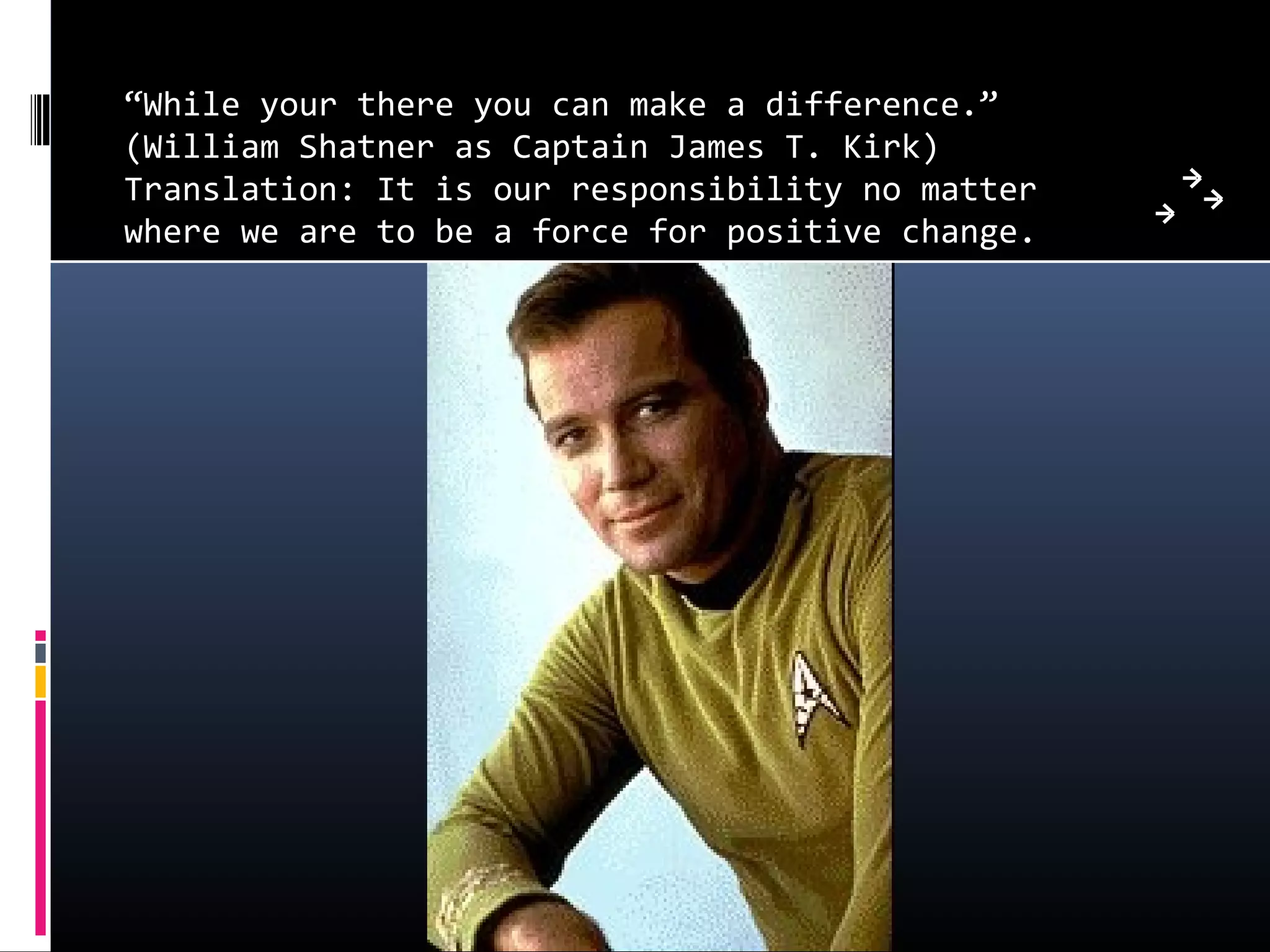
“While your there you can make a difference.”
(William Shatner as Captain James T. Kirk)
Translation: It is our responsibility no matter
where we are to be a force for positive change.
What Kind of Oppression Are We
Talking About?
“Ableism, sometimes referred to as 'disableism’ is the systematic
oppression of a group of people with disabilities. This form of
oppression is manifest in the combination of persona) prejudices,
cultural expressions and values, and social forces that marginalize
people with disabilities and portray them in a negative light, thus
oppressing them.” (Mullaly, 2010 P. 215)
An Example of Ableism
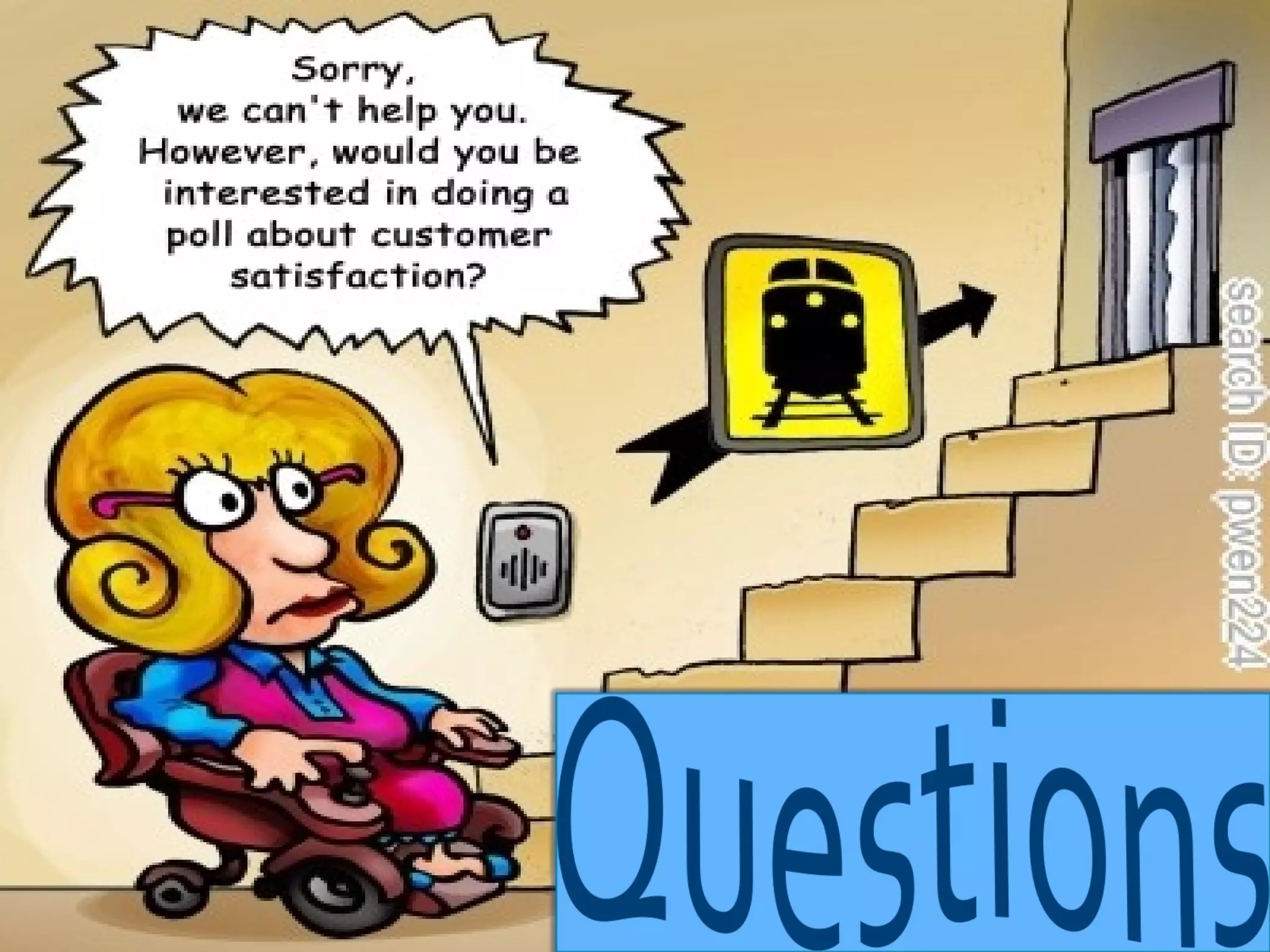
 My apartment at the U of L
 Mobility problems
 Attempted solutions
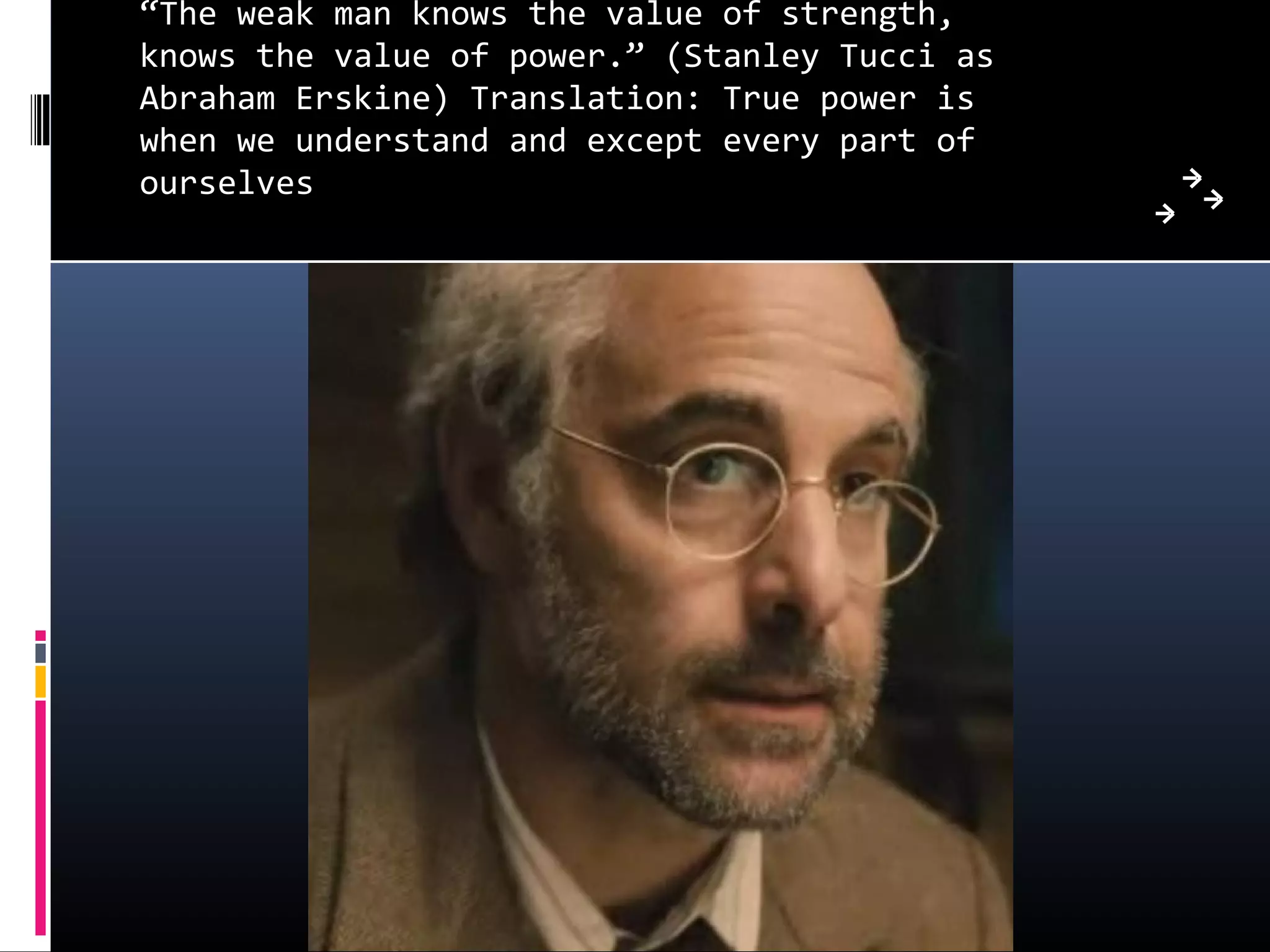
“The weak man knows the value of strength,
knows the value of power.” (Stanley Tucci as
Abraham Erskine) Translation: True power is
when we understand and except every part of
ourselves
The Anti-Oppressive Framework
 Anti-Oppressive Practice: From a Personal Level
 Focus: Education and Empowerment
 Theories: Ability and Structural Social Work
Why I Chose This Framework
 A lack of communication and understanding between the
groups involved.
Able-Bodied = Dominant Culture
Disabled = Subculture
 A tendency to want to over come personal barriers
before attempting larger group barriers.
 Fragmentation among the different oppressed
“disabled” groups in society. Eg. Wheelchair bound,
blind, hearing impaired, mentally disabled may view all
of their oppressions as different.
The Anti-Oppressive Practice In
Action
 Thmost effective using support group for disabled
people.
 This would allow for individuals to gain a new
perspective and understanding of themselves and
as a part of a larger oppressed group in society.
 Participating in this group would give the
participants a sense of empowerment that could
encourage them to move towards political action.
Example of The Anti-Oppressive
Framework In Action
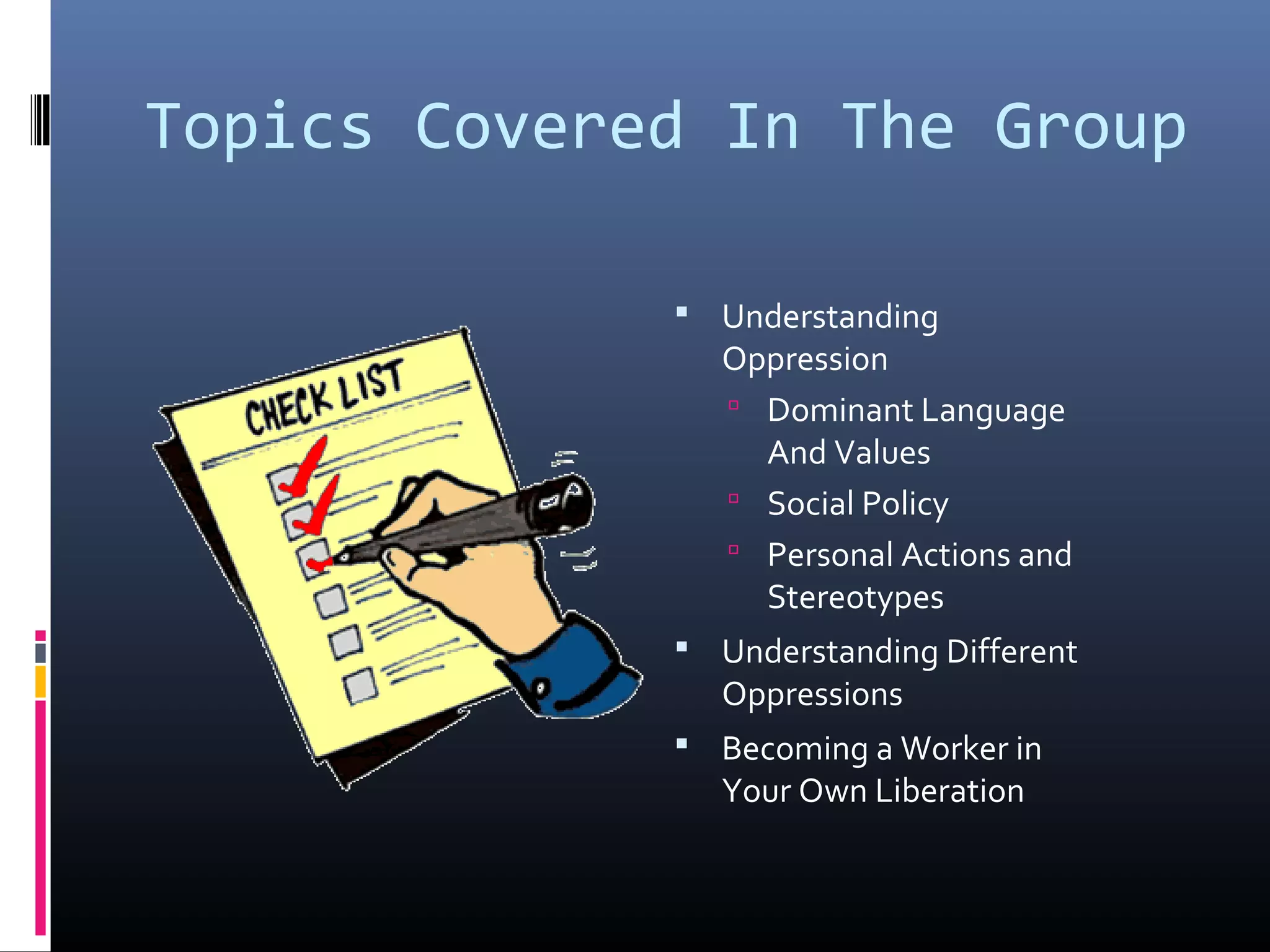
Topics Covered In The Group
 Understanding
Oppression
 Dominant Language
And Values
 Social Policy
 Personal Actions and
Stereotypes
 Understanding Different
Oppressions
 Becoming a Worker in
Your Own Liberation
KNOWLEDGE BUILDING TOOLS
Understanding Oppression (Labels And Values)
SAMPLE QUESTIONS
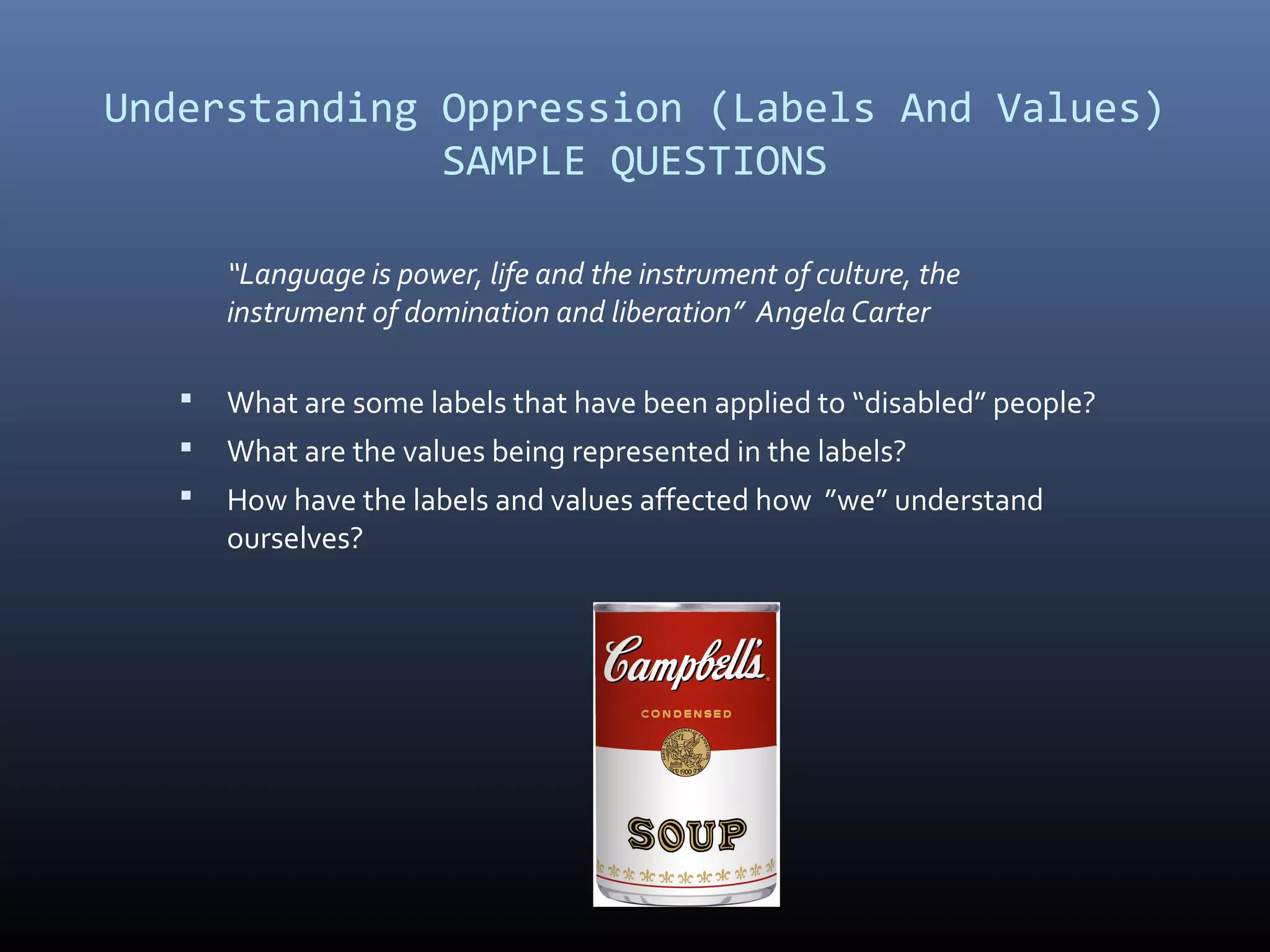
“Language is power, life and the instrument of culture, the
instrument of domination and liberation” Angela Carter
 What are some labels that have been applied to “disabled” people?
 What are the values being represented in the labels?
 How have the labels and values affected how ”we” understand
ourselves?
Understanding Oppression (Labels And
Values) SAMPLE QUESTIONS
 How can the labels and values be linked to structural
oppression?
 Why do you think these labels and values have been
applied to “disabled people”?
 Is there be a better term to define the group?
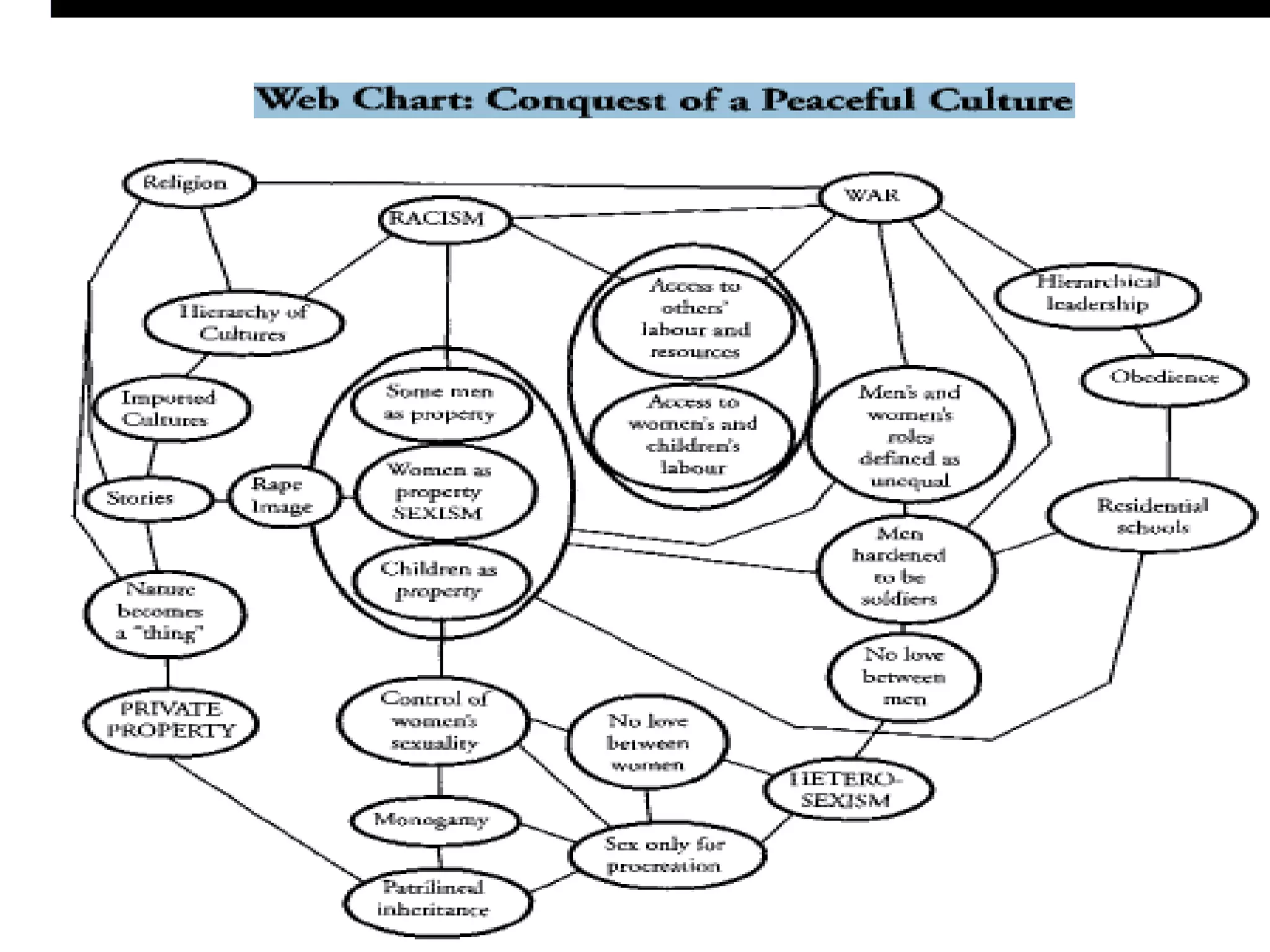
STARTTHE WEB CHART AND FOCUS ON
STRUCTURAL OPRESSION
Understanding Oppression (Social Policy)
SAMPLE QUESTIONS
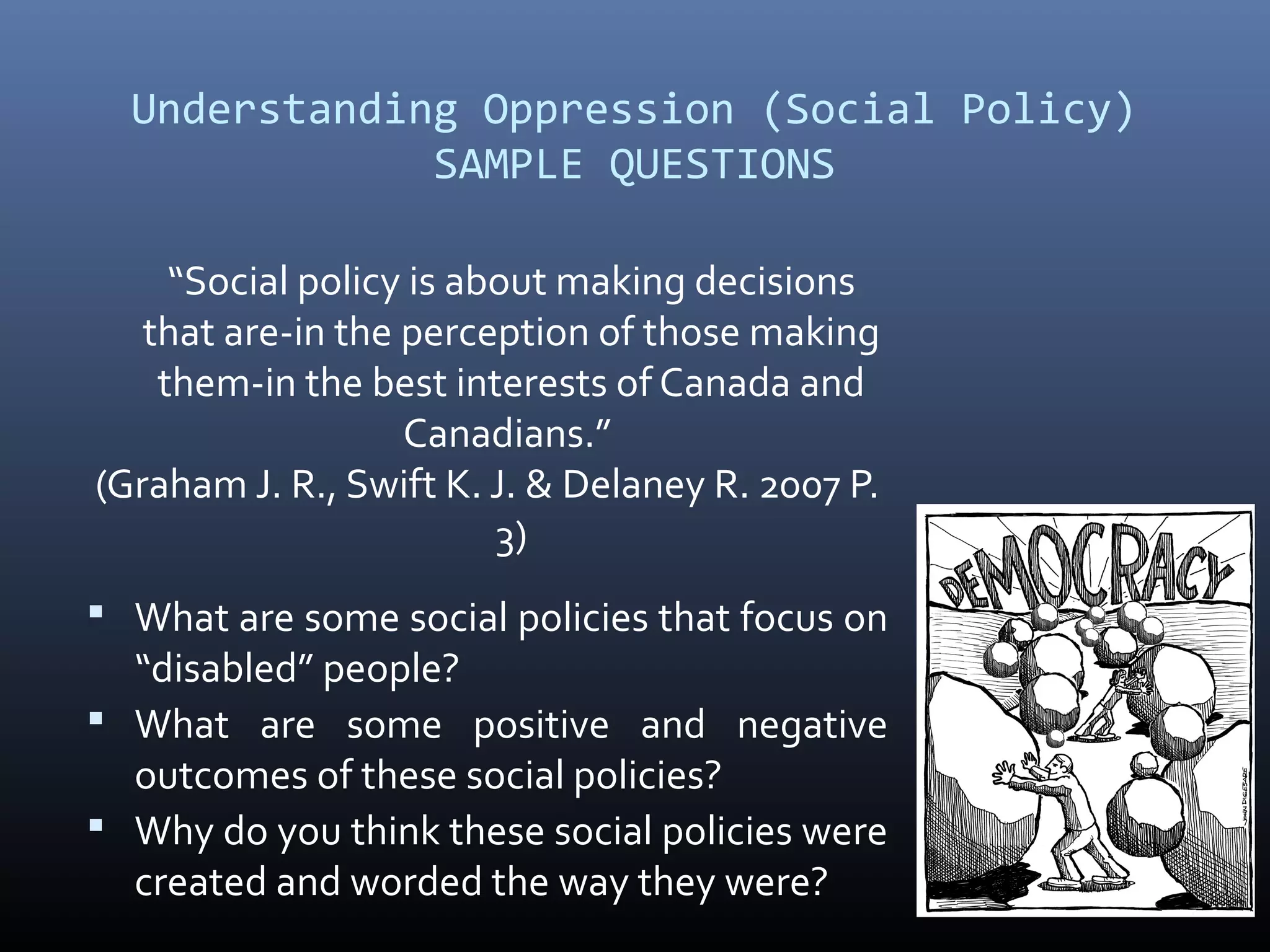
“Social policy is about making decisions
that are-in the perception of those making
them-in the best interests of Canada and
Canadians.”
(Graham J. R., Swift K. J. & Delaney R. 2007 P.
3)
 What are some social policies that focus on
“disabled” people?
 What are some positive and negative
outcomes of these social policies?
 Why do you think these social policies were
created and worded the way they were?
Understanding Oppression (Social
Policy) SAMPLE QUESTIONS
 How do language and values affect social policy?
 How can the effects of social policies be linked into
structural oppression?
 What are some actions that “we” can take as
“disabled” people and as Canadian citizens to
impact or change the role of social policy in our
lives?
APPLY WHATWE’VE LEARNEDTOTHEWEB CHART
Understanding Oppression
(Personal Actions and Stereotypes) SAMPLE
QUESTIONS
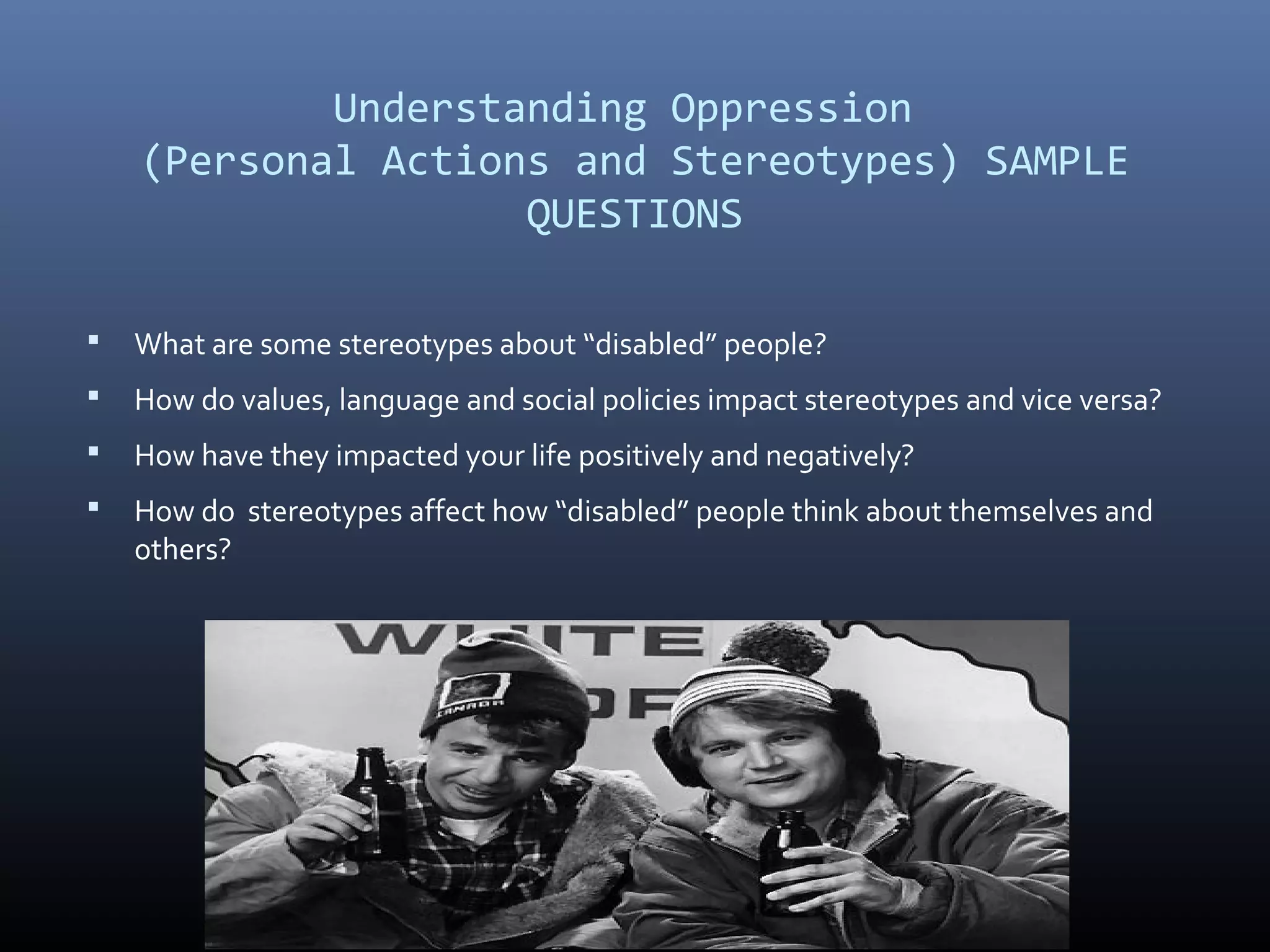
 What are some stereotypes about “disabled” people?
 How do values, language and social policies impact stereotypes and vice versa?
 How have they impacted your life positively and negatively?
 How do stereotypes affect how “disabled” people think about themselves and
others?
Understanding Oppression
(Personal Actions and Stereotypes) SAMPLE
QUESTIONS
 How do stereotypes affect how “disabled” people
think about themselves?
 How do stereotypes affect how “disabled” people
interact with each other?
 What are some expectations on the part of disabled
people that reinforce stereotypes?
 How can personal actions and stereotypes be linked
into structural oppression?
 What are some actions that could either reinforce or
deny stereotypes made about” disabled” people?
APPLY WHATWE’VE LEARNEDTOTHEWEB CHART
Understanding Different Oppressions SAMPLE
QUESTIONS
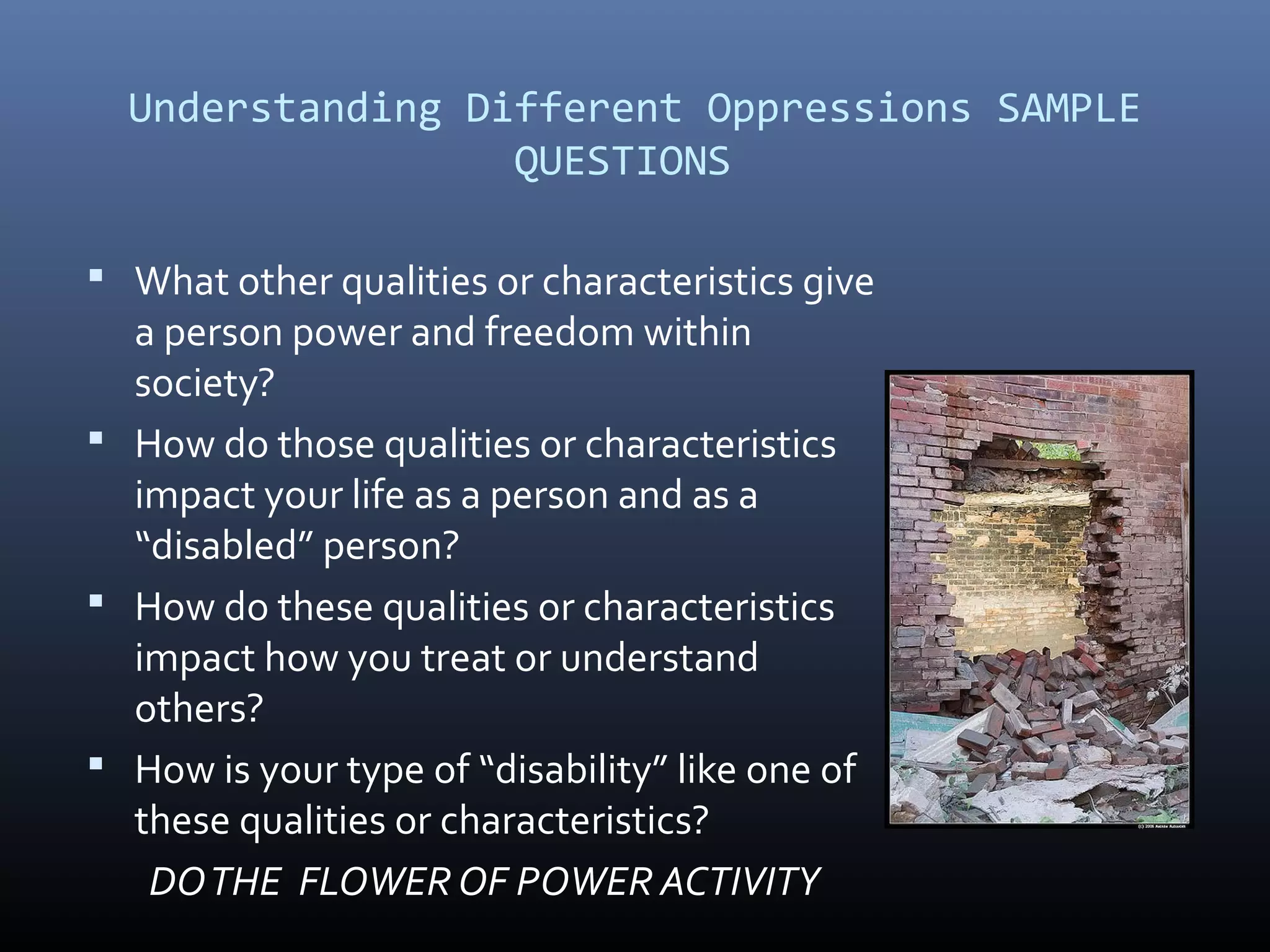
 What other qualities or characteristics give
a person power and freedom within
society?
 How do those qualities or characteristics
impact your life as a person and as a
“disabled” person?
 How do these qualities or characteristics
impact how you treat or understand
others?
 How is your type of “disability” like one of
these qualities or characteristics?
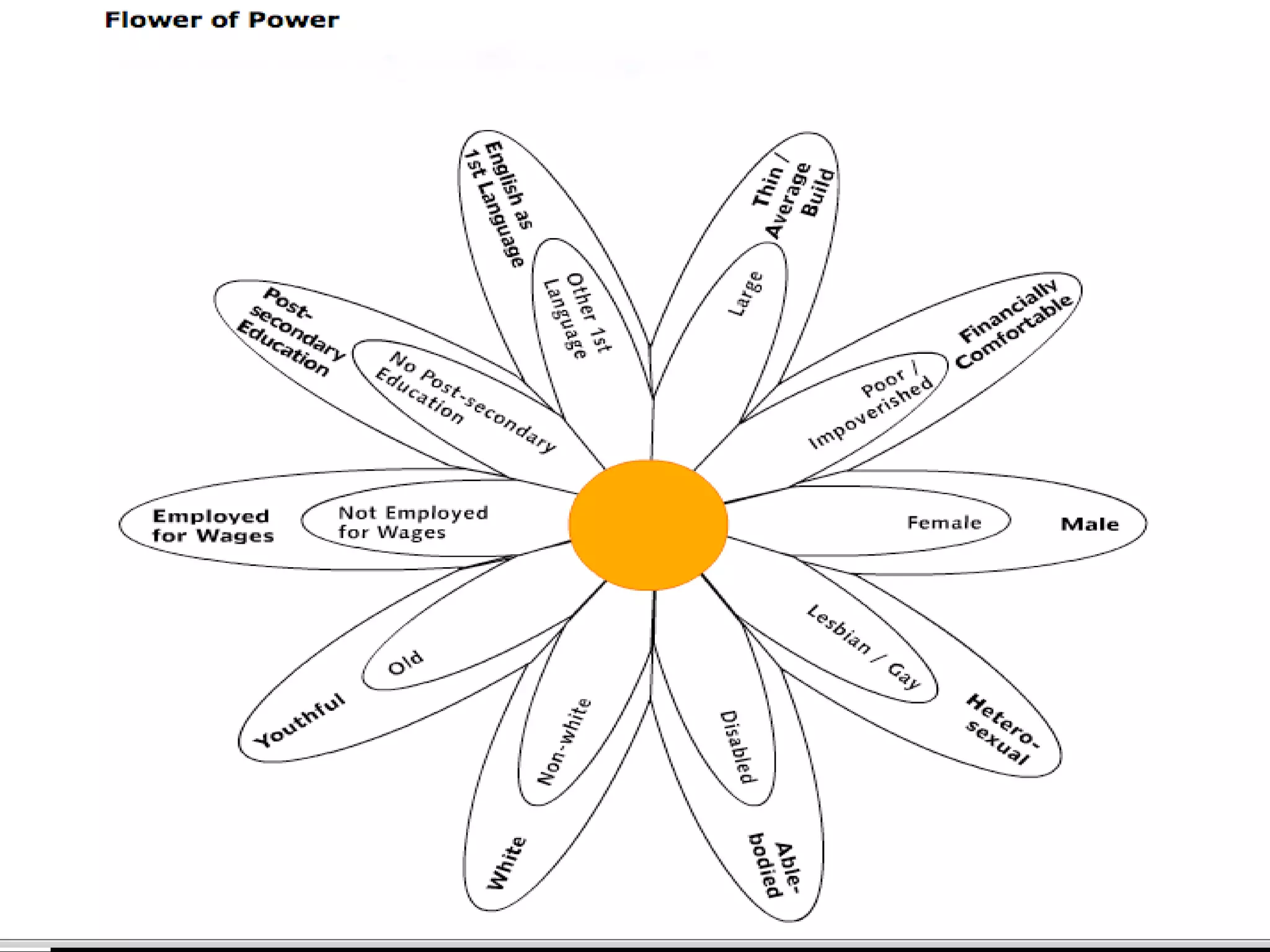
DOTHE FLOWER OF POWER ACTIVITY
Understanding Different Oppressions
SAMPLE QUESTIONS
 Compare your “FLOWER OF POWER” to another
person’s in the room. How are their experiences and
challenges similar?
 Could the way we understand barriers such as
structural oppression be understood and addressed
in a similar way to understand different
oppressions?
COMPAREWEB CHART AND FLOWER OF POWER
REVISIT OPPRESSOR PERSPECTIVE ANSWERS FROM
OTHER SLIDES AND DECIUS
Becoming a Worker in Your Own Liberation
SAMPLE QUESTIONS
 What can be from the inside in order to break the
web of oppression that we’ve been building?
 What can be done individually?
 What can be done as a group?
 How can we get others involved?
Resources
Bishop A. (2002). Becoming an Ally Breaking the Cycle of Oppression in People. Black
Point: Fernwood Publishing
Mallaly B. (2010). Challenging Oppression and Confronting Privilege A Critical Social Work
Approach. Don Mills, Ontario: Oxford University Press
Graham J. R., Swift K. J. & Delaney R. (2007). Canadian Social Policy: An Introduction (2nd
ed.).

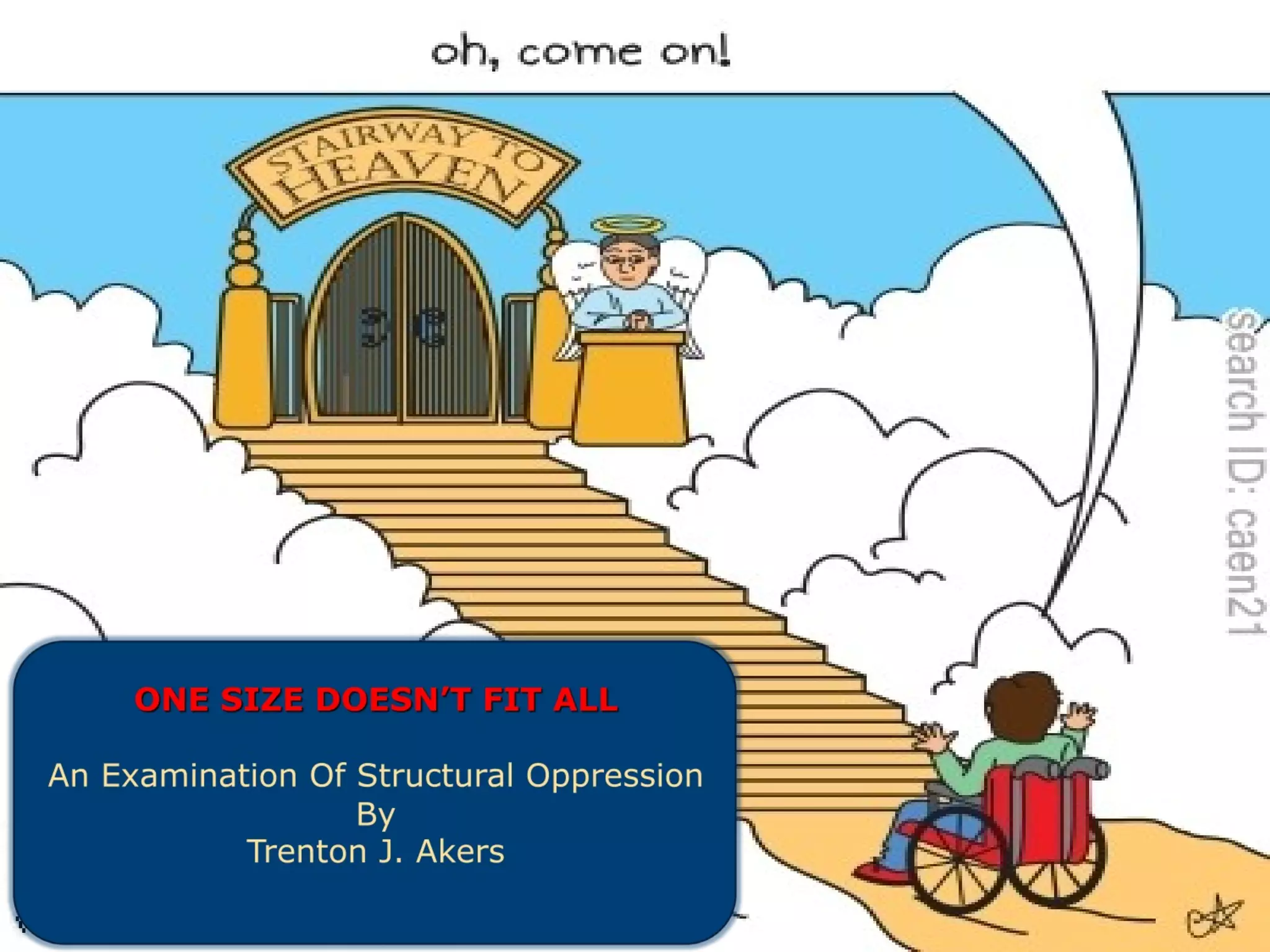
One size doesn’t fit all final draft

  • 2.
    “While your thereyou can make a difference.” (William Shatner as Captain James T. Kirk) Translation: It is our responsibility no matter where we are to be a force for positive change.
  • 3.
    What Kind ofOppression Are We Talking About? “Ableism, sometimes referred to as 'disableism’ is the systematic oppression of a group of people with disabilities. This form of oppression is manifest in the combination of persona) prejudices, cultural expressions and values, and social forces that marginalize people with disabilities and portray them in a negative light, thus oppressing them.” (Mullaly, 2010 P. 215)
  • 4.
    An Example ofAbleism  My apartment at the U of L  Mobility problems  Attempted solutions
  • 5.
    “The weak manknows the value of strength, knows the value of power.” (Stanley Tucci as Abraham Erskine) Translation: True power is when we understand and except every part of ourselves
  • 6.
    The Anti-Oppressive Framework Anti-Oppressive Practice: From a Personal Level  Focus: Education and Empowerment  Theories: Ability and Structural Social Work
  • 7.
    Why I ChoseThis Framework  A lack of communication and understanding between the groups involved. Able-Bodied = Dominant Culture Disabled = Subculture  A tendency to want to over come personal barriers before attempting larger group barriers.  Fragmentation among the different oppressed “disabled” groups in society. Eg. Wheelchair bound, blind, hearing impaired, mentally disabled may view all of their oppressions as different.
  • 8.
    The Anti-Oppressive PracticeIn Action  Thmost effective using support group for disabled people.  This would allow for individuals to gain a new perspective and understanding of themselves and as a part of a larger oppressed group in society.  Participating in this group would give the participants a sense of empowerment that could encourage them to move towards political action.
  • 9.
    Example of TheAnti-Oppressive Framework In Action
  • 10.
    Topics Covered InThe Group  Understanding Oppression  Dominant Language And Values  Social Policy  Personal Actions and Stereotypes  Understanding Different Oppressions  Becoming a Worker in Your Own Liberation
  • 11.
  • 14.
    Understanding Oppression (LabelsAnd Values) SAMPLE QUESTIONS “Language is power, life and the instrument of culture, the instrument of domination and liberation” Angela Carter  What are some labels that have been applied to “disabled” people?  What are the values being represented in the labels?  How have the labels and values affected how ”we” understand ourselves?
  • 15.
    Understanding Oppression (LabelsAnd Values) SAMPLE QUESTIONS  How can the labels and values be linked to structural oppression?  Why do you think these labels and values have been applied to “disabled people”?  Is there be a better term to define the group? STARTTHE WEB CHART AND FOCUS ON STRUCTURAL OPRESSION
  • 16.
    Understanding Oppression (SocialPolicy) SAMPLE QUESTIONS “Social policy is about making decisions that are-in the perception of those making them-in the best interests of Canada and Canadians.” (Graham J. R., Swift K. J. & Delaney R. 2007 P. 3)  What are some social policies that focus on “disabled” people?  What are some positive and negative outcomes of these social policies?  Why do you think these social policies were created and worded the way they were?
  • 17.
    Understanding Oppression (Social Policy)SAMPLE QUESTIONS  How do language and values affect social policy?  How can the effects of social policies be linked into structural oppression?  What are some actions that “we” can take as “disabled” people and as Canadian citizens to impact or change the role of social policy in our lives? APPLY WHATWE’VE LEARNEDTOTHEWEB CHART
  • 18.
    Understanding Oppression (Personal Actionsand Stereotypes) SAMPLE QUESTIONS  What are some stereotypes about “disabled” people?  How do values, language and social policies impact stereotypes and vice versa?  How have they impacted your life positively and negatively?  How do stereotypes affect how “disabled” people think about themselves and others?
  • 19.
    Understanding Oppression (Personal Actionsand Stereotypes) SAMPLE QUESTIONS  How do stereotypes affect how “disabled” people think about themselves?  How do stereotypes affect how “disabled” people interact with each other?  What are some expectations on the part of disabled people that reinforce stereotypes?  How can personal actions and stereotypes be linked into structural oppression?  What are some actions that could either reinforce or deny stereotypes made about” disabled” people? APPLY WHATWE’VE LEARNEDTOTHEWEB CHART
  • 20.
    Understanding Different OppressionsSAMPLE QUESTIONS  What other qualities or characteristics give a person power and freedom within society?  How do those qualities or characteristics impact your life as a person and as a “disabled” person?  How do these qualities or characteristics impact how you treat or understand others?  How is your type of “disability” like one of these qualities or characteristics? DOTHE FLOWER OF POWER ACTIVITY
  • 21.
    Understanding Different Oppressions SAMPLEQUESTIONS  Compare your “FLOWER OF POWER” to another person’s in the room. How are their experiences and challenges similar?  Could the way we understand barriers such as structural oppression be understood and addressed in a similar way to understand different oppressions? COMPAREWEB CHART AND FLOWER OF POWER REVISIT OPPRESSOR PERSPECTIVE ANSWERS FROM OTHER SLIDES AND DECIUS
  • 22.
    Becoming a Workerin Your Own Liberation SAMPLE QUESTIONS  What can be from the inside in order to break the web of oppression that we’ve been building?  What can be done individually?  What can be done as a group?  How can we get others involved?
  • 24.
    Resources Bishop A. (2002).Becoming an Ally Breaking the Cycle of Oppression in People. Black Point: Fernwood Publishing Mallaly B. (2010). Challenging Oppression and Confronting Privilege A Critical Social Work Approach. Don Mills, Ontario: Oxford University Press Graham J. R., Swift K. J. & Delaney R. (2007). Canadian Social Policy: An Introduction (2nd ed.).