One belt, many roads and beyond
Abu Saeed Khan
Senior Policy Fellow
LIRNEasia
abu@lirneasia.net
ESCAP Working Group on the
Asia-Pacific Information Superhighway
Incheon, Republic of Korea
September 1, 2015
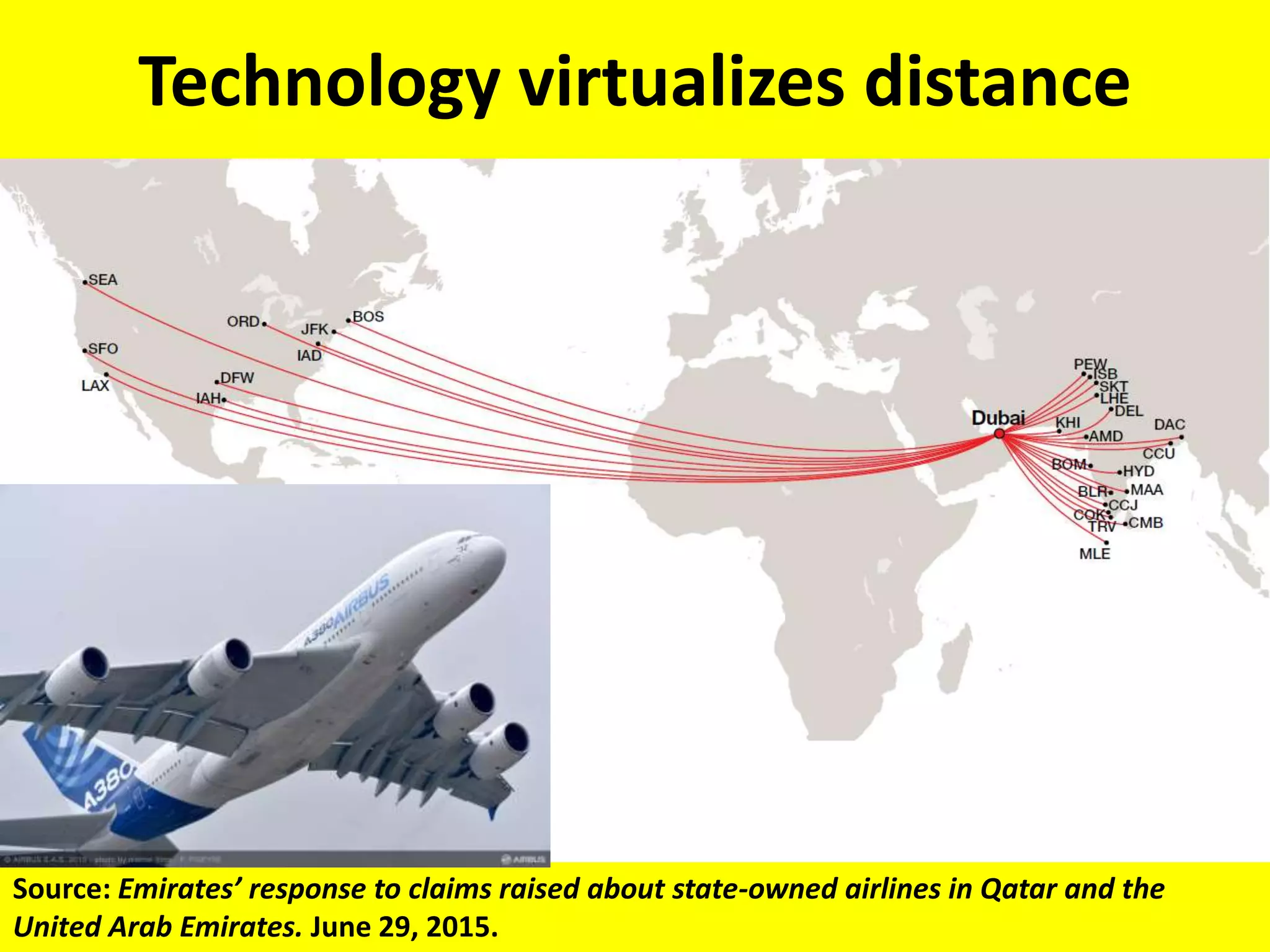
Technology virtualizes distance
Source: Emirates’ response to claims raised about state-owned airlines in Qatar and the
United Arab Emirates. June 29, 2015.
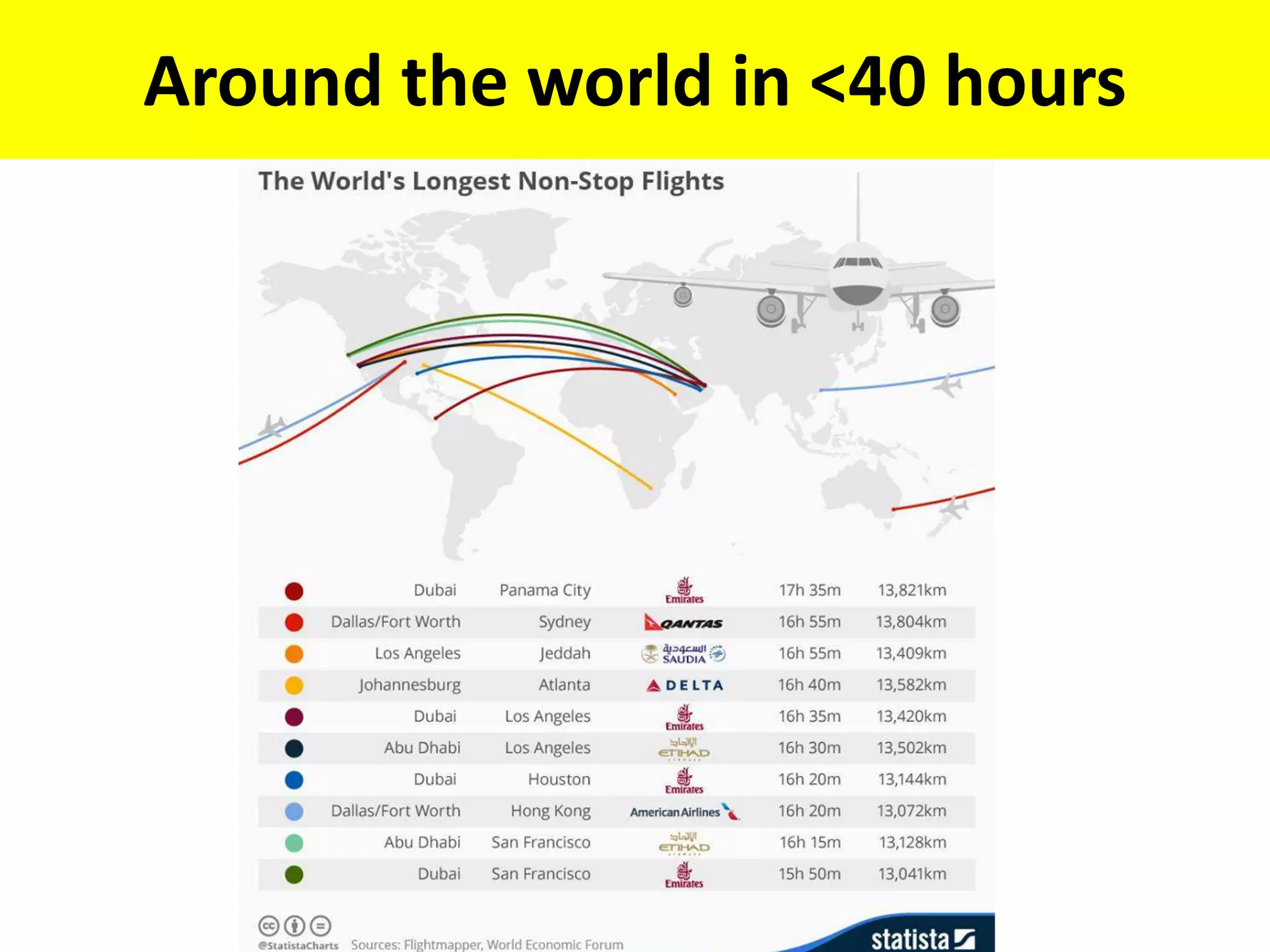
Around the world in <40 hours
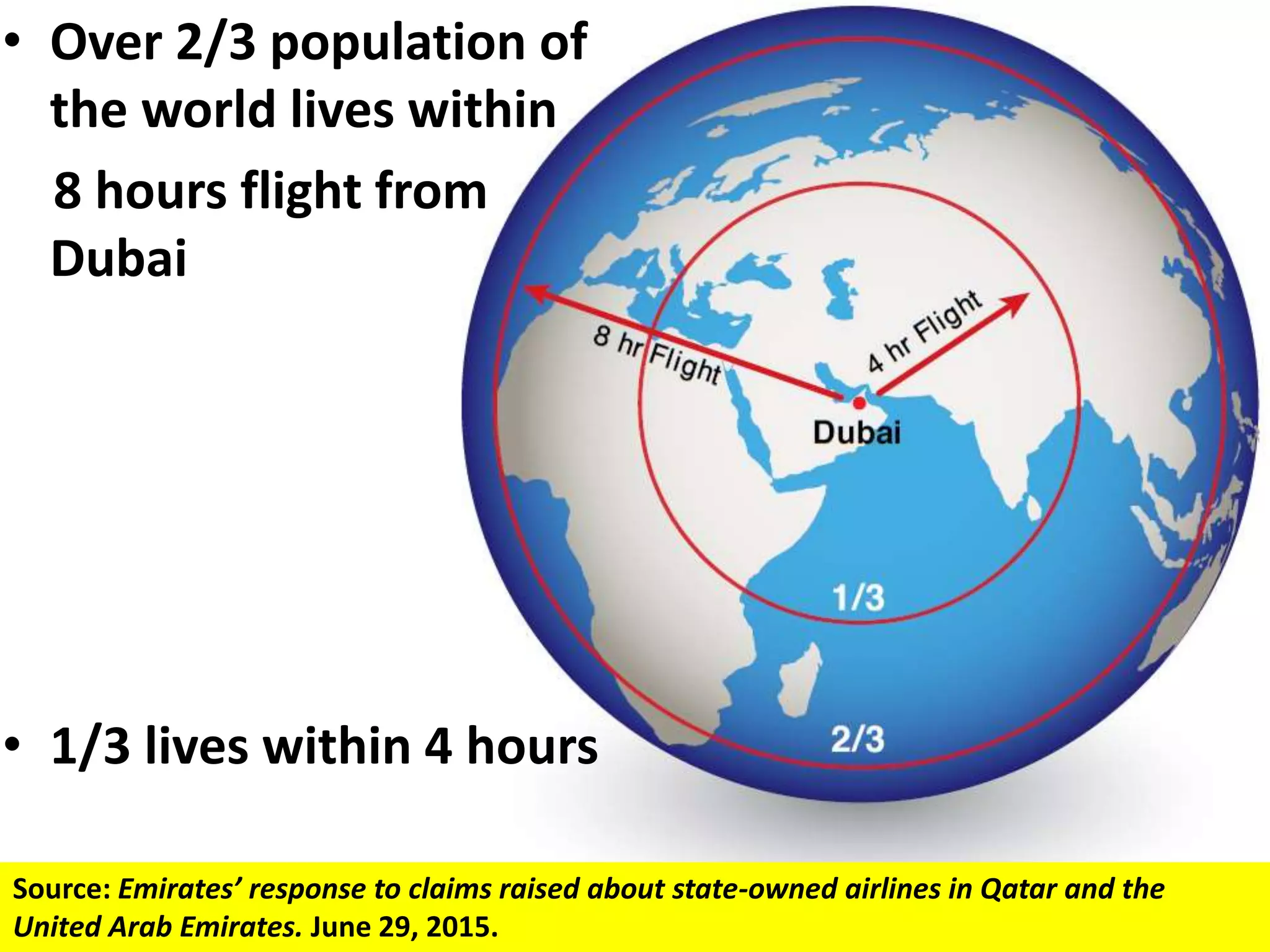
• Over 2/3 population of
the world lives within
8 hours flight from
Dubai
• 1/3 lives within 4 hours
Source: Emirates’ response to claims raised about state-owned airlines in Qatar and the
United Arab Emirates. June 29, 2015.
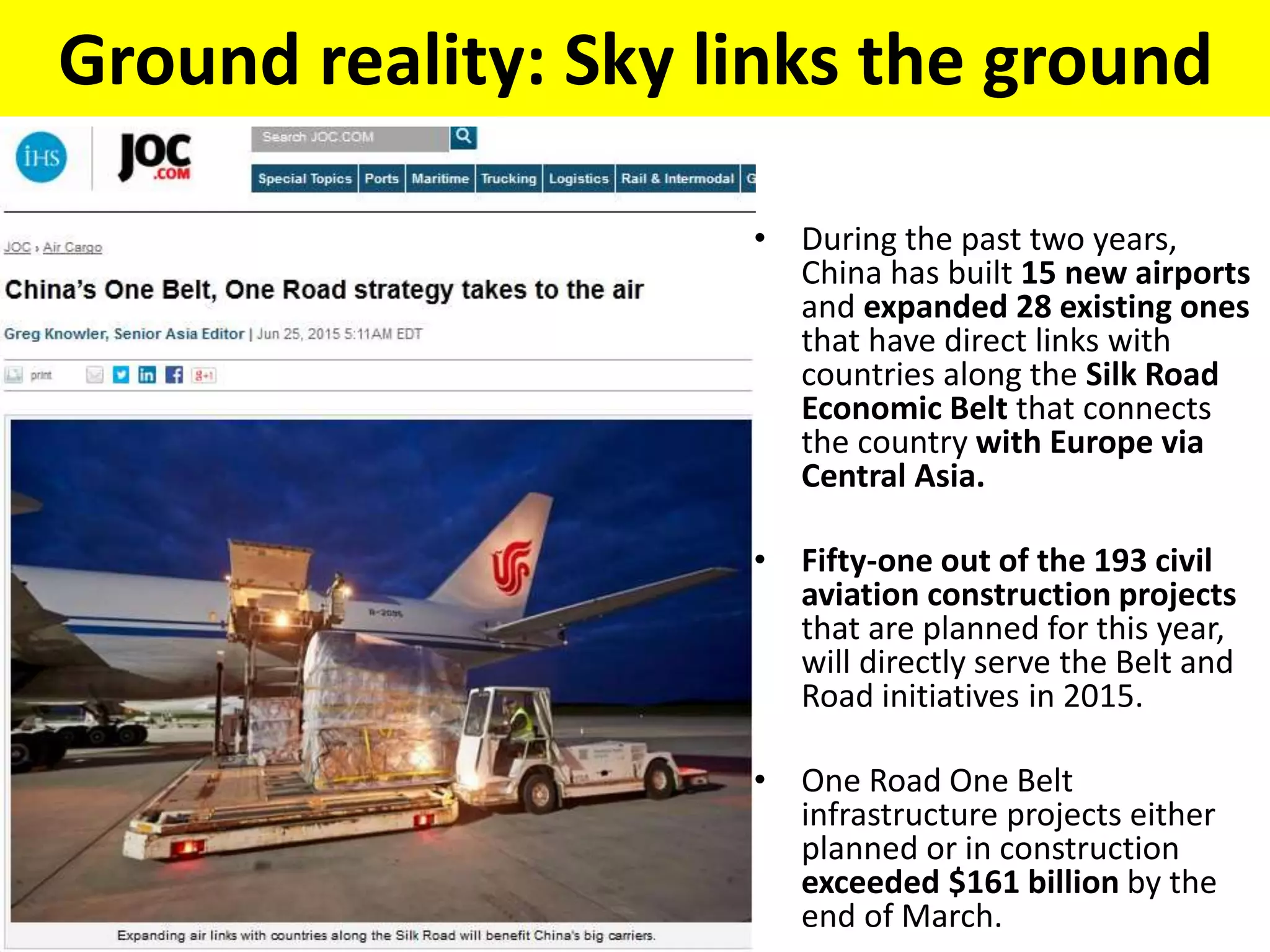
Ground reality: Sky links the ground
• During the past two years,
China has built 15 new airports
and expanded 28 existing ones
that have direct links with
countries along the Silk Road
Economic Belt that connects
the country with Europe via
Central Asia.
• Fifty-one out of the 193 civil
aviation construction projects
that are planned for this year,
will directly serve the Belt and
Road initiatives in 2015.
• One Road One Belt
infrastructure projects either
planned or in construction
exceeded $161 billion by the
end of March.
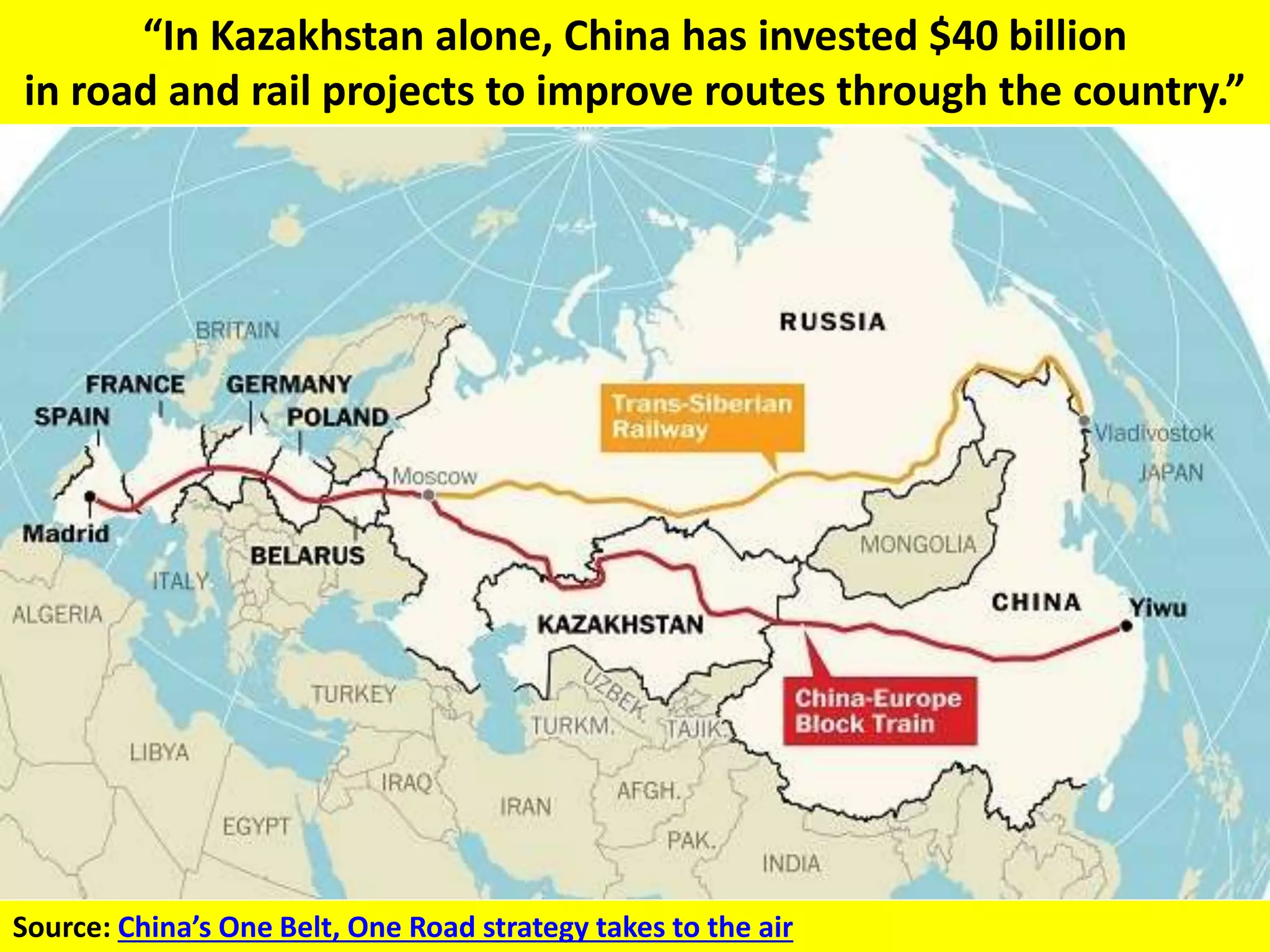
“In Kazakhstan alone, China has invested $40 billion
in road and rail projects to improve routes through the country.”
Source: China’s One Belt, One Road strategy takes to the air
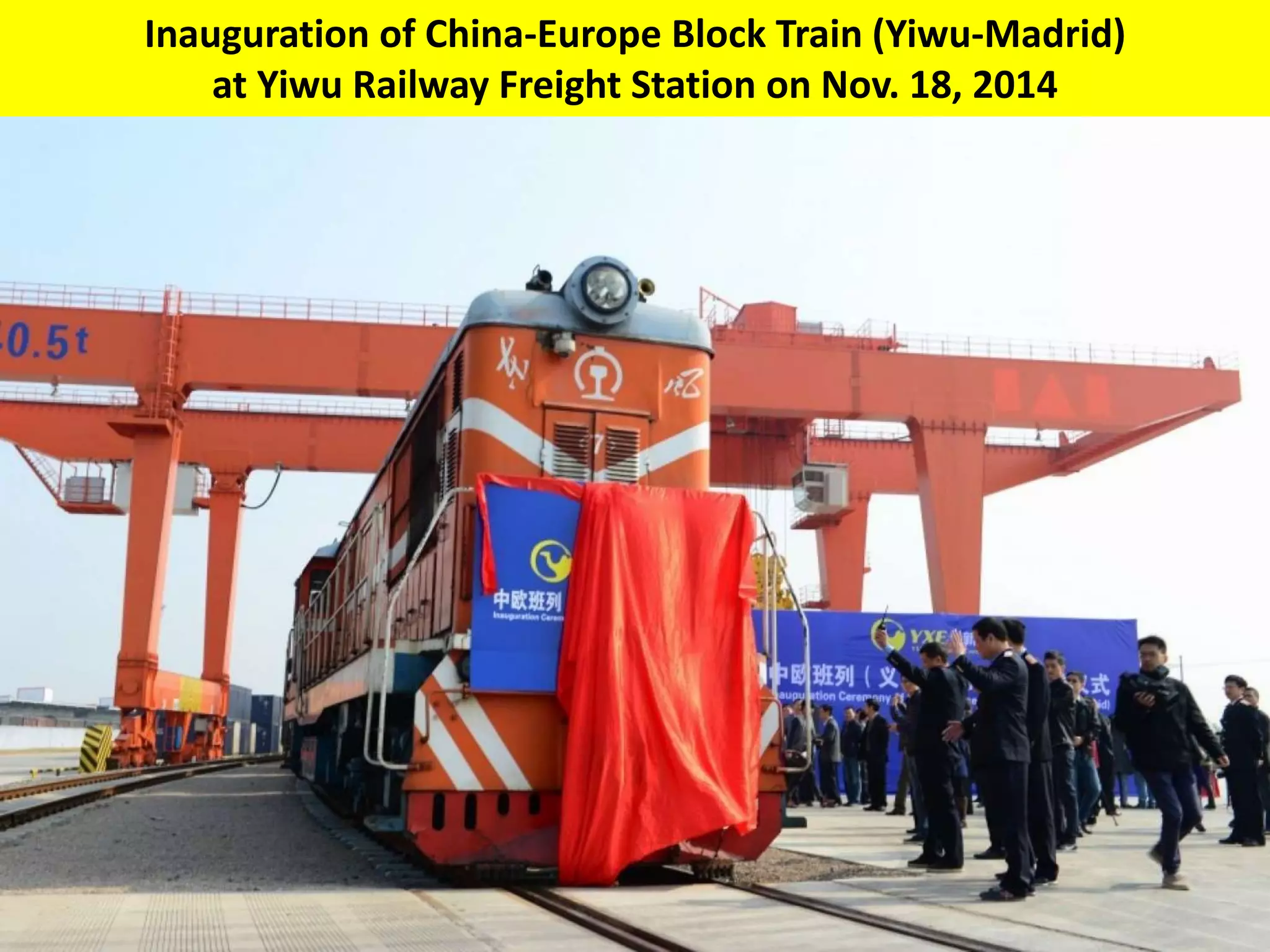
Inauguration of China-Europe Block Train (Yiwu-Madrid)
at Yiwu Railway Freight Station on Nov. 18, 2014
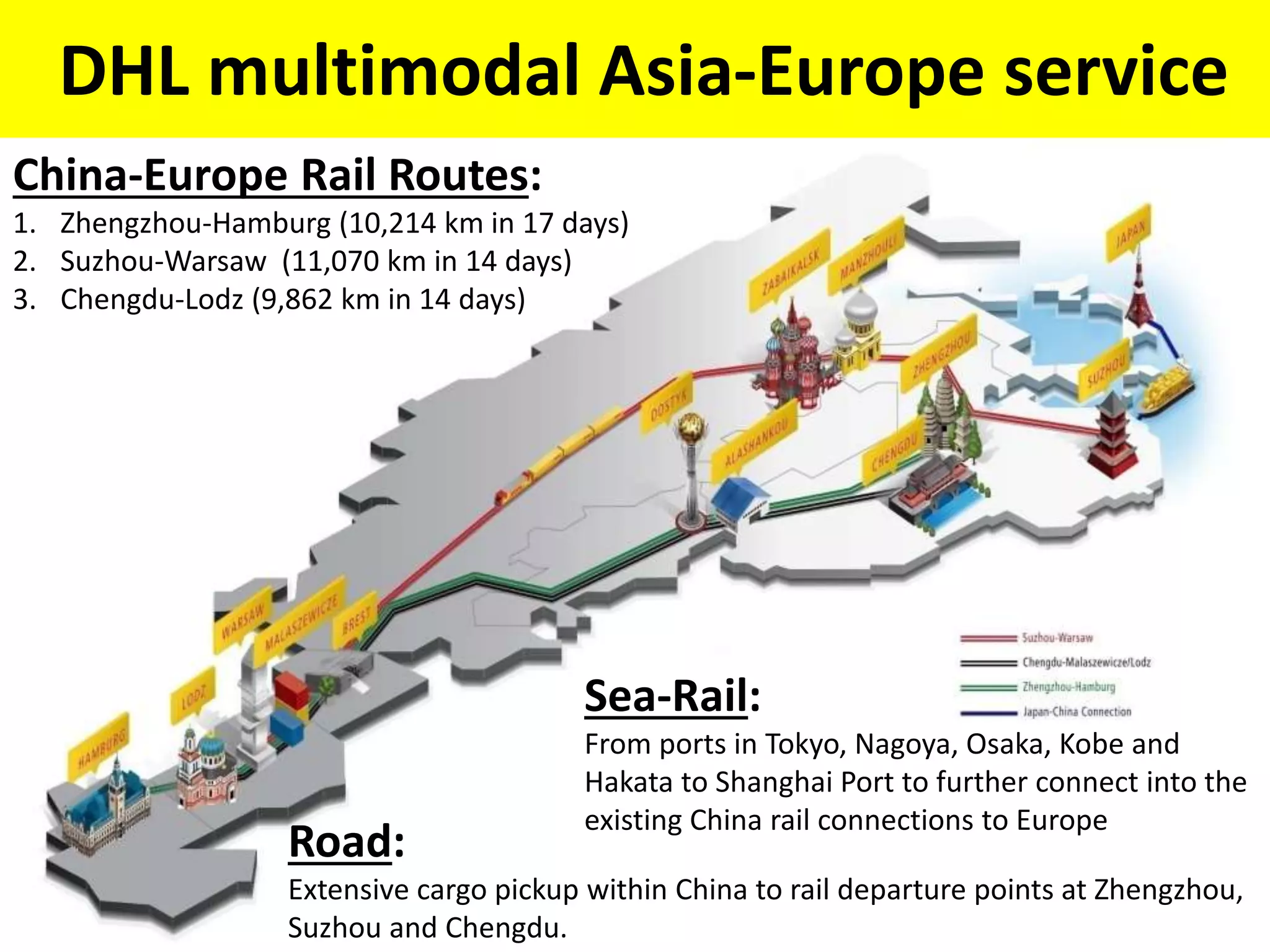
DHL multimodal Asia-Europe service
China-Europe Rail Routes:
1. Zhengzhou-Hamburg (10,214 km in 17 days)
2. Suzhou-Warsaw (11,070 km in 14 days)
3. Chengdu-Lodz (9,862 km in 14 days)
Sea-Rail:
From ports in Tokyo, Nagoya, Osaka, Kobe and
Hakata to Shanghai Port to further connect into the
existing China rail connections to Europe
Road:
Extensive cargo pickup within China to rail departure points at Zhengzhou,
Suzhou and Chengdu.
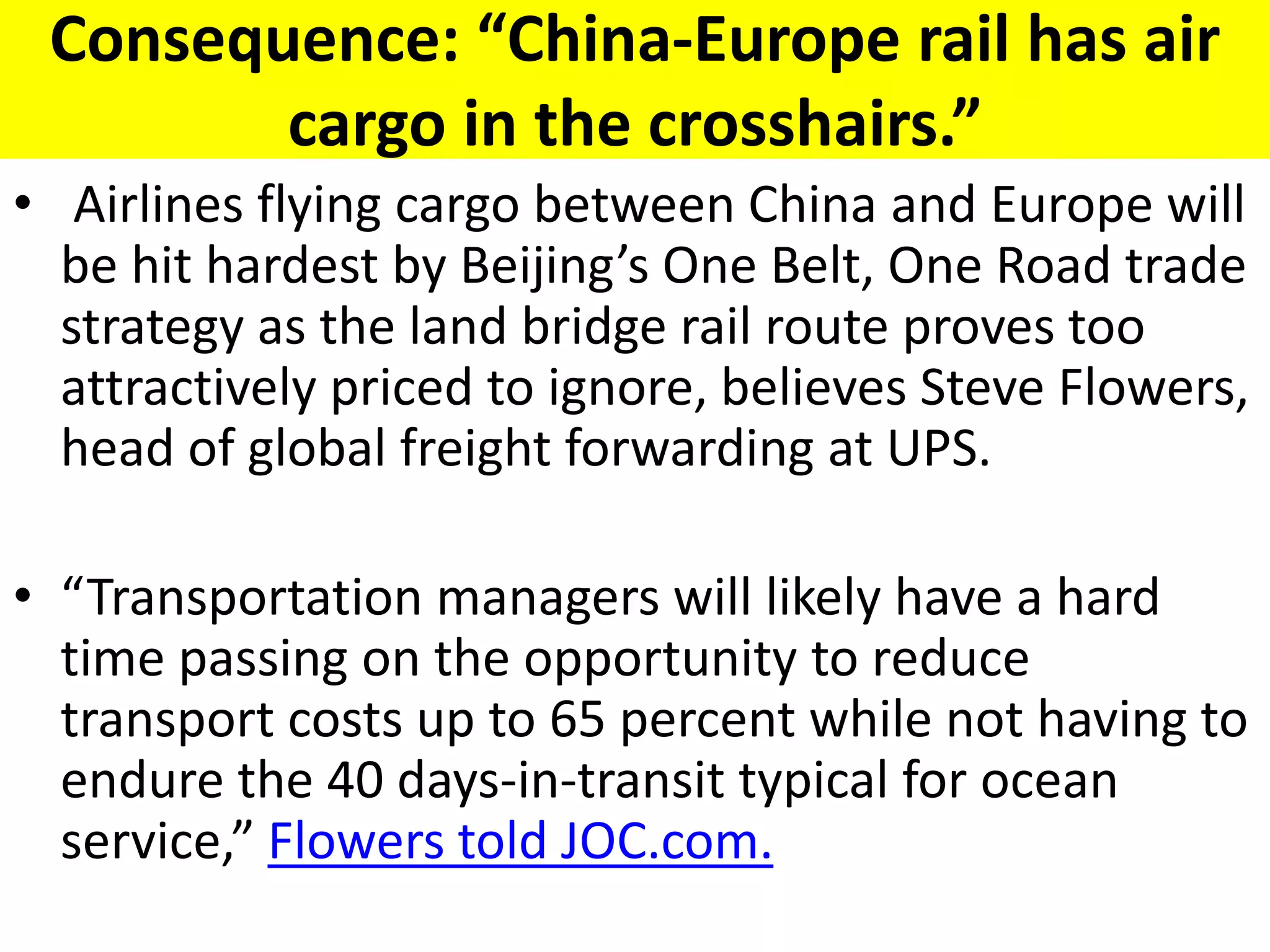
Consequence: “China-Europe rail has air
cargo in the crosshairs.”
• Airlines flying cargo between China and Europe will
be hit hardest by Beijing’s One Belt, One Road trade
strategy as the land bridge rail route proves too
attractively priced to ignore, believes Steve Flowers,
head of global freight forwarding at UPS.
• “Transportation managers will likely have a hard
time passing on the opportunity to reduce
transport costs up to 65 percent while not having to
endure the 40 days-in-transit typical for ocean
service,” Flowers told JOC.com.
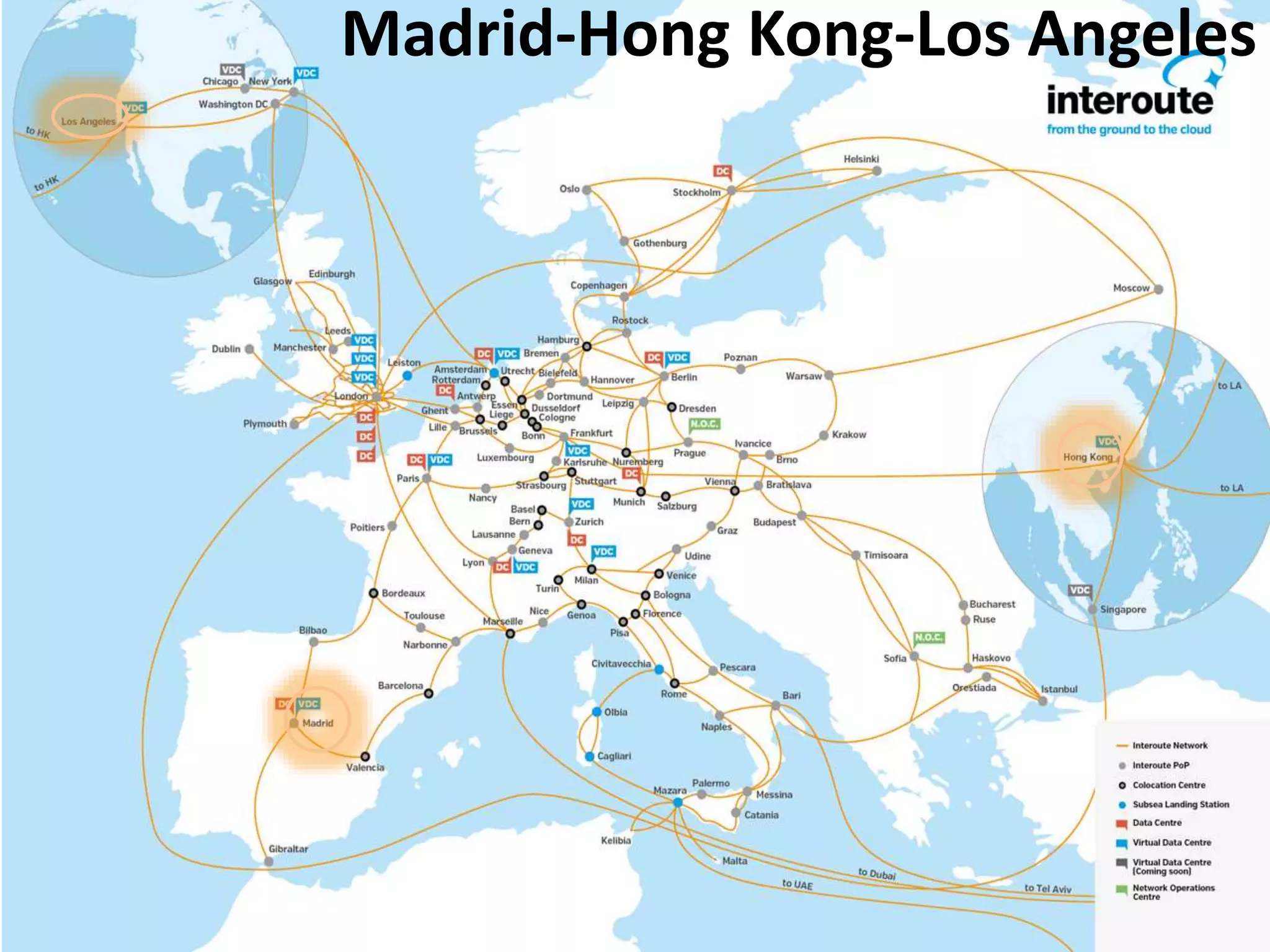
DREAM (Diverse Route for European and Asian Markets)
was launched October 17, 2013
Madrid-Hong Kong-Los Angeles
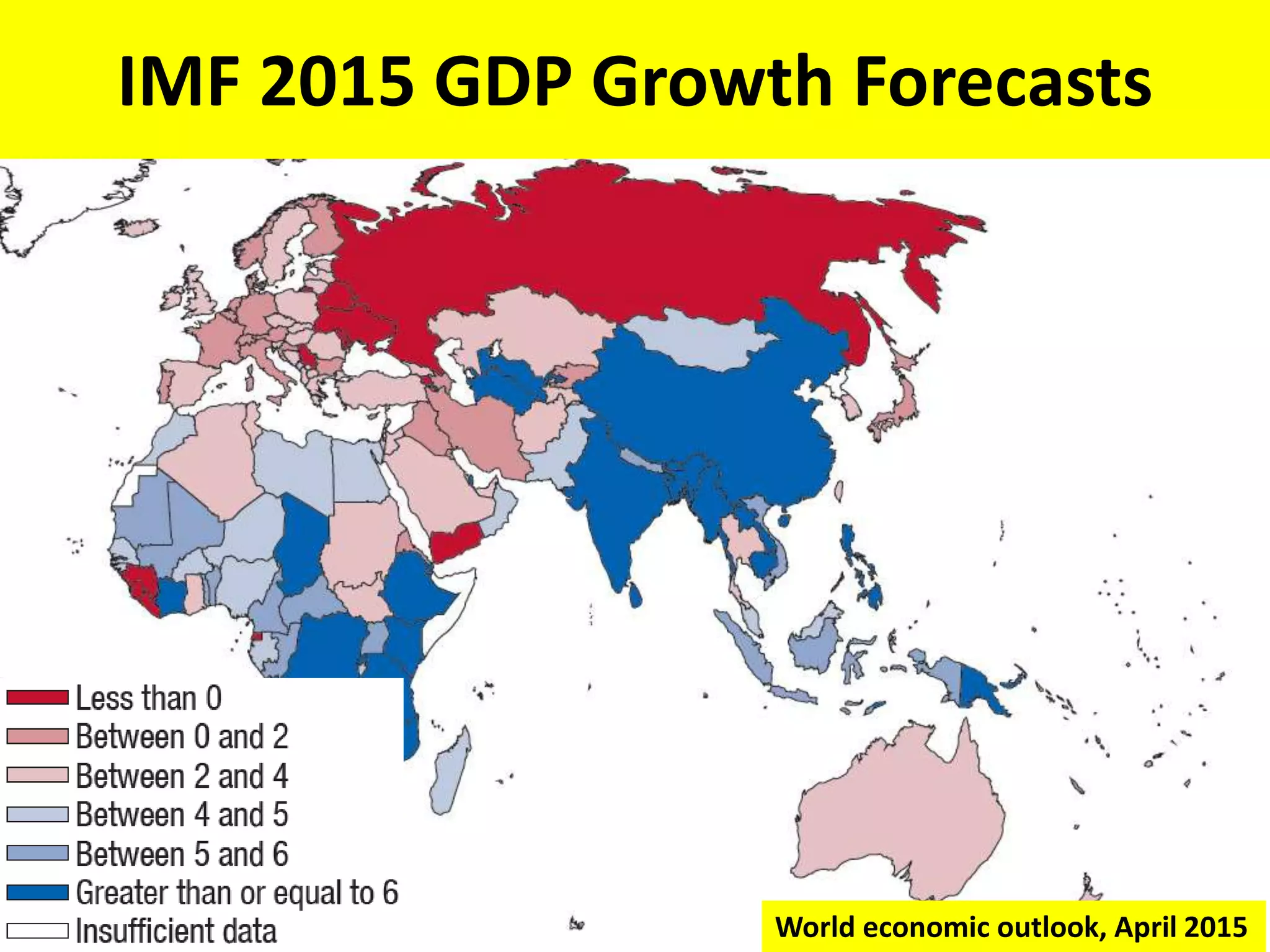
IMF 2015 GDP Growth Forecasts
World economic outlook, April 2015
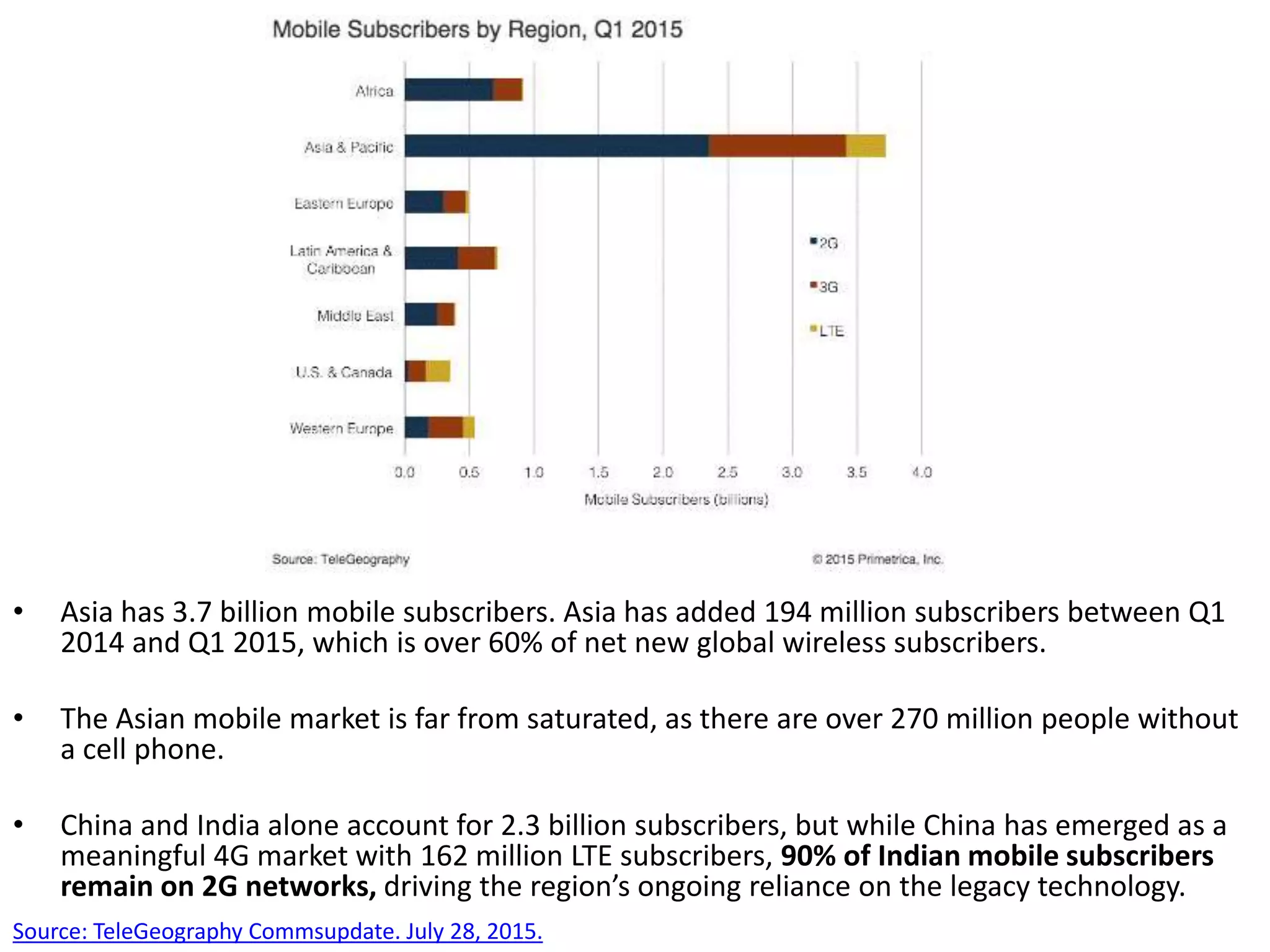
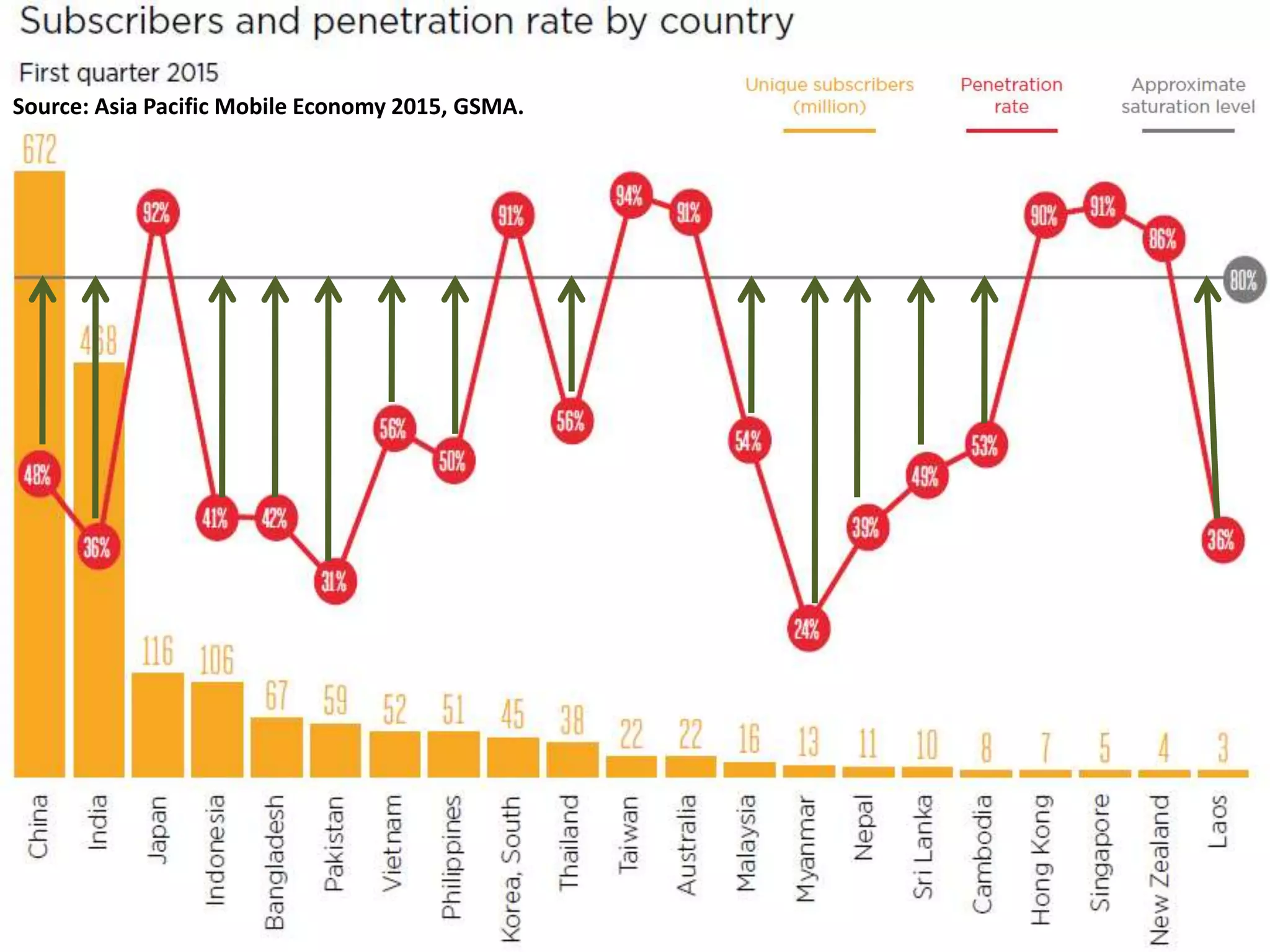
• Asia has 3.7 billion mobile subscribers. Asia has added 194 million subscribers between Q1
2014 and Q1 2015, which is over 60% of net new global wireless subscribers.
• The Asian mobile market is far from saturated, as there are over 270 million people without
a cell phone.
• China and India alone account for 2.3 billion subscribers, but while China has emerged as a
meaningful 4G market with 162 million LTE subscribers, 90% of Indian mobile subscribers
remain on 2G networks, driving the region’s ongoing reliance on the legacy technology.
Source: TeleGeography Commsupdate. July 28, 2015.
Source: Asia Pacific Mobile Economy 2015, GSMA.
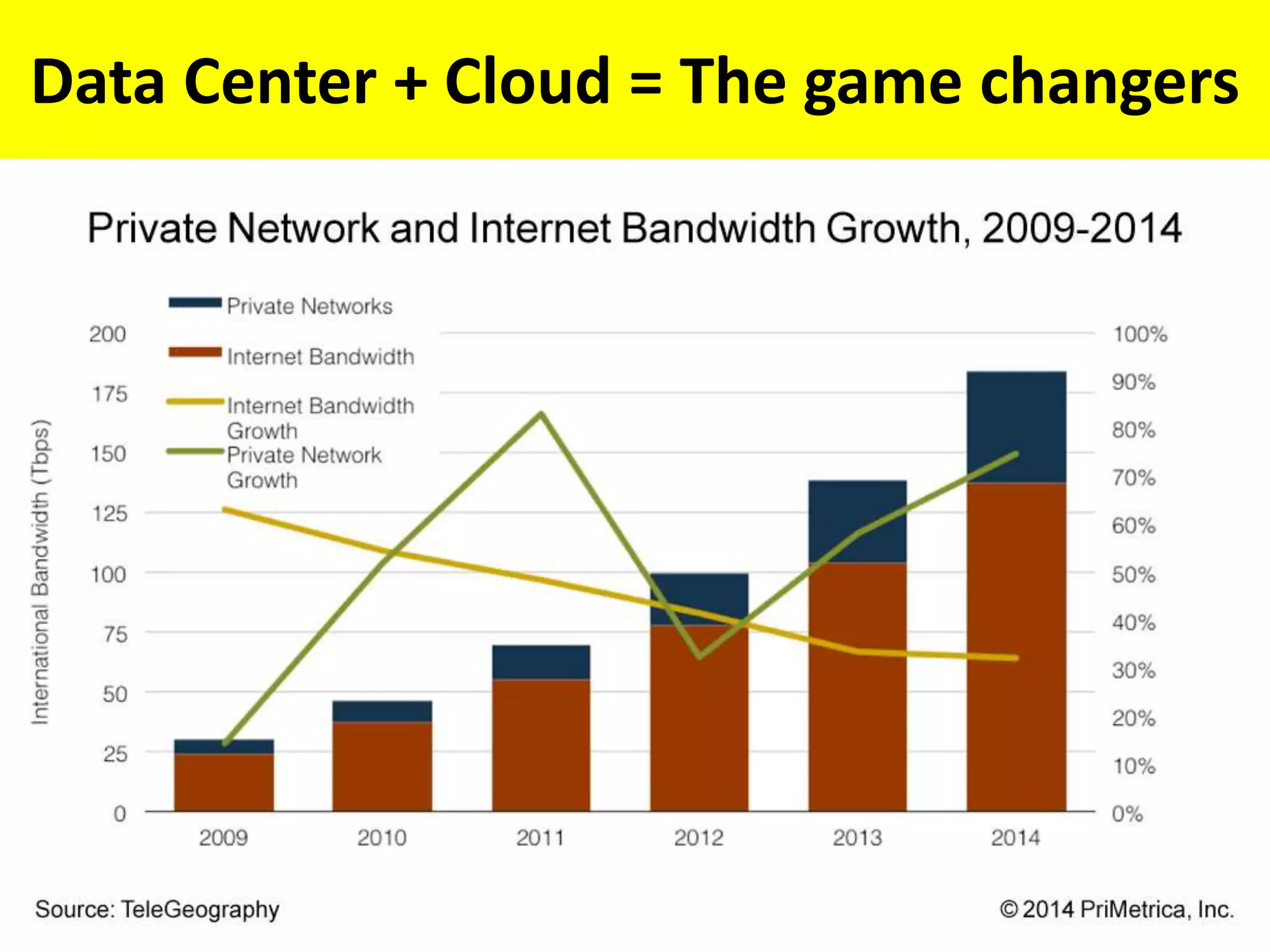
Data Center + Cloud = The game changers
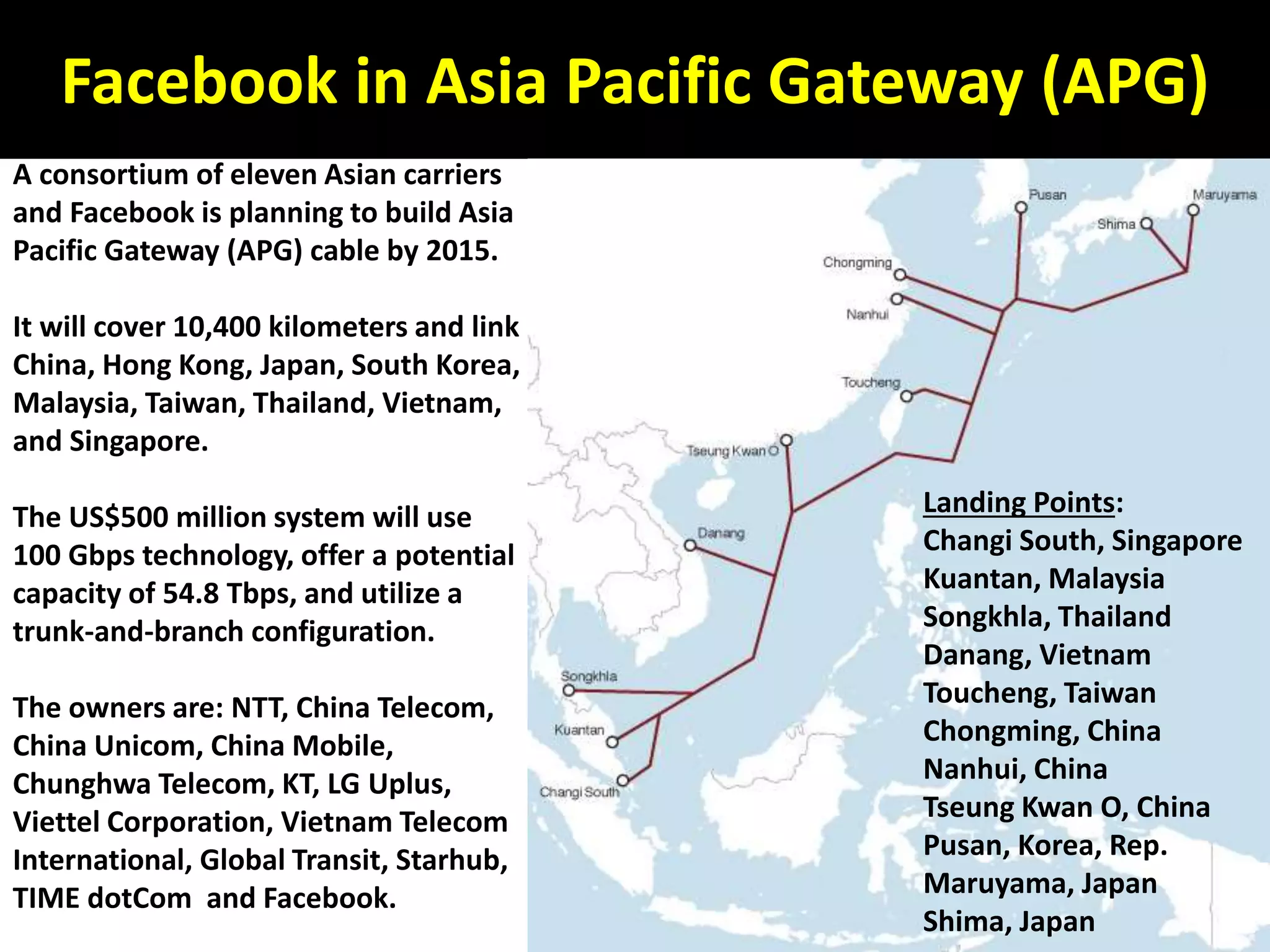
Facebook in Asia Pacific Gateway (APG)
A consortium of eleven Asian carriers
and Facebook is planning to build Asia
Pacific Gateway (APG) cable by 2015.
It will cover 10,400 kilometers and link
China, Hong Kong, Japan, South Korea,
Malaysia, Taiwan, Thailand, Vietnam,
and Singapore.
The US$500 million system will use
100 Gbps technology, offer a potential
capacity of 54.8 Tbps, and utilize a
trunk-and-branch configuration.
The owners are: NTT, China Telecom,
China Unicom, China Mobile,
Chunghwa Telecom, KT, LG Uplus,
Viettel Corporation, Vietnam Telecom
International, Global Transit, Starhub,
TIME dotCom and Facebook.
Landing Points:
Changi South, Singapore
Kuantan, Malaysia
Songkhla, Thailand
Danang, Vietnam
Toucheng, Taiwan
Chongming, China
Nanhui, China
Tseung Kwan O, China
Pusan, Korea, Rep.
Maruyama, Japan
Shima, Japan
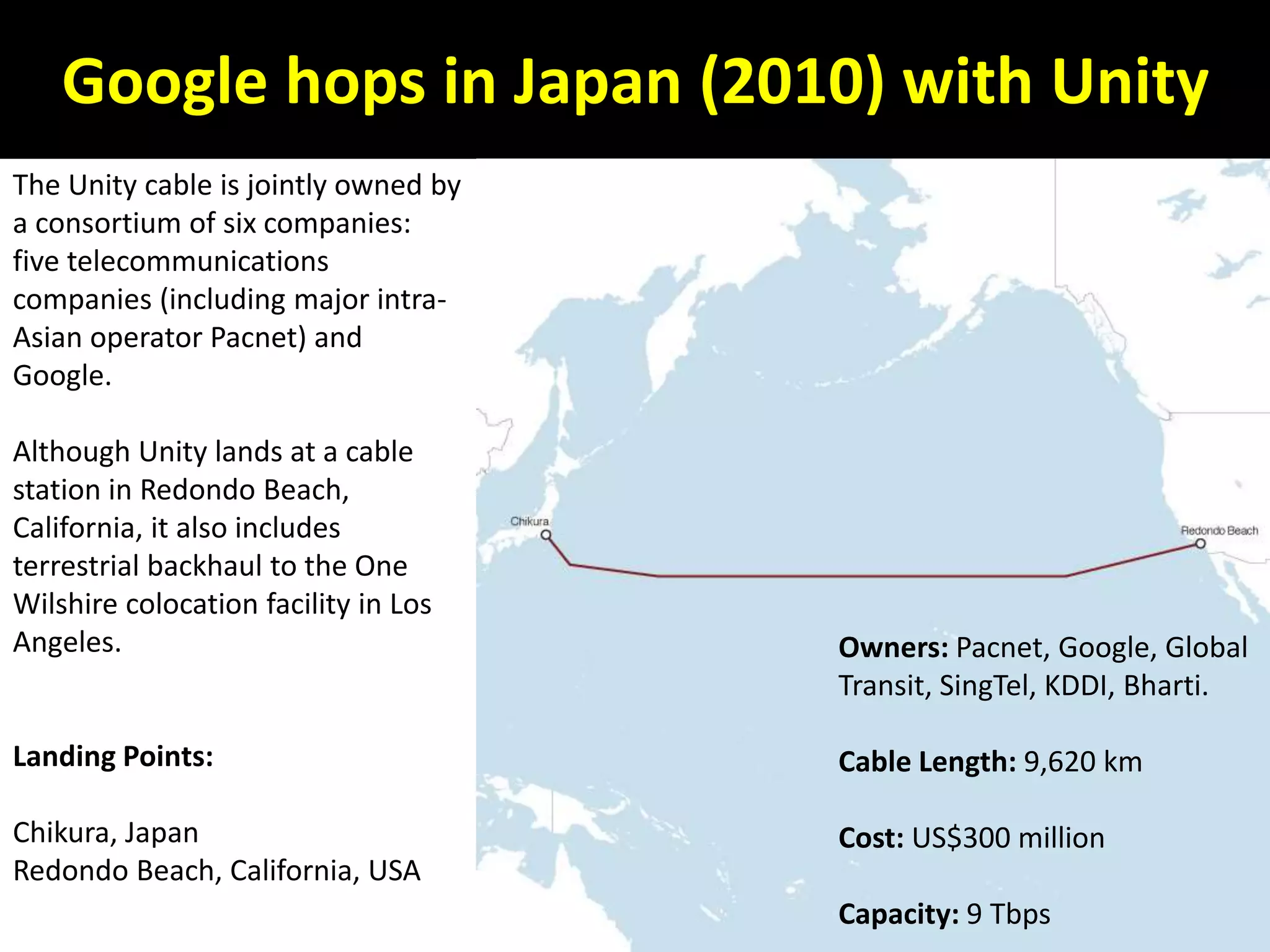
Google hops in Japan (2010) with Unity
The Unity cable is jointly owned by
a consortium of six companies:
five telecommunications
companies (including major intra-
Asian operator Pacnet) and
Google.
Although Unity lands at a cable
station in Redondo Beach,
California, it also includes
terrestrial backhaul to the One
Wilshire colocation facility in Los
Angeles.
Landing Points:
Chikura, Japan
Redondo Beach, California, USA
Owners: Pacnet, Google, Global
Transit, SingTel, KDDI, Bharti.
Cable Length: 9,620 km
Cost: US$300 million
Capacity: 9 Tbps
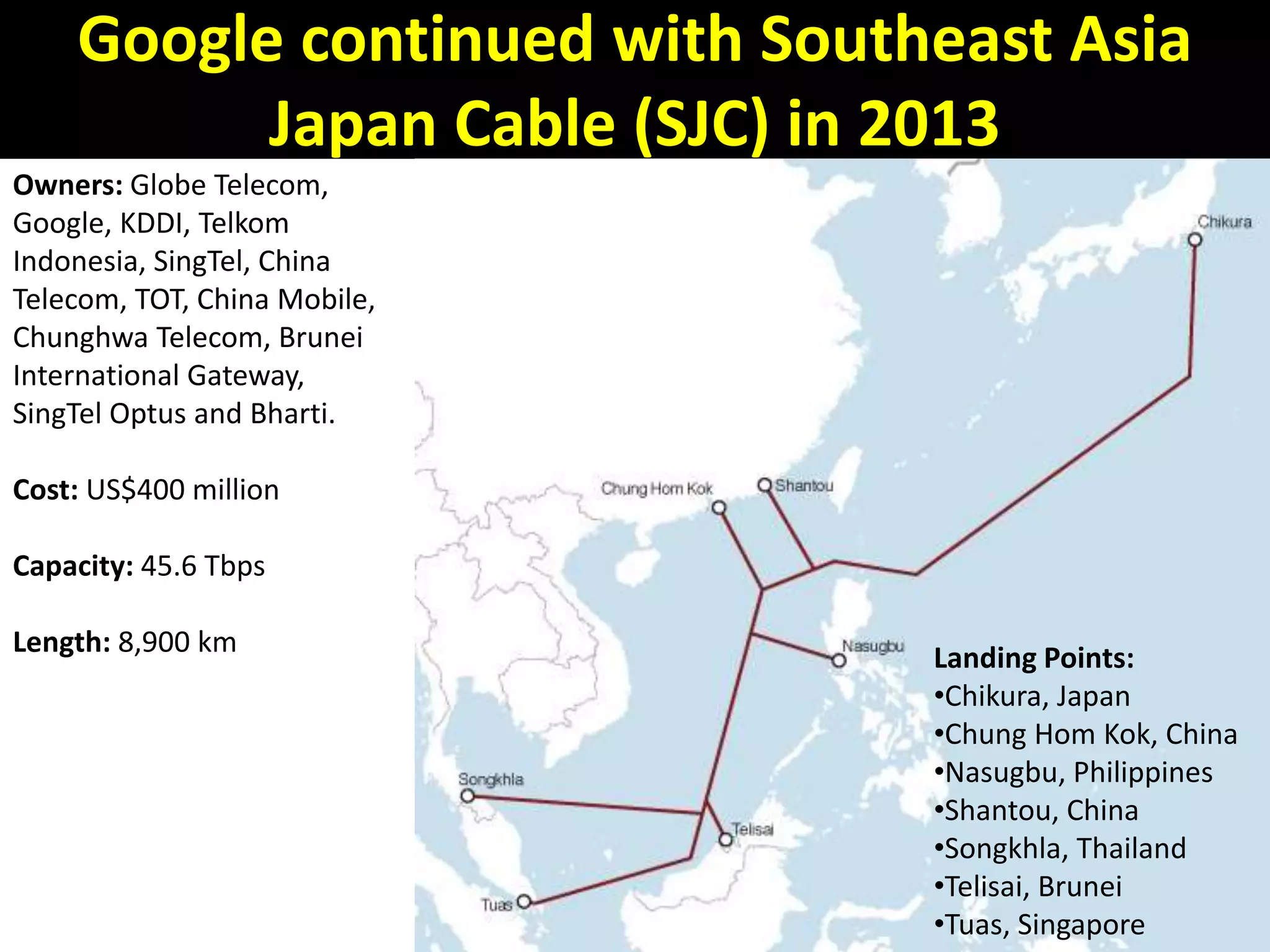
Google continued with Southeast Asia
Japan Cable (SJC) in 2013
Landing Points:
•Chikura, Japan
•Chung Hom Kok, China
•Nasugbu, Philippines
•Shantou, China
•Songkhla, Thailand
•Telisai, Brunei
•Tuas, Singapore
Owners: Globe Telecom,
Google, KDDI, Telkom
Indonesia, SingTel, China
Telecom, TOT, China Mobile,
Chunghwa Telecom, Brunei
International Gateway,
SingTel Optus and Bharti.
Cost: US$400 million
Capacity: 45.6 Tbps
Length: 8,900 km
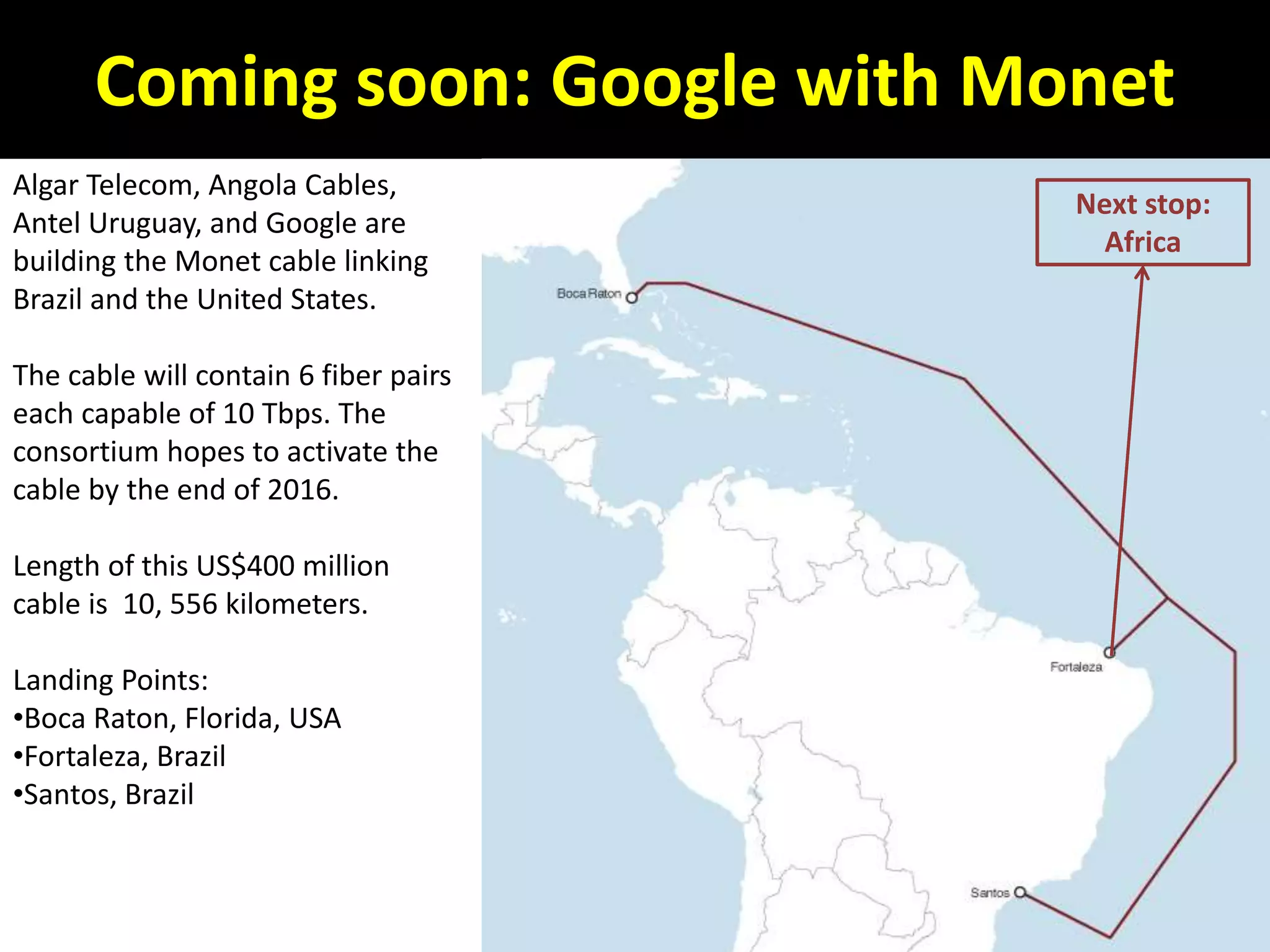
Coming soon: Google with Monet
Algar Telecom, Angola Cables,
Antel Uruguay, and Google are
building the Monet cable linking
Brazil and the United States.
The cable will contain 6 fiber pairs
each capable of 10 Tbps. The
consortium hopes to activate the
cable by the end of 2016.
Length of this US$400 million
cable is 10, 556 kilometers.
Landing Points:
•Boca Raton, Florida, USA
•Fortaleza, Brazil
•Santos, Brazil
Next stop:
Africa
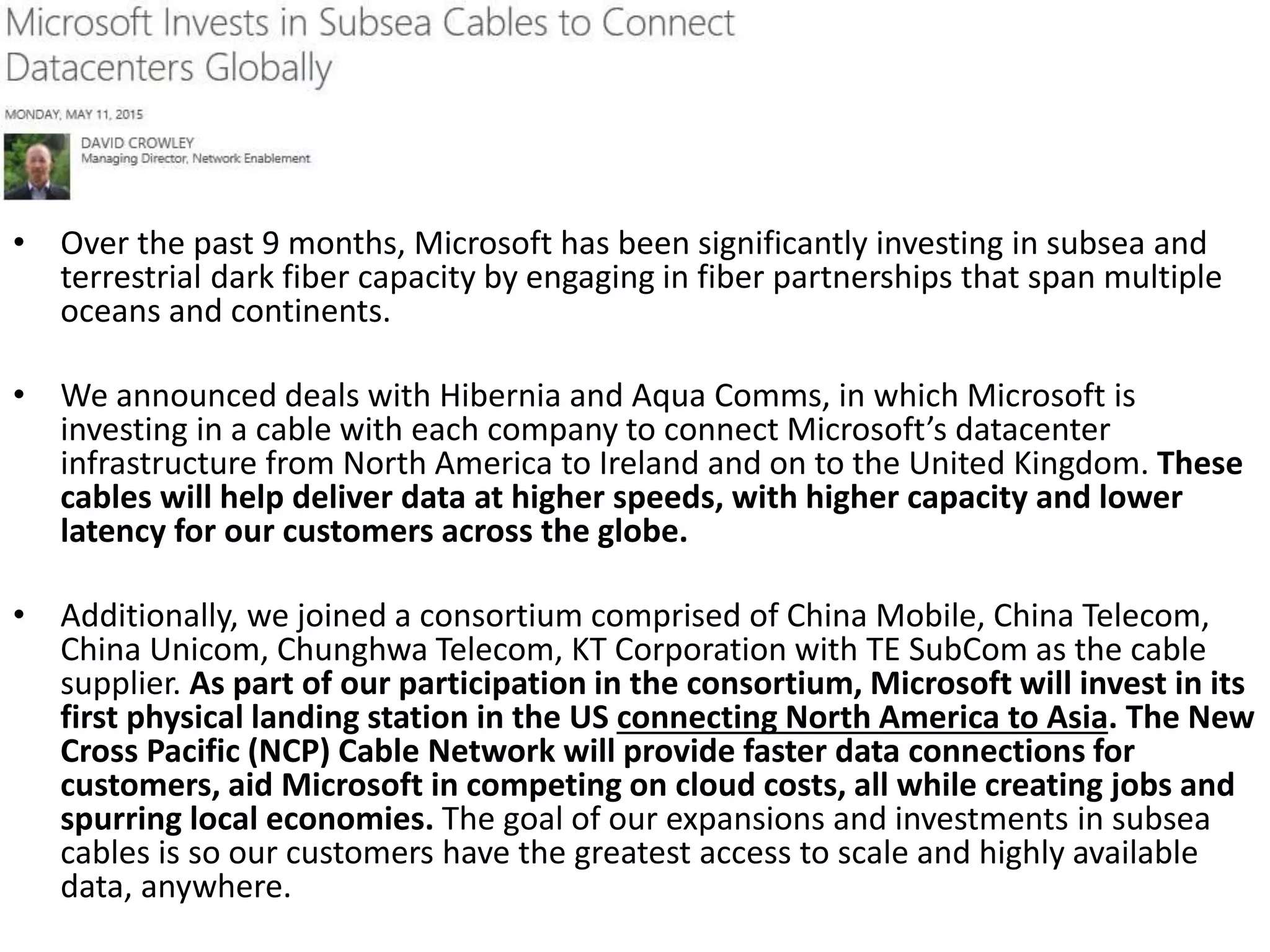
• Over the past 9 months, Microsoft has been significantly investing in subsea and
terrestrial dark fiber capacity by engaging in fiber partnerships that span multiple
oceans and continents.
• We announced deals with Hibernia and Aqua Comms, in which Microsoft is
investing in a cable with each company to connect Microsoft’s datacenter
infrastructure from North America to Ireland and on to the United Kingdom. These
cables will help deliver data at higher speeds, with higher capacity and lower
latency for our customers across the globe.
• Additionally, we joined a consortium comprised of China Mobile, China Telecom,
China Unicom, Chunghwa Telecom, KT Corporation with TE SubCom as the cable
supplier. As part of our participation in the consortium, Microsoft will invest in its
first physical landing station in the US connecting North America to Asia. The New
Cross Pacific (NCP) Cable Network will provide faster data connections for
customers, aid Microsoft in competing on cloud costs, all while creating jobs and
spurring local economies. The goal of our expansions and investments in subsea
cables is so our customers have the greatest access to scale and highly available
data, anywhere.
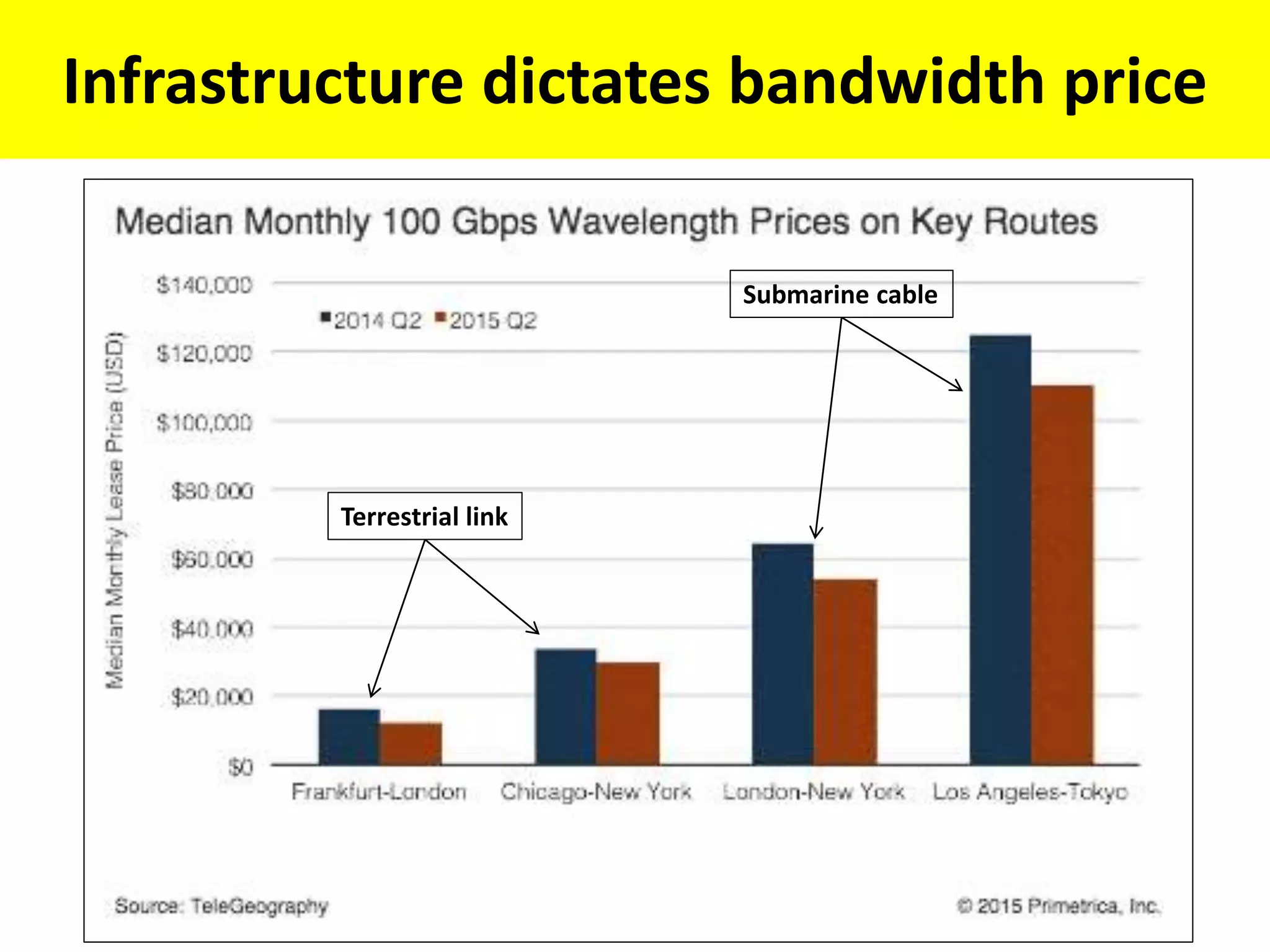
Terrestrial link
Submarine cable
Infrastructure dictates bandwidth price
“100G: are the potential savings worth the
investment?” TeleGeography, 4 Jun 2015
• ‘As 100Gbps technology continues to mature and
equipment costs decrease, network operators are able
to pass along their cost savings to bandwidth buyers
in the form of steady price declines,’ said
TeleGeography analyst Brianna Boudreau. ‘The initial
cost of purchasing 100Gbps capacity is daunting for
many. However, where massive point-to-point
connections are needed, economies of scale make this
approach less expensive than purchasing incremental
capacity upgrades over the long term. Customers can
further benefit from a reduction in network
complexity and the aggregate cost of required cross
connects.’
Takeaway
• ‘The initial cost of purchasing 100Gbps capacity is
daunting for many. However, where massive point-
to-point connections are needed, economies of
scale make this approach less expensive than
purchasing incremental capacity upgrades over the
long term. Customers can further benefit from a
reduction in network complexity and the
aggregate cost of required cross connects.’
Takeaway
• ‘The initial cost of purchasing 100Gbps capacity is
daunting for many. However, where massive point-
to-point connections are needed, economies of
scale make this approach less expensive than
purchasing incremental capacity upgrades over the
long term. Customers can further benefit from a
reduction in network complexity and the
aggregate cost of required cross connects.’
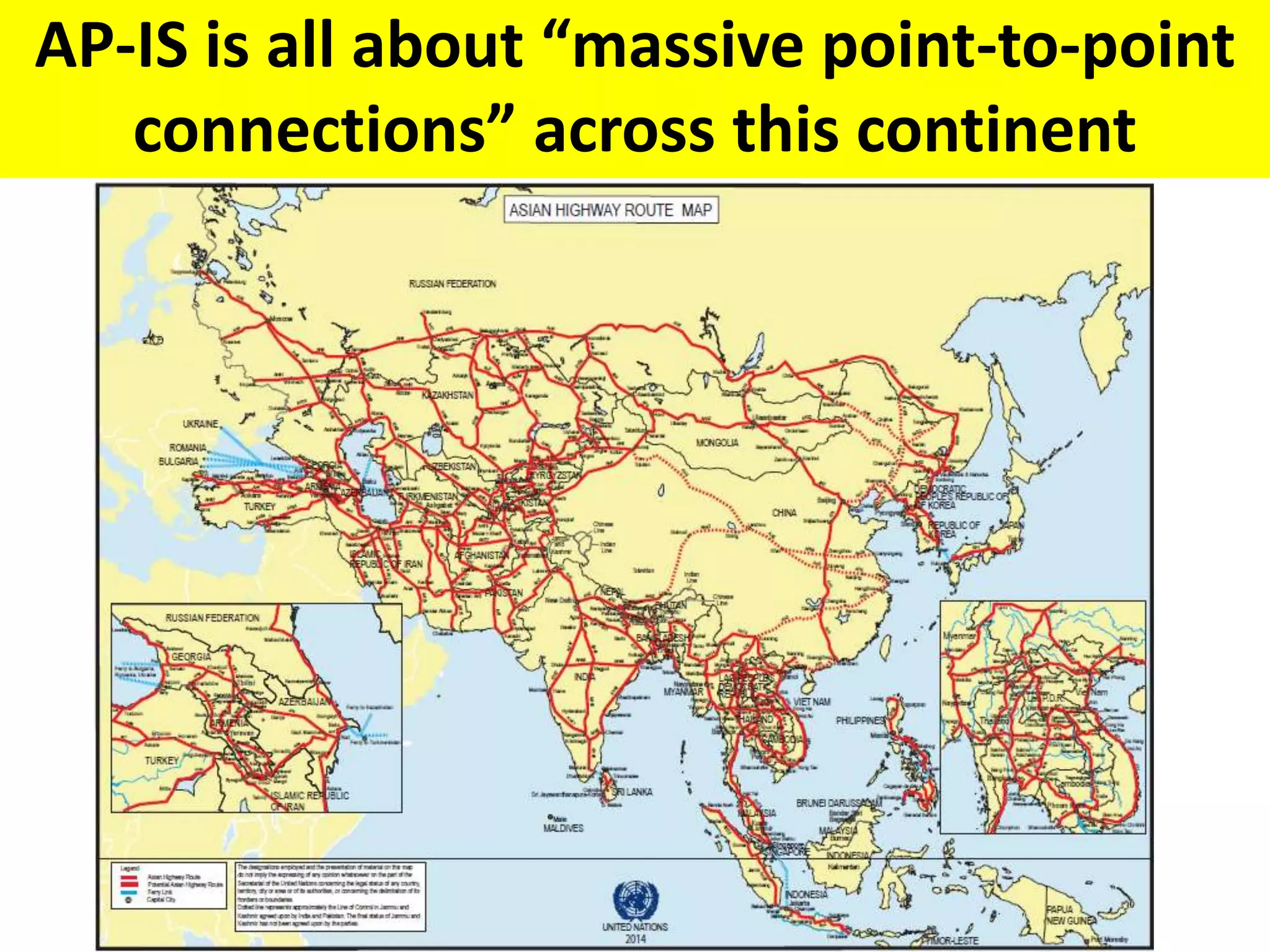
AP-IS is all about “massive point-to-point
connections” across this continent

One Belt, Many Roads and Beyond

  • 1.
    One belt, manyroads and beyond Abu Saeed Khan Senior Policy Fellow LIRNEasia abu@lirneasia.net ESCAP Working Group on the Asia-Pacific Information Superhighway Incheon, Republic of Korea September 1, 2015
  • 2.
    Technology virtualizes distance Source:Emirates’ response to claims raised about state-owned airlines in Qatar and the United Arab Emirates. June 29, 2015.
  • 3.
    Around the worldin <40 hours
  • 4.
    • Over 2/3population of the world lives within 8 hours flight from Dubai • 1/3 lives within 4 hours Source: Emirates’ response to claims raised about state-owned airlines in Qatar and the United Arab Emirates. June 29, 2015.
  • 5.
    Ground reality: Skylinks the ground • During the past two years, China has built 15 new airports and expanded 28 existing ones that have direct links with countries along the Silk Road Economic Belt that connects the country with Europe via Central Asia. • Fifty-one out of the 193 civil aviation construction projects that are planned for this year, will directly serve the Belt and Road initiatives in 2015. • One Road One Belt infrastructure projects either planned or in construction exceeded $161 billion by the end of March.
  • 6.
    “In Kazakhstan alone,China has invested $40 billion in road and rail projects to improve routes through the country.” Source: China’s One Belt, One Road strategy takes to the air
  • 7.
    Inauguration of China-EuropeBlock Train (Yiwu-Madrid) at Yiwu Railway Freight Station on Nov. 18, 2014
  • 8.
    DHL multimodal Asia-Europeservice China-Europe Rail Routes: 1. Zhengzhou-Hamburg (10,214 km in 17 days) 2. Suzhou-Warsaw (11,070 km in 14 days) 3. Chengdu-Lodz (9,862 km in 14 days) Sea-Rail: From ports in Tokyo, Nagoya, Osaka, Kobe and Hakata to Shanghai Port to further connect into the existing China rail connections to Europe Road: Extensive cargo pickup within China to rail departure points at Zhengzhou, Suzhou and Chengdu.
  • 9.
    Consequence: “China-Europe railhas air cargo in the crosshairs.” • Airlines flying cargo between China and Europe will be hit hardest by Beijing’s One Belt, One Road trade strategy as the land bridge rail route proves too attractively priced to ignore, believes Steve Flowers, head of global freight forwarding at UPS. • “Transportation managers will likely have a hard time passing on the opportunity to reduce transport costs up to 65 percent while not having to endure the 40 days-in-transit typical for ocean service,” Flowers told JOC.com.
  • 10.
    DREAM (Diverse Routefor European and Asian Markets) was launched October 17, 2013
  • 11.
  • 12.
    IMF 2015 GDPGrowth Forecasts World economic outlook, April 2015
  • 13.
    • Asia has3.7 billion mobile subscribers. Asia has added 194 million subscribers between Q1 2014 and Q1 2015, which is over 60% of net new global wireless subscribers. • The Asian mobile market is far from saturated, as there are over 270 million people without a cell phone. • China and India alone account for 2.3 billion subscribers, but while China has emerged as a meaningful 4G market with 162 million LTE subscribers, 90% of Indian mobile subscribers remain on 2G networks, driving the region’s ongoing reliance on the legacy technology. Source: TeleGeography Commsupdate. July 28, 2015.
  • 14.
    Source: Asia PacificMobile Economy 2015, GSMA.
  • 15.
    Data Center +Cloud = The game changers
  • 16.
    Facebook in AsiaPacific Gateway (APG) A consortium of eleven Asian carriers and Facebook is planning to build Asia Pacific Gateway (APG) cable by 2015. It will cover 10,400 kilometers and link China, Hong Kong, Japan, South Korea, Malaysia, Taiwan, Thailand, Vietnam, and Singapore. The US$500 million system will use 100 Gbps technology, offer a potential capacity of 54.8 Tbps, and utilize a trunk-and-branch configuration. The owners are: NTT, China Telecom, China Unicom, China Mobile, Chunghwa Telecom, KT, LG Uplus, Viettel Corporation, Vietnam Telecom International, Global Transit, Starhub, TIME dotCom and Facebook. Landing Points: Changi South, Singapore Kuantan, Malaysia Songkhla, Thailand Danang, Vietnam Toucheng, Taiwan Chongming, China Nanhui, China Tseung Kwan O, China Pusan, Korea, Rep. Maruyama, Japan Shima, Japan
  • 17.
    Google hops inJapan (2010) with Unity The Unity cable is jointly owned by a consortium of six companies: five telecommunications companies (including major intra- Asian operator Pacnet) and Google. Although Unity lands at a cable station in Redondo Beach, California, it also includes terrestrial backhaul to the One Wilshire colocation facility in Los Angeles. Landing Points: Chikura, Japan Redondo Beach, California, USA Owners: Pacnet, Google, Global Transit, SingTel, KDDI, Bharti. Cable Length: 9,620 km Cost: US$300 million Capacity: 9 Tbps
  • 18.
    Google continued withSoutheast Asia Japan Cable (SJC) in 2013 Landing Points: •Chikura, Japan •Chung Hom Kok, China •Nasugbu, Philippines •Shantou, China •Songkhla, Thailand •Telisai, Brunei •Tuas, Singapore Owners: Globe Telecom, Google, KDDI, Telkom Indonesia, SingTel, China Telecom, TOT, China Mobile, Chunghwa Telecom, Brunei International Gateway, SingTel Optus and Bharti. Cost: US$400 million Capacity: 45.6 Tbps Length: 8,900 km
  • 19.
    Coming soon: Googlewith Monet Algar Telecom, Angola Cables, Antel Uruguay, and Google are building the Monet cable linking Brazil and the United States. The cable will contain 6 fiber pairs each capable of 10 Tbps. The consortium hopes to activate the cable by the end of 2016. Length of this US$400 million cable is 10, 556 kilometers. Landing Points: •Boca Raton, Florida, USA •Fortaleza, Brazil •Santos, Brazil Next stop: Africa
  • 20.
    • Over thepast 9 months, Microsoft has been significantly investing in subsea and terrestrial dark fiber capacity by engaging in fiber partnerships that span multiple oceans and continents. • We announced deals with Hibernia and Aqua Comms, in which Microsoft is investing in a cable with each company to connect Microsoft’s datacenter infrastructure from North America to Ireland and on to the United Kingdom. These cables will help deliver data at higher speeds, with higher capacity and lower latency for our customers across the globe. • Additionally, we joined a consortium comprised of China Mobile, China Telecom, China Unicom, Chunghwa Telecom, KT Corporation with TE SubCom as the cable supplier. As part of our participation in the consortium, Microsoft will invest in its first physical landing station in the US connecting North America to Asia. The New Cross Pacific (NCP) Cable Network will provide faster data connections for customers, aid Microsoft in competing on cloud costs, all while creating jobs and spurring local economies. The goal of our expansions and investments in subsea cables is so our customers have the greatest access to scale and highly available data, anywhere.
  • 21.
  • 22.
    “100G: are thepotential savings worth the investment?” TeleGeography, 4 Jun 2015 • ‘As 100Gbps technology continues to mature and equipment costs decrease, network operators are able to pass along their cost savings to bandwidth buyers in the form of steady price declines,’ said TeleGeography analyst Brianna Boudreau. ‘The initial cost of purchasing 100Gbps capacity is daunting for many. However, where massive point-to-point connections are needed, economies of scale make this approach less expensive than purchasing incremental capacity upgrades over the long term. Customers can further benefit from a reduction in network complexity and the aggregate cost of required cross connects.’
  • 23.
    Takeaway • ‘The initialcost of purchasing 100Gbps capacity is daunting for many. However, where massive point- to-point connections are needed, economies of scale make this approach less expensive than purchasing incremental capacity upgrades over the long term. Customers can further benefit from a reduction in network complexity and the aggregate cost of required cross connects.’
  • 24.
    Takeaway • ‘The initialcost of purchasing 100Gbps capacity is daunting for many. However, where massive point- to-point connections are needed, economies of scale make this approach less expensive than purchasing incremental capacity upgrades over the long term. Customers can further benefit from a reduction in network complexity and the aggregate cost of required cross connects.’
  • 25.
    AP-IS is allabout “massive point-to-point connections” across this continent