Abu Saeed Khan
abu@lirneasia.net
Senior Policy Fellow
LIRNEasia
Technology
and
Diplomacy
Mobile
Internet in
Asia
Global growth indicators
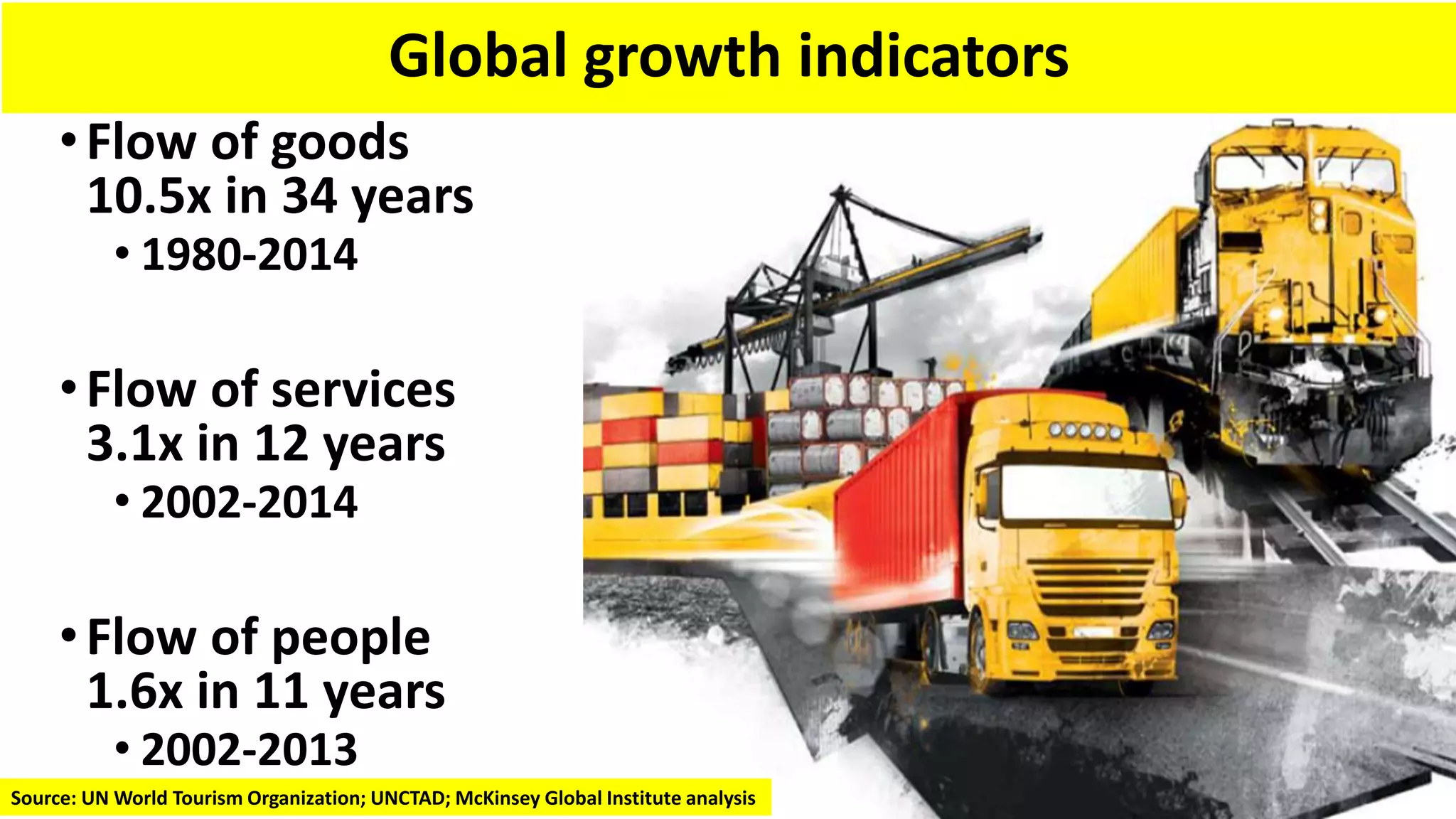
•Flow of goods
10.5x in 34 years
• 1980-2014
•Flow of services
3.1x in 12 years
• 2002-2014
•Flow of people
1.6x in 11 years
• 2002-2013
Source: UN World Tourism Organization; UNCTAD; McKinsey Global Institute analysis
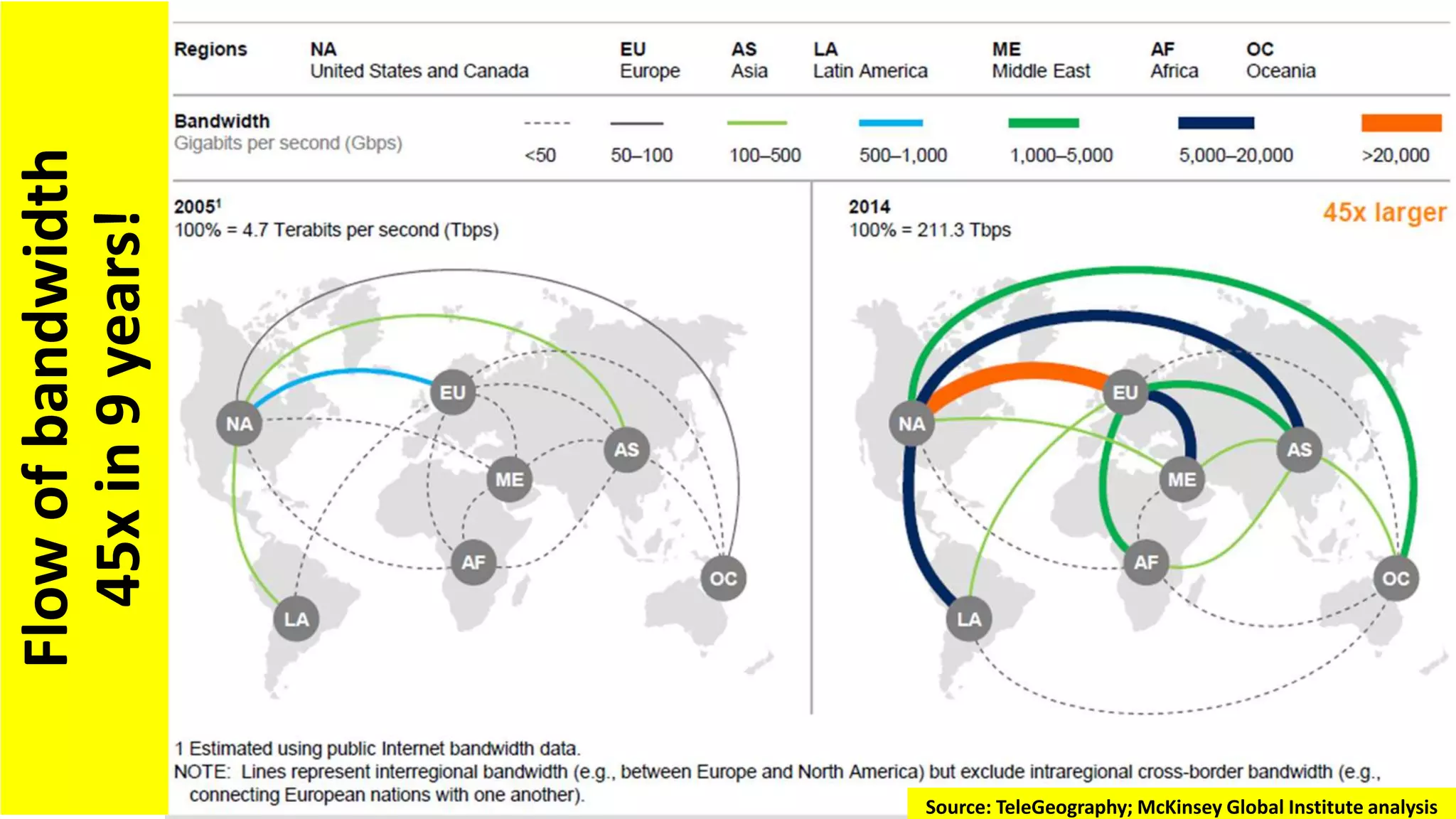
Flowofbandwidth
45xin9years!
Source: TeleGeography; McKinsey Global Institute analysis
“It’s a big deal.”
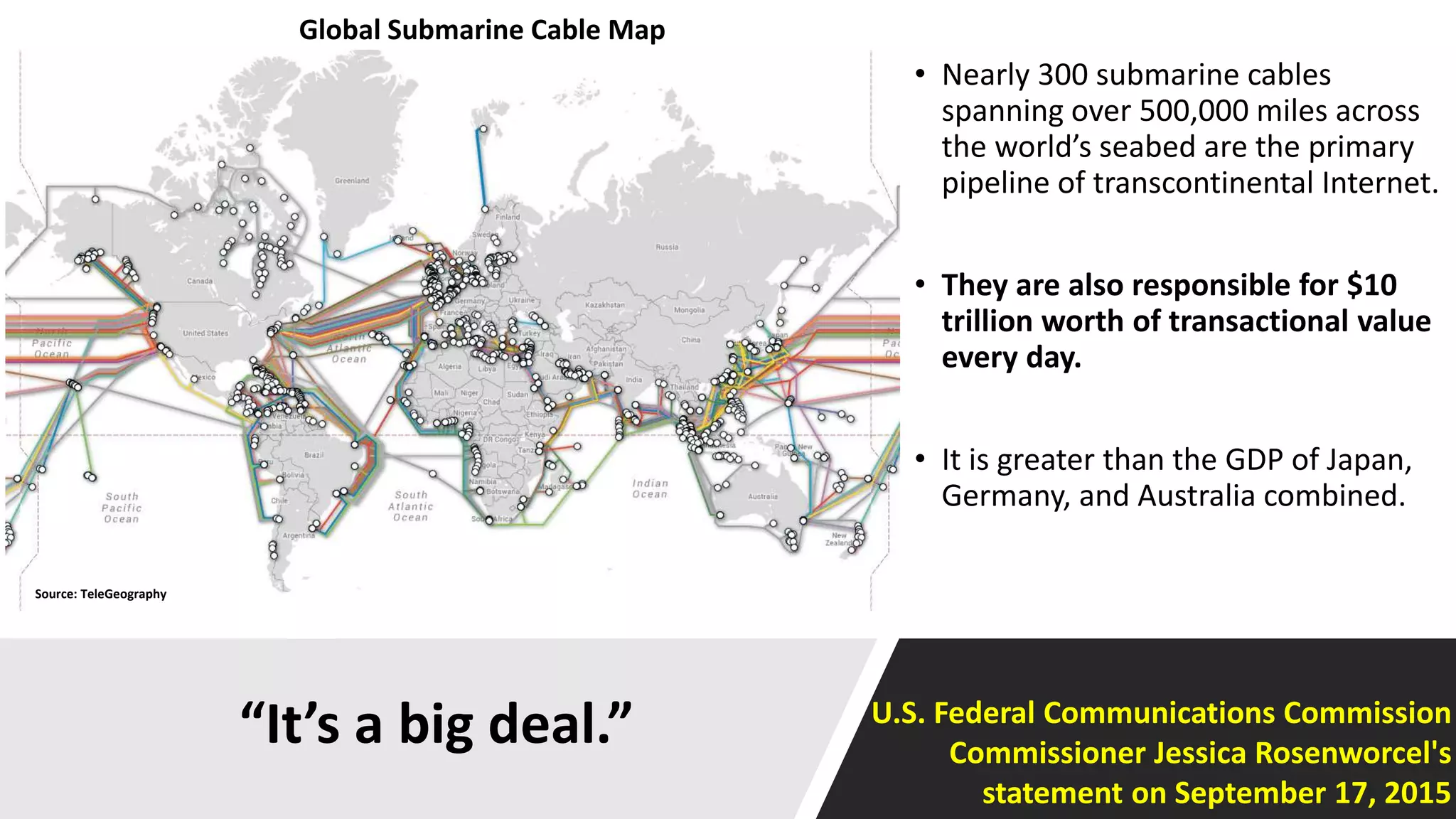
• Nearly 300 submarine cables
spanning over 500,000 miles across
the world’s seabed are the primary
pipeline of transcontinental Internet.
• They are also responsible for $10
trillion worth of transactional value
every day.
• It is greater than the GDP of Japan,
Germany, and Australia combined.
Source: TeleGeography
Global Submarine Cable Map
U.S. Federal Communications Commission
Commissioner Jessica Rosenworcel's
statement on September 17, 2015
Mobile Internet in Asia
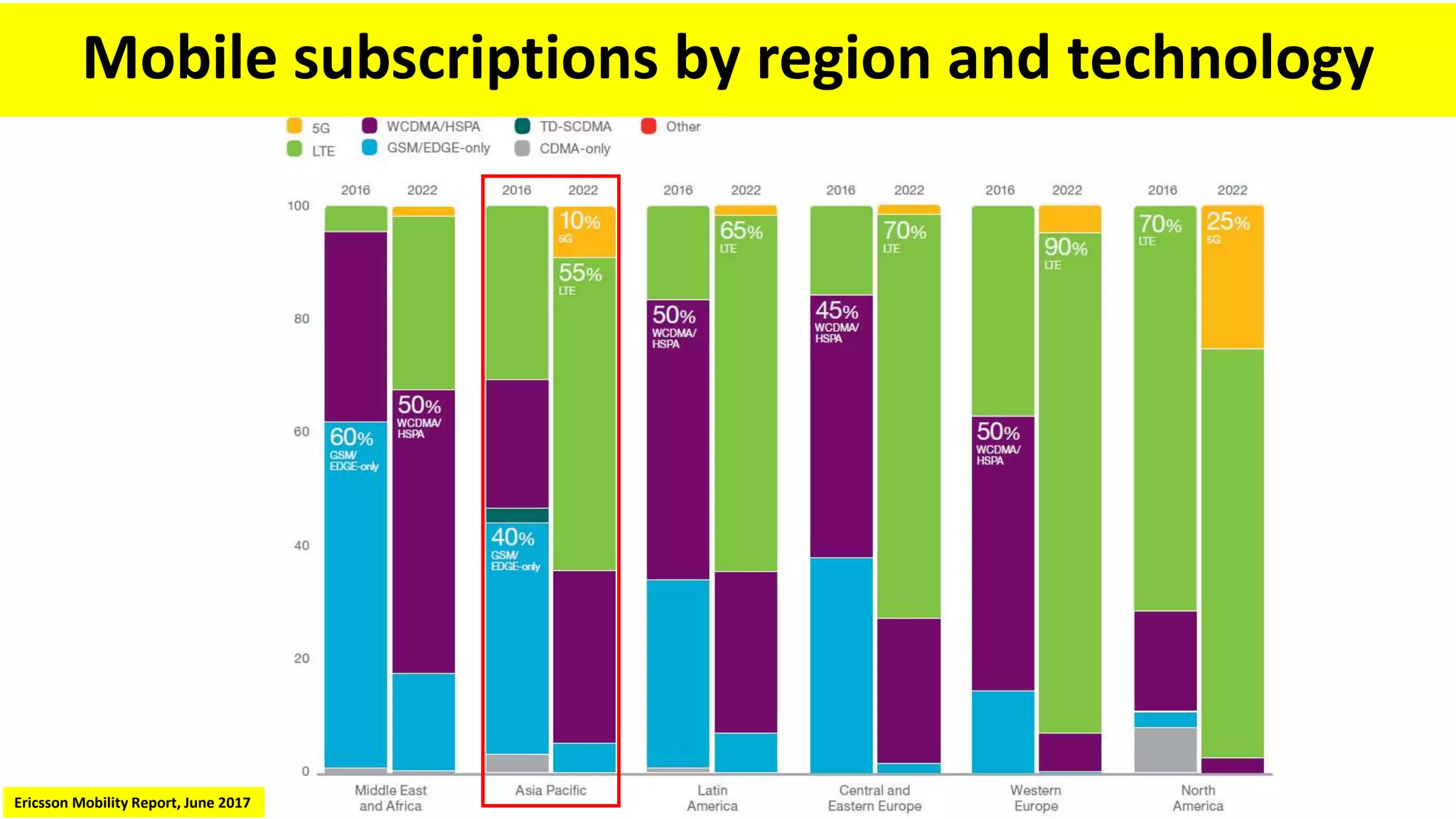
Mobile subscriptions by region and technology
Ericsson Mobility Report, June 2017
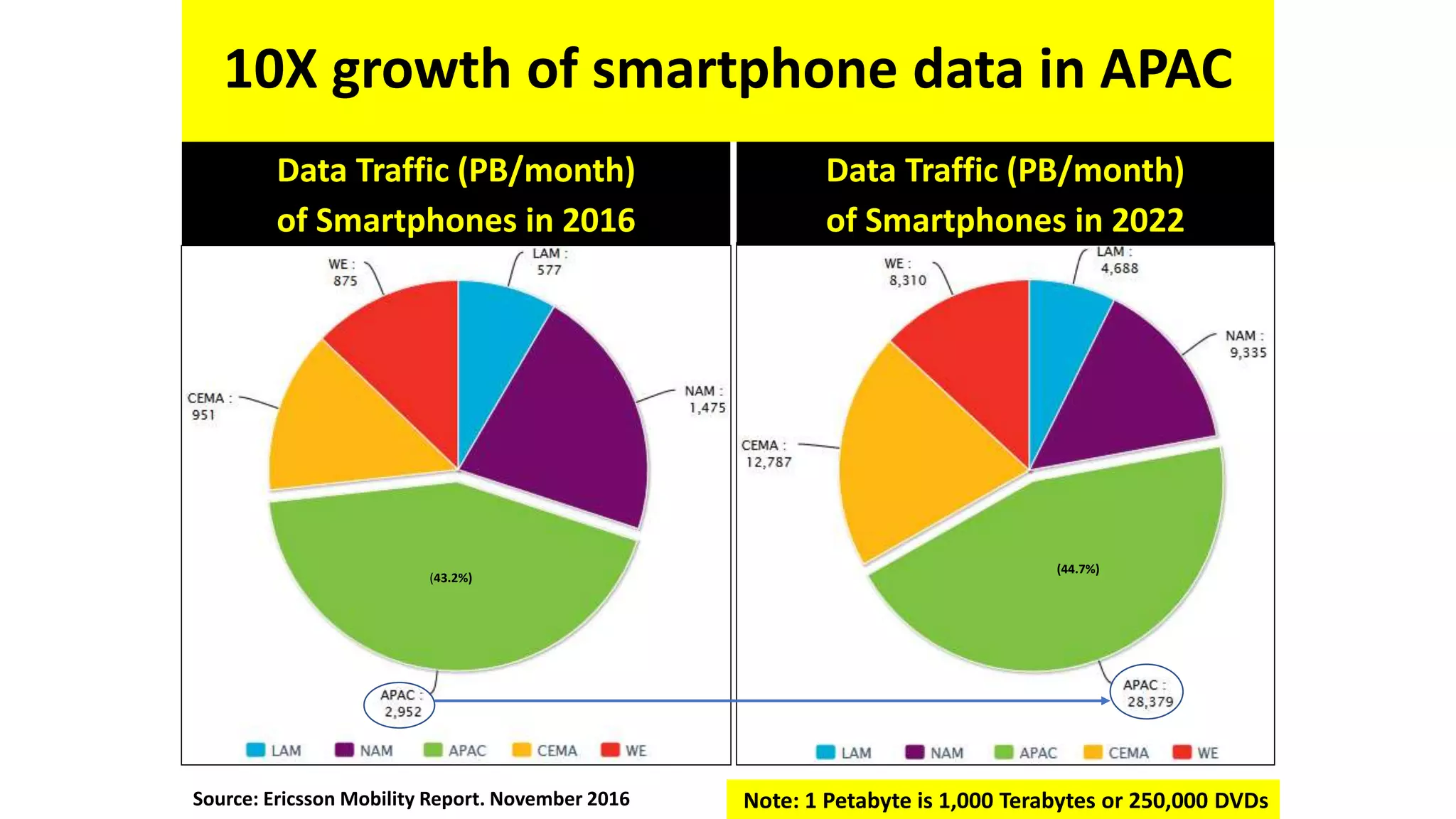
Data Traffic (PB/month)
of Smartphones in 2016
Data Traffic (PB/month)
of Smartphones in 2022
(44.7%)
(43.2%)
Source: Ericsson Mobility Report. November 2016
10X growth of smartphone data in APAC
Note: 1 Petabyte is 1,000 Terabytes or 250,000 DVDs
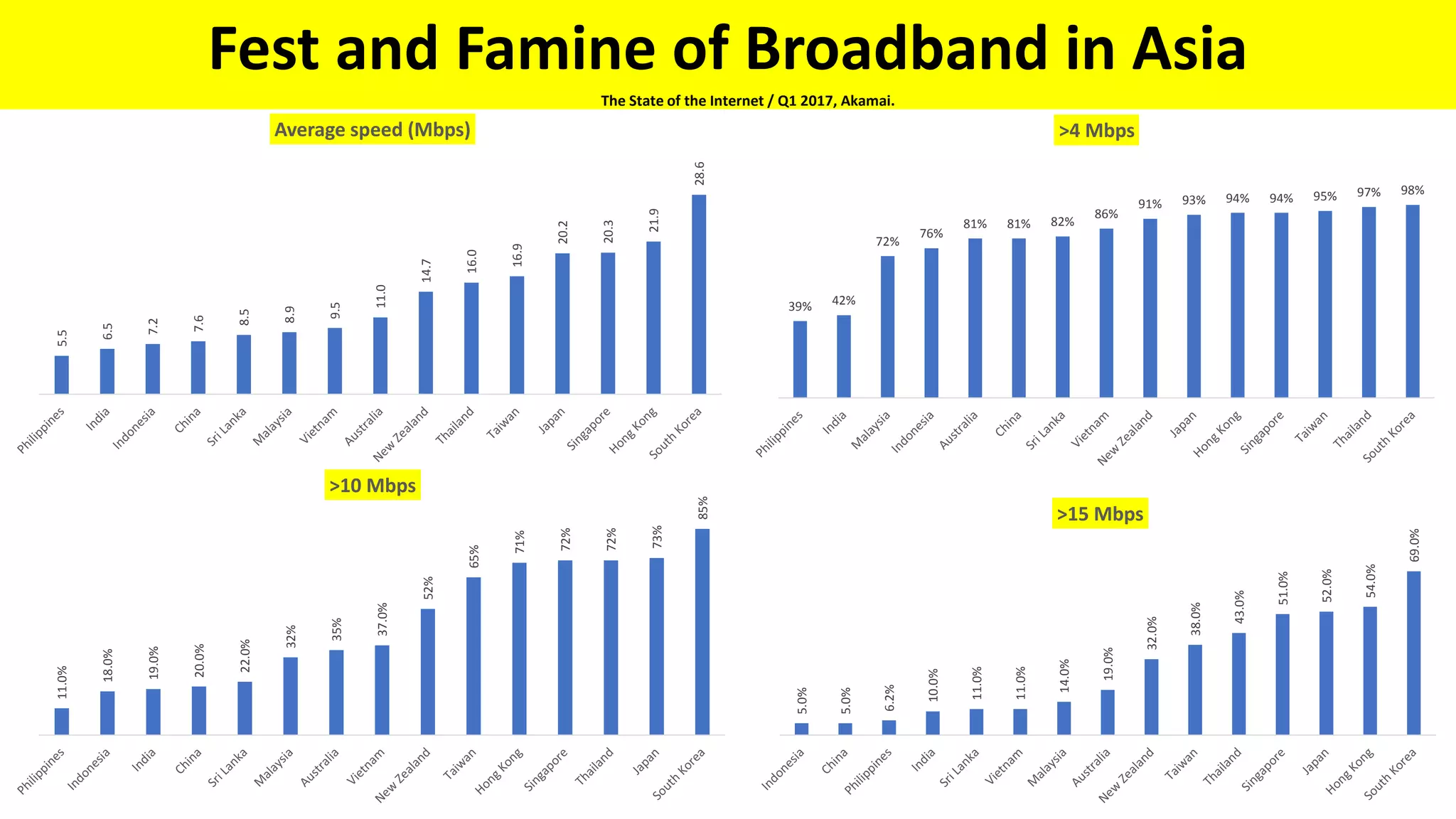
Fest and Famine of Broadband in Asia
39% 42%
72%
76%
81% 81% 82%
86%
91% 93% 94% 94% 95% 97% 98%
>4 Mbps
5.5
6.5
7.2
7.6
8.5
8.9
9.5
11.0
14.7
16.0
16.9
20.2
20.3
21.9
28.6
Average speed (Mbps)
11.0%
18.0%
19.0%
20.0%
22.0%
32%
35%
37.0%
52%
65%
71%
72%
72%
73%
85%
>10 Mbps
5.0%
5.0%
6.2%
10.0%
11.0%
11.0%
14.0%
19.0%
32.0%
38.0%
43.0%
51.0%
52.0%
54.0%
69.0%
>15 Mbps
The State of the Internet / Q1 2017, Akamai.
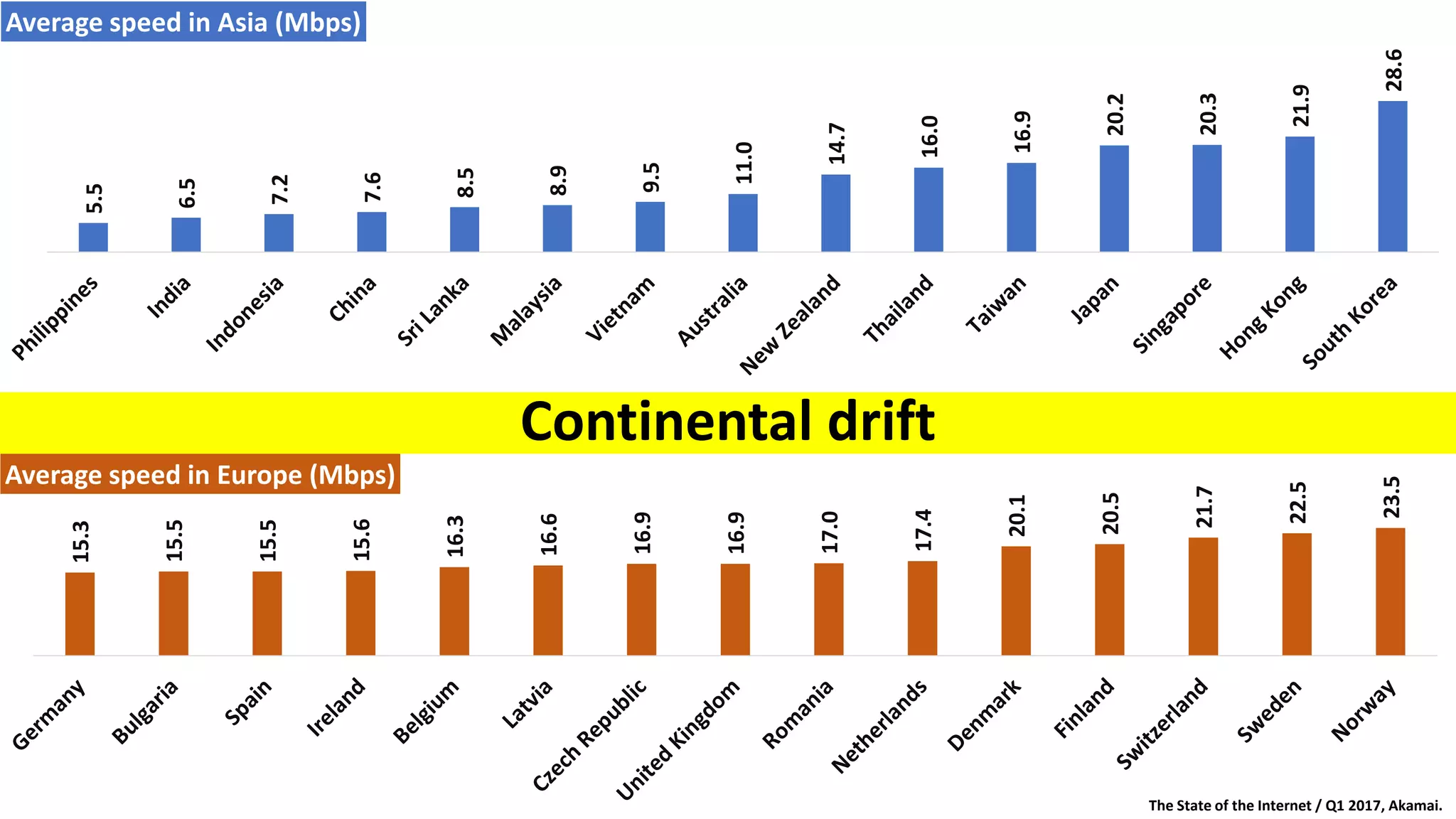
Continental drift
5.5
6.5
7.2
7.6
8.5
8.9
9.5
11.0
14.7
16.0
16.9
20.2
20.3
21.9
28.6
Average speed in Asia (Mbps)
The State of the Internet / Q1 2017, Akamai.
15.3
15.5
15.5
15.6
16.3
16.6
16.9
16.9
17.0
17.4
20.1
20.5
21.7
22.5
23.5
Average speed in Europe (Mbps)
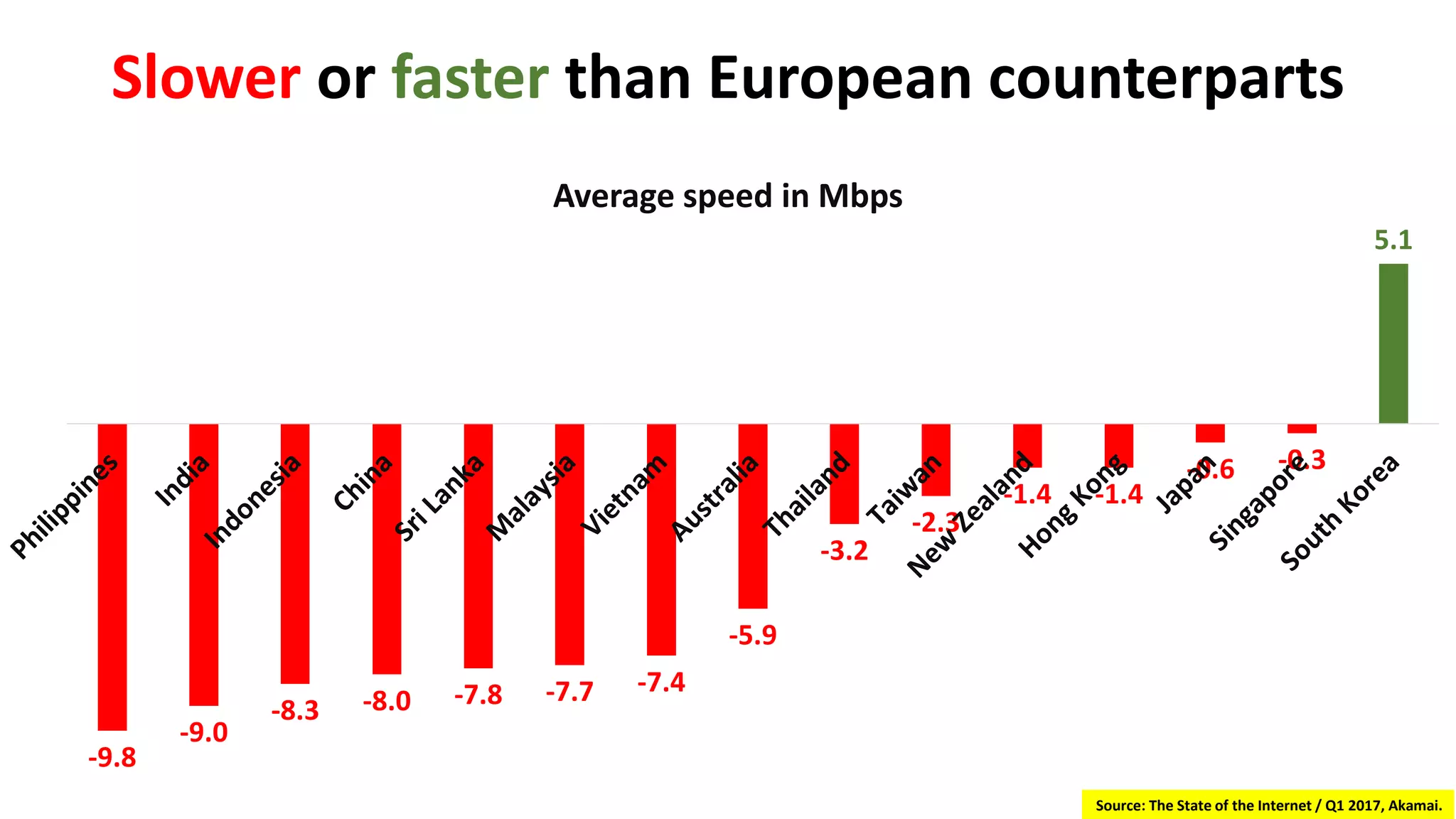
Slower or faster than European counterparts
-9.8
-9.0
-8.3 -8.0 -7.8 -7.7 -7.4
-5.9
-3.2
-2.3
-1.4 -1.4
-0.6 -0.3
5.1
Average speed in Mbps
Source: The State of the Internet / Q1 2017, Akamai.
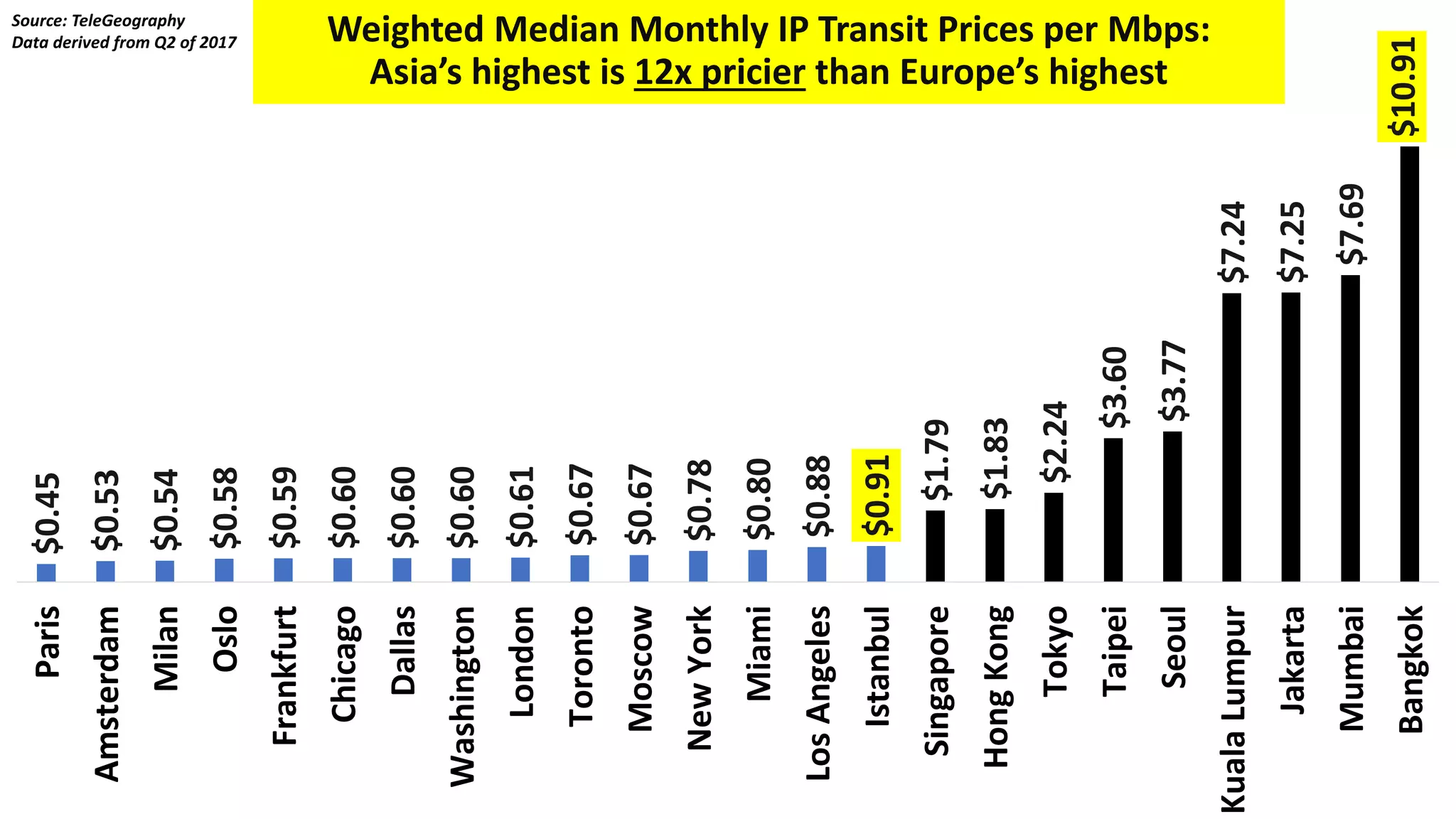
$0.45
$0.53
$0.54
$0.58
$0.59
$0.60
$0.60
$0.60
$0.61
$0.67
$0.67
$0.78
$0.80
$0.88
$0.91
$1.79
$1.83
$2.24
$3.60
$3.77
$7.24
$7.25
$7.69
$10.91
Paris
Amsterdam
Milan
Oslo
Frankfurt
Chicago
Dallas
Washington
London
Toronto
Moscow
NewYork
Miami
LosAngeles
Istanbul
Singapore
HongKong
Tokyo
Taipei
Seoul
KualaLumpur
Jakarta
Mumbai
Bangkok
Source: TeleGeography
Data derived from Q2 of 2017 Weighted Median Monthly IP Transit Prices per Mbps:
Asia’s highest is 12x pricier than Europe’s highest
Infrastructure dictates the cost of bandwidth
Terrestrial cables
Submarine cables
Curtsey: Brianna Boudreau, Senior Analyst, TeleGeography.
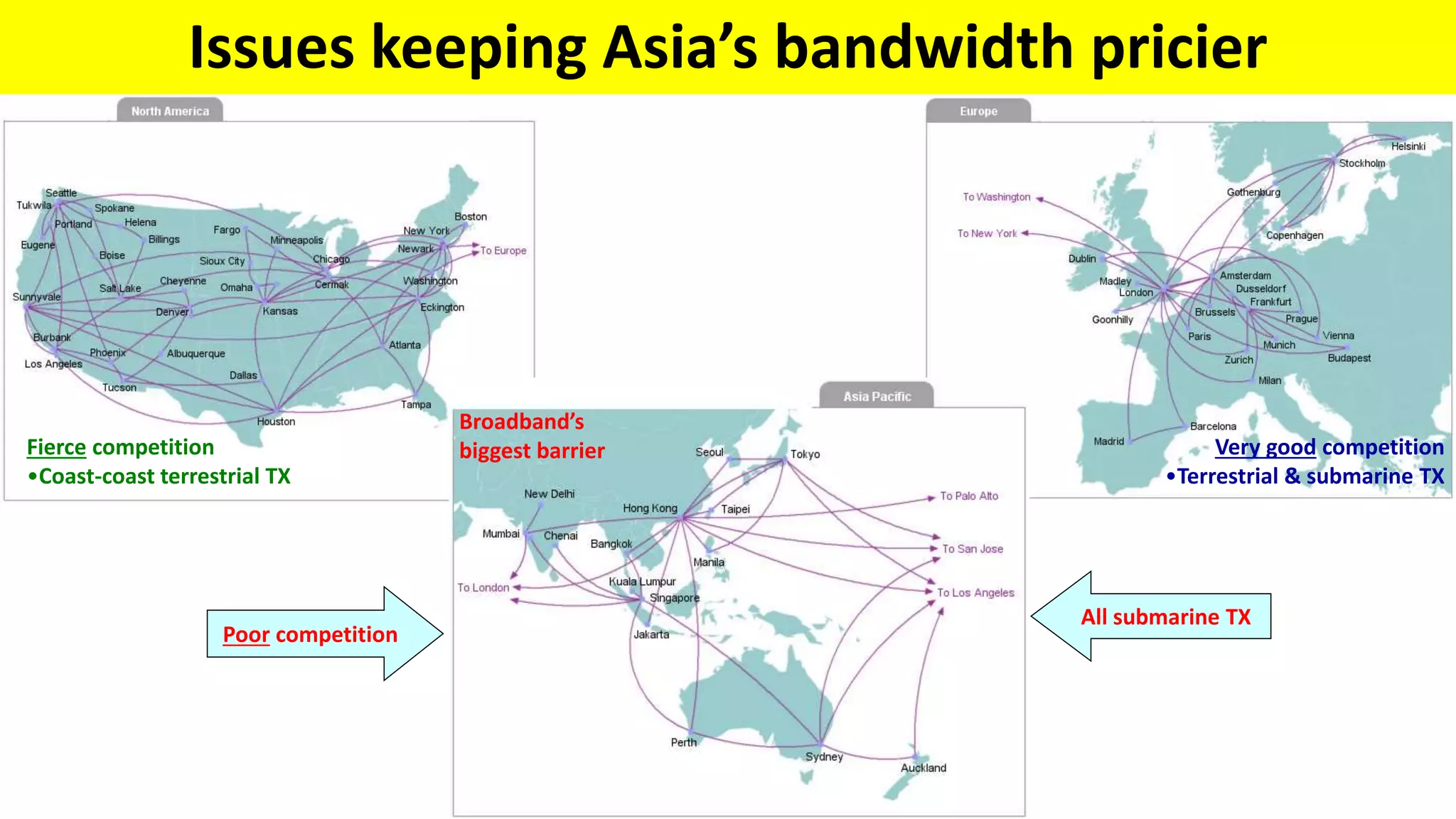
Very good competition
•Terrestrial & submarine TX
Poor competition
All submarine TX
Fierce competition
•Coast-coast terrestrial TX
Broadband’s
biggest barrier
Issues keeping Asia’s bandwidth pricier
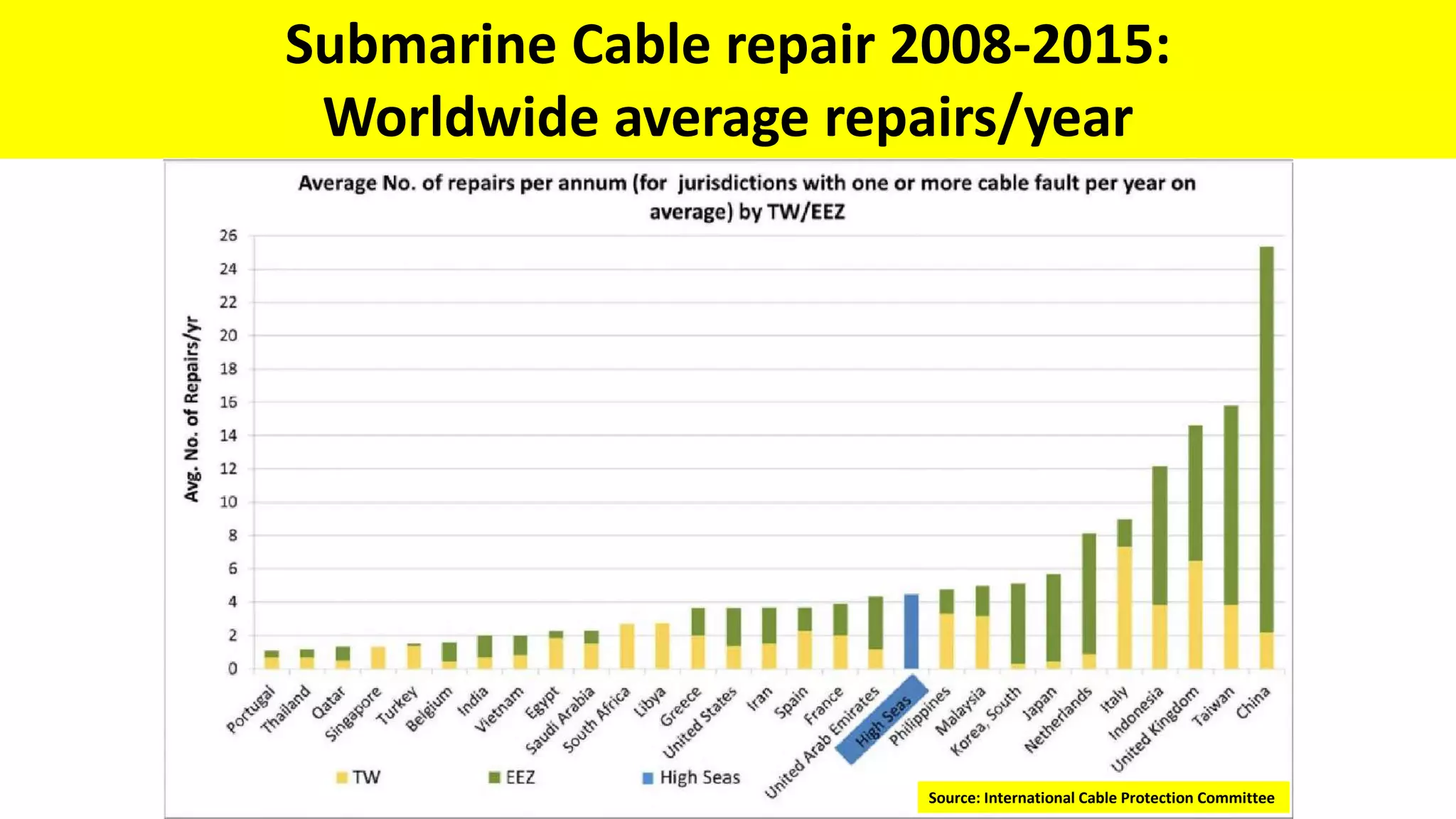
Submarine Cable repair 2008-2015:
Worldwide average repairs/year
Source: International Cable Protection Committee
Submarine Cable repair 2008-2015:
Average time to begin repair
Source: International Cable Protection Committee
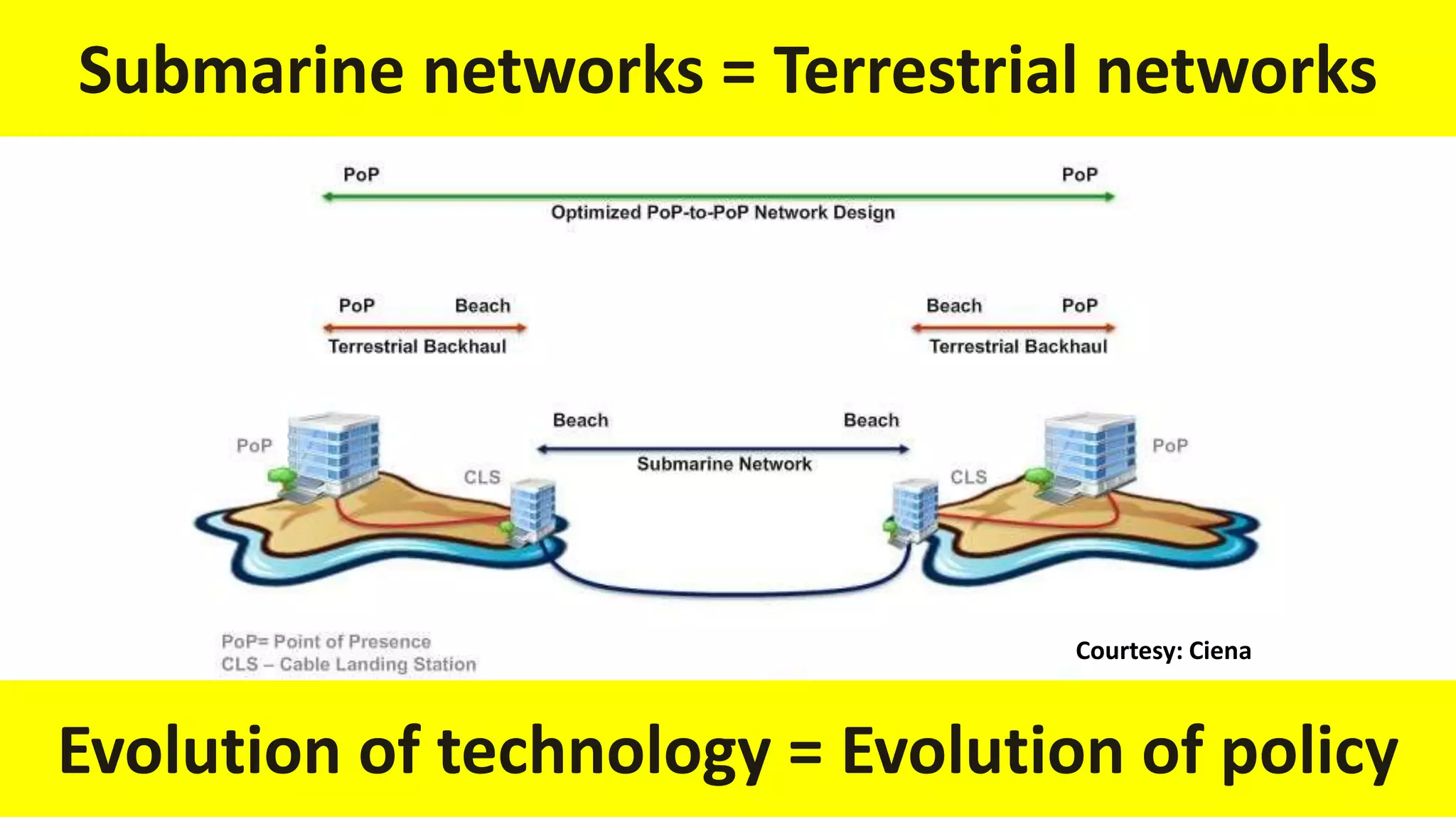
Submarine networks = Terrestrial networks
Courtesy: Ciena
Evolution of technology = Evolution of policy
Technology and Diplomacy
A bilateral
move that is
shaping global
trade
Rolling on
Belt and Road
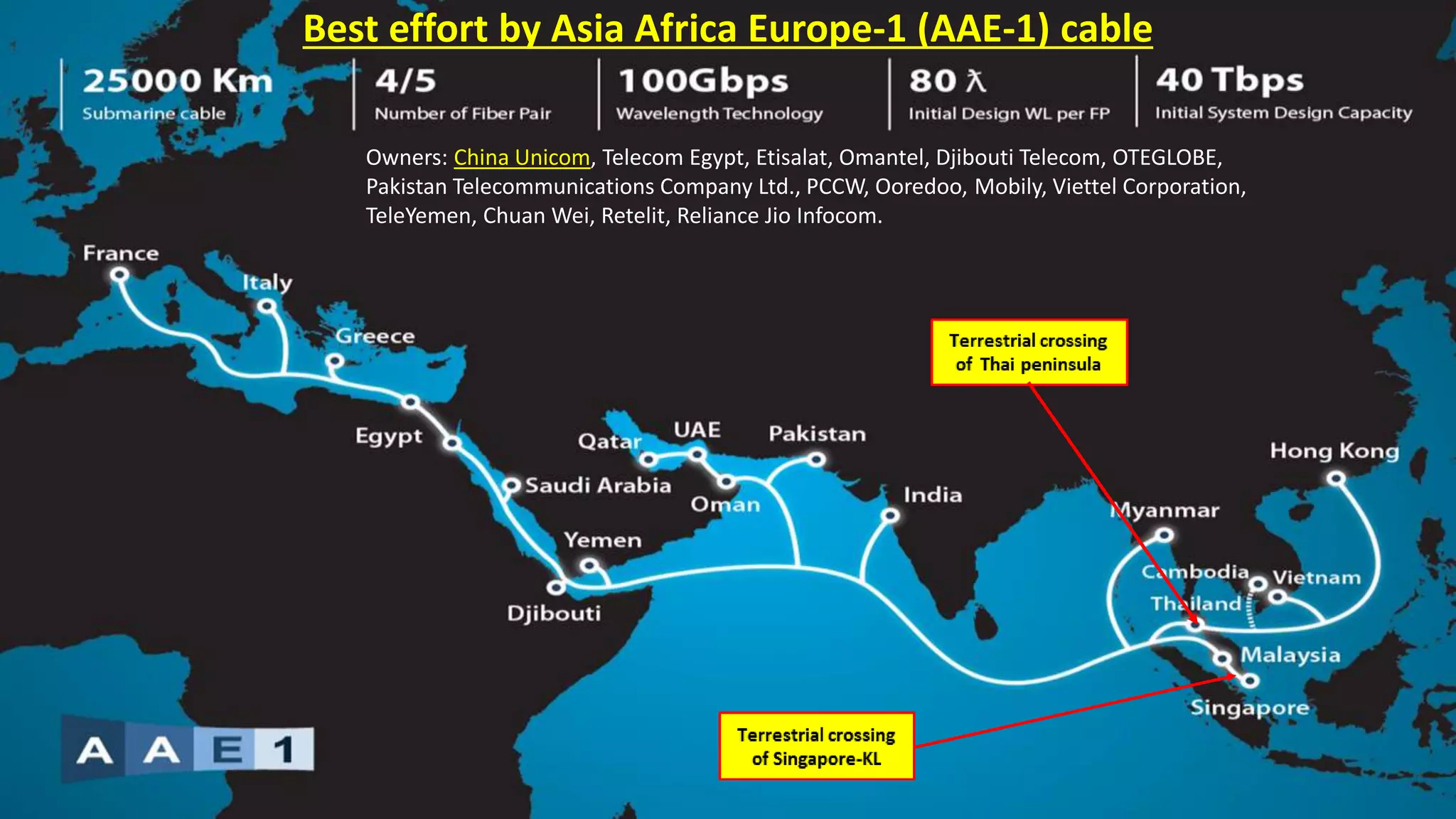
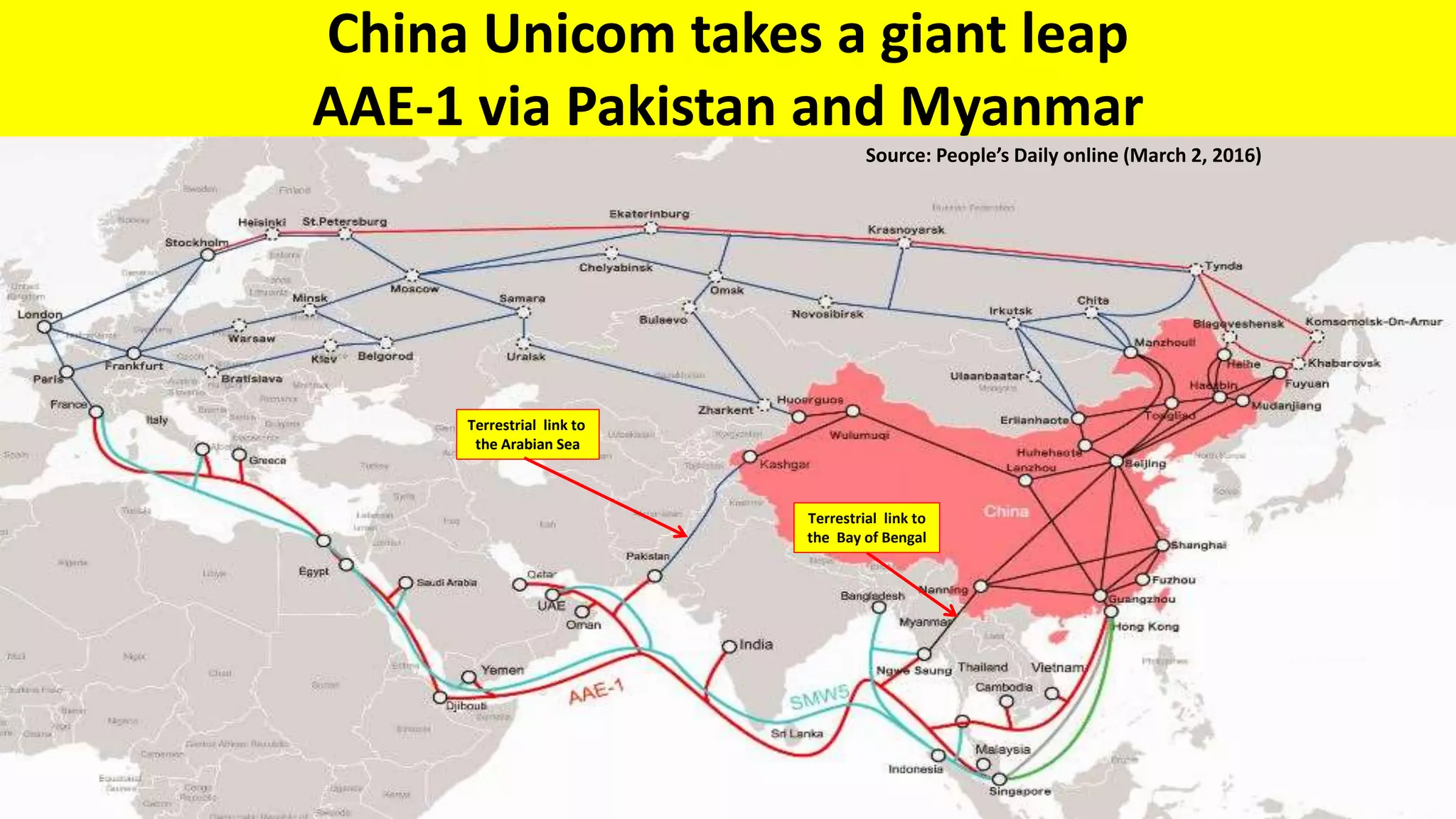
Best effort by Asia Africa Europe-1 (AAE-1) cable
Owners: China Unicom, Telecom Egypt, Etisalat, Omantel, Djibouti Telecom, OTEGLOBE,
Pakistan Telecommunications Company Ltd., PCCW, Ooredoo, Mobily, Viettel Corporation,
TeleYemen, Chuan Wei, Retelit, Reliance Jio Infocom.
Terrestrial link to
the Bay of Bengal
Terrestrial link to
the Arabian Sea
China Unicom takes a giant leap
AAE-1 via Pakistan and Myanmar
Source: People’s Daily online (March 2, 2016)
• 145,000 km meshed across 32
countries (12 landlocked).
• Seamlessly connects Asia and
Europe.
Each country’s share in Asian Highway
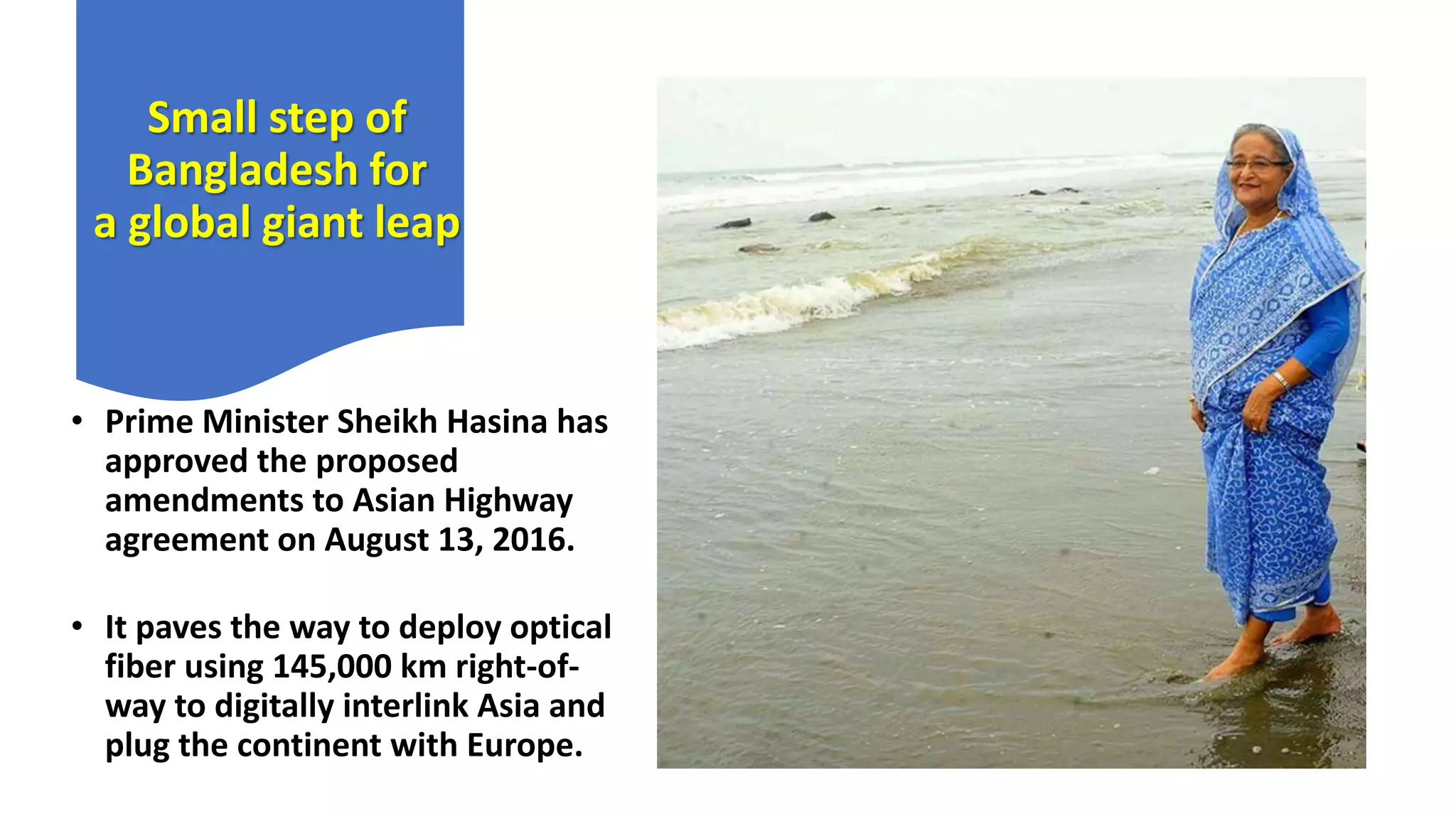
Small step of
Bangladesh for
a global giant leap
• Prime Minister Sheikh Hasina has
approved the proposed
amendments to Asian Highway
agreement on August 13, 2016.
• It paves the way to deploy optical
fiber using 145,000 km right-of-
way to digitally interlink Asia and
plug the continent with Europe.
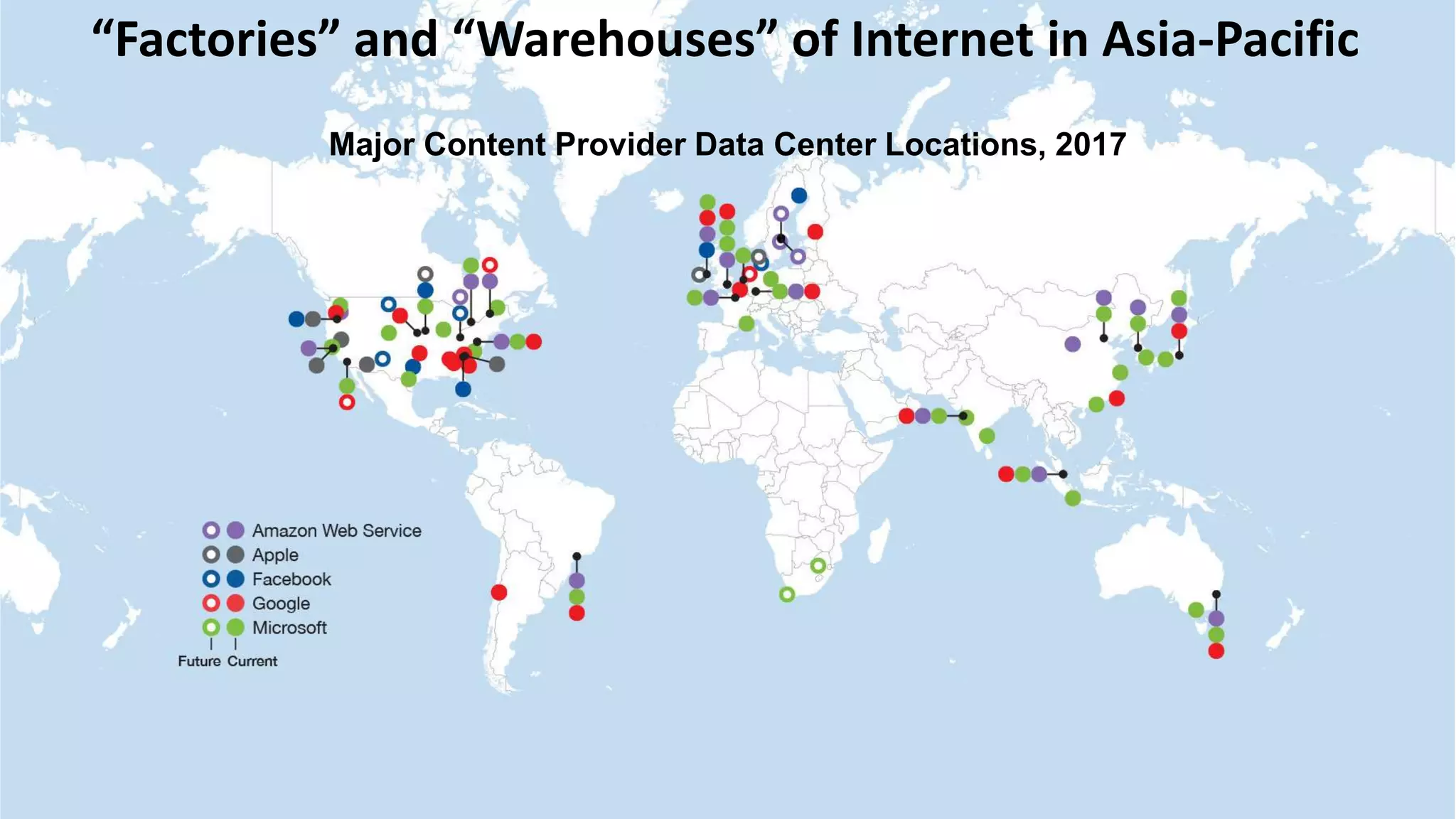
“Factories” and “Warehouses” of Internet in Asia-Pacific
Major Content Provider Data Center Locations, 2017
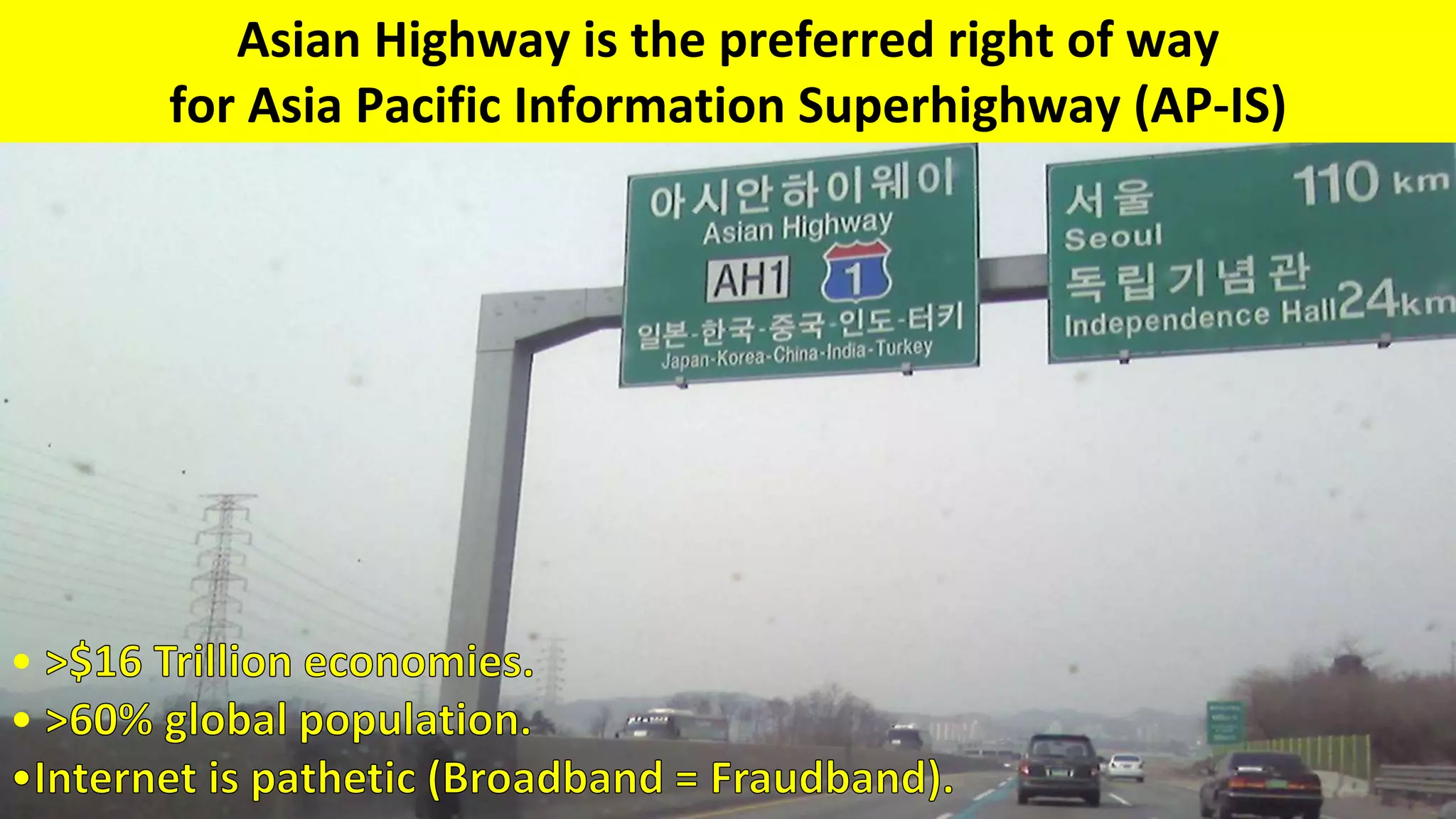
Asian Highway is the preferred right of way
for Asia Pacific Information Superhighway (AP-IS)
•
•
Advantages of AP-IS
• Presumed ‘unfriendly’ countries are already interlinked.
• Submarine : SEA-ME-WE 4 and SEA-ME-WE 5.
• Terrestrial: Sino-Russian link (TEA) and Sino-Indian link (Reliance/Tata/Bharti + China Mobile).
• Highly resilient due to mesh.
• Rerouting the traffic means ‘zero’ downtime.
• Installation and maintenance crew/materials available everywhere.
• Creates more opportunities for submarine cables.
• Investments in transpacific rather than intra-Asia.
• Lower latency and higher SLA at lesser cost for international bandwidth.
Open access guaranteed
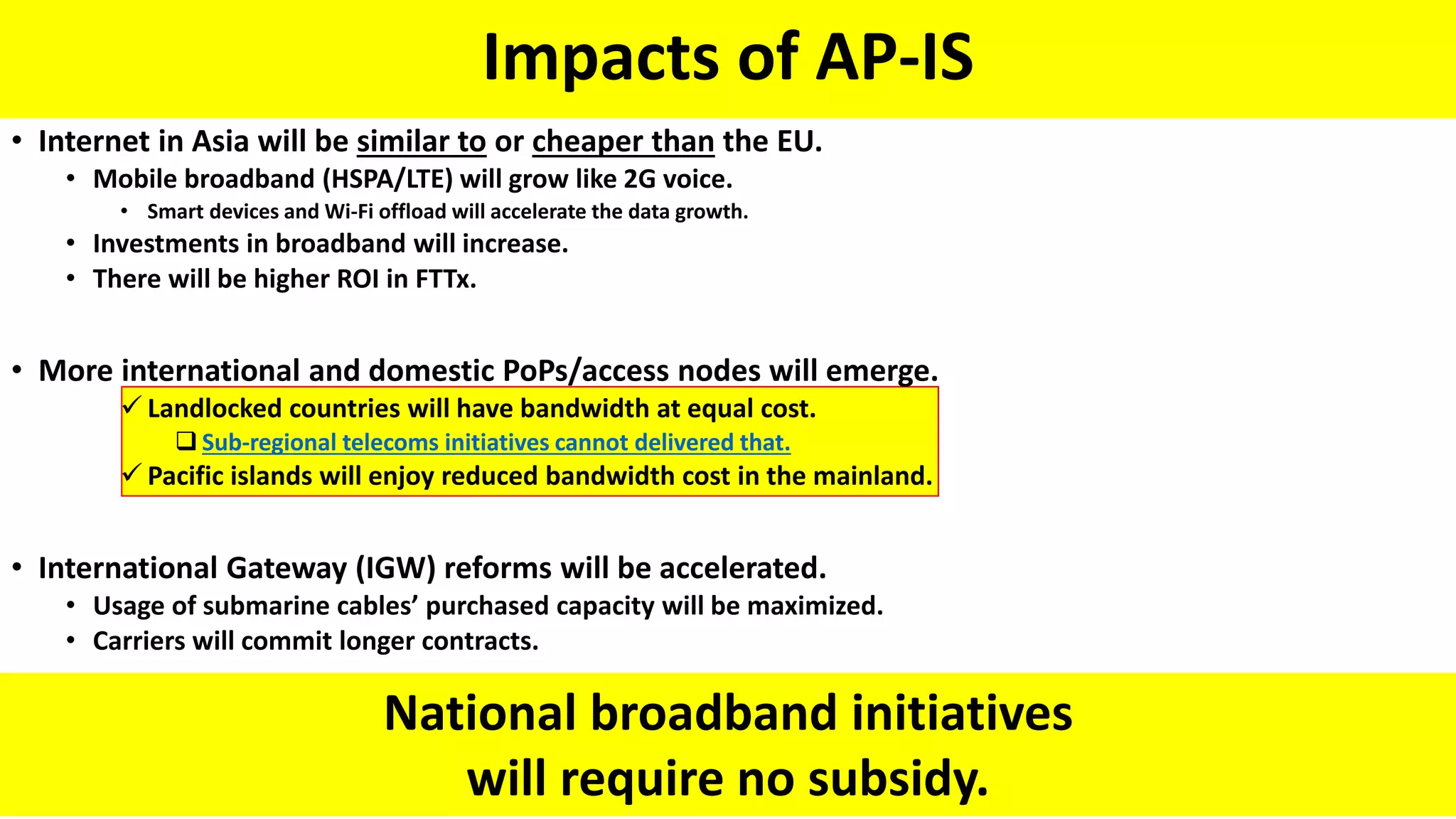
Impacts of AP-IS
National broadband initiatives
will require no subsidy.
• Internet in Asia will be similar to or cheaper than the EU.
• Mobile broadband (HSPA/LTE) will grow like 2G voice.
• Smart devices and Wi-Fi offload will accelerate the data growth.
• Investments in broadband will increase.
• There will be higher ROI in FTTx.
• More international and domestic PoPs/access nodes will emerge.
 Landlocked countries will have bandwidth at equal cost.
 Sub-regional telecoms initiatives cannot delivered that.
 Pacific islands will enjoy reduced bandwidth cost in the mainland.
• International Gateway (IGW) reforms will be accelerated.
• Usage of submarine cables’ purchased capacity will be maximized.
• Carriers will commit longer contracts.
Thank you! Questions?

Technology and Diplomacy: Mobile Internet in Asia

  • 1.
    Abu Saeed Khan abu@lirneasia.net SeniorPolicy Fellow LIRNEasia Technology and Diplomacy Mobile Internet in Asia
  • 2.
    Global growth indicators •Flowof goods 10.5x in 34 years • 1980-2014 •Flow of services 3.1x in 12 years • 2002-2014 •Flow of people 1.6x in 11 years • 2002-2013 Source: UN World Tourism Organization; UNCTAD; McKinsey Global Institute analysis
  • 3.
  • 4.
    “It’s a bigdeal.” • Nearly 300 submarine cables spanning over 500,000 miles across the world’s seabed are the primary pipeline of transcontinental Internet. • They are also responsible for $10 trillion worth of transactional value every day. • It is greater than the GDP of Japan, Germany, and Australia combined. Source: TeleGeography Global Submarine Cable Map U.S. Federal Communications Commission Commissioner Jessica Rosenworcel's statement on September 17, 2015
  • 5.
  • 6.
    Mobile subscriptions byregion and technology Ericsson Mobility Report, June 2017
  • 7.
    Data Traffic (PB/month) ofSmartphones in 2016 Data Traffic (PB/month) of Smartphones in 2022 (44.7%) (43.2%) Source: Ericsson Mobility Report. November 2016 10X growth of smartphone data in APAC Note: 1 Petabyte is 1,000 Terabytes or 250,000 DVDs
  • 8.
    Fest and Famineof Broadband in Asia 39% 42% 72% 76% 81% 81% 82% 86% 91% 93% 94% 94% 95% 97% 98% >4 Mbps 5.5 6.5 7.2 7.6 8.5 8.9 9.5 11.0 14.7 16.0 16.9 20.2 20.3 21.9 28.6 Average speed (Mbps) 11.0% 18.0% 19.0% 20.0% 22.0% 32% 35% 37.0% 52% 65% 71% 72% 72% 73% 85% >10 Mbps 5.0% 5.0% 6.2% 10.0% 11.0% 11.0% 14.0% 19.0% 32.0% 38.0% 43.0% 51.0% 52.0% 54.0% 69.0% >15 Mbps The State of the Internet / Q1 2017, Akamai.
  • 9.
    Continental drift 5.5 6.5 7.2 7.6 8.5 8.9 9.5 11.0 14.7 16.0 16.9 20.2 20.3 21.9 28.6 Average speedin Asia (Mbps) The State of the Internet / Q1 2017, Akamai. 15.3 15.5 15.5 15.6 16.3 16.6 16.9 16.9 17.0 17.4 20.1 20.5 21.7 22.5 23.5 Average speed in Europe (Mbps)
  • 10.
    Slower or fasterthan European counterparts -9.8 -9.0 -8.3 -8.0 -7.8 -7.7 -7.4 -5.9 -3.2 -2.3 -1.4 -1.4 -0.6 -0.3 5.1 Average speed in Mbps Source: The State of the Internet / Q1 2017, Akamai.
  • 11.
  • 12.
    Infrastructure dictates thecost of bandwidth Terrestrial cables Submarine cables Curtsey: Brianna Boudreau, Senior Analyst, TeleGeography.
  • 13.
    Very good competition •Terrestrial& submarine TX Poor competition All submarine TX Fierce competition •Coast-coast terrestrial TX Broadband’s biggest barrier Issues keeping Asia’s bandwidth pricier
  • 14.
    Submarine Cable repair2008-2015: Worldwide average repairs/year Source: International Cable Protection Committee
  • 15.
    Submarine Cable repair2008-2015: Average time to begin repair Source: International Cable Protection Committee
  • 16.
    Submarine networks =Terrestrial networks Courtesy: Ciena Evolution of technology = Evolution of policy
  • 17.
  • 18.
    A bilateral move thatis shaping global trade
  • 20.
  • 22.
    Best effort byAsia Africa Europe-1 (AAE-1) cable Owners: China Unicom, Telecom Egypt, Etisalat, Omantel, Djibouti Telecom, OTEGLOBE, Pakistan Telecommunications Company Ltd., PCCW, Ooredoo, Mobily, Viettel Corporation, TeleYemen, Chuan Wei, Retelit, Reliance Jio Infocom.
  • 23.
    Terrestrial link to theBay of Bengal Terrestrial link to the Arabian Sea China Unicom takes a giant leap AAE-1 via Pakistan and Myanmar Source: People’s Daily online (March 2, 2016)
  • 24.
    • 145,000 kmmeshed across 32 countries (12 landlocked). • Seamlessly connects Asia and Europe.
  • 25.
    Each country’s sharein Asian Highway
  • 26.
    Small step of Bangladeshfor a global giant leap • Prime Minister Sheikh Hasina has approved the proposed amendments to Asian Highway agreement on August 13, 2016. • It paves the way to deploy optical fiber using 145,000 km right-of- way to digitally interlink Asia and plug the continent with Europe.
  • 27.
    “Factories” and “Warehouses”of Internet in Asia-Pacific Major Content Provider Data Center Locations, 2017
  • 28.
    Asian Highway isthe preferred right of way for Asia Pacific Information Superhighway (AP-IS) • •
  • 29.
    Advantages of AP-IS •Presumed ‘unfriendly’ countries are already interlinked. • Submarine : SEA-ME-WE 4 and SEA-ME-WE 5. • Terrestrial: Sino-Russian link (TEA) and Sino-Indian link (Reliance/Tata/Bharti + China Mobile). • Highly resilient due to mesh. • Rerouting the traffic means ‘zero’ downtime. • Installation and maintenance crew/materials available everywhere. • Creates more opportunities for submarine cables. • Investments in transpacific rather than intra-Asia. • Lower latency and higher SLA at lesser cost for international bandwidth. Open access guaranteed
  • 30.
    Impacts of AP-IS Nationalbroadband initiatives will require no subsidy. • Internet in Asia will be similar to or cheaper than the EU. • Mobile broadband (HSPA/LTE) will grow like 2G voice. • Smart devices and Wi-Fi offload will accelerate the data growth. • Investments in broadband will increase. • There will be higher ROI in FTTx. • More international and domestic PoPs/access nodes will emerge.  Landlocked countries will have bandwidth at equal cost.  Sub-regional telecoms initiatives cannot delivered that.  Pacific islands will enjoy reduced bandwidth cost in the mainland. • International Gateway (IGW) reforms will be accelerated. • Usage of submarine cables’ purchased capacity will be maximized. • Carriers will commit longer contracts.
  • 31.