OPENING PRAYEROPENING PRAYER
Give me faith dear God to faceGive me faith dear God to face
each hour throughout the dayeach hour throughout the day
and not to worry over things Iand not to worry over things I
cannot change in anyway.cannot change in anyway.
We ask this through theWe ask this through the
intercession of the Blessedintercession of the Blessed
Virgin Mary .Virgin Mary .
Amen.Amen.
BIBLE PASSAGE:BIBLE PASSAGE:
2 Cor. 8:72 Cor. 8:7
““But as you abound in everything inBut as you abound in everything in
faithfaith, in speech, in knowledge, in all, in speech, in knowledge, in all
diligence and in our love for us – surediligence and in our love for us – sure
that you abound in this grace also”that you abound in this grace also”
REVIEWREVIEW
What is a poetic device?What is a poetic device?
AA poetic devicepoetic device is a technique oris a technique or
tool used in poetry which helps totool used in poetry which helps to
improve the quality of a poem.improve the quality of a poem.
FOCUS:FOCUS:
““On His Blindness”On His Blindness”
By John MiltonBy John Milton
Motivation
“DARK IMAGES”
 A.) A video clip will be presented to class.
The students will visualize the video clip
while being blindfolded.
 B.) 2 volunteer students will also be asked
to walk while being blindfolded and will be
asked later on to share their experience.
QUESTIONS:
 How did you visualize the
presentation in your mind?
 Is it easy to visualize things by
mere listening? Why?
 What is the importance of
eyesight?
ObjectivesObjectives:
The students will be able to….
 Know the importance of one’s attitude in life
through the poem and class sharing
Express the moral lesson of the poem
ACTIVITYACTIVITY
 THINK-PAIR-SHARETHINK-PAIR-SHARE
Think of a difficulties/trials in life thatThink of a difficulties/trials in life that
you’ve experienced before. Share ityou’ve experienced before. Share it
with your seatmates, encourage thewith your seatmates, encourage the
students to share their thoughts instudents to share their thoughts in
class.class.
ACTIVATING PRIORACTIVATING PRIOR
KNOWLEDGEKNOWLEDGE
Who is John Milton? What areWho is John Milton? What are
some poetic devices hesome poetic devices he
used in his poems?used in his poems?
“ON HIS
BLINDNESS”
By John Milton
JOHN MILTON: HIS LIFE & WORKS
 John Milton (1608-1674)John Milton (1608-1674) - was
born on December 9, 1608, in
London, as the second child of John
Milton Sr. and Sara. The family
lived on Bread Street in Cheapside,
near St. Paul's Cathedral
 It was from his father that John
acquired his love for music and
poetry
 His eyesight was never good. In
1652, he became totally blind
thus this prompted him to write
the sonnet , “On His Blindness"“On His Blindness"
 His epic “Paradise Lost” is
considered the greatest epic in
the English Language. It
discusses the fall of man and the
promise of redemption
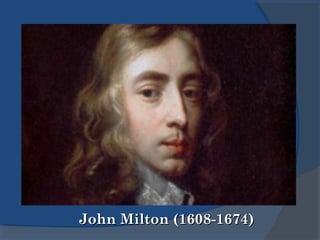
John Milton (1608-1674)John Milton (1608-1674)
SONNETSONNET
 What is a sonnet?
SonnetSonnet – came from Italian word
“sonnetto” which means “little
song.”
- It is a lyric poem
consists of fourteen lines written
in iambic pentameteriambic pentameter.
2 KINDS OF SONNET:
1.) “ELIZABETHAN” or
SHAKESPEAREAN SONNET
– it is composed of threethree
quatrainsquatrains ( a verse with four lines) and
the last two rhyming linestwo rhyming lines oror coupletcouplet.
- A kind of sonnet named after
the famous English playwright and poet,
William Shakespeare.
rhyming scheme – abab, cdcd, efef, gg
2.) “PETRARCHAN” or ITALIAN“PETRARCHAN” or ITALIAN
SONNETSONNET
– it was introduced by Sir ThomasSir Thomas
WyattWyatt during the Renaissance Period. It
was named after a famous 14th
century
Italian poet, Francesco Petrarch.Francesco Petrarch.
- it consists of two parts: the
octaveoctave (the first eight lines, the part that
raises the question or problem) and the
sestetsestet (the last six lines, the solution orthe last six lines, the solution or
answer to the octave.answer to the octave.)
- rhyming scheme: abba, abba, cde, cde
BRIEF BACKGROUND OF THEBRIEF BACKGROUND OF THE
POEMPOEM
 John Milton’s poem “On His Blindness” is
an autobiographical sonnet in which Milton
meditates on his own loss of sight. For
most of his life, Milton had been able to see
perfectly, but his late-night reading and
writing on behalf of the government of the
short-lived English Republic, in which he
held a very prominent position, helped ruin
his eyesight.
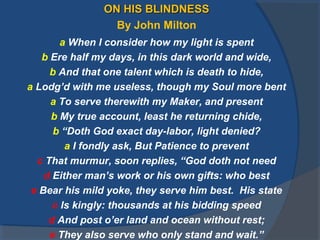
ON HIS BLINDNESSON HIS BLINDNESS
By John Milton
a When I consider how my light is spent
b Ere half my days, in this dark world and wide,
b And that one talent which is death to hide,
a Lodg’d with me useless, though my Soul more bent
a To serve therewith my Maker, and present
b My true account, least he returning chide,
b “Doth God exact day-labor, light denied?
a I fondly ask, But Patience to prevent
c That murmur, soon replies, “God doth not need
d Either man’s work or his own gifts: who best
e Bear his mild yoke, they serve him best. His state
c Is kingly: thousands at his bidding speed
d And post o’er land and ocean without rest;
e They also serve who only stand and wait.”
 BROADENING OF CONCEPTBROADENING OF CONCEPT:
How did John Milton search for meaning
in his life?
 INTEGRATION:INTEGRATION:
SOCIAL ORIENTATION:SOCIAL ORIENTATION:
PHYSICAL DISABILITY
 Question: Is physical impairment a
hindrance to continue whatever we have
started in pursuit for fulfillment?
 LESSON ACROSS DISCIPLINELESSON ACROSS DISCIPLINE:
Christian Living – The Healing of the
Two Blind Men
 Question: Are life’s trials or failures
bothering you?
 EVALUATION/ASSESSMENTEVALUATION/ASSESSMENT:
Answer the Posttest on page 87 of your
book, 1-10 items
 SUMMARY:
Are life’ trials or failures bothering
you?
 Writing a ReflectionWriting a Reflection
Write a reflection about the message
of the poem, “On His Blindness”
ACTION:ACTION: As a student, as you look back
in your life, do you remember any
experience when you felt as if you had
fallen into a pit?
ASSIGNMENT:
 Compose a “thank you” letter to God for His
unwavering assistance/grace during your
trial?
 Read and understand the poem entitled,
“Sonnet 18” on pp. 125-129
 Answer the questions on p. 129

On His Blindness

  • 1.
    OPENING PRAYEROPENING PRAYER Giveme faith dear God to faceGive me faith dear God to face each hour throughout the dayeach hour throughout the day and not to worry over things Iand not to worry over things I cannot change in anyway.cannot change in anyway. We ask this through theWe ask this through the intercession of the Blessedintercession of the Blessed Virgin Mary .Virgin Mary . Amen.Amen.
  • 2.
    BIBLE PASSAGE:BIBLE PASSAGE: 2Cor. 8:72 Cor. 8:7 ““But as you abound in everything inBut as you abound in everything in faithfaith, in speech, in knowledge, in all, in speech, in knowledge, in all diligence and in our love for us – surediligence and in our love for us – sure that you abound in this grace also”that you abound in this grace also”
  • 3.
    REVIEWREVIEW What is apoetic device?What is a poetic device? AA poetic devicepoetic device is a technique oris a technique or tool used in poetry which helps totool used in poetry which helps to improve the quality of a poem.improve the quality of a poem. FOCUS:FOCUS: ““On His Blindness”On His Blindness” By John MiltonBy John Milton
  • 4.
    Motivation “DARK IMAGES”  A.)A video clip will be presented to class. The students will visualize the video clip while being blindfolded.  B.) 2 volunteer students will also be asked to walk while being blindfolded and will be asked later on to share their experience.
  • 5.
    QUESTIONS:  How didyou visualize the presentation in your mind?  Is it easy to visualize things by mere listening? Why?  What is the importance of eyesight?
  • 6.
    ObjectivesObjectives: The students willbe able to….  Know the importance of one’s attitude in life through the poem and class sharing Express the moral lesson of the poem
  • 7.
    ACTIVITYACTIVITY  THINK-PAIR-SHARETHINK-PAIR-SHARE Think ofa difficulties/trials in life thatThink of a difficulties/trials in life that you’ve experienced before. Share ityou’ve experienced before. Share it with your seatmates, encourage thewith your seatmates, encourage the students to share their thoughts instudents to share their thoughts in class.class.
  • 8.
    ACTIVATING PRIORACTIVATING PRIOR KNOWLEDGEKNOWLEDGE Whois John Milton? What areWho is John Milton? What are some poetic devices hesome poetic devices he used in his poems?used in his poems?
  • 9.
  • 10.
    JOHN MILTON: HISLIFE & WORKS  John Milton (1608-1674)John Milton (1608-1674) - was born on December 9, 1608, in London, as the second child of John Milton Sr. and Sara. The family lived on Bread Street in Cheapside, near St. Paul's Cathedral  It was from his father that John acquired his love for music and poetry
  • 11.
     His eyesightwas never good. In 1652, he became totally blind thus this prompted him to write the sonnet , “On His Blindness"“On His Blindness"  His epic “Paradise Lost” is considered the greatest epic in the English Language. It discusses the fall of man and the promise of redemption
  • 12.
    John Milton (1608-1674)JohnMilton (1608-1674)
  • 13.
    SONNETSONNET  What isa sonnet? SonnetSonnet – came from Italian word “sonnetto” which means “little song.” - It is a lyric poem consists of fourteen lines written in iambic pentameteriambic pentameter.
  • 14.
    2 KINDS OFSONNET: 1.) “ELIZABETHAN” or SHAKESPEAREAN SONNET – it is composed of threethree quatrainsquatrains ( a verse with four lines) and the last two rhyming linestwo rhyming lines oror coupletcouplet. - A kind of sonnet named after the famous English playwright and poet, William Shakespeare. rhyming scheme – abab, cdcd, efef, gg
  • 15.
    2.) “PETRARCHAN” orITALIAN“PETRARCHAN” or ITALIAN SONNETSONNET – it was introduced by Sir ThomasSir Thomas WyattWyatt during the Renaissance Period. It was named after a famous 14th century Italian poet, Francesco Petrarch.Francesco Petrarch. - it consists of two parts: the octaveoctave (the first eight lines, the part that raises the question or problem) and the sestetsestet (the last six lines, the solution orthe last six lines, the solution or answer to the octave.answer to the octave.) - rhyming scheme: abba, abba, cde, cde
  • 16.
    BRIEF BACKGROUND OFTHEBRIEF BACKGROUND OF THE POEMPOEM  John Milton’s poem “On His Blindness” is an autobiographical sonnet in which Milton meditates on his own loss of sight. For most of his life, Milton had been able to see perfectly, but his late-night reading and writing on behalf of the government of the short-lived English Republic, in which he held a very prominent position, helped ruin his eyesight.
  • 17.
    ON HIS BLINDNESSONHIS BLINDNESS By John Milton a When I consider how my light is spent b Ere half my days, in this dark world and wide, b And that one talent which is death to hide, a Lodg’d with me useless, though my Soul more bent a To serve therewith my Maker, and present b My true account, least he returning chide, b “Doth God exact day-labor, light denied? a I fondly ask, But Patience to prevent c That murmur, soon replies, “God doth not need d Either man’s work or his own gifts: who best e Bear his mild yoke, they serve him best. His state c Is kingly: thousands at his bidding speed d And post o’er land and ocean without rest; e They also serve who only stand and wait.”
  • 18.
     BROADENING OFCONCEPTBROADENING OF CONCEPT: How did John Milton search for meaning in his life?  INTEGRATION:INTEGRATION: SOCIAL ORIENTATION:SOCIAL ORIENTATION: PHYSICAL DISABILITY  Question: Is physical impairment a hindrance to continue whatever we have started in pursuit for fulfillment?
  • 19.
     LESSON ACROSSDISCIPLINELESSON ACROSS DISCIPLINE: Christian Living – The Healing of the Two Blind Men  Question: Are life’s trials or failures bothering you?
  • 20.
     EVALUATION/ASSESSMENTEVALUATION/ASSESSMENT: Answer thePosttest on page 87 of your book, 1-10 items  SUMMARY: Are life’ trials or failures bothering you?  Writing a ReflectionWriting a Reflection Write a reflection about the message of the poem, “On His Blindness”
  • 21.
    ACTION:ACTION: As astudent, as you look back in your life, do you remember any experience when you felt as if you had fallen into a pit? ASSIGNMENT:  Compose a “thank you” letter to God for His unwavering assistance/grace during your trial?  Read and understand the poem entitled, “Sonnet 18” on pp. 125-129  Answer the questions on p. 129