Poem On his blindness
Submitted by: Abdul Jabbar
Topic
John Milton
He was born December 9 / 1608 London.
Died November 8 / 1674.
English poet, pamphleter and historian, considered most significant
English author after William shake spear.
 His work epi “paradise lost” Classical tragedy, Samson agonistes, also
written pros work.
The poem On His Blindness is an autobiographical sonnet in
which he expresses his feelings as a blind person.
The poet thinks, in the beginning, that he will not be able to serve
God as his sight is gone.
As the poem develops, he begins to believe that God wants him to
keep working, in spite of the fact that his job caused him to lose his
sight.
Introduction
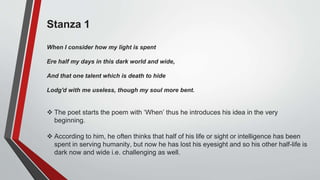
Stanza 1
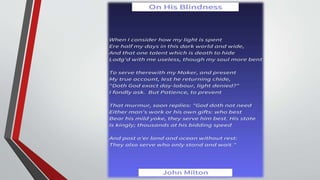
When I consider how my light is spent
Ere half my days in this dark world and wide,
And that one talent which is death to hide
Lodg'd with me useless, though my soul more bent.
 The poet starts the poem with ‘When’ thus he introduces his idea in the very
beginning.
 According to him, he often thinks that half of his life or sight or intelligence has been
spent in serving humanity, but now he has lost his eyesight and so his other half-life is
dark now and wide i.e. challenging as well.
Continue…
 The one talent (of writing) which he had, is useless now because without eyesight he
cannot write.
 it is just a load from God that has been bestowed on him. The poet laments over the
loss of his eyesight and wonders what this talent means for him now as without
eyesight he cannot use it.
Stanza 2
To serve therewith my Maker, and present
My true account, lest he returning chide,
"Doth God exact day-labour, light denied?"
I fondly ask. But Patience, to prevent.
 In these lines, the lament of poets turns into desire and wonder. He says that he
desired to serve his Maker but because of this blindness he cannot do so.
 . He wonders if God still wants to serve Him in spite of the fact that his sight is gone.
The poet says that this foolish thought often haunts him.
Stanza 3
That murmur, soon replies: "God doth not need
Either man's work or his own gifts: who best
Bear his mild yoke, they serve him best. His state
Is kingly; thousands at his bidding speed.
 In these lines, the poet says that when such foolish thoughts come into his mind, the
patience at once comes to reply that the work of man does not please God, but the one
who remains patient and content with what he has is most liked by Him.
 God has a huge Kingdom and there are thousands of angels who remain in motion to carry
God’s order.
Continue…
 They never take rest.
 The poet compares them with those who have the talent and use it to serve
God.
Couplet
And post o'er land and ocean without rest:
They also serve who only stand and wait.
 The poet compares himself with the later Angels who just keep patience.
 Thus, in the end, the poet is quite satisfied as he is also serving God just by keeping
patience.
Poem On his blindness

Poem On his blindness

  • 1.
    Poem On hisblindness Submitted by: Abdul Jabbar Topic
  • 3.
    John Milton He wasborn December 9 / 1608 London. Died November 8 / 1674. English poet, pamphleter and historian, considered most significant English author after William shake spear.  His work epi “paradise lost” Classical tragedy, Samson agonistes, also written pros work.
  • 4.
    The poem OnHis Blindness is an autobiographical sonnet in which he expresses his feelings as a blind person. The poet thinks, in the beginning, that he will not be able to serve God as his sight is gone. As the poem develops, he begins to believe that God wants him to keep working, in spite of the fact that his job caused him to lose his sight. Introduction
  • 5.
    Stanza 1 When Iconsider how my light is spent Ere half my days in this dark world and wide, And that one talent which is death to hide Lodg'd with me useless, though my soul more bent.  The poet starts the poem with ‘When’ thus he introduces his idea in the very beginning.  According to him, he often thinks that half of his life or sight or intelligence has been spent in serving humanity, but now he has lost his eyesight and so his other half-life is dark now and wide i.e. challenging as well.
  • 6.
    Continue…  The onetalent (of writing) which he had, is useless now because without eyesight he cannot write.  it is just a load from God that has been bestowed on him. The poet laments over the loss of his eyesight and wonders what this talent means for him now as without eyesight he cannot use it.
  • 7.
    Stanza 2 To servetherewith my Maker, and present My true account, lest he returning chide, "Doth God exact day-labour, light denied?" I fondly ask. But Patience, to prevent.  In these lines, the lament of poets turns into desire and wonder. He says that he desired to serve his Maker but because of this blindness he cannot do so.  . He wonders if God still wants to serve Him in spite of the fact that his sight is gone. The poet says that this foolish thought often haunts him.
  • 8.
    Stanza 3 That murmur,soon replies: "God doth not need Either man's work or his own gifts: who best Bear his mild yoke, they serve him best. His state Is kingly; thousands at his bidding speed.  In these lines, the poet says that when such foolish thoughts come into his mind, the patience at once comes to reply that the work of man does not please God, but the one who remains patient and content with what he has is most liked by Him.  God has a huge Kingdom and there are thousands of angels who remain in motion to carry God’s order.
  • 9.
    Continue…  They nevertake rest.  The poet compares them with those who have the talent and use it to serve God.
  • 10.
    Couplet And post o'erland and ocean without rest: They also serve who only stand and wait.  The poet compares himself with the later Angels who just keep patience.  Thus, in the end, the poet is quite satisfied as he is also serving God just by keeping patience.