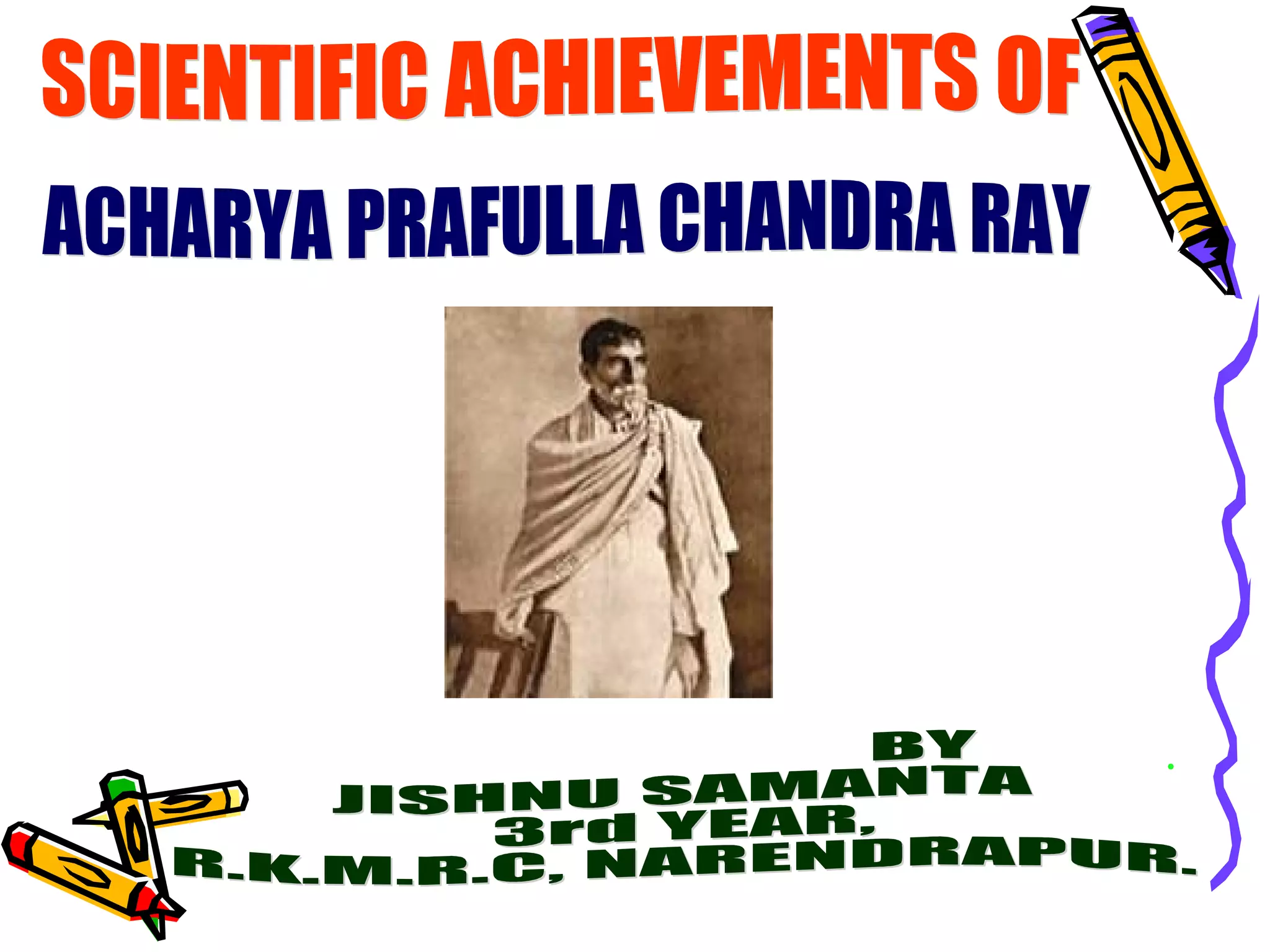
SCIENTIFIC ACHIEVEMENTS OF  ACHARYA PRAFULLA CHANDRA RAY BY  JISHNU SAMANTA 3rd YEAR, R.K.M.R.C, NARENDRAPUR.
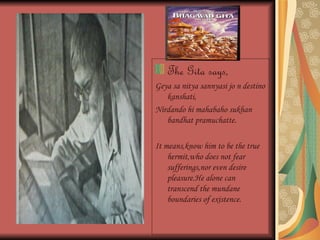
The Gita says, Geya sa nitya sannyasi jo n destino kanshati, Nirdando hi mahabaho sukhan bandhat pramuchatte. It means,know him to be the true hermit,who does not fear sufferings,nor even desire pleasure.He alone can transcend the mundane boundaries of existence.
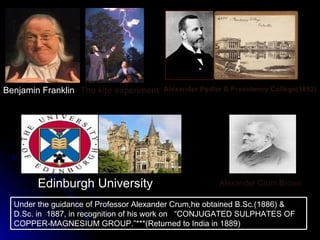
Alexander Pedler & Presidency College(1882) The kite experiment Alexander Crum Brown Benjamin Franklin Edinburgh University Under the guidance of Professor Alexander Crum,he obtained B.Sc.(1886) & D.Sc. in  1887, in recognition of his work on  “CONJUGATED SULPHATES OF COPPER-MAGNESIUM GROUP.”***(Returned to India in 1889)
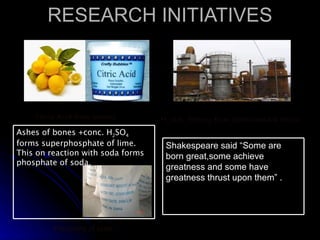
RESEARCH INITIATIVES Citric Acid from lemons H 2  SO 4  factory from Jadavchandra Mitra   Phosphate of soda Ashes of bones +conc. H 2 SO 4  forms superphosphate of lime. This on reaction with soda forms phosphate of soda. Shakespeare said “Some are born great,some achieve greatness and some have greatness thrust upon them” .
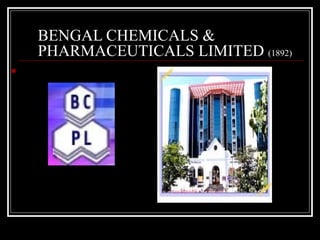
BENGAL CHEMICALS & PHARMACEUTICALS LIMITED  (1892)
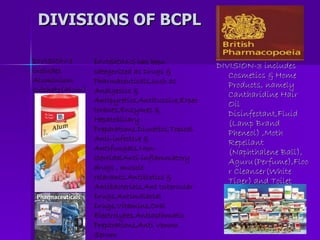
DIVISIONS OF BCPL DIVISION-3 includes Cosmetics & Home Products, namely Cantharidine Hair Oil Disinfectant,Fluid (Lamp Brand Pheneol) ,Moth Repellant (Naphthalene Ball), Aguru(Perfume),Floor Cleanser(White Tiger) and Toilet Cleaner (Klin Toilet)  DIVISION-1 includes Aluminium sulphate(Alum) DIVISION-2 has been categorized as Drugs & Pharmaceuticals,such as Analgesics & Antipyretics,Antitussive,Expectorants,Enzymes & Hepatobiliary Preparations,Diuretics,Topical Anti-infective & Antifungals,Non-steroidalAnti-inflammatory drugs , muscle relaxants,Antibiotics & Antibacterials,Ant tubercular Drugs,Antimalarial Drugs,Vitamins,Oral Electrolytes,Antiasthmatic Preparations,Anti Venom Serum
Discovery of Mercurous Nitrite Published 120 research papers Mercurous Nitrite [Hg 2 (NO 2 ) 2 ] “ The discovery of mercurous nitrite opened a new chapter in my life” It was published in the Journal of Asiatic Society Of Bengal & noticed by Nature. Synthesis of Ammonium Nitrite in pure form. Before this it was believed that ammonium nitrite undergoes fast thermal decomposition yielding nitrogen(N 2 ) and water (H 2 O). NATURE JOURNAL OF THE ASIATIC SOCIETY OF BENGAL
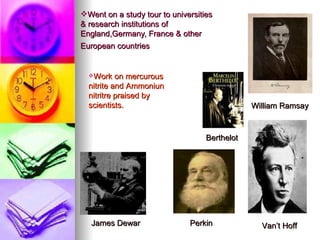
Went on a study tour to universities & research institutions of England,Germany, France & other European countries   Work on mercurous nitrite and Ammoniun nitritre praised by scientists. William Ramsay James Dewar Perkin Van’t Hoff Berthelot
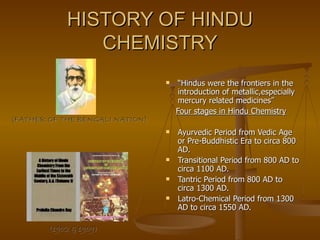
HISTORY OF HINDU CHEMISTRY “ Hindus were the frontiers in the introduction of metallic,especially mercury related medicines” Four stages in Hindu Chemistry Ayurvedic Period from Vedic Age or Pre-Buddhistic Era to circa 800 AD. Transitional Period from 800 AD to circa 1100 AD. Tantric Period from 800 AD to circa 1300 AD. Latro-Chemical Period from 1300 AD to circa 1550 AD.  (FATHER OF THE BENGALI NATION) (1902 & 1909)
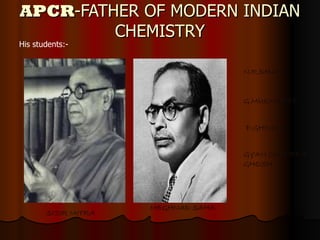
APCR -FATHER OF MODERN INDIAN CHEMISTRY MEGHNAD SAHA GYAN CHANDRA GHOSH N.R.DHAR SISIR MITRA P.GHOSH G.MUKHERJEE His students:-
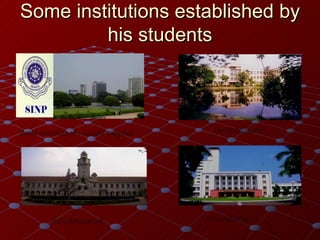
Some institutions established by his students IIT,Kharagpur Saha Institute of Nuclear Physics IISC,Bangalore IACS,Calcutta
Donations for scientific research He donated nine-tenths of his income in charity and chemical research. In 1922,made an endowment of Rs.10,000 for an annual prize in chemistry named after great Indian alchemist Nagarjuna Also made an endowment of Rs. 10,000 in 1936 for a research prize in zoology & botany named after Ashutosh Mukherjee Donated about Rs.180,000 to CU for research and other purposes HE used to say “person who hasn’t developed any inner interest in research work, should not do it just to earn money.”
CHRONOLOGY OF RAY’S   SCIENTIFIC ACHIEVEMENTS 1879-Started Education in Metropolitan college 1881-Passed F.A. Exam 1882-Received Gilchrist Prize Scholarship and went to England for further studies 1886-Obtained B.Sc. Degree from Edinburgh University 1887-Got his D.Sc. Degree for his work on  “Conjugated sulphates of the copper-magnesium group:A study of Isomorphous Mixtures and Molecular Combinations 1888-Elected Vice-President of Edinburgh University Chemical Society 1889-Back to INDIA 1892- Established the Bengal Chemicals & started experimenting with indigenous plants 1893-Wrote books on Zoology and Botany, bought the sulphuric acid plant from Jadavchandra Mitra 1894-Writing on OIL & GHEE IMPURITIES published in  “Journal of the Asiatic Society of Bengal” 1896-Famous research on mercurous nitrite  1898-His research on INDIAN plants obtained a place in the British Pharmacopoeia 1901-Bengal Chemicals converted to a Limited Company
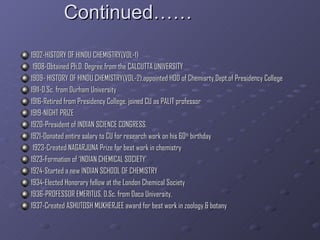
Continued…… 1902-HISTORY OF HINDU CHEMISTRY(VOL-1) 1908-Obtained Ph.D. Degree from the CALCUTTA UNIVERSITY  1909- HISTORY OF HINDU CHEMISTRY(VOL-2),appointed HOD of Chemisrty Dept.of Presidency College 1911-D.Sc. from Durham University 1916-Retired from Presidency College, joined CU as PALIT professor 1919-NIGHT PRIZE 1920-President of INDIAN SCIENCE CONGRESS. 1921-Donated entire salary to CU for research work on his 60 th  birthday 1923-Created NAGARJUNA Prize for best work in chemistry 1923-Formation of ‘INDIAN CHEMICAL SOCIETY’ 1924-Started a new INDIAN SCHOOL OF CHEMISTRY 1934-Elected Honorary fellow at the London Chemical Society 1936-PROFESSOR EMERITUS, D.Sc. from Daca University, 1937-Created ASHUTOSH MUKHERJEE award for best work in zoology & botany
THANK YOU

ON APCR

  • 1.
    SCIENTIFIC ACHIEVEMENTS OF ACHARYA PRAFULLA CHANDRA RAY BY JISHNU SAMANTA 3rd YEAR, R.K.M.R.C, NARENDRAPUR.
  • 2.
    The Gita says,Geya sa nitya sannyasi jo n destino kanshati, Nirdando hi mahabaho sukhan bandhat pramuchatte. It means,know him to be the true hermit,who does not fear sufferings,nor even desire pleasure.He alone can transcend the mundane boundaries of existence.
  • 3.
    Alexander Pedler &Presidency College(1882) The kite experiment Alexander Crum Brown Benjamin Franklin Edinburgh University Under the guidance of Professor Alexander Crum,he obtained B.Sc.(1886) & D.Sc. in 1887, in recognition of his work on “CONJUGATED SULPHATES OF COPPER-MAGNESIUM GROUP.”***(Returned to India in 1889)
  • 4.
    RESEARCH INITIATIVES CitricAcid from lemons H 2 SO 4 factory from Jadavchandra Mitra Phosphate of soda Ashes of bones +conc. H 2 SO 4 forms superphosphate of lime. This on reaction with soda forms phosphate of soda. Shakespeare said “Some are born great,some achieve greatness and some have greatness thrust upon them” .
  • 5.
    BENGAL CHEMICALS &PHARMACEUTICALS LIMITED (1892)
  • 6.
    DIVISIONS OF BCPLDIVISION-3 includes Cosmetics & Home Products, namely Cantharidine Hair Oil Disinfectant,Fluid (Lamp Brand Pheneol) ,Moth Repellant (Naphthalene Ball), Aguru(Perfume),Floor Cleanser(White Tiger) and Toilet Cleaner (Klin Toilet) DIVISION-1 includes Aluminium sulphate(Alum) DIVISION-2 has been categorized as Drugs & Pharmaceuticals,such as Analgesics & Antipyretics,Antitussive,Expectorants,Enzymes & Hepatobiliary Preparations,Diuretics,Topical Anti-infective & Antifungals,Non-steroidalAnti-inflammatory drugs , muscle relaxants,Antibiotics & Antibacterials,Ant tubercular Drugs,Antimalarial Drugs,Vitamins,Oral Electrolytes,Antiasthmatic Preparations,Anti Venom Serum
  • 7.
    Discovery of MercurousNitrite Published 120 research papers Mercurous Nitrite [Hg 2 (NO 2 ) 2 ] “ The discovery of mercurous nitrite opened a new chapter in my life” It was published in the Journal of Asiatic Society Of Bengal & noticed by Nature. Synthesis of Ammonium Nitrite in pure form. Before this it was believed that ammonium nitrite undergoes fast thermal decomposition yielding nitrogen(N 2 ) and water (H 2 O). NATURE JOURNAL OF THE ASIATIC SOCIETY OF BENGAL
  • 8.
    Went on astudy tour to universities & research institutions of England,Germany, France & other European countries Work on mercurous nitrite and Ammoniun nitritre praised by scientists. William Ramsay James Dewar Perkin Van’t Hoff Berthelot
  • 9.
    HISTORY OF HINDUCHEMISTRY “ Hindus were the frontiers in the introduction of metallic,especially mercury related medicines” Four stages in Hindu Chemistry Ayurvedic Period from Vedic Age or Pre-Buddhistic Era to circa 800 AD. Transitional Period from 800 AD to circa 1100 AD. Tantric Period from 800 AD to circa 1300 AD. Latro-Chemical Period from 1300 AD to circa 1550 AD. (FATHER OF THE BENGALI NATION) (1902 & 1909)
  • 10.
    APCR -FATHER OFMODERN INDIAN CHEMISTRY MEGHNAD SAHA GYAN CHANDRA GHOSH N.R.DHAR SISIR MITRA P.GHOSH G.MUKHERJEE His students:-
  • 11.
    Some institutions establishedby his students IIT,Kharagpur Saha Institute of Nuclear Physics IISC,Bangalore IACS,Calcutta
  • 12.
    Donations for scientificresearch He donated nine-tenths of his income in charity and chemical research. In 1922,made an endowment of Rs.10,000 for an annual prize in chemistry named after great Indian alchemist Nagarjuna Also made an endowment of Rs. 10,000 in 1936 for a research prize in zoology & botany named after Ashutosh Mukherjee Donated about Rs.180,000 to CU for research and other purposes HE used to say “person who hasn’t developed any inner interest in research work, should not do it just to earn money.”
  • 13.
    CHRONOLOGY OF RAY’S SCIENTIFIC ACHIEVEMENTS 1879-Started Education in Metropolitan college 1881-Passed F.A. Exam 1882-Received Gilchrist Prize Scholarship and went to England for further studies 1886-Obtained B.Sc. Degree from Edinburgh University 1887-Got his D.Sc. Degree for his work on “Conjugated sulphates of the copper-magnesium group:A study of Isomorphous Mixtures and Molecular Combinations 1888-Elected Vice-President of Edinburgh University Chemical Society 1889-Back to INDIA 1892- Established the Bengal Chemicals & started experimenting with indigenous plants 1893-Wrote books on Zoology and Botany, bought the sulphuric acid plant from Jadavchandra Mitra 1894-Writing on OIL & GHEE IMPURITIES published in “Journal of the Asiatic Society of Bengal” 1896-Famous research on mercurous nitrite 1898-His research on INDIAN plants obtained a place in the British Pharmacopoeia 1901-Bengal Chemicals converted to a Limited Company
  • 14.
    Continued…… 1902-HISTORY OFHINDU CHEMISTRY(VOL-1) 1908-Obtained Ph.D. Degree from the CALCUTTA UNIVERSITY 1909- HISTORY OF HINDU CHEMISTRY(VOL-2),appointed HOD of Chemisrty Dept.of Presidency College 1911-D.Sc. from Durham University 1916-Retired from Presidency College, joined CU as PALIT professor 1919-NIGHT PRIZE 1920-President of INDIAN SCIENCE CONGRESS. 1921-Donated entire salary to CU for research work on his 60 th birthday 1923-Created NAGARJUNA Prize for best work in chemistry 1923-Formation of ‘INDIAN CHEMICAL SOCIETY’ 1924-Started a new INDIAN SCHOOL OF CHEMISTRY 1934-Elected Honorary fellow at the London Chemical Society 1936-PROFESSOR EMERITUS, D.Sc. from Daca University, 1937-Created ASHUTOSH MUKHERJEE award for best work in zoology & botany
  • 15.