One Laptop per Child History & Deployment  Prepared by Dr. Anwar Dafa-Alla [email_address] One Laptop per Child
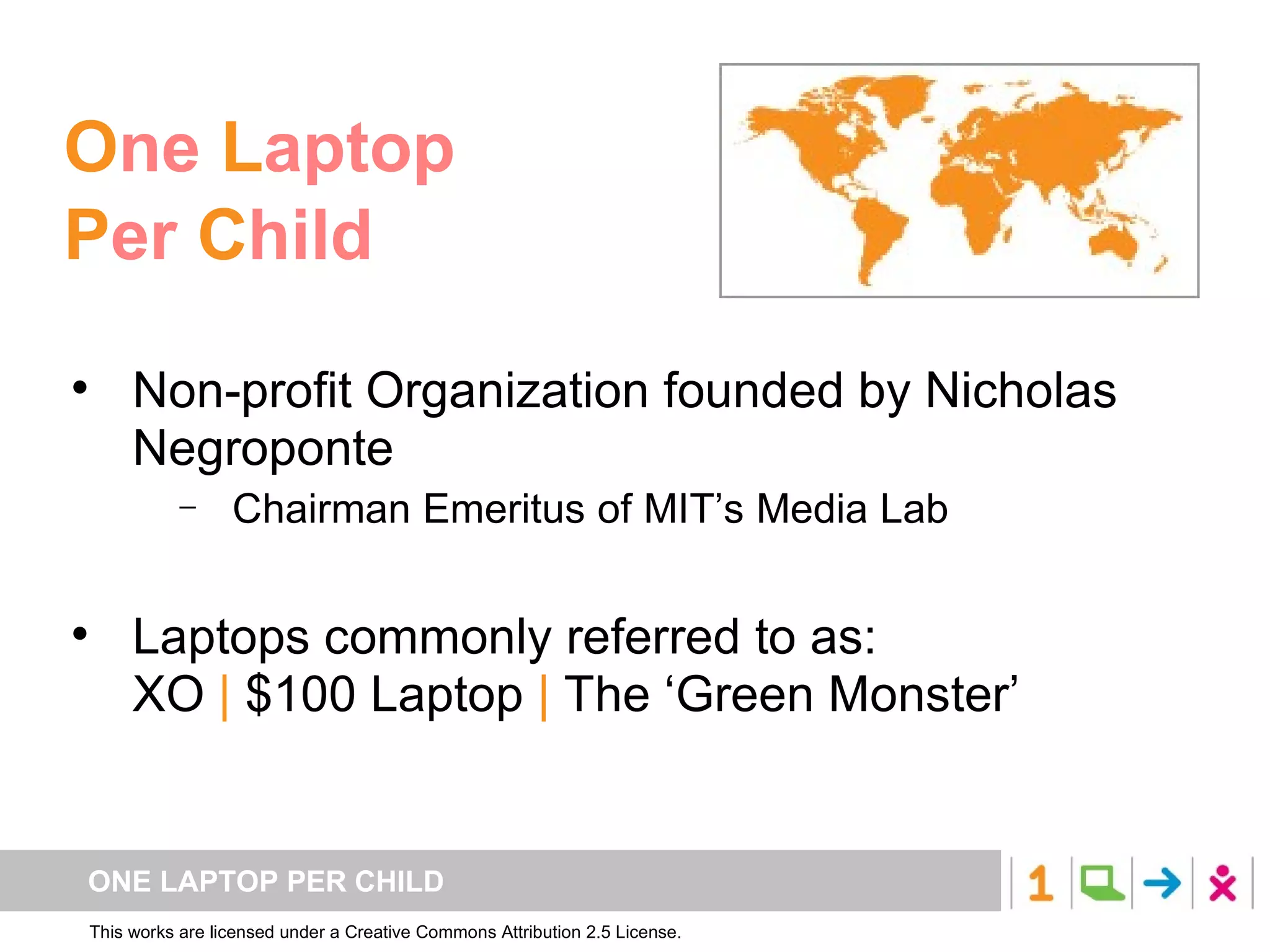
O ne  L aptop  P er  C hild Non-profit Organization founded by Nicholas Negroponte Chairman Emeritus of MIT’s Media Lab Laptops commonly referred to as: XO  |  $100 Laptop  |  The ‘Green Monster’
The OLPC Mission: Provide laptops as a means to  empower  the nearly 2 billion children in the developing world who receive little to no education and help close the digital divide  before it’s too late.
Five Principles of OLPC: Ownership  Target: Youth The hardware and software are designed for elementary school children aged 6-12.  Saturation  Connection  Free and open source software
“ This is not just a matter of giving a laptop to each child, as if bestowing on them some magical charm.  The magic lies within - within each child, within each scientist-, scholar-, or just-plain-citizen-in-the-making.  This initiative is meant to bring it forth into the light of day” ~  Kofi Annan |  WSIS, 2005.
An Idea is Born… April, 2002 Negroponte goes to a remote village in Cambodia, bearing laptops to connect 20 children.  He would return a year later, with another 20 laptops. January, 2005 Negroponte comes up with an idea for an affordable laptop for children living in poverty.  He emails his friend, Hector Ruiz, CEO of AMD.  Six hours later, Ruiz replies:  Count us in… Within weeks, News Corp. and Google also join as founding members of the newly formed program, One Laptop per Child.
Getting the Name Out… January, 2005 | Davos, Switzerland Negroponte presents his idea (and a very rudimentary prototype) for a $100 laptop at the World Economic Forum in Davos, Switzerland November, 2005 | Tunis, Tunisia  The  ‘green machine’  is next presented at the World Symposium on the Information Society, with the support of Kofi Annan.  The event is covered by the international press. Two weeks later, Nigeria’s Obasanjo is the first to commit his country to 1 million units.
January, 2006 | World Economic Forum (Again) A Memo of Understanding (MOU) is signed with UNDP: UNDP will serve as OLPC's ground force in many of the 166 countries in which it has offices, assisting with everything from communications with ministries to logistics for school rollout. The planned 1 st  Generation launch proposes a target of 5–10 million laptops in large countries or regions.  Meanwhile, deals and commitments continue to be made by various governments and heads of state…
Africa Rwanda, Nigeria, Ethiopia, Egypt, Libya, Tunisia Americas Haiti, Mexico, Peru, US (Alabama), Uruguay, Brazil, Suriname, Argentina, Costa Rica, Dominican republic Asia Afghanistan, Cambodia, Mongolia, India, Nepal, Pakistan, Phillippines, Thailand Europe Greece Middle East Iraq BUT: A lot of these are simply ‘Memorandums of Understanding’… …  NOT contracts! OLPC generates much initial interest:
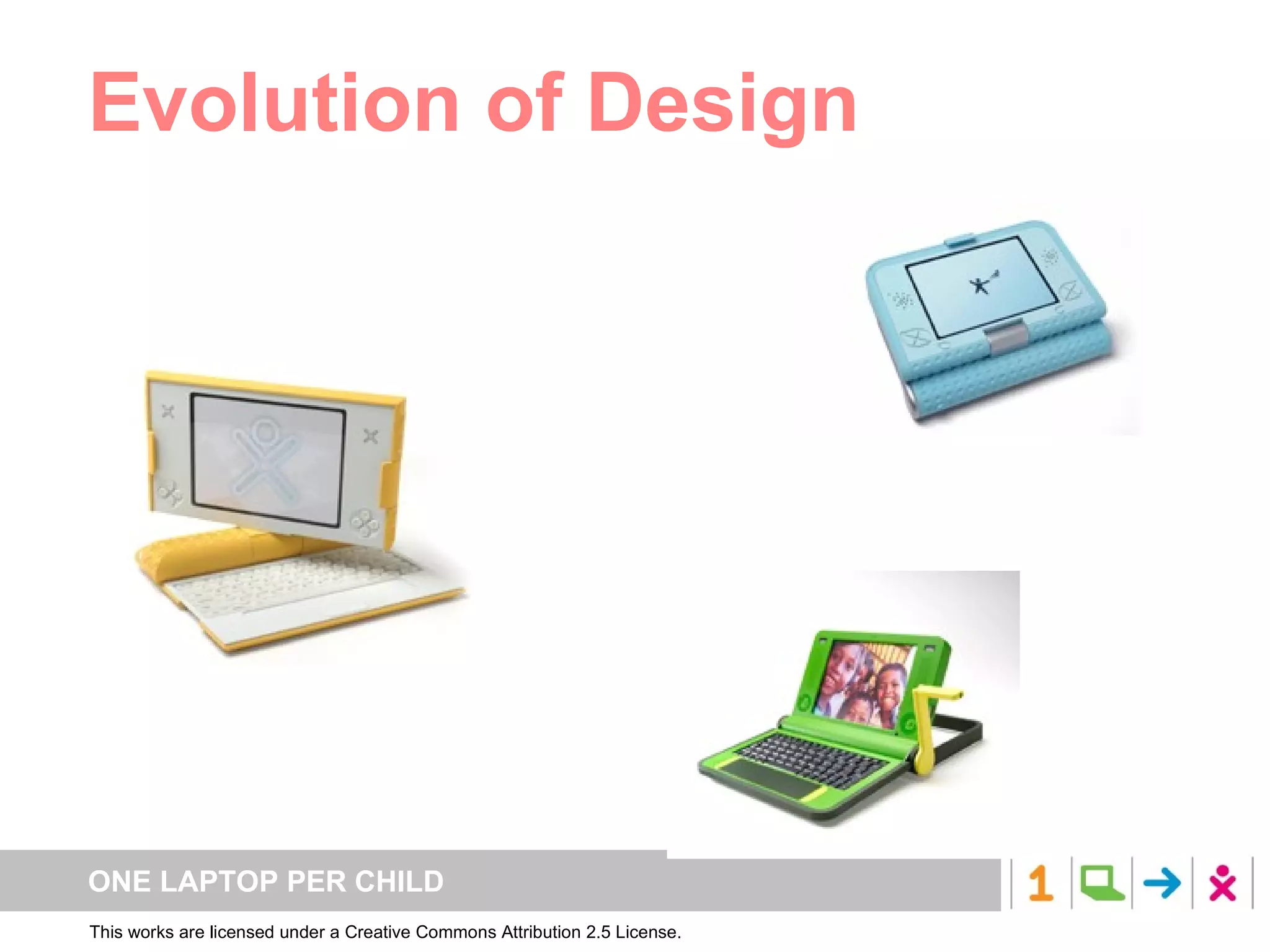
Evolution of Design Blue e-Book Yellow Pivoting Laptop Green Hand-cranked Laptop
Some of the key features Durable: Rugged, no moving parts, waterproof Internet Connectivity: Each laptop creates its own mesh, acting as a router Can also be solar or ‘foot’ powered: Cranks, yo-yo, or rip-cord power supply available 433 MHz, 1GB flash memory, Linux open-source operating system ( upgraded now!)
Environmental Friendliness and Innovations In addition to hand crank and solar power alternatives, the XO has a 12V power socket that functions with any power generation system that can charge a 12V car battery.  The XO's lithium-iron-phosphorus battery contains no toxic heavy metals.  The screen backlight uses LEDs rather than fluorescents, and so contains no mercury.  The plastic parts can be completely dismantled with a #1 Phillips screwdriver and separated by color for recycling rather than downcycling.
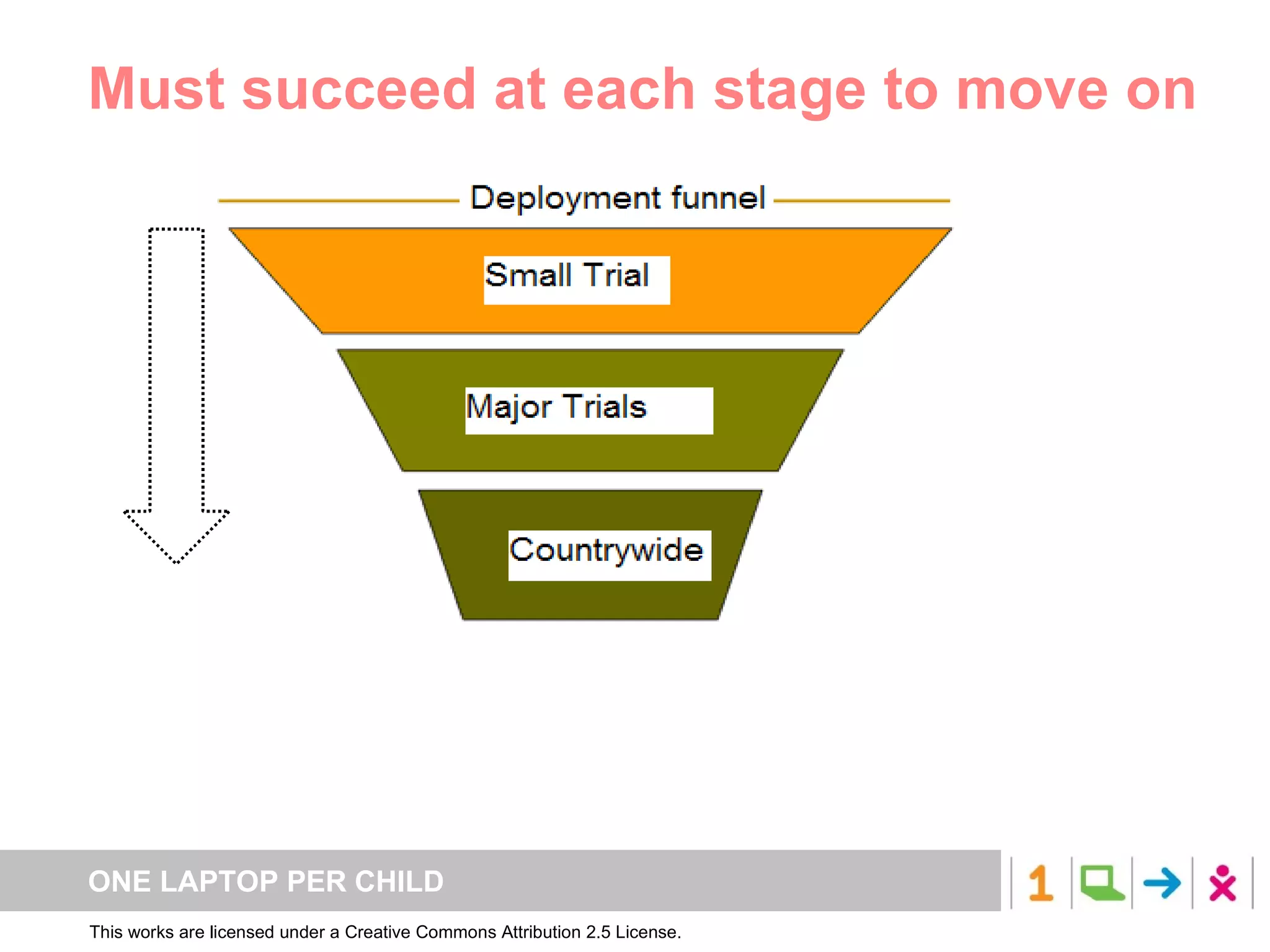
Types of Deployments Small deployments 50 – 1000 XOs Often run solely on the documentation and possibly mailing lists. More deployments like this expected More flexible and able to deploy rapidly. Large “trial” deployment 1K – 10K XOs High profile trials come up quickly and have tight time frames May engage via tech support e-mail and visits by OLPC staff After initial deployment, feedback can taper off Mature deployment 11K – 300K XOs Usually some SI and extensive in country support system Regular meetings with 1CC, list and tech support engagements
Must succeed at each stage to move on
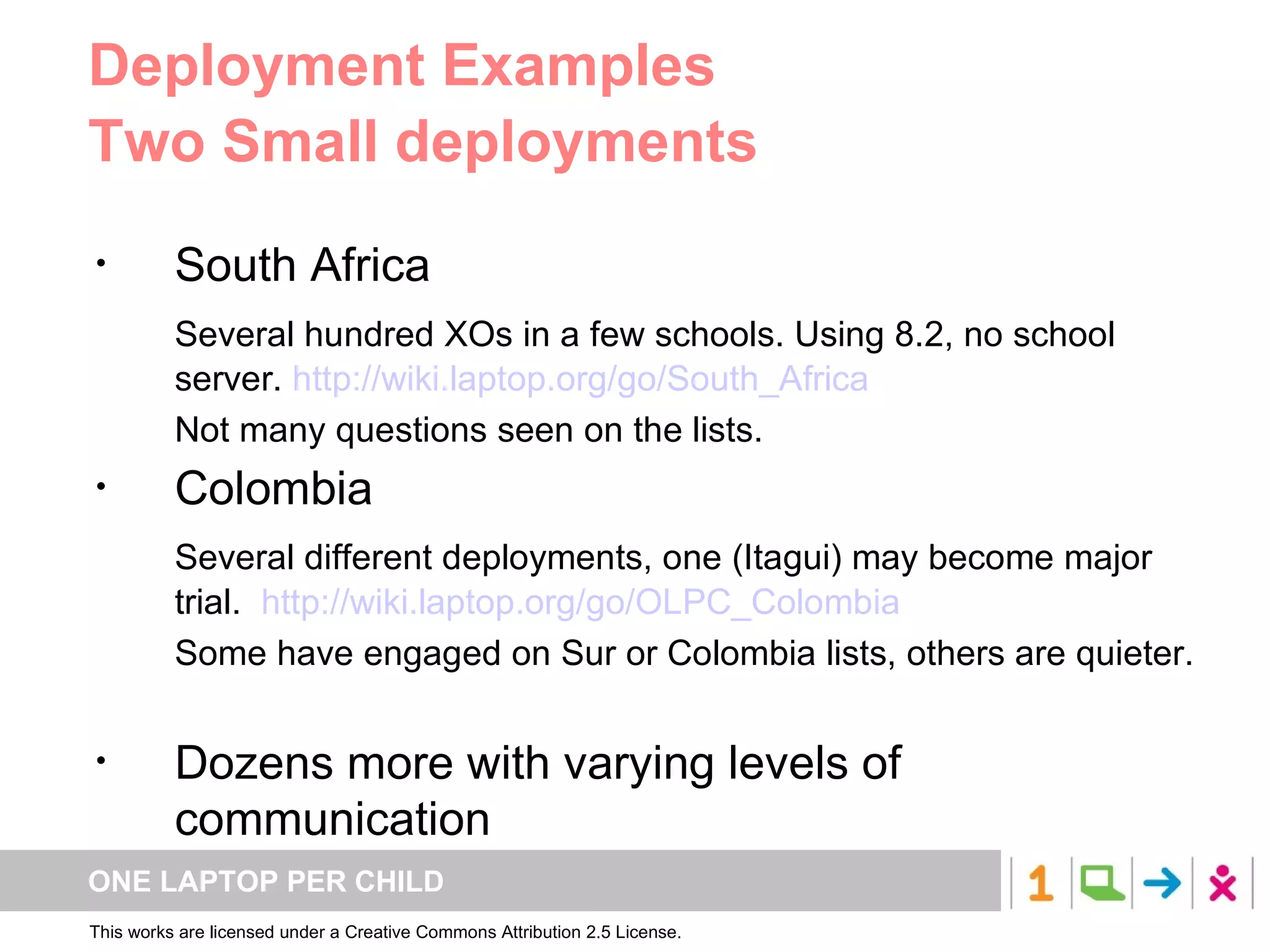
Deployment Examples Two Small deployments South Africa Several hundred XOs in a few schools. Using 8.2, no school server.  http://wiki.laptop.org/go/South_Africa Not many questions seen on the lists. Colombia Several different deployments, one (Itagui) may become major trial.  http://wiki.laptop.org/go/OLPC_Colombia Some have engaged on Sur or Colombia lists, others are quieter. Dozens more with varying levels of communication
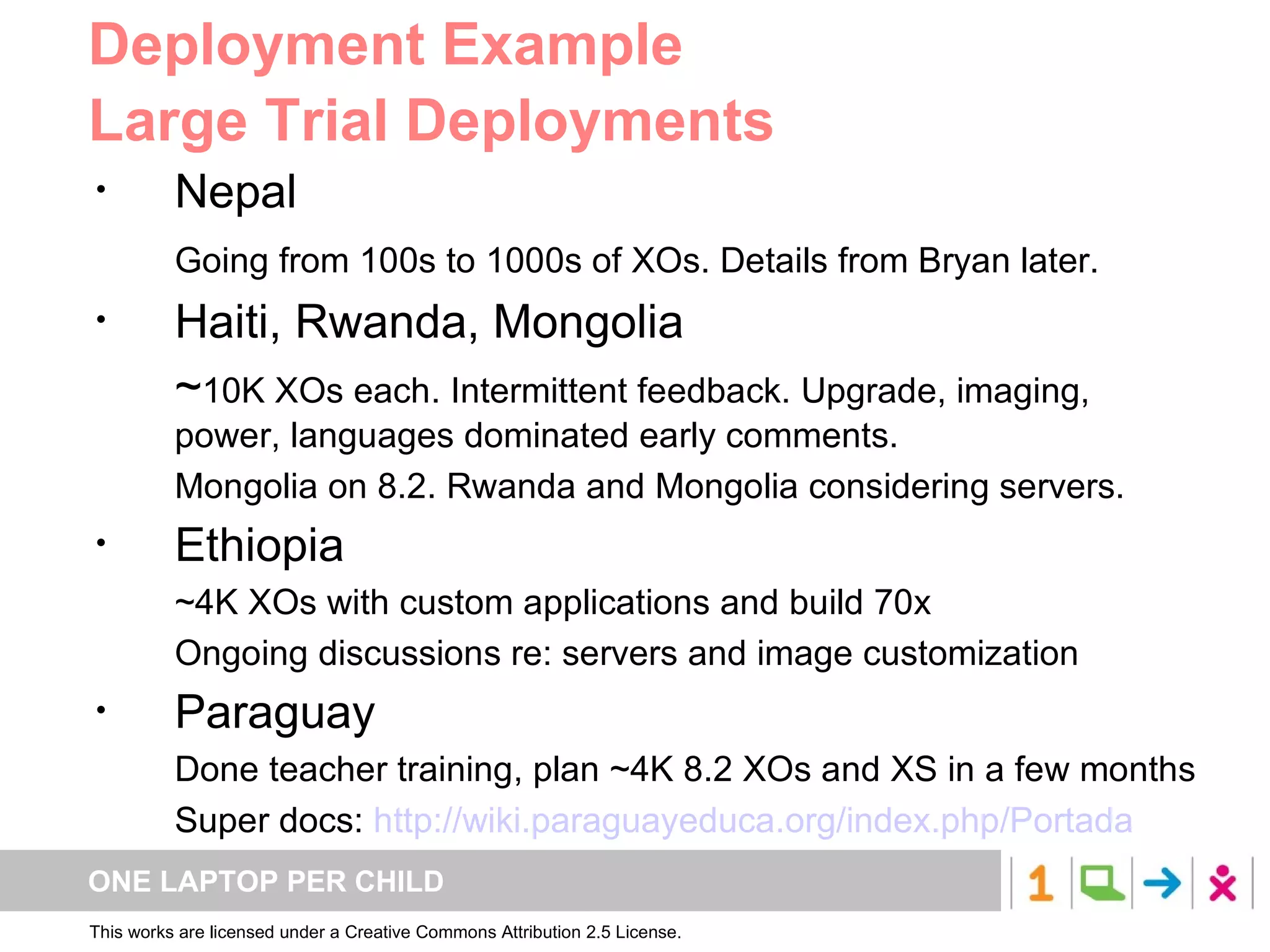
Deployment Example Large Trial Deployments Nepal Going from 100s to 1000s of XOs. Details from Bryan later. Haiti, Rwanda, Mongolia ~ 10K XOs each. Intermittent feedback. Upgrade, imaging, power, languages dominated early comments. Mongolia on 8.2. Rwanda and Mongolia considering servers. Ethiopia ~4K XOs with custom applications and build 70x Ongoing discussions re: servers and image customization Paraguay Done teacher training, plan ~4K 8.2 XOs and XS in a few months Super docs:  http://wiki.paraguayeduca.org/index.php/Portada
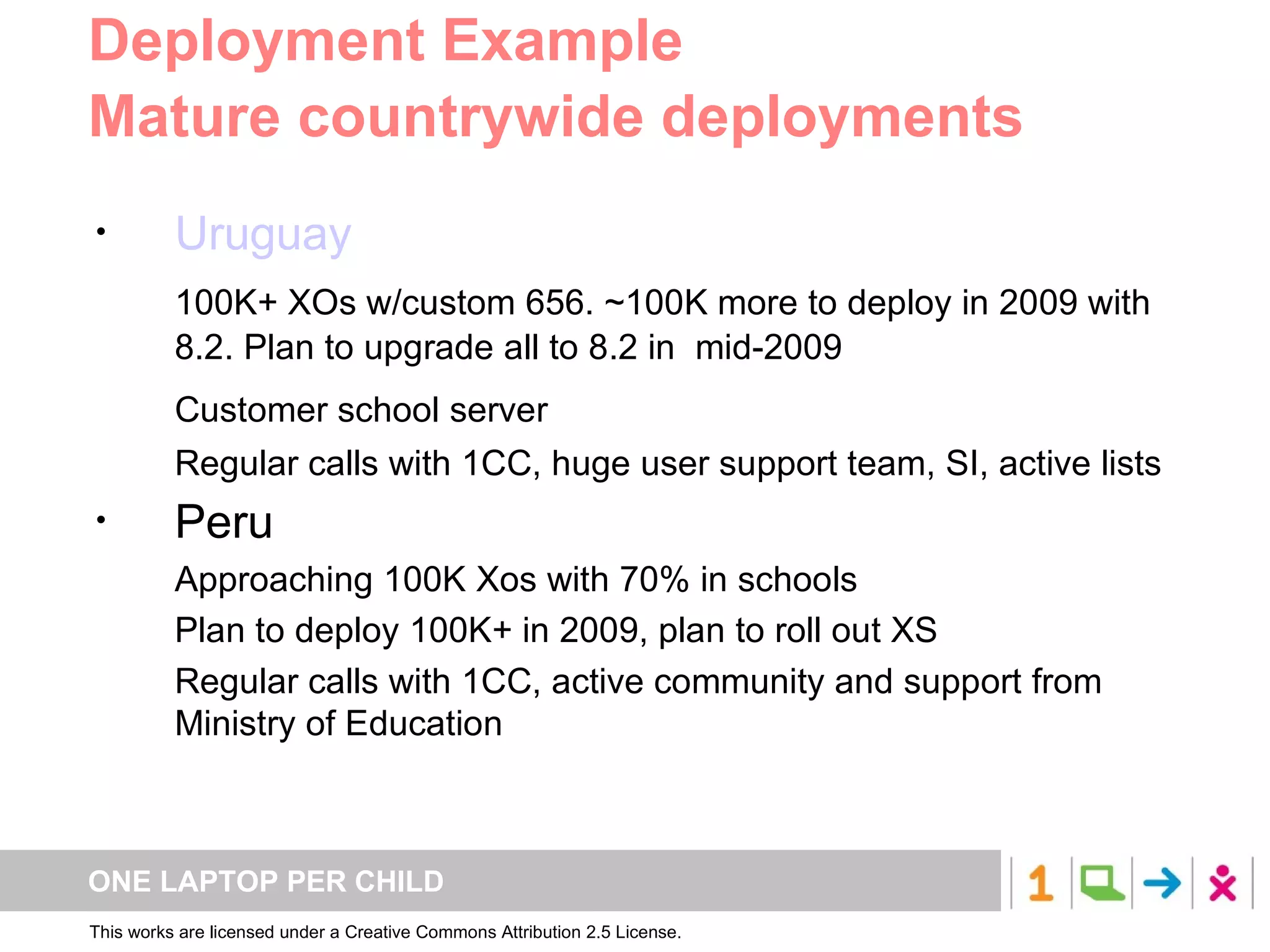
Deployment Example Mature countrywide deployments Uruguay 100K+ XOs w/custom 656. ~100K more to deploy in 2009 with 8.2. Plan to upgrade all to 8.2 in  mid-2009 Customer school server Regular calls with 1CC, huge user support team, SI, active lists Peru Approaching 100K Xos with 70% in schools Plan to deploy 100K+ in 2009, plan to roll out XS Regular calls with 1CC, active community and support from Ministry of Education
Dilemma: How to boost sales? Countries were backing out of commitments. Competition was looming. OLPC needed a strong showing to  regain credibility. Proposal:  Give One Get One   (G1G1)  Campaign for the holiday season (Nov. 12 -  Dec. 31, 2007):  Can purchase two laptops for $400, receiving one and donating the other
December, 2007 | Let the Learning Begin! Schoolchildren across the globe finally receive their laptops. So far, over 500,000 laptops have been distributed to children in developing regions. November, 2007 | China Mass production of XOs begins…
Advantages OLPC has a number of good characteristics that makes it attractive for the case of Sudan, such as: XO laptops designed to survive in a very harsh conditions :rain, dust, bright sunlight and the lack in electricity supply.   Low cost laptops suitable for countries with underdeveloped economy.  Sugar (the XO interface) has very interactive and enjoyable activities that help children to explore and learn, for OLPC everyone has the potential for being both a learner and a teacher.. The collaboration between children and other community members will make learning process more engaging and stimulate critical thinking skills. It motivates children for learning and they get attached to it quickly. The XO laptops have the ability to run its activities with almost any language. Low cost internet connectivity
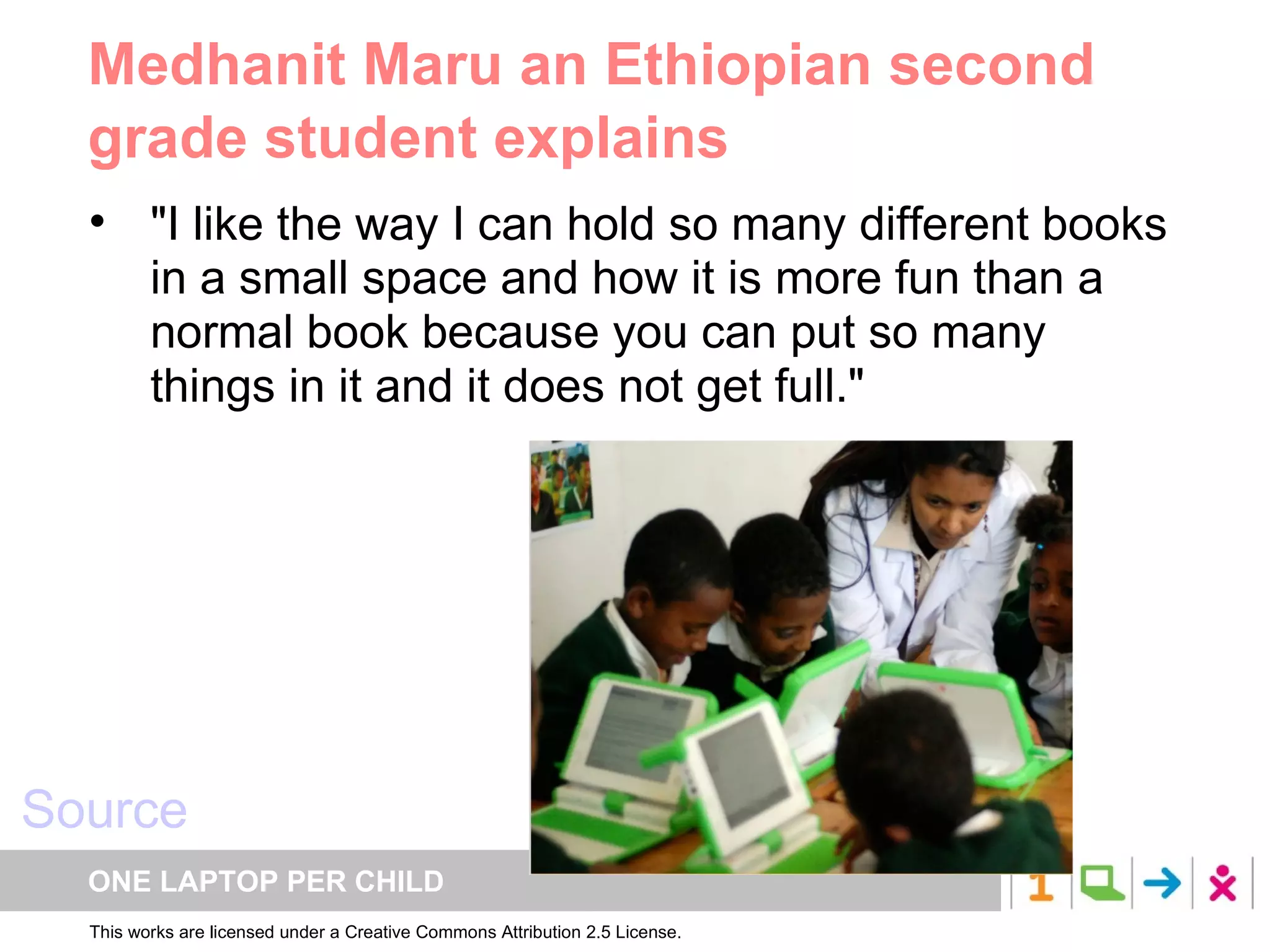
Medhanit Maru an Ethiopian second grade student explains "I like the way I can hold so many different books in a small space and how it is more fun than a normal book because you can put so many things in it and it does not get full."  Source
حول العالم   موجز طلبيات الكمبيوتر المحمول المصدر السنة عدد مؤكد  ( تقريبي ) التاريخ مؤكد الشاري 2007 100 ، 000 تشرين الأول / أكتوبر  2007. أوروغواي  [40] [41] 15 ، 000 14  نوفمبر  2007 برمنغهام، ألاباما ، الولايات المتحدة  [42] 260 ، 000 4  ديسمبر  2008 بيرو [43] 50 ، 000 4  ديسمبر،  2008 المكسيك  ( رجل الأعمال المكسيكي  كارلوس سليم) [44] 167 ، 000 16  يناير  1983 برنامج  G1G1 2007  [43] 2008 65 ، 000 31  مايو  2009 كولومبيا  ( كالداس ) [45] +200 ، 000 يونيو  2008 أوروغواي [46] +30 ، 000 أكتوبر  2008 بيرو [47] 10 ، 000 10  نوفمبر  2008 غانا [48] 12 ، 500 16  يناير  2008 برنامج  1 G1 2008  [39] ٢٠٠٩ 5 ، 000 2  أبريل  2009 سيراليون 100 ، 000 31  مايو / أيار  2009 رواندا [49] +160 ، 000 126  أكتوبر / تشرين الأول  2009 أوروغواي   ( المجموع : 362000  للأطفال،  18000  للمعلمين ) 2010 +260 ، 000 17  مارس  2010 بيرو [50] +60 ، 000 2  أبريل  2009 الأرجنتين [51] الإجمالي 1 ، 494 ، 500    
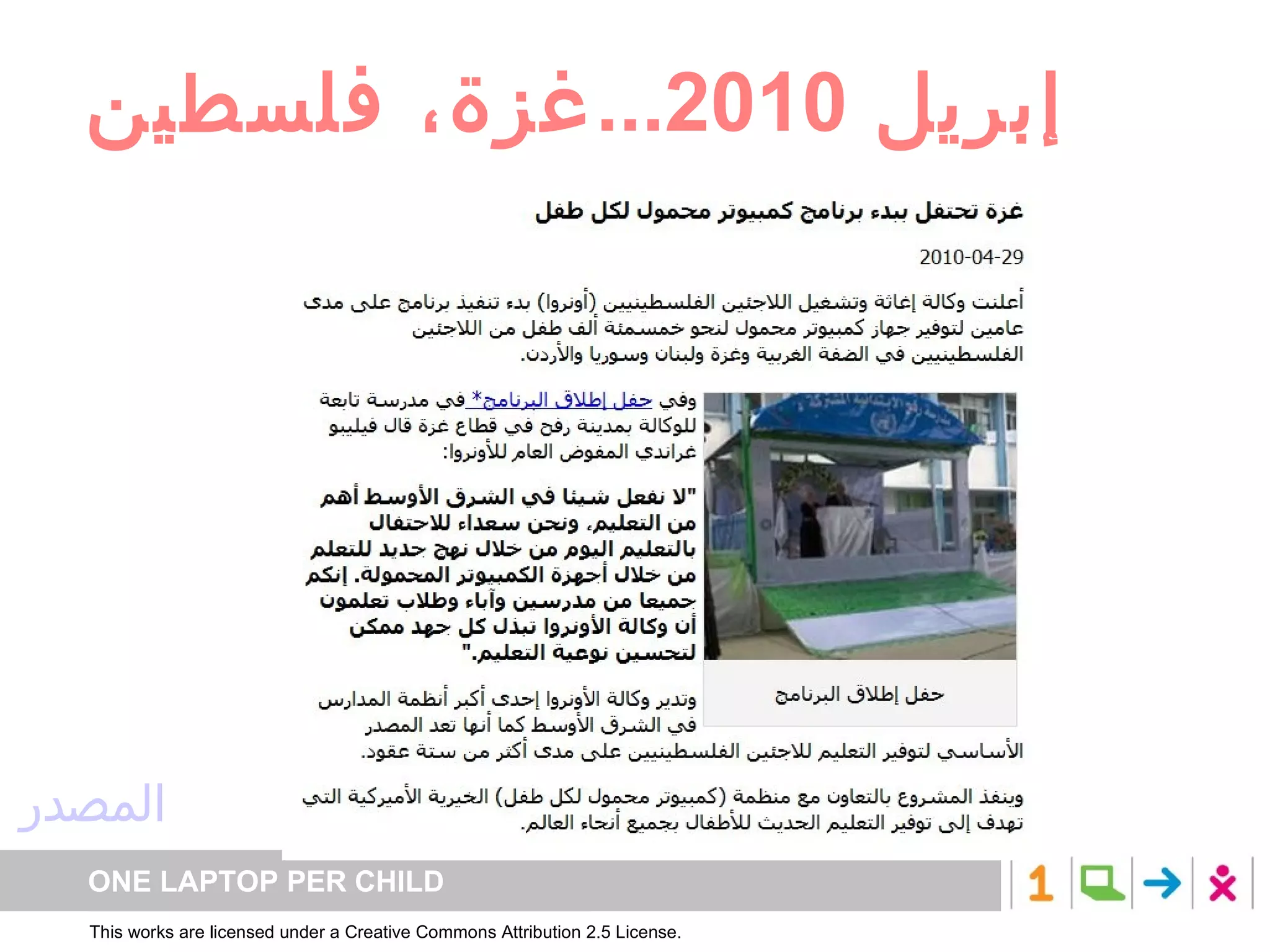
إبريل  2010... غزة، فلسطين المصدر
السودان متى؟
إجتماع تأسيس شبكة الحضور د .  أسامة عبد الوهاب محمد ريس  :  مدينة أفريقيا التكنلوجية  ( مدير ) د .  آمنة أدريس أحمد بحر  :  معهد تنمية المجتمع، كلية شرق النيل  ( مستشار متعاون ) حنان عبد الحكم الأمين :  معهد تنمية المجتمع، كلية شرق النيل  ( مشرف مشاريع )  [email_address] الإتصالات د . عبد المجيد خليل محمد  ( مدينة دارفور الرقمية )  [email_address] , د .  محمد عوض الشيخ محمد مركز الحاسوب جامعة السودان ) mawad_elshaikh@yahoo.com,   د .  محمد يعقوب قيقر آدم  ( جامعة السودان، مركز الحاسوب )  geiger@sustech.edu  د .  أيمن محمد بدري  ( جامعة الاحفاد للبنات )  مشروع التعليم الالكتروني للأطفال خارج المدارس  [email_address] د . أنور فتح الرحمن أحمد دفع الله
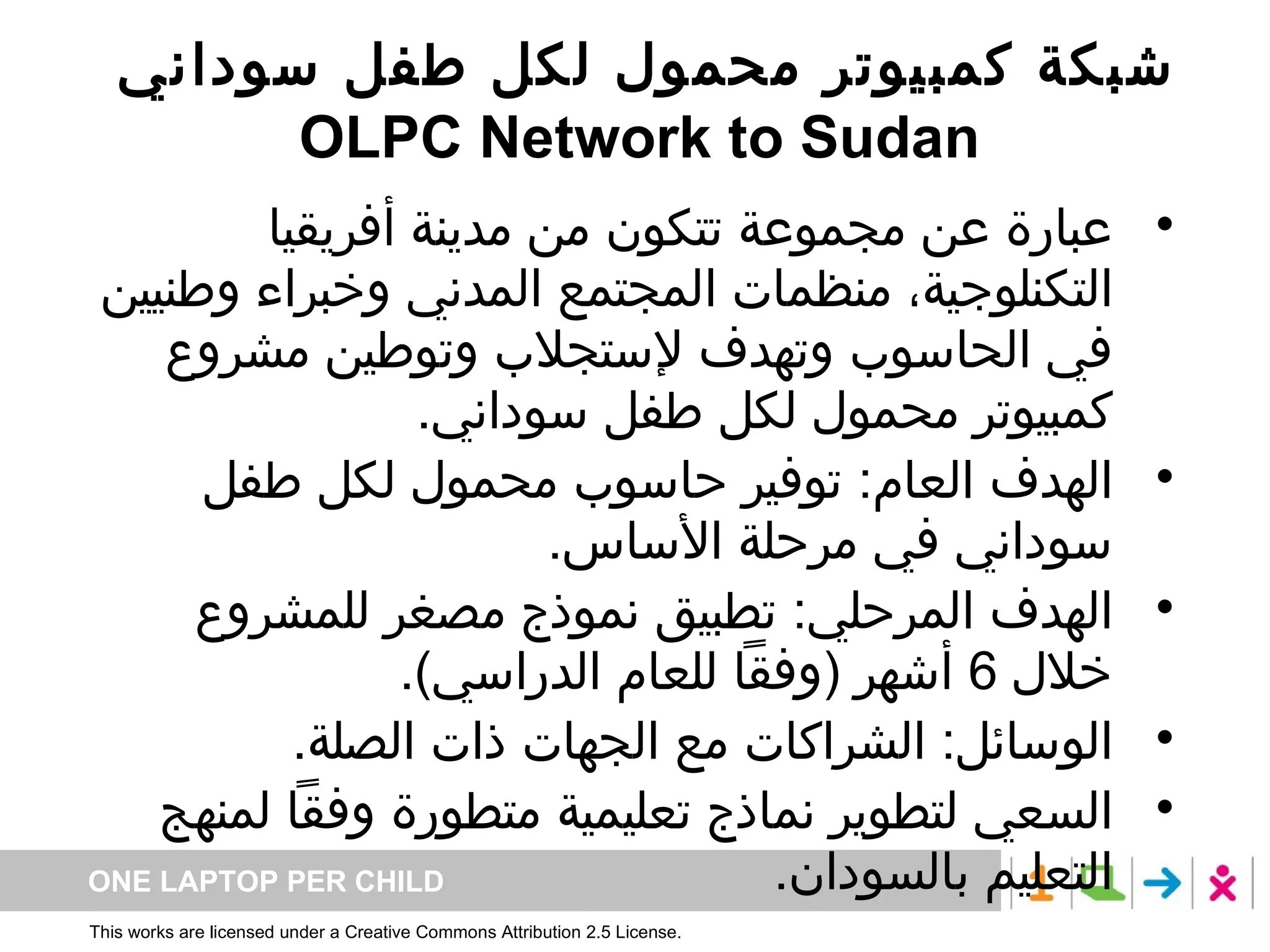
شبكة كمبيوتر محمول لكل طفل سوداني    OLPC Network to Sudan  عبارة عن مجموعة تتكون من مدينة أفريقيا التكنلوجية، منظمات المجتمع المدني وخبراء وطنيين في الحاسوب وتهدف لإستجلاب وتوطين مشروع كمبيوتر محمول لكل طفل سوداني .  الهدف العام :  توفير حاسوب محمول لكل طفل سوداني في مرحلة الأساس . الهدف المرحلي :  تطبيق نموذج مصغر للمشروع خلال  6  أشهر  ( وفقاً للعام الدراسي ). الوسائل :  الشراكات مع الجهات ذات الصلة . السعي لتطوير نماذج تعليمية متطورة وفقاً لمنهج التعليم بالسودان .
التمويل بدء بداعمي من معهد تنمية المجتمع، كلية شرق النيل . المقترح :  تبني مقترح معهد تنمية المجتمع
Online resources OLPC News Forum http://olpc.com/ http://laptopfoundation.org/
References  http://www.princeton.edu/~ttong/work/GDN%20OLPC%20041108.ppt http://www.stanford.edu/class/ee380/Abstracts/061004-slides-olpc.pdf http://wiki.laptop.org/images/e/e2/XO-Camp-Usersv4.ppt Venus Gorashi,  Computers in education in Sudan: a tool for empowering children and youth : A policy brief  ,Course report. International institute for social studies,2010

OLPC to Sudan

  • 1.
    One Laptop perChild History & Deployment Prepared by Dr. Anwar Dafa-Alla [email_address] One Laptop per Child
  • 2.
    O ne L aptop P er C hild Non-profit Organization founded by Nicholas Negroponte Chairman Emeritus of MIT’s Media Lab Laptops commonly referred to as: XO | $100 Laptop | The ‘Green Monster’
  • 3.
    The OLPC Mission:Provide laptops as a means to empower the nearly 2 billion children in the developing world who receive little to no education and help close the digital divide before it’s too late.
  • 4.
    Five Principles ofOLPC: Ownership Target: Youth The hardware and software are designed for elementary school children aged 6-12. Saturation Connection Free and open source software
  • 5.
    “ This isnot just a matter of giving a laptop to each child, as if bestowing on them some magical charm. The magic lies within - within each child, within each scientist-, scholar-, or just-plain-citizen-in-the-making. This initiative is meant to bring it forth into the light of day” ~ Kofi Annan | WSIS, 2005.
  • 6.
    An Idea isBorn… April, 2002 Negroponte goes to a remote village in Cambodia, bearing laptops to connect 20 children. He would return a year later, with another 20 laptops. January, 2005 Negroponte comes up with an idea for an affordable laptop for children living in poverty. He emails his friend, Hector Ruiz, CEO of AMD. Six hours later, Ruiz replies: Count us in… Within weeks, News Corp. and Google also join as founding members of the newly formed program, One Laptop per Child.
  • 7.
    Getting the NameOut… January, 2005 | Davos, Switzerland Negroponte presents his idea (and a very rudimentary prototype) for a $100 laptop at the World Economic Forum in Davos, Switzerland November, 2005 | Tunis, Tunisia The ‘green machine’ is next presented at the World Symposium on the Information Society, with the support of Kofi Annan. The event is covered by the international press. Two weeks later, Nigeria’s Obasanjo is the first to commit his country to 1 million units.
  • 8.
    January, 2006 |World Economic Forum (Again) A Memo of Understanding (MOU) is signed with UNDP: UNDP will serve as OLPC's ground force in many of the 166 countries in which it has offices, assisting with everything from communications with ministries to logistics for school rollout. The planned 1 st Generation launch proposes a target of 5–10 million laptops in large countries or regions. Meanwhile, deals and commitments continue to be made by various governments and heads of state…
  • 9.
    Africa Rwanda, Nigeria,Ethiopia, Egypt, Libya, Tunisia Americas Haiti, Mexico, Peru, US (Alabama), Uruguay, Brazil, Suriname, Argentina, Costa Rica, Dominican republic Asia Afghanistan, Cambodia, Mongolia, India, Nepal, Pakistan, Phillippines, Thailand Europe Greece Middle East Iraq BUT: A lot of these are simply ‘Memorandums of Understanding’… … NOT contracts! OLPC generates much initial interest:
  • 10.
    Evolution of DesignBlue e-Book Yellow Pivoting Laptop Green Hand-cranked Laptop
  • 11.
    Some of thekey features Durable: Rugged, no moving parts, waterproof Internet Connectivity: Each laptop creates its own mesh, acting as a router Can also be solar or ‘foot’ powered: Cranks, yo-yo, or rip-cord power supply available 433 MHz, 1GB flash memory, Linux open-source operating system ( upgraded now!)
  • 12.
    Environmental Friendliness andInnovations In addition to hand crank and solar power alternatives, the XO has a 12V power socket that functions with any power generation system that can charge a 12V car battery. The XO's lithium-iron-phosphorus battery contains no toxic heavy metals. The screen backlight uses LEDs rather than fluorescents, and so contains no mercury. The plastic parts can be completely dismantled with a #1 Phillips screwdriver and separated by color for recycling rather than downcycling.
  • 13.
    Types of DeploymentsSmall deployments 50 – 1000 XOs Often run solely on the documentation and possibly mailing lists. More deployments like this expected More flexible and able to deploy rapidly. Large “trial” deployment 1K – 10K XOs High profile trials come up quickly and have tight time frames May engage via tech support e-mail and visits by OLPC staff After initial deployment, feedback can taper off Mature deployment 11K – 300K XOs Usually some SI and extensive in country support system Regular meetings with 1CC, list and tech support engagements
  • 14.
    Must succeed ateach stage to move on
  • 15.
    Deployment Examples TwoSmall deployments South Africa Several hundred XOs in a few schools. Using 8.2, no school server. http://wiki.laptop.org/go/South_Africa Not many questions seen on the lists. Colombia Several different deployments, one (Itagui) may become major trial. http://wiki.laptop.org/go/OLPC_Colombia Some have engaged on Sur or Colombia lists, others are quieter. Dozens more with varying levels of communication
  • 16.
    Deployment Example LargeTrial Deployments Nepal Going from 100s to 1000s of XOs. Details from Bryan later. Haiti, Rwanda, Mongolia ~ 10K XOs each. Intermittent feedback. Upgrade, imaging, power, languages dominated early comments. Mongolia on 8.2. Rwanda and Mongolia considering servers. Ethiopia ~4K XOs with custom applications and build 70x Ongoing discussions re: servers and image customization Paraguay Done teacher training, plan ~4K 8.2 XOs and XS in a few months Super docs: http://wiki.paraguayeduca.org/index.php/Portada
  • 17.
    Deployment Example Maturecountrywide deployments Uruguay 100K+ XOs w/custom 656. ~100K more to deploy in 2009 with 8.2. Plan to upgrade all to 8.2 in mid-2009 Customer school server Regular calls with 1CC, huge user support team, SI, active lists Peru Approaching 100K Xos with 70% in schools Plan to deploy 100K+ in 2009, plan to roll out XS Regular calls with 1CC, active community and support from Ministry of Education
  • 18.
    Dilemma: How toboost sales? Countries were backing out of commitments. Competition was looming. OLPC needed a strong showing to regain credibility. Proposal: Give One Get One (G1G1) Campaign for the holiday season (Nov. 12 - Dec. 31, 2007): Can purchase two laptops for $400, receiving one and donating the other
  • 19.
    December, 2007 |Let the Learning Begin! Schoolchildren across the globe finally receive their laptops. So far, over 500,000 laptops have been distributed to children in developing regions. November, 2007 | China Mass production of XOs begins…
  • 20.
    Advantages OLPC hasa number of good characteristics that makes it attractive for the case of Sudan, such as: XO laptops designed to survive in a very harsh conditions :rain, dust, bright sunlight and the lack in electricity supply.   Low cost laptops suitable for countries with underdeveloped economy. Sugar (the XO interface) has very interactive and enjoyable activities that help children to explore and learn, for OLPC everyone has the potential for being both a learner and a teacher.. The collaboration between children and other community members will make learning process more engaging and stimulate critical thinking skills. It motivates children for learning and they get attached to it quickly. The XO laptops have the ability to run its activities with almost any language. Low cost internet connectivity
  • 21.
    Medhanit Maru anEthiopian second grade student explains "I like the way I can hold so many different books in a small space and how it is more fun than a normal book because you can put so many things in it and it does not get full." Source
  • 22.
    حول العالم موجز طلبيات الكمبيوتر المحمول المصدر السنة عدد مؤكد ( تقريبي ) التاريخ مؤكد الشاري 2007 100 ، 000 تشرين الأول / أكتوبر 2007. أوروغواي  [40] [41] 15 ، 000 14 نوفمبر 2007 برمنغهام، ألاباما ، الولايات المتحدة  [42] 260 ، 000 4 ديسمبر 2008 بيرو [43] 50 ، 000 4 ديسمبر، 2008 المكسيك ( رجل الأعمال المكسيكي  كارلوس سليم) [44] 167 ، 000 16 يناير 1983 برنامج G1G1 2007  [43] 2008 65 ، 000 31 مايو 2009 كولومبيا ( كالداس ) [45] +200 ، 000 يونيو 2008 أوروغواي [46] +30 ، 000 أكتوبر 2008 بيرو [47] 10 ، 000 10 نوفمبر 2008 غانا [48] 12 ، 500 16 يناير 2008 برنامج 1 G1 2008  [39] ٢٠٠٩ 5 ، 000 2 أبريل 2009 سيراليون 100 ، 000 31 مايو / أيار 2009 رواندا [49] +160 ، 000 126 أكتوبر / تشرين الأول 2009 أوروغواي   ( المجموع : 362000 للأطفال، 18000 للمعلمين ) 2010 +260 ، 000 17 مارس 2010 بيرو [50] +60 ، 000 2 أبريل 2009 الأرجنتين [51] الإجمالي 1 ، 494 ، 500    
  • 23.
    إبريل 2010...غزة، فلسطين المصدر
  • 24.
  • 25.
    إجتماع تأسيس شبكةالحضور د . أسامة عبد الوهاب محمد ريس : مدينة أفريقيا التكنلوجية ( مدير ) د . آمنة أدريس أحمد بحر : معهد تنمية المجتمع، كلية شرق النيل ( مستشار متعاون ) حنان عبد الحكم الأمين : معهد تنمية المجتمع، كلية شرق النيل ( مشرف مشاريع ) [email_address] الإتصالات د . عبد المجيد خليل محمد ( مدينة دارفور الرقمية ) [email_address] , د . محمد عوض الشيخ محمد مركز الحاسوب جامعة السودان ) mawad_elshaikh@yahoo.com, د . محمد يعقوب قيقر آدم ( جامعة السودان، مركز الحاسوب ) geiger@sustech.edu د . أيمن محمد بدري ( جامعة الاحفاد للبنات ) مشروع التعليم الالكتروني للأطفال خارج المدارس [email_address] د . أنور فتح الرحمن أحمد دفع الله
  • 26.
    شبكة كمبيوتر محموللكل طفل سوداني OLPC Network to Sudan عبارة عن مجموعة تتكون من مدينة أفريقيا التكنلوجية، منظمات المجتمع المدني وخبراء وطنيين في الحاسوب وتهدف لإستجلاب وتوطين مشروع كمبيوتر محمول لكل طفل سوداني . الهدف العام : توفير حاسوب محمول لكل طفل سوداني في مرحلة الأساس . الهدف المرحلي : تطبيق نموذج مصغر للمشروع خلال 6 أشهر ( وفقاً للعام الدراسي ). الوسائل : الشراكات مع الجهات ذات الصلة . السعي لتطوير نماذج تعليمية متطورة وفقاً لمنهج التعليم بالسودان .
  • 27.
    التمويل بدء بداعميمن معهد تنمية المجتمع، كلية شرق النيل . المقترح : تبني مقترح معهد تنمية المجتمع
  • 28.
    Online resources OLPCNews Forum http://olpc.com/ http://laptopfoundation.org/
  • 29.
    References http://www.princeton.edu/~ttong/work/GDN%20OLPC%20041108.ppthttp://www.stanford.edu/class/ee380/Abstracts/061004-slides-olpc.pdf http://wiki.laptop.org/images/e/e2/XO-Camp-Usersv4.ppt Venus Gorashi, Computers in education in Sudan: a tool for empowering children and youth : A policy brief ,Course report. International institute for social studies,2010

Editor's Notes

  • #7 This is Negroponte’s project! He’s long been interested in exposing children to computing.