The challenge of ensuring secure
clinics and hospitals for patients
and staff
Danie Schoeman
17 September 2015
What’s your emergency?
Critical issues for hospitals and
medical centres
 Workplace violence
 Budget/funding
 Technology
integration and
management
 Active shooter
 Staffing and training
 Patient behavioural
health and violence
 Asset protection/theft
ASIS: The 2014 Security 500 Sector Reports
Top security concerns
Guardian 8 Survey
8%
10%
12%
16%
17%
19%
24%
56%
57%
OSHA fines
Employee retention
High incidence of fatalities
Lack of
accountability/documentat…
Administrators'
understanding of regulations
Legal fees/repercussions
Disruptions to patient care
Office safety
Patient safety
Increasing crime and violence
Health Facilities Management/ASHE 2012 Hospital Security Survey
0%
0%
1%
1%
3%
3%
8%
9%
10%
11%
12%
17%
17%
18%
21%
25%
26%
33%
79%
80%
78%
78%
74%
79%
77%
78%
74%
75%
77%
70%
75%
64%
68%
68%
68%
60%
21%
20%
21%
21%
23%
18%
15%
13%
16%
14%
11%
13%
8%
18%
11%
7%
6%
7%
Infant abduction - actual
Infant abduction - attempted
Shootings in hospital and on grounds, excl. ED
Shootings in ED
Bomb threats
Staff-on-staff violence
Other thefts (major - more than $500/item)
Patient care equipment thefts
Pharmaceutical and supply thefts
IT equipment thefts
Domestic incidents involving employees
Other thefts (minor - $500 or less/item)
Elopements/patient wandering
Auto thefts/car break-ins
Property damage/vandalism
Attacks/assaults
Patient/family violence against staff in hospital, excl. ED
Patient/family violence against staff in ED
Change in frequency of incidents
Increase About the same Decrease
A unique balancing act
A paradox
 Patients
 Employees
 Visitors
 Vendors
 Infant units
 Paediatric units
 Pharmacy
 Psychiatric units
A fine balance
Privacy vs Security
Challenges
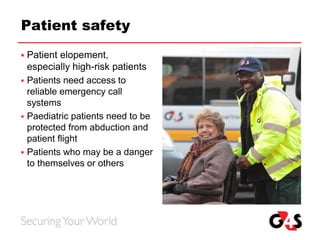
Patient safety
 Patient elopement,
especially high-risk patients
 Patients need access to
reliable emergency call
systems
 Paediatric patients need to be
protected from abduction and
patient flight
 Patients who may be a danger
to themselves or others
Infant protection
 Potential infant
abduction
 Infant care outside the
mother’s room
 Mother/infant
mismatching
Patient information security
Verizon 2015 Data Breach Investigations Report
0,1%
3,1%
3,3%
8,1%
9,4%
10,6%
18,0%
18,8%
28,5%
Denial of service
attacks
Payment card
skimmers
Physical theft and
loss
Miscellaneous
errors
Web app attacks
Insider and
privilege misuse
Cyber espionage
Crime ware
Point of sale
intrusions
Almost all cyber attacks can be
classified by 9 patterns
32% 26% 16%Healthcare
Miscellaneous errors Insider misuse Physical theft / loss
Typical cyber attack incidents for
healthcare
of the incidents in an industry can be described by just
three of the nine patterns.
PHYSICAL THEFT / LOSS
Any incident where an
information asset went
missing, whether through
misplacement or malice.
INSIDER AND PRIVILEGE MISUSE
This is mainly by insider’s misuse,
but outsiders (due to collusion) and
partners (because they are granted
privileges) show up as well.
Potential culprits come from every
level of the business, from the
frontline to the boardroom.
MISCELLANEOUS ERRORS
Incidents where unintentional
actions directly compromised
a security attribute of an
information asset. This does
not include lost devices,
which is grouped with theft
instead.
Verizon 2015 Data Breach Investigations Report
ON AVERAGE
76%
Cyber attacks are physical
of insider and
privilege misuse
attacks used the
corporate LAN.
of theft / loss
happened at
work.
of miscellaneous
errors involved
printed
documents.
Verizon 2014 & 2015 Data Breach Investigations Report
85%
49%
55%
Look inside your company
PWC Global State of Information Security Survey 2015
0% 5% 10% 15% 20% 25% 30% 35% 40%
Unknown
Domestic intelligence service
Foreign nation-states
Competitors
Activists / activist organisations / hacktivist
Organised crime
Hackers
Suppliers / business partners
Former service providers / consultants / contractors
Current service providers / consultants / contractors
Former employees
Current employees
Likely sources of incidents
All industries in all regions Healthcare
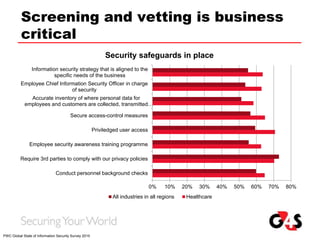
Screening and vetting is business
critical
PWC Global State of Information Security Survey 2015
0% 10% 20% 30% 40% 50% 60% 70% 80%
Conduct personnel background checks
Require 3rd parties to comply with our privacy policies
Employee security awareness training programme
Priviledged user access
Secure access-control measures
Accurate inventory of where personal data for
employees and customers are collected, transmitted…
Employee Chief Information Security Officer in charge
of security
Information security strategy that is aligned to the
specific needs of the business
Security safeguards in place
All industries in all regions Healthcare
Staff safety
 Workplace violence
 Even though you know that workplace
violence occurs more frequently in
certain departments—including ED,
mental health, geriatrics, and substance
abuse—it’s very difficult to predict and
prevent staff duress
 Staff duress during emergency
situations
 High turnover, low morale in certain
departments particularly the ED
due to with frequent staff duress
 Staff members get injured, injury
claims push up costs and overtime
needed to cover absent caregivers’
shifts
Workplace violence
Occurrences Perpetrators
30%
18%
10%
4%
1%
One type Two types Three
types
Four types Five types
27%
15%
31%
14%
4% 4% 4%
Number of different types of violence experienced
per respondent
Susan Steinman; Workplace Violence in the Health Sector; Country Case Study: South Africa (ILO, ICN, WHO, PSI)
Pharmacy inventory management
 Little or no inventory visibility
causing overstocking to
compensate
 Increased risk to patient safety due
to product expiration or
unavailability
 Inefficient manual processes
 Complex payment structures and
regulations
 Data disconnection between
inventory costs and procedural
measures
8 to 10% of items expire annually in procedure rooms and
as much as 15% of critical assets are lost
Stanley Healthcare
Healthcare asset tracking and
management
 Productivity losses due to manual
processes to manage capital and rental
equipment
 “Squirrel stores” due to equipment
availability
 Having a hard time locating needed
equipment, health systems end up
purchasing or renting more than they
actually need
 Patient dissatisfaction due to waiting for
equipment when staff have difficulty
locating it
40% of nurses report spending up to one hour per shift
searching for equipment
Stanley Healthcare
Solutions
Top hospital security systems
being implemented
Health Facilities Management/ASHE 2012 Hospital Security Survey
12%
14%
16%
12%
20%
18%
27%
38%
25%
50%
41%
52%
72%
67%
76%
69%
71%
88%
5%
6%
4%
14%
7%
13%
14%
11%
26%
10%
21%
17%
7%
14%
10%
18%
19%
8%
Man traps
Metal detectors
Outsourced remote video surveillance and monitoring
Wireless RFID clinician badges with panic alert buttons
Biometrics
Video analytics capabilities
Physical security information management (PSIM)
Wireless panic alarm system
RFID for tracking equipment, supplies, medications,…
Patient elopement system
Visitor management system
Electronic lockdown from a central location
Wired panic alarm systems
Integrated security system
Vendor management system
Mass notification system for emergency preparedness
Digital IP-video surveillance system
Electronic access control
Already implemented Plan to implement in the next 24 months
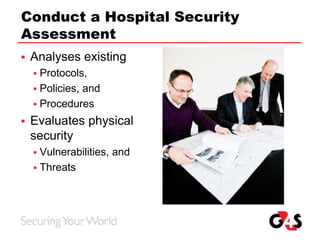
Conduct a Hospital Security
Assessment
 Analyses existing
 Protocols,
 Policies, and
 Procedures
 Evaluates physical
security
 Vulnerabilities, and
 Threats
Develop a Hospital Security
Management Plan
 Develop and implement
protocols, policies, and
procedures
 Hazard surveillance
program
 Identify trends from
monitored data
 Maintain, evaluate and
improve system
 Ensure regulatory
compliance
 Employ reputable security
organisation
Is there a doctor in the house?
 Patient
management
 Patient flow
 Safety
 Asset
management
 Inventory
management
 Environmental
monitoring
Real-time locating system (RTLS)
Beyond basic security technology
 Enhance with video
analytics
 Integrate intrusion
detection, access
control, and video
surveillance
 Add RTLS
 Environmental monitoring
 Asset management
 Enterprise Systems
Integration
A single integrated system
Outsource non-core services
 Cleaning
 Maintenance
 Catering
 Fleet management
 Stores management
 Document storage
The payoff
Benefits to you
 Reduction in operational costs such as administration and
maintenance
 Lower capital expenditures due to flexibility of single integrated
system to accommodate add-on security components
 Single system also keeps training costs lower
 Decreased losses and lower associated operational costs
 Improved business continuity via a more robust, resilient, and
responsive operation
 Greater end-to-end transparency for improved process
management and efficiency
 Independent study showed that for single integrated system
 24% saving in installation cost for 13500m2 building
 33% reduction in training
 82% reduction in IT administration
 32% reduction in cost of changes, upgrades and additions
Strategic ICT Consulting, Teng & Associates
Thank you

OHMC 201509 lin

  • 1.
    The challenge ofensuring secure clinics and hospitals for patients and staff Danie Schoeman 17 September 2015
  • 2.
  • 3.
    Critical issues forhospitals and medical centres  Workplace violence  Budget/funding  Technology integration and management  Active shooter  Staffing and training  Patient behavioural health and violence  Asset protection/theft ASIS: The 2014 Security 500 Sector Reports
  • 4.
    Top security concerns Guardian8 Survey 8% 10% 12% 16% 17% 19% 24% 56% 57% OSHA fines Employee retention High incidence of fatalities Lack of accountability/documentat… Administrators' understanding of regulations Legal fees/repercussions Disruptions to patient care Office safety Patient safety
  • 5.
    Increasing crime andviolence Health Facilities Management/ASHE 2012 Hospital Security Survey 0% 0% 1% 1% 3% 3% 8% 9% 10% 11% 12% 17% 17% 18% 21% 25% 26% 33% 79% 80% 78% 78% 74% 79% 77% 78% 74% 75% 77% 70% 75% 64% 68% 68% 68% 60% 21% 20% 21% 21% 23% 18% 15% 13% 16% 14% 11% 13% 8% 18% 11% 7% 6% 7% Infant abduction - actual Infant abduction - attempted Shootings in hospital and on grounds, excl. ED Shootings in ED Bomb threats Staff-on-staff violence Other thefts (major - more than $500/item) Patient care equipment thefts Pharmaceutical and supply thefts IT equipment thefts Domestic incidents involving employees Other thefts (minor - $500 or less/item) Elopements/patient wandering Auto thefts/car break-ins Property damage/vandalism Attacks/assaults Patient/family violence against staff in hospital, excl. ED Patient/family violence against staff in ED Change in frequency of incidents Increase About the same Decrease
  • 6.
  • 7.
    A paradox  Patients Employees  Visitors  Vendors  Infant units  Paediatric units  Pharmacy  Psychiatric units
  • 8.
  • 9.
  • 10.
    Patient safety  Patientelopement, especially high-risk patients  Patients need access to reliable emergency call systems  Paediatric patients need to be protected from abduction and patient flight  Patients who may be a danger to themselves or others
  • 11.
    Infant protection  Potentialinfant abduction  Infant care outside the mother’s room  Mother/infant mismatching
  • 12.
    Patient information security Verizon2015 Data Breach Investigations Report 0,1% 3,1% 3,3% 8,1% 9,4% 10,6% 18,0% 18,8% 28,5% Denial of service attacks Payment card skimmers Physical theft and loss Miscellaneous errors Web app attacks Insider and privilege misuse Cyber espionage Crime ware Point of sale intrusions Almost all cyber attacks can be classified by 9 patterns
  • 13.
    32% 26% 16%Healthcare Miscellaneouserrors Insider misuse Physical theft / loss Typical cyber attack incidents for healthcare of the incidents in an industry can be described by just three of the nine patterns. PHYSICAL THEFT / LOSS Any incident where an information asset went missing, whether through misplacement or malice. INSIDER AND PRIVILEGE MISUSE This is mainly by insider’s misuse, but outsiders (due to collusion) and partners (because they are granted privileges) show up as well. Potential culprits come from every level of the business, from the frontline to the boardroom. MISCELLANEOUS ERRORS Incidents where unintentional actions directly compromised a security attribute of an information asset. This does not include lost devices, which is grouped with theft instead. Verizon 2015 Data Breach Investigations Report ON AVERAGE 76%
  • 14.
    Cyber attacks arephysical of insider and privilege misuse attacks used the corporate LAN. of theft / loss happened at work. of miscellaneous errors involved printed documents. Verizon 2014 & 2015 Data Breach Investigations Report 85% 49% 55%
  • 15.
    Look inside yourcompany PWC Global State of Information Security Survey 2015 0% 5% 10% 15% 20% 25% 30% 35% 40% Unknown Domestic intelligence service Foreign nation-states Competitors Activists / activist organisations / hacktivist Organised crime Hackers Suppliers / business partners Former service providers / consultants / contractors Current service providers / consultants / contractors Former employees Current employees Likely sources of incidents All industries in all regions Healthcare
  • 16.
    Screening and vettingis business critical PWC Global State of Information Security Survey 2015 0% 10% 20% 30% 40% 50% 60% 70% 80% Conduct personnel background checks Require 3rd parties to comply with our privacy policies Employee security awareness training programme Priviledged user access Secure access-control measures Accurate inventory of where personal data for employees and customers are collected, transmitted… Employee Chief Information Security Officer in charge of security Information security strategy that is aligned to the specific needs of the business Security safeguards in place All industries in all regions Healthcare
  • 17.
    Staff safety  Workplaceviolence  Even though you know that workplace violence occurs more frequently in certain departments—including ED, mental health, geriatrics, and substance abuse—it’s very difficult to predict and prevent staff duress  Staff duress during emergency situations  High turnover, low morale in certain departments particularly the ED due to with frequent staff duress  Staff members get injured, injury claims push up costs and overtime needed to cover absent caregivers’ shifts
  • 18.
    Workplace violence Occurrences Perpetrators 30% 18% 10% 4% 1% Onetype Two types Three types Four types Five types 27% 15% 31% 14% 4% 4% 4% Number of different types of violence experienced per respondent Susan Steinman; Workplace Violence in the Health Sector; Country Case Study: South Africa (ILO, ICN, WHO, PSI)
  • 19.
    Pharmacy inventory management Little or no inventory visibility causing overstocking to compensate  Increased risk to patient safety due to product expiration or unavailability  Inefficient manual processes  Complex payment structures and regulations  Data disconnection between inventory costs and procedural measures 8 to 10% of items expire annually in procedure rooms and as much as 15% of critical assets are lost Stanley Healthcare
  • 20.
    Healthcare asset trackingand management  Productivity losses due to manual processes to manage capital and rental equipment  “Squirrel stores” due to equipment availability  Having a hard time locating needed equipment, health systems end up purchasing or renting more than they actually need  Patient dissatisfaction due to waiting for equipment when staff have difficulty locating it 40% of nurses report spending up to one hour per shift searching for equipment Stanley Healthcare
  • 21.
  • 22.
    Top hospital securitysystems being implemented Health Facilities Management/ASHE 2012 Hospital Security Survey 12% 14% 16% 12% 20% 18% 27% 38% 25% 50% 41% 52% 72% 67% 76% 69% 71% 88% 5% 6% 4% 14% 7% 13% 14% 11% 26% 10% 21% 17% 7% 14% 10% 18% 19% 8% Man traps Metal detectors Outsourced remote video surveillance and monitoring Wireless RFID clinician badges with panic alert buttons Biometrics Video analytics capabilities Physical security information management (PSIM) Wireless panic alarm system RFID for tracking equipment, supplies, medications,… Patient elopement system Visitor management system Electronic lockdown from a central location Wired panic alarm systems Integrated security system Vendor management system Mass notification system for emergency preparedness Digital IP-video surveillance system Electronic access control Already implemented Plan to implement in the next 24 months
  • 23.
    Conduct a HospitalSecurity Assessment  Analyses existing  Protocols,  Policies, and  Procedures  Evaluates physical security  Vulnerabilities, and  Threats
  • 24.
    Develop a HospitalSecurity Management Plan  Develop and implement protocols, policies, and procedures  Hazard surveillance program  Identify trends from monitored data  Maintain, evaluate and improve system  Ensure regulatory compliance  Employ reputable security organisation
  • 25.
    Is there adoctor in the house?  Patient management  Patient flow  Safety  Asset management  Inventory management  Environmental monitoring Real-time locating system (RTLS)
  • 26.
    Beyond basic securitytechnology  Enhance with video analytics  Integrate intrusion detection, access control, and video surveillance  Add RTLS  Environmental monitoring  Asset management  Enterprise Systems Integration
  • 27.
  • 28.
    Outsource non-core services Cleaning  Maintenance  Catering  Fleet management  Stores management  Document storage
  • 29.
  • 30.
    Benefits to you Reduction in operational costs such as administration and maintenance  Lower capital expenditures due to flexibility of single integrated system to accommodate add-on security components  Single system also keeps training costs lower  Decreased losses and lower associated operational costs  Improved business continuity via a more robust, resilient, and responsive operation  Greater end-to-end transparency for improved process management and efficiency  Independent study showed that for single integrated system  24% saving in installation cost for 13500m2 building  33% reduction in training  82% reduction in IT administration  32% reduction in cost of changes, upgrades and additions Strategic ICT Consulting, Teng & Associates
  • 31.