‘Anything, anywhere, anytime’: What does
this mean for the fresh produce sector?
Danie Schoeman
The anything, anywhere, anytime
challenge
© 2016 Danie Schoeman & Company.
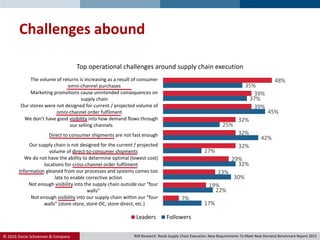
Challenges abound
17%
22%
30%
32%
17%
42%
25%
45%
37%
35%
7%
19%
23%
29%
32%
32%
32%
39%
39%
48%
Not enough visibility into our supply chain within our “four
walls” (store-store, store-DC, store-direct, etc.)
Not enough visibility into the supply chain outside our “four
walls”
Information gleaned from our processes and systems comes too
late to enable corrective action
We do not have the ability to determine optimal (lowest cost)
locations for cross-channel order fulfilment
Our supply chain is not designed for the current / projected
volume of direct-to-consumer shipments
Direct to consumer shipments are not fast enough
We don't have good visibility into how demand flows through
our selling channels
Our stores were not designed for current / projected volume of
omni-channel order fulfilment
Marketing promotions cause unintended consequences on
supply chain
The volume of returns is increasing as a result of consumer
omni-channel purchases
Top operational challenges around supply chain execution
Leaders Followers
RSR Research: Retail Supply Chain Execution: New Requirements To Meet New Demand Benchmark Report 2015
© 2016 Danie Schoeman & Company.
Challenges abound
17%
22%
30%
32%
17%
42%
25%
45%
37%
35%
7%
19%
23%
29%
32%
32%
32%
39%
39%
48%
Not enough visibility into our supply chain within our “four
walls” (store-store, store-DC, store-direct, etc.)
Not enough visibility into the supply chain outside our “four
walls”
Information gleaned from our processes and systems comes too
late to enable corrective action
We do not have the ability to determine optimal (lowest cost)
locations for cross-channel order fulfilment
Our supply chain is not designed for the current / projected
volume of direct-to-consumer shipments
Direct to consumer shipments are not fast enough
We don't have good visibility into how demand flows through
our selling channels
Our stores were not designed for current / projected volume of
omni-channel order fulfilment
Marketing promotions cause unintended consequences on
supply chain
The volume of returns is increasing as a result of consumer
omni-channel purchases
Top operational challenges around supply chain execution
Leaders Followers
RSR Research: Retail Supply Chain Execution: New Requirements To Meet New Demand Benchmark Report 2015
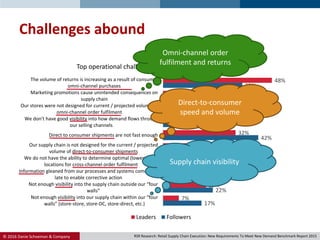
Omni-channel order
fulfilment and returns
Direct-to-consumer
speed and volume
Supply chain visibility
© 2016 Danie Schoeman & Company.
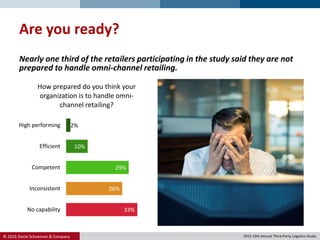
Are you ready?
33%
26%
29%
10%
2%
No capability
Inconsistent
Competent
Efficient
High performing
How prepared do you think your
organization is to handle omni-
channel retailing?
Nearly one third of the retailers participating in the study said they are not
prepared to handle omni-channel retailing.
2015 19th Annual Third-Party Logistics Study.
© 2016 Danie Schoeman & Company.
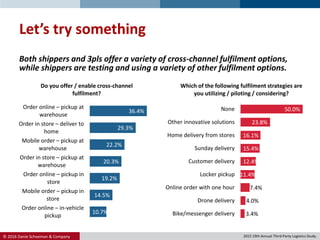
Let’s try something
10.7%
14.5%
19.2%
20.3%
22.2%
29.3%
36.4%
Order online – in-vehicle
pickup
Mobile order – pickup in
store
Order online – pickup in
store
Order in store – pickup at
warehouse
Mobile order – pickup at
warehouse
Order in store – deliver to
home
Order online – pickup at
warehouse
Do you offer / enable cross-channel
fulfilment?
3.4%
4.0%
7.4%
11.4%
12.4%
15.4%
16.1%
23.8%
50.0%
Bike/messenger delivery
Drone delivery
Online order with one hour
Locker pickup
Customer delivery
Sunday delivery
Home delivery from stores
Other innovative solutions
None
Which of the following fulfilment strategies are
you utilizing / piloting / considering?
Both shippers and 3pls offer a variety of cross-channel fulfilment options,
while shippers are testing and using a variety of other fulfilment options.
2015 19th Annual Third-Party Logistics Study.
© 2016 Danie Schoeman & Company.
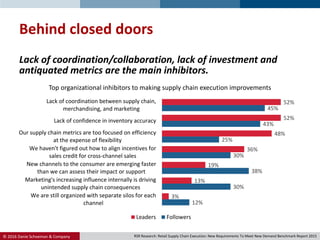
Behind closed doors
12%
30%
38%
30%
25%
43%
45%
3%
13%
19%
36%
48%
52%
52%
We are still organized with separate silos for each
channel
Marketing's increasing influence internally is driving
unintended supply chain consequences
New channels to the consumer are emerging faster
than we can assess their impact or support
We haven't figured out how to align incentives for
sales credit for cross-channel sales
Our supply chain metrics are too focused on efficiency
at the expense of flexibility
Lack of confidence in inventory accuracy
Lack of coordination between supply chain,
merchandising, and marketing
Top organizational inhibitors to making supply chain execution improvements
Leaders Followers
Lack of coordination/collaboration, lack of investment and
antiquated metrics are the main inhibitors.
RSR Research: Retail Supply Chain Execution: New Requirements To Meet New Demand Benchmark Report 2015
© 2016 Danie Schoeman & Company.
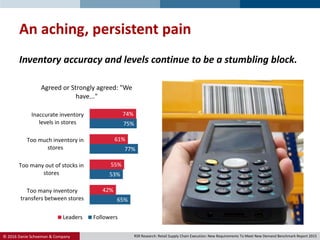
65%
53%
77%
75%
42%
55%
61%
74%
Too many inventory
transfers between stores
Too many out of stocks in
stores
Too much inventory in
stores
Inaccurate inventory
levels in stores
Agreed or Strongly agreed: "We
have..."
Leaders Followers
An aching, persistent pain
Inventory accuracy and levels continue to be a stumbling block.
RSR Research: Retail Supply Chain Execution: New Requirements To Meet New Demand Benchmark Report 2015
© 2016 Danie Schoeman & Company.
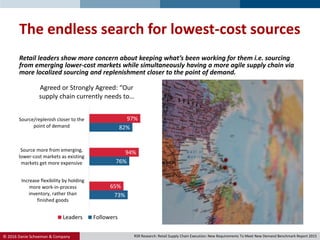
73%
76%
82%
65%
94%
97%
Increase flexibility by holding
more work-in-process
inventory, rather than
finished goods
Source more from emerging,
lower-cost markets as existing
markets get more expensive
Source/replenish closer to the
point of demand
Agreed or Strongly Agreed: “Our
supply chain currently needs to…
Leaders Followers
The endless search for lowest-cost sources
Retail leaders show more concern about keeping what’s been working for them i.e. sourcing
from emerging lower-cost markets while simultaneously having a more agile supply chain via
more localized sourcing and replenishment closer to the point of demand.
RSR Research: Retail Supply Chain Execution: New Requirements To Meet New Demand Benchmark Report 2015
© 2016 Danie Schoeman & Company.
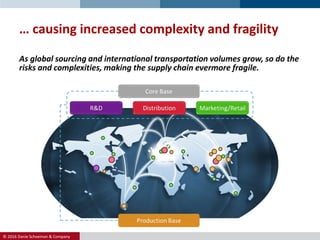
… causing increased complexity and fragility
As global sourcing and international transportation volumes grow, so do the
risks and complexities, making the supply chain evermore fragile.
Full of risk
© 2016 Danie Schoeman & Company.
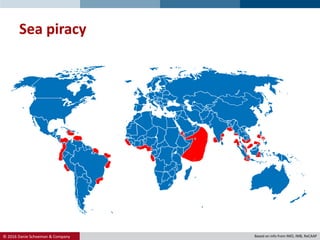
Sea piracy
Based on info from IMO, IMB, ReCAAP
© 2016 Danie Schoeman & Company.
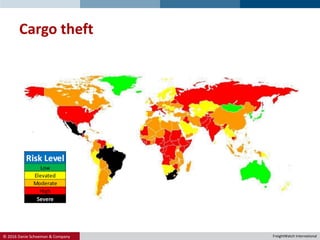
Cargo theft
FreightWatch International
© 2016 Danie Schoeman & Company.
Corruption
2014 Transparency International
© 2016 Danie Schoeman & Company.
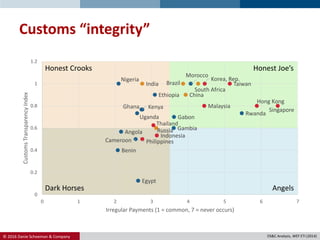
Customs “integrity”
Brazil
Russia
India
China
South Africa
Morocco
Rwanda
Nigeria
Gabon
Ghana
Ethiopia
Benin
Angola
Uganda
Cameroon
Gambia
Kenya
Egypt
Hong Kong
Indonesia
Korea, Rep.
Malaysia
Philippines
Singapore
Taiwan
Thailand
0
0.2
0.4
0.6
0.8
1
1.2
0 1 2 3 4 5 6 7
CustomsTransparencyIndex
Irregular Payments (1 = common, 7 = never occurs)
Honest Joe’sHonest Crooks
AngelsDark Horses
DS&C Analysis, WEF ETI (2014)
Ready or not, here IoT comes
© 2016 Danie Schoeman & Company.
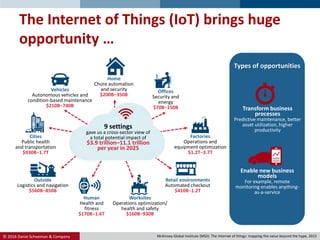
Home
Chore automation
and security
$200B−350B
The Internet of Things (IoT) brings huge
opportunity …
Human
Health and
fitness
$170B−1.6T
Offices
Security and
energy
$70B−150B
Factories
Operations and
equipment optimization
$1.2T−3.7T
Vehicles
Autonomous vehicles and
condition-based maintenance
$210B−740B
Outside
Logistics and navigation
$560B−850B
Cities
Public health
and transportation
$930B−1.7T
Worksites
Operations optimization/
health and safety
$160B−930B
Retail environments
Automated checkout
$410B−1.2T
Enable new business
models
For example, remote
monitoring enables anything-
as-a-service
Transform business
processes
Predictive maintenance, better
asset utilization, higher
productivity
Types of opportunities
9 settings
gave us a cross-sector view of
a total potential impact of
$3.9 trillion–11.1 trillion
per year in 2025
McKinsey Global Institute (MGI): The internet of things: mapping the value beyond the hype, 2015
© 2016 Danie Schoeman & Company.
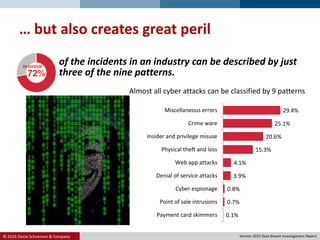
… but also creates great peril
Almost all cyber attacks can be classified by 9 patterns
0.1%
0.7%
0.8%
3.9%
4.1%
15.3%
20.6%
25.1%
29.4%
Payment card skimmers
Point of sale intrusions
Cyber espionage
Denial of service attacks
Web app attacks
Physical theft and loss
Insider and privilege misuse
Crime ware
Miscellaneous errors
72%
ON AVERAGE
of the incidents in an industry can be described by just
three of the nine patterns.
Verizon 2015 Data Breach Investigations Report
© 2016 Danie Schoeman & Company.
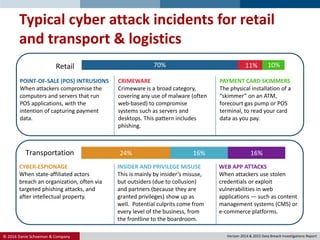
Typical cyber attack incidents for retail
and transport & logistics
70% 11% 10%Retail
POS intrusion Crimeware Payment card skimmer
24% 16% 16%Transportation
Cyber-espionage Insider and privilege misuse Web app attacks
PAYMENT CARD SKIMMERS
The physical installation of a
“skimmer” on an ATM,
forecourt gas pump or POS
terminal, to read your card
data as you pay.
CRIMEWARE
Crimeware is a broad category,
covering any use of malware (often
web-based) to compromise
systems such as servers and
desktops. This pattern includes
phishing.
POINT-OF-SALE (POS) INTRUSIONS
When attackers compromise the
computers and servers that run
POS applications, with the
intention of capturing payment
data.
WEB APP ATTACKS
When attackers use stolen
credentials or exploit
vulnerabilities in web
applications — such as content
management systems (CMS) or
e-commerce platforms.
INSIDER AND PRIVILEGE MISUSE
This is mainly by insider’s misuse,
but outsiders (due to collusion)
and partners (because they are
granted privileges) show up as
well. Potential culprits come from
every level of the business, from
the frontline to the boardroom.
CYBER-ESPIONAGE
When state-affiliated actors
breach an organization, often via
targeted phishing attacks, and
after intellectual property.
Verizon 2014 & 2015 Data Breach Investigations Report
Last mile killed the e-tailer star
© 2016 Danie Schoeman & Company.
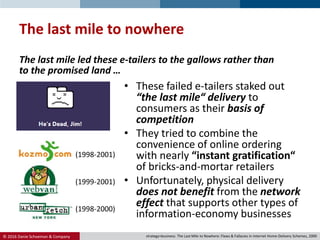
The last mile to nowhere
• These failed e-tailers staked out
“the last mile“ delivery to
consumers as their basis of
competition
• They tried to combine the
convenience of online ordering
with nearly “instant gratification“
of bricks-and-mortar retailers
• Unfortunately, physical delivery
does not benefit from the network
effect that supports other types of
information-economy businesses
The last mile led these e-tailers to the gallows rather than
to the promised land …
(1998-2001)
(1999-2001)
(1998-2000)
strategy+business: The Last Mile to Nowhere: Flaws & Fallacies in Internet Home-Delivery Schemes, 2000
© 2016 Danie Schoeman & Company.
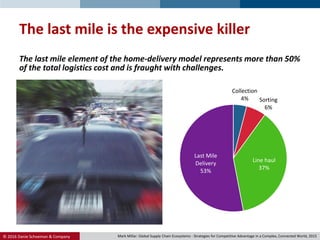
The last mile is the expensive killer
Collection
4% Sorting
6%
Line haul
37%
Last Mile
Delivery
53%
The last mile element of the home-delivery model represents more than 50%
of the total logistics cost and is fraught with challenges.
Mark Millar: Global Supply Chain Ecosystems - Strategies for Competitive Advantage in a Complex, Connected World, 2015
© 2016 Danie Schoeman & Company.
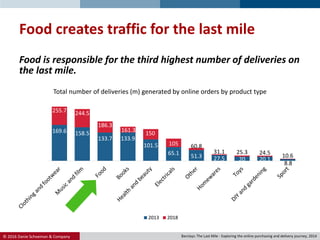
Food creates traffic for the last mile
169.6 158.5
133.7 133.9
101.5
65.1 51.3 27.5 20 20.1
8.8
255.7 244.5
186.3
161.3
150
105 60.8
31.1 25.3 24.5 10.6
Total number of deliveries (m) generated by online orders by product type
2013 2018
Barclays: The Last Mile - Exploring the online purchasing and delivery journey, 2014
Food is responsible for the third highest number of deliveries on
the last mile.
© 2016 Danie Schoeman & Company.
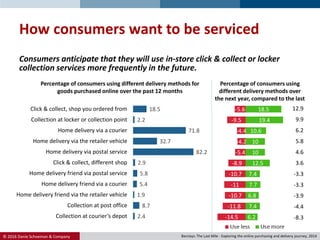
How consumers want to be serviced
2.4
8.7
1.9
5.4
5.8
2.9
82.2
32.7
71.8
2.2
18.5
Collection at courier’s depot
Collection at post office
Home delivery friend via the retailer vehicle
Home delivery friend via a courier
Home delivery friend via postal service
Click & collect, different shop
Home delivery via postal service
Home delivery via the retailer vehicle
Home delivery via a courier
Collection at locker or collection point
Click & collect, shop you ordered from
-14.5
-11.8
-10.7
-11
-10.7
-8.9
-5.4
-4.2
-4.4
-9.5
-5.6
6.2
7.4
6.8
7.7
7.4
12.5
10
10
10.6
19.4
18.5 12.9
9.9
4.6
3.6
-3.3
-3.3
-3.9
-4.4
-8.3
6.2
5.8
Barclays: The Last Mile - Exploring the online purchasing and delivery journey, 2014
Percentage of consumers using different delivery methods for
goods purchased online over the past 12 months
Percentage of consumers using
different delivery methods over
the next year, compared to the last
Consumers anticipate that they will use in-store click & collect or locker
collection services more frequently in the future.
© 2016 Danie Schoeman & Company.
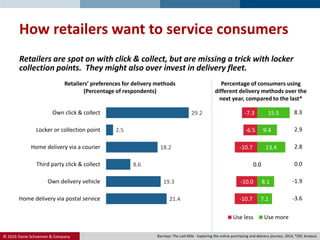
How retailers want to service consumers
21.4
19.3
8.6
18.2
2.5
29.2
Home delivery via postal service
Own delivery vehicle
Third party click & collect
Home delivery via a courier
Locker or collection point
Own click & collect
Chart Title
Series1
-10.7
-10.0
0.0
-10.7
-6.5
-7.3
7.1
8.1
0.0
13.4
9.4
15.5
Chart Title
Use less Use more
8.3
2.9
2.8
0.0
-1.9
-3.6
Barclays: The Last Mile - Exploring the online purchasing and delivery journey, 2014, *DSC Analysis
Retailers are spot on with click & collect, but are missing a trick with locker
collection points. They might also over invest in delivery fleet.
Retailers’ preferences for delivery methods
(Percentage of respondents)
Percentage of consumers using
different delivery methods over the
next year, compared to the last*
© 2016 Danie Schoeman & Company.
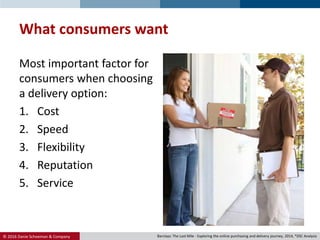
Most important factor for
consumers when choosing
a delivery option:
1. Cost
2. Speed
3. Flexibility
4. Reputation
5. Service
What consumers want
Barclays: The Last Mile - Exploring the online purchasing and delivery journey, 2014, *DSC Analysis
Waste not want not
© 2016 Danie Schoeman & Company.
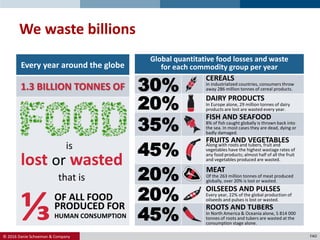
We waste billions
Every year around the globe
1.3 BILLION TONNES OF
Global quantitative food losses and waste
for each commodity group per year
In industrialized countries, consumers throw
away 286 million tonnes of cereal products.
CEREALS
30%
FISH AND SEAFOOD
FRUITS AND VEGETABLES
MEAT
OILSEEDS AND PULSES
ROOTS AND TUBERS
DAIRY PRODUCTS
20%
45%
20%
20%
45%
35% 8% of fish caught globally is thrown back into
the sea. In most cases they are dead, dying or
badly damaged.
In Europe alone, 29 million tonnes of dairy
products are lost are wasted every year.
Along with roots and tubers, fruit and
vegetables have the highest wastage rates of
any food products; almost half of all the fruit
and vegetables produced are wasted.
Of the 263 million tonnes of meat produced
globally, over 20% is lost or wasted.
Every year, 22% of the global production of
oilseeds and pulses is lost or wasted.
In North America & Oceania alone, 5 814 000
tonnes of roots and tubers are wasted at the
consumption stage alone.
is
that is
OF ALL FOOD
PRODUCED FOR
HUMAN CONSUMPTION
lost or wasted
⅓ FAO
© 2016 Danie Schoeman & Company.
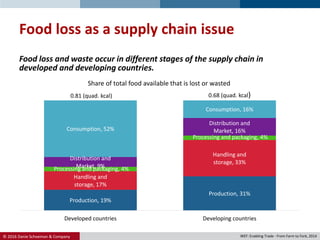
Food loss as a supply chain issue
WEF: Enabling Trade - From Farm to Fork, 2014
Production, 19%
Production, 31%
Handling and
storage, 17%
Handling and
storage, 33%
Processing and packaging, 4%
Distribution and
Market, 9%
Distribution and
Market, 16%Consumption, 52%
Consumption, 16%
Developed countries Developing countries
Chart Title
Food loss and waste occur in different stages of the supply chain in
developed and developing countries.
Share of total food available that is lost or wasted
0.81 (quad. kcal) 0.68 (quad. kcal)
© 2016 Danie Schoeman & Company.
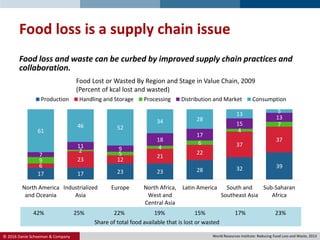
Food loss is a supply chain issue
17 17 23 23 28 32 396
23 12
21
22
37
37
9
2 5
4
6
4
7
7
11 9
18
17
15
13
61
46 52
34 28
13 5
North America
and Oceania
Industrialized
Asia
Europe North Africa,
West and
Central Asia
Latin America South and
Southeast Asia
Sub-Saharan
Africa
Chart Title
Production Handling and Storage Processing Distribution and Market Consumption
World Resources Institute: Reducing Food Loss and Waste, 2013
42%
Food Lost or Wasted By Region and Stage in Value Chain, 2009
(Percent of kcal lost and wasted)
25% 22% 19% 15% 17% 23%
Share of total food available that is lost or wasted
Food loss and waste can be curbed by improved supply chain practices and
collaboration.
© 2016 Danie Schoeman & Company.
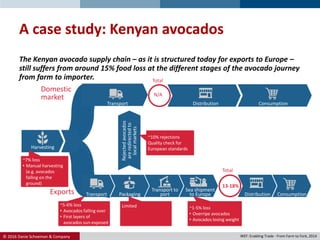
A case study: Kenyan avocados
WEF: Enabling Trade - From Farm to Fork, 2014
Domestic
market
Exports Transport Packaging
Transport to
port
Sea shipment
to Europe
Transport
Total
Consumption
Distribution Consumption
Distribution
~5-6% loss
• Avocados falling over
• First layers of
avocados sun-exposed
~1-5% loss
• Overripe avocados
• Avocados losing weight
Limited
~10% rejections
Quality check for
European standards
Total
The Kenyan avocado supply chain – as it is structured today for exports to Europe –
still suffers from around 15% food loss at the different stages of the avocado journey
from farm to importer.
13-18%
N/A
Rejectedavocados
areredirectedto
localmarkets
Harvesting
~7% loss
• Manual harvesting
(e.g. avocados
falling on the
ground)
Collaborate or perish
© 2016 Danie Schoeman & Company.
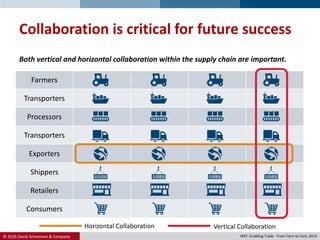
Collaboration is critical for future success
Farmers
Transporters
Processors
Transporters
Exporters
Shippers
Retailers
Consumers
Both vertical and horizontal collaboration within the supply chain are important.
Horizontal Collaboration Vertical Collaboration
WEF: Enabling Trade - From Farm to Fork, 2014
© 2016 Danie Schoeman & Company.
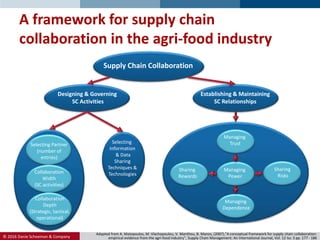
A framework for supply chain
collaboration in the agri-food industry
Managing
Trust
Supply Chain Collaboration
Managing
Power
Designing & Governing
SC Activities
Establishing & Maintaining
SC Relationships
Managing
Dependence
Sharing
Risks
Selecting Partner
(number of
entries)
Selecting
Information
& Data
Sharing
Techniques &
TechnologiesCollaboration
Width
(SC activities)
Collaboration
Depth
(Strategic, tactical,
operational)
Sharing
Rewards
Adapted from A. Matopoulos, M. Vlachopoulou, V. Manthou, B. Manos, (2007),"A conceptual framework for supply chain collaboration:
empirical evidence from the agri-food industry", Supply Chain Management: An International Journal, Vol. 12 Iss: 3 pp. 177 - 186
The 3PL agenda
© 2016 Danie Schoeman & Company.
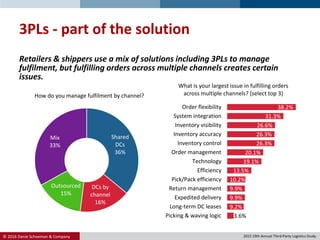
3PLs - part of the solution
Shared
DCs
36%
DCs by
channel
16%
Outsourced
15%
Mix
33%
How do you manage fulfilment by channel?
3.6%
9.2%
9.9%
9.9%
10.2%
13.5%
19.1%
20.1%
26.3%
26.3%
26.6%
31.3%
38.2%
Picking & waving logic
Long-term DC leases
Expedited delivery
Return management
Pick/Pack efficiency
Efficiency
Technology
Order management
Inventory control
Inventory accuracy
Inventory visibility
System integration
Order flexibility
What is your largest issue in fulfilling orders
across multiple channels? (select top 3)
Retailers & shippers use a mix of solutions including 3PLs to manage
fulfilment, but fulfilling orders across multiple channels creates certain
issues.
2015 19th Annual Third-Party Logistics Study.
© 2016 Danie Schoeman & Company.
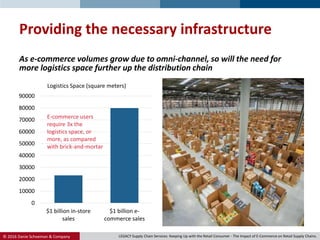
Providing the necessary infrastructure
0
10000
20000
30000
40000
50000
60000
70000
80000
90000
$1 billion in-store
sales
$1 billion e-
commerce sales
Logistics Space (square meters)
As e-commerce volumes grow due to omni-channel, so will the need for
more logistics space further up the distribution chain
E-commerce users
require 3x the
logistics space, or
more, as compared
with brick-and-mortar
LEGACY Supply Chain Services: Keeping Up with the Retail Consumer - The Impact of E-Commerce on Retail Supply Chains.
© 2016 Danie Schoeman & Company.
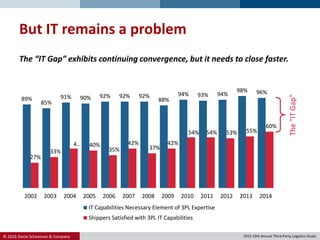
But IT remains a problem
89%
85%
91% 90% 92% 92% 92%
88%
94% 93% 94%
98% 96%
27%
33%
4… 40%
35%
42%
37%
42%
54% 54% 53% 55%
60%
2002 2003 2004 2005 2006 2007 2008 2009 2010 2011 2012 2013 2014
IT Capabilities Necessary Element of 3PL Expertise
Shippers Satisfied with 3PL IT Capabilities
2015 19th Annual Third-Party Logistics Study.
The “IT Gap” exhibits continuing convergence, but it needs to close faster.
The“ITGap”
© 2016 Danie Schoeman & Company.
What are the three things you hope to
achieve?
“Demosthenes, the greatest
of Athenian orators, was
asked what the three tests of
a great speech were. “Action,
action and action‟ was his
reply.”
James C. Humes
© 2016 Danie Schoeman & Company.
Danie Schoeman
+27 82 940 6028
danie@danieschoeman.com
www.danieschoeman.com
There’s more to talk about, so let’s have
coffee …
© 2016 Danie Schoeman & Company.
Disclaimer
This document has been prepared by Danie Schoeman and Company
to provide background information on the subjects mentioned herein,
the forecasts, opinions and expectations are entirely those of Danie
Schoeman and Company. This presentation was prepared with the
utmost due care and consideration for accuracy and factual
information; the forecasts, opinions and expectations are deemed to
be fair and reasonable. However there can be no assurance that
future results or events will be consistent with any such forecasts,
opinions and expectations. Therefore the authors will not incur any
liability for any loss arising from any use of this presentation or its
contents or otherwise arising in connection herewith. Neither will the
sources of information or any other related parties be held responsible
for any form of action that is taken as a result of the proliferation of
this document.

Fruit Logistica 2016 Logistics Hub Session 10 lin

  • 1.
    ‘Anything, anywhere, anytime’:What does this mean for the fresh produce sector? Danie Schoeman
  • 2.
    The anything, anywhere,anytime challenge
  • 3.
    © 2016 DanieSchoeman & Company. Challenges abound 17% 22% 30% 32% 17% 42% 25% 45% 37% 35% 7% 19% 23% 29% 32% 32% 32% 39% 39% 48% Not enough visibility into our supply chain within our “four walls” (store-store, store-DC, store-direct, etc.) Not enough visibility into the supply chain outside our “four walls” Information gleaned from our processes and systems comes too late to enable corrective action We do not have the ability to determine optimal (lowest cost) locations for cross-channel order fulfilment Our supply chain is not designed for the current / projected volume of direct-to-consumer shipments Direct to consumer shipments are not fast enough We don't have good visibility into how demand flows through our selling channels Our stores were not designed for current / projected volume of omni-channel order fulfilment Marketing promotions cause unintended consequences on supply chain The volume of returns is increasing as a result of consumer omni-channel purchases Top operational challenges around supply chain execution Leaders Followers RSR Research: Retail Supply Chain Execution: New Requirements To Meet New Demand Benchmark Report 2015
  • 4.
    © 2016 DanieSchoeman & Company. Challenges abound 17% 22% 30% 32% 17% 42% 25% 45% 37% 35% 7% 19% 23% 29% 32% 32% 32% 39% 39% 48% Not enough visibility into our supply chain within our “four walls” (store-store, store-DC, store-direct, etc.) Not enough visibility into the supply chain outside our “four walls” Information gleaned from our processes and systems comes too late to enable corrective action We do not have the ability to determine optimal (lowest cost) locations for cross-channel order fulfilment Our supply chain is not designed for the current / projected volume of direct-to-consumer shipments Direct to consumer shipments are not fast enough We don't have good visibility into how demand flows through our selling channels Our stores were not designed for current / projected volume of omni-channel order fulfilment Marketing promotions cause unintended consequences on supply chain The volume of returns is increasing as a result of consumer omni-channel purchases Top operational challenges around supply chain execution Leaders Followers RSR Research: Retail Supply Chain Execution: New Requirements To Meet New Demand Benchmark Report 2015 Omni-channel order fulfilment and returns Direct-to-consumer speed and volume Supply chain visibility
  • 5.
    © 2016 DanieSchoeman & Company. Are you ready? 33% 26% 29% 10% 2% No capability Inconsistent Competent Efficient High performing How prepared do you think your organization is to handle omni- channel retailing? Nearly one third of the retailers participating in the study said they are not prepared to handle omni-channel retailing. 2015 19th Annual Third-Party Logistics Study.
  • 6.
    © 2016 DanieSchoeman & Company. Let’s try something 10.7% 14.5% 19.2% 20.3% 22.2% 29.3% 36.4% Order online – in-vehicle pickup Mobile order – pickup in store Order online – pickup in store Order in store – pickup at warehouse Mobile order – pickup at warehouse Order in store – deliver to home Order online – pickup at warehouse Do you offer / enable cross-channel fulfilment? 3.4% 4.0% 7.4% 11.4% 12.4% 15.4% 16.1% 23.8% 50.0% Bike/messenger delivery Drone delivery Online order with one hour Locker pickup Customer delivery Sunday delivery Home delivery from stores Other innovative solutions None Which of the following fulfilment strategies are you utilizing / piloting / considering? Both shippers and 3pls offer a variety of cross-channel fulfilment options, while shippers are testing and using a variety of other fulfilment options. 2015 19th Annual Third-Party Logistics Study.
  • 7.
    © 2016 DanieSchoeman & Company. Behind closed doors 12% 30% 38% 30% 25% 43% 45% 3% 13% 19% 36% 48% 52% 52% We are still organized with separate silos for each channel Marketing's increasing influence internally is driving unintended supply chain consequences New channels to the consumer are emerging faster than we can assess their impact or support We haven't figured out how to align incentives for sales credit for cross-channel sales Our supply chain metrics are too focused on efficiency at the expense of flexibility Lack of confidence in inventory accuracy Lack of coordination between supply chain, merchandising, and marketing Top organizational inhibitors to making supply chain execution improvements Leaders Followers Lack of coordination/collaboration, lack of investment and antiquated metrics are the main inhibitors. RSR Research: Retail Supply Chain Execution: New Requirements To Meet New Demand Benchmark Report 2015
  • 8.
    © 2016 DanieSchoeman & Company. 65% 53% 77% 75% 42% 55% 61% 74% Too many inventory transfers between stores Too many out of stocks in stores Too much inventory in stores Inaccurate inventory levels in stores Agreed or Strongly agreed: "We have..." Leaders Followers An aching, persistent pain Inventory accuracy and levels continue to be a stumbling block. RSR Research: Retail Supply Chain Execution: New Requirements To Meet New Demand Benchmark Report 2015
  • 9.
    © 2016 DanieSchoeman & Company. 73% 76% 82% 65% 94% 97% Increase flexibility by holding more work-in-process inventory, rather than finished goods Source more from emerging, lower-cost markets as existing markets get more expensive Source/replenish closer to the point of demand Agreed or Strongly Agreed: “Our supply chain currently needs to… Leaders Followers The endless search for lowest-cost sources Retail leaders show more concern about keeping what’s been working for them i.e. sourcing from emerging lower-cost markets while simultaneously having a more agile supply chain via more localized sourcing and replenishment closer to the point of demand. RSR Research: Retail Supply Chain Execution: New Requirements To Meet New Demand Benchmark Report 2015
  • 10.
    © 2016 DanieSchoeman & Company. … causing increased complexity and fragility As global sourcing and international transportation volumes grow, so do the risks and complexities, making the supply chain evermore fragile.
  • 11.
  • 12.
    © 2016 DanieSchoeman & Company. Sea piracy Based on info from IMO, IMB, ReCAAP
  • 13.
    © 2016 DanieSchoeman & Company. Cargo theft FreightWatch International
  • 14.
    © 2016 DanieSchoeman & Company. Corruption 2014 Transparency International
  • 15.
    © 2016 DanieSchoeman & Company. Customs “integrity” Brazil Russia India China South Africa Morocco Rwanda Nigeria Gabon Ghana Ethiopia Benin Angola Uganda Cameroon Gambia Kenya Egypt Hong Kong Indonesia Korea, Rep. Malaysia Philippines Singapore Taiwan Thailand 0 0.2 0.4 0.6 0.8 1 1.2 0 1 2 3 4 5 6 7 CustomsTransparencyIndex Irregular Payments (1 = common, 7 = never occurs) Honest Joe’sHonest Crooks AngelsDark Horses DS&C Analysis, WEF ETI (2014)
  • 16.
    Ready or not,here IoT comes
  • 17.
    © 2016 DanieSchoeman & Company. Home Chore automation and security $200B−350B The Internet of Things (IoT) brings huge opportunity … Human Health and fitness $170B−1.6T Offices Security and energy $70B−150B Factories Operations and equipment optimization $1.2T−3.7T Vehicles Autonomous vehicles and condition-based maintenance $210B−740B Outside Logistics and navigation $560B−850B Cities Public health and transportation $930B−1.7T Worksites Operations optimization/ health and safety $160B−930B Retail environments Automated checkout $410B−1.2T Enable new business models For example, remote monitoring enables anything- as-a-service Transform business processes Predictive maintenance, better asset utilization, higher productivity Types of opportunities 9 settings gave us a cross-sector view of a total potential impact of $3.9 trillion–11.1 trillion per year in 2025 McKinsey Global Institute (MGI): The internet of things: mapping the value beyond the hype, 2015
  • 18.
    © 2016 DanieSchoeman & Company. … but also creates great peril Almost all cyber attacks can be classified by 9 patterns 0.1% 0.7% 0.8% 3.9% 4.1% 15.3% 20.6% 25.1% 29.4% Payment card skimmers Point of sale intrusions Cyber espionage Denial of service attacks Web app attacks Physical theft and loss Insider and privilege misuse Crime ware Miscellaneous errors 72% ON AVERAGE of the incidents in an industry can be described by just three of the nine patterns. Verizon 2015 Data Breach Investigations Report
  • 19.
    © 2016 DanieSchoeman & Company. Typical cyber attack incidents for retail and transport & logistics 70% 11% 10%Retail POS intrusion Crimeware Payment card skimmer 24% 16% 16%Transportation Cyber-espionage Insider and privilege misuse Web app attacks PAYMENT CARD SKIMMERS The physical installation of a “skimmer” on an ATM, forecourt gas pump or POS terminal, to read your card data as you pay. CRIMEWARE Crimeware is a broad category, covering any use of malware (often web-based) to compromise systems such as servers and desktops. This pattern includes phishing. POINT-OF-SALE (POS) INTRUSIONS When attackers compromise the computers and servers that run POS applications, with the intention of capturing payment data. WEB APP ATTACKS When attackers use stolen credentials or exploit vulnerabilities in web applications — such as content management systems (CMS) or e-commerce platforms. INSIDER AND PRIVILEGE MISUSE This is mainly by insider’s misuse, but outsiders (due to collusion) and partners (because they are granted privileges) show up as well. Potential culprits come from every level of the business, from the frontline to the boardroom. CYBER-ESPIONAGE When state-affiliated actors breach an organization, often via targeted phishing attacks, and after intellectual property. Verizon 2014 & 2015 Data Breach Investigations Report
  • 20.
    Last mile killedthe e-tailer star
  • 21.
    © 2016 DanieSchoeman & Company. The last mile to nowhere • These failed e-tailers staked out “the last mile“ delivery to consumers as their basis of competition • They tried to combine the convenience of online ordering with nearly “instant gratification“ of bricks-and-mortar retailers • Unfortunately, physical delivery does not benefit from the network effect that supports other types of information-economy businesses The last mile led these e-tailers to the gallows rather than to the promised land … (1998-2001) (1999-2001) (1998-2000) strategy+business: The Last Mile to Nowhere: Flaws & Fallacies in Internet Home-Delivery Schemes, 2000
  • 22.
    © 2016 DanieSchoeman & Company. The last mile is the expensive killer Collection 4% Sorting 6% Line haul 37% Last Mile Delivery 53% The last mile element of the home-delivery model represents more than 50% of the total logistics cost and is fraught with challenges. Mark Millar: Global Supply Chain Ecosystems - Strategies for Competitive Advantage in a Complex, Connected World, 2015
  • 23.
    © 2016 DanieSchoeman & Company. Food creates traffic for the last mile 169.6 158.5 133.7 133.9 101.5 65.1 51.3 27.5 20 20.1 8.8 255.7 244.5 186.3 161.3 150 105 60.8 31.1 25.3 24.5 10.6 Total number of deliveries (m) generated by online orders by product type 2013 2018 Barclays: The Last Mile - Exploring the online purchasing and delivery journey, 2014 Food is responsible for the third highest number of deliveries on the last mile.
  • 24.
    © 2016 DanieSchoeman & Company. How consumers want to be serviced 2.4 8.7 1.9 5.4 5.8 2.9 82.2 32.7 71.8 2.2 18.5 Collection at courier’s depot Collection at post office Home delivery friend via the retailer vehicle Home delivery friend via a courier Home delivery friend via postal service Click & collect, different shop Home delivery via postal service Home delivery via the retailer vehicle Home delivery via a courier Collection at locker or collection point Click & collect, shop you ordered from -14.5 -11.8 -10.7 -11 -10.7 -8.9 -5.4 -4.2 -4.4 -9.5 -5.6 6.2 7.4 6.8 7.7 7.4 12.5 10 10 10.6 19.4 18.5 12.9 9.9 4.6 3.6 -3.3 -3.3 -3.9 -4.4 -8.3 6.2 5.8 Barclays: The Last Mile - Exploring the online purchasing and delivery journey, 2014 Percentage of consumers using different delivery methods for goods purchased online over the past 12 months Percentage of consumers using different delivery methods over the next year, compared to the last Consumers anticipate that they will use in-store click & collect or locker collection services more frequently in the future.
  • 25.
    © 2016 DanieSchoeman & Company. How retailers want to service consumers 21.4 19.3 8.6 18.2 2.5 29.2 Home delivery via postal service Own delivery vehicle Third party click & collect Home delivery via a courier Locker or collection point Own click & collect Chart Title Series1 -10.7 -10.0 0.0 -10.7 -6.5 -7.3 7.1 8.1 0.0 13.4 9.4 15.5 Chart Title Use less Use more 8.3 2.9 2.8 0.0 -1.9 -3.6 Barclays: The Last Mile - Exploring the online purchasing and delivery journey, 2014, *DSC Analysis Retailers are spot on with click & collect, but are missing a trick with locker collection points. They might also over invest in delivery fleet. Retailers’ preferences for delivery methods (Percentage of respondents) Percentage of consumers using different delivery methods over the next year, compared to the last*
  • 26.
    © 2016 DanieSchoeman & Company. Most important factor for consumers when choosing a delivery option: 1. Cost 2. Speed 3. Flexibility 4. Reputation 5. Service What consumers want Barclays: The Last Mile - Exploring the online purchasing and delivery journey, 2014, *DSC Analysis
  • 27.
  • 28.
    © 2016 DanieSchoeman & Company. We waste billions Every year around the globe 1.3 BILLION TONNES OF Global quantitative food losses and waste for each commodity group per year In industrialized countries, consumers throw away 286 million tonnes of cereal products. CEREALS 30% FISH AND SEAFOOD FRUITS AND VEGETABLES MEAT OILSEEDS AND PULSES ROOTS AND TUBERS DAIRY PRODUCTS 20% 45% 20% 20% 45% 35% 8% of fish caught globally is thrown back into the sea. In most cases they are dead, dying or badly damaged. In Europe alone, 29 million tonnes of dairy products are lost are wasted every year. Along with roots and tubers, fruit and vegetables have the highest wastage rates of any food products; almost half of all the fruit and vegetables produced are wasted. Of the 263 million tonnes of meat produced globally, over 20% is lost or wasted. Every year, 22% of the global production of oilseeds and pulses is lost or wasted. In North America & Oceania alone, 5 814 000 tonnes of roots and tubers are wasted at the consumption stage alone. is that is OF ALL FOOD PRODUCED FOR HUMAN CONSUMPTION lost or wasted ⅓ FAO
  • 29.
    © 2016 DanieSchoeman & Company. Food loss as a supply chain issue WEF: Enabling Trade - From Farm to Fork, 2014 Production, 19% Production, 31% Handling and storage, 17% Handling and storage, 33% Processing and packaging, 4% Processing and packaging, 4% Distribution and Market, 9% Distribution and Market, 16%Consumption, 52% Consumption, 16% Developed countries Developing countries Chart Title Food loss and waste occur in different stages of the supply chain in developed and developing countries. Share of total food available that is lost or wasted 0.81 (quad. kcal) 0.68 (quad. kcal)
  • 30.
    © 2016 DanieSchoeman & Company. Food loss is a supply chain issue 17 17 23 23 28 32 396 23 12 21 22 37 37 9 2 5 4 6 4 7 7 11 9 18 17 15 13 61 46 52 34 28 13 5 North America and Oceania Industrialized Asia Europe North Africa, West and Central Asia Latin America South and Southeast Asia Sub-Saharan Africa Chart Title Production Handling and Storage Processing Distribution and Market Consumption World Resources Institute: Reducing Food Loss and Waste, 2013 42% Food Lost or Wasted By Region and Stage in Value Chain, 2009 (Percent of kcal lost and wasted) 25% 22% 19% 15% 17% 23% Share of total food available that is lost or wasted Food loss and waste can be curbed by improved supply chain practices and collaboration.
  • 31.
    © 2016 DanieSchoeman & Company. A case study: Kenyan avocados WEF: Enabling Trade - From Farm to Fork, 2014 Domestic market Exports Transport Packaging Transport to port Sea shipment to Europe Transport Total Consumption Distribution Consumption Distribution ~5-6% loss • Avocados falling over • First layers of avocados sun-exposed ~1-5% loss • Overripe avocados • Avocados losing weight Limited ~10% rejections Quality check for European standards Total The Kenyan avocado supply chain – as it is structured today for exports to Europe – still suffers from around 15% food loss at the different stages of the avocado journey from farm to importer. 13-18% N/A Rejectedavocados areredirectedto localmarkets Harvesting ~7% loss • Manual harvesting (e.g. avocados falling on the ground)
  • 32.
  • 33.
    © 2016 DanieSchoeman & Company. Collaboration is critical for future success Farmers Transporters Processors Transporters Exporters Shippers Retailers Consumers Both vertical and horizontal collaboration within the supply chain are important. Horizontal Collaboration Vertical Collaboration WEF: Enabling Trade - From Farm to Fork, 2014
  • 34.
    © 2016 DanieSchoeman & Company. A framework for supply chain collaboration in the agri-food industry Managing Trust Supply Chain Collaboration Managing Power Designing & Governing SC Activities Establishing & Maintaining SC Relationships Managing Dependence Sharing Risks Selecting Partner (number of entries) Selecting Information & Data Sharing Techniques & TechnologiesCollaboration Width (SC activities) Collaboration Depth (Strategic, tactical, operational) Sharing Rewards Adapted from A. Matopoulos, M. Vlachopoulou, V. Manthou, B. Manos, (2007),"A conceptual framework for supply chain collaboration: empirical evidence from the agri-food industry", Supply Chain Management: An International Journal, Vol. 12 Iss: 3 pp. 177 - 186
  • 35.
  • 36.
    © 2016 DanieSchoeman & Company. 3PLs - part of the solution Shared DCs 36% DCs by channel 16% Outsourced 15% Mix 33% How do you manage fulfilment by channel? 3.6% 9.2% 9.9% 9.9% 10.2% 13.5% 19.1% 20.1% 26.3% 26.3% 26.6% 31.3% 38.2% Picking & waving logic Long-term DC leases Expedited delivery Return management Pick/Pack efficiency Efficiency Technology Order management Inventory control Inventory accuracy Inventory visibility System integration Order flexibility What is your largest issue in fulfilling orders across multiple channels? (select top 3) Retailers & shippers use a mix of solutions including 3PLs to manage fulfilment, but fulfilling orders across multiple channels creates certain issues. 2015 19th Annual Third-Party Logistics Study.
  • 37.
    © 2016 DanieSchoeman & Company. Providing the necessary infrastructure 0 10000 20000 30000 40000 50000 60000 70000 80000 90000 $1 billion in-store sales $1 billion e- commerce sales Logistics Space (square meters) As e-commerce volumes grow due to omni-channel, so will the need for more logistics space further up the distribution chain E-commerce users require 3x the logistics space, or more, as compared with brick-and-mortar LEGACY Supply Chain Services: Keeping Up with the Retail Consumer - The Impact of E-Commerce on Retail Supply Chains.
  • 38.
    © 2016 DanieSchoeman & Company. But IT remains a problem 89% 85% 91% 90% 92% 92% 92% 88% 94% 93% 94% 98% 96% 27% 33% 4… 40% 35% 42% 37% 42% 54% 54% 53% 55% 60% 2002 2003 2004 2005 2006 2007 2008 2009 2010 2011 2012 2013 2014 IT Capabilities Necessary Element of 3PL Expertise Shippers Satisfied with 3PL IT Capabilities 2015 19th Annual Third-Party Logistics Study. The “IT Gap” exhibits continuing convergence, but it needs to close faster. The“ITGap”
  • 39.
    © 2016 DanieSchoeman & Company. What are the three things you hope to achieve? “Demosthenes, the greatest of Athenian orators, was asked what the three tests of a great speech were. “Action, action and action‟ was his reply.” James C. Humes
  • 40.
    © 2016 DanieSchoeman & Company. Danie Schoeman +27 82 940 6028 danie@danieschoeman.com www.danieschoeman.com There’s more to talk about, so let’s have coffee …
  • 41.
    © 2016 DanieSchoeman & Company.
  • 42.
    © 2016 DanieSchoeman & Company. Disclaimer This document has been prepared by Danie Schoeman and Company to provide background information on the subjects mentioned herein, the forecasts, opinions and expectations are entirely those of Danie Schoeman and Company. This presentation was prepared with the utmost due care and consideration for accuracy and factual information; the forecasts, opinions and expectations are deemed to be fair and reasonable. However there can be no assurance that future results or events will be consistent with any such forecasts, opinions and expectations. Therefore the authors will not incur any liability for any loss arising from any use of this presentation or its contents or otherwise arising in connection herewith. Neither will the sources of information or any other related parties be held responsible for any form of action that is taken as a result of the proliferation of this document.