Guidelines for Developingthe Organizations to become Learning
Organizations: Case Study of Suan Dusit Rajabhat University
By
Mr.Jadesadakorn Thongsawang
An Independent Study Submitted in Partial Fulfillment of the Requirements
for the Degree of Master of Science
Technology Management
College of Innovation
Thammasat University
2010
Abstract
This research isto study about the guidelines for developing Organizations of Suan Dusit
Rajabhat University to become learning organizations, emphasizing learning motives under the
conceptofMarquardt(Marquardt,1996).
This independent research studied the information from personnel, lecturers of Suan Dusit
RajabhatUniversity,usingtheacquiredinformationtoanalyzebyusingstatisticalpackageprogram
to analyze the information, distinguishing the result of research and the information analysis into 5
parts,includingtheinformationofgeneralstatusofthequestionnairerespondents,i.e.,gender,age,
educationlevelandrelatedworkingunits,byusingdescriptivestatistics,andbyanalyzingthefactors
affecting learning motive and the learning motive of Suan Dusit Rajabhat University, analyzing the
information by searching for x and searching for the standard deviation (S.D.), analyzing the
demographicinformation,includinggender,age,educationlevelandrelatedworkingunits;byusing
analysis statistics, T-test, one-way ANOVA, multiple regression analysis between factors effecting
learningmotiveandthelearningmotiveofSuanDusitRajabhatUniversityanddetailedinterview.
The research result can be summarized as follows: the learning motive of Suan Dusit
Rajabhat University had the factors having important effect including management system factor,
personnel capability factor, information technology factor and organization structure factor,
respectively. Furthermore, related working units effecting learning motive, i.e., institute/bureau, had
moremanagementsystemfactoreffectinglearningmotivethanacademicsupportworkingunit. The
facultiesandinstitute/bureauhadmorepersonnelcapabilityfactoreffectinglearningmotive,thanthe
academic support working units. Special Activity Bureau had more reinforcement and motivation
factor on learning motive than academic support working units and the faculties. Lastly
institute/bureau had more learning motive than study center, academic support working units and
special activity bureau. The faculties had more learning motive than learning center and academic
supportworkingunits.Thegeneralstatusinformationregardinggender,itwasfoundthatgenderdid
notcausedifferencebetweengroupsandregardingtheinformationtechnologyfactor,therewasno
dataongeneralstatusofquestionnairerespondentscausingdifferencebetweengroups.
(2)
70
ตารางที่ 4.10
การวิเคราะห์ข้อมูลด้านประชากรศาสตร์ด้านอายุกับปัจจัยที่ส่งผลต่อการเป็นพลวัตการเรียนรู้โดย
ใช้สถิติการวิเคราะห์ความแปรปรวนทางเดียว (One- Way ANOVA)
ANOVA
Sum of
Squares df
Mean
Square F Sig.
1.ปัจจัยภาวะผู้นาแห่ง
การเรียนรู้
Between
Groups
4.520 3 1.507 2.734 .044
Within Groups 196.144 356 .551
Total 200.664 359
2.ปัจจัยบรรยากาศ
และวัฒนธรรมองค์กร
Between
Groups
3.567 3 1.189 2.121 .097
Within Groups 199.588 356 .561
Total 203.156 359
3.ปัจจัยวิสัยทัศน์ พันธ
กิจและยุทธศาสตร์
Between
Groups
7.300 3 2.433 4.336 .005
Within Groups 199.800 356 .561
Total 207.100 359
4.ปัจจัยโครงสร้าง
องค์กร
Between
Groups
2.223 3 .741 1.543 .203
Within Groups 170.974 356 .480
Total 173.197 359
5.ปัจจัยเทคโนโลยี
สารสนเทศ
Between
Groups
4.013 3 1.338 2.053 .106
Within Groups 231.962 356 .652
Total 235.975 359
83.
71
ตารางที่ 4.10 (ต่อ)
Sumof
Squares df
Mean
Square F Sig.
6.ปัจจัยระบบการ
จัดการ
Between
Groups
5.421 3 1.807 3.376 .019
Within Groups 190.576 356 .535
Total 195.997 359
7.ปัจจัยความสามารถ
ของบุคลากร
Between
Groups
14.581 3 4.860 7.816 .000
Within Groups 221.394 356 .622
Total 235.975 359
8.ปัจจัยการเสริมแรง
และการจูงใจ
Between
Groups
7.731 3 2.577 3.120 .026
Within Groups 294.044 356 .826
Total 301.775 359
9.พลวัตการเรียนรู้ Between
Groups
2.620 3 .873 2.294 .078
Within Groups 135.521 356 .381
Total 138.140 359
ที่มา: จากการประมวลผลแบบสอบถามด้วยโปรแกรมคานวณทางสถิติ SPSS
1. ปัจจัยภาวะผู้นาแห่งการเรียนรู้
สมมุติฐานทางสถิติ
H0 : µ 1 = µ 2 = µ 3= µ 4 กลุ่มอายุต่างๆมีความคิดเห็นต่อภาวะผู้นาแห่งการ
เรียนรู้ขององค์กรไม่แตกต่างกัน
H1 : µ 1 ≠ µ 2 ≠ µ 3≠ µ 4 กลุ่มอายุต่างๆมีความคิดเห็นต่อภาวะผู้นาแห่งการ
เรียนรู้ขององค์กรแตกต่างกัน
75
ตารางที่ 4.11
การวิเคราะห์ข้อมูลด้านประชากรศาสตร์ด้านระดับการศึกษากับกับปัจจัยที่ส่งผลต่อการเป็นพลวัต
การเรียนรู้ โดยใช้สถิติการวิเคราะห์ความแปรปรวนทางเดียว(One - Way ANOVA)
ANOVA
Sum of
Squares df
Mean
Square F Sig.
1.ปัจจัยภาวะผู้นาแห่ง
การเรียนรู้
Between
Groups
3.544 3 1.181 2.134 .096
Within Groups 197.120 356 .554
Total 200.664 359
2.ปัจจัยบรรยากาศ
และวัฒนธรรมองค์กร
Between
Groups
8.502 3 2.834 5.183 .002
Within Groups 194.653 356 .547
Total 203.156 359
3.ปัจจัย วิสัยทัศน์
พันธกิจและ
ยุทธศาสตร์
Between
Groups
7.570 3 2.523 4.502 .004
Within Groups 199.530 356 .560
Total 207.100 359
4.ปัจจัยโครงสร้าง
องค์กร
Between
Groups
4.446 3 1.482 3.127 .026
Within Groups 168.751 356 .474
Total 173.197 359
5.ปัจจัยเทคโนโลยี
สารสนเทศ
Between
Groups
2.863 3 .954 1.457 .226
Within Groups 233.112 356 .655
Total 235.975 359
88.
76
ตารางที่ 4.11 (ต่อ)
Sumof
Squares df
Mean
Square F Sig.
6.ปัจจัยระบบการ
จัดการ
Between
Groups
4.693 3 1.564 2.911 .034
Within Groups 191.305 356 .537
Total 195.997 359
7.ปัจจัยความสามารถ
ของบุคลากร
Between
Groups
5.212 3 1.737 2.680 .047
Within Groups 230.763 356 .648
Total 235.975 359
8.ปัจจัยการเสริมแรง
และการจูงใจ
Between
Groups
10.477 3 3.492 4.268 .006
Within Groups 291.298 356 .818
Total 301.775 359
9.พลวัตการเรียนรู้ Between
Groups
.176 3 .059 .151 .929
Within Groups 137.965 356 .388
Total 138.140 359
ที่มา: จากการประมวลผลแบบสอบถามด้วยโปรแกรมคานวณทางสถิติ SPSS
1. ปัจจัยภาวะผู้นาแห่งการเรียนรู้
สมมุติฐานทางสถิติ
H0 : µ 1 = µ 2 = µ 3= µ 4 กลุ่มระดับการศึกษาต่างๆมีความคิดเห็นต่อภาวะ
ผู้นาแห่งการเรียนรู้ขององค์กรไม่แตกต่างกัน
H1 : µ 1 ≠ µ 2 ≠ µ 3≠ µ 4 กลุ่มระดับการศึกษาต่างๆมีความคิดเห็นต่อภาวะ
ผู้นาแห่งการเรียนรู้ขององค์กรแตกต่างกัน
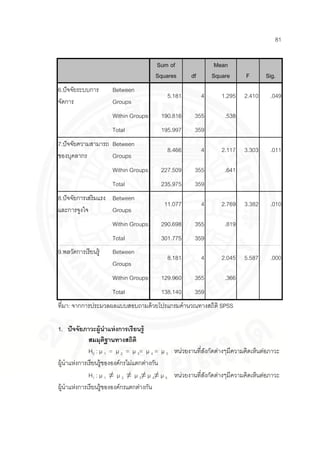
80
ตารางที่ 4.12
การวิเคราะห์ข้อมูลด้านประชากรศาสตร์ด้านหน่วยงานที่สังกัดกับกับปัจจัยที่ส่งผลต่อการเป็นพลวัต
การเรียนรู้ โดยใช้สถิติการวิเคราะห์ความแปรปรวนทางเดียว(One - Way ANOVA)
Sum of
Squares df
Mean
Square F Sig.
1.ปัจจัยภาวะผู้นาแห่ง
การเรียนรู้
Between
Groups
1.787 4 .447 .797 .527
Within Groups 198.877 355 .560
Total 200.664 359
2.ปัจจัยบรรยากาศ
และวัฒนธรรมองค์กร
Between
Groups
2.567 4 .642 1.136 .339
Within Groups 200.589 355 .565
Total 203.156 359
3.ปัจจัยวิสัยทัศน์ พันธ
กิจและยุทธศาสตร์
Between
Groups
1.965 4 .491 .850 .494
Within Groups 205.135 355 .578
Total 207.100 359
4.ปัจจัยโครงสร้าง
องค์กร
Between
Groups
3.827 4 .957 2.005 .093
Within Groups 169.370 355 .477
Total 173.197 359
5.ปัจจัยเทคโนโลยี
สารสนเทศ
Between
Groups
5.616 4 1.404 2.164 .073
Within Groups 230.359 355 .649
Total 235.975 359
93.
81
Sum of
Squares df
Mean
SquareF Sig.
6.ปัจจัยระบบการ
จัดการ
Between
Groups
5.181 4 1.295 2.410 .049
Within Groups 190.816 355 .538
Total 195.997 359
7.ปัจจัยความสามารถ
ของบุคลากร
Between
Groups
8.466 4 2.117 3.303 .011
Within Groups 227.509 355 .641
Total 235.975 359
8.ปัจจัยการเสริมแรง
และการจูงใจ
Between
Groups
11.077 4 2.769 3.382 .010
Within Groups 290.698 355 .819
Total 301.775 359
9.พลวัตการเรียนรู้ Between
Groups
8.181 4 2.045 5.587 .000
Within Groups 129.960 355 .366
Total 138.140 359
ที่มา: จากการประมวลผลแบบสอบถามด้วยโปรแกรมคานวณทางสถิติ SPSS
1. ปัจจัยภาวะผู้นาแห่งการเรียนรู้
สมมุติฐานทางสถิติ
H0 : µ 1 = µ 2 = µ 3= µ 4 = µ 5 หน่วยงานที่สังกัดต่างๆมีความคิดเห็นต่อภาวะ
ผู้นาแห่งการเรียนรู้ขององค์กรไม่แตกต่างกัน
H1 : µ 1 ≠ µ 2 ≠ µ 3≠ µ 4≠ µ 5 หน่วยงานที่สังกัดต่างๆมีความคิดเห็นต่อภาวะ
ผู้นาแห่งการเรียนรู้ขององค์กรแตกต่างกัน
126
รายการอ้างอิง
หนังสือและบทความในหนังสือ
กระทรวงศึกษาธิการ. (2546). พระราชบัญญัติการศึกษาแห่งชาติพุทธศักราช 2542และที่แก้ไข
เพิ่มเติม (ฉบับที่ 2) พ.ศ.2545. กรุงเทพฯ: คุรุสภาลาดพร้าว.
จาเรียง วัยวัฒน์ และ เบญจมาศ อ่าพันธุ์ . วินัย 5 ประการพื้นฐานองค์กรเรียน รู้. กรุงเทพมหานคร
บริษัท คู่แข่ง จากัด (มหาชน), 2540.
พจน์ สะเพียรชัย .(2546). ผู้บริหารสถานศึกษากับการวิจัยเพื่อสร้างองค์การแห่งการเรียนรู้ .
กรุงเทพมหานคร : พริกหวานกราฟฟิค.
วิโรจน์ สารรัตนะและอัญชลี สารรัตนะ.(2545). ปัจจัยทางการบริหารกับความเป็นองค์การแห่งการ
เรียนรู้:ข้อเสนอผลการวิจัยเพื่อการพัฒนาและการวิพากย์. กรุงเทพมหานคร:ทิพยวิสุทธิ์
วิโรจน์ สารรัตนะ . โรงเรียนองค์การแห่งการเรียนรู้ กรอบแนวคิดเชิงทฤษฎีทางการบริหาร
การศึกษา.ขอนแก่น: อักษราพิพัฒน์ จากัด,2546
สมคิด สร้อยน้า. การพัฒนาตัวแบบองค์การแห่งการเรียนรู้ในโรงเรียนมัธยมศึกษา.ขอนแก่น:
บัณฑิตวิทยาลัย ขอนแก่น,2547
Argyris, C.Double-loop learning in Organization. Harvard Business Review, Septernber-
October,118
Bennett,J.K., and O, Brien,M.J. (1994). The building blocks of the learning
Organization.Training,3(June 1994)
Choi,Yong Suk. (2000). An empirical study of factors affecting successful
implementation of Knowledge management. A dissertation presented to faculty
of the graduate colledgeAt the University of Nebraska in partial fulfillment of
requirements for the Degree ofDoctor of Philosophy.
Gruber,H.G.(2000). Does organizational culture affect the sharing of knowledge? The
case of a Department in High-Technology Company.A thesis submitted to the
Faculty of Graduate Studies and research in partial fulfillment of The
requirements for the Degree Of Master of Management Studies.Carleton
University Ottawa.Ontario.Green , Madeleine F.(1998). “ Leaders and Their
Development. “ in Leader For A New Era :New York : Macmillan Publishing
139.
127
Company.
Garvin, David A.Building a learning organization. Harvard Business Review, 1993
Hoy ,Wayne K., and Miskel,Cecil G. (1987). Educational Administration. 3 rd ed.
New York : Random House ,Inc.
Marquardt, M.J. (2002). Building the learning organization : A systems approach to
quantum Improvement and global success. New York : McGraw-Hill.
Marquardt, M.J. Building the Learning Organization : System Approach to Quantum
Improvement and Global Success.New York : McGraw-Hill, 1996.
Marquardt,M.J.and Reynolds,A.(1994). The global learning organization.New
York:IRWIN.
Senge, Peter M. The Fifth Discipline: The art and practice of the learning organization.
London: Random House, 1990
Watkins, K.E., and Marsick, V.J. (1993). Sculpting the learning organization. Sun
Francisco Jossey-Bass
วิทยานิพนธ์
ผศ.ดร.สมชัย วงษ์นายะ.ปัจจัยที่ส่งผลต่อความเป็นองค์การแห่งการเรียนรู้ของมหาวิทยาลัยราช
ภัฏเขตภาคเหนือ.คณะครุศาสตร์ มหาวิทยาลัยราชภัฏกาแพงเพชร, 2548
สันติมา ศรีสังข์สุวรรณ.การพัฒนาการเรียนรู้ด้วยตนเองเพื่อก้าวไปสู่การเป็นองค์กรแห่งการเรียนรู้ .
ภาคนิพนธ์โครงการบัณฑิตศึกษาการพัฒนาทรัพยากรมนุษย์สถาบันบัณฑิตพัฒนบริหาร
ศาสตร์,2540
Davis.B.(1997) “Transformational Leadership and Organizational Learning : Leader
actions that Stimulate Individual Group Learning”.
Earl – lewis, Monique. (2000) A Framework for Developing a Culture of Learning in
Organizations : A 360 Degree Feedback Model for diagnosis and Intervention.
Ellinger, A.D., Yang, B. And Ellinger, A.E.(2000). IS the learning organization for real
examining the impacts of the dimentions of the learning organization on
140.
128
organizational performance. http://www.edst.educ.ubc.ca/aerc/2000/ellingeraet
all-final Pdf
Giordano, Daniela. (1995) Designing “Learning Organizations” : A Critical Evaluation of
the Strategies and Policies Proposed in Literature.
Hutt, Leonard Jospeh. (1996) An Exploration into the Developmental Process of a
Learning Organization.
Kaiser, Sandra M. (2000). “Mapping the Learning Organization : Exploring A Model
of Organization Learning “Dissertation for the Degree of Doctor of
Philosophy of the Louisiana State University.
Reimann , B.C. Organizational effectiveness and managements public values : A
canonical analysis. Academy of Management Journal. (Pre-1968) : June 1975
Rodsutli, M.C., and Swierczek, F.W. (2002) Leadership and organizational effectiveness
in multinational enterprises in Southeast Asia. Leadership & Organizational
development Journal. Bradford. Val (23)
Stanage, Kenneth jon. 1996. Using Technology to Create a Learning Organization
(Leadership).
Ziegler, Mary Frances. 1995. The Learning Organization : Awakening (Small Businesses,
Organizational Change)
สื่ออิเล็กทรอนิกส์
Ghalib, Kamran . (2004). Systemic Knowledge Management : Developing a Model for
Managing Organisational Assets for Strategic and Sustainable Competitive
Advantage.Journal of Knowledge ManagementPractice,
(January).(Online).Available: สืบค้นเมื่อวันที่15 พฤษภาคม
2552.http://www.tlainc.com/articl97.htm.Accessed.
Hurley,T.A., and Green,C.W. (2005). Knowledge Management And The Nonprofit
Industry:A Within And Between Approach. Journal of Knowledge
Management Practice,(May).(Online).Available: สืบค้นเมื่อวันที่10 พฤษภาคม
2552. http://www.tlainc.com/articl66.htm.Accessed.
141.
129
Hussain, Fareed andOthers. (2004). Managing Knowledge Effectively.Journal of
Knowledge Management Practice,( May).(Online).Available: สืบค้นเมื่อวันที่15
พฤษภาคม 2552.http://www.tlainc.com/articl66.htm.Accessed.
Peyman Akhavan and Others. (2005). Exploring Failure-Factors Of Implementing
Knowledge Management Systems In Organizations. Journal of Knowledge
Management Practice, (May).(Online).Available: สืบค้นเมื่อวันที่15 พฤษภาคม
2552.http://www.tlainc.com/articl85.htm.Accessed








![131
ตอนที่ 1 สถานภาพของผู้ตอบแบบสอบถามโปรดทาเครื่องหมาย [ ] ลงใน ตามข้อต่อไปนี้
1. เพศ ชาย หญิง
2. อายุ ไม่เกิน 30 ปี 31 – 40 ปี
41 – 51 ปี มากกว่า50 ปี
3. ระดับการศึกษา ต่ากว่าปริญญาตรี ปริญญาตรี
ปริญญาโท ปริญญาเอก
4. หน่วยงานที่สังกัด คณะ สถาบัน / สานัก
หน่วยงานสนับสนุนด้านวิชาการ สานักกิจการพิเศษ
ศูนย์การเรียน
ตอนที่ 2 ปัจจัยที่ส่งผลต่อการเป็นองค์กรแห่งการเรียนรู้ มีการปฏิบัติอยู่ในระดับใด
คาชี้แจง โปรดพิจารณาข้อความต่อไปนี้ตรงกับสภาพของมหาวิทยาลัยราชภัฏสวนดุสิตอย่างไร โดยให้ท่านโปรดทาเครื่องหมาย [ ]
ลงในช่องที่ตรงกับความเป็นจริงเกี่ยวกับมหาวิทยาลัยราชภัฏสวนดุสิต
ปัจจัยที่ส่งผลต่อการเป็นองค์กรแห่งการเรียนรู้
ระดับความเป็นจริง
มากที่สุด มาก ปานกลาง น้อย น้อยที่สุด
1. ผู้บริหารกล้าตัดสินใจในการปรับปรุงงานที่จะทาให้มหาวิทยาลัย
เปลี่ยนแปลงไปสู่ภาพที่พึงปรารถนาในอนาคต และรับฟังความคิดเห็น
ของผู้ใต้บังคับบัญชา
2. มีระบบการประเมินผลการปฏิบัติงานโดยพิจารณาจากปริมาณและ
คุณภาพงาน โดยมีข้อมูลประกอบที่ชัดเจน
3. วิสัยทัศน์ พันธกิจและยุทธศาสตร์ของมหาวิทยาลัยมีความเป็นไปได้
ในทางปฏิบัติ
4. มีการจัดองค์กรหรือโครงสร้างการบริหารในรูปแผนภูมิอย่างชัดเจนและ
การปฏิบัติงานของมหาวิทยาลัยสอดคล้องกับที่กาหนดไว้ในแผนภูมิ
5. บุคลากรของมหาวิทยาลัยได้รับการพัฒนาทักษะในการใช้เทคโนโลยี
สารสนเทศในการปฏิบัติงานและการให้บริการ
6. มีการพัฒนากลยุทธ์หรือวิธีการต่างๆเพื่อให้เกิดการแลกเปลี่ยนความรู้
และการพัฒนาอย่างต่อเนื่องทั่วทั้งมหาวิทยาลัย
7. มหาวิทยาลัยสนับสนุนบุคลากรให้ได้รับการพัฒนาประสิทธิภาพในการ
ทางาน เช่น ฝึกอบรม ศึกษาต่อ workshop การโยกย้ายข้ามสายงาน
การทางานเป็นทีม เป็นต้น
8. มีการจัดสวัสดิการด้านต่างๆไว้อย่างเหมาะสม](https://image.slidesharecdn.com/oganization3-180526091806/85/Oganization3-144-320.jpg)
![132
ตอนที่ 3 ความเป็นองค์กรแห่งการเรียนรู้ของมหาวิทยาลัยราชภัฏสวนดุสิต
คาชี้แจง โปรดพิจารณาข้อความต่อไปนี้ตรงกับสภาพของมหาวิทยาลัยราชภัฏสวนดุสิตอย่างไร โดยให้ท่านโปรดทาเครื่องหมาย [ ]
ลงในช่องที่ตรงกับความเป็นจริงเกี่ยวกับมหาวิทยาลัยราชภัฏสวนดุสิต
ความเป็นองค์กรแห่งการเรียนรู้ของมหาวิทยาลัยราชภัฏสวนดุสิต
ระดับความเป็นจริง
มากที่สุด มาก ปานกลาง น้อย น้อยที่สุด
1. บุคลากรได้รับการกระตุ้นให้แลกเปลี่ยนความรู้ร่วมกันด้วยวิธีการต่างๆ
เช่น อี-เมลล์ จดหมายข่าว การประชุมกลุ่มย่อย การจัดเวทีเสวนา เป็นต้น
2. บุคลากรสามารถคิดและปฏิบัติงานได้อย่างเป็นระบบ
3. บุคลากรมีความกระตือรือร้น สนใจใฝ่หาความรู้ใหม่ๆอยู่เสมอ เพื่อเพิ่ม
ศักยภาพของตนไปสู่ความสาเร็จ
4. บุคลากรเห็นความสาคัญของการพัฒนามหาวิทยาลัยให้เป็นองค์กรที่
เอื้อต่อการเรียนรู้
5. ผู้บริหารระดับสูงสนับสนุนการปรับองค์กรให้เอื้อต่อการเรียนรู้ของบุคลากร
6. บุคลากรมีความตั้งใจในการปฏิบัติงานและพร้อมใจกันที่จะเรียนรู้อย่าง
ต่อเนื่อง เพื่อก่อให้เกิดการเปลี่ยนแปลงขององค์กรในทางที่ดีขึ้น
7. ผู้บริหารมีความพยายามที่จะทาให้บุคลากรของมหาวิทยาลัยมีศักยภาพ
ที่จะเรียนรู้และปฏิบัติงาน
8. ผู้บริหารมีการกระจายอานาจในการบริหารงานและมอบหมายงานไปสู่
ระดับปฏิบัติเพื่อให้ทุกคนมีส่วนร่วมรับผิดชอบและเรียนรู้ในการ
ปฏิบัติงานอย่างเท่าเทียมกัน
9. ผู้บริหารและผู้ใต้บังคับบัญชาทางานร่วมกัน เรียนรู้และแก้ปัญหาด้วยกัน
10.บุคลากรมีความตระหนักถึงความต้องการเรียนรู้และแลกเปลี่ยนความรู้ที่
เป็นประโยชน์ต่อมหาวิทยาลัย
11.บุคลากรมีโอกาสได้รับการฝึกอบรมให้มีทักษะการคิดอย่างสร้างสรรค์
และได้ทดลองปฏิบัติเพื่อสร้างองค์ความรู้ใหม่
12.มีการทางานร่วมกันระหว่างคณะ ศูนย์ สานัก หรือฝ่ายต่างๆทาให้เกิด
การถ่ายทอดความรู้ซึ่งกันและกัน
13.บุคลากรสามารถใช้คอมพิวเตอร์หรือสื่ออิเลคทรอนิกส์ที่เหมาะสมเพื่อ
ช่วยในการปฏิบัติงานและการเรียนรู้ได้อย่างทั่วถึง
14.บุคลากรสามารถใช้ข้อมูลจากเทคโนโลยีสารสนเทศ เช่น ระบบเครือข่าย
ภายใน หรือระบบอินเทอร์เน็ตได้อย่างทั่วถึง
15.บุคลากรนาเทคโนโลยีมาใช้ในการปฏิบัติงานได้ตรงตามคุณสมบัติและ
คุณประโยชน์การใช้งานได้อย่างมีประสิทธิภาพ](https://image.slidesharecdn.com/oganization3-180526091806/85/Oganization3-145-320.jpg)


