ง
Name : MissThidawan Amjang
Thesis Title : A Potential Development Model of Environmental Management
System Consultants in the Industrial Sector
Major Field : Industrial Business and Human Resource Development
King Mongkut’s University of Technology North Bangkok
Thesis Advisor : Assistant Professor Dr.Suwattana Thepchit
Co-advisor : Assistant Professor Dr.Siraprapa Manomat
Academic Year : 2017
Abstract
This research aims to study the desired potentiality of environmental
management system consultants in an industrial sector with 3 main objectives
(1) studying characteristics of environmental management system consultants being
expected by industrial entrepreneurs (2) designing a potential development model
for industrial environmental management system consultants (3) proposing a handbook
on potential development of industrial environmental management system consultants.
A mixed research methodology of qualitative and quantitative was employed.
The research population included 3 groups of people: group 1-environmental
management experts; group 2-questionnaire respondents i.e. companies of certified
environmental standards ISO14001 located within region 6 which comprised of 318
samples from provinces of Bangkok, Nonthaburi, PathumThani, NakornPathom,
SamutSakhon, and SamutSongkhram and through a proportion of 15% of each
provincial population and a simple random method resulting in 48 sampling
companies; group 3-the scholars. A group discussion was conducted on the
consensus of the potential development model for environmental management
system consultants. The questionnaire was later submitted to each company’s
related persons who were involved in the environmental standard management,
ISO 14001, in which a total of 355 responses was obtained. The data collecting tools
was a structural in-depth interview, questionnaire, and group discussions. The findings
reveal the sample groups’ opinions that all characteristics lists of environmental
management system consultants are the ones being highly expected by industrial
entrepreneurs. Upon considering on each aspect, it is found that the one of consultants’
knowledge transferring method of clear and easy to comprehend to the service
receivers gets the highest mean, followed by their abilities in being an expert in the
field. These show that the consultants’ knowledge and skills are crucial in providing
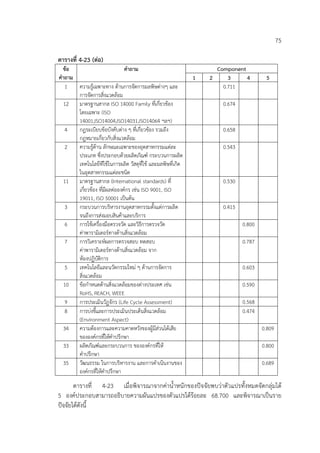
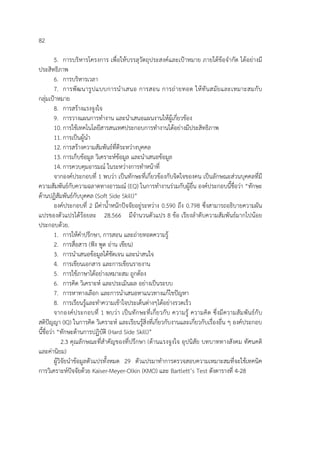
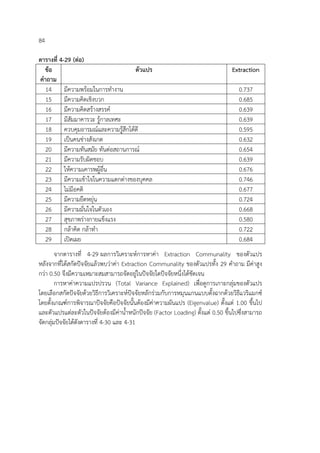
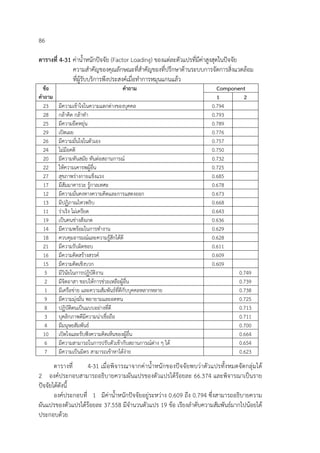
services. The exploratory factor analysis (EFA) used for setting the potential model
shows that all elements demonstrate the variance value of more than 1. The main
6.
จ
elements can becategorized into 5 aspects with 32 factors: (1) knowledge of 5
elements (2) skills of 2 elements (3) characteristics of 2 elements (4) ethics of 1
element (5) development technique of 2 elements. The potential development
handbook is later formed and tried with 32 industrial environmental management
system consultants in which the result shows that they gain knowledge at a
statistical significant level of .05.
(Total 257 pages)
Keywords : Environmental Management System, Consultant, Potential
Advisor
116
ภาษาอังกฤษ
Arnauld de Nadaillac.(2003). [online]. The definition of competencies. [cited 2017
January 10]. Available from : URL : http://competency.rmutp.ac.th
Boyatzis, R.E. (1982). The Competent Manager: A model for Effective Performance.
New York : John Wiley & Sons.
Comrey, A.L. and Lee, H.B. (1992). A First Course in Factor Analysis. 2nd
ed.
Hillsdale, NJ : Lawrence Erlbaum.
Cronbach, Lee J. (1990). Essentials of psychology Testing. 3rd
ed. NewYork : Harper
& Row Publishers.
David Biggs. (2010). Management Consulting A Guide for Students. Croatia : Thomas
Rennie.
Dubois, D. and Rothwell, W.J. (2004). Competency-Based Human Resource
Management. California : Davies-Black Publishing.
Howell, M.T. (2015). The Results Facilitator Expert, Manager, Mentor. Newyork : CRC
Press Taylor& Francis Group an informa business.
ISO 14001. (2015). Environmental management systems-Requirements with
guidance for use.
ISO 10019. (2005). Guidelines for the selection of quality management system
consultants and use of their services.
Jones, J.W., et al. (1981). [online]. Potential benefits of climate forecasting to
agriculture. [cited 2017 April 2]. Available from : URL :
http://www.researchgate.net/...Potential.../09e41510c29e85d9bf0.
Kaiser, H. and Rice, J. (1974l). “Little Jiffy, Mark IV.” Journal of Educational and
Psychological Measurement. 34 : 111-117.
Kaplan, R.S. and Norton, D.P. (2004). Strategy MAPS : Converting Intangible Asset into
Tangible Outcome. New York: Harvard Business School.
Knowles, M.S. (1978). The Adult Learner: A Neglected Species. 2nd
ed. Houston,
Teas : Gulf Publishing Co.
Knowles, M.S., Holton, E.G. and Swanson, R.A. (1998). The adult learner: The
definitive classic in adult education and human resources development.
Houston, TX : Gulf Publishing Company.
Leonard Nadler. (1970). Feveloping Human Resources. Houston : Gulf.
Likert, R. (1932). “A technique for the measurement of attitudes.” Archives of
Psychology. Vol.22 No.140 : 1-55.
Longman Dictionary of Contemporary English. (2003). The Living Dictionary.
England : Pearson Education.
127.
117
McClelland, D. (1973).“Testing for Competency Rather than for Intelligence.”
American Psychologist. 28 (1) : 1-14.
Randy, L.D., Jon, M.W. and David, M.H. (2002). Human Resource Development.
Harcourt College Publishers
Raymond, A. Noe. (2017). Employee Training and Development. 7th
ed. New York :
McGraw-Hill Education International.
Richard, E.B. (1982). The Competent Manager: A Model for Effective Performance.
Canada : A Wiley-Interscience Publication.
Shafritz and Rosenbloom. (1998). Personnel Management in Government. 5th
ed. ]
New York : Marcel Dekker AG.
Spencer, L.M. and Spencer, S.M. (1993). Competence at Work: Models for Superior
Performance. Newyork : John Wiley & Sons.
Swanson, R.A. (1995). “Human Resource Development: Performance Is the Key.”
Human Resource Quarterly. 6(2) : 207-213.
Woodruffe, C. (1992). What is Meant by a Competency. London : McGraw-Hill.
189
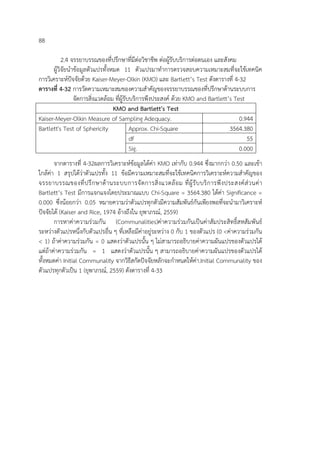
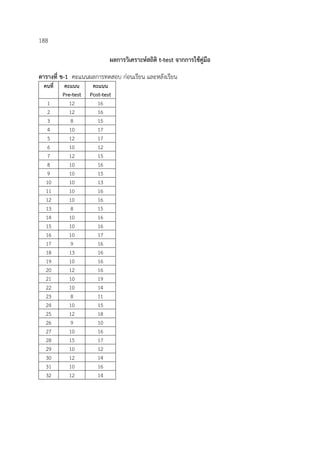
ผลการวิเคราะห์ t-test
t-Test: PairedTwo Sample forMeans
post test pre test
Mean 15.25 10.5
Variance 3.806 2.323
Observations 32 32
Pearson Correlation 0.358019505
Hypothesized Mean Difference 0
df 31
t Stat 13.435029
P(T<=t) one-tail 0.000000
t Critical one-tail 1.695519
P(T<=t) two-tail 0.000000
t Critical two-tail 2.039513







































![113
บรรณานุกรม
กรมพัฒนาธุรกิจการค้า. (2547). [ออนไลน์]. รายงานสรุปโครงการศึกษาวิจัยการพัฒนาธุรกิจ
บริการสู่ตลาดโลก-ธุรกิจการให้คําปรึกษา. [สืบค้นวันที่ 1 มกราคม 2560].
จาก https://www.dbd.go.th/download/doc/5summary_of_research.doc
กมลรัตน์ หล้าสุวงษ์. (2524). จิตวิทยาการศึกษา. กรุงเทพฯ : คณะศึกษาศาสตร์ มหาวิทยาลัย
ศรีนครินวิโรฒ ประสานมิตร.
จิรประภา อัครบวร. (2557). “การศึกษาเปรียบเทียบแนวโน้มงานทรัพยากรมนุษย์ในประเทศ
อาเซียนปี พ.ศ. 2557-2558.” วารสารพัฒนาทรัพยากรมนุษย์และองค์การ (HROD
Journal). ฉบับที่ 2 (กรกฎาคม-ธันวาคม).
จิรพันธ์ นันศรี. (2553). มาตรการทางกฎหมายในการจํากัดการใช้สารอันตรายบางชนิดใน
ผลิตภัณฑ์ไฟฟ้าและอิเล็คทรอนิกส์. วิทยานิพนธ์นิติศาสตรมหาบัณฑิต สาขาวิชากฎหมาย
ธุรกิจ บัณฑิตวิทยาลัย มหาวิทยาลัยศรีปทุม.
ชนกานต์ แก้วเข้ม. (2544). ศักยภาพของโรงงานอุตสาหกรรม ซึ่งได้รับการรับรอง ISO 14001 ใน
การรักษาระบบการ จัดการสิ่งแวดล้อม. วิทยานิพนธ์วิทยาศาสตรมหาบัณฑิต สาขาวิชา
เทคโนโลยีที่เหมาะสมเพื่อการพัฒนาทรัพยากร มหาวิทยาลัยมหิดล.
ชนนทร์ จิตต์โกมุท. (2545). ปัจจัยที่มีอิทธิพลต่อความต้องการมาตรฐานการบริหารงานคุณภาพ
ISO 9000 และมาตรฐาน การจัดการสิ่งแวดล้อม ISO 14001 ของโรงงานภายใต้ความ
รับผิดชอบของการนิคมอุตสาหกรรม แห่งประเทศไทย. วิทยานิพนธ์วิทยาศาสตร
มหาบัณฑิต สาขาวิชาการวางแผนสิ่งแวดล้อมเพื่อพัฒนาชุมชนและชนบท
มหาวิทยาลัยมหิดล.
เชิดชัย สมบัติโยธา. (2554). ปัญหาอุปสรรคของการจัดทําระบบมาตรฐานการจัดการสิ่งแวดล้อม
กรณีศึกษา:โครงการฝึกอบรมและให้คําปรึกษาแนะนําการจัดทําระบบการจัดการ
สิ่งแวดล้อมตาม ISO 14001. วิทยานิพนธ์วิทยาศาสตรมหาบัณฑิต สาขาวิชาเทคโนโลยี
การบริหารสิ่งแวดล้อม บัณฑิตวิทยาลัย มหาวิทยาลัยมหิดล.
ธันย์ รวีสวัสดิ์. (2548). ปัจจัยที่มีผลต่อการนําระบบมาตรฐานการจัดการสิ่งแวดล้อม ISO 14001
ไปประยุกต์ใช้กับอุตสาหกรรมการผลิตอาหารในกลุ่มธุรกิจ SMEs ในเขตกรุงเทพและ
ปริมณฑล. วิทยานิพนธ์วิทยาศาสตรมหาบัณฑิต สาขาวิชาการวางแผนสิ่งแวดล้อมเพื่อ
พัฒนาชุมชนและชนบท บัณฑิตวิทยาลัย มหาวิทยาลัยมหิดล.
ธํารงรัตน์ มุ่งเจริญ. (2554). “วิศวกรรมการป้องกันมลพิษในประเทศไทย.” วิศวกรรมสาร มก.
ปีที่ 75 : 13-24.
เนื้อทิพย์ สุวรรณภาณุ. (2546). การพัฒนาบุคลากรเพื่อเข้าสู่ระบบมาตรฐานการจัดการสิ่งแวดล้อม
ISO 14001. วิทยานิพนธ์ศึกษาศาสตรมหาบัณฑิต สาขาวิชาสิ่งแวดล้อมศึกษา
บัณฑิตวิทยาลัย มหาวิทยาลัยมหิดล.](https://image.slidesharecdn.com/b16196867-200324085020/85/slide-123-320.jpg)

![115
วารี กุนาคํา. (2557). ปัจจัยที่ส่งผลต่อการจัดการสิ่งแวดล้อมตามมาตรฐาน ISO 14001:2004 ใน
โรงงานผลิตสีอุตสาหกรรมเฟส 8 นิคมอุตสาหกรรมอมตะนคร จังหวัดชลบุรี. วิทยานิพนธ์
บริหารธุรกิจมหาบัณฑิต สาขาวิชาบริหารธุรกิจอุตสาหกรรม วิทยาลัยการบริหารและ
จัดการ สถาบันเทคโนโลยีพระจอมเกล้าเจ้าคุณทหารลาดกระบัง.
วิชุกร กุหลาบศรี. (2541). การปรับตัวขององค์การส่งเสริมการท่องเที่ยวแห่งประเทศไทย (ททท.)
สํานักงานภาคใต้ในปีการท่องเที่ยว 2541-2542. วิทยานิพนธ์ศิลปศาสตรมหาบัณฑิต
สาขาวิชาการวิเคราะห์และวางแผนทางสังคม สถาบันบัณฑิตพัฒนบริหารศาสตร์.
สถาบันสิ่งแวดล้อมไทย. (2556). [ออนไลน์]. สัมมนาวิชาการ 20ปี TEI กับทศวรรษหน้า. [สืบค้น
วันที่ 1 กันยายน 2560]. จาก http://www.tei.or.th/publications/annualreport
สํานักงานคณะกรรมการวิจัยแห่งชาติ. (2556). [ออนไลน์]. ยุทธศาสตร์การวิจัยรายประเด็นด้าน
สิ่งแวดล้อม (พ.ศ. ๒๕๕๖–๒๕๕๙). [สืบค้นวันที่ 10 กันยายน 2560]. จาก
http://www.nrct.go.th/ภาพรวมการวิจัยของประเทศ
สํานักงานปลัดกระทรวงอุตสาหกรรม. (2557). แผนยุทธศาสตร์กระทรวงอุตสาหกรรม พ.ศ. 2559-
2564. กรุงเทพฯ : กระทรวงอุตสาหกรรม.
สํานักงานส่งเสริมและพัฒนาอุตสาหกรรมสีเขียว. (2556). คู่มืออุตสาหกรรมสีเขียวสําหรับ
ผู้ประกอบการ. พิมพ์ครั้งที่ 4. กรุงเทพฯ : สํานักงานปลัดกระทรวงอุตสาหกรรม.
สํานักพัฒนาหน่วยบริการอุตสาหกรรม. [2556]. [วารสารออนไลน์]. “คู่มือสมรรถนะที่ปรึกษา
รายบุคคลประจําปี พ.ศ. 2555.” [สืบค้นวันที่ 1 สิงหาคม 2560]. จาก
http://www.thaisp.org/
สุมิตตา สว่างทุกข์. (2553). รูปแบบการพัฒนาศักยภาพการคิดตามแนวคิดจิตทั้ง 5 ของการ์ดเนอร์
สําหรับนักศึกษาพยาบาล. วิทยานิพนธ์ครุศาสตรดุษฏีบัณฑิต สาขาวิชาอุดมศึกษา
ภาควิชานโยบายการจัดการและความเป็นผู้นําทางการศึกษา คณะครุศาสตร์ จุฬาลงกรณ์
มหาวิทยาลัย.
ศักดิ์ไทย สุรกิจบวร. (2557). “สมรรถนะสําคัญของผู้บริหารมืออาชีพ.” วารสารมหาวิทยาลัย
ราชภัฏสกลนคร. ปีที่ 6 ฉบับที่ 12 : 165-183.
ศิริพงษ์ ลดาวัลย์ ณ อยุธยา. (2550). การบริหารงานคุณภาพ. พิมพ์ครั้งที่ 1. เชียงใหม่ :
ธนุชพรินติ้ง.
อนุวัต สถิรศานต์. (2548). แผนยุทธศาสตร์การพัฒนาทรัพยากรบุคคลด้านสิ่งแวดล้อม กรณีศึกษา
กรมควบคุมมลพิษ. วิทยานิพนธ์วิทยาศาสตรมหาบัณฑิต สาขาวิชาการจัดการสิ่งแวดล้อม
สถาบันบัณฑิตพัฒนบริหารศาสตร์.
อาภรณ์ ภู่วิทยพันธุ์. (2551). พจนานุกรมพฤติกรรมความสามารถ. พิมพ์ครั้งที่ 2. กรุงเทพฯ :
พิมพ์ดีการพิมพ์
อลงกรณ์ อินทรทูต และจุฑารัตน์ ชมพันธ์. (2558). “ปัจจัยที่ส่งผลต่อการดําเนินงานระบบการ
จัดการสิ่งแวดล้อม (ISO 14001) ของอุตสาหกรรมปิโตรเคมี : กรณีศึกษา บริษัทไออาร์พีซี
จํากัด (มหาชน).” วารสารดุษฎีบัณฑิตทางสังคมศาสตร์. ปีที่ 5 ฉบับที่ 2 : 14-28.](https://image.slidesharecdn.com/b16196867-200324085020/85/slide-125-320.jpg)
![116
ภาษาอังกฤษ
Arnauld de Nadaillac. (2003). [online]. The definition of competencies. [cited 2017
January 10]. Available from : URL : http://competency.rmutp.ac.th
Boyatzis, R.E. (1982). The Competent Manager: A model for Effective Performance.
New York : John Wiley & Sons.
Comrey, A.L. and Lee, H.B. (1992). A First Course in Factor Analysis. 2nd
ed.
Hillsdale, NJ : Lawrence Erlbaum.
Cronbach, Lee J. (1990). Essentials of psychology Testing. 3rd
ed. NewYork : Harper
& Row Publishers.
David Biggs. (2010). Management Consulting A Guide for Students. Croatia : Thomas
Rennie.
Dubois, D. and Rothwell, W.J. (2004). Competency-Based Human Resource
Management. California : Davies-Black Publishing.
Howell, M.T. (2015). The Results Facilitator Expert, Manager, Mentor. Newyork : CRC
Press Taylor& Francis Group an informa business.
ISO 14001. (2015). Environmental management systems-Requirements with
guidance for use.
ISO 10019. (2005). Guidelines for the selection of quality management system
consultants and use of their services.
Jones, J.W., et al. (1981). [online]. Potential benefits of climate forecasting to
agriculture. [cited 2017 April 2]. Available from : URL :
http://www.researchgate.net/...Potential.../09e41510c29e85d9bf0.
Kaiser, H. and Rice, J. (1974l). “Little Jiffy, Mark IV.” Journal of Educational and
Psychological Measurement. 34 : 111-117.
Kaplan, R.S. and Norton, D.P. (2004). Strategy MAPS : Converting Intangible Asset into
Tangible Outcome. New York: Harvard Business School.
Knowles, M.S. (1978). The Adult Learner: A Neglected Species. 2nd
ed. Houston,
Teas : Gulf Publishing Co.
Knowles, M.S., Holton, E.G. and Swanson, R.A. (1998). The adult learner: The
definitive classic in adult education and human resources development.
Houston, TX : Gulf Publishing Company.
Leonard Nadler. (1970). Feveloping Human Resources. Houston : Gulf.
Likert, R. (1932). “A technique for the measurement of attitudes.” Archives of
Psychology. Vol.22 No.140 : 1-55.
Longman Dictionary of Contemporary English. (2003). The Living Dictionary.
England : Pearson Education.](https://image.slidesharecdn.com/b16196867-200324085020/85/slide-126-320.jpg)
![117
McClelland, D. (1973). “Testing for Competency Rather than for Intelligence.”
American Psychologist. 28 (1) : 1-14.
Randy, L.D., Jon, M.W. and David, M.H. (2002). Human Resource Development.
Harcourt College Publishers
Raymond, A. Noe. (2017). Employee Training and Development. 7th
ed. New York :
McGraw-Hill Education International.
Richard, E.B. (1982). The Competent Manager: A Model for Effective Performance.
Canada : A Wiley-Interscience Publication.
Shafritz and Rosenbloom. (1998). Personnel Management in Government. 5th
ed. ]
New York : Marcel Dekker AG.
Spencer, L.M. and Spencer, S.M. (1993). Competence at Work: Models for Superior
Performance. Newyork : John Wiley & Sons.
Swanson, R.A. (1995). “Human Resource Development: Performance Is the Key.”
Human Resource Quarterly. 6(2) : 207-213.
Woodruffe, C. (1992). What is Meant by a Competency. London : McGraw-Hill.](https://image.slidesharecdn.com/b16196867-200324085020/85/slide-127-320.jpg)


![125
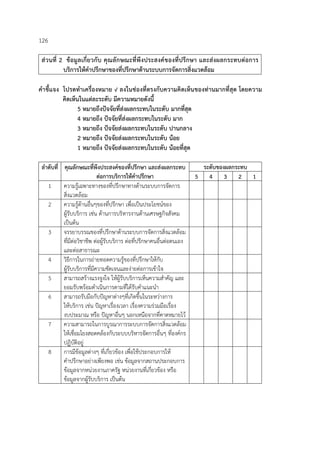
ส่วนที่ 1 ข้อมูลเกี่ยวกับผู้ตอบแบบสอบถาม
คําชี้แจง โปรดทําเครื่องหมาย √ ลงในกล่องหน้าข้อความ หรือ เติมข้อความลงใน……….. ที่ตรง
กับสภาพความเป็นจริงของผู้ตอบ
18. เพศ
[ ] ชาย [ ] หญิง
19. อายุ
[ ] ต่ํากว่า 35 [ ] 35-45 ปี
[ ] 46-55 ปี [ ] มากกว่า 55 ปี
20. วุฒิการศึกษาสูงสุด
[ ] ต่ํากว่าปริญญาตรี [ ] ปริญญาตรี
[ ] ปริญญาโท [ ] ปริญญาเอก
21. ตําแหน่ง
………………………………………………………………………………………………..
22. ประสบการณ์ทํางาน
[ ] น้อยกว่า 5 ปี [ ] 5 ปี แต่ไม่เกิน 10 ปี
[ ] 10 ปี แต่ไม่เกิน 15 ปี [ ] มากกว่า 15 ปี
23. ประสบการณ์ ในการจัดทําระบบบริหารจัดการสิ่งแวดล้อม
[ ] น้อยกว่า 5 ปี [ ] 5 ปี แต่ไม่เกิน 10 ปี
[ ] 10 ปี แต่ไม่เกิน 15 ปี [ ] มากกว่า 15 ปี](https://image.slidesharecdn.com/b16196867-200324085020/85/slide-134-320.jpg)




![135
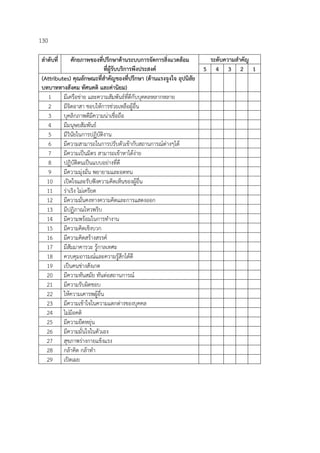
ส่วนที่ 1 ข้อมูลเกี่ยวกับผู้ตอบแบบสอบถาม
ส่วนที่ 1 ข้อมูลทั่วไปของผู้ตอบแบบสอบถาม ความเห็นของผู้เชี่ยวชาญ
โปรดทําเครื่องหมาย✓ลงในช่องเหมาะสมและหากไม่เหมาะสม
กรุณาเขียนข้อคิดเห็นเพื่อปรับปรุง
เหมาะสม ควรปรับปรุง
1. เพศ [ ] ชาย [ ] หญิง
2. อายุ [ ] ต่ํากว่า 35 ปี [ ] 35 – 40 ปี
[ ] 46 – 55 ปี [ ] มากกว่า 55 ปี
3. วุฒิการศึกษา [ ] ต่ํากว่าปริญญาตรี [ ] ปริญญาตรี
[ ] ปริญญาโท [ ] ปริญญาเอก
4. ตําแหน่ง ...............................................
5. ประสบการณ์การทํางาน
[ ] น้อยกว่า 5 ปี [ ] 5 ปี แต่ไม่เกิน 10 ปี
[ ] 10 ปี แต่ไม่เกิน 15 ปี [ ] มากกว่า 15 ปี
6. ประสบการณ์ ในการจัดทําระบบบริหารจัดการสิ่งแวดล้อม
[ ] น้อยกว่า 5 ปี [ ] 5 ปี แต่ไม่เกิน 10 ปี
[ ] 10 ปี แต่ไม่เกิน 15 ปี [ ] มากกว่า 15 ปี](https://image.slidesharecdn.com/b16196867-200324085020/85/slide-144-320.jpg)








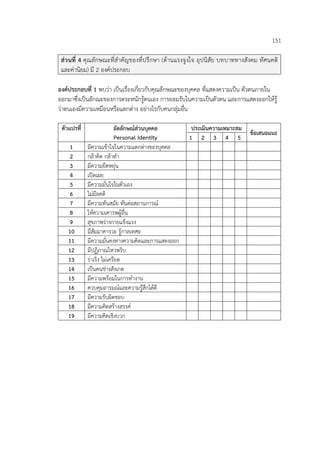
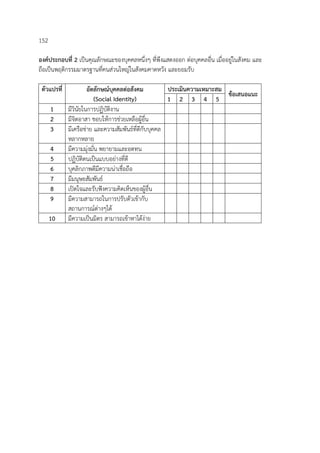


![160
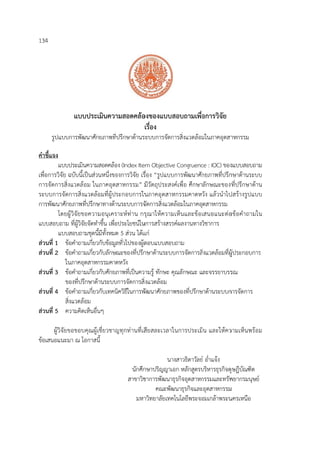
การประเมินค่าความสอดคล้อง (IOC) ของแบบสอบถามเพื่อการวิจัย
เรื่อง
รูปแบบการพัฒนาศักยภาพที่ปรึกษาด้านระบบการจัดการสิ่งแวดล้อมในภาคอุตสาหกรรม
ส่วนที่ 1 ข้อมูลเกี่ยวกับผู้ตอบแบบสอบถาม
ส่วนที่ 1 ข้อมูลทั่วไปของผู้ตอบแบบสอบถาม ความเห็นของผู้เชี่ยวชาญ
โปรดทําเครื่องหมาย✓ลงในช่องเหมาะสมและหากไม่เหมาะสม
กรุณาเขียนข้อคิดเห็นเพื่อปรับปรุง
เหมาะสม ควรปรับปรุง
1. เพศ [ ] ชาย [ ] หญิง ////
2. อายุ [ ] ต่ํากว่า 35 ปี [ ]35 – 40 ปี
[ ] 46 – 55 ปี [ ] มากกว่า 55 ปี
////
3. วุฒิการศึกษา [ ] ต่ํากว่าปริญญาตรี [ ] ปริญญาตรี
[ ] ปริญญาโท [ ] ปริญญาเอก
////
4. ตําแหน่ง ............................................... ////
5. ประสบการณ์การทํางาน
[ ] น้อยกว่า 5 ปี [ ] 5 ปี แต่ไม่เกิน 10 ปี
[ ] 10 ปี แต่ไม่เกิน 15 ปี[ ] มากกว่า 15 ปี
////
6. ประสบการณ์ ในการจัดทําระบบบริหารจัดการสิ่งแวดล้อม
[ ] น้อยกว่า 5 ปี [ ] 5 ปี แต่ไม่เกิน 10 ปี
[ ] 10 ปี แต่ไม่เกิน 15 ปี [ ] มากกว่า 15 ปี
////](https://image.slidesharecdn.com/b16196867-200324085020/85/slide-168-320.jpg)


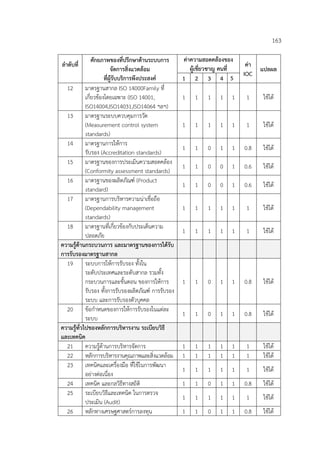


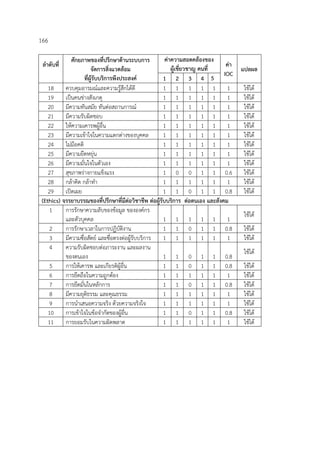

![168
ผลการวิเคราะห์ข้อมูลจากการทํา Try Out แบบสอบถามเพื่อการวิจัย
เรื่อง
รูปแบบการพัฒนาศักยภาพที่ปรึกษาด้านระบบการจัดการสิ่งแวดล้อม ในภาคอุตสาหกรรม
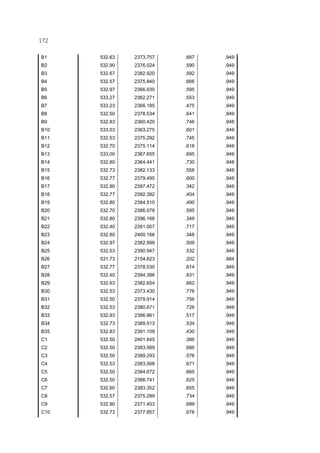
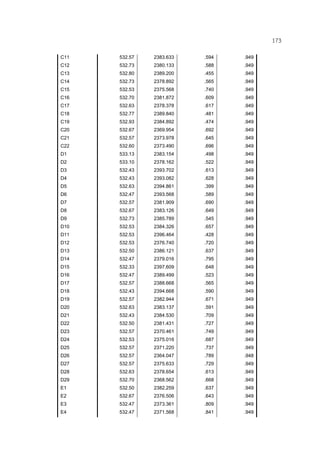
RELIABILITY
/VARIABLES=A1 A2 A3 A4 A5 A6 A7 A8 B1 B2 B3 B4 B5 B6 B7 B8 B9 B10 B11 B12
B13 B14 B15 B16 B17 B18 B19 B20 B21 B22 B23 B24 B25 B26 B27 B28 B29 B30 B31
B32 B33 B34 B35 C1 C2 C3 C4 C5 C6 C7 C8 C9 C10 C11 C12 C13 C14 C15 C16 C17
C18 C19 C20 C21 C22 D1 D2 D3
D4 D5 D6 D7 D8 D9 D10 D11 D12 D13 D14 D15 D16 D17 D18 D19 D20 D21 D22 D23
D24 D25 D26 D27 D28 D29 E1 E2 E3 E4 E5 E6 E7 E8 E9 E10 E11 F1 F2 F3 F4 F5 F6
F7 F8 F9 F10 F11 F12 F13 F14
/SCALE('ALL VARIABLES') ALL
/MODEL=ALPHA
/STATISTICS=DESCRIPTIVE SCALE
/SUMMARY=TOTAL.
Reliability
[DataSet1] C:UsersAdministrator.Eof201510011746DesktopNew
folderDATA30.sav
Scale: ALL VARIABLES
Case Processing Summary
N %
Cases Valid 30 100.0
Excluded
a
0 0.0
Total 30 100.0
a. Listwise deletion based on all variables in the procedure.
Reliability Statistics
Cronbach's
Alpha N of Items
.949 119](https://image.slidesharecdn.com/b16196867-200324085020/85/slide-176-320.jpg)
































![Requirement iso 140012015[1] (4) training](https://cdn.slidesharecdn.com/ss_thumbnails/requirementiso14001201514training-190925063657-thumbnail.jpg?width=640&height=640&fit=bounds)


