Wichita MS4 Program: “Unifying
watershed management through
an Off-site BMP Implementation
Program”
Ron Graber & Trisha Moore
Kansas State University
Spring Stormwater Symposium
March 8, 2017
Storm Water Advisory Board
formed November 2011
 Greg Allison, PE (Appointed by: City Manager)
 Richard Basore - Ex-Officio KDHE Member
 Chris Bohm, PE (Appointed by: Wichita Area Builders Assoc.)
 Don Kirkland (Appointed by: Wichita Chapter KS Society of
Professional Engineers)
 Hoyt Hillman (Appointed by: Sierra Club/WRAPS)
 David Leyh (Appointed by: Wichita Area Assoc. of Realtors)
 Mitch Mitchell (Appointed by: Sedgwick County Stormwater
Advisory Board)
 Gary Oborny (Appointed by: Kansas CCIM)
 Joe Pajor, (Appointed by: City of Wichita Public Works & Utilities)
 Jim Weber, PE (Appointed by: Sedgwick County Public Works)
Storm Water Advisory Board
Purpose and Duties
 Advise City Council and staff on storm water
management policy
 Review proposed changes to manuals
 Comment on matters forwarded by
the Director of Public Works
 To frame our actions in conformance with the
MS4 permit and EPA
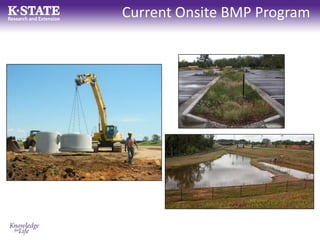
Current Onsite BMP Program
 Stormwater discharge from City of Wichita, KS
regulated by MS4 permit (MS4 = Municipal Separated Storm
Sewer)
 Permit includes requirement to address TMDLs
within MS4 area
 Development and redevelopment required to meet
water quality treatment (> 1 acre)
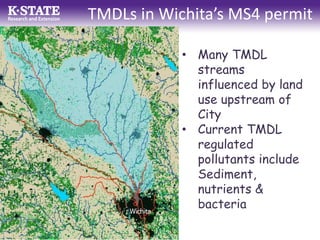
TMDLs in Wichita’s MS4 permit
• Many TMDL
streams
influenced by land
use upstream of
City
• Current TMDL
regulated
pollutants include
Sediment,
nutrients &
bacteria
How its done Currently
Current Onsite BMP Program
Storm Water Advisory Board
 Substantial onsite expense involved
 What if the SWAB could find a cheaper
method?
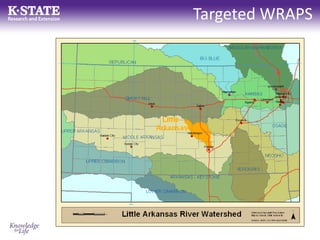
WRAPS
Targeted WRAPS
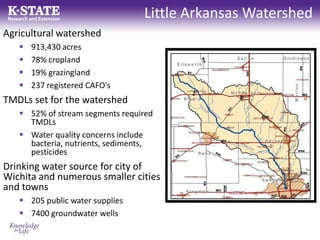
Little Arkansas Watershed
Agricultural watershed
 913,430 acres
 78% cropland
 19% grazingland
 237 registered CAFO’s
TMDLs set for the watershed
 52% of stream segments required
TMDLs
 Water quality concerns include
bacteria, nutrients, sediments,
pesticides
Drinking water source for city of
Wichita and numerous smaller cities
and towns
 205 public water supplies
 7400 groundwater wells
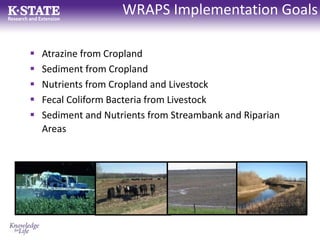
WRAPS Implementation Goals
 Atrazine from Cropland
 Sediment from Cropland
 Nutrients from Cropland and Livestock
 Fecal Coliform Bacteria from Livestock
 Sediment and Nutrients from Streambank and Riparian
Areas
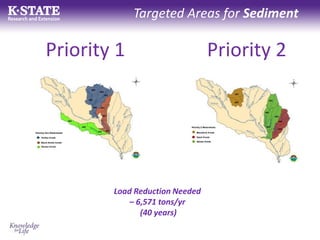
Targeted Areas for Sediment
Load Reduction Needed
– 6,571 tons/yr
(40 years)
Priority 1 Priority 2
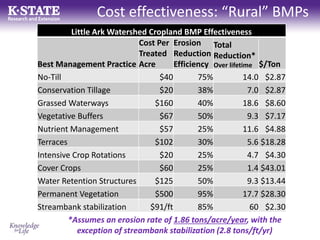
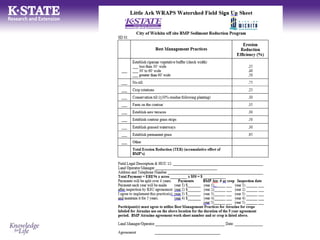
Cost effectiveness: “Rural” BMPs
Little Ark Watershed Cropland BMP Effectiveness
Best Management Practice
Cost Per
Treated
Acre
Erosion
Reduction
Efficiency
Total
Reduction*
Over lifetime $/Ton
No-Till $40 75% 14.0 $2.87
Conservation Tillage $20 38% 7.0 $2.87
Grassed Waterways $160 40% 18.6 $8.60
Vegetative Buffers $67 50% 9.3 $7.17
Nutrient Management $57 25% 11.6 $4.88
Terraces $102 30% 5.6 $18.28
Intensive Crop Rotations $20 25% 4.7 $4.30
Cover Crops $60 25% 1.4 $43.01
Water Retention Structures $125 50% 9.3 $13.44
Permanent Vegetation $500 95% 17.7 $28.30
Streambank stabilization $91/ft 85% 60 $2.30
*Assumes an erosion rate of 1.86 tons/acre/year, with the
exception of streambank stabilization (2.8 tons/ft/yr)
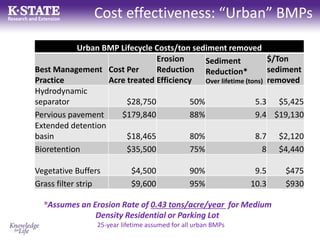
Cost effectiveness: “Urban” BMPs
Urban BMP Lifecycle Costs/ton sediment removed
Best Management
Practice
Cost Per
Acre treated
Erosion
Reduction
Efficiency
Sediment
Reduction*
Over lifetime (tons)
$/Ton
sediment
removed
Hydrodynamic
separator $28,750 50% 5.3 $5,425
Pervious pavement $179,840 88% 9.4 $19,130
Extended detention
basin $18,465 80% 8.7 $2,120
Bioretention $35,500 75% 8 $4,440
Vegetative Buffers $4,500 90% 9.5 $475
Grass filter strip $9,600 95% 10.3 $930
*Assumes an Erosion Rate of 0.43 tons/acre/year for Medium
Density Residential or Parking Lot
25-year lifetime assumed for all urban BMPs
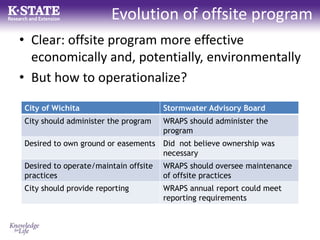
Evolution of offsite program
• Clear: offsite program more effective
economically and, potentially, environmentally
• But how to operationalize?
City of Wichita Stormwater Advisory Board
City should administer the program WRAPS should administer the
program
Desired to own ground or easements Did not believe ownership was
necessary
Desired to operate/maintain offsite
practices
WRAPS should oversee maintenance
of offsite practices
City should provide reporting WRAPS annual report could meet
reporting requirements
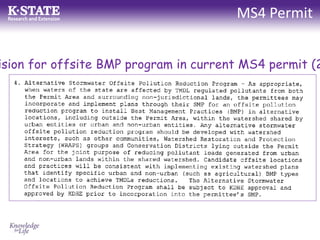
MS4 Permit
ision for offsite BMP program in current MS4 permit (2
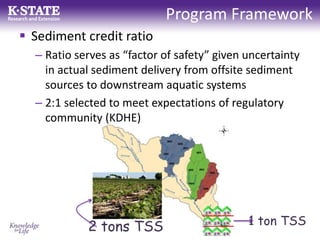
Program Framework
 Sediment credit ratio
– Ratio serves as “factor of safety” given uncertainty
in actual sediment delivery from offsite sediment
sources to downstream aquatic systems
– 2:1 selected to meet expectations of regulatory
community (KDHE)
1 ton TSS2 tons TSS
Program framework
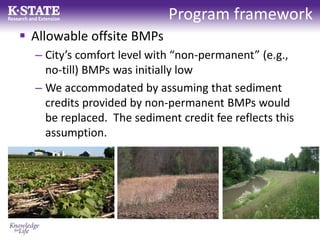
 Allowable offsite BMPs
– City’s comfort level with “non-permanent” (e.g.,
no-till) BMPs was initially low
– We accommodated by assuming that sediment
credits provided by non-permanent BMPs would
be replaced. The sediment credit fee reflects this
assumption.
Program framework
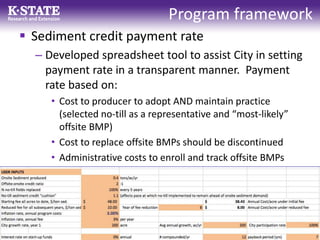
 Sediment credit payment rate
– Developed spreadsheet tool to assist City in setting
payment rate in a transparent manner. Payment
rate based on:
• Cost to producer to adopt AND maintain practice
(selected no-till as a representative and “most-likely”
offsite BMP)
• Cost to replace offsite BMPs should be discontinued
• Administrative costs to enroll and track offsite BMPs
Program Framework
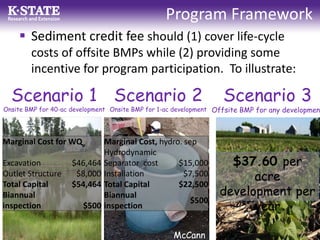
 Sediment credit fee should (1) cover life-cycle
costs of offsite BMPs while (2) providing some
incentive for program participation. To illustrate:
McCann
Scenario 1
Onsite BMP for 40-ac development
Scenario 2
Onsite BMP for 1-ac development
Scenario 3
Offsite BMP for any developmen
Marginal Cost for WQv
Excavation $46,464
Outlet Structure $8,000
Total Capital $54,464
Biannual
inspection $500
Marginal Cost, hydro. sep
Hydrodynamic
Separator cost $15,000
Installation $7,500
Total Capital $22,500
Biannual
inspection
$500
$37.60 per
acre
development per
year
Program framework
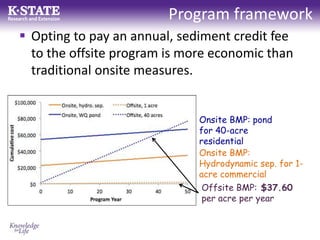
 Opting to pay an annual, sediment credit fee
to the offsite program is more economic than
traditional onsite measures.
Onsite BMP: pond
for 40-acre
residential
Onsite BMP:
Hydrodynamic sep. for 1-
acre commercial
Offsite BMP: $37.60
per acre per year
MS4 NPDES Permit Requirements
 July 2014: MS4 permit issued for the City of Wichita now
requires the City to manage post-construction stormwater
runoff quality
 Permitted Post-construction stormwater management options
include:
– On-site stormwater quality BMPs (traditional approach)
– Off-site stormwater program
 KDHE continues to emphasize the MS4 Permittee should
develop a Stormwater Management Program which works for
their location and circumstances
MS4: Municipal Separated Storm Sewer System
NPDES: Non-Point Discharge Elimination System
BMP: Best Management Practice
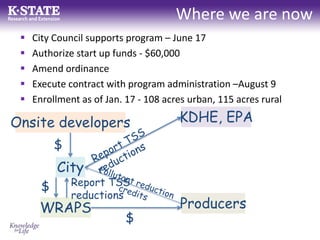
Where we are now
 City Council supports program – June 17
 Authorize start up funds - $60,000
 Amend ordinance
 Execute contract with program administration –August 9
 Enrollment as of Jan. 17 - 108 acres urban, 115 acres rural
Onsite developers
City
WRAPS Producers
KDHE, EPA
$
$
$
Report TSS
reductions
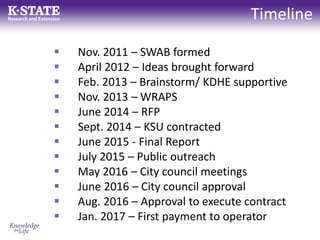
Timeline
 Nov. 2011 – SWAB formed
 April 2012 – Ideas brought forward
 Feb. 2013 – Brainstorm/ KDHE supportive
 Nov. 2013 – WRAPS
 June 2014 – RFP
 Sept. 2014 – KSU contracted
 June 2015 - Final Report
 July 2015 – Public outreach
 May 2016 – City council meetings
 June 2016 – City council approval
 Aug. 2016 – Approval to execute contract
 Jan. 2017 – First payment to operator
What does it take?
 Stakeholder buy-in (education)
– KDHE, City of Wichita, Sedgwick County,
development community
 Watershed “champion”
– WRAPS – prioritize watershed efforts,
landowner/producer relationships
 Monitoring
– Assess changes in eco service provision & adapt as
necessary
Ron Graber
Watershed Specialist
rgraber@ksu.edu
Trisha Moore
Bio & Ag Engineering
tlcmoore@ksu.edu

Off-Site BMP Implementation Program

  • 1.
    Wichita MS4 Program:“Unifying watershed management through an Off-site BMP Implementation Program” Ron Graber & Trisha Moore Kansas State University Spring Stormwater Symposium March 8, 2017
  • 2.
    Storm Water AdvisoryBoard formed November 2011  Greg Allison, PE (Appointed by: City Manager)  Richard Basore - Ex-Officio KDHE Member  Chris Bohm, PE (Appointed by: Wichita Area Builders Assoc.)  Don Kirkland (Appointed by: Wichita Chapter KS Society of Professional Engineers)  Hoyt Hillman (Appointed by: Sierra Club/WRAPS)  David Leyh (Appointed by: Wichita Area Assoc. of Realtors)  Mitch Mitchell (Appointed by: Sedgwick County Stormwater Advisory Board)  Gary Oborny (Appointed by: Kansas CCIM)  Joe Pajor, (Appointed by: City of Wichita Public Works & Utilities)  Jim Weber, PE (Appointed by: Sedgwick County Public Works)
  • 3.
    Storm Water AdvisoryBoard Purpose and Duties  Advise City Council and staff on storm water management policy  Review proposed changes to manuals  Comment on matters forwarded by the Director of Public Works  To frame our actions in conformance with the MS4 permit and EPA
  • 4.
    Current Onsite BMPProgram  Stormwater discharge from City of Wichita, KS regulated by MS4 permit (MS4 = Municipal Separated Storm Sewer)  Permit includes requirement to address TMDLs within MS4 area  Development and redevelopment required to meet water quality treatment (> 1 acre)
  • 5.
    TMDLs in Wichita’sMS4 permit • Many TMDL streams influenced by land use upstream of City • Current TMDL regulated pollutants include Sediment, nutrients & bacteria
  • 6.
    How its doneCurrently Current Onsite BMP Program
  • 7.
    Storm Water AdvisoryBoard  Substantial onsite expense involved  What if the SWAB could find a cheaper method?
  • 8.
  • 9.
  • 10.
    Little Arkansas Watershed Agriculturalwatershed  913,430 acres  78% cropland  19% grazingland  237 registered CAFO’s TMDLs set for the watershed  52% of stream segments required TMDLs  Water quality concerns include bacteria, nutrients, sediments, pesticides Drinking water source for city of Wichita and numerous smaller cities and towns  205 public water supplies  7400 groundwater wells
  • 11.
    WRAPS Implementation Goals Atrazine from Cropland  Sediment from Cropland  Nutrients from Cropland and Livestock  Fecal Coliform Bacteria from Livestock  Sediment and Nutrients from Streambank and Riparian Areas
  • 12.
    Targeted Areas forSediment Load Reduction Needed – 6,571 tons/yr (40 years) Priority 1 Priority 2
  • 13.
    Cost effectiveness: “Rural”BMPs Little Ark Watershed Cropland BMP Effectiveness Best Management Practice Cost Per Treated Acre Erosion Reduction Efficiency Total Reduction* Over lifetime $/Ton No-Till $40 75% 14.0 $2.87 Conservation Tillage $20 38% 7.0 $2.87 Grassed Waterways $160 40% 18.6 $8.60 Vegetative Buffers $67 50% 9.3 $7.17 Nutrient Management $57 25% 11.6 $4.88 Terraces $102 30% 5.6 $18.28 Intensive Crop Rotations $20 25% 4.7 $4.30 Cover Crops $60 25% 1.4 $43.01 Water Retention Structures $125 50% 9.3 $13.44 Permanent Vegetation $500 95% 17.7 $28.30 Streambank stabilization $91/ft 85% 60 $2.30 *Assumes an erosion rate of 1.86 tons/acre/year, with the exception of streambank stabilization (2.8 tons/ft/yr)
  • 14.
    Cost effectiveness: “Urban”BMPs Urban BMP Lifecycle Costs/ton sediment removed Best Management Practice Cost Per Acre treated Erosion Reduction Efficiency Sediment Reduction* Over lifetime (tons) $/Ton sediment removed Hydrodynamic separator $28,750 50% 5.3 $5,425 Pervious pavement $179,840 88% 9.4 $19,130 Extended detention basin $18,465 80% 8.7 $2,120 Bioretention $35,500 75% 8 $4,440 Vegetative Buffers $4,500 90% 9.5 $475 Grass filter strip $9,600 95% 10.3 $930 *Assumes an Erosion Rate of 0.43 tons/acre/year for Medium Density Residential or Parking Lot 25-year lifetime assumed for all urban BMPs
  • 15.
    Evolution of offsiteprogram • Clear: offsite program more effective economically and, potentially, environmentally • But how to operationalize? City of Wichita Stormwater Advisory Board City should administer the program WRAPS should administer the program Desired to own ground or easements Did not believe ownership was necessary Desired to operate/maintain offsite practices WRAPS should oversee maintenance of offsite practices City should provide reporting WRAPS annual report could meet reporting requirements
  • 16.
    MS4 Permit ision foroffsite BMP program in current MS4 permit (2
  • 17.
    Program Framework  Sedimentcredit ratio – Ratio serves as “factor of safety” given uncertainty in actual sediment delivery from offsite sediment sources to downstream aquatic systems – 2:1 selected to meet expectations of regulatory community (KDHE) 1 ton TSS2 tons TSS
  • 18.
    Program framework  Allowableoffsite BMPs – City’s comfort level with “non-permanent” (e.g., no-till) BMPs was initially low – We accommodated by assuming that sediment credits provided by non-permanent BMPs would be replaced. The sediment credit fee reflects this assumption.
  • 19.
    Program framework  Sedimentcredit payment rate – Developed spreadsheet tool to assist City in setting payment rate in a transparent manner. Payment rate based on: • Cost to producer to adopt AND maintain practice (selected no-till as a representative and “most-likely” offsite BMP) • Cost to replace offsite BMPs should be discontinued • Administrative costs to enroll and track offsite BMPs
  • 20.
    Program Framework  Sedimentcredit fee should (1) cover life-cycle costs of offsite BMPs while (2) providing some incentive for program participation. To illustrate: McCann Scenario 1 Onsite BMP for 40-ac development Scenario 2 Onsite BMP for 1-ac development Scenario 3 Offsite BMP for any developmen Marginal Cost for WQv Excavation $46,464 Outlet Structure $8,000 Total Capital $54,464 Biannual inspection $500 Marginal Cost, hydro. sep Hydrodynamic Separator cost $15,000 Installation $7,500 Total Capital $22,500 Biannual inspection $500 $37.60 per acre development per year
  • 21.
    Program framework  Optingto pay an annual, sediment credit fee to the offsite program is more economic than traditional onsite measures. Onsite BMP: pond for 40-acre residential Onsite BMP: Hydrodynamic sep. for 1- acre commercial Offsite BMP: $37.60 per acre per year
  • 22.
    MS4 NPDES PermitRequirements  July 2014: MS4 permit issued for the City of Wichita now requires the City to manage post-construction stormwater runoff quality  Permitted Post-construction stormwater management options include: – On-site stormwater quality BMPs (traditional approach) – Off-site stormwater program  KDHE continues to emphasize the MS4 Permittee should develop a Stormwater Management Program which works for their location and circumstances MS4: Municipal Separated Storm Sewer System NPDES: Non-Point Discharge Elimination System BMP: Best Management Practice
  • 24.
    Where we arenow  City Council supports program – June 17  Authorize start up funds - $60,000  Amend ordinance  Execute contract with program administration –August 9  Enrollment as of Jan. 17 - 108 acres urban, 115 acres rural Onsite developers City WRAPS Producers KDHE, EPA $ $ $ Report TSS reductions
  • 25.
    Timeline  Nov. 2011– SWAB formed  April 2012 – Ideas brought forward  Feb. 2013 – Brainstorm/ KDHE supportive  Nov. 2013 – WRAPS  June 2014 – RFP  Sept. 2014 – KSU contracted  June 2015 - Final Report  July 2015 – Public outreach  May 2016 – City council meetings  June 2016 – City council approval  Aug. 2016 – Approval to execute contract  Jan. 2017 – First payment to operator
  • 26.
    What does ittake?  Stakeholder buy-in (education) – KDHE, City of Wichita, Sedgwick County, development community  Watershed “champion” – WRAPS – prioritize watershed efforts, landowner/producer relationships  Monitoring – Assess changes in eco service provision & adapt as necessary
  • 27.
    Ron Graber Watershed Specialist rgraber@ksu.edu TrishaMoore Bio & Ag Engineering tlcmoore@ksu.edu