V4: Sub‐basin management and governance 
      of rainwater and small reservoirs

          COMPANION MODELING IN GHANA: 
          Objectives, Processes and first Results

CPWF Volta Science Week
Ouagadougou
3‐5 July 2012
                                            Aaron Bundi ADUNA ‐ WRC
The Volta Basin Challenge (VBDC)
   Adapt and further develop an integrated 
    approach towards the management of 
  rainwater and small reservoirs for multiple 
                    uses
As a way to
    • Contribute to poverty reduction
    • Improve livelihoods
    • Enhance resilience (adaptability) 
    • Ensure sustainability
Components of the VBDC Study
• V1 Targeting and Scaling Out
• V2 Integrated Management of Rainwater for Crop‐
  Livestock Agro‐ecosystems
• V3 Integrated Management of Small Reservoirs for
  Multiple Uses
• V4 Sub‐basin   Management and Governance of
  Rainwater and Small Reservoirs
• V5 Coordination and Learning for Adaptive
      Management and Change
V4 Study Area
                           Bawku West District   Zongoyiri
                                                 Widnaba
                                                 Binaba


                     INTEGRATED MANAGEMENT OF WATER 
                     RESSOURCES
                     Poverty alleviation
                     Enhance livelihoods
                     Environmental sustainability
Nafkolga             Limited conflicts
Binduri
Bansi

Bawku Municipality                                           V4 project team
Water Resources Management Issues
 WRM issues are very diversified and complex in 
  nature. They may be but not limited to the ff:

 • Thematic in nature: Biodiversity, Water, Forest, 
   Agriculture, Livestock, Peri‐urban area, etc. 

 • Social Dynamics: Market, Credit, Migration, 
   institution building, learning, Dialogue, Conflict.

 • Geographical
Companion Modeling
• An interactive process facilitated by models used as 
  mediating tools to support dialogue, shared learning & 
  collective decision‐making. 

• The modeling and simulation activities are driven by end 
  users interest 
• Uses conceptual models, role‐playing games, and agent‐
  based simulators in an iterative way to represent how 
  competing natural resource uses/users could be 
  coordinated and to search for acceptable collective 
  solutions through scenario assessment.
Objectives
• Stakeholders learn together by creating, 
  modifying, observing and assessing 
  simulations. 

• Identify evolving knowledge, perceptions, 
  behavior, and practices along the process

• How it translates to the development of 
  collective action plans and better 
  mobilization to implement them. 
Objectives Cont’d
• To address governance “questions” along the main White Volta 
  River and find locally relevant answers to:

      Uncoordinated management 
      Competing use of land and water resources
      Potential conflicts among users
      Environmental threats (floods, droughts, pollution, etc.)

• To establish necessary linkages between
      Science (Knowledge base) and policy (Institutional)
      Theory (Management principles & national policies) and 
      Practice (local priorities, stakeholder consultation)
Engagement of Visionary Team of Experts     
(VToE)  
 • VToE: (Local Government, Environment, 
   Agriculture, Academia/Research and NGO.)

 • Guide the V4 team in its study(Rainbow 
   Framework).
 • Identify   ’tricky’ areas in the participatory 
   approach
 • Knowledge gathering on institutional and legal 
   arrangements in Water and Natural Resource 
   Management.
Rainbow Framework

Developed from engagement with VToE to guide in the ff:
• Identification of Actors/Stakeholders
• Stakeholder roles/interventions
• Required Capacity of Stakeholder 
• Capacity  needs ( who provides?)
• Methods/Tools needed for effective engagement of 
  relevant stakeholders
Community and District level Engagement

• Field visit and Interaction with Community 
  elders and Waterusers.

• Interaction with political and administrative 
  heads of decentralised organisations

• Presentation of Project to General Assembly 
  meetings (Bawku Municipal and Bawku‐
  West District ) 
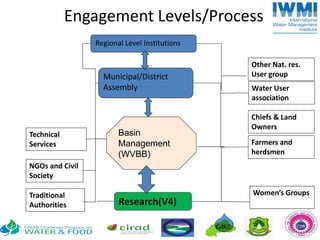
Engagement Levels/Process
                  Regional Level Institutions

                                                Other Nat. res.      
                    Municipal/District          User group
                    Assembly                    Water User 
                                                association

                                                Chiefs & Land 
                                                Owners
Technical                Basin
Services                 Management             Farmers and 
                         (WVBB)                 herdsmen
NGOs and Civil 
Society

Traditional                                     Women’s Groups
Authorities              Research(V4)
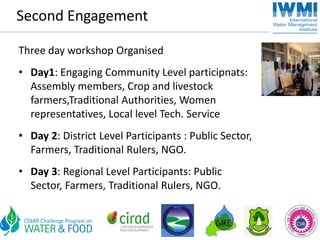
Second Engagement

Three day workshop Organised
• Day1: Engaging Community Level participnats: 
  Assembly members, Crop and livestock 
  farmers,Traditional Authorities, Women 
  representatives, Local level Tech. Service 
• Day 2: District Level Participants : Public Sector, 
  Farmers, Traditional Rulers, NGO.
• Day 3: Regional Level Participants: Public 
  Sector, Farmers, Traditional Rulers, NGO.
Results from Second Engagement
Each group produced its version of:
• Natural resource map

• Identified and mapped critical Issues relating to water and 
  other natural resources

• Identified  potential Interventions and/or Regulations to 
  deal with the undesirable.

• Identified erosion and flooding as key issues
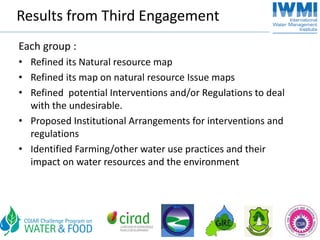
Third Engagement

Another Three day workshop Organised
• Day1: Engaging Community Level participnats: 
  Assembly members, Crop and livestock 
  farmers,Traditional Authorities, Women 
  representatives, Local level Tech. Service 
• Day 2: District Level Participants : Public Sector, 
  Farmers, Traditional Rulers, NGO.
• Day 3: Regional Level Participants: Public 
  Sector, Farmers, Traditional Rulers, NGO.
Results from Third Engagement
Each group :
• Refined its Natural resource map
• Refined its map on natural resource Issue maps
• Refined  potential Interventions and/or Regulations to deal 
  with the undesirable.
• Proposed Institutional Arrangements for interventions and 
  regulations
• Identified Farming/other water use practices and their 
  impact on water resources and the environment
Next Step

• All levels of Participants (Community, District 
  and Regional) to discuss their results and 
  proposed interventions.
THANKS FOR YOUR 
ATTENTION

COMPANION MODELING IN GHANA: Objectives, Processes and first Results