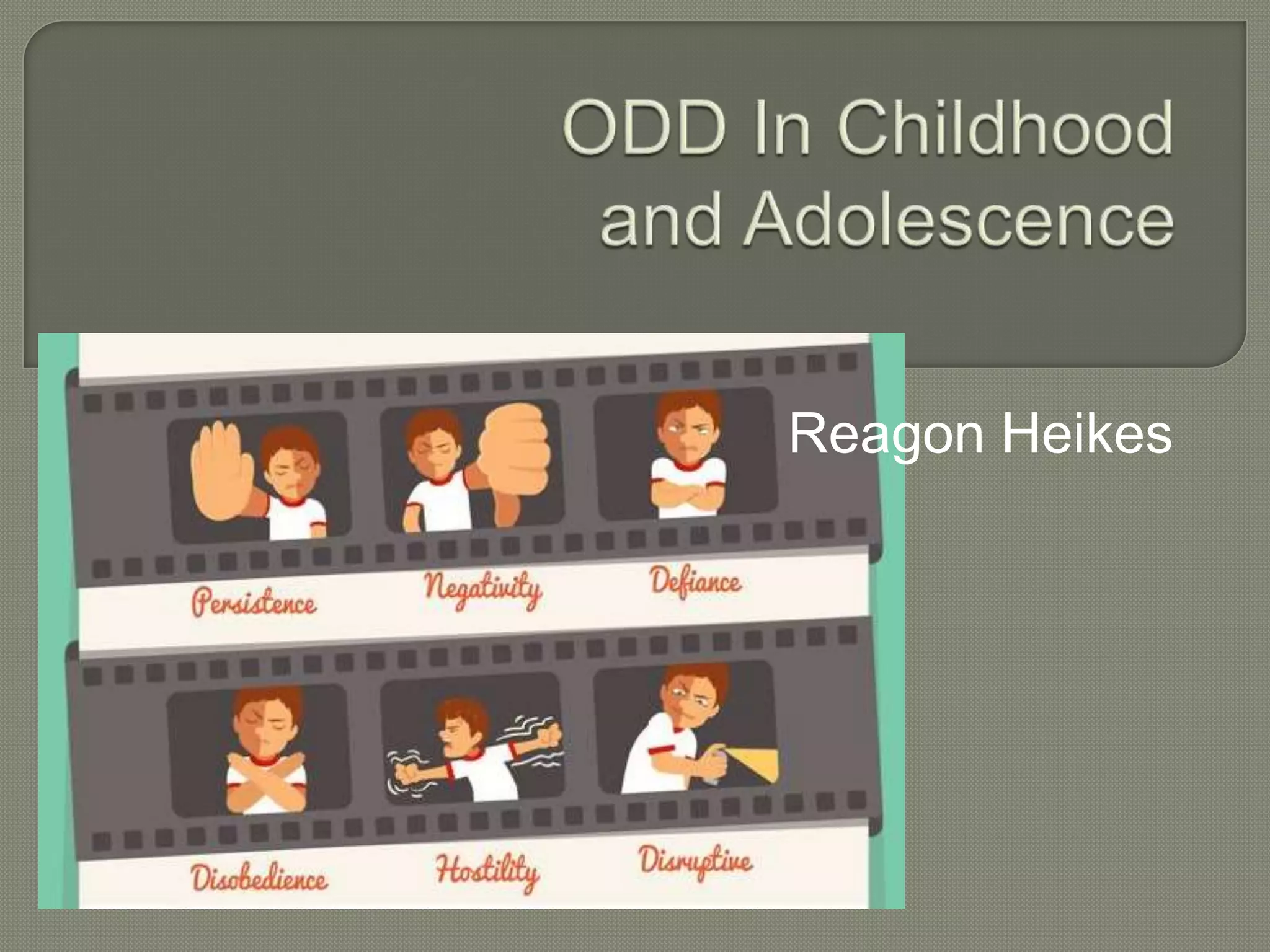
Reagon Heikes
 DSM 5:
Disruptive, Impulse-Control and Conduct Disorders.
 Pattern of angry/irritable mood, argumentative/defiant behavior,
and vindictiveness
• Is it persistent?
• Has it lasted for 6 months or more?
• Is it clearly disruptive to family/home/school?
 Has 4 symptoms, exhibited with at least one individual who is not a sibling:
• Often looses temper
• Is often touchy or easily annoyed
• Is often angry and resentful
• Often argues with authority figures
• Often actively defies or refuses to comply with requests or rules
• Often deliberately annoys others
• Often blames others for his or her mistakes or behaviors
• Has been spiteful or vindictive at least twice in the past 6 months
 Frequency:
• Important to distinguish from normal behavior.
• 2-5: occurs on most days for 6 + months
• 5+: occurs at least 1/wk for 6 + months
 Behaviors occur outside of psychotic,
substance use, depressive or bipolar
disorder.
 Severity: Mild, Moderate, Severe
 Video: 6 year old boy
 Frequent temper tantrums
 Argumentativeness with adults
 Refusal to comply to adults requests
 Deliberate annoyance of others
 Blaming other
 Aggressiveness towards peers
 Difficulty maintaining friendships
 Academic problems
 Bullying or bullied
Acceptable stress-related behaviors
Non-severe behavior
Conflicts with peers only
Case Example
Mirroring Activity
 Rating Scales and Questionnaires
 ARES: Anger Regulation & Expression Scale (Full 75 or Short 17)
• Internalized –v- externalized anger
• Anger as a predictor for conduct problems
 MASC: Multidimensional Anxiety Scale for Children
 Parenting Alliance Measure: significantly predicts child's behavior, self report
from parents
 CBCRS-SR: Conners Comprehensive Behaviors Rating Scale Self Report
Oppositional Defiant Disorder Scale
• 8 items correspond to DSM
• Measures emotional, behavioral, academic, social functioning
• Children and teenagers
• Can be read aloud
• Self-report
• Good internal consistency and test-reliability
 2-15% of children and adolescence
• Research inconsistent, nonrepresentational samples,
inconsistent diagnostic approaches
 3.3% Western Countries (Canino et al. 2010)
• 25 countries total
• 21 year review of worldwide prevalence
• Most reliable figure for Western Countries
 Gender:
• 1/10 Turkey. 1/4 U.S. Some places 1/1.
ADHD
Anxiety Disorder
Mood Disorders
Can become CD (30%)
 Heritability of ADHD 76% (Danforth et al. 2016) Parent-child bi-
directional influences
 On average 4 years between diagnosis of ADHD and ODD/CD
 Neurodevelopment impairment in executive function, specifically
verbal working memory
 Contingency (event/response/outcome) impaired
• Helps bridge the gap between current behavior and outcome
 ADHD increases the risk of coercive parenting style and reduces
constructive parenting interactions that would otherwise enhance the
development of the verbal working memory
• Lax or over-reactive parenting styles
 Share symptoms of disruptive behavior
 “Not a lot works”
 Combination of therapies, parent training,
family therapy, social skills, school based,
medications
 Tailor Tx Plan to each child, careful
consideration of individual behaviors
 Requires commitment and follow through
from parents
 Anger Management
• Relaxation, goal setting, problem solving, trigger identification, recognition of
consequences
 Individual therapy
• Behavior modification, rewards & consequences
• Play therapy
 Family therapy
• Parenting skills, PCIT, alteration of family environment if chaotic
 ABA/PBS: Behavior is learned & serves a specific purpose.
• For each year takes 1 month to see significant changes
• Children comply 80% of the time, recognized 2%
• Teach behavior, model behavior, practice behavior, praise attempts
 Rx: antidepressants, stimulants if other Dx are present
 One of the most effective ways to reduce behavior
symptoms is to address the parenting
 Tx: Parent-Management Training
• Increased positive parenting practices: supportive,
consistent supervision and discipline.
• Decreased negative parenting practices:
harsh punishment, focus on inappropriate behavior
• Predictable, immediate parental response.
 PCIT Therapy Video (Parent-Child Interaction)
67% of ODD children receiving Tx will be
symptom free after 3 years (AACAP)
30% will go to develop CD
10% will go on to develop a personality
disorder such as Antisocial Personality
Disorder.
Increased risk for SA and delinquency
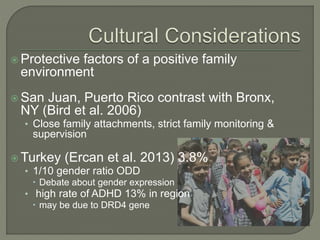
 Protective factors of a positive family
environment
 San Juan, Puerto Rico contrast with Bronx,
NY (Bird et al. 2006)
• Close family attachments, strict family monitoring &
supervision
 Turkey (Ercan et al. 2013) 3.8%
• 1/10 gender ratio ODD
 Debate about gender expression
• high rate of ADHD 13% in region
 may be due to DRD4 gene

Odd pp rh

  • 1.
  • 2.
     DSM 5: Disruptive,Impulse-Control and Conduct Disorders.  Pattern of angry/irritable mood, argumentative/defiant behavior, and vindictiveness • Is it persistent? • Has it lasted for 6 months or more? • Is it clearly disruptive to family/home/school?  Has 4 symptoms, exhibited with at least one individual who is not a sibling: • Often looses temper • Is often touchy or easily annoyed • Is often angry and resentful • Often argues with authority figures • Often actively defies or refuses to comply with requests or rules • Often deliberately annoys others • Often blames others for his or her mistakes or behaviors • Has been spiteful or vindictive at least twice in the past 6 months
  • 3.
     Frequency: • Importantto distinguish from normal behavior. • 2-5: occurs on most days for 6 + months • 5+: occurs at least 1/wk for 6 + months  Behaviors occur outside of psychotic, substance use, depressive or bipolar disorder.  Severity: Mild, Moderate, Severe  Video: 6 year old boy
  • 4.
     Frequent tempertantrums  Argumentativeness with adults  Refusal to comply to adults requests  Deliberate annoyance of others  Blaming other  Aggressiveness towards peers  Difficulty maintaining friendships  Academic problems  Bullying or bullied
  • 5.
    Acceptable stress-related behaviors Non-severebehavior Conflicts with peers only Case Example Mirroring Activity
  • 6.
     Rating Scalesand Questionnaires  ARES: Anger Regulation & Expression Scale (Full 75 or Short 17) • Internalized –v- externalized anger • Anger as a predictor for conduct problems  MASC: Multidimensional Anxiety Scale for Children  Parenting Alliance Measure: significantly predicts child's behavior, self report from parents  CBCRS-SR: Conners Comprehensive Behaviors Rating Scale Self Report Oppositional Defiant Disorder Scale • 8 items correspond to DSM • Measures emotional, behavioral, academic, social functioning • Children and teenagers • Can be read aloud • Self-report • Good internal consistency and test-reliability
  • 7.
     2-15% ofchildren and adolescence • Research inconsistent, nonrepresentational samples, inconsistent diagnostic approaches  3.3% Western Countries (Canino et al. 2010) • 25 countries total • 21 year review of worldwide prevalence • Most reliable figure for Western Countries  Gender: • 1/10 Turkey. 1/4 U.S. Some places 1/1.
  • 9.
  • 10.
     Heritability ofADHD 76% (Danforth et al. 2016) Parent-child bi- directional influences  On average 4 years between diagnosis of ADHD and ODD/CD  Neurodevelopment impairment in executive function, specifically verbal working memory  Contingency (event/response/outcome) impaired • Helps bridge the gap between current behavior and outcome  ADHD increases the risk of coercive parenting style and reduces constructive parenting interactions that would otherwise enhance the development of the verbal working memory • Lax or over-reactive parenting styles  Share symptoms of disruptive behavior
  • 11.
     “Not alot works”  Combination of therapies, parent training, family therapy, social skills, school based, medications  Tailor Tx Plan to each child, careful consideration of individual behaviors  Requires commitment and follow through from parents
  • 12.
     Anger Management •Relaxation, goal setting, problem solving, trigger identification, recognition of consequences  Individual therapy • Behavior modification, rewards & consequences • Play therapy  Family therapy • Parenting skills, PCIT, alteration of family environment if chaotic  ABA/PBS: Behavior is learned & serves a specific purpose. • For each year takes 1 month to see significant changes • Children comply 80% of the time, recognized 2% • Teach behavior, model behavior, practice behavior, praise attempts  Rx: antidepressants, stimulants if other Dx are present
  • 13.
     One ofthe most effective ways to reduce behavior symptoms is to address the parenting  Tx: Parent-Management Training • Increased positive parenting practices: supportive, consistent supervision and discipline. • Decreased negative parenting practices: harsh punishment, focus on inappropriate behavior • Predictable, immediate parental response.  PCIT Therapy Video (Parent-Child Interaction)
  • 14.
    67% of ODDchildren receiving Tx will be symptom free after 3 years (AACAP) 30% will go to develop CD 10% will go on to develop a personality disorder such as Antisocial Personality Disorder. Increased risk for SA and delinquency
  • 15.
     Protective factorsof a positive family environment  San Juan, Puerto Rico contrast with Bronx, NY (Bird et al. 2006) • Close family attachments, strict family monitoring & supervision  Turkey (Ercan et al. 2013) 3.8% • 1/10 gender ratio ODD  Debate about gender expression • high rate of ADHD 13% in region  may be due to DRD4 gene

Editor's Notes

  • #9 Hard to untangle the environmental from genetic influences Sometimes impossible to distinguish between behaviors caused by negative environments without internal dysfunction and behaviors originating from negative environments that do involve internal dysfunction