Organization Development and Change
Thomas G. Cummings
Christopher G. Worley
Chapter One:
Introduction to
Organization Development
Cummings & Worley 7e. (c) 2001 South-
Western College Publishing
1-2
Learning Objectives
for Chapter One
• To provide a definition of Organization
Development (OD)
• To distinguish OD and planned change
from other forms of organization change
• To describe the historical development of
OD
• To provide an outline of the book
Cummings & Worley 7e. (c) 2001 South-
Western College Publishing
1-3
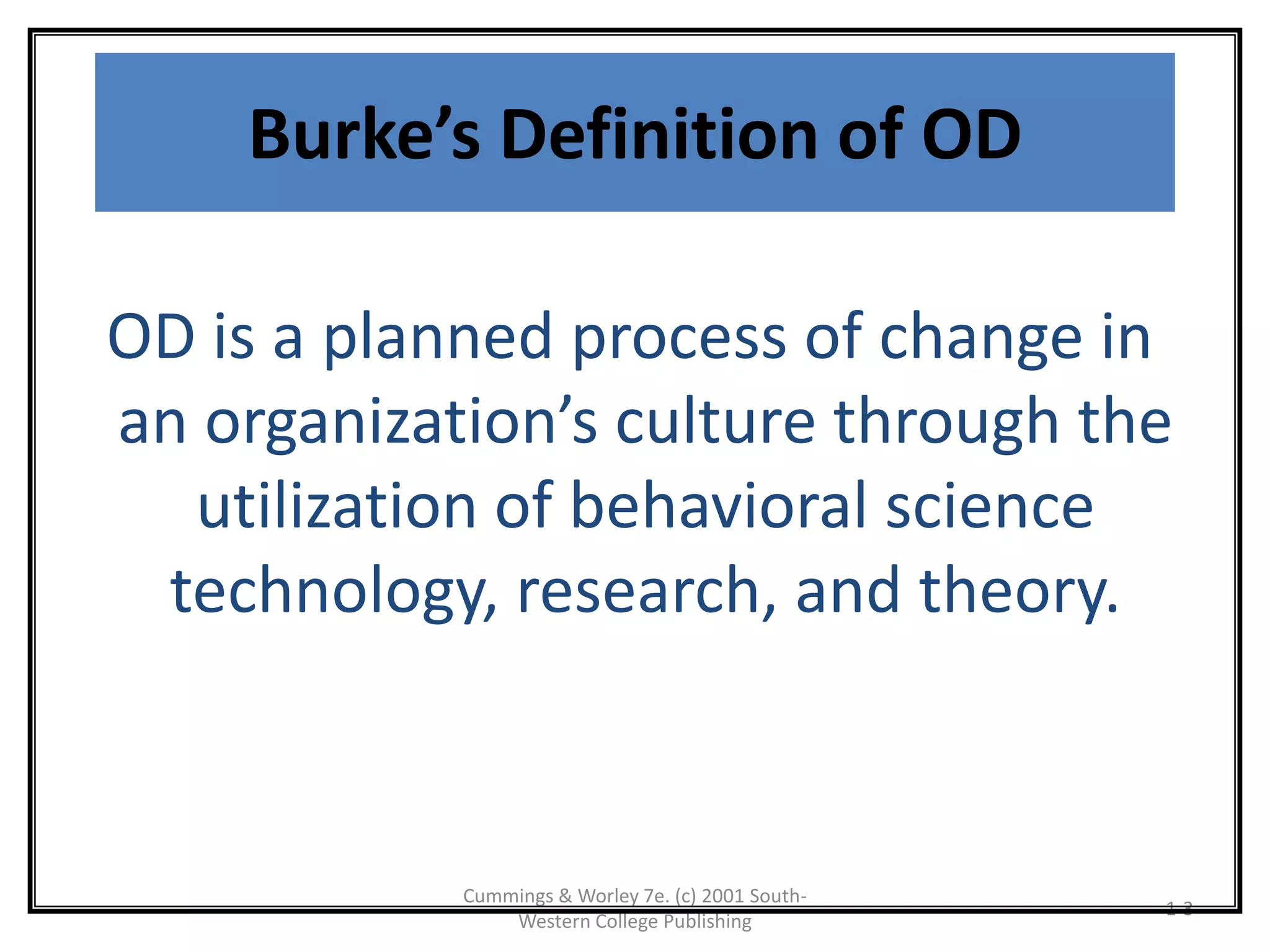
Burke’s Definition of OD
OD is a planned process of change in
an organization’s culture through the
utilization of behavioral science
technology, research, and theory.
Cummings & Worley 7e. (c) 2001 South-
Western College Publishing
1-4
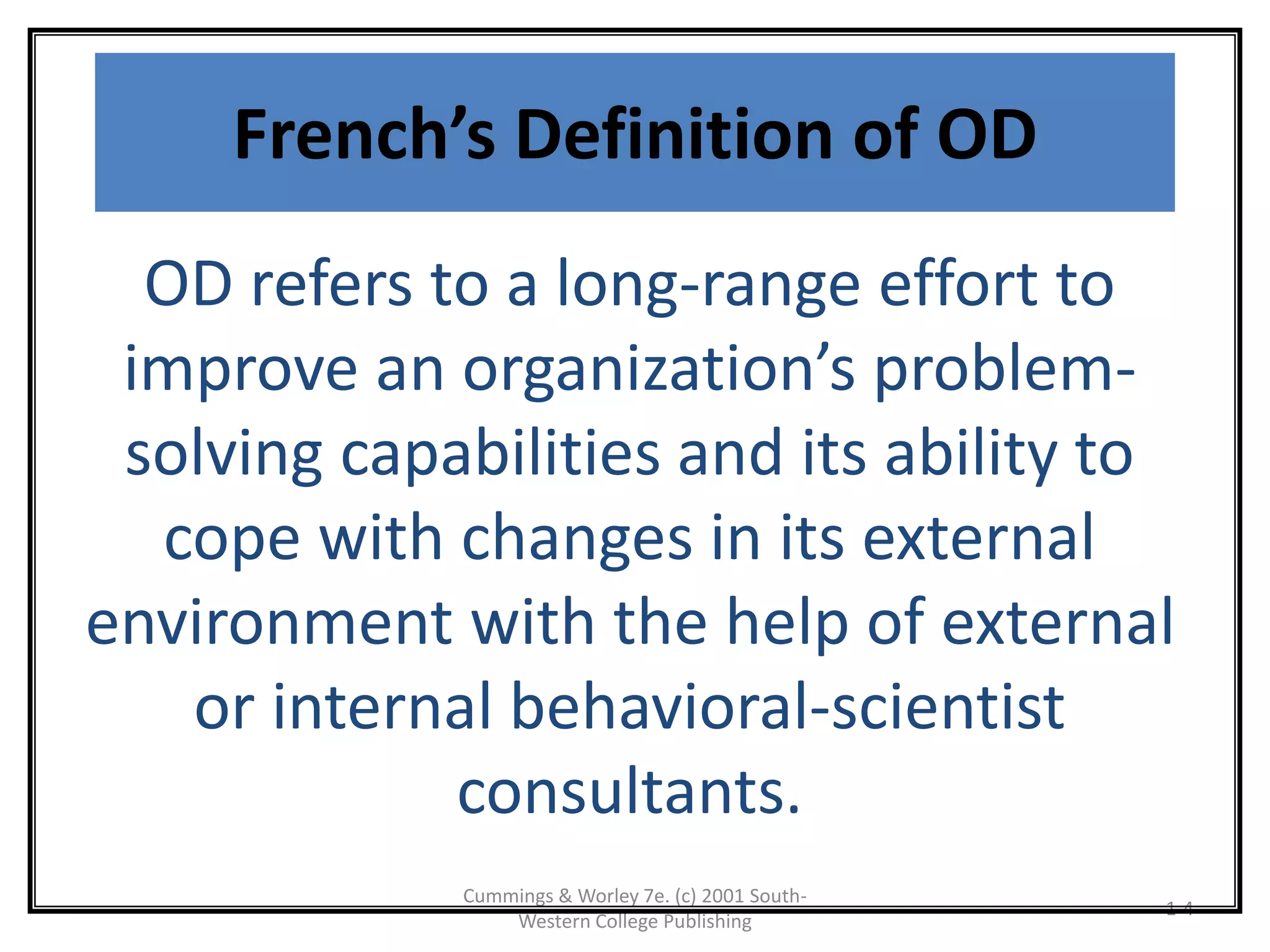
French’s Definition of OD
OD refers to a long-range effort to
improve an organization’s problem-
solving capabilities and its ability to
cope with changes in its external
environment with the help of external
or internal behavioral-scientist
consultants.
Cummings & Worley 7e. (c) 2001 South-
Western College Publishing
1-5
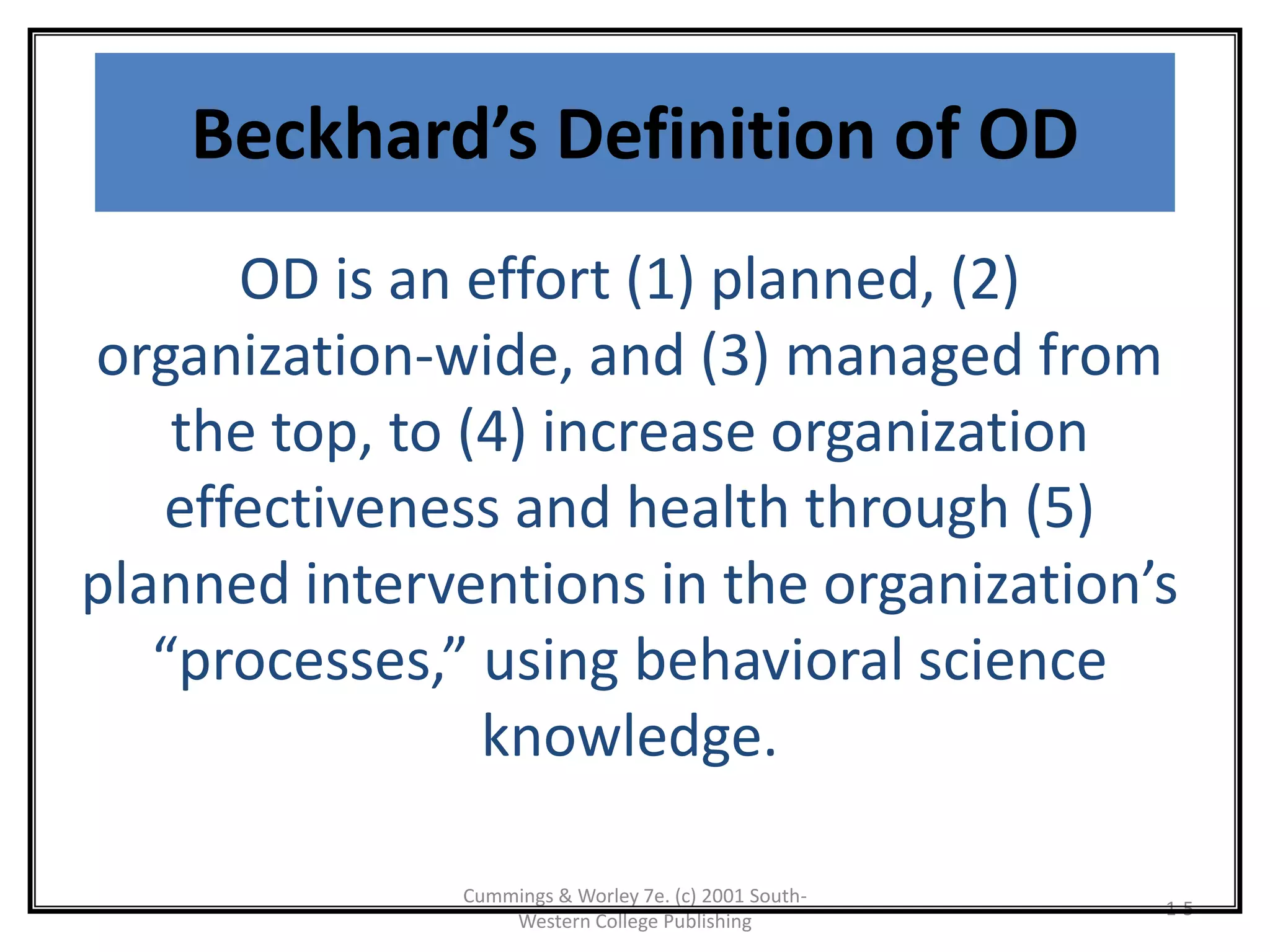
Beckhard’s Definition of OD
OD is an effort (1) planned, (2)
organization-wide, and (3) managed from
the top, to (4) increase organization
effectiveness and health through (5)
planned interventions in the organization’s
“processes,” using behavioral science
knowledge.
Cummings & Worley 7e. (c) 2001 South-
Western College Publishing
1-6
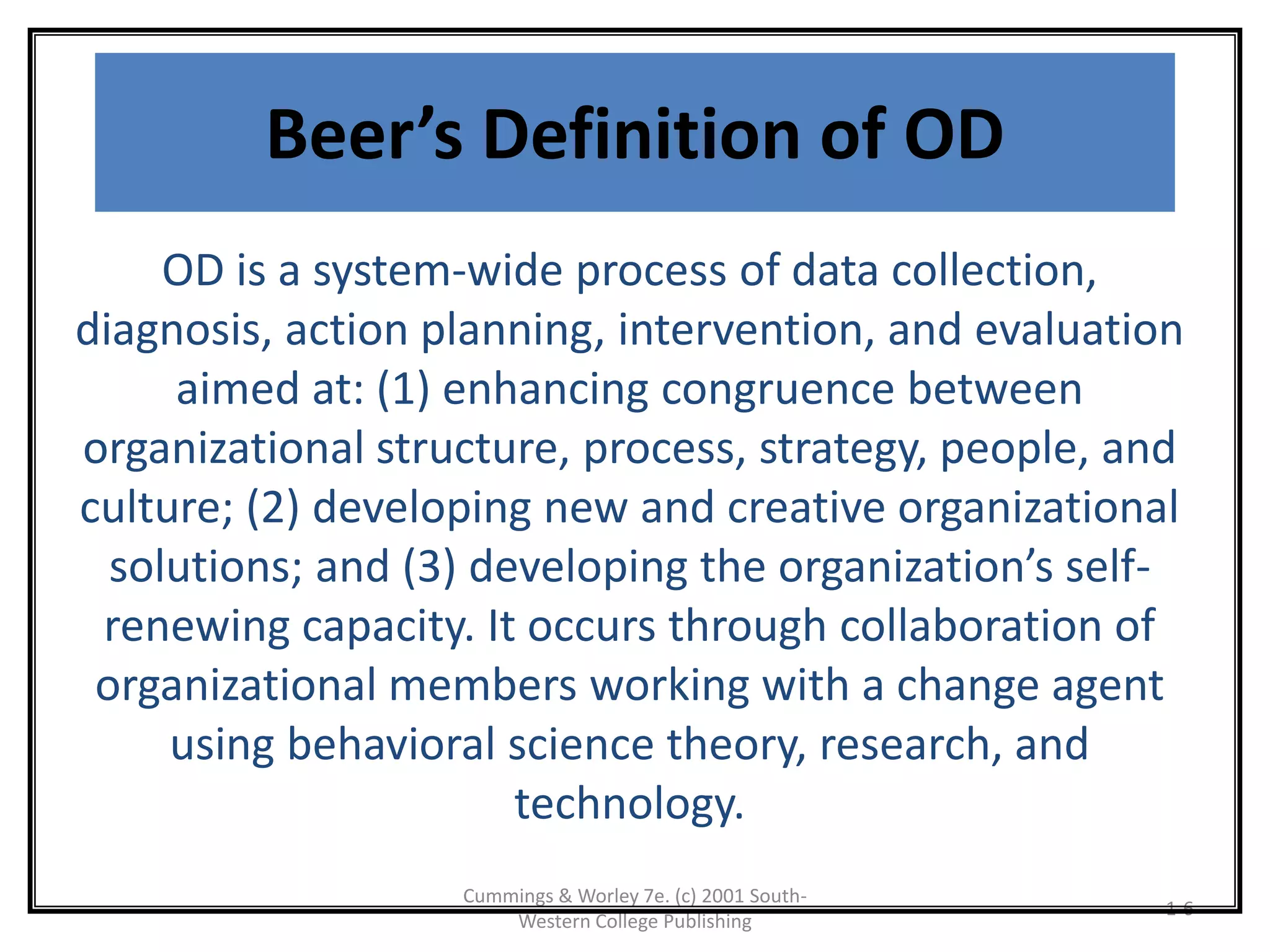
Beer’s Definition of OD
OD is a system-wide process of data collection,
diagnosis, action planning, intervention, and evaluation
aimed at: (1) enhancing congruence between
organizational structure, process, strategy, people, and
culture; (2) developing new and creative organizational
solutions; and (3) developing the organization’s self-
renewing capacity. It occurs through collaboration of
organizational members working with a change agent
using behavioral science theory, research, and
technology.
Cummings & Worley 7e. (c) 2001 South-
Western College Publishing
1-7
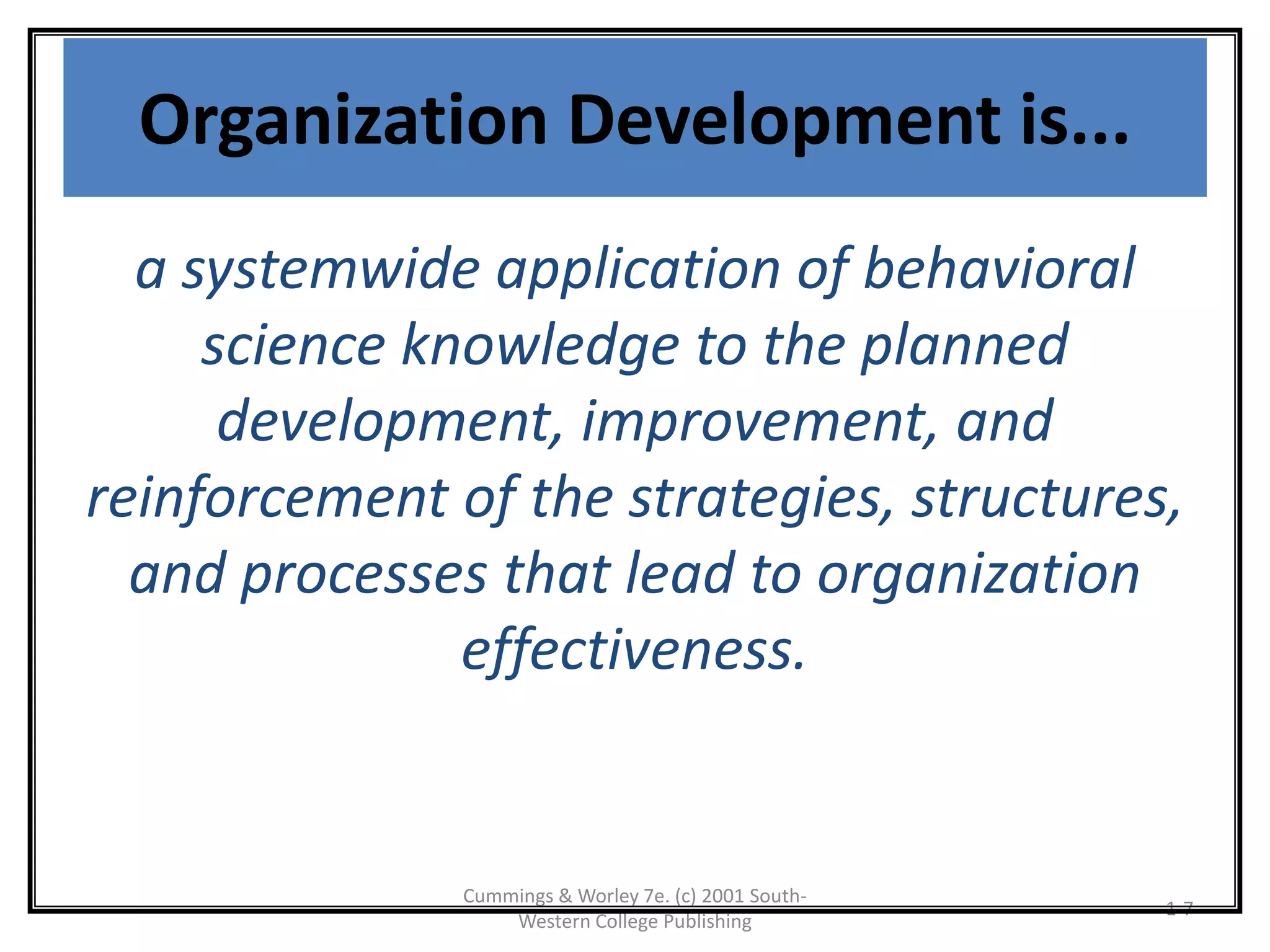
Organization Development is...
a systemwide application of behavioral
science knowledge to the planned
development, improvement, and
reinforcement of the strategies, structures,
and processes that lead to organization
effectiveness.
Cummings & Worley 7e. (c) 2001 South-
Western College Publishing
1-8
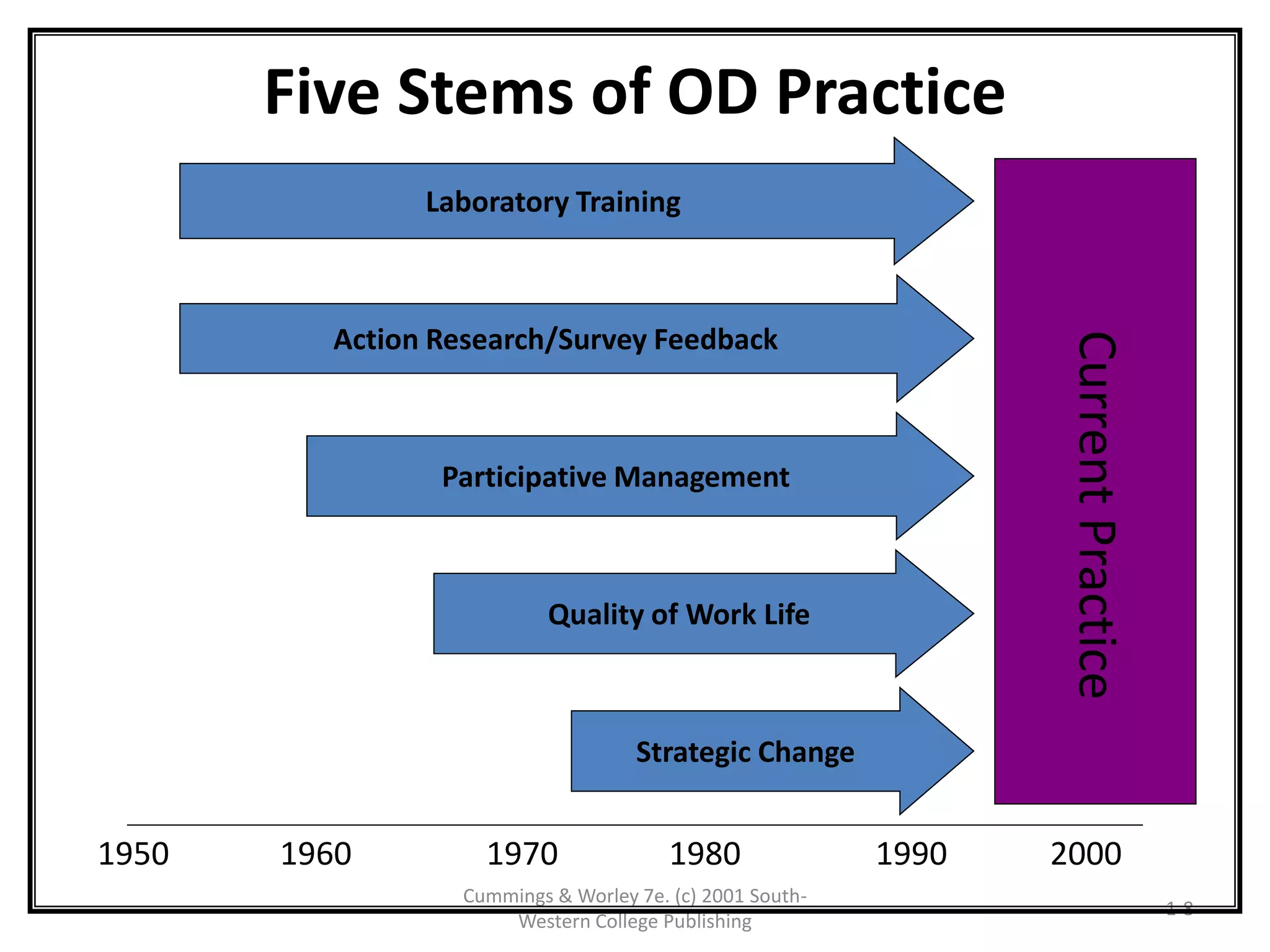
Five Stems of OD Practice
CurrentPractice
Laboratory Training
Action Research/Survey Feedback
Participative Management
Quality of Work Life
Strategic Change
1950 1960 1970 1980 1990 2000
Cummings & Worley 7e. (c) 2001 South-
Western College Publishing
1-9
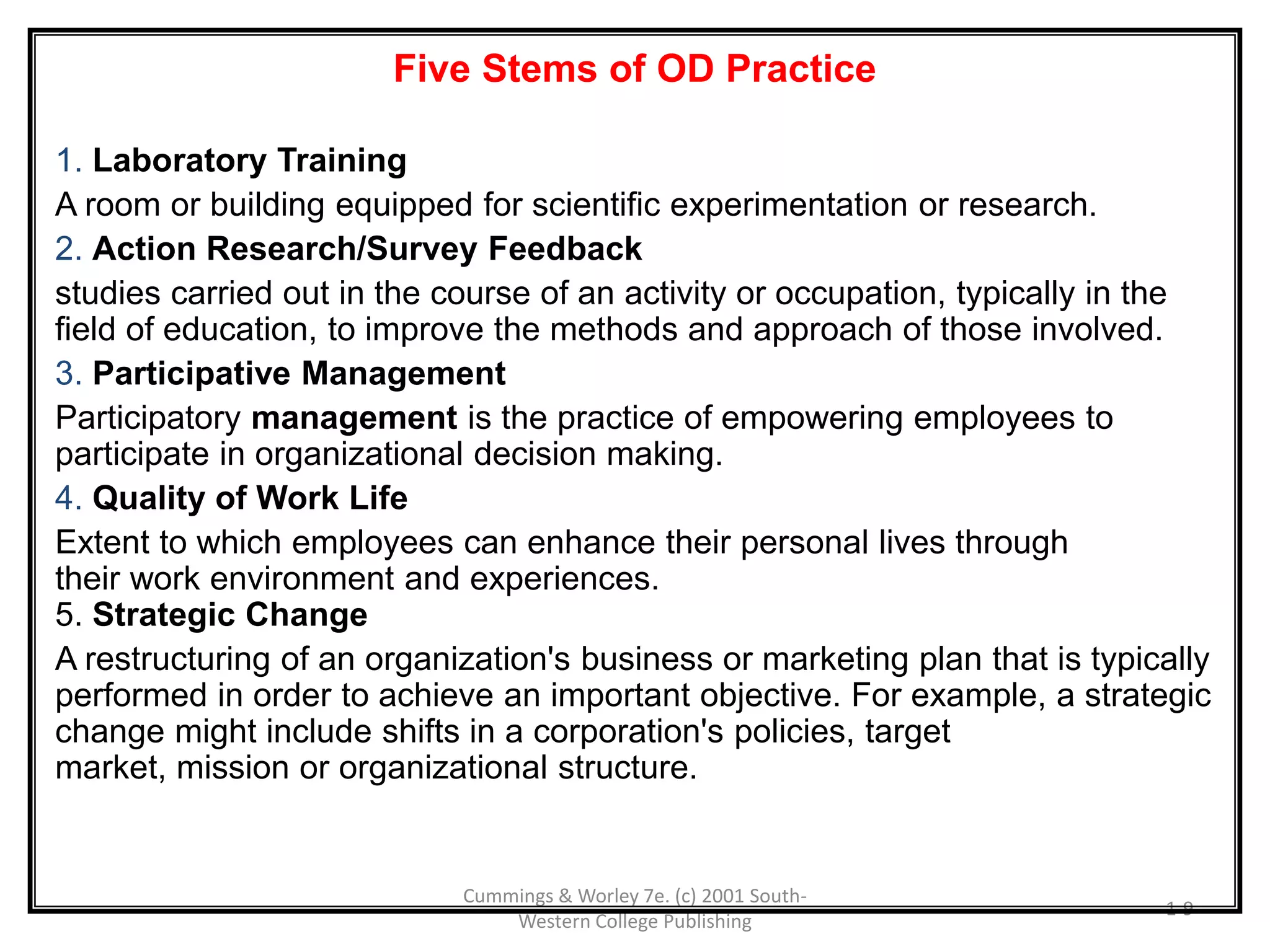
Five Stems of OD Practice
1. Laboratory Training
A room or building equipped for scientific experimentation or research.
2. Action Research/Survey Feedback
studies carried out in the course of an activity or occupation, typically in the
field of education, to improve the methods and approach of those involved.
3. Participative Management
Participatory management is the practice of empowering employees to
participate in organizational decision making.
4. Quality of Work Life
Extent to which employees can enhance their personal lives through
their work environment and experiences.
5. Strategic Change
A restructuring of an organization's business or marketing plan that is typically
performed in order to achieve an important objective. For example, a strategic
change might include shifts in a corporation's policies, target
market, mission or organizational structure.

Od. chapter 1 (1)

  • 1.
    Organization Development andChange Thomas G. Cummings Christopher G. Worley Chapter One: Introduction to Organization Development
  • 2.
    Cummings & Worley7e. (c) 2001 South- Western College Publishing 1-2 Learning Objectives for Chapter One • To provide a definition of Organization Development (OD) • To distinguish OD and planned change from other forms of organization change • To describe the historical development of OD • To provide an outline of the book
  • 3.
    Cummings & Worley7e. (c) 2001 South- Western College Publishing 1-3 Burke’s Definition of OD OD is a planned process of change in an organization’s culture through the utilization of behavioral science technology, research, and theory.
  • 4.
    Cummings & Worley7e. (c) 2001 South- Western College Publishing 1-4 French’s Definition of OD OD refers to a long-range effort to improve an organization’s problem- solving capabilities and its ability to cope with changes in its external environment with the help of external or internal behavioral-scientist consultants.
  • 5.
    Cummings & Worley7e. (c) 2001 South- Western College Publishing 1-5 Beckhard’s Definition of OD OD is an effort (1) planned, (2) organization-wide, and (3) managed from the top, to (4) increase organization effectiveness and health through (5) planned interventions in the organization’s “processes,” using behavioral science knowledge.
  • 6.
    Cummings & Worley7e. (c) 2001 South- Western College Publishing 1-6 Beer’s Definition of OD OD is a system-wide process of data collection, diagnosis, action planning, intervention, and evaluation aimed at: (1) enhancing congruence between organizational structure, process, strategy, people, and culture; (2) developing new and creative organizational solutions; and (3) developing the organization’s self- renewing capacity. It occurs through collaboration of organizational members working with a change agent using behavioral science theory, research, and technology.
  • 7.
    Cummings & Worley7e. (c) 2001 South- Western College Publishing 1-7 Organization Development is... a systemwide application of behavioral science knowledge to the planned development, improvement, and reinforcement of the strategies, structures, and processes that lead to organization effectiveness.
  • 8.
    Cummings & Worley7e. (c) 2001 South- Western College Publishing 1-8 Five Stems of OD Practice CurrentPractice Laboratory Training Action Research/Survey Feedback Participative Management Quality of Work Life Strategic Change 1950 1960 1970 1980 1990 2000
  • 9.
    Cummings & Worley7e. (c) 2001 South- Western College Publishing 1-9 Five Stems of OD Practice 1. Laboratory Training A room or building equipped for scientific experimentation or research. 2. Action Research/Survey Feedback studies carried out in the course of an activity or occupation, typically in the field of education, to improve the methods and approach of those involved. 3. Participative Management Participatory management is the practice of empowering employees to participate in organizational decision making. 4. Quality of Work Life Extent to which employees can enhance their personal lives through their work environment and experiences. 5. Strategic Change A restructuring of an organization's business or marketing plan that is typically performed in order to achieve an important objective. For example, a strategic change might include shifts in a corporation's policies, target market, mission or organizational structure.