Organization Development and Change
Thomas G. Cummings
Christopher G. Worley
Chapter One:
Introduction to
Organization Development
Cummings & Worley, 8e
(c)2005 Thomson/South-Western
1-2
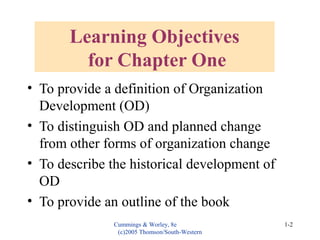
Learning Objectives
for Chapter One
• To provide a definition of Organization
Development (OD)
• To distinguish OD and planned change
from other forms of organization change
• To describe the historical development of
OD
• To provide an outline of the book
Cummings & Worley, 8e
(c)2005 Thomson/South-Western
1-3
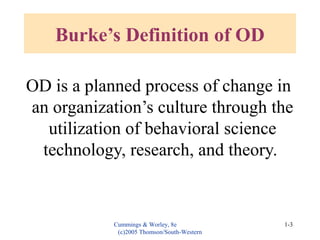
Burke’s Definition of OD
OD is a planned process of change in
an organization’s culture through the
utilization of behavioral science
technology, research, and theory.
Cummings & Worley, 8e
(c)2005 Thomson/South-Western
1-4
French’s Definition of OD
OD refers to a long-range effort to
improve an organization’s problem-
solving capabilities and its ability to
cope with changes in its external
environment with the help of external
or internal behavioral-scientist
consultants.
Cummings & Worley, 8e
(c)2005 Thomson/South-Western
1-5
Beckhard’s Definition of OD
OD is an effort (1) planned, (2)
organization-wide, and (3) managed from
the top, to (4) increase organization
effectiveness and health through (5) planned
interventions in the organization’s
“processes,” using behavioral science
knowledge.
Cummings & Worley, 8e
(c)2005 Thomson/South-Western
1-6
Beer’s Definition of OD
OD is a system-wide process of data collection,
diagnosis, action planning, intervention, and evaluation
aimed at: (1) enhancing congruence between
organizational structure, process, strategy, people, and
culture; (2) developing new and creative organizational
solutions; and (3) developing the organization’s self-
renewing capacity. It occurs through collaboration of
organizational members working with a change agent
using behavioral science theory, research, and
technology.
Cummings & Worley, 8e
(c)2005 Thomson/South-Western
1-7
Organization Development is...
a systemwide application and transfer of
behavioral science knowledge to the
planned development, improvement, and
reinforcement of the strategies,
structures, and processes that lead to
organization effectiveness.
Cummings & Worley, 8e
(c)2005 Thomson/South-Western
1-8
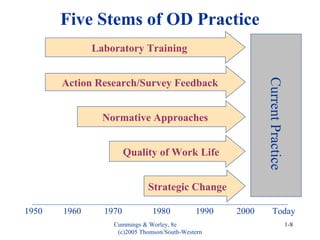
1950 1960 1970 1980 1990 2000 Today
Five Stems of OD Practice
CurrentPractice
Laboratory Training
Action Research/Survey Feedback
Normative Approaches
Quality of Work Life
Strategic Change
Cummings & Worley, 8e
(c)2005 Thomson/South-Western
1-9
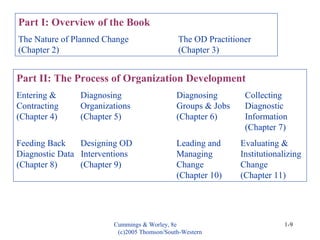
Part I: Overview of the Book
The Nature of Planned Change The OD Practitioner
(Chapter 2) (Chapter 3)
Part II: The Process of Organization Development
Entering & Diagnosing Diagnosing Collecting
Contracting Organizations Groups & Jobs Diagnostic
(Chapter 4) (Chapter 5) (Chapter 6) Information
(Chapter 7)
Feeding Back Designing OD Leading and Evaluating &
Diagnostic Data Interventions Managing Institutionalizing
(Chapter 8) (Chapter 9) Change Change
(Chapter 10) (Chapter 11)
Cummings & Worley, 8e
(c)2005 Thomson/South-Western
1-10
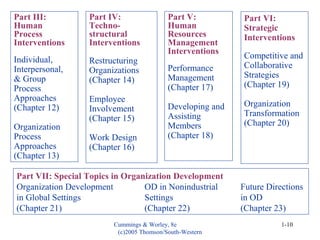
Part III:
Human
Process
Interventions
Individual,
Interpersonal,
& Group
Process
Approaches
(Chapter 12)
Organization
Process
Approaches
(Chapter 13)
Part IV:
Techno-
structural
Interventions
Restructuring
Organizations
(Chapter 14)
Employee
Involvement
(Chapter 15)
Work Design
(Chapter 16)
Part V:
Human
Resources
Management
Interventions
Performance
Management
(Chapter 17)
Developing and
Assisting
Members
(Chapter 18)
Part VI:
Strategic
Interventions
Competitive and
Collaborative
Strategies
(Chapter 19)
Organization
Transformation
(Chapter 20)
Part VII: Special Topics in Organization Development
Organization Development OD in Nonindustrial Future Directions
in Global Settings Settings in OD
(Chapter 21) (Chapter 22) (Chapter 23)

OD 1st chapter

  • 1.
    Organization Development andChange Thomas G. Cummings Christopher G. Worley Chapter One: Introduction to Organization Development
  • 2.
    Cummings & Worley,8e (c)2005 Thomson/South-Western 1-2 Learning Objectives for Chapter One • To provide a definition of Organization Development (OD) • To distinguish OD and planned change from other forms of organization change • To describe the historical development of OD • To provide an outline of the book
  • 3.
    Cummings & Worley,8e (c)2005 Thomson/South-Western 1-3 Burke’s Definition of OD OD is a planned process of change in an organization’s culture through the utilization of behavioral science technology, research, and theory.
  • 4.
    Cummings & Worley,8e (c)2005 Thomson/South-Western 1-4 French’s Definition of OD OD refers to a long-range effort to improve an organization’s problem- solving capabilities and its ability to cope with changes in its external environment with the help of external or internal behavioral-scientist consultants.
  • 5.
    Cummings & Worley,8e (c)2005 Thomson/South-Western 1-5 Beckhard’s Definition of OD OD is an effort (1) planned, (2) organization-wide, and (3) managed from the top, to (4) increase organization effectiveness and health through (5) planned interventions in the organization’s “processes,” using behavioral science knowledge.
  • 6.
    Cummings & Worley,8e (c)2005 Thomson/South-Western 1-6 Beer’s Definition of OD OD is a system-wide process of data collection, diagnosis, action planning, intervention, and evaluation aimed at: (1) enhancing congruence between organizational structure, process, strategy, people, and culture; (2) developing new and creative organizational solutions; and (3) developing the organization’s self- renewing capacity. It occurs through collaboration of organizational members working with a change agent using behavioral science theory, research, and technology.
  • 7.
    Cummings & Worley,8e (c)2005 Thomson/South-Western 1-7 Organization Development is... a systemwide application and transfer of behavioral science knowledge to the planned development, improvement, and reinforcement of the strategies, structures, and processes that lead to organization effectiveness.
  • 8.
    Cummings & Worley,8e (c)2005 Thomson/South-Western 1-8 1950 1960 1970 1980 1990 2000 Today Five Stems of OD Practice CurrentPractice Laboratory Training Action Research/Survey Feedback Normative Approaches Quality of Work Life Strategic Change
  • 9.
    Cummings & Worley,8e (c)2005 Thomson/South-Western 1-9 Part I: Overview of the Book The Nature of Planned Change The OD Practitioner (Chapter 2) (Chapter 3) Part II: The Process of Organization Development Entering & Diagnosing Diagnosing Collecting Contracting Organizations Groups & Jobs Diagnostic (Chapter 4) (Chapter 5) (Chapter 6) Information (Chapter 7) Feeding Back Designing OD Leading and Evaluating & Diagnostic Data Interventions Managing Institutionalizing (Chapter 8) (Chapter 9) Change Change (Chapter 10) (Chapter 11)
  • 10.
    Cummings & Worley,8e (c)2005 Thomson/South-Western 1-10 Part III: Human Process Interventions Individual, Interpersonal, & Group Process Approaches (Chapter 12) Organization Process Approaches (Chapter 13) Part IV: Techno- structural Interventions Restructuring Organizations (Chapter 14) Employee Involvement (Chapter 15) Work Design (Chapter 16) Part V: Human Resources Management Interventions Performance Management (Chapter 17) Developing and Assisting Members (Chapter 18) Part VI: Strategic Interventions Competitive and Collaborative Strategies (Chapter 19) Organization Transformation (Chapter 20) Part VII: Special Topics in Organization Development Organization Development OD in Nonindustrial Future Directions in Global Settings Settings in OD (Chapter 21) (Chapter 22) (Chapter 23)