OCULAR LEPROSY
P R E S E N T E R : D R . I D D I N D YA B AW E
M O D U L ATO R : D R . A M PA I R E A N N E
M AY 2 0 2 1
LECTURE OUTLINE
• Introduction
• Etiology
• Classification of leprosy
• Transmission
• Ocular features
• Complications
• Diagnosis
• Lab investigations
• Management
INTRODUCTION
• a.k.a Hansen disease.
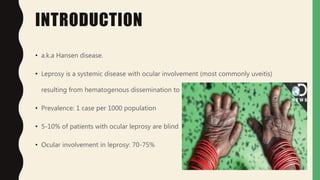
• Leprosy is a systemic disease with ocular involvement (most commonly uveitis)
resulting from hematogenous dissemination to the eye
• Prevalence: 1 case per 1000 population
• 5-10% of patients with ocular leprosy are blind
• Ocular involvement in leprosy: 70-75%
ETIOLOGY
• Mycobacterium leprae: obligate intracellular aerobic bacilli
• Spread from human-to-human contact
• Acid-fast due to mycolic acid
• M.leprae favour cooler parts of the body e.g skin.
6 CLASSES OF LEPROSY
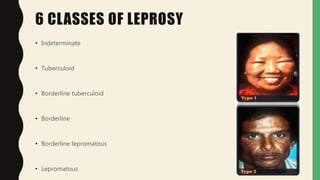
• Indeterminate
• Tuberculoid
• Borderline tuberculoid
• Borderline
• Borderline lepromatous
• Lepromatous
SPREAD
• Mode of transmission: unclear
• Risk factors: over crowding, poverty, poor hygiene
• Route of spread:
-Person to person spread by nasal droplet infection (commonest)
-Soil contamination
-Insect vectors
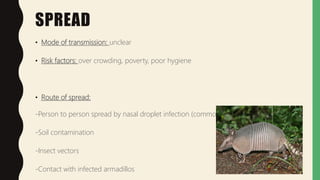
-Contact with infected armadillos
MODES OF INFECTION
• Direct invasion of M.leprae in eyes and surrounding tissues
• Inflammatory lesions: sensitization of ocular tissues to M.leprae antigens, formation of
intravascular immune complexes
• Granulomatous infiltration of CN5 and 7
• Granulomatous infiltration of contiguous structures: eyebrows, eyelids, lid glands,
lacrimal drainage system.
• Secondary infections can also play a role
ANALOGY!
Paucibacillary (tuberculoid spectrum)
• 5 lesions and less
• Only ONE nerve trunk is enlarged
• Negative slit skin smear (SSS)
• Asymmetrical
Multibacillary (lepromatous spectrum)
• >5 lesions
• Many nerve trunks are enlarged
• Positive slit skin smear (SSS)
• Symmetrical
OCULAR FEATURES OF LEPROSY
• Eyelid and lacrimal glands:
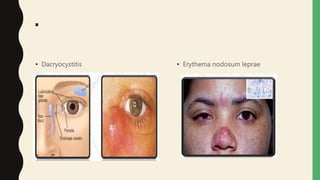
• Eyelid: madarosis, trichiasis, distichiasis, entropion, ectropion, leromatous nodules,
lagophthalmos
• Lacrimal system: dacryocystitis and NLDO, chronic dacroadenitis, DES
• Conjuctiva: chronic conjunctivitis; episcleral nodules (cardinal sign)
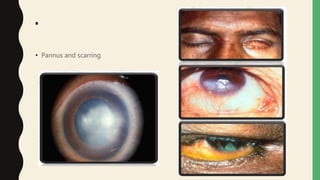
• Cornea and sclera: interstitial keratitis, exposure keratopathy (CN 7 palsy), neurotrophic
keratopathy, band keratopathy, corneal opacities, corneal anaesthesia, thickened
nerves, pannus and scarring (corneal pearls), episcleritis and scleritis
.
• Dacryocystitis • Erythema nodosum leprae
.
• Pannus and scarring
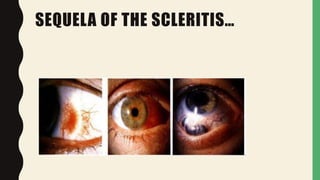
SEQUELA OF THE SCLERITIS…
INTRAOCULAR
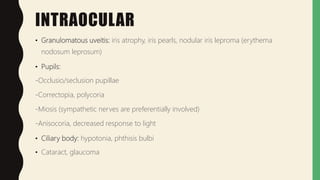
• Granulomatous uveitis: iris atrophy, iris pearls, nodular iris leproma (erythema
nodosum leprosum)
• Pupils:
-Occlusio/seclusion pupillae
-Correctopia, polycoria
-Miosis (sympathetic nerves are preferentially involved)
-Anisocoria, decreased response to light
• Ciliary body: hypotonia, phthisis bulbi
• Cataract, glaucoma
NEURO-OPHTHALMIC
• Optic neuritis
• CN palsies
CHOROID AND RETINA:
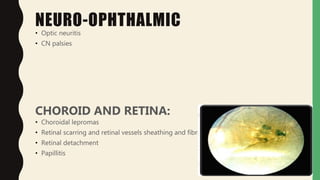
• Choroidal lepromas
• Retinal scarring and retinal vessels sheathing and fibrosis
• Retinal detachment
• Papillitis
WHAT ARE THE POSSIBLE MECHANISMS
OF PANNUS AND SCARRING?
• Lid lesions
• Interstitial keratitis
• Exposure keratopathy
• Neurotrophic keratopathy
• Secondary infective keratitis
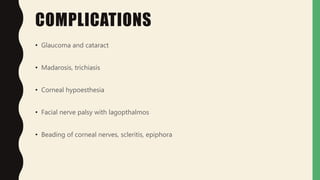
COMPLICATIONS
• Glaucoma and cataract
• Madarosis, trichiasis
• Corneal hypoesthesia
• Facial nerve palsy with lagopthalmos
• Beading of corneal nerves, scleritis, epiphora
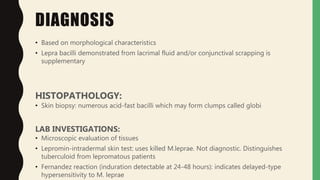
DIAGNOSIS
• Based on morphological characteristics
• Lepra bacilli demonstrated from lacrimal fluid and/or conjunctival scrapping is
supplementary
HISTOPATHOLOGY:
• Skin biopsy: numerous acid-fast bacilli which may form clumps called globi
LAB INVESTIGATIONS:
• Microscopic evaluation of tissues
• Lepromin-intradermal skin test: uses killed M.leprae. Not diagnostic. Distinguishes
tuberculoid from lepromatous patients
• Fernandez reaction (induration detectable at 24-48 hours): indicates delayed-type
hypersensitivity to M. leprae
MANAGEMENT
• Frequent washing with clean water (boiled and cooled)
• Local antibiotics
• Rest to the eye
• Refer if it doesn’t improve in 48 hours
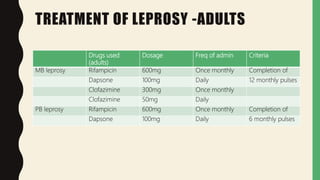
TREATMENT OF LEPROSY -ADULTS
Drugs used
(adults)
Dosage Freq of admin Criteria
MB leprosy Rifampicin 600mg Once monthly Completion of
Dapsone 100mg Daily 12 monthly pulses
Clofazimine 300mg Once monthly
Clofazimine 50mg Daily
PB leprosy Rifampicin 600mg Once monthly Completion of
Dapsone 100mg Daily 6 monthly pulses
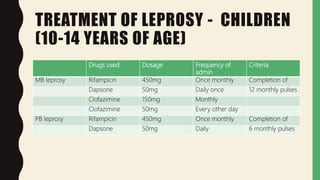
TREATMENT OF LEPROSY - CHILDREN
(10-14 YEARS OF AGE)
Drugs used Dosage Frequency of
admin
Criteria
MB leprosy Rifampicin 450mg Once monthly Completion of
Dapsone 50mg Daily once 12 monthly pulses
Clofazimine 150mg Monthly
Clofazimine 50mg Every other day
PB leprosy Rifampicin 450mg Once monthly Completion of
Dapsone 50mg Daily 6 monthly pulses
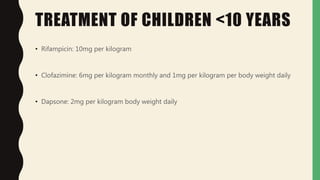
TREATMENT OF CHILDREN <10 YEARS
• Rifampicin: 10mg per kilogram
• Clofazimine: 6mg per kilogram monthly and 1mg per kilogram per body weight daily
• Dapsone: 2mg per kilogram body weight daily
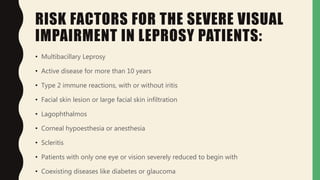
RISK FACTORS FOR THE SEVERE VISUAL
IMPAIRMENT IN LEPROSY PATIENTS:
• Multibacillary Leprosy
• Active disease for more than 10 years
• Type 2 immune reactions, with or without iritis
• Facial skin lesion or large facial skin infiltration
• Lagophthalmos
• Corneal hypoesthesia or anesthesia
• Scleritis
• Patients with only one eye or vision severely reduced to begin with
• Coexisting diseases like diabetes or glaucoma
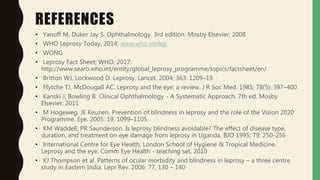
REFERENCES
• Yanoff M, Duker Jay S. Ophthalmology. 3rd edition. Mosby Elsevier; 2008
• WHO Leprosy Today, 2014: www.who.int/lep
• WONG
• Leprosy Fact Sheet; WHO, 2017:
http://www.searo.who.int/entity/global_leprosy_programme/topics/factsheet/en/
• Britton WJ, Lockwood D. Leprosy. Lancet. 2004; 363: 1209–19
• Ffytche TJ, McDougall AC. Leprosy and the eye: a review. J R Soc Med. 1985; 78(5): 397–400
• Kanski J, Bowling B. Clinical Ophthalmology - A Systematic Approach. 7th ed. Mosby
Elsevier; 2011
• M Hogeweg, JE Keunen. Prevention of blindness in leprosy and the role of the Vision 2020
Programme. Eye. 2005: 19, 1099–1105.
• KM Waddell, PR Saunderson. Is leprosy blindness avoidable? The effect of disease type,
duration, and treatment on eye damage from leprosy in Uganda. BJO 1995; 79: 250-256
• International Centre for Eye Health, London School of Hygiene & Tropical Medicine.
Leprosy and the eye. Comm Eye Health - teaching set, 2010
• KJ Thompson et al. Patterns of ocular morbidity and blindness in leprosy – a three centre
study in Eastern India. Lepr Rev. 2006: 77, 130 – 140

Ocular leprosy by Dr. Iddi.pptx

  • 1.
    OCULAR LEPROSY P RE S E N T E R : D R . I D D I N D YA B AW E M O D U L ATO R : D R . A M PA I R E A N N E M AY 2 0 2 1
  • 2.
    LECTURE OUTLINE • Introduction •Etiology • Classification of leprosy • Transmission • Ocular features • Complications • Diagnosis • Lab investigations • Management
  • 3.
    INTRODUCTION • a.k.a Hansendisease. • Leprosy is a systemic disease with ocular involvement (most commonly uveitis) resulting from hematogenous dissemination to the eye • Prevalence: 1 case per 1000 population • 5-10% of patients with ocular leprosy are blind • Ocular involvement in leprosy: 70-75%
  • 4.
    ETIOLOGY • Mycobacterium leprae:obligate intracellular aerobic bacilli • Spread from human-to-human contact • Acid-fast due to mycolic acid • M.leprae favour cooler parts of the body e.g skin.
  • 5.
    6 CLASSES OFLEPROSY • Indeterminate • Tuberculoid • Borderline tuberculoid • Borderline • Borderline lepromatous • Lepromatous
  • 6.
    SPREAD • Mode oftransmission: unclear • Risk factors: over crowding, poverty, poor hygiene • Route of spread: -Person to person spread by nasal droplet infection (commonest) -Soil contamination -Insect vectors -Contact with infected armadillos
  • 7.
    MODES OF INFECTION •Direct invasion of M.leprae in eyes and surrounding tissues • Inflammatory lesions: sensitization of ocular tissues to M.leprae antigens, formation of intravascular immune complexes • Granulomatous infiltration of CN5 and 7 • Granulomatous infiltration of contiguous structures: eyebrows, eyelids, lid glands, lacrimal drainage system. • Secondary infections can also play a role
  • 8.
    ANALOGY! Paucibacillary (tuberculoid spectrum) •5 lesions and less • Only ONE nerve trunk is enlarged • Negative slit skin smear (SSS) • Asymmetrical Multibacillary (lepromatous spectrum) • >5 lesions • Many nerve trunks are enlarged • Positive slit skin smear (SSS) • Symmetrical
  • 9.
    OCULAR FEATURES OFLEPROSY • Eyelid and lacrimal glands: • Eyelid: madarosis, trichiasis, distichiasis, entropion, ectropion, leromatous nodules, lagophthalmos • Lacrimal system: dacryocystitis and NLDO, chronic dacroadenitis, DES • Conjuctiva: chronic conjunctivitis; episcleral nodules (cardinal sign) • Cornea and sclera: interstitial keratitis, exposure keratopathy (CN 7 palsy), neurotrophic keratopathy, band keratopathy, corneal opacities, corneal anaesthesia, thickened nerves, pannus and scarring (corneal pearls), episcleritis and scleritis
  • 10.
    . • Dacryocystitis •Erythema nodosum leprae
  • 11.
  • 12.
    SEQUELA OF THESCLERITIS…
  • 13.
    INTRAOCULAR • Granulomatous uveitis:iris atrophy, iris pearls, nodular iris leproma (erythema nodosum leprosum) • Pupils: -Occlusio/seclusion pupillae -Correctopia, polycoria -Miosis (sympathetic nerves are preferentially involved) -Anisocoria, decreased response to light • Ciliary body: hypotonia, phthisis bulbi • Cataract, glaucoma
  • 14.
    NEURO-OPHTHALMIC • Optic neuritis •CN palsies CHOROID AND RETINA: • Choroidal lepromas • Retinal scarring and retinal vessels sheathing and fibrosis • Retinal detachment • Papillitis
  • 15.
    WHAT ARE THEPOSSIBLE MECHANISMS OF PANNUS AND SCARRING? • Lid lesions • Interstitial keratitis • Exposure keratopathy • Neurotrophic keratopathy • Secondary infective keratitis
  • 16.
    COMPLICATIONS • Glaucoma andcataract • Madarosis, trichiasis • Corneal hypoesthesia • Facial nerve palsy with lagopthalmos • Beading of corneal nerves, scleritis, epiphora
  • 17.
    DIAGNOSIS • Based onmorphological characteristics • Lepra bacilli demonstrated from lacrimal fluid and/or conjunctival scrapping is supplementary HISTOPATHOLOGY: • Skin biopsy: numerous acid-fast bacilli which may form clumps called globi LAB INVESTIGATIONS: • Microscopic evaluation of tissues • Lepromin-intradermal skin test: uses killed M.leprae. Not diagnostic. Distinguishes tuberculoid from lepromatous patients • Fernandez reaction (induration detectable at 24-48 hours): indicates delayed-type hypersensitivity to M. leprae
  • 18.
    MANAGEMENT • Frequent washingwith clean water (boiled and cooled) • Local antibiotics • Rest to the eye • Refer if it doesn’t improve in 48 hours
  • 19.
    TREATMENT OF LEPROSY-ADULTS Drugs used (adults) Dosage Freq of admin Criteria MB leprosy Rifampicin 600mg Once monthly Completion of Dapsone 100mg Daily 12 monthly pulses Clofazimine 300mg Once monthly Clofazimine 50mg Daily PB leprosy Rifampicin 600mg Once monthly Completion of Dapsone 100mg Daily 6 monthly pulses
  • 20.
    TREATMENT OF LEPROSY- CHILDREN (10-14 YEARS OF AGE) Drugs used Dosage Frequency of admin Criteria MB leprosy Rifampicin 450mg Once monthly Completion of Dapsone 50mg Daily once 12 monthly pulses Clofazimine 150mg Monthly Clofazimine 50mg Every other day PB leprosy Rifampicin 450mg Once monthly Completion of Dapsone 50mg Daily 6 monthly pulses
  • 21.
    TREATMENT OF CHILDREN<10 YEARS • Rifampicin: 10mg per kilogram • Clofazimine: 6mg per kilogram monthly and 1mg per kilogram per body weight daily • Dapsone: 2mg per kilogram body weight daily
  • 22.
    RISK FACTORS FORTHE SEVERE VISUAL IMPAIRMENT IN LEPROSY PATIENTS: • Multibacillary Leprosy • Active disease for more than 10 years • Type 2 immune reactions, with or without iritis • Facial skin lesion or large facial skin infiltration • Lagophthalmos • Corneal hypoesthesia or anesthesia • Scleritis • Patients with only one eye or vision severely reduced to begin with • Coexisting diseases like diabetes or glaucoma
  • 23.
    REFERENCES • Yanoff M,Duker Jay S. Ophthalmology. 3rd edition. Mosby Elsevier; 2008 • WHO Leprosy Today, 2014: www.who.int/lep • WONG • Leprosy Fact Sheet; WHO, 2017: http://www.searo.who.int/entity/global_leprosy_programme/topics/factsheet/en/ • Britton WJ, Lockwood D. Leprosy. Lancet. 2004; 363: 1209–19 • Ffytche TJ, McDougall AC. Leprosy and the eye: a review. J R Soc Med. 1985; 78(5): 397–400 • Kanski J, Bowling B. Clinical Ophthalmology - A Systematic Approach. 7th ed. Mosby Elsevier; 2011 • M Hogeweg, JE Keunen. Prevention of blindness in leprosy and the role of the Vision 2020 Programme. Eye. 2005: 19, 1099–1105. • KM Waddell, PR Saunderson. Is leprosy blindness avoidable? The effect of disease type, duration, and treatment on eye damage from leprosy in Uganda. BJO 1995; 79: 250-256 • International Centre for Eye Health, London School of Hygiene & Tropical Medicine. Leprosy and the eye. Comm Eye Health - teaching set, 2010 • KJ Thompson et al. Patterns of ocular morbidity and blindness in leprosy – a three centre study in Eastern India. Lepr Rev. 2006: 77, 130 – 140