OCR
OBCR
OMR
MICR
P R E P A R E D B Y : K I R A N K H A N A L | B I M F I R S T
S E M E S T E R 1
OCR
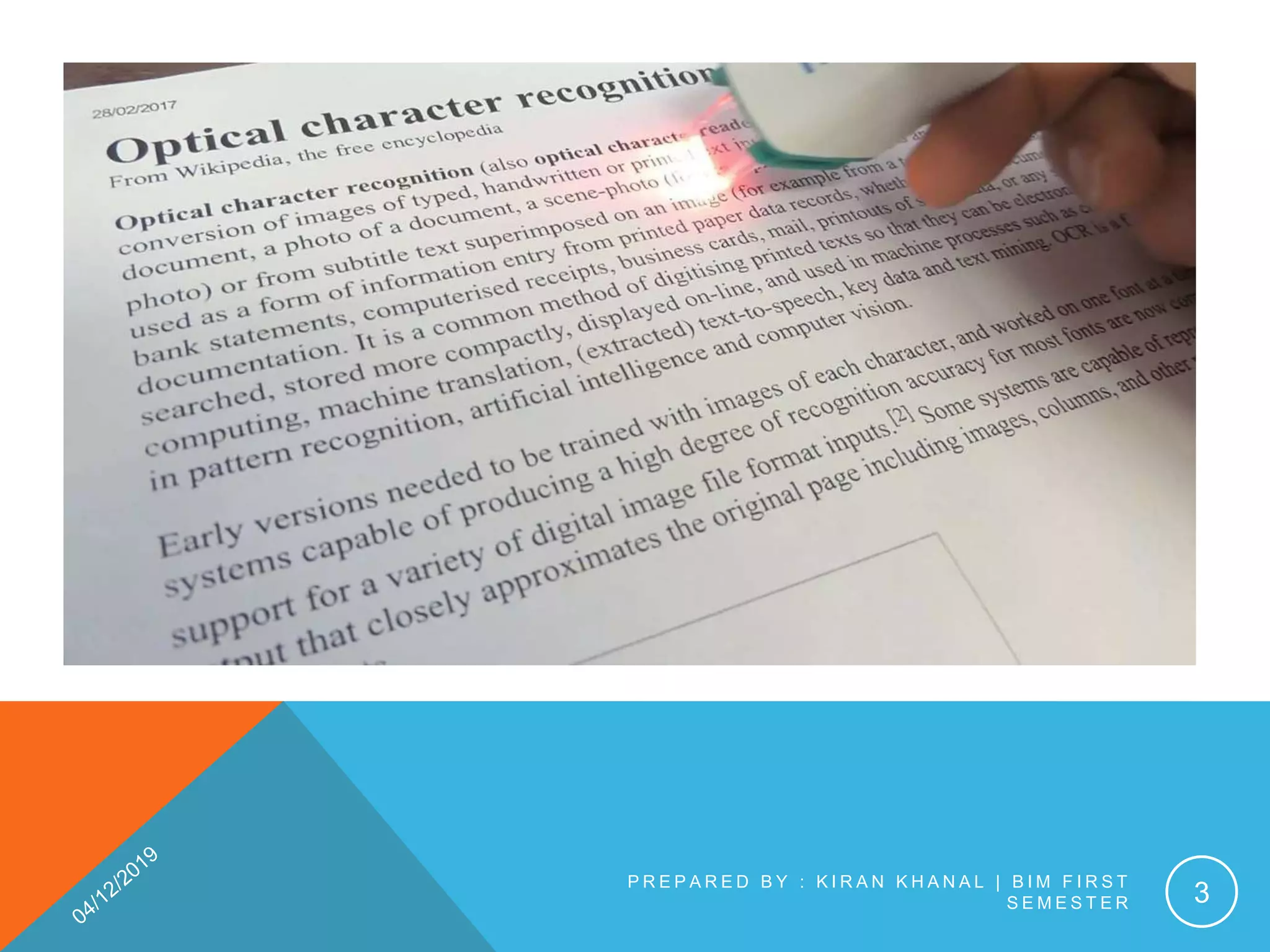
 OCR stands for Optical Character Recognition or Optical
Character Reader.
 It is the electronic conversion of handwritten or printed text
into machine-encoded text.
 Use optical scanners for input.
 This technology was developed early for creating reading
device for blinds.
 Most commonly used to convert hardcopy output into
softcopy.
P R E P A R E D B Y : K I R A N K H A N A L | B I M F I R S T
S E M E S T E R 2
P R E P A R E D B Y : K I R A N K H A N A L | B I M F I R S T
S E M E S T E R 3
HOW DOES IT WORK?
 Scans physical form of documents.
 Converts the documents to black and white.
 Further scans black part to find alphanumeric
digits.
 After identifying character, it is converted into
ASCII code that can be used by computer.
P R E P A R E D B Y : K I R A N K H A N A L | B I M F I R S T
S E M E S T E R 4
P R E P A R E D B Y : K I R A N K H A N A L | B I M F I R S T
S E M E S T E R 5
BENEFIT’S
Saves time
Minimize efforts
Decrease errors
APPLICATION AREAS
Banking
Legal
Healthcare
Others
P R E P A R E D B Y : K I R A N K H A N A L | B I M F I R S T
S E M E S T E R 6
OBCR
 Barcodes are series of black and white bars used to
represent alpha-numeric information in various
combinations.
 OBCR stands for Optical Barcode Reader.
 It can read printed barcodes, decode the data present in
barcode and send the data to the computer.
 Light sensor is used for translating optical impulses into
electrical signals.
P R E P A R E D B Y : K I R A N K H A N A L | B I M F I R S T
S E M E S T E R 7
P R E P A R E D B Y : K I R A N K H A N A L | B I M F I R S T
S E M E S T E R 8
HOW DOES IT WORK?
 Scans the blank and white elements of barcode.
 Generates analog signals which is sent to
decoder.
 The decoder interprets the signals and convert it
into texts.
P R E P A R E D B Y : K I R A N K H A N A L | B I M F I R S T
S E M E S T E R 9
P R E P A R E D B Y : K I R A N K H A N A L | B I M F I R S T
S E M E S T E R 10
BENEFIT’S
Eliminate errors
Inexpensive
Saves time
Easy access to
database
APPLICATION AREAS
Supermarket
Library
Advertisement
Flight ticket
Others
P R E P A R E D B Y : K I R A N K H A N A L | B I M F I R S T
S E M E S T E R 11
OMR
 OMR stands for Optical Mark Recognition.
 It is the process of recognizing pre specified
options.
 This type of technology is used to evaluate the
papers of competitive examination.
P R E P A R E D B Y : K I R A N K H A N A L | B I M F I R S T
S E M E S T E R 12
P R E P A R E D B Y : K I R A N K H A N A L | B I M F I R S T
S E M E S T E R 13
HOW DOES IT WORK?
 Optical mark reading is done with the help of device
called optical mark reader
 Data that is to be interpreted is in the form of dots,
darkened circles or dots
 These dots are identified by the OMR scanner when an
OMR sheets is passed through it and stores it to
separate files.
P R E P A R E D B Y : K I R A N K H A N A L | B I M F I R S T
S E M E S T E R 14
P R E P A R E D B Y : K I R A N K H A N A L | B I M F I R S T
S E M E S T E R 15
BENEFIT’S
Fast
Accurate
Cost effective.
MICR
 MICR stands for Magnetic Ink Character
Recognition.
 It is the technology which use magnetic ink for
printing the code.
 Used by banks while printing cheque.
 MICR technology contains magnetic ink of iron
dioxide which can be read even if it is overwritten.
P R E P A R E D B Y : K I R A N K H A N A L | B I M F I R S T
S E M E S T E R 16
P R E P A R E D B Y : K I R A N K H A N A L | B I M F I R S T
S E M E S T E R 17
Any Questions
?
P R E P A R E D B Y : K I R A N K H A N A L | B I M F I R S T
S E M E S T E R 18

OCR, OBCR, OMR, MICR

  • 1.
    OCR OBCR OMR MICR P R EP A R E D B Y : K I R A N K H A N A L | B I M F I R S T S E M E S T E R 1
  • 2.
    OCR  OCR standsfor Optical Character Recognition or Optical Character Reader.  It is the electronic conversion of handwritten or printed text into machine-encoded text.  Use optical scanners for input.  This technology was developed early for creating reading device for blinds.  Most commonly used to convert hardcopy output into softcopy. P R E P A R E D B Y : K I R A N K H A N A L | B I M F I R S T S E M E S T E R 2
  • 3.
    P R EP A R E D B Y : K I R A N K H A N A L | B I M F I R S T S E M E S T E R 3
  • 4.
    HOW DOES ITWORK?  Scans physical form of documents.  Converts the documents to black and white.  Further scans black part to find alphanumeric digits.  After identifying character, it is converted into ASCII code that can be used by computer. P R E P A R E D B Y : K I R A N K H A N A L | B I M F I R S T S E M E S T E R 4
  • 5.
    P R EP A R E D B Y : K I R A N K H A N A L | B I M F I R S T S E M E S T E R 5 BENEFIT’S Saves time Minimize efforts Decrease errors
  • 6.
    APPLICATION AREAS Banking Legal Healthcare Others P RE P A R E D B Y : K I R A N K H A N A L | B I M F I R S T S E M E S T E R 6
  • 7.
    OBCR  Barcodes areseries of black and white bars used to represent alpha-numeric information in various combinations.  OBCR stands for Optical Barcode Reader.  It can read printed barcodes, decode the data present in barcode and send the data to the computer.  Light sensor is used for translating optical impulses into electrical signals. P R E P A R E D B Y : K I R A N K H A N A L | B I M F I R S T S E M E S T E R 7
  • 8.
    P R EP A R E D B Y : K I R A N K H A N A L | B I M F I R S T S E M E S T E R 8
  • 9.
    HOW DOES ITWORK?  Scans the blank and white elements of barcode.  Generates analog signals which is sent to decoder.  The decoder interprets the signals and convert it into texts. P R E P A R E D B Y : K I R A N K H A N A L | B I M F I R S T S E M E S T E R 9
  • 10.
    P R EP A R E D B Y : K I R A N K H A N A L | B I M F I R S T S E M E S T E R 10 BENEFIT’S Eliminate errors Inexpensive Saves time Easy access to database
  • 11.
    APPLICATION AREAS Supermarket Library Advertisement Flight ticket Others PR E P A R E D B Y : K I R A N K H A N A L | B I M F I R S T S E M E S T E R 11
  • 12.
    OMR  OMR standsfor Optical Mark Recognition.  It is the process of recognizing pre specified options.  This type of technology is used to evaluate the papers of competitive examination. P R E P A R E D B Y : K I R A N K H A N A L | B I M F I R S T S E M E S T E R 12
  • 13.
    P R EP A R E D B Y : K I R A N K H A N A L | B I M F I R S T S E M E S T E R 13
  • 14.
    HOW DOES ITWORK?  Optical mark reading is done with the help of device called optical mark reader  Data that is to be interpreted is in the form of dots, darkened circles or dots  These dots are identified by the OMR scanner when an OMR sheets is passed through it and stores it to separate files. P R E P A R E D B Y : K I R A N K H A N A L | B I M F I R S T S E M E S T E R 14
  • 15.
    P R EP A R E D B Y : K I R A N K H A N A L | B I M F I R S T S E M E S T E R 15 BENEFIT’S Fast Accurate Cost effective.
  • 16.
    MICR  MICR standsfor Magnetic Ink Character Recognition.  It is the technology which use magnetic ink for printing the code.  Used by banks while printing cheque.  MICR technology contains magnetic ink of iron dioxide which can be read even if it is overwritten. P R E P A R E D B Y : K I R A N K H A N A L | B I M F I R S T S E M E S T E R 16
  • 17.
    P R EP A R E D B Y : K I R A N K H A N A L | B I M F I R S T S E M E S T E R 17
  • 18.
    Any Questions ? P RE P A R E D B Y : K I R A N K H A N A L | B I M F I R S T S E M E S T E R 18