WEEK 12
ASSIGNMENT
A look at AHRQ and PCORI by Tammy Burke
Speakers
notes
• Research Organizations
• Patient Centered Outcomes Research Institute (PCORI)
• Independent nonprofit
• Mandate to improve quality and relevance of evidence for all stakeholders
• patient-centered comparative clinical effectiveness research, or CER used to
improve patient care.
• Agency for Healthcare Research and Quality (AHRQ)
• Lead by federal agency U.S. Department of Health and Human Services
• Mission is to produce evidence to make health care safer, higher quality, more
accessible, equitable, and affordable, and to work.
• AHRQ invests in research on the Nation's health delivery system that goes beyond
the "what" of health care to understand "how" to make health care safer and
improve quality (Agency for Healthcare Research and Quality [AHRQ], 2016).
The Patient Centered
Outcomes Research institute
(PCORI) and the Agency for
Healthcare Research and
Quality (AHRQ) spend a lot
of time and money devoted
to improving the lives of
patients everywhere. This
power-point will present
some topics they are
currently working on. It will
be presented by
organization and whether
the outcomes are
determined good or a waste
of resources by the author
Speakers
Notes
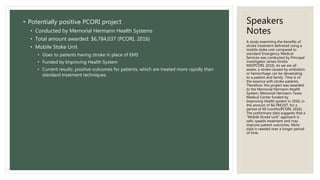
• Potentially positive PCORI project
• Conducted by Memorial Hermann Health Systems
• Total amount awarded: $6,784,037 (PCORI, 2016)
• Mobile Stoke Unit
• Goes to patients having stroke in place of EMS
• Funded by Improving Health System
• Current results: positive outcomes for patients, which are treated more rapidly than
standard treatment techniques.
A study examining the benefits of
stroke treatment delivered using a
mobile stoke unit compared to
standard Emergency Medical
Services was conducted by Principal
investigator James Grotta
MD(PCORI, 2016). As we are all
aware, a stroke caused by embolism
or hemorrhage can be devastating
to a patient and family. Time is of
the essence with stroke patients.
Therefore, this project was awarded
to the Memorial Hermann Health
System, Memorial Hermann-Texas
Medical Center funded by
Improving Health system in 2016, in
the amount of $6,784,037, for a
period of 60 months(PCORI, 2016).
The preliminary data suggests that a
“Mobile Stroke Unit” approach is
safe, speeds treatment and may
improve patient outcomes. More
data is needed over a longer period
of time.
Speakers
Notes
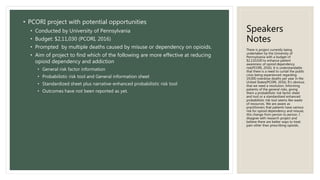
• PCORI project with potential opportunities
• Conducted by University of Pennsylvania
• Budget: $2,11,030 (PCORI, 2016)
• Prompted by multiple deaths caused by misuse or dependency on opioids.
• Aim of project to find which of the following are more effective at reducing
opioid dependency and addiction
• General risk factor information
• Probabilistic risk tool and General information sheet
• Standardized sheet plus narrative-enhanced probabilistic risk tool
• Outcomes have not been reported as yet.
There is project currently being
undertaken by the University of
Pennsylvania with a budget of
$2,110,030 to enhance patient
awareness of opioid dependency
risk(PCORI, 2016). It is understandable
that there is a need to curtail the public
crisis being experienced regarding
19,000 overdose deaths per year in the
United States(PCORI, 2016). It’s obvious
that we need a resolution. Informing
patients of the general risks, giving
them a probabilistic risk factor sheet
and tool or a standardized enhanced
probabilistic risk tool seems like waste
of resources. We are aware as
practitioners that patients have various
risk for opioid dependency and misuse,
this change from person to person. I
disagree with research project and
believe there are better ways to treat
pain other than prescribing opioids.
Speakers
Notes
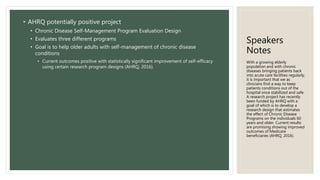
• AHRQ potentially positive project
• Chronic Disease Self-Management Program Evaluation Design
• Evaluates three different programs
• Goal is to help older adults with self-management of chronic disease
conditions
• Current outcomes positive with statistically significant improvement of self-efficacy
using certain research program designs (AHRQ, 2016).
With a growing elderly
population and with chronic
diseases bringing patients back
into acute care facilities regularly,
it is important that we as
clinicians find a way to keep
patients conditions out of the
hospital once stabilized and safe.
A research project has recently
been funded by AHRQ with a
goal of which is to develop a
research design that estimates
the effect of Chronic Disease
Programs on the individuals 60
years and older. Current results
are promising showing improved
outcomes of Medicare
beneficiaries (AHRQ, 2016).
Speakers
Notes
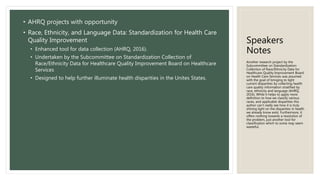
• AHRQ projects with opportunity
• Race, Ethnicity, and Language Data: Standardization for Health Care
Quality Improvement
• Enhanced tool for data collection (AHRQ, 2016).
• Undertaken by the Subcommittee on Standardization Collection of
Race/Ethnicity Data for Healthcare Quality Improvement Board on Healthcare
Services
• Designed to help further illuminate health disparities in the Unites States.
Another research project by the
Subcommittee on Standardization
Collection of Race/Ethnicity Data for
Healthcare Quality Improvement Board
on Health Care Services was assumed
with the goal of bringing to light
current disparities by collecting health
care quality information stratified by
race, ethnicity and language (AHRQ,
2016). While it helps to apply more
definition to how we classify various
races, and applicable disparities this
author can’t really see how it is truly
shining light on the disparities in health
we already know exist. Furthermore, it
offers nothing towards a resolution of
the problem, just another tool for
classification which to some may seem
wasteful.
References
Agency for Healthcare Research and Quality.(2016). www.ahrq.gov
Patient Centered Outcomes Research Institute. (2016). www.pcori.org

Week 12 assignment

  • 1.
    WEEK 12 ASSIGNMENT A lookat AHRQ and PCORI by Tammy Burke
  • 2.
    Speakers notes • Research Organizations •Patient Centered Outcomes Research Institute (PCORI) • Independent nonprofit • Mandate to improve quality and relevance of evidence for all stakeholders • patient-centered comparative clinical effectiveness research, or CER used to improve patient care. • Agency for Healthcare Research and Quality (AHRQ) • Lead by federal agency U.S. Department of Health and Human Services • Mission is to produce evidence to make health care safer, higher quality, more accessible, equitable, and affordable, and to work. • AHRQ invests in research on the Nation's health delivery system that goes beyond the "what" of health care to understand "how" to make health care safer and improve quality (Agency for Healthcare Research and Quality [AHRQ], 2016). The Patient Centered Outcomes Research institute (PCORI) and the Agency for Healthcare Research and Quality (AHRQ) spend a lot of time and money devoted to improving the lives of patients everywhere. This power-point will present some topics they are currently working on. It will be presented by organization and whether the outcomes are determined good or a waste of resources by the author
  • 3.
    Speakers Notes • Potentially positivePCORI project • Conducted by Memorial Hermann Health Systems • Total amount awarded: $6,784,037 (PCORI, 2016) • Mobile Stoke Unit • Goes to patients having stroke in place of EMS • Funded by Improving Health System • Current results: positive outcomes for patients, which are treated more rapidly than standard treatment techniques. A study examining the benefits of stroke treatment delivered using a mobile stoke unit compared to standard Emergency Medical Services was conducted by Principal investigator James Grotta MD(PCORI, 2016). As we are all aware, a stroke caused by embolism or hemorrhage can be devastating to a patient and family. Time is of the essence with stroke patients. Therefore, this project was awarded to the Memorial Hermann Health System, Memorial Hermann-Texas Medical Center funded by Improving Health system in 2016, in the amount of $6,784,037, for a period of 60 months(PCORI, 2016). The preliminary data suggests that a “Mobile Stroke Unit” approach is safe, speeds treatment and may improve patient outcomes. More data is needed over a longer period of time.
  • 4.
    Speakers Notes • PCORI projectwith potential opportunities • Conducted by University of Pennsylvania • Budget: $2,11,030 (PCORI, 2016) • Prompted by multiple deaths caused by misuse or dependency on opioids. • Aim of project to find which of the following are more effective at reducing opioid dependency and addiction • General risk factor information • Probabilistic risk tool and General information sheet • Standardized sheet plus narrative-enhanced probabilistic risk tool • Outcomes have not been reported as yet. There is project currently being undertaken by the University of Pennsylvania with a budget of $2,110,030 to enhance patient awareness of opioid dependency risk(PCORI, 2016). It is understandable that there is a need to curtail the public crisis being experienced regarding 19,000 overdose deaths per year in the United States(PCORI, 2016). It’s obvious that we need a resolution. Informing patients of the general risks, giving them a probabilistic risk factor sheet and tool or a standardized enhanced probabilistic risk tool seems like waste of resources. We are aware as practitioners that patients have various risk for opioid dependency and misuse, this change from person to person. I disagree with research project and believe there are better ways to treat pain other than prescribing opioids.
  • 5.
    Speakers Notes • AHRQ potentiallypositive project • Chronic Disease Self-Management Program Evaluation Design • Evaluates three different programs • Goal is to help older adults with self-management of chronic disease conditions • Current outcomes positive with statistically significant improvement of self-efficacy using certain research program designs (AHRQ, 2016). With a growing elderly population and with chronic diseases bringing patients back into acute care facilities regularly, it is important that we as clinicians find a way to keep patients conditions out of the hospital once stabilized and safe. A research project has recently been funded by AHRQ with a goal of which is to develop a research design that estimates the effect of Chronic Disease Programs on the individuals 60 years and older. Current results are promising showing improved outcomes of Medicare beneficiaries (AHRQ, 2016).
  • 6.
    Speakers Notes • AHRQ projectswith opportunity • Race, Ethnicity, and Language Data: Standardization for Health Care Quality Improvement • Enhanced tool for data collection (AHRQ, 2016). • Undertaken by the Subcommittee on Standardization Collection of Race/Ethnicity Data for Healthcare Quality Improvement Board on Healthcare Services • Designed to help further illuminate health disparities in the Unites States. Another research project by the Subcommittee on Standardization Collection of Race/Ethnicity Data for Healthcare Quality Improvement Board on Health Care Services was assumed with the goal of bringing to light current disparities by collecting health care quality information stratified by race, ethnicity and language (AHRQ, 2016). While it helps to apply more definition to how we classify various races, and applicable disparities this author can’t really see how it is truly shining light on the disparities in health we already know exist. Furthermore, it offers nothing towards a resolution of the problem, just another tool for classification which to some may seem wasteful.
  • 7.
    References Agency for HealthcareResearch and Quality.(2016). www.ahrq.gov Patient Centered Outcomes Research Institute. (2016). www.pcori.org