Oceans Chapters 15.2 – 15.3
Goal 1 Discuss the chemical and physical properties of seawater
Gases Nutrients Salts  (see table 15-1 page 392) Salinity 35 ppt = 3.5%  Salt ions Chloride Sodium Sulfate Magnesium Calcium
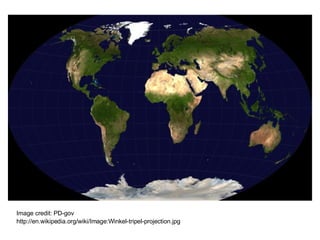
Salinity Varies  (figure 15-10 page 393) High salinity (up to 37 ppt) Evaporation Hot Low precipitation
Low salinity (down to 32 ppt) Low Evaporation High precipitation Freshwater influx Glacier melt River mouth
Image credit: PD-gov http://en.wikipedia.org/wiki/Image:Winkel-tripel-projection.jpg
Salinity affects Physical Properties More dense than freshwater Freshwater = 1.00 g /mL Seawater = 1.02 g/mL  to 1.03 g/mL Lower freezing point Fresh water = 0° C Seawater =  -2° C
Seawater absorbs light  (see figure 15-14 page 396) RYO (Long wavelengths) 50 m Green to 100 m Average depth of oceans 3720 m Photosynthesis occurs where??
Goal 2 Explain ocean layering   (See page 397)
Basis of ocean layering: Warm water    less dense   floats Cold water    more dense    sinks
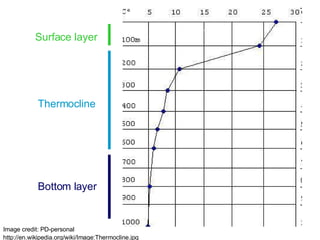
Ocean is divided into 3 layers Surface layer Thermocline Bottom layer Layers determined by temperature characteristics
Temperature decrease with depth Surface layer (top layer) Warm  ~ 100 m depth Equator  Nonexistent at poles
Thermocline (middle layer) Temperature rapidly decreases Depth location varies Nonexistent at poles
Bottom layer (bottom layer) Very cold <4° C  Near freezing temps Depth varies
Image credit: PD-personal http://en.wikipedia.org/wiki/Image:Thermocline.jpg Surface layer Thermocline Bottom layer
Goal 3 Explain deep water masses
Deep water mass formation Polar areas Cold Salty water = very dense  Salts do not freeze out of water Sinks  Migrates toward equator
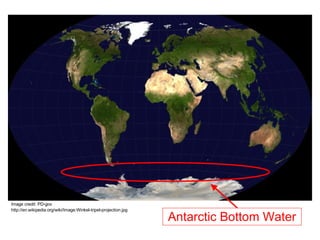
Three major water masses Antarctic Bottom Water Antarctic  winter Freezing , salt concentration Coldest Most dense
Image credit: PD-gov http://en.wikipedia.org/wiki/Image:Winkel-tripel-projection.jpg Antarctic Bottom Water
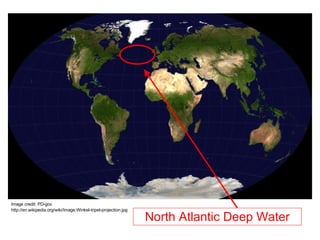
North Atlantic Deepwater Greenland Winter Freezing, salt concentration 2 nd  Coldest 2 nd  most dense
Image credit: PD-gov http://en.wikipedia.org/wiki/Image:Winkel-tripel-projection.jpg North Atlantic Deep Water
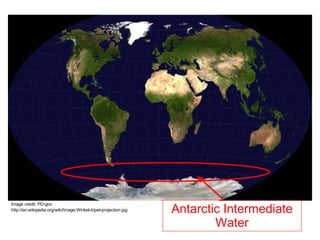
Antarctic Intermediate Water Antarctic winter Temperature decrease Least cold deep water mass Least dense deep water mass
Image credit: PD-gov http://en.wikipedia.org/wiki/Image:Winkel-tripel-projection.jpg Antarctic Intermediate Water
Atlantic ocean Affected by all 3 deep water masses Pacific Ocean Affected by only 2  Which one does not ???
Goal 4 Understand movement of water via ocean currents
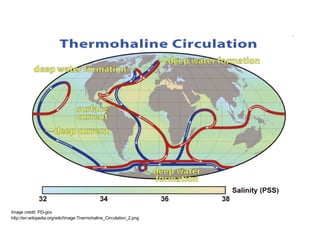
Density currents Driven by  Cold, salty deep water currents Great Ocean Conveyor Belt
Image credit: PD-gov http://en.wikipedia.org/wiki/Image:Thermohaline_Circulation_2.png
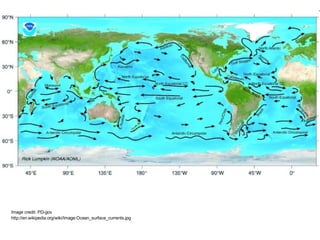
Surface currents Driven by global wind systems
Image credit: PD-gov http://en.wikipedia.org/wiki/Image:Ocean_surface_currents.jpg
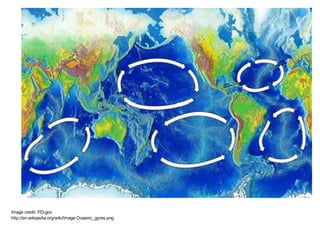
Gyres Continents deflect surface currents Northern Hemi = Clockwise Southern Hemi = Counterclockwise
Image credit: PD-gov http://en.wikipedia.org/wiki/Image:Oceanic_gyres.png
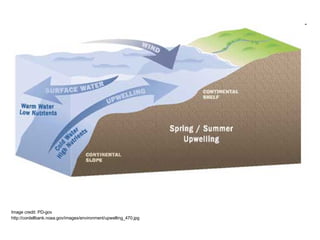
Upwelling Cold bottom water deflects up continents Pushed out by winds West coasts & trade winds Nutrient rich = fish
Image credit: PD-gov http://cordellbank.noaa.gov/images/environment/upwelling_470.jpg

Oceans