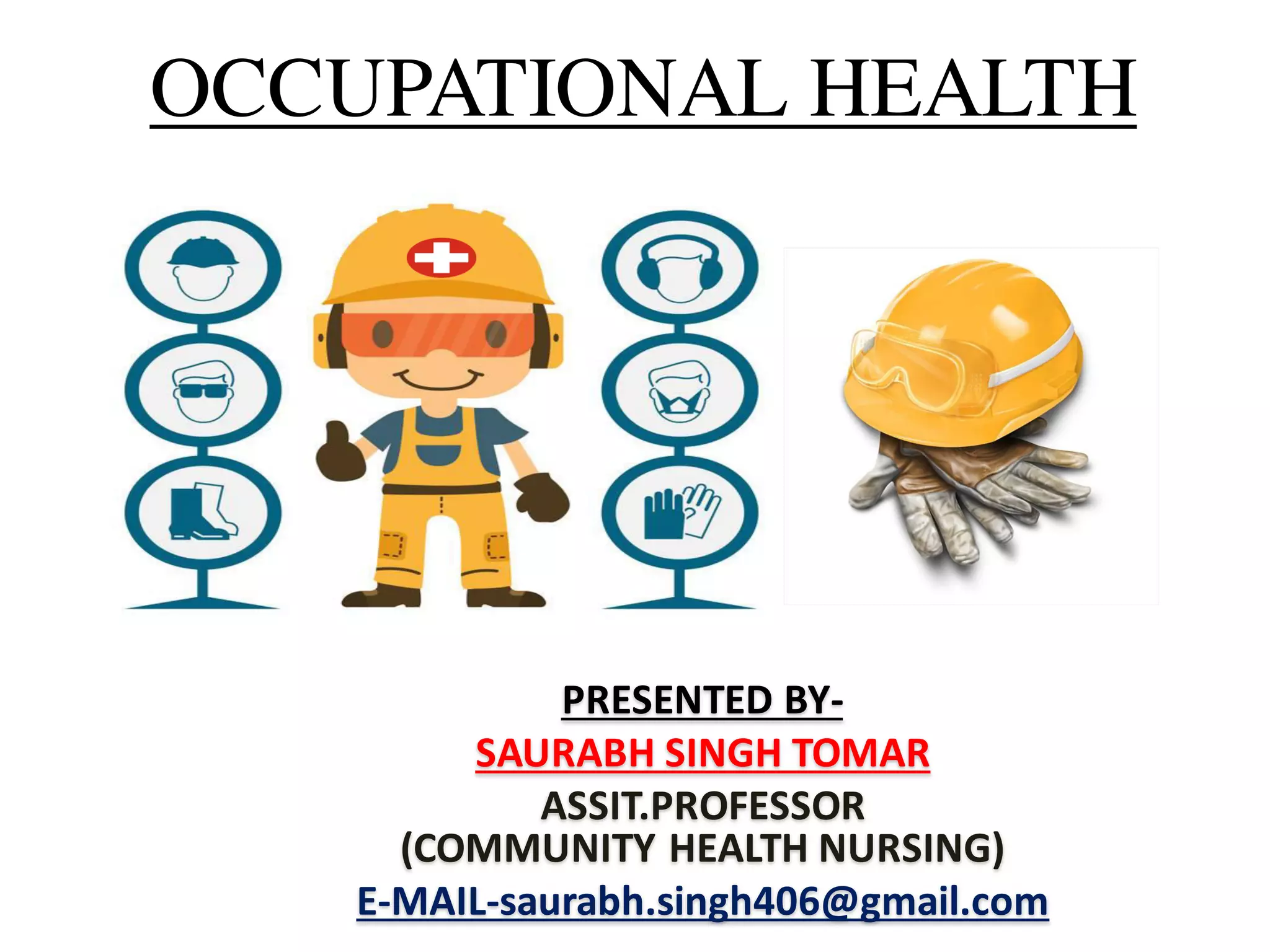
OCCUPATIONAL HEALTH
PRESENTED BY-
SAURABH SINGH TOMAR
ASSIT.PROFESSOR
(COMMUNITY HEALTH NURSING)
E-MAIL-saurabh.singh406@gmail.com
INTRODUCTION
‱ Occupational health care is preventive health care,
which is provided on the basis of the Occupational
Health Care Act.
‱ The objective of occupational health care is a providing
of healthy and safe working environment, a well-
functioning working community, prevention of work-
related diseases as well as the maintenance of
employees’ working ability and functional capacity, and
promotion of their health.
DEFINITIONS
1. ‘The promotion and maintenance of the highest degree of
physical, mental and social well-being of workers in all
occupations’
(Harrington & Gill,1992)
2. Occupational Health is the promotion and maintenance of
the highest degree of physical, mental and social well-being
of workers in all occupations by preventing departures from
health, controlling risks and the adaptation of work to
people, and people to their jobs.
(ILO / WHO 1950)
What is Occupational Health
Nursing?
‱ The specialty practice that focuses on the promotion,
prevention, and restoration of health within the context
of a safe and healthy environment.
‱ It includes the prevention of adverse health effects from
occupational and environmental hazards.
‱ It provides for and delivers occupational and
environmental health and safety programs and services to
clients.
‱ It is an autonomous specialty, and nurses make
independent nursing judgments in providing health care
services.
American Association of Occupational Health Nurses,
2004
AIM
"The promotion and maintenance of the highest degree
of physical, mental and social well-being of workers
in all occupations“
OBJECTIVES
‱ The maintenance and promotion of workers’ health
and working capacity.
‱ To prevent occupational diseases and injuries
‱ The improvement of working environment and work
to become conducive to safety and health
‱ Development of work organizations and working
cultures ,which supports health and safety at work
and promotes a positive social climate and smooth
operation and may enhance productivity of the
undertakings.
Joint ILO/WHO Committee on Occupational Health
CONTENT
1. Health promotion of workers
2. Prevention of occupational diseases
3. Roles and responsibilities of occupational health nurse
4. Administration of occupational health services
5. International organizations
6. Women and occupational health
7. Child labour and prevention
8. Values at workplace
HEALTH PROMOTION
OF WORKERS
Recommendationsby ILO / WHO committee on
occupational health in 1953
1) Nutrition
2) Communicable disease control
3) Environmental sanitation
4) Mental health
5) Measures for women and
children
6) Health education
7) Family planning
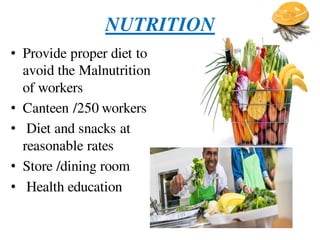
NUTRITION
‱ Provide proper diet to
avoid the Malnutrition
of workers
‱ Canteen /250 workers
‱ Diet and snacks at
reasonable rates
‱ Store /dining room
‱ Health education
COMMUNICABLE DISEASE
CONTROL
 Early diagnosis and prompt treatment
 Cases isolated from working environment
 Protective measures
 Regular Medical checkup & Immunization for
communicable diseases like TB, Typhoid, hepatitis,
malaria, venereal diseases
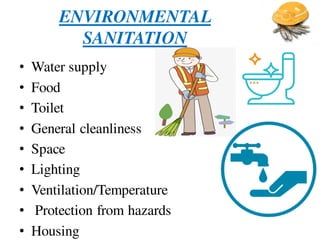
ENVIRONMENTAL
SANITATION
‱ Water supply
‱ Food
‱ Toilet
‱ General cleanliness
‱ Space
‱ Lighting
‱ Ventilation/Temperature
‱ Protection from hazards
‱ Housing
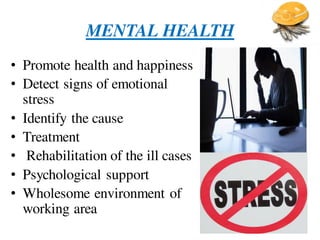
MENTAL HEALTH
‱ Promote health and happiness
‱ Detect signs of emotional
stress
‱ Identify the cause
‱ Treatment
‱ Rehabilitation of the ill cases
‱ Psychological support
‱ Wholesome environment of
working area
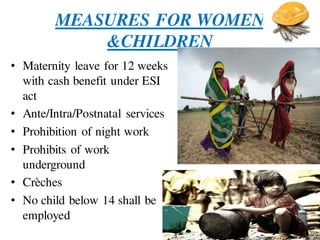
MEASURES FOR WOMEN
&CHILDREN
‱ Maternity leave for 12 weeks
with cash benefit under ESI
act
‱ Ante/Intra/Postnatal services
‱ Prohibition of night work
‱ Prohibits of work
underground
‱ Crùches
‱ No child below 14 shall be
employed
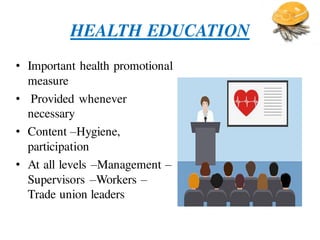
HEALTH EDUCATION
‱ Important health promotional
measure
‱ Provided whenever
necessary
‱ Content –Hygiene,
participation
‱ At all levels –Management –
Supervisors –Workers –
Trade union leaders
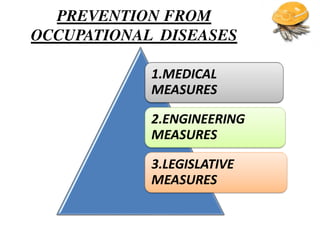
PREVENTION FROM
OCCUPATIONAL DISEASES
1.MEDICAL
MEASURES
2.ENGINEERING
MEASURES
3.LEGISLATIVE
MEASURES
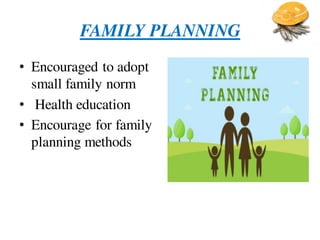
FAMILY PLANNING
‱ Encouraged to adopt
small family norm
‱ Health education
‱ Encourage for family
planning methods
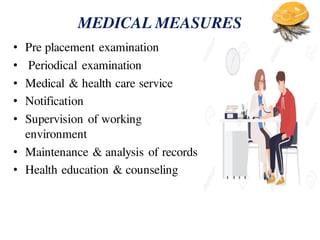
MEDICAL MEASURES
‱ Pre placement examination
‱ Periodical examination
‱ Medical & health care service
‱ Notification
‱ Supervision of working
environment
‱ Maintenance & analysis of records
‱ Health education & counseling
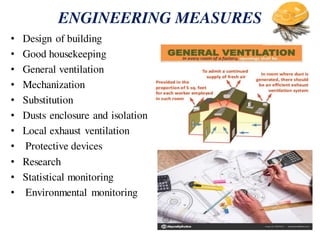
ENGINEERING MEASURES
‱ Design of building
‱ Good housekeeping
‱ General ventilation
‱ Mechanization
‱ Substitution
‱ Dusts enclosure and isolation
‱ Local exhaust ventilation
‱ Protective devices
‱ Research
‱ Statistical monitoring
‱ Environmental monitoring
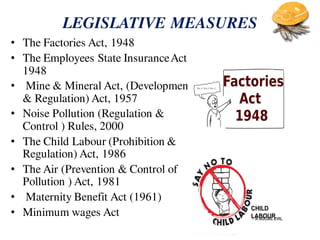
LEGISLATIVE MEASURES
‱ The Factories Act, 1948
‱ The Employees State InsuranceAct,
1948
‱ Mine & Mineral Act, (Development
& Regulation) Act, 1957
‱ Noise Pollution (Regulation &
Control ) Rules, 2000
‱ The Child Labour (Prohibition &
Regulation) Act, 1986
‱ The Air (Prevention & Control of
Pollution ) Act, 1981
‱ Maternity Benefit Act (1961)
‱ Minimum wages Act
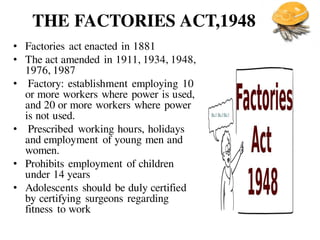
THE FACTORIES ACT,1948
‱ Factories act enacted in 1881
‱ The act amended in 1911, 1934, 1948,
1976, 1987
‱ Factory: establishment employing 10
or more workers where power is used,
and 20 or more workers where power
is not used.
‱ Prescribed working hours, holidays
and employment of young men and
women.
‱ Prohibits employment of children
under 14 years
‱ Adolescents should be duly certified
by certifying surgeons regarding
fitness to work
THE FACTORIES ACT, 1948
‱ Chapter III (Section 11-20) deals
with health aspects
‱ Chapter IV (Section 21-40) deals
with safety aspects
‱ Chapter V deals with welfare
aspects
‱ Chapter VI deals with work hours
holidays interval
‱ Chapter VII deals with employment
of young person
THE EMPLOYEES STATE
INSURANCE ACT, 1948
‱ Provides cash and medical benefits to
industrial employees in case of sickness,
maternity and employment injury.
‱ Administration by ESI Corporation
‱ The Union minister for labour :chairman
‱ Secretary Ministry of labour : vice
chairman
‱ 4 principal officers –
Insurance commissioner
Medical commissioner
Finance commissioner
Actuary
THE EMPLOYEES STATE
INSURANCEACT, 1948
BENEFITS TO
EMPLOYEES
‱ Medical benefit
‱ Sickness benefit
‱ Maternity benefit
‱ Disablement benefit
‱ Dependent benefit
‱ Funeral expense
‱ Rehabilitation
allowance
BENEFITS OF
EMPLOYER
‱ Exemption from the applicability
of Workmen's Compensation Act
1923
‱ Exemption from Maternity
Benefit Act 1961
‱ Exemption from payment of
Medical allowance to employees
and their dependants or arranging
for their medical care
‱ Rebate under the Income Tax Act
on contribution deposited in the
ESI Account
‱ Healthy work-force.
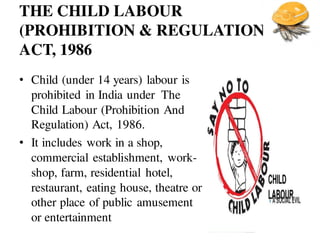
THE CHILD LABOUR
(PROHIBITION & REGULATION)
ACT, 1986
‱ Child (under 14 years) labour is
prohibited in India under The
Child Labour (Prohibition And
Regulation) Act, 1986.
‱ It includes work in a shop,
commercial establishment, work-
shop, farm, residential hotel,
restaurant, eating house, theatre or
other place of public amusement
or entertainment
ADVANTAGES OF
OCCUPATIONAL HEALTH CARE
1. Investigates and assesses load factors and hazards and
gives expert assistance for eliminating them
2. Gives information and advice
3. Estimates employees’ working ability and monitors
their health condition
4. By its knowledge and skills supports action for
maintaining working ability in the development of
individuals, working environment and working
community, in this way also affecting productivity
continued
5. Prevents occupational diseases and other work-related
illnesses .
Cont
.
5. Prevents premature incapacity for work, reduces
pension costs
6. Reduces absenteeism due to sickness
7. Can make calculations of the profitability of
occupational safety and health and occupational
health care in cooperation with workplaces or
encourage workplaces to make these themselves
THE NEED OF OCCUPATIONAL
HEALTH SERVICES
1. Any undertakings, which employ more than the
prescribed number.
2. Public sector undertakings
3. Atomic energy unit, explosive production unit,
mining unit, and asbestos production unit etc.,
4. A unit where workers are exposed to health hazards
from toxic substances.
FUNCTIONS OF OCCUPATIONAL
HEALTH SERVICE
1. Pre-employment medical examination.
2. First Aid and emergency service.
3. Supervision of the work environment for the
control of dangerous substances in the work
environment.
4. Special periodic medical examination particularly
for the workers in dangerous operations.
5. Health education for disseminating information on
specific hazards and risks in the work environment.
6. Special examination and surveillance of health of women and
children
7. Advising the employer or management for improving working
conditions, and placement of hazards.
8. Monitoring of working environment for assessment and control
of hazards.
9. Supervision over sanitation, hygiene and canteen facilities.
10. Liaison and cooperation with the safety committees
11. Maintenance of medical records for medical check-up and
follow-up for maintaining health standards and also for
evaluation.
12. To carry out other parallel activities such as nutrition
programme, family planning, social services recreation etc.,
Concerning the health and welfare of the workers.
COMPONENTS OCCUPATIONAL
HEALTH SERVICES
‱ Medical treatment, First aid treatment in emergency.
‱ Health education, First aid education.
‱ Medical examination
‱ Pre employment examination
‱ Medical treatment, First aid treatment in emergency.
‱ Health education, First aid education.
‱ Medical examination
 Pre employment examination
 Periodic medical examination
 Special medical examination
‱ Health counseling
 Stress management
 Mental health
 And Physical health
 Rehabilitation programme
 Medical rehabilitation
 Social rehabilitation
 Educational rehabilitation
 Vocational rehabilitation
‱ Assessment of dusts pollution
‱ Assessment of noise pollution
 Assessment of vibration
 Assessment heat radiation
 Assessment of radiation
‱ Family welfare program
‱ To take care of employee and dependents
‱ Disaster management
‱ Health records maintenance
‱ Supervision of the working environment
 Hazard identification
 Monitoring
 Evaluation
 Engineering project review
 Control measures
 Development of personal protective devices
12- MAIN FUNCTIONS
SPECIFIC TO OCCUPATIONAL
HEALTH NURSING
ACCORDING TO Dorward (1993 cited by Oakley
1. Health supervision of
workers
2. Health surveillance of the
work environment
3. Accident prevention
4. Prevention of occupational
ill health
5. Treatment of illness
6. Treatment of illness and
injury at work
7. First aid course
8. Promotion of health and
prevention of ill health
9. Giving counselling
10. Rehabilitation and
resettlement into work;
records and reports
11. Liaison and co-operation
(internally and externally)
12. Administration of the health
unit
13. Research (including surveys)
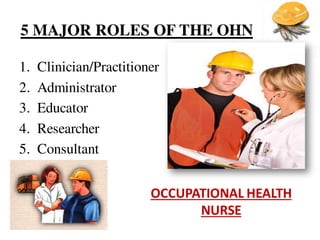
5 MAJOR ROLES OF THE OHN
1. Clinician/Practitioner
2. Administrator
3. Educator
4. Researcher
5. Consultant
OCCUPATIONAL HEALTH
NURSE
1. CLINICIAN/PRACTITIONER
1. Assess work environment
2. Assess workers health status
3. Perform health surveillance
4. Provide direct nursing care
5. Conduct health education and
counselling
6. Collaborate, communicate and consult
with Occ. Safety & Health (OSH) team
7. Maintain accurate, concise and
complete records
8. Develop and implement programs to
correct health and safety hazards
9. Institute personal protective programs
10. Initiate referrals to hospitals and clinics
11. Conduct health screening programs
12. Conduct health training programs
13. Manage workers compensation claims
14. Maintain professionalism and ethical
conduct
15. Adhere to legal requirements in exercising
duites
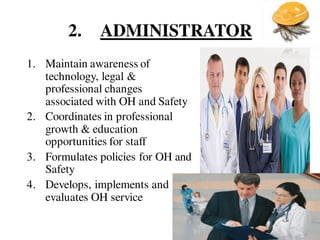
2. ADMINISTRATOR
1. Maintain awareness of
technology, legal &
professional changes
associated with OH and Safety
2. Coordinates in professional
growth & education
opportunities for staff
3. Formulates policies for OH and
Safety
4. Develops, implements and
evaluates OH service
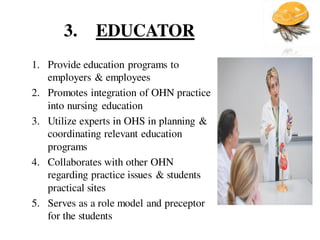
3. EDUCATOR
1. Provide education programs to
employers & employees
2. Promotes integration of OHN practice
into nursing education
3. Utilize experts in OHS in planning &
coordinating relevant education
programs
4. Collaborates with other OHN
regarding practice issues & students
practical sites
5. Serves as a role model and preceptor
for the students
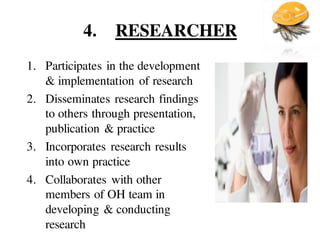
4. RESEARCHER
1. Participates in the development
& implementation of research
2. Disseminates research findings
to others through presentation,
publication & practice
3. Incorporates research results
into own practice
4. Collaborates with other
members of OH team in
developing & conducting
research
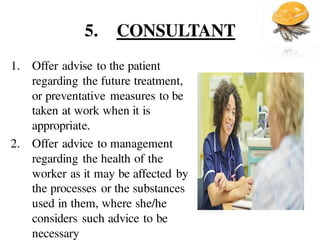
5. CONSULTANT
1. Offer advise to the patient
regarding the future treatment,
or preventative measures to be
taken at work when it is
appropriate.
2. Offer advice to management
regarding the health of the
worker as it may be affected by
the processes or the substances
used in them, where she/he
considers such advice to be
necessary
SPECIFIC ROLES OF THE OHN
Harrison (1984)
1. Advisor
2. Counselor
3. Educator
4. Environmentalist
5. Hygienist
6. Interpreter
1. Leader
2. Rehabilitator
3. Researcher
4. Safety expert
5. Supervisor
6. Student
SKILLSAND COMPETENCIES
OF THE OCCUPATIONAL
HEALTH NURSE
Clinical and primary care
Case management
Workforce, workplace, and environmental issues
Legal and ethical responsibilities
Management and administration
Health promotion and disease prevention
Occupational and environmental health and safety
education
Research
Professionalism
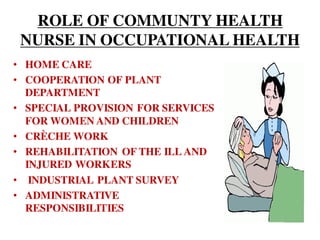
ROLE OF COMMUNTY HEALTH
NURSE IN OCCUPATIONAL HEALTH
‱ HOME CARE
‱ COOPERATION OF PLANT
DEPARTMENT
‱ SPECIAL PROVISION FOR SERVICES
FOR WOMEN AND CHILDREN
‱ CRÈCHE WORK
‱ REHABILITATION OF THE ILL AND
INJURED WORKERS
‱ INDUSTRIAL PLANT SURVEY
‱ ADMINISTRATIVE
RESPONSIBILITIES
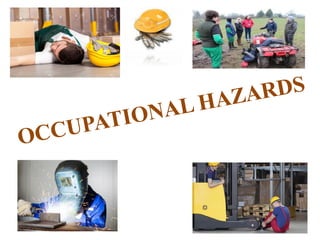
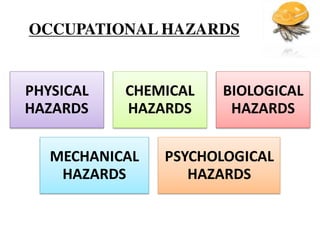
OCCUPATIONAL HAZARDS
PHYSICAL
HAZARDS
CHEMICAL
HAZARDS
BIOLOGICAL
HAZARDS
MECHANICAL
HAZARDS
PSYCHOLOGICAL
HAZARDS
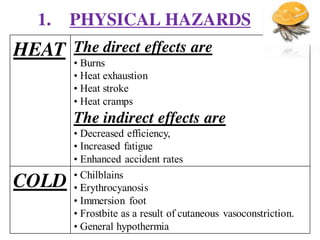
1. PHYSICAL HAZARDS
HEAT The direct effects are
‱ Burns
‱ Heat exhaustion
‱ Heat stroke
‱ Heat cramps
The indirect effects are
‱ Decreased efficiency,
‱ Increased fatigue
‱ Enhanced accident rates
COLD ‱ Chilblains
‱ Erythrocyanosis
‱ Immersion foot
‱ Frostbite as a result of cutaneous vasoconstriction.
‱ General hypothermia
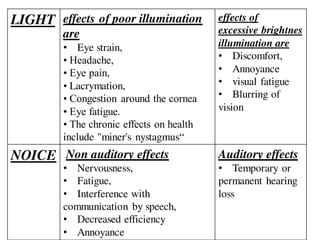
LIGHT effects of poor illumination
are
‱ Eye strain,
‱ Headache,
‱ Eye pain,
‱ Lacrymation,
‱ Congestion around the cornea
‱ Eye fatigue.
‱ The chronic effects on health
include "miner's nystagmus“
effects of
excessive brightnes
illumination are
‱ Discomfort,
‱ Annoyance
‱ visual fatigue
‱ Blurring of
vision
NOICE Non auditory effects
‱ Nervousness,
‱ Fatigue,
‱ Interference with
communication by speech,
‱ Decreased efficiency
‱ Annoyance
Auditory effects
‱ Temporary or
permanent hearing
loss
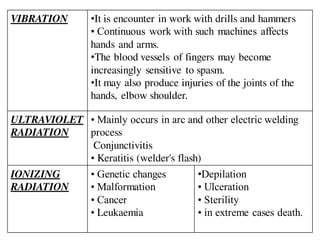
VIBRATION ‱It is encounter in work with drills and hammers
‱ Continuous work with such machines affects
hands and arms.
‱The blood vessels of fingers may become
increasingly sensitive to spasm.
‱It may also produce injuries of the joints of the
hands, elbow shoulder.
ULTRAVIOLET
RADIATION
‱ Mainly occurs in arc and other electric welding
process
Conjunctivitis
‱ Keratitis (welder's flash)
IONIZING
RADIATION
‱ Genetic changes
‱ Malformation
‱ Cancer
‱ Leukaemia
‱Depilation
‱ Ulceration
‱ Sterility
‱ in extreme cases death.
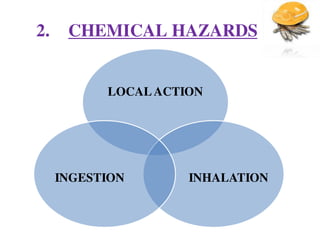
2. CHEMICAL HAZARDS
LOCALACTION
INHALATIONINGESTION
1)Local Action
‱ Dermatitis
‱ Eczema
‱ Ulcers
‱ Cancer by primary irritant action
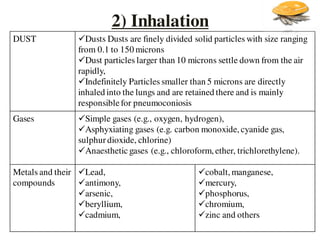
2) Inhalation
DUST Dusts Dusts are finely divided solid particles with size ranging
from 0.1 to 150 microns
Dust particles larger than 10 microns settle down from the air
rapidly,
Indefinitely Particles smaller than 5 microns are directly
inhaled into the lungs and are retained there and is mainly
responsiblefor pneumoconiosis
Gases Simple gases (e.g., oxygen, hydrogen),
Asphyxiating gases (e.g. carbon monoxide, cyanide gas,
sulphur dioxide, chlorine)
Anaesthetic gases (e.g., chloroform, ether, trichlorethylene).
Metals and their
compounds
Lead,
antimony,
arsenic,
beryllium,
cadmium,
cobalt, manganese,
mercury,
phosphorus,
chromium,
zinc and others
3) Ingestion
‱ Occupational diseases may also result from
ingestion of chemical substances such as lead,
mercury, arsenic, zinc, chromium, cadmium,
phosphorus etc.
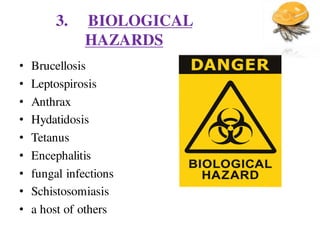
3. BIOLOGICAL
HAZARDS
‱ Brucellosis
‱ Leptospirosis
‱ Anthrax
‱ Hydatidosis
‱ Tetanus
‱ Encephalitis
‱ fungal infections
‱ Schistosomiasis
‱ a host of others
4. MECHANICAL
HAZARDS
‱ May cause due to protruding
moving parts of machinery.
‱ Sometimes due to own
carelessness
‱ About 10% of accidents in
industry are said to be due to
mechanical causes.
Who are at risk?
1) Agricultural workers
2) Business establishments
workers
3) Construction workers
4) Transport workers
Common injuries due to trips, slips or falls, mishandling and
lifting of equipment
‱ Sprains and strains
‱ Back injuries
‱ Head injuries
‱ Neck injuries
‱ Appendage injuries
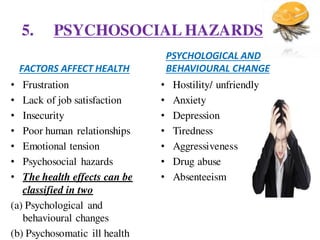
5. PSYCHOSOCIAL HAZARDS
FACTORS AFFECT HEALTH
‱ Frustration
‱ Lack of job satisfaction
‱ Insecurity
‱ Poor human relationships
‱ Emotional tension
‱ Psychosocial hazards
‱ The health effects can be
classified in two
(a) Psychological and
behavioural changes
(b) Psychosomatic ill health
PSYCHOLOGICAL AND
BEHAVIOURAL CHANGE
‱ Hostility/ unfriendly
‱ Anxiety
‱ Depression
‱ Tiredness
‱ Aggressiveness
‱ Drug abuse
‱ Absenteeism
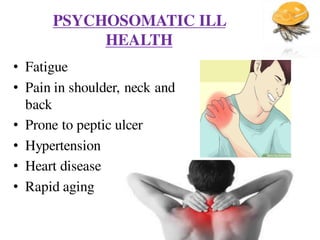
PSYCHOSOMATIC ILL
HEALTH
‱ Fatigue
‱ Pain in shoulder, neck and
back
‱ Prone to peptic ulcer
‱ Hypertension
‱ Heart disease
‱ Rapid aging
Occupational health

Occupational health

  • 1.
    OCCUPATIONAL HEALTH PRESENTED BY- SAURABHSINGH TOMAR ASSIT.PROFESSOR (COMMUNITY HEALTH NURSING) E-MAIL-saurabh.singh406@gmail.com
  • 2.
    INTRODUCTION ‱ Occupational healthcare is preventive health care, which is provided on the basis of the Occupational Health Care Act. ‱ The objective of occupational health care is a providing of healthy and safe working environment, a well- functioning working community, prevention of work- related diseases as well as the maintenance of employees’ working ability and functional capacity, and promotion of their health.
  • 3.
    DEFINITIONS 1. ‘The promotionand maintenance of the highest degree of physical, mental and social well-being of workers in all occupations’ (Harrington & Gill,1992) 2. Occupational Health is the promotion and maintenance of the highest degree of physical, mental and social well-being of workers in all occupations by preventing departures from health, controlling risks and the adaptation of work to people, and people to their jobs. (ILO / WHO 1950)
  • 4.
    What is OccupationalHealth Nursing? ‱ The specialty practice that focuses on the promotion, prevention, and restoration of health within the context of a safe and healthy environment. ‱ It includes the prevention of adverse health effects from occupational and environmental hazards. ‱ It provides for and delivers occupational and environmental health and safety programs and services to clients. ‱ It is an autonomous specialty, and nurses make independent nursing judgments in providing health care services. American Association of Occupational Health Nurses, 2004
  • 5.
    AIM "The promotion andmaintenance of the highest degree of physical, mental and social well-being of workers in all occupations“
  • 6.
    OBJECTIVES ‱ The maintenanceand promotion of workers’ health and working capacity. ‱ To prevent occupational diseases and injuries ‱ The improvement of working environment and work to become conducive to safety and health ‱ Development of work organizations and working cultures ,which supports health and safety at work and promotes a positive social climate and smooth operation and may enhance productivity of the undertakings. Joint ILO/WHO Committee on Occupational Health
  • 7.
    CONTENT 1. Health promotionof workers 2. Prevention of occupational diseases 3. Roles and responsibilities of occupational health nurse 4. Administration of occupational health services 5. International organizations 6. Women and occupational health 7. Child labour and prevention 8. Values at workplace
  • 8.
    HEALTH PROMOTION OF WORKERS RecommendationsbyILO / WHO committee on occupational health in 1953 1) Nutrition 2) Communicable disease control 3) Environmental sanitation 4) Mental health 5) Measures for women and children 6) Health education 7) Family planning
  • 9.
    NUTRITION ‱ Provide properdiet to avoid the Malnutrition of workers ‱ Canteen /250 workers ‱ Diet and snacks at reasonable rates ‱ Store /dining room ‱ Health education
  • 10.
    COMMUNICABLE DISEASE CONTROL  Earlydiagnosis and prompt treatment  Cases isolated from working environment  Protective measures  Regular Medical checkup & Immunization for communicable diseases like TB, Typhoid, hepatitis, malaria, venereal diseases
  • 11.
    ENVIRONMENTAL SANITATION ‱ Water supply ‱Food ‱ Toilet ‱ General cleanliness ‱ Space ‱ Lighting ‱ Ventilation/Temperature ‱ Protection from hazards ‱ Housing
  • 12.
    MENTAL HEALTH ‱ Promotehealth and happiness ‱ Detect signs of emotional stress ‱ Identify the cause ‱ Treatment ‱ Rehabilitation of the ill cases ‱ Psychological support ‱ Wholesome environment of working area
  • 13.
    MEASURES FOR WOMEN &CHILDREN ‱Maternity leave for 12 weeks with cash benefit under ESI act ‱ Ante/Intra/Postnatal services ‱ Prohibition of night work ‱ Prohibits of work underground ‱ Crùches ‱ No child below 14 shall be employed
  • 14.
    HEALTH EDUCATION ‱ Importanthealth promotional measure ‱ Provided whenever necessary ‱ Content –Hygiene, participation ‱ At all levels –Management – Supervisors –Workers – Trade union leaders
  • 15.
  • 16.
    FAMILY PLANNING ‱ Encouragedto adopt small family norm ‱ Health education ‱ Encourage for family planning methods
  • 17.
    MEDICAL MEASURES ‱ Preplacement examination ‱ Periodical examination ‱ Medical & health care service ‱ Notification ‱ Supervision of working environment ‱ Maintenance & analysis of records ‱ Health education & counseling
  • 18.
    ENGINEERING MEASURES ‱ Designof building ‱ Good housekeeping ‱ General ventilation ‱ Mechanization ‱ Substitution ‱ Dusts enclosure and isolation ‱ Local exhaust ventilation ‱ Protective devices ‱ Research ‱ Statistical monitoring ‱ Environmental monitoring
  • 19.
    LEGISLATIVE MEASURES ‱ TheFactories Act, 1948 ‱ The Employees State InsuranceAct, 1948 ‱ Mine & Mineral Act, (Development & Regulation) Act, 1957 ‱ Noise Pollution (Regulation & Control ) Rules, 2000 ‱ The Child Labour (Prohibition & Regulation) Act, 1986 ‱ The Air (Prevention & Control of Pollution ) Act, 1981 ‱ Maternity Benefit Act (1961) ‱ Minimum wages Act
  • 20.
    THE FACTORIES ACT,1948 ‱Factories act enacted in 1881 ‱ The act amended in 1911, 1934, 1948, 1976, 1987 ‱ Factory: establishment employing 10 or more workers where power is used, and 20 or more workers where power is not used. ‱ Prescribed working hours, holidays and employment of young men and women. ‱ Prohibits employment of children under 14 years ‱ Adolescents should be duly certified by certifying surgeons regarding fitness to work
  • 21.
    THE FACTORIES ACT,1948 ‱ Chapter III (Section 11-20) deals with health aspects ‱ Chapter IV (Section 21-40) deals with safety aspects ‱ Chapter V deals with welfare aspects ‱ Chapter VI deals with work hours holidays interval ‱ Chapter VII deals with employment of young person
  • 22.
    THE EMPLOYEES STATE INSURANCEACT, 1948 ‱ Provides cash and medical benefits to industrial employees in case of sickness, maternity and employment injury. ‱ Administration by ESI Corporation ‱ The Union minister for labour :chairman ‱ Secretary Ministry of labour : vice chairman ‱ 4 principal officers – Insurance commissioner Medical commissioner Finance commissioner Actuary
  • 23.
    THE EMPLOYEES STATE INSURANCEACT,1948 BENEFITS TO EMPLOYEES ‱ Medical benefit ‱ Sickness benefit ‱ Maternity benefit ‱ Disablement benefit ‱ Dependent benefit ‱ Funeral expense ‱ Rehabilitation allowance BENEFITS OF EMPLOYER ‱ Exemption from the applicability of Workmen's Compensation Act 1923 ‱ Exemption from Maternity Benefit Act 1961 ‱ Exemption from payment of Medical allowance to employees and their dependants or arranging for their medical care ‱ Rebate under the Income Tax Act on contribution deposited in the ESI Account ‱ Healthy work-force.
  • 24.
    THE CHILD LABOUR (PROHIBITION& REGULATION) ACT, 1986 ‱ Child (under 14 years) labour is prohibited in India under The Child Labour (Prohibition And Regulation) Act, 1986. ‱ It includes work in a shop, commercial establishment, work- shop, farm, residential hotel, restaurant, eating house, theatre or other place of public amusement or entertainment
  • 25.
    ADVANTAGES OF OCCUPATIONAL HEALTHCARE 1. Investigates and assesses load factors and hazards and gives expert assistance for eliminating them 2. Gives information and advice 3. Estimates employees’ working ability and monitors their health condition 4. By its knowledge and skills supports action for maintaining working ability in the development of individuals, working environment and working community, in this way also affecting productivity continued 5. Prevents occupational diseases and other work-related illnesses .
  • 26.
    Cont
. 5. Prevents prematureincapacity for work, reduces pension costs 6. Reduces absenteeism due to sickness 7. Can make calculations of the profitability of occupational safety and health and occupational health care in cooperation with workplaces or encourage workplaces to make these themselves
  • 27.
    THE NEED OFOCCUPATIONAL HEALTH SERVICES 1. Any undertakings, which employ more than the prescribed number. 2. Public sector undertakings 3. Atomic energy unit, explosive production unit, mining unit, and asbestos production unit etc., 4. A unit where workers are exposed to health hazards from toxic substances.
  • 28.
    FUNCTIONS OF OCCUPATIONAL HEALTHSERVICE 1. Pre-employment medical examination. 2. First Aid and emergency service. 3. Supervision of the work environment for the control of dangerous substances in the work environment. 4. Special periodic medical examination particularly for the workers in dangerous operations. 5. Health education for disseminating information on specific hazards and risks in the work environment.
  • 29.
    6. Special examinationand surveillance of health of women and children 7. Advising the employer or management for improving working conditions, and placement of hazards. 8. Monitoring of working environment for assessment and control of hazards. 9. Supervision over sanitation, hygiene and canteen facilities. 10. Liaison and cooperation with the safety committees 10. Liaison and cooperation with the safety committees 11. Maintenance of medical records for medical check-up and follow-up for maintaining health standards and also for evaluation. 12. To carry out other parallel activities such as nutrition programme, family planning, social services recreation etc., Concerning the health and welfare of the workers.
  • 30.
    COMPONENTS OCCUPATIONAL HEALTH SERVICES ‱Medical treatment, First aid treatment in emergency. ‱ Health education, First aid education. ‱ Medical examination ‱ Pre employment examination ‱ Medical treatment, First aid treatment in emergency. ‱ Health education, First aid education. ‱ Medical examination  Pre employment examination  Periodic medical examination  Special medical examination
  • 31.
    ‱ Health counseling Stress management  Mental health  And Physical health  Rehabilitation programme  Medical rehabilitation  Social rehabilitation  Educational rehabilitation  Vocational rehabilitation ‱ Assessment of dusts pollution ‱ Assessment of noise pollution  Assessment of vibration  Assessment heat radiation  Assessment of radiation
  • 32.
    ‱ Family welfareprogram ‱ To take care of employee and dependents ‱ Disaster management ‱ Health records maintenance ‱ Supervision of the working environment  Hazard identification  Monitoring  Evaluation  Engineering project review  Control measures  Development of personal protective devices
  • 33.
    12- MAIN FUNCTIONS SPECIFICTO OCCUPATIONAL HEALTH NURSING ACCORDING TO Dorward (1993 cited by Oakley 1. Health supervision of workers 2. Health surveillance of the work environment 3. Accident prevention 4. Prevention of occupational ill health 5. Treatment of illness 6. Treatment of illness and injury at work 7. First aid course 8. Promotion of health and prevention of ill health 9. Giving counselling 10. Rehabilitation and resettlement into work; records and reports 11. Liaison and co-operation (internally and externally) 12. Administration of the health unit 13. Research (including surveys)
  • 34.
    5 MAJOR ROLESOF THE OHN 1. Clinician/Practitioner 2. Administrator 3. Educator 4. Researcher 5. Consultant OCCUPATIONAL HEALTH NURSE
  • 35.
    1. CLINICIAN/PRACTITIONER 1. Assesswork environment 2. Assess workers health status 3. Perform health surveillance 4. Provide direct nursing care 5. Conduct health education and counselling 6. Collaborate, communicate and consult with Occ. Safety & Health (OSH) team 7. Maintain accurate, concise and complete records 8. Develop and implement programs to correct health and safety hazards
  • 36.
    9. Institute personalprotective programs 10. Initiate referrals to hospitals and clinics 11. Conduct health screening programs 12. Conduct health training programs 13. Manage workers compensation claims 14. Maintain professionalism and ethical conduct 15. Adhere to legal requirements in exercising duites
  • 37.
    2. ADMINISTRATOR 1. Maintainawareness of technology, legal & professional changes associated with OH and Safety 2. Coordinates in professional growth & education opportunities for staff 3. Formulates policies for OH and Safety 4. Develops, implements and evaluates OH service
  • 38.
    3. EDUCATOR 1. Provideeducation programs to employers & employees 2. Promotes integration of OHN practice into nursing education 3. Utilize experts in OHS in planning & coordinating relevant education programs 4. Collaborates with other OHN regarding practice issues & students practical sites 5. Serves as a role model and preceptor for the students
  • 39.
    4. RESEARCHER 1. Participatesin the development & implementation of research 2. Disseminates research findings to others through presentation, publication & practice 3. Incorporates research results into own practice 4. Collaborates with other members of OH team in developing & conducting research
  • 40.
    5. CONSULTANT 1. Offeradvise to the patient regarding the future treatment, or preventative measures to be taken at work when it is appropriate. 2. Offer advice to management regarding the health of the worker as it may be affected by the processes or the substances used in them, where she/he considers such advice to be necessary
  • 41.
    SPECIFIC ROLES OFTHE OHN Harrison (1984) 1. Advisor 2. Counselor 3. Educator 4. Environmentalist 5. Hygienist 6. Interpreter 1. Leader 2. Rehabilitator 3. Researcher 4. Safety expert 5. Supervisor 6. Student
  • 42.
    SKILLSAND COMPETENCIES OF THEOCCUPATIONAL HEALTH NURSE Clinical and primary care Case management Workforce, workplace, and environmental issues Legal and ethical responsibilities Management and administration Health promotion and disease prevention Occupational and environmental health and safety education Research Professionalism
  • 43.
    ROLE OF COMMUNTYHEALTH NURSE IN OCCUPATIONAL HEALTH ‱ HOME CARE ‱ COOPERATION OF PLANT DEPARTMENT ‱ SPECIAL PROVISION FOR SERVICES FOR WOMEN AND CHILDREN ‱ CRÈCHE WORK ‱ REHABILITATION OF THE ILL AND INJURED WORKERS ‱ INDUSTRIAL PLANT SURVEY ‱ ADMINISTRATIVE RESPONSIBILITIES
  • 45.
  • 46.
    1. PHYSICAL HAZARDS HEATThe direct effects are ‱ Burns ‱ Heat exhaustion ‱ Heat stroke ‱ Heat cramps The indirect effects are ‱ Decreased efficiency, ‱ Increased fatigue ‱ Enhanced accident rates COLD ‱ Chilblains ‱ Erythrocyanosis ‱ Immersion foot ‱ Frostbite as a result of cutaneous vasoconstriction. ‱ General hypothermia
  • 47.
    LIGHT effects ofpoor illumination are ‱ Eye strain, ‱ Headache, ‱ Eye pain, ‱ Lacrymation, ‱ Congestion around the cornea ‱ Eye fatigue. ‱ The chronic effects on health include "miner's nystagmus“ effects of excessive brightnes illumination are ‱ Discomfort, ‱ Annoyance ‱ visual fatigue ‱ Blurring of vision NOICE Non auditory effects ‱ Nervousness, ‱ Fatigue, ‱ Interference with communication by speech, ‱ Decreased efficiency ‱ Annoyance Auditory effects ‱ Temporary or permanent hearing loss
  • 48.
    VIBRATION ‱It isencounter in work with drills and hammers ‱ Continuous work with such machines affects hands and arms. ‱The blood vessels of fingers may become increasingly sensitive to spasm. ‱It may also produce injuries of the joints of the hands, elbow shoulder. ULTRAVIOLET RADIATION ‱ Mainly occurs in arc and other electric welding process Conjunctivitis ‱ Keratitis (welder's flash) IONIZING RADIATION ‱ Genetic changes ‱ Malformation ‱ Cancer ‱ Leukaemia ‱Depilation ‱ Ulceration ‱ Sterility ‱ in extreme cases death.
  • 49.
  • 50.
    1)Local Action ‱ Dermatitis ‱Eczema ‱ Ulcers ‱ Cancer by primary irritant action
  • 51.
    2) Inhalation DUST DustsDusts are finely divided solid particles with size ranging from 0.1 to 150 microns Dust particles larger than 10 microns settle down from the air rapidly, Indefinitely Particles smaller than 5 microns are directly inhaled into the lungs and are retained there and is mainly responsiblefor pneumoconiosis Gases Simple gases (e.g., oxygen, hydrogen), Asphyxiating gases (e.g. carbon monoxide, cyanide gas, sulphur dioxide, chlorine) Anaesthetic gases (e.g., chloroform, ether, trichlorethylene). Metals and their compounds Lead, antimony, arsenic, beryllium, cadmium, cobalt, manganese, mercury, phosphorus, chromium, zinc and others
  • 52.
    3) Ingestion ‱ Occupationaldiseases may also result from ingestion of chemical substances such as lead, mercury, arsenic, zinc, chromium, cadmium, phosphorus etc.
  • 53.
    3. BIOLOGICAL HAZARDS ‱ Brucellosis ‱Leptospirosis ‱ Anthrax ‱ Hydatidosis ‱ Tetanus ‱ Encephalitis ‱ fungal infections ‱ Schistosomiasis ‱ a host of others
  • 54.
    4. MECHANICAL HAZARDS ‱ Maycause due to protruding moving parts of machinery. ‱ Sometimes due to own carelessness ‱ About 10% of accidents in industry are said to be due to mechanical causes. Who are at risk? 1) Agricultural workers 2) Business establishments workers 3) Construction workers 4) Transport workers Common injuries due to trips, slips or falls, mishandling and lifting of equipment ‱ Sprains and strains ‱ Back injuries ‱ Head injuries ‱ Neck injuries ‱ Appendage injuries
  • 55.
    5. PSYCHOSOCIAL HAZARDS FACTORSAFFECT HEALTH ‱ Frustration ‱ Lack of job satisfaction ‱ Insecurity ‱ Poor human relationships ‱ Emotional tension ‱ Psychosocial hazards ‱ The health effects can be classified in two (a) Psychological and behavioural changes (b) Psychosomatic ill health PSYCHOLOGICAL AND BEHAVIOURAL CHANGE ‱ Hostility/ unfriendly ‱ Anxiety ‱ Depression ‱ Tiredness ‱ Aggressiveness ‱ Drug abuse ‱ Absenteeism
  • 56.
    PSYCHOSOMATIC ILL HEALTH ‱ Fatigue ‱Pain in shoulder, neck and back ‱ Prone to peptic ulcer ‱ Hypertension ‱ Heart disease ‱ Rapid aging