Obstacles Children 
Face 
By: Kelcey Kiehn, Meagan Kappen, 
Jared Miller, Kristen Allen
Children and Hunger in 
America 
• Good nutrition, particularly in the first three years of life, is important for 
establishing a good foundation that has implications for a child’s future physical 
and mental health, academic achievement, and economic productivity. 
Unfortunately, food insecurity is an obstacle that threatens that critical 
foundation. 
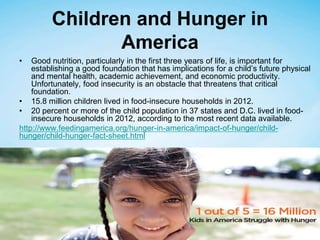
• 15.8 million children lived in food-insecure households in 2012. 
• 20 percent or more of the child population in 37 states and D.C. lived in food-insecure 
households in 2012, according to the most recent data available. 
http://www.feedingamerica.org/hunger-in-america/impact-of-hunger/child-hunger/ 
child-hunger-fact-sheet.html
Food Insecurity and Children 
• Food insecurity—the limited or uncertain availability of 
nutritionally adequate and safe food— exists in 17.2 million 
households in America, 3.9 million of them with children. 
• 25 % of households with children living in large cities are 
food-insecure. 
• 9% of food-insecure households reported that in the previous 
month they had participated in one or more of the three 
largest federal food and nutrition assistance programs: SNAP 
(formerly food stamps), School Lunch and WIC. 
http://www.nokidhungry.org/problem/hunger-facts
World Wide Child Hunger 
• By treating malnutrition in the first 1,000 
days of a child's life, UNICEF has helped 
cut the number of children badly affected 
by stunting by nearly 100 million since 
1990. 
• Founded in 1946, UNICEF has always 
put children first, helping to save more 
children’s lives than any other 
humanitarian organization. UNICEF 
cares about making the world better for 
kids. 
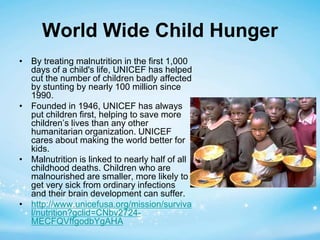
• Malnutrition is linked to nearly half of all 
childhood deaths. Children who are 
malnourished are smaller, more likely to 
get very sick from ordinary infections 
and their brain development can suffer. 
• http://www.unicefusa.org/mission/surviva 
l/nutrition?gclid=CNbv2724- 
MECFQVffgodbYgAHA
Hunger Kills 
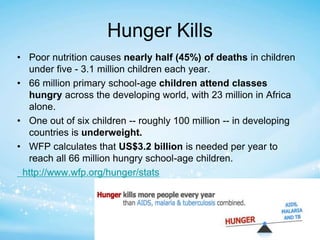
• Poor nutrition causes nearly half (45%) of deaths in children 
under five - 3.1 million children each year. 
• 66 million primary school-age children attend classes 
hungry across the developing world, with 23 million in Africa 
alone. 
• One out of six children -- roughly 100 million -- in developing 
countries is underweight. 
• WFP calculates that US$3.2 billion is needed per year to 
reach all 66 million hungry school-age children. 
http://www.wfp.org/hunger/stats
Nutrition Assistance 
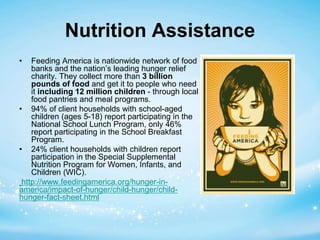
• Feeding America is nationwide network of food 
banks and the nation’s leading hunger relief 
charity. They collect more than 3 billion 
pounds of food and get it to people who need 
it including 12 million children - through local 
food pantries and meal programs. 
• 94% of client households with school-aged 
children (ages 5-18) report participating in the 
National School Lunch Program, only 46% 
report participating in the School Breakfast 
Program. 
• 24% client households with children report 
participation in the Special Supplemental 
Nutrition Program for Women, Infants, and 
Children (WIC). 
http://www.feedingamerica.org/hunger-in-america/ 
impact-of-hunger/child-hunger/child-hunger- 
fact-sheet.html
UNICEF Assistance in Child 
Hunger 
• Micronutrient Powder: A winning combination of vitamins and 
minerals boosts the immune system and gives children the 
strength to survive illness. 
• Fight Malnutrition with Peanut Paste: Known as a “miracle 
food,” the peanut-based paste is easy-to-ship, ready-to-eat 
and does not need to be refrigerated. 
• Trick-or-Treat for UNICEF began in 1950 as a way to help 
kids who need more than candy. Since then, children all over 
America have gone door-to-door on Halloween with UNICEF 
collection boxes, calling out, "Trick-or-Treat for UNICEF!" 
They have raised more than $170 million for the U.S. Fund for 
UNICEF since 1950. 
http://www.unicefusa.org/mission/survival/nutrition?gclid=CNb 
v2724-MECFQVffgodbYgAHA
The Effects of Divorce 
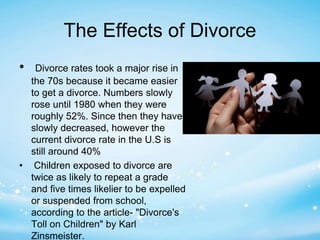
• Divorce rates took a major rise in 
the 70s because it became easier 
to get a divorce. Numbers slowly 
rose until 1980 when they were 
roughly 52%. Since then they have 
slowly decreased, however the 
current divorce rate in the U.S is 
still around 40% 
• Children exposed to divorce are 
twice as likely to repeat a grade 
and five times likelier to be expelled 
or suspended from school, 
according to the article- "Divorce's 
Toll on Children" by Karl 
Zinsmeister.
Divorce’s Impact On Children 
• Increased probability of becoming a smoker 
• Increased drug use (mainly Ritalin) 
• Poor math and social skills 
• Susceptibility to sickness and other health issues (stress 
= bad immune system) 
• Increased likelihood of dropping out of school 
• More likely to commit a crime 
• Greater chance of getting divorced (would continue the 
cycle)
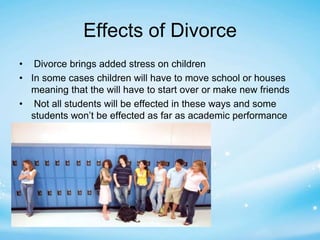
Effects of Divorce 
• Divorce brings added stress on children 
• In some cases children will have to move school or houses 
meaning that the will have to start over or make new friends 
• Not all students will be effected in these ways and some 
students won’t be effected as far as academic performance
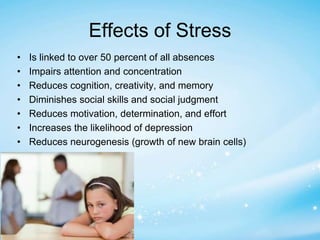
Effects of Stress 
• Is linked to over 50 percent of all absences 
• Impairs attention and concentration 
• Reduces cognition, creativity, and memory 
• Diminishes social skills and social judgment 
• Reduces motivation, determination, and effort 
• Increases the likelihood of depression 
• Reduces neurogenesis (growth of new brain cells)
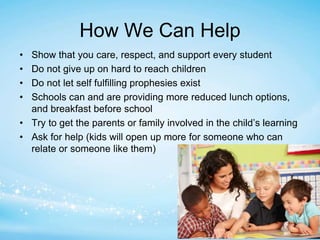
How We Can Help 
• Show that you care, respect, and support every student 
• Do not give up on hard to reach children 
• Do not let self fulfilling prophesies exist 
• Schools can and are providing more reduced lunch options, 
and breakfast before school 
• Try to get the parents or family involved in the child’s learning 
• Ask for help (kids will open up more for someone who can 
relate or someone like them)
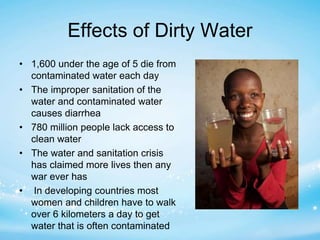
Effects of Dirty Water 
• 1,600 under the age of 5 die from 
contaminated water each day 
• The improper sanitation of the 
water and contaminated water 
causes diarrhea 
• 780 million people lack access to 
clean water 
• The water and sanitation crisis 
has claimed more lives then any 
war ever has 
• In developing countries most 
women and children have to walk 
over 6 kilometers a day to get 
water that is often contaminated
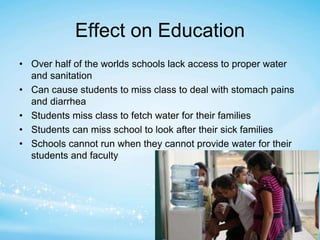
Effect on Education 
• Over half of the worlds schools lack access to proper water 
and sanitation 
• Can cause students to miss class to deal with stomach pains 
and diarrhea 
• Students miss class to fetch water for their families 
• Students can miss school to look after their sick families 
• Schools cannot run when they cannot provide water for their 
students and faculty
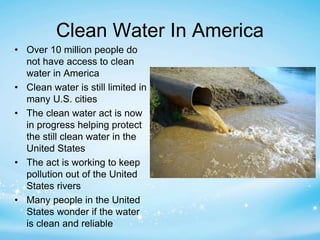
Clean Water In America 
• Over 10 million people do 
not have access to clean 
water in America 
• Clean water is still limited in 
many U.S. cities 
• The clean water act is now 
in progress helping protect 
the still clean water in the 
United States 
• The act is working to keep 
pollution out of the United 
States rivers 
• Many people in the United 
States wonder if the water 
is clean and reliable
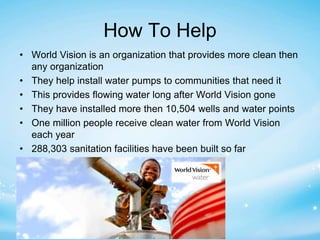
How To Help 
• World Vision is an organization that provides more clean then 
any organization 
• They help install water pumps to communities that need it 
• This provides flowing water long after World Vision gone 
• They have installed more then 10,504 wells and water points 
• One million people receive clean water from World Vision 
each year 
• 288,303 sanitation facilities have been built so far
Vaccinations Required for 
Public Schools 
• To enter Kindergarten (or by age 7 if not put in school on 
time): 
1. Hepatitis B – 3 doses 
2. DTaP (Diphtheria, Tetanus, Pertussis) – 5 doses 
3. Hib (Haemophilus influenza type B) – Not given after age 5, 
but 4 doses needed before then 
4. Polio – 4 doses 
5. PCV (Pneumococcal Conjugate) – Not given after age 5, but 
4 doses needed before then 
6. MMR (Measles, Mumps, Rubella) - 2 doses 
7. Varicella (Chicken Pox) – 2 doses (unless already had virus)
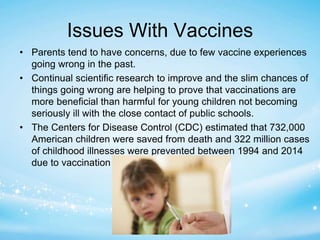
Issues With Vaccines 
• Parents tend to have concerns, due to few vaccine experiences 
going wrong in the past. 
• Continual scientific research to improve and the slim chances of 
things going wrong are helping to prove that vaccinations are 
more beneficial than harmful for young children not becoming 
seriously ill with the close contact of public schools. 
• The Centers for Disease Control (CDC) estimated that 732,000 
American children were saved from death and 322 million cases 
of childhood illnesses were prevented between 1994 and 2014 
due to vaccination
Resources to Get Vaccinated 
• The Children’s Aid Society 
• Vaccines for Children Program (VCP) 
• Centers for Disease Control and Prevention(CDC) 
• The average American has 6 to 10 colds a year and children are more 
susceptible, because they have weaker immune systems and are in close 
contact at schools. But there are simple measures to help prevent these 
illnesses; such as, Vaccinations, routine hand washings, hand sanitizer, 
bring own pencils and water bottles to avoid extra germs, and keep up on 
personal health (diet, exercise, and sleep).
References 
• http://www.feedingamerica.org/hunger-in-america/ 
impact-of-hunger/child-hunger/child-hunger- 
fact-sheet.html. Website. 11/12/2014. 
• http://www.nokidhungry.org/problem/hunger-facts 
. Website. 11/12/2014. 
• http://www.unicefusa.org/mission/survival/nut 
rition. Website. 11/12/2014. 
• http://www.wfp.org/hunger/stats. Website. 
11/12/2014.

Obstacles children face

  • 1.
    Obstacles Children Face By: Kelcey Kiehn, Meagan Kappen, Jared Miller, Kristen Allen
  • 2.
    Children and Hungerin America • Good nutrition, particularly in the first three years of life, is important for establishing a good foundation that has implications for a child’s future physical and mental health, academic achievement, and economic productivity. Unfortunately, food insecurity is an obstacle that threatens that critical foundation. • 15.8 million children lived in food-insecure households in 2012. • 20 percent or more of the child population in 37 states and D.C. lived in food-insecure households in 2012, according to the most recent data available. http://www.feedingamerica.org/hunger-in-america/impact-of-hunger/child-hunger/ child-hunger-fact-sheet.html
  • 3.
    Food Insecurity andChildren • Food insecurity—the limited or uncertain availability of nutritionally adequate and safe food— exists in 17.2 million households in America, 3.9 million of them with children. • 25 % of households with children living in large cities are food-insecure. • 9% of food-insecure households reported that in the previous month they had participated in one or more of the three largest federal food and nutrition assistance programs: SNAP (formerly food stamps), School Lunch and WIC. http://www.nokidhungry.org/problem/hunger-facts
  • 4.
    World Wide ChildHunger • By treating malnutrition in the first 1,000 days of a child's life, UNICEF has helped cut the number of children badly affected by stunting by nearly 100 million since 1990. • Founded in 1946, UNICEF has always put children first, helping to save more children’s lives than any other humanitarian organization. UNICEF cares about making the world better for kids. • Malnutrition is linked to nearly half of all childhood deaths. Children who are malnourished are smaller, more likely to get very sick from ordinary infections and their brain development can suffer. • http://www.unicefusa.org/mission/surviva l/nutrition?gclid=CNbv2724- MECFQVffgodbYgAHA
  • 5.
    Hunger Kills •Poor nutrition causes nearly half (45%) of deaths in children under five - 3.1 million children each year. • 66 million primary school-age children attend classes hungry across the developing world, with 23 million in Africa alone. • One out of six children -- roughly 100 million -- in developing countries is underweight. • WFP calculates that US$3.2 billion is needed per year to reach all 66 million hungry school-age children. http://www.wfp.org/hunger/stats
  • 6.
    Nutrition Assistance •Feeding America is nationwide network of food banks and the nation’s leading hunger relief charity. They collect more than 3 billion pounds of food and get it to people who need it including 12 million children - through local food pantries and meal programs. • 94% of client households with school-aged children (ages 5-18) report participating in the National School Lunch Program, only 46% report participating in the School Breakfast Program. • 24% client households with children report participation in the Special Supplemental Nutrition Program for Women, Infants, and Children (WIC). http://www.feedingamerica.org/hunger-in-america/ impact-of-hunger/child-hunger/child-hunger- fact-sheet.html
  • 7.
    UNICEF Assistance inChild Hunger • Micronutrient Powder: A winning combination of vitamins and minerals boosts the immune system and gives children the strength to survive illness. • Fight Malnutrition with Peanut Paste: Known as a “miracle food,” the peanut-based paste is easy-to-ship, ready-to-eat and does not need to be refrigerated. • Trick-or-Treat for UNICEF began in 1950 as a way to help kids who need more than candy. Since then, children all over America have gone door-to-door on Halloween with UNICEF collection boxes, calling out, "Trick-or-Treat for UNICEF!" They have raised more than $170 million for the U.S. Fund for UNICEF since 1950. http://www.unicefusa.org/mission/survival/nutrition?gclid=CNb v2724-MECFQVffgodbYgAHA
  • 8.
    The Effects ofDivorce • Divorce rates took a major rise in the 70s because it became easier to get a divorce. Numbers slowly rose until 1980 when they were roughly 52%. Since then they have slowly decreased, however the current divorce rate in the U.S is still around 40% • Children exposed to divorce are twice as likely to repeat a grade and five times likelier to be expelled or suspended from school, according to the article- "Divorce's Toll on Children" by Karl Zinsmeister.
  • 9.
    Divorce’s Impact OnChildren • Increased probability of becoming a smoker • Increased drug use (mainly Ritalin) • Poor math and social skills • Susceptibility to sickness and other health issues (stress = bad immune system) • Increased likelihood of dropping out of school • More likely to commit a crime • Greater chance of getting divorced (would continue the cycle)
  • 10.
    Effects of Divorce • Divorce brings added stress on children • In some cases children will have to move school or houses meaning that the will have to start over or make new friends • Not all students will be effected in these ways and some students won’t be effected as far as academic performance
  • 11.
    Effects of Stress • Is linked to over 50 percent of all absences • Impairs attention and concentration • Reduces cognition, creativity, and memory • Diminishes social skills and social judgment • Reduces motivation, determination, and effort • Increases the likelihood of depression • Reduces neurogenesis (growth of new brain cells)
  • 12.
    How We CanHelp • Show that you care, respect, and support every student • Do not give up on hard to reach children • Do not let self fulfilling prophesies exist • Schools can and are providing more reduced lunch options, and breakfast before school • Try to get the parents or family involved in the child’s learning • Ask for help (kids will open up more for someone who can relate or someone like them)
  • 13.
    Effects of DirtyWater • 1,600 under the age of 5 die from contaminated water each day • The improper sanitation of the water and contaminated water causes diarrhea • 780 million people lack access to clean water • The water and sanitation crisis has claimed more lives then any war ever has • In developing countries most women and children have to walk over 6 kilometers a day to get water that is often contaminated
  • 14.
    Effect on Education • Over half of the worlds schools lack access to proper water and sanitation • Can cause students to miss class to deal with stomach pains and diarrhea • Students miss class to fetch water for their families • Students can miss school to look after their sick families • Schools cannot run when they cannot provide water for their students and faculty
  • 15.
    Clean Water InAmerica • Over 10 million people do not have access to clean water in America • Clean water is still limited in many U.S. cities • The clean water act is now in progress helping protect the still clean water in the United States • The act is working to keep pollution out of the United States rivers • Many people in the United States wonder if the water is clean and reliable
  • 16.
    How To Help • World Vision is an organization that provides more clean then any organization • They help install water pumps to communities that need it • This provides flowing water long after World Vision gone • They have installed more then 10,504 wells and water points • One million people receive clean water from World Vision each year • 288,303 sanitation facilities have been built so far
  • 17.
    Vaccinations Required for Public Schools • To enter Kindergarten (or by age 7 if not put in school on time): 1. Hepatitis B – 3 doses 2. DTaP (Diphtheria, Tetanus, Pertussis) – 5 doses 3. Hib (Haemophilus influenza type B) – Not given after age 5, but 4 doses needed before then 4. Polio – 4 doses 5. PCV (Pneumococcal Conjugate) – Not given after age 5, but 4 doses needed before then 6. MMR (Measles, Mumps, Rubella) - 2 doses 7. Varicella (Chicken Pox) – 2 doses (unless already had virus)
  • 18.
    Issues With Vaccines • Parents tend to have concerns, due to few vaccine experiences going wrong in the past. • Continual scientific research to improve and the slim chances of things going wrong are helping to prove that vaccinations are more beneficial than harmful for young children not becoming seriously ill with the close contact of public schools. • The Centers for Disease Control (CDC) estimated that 732,000 American children were saved from death and 322 million cases of childhood illnesses were prevented between 1994 and 2014 due to vaccination
  • 19.
    Resources to GetVaccinated • The Children’s Aid Society • Vaccines for Children Program (VCP) • Centers for Disease Control and Prevention(CDC) • The average American has 6 to 10 colds a year and children are more susceptible, because they have weaker immune systems and are in close contact at schools. But there are simple measures to help prevent these illnesses; such as, Vaccinations, routine hand washings, hand sanitizer, bring own pencils and water bottles to avoid extra germs, and keep up on personal health (diet, exercise, and sleep).
  • 21.
    References • http://www.feedingamerica.org/hunger-in-america/ impact-of-hunger/child-hunger/child-hunger- fact-sheet.html. Website. 11/12/2014. • http://www.nokidhungry.org/problem/hunger-facts . Website. 11/12/2014. • http://www.unicefusa.org/mission/survival/nut rition. Website. 11/12/2014. • http://www.wfp.org/hunger/stats. Website. 11/12/2014.