Nutrition in the First 1,000 Days
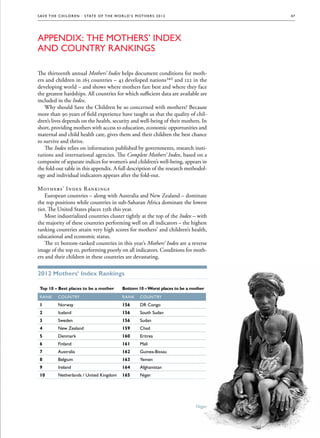
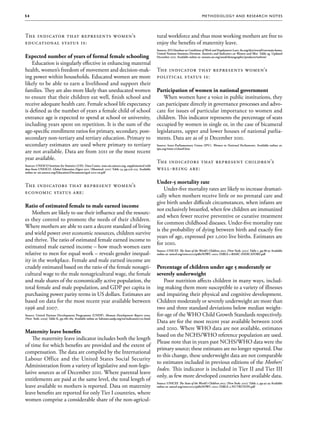
             State of the World’s Mothers 2012
2                                                                        chapter title goe s h e r e


Contents
Foreword by Dr. Rajiv Shah. . . . . . . . . . . . . . . . . . . . . . . . . . . . . . . . . . . . . . . . . . . . . . . . . . . . 2
Introduction by Carolyn Miles.. . . . . . . . . . . . . . . . . . . . . . . . . . . . . . . . . . . . . . . . . . . . . . . . . 3
Executive Summary: Key Findings and Recommendations. . . . . . . . . . . . . . . . . . . . . . . 5
                                                   .
Why Focus on the First 1,000 Days?.. . . . . . . . . . . . . . . . . . . . . . . . . . . . . . . . . . . . . . . . . . 11
The Global Malnutrition Crisis.. . . . . . . . . . . . . . . . . . . . . . . . . . . . . . . . . . . . . . . . . . . . . . . 15
Saving Lives and Building a Better Future: Low-Cost Solutions That Work.. . . . . 23
   •	The Lifesaving Six.. . . . . . . . . . . . . . . . . . . . . . . . . . . . . . . . . . . . . . . . . . . . . . . . . . . . . . . . . 23
   •	Infant and Toddler Feeding Scorecard.. . . . . . . . . . . . . . . . . . . . . . . . . . . . . . . . . . . . . 26
   •	Health Workers Are Key to Success.. . . . . . . . . . . . . . . . . . . . . . . . . . . . . . . . . . . . . . 32
Breastfeeding in the Industrialized World.. . . . . . . . . . . . . . . . . . . . . . . . . . . . . . . . . . . . . 39
Take Action Now.. . . . . . . . . . . . . . . . . . . . . . . . . . . . . . . . . . . . . . . . . . . . . . . . . . . . . . . . . . . . 45
Appendix: 13th Annual Mothers’ Index and Country Rankings.. . . . . . . . . . . . . . . . . 47
Methodology and Research Notes.. . . . . . . . . . . . . . . . . . . . . . . . . . . . . . . . . . . . . . . . . . . . 53
Endnotes.. . . . . . . . . . . . . . . . . . . . . . . . . . . . . . . . . . . . . . . . . . . . . . . . . . . . . . . . . . . . . . . . . . . . 59


Front cover
Hemanti, an 18-year-old mother in Nepal,
prepares to breastfeed her 28-day-old baby
who was born underweight. The baby has not
yet been named.
Photo by Michael Bisceglie
Save the Children, May 2012.
All rights reserved.
ISBN 1-888393-24-6

State of the World’s Mothers 2012 was
published with generous support from
Johnson  Johnson, Mattel, Inc. and
Brookstone.
Nutrition in the First 1,000 Days
In commemoration of Mother’s Day, Save the Children is publishing
its thirteenth annual State of the World’s Mothers report. The focus is
on the 171 million children globally who do not have the opportunity
to reach their full potential due to the physical and mental effects of
poor nutrition in the earliest months of life. This report shows which
countries are doing the best – and which are doing the worst – at
providing nutrition during the critical window of development that
starts during a mother’s pregnancy and goes through her child’s second
birthday. It looks at six key nutrition solutions, including breastfeeding,
that have the greatest potential to save lives, and shows that these
solutions are affordable, even in the world’s poorest countries.
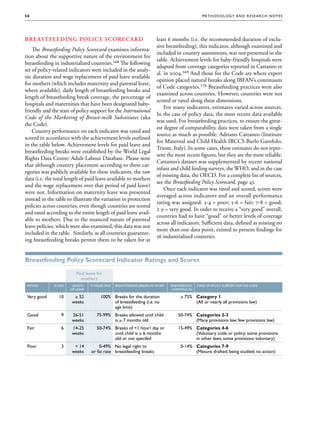
    The Infant and Toddler Feeding Scorecard ranks 73 developing
countries on measures of early child nutrition. The Breastfeeding Policy
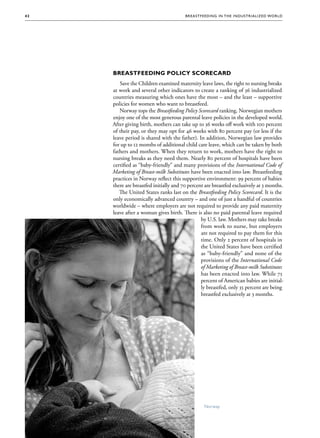
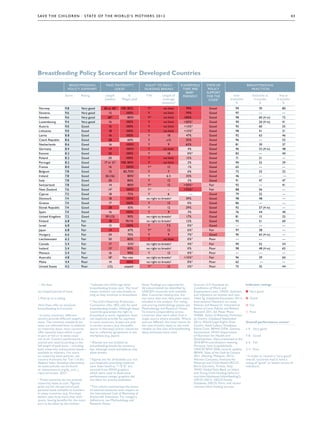
Scorecard examines maternity leave laws, the right to nursing breaks
at work and other indicators to rank 36 developed countries on the
degree to which their policies support women who want to breastfeed.
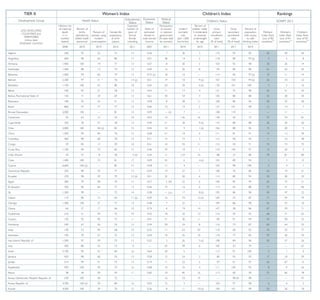
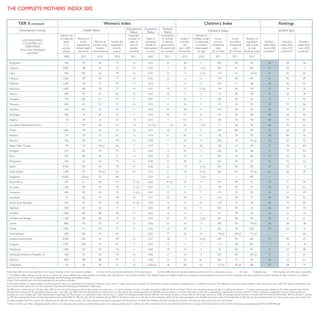
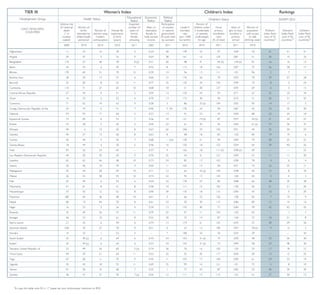
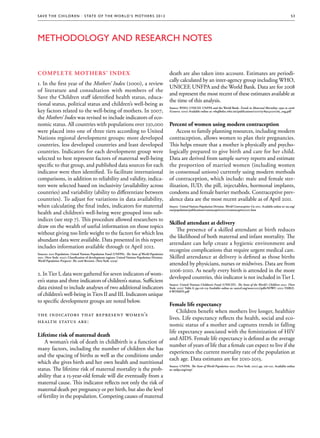
And the annual Mothers’ Index evaluates the status of women’s health,
nutrition, education, economic well-being and political participation to
rank 165 countries – both in the industrialized and developing world –
to show where mothers and children fare best and where they face the
greatest hardships.


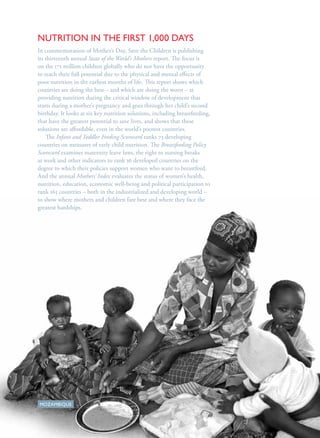
MOZAMBIQUE
2


Foreword


It’s hard to believe, but a child’s future                                           has been proven that their own health
can be determined years before they                                                  and practices determine the health
even reach their fifth birthday. As a                                                and prospects of the next generation.
father of three, I see unlimited poten-                                                 To help address this challenge,
tial when I look at my kids. But for                                                 our programs support country-led
many children, this is not the case.                                                 efforts to ensure the availability of
     In some countries, half of all chil-                                            affordable, quality foods, the promo-
dren are chronically undernourished                                                  tion of breastfeeding and improved
or “stunted.” Despite significant prog-                                              feeding practices, micronutrient sup-
ress against hunger and poverty in                                                   plementation and community-based
the last decade, undernutrition is an                                                management of acute malnutrition.
underlying killer of more than 2.6 mil-                                              Since we know rising incomes do not
lion children and more than 100,000                                                  necessarily translate into a reduction
mothers every year. Sustained poor                                                   in undernutrition, we are support-
nutrition weakens immune systems, making children and          ing specific efforts geared towards better child nutrition
adults more likely to die of diarrhea or pneumonia. And it     outcomes including broader nutrition education target-
impairs the effectiveness of lifesaving medications, includ-   ing not only mothers, but fathers, grandmothers and
ing those needed by people living with HIV and AIDS.           other caregivers.
     The devastating impact of undernutrition spans genera-        The United States is not acting alone; many develop-
tions, as poorly nourished women are more likely to suffer     ing countries are taking the lead on tackling this issue.
difficult pregnancies and give birth to undernourished chil-   In 2009, G8 leaders met in L’Aquila, Italy and pledged
dren themselves. Lost productivity in the 36 countries with    to increase funding and coordination for investment in
the highest levels of undernutrition can cost those econo-     agriculture and food security, reversing years of declining
mies between 2 and 3 percent of gross domestic product.        public investment. And since 2010, some 27 developing
That’s billions of dollars each year that could go towards     countries have joined the Scaling Up Nutrition (SUN)
educating more children, treating more patients at health      Movement, pledging to focus on reducing undernutrition.
clinics and fueling the global economy.                            That same year, the United States and several inter-
     We know that investments in nutrition are some of the     national partners launched the 1,000 Days Partnership. The
most powerful and cost-effective in global development.        Partnership was designed to raise awareness of and focus
Good nutrition during the critical 1,000-day window from       political will on nutrition during the critical 1,000 days
pregnancy to a child’s second birthday is crucial to devel-    from pregnancy to a child’s second birthday. 1,000 Days
oping a child’s cognitive capacity and physical growth.        also supports the SUN Movement, and I am proud to be
Ensuring a child receives adequate nutrition during this       a member of the SUN Lead Group until the end of 2013.
window can yield dividends for a lifetime, as a well-nour-         Preventing undernutrition means more than just pro-
ished child will perform better in school, more effectively    viding food to the hungry. It is a long-term investment in
fight off disease and even earn more as an adult.              our future, with generational payoffs. This report docu-
     The United States continues to be a leader in fighting    ments the extent of the problem and the ways we can solve
undernutrition. Through Feed the Future and the Global         it. All we must do is act.
Health Initiative we’re responding to the varying causes and
consequences of, and solutions to, undernutrition. Our         Dr. Rajiv Shah
nutrition programs are integrated in both initiatives, as we   Administrator of the United States Agency for
seek to ensure mothers and young children have access to       International Development (USAID)
nutritious food and quality health services.
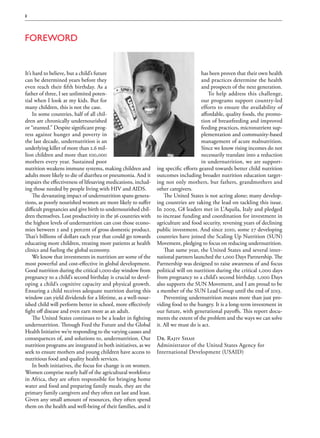
     In both initiatives, the focus for change is on women.
Women comprise nearly half of the agricultural workforce
in Africa, they are often responsible for bringing home
water and food and preparing family meals, they are the
primary family caregivers and they often eat last and least.
Given any small amount of resources, they often spend
them on the health and well-being of their families, and it
S av e t h e c h i l d r e n · S tat e o f t h e Wo r l d ’ s M ot h e r s 2 0 1 2                                                                3


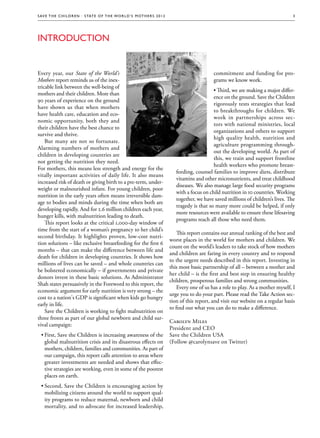
Introduction


Every year, our State of the World’s                                                                        commitment and funding for pro-
Mothers report reminds us of the inex-                                                                      grams we know work.
tricable link between the well-being of
                                                                                                            • Third, we are making a major differ-
mothers and their children. More than
                                                                                                            ence on the ground. Save the Children
90 years of experience on the ground
                                                                                                            rigorously tests strategies that lead
have shown us that when mothers
                                                                                                            to breakthroughs for children. We
have health care, education and eco-
                                                                                                            work in partnerships across sec-
nomic opportunity, both they and
                                                                                                            tors with national ministries, local
their children have the best chance to
                                                                                                            organizations and others to support
survive and thrive.
                                                                                                            high quality health, nutrition and
    But many are not so fortunate.
                                                                                                            agriculture programming through-
Alarming numbers of mothers and
                                                                                                            out the developing world. As part of
children in developing countries are
                                                                                                            this, we train and support frontline
not getting the nutrition they need.
                                                                                                            health workers who promote breast-
For mothers, this means less strength and energy for the
                                                                                          feeding, counsel families to improve diets, distribute
vitally important activities of daily life. It also means
                                                                                          vitamins and other micronutrients, and treat childhood
increased risk of death or giving birth to a pre-term, under-
                                                                                          diseases. We also manage large food security programs
weight or malnourished infant. For young children, poor
                                                                                          with a focus on child nutrition in 10 countries. Working
nutrition in the early years often means irreversible dam-
                                                                                          together, we have saved millions of children’s lives. The
age to bodies and minds during the time when both are
                                                                                          tragedy is that so many more could be helped, if only
developing rapidly. And for 2.6 million children each year,
                                                                                          more resources were available to ensure these lifesaving
hunger kills, with malnutrition leading to death.
                                                                                          programs reach all those who need them.
    This report looks at the critical 1,000-day window of
time from the start of a woman’s pregnancy to her child’s
                                                                                           This report contains our annual ranking of the best and
second birthday. It highlights proven, low-cost nutri-
                                                                                       worst places in the world for mothers and children. We
tion solutions – like exclusive breastfeeding for the first 6
                                                                                       count on the world’s leaders to take stock of how mothers
months – that can make the difference between life and
                                                                                       and children are faring in every country and to respond
death for children in developing countries. It shows how
                                                                                       to the urgent needs described in this report. Investing in
millions of lives can be saved – and whole countries can
                                                                                       this most basic partnership of all – between a mother and
be bolstered economically – if governments and private
                                                                                       her child – is the first and best step in ensuring healthy
donors invest in these basic solutions. As Administrator
                                                                                       children, prosperous families and strong communities.
Shah states persuasively in the Foreword to this report, the
                                                                                           Every one of us has a role to play. As a mother myself, I
economic argument for early nutrition is very strong – the
                                                                                       urge you to do your part. Please read the Take Action sec-
cost to a nation's GDP is significant when kids go hungry
                                                                                       tion of this report, and visit our website on a regular basis
early in life.
                                                                                       to find out what you can do to make a difference.
    Save the Children is working to fight malnutrition on
three fronts as part of our global newborn and child sur-
                                                                                       Carolyn Miles
vival campaign:
                                                                                       President and CEO
  ••First, Save the Children is increasing awareness of the                            Save the Children USA
    global malnutrition crisis and its disastrous effects on                           (Follow @carolynsave on Twitter)
    mothers, children, families and communities. As part of
    our campaign, this report calls attention to areas where
    greater investments are needed and shows that effec-
    tive strategies are working, even in some of the poorest
    places on earth.
  ••Second, Save the Children is encouraging action by
    mobilizing citizens around the world to support qual-
    ity programs to reduce maternal, newborn and child
    mortality, and to advocate for increased leadership,
4   chapter title goe s h e r e


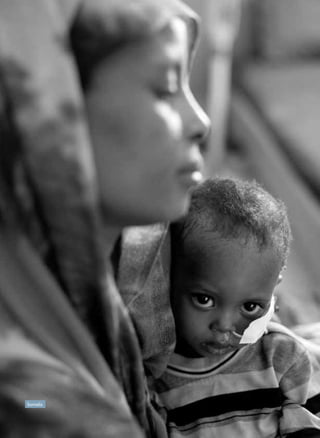
Somalia
S av e t h e c h i l d r e n · S tat e o f t h e Wo r l d ’ s M ot h e r s 2 0 1 2                                                     5


Executive Summary:
Key Findings and Recommendations

Malnutrition is an underlying cause of death for 2.6 million children each year,       Vital Statistics
and it leaves millions more with lifelong physical and mental impairments.
Worldwide, more than 170 million children do not have the opportunity to               Malnutrition is the underlying cause
                                                                                       of more than 2.6 million child deaths
reach their full potential because of poor nutrition in the earliest months of life.
                                                                                       each year.
    Much of a child’s future – and in fact much of a nation’s future – is deter-
mined by the quality of nutrition in the first 1,000 days. The period from the         171 million children – 27 percent of all chil-
                                                                                                                                chil-
start of a mother’s pregnancy through her child’s second birthday is a critical        dren globally – are stunted, meaning their
window when a child’s brain and body are developing rapidly and good nutri-            bodies and minds have suffered permanent,
tion is essential to lay the foundation for a healthy and productive future. If        irreversible damage due to malnutrition.
children do not get the right nutrients during this period, the damage is often
                                                                                       In developing countries, breastfed children
irreversible.
                                                                                       are at least 6 times more likely to survive in
    This year’s State of the World’s Mothers report shows which countries are suc-     the early months of life than non-breastfed
ceeding – and which are failing – to provide good nutrition during the critical        children.
1,000-day window. It examines how investments in nutrition solutions make
a difference for mothers, children, communities, and society as a whole. It also       If all children in the developing world
points to proven, low-cost solutions that could save millions of lives and help        received adequate nutrition and feeding
lift millions more out of ill-health and poverty.                                      of solid foods with breastfeeding,
                                                                                       stunting rates at 12 months could be cut
                                                                                       by 20 percent.
Key findings
1. Children in an alarming number of countries are not getting adequate                Breastfeeding is the single most effective
                                                                                       nutrition intervention for saving lives.
nutrition during their first 1,000 days. Out of 73 developing countries –
                                                                                       If practiced optimally, it could prevent
which together account for 95 percent of child deaths – only four score “very          1 million child deaths each year.
good” on measures of young child nutrition. Our Infant and Toddler Feeding
Scorecard identifies Malawi, Madagascar, Peru and Solomon Islands as the top           Adults who were malnourished as children
four countries where the majority of children under age 2 are being fed accord-        can earn an estimated 20 percent less on
ing to recommended standards. More than two thirds of the countries on the             average than those who weren’t.
Scorecard receive grades of “fair” or “poor” on these measures overall, indicating
                                                                                       The effects of malnutrition in developing
vast numbers of children are not getting a healthy start in life. The bottom four
                                                                                       countries can translate into losses in GDP
countries on the Scorecard – Somalia, Côte d'Ivoire, Botswana and Equatorial           of up to 2-3 percent annually.
Guinea – have staggeringly poor performance on indicators of early child feed-
ing and have made little to no progress since 1990 in saving children’s lives. (To     Globally, the direct cost of malnutrition is
read more, turn to pages 26-31.)                                                       estimated at $20 to $30 billion per year.

2. Child malnutrition is widespread and it is limiting the future success of
millions of children and their countries. Stunting, or stunted growth, occurs
when children do not receive the right type of nutrients, especially in utero or
during the first two years of life. Children whose bodies and minds are limited
by stunting are at greater risk for disease and death, poor performance in school,
and a lifetime of poverty. More than 80 countries in the developing world have
child stunting rates of 20 percent or more. Thirty of these countries have what
is considered to be “very high” stunting rates of 40 percent or more. While
many countries are making progress in reducing child malnutrition, stunting
prevalence is on the rise in at least 14 countries, most of them in sub-Saharan
Africa. If current trends continue, Africa may overtake Asia as the region most
heavily burdened by child malnutrition. (To read more, turn to pages 15-21.)
3. Economic growth is not enough to fight malnutrition. Political will and
effective strategies are needed to reduce malnutrition and prevent stunting.
A number of relatively poor countries are doing an admirable job of tackling
this problem, while other countries with greater resources are not doing so
6                                                                  executive su m m a ry


     well. For example: India has a GDP per capita of $1,500 and 48 percent of
     its children are stunted. Compare this to Vietnam where the GDP per capita
     is $1,200 and the child stunting rate is 23 percent. Others countries that are
     performing better on child nutrition than their national wealth might suggest
     include: Brazil, Chile, Costa Rica, Kyrgyzstan, Mongolia, Senegal and Tunisia.
     Countries that are underperforming relative to their national wealth include:
     Botswana, Equatorial Guinea, Guatemala, Indonesia, Mexico, Panama, Peru,
     South Africa and Venezuela. (To read more, turn to pages 19-20.)
     4. We know how to save millions of children. Save the Children has high-
     lighted six low-cost nutrition interventions with the greatest potential to save
     lives in children’s first 1,000 days and beyond. Universal coverage of these
     “lifesaving six” solutions globally could prevent more than 2 million mother
     and child deaths each year. The lifesaving six are: iron folate, breastfeeding,
     complementary feeding, vitamin A, zinc and hygiene. Nearly 1 million lives
     could be saved by breastfeeding alone. This entire lifesaving package can be
     delivered at a cost of less than $20 per child for the first 1,000 days. Tragically,
     more than half of the world’s children do not have access to the lifesaving six.
     (To read more, turn to pages 23-26.)
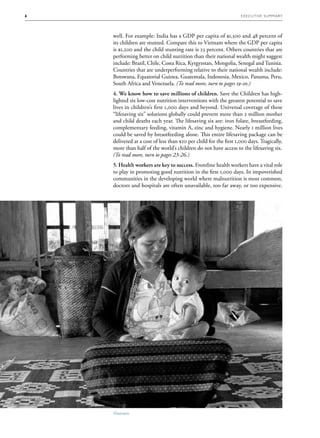
     5. Health workers are key to success. Frontline health workers have a vital role
     to play in promoting good nutrition in the first 1,000 days. In impoverished
     communities in the developing world where malnutrition is most common,
     doctors and hospitals are often unavailable, too far away, or too expensive.


     Vietnam
S av e t h e c h i l d r e n · S tat e o f t h e Wo r l d ’ s M ot h e r s 2 0 1 2             7


                                                                                       Kyrgyzstan

Community health workers and midwives meet critical needs in these com-
munities by screening children for malnutrition, treating diarrhea, promoting
breastfeeding, distributing vitamins and other micronutrients, and counsel-
ing mothers about balanced diet, hygiene and sanitation. The “lifesaving six”
interventions highlighted in this report can all be delivered in remote, impov-
erished places by well-trained and well-equipped community health workers.
In a number of countries – including Cambodia, Malawi and Nepal – these
health workers have contributed to broad-scale success in fighting malnutrition
and saving lives. (To read more, turn to pages 32-37.)
6. In the industrialized world, the United States has the least favorable envi-
ronment for mothers who want to breastfeed. Save the Children examined
maternity leave laws, the right to nursing breaks at work, and several other
indicators to create a ranking of 36 industrialized countries measuring which
ones have the most – and the least – supportive policies for women who want to
breastfeed. Norway tops the Breastfeeding Policy Scorecard ranking. The United
States comes in last. (To read more, turn to pages 39-43.)

Recommendations
1. Invest in proven, low-cost solutions to save children’s lives and prevent
stunting. Malnutrition and child mortality can be fought with relatively simple
and inexpensive solutions. Iron supplements strengthen children’s resistance
to disease, lower women’s risk of dying in childbirth and may help prevent
premature births and low birthweight. Six months of exclusive breastfeeding
increases a child’s chance of survival at least six-fold. Timely and appropriate
complementary feeding is the best way to prevent a lifetime of lost potential
due to stunting. Vitamin A helps prevent blindness and lowers a child’s risk
of death from common diseases. Zinc and good hygiene can save a child from
dying of diarrhea. These solutions are not expensive, and it is a tragedy that
millions of mothers and children do not get them.
2. Invest in health workers – especially those serving on the front lines – to
reach the most vulnerable mothers and children. The world is short more than
3 million health workers of all types, and there is an acute shortage of frontline
8                                                                                 executive su m m a ry


                   workers, including community health workers, who are critical to delivering
                   the nutrition solutions that can save lives and prevent stunting. Governments
                   and donors should work together to fill this health worker gap by recruiting,
                   training and supporting new and existing health workers, and deploying them
                   where they are needed most.
                   3. Help more girls go to school and stay in school. One of the most effective
                   ways to fight child malnutrition is to focus on girls’ education. Educated women
                   tend to have fewer, healthier and better-nourished children. Increased investments
                   are needed to help more girls go to school and stay in school, and to encourage
                   families and communities to value the education of girls. Both formal education
                   and non-formal training give girls knowledge, self-confidence, practical skills and
                   hope for a bright future. These are powerful tools that can help delay marriage
                   and child-bearing to a time that is healthier for them and their babies.
                   4. Increase government support for proven solutions to fight malnutrition
                   and save lives. In order to meet internationally agreed upon development goals
                   to reduce child deaths and improve mothers’ health, lifesaving services must
                   be increased for the women and children who need help most. All countries
                   must make fighting malnutrition and stunting a priority. Developing countries
                   should commit to and fund national nutrition plans that are integrated with
                   plans for maternal and child health. Donor countries should support these
                   goals by keeping their funding commitments to achieving the Millennium
                   Development Goals and countries should endorse and support the Scaling Up
                   Nutrition (SUN) movement. Resources for malnutrition programs should not
                   come at the expense of other programs critical to the survival and well-being
                   of children.(To read more, turn to page 45.)
                   5. Increase private sector partnerships to improve nutrition for mothers and
                   children. Many local diets fail to meet the nutritional requirements of children 6-24
                   months old. The private sector can help by producing and marketing affordable
                   fortified products. Partnerships should be established with multiple manufactur-
                   ers, distributors and government ministries to increase product choice, access and
                   affordability, improve compliance with codes and standards, and promote public
                   education on good feeding practices and use of local foods and commercial prod-
                   ucts. The food industry can also invest more in nutrition programs and research,
                   contribute social marketing expertise to promote healthy behaviors such as breast-
                   feeding, and advocate for greater government investments in nutrition.
                   6. Improve laws, policies and actions that support families and encourage
                   breastfeeding. Governments in all countries can do more to help parents and
                   create a supportive environment for breastfeeding. Governments and part-
                   ners should adopt policies that are child-friendly and support breastfeeding
                   mothers. Such policies would give families access to maternal and paternal
                   leave, ensure that workplaces and public facilities offer women a suitable
                   place to feed their babies outside of the home, and ensure working women
                   are guaranteed breastfeeding breaks while on the job. In an increasingly urban
                   world, a further example is that public transportation can offer special seats
                   for breastfeeding mothers.


     Afghanistan
S av e t h e c h i l d r e n · S tat e o f t h e Wo r l d ’ s M ot h e r s 2 0 1 2             9


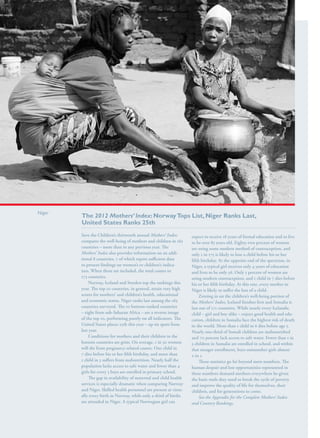
Niger
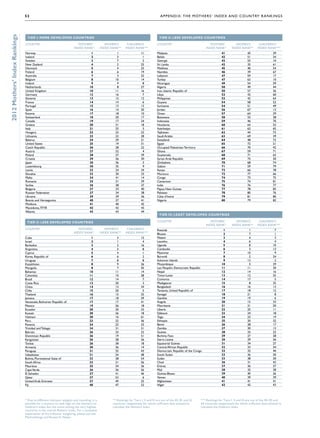
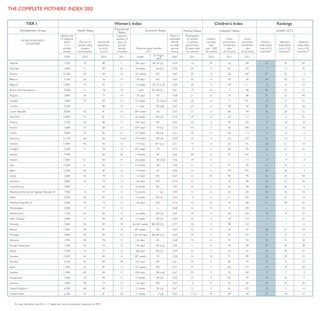
                            The 2012 Mothers’ Index: Norway Tops List, Niger Ranks Last,
                                              Index:
                            United States Ranks 25th
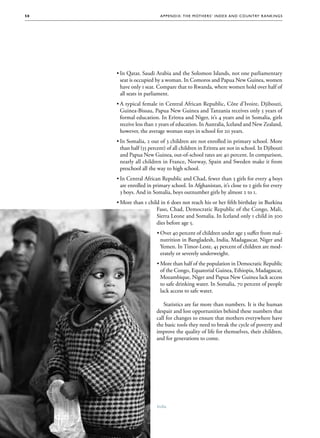
                            Save the Children’s thirteenth annual Mothers’ Index         expect to receive 18 years of formal education and to live
                            compares the well-being of mothers and children in 165       to be over 83 years old. Eighty-two percent of women
                            countries – more than in any previous year. The              are using some modern method of contraception, and
                            Mothers’ Index also provides information on an addi-
                                                                              addi-      only 1 in 175 is likely to lose a child before his or her
                            tional 8 countries, 7 of which report sufficient data        fifth birthday. At the opposite end of the spectrum, in
                            to present findings on women’s or children’s indica-
                                                                           indica-       Niger, a typical girl receives only 4 years of education
                            tors. When these are included, the total comes to            and lives to be only 56. Only 5 percent of women are
                            173 countries.                                               using modern contraception, and 1 child in 7 dies before
                                Norway, Iceland and Sweden top the rankings this         his or her fifth birthday. At this rate, every mother in
                            year. The top 10 countries, in general, attain very high     Niger is likely to suffer the loss of a child.
                            scores for mothers’ and children’s health, educational            Zeroing in on the children’s well-being portion of
                            and economic status. Niger ranks last among the 165          the Mothers’ Index, Iceland finishes first and Somalia is
                                                                                                        Index,
                            countries surveyed. The 10 bottom-ranked countries           last out of 171 countries. While nearly every Icelandic
                            – eight from sub-Saharan Africa – are a reverse image        child – girl and boy alike – enjoys good health and edu-edu-
                            of the top 10, performing poorly on all indicators. The      cation, children in Somalia face the highest risk of death
                            United States places 25th this year – up six spots from      in the world. More than 1 child in 6 dies before age 5.
                            last year.                                                   Nearly one-third of Somali children are malnourished
                                Conditions for mothers and their children in the         and 70 percent lack access to safe water. Fewer than 1 in
                            bottom countries are grim. On average, 1 in 30 women         3 children in Somalia are enrolled in school, and within
                            will die from pregnancy-related causes. One child in         that meager enrollment, boys outnumber girls almost
                            7 dies before his or her fifth birthday, and more than       2 to 1.
                            1 child in 3 suffers from malnutrition. Nearly half the           These statistics go far beyond mere numbers. The
                            population lacks access to safe water and fewer than 4       human despair and lost opportunities represented in
                            girls for every 5 boys are enrolled in primary school.       these numbers demand mothers everywhere be given
                                The gap in availability of maternal and child health     the basic tools they need to break the cycle of poverty
                            services is especially dramatic when comparing Norway        and improve the quality of life for themselves, their
                            and Niger. Skilled health personnel are present at virtu-
                                                                                virtu-   children, and for generations to come.
                            ally every birth in Norway, while only a third of births          See the Appendix for the Complete Mothers’ Index
                            are attended in Niger. A typical Norwegian girl can          and Country Rankings.
10    chapter title goe s h e r e


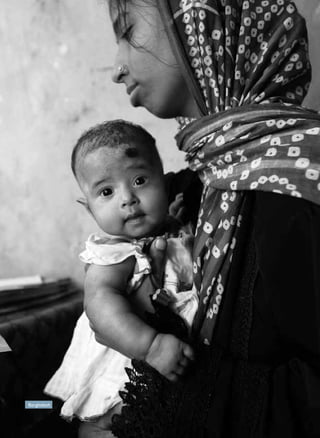
Bangladesh
S av e t h e c h i l d r e n · S tat e o f t h e Wo r l d ’ s M ot h e r s 2 0 1 2            11


Why Focus on the First 1,000 Days?


Good nutrition during the 1,000-day period between the start of a woman’s
pregnancy and her child’s second birthday is critical to the future health, well-
being and success of her child. The right nutrition during this window can have
a profound impact on a child’s ability to grow, learn and rise out of poverty.
It also benefits society, by boosting productivity and improving economic
prospects for families and communities.
    Malnutrition is an underlying cause of 2.6 million child deaths each year.1
Millions more children survive, but suffer lifelong physical and cognitive
impairments because they did not get the nutrients they needed early in their
lives when their growing bodies and minds were most vulnerable. When chil-
dren start their lives malnourished, the negative effects are largely irreversible.
    Pregnancy and infancy are the most important periods for brain develop-
ment. Mothers and babies need good nutrition to lay the foundation for the
child’s future cognitive, motor and social skills, school success and productiv-
ity. Children with restricted brain development in early life are at risk for later
neurological problems, poor school achievement, early school drop out, low-
skilled employment and poor care of their own children, thus contributing to
the intergenerational transmission of poverty.2
    Millions of mothers in poor countries struggle to give their children a healthy
start in life. Complex social and cultural beliefs in many developing countries
put females at a disadvantage and, starting from a very young age, many girls
do not get enough to eat. In communities where early marriage is common,
teenagers often leave school and become pregnant before their bodies have fully
matured. With compromised health, small bodies and inadequate resources and
support, these mothers often fail to gain sufficient weight during pregnancy
and are susceptible to a host of complications that put themselves and their
babies at risk.
    Worldwide, 20 million babies are born with low birthweight each year.3
Many of these babies are born too early – before the full nine months of preg-
nancy. Others are full-term but they are small because of poor growth in the
mother’s womb. Even babies who are born at a normal weight may still have
been malnourished in the womb if the mother’s diet was poor. Others become
malnourished in infancy due to disease, inadequate breastfeeding or lack of
nutritious food. Malnutrition weakens young children’s immune systems and
leaves them vulnerable to death from common illnesses such as pneumonia,
diarrhea and malaria.


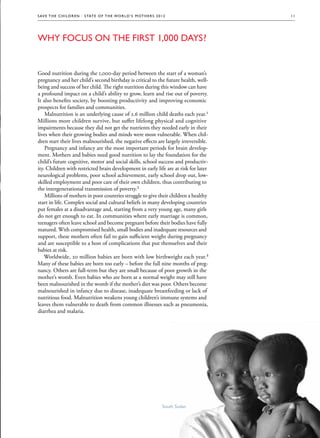
                                                                                 South Sudan
12                                                Why Focus on the First 1,00 0 Day s ?


      Economic Growth and Future Success
         Investments in improving nutrition for mothers and children in the first
      1,000 days will yield real payoffs both in lives saved and in healthier, more
      stable and productive populations. In addition to its negative, often fatal, health
      consequences, malnutrition means children achieve less at school and their
      productivity and health in adult life is affected, which has dire financial con-
      sequences for entire countries.
          Children whose physical and mental development are stunted by malnutri-
      tion will earn less on average as adults. One study suggested the loss of human
      potential resulting from stunting was associated with 20 percent less adult
      income on average.4 Malnutrition costs many developing nations an estimated
      2-3 percent of their GDP each year, extends the cycle of poverty, and impedes
      global economic growth.5 Globally, the direct cost of child malnutrition is
      estimated at $20 to $30 billion per year.6
         In contrast, well-nourished children perform better in school and grow up
      to earn considerably more on average than those who were malnourished as
      children. Recent evidence suggests nutritional interventions can increase adult
      earnings by as much as 46 percent.7
         An estimated 450 million children will be affected by stunting in the next
      15 years if current trends continue.8 This is bad news for the economies of
      developing nations, and for a global economy that is increasingly dependent
      on new markets to drive economic growth.


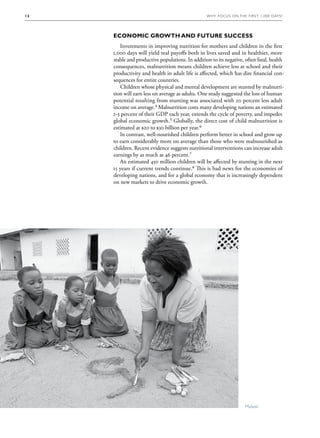
                                                                      Malawi
S av e t h e c h i l d r e n · S tat e o f t h e Wo r l d ’ s M ot h e r s 2 0 1 2                                                                       13


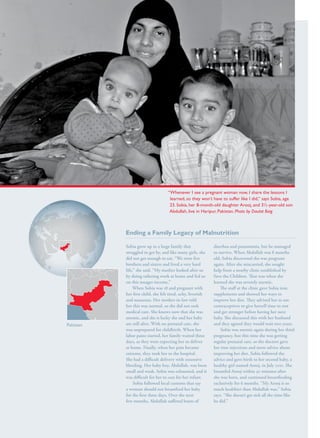
                                                                                       “Whenever I see a pregnant woman now, I share the lessons I
                                                                                        learned, so they won’t have to suffer like I did,” says Sobia, age
                                                                                        23. Sobia, her 8-month-old daughter Arooj, and 3½-year-old son
                                                                                        Abdullah, live in Haripur, Pakistan. Photo by Daulat Baig


                                                         Ending a Family Legacy of Malnutrition

                                                         Sobia grew up in a large family that                  diarrhea and pneumonia, but he managed
                                                         struggled to get by, and like many girls, she         to survive. When Abdullah was 8 months
                                                         did not get enough to eat. “We were five              old, Sobia discovered she was pregnant
                                                         brothers and sisters and lived a very hard            again. After she miscarried, she sought
                                                         life,” she said. “My mother looked after us           help from a nearby clinic established by
                                                         by doing tailoring work at home and fed us            Save the Children. That was when she
                                                         on this meager income.”                               learned she was severely anemic.
                                                              When Sobia was 18 and pregnant with                  The staff at the clinic gave Sobia iron
                                                         her first child, she felt tired, achy, feverish       supplements and showed her ways to
                                                         and nauseous. Her mother-in-law told                  improve her diet. They advised her to use
                                                         her this was normal, so she did not seek              contraceptives to give herself time to rest
                                                         medical care. She knows now that she was              and get stronger before having her next
                                                         anemic, and she is lucky she and her baby             baby. She discussed this with her husband
                  Pakistan                               are still alive. With no prenatal care, she           and they agreed they would wait two years.
                                                         was unprepared for childbirth. When her                   Sobia was anemic again during her third
                                                         labor pains started, her family waited three          pregnancy, but this time she was getting
                                                         days, as they were expecting her to deliver           regular prenatal care, so the doctors gave
                                                         at home. Finally, when her pain became                her iron injections and more advice about
                                                         extreme, they took her to the hospital.               improving her diet. Sobia followed the
                                                         She had a difficult delivery with extensive           advice and gave birth to her second baby, a
                                                         bleeding. Her baby boy, Abdullah, was born            healthy girl named Arooj, in July 2011. She
                                                         small and weak. Sobia was exhausted, and it           breastfed Arooj within 30 minutes after
                                                         was difficult for her to care for her infant.         she was born, and continued breastfeeding
                                                              Sobia followed local customs that say            exclusively for 6 months. “My Arooj is so
                                                         a woman should not breastfeed her baby                much healthier than Abdullah was,” Sobia
                                                         for the first three days. Over the next               says. “She doesn’t get sick all the time like
                                                         few months, Abdullah suffered bouts of                he did.”
14    chapter title goe s h e r e


Mozambique
S av e t h e c h i l d r e n · S tat e o f t h e Wo r l d ’ s M ot h e r s 2 0 1 2                                                                                         15


The Global Malnutrition Crisis


 One in four of the world’s children are chronically malnourished, also known
 as stunted. These are children who have not gotten the essential nutrients they                                 Chronic Malnutrition
 need, and their bodies and brains have not developed properly.                                                  Causes Three Times as
    The damage often begins before a child is born, when a poorly nourished                                      Many Child Deaths as Acute
 mother cannot pass along adequate nutrition to the baby in her womb. She                                        Malnutrition
 then gives birth to an underweight infant. If she is impoverished, overworked,
 poorly educated or in poor health, she may be at greater risk of not being able                                                                      Child             % of
                                                                                                                                                     deaths         all child
 to feed her baby adequately. The child may endure more frequent infections,                                                                       (1,000s)          deaths
 which will also deprive the growing body of essential nutrients. Children under
                                                                                                                 Chronic malnutrition                  1,100             14.5
 age 2 are especially vulnerable, and the negative effects of malnutrition at this                               (stunting)
 age are largely irreversible.
                                                                                                                 Acute malnutrition                       340             4.4
    The issue of chronic malnutrition, as opposed to acute malnutrition (as in                                   (severe wasting)
 the Horn of Africa in the last year) seldom grabs the headlines, yet it is slowly
 destroying the potential of millions of children. Globally, 171 million children                                Low birthweight*                         250             3.3
 are experiencing chronic malnutrition,9 which leaves a large portion of the                                     Total* *                             1,600          21.4%
 world’s children not only shorter than they otherwise would be, but also facing                                 —
                                                                                                                 * Deaths are for low birthweight (LBW) due to intrauterine
 cognitive impairment that lasts a lifetime.                                                                     growth restriction, the primary cause of LBW in developing
                                                                                                                 countries.
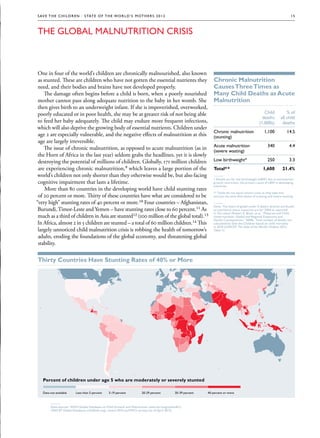
     More than 80 countries in the developing world have child stunting rates
                                                                                                                 ** Totals do not equal column sums as they take into
 of 20 percent or more. Thirty of these countries have what are considered to be                                 account the joint distrubtion of stunting and severe wasting.

“very high” stunting rates of 40 percent or more.10 Four countries – Afghanistan,                                —
                                                                                                                 Note: The share of global under-5 deaths directly attributed
 Burundi, Timor-Leste and Yemen – have stunting rates close to 60 percent.11 As                                  to nutritional status measures are for 2004 as reported
                                                                                                                 in The Lancet (Robert E. Black, et al. “Maternal and Child
 much as a third of children in Asia are stunted12 (100 million of the global total).13                          Undernutrition: Global and Regional Exposures and
                                                                                                                 Health Consequences,” 2008). Total number of deaths are
 In Africa, almost 2 in 5 children are stunted – a total of 60 million children.14 This                          calculated by Save the Children based on child mortality
                                                                                                                 in 2010 (UNICEF. The State of the World’s Children 2012,
 largely unnoticed child malnutrition crisis is robbing the health of tomorrow’s                                 Table 1).

 adults, eroding the foundations of the global economy, and threatening global
 stability.

Thirty Countries Have Stunting Rates of 40% or More


   Percent of children under age 5 who are moderately or severely stunted

   Data not available    Less than 5 percent   5-19 percent           20-29 percent          30-39 percent   40 percent or more


        —
        Data sources: WHO Global Database on Child Growth and Malnutrition (who.int/nutgrowthdb/);
        UNICEF Global Databases (childinfo.org); recent DHS and MICS surveys (as of April 2012)
16                                                                                               The G lob al Mal nu trition Cr i s i s


                                                   Malnutrition and Child Mortality
                                                       Every year, 7.6 million children die before they reach the age of 5, most
                                                   from preventable or treatable illnesses and almost all in developing countries.20
                                                   Malnutrition is an underlying cause of more than a third (35 percent) of these
                                                   deaths.21
Four Types of Malnutrition
                                                       A malnourished child is up to 10 times as likely to die from an easily pre-
Stunting – A child is too short for their age.     ventable or treatable disease as a well-nourished child.22 And a chronically
This is caused by poor diet and frequent           malnourished child is more vulnerable to acute malnutrition during food short-
infections. Stunting generally occurs before       ages, economic crises and other emergencies.23
age 2, and the effects are largely irreversible.       Unfortunately, many countries have not made addressing malnutrition and
These include delayed motor development,           child survival a high-level priority. For instance, a recent analysis by the World
impaired cognitive function and poor
                                                   Health Organization found that only 67 percent of 121 mostly low- and mid-
school performance. In total, 171 million
children – 27 percent of all children globally
                                                   dle-income countries had policies to promote breastfeeding. Complementary
– are stunted.15
  are stunted.15                                   feeding and iron and folic acid supplements were included in little over half of
                                                   all national policy documents (55 and 51 percent, respectively). And vitamin A
Wasting – A child’s weight is too low              and zinc supplementation for children (for the treatment of diarrhea) were part
for their height. This is caused by acute          of national policies in only 37 percent and 22 percent of countries respectively.24
malnutrition. Wasting is a strong predic-
                                    predic-        While nutrition is getting more high-level commitment than ever before, there
tor of mortality among children under 5.
                                                   is still a lot of progress to be made.
It is usually caused by severe food short-
                                    short-
age or disease. In total, over 60 million
                                                       Persistent and worsening malnutrition in developing countries is perhaps
children – 10 percent of all children globally     the single biggest obstacle to achieving many of the Millennium Development
– are wasted.16
  are wasted.16                                    Goals (MDGs). These goals – agreed to by all United Nations member states in
                                                   2000 – set specific targets for ending poverty and improving human rights and
Underweight – A child’s weight is too low          security. MDG 1 includes halving the proportion of people living in hunger.
for their age. A child can be underweight          MDG 2 is to ensure all children complete primary school. MDG 4 aims to
because she is stunted, wasted or both.
                                                   reduce the world’s 1990 under-5 mortality rate by two thirds. MDG 5 aims to
Weight is a sensitive indicator of short-term
(i.e., acute) undernutrition. Whereas a
                                                   reduce the 1990 maternal mortality ratio by three quarters. And MDG 6 is to
deficit in height (stunting) is difficult to       halt and begin to reverse the spread of HIV/AIDS and the incidence of malaria
correct, a deficit in weight (underweight)         and other major diseases. Improving nutrition helps fuel progress toward all
can be recouped if nutrition and health            of these MDGs.
improve later in childhood. Worldwide,                 With just a few years left until the 2015 deadline, less than a third (22)
more than 100 million children are under-
                                       under-      of 75 priority countries are on track to achieve the poverty and hunger goal
weight.17
weight.17 Being underweight is associated
                                                   (MDG 1).25 Only half of developing countries are on target to achieve univer-
with 19 percent of child deaths.18
                     child deaths.18
                                                   sal primary education (MDG 2).26 Just 23 of the 75 countries are on track to
Micronutrient deficiency – A child                 achieve the child survival goal (MDG 4).27 And just 13 of the 75 countries are
lacks essential vitamins or minerals.              on target to achieve the maternal mortality goal (MDG 5).28 While new HIV
These include vitamin A, iron and zinc.            infections are declining in some regions, trends are worrisome in others.29 Also,
Micronutrient deficiencies are caused by           treatment for HIV and AIDS has expanded quickly, but not fast enough to
a long-term lack of nutritious food or by          meet the 2010 target for universal access (MDG 6).30
infections such as worms. Micronutrient
deficiencies are associated with 10 percent
of all children’s deaths, or about one-third
                                                   Maternal Malnutrition
of all child deaths due to malnutrition.19
                            malnutrition.19           Many children are born undernourished because their mothers are under-
                                                   nourished. As much as half of all child stunting occurs in utero,31 underscoring
                                                   the critical importance of better nutrition for women and girls.
                                                      In most developing countries, the nutritional status of women and girls is
                                                   compromised by the cumulative and synergistic effects of many risk factors.
                                                   These include: limited access to food, lack of power at the household level, tra-
                                                   ditions and customs that limit women’s consumption of certain nutrient-rich
                                                   foods, the energy demands of heavy physical labor, the nutritional demands
                                                   of frequent pregnancies and breastfeeding, and the toll of frequent infections
                                                   with limited access to health care.
                                                      Anemia is the most widespread nutritional problem affecting girls and wom-
                                                   en in developing countries. It is a significant cause of maternal mortality and
                                                   can cause premature birth and low birthweight. In the developing world, 40
S av e t h e c h i l d r e n · S tat e o f t h e Wo r l d ’ s M ot h e r s 2 0 1 2                                                                                                               17


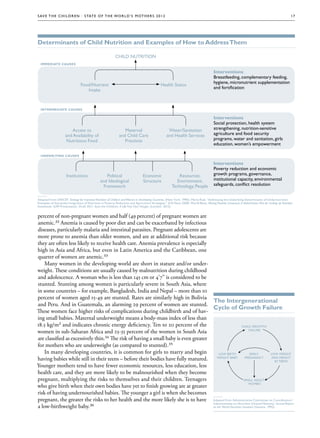
Determinants of Child Nutrition and Examples of How to Address Them

                                                           Child Nutrition
  Immediate Causes

                                                                                                                                       Interventions
                                                                                                                                       Breastfeeding, complementary feeding,
                                                                                                                                       hygiene, micronutrient supplementation
                                 Food/Nutrient                                                Health Status
                                                                                                                                       and fortification
                                    Intake


  Intermediate Causes

                                                                                                                                       Interventions
                                                                                                                                       Social protection, health system
                         Access to                               Maternal                           Water/Sanitation                   strengthening, nutrition-sensitive
                     and Availability of                      and Child Care                       and Health Services                 agriculture and food security
                      Nutritious Food                            Practices                                                             programs, water and sanitation, girls
                                                                                                                                       education, women’s empowerment

  Underlying Causes

                                                                                                                                       Interventions
                                                                                                                                       Poverty reduction and economic
                     Institutions                   Political                   Economic                   Resources:                  growth programs, governance,
                                                and Ideological                 Structure                 Environment,                 institutional capacity, environmental
                                                  Framework                                            Technology, People              safeguards, conflict resolution

—
Adapted from UNICEF. Strategy for Improved Nutrition of Children and Women in Developing Countries, (New York: 1990); Marie Ruel. “Addressing the Underlying Determinants of Undernutrition:
Examples of Successful Integration of Nutrition in Poverty Reduction and Agriculture Strategies,” SCN News 2008; World Bank, Moving Towards Consensus. A Global Action Plan for Scaling up Nutrition
Investments. GAP Presentation. Draft 2011; Save the Children, A Life Free From Hunger, (London: 2012)


percent of non-pregnant women and half (49 percent) of pregnant women are
anemic.32 Anemia is caused by poor diet and can be exacerbated by infectious
diseases, particularly malaria and intestinal parasites. Pregnant adolescents are
more prone to anemia than older women, and are at additional risk because
they are often less likely to receive health care. Anemia prevalence is especially
high in Asia and Africa, but even in Latin America and the Caribbean, one
quarter of women are anemic.33
    Many women in the developing world are short in stature and/or under-
weight. These conditions are usually caused by malnutrition during childhood
and adolescence. A woman who is less than 145 cm or 4'7 is considered to be
stunted. Stunting among women is particularly severe in South Asia, where
in some countries – for example, Bangladesh, India and Nepal – more than 10
percent of women aged 15-49 are stunted. Rates are similarly high in Bolivia
                                                                                      The Intergenerational
and Peru. And in Guatemala, an alarming 29 percent of women are stunted.
                                                                                      Cycle of Growth Failure
These women face higher risks of complications during childbirth and of hav-
ing small babies. Maternal underweight means a body-mass index of less than
18.5 kg/m² and indicates chronic energy deficiency. Ten to 20 percent of the                                CHILD GROWTH
women in sub-Saharan Africa and 25-35 percent of the women in South Asia                                          FAILURE

are classified as excessively thin.34 The risk of having a small baby is even greater
for mothers who are underweight (as compared to stunted).35
    In many developing countries, it is common for girls to marry and begin               LOW BIRTH                EARLY          LOW WEIGHT
having babies while still in their teens – before their bodies have fully matured.       WEIGHT BABY           PREGNANCY           AND HEIGHT
                                                                                                                                     IN TEENS
Younger mothers tend to have fewer economic resources, less education, less
health care, and they are more likely to be malnourished when they become
pregnant, multiplying the risks to themselves and their children. Teenagers                                   SMALL ADULT
                                                                                                                  WOMEN
who give birth when their own bodies have yet to finish growing are at greater
risk of having undernourished babies. The younger a girl is when she becomes
                                                                                      —
pregnant, the greater the risks to her health and the more likely she is to have Adapted from Administrative Committee on Coordination/
                                                                                      Subcommittee on Nutrition (United Nations), Second Report
a low-birthweight baby.36                                                             on the World Nutrition Situation (Geneva: 1992).
18                                                                                                                        The G lob al Mal nu trition Cr i s i s


                                                  Barriers to Breastfeeding
Rising Food Prices Can                               Experts recommend that children be breastfed within one hour of birth,
Hurt Mothers and Children                         exclusively breastfed for the first 6 months, and then breastfed until age 2
                                                  with age-appropriate, nutritionally adequate and safe complementary foods.
As global food prices remain high and             Optimal feeding according to these standards can prevent an estimated 19 per-
volatile, poor mothers and children in
                                                  cent of all under-5 deaths, more than any other child survival intervention.41
developing countries can have little choice
but to cut back on the quantity and qual-
                                      qual-
                                                  Yet worldwide, the vast majority of children are not breastfed optimally.
ity of the food they eat. The World Bank             What are some of the reasons for this? Cultural beliefs, lack of knowledge
estimates that rising food prices pushed an       and misinformation play major roles. Many women and family members are
additional 44 million people into poverty         unaware of the benefits of exclusive breastfeeding. New mothers may be told
between June 2010 and February 2011.37
                                    2011.37       they should wait several hours or days after their baby is born to begin breast-
Staple food prices hit record highs in            feeding. Aggressive marketing of infant formula often gives the impression that
February 2011 and may have put the lives of
                                                  human milk is less modern and thus less healthy for infants than commercial
more than 400,000 more children at risk.38
                                        risk.38
    Poor families in developing countries
                                                  formula. Or mothers may be told their breast milk is “bad” or does not contain
typically spend between 50 to 70 percent          sufficient nutrients, so they introduce other liquids and solid food too early.
of their income on food.39 When meat,
                     food.39                         Most breastfeeding problems occur in the first two weeks of a child’s life. If
fish, eggs, fruit and vegetables become too       a mother experiences pain or the baby does not latch, an inexperienced mother
expensive, families often turn to cheaper         may give up. Support from fathers, mothers-in-law, peer groups and health
cereals and grains, which offer fewer             workers can help a mother to gain confidence, overcome obstacles and prolong
nutrients. Studies show that women tend
                                                  exclusive breastfeeding.
to cut their food consumption first, and as
a crisis deepens, other adults and eventually
                                                     Women often stop breastfeeding because they return to work. Many aren’t
children cut back.40
          cut back.40                             provided with paid maternity leave or time and a private place to breastfeed
    When pregnant mothers and young               or express their breast milk. Legislation around maternity leave and policies
children are deprived of essential nutrients      that provide time, space, and support for breastfeeding in the workplace could
during a critical period in their develop-
                                  develop-        reduce this barrier. For mothers who work in farming or the informal sector,
ment, the results are often devastating.          family and community support can help them to continue breastfeeding, even
Mothers experience higher rates of anemia
                                                  after returning to work. Also many countries need better laws and enforcement
and chronic energy deficiency. Childbirth
becomes more risky, and babies are more
                                                  to protect women from persecution or harassment for breastfeeding in public.
likely to be born at low birthweight.
Children face increased risk of stunting,
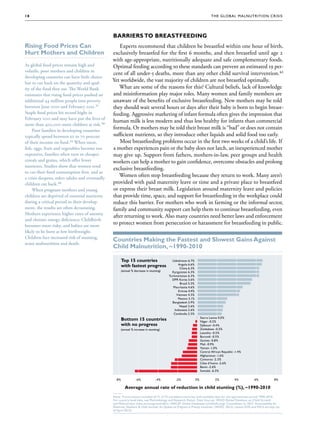
                                                  Countries Making the Fastest and Slowest Gains Against
acute malnutrition and death.
                                                  Child Malnutrition, ~1990-2010

                                                       Top 15 countries                      Uzbekistan 6.7%
                                                                                                  Angola 6.6%
                                                       with fastest progress                       China 6.3%
                                                       (annual % decrease in stunting)       Kyrgyzstan 6.3%
                                                                                           Turkmenistan 6.3%
                                                                                             DPR Korea 5.6%
                                                                                                   Brazil 5.5%
                                                                                              Mauritania 4.6%
                                                                                                  Eritrea 4.4%
                                                                                                 Vietnam 4.3%
                                                                                                  Mexico 3.1%
                                                                                             Bangladesh 2.9%
                                                                                                   Nepal 2.6%
                                                                                               Indonesia 2.6%
                                                                                              Cambodia 2.5%
                                                                                                                   Sierra Leone 0.0%
                                                       Bottom 15 countries                                         Niger -0.2%
                                                       with no progress                                            Djibouti -0.4%
                                                       (annual % increase in stunting)                             Zimbabwe -0.5%
                                                                                                                   Lesotho -0.5%
                                                                                                                   Burundi -0.5%
                                                                                                                   Guinea -0.8%
                                                                                                                   Mali -0.9%
                                                                                                                   Yemen -1.0%
                                                                                                                   Central African Republic -1.4%
                                                                                                                   Afghanistan -1.6%
                                                                                                                   Comoros -2.3%
                                                                                                                   Côte d'Ivoire -2.6%
                                                                                                                   Benin -2.6%
                                                                                                                   Somalia -6.3%

                                                   -8%	           -6%	            -4%	           -2%	            0%	          2%	            4%	            6%            8%

                                                          Average annual rate of reduction in child stunting (%), ~1990-2010
                                                  —
                                                  Note: Trend analysis included all 71 of 75 Countdown countries with available data for the approximate period 1990-2010.
                                                  For country-level data, see Methodology and Research Notes. Data Sources: WHO Global Database on Child Growth
                                                  and Malnutrition (who.int/nutgrowthdb/); UNICEF Global Databases (childinfo.org); Countdown to 2015. Accountability for
                                                  Maternal, Newborn  Child Survival: An Update on Progress in Priority Countries. (WHO: 2012); recent DHS and MICS surveys (as
                                                  of April 2012)
S av e t h e c h i l d r e n · S tat e o f t h e Wo r l d ’ s M ot h e r s 2 0 1 2                                                                         19


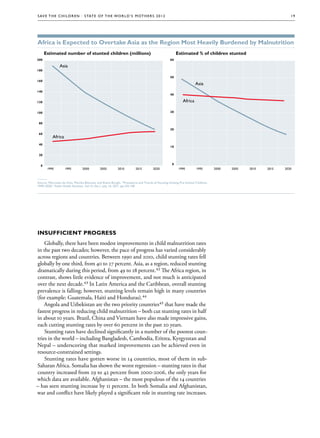
Africa is Expected to Overtake Asia as the Region Most Heavily Burdened by Malnutrition
      Estimated number of stunted children (millions)                                               Estimated % of children stunted
200                                                                                            60

               Asia
180

                                                                                               50
160
                                                                                                                 Asia
140
                                                                                               40

120                                                                                                     Africa

100                                                                                            30


 80
                                                                                               20
 60
          Africa
 40
                                                                                               10

 20


  0                                                                                             0
       1990        1995         2000        2005         2010         2015        2020               1990        1995        2000   2005   2010   2015   2020


—
Source: Mercedes de Onis, Monika Blössner and Elaine Borghi, “Prevalence and Trends of Stunting Among Pre-School Children,
1990-2020,” Public Health Nutrition, Vol.15, No.1, July 14, 2011, pp.142-148


Insufficient Progress
    Globally, there have been modest improvements in child malnutrition rates
in the past two decades; however, the pace of progress has varied considerably
across regions and countries. Between 1990 and 2010, child stunting rates fell
globally by one third, from 40 to 27 percent. Asia, as a region, reduced stunting
dramatically during this period, from 49 to 28 percent.42 The Africa region, in
contrast, shows little evidence of improvement, and not much is anticipated
over the next decade.43 In Latin America and the Caribbean, overall stunting
prevalence is falling; however, stunting levels remain high in many countries
(for example: Guatemala, Haiti and Honduras).44
    Angola and Uzbekistan are the two priority countries45 that have made the
fastest progress in reducing child malnutrition – both cut stunting rates in half
in about 10 years. Brazil, China and Vietnam have also made impressive gains,
each cutting stunting rates by over 60 percent in the past 20 years.
    Stunting rates have declined significantly in a number of the poorest coun-
tries in the world – including Bangladesh, Cambodia, Eritrea, Kyrgyzstan and
Nepal – underscoring that marked improvements can be achieved even in
resource-constrained settings.
    Stunting rates have gotten worse in 14 countries, most of them in sub-
Saharan Africa. Somalia has shown the worst regression – stunting rates in that
country increased from 29 to 42 percent from 2000-2006, the only years for
which data are available. Afghanistan – the most populous of the 14 countries
– has seen stunting increase by 11 percent. In both Somalia and Afghanistan,
war and conflict have likely played a significant role in stunting rate increases.
20                                                                                                                                                                                         The G lob al Mal nu trition Cr i s i s


                                                                                                                        Economic Growth Isn’t Enough
                                                                                                                           While children who live in impoverished countries are at higher risk for
                                                                                                                        malnutrition and stunting, poverty alone does not explain high malnutrition
                                                                                                                        rates for children. A number of relatively poor countries are doing an admirable
                                                                                                                        job of tackling this problem, while other countries with greater resources are
                                                                                                                        not doing so well.
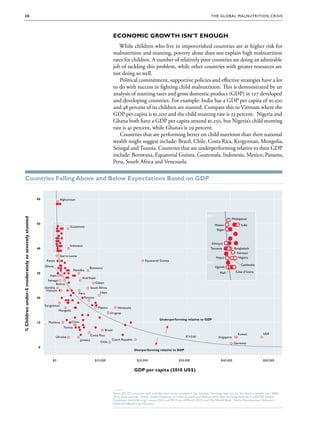
                                                                                                                           Political commitment, supportive policies and effective strategies have a lot
                                                                                                                        to do with success in fighting child malnutrition. This is demonstrated by an
                                                                                                                        analysis of stunting rates and gross domestic product (GDP) in 127 developed
                                                                                                                        and developing countries. For example: India has a GDP per capita of $1,500
                                                                                                                        and 48 percent of its children are stunted. Compare this to Vietnam where the
                                                                                                                        GDP per capita is $1,200 and the child stunting rate is 23 percent. Nigeria and
                                                                                                                        Ghana both have a GDP per capita around $1,250, but Nigeria’s child stunting
                                                                                                                        rate is 41 percent, while Ghana’s is 29 percent.
                                                                                                                           Countries that are performing better on child nutrition than their national
                                                                                                                        wealth might suggest include: Brazil, Chile, Costa Rica, Kyrgyzstan, Mongolia,
                                                                                                                        Senegal and Tunisia. Countries that are underperforming relative to their GDP
                                                                                                                        include: Botswana, Equatorial Guinea, Guatemala, Indonesia, Mexico, Panama,
                                                                                                                        Peru, South Africa and Venezuela.

          Countries Falling Above and Below Expectations Based on GDP


                                                    60                Afghanistan


                                                                                                                                                                                                 50%
% Children under-5 moderately or severely stunted


                                                                                                                                                                                                                      Madagascar
                                                    50                                                                                                                                                 Malawi              India
                                                                             Guatemala
                                                                                                                                                                                                        Niger


                                                                                                                                                                                                     Ethiopia
                                                                             Indonesia
                                                    40                                                                                                                                              Tanzania           Bangladesh
                                                                                                                                                                                                                        Pakistan
                                                                      Sierra Leone
                                                                                                                                                                                                        Nepal            Nigeria
                                                          Kenya                                                                                  Equatorial Guinea
                                                                                                                                                                                                 40%
                                                         Ghana                                                                                                                                                             Cambodia
                                                                                              Botswana                                                                                                 Uganda
                                                                                  Namibia
                                                    30                                                                                                                                                     Mali         Côte d’Ivoire
                                                             Haiti
                                                                                         Azerbajan
                                                           Senegal
                                                                 Bolivia                             Gabon
                                                         Gambia                                   South Africa
                                                          Vietnam
                                                                                     Peru                Libya
                                                    20                                  Panama

                                                         Kyrgyzstan
                                                                                                       Mexico              Venezuela
                                                                     Mongolia
                                                                                                                   Uruguay

                                                                                                                                                            Underperforming relative to GDP
                                                    10     Moldova              China
                                                                        Tunisia
                                                                                                               Brazil
                                                                                                  Costa Rica                                                                                                             Kuwait              USA
                                                                  Ukraine                                                                                                       R 2 =0.61                 Singapore
                                                                                        Jamaica                     Czech Republic
                                                                                                         Chile                                                                                                         Germany
                                                     0
                                                                                                                                        Overperforming relative to GDP


                                                               $0                                    $10,000                              $20,000                          $30,000                          $40,000                          $50,000


                                                                                                                                        GDP per capita (2010 US$)


                                                                                                                        —
                                                                                                                        Note: All 127 countries with available data were included in this analysis. Stunting rates are for the latest available year 2000-
                                                                                                                        2010. Data sources: WHO Global Database on Child Growth and Malnutrition (who.int/nutgrowthdb/); UNICEF Global
                                                                                                                        Databases (childinfo.org); recent DHS and MICS (as of March 2012) and The World Bank, World Development Indicators
                                                                                                                        (data.worldbank.org/indicator)
S av e t h e c h i l d r e n · S tat e o f t h e Wo r l d ’ s M ot h e r s 2 0 1 2    21


                                                                                            Guatemala
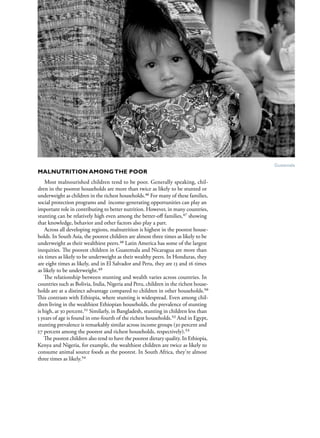
Malnutrition Among the Poor
    Most malnourished children tend to be poor. Generally speaking, chil-
dren in the poorest households are more than twice as likely to be stunted or
underweight as children in the richest households.46 For many of these families,
social protection programs and income-generating opportunities can play an
important role in contributing to better nutrition. However, in many countries,
stunting can be relatively high even among the better-off families,47 showing
that knowledge, behavior and other factors also play a part. 
    Across all developing regions, malnutrition is highest in the poorest house-
holds. In South Asia, the poorest children are almost three times as likely to be
underweight as their wealthiest peers.48 Latin America has some of the largest
inequities. The poorest children in Guatemala and Nicaragua are more than
six times as likely to be underweight as their wealthy peers. In Honduras, they
are eight times as likely, and in El Salvador and Peru, they are 13 and 16 times
as likely to be underweight.49
    The relationship between stunting and wealth varies across countries. In
countries such as Bolivia, India, Nigeria and Peru, children in the richest house-
holds are at a distinct advantage compared to children in other households.50
This contrasts with Ethiopia, where stunting is widespread. Even among chil-
dren living in the wealthiest Ethiopian households, the prevalence of stunting
is high, at 30 percent.51 Similarly, in Bangladesh, stunting in children less than
5 years of age is found in one-fourth of the richest households.52 And in Egypt,
stunting prevalence is remarkably similar across income groups (30 percent and
27 percent among the poorest and richest households, respectively).53
    The poorest children also tend to have the poorest dietary quality. In Ethiopia,
Kenya and Nigeria, for example, the wealthiest children are twice as likely to
consume animal source foods as the poorest. In South Africa, they're almost
three times as likely.54
22    chapter title goe s h e r e


South Sudan
S av e t h e c h i l d r e n · S tat e o f t h e Wo r l d ’ s M ot h e r s 2 0 1 2                                                    23


Saving Lives and Building a Better Future:
Low-Cost Solutions That Work

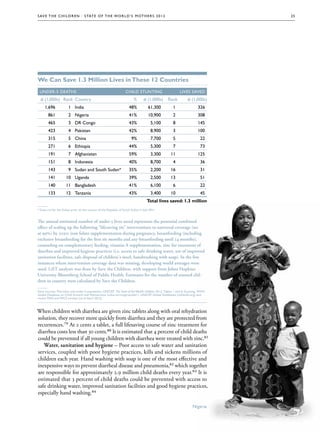
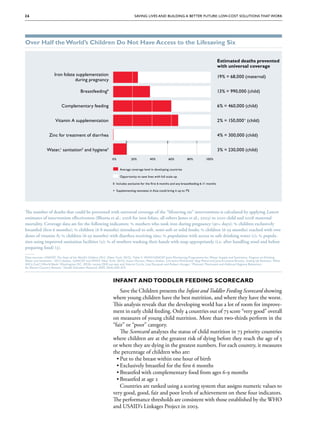
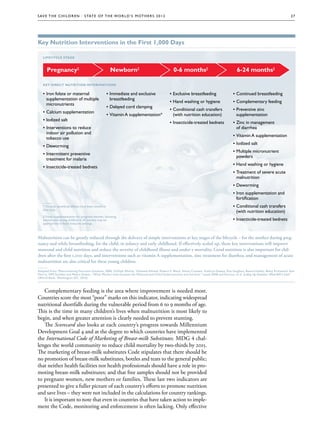
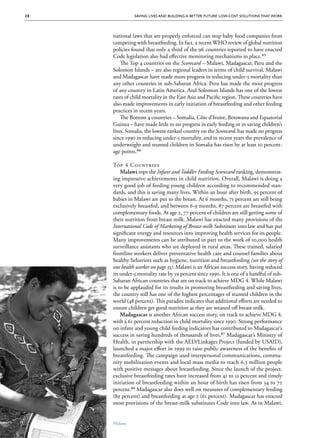
Here is a look at six key nutrition solutions that have the greatest potential         What Else Is Needed to
to save lives in a child’s first 1,000 days and beyond.55 Using a new evidence-        Fight Malnutrition and
based tool,56 Save the Children has calculated that nearly 1.3 million children’s      Save Lives?
lives could be saved each year if these six interventions are fully implemented
at scale in the 12 countries most heavily burdened by child malnutrition and           In 2008, world nutrition experts worked
                                                                                       together to identify a group of 13 cost-
under-5 mortality.
                                                                                       effective direct nutrition interventions,
    Implementing these solutions globally could save more than 2 million lives,        which were published in the Lancet medical
and would not require massive investments in health infrastructure. In fact,           journal. It was estimated that if these
with the help of frontline health workers, all six of these interventions can be       interventions were scaled up to reach every
delivered fairly rapidly using health systems that are already in place in most        mother and child in the 36 countries that
developing countries. What is lacking is the political will and relatively small       are home to 90 percent of malnourished
amount of money needed to take these proven solutions to the women and                 children, approximately 25 percent of child
                                                                                       deaths could be prevented. There would
children who need them most.
                                                                                       also be substantial reductions in childhood
   Three of the six solutions – iron, vitamin A and zinc – are typically packaged      illnesses and stunting.64
                                                                                                      stunting.64
as capsules costing pennies per dose, or about $1 to $2 per person, per year. The           Experts also agreed that to make an even
other three solutions – breastfeeding, complementary feeding and good hygiene          greater impact on reducing chronic malnu-
                                                                                                                             malnu-
– are behavior-change solutions, which are implemented through outreach,               trition, short- and long-term approaches are
education and community support. The World Bank estimates these latter three           required across multiple sectors involv-
                                                                                                                          involv-
solutions could be delivered through community nutrition programs at a cost            ing health, social protection, agriculture,
                                                                                       economic growth, education and women’s
of $15 per household or $7.50 per child.57 All combined, the entire lifesaving
                                                                                       empowerment.
package costs less than $20 per child for the first 1,000 days.58                           In 2010, experts from the Scaling Up
    Breastfeeding, when practiced optimally, is one of the most effective child        Nutrition (SUN) movement recommended
survival interventions available today. Optimal feeding from birth to age 2            a slightly revised group of 13 program-
can prevent an estimated 19 percent of all under-5 deaths, more than any other         matically feasible, evidence-based direct
intervention.59 However there are also other feeding practices and interventions       nutrition interventions. The “lifesaving
that are needed to ensure good nutrition in developing countries (see sidebar          six” solutions profiled in this report are
                                                                                       a subset of both the 13 Lancet and the 13
on this page and graphic on page 27).
                                                                                       SUN interventions. The other seven SUN
    Given the close link between malnutrition and infections, key interventions        interventions are:
to prevent and treat infections will contribute to better nutrition as well as
reduced mortality. These interventions include good hygiene practices and hand         •• Multiple micronutrient powders
washing, sanitation and access to safe drinking water (which reduce diarrhea
and other parasitic diseases to which undernourished children are particularly         •• Deworming drugs for children (to reduce
vulnerable) and oral rehydration salts and therapeutic zinc to treat diarrhea.            loss of nutrients)

                                                                                       •• Salt iodization
The six lifesaving solutions are:
   Iron folate supplements – Iron deficiency anemia, the most common                   •• Iodized oil capsules where iodized salt is
                                                                                          unavailable
nutritional disorder in the world, is a significant cause of maternal mortality,
increasing the risk of hemorrhage and infection during childbirth. It may also         •• Iron fortification of staple foods
cause premature birth and low birthweight. At least 25 percent – or 1.6 billion
people – are estimated to be anemic, and millions more are iron deficient, the         •• Supplemental feeding for moderately mal-
                                                                                                                                mal-
vast majority of them women.60 A range of factors cause iron deficiency ane-              nourished children with special foods
mia, including inadequate diet, blood loss associated with menstruation, and
parasitic infections such as hookworm. Anemia also affects children, lower-            •• Treatment of severe malnutrition with
                                                                                          ready-to-use therapeutic foods (RUTF)
ing resistance to disease and weakening a child’s learning ability and physical
stamina. Recent studies suggest that pregnant women who take iron folate
supplements not only lower their risk of dying in childbirth, they also enhance
the intellectual development of their babies.61 Iron supplements for pregnant
women cost just $2 per pregnancy.62 It is estimated that 19 percent of maternal
deaths could be prevented if all women took iron supplements while pregnant.63
24                                                         Saving Lives and Building a Better Future: Low-Cost Solutions That Work


Promoting and Supporting                              Breastfeeding – Human breast milk provides all the nutrients newborns
Early Initiation of                               need for healthy development and also provides important antibodies against
Breastfeeding                                     common childhood illnesses. Exclusive breastfeeding prevents babies from
                                                  ingesting contaminated water that could be mixed with infant formula. The
Despite its benefits, many women delay            protective benefits of breastfeeding have been shown to be most significant with
initiation of breastfeeding. Only 43 percent
                                                  6 months of exclusive breastfeeding and with continuation after 6 months, in
of newborns in developing countries are
put to the breast within one hour of birth.
                                                  combination with nutritious complementary foods (solids), up to age 2. In
Establishing good breastfeeding practices         conditions that normally exist in developing countries, breastfed children are
in the first days is critical to the health of    at least 6 times more likely to survive in the early months than non-breastfed
the infant and to breastfeeding success.          children.65
Initiating breastfeeding is easiest and most          Complementary feeding – When breast milk alone is no longer sufficient
successful when a mother is physically            to meet a child’s nutritional needs, other foods and liquids must be added
and psychologically prepared for birth and
                                                  to a child’s diet in addition to breast milk. Optimal complementary feed-
breastfeeding and when she is informed,
supported, and confident of her ability to
                                                  ing involves factors such as the quantity and quality of food, frequency and
care for her newborn. The following actions       timeliness of feeding, food hygiene, and feeding during/after illnesses. The
can increase rates of early initiation of         target range for complementary feeding is 6-23 months.66 WHO notes that
breastfeeding:                                    breastfeeding should not be decreased when starting complementary feeding;
                                                  complementary foods should be given with a spoon or a cup, not in a bottle;
•• Identify the practices, beliefs, concerns      foods should be clean, safe and locally available; and ample time should be given
   and constraints to early and exclusive
                                                  for young children to learn to eat solid foods.67 Rates of malnutrition among
   breastfeeding and address them through
   appropriate messages and changes in
                                                  children usually peak during the time of complementary feeding. Growth
   delivery and postnatal procedures              faltering is most evident between 6-12 months, when foods of low nutrient
                                                  density begin to replace breast milk and rates of diarrheal illness due to food
•• Counsel women during prenatal care on          contamination are at their highest.68 During the past decade, there has been
   early initiation and exclusive breastfeeding   considerable improvement in breastfeeding practices in many countries; how-
                                                  ever, similar progress has not been made in the area of complementary feeding.
•• Upgrade the skills of birth attendants to
                                                  Complementary feeding is a proven intervention that can significantly reduce
   support early and exclusive breastfeeding
                                                  stunting during the first two years of life.69 If all children in the developing
•• Make skin-to-skin contact and initiation       world received adequate complementary feeding, stunting rates at 12 months
   of breastfeeding the first routine after       could be cut by 20 percent.70
   delivery                                           Vitamin A supplements – Roughly a third of all preschool-age children
                                                  (190 million)71 and 15 percent of pregnant women (19 million)72 do not have
•• Praise the mother for giving colostrum         enough vitamin A in their daily diet. Vitamin A deficiency is a contributing
   (the “first milk”), provide ongoing
                                                  factor in the 1.3 million deaths each year from diarrhea among children and the
   encouragement, and assist with position-
                                    position-
   ing and attachment
                                                  nearly 118,000 deaths from measles.73 Severe deficiency can also cause irrevers-
                                                  ible corneal damage, leading to partial or total blindness. Vitamin A capsules
                                                  given to children twice a year can prevent blindness and lower a child’s risk of
                                                  death from common childhood diseases – at a cost of only 2 cents per capsule.74
                                                  It is estimated that at least 2 percent of child deaths could be prevented if all
                                                  children under age 5 received two doses of vitamin A each year.75
                                                      Zinc for diarrhea – Diarrhea causes the death of 1.3 million children76 each
                                                  year, most of them between the ages of 6 months and 2 years.77 Young children
                                                  are especially vulnerable because a smaller amount of fluid loss causes sig-
                                                  nificant dehydration, because they have fewer internal resources, and because
                                                  their energy requirements are higher. Children in developing nations suffer an
                                                  average of three cases of diarrhea a year.78 Diarrhea robs a child’s body of vital
                                                  nutrients, causing malnutrition. Malnutrition, in turn, decreases the ability
                                                  of the immune system to fight further infections, making diarrheal episodes
                                                  more frequent. Repeated bouts of diarrhea stunt children’s growth and keep
                                                  them out of school, which further limits their chances for a successful future.
S av e t h e c h i l d r e n · S tat e o f t h e Wo r l d ’ s M ot h e r s 2 0 1 2                                             25


We Can Save 1.3 Million Lives in These 12 Countries
 Under-5 deaths                                                    Child stunting                         Lives saved
  # (1,000s) Rank Country                                                %       # (1,000s)      Rank           # (1,000s)
     1,696             1 India                                       48%            61,300           1                 326
        861            2 Nigeria                                     41%            10,900           2                 308
        465            3 DR Congo                                    43%              5,100          8                 145
        423            4 Pakistan                                    42%              8,900          3                 100
        315            5 China                                         9%             7,700          5                   22
        271            6 Ethiopia                                    44%              5,300          7                   73
        191            7 Afghanistan                                 59%              3,300        11                  125
        151            8 Indonesia                                   40%              8,700          4                   36
        143            9 Sudan and South Sudan*                      35%              2,200        16                    31
        141          10 Uganda                                       39%              2,500        13                    51
        140          11 Bangladesh                                   41%              6,100          6                   22
        133          12 Tanzania                                     43%              3,400        10                    45
                                                                                   Total lives saved: 1.3 million
—
* Data are for the Sudan prior to the cession of the Republic of South Sudan in July 2011.


The annual estimated number of under-5 lives saved represents the potential combined
effect of scaling up the following “lifesaving six” interventions to universal coverage (set
at 99%) by 2020: iron folate supplementation during pregnancy, breastfeeding (including
exclusive breastfeeding for the first six months and any breastfeeding until 24 months),
counseling on complementary feeding, vitamin A supplementation, zinc for treatment of
diarrhea and improved hygiene practices (i.e. access to safe drinking water, use of improved
sanitation facilities, safe disposal of children's stool, handwashing with soap). In the few
instances where intervention coverage data was missing, developing world averages were
used. LiST analysis was done by Save the Children, with support from Johns Hopkins
University Bloomberg School of Public Health. Estimates for the number of stunted chil-   chil-
dren in country were calculated by Save the Children.
—
Data sources: Mortality and under-5 population, UNICEF. The State of the World’s Children 2012. Tables 1 and 6; Stunting, WHO
Global Database on Child Growth and Malnutrition (usho.int/nutgrowthb/.), UNICEF Global Databases (childinfo.org) and
recent DHS and MICS surveys (as of April 2012)


When children with diarrhea are given zinc tablets along with oral rehydration
solution, they recover more quickly from diarrhea and they are protected from
recurrences.79 At 2 cents a tablet, a full lifesaving course of zinc treatment for
diarrhea costs less than 30 cents.80 It is estimated that 4 percent of child deaths
could be prevented if all young children with diarrhea were treated with zinc.81
   Water, sanitation and hygiene – Poor access to safe water and sanitation
services, coupled with poor hygiene practices, kills and sickens millions of
children each year. Hand washing with soap is one of the most effective and
inexpensive ways to prevent diarrheal disease and pneumonia,82 which together
are responsible for approximately 2.9 million child deaths every year.83 It is
estimated that 3 percent of child deaths could be prevented with access to
safe drinking water, improved sanitation facilities and good hygiene practices,
especially hand washing.84

                                                                                                                   Nigeria
26                                                                           Saving Lives and Building a Better Future: Low-Cost Solutions That Work


Over Half the World’s Children Do Not Have Access to the Lifesaving Six

                                                                                                                                               Estimated deaths prevented
                                                                                                                                               with universal coverage
                    Iron folate supplementation                                                                                                19% = 68,000 (maternal)
                               during pregnancy

                                       Breastfeedingß                                                                                          13% = 990,000 (child)


                         Complementary feeding                                                                                                 6% = 460,000 (child)


                     Vitamin A supplementation                                                                                                 2% = 150,000 + (child)


                 Zinc for treatment of diarrhea                                                                                                4% = 300,000 (child)
                                                                       3                              2                     1

               Water,1 sanitation2 and hygiene3                                                                                                3% = 230,000 (child)
                                                              0%           20%           40%              60%         80%           100%


                                                              ■  Average coverage level in developing countries
                                                              ■  Opportunity to save lives with full scale-up
                                                              ß  Includes exclusive for the first 6 months and any breastfeeding 6-11 months

                                                              +  Supplementing neonates in Asia could bring it up to 7%


The number of deaths that could be prevented with universal coverage of the “lifesaving six” interventions is calculated by applying Lancet
estimates of intervention effectiveness (Bhutta et al., 2008 for iron folate, all others Jones et al., 2003) to 2010 child and 2008 maternal
mortality. Coverage data are for the following indicators: % mothers who took iron during pregnancy (90+ days); % children exclusively
breastfed (first 6 months); % children (6-8 months) introduced to soft, semi-soft or solid foods; % children (6-59 months) reached with two
doses of vitamin A; % children (6-59 months) with diarrhea receiving zinc; % population with access to safe drinking water (1); % popula-
                                                                                                                                       popula-
tion using improved sanitation facilities (2); % of mothers washing their hands with soap appropriately (i.e. after handling stool and before
preparing food) (3).
—
Data sources: UNICEF. The State of the World’s Children 2012. (New York: 2012), Table 2; WHO/UNICEF Joint Monitoring Programme for Water Supply and Sanitation. Progress on Drinking
Water and Sanitation - 2012 Update. (UNICEF and WHO: New York: 2012); Susan Horton, Meera Shekar, Christine McDonald, Ajay Mahal and Jana Krystene Brooks, Scaling Up Nutrition: What
Will it Cost? (World Bank: Washington DC: 2010); recent DHS surveys and Valerie Curtis, Lisa Danquah and Robert Aunger, “Planned, Motivated and Habitual Hygiene Behaviour:
An Eleven Country Review,” Health Education Research 2009, 24(4):655-673.


                                                              Infant and Toddler Feeding Scorecard
                                                                  Save the Children presents the Infant and Toddler Feeding Scorecard showing
                                                              where young children have the best nutrition, and where they have the worst.
                                                              This analysis reveals that the developing world has a lot of room for improve-
                                                              ment in early child feeding. Only 4 countries out of 73 score “very good” overall
                                                              on measures of young child nutrition. More than two-thirds perform in the
                                                              “fair” or “poor” category.
                                                                  The Scorecard analyzes the status of child nutrition in 73 priority countries
                                                              where children are at the greatest risk of dying before they reach the age of 5
                                                              or where they are dying in the greatest numbers. For each country, it measures
                                                              the percentage of children who are:
                                                                ••Put to the breast within one hour of birth
                                                                ••Exclusively breastfed for the first 6 months
                                                                ••Breastfed with complementary food from ages 6-9 months
                                                                ••Breastfed at age 2
                                                                  Countries are ranked using a scoring system that assigns numeric values to
                                                              very good, good, fair and poor levels of achievement on these four indicators.
                                                              The performance thresholds are consistent with those established by the WHO
                                                              and USAID’s Linkages Project in 2003.
S av e t h e c h i l d r e n · S tat e o f t h e Wo r l d ’ s M ot h e r s 2 0 1 2                                                                                                       27


Key Nutrition Interventions in the First 1,000 Days

   Lifecycle stage


      Pregnancy‡                                       Newborn‡                                    0-6 months‡                                    6-24 months‡

   Key direct nutrition interventions

   •• Iron folate or maternal                         •• Immediate and exclusive                 •• Exclusive breastfeeding                    •• Continued breastfeeding
      supplementation of multiple                        breastfeeding
                                                                                                 •• Hand washing or hygiene                    •• Complementary feeding
      micronutrients
                                                      •• Delayed cord clamping
                                                                                                 •• Conditional cash transfers                 •• Preventive zinc
   •• Calcium supplementation
                                                      •• Vitamin A supplementation*                 (with nutrition education)                    supplementation
   •• Iodized salt
                                                                                                 •• Insecticide-treated bednets                •• Zinc in management
   •• Interventions to reduce                                                                                                                     of diarrhea
      indoor air pollution and
                                                                                                                                               •• Vitamin A supplementation
      tobacco use
                                                                                                                                               •• Iodized salt
   •• Deworming
                                                                                                                                               •• Multiple micronutrient
   •• Intermittent preventive
                                                                                                                                                  powders
      treatment for malaria
                                                                                                                                               •• Hand washing or hygiene
   •• Insecticide-treated bednets
                                                                                                                                               •• Treatment of severe acute
                                                                                                                                                  malnutrition
                                                                                                                                               •• Deworming
                                                                                                                                               •• Iron supplementation and
                                                                                                                                                  fortification
   —
   * To date, beneficial effects have been shown in                                                                                            •• Conditional cash transfers
   Asia only.
                                                                                                                                                  (with nutrition education)
   ‡ Food supplementation for pregnant women, lactating
   women and young children 6-24 months may be                                                                                                 •• Insecticide-treated bednets
   appropriate in food insecure settings.


Malnutrition can be greatly reduced through the delivery of simple interventions at key stages of the lifecycle – for the mother during preg-
                                                                                                                                          preg-
nancy and while breastfeeding; for the child, in infancy and early childhood. If effectively scaled up, these key interventions will improve
maternal and child nutrition and reduce the severity of childhood illness and under-5 mortality. Good nutrition is also important for chil-
                                                                                                                                         chil-
dren after the first 1,000 days, and interventions such as vitamin A supplementation, zinc treatment for diarrhea, and management of acute
malnutrition are also critical for these young children.
—
Adapted from: Mainstreaming Nutrition Initiative, 2006; Zulfiqar Bhutta, Tahmeed Ahmed, Robert E. Black, Simon Cousens, Kathryn Dewey, Elsa Giugliani, Batool Haider, Betty Kirkwood, Saul
Morris, HPS Sachdev and Meera Shekar, “What Works? Interventions for Maternal and Child Undernutrition and Survival,” Lancet 2008 and Horton, et al. Scaling Up Nutrition: What Will it Cost?
(World Bank: Washington DC: 2010)


   Complementary feeding is the area where improvement is needed most.
Countries score the most “poor” marks on this indicator, indicating widespread
nutritional shortfalls during the vulnerable period from 6 to 9 months of age.
This is the time in many children’s lives when malnutrition is most likely to
begin, and when greater attention is clearly needed to prevent stunting.
   The Scorecard also looks at each country’s progress towards Millennium
Development Goal 4 and at the degree to which countries have implemented
the International Code of Marketing of Breast-milk Substitutes. MDG 4 chal-
lenges the world community to reduce child mortality by two-thirds by 2015.
The marketing of breast-milk substitutes Code stipulates that there should be
no promotion of breast-milk substitutes, bottles and teats to the general public;
that neither health facilities nor health professionals should have a role in pro-
moting breast-milk substitutes; and that free samples should not be provided
to pregnant women, new mothers or families. These last two indicators are
presented to give a fuller picture of each country’s efforts to promote nutrition
and save lives – they were not included in the calculations for country rankings.
   It is important to note that even in countries that have taken action to imple-
ment the Code, monitoring and enforcement is often lacking. Only effective
28             Saving Lives and Building a Better Future: Low-Cost Solutions That Work


      national laws that are properly enforced can stop baby food companies from
      competing with breastfeeding. In fact, a recent WHO review of global nutrition
      policies found that only a third of the 96 countries reported to have enacted
      Code legislation also had effective monitoring mechanisms in place.85
          The Top 4 countries on the Scorecard – Malawi, Madagascar, Peru and the
      Solomon Islands – are also regional leaders in terms of child survival. Malawi
      and Madagascar have made more progress in reducing under-5 mortality than
      any other countries in sub-Saharan Africa. Peru has made the most progress
      of any country in Latin America. And Solomon Islands has one of the lowest
      rates of child mortality in the East Asia and Pacific region. These countries have
      also made improvements in early initiation of breastfeeding and other feeding
      practices in recent years.
          The Bottom 4 countries – Somalia, Côte d’Ivoire, Botswana and Equatorial
      Guinea – have made little to no progress in early feeding or in saving children’s
      lives. Somalia, the lowest-ranked country on the Scorecard, has made no progress
      since 1990 in reducing under-5 mortality, and in recent years the prevalence of
      underweight and stunted children in Somalia has risen by at least 10 percent-
      age points.86

      Top 4 Countries
          Malawi tops the Infant and Toddler Feeding Scorecard ranking, demonstrat-
      ing impressive achievements in child nutrition. Overall, Malawi is doing a
      very good job of feeding young children according to recommended stan-
      dards, and this is saving many lives. Within an hour after birth, 95 percent of
      babies in Malawi are put to the breast. At 6 months, 71 percent are still being
      exclusively breastfed, and between 6-9 months, 87 percent are breastfed with
      complementary foods. At age 2, 77 percent of children are still getting some of
      their nutrition from breast milk. Malawi has enacted many provisions of the
      International Code of Marketing of Breast-milk Substitutes into law and has put
      significant energy and resources into improving health services for its people.
      Many improvements can be attributed in part to the work of 10,000 health
      surveillance assistants who are deployed in rural areas. These trained, salaried
      frontline workers deliver preventative health care and counsel families about
      healthy behaviors such as hygiene, nutrition and breastfeeding (see the story of
      one health worker on page 35). Malawi is an African success story, having reduced
      its under-5 mortality rate by 59 percent since 1990. It is one of a handful of sub-
      Saharan African countries that are on track to achieve MDG 4. While Malawi
      is to be applauded for its results in promoting breastfeeding and saving lives,
      the country still has one of the highest percentages of stunted children in the
      world (48 percent). This paradox indicates that additional efforts are needed to
      ensure children get good nutrition as they are weaned off breast milk.
          Madagascar is another African success story, on track to achieve MDG 4,
      with a 61 percent reduction in child mortality since 1990. Strong performance
      on infant and young child feeding indicators has contributed to Madagascar’s
      success in saving hundreds of thousands of lives.87 Madagascar’s Ministry of
      Health, in partnership with the AED/Linkages Project (funded by USAID),
      launched a major effort in 1999 to raise public awareness of the benefits of
      breastfeeding. The campaign used interpersonal communications, commu-
      nity mobilization events and local mass media to reach 6.3 million people
      with positive messages about breastfeeding. Since the launch of the project,
      exclusive breastfeeding rates have increased from 41 to 51 percent and timely
      initiation of breastfeeding within an hour of birth has risen from 34 to 72
      percent.88 Madagascar also does well on measures of complementary feeding
      (89 percent) and breastfeeding at age 2 (61 percent). Madagascar has enacted
      most provisions of the breast-milk substitutes Code into law. As in Malawi,


      Malawi
S av e t h e c h i l d r e n · S tat e o f t h e Wo r l d ’ s M ot h e r s 2 0 1 2           29


                                                                                       Peru

Madagascar’s children often falter as they are transitioning from breast milk to
solid foods: despite starting life with healthy nutrition, an alarming 49 percent
of Madagascar’s children under age 5 have stunted growth.
    Peru also does a very good job with early feeding of its children: 51 percent
of newborns are put to the breast within an hour of birth; 68 percent are exclu-
sively breastfed for 6 months; 84 percent are breastfed with complementary
foods between 6-9 months; and an estimated 61 percent are still being breastfed
around age 2. After years of almost no change in child chronic malnutrition
rates, the Peruvian government launched Programa Integral de Nutrición
(PIN) in 2006. PIN prioritized interventions for children under age 3, pregnant
women, lactating mothers and the poorest families who were at high risk for
malnutrition.89 To inspire mothers to breastfeed more, the Ministry of Health
sponsors events to promote breastfeeding, such as an annual breastfeeding
contest where a prize is awarded for the baby who nurses the longest in one
sitting.90 Government programs combined with supporting efforts by NGOs
and the donor community are credited with reducing Peru’s under-5 chronic
malnutrition rate by about one quarter since 2005,91 an impressive achieve-
ment. Peru has also cut its under-5 mortality rate by 76 percent since 1990 so
it has already achieved MDG 4. Still, 23 percent of Peru’s children are stunted,
indicating that more needs to be done to provide good nutrition to women
while they are pregnant and children as they are transitioning from breast milk
to solid foods.
    Solomon Islands is one of the least developed countries in the world, yet it
performs very well on early nutrition indicators, demonstrating that a strong
policy environment and individual adoption of lifesaving nutrition practices
can matter more than national wealth when it comes to saving children’s lives.
Within an hour after birth, 75 percent of babies in Solomon Islands are put
to the breast. At 6 months, 74 percent are still being exclusively breastfed, and
between 6-9 months, 81 percent are breastfed with complementary foods. At
age 2, 67 percent of children are still getting some of their nutrition from breast
milk. Solomon Islands has cut under-5 deaths by 40 percent since 1990 and is
on track to achieve MDG 4.

Bottom 4 Countries
    Somalia scores last on the Infant and Toddler Feeding Scorecard, demon-
strating a widespread child nutrition crisis that often starts as soon as a child
is born, if not before. Armed conflict, drought and food crises have placed
enormous stresses on families in Somalia. Many women do not exclusively
breastfeed, instead giving their infants camel’s milk, tea or water in addition
to breast milk.92 Only 23 percent of Somali newborns are put to the breast
30             Saving Lives and Building a Better Future: Low-Cost Solutions That Work


      within an hour of birth; only 5 percent are exclusively breastfed for 6 months
      and 15 percent are breastfed with complementary foods between 6-9 months.
      At age 2, it is estimated that 27 percent of children are still getting some breast
      milk. Somalia has the lowest complementary feeding rate and the highest child
      mortality rate in the world. Tragically, 1 child in 6 dies before reaching age 5.93
      Years of political and economic instability in Somalia have also contributed
      to severe increases in stunting – up from 29 percent in 2000 to 42 percent in
      2006.94 Somalia has made no progress towards MDG 4.
          Côte d'Ivoire is another country where conflict and instability have created a
      dire situation for mothers and children. Only 25 percent of Ivorian newborns are
      put to the breast within an hour of birth; only 4 percent are exclusively breastfed
      for 6 months; and 54 percent are breastfed with complementary foods between
      6-9 months. At age 2, it is estimated that 37 percent of children are still getting
      some breast milk. One child in 12 dies before reaching age 195 and 39 percent
      of children are stunted. Côte d'Ivoire has made insufficient progress towards
      MDG 4, and has taken little action on the International Code of Marketing of
      Breast-milk Substitutes.
          In Botswana, breastfeeding was once widely practiced96 but today, only
      20 percent of infants are exclusively breastfed. Botswana has been hard hit by
      AIDS, and many infected mothers likely do not breastfeed for fear they might
      pass along the disease to their babies. However, if given the right treatment with
      antiretrovirals (ARVs), HIV-positive mothers can safely breastfeed.97 And even
      without ARVs, in places where there is little access to clean water, sanitation or
      health services, the risk that a child will die of diarrhea or another childhood
      disease outweighs the risk of contracting HIV through breast milk, at least
      during the early months. Most HIV-positive mothers in developing countries
      are advised to exclusively breastfeed, but this message has met resistance in
      Botswana. Poorly trained health workers often do not encourage this recom-
      mended practice. And despite good efforts by the government to discourage
      formula feeding by enacting most of the Code into law, the policies and pro-
      grams to ensure that HIV-positive mothers are informed about the risks and
      benefits of different infant feeding options – and are supported in carrying out
      their infant feeding decisions – remain inadequate.98 Largely as a result, only 20
      percent of Botswana’s newborns are put to the breast within an hour of birth. At
      ages 6-9 months, 46 percent are breastfed with complementary foods and at age
      2, only 6 percent of children are getting any breast milk at all. Botswana’s infant
      mortality rate is 36 per 1,000 live births and 31 percent of children are stunted.
          Equatorial Guinea is the highest income country in Africa, demonstrating
      that national wealth alone is not sufficient to prevent malnutrition. Only 24
      percent of babies in Equatorial Guinea are exclusively breastfed for 6 months
      and 48 percent are breastfed with complementary foods between 6-9 months.
      At age 2, it is estimated that just 10 percent of children are still getting some
      breast milk. Equatorial Guinea has made insufficient progress towards MDG 4,
      and has taken no action on the International Code of Marketing of Breast-milk
      Substitutes. One child in 12 dies before reaching age 199 and 35 percent of chil-
      dren have stunted growth.


      Côte d’Ivoire
S av e t h e c h i l d r e n · S tat e o f t h e Wo r l d ’ s M ot h e r s 2 0 1 2                                                                                                               31


Infant and Toddler Feeding Scorecard
                                                                                             % of childlren (2000 -2011) who are :                              Early feeding summary
                                                                                put to the breast   exclusively        breastfed with    breastfed at age 2          Score         Rating               Progress      State of policy
                                                                                within 1 hour of    breastfed          complementary     (20-23 months)                                                 towards MDG 4 support for the
                                                                                birth               (first 6 months)   food (6-9 months)                                                                (2010) 1
                                                                                                                                                                                                                      Code2
                                       Malawi                                          95                  71                 87                  77                   9.3         Very good            On track          Good
                                       Madagascar                                      72                  51                 89                  61                   9.0         Very good            On track          Very good
                                       Peru                                            51                  68                 84                  61z                  9.0         Very good            On track          Very good
                                       Solomon Islands                                 75                  74                 81                  67                   9.0         Very good            On track          Poor
                                       Bolivia, Plurinational State of                 64                  60                 81                  40                   8.3         Good                 On track          Good
                                       Burundi                                         74                  69                 74                  79                   8.3         Good                 Insufficient      Poor
                                       Cambodia                                        66                  74                 85                  43                   8.3         Good                 On track          Good
                                       Myanmar                                         76                  24                 81                  65                   8.3         Good                 Insufficient      Fair
                                       Rwanda                                          71                  85                 69                  84                   8.3         Good                 Insufficient      Poor
                                       Zambia                                          57                  61                 93                  42                   8.3         Good                 Insufficient      Good
                                       Papua New Guinea                                –                   56                 76                  72                   8.0         Good                 Insufficient      Good
                                       Bangladesh                                      43                  64                 69                  90                   7.8         Good                 On track          Good
                                       Nepal                                           45                  70                 70                  93                   7.8         Good                 On track          Very good
                                       Egypt                                           56                  53                 66                  35                   7.5         Good                 On track          Good
                                       Eritrea                                         78                  52                 43                  62                   7.5         Good                 On track          Poor
                                       Ethiopia                                        52                  52                 51                  82                   7.5         Good                 Insufficient      Good
                                       Ghana                                           52                  63                 75                  44                   7.5         Good                 Insufficient      Very good
                                       Guatemala                                       56                  50                 71                  46                   7.5         Good                 On track          Very good
                                       Kenya                                           58                  32                 83                  54                   7.5         Good                 No progress       Fair
                                       Mozambique                                      63                  41                 81                  52                   7.5         Good                 Insufficient      Very good
                                       Tanzania, United Republic of                    49                  50                 93                  51                   7.5         Good                 Insufficient      Very good
                                       Togo                                            53                  63                 44x                 64                   7.5         Good                 Insufficient      Poor
                                       Uganda                                          42                  60                 80                  54                   7.5         Good                 Insufficient      Very good
                                       Benin                                           32                  43                 76                  92                   7.0         Fair                 Insufficient      Very good
                                       Guinea-Bissau                                   55                  38                 41x                 65                   6.8         Fair                 Insufficient      Good
                                       Haiti                                           44                  41                 87                  35                   6.8         Fair                 No progress       Poor
                                       Lesotho                                         53                  54                 58                  35                   6.8         Fair                 No progress       Poor
                                       Mauritania                                      81                  46                 61                  47                   6.8         Fair                 No progress       Poor
                                       Niger                                           42                  27                 65                  62                   6.8         Fair                 Insufficient      Good
                                       Zimbabwe                                        65                  31                 83                  20                   6.8         Fair                 No progress       Very good
                                       Angola                                          55                  11                 77                  37                   6.0         Fair                 Insufficient      Poor
                                       Gambia                                          53                  36                 34x                 31                   6.0         Fair                 Insufficient      Very good
                                       Guinea                                          35                  48                 32                  71                   6.0         Fair                 Insufficient      Good
                                       India                                           41                  46                 57                  77                   6.0         Fair                 Insufficient      Very good
                                       Indonesia                                       44                  32                 75                  50                   6.0         Fair                 On track          Good
                                       Lao People’s Democratic Republic                30                  26                 70                  48                   6.0         Fair                 On track          Good
                                       Morocco                                         52                  15                 66                  15                   6.0         Fair                 On track          Fair
                                       Nigeria                                         38                  13                 75                  32                   6.0         Fair                 Insufficient      Good
                                       Philippines                                     54                  34                 58                  34                   6.0         Fair                 On track          Very good
                                       Sao Tome and Principe                           45                  51                 73                  20                   6.0         Fair                 No progress       Poor
                                       Sierra Leone                                    51                  11                 73                  50                   6.0         Fair                 Insufficient      Poor
                                       Swaziland                                       55                  44                 67x                 11                   6.0         Fair                 Insufficient      Fair
                                       Tajikistan                                      57z                 25                 15                  34                   6.0         Fair                 Insufficient      Good
                                       Uzbekistan                                      67                  26                 45                  38                   6.0         Fair                 Insufficient      Poor
                                       Yemen                                           30                  12                 76                  [42]                 6.0         Fair                 Insufficient      Very good
                                       Afghanistan                                     37y                 43y                29                  54                   5.3         Fair                 Insufficient      Very good
                                       Brazil                                          43                  40                 70                  25                   5.3         Fair                 On track          Very good
                                       Burkina Faso                                    20                  25                 52                  80                   5.3         Fair                 No progress       Good
                                       Central African Republic                        39                  23                 55                  47                   5.3         Fair                 No progress       Poor
                                       Congo                                           39                  19                 78                  21                   5.3         Fair                 Insufficient      Poor
                                       Congo, Democratic Republic of the               43                  37                 52 x                53                   5.3         Fair                 No progress       Good
                                       Gabon                                           71                  6                  62                  9                    5.3         Fair                 Insufficient      Very good
                                       Iraq                                            31                  25                 51                  36                   5.3         Fair                 On track          Poor
                                       Korea, Democratic People’s Republic of          18                  65                 31                  37                   5.3         Fair                 On track          Poor
                                       Kyrgyzstan                                      65                  32                 49                  26                   5.3         Fair                 On track          Good
                                       Liberia                                         44                  34                 51                  41                   5.3         Fair                 On track          Fair
                                       Mali                                            43                  34                 30                  56                   5.3         Fair                 Insufficient      Good
                                       Senegal                                         23                   39                71                  51                   5.3         Fair                 Insufficient      Good
                                       South Africa                                    61                   8                 49                  31                   5.3         Fair                 No progress       Fair
                                       Turkmenistan                                    60                   11                54                  37                   5.3         Fair                 Insufficient      Good
                                       Sudan and South Sudan‡                          –                    41                51x                 40                   5.0         Fair                 Insufficient      Poor
                                       Azerbaijan                                      32                   12                44                  16                   4.5         Poor                 Insufficient      Good
                                       Cameroon                                        20                   20                76                  24                   4.5         Poor                 No progress       Very good
                                       Chad                                            34                   3                 36x                 59                   4.5         Poor                 No progress       Poor
                                       China                                           41                   28                43                  15                   4.5         Poor                 On track          Good
                                       Comoros                                         25                   21                34                  45                   4.5         Poor                 Insufficient      Poor
                                       Djibouti                                        67                   1                 23                  18                   4.5         Poor                 Insufficient      Good
                                       Pakistan                                        29                   37                36                  55                   4.5         Poor                 Insufficient      Very good
                                       Vietnam                                         40                   17                50 x                19                   4.5         Poor                 On track          Good
                                       Equatorial Guinea                               –                    24                48                  10                   4.0         Poor                 Insufficient      Poor
                                       Botswana                                        20                   20                46                  6                    3.8         Poor                 Insufficient      Very good
                                       Côte d’Ivoire                                   25                   4                 54                  37                   3.8         Poor                 Insufficient      Poor
                                       Somalia                                         23                   5                 15                  27                   3.0         Poor                 No progress       Poor

                                       Indicator ratings                   ratings received the same overall      Philippines, Solomon Islands) or        the International Code of Marketing of      and scoring methodology please see
                                                                           performance score.                     that it is 40 or more with an average   Breast-milk Substitutes. For category       Methodology and Research Notes.
                                       ■  Very good                                                               annual rate of reduction (AARR)         definitions, please see Research            Country scores and ratings in italics
                                       ■  Good                             – Data not available                   of 4% or higher for 1990-2010;          and Methodology Notes. Sources:             should be interpreted with care
                                       ■  Fair                             x
                                                                             Data differ from the standard        “insufficient progress” indicates       IBFAN. SOC 2011; UNICEF. National           as they are based on incomplete,
                                       ■  Poor                             definition                             a U5MR ≥ 40 with an AARR of             Implementation of the International Code.   outdated or sub-regional data.
                                                                           y
                                                                             Data refer to only part of a country 1% -3.9%; “no progress” indicates       April 2011.                                 Data sources: WHO Global
                                       Overall performance scores +        [z] Data are pre-2000                  a U5MR ≥ 40 with an AARR  1%.                                                      Databank on Infant and Young Child
                                                                           ‡ Data are for the Sudan prior to      Progress assessment by Save the         —                                           Feeding (who.int/nutrition/databases/
                                       ≥ 9	Very good                       the cession of the Republic of South Children. Sources: Methodology,           Note: Findings are reported for             infantfeeding/); UNICEF Global
                                       7-8	Good                            Sudan in July 2011.                    Countdown to 2015; AARR,                73 Countdown countries with latest          Databases (childinfo.org); recent DHS,
                                       5-6	 Fair                                                                  UNICEF. State of the World’s Children   available data from 2000-2011 for at        MICS and other national surveys
                                       3-4	Poor                            1
                                                                             “On track” means that the under-5 2012. Table 10.                            least 3 out of these 4 early feeding        (as of April 2012).
                                                                           mortality rate (U5MR) in 2010 is less                                          indicators. Coverage ratings are
                                       +
                                        Aside from top performers,         than 40 deaths per 1,000 live births   2
                                                                                                                    This column summarizes the status     based on performance thresholds
                                       countries with three of the same    (e.g. DPR Korea, Iraq, Kyrgyzstan,     of national measures with respect to    established by the WHO. For rating
32                                                       Saving Lives and Building a Better Future: Low-Cost Solutions That Work


To Improve Child Nutrition,                     Health Workers are Key to Success
Educate Girls
                                                    Frontline health workers have a vital role to play in ensuring good nutrition
The evidence is clear: When better-educated     in the first 1,000 days. In impoverished communities in the developing world
girls grow up and become mothers, they          where malnutrition is most common, doctors and hospitals are often unavail-
tend to have fewer, healthier and better-       able, too far away, or too expensive. Frontline health workers meet critical needs
nourished children. Educating girls is one      in these communities by supporting and promoting breastfeeding, distributing
of the most effective ways there is to fight    vitamins and other micronutrients, counseling mothers about balanced diet and
malnutrition and break the intergenera-
                              intergenera-
                                                improved complementary feeding, promoting hygiene and sanitation, screening
tional cycle of malnutrition.
    Studies the world over have linked
                                                children for malnutrition, and treating diarrhea and pneumonia.
maternal education with improved nutri-
                                      nutri-        Frontline health workers deliver advice and services to families in their
tion status of children. For example, a 2003    homes and in clinics, serving as counselors, educators and treatment provid-
analysis by the International Food Policy       ers. Because they often come from the communities they serve, community
Research Institute estimated that improved      health workers and midwives understand the beliefs, practices and norms of the
female education was “responsible for           people, allowing them to provide health care that is more culturally appropriate,
almost 43 percent of the total reduction in
                                                and often highly effective.
undernutrition across 63 countries between
1971 and 1995.”100
           1995.”100
                                                    The “lifesaving six” interventions highlighted in this report can all be deliv-
    Improvements in maternal educa-
                                  educa-        ered in remote, impoverished places by well-trained and well-equipped local
tion also lead to lower mortality rates in      health workers. In a number of countries, these health workers have contrib-
children. UNESCO has estimated that             uted to broad-scale success in fighting malnutrition and saving lives. Some
each additional year of girls’ education can    examples follow.
reduce child mortality by 9 percent and that
universal secondary education could save         ••In Cambodia, exclusive breastfeeding rates climbed dramatically from 11
1.8 million children's lives in sub-Saharan        percent in 2000 to 74 percent in 2010.104 Much of the credit goes to efforts
Africa alone.101
        alone.101                                  such as the Baby-Friendly Community Initiative, which organized “Mother
    The “Copenhagen Consensus 2008” (a             Support Groups” to provide education and individual counseling on infant
panel of eight distinguished economists,
                                                   and young child feeding. These volunteer-led groups have reached approxi-
including five Nobel Laureates) ranked
investments in education, especially for
                                                   mately 517,000 women in 2,675 villages, promoting early and exclusive
girls, as providing some of the best returns       breastfeeding, continued nursing to 2 years or beyond, and appropriate
of all development interventions. Lowering         complementary feeding starting at 6 months of age.105
the price of schooling and increasing and
improving girls’ education ranked 7th and
                                                 ••Nepal has 50,000 female community health volunteers, 97 percent of whom
8th out of their top 10 best investments in        are in rural areas.106 These volunteers are chosen from and work for the com-
development.102
development.102                                    munity. They play an important role in contributing to a variety of public
    Despite the many benefits to individuals       health programs, including family planning, maternal care, child health,
and society, far too many girls in developing      vitamin A supplementation and immunization coverage.107 Anemia was a
countries are still deprived of an educa-
                                   educa-          serious public health problem in Nepal for many years, but now the health
tion. Worldwide, an estimated 36 million
                                                   volunteers have helped increase iron folate supplementation to 81 percent
primary-school-aged girls are not enrolled
in school.103
   school.103
                                                   (up from 23 percent in 2001).108 At the national level, the prevalence of
                                                   anemia in women of reproductive age decreased from 68 percent in 1998
                                                   to 35 percent in 2011.109 Through this and other efforts, Nepal succeeded
                                                   in cutting its maternal mortality rate in half – from 539 deaths per 100,000
                                                   live births in 1996 to 281 in 2006.110
                                                 ••India’s Bihar State – one of the poorest in the nation – is at the forefront
                                                   of the battle against vitamin A deficiency, which afflicts up to 62 percent
                                                   of preschool-aged children in rural India. The state set the ambitious goal
                                                   of reaching out to all children, beginning with those traditionally excluded
                                                   from services – children from the lower castes and minority groups – in
                                                   which malnutrition and mortality rates are often highest. More than 11,000
                                                   health centers and 80,000 anganwadis, or child development centers, serve
                                                   as core distribution sites for vitamin A supplements in Bihar. In addition,
S av e t h e c h i l d r e n · S tat e o f t h e Wo r l d ’ s M ot h e r s 2 0 1 2                                                                       33


                                                                                       Hira, 30, a mother in Nepal, saw how much of a difference it
                                                                                       made when she breastfed her third child exclusively for the
                                                                                       first six months. Sandesh is much healthier than his two older
                                                                                       brothers. Photo by Honey Malla


                                                         There’s Nothing Better Than Mother’s Milk

                                                         Like mothers everywhere, Hira has a lot of          why it is important to breastfeed exclusively
                                                         demands on her time and energy. She has             for the first six months of a child’s life, then
                                                         three small boys to look after and her hus-
                                                                                                 hus-        to start introducing foods like leeto after six
                                                         band is away for months at a time working           months. “I was not aware that the mother’s
                                                         outside the country, so Hira has to manage          milk is so good for the child,” said Hira.
                                                         on her own.                                         “That it protects children from disease and
                                                             Hira started breastfeeding all three of         infection.”
                                                         her children as soon as they were born, but              Hira’s third son, Sandesh, got nothing
                                                         she had difficulty continuing with the first        but breast milk for his first six months.
                                                         two. With her husband away, she had to              “Not even water,” Hira says proudly. “It is
                                                         tend to their small farm, so she couldn’t           very easy to breastfeed. It doesn’t take any
                                                         breastfeed as frequently as she wanted to.          preparation time. It is hygienic, and I feed
                                                         After about three months, she did not think         anytime the baby needs it. My two older
Nepal                                                    she had enough of her own milk to feed              sons could not digest the leeto so early.
                                                         the boys, so she started giving them leeto (a       Sandesh is much healthier. He has only
                                                         porridge made of wheat and soy). Both boys          been sick once. I took him to be weighed
                                                         suffered frequent ailments such as com-
                                                                                             com-            last week – he is up to 16.5 pounds.”
                                                         mon colds, coughs, fever, pneumonia and                  Hira started complementary feeding
                                                         diarrhea.                                           Sandesh when he reached 6 months of age.
                                                             When Hira became pregnant with her              “Right now, I breastfeed him first thing in
                                                         third child, she started getting help from          the morning. I just started feeding him leeto
                                                         the female community health volunteer in            three times a day and he is able to digest it. I
                                                         her village, a woman named Bhagawati,               still breastfeed him at least six times a day.”
                                                         who was trained by Save the Children.               Hira says she plans to continue breastfeed-
                                                                                                                                                 breastfeed-
                                                         Bhagawati counseled Hira about improving            ing Sandesh for a few more years.
                                                         her diet, and taking vitamins and iron, so
                                                         she could be stronger. She also explained
34           Saving Lives and Building a Better Future: Low-Cost Solutions That Work


       more than 3,400 temporary sites were organized to deliver vitamin A within
       small, isolated communities. Frontline health and nutrition workers and
       community volunteers in the 38 districts of Bihar were trained to adminis-
       ter preventive vitamin A syrup to children and to counsel mothers on how
       to improve the vitamin A content of their children’s diet. In 2009, Bihar’s
       vitamin A supplementation program reached 13.4 million children under 5,
       protecting 95 percent of children in this age group against the devastating
       consequences of vitamin A deficiency.111 In 2010, national coverage for India
       as a whole was estimated at only 34 percent.112
      ••Vietnam has a strong public health system at all levels that includes over
        100,000 community health workers113 and a specific cadre called “nutrition
        collaborators” who staff clinics and do home visits. These health workers
        screen children for malnutrition, treat diarrhea and counsel mothers about
        breastfeeding, balanced diet, hygiene and sanitation. With the help of these
        health workers, Vietnam is making promising progress toward the MDGs.
        By 2015 the country is almost certain to reach MDGs 4 and 5 related to
        child and maternal mortality. Since 1990, Vietnam has cut child mortality
        by 55 percent114 and maternal mortality by 66 percent.115 Over the past
        two decades Vietnam has also cut child stunting by over 60 percent (from
        61 percent in 1989 to 23 percent in 2010)116 and since 2005, the country has
        nearly eliminated iodine deficiency in pregnant women and children.117
      ••In Mali, community health workers in one program helped ensure more
        than 90 percent of mothers took daily doses of iron-folic acid and multiple
        micronutrients.118 In nationwide efforts from 2002-2007, Mali’s govern-
        ment trained 22,000 community health workers on several nutrition-related
        interventions to improve child survival. Each health worker was responsible
        for 35 households and was expected to visit each household monthly. The
        health workers delivered vitamin A to women and children under 5. They
        also discussed the benefits of exclusive breastfeeding in the first 6 months of
        life and the risks of giving water instead of breast milk.119 Program-specific
        results are not available, but national-level surveys have reported early initia-
        tion of breastfeeding increased from 10 percent in 1995/96, to 43 percent in
        2007. Exclusive breastfeeding rose from 8 to 34 percent.120
      ••In Mongolia, community health volunteers deliver multiple micronutrient
        powders – known as “Sprinkles” – that can improve vitamin and mineral
        intake among children over 6 months old. The powders contain up to 15
        vitamins and minerals (such as iron, and vitamins A and D), are relatively
        tasteless, odorless, colorless, and are safe and easy to use. They cost about 3
        cents per sachet (one child typically gets 60 to 90 sachets per year). Mongolia
        is introducing Sprinkles as part of an integrated approach to improve young
        child feeding and reduce anemia and stunting. In 2001, when the country
        began distributing Sprinkles as part of a pilot program, around 42 percent of
        preschool-age children were anemic. Public health workers and community
        volunteers gave 30 sachets monthly to children. One year into the program,
        13,000 children, or more than 80 percent of those targeted, had received
        multi-micronutrient powders, and anemia was reduced to half of baseline
        levels.121 Mongolia is currently scaling-up the program nationally, aiming
        to reach 49,480 children under age 2. Nurses, public health workers and
        community volunteers are distributing sachets at health posts.122


       Vietnam
S av e t h e c h i l d r e n · S tat e o f t h e Wo r l d ’ s M ot h e r s 2 0 1 2                    35


                                                                                       Chisomo Boxer examines Anthony’s feet to check for edema.
                                                                                       Chisomo was trained by Save the Children to deliver primary
                                                                                       health care in an isolated rural community in Malawi. Anthony’s
                                                                                       mother Mercy is grateful that she does not have to walk 14 miles
                                                                                       across rugged, mountainous terrain to get to the nearest health
                                                                                       facility when her children are sick. Photo by Amos Gumulira


                                                         A Personal Approach to Fighting Malnutrition
                                                         Chisomo, the village heath worker, visited          food for Anthony and the rest of the family
                                                         Mercy Benson and her children as often as           using multi-mix food principles. This means
                                                         he could because he noticed a lot of health         staple foods, legumes, fresh vegetables and
                                                         problems in the household. The family               oils should all be eaten as a single meal,”
                                                         couldn’t afford much food, they were drink-
                                                                                               drink-        said Chisomo. “I also taught her about
                                                         ing unsafe water and cooking in unsanitary          hygienic food handling practices and envi-
                                                                                                                                                    envi-
                                                         conditions. Chisomo was especially worried          ronmental sanitation. Better refuse disposal
                                                         about Anthony, the youngest child, who              would fix their condition once and for all. I
                                                         had been sick with malaria, diarrhea and            dislike crude dumping. It contributes to the
                                                         other ailments.                                     spread of diarrheal disease.”
                                                             Anthony’s health problems intensified               Chisomo checked in on the Bensons a
                                                         when he was about a year old and Mercy              few weeks later. “I noticed great improve-
                                                                                                                                                improve-
Malawi                                                   stopped breastfeeding him. Mercy was preg-
                                                                                                 preg-       ments!” he said. “The family responded to
                                                         nant again, and she mistakenly believed she         my advice. They improved their hygiene to
                                                         shouldn’t breastfeed because it would take          prevent diarrhea. Anthony no longer had
                                                         nutrition away from the baby in her womb.           edema due to malnutrition. And I was very
                                                         Anthony started getting diarrhea more               pleased to see Mercy breastfeeding during
                                                         frequently, and a few months later Chisomo          my visit.”
                                                         discovered Anthony was malnourished,                    Save the Children staff visited Anthony
                                                         and getting worse.                                  in March 2012, and found him healthy,
                                                             Chisomo treated Anthony’s diarrhea              playful and laughing with his sisters and
                                                         with oral rehydration solution and zinc.            brothers. “Anthony is no longer malnour-
                                                                                                                                                malnour-
                                                         He explained to Mercy that she should               ished,” said Chisomo. “He is fully recovered
                                                         resume breastfeeding, because it would help         and he is even picking up weight.”
                                                         Anthony get better and it would not harm
                                                         her pregnancy. “I advised Mercy to prepare
36           Saving Lives and Building a Better Future: Low-Cost Solutions That Work


      ••Brazil has more than 246,000 community health agents serving 120 million
        people (63 percent of the population). The health agents make home visits
        where they promote healthy practices such as breastfeeding, monitor the
        growth of children and counsel on follow up, and provide simple treatments
        such as oral rehydration solution for diarrhea. These health workers are
        residents of the communities they serve and are selected in a public process
        with strong community engagement. The health worker program has been
        in place nationally since the early 1990s.123 Since that time there has been
        over a 90 percent decline in diarrhea-related mortality,124 and stunting has
        been reduced from 19 to 7 percent.125
      ••Pakistan began training and deploying “Lady Health Workers” in 1994.
        There are now more than 90,000 female health workers throughout the
        country, serving 70 percent of the rural population.126 Lady Health Workers
        focus largely on essential maternal and newborn care. Their training empha­
        sizes maternal nutrition, iron and folate use, rest during pregnancy and
                                               promotion of breastfeeding. Each
                                               Lady Health Worker looks after
                                               a population of about 1,000 indi-
                                               viduals. At group meetings, she will
                                               discuss issues related to better health,
                                               hygiene, nutrition, sanitation and
                                               family planning, emphasizing their
                                               benefits towards improved qual-
                                               ity of life. In household visits, she
                                               will treat iron deficiency anemia in
                                               women and young children, and
                                               provide nutritional education with
                                               emphasis on breastfeeding and com-
                                               plementary feeding practices, and
                                               maternal nutrition, including ways
                                               to reduce micronutrient malnutri-
                                               tion.127 Pakistan still does poorly on
                                               breastfeeding indicators, but trends
                                               are moving in the right direction.
                                               Exclusive breastfeeding rates increased
                                               from 23 percent in 1990/91 to 37 per-
                                               cent in 2006/07. During that same
                                               period, rates of early initiation rose
                                               three-fold, from 9 to 29 percent.128
                                               Over roughly the same period (1990-
                                               2008), maternal mortality dropped by
                                               nearly half.129

                                               Greater investments are needed to
                                               recruit, train and supervise/support
                                               more frontline health workers to build
                                               on these successes. WHO estimates
                                               there is a shortage of at least 1 mil-
                                               lion frontline health workers in the
                                               developing world.130 And many exist-
                                               ing health workers could do more to
                                               fight malnutrition if they had better
                                               training, equipment and support.131

                                               Brazil
S av e t h e c h i l d r e n · S tat e o f t h e Wo r l d ’ s M ot h e r s 2 0 1 2                      37


                                                                                       “Naweeda is getting fatter day by day,” said Roshan Gul.
                                                                                       “I am so happy.” Photo by Elissa Bogos


                                                         Coping with Food Crisis in Afghanistan

                                                         Roshan Gul is the mother of five children            become stronger. We cook rice with beans,
                                                         and the wife of a day laborer who used to            eggs, carrots, turnips, potatoes and oil. We
                                                         work in the fields of local farmers in north-
                                                                                                north-        clean our hands before we start to cook so
                                                         ern Afghanistan. Then the drought started,           that the children don’t become sick. It is
                                                         and harvests failed three years in a row, so         good to know that this helps to keep my
                                                         her husband couldn’t find work anymore.              children healthy.
                                                         Sometimes her family doesn’t have food for               “In the beginning Naweeda didn’t eat
                                                         days. If there is food, it mostly consists of        much, but her appetite is becoming better
                                                         rice, bread and tea. Vegetables and meat are         and she is eating more now. Her face looks
                                                         too expensive. Roshan Gul’s youngest child,          beautiful again, like when she was born.”
                                                         Naweeda, became severely malnourished.                   When the doctor weighed Naweeda in
                                                         She was 9 months old and weighed 9.9                 April 2012, she was up to 13.2 pounds. “He
                                                         pounds when Save the Children community              also measured my daughter’s upper arm,
                                                         mobilizers weighed her for the first time in         and it is fatter. It is at 11.3 centimeters,” said
                                                         January 2012.                                        Roshan Gul. “They say it was 9.5 in the
                                                             “When my baby Naweeda was born, she              beginning. She wasn’t like a baby then. She
                  Afghanistan                            was round and healthy. She was pretty,” said         was like a bird – so light. She is heavier in
                                                         Roshan Gul. “But then she stopped grow-grow-         my arms now.
                                                         ing. Look: she cannot cry properly and she               “Naweeda is getting fatter day by day.
                                                         cannot move like other little babies.                I am so happy. We don’t sleep so much
                                                             “I was very happy when the women                 anymore, because she is often awake at
                                                         [Save the Children community mobilizers]             night now. She wakes up and looks around
                                                         came to my house, weighed the baby and               and tells me things, then she sleeps, then
                                                         said they would help me to feed her. Now I           she wakes up again. She has more energy,
                                                         go to a neighbor’s house four times a week           more like a normal baby, but she still doesn’t
                                                         and we cook together for the children.               want to play very much. I think she needs
                                                         Everybody brings a child and a little bit of         to eat more and recover. She is still too light
                                                         food from home – a tea glass full of rice, a         for her age. The doctor says she must gain
                                                         carrot, a potato… We have teachers and we            another 4 pounds soon.”
                                                         learn from them what children must eat to
38    chapter title goe s h e r e


Sweden
S av e t h e c h i l d r e n · S tat e o f t h e Wo r l d ’ s M ot h e r s 2 0 1 2                                                39


Breastfeeding in the Industrialized World


In developed countries, breastfeeding usually is not critical to an infant’s sur-      The Double Burden:
vival, as it often is in impoverished developing countries. Uncontaminated,            Hunger and Obesity
nutritious alternatives to breast milk are readily available in wealthier countries,
and while malnutrition does exist, it is relatively uncommon. Still, breastfeeding     Childhood overweight and obesity are on
                                                                                       the rise the world over. This is a growing
has many benefits for mothers and babies, and more can be done to support
                                                                                       problem in both rich and poor countries
mothers who want to breastfeed.                                                        alike, with the poorest people in both
    According the World Health Organization, exclusive breastfeeding for the           affected most. People with lower incomes
first six months is best for babies everywhere.132 Babies who are fed formula and      tend to consume more fat, meat and sugar,
stop breastfeeding early have higher risks of illness, obesity, allergies and sud-     while those with higher incomes consume
den infant death syndrome (SIDS).133 They tend to require more doctor visits,          more fruit and vegetables. Children who are
hospitalizations and prescriptions.134 Various studies also suggest breastfeeding      not breastfed are at higher risk of obesity.
                                                                                       In addition, breastfeeding for at least the
enhances a child’s cognitive development.135 While health professionals agree
                                                                                       first six months of life appears to be a factor
that human milk provides the most complete form of nutrition for infants,              protecting against obesity.144
                                                                                                            obesity.144
there are a few exceptions when breastfeeding is not advised, such as when                  In the United States, 10 percent of
the mother is taking certain drugs or is infected with HIV or tuberculosis.136         children under age 5 are overweight and an
    Mothers who breastfeed have lower risks of breast137 and ovarian138 cancers.       additional 10 percent of 2- to 5-year-olds
Breastfeeding delays the return to fertility and helps a mother lose the weight        are at risk of overweight.145 Among other
                                                                                                      overweight.145
she gained while pregnant. In the long term, breastfeeding reduces the risk of         developed countries with available data, the
                                                                                       highest levels of child overweight (around
type 2 diabetes.139 It also increases the physical and emotional bond between
                                                                                       20 percent or more) are found in Albania,
a mother and her child.                                                                Bosnia and Herzegovina, Georgia and
    In all countries of the world, it is cheaper to breastfeed than to feed a baby     Serbia.146
                                                                                       Serbia.146
formula or other milk. Breastfeeding is also the most environment-friendly way              Some of these countries also have large
to feed a baby. Breast milk does not require packaging, storage, transportation        numbers or high percentages of stunted
or refrigeration. It generates no waste, is a renewable resource, and requires no      children. In the United States, for example,
energy to produce (except of course, the calories burned by the mother’s body).        4 percent of young children are estimated to
                                                                                       be stunted, which translates into 840,000
    Opinions vary on the benefits of breastfeeding mixed with other foods in
                                                                                       stunted children.147 Stunting rates are over
                                                                                                 children.147
the early months of a baby’s life. While some breast milk is seen as better than       10 percent in Bosnia and Herzegovina and
none, a number of recent studies have suggested that the immunity benefits             Georgia. In Albania, the rate is over 20
for babies come only with exclusive breastfeeding.140                                  percent.148
                                                                                       percent.148
    Despite these many known benefits of breastfeeding for mothers and their                Although being overweight is a problem
children, significant percentages of women in developed countries do not               most often associated with industrialized
breastfeed optimally.                                                                  countries, obesity has been on the rise in
                                                                                       developing countries in recent years as
    In Belgium and the United Kingdom, only about 1 percent of children are
                                                                                       well. This has lead to a “double burden” of
exclusively breastfed for the first 6 months. In Australia, Canada, Finland, Italy,    malnutrition, where countries have high
Norway, Sweden, the United States and several other countries, 15 percent or           rates of both stunting and overweight. In
fewer of children have 6 months of exclusive breastfeeding. Even the “best”            Comoros, for example, 22 percent of young
countries in the industrialized world have exclusive breastfeeding rates well          children are overweight, while around half
below 50 percent.141                                                                   are stunted. In Egypt, 21 percent of children
    Poor compliance with breastfeeding recommendations costs the world econ-           under 5 are overweight while 31 percent are
                                                                                       stunted. Libya has stunting and overweight
omy billions of dollars each year. In the United States alone, it is estimated that
                                                                                       rates above 20 percent. Other countries
low rates of breastfeeding add $13 billion to medical costs and lead to 911 excess     with serious levels of both extremes of
deaths every year.142 In the United Kingdom, it was estimated in 1995 that the         malnutrition include: Azerbaijan, Belize,
National Health Service spent £35 million per year in England and Wales treat-         Benin, Botswana, Central African Republic,
ing gastroenteritis in formula-fed infants and that, for every 1 percent increase      Djibouti, Indonesia, Iraq, Malawi,
in breastfeeding at 13 weeks, £500,000 would be saved.143                              Mongolia, Morocco, Nigeria, Peru, Sierra
    The reasons why women don’t breastfeed are varied and complex. In most             Leone and Syria.149
                                                                                                and Syria.149
developed countries, the majority of women report they try to breastfeed, but
then at 3 months a significant percentage are not breastfeeding exclusively, and
at 6 months many have stopped nursing (see table on p.43). Mothers who want
to breastfeed may become frustrated by physical challenges or the amount of
40                                            Brea stfee di ng in the Indus triali zed Wo r ld


Australia
            time required. They may lose confidence if their baby has difficulty latching
            and there is not a lactation consultant or support group they can turn to for
            advice. If she has a demanding work schedule, or lack of support at home, a
            mother may be forced to stop breastfeeding or start using formula sooner than
            she would like.
                Breastfeeding practices tend to vary widely across race, ethnicity, education
            and income levels. Often, disadvantaged mothers breastfeed less that their more
            privileged counterparts.
                In the United States, more than 80 percent of Hispanics and Asians begin
            breastfeeding, but only 74 percent of whites and 54 percent of blacks do so.150
            Women with higher levels of education are more likely to breastfeed, but racial
            differences are apparent across education levels. For example, even among wom-
            en with a college degree, blacks are less likely to breastfeed than whites.151 There
            are sharp geographical differences as well: in eight states, most in the Southeast,
            less than 10 percent of infants are exclusively breastfed at 6 months.152
                Similar trends are found in Australia, where Aboriginal mothers are less
            likely to breastfeed than non-Aboriginal mothers. Poorer, less educated, women
            breastfeed less than women with post-school qualifications. And mothers over
            30 are twice as likely to be breastfeeding their babies at 12 months of age (28
            percent) compared with mothers aged 18-29 years (14 percent).153
                In the United Kingdom, the highest incidences of breastfeeding are found
            among mothers from managerial and professional occupations, those with
            the highest education levels and those age 30 and older.154 South Asian and
            black mothers are more likely than white mothers to breastfeed initially, and
            to continue breastfeeding through six months. However, among mothers who
            breastfeed exclusively at birth, the fall-off is greater among South Asian and
            black mothers than among white mothers. For example, 70 percent of white
            mothers who nursed exclusively at birth were still exclusive at one week, com-
            pared with 62 percent of South Asian and 52 percent of black mothers. At
            four months, 12 percent of white mothers were still exclusively breastfeeding,
            compared with 7 percent of South Asians and 5 percent of blacks.155
S av e t h e c h i l d r e n · S tat e o f t h e Wo r l d ’ s M ot h e r s 2 0 1 2          41


    A recent study in the United States found that less than 2 percent of low-
 income mothers who planned to breastfeed were able to meet their goals, while
50 percent of women from a more affluent population did. The low-income
 women reported the obstacles they encountered when breastfeeding led them
 to stop sooner than they had planned. The study suggested better support is
 needed from medical professionals to help low-income mothers succeed in
 their breastfeeding plans.156
    Experts agree that much of breastfeeding success hinges on getting off
 to a good start. The Baby-Friendly Hospital Initiative, launched in 1991 by
 UNICEF and the WHO, is an effort to ensure that more hospitals and mater-
 nity units provide breastfeeding support. A maternity facility can be designated
“baby-friendly” when it does not accept free or low-cost breast milk substi-
 tutes, feeding bottles or teats, and has implemented 10 specific steps to support
 successful breastfeeding. These steps include: training staff to encourage and
 support breastfeeding; informing all pregnant women about the benefits of
 breastfeeding; helping mothers to begin nursing within half an hour of birth;
 and establishing breastfeeding groups to support mothers after they leave the
 hospital.157 In many areas where hospitals have been designated Baby-Friendly,
 more mothers are breastfeeding their infants, and child health has improved.158
    The implementation of the Baby-Friendly Hospital Initiative has been dif-
 ficult and slow in many countries. Three countries – Norway, Slovenia and
 Sweden – report very high percentages of births in baby-friendly hospitals.159
 Sweden is considered the global leader in terms of Baby-Friendly Hospital
 Initiative implementation: just four years after the program was introduced in
 1993, all of the then 65 maternity centers in the country had been designated
 as “baby-friendly.”160 Today, Sweden remains the only industrialized country
 where all the hospitals are baby-friendly.
    Perhaps the most effective way to improve breastfeeding rates is to provide
 longer periods of paid maternity leave. Countries with generous maternity and
 parental leave policies – such as Denmark, Norway and Sweden – tend to have
 high breastfeeding rates. Public health researchers in the United States recently
 found that women whose maternity leave lasted longer than six weeks were
 more likely to initiate breastfeeding, continue for more than six months and
 rely mostly on exclusive breastfeeding beyond three months, compared with
 women who returned to work between one and six weeks after giving birth.161
    Apart from the United States, all developed countries now have laws mandat-
 ing some form of paid compensation for women after giving birth. Depending
 on the country, maternity leave can range from 12 to 46 weeks, with pay from
55 to 100 percent of regular salary.
    Many countries have also enacted laws giving working women the right
 to take nursing breaks while on the job. Although research has shown that
 returning to work is associated with early discontinuation of breastfeeding,
 a supportive work environment may make a difference in whether mothers
 are able to continue to nurse. Under the best policies – in countries such as
 Germany, Poland and Portugal – women may take an hour or more of paid
 nursing breaks each day, for as long as they need them. Laws in France, Japan,
 New Zealand, Norway, Sweden, Switzerland and the United States give women
 the right to nursing breaks, but without guaranteed pay. In Australia, Canada,
 Denmark, Finland, Iceland and the United Kingdom, women do not have the
 explicit right to nursing breaks, paid or unpaid.


                                                                                       USA
42                                      Brea stfee di ng in the Indus triali zed Wo r ld


      Breastfeeding Policy Scorecard
         Save the Children examined maternity leave laws, the right to nursing breaks
      at work and several other indicators to create a ranking of 36 industrialized
      countries measuring which ones have the most – and the least – supportive
      policies for women who want to breastfeed.
         Norway tops the Breastfeeding Policy Scorecard ranking. Norwegian mothers
      enjoy one of the most generous parental leave policies in the developed world.
      After giving birth, mothers can take up to 36 weeks off work with 100 percent
      of their pay, or they may opt for 46 weeks with 80 percent pay (or less if the
      leave period is shared with the father). In addition, Norwegian law provides
      for up to 12 months of additional child care leave, which can be taken by both
      fathers and mothers. When they return to work, mothers have the right to
      nursing breaks as they need them. Nearly 80 percent of hospitals have been
      certified as “baby-friendly” and many provisions of the International Code of
      Marketing of Breast-milk Substitutes have been enacted into law. Breastfeeding
      practices in Norway reflect this supportive environment: 99 percent of babies
      there are breastfed initially and 70 percent are breastfed exclusively at 3 months.
         The United States ranks last on the Breastfeeding Policy Scorecard. It is the
      only economically advanced country – and one of just a handful of countries
      worldwide – where employers are not required to provide any paid maternity
      leave after a woman gives birth. There is also no paid parental leave required
                                                 by U.S. law. Mothers may take breaks
                                                 from work to nurse, but employers
                                                 are not required to pay them for this
                                                 time. Only 2 percent of hospitals in
                                                 the United States have been certified
                                                 as “baby-friendly” and none of the
                                                 provisions of the International Code
                                                 of Marketing of Breast-milk Substitutes
                                                 has been enacted into law. While 75
                                                 percent of American babies are initial-
                                                 ly breastfed, only 35 percent are being
                                                 breastfed exclusively at 3 months.


                                                  Norway
S av e t h e c h i l d r e n · S tat e o f t h e Wo r l d ’ s M ot h e r s 2 0 1 2                                                                                                                43


Breastfeeding Policy Scorecard for Developed Countries
                            Bre astfeeding              Paid maternit y                Right to daily          % Hospitals        State of                      Bre astfeeding
                           policy summary                    le ave¹                   nursing bre aks          that are           policy                         Pr actices
                                                                                                                  baby‐           support
                         Score   Rating                 Length           %             Y/N        Length of     friendly          for the             Ever           Exclusive at        Any at
                                                       (weeks)        Wages paid                   coverage                        Code 4           breastfed         3 months          6 months
                                                                                                  (months) 3                                           %                  %                %
    Norway               9.8     Very good            36 or 462      100, 80%           Y*          no limit     79%                Good               99                   70              80
    Slovenia             9.6     Very good               15             100%            Y           no limit     79%                Good               97                   —‐              —‐
    Sweden               9.6     Very good               602              80% †         Y*          no limit    100%                Good               98                   60 (4 m)        72
    Luxembourg           9.4     Very good               16             100%            Y           no limit    50% ß              Good               90                   26 (4 m)        41
    Austria              9.0     Good                    16             100%            Y           no limit    15% ß              Good               93                   60              55
    Lithuania            9.0     Good                    18             100%            Y           no limit    15% ß              Good               98                   41              31
    Latvia               8.8     Good                    16             100%            Y              18        47%                Good               92                   63              46
    Czech Republic       8.6     Good                    28               60%           Y             ≥12        55%                Good               96                   —‐              53
    Netherlands          8.6     Good                    16             100% †          Y               9        63%                Good               81                   30              37
    Germany              8.4     Good                    14             100% †          Y           no limit      4%                Good               96                   33 (4 m)        48
    Estonia              8.2     Good                    20             100%            Y              18         0% ß              Good               82                   —‐              40
    Poland               8.2     Good                    20             100%            Y           no limit     15%                Good               71                   31              —‐
    Portugal             8.2     Good                 17 or 212      100, 80%           Y           no limit      2%                Good               90                   52              29
    France               8.0     Good                    16             100% †          Y*             12         1%                Good               65                   —‐              —‐
    Belgium              7.8     Good                    15            82,75% †         Y               7         6%                Good               72                   25              25
    Ireland              7.8     Good                  26 (16)            80% †         Y             6.5        35%                Good               46                   —‐              ‐—
    Italy                7.8     Good                    20               80%           Y              12         2%                Good               91                   47              47
    Switzerland          7.8     Good                    14               80% †         Y*             12       50% ß              Fair               92                   —‐              41
    New Zealand          7.6     Good                    142            100% †          Y*              –       75% ß              Fair               88                   56              —‐
    Cyprus               7.5     Good                    18               75%           Y               6          —                Good               79                   52              —‐
    Denmark              7.4     Good                    18             100% †         no right to breaks‡       39%                Good               98                   48              —‐
    Greece               7.4     Good                    17             100%            Y              12         0%                Good               86                   —‐              —‐
    Slovak Republic      7.4     Good                    28               55%           Y              12        29%                Good               92                   57 (4 m)        —‐
    Spain                7.4     Good                    16             100%            Y               9         3%                Good               76                   44              40
    United Kingdom       7.2     Good                  39 (13)            90%          no right to breaks‡       17%                Good               81                   13              25
    Finland              6.8     Fair                    18             70+%           no right to breaks‡       12%                Good               93                   51              60
    Israel               6.8     Fair                    12             100%            Y             7.5         0% ß              Good               —‐                   —‐              —‐
    Japan                6.8     Fair                    14               67%           Y*             12         6% ß              Fair               97                   38              —‐
    Hungary              6.6     Fair                    24               70%           Y               9         7% ß              Good               96                   62 (4 m)        —‐
    Liechtenstein        6.2     Fair                    20               80%           Y           no limit      0% ß              Poor               —‐                   —‐              —‐
    Canada               5.4     Fair                     17               55% †       no right to breaks‡        4% ß              Fair               90                   52              54
    Iceland              5.4     Fair                     132              80%         no right to breaks‡        0%                Poor               98                   48 (4 m)        65
    Monaco               5.4     Fair                     16               90%          Y              12         0% ß              Poor               —‐                   —‐              —‐
    Australia            4.8     Poor                     182         flat rate        no right to breaks‡      15% ß              Fair               96                   39              60
    Malta                4.4     Poor                     14             100%          no right to breaks‡        0% ß              Poor               62                   ‐—‐             —‐
    United States        4.2     Poor                    (12)           unpaid          Y*             12         2% ß              Poor               75                   35              44


‐– No data                                3
                                            Indicates the child’s age when     Note: Findings are reported for           Sources: ILO Database on               Indicator ratings
                                          breastfeeding breaks end. “No limit” 36 industrialized (as identified by       Conditions of Work and
(x) Unpaid period of leave                means mothers can take breaks as     UNICEF) countries with available          Employment Laws; UNSD. Statistics      ■  Very good
                                          long as they continue to breastfeed. data. Countries missing one, but          and indicators on women and men.
† Paid up to a ceiling                                                         not more than one, data point were        Table 5g. (Updated December 2011);     ■  Good
                                          * The ILO’s Maternity Protection     inlcuded in the analysis. For rating      International Network on Leave
(4m) Data refer to exclusive              Convention (No. 183) calls for paid  and scoring methodology please see        Policies and Research. International   ■  Fair
breastfeeding at 4 months                 breastfeeding breaks. Although these Methodology and Research Notes.           Review of Leave Policies and Related
                                          countries guarantee the right to     To ensure comparability across            Research 2011. Ed. Peter Moss;         ■  Poor
1
  In some countries, different            breastfeed at work, legislation does countries, data were taken from a         WABA. Status of Maternity Protection
sectors provide different lengths of      not explicitly provide for payment.  single source where possible. Where       by Country. (Updated September
leave. The minimum standards for          In some countries, breaks are paid   sources differed, the most recent (in     2011); World Legal Rights Data         Overall performance scores +
leave are indicated here. In addition     in certain sectors (e.g. the public  the case of policy data) or the most      Centre: Adult Labour Database;
to maternity leave, most countries        sector in Norway) and/or industries reliable (in the case of breastfeeding     Elaine Cote, IBFAN-GIFA, Geneva,       ≥ 9	Very good
offer parental leave which is paid        due to collective agreements in the  data) estimates were used.                Switzerland; WHO Department
in part or full or in some cases          workplace (e.g. Japan).                                                        of Nutrition for Health and            7-8	Good
not at all. Country performance is                                                                                       Development. Data presented at the
scored and rated according to the         ‡
                                            Women are not entitled to                                                    2010 BFHI coordinators meeting.        5-6	 Fair
full length of paid leave‐– including     breastfeeding breaks by statutory                                              Florence, Italy (unpublished);
both maternity and parental leaves –      law, although some workplaces may                                              UNICEF BFHI 2006 records update;       3-4	Poor
available to mothers. For more            allow breaks.                                                                  IBFAN. State of the Code by Country
on maternity leave policies, see                                                                                         2011. (Penang, Malaysia: 2011);        +
                                                                                                                                                                  In order to receive a very good
country footnotes for Tier I of the       ß
                                            Figures are for all facilities (i.e. not                                     Adriano Cattaneo, Institute for        overall, countries had to have a
Mothers’ Index. Detailed information      just hospitals) providing maternal                                             Maternal and Child Health IRCCS        rating of good or better across all
on leave policies can be found            care. Data listed as “ X %” are                                               Burlo Garofolo, Trieste, Italy;        indicators.
at: leavenetwork.org/lp_and_r_            sourced from WHO graphics                                                      WHO Global Data Bank on Infant
reports/review_2011/                      which were used to determine                                                   and Young Child Feeding (who.int/
                                          performance ratings; graphics did                                              nutrition/databases/infantfeeding/);
2
  These countries do not provide          not allow for precise estimates.                                               OECD (2011), OECD Family
maternity leave as such. Figures                                                                                         Database, OECD, Paris; and recent
given are for the period of paid          4
                                           This column summarizes the status                                             national infant feeding surveys.
parental leave available to mothers.      of national measures with respect to
In many countries (e.g. Norway),          the International Code of Marketing of
fathers take little more than their       Breast-milk Substitutes. For category
quota, leaving benefits for the most      definitions, see Methodology and
part to be taken by the mother.           Research Notes.
44    chapter title goe s h e r e


Niger
S av e t h e c h i l d r e n · S tat e o f t h e Wo r l d ’ s M ot h e r s 2 0 1 2                                                              45


Take Action Now to Ensure Every Child Gets the
Nutrition they Need for the Right Start in Life

Children who get the right nutrition in their first 1,000                                of a national action plan for nutrition which is sup-
days – from pregnancy to age 2 – have a foundation that                                  ported by accountable leadership and good stewardship
lasts their entire lives. Their bodies and brains develop,                               of resources.
they do better in school, and they even have higher lifelong
earnings.                                                                              Donor Countries:
    For children who don’t get this adequate investment,
                                                                                        ••With global economic turmoil, many international
the opposite is true; the impacts are often irreversible. Even
                                                                                          assistance budgets are under pressure. However, most
worse, malnutrition is an underlying cause of more than a
                                                                                          countries spend less than 1 percent of their GDP on
third of child deaths before the age of 5.
                                                                                          international assistance. Citizens in developed countries
    Every child deserves a fair start in life. Getting children
                                                                                          need to tell their governments to continue to invest in
the right nutrition – especially in this 1,000 day window
                                                                                          global health and development – including nutrition.
– pays for itself and is one of the most cost-effective devel-
opment interventions.                                                                   ••Donor countries and international agencies must keep
                                                                                          their funding commitments to achieving MDGs 1, 4
All Countries:                                                                            and 5. They should endorse the SUN movement and
                                                                                          support country plans to reduce malnutrition.
  ••Malnutrition impacts both wealthy and developing
    countries in serious ways. All governments must make                                ••Nations participating in the G-8 Summit in May 2012
    fighting malnutrition and stunting a priority, setting                                at Camp David in the United States must set a global
    targets for progress in their own countries and around                                target for preventing stunting and, at a minimum, con-
    the world. Together, countries should set and monitor a                               tinue support for food security at levels agreed to under
    global target for reducing stunting as a key way to accel-                            the L’Aquila Food Security Initiative.
    erate investment and accountability for malnutrition.
                                                                                        ••Nations attending the G20 in Mexico in June must
  ••Countries should endorse and support the Scaling                                      endorse the SUN movement, direct their Agriculture
    Up Nutrition (SUN) movement, which provides a                                         Ministers to identify policies and practices that maxi-
    framework for donor and developing countries, multi-                                  mize the impact on nutrition; and support low-income
    lateral agencies and NGOs to work together to advance                                 countries to establish, develop and finance social protec-
    nutrition.                                                                            tion systems that can be scaled up to protect poor and
                                                                                          vulnerable populations.
  ••Leaders attending the Call to Action forum, A Promise
    to Keep: Ending Preventable Child Deaths in Washington
                                                                                       Individuals:
    in June should commit to ending preventable child
    deaths and focusing on nutrition as an underlying cause                             ••Citizens everywhere should urge their governments –
    of a third of child deaths.                                                           national governments and donors alike – to invest in
                                                                                          nutrition for mothers and all children, especially in the
  ••Governments, donors and international agencies should
                                                                                          first 1,000 days, and live up to the commitments made
    prioritize investing in frontline health workers and girls’
                                                                                          to achieve Millennium Development Goals 1, 4 and 5.
    education. Both of these are essential to breaking the
    cycle of malnutrition.                                                              ••Join Save the Children’s newborn and child survival
                                                                                          campaign. Visit www.savethechildren.net to find the
Developing Countries:                                                                     campaign in your country, take action to let your leaders
                                                                                          know that preventable child deaths and malnutrition
  ••Developing country governments must commit and
                                                                                          are unacceptable, and join our movement.
    fund national nutrition plans of action that are inte-
    grated with plans for maternal and child health. Again,
    the SUN movement provides a framework for develop-
    ing country leadership.
  ••African governments must invest in health by meet-
    ing the Abuja target set in 2001 to devote at least 15
    percent of government spending to the health sector.
    This must include resources for the implementation
46    chapter title goe s h e r e


Norway
S av e t h e c h i l d r e n · S tat e o f t h e Wo r l d ’ s M ot h e r s 2 0 1 2               47


Appendix: The Mothers’ Index
and Country Rankings

The thirteenth annual Mothers’ Index helps document conditions for moth-
ers and children in 165 countries – 43 developed nations162 and 122 in the
developing world – and shows where mothers fare best and where they face
the greatest hardships. All countries for which sufficient data are available are
included in the Index.
   Why should Save the Children be so concerned with mothers? Because
more than 90 years of field experience have taught us that the quality of chil-
dren’s lives depends on the health, security and well-being of their mothers. In
short, providing mothers with access to education, economic opportunities and
maternal and child health care, gives them and their children the best chance
to survive and thrive.
    The Index relies on information published by governments, research insti-
tutions and international agencies. The Complete Mothers’ Index, based on a
composite of separate indices for women’s and children’s well-being, appears in
the fold-out table in this appendix. A full description of the research methodol-
ogy and individual indicators appears after the fold-out.

Mothers’ Index Rankings
    European countries – along with Australia and New Zealand – dominate
the top positions while countries in sub-Saharan Africa dominate the lowest
tier. The United States places 25th this year.
    Most industrialized countries cluster tightly at the top of the Index – with
the majority of these countries performing well on all indicators – the highest
ranking countries attain very high scores for mothers’ and children’s health,
educational and economic status.
    The 10 bottom-ranked countries in this year’s Mothers’ Index are a reverse
image of the top 10, performing poorly on all indicators. Conditions for moth-
ers and their children in these countries are devastating.

2012 Mothers’ Index Rankings

 Top 10 – Best places to be a mother                   Bottom 10 – Worst places to be a mother
 RANK        Country                                   RANK       Country
 1           Norway                                    156        DR Congo
 2           Iceland                                   156        South Sudan
 3           Sweden                                    156        Sudan
 4           New Zealand                               159        Chad
 5           Denmark                                   160        Eritrea
 6           Finland                                   161        Mali
 7           Australia                                 162        Guinea-Bissau
 8           Belgium                                   163        Yemen
 9           Ireland                                   164        Afghanistan
 10          Netherlands / United Kingdom              165        Niger


                                                                                          Niger
48                                                                    A p p e nd i x : T h e M ot h e r s ’ Ind e x a nd C o un t ry R a nk i n g s


What the Numbers Don’t                           ••Over half of all births are not attended by skilled health personnel.
Tell You
                                                 ••On average, 1 in 30 women will die from pregnancy-related causes.
The national-level data presented in the         ••1 child in 7 dies before his or her fifth birthday.
Mothers’ Index provide an overview of many
countries. However, it is important to           ••Nearly a third of all children suffer from malnutrition.
remember that the condition of geographic
or ethnic sub-groups in a country may vary       ••1 child in 6 is not enrolled in primary school.
greatly from the national average. Remote
                                                 ••Fewer than 4 girls are enrolled in primary school for every 5 boys.
rural areas tend to have fewer services and
more dire statistics. War, violence and law-
                                        law-     ••On average, females receive about 6 years of formal education.
lessness also do great harm to the well-being
of mothers and children, and often affect        ••Women earn less than 40 percent of what men do.
certain segments of the population dispro-
                                     dispro-
portionately. These details are hidden when
                                                 ••8 out of 10 women are likely to suffer the loss of a child in their lifetime.
only broad national-level data are available.
                                                    The contrast between the top-ranked country, Norway, and the lowest-
                                                ranked country, Niger, is striking. Skilled health personnel are present at
                                                virtually every birth in Norway, while only 1 in 3 births are attended in Niger.
                                                In Norway, nearly 40 percent of parliamentary seats are held by women; in
                                                Niger only 13 percent are. A typical Norwegian girl can expect to receive 18 years
                                                of formal education and will live to be over 83 years old. Eighty-two percent of
                                                women are using some modern method of contraception, and only 1 mother in
                                                175 is likely to lose a child before his or her fifth birthday. At the opposite end
                                                of the spectrum, in Niger, a typical girl receives only 4 years of education and
                                                lives to only 56. Only 5 percent of women are using modern contraception, and
                                                1 child in 7 dies before his or her fifth birthday. This means that every mother
                                                in Niger is likely to suffer the loss of a child.


                                                                                                                            Chad
S av e t h e c h i l d r e n · S tat e o f t h e Wo r l d ’ s M ot h e r s 2 0 1 2                                                  49


                                                                                                   Progress in Afghanistan
                                                                                                   After two years as the worst place in the
                                                                                                   world to be a mother, Afghanistan has
                                                                                                   moved up one notch on the Mothers’ Index
                                                                                                   this year. Afghanistan has made note-
                                                                                                                                       note-
                                                                                                   worthy improvements in maternal and
                                                                                                   child health and well-being. Skilled birth
                                                                                                   attendance has risen from 14 to 24 percent.
                                                                                                   Female life expectancy is up by almost 5
                                                                                                   years. The average number of years girls
                                                                                                   are in school has increased by a year and
                                                                                                   a half. Child mortality has dropped from
                                                                                                   around 200 deaths per 1,000 live births to
Afghanistan                                                                                        149. And enrollment in primary school has
                                                                                                   been climbing steadily. In 2000, only 20
             The data collected for the Mothers’ Index document the tremendous gaps                percent of primary-school-age children were
          between rich and poor countries and the urgent need to accelerate progress in            enrolled in school, and twice as many boys
          the health and well-being of mothers and their children. The data also highlight         as girls were in school. Today, enrollment in
                                                                                                   primary school is at 97 percent.
          the regional dimension of this tragedy. Eight of the bottom 10 countries are in
                                                                                                        What explains Afghanistan’s progress?
          sub-Saharan Africa. Sub-Saharan Africa also accounts for 18 of the 20 lowest-            One answer is that it has invested in train-
                                                                                                                                           train-
          ranking countries.                                                                       ing and deploying more frontline health
             Individual country comparisons are especially startling when one considers            workers. With support from international
          the human suffering behind the statistics:                                               partners, Afghanistan increased its cadre of
                                                                                                   community health workers from 2,500 in
              ••Less than 25 percent of births are attended by skilled health personnel in         2004 to about 22,000 today. And there are
                Afghanistan, Chad, Lao PDR and Nepal. In Ethiopia only 6 percent of                now 3,000 trained midwives, up from about
                births are attended. Compare that to 99 percent in Sri Lanka and 95 percent        500 in 2003.
                in Botswana.                                                                            Despite this progress, Afghanistan still
                                                                                                   has a long way to go. Half of the population
              ••According to the most recent estimates, 1 woman in 11 dies in pregnancy or         does not have access to safe drinking water.
                childbirth in Afghanistan. The risk is 1 in 14 in Chad and Somalia. In Italy       Only 7 girls for every 10 boys are enrolled in
                and Ireland the risk of maternal death is less than 1 in 15,000 and in Greece      primary school – the second largest gender
                it’s 1 in 31,800.                                                                  disparity in education in the world. One
                                                                                                   child in 3 is underweight. One child in 7
              ••A girl born today isn’t likely to live much past the age of 50 in Botswana,        dies before reaching age 5. Only 1 in 4 births
                Central African Republic, Democratic Republic of the Congo, Guinea-                is attended by skilled personnel. Just 1
                Bissau and Zambia. In Afghanistan, Lesotho, Sierra Leone and Swaziland,            woman in 6 is using modern contraception.
                                                                                                   And, according to the latest international
                the average girl won’t live to see her 50th birthday, while in Japan female life
                                                                                                   estimates, 1 woman in 11 will die of a preg-
                                                                                                                                            preg-
                expectancy is over 87 years old.                                                   nancy-related cause – the highest lifetime
              ••In Somalia, only 1 percent of women use modern contraception. Rates are            risk of maternal mortality in the world.
                                                                                                        Results from a recent national survey
                5 percent or less in Angola, Chad, Eritrea, Guinea and Niger. And less than
                                                                                                   suggest that Afghanistan’s maternal mortal-
                                                                                                                                          mortal-
                10 percent of women use modern contraception in 13 other developing                ity rate is on the decline, but Afghanistan
                countries. By contrast, at least 80 percent of women in Norway, Portugal           still has the highest lifetime risk of maternal
                and Thailand and 84 percent of women in China and the United Kingdom               mortality in the world. It also places second
                use some form of modern contraception.                                             to last on female life expectancy and gender
                                                                                                   disparity in primary education.
              ••In Afghanistan, Jordan, Lebanon, Libya, Morocco, Oman, Pakistan, Syria
                and Yemen, women earn 25 cents or less for every dollar men earn. Saudi
                and Palestinian women earn only 16 and 12 cents respectively to the male
                dollar. In Mongolia, women earn 87 cents for every dollar men earn and in
                Mozambique they earn 90 cents.
50                        A p p e nd i x : T h e M ot h e r s ’ Ind e x a nd C o un t ry R a nk i n g s


      ••In Qatar, Saudi Arabia and the Solomon Islands, not one parliamentary
        seat is occupied by a woman. In Comoros and Papua New Guinea, women
        have only 1 seat. Compare that to Rwanda, where women hold over half of
        all seats in parliament.
      ••A typical female in Central African Republic, Côte d’Ivoire, Djibouti,
        Guinea-Bissau, Papua New Guinea and Tanzania receives only 5 years of
        formal education. In Eritrea and Niger, it’s 4 years and in Somalia, girls
        receive less than 2 years of education. In Australia, Iceland and New Zealand,
        however, the average woman stays in school for 20 years.
      ••In Somalia, 2 out of 3 children are not enrolled in primary school. More
        than half (55 percent) of all children in Eritrea are not in school. In Djibouti
        and Papua New Guinea, out-of-school rates are 40 percent. In comparison,
        nearly all children in France, Norway, Spain and Sweden make it from
        preschool all the way to high school.
      ••In Central African Republic and Chad, fewer than 3 girls for every 4 boys
        are enrolled in primary school. In Afghanistan, it’s close to 2 girls for every
        3 boys. And in Somalia, boys outnumber girls by almost 2 to 1.
      ••More than 1 child in 6 does not reach his or her fifth birthday in Burkina
                        Faso, Chad, Democratic Republic of the Congo, Mali,
                        Sierra Leone and Somalia. In Iceland only 1 child in 500
                        dies before age 5.
                         •	Over 40 percent of children under age 5 suffer from mal-
                           nutrition in Bangladesh, India, Madagascar, Niger and
                           Yemen. In Timor-Leste, 45 percent of children are mod-
                           erately or severely underweight.
                         •	More than half of the population in Democratic Republic
                           of the Congo, Equatorial Guinea, Ethiopia, Madagascar,
                           Mozambique, Niger and Papua New Guinea lack access
                           to safe drinking water. In Somalia, 70 percent of people
                           lack access to safe water.

                            Statistics are far more than numbers. It is the human
                         despair and lost opportunities behind these numbers that
                         call for changes to ensure that mothers everywhere have
                         the basic tools they need to break the cycle of poverty and
                         improve the quality of life for themselves, their children,
                         and for generations to come.


                         India
S av e t h e c h i l d r e n · S tat e o f t h e Wo r l d ’ s M ot h e r s 2 0 1 2                                                 51


Frequently Asked Questions about the Mothers’ Index


Why doesn’t the United States do better in                             Why is Niger last?
the rankings?                                                             It is the cumulative effect of underperformance that
    This year the United States moved up six spots, from               lands Niger at the bottom of the Index. Unlike many
                                                                                                          Index.
31st to 25th place. Improvements across education indi-
                                                   indi-               other least-developed countries, which perform “well”
cators are largely responsible for the movement. Despite               with respect to their peers on at least one measure,
these gains, however, the U.S. still performs below aver-
                                                    aver-              Niger performs very poorly across all indicators of
age overall and quite poorly on a number of measures:                  maternal and child health and well-being. Levels of
                                                                       maternal mortality and education, contraceptive use,
•• One of the key indicators of maternal well-being is                 women’s income relative to men’s, as well as primary
   lifetime risk of maternal mortality. In the United                  school enrollment and rates of child malnutrition are
   States, mothers face a 1 in 2,100 risk of maternal death            among the very worst in the world.
   – the highest of any industrialized nation. In fact, only
   three developed countries – Albania, Moldova and the                Why are some countries not included in the
   Russian Federation – perform worse than the United                  Mothers’ Index?
   States on this indicator. A woman in the U.S. is more                   Rankings were based on a country's performance
   than 7 times as likely as a woman in Ireland or Italy               with respect to a defined set of indicators related
   to die from a pregnancy-related cause and her risk of               primarily to health, nutrition, education, economic
   maternal death is 15 times that of a woman in Greece.               and political status. There were 165 countries for
                                                                       which published information regarding performance
•• Similarly, the United States does not do as well as                 on these indicators existed. All 165 were included in
   most other developed countries with regard to under-5               the study. The only basis for excluding countries was
   mortality. The U.S. under-5 mortality rate is 8 per                 insufficient or unavailable data or national population
   1,000 births. This is on par with rates in Bosnia and               below 250,000.
   Herzegovina, Montenegro, Slovakia and Qatar. Forty
   countries performed better than the U.S. on this                    Why can’t country performance be compared across
   indicator. This means that a child in the U.S. is four              development tiers?
   times as likely as a child in Iceland to die before his or              Indicators for the three tiers were selected to best
   her 5th birthday.                                                   represent factors of maternal well-being specific to
                                                                       each level of development. Because the set of indicators
•• The United States has the least generous maternity                  tracked for each tier is different, a single Index ranking
   leave policy of any wealthy nation. It is the only devel-
                                                      devel-           cannot be generated and performance on the rankings
   oped country – and one of only a handful of countries               should not be compared across tiers. 
   in the world – that does not guarantee working moth-
                                                     moth-
   ers paid leave.                                                     What should be done to bridge the divide between
                                                                       countries that meet the needs of their mothers and
•• The United States is also lagging behind with regard                those that don’t?
   to preschool enrollment and the political status of
   women. Performance in both areas places it among                    •• Governments and international agencies need to
   the bottom 10 in the developed world.                                  increase funding to improve education levels for
                                                                          women and girls, provide access to maternal and
Why is Norway number one?                                                 child health care and advance women’s economic
    Norway generally performed as well as or better                       opportunities.
than other countries in the rankings on all indicators. It
ranks among the very best (i.e. top 5) on contraceptive                •• The international community also needs to improve
use, female education and political representation and                    current research and conduct new studies that focus
has one of the most generous maternity leave policies                     specifically on mothers’ and children’s well-being.
in the developed world. It also has the highest ratio of
female-to-male earned income and the second lowest                     •• In the United States and other industrialized nations,
under-5 mortality rate (tied with five other countries) in                governments and communities need to work together
the developed world.                                                      to improve education and health care for disadvan-
                                                                                                                    disadvan-
                                                                          taged mothers and children.
2012 Mothers’ Index Rankings   52                                                                                                     A p p e nd i x : T h e M ot h e r s ’ Ind e x a nd C o un t ry R a nk i n g s


                                TIER I: More Developed Countries                                                                      TIER II: Less Developed Countries

                               Country                                 Mothers’             Women’s         Children’s              Country                                Mothers’           Women’s            Children’s
                                                                     Index Rank*          Index Rank**     Index Rank***                                                 Index Rank*        Index Rank**        Index Rank***
                               Norway                                             1                 1                  11           Malaysia                                         41                 45                  39
                               Iceland                                            2                 5                   1           Belize                                           42                 51                  24
                               Sweden                                             3                 7                   2           Georgia                                          42                 55                  10
                               New Zealand                                        4                 2                  25           Sri Lanka                                        42                 35                  61
                               Denmark                                            5                 4                  25           Maldives                                         45                 40                  54
                               Finland                                            6                 6                  19           Namibia                                          46                 39                  67
                               Australia                                          7                 3                  32           Lebanon                                          47                 59                  17
                               Belgium                                            8                10                  14           Turkey                                           47                 63                  10
                               Ireland                                            9                 9                   8           Nicaragua                                        49                 54                  59
                               Netherlands                                       10                 8                  27           Algeria                                          50                 49                  44
                               United Kingdom                                    10                11                  16           Iran, Islamic Republic of                        50                 57                  26
                               Germany                                           12                16                   7           Libya                                            52                 42                  60
                               Slovenia                                          13                12                  12           Philippines                                      52                 42                  64
                               France                                            14                14                   6           Guyana                                           54                 58                  52
                               Portugal                                          15                13                  13           Suriname                                         54                 51                  49
                               Spain                                             16                14                  20           Jordan                                           56                 67                  13
                               Estonia                                           17                18                  10           Oman                                             57                 64                  29
                               Switzerland                                       18                20                  17           Botswana                                         58                 55                  58
                               Canada                                            19                17                  24           Indonesia                                        59                 46                  70
                               Greece                                            20                21                  18           Honduras                                         60                 64                  52
                               Italy                                             21                25                   5           Azerbaijan                                       61                 62                  65
                               Hungary                                           22                23                  22           Tajikistan                                       62                 44                  73
                               Lithuania                                         23                22                  28           Saudi Arabia                                     63                 69                  39
                               Belarus                                           24                29                  21           Swaziland                                        64                 48                  72
                               United States                                     25                19                  31           Egypt                                            65                 72                  21
                               Czech Republic                                    26                28                  22           Occupied Palestinian Territory                   66                 70                  42
                               Austria                                           27                32                   4           Ghana                                            67                 59                  71
                               Poland                                            28                27                  29           Guatemala                                        68                 71                  63
                               Croatia                                           29                26                  30           Syrian Arab Republic                             69                 75                  50
                               Japan                                             30                36                   3           Zimbabwe                                         70                 68                  74
                               Luxembourg                                        30                35                   9           Gabon                                            71                 59                  79
                               Latvia                                            32                24                  34           Kenya                                            72                 66                  78
                               Slovakia                                          33                30                  33           Morocco                                          72                 77                  66
                               Malta                                             34                41                  14           Congo                                            74                 73                  75
                               Romania                                           35                31                  39           Cameroon                                         75                 74                  81
                               Serbia                                            36                38                  37           India                                            76                 76                  77
                               Bulgaria                                          37                33                  40           Papua New Guinea                                 77                 78                  83
                               Russian Federation                                37                34                  38           Pakistan                                         78                 80                  76
                               Ukraine                                           39                39                  36           Côte d’Ivoire                                    79                 81                  80
                               Bosnia and Herzegovina                            40                37                  41           Nigeria                                          80                 79                  82
                               Moldova                                           41                40                  42
                               Macedonia, TFYR                                   42                42                  43
                               Albania                                           43                43                  44
                                                                                                                                      TIER III: Least Developed Countries

                                TIER II: Less Developed Countries                                                                   Country                                Mothers’           Women’s            Children’s
                                                                                                                                                                         Index Rank*        Index Rank**        Index Rank***
                               Country                                 Mothers’             Women’s         Children’s              Rwanda                                            1                  1                   7
                                                                     Index Rank*          Index Rank**     Index Rank***            Bhutan                                            2                  7                   1
                               Cuba                                               1                3                   12           Malawi                                            3                  4                   3
                               Israel                                             2                1                    4           Lesotho                                           4                  6                   4
                               Barbados                                           3                2                   16           Uganda                                            5                  8                  10
                               Argentina                                          4                5                    8           Cambodia                                          6                  3                  13
                               Cyprus                                             5                4                    1           Myanmar                                           7                 10                   9
                               Korea, Republic of                                 6                6                    2           Burundi                                           8                  2                  24
                               Uruguay                                            7                8                    8           Solomon Islands                                   9                 13                   2
                               Kazakhstan                                         8                9                   26           Mozambique                                       10                  5                  29
                               Mongolia                                           8                7                   45           Lao People’s Democratic Republic                 11                 11                  20
                               Bahamas                                           10               11                   14           Nepal                                            12                 14                  16
                               Colombia                                          11               10                   28           Timor-Leste                                      13                 12                  25
                               Brazil                                            12               14                    7           Comoros                                          14                 17                   5
                               Costa Rica                                        13               20                    3           Madagascar                                       15                  8                  35
                               China                                             14               13                   34           Bangladesh                                       16                 16                  13
                               Chile                                             15               20                    5           Tanzania, United Republic of                     17                 18                  12
                               Thailand                                          16               15                   35           Senegal                                          18                 21                   8
                               Jamaica                                           17               18                   29           Gambia                                           19                 19                   6
                               Venezuela, Bolivarian Republic of                 17               17                   41           Angola                                           20                 15                  33
                               Mexico                                            19               26                   18           Mauritania                                       21                 21                  20
                               Ecuador                                           20               30                   33           Liberia                                          22                 25                  11
                               Kuwait                                            20               26                   18           Djibouti                                         23                 24                  18
                               Vietnam                                           20               16                   61           Togo                                             24                 23                  19
                               Peru                                              23               22                   36           Ethiopia                                         25                 20                  32
                               Panama                                            24               22                   32           Benin                                            26                 28                  17
                               Trinidad and Tobago                               24               31                   31           Zambia                                           27                 30                  13
                               Bahrain                                           26               33                   22           Guinea                                           28                 25                  22
                               Dominican Republic                                26               19                   51           Burkina Faso                                     29                 27                  28
                               Kyrgyzstan                                        26               28                   36           Sierra Leone                                     30                 29                  36
                               Tunisia                                           26               38                   18           Equatorial Guinea                                31                 34                  27
                               Armenia                                           30               36                   14           Central African Republic                         32                 33                  34
                               Paraguay                                          31               25                   43           Democratic Republic of the Congo                 33                 32                  40
                               Uzbekistan                                        31               24                   48           South Sudan                                      33                 36                  30
                               Bolivia, Plurinational State of                   33               28                   54           Sudan                                            33                 38                  30
                               South Africa                                      33               31                   56           Chad                                             36                 31                  42
                               Mauritius                                         35               34                   36           Eritrea                                          37                 36                  37
                               Cape Verde                                        36               36                   56           Mali                                             38                 35                  38
                               El Salvador                                       37               41                   46           Guinea-Bissau                                    39                 40                  26
                               Qatar                                             37               53                    6           Yemen                                            40                 39                  39
                               United Arab Emirates                              37               49                   25           Afghanistan                                      41                 41                  41
                               Fiji                                              40               47                   22           Niger                                            42                 42                  43


                               * Due to different indicator weights and rounding, it is          ** Rankings for Tiers I, II and III are out of the 43, 81 and 42    *** Rankings for Tiers I, II and III are out of the 44, 83 and
                               possible for a country to rank high on the women’s or             countries respectively for which sufficient data existed to         44 countries respectively for which sufficient data existed to
                               children’s index but not score among the very highest             calculate the Women’s Index.                                        calculate the Children’s Index.
                               countries in the overall Mothers’ Index. For a complete
                               explanation of the indicator weighting, please see the
                               Methodology and Research Notes.
Index 12_SIDE 1   5/2/12   2:09 AM           Page 1


                      THE COMPLETE MOTHERS’ INDEX 2012

                                         TIER I                                                                           Women’s Index                                                                            Children’s Index                                      Rankings                                     TIER II                                                           Women’s Index                                                                           Children’s Index                                                      Rankings
                                    Development Group                                    Health Status                    Educational                Economic Status                                                                                                                                             Development Group                                  Health Status                         Educational   Economic        Political
                                                                                                                            Status                                                    Political Status                  Children’s Status                                SOWM 2012                                                                                                                          Status        Status         Status                                     Children’s Status                                                 SOWM 2012
                                                                         Lifetime risk                                      Expected                                       Ratio of     Participation                                                                                                                                          Lifetime risk                                                Expected                   Participation                    Percent of
                                                                         of maternal                                       number of                                      estimated      of women          Under-5            Gross            Gross                                                                                           of maternal      Percent of                                 number of      Ratio of      of women         Under-5      children under      Gross            Gross         Percent of
                                     MORE DEVELOPED                                                                                                                                                                                                                                                                 LESS DEVELOPED
                                                                             death         Percent of       Female life      years of                                       female       in national       mortality       pre-primary       secondary       Mothers’      Women’s       Children’s                                                death            births    Percent of    Female life      years of    estimated      in national      mortality     5 moderately      primary         secondary       population       Mothers’      Women’s       Children’s
                                       COUNTRIES                                                                                                                                                                                                                                                                     COUNTRIES and
                                                                             (1 in       women using        expectancy        formal                                       to male      government           rate          enrollment       enrollment     Index Rank     Index Rank    Index Rank                                                 (1 in       attended by women using      expectancy        formal     female to     government          rate         or severely    enrollment       enrollment      with access     Index Rank     Index Rank    Index Rank
                                                                                                                                                                                                                                                                                                                      TERRITORIES
                                                                            number          modern            at birth        female      Maternity leave benefits         earned      (% seats held     (per 1,000           ratio             ratio       (out of 43     (out of 43    (out of 44                                               number       skilled health  modern         at birth        female    male earned   (% seats held    (per 1,000      underweight        ratio             ratio          to safe       (out of 80     (out of 81    (out of 83
                                                                                                                                                                                                                                                                                                                       (minus least
                                                                            stated)      contraception        (years)       schooling              2011                    income       by women)        live births)      (% of total)     (% of total)   countries)+    countries)+   countries)+                                               stated)       personnel contraception       (years)       schooling     income       by women)       live births)        for age     (% of total)     (% of total)   drinking water   countries)+    countries)+   countries)+
                                                                                                                                                                                                                                                                                                                   developed countries)
                                                                             2008             2010                2010       2011         Length          % Wages           2007           2011             2010              2011             2011                                                                                               2008            2010         2010            2010          2011          2007           2011            2010            2010            2011             2011            2010
                                                                                                                                                            paid
                       Albania                                               1,700             10                  80         11         365 days   1
                                                                                                                                                          80, 50 (a)        0.54            16              18                 56               89             43              43           44        Algeria                                       340            95           52              75            14           0.36             7               36              3              110               95             83              50             49            44

                       Australia                                             7,400             71                  84         20         18 weeks            flat (b)       0.70            29                5                81              129               7              3           32        Argentina                                     600            98           64              80            17           0.51            38               14              2              118               89             97 (z)           4              5             8

                       Austria                                             14,300              47                  84         16         16* weeks          100             0.40            29                4                96              100             27              32            4        Armenia                                     1,900           100           19              77            13           0.57             8               20              5              103               92             98              30             36            14

                       Belarus                                               5,100             56                  76         15         126 days1          100             0.63            32                6                99               96             24              29           21        Azerbaijan                                  1,200            88           13              74            12           0.44            16               46              8                94              85             80              61             62            65

                       Belgium                                             10,900              73                  83         17         15 weeks         82, 75 (c,d)      0.64            39                4               118              111               8             10           14        Bahamas                                     1,000            99           60              79            13           0.72 (y)        18               16            ––               114               96             97 (z)          10             11            14
                                                                                                                                                                                                                                                                                                                                                                                        2
                       Bosnia and Herzegovina                                9,300             11                  78         14           1 year        50-100 (r)         0.61            19                8                17               90             40              37           41        Bahrain                                     2,200            97           31              76            13 (z)       0.51            19               10              9 (z)          107             103              94 (z)          26             33            22

                       Bulgaria                                              5,800             40                  77         14          135 days           90             0.68            21              13                 79               88             37              33           40        Barbados                                    1,100           100           53              80            18           0.65            20               20              6 (z)          120             101             100               3              2            16

                       Canada                                                5,600             72                  83         16         52 weeks            55 (d,e,r)     0.65            28                6                71              101             19              17           24        Belize                                        330            95           31              78            13           0.43            11               17              4              121               75             98              42             51            24

                       Croatia                                               5,200             ––                  80         14          1+ year           100 (f,g)       0.67            24                6                58               95             29              26           30        Bolivia, Plurinational State of               150            71           34              69            13           0.61            30               54              4              105               80             88              33             28            54

                       Czech Republic                                        8,500             63                  81         16         28* weeks           60             0.57            21                4               106               90             26              28           22        Botswana                                      180            95           42              51            12           0.58             8               48            11               108               80             96              58             55            58

                       Denmark                                             10,900              72                  81         17         52 weeks           100 (d)         0.74            39                4                96              117               5              4           25        Brazil                                        860            97           77              77            14           0.60            10               19              2              127             101              98              12             14             7

                       Estonia                                               5,300             56                  80         17         140* days1         100             0.65            20                5                96              104             17              18           10        Brunei Darussalam                           2,000           100           ––              81            15           0.59            –– (ii)           7            ––               108             110              ––              —              11            —

                       Finland                                               7,600             75                  83         17         105* days11         70 (h)         0.73            43                3                66              108               6              6           19        Cameroon                                        35           63           12              54            10           0.53            14             136             16               120               42             77              75             74            81

                       France                                                6,600             75                  85         16         16* weeks          100 (d)         0.61            20                4               110              113             14              14            6        Cape Verde                                    350            78           57              78            13           0.49            21               36              9 (z)          110               88             88              36             36            56

                       Germany                                             11,100              66                  83         16 (z)     14* weeks          100 (d)         0.59            32                4               114              103             12              16            7        Chile                                       2,000           100           58 (y)          82            15           0.42            14                9              1 (z)          106               88             96              15             20             5

                       Greece                                              31,800              46                  83         16          119 days         50+ (j,s)        0.51            19                4                67              101             20              21           18        China                                       1,500            99           84              76            12           0.68            21               18              4              111               81             91              14             13            34

                       Hungary                                               5,500             71                  78         16         24* weeks           70             0.75             9                6                85               98             22              23           22        Colombia                                      460            98           68              78            14           0.71            14               19              3              115               96             92              11             10            28

                       Iceland                                               9,400             ––                  84         20         3 months            80             0.62            40                2                97              107               2              5            1        Congo                                           39           83           13              59            10           0.51            10               93            11               115               45             71              74             73            75

                       Ireland                                             17,800              61                  83         19         26 weeks            80 (h,d)       0.56            19                4                —               117               9              9            8        Costa Rica                                  1,100            99           72              82            12           0.46            39               10              1              110             100              97              13             20             3

                       Italy                                               15,200              41                  85         17         5 months            80             0.49            21                4                97               99             21              25            5        Côte d’Ivoire                                   44           57               8           58              5 (z)      0.34            11             123             16                 88              27             80              79             81            80

                       Japan                                               12,200              44                  87         15         14 weeks            67             0.45            13                3                90              102             30              36            3        Cuba                                        1,400           100           72              81            17           0.49            45                6              4 (z)          103               89             94               1              3            12

                       Latvia                                                3,600             56                  79         16         112 days1          100             0.67            23              10                 84               95             32              24           34        Cyprus                                      6,600           100 (y)       ––              82            15           0.58            11                4            ––               105               98            100               5              4             1

                       Lithuania                                             5,800             33                  78         17         126 days1          100             0.70            19                7                75               98             23              22           28        Dominican Republic                            320            98           70              77            13           0.59            19               27              7              108               76             86              26             19            51

                       Luxembourg                                            3,800             ––                  83         14         16 weeks           100             0.57            25                3                87               98             30              35            9        Ecuador                                       270            98           59              79            12 (z)       0.51            32               20              6              114               80             94              20             30            33

                       Macedonia, the former Yugoslav Republic of            7,300             10                  77         13         9 months            — (k)          0.49            31              12                 25               83             42              42           43        Egypt                                         380            79           58              76            11           0.27             2 (iii)         22              6              106               85             99              65             72            21

                       Malta                                                 9,200             46                  82         14         14 weeks           100 (l)         0.45             9                6               111              105             34              41           14        El Salvador                                   350            96           66              77            12           0.46            19               16              6              114               65             88              37             41            46

                       Moldova, Republic of                                  2,000             43                  73         12         126 days1          100             0.73            20              19                 76               88             41              40           42        Fiji                                        1,300            99           ––              72            14           0.38            –– (iv)          17              8 (z)          105               86             98              40             47            22

                       Montenegro                                            4,000             17                  77         15             ––              ––             0.58            12                8                31              104             —               —            35        Gabon                                         110            86           12              64            11 (z)       0.59            16               74            12 (z)           182               53             87              71             59            79

                       Netherlands                                           7,100             67                  83         17         16 weeks           100 (d)         0.67            39                4                96              120             10               8           27        Georgia                                     1,300           100           27              77            13           0.38             7               22              1              109               86             98              42             55            10

                       New Zealand                                           3,800             72                  83         20         14 weeks           100 (d)         0.69            32                6                93              119               4              2           25        Ghana                                           66           57           17              66            10           0.74             8               74            14               107               58             86              67             59            71

                       Norway                                                7,600             82                  83         18        36-46* weeks     80,100 (m)         0.77            40                3                98              110               1              1           11        Guatemala                                     210            51           34              75            10           0.42            18               32            13               116               59             92              68             71            63

                       Poland                                              13,300              28                  81         16         20* weeks          100             0.59            22                6                66               97             28              27           29        Guyana                                        150            92           40              73            11           0.41            31               30            11                 85              91             94              54             58            52

                       Portugal                                              9,800             83                  83         16        120-150 days     80,100 (m)         0.60            29                4                82              107             15              13           13        Honduras                                      240            67           56              76            12           0.34            20               24              8              116               73             87              60             64            52

                       Romania                                               2,700             38                  78         15         126 days   1
                                                                                                                                                             85             0.68            10              14                 77               95             35              31           39        India                                         140            53           49              68            10           0.32            11               63            43               118               60             92              76             76            77

                       Russian Federation                                    1,900             65                  75         15         140 days1          100 (d,s)       0.64            11              12                 90               89             37              34           38        Indonesia                                     190            79           57              72            13           0.44            18               35            18               118               77             82              59             46            70

                       Serbia                                                7,500             19                  77         14          365 days          100 (n)         0.59            22                7                53               91             36              38           37        Iran, Islamic Republic of                   1,500            97           59              75            13           0.32             3               26              5 (z)          108               84             96              50             57            26

                       Slovakia                                            13,300              66                  80         15         28* weeks           55             0.58            16                8                91               89             33              30           33        Iraq                                          300            80           33              73              9           ––             25               39              6              105               53             79              —              —             67
                                                                                                                                                                                                                                                                                                                                                                                        3
                       Slovenia                                              4,100             63                  83         18         105 days1          100             0.61            23                3                86               97             13              12           12        Israel                                      5,100            99           52              84            16           0.64            20                5            ––               113               91            100               2              1             4

                       Spain                                               11,400              62                  85         17         16* weeks          100             0.52            35                5               126              119             16              14           20        Jamaica                                       450            98           66              76            13           0.58            15               24              2                89              93             93              17             18            29

                       Sweden                                              11,400              65                  84         17         420 days1           80 (o,d)       0.67            45                3                95              100               3              7            2        Jordan                                        510            99           41              75            14           0.19            11               22              2                97              91             97              56             67            13

                       Switzerland                                           7,600             78                  85         15         14 weeks            80 (d)         0.62            27                5               102               95             18              20           17        Kazakhstan                                    950           100           49              73            16           0.68            14               33              4              111             100              95               8              9            26

                       Ukraine                                               3,000             48                  75         15          126 days          100             0.59             8              13                 97               96             39              39           36        Kenya                                           38           44           39              59            11           0.65            10               85            16               113               60             59              72             66            78

                       United Kingdom                                        4,700             84 1                82         17         52 weeks            90 (p)         0.67            22                5                81              102             10              11           16        Korea, Democratic People’s Republic of        230           100           58              72            ––            ––             16               33            19                 ––              98 (z)         98              —              —             47

                       United States                                         2,100             73                  81         18         12 weeks              0 (q)        0.62            17 (i)            8                69               96             25              19           31        Korea, Republic of                          4,700           100 (y)       70              84            16           0.52            15                5            ––               104               97             98               6              6             2
                                                                                                                                                                                                                                                                                                                                                                                        2
                                                                                                                                                                                                                                                                                                      Kuwait                                      4,500           100           39              76            15           0.36             8               11            10 (z)           106             101              99              20             26            18
                               To copy this table onto 8 1⁄2 x 11 paper, set your photocopier reduction to 85%
Index 12_SIDE 1   5/2/12   2:09 AM           Page 1


                      THE COMPLETE MOTHERS’ INDEX 2012

                                         TIER I                                                                           Women’s Index                                                                            Children’s Index                                      Rankings                                     TIER II                                                           Women’s Index                                                                           Children’s Index                                                      Rankings
                                    Development Group                                    Health Status                    Educational                Economic Status                                                                                                                                             Development Group                                  Health Status                         Educational   Economic        Political
                                                                                                                            Status                                                    Political Status                  Children’s Status                                SOWM 2012                                                                                                                          Status        Status         Status                                     Children’s Status                                                 SOWM 2012
                                                                         Lifetime risk                                      Expected                                       Ratio of     Participation                                                                                                                                          Lifetime risk                                                Expected                   Participation                    Percent of
                                                                         of maternal                                       number of                                      estimated      of women          Under-5            Gross            Gross                                                                                           of maternal      Percent of                                 number of      Ratio of      of women         Under-5      children under      Gross            Gross         Percent of
                                     MORE DEVELOPED                                                                                                                                                                                                                                                                 LESS DEVELOPED
                                                                             death         Percent of       Female life      years of                                       female       in national       mortality       pre-primary       secondary       Mothers’      Women’s       Children’s                                                death            births    Percent of    Female life      years of    estimated      in national      mortality     5 moderately      primary         secondary       population       Mothers’      Women’s       Children’s
                                       COUNTRIES                                                                                                                                                                                                                                                                     COUNTRIES and
                                                                             (1 in       women using        expectancy        formal                                       to male      government           rate          enrollment       enrollment     Index Rank     Index Rank    Index Rank                                                 (1 in       attended by women using      expectancy        formal     female to     government          rate         or severely    enrollment       enrollment      with access     Index Rank     Index Rank    Index Rank
                                                                                                                                                                                                                                                                                                                      TERRITORIES
                                                                            number          modern            at birth        female      Maternity leave benefits         earned      (% seats held     (per 1,000           ratio             ratio       (out of 43     (out of 43    (out of 44                                               number       skilled health  modern         at birth        female    male earned   (% seats held    (per 1,000      underweight        ratio             ratio          to safe       (out of 80     (out of 81    (out of 83
                                                                                                                                                                                                                                                                                                                       (minus least
                                                                            stated)      contraception        (years)       schooling              2011                    income       by women)        live births)      (% of total)     (% of total)   countries)+    countries)+   countries)+                                               stated)       personnel contraception       (years)       schooling     income       by women)       live births)        for age     (% of total)     (% of total)   drinking water   countries)+    countries)+   countries)+
                                                                                                                                                                                                                                                                                                                   developed countries)
                                                                             2008             2010                2010       2011         Length          % Wages           2007           2011             2010              2011             2011                                                                                               2008            2010         2010            2010          2011          2007           2011            2010            2010            2011             2011            2010
                                                                                                                                                            paid
                       Albania                                               1,700             10                  80         11         365 days   1
                                                                                                                                                          80, 50 (a)        0.54            16              18                 56               89             43              43           44        Algeria                                       340            95           52              75            14           0.36             7               36              3              110               95             83              50             49            44

                       Australia                                             7,400             71                  84         20         18 weeks            flat (b)       0.70            29                5                81              129               7              3           32        Argentina                                     600            98           64              80            17           0.51            38               14              2              118               89             97 (z)           4              5             8

                       Austria                                             14,300              47                  84         16         16* weeks          100             0.40            29                4                96              100             27              32            4        Armenia                                     1,900           100           19              77            13           0.57             8               20              5              103               92             98              30             36            14

                       Belarus                                               5,100             56                  76         15         126 days1          100             0.63            32                6                99               96             24              29           21        Azerbaijan                                  1,200            88           13              74            12           0.44            16               46              8                94              85             80              61             62            65

                       Belgium                                             10,900              73                  83         17         15 weeks         82, 75 (c,d)      0.64            39                4               118              111               8             10           14        Bahamas                                     1,000            99           60              79            13           0.72 (y)        18               16            ––               114               96             97 (z)          10             11            14
                                                                                                                                                                                                                                                                                                                                                                                        2
                       Bosnia and Herzegovina                                9,300             11                  78         14           1 year        50-100 (r)         0.61            19                8                17               90             40              37           41        Bahrain                                     2,200            97           31              76            13 (z)       0.51            19               10              9 (z)          107             103              94 (z)          26             33            22

                       Bulgaria                                              5,800             40                  77         14          135 days           90             0.68            21              13                 79               88             37              33           40        Barbados                                    1,100           100           53              80            18           0.65            20               20              6 (z)          120             101             100               3              2            16

                       Canada                                                5,600             72                  83         16         52 weeks            55 (d,e,r)     0.65            28                6                71              101             19              17           24        Belize                                        330            95           31              78            13           0.43            11               17              4              121               75             98              42             51            24

                       Croatia                                               5,200             ––                  80         14          1+ year           100 (f,g)       0.67            24                6                58               95             29              26           30        Bolivia, Plurinational State of               150            71           34              69            13           0.61            30               54              4              105               80             88              33             28            54

                       Czech Republic                                        8,500             63                  81         16         28* weeks           60             0.57            21                4               106               90             26              28           22        Botswana                                      180            95           42              51            12           0.58             8               48            11               108               80             96              58             55            58

                       Denmark                                             10,900              72                  81         17         52 weeks           100 (d)         0.74            39                4                96              117               5              4           25        Brazil                                        860            97           77              77            14           0.60            10               19              2              127             101              98              12             14             7

                       Estonia                                               5,300             56                  80         17         140* days1         100             0.65            20                5                96              104             17              18           10        Brunei Darussalam                           2,000           100           ––              81            15           0.59            –– (ii)           7            ––               108             110              ––              —              11            —

                       Finland                                               7,600             75                  83         17         105* days11         70 (h)         0.73            43                3                66              108               6              6           19        Cameroon                                        35           63           12              54            10           0.53            14             136             16               120               42             77              75             74            81

                       France                                                6,600             75                  85         16         16* weeks          100 (d)         0.61            20                4               110              113             14              14            6        Cape Verde                                    350            78           57              78            13           0.49            21               36              9 (z)          110               88             88              36             36            56

                       Germany                                             11,100              66                  83         16 (z)     14* weeks          100 (d)         0.59            32                4               114              103             12              16            7        Chile                                       2,000           100           58 (y)          82            15           0.42            14                9              1 (z)          106               88             96              15             20             5

                       Greece                                              31,800              46                  83         16          119 days         50+ (j,s)        0.51            19                4                67              101             20              21           18        China                                       1,500            99           84              76            12           0.68            21               18              4              111               81             91              14             13            34

                       Hungary                                               5,500             71                  78         16         24* weeks           70             0.75             9                6                85               98             22              23           22        Colombia                                      460            98           68              78            14           0.71            14               19              3              115               96             92              11             10            28

                       Iceland                                               9,400             ––                  84         20         3 months            80             0.62            40                2                97              107               2              5            1        Congo                                           39           83           13              59            10           0.51            10               93            11               115               45             71              74             73            75

                       Ireland                                             17,800              61                  83         19         26 weeks            80 (h,d)       0.56            19                4                —               117               9              9            8        Costa Rica                                  1,100            99           72              82            12           0.46            39               10              1              110             100              97              13             20             3

                       Italy                                               15,200              41                  85         17         5 months            80             0.49            21                4                97               99             21              25            5        Côte d’Ivoire                                   44           57               8           58              5 (z)      0.34            11             123             16                 88              27             80              79             81            80

                       Japan                                               12,200              44                  87         15         14 weeks            67             0.45            13                3                90              102             30              36            3        Cuba                                        1,400           100           72              81            17           0.49            45                6              4 (z)          103               89             94               1              3            12

                       Latvia                                                3,600             56                  79         16         112 days1          100             0.67            23              10                 84               95             32              24           34        Cyprus                                      6,600           100 (y)       ––              82            15           0.58            11                4            ––               105               98            100               5              4             1

                       Lithuania                                             5,800             33                  78         17         126 days1          100             0.70            19                7                75               98             23              22           28        Dominican Republic                            320            98           70              77            13           0.59            19               27              7              108               76             86              26             19            51

                       Luxembourg                                            3,800             ––                  83         14         16 weeks           100             0.57            25                3                87               98             30              35            9        Ecuador                                       270            98           59              79            12 (z)       0.51            32               20              6              114               80             94              20             30            33

                       Macedonia, the former Yugoslav Republic of            7,300             10                  77         13         9 months            — (k)          0.49            31              12                 25               83             42              42           43        Egypt                                         380            79           58              76            11           0.27             2 (iii)         22              6              106               85             99              65             72            21

                       Malta                                                 9,200             46                  82         14         14 weeks           100 (l)         0.45             9                6               111              105             34              41           14        El Salvador                                   350            96           66              77            12           0.46            19               16              6              114               65             88              37             41            46

                       Moldova, Republic of                                  2,000             43                  73         12         126 days1          100             0.73            20              19                 76               88             41              40           42        Fiji                                        1,300            99           ––              72            14           0.38            –– (iv)          17              8 (z)          105               86             98              40             47            22

                       Montenegro                                            4,000             17                  77         15             ––              ––             0.58            12                8                31              104             —               —            35        Gabon                                         110            86           12              64            11 (z)       0.59            16               74            12 (z)           182               53             87              71             59            79

                       Netherlands                                           7,100             67                  83         17         16 weeks           100 (d)         0.67            39                4                96              120             10               8           27        Georgia                                     1,300           100           27              77            13           0.38             7               22              1              109               86             98              42             55            10

                       New Zealand                                           3,800             72                  83         20         14 weeks           100 (d)         0.69            32                6                93              119               4              2           25        Ghana                                           66           57           17              66            10           0.74             8               74            14               107               58             86              67             59            71

                       Norway                                                7,600             82                  83         18        36-46* weeks     80,100 (m)         0.77            40                3                98              110               1              1           11        Guatemala                                     210            51           34              75            10           0.42            18               32            13               116               59             92              68             71            63

                       Poland                                              13,300              28                  81         16         20* weeks          100             0.59            22                6                66               97             28              27           29        Guyana                                        150            92           40              73            11           0.41            31               30            11                 85              91             94              54             58            52

                       Portugal                                              9,800             83                  83         16        120-150 days     80,100 (m)         0.60            29                4                82              107             15              13           13        Honduras                                      240            67           56              76            12           0.34            20               24              8              116               73             87              60             64            52

                       Romania                                               2,700             38                  78         15         126 days   1
                                                                                                                                                             85             0.68            10              14                 77               95             35              31           39        India                                         140            53           49              68            10           0.32            11               63            43               118               60             92              76             76            77

                       Russian Federation                                    1,900             65                  75         15         140 days1          100 (d,s)       0.64            11              12                 90               89             37              34           38        Indonesia                                     190            79           57              72            13           0.44            18               35            18               118               77             82              59             46            70

                       Serbia                                                7,500             19                  77         14          365 days          100 (n)         0.59            22                7                53               91             36              38           37        Iran, Islamic Republic of                   1,500            97           59              75            13           0.32             3               26              5 (z)          108               84             96              50             57            26

                       Slovakia                                            13,300              66                  80         15         28* weeks           55             0.58            16                8                91               89             33              30           33        Iraq                                          300            80           33              73              9           ––             25               39              6              105               53             79              —              —             67
                                                                                                                                                                                                                                                                                                                                                                                        3
                       Slovenia                                              4,100             63                  83         18         105 days1          100             0.61            23                3                86               97             13              12           12        Israel                                      5,100            99           52              84            16           0.64            20                5            ––               113               91            100               2              1             4

                       Spain                                               11,400              62                  85         17         16* weeks          100             0.52            35                5               126              119             16              14           20        Jamaica                                       450            98           66              76            13           0.58            15               24              2                89              93             93              17             18            29

                       Sweden                                              11,400              65                  84         17         420 days1           80 (o,d)       0.67            45                3                95              100               3              7            2        Jordan                                        510            99           41              75            14           0.19            11               22              2                97              91             97              56             67            13

                       Switzerland                                           7,600             78                  85         15         14 weeks            80 (d)         0.62            27                5               102               95             18              20           17        Kazakhstan                                    950           100           49              73            16           0.68            14               33              4              111             100              95               8              9            26

                       Ukraine                                               3,000             48                  75         15          126 days          100             0.59             8              13                 97               96             39              39           36        Kenya                                           38           44           39              59            11           0.65            10               85            16               113               60             59              72             66            78

                       United Kingdom                                        4,700             84 1                82         17         52 weeks            90 (p)         0.67            22                5                81              102             10              11           16        Korea, Democratic People’s Republic of        230           100           58              72            ––            ––             16               33            19                 ––              98 (z)         98              —              —             47

                       United States                                         2,100             73                  81         18         12 weeks              0 (q)        0.62            17 (i)            8                69               96             25              19           31        Korea, Republic of                          4,700           100 (y)       70              84            16           0.52            15                5            ––               104               97             98               6              6             2
                                                                                                                                                                                                                                                                                                                                                                                        2
                                                                                                                                                                                                                                                                                                      Kuwait                                      4,500           100           39              76            15           0.36             8               11            10 (z)           106             101              99              20             26            18
                               To copy this table onto 8 1⁄2 x 11 paper, set your photocopier reduction to 85%
Index 12_SIDE 2      5/1/12           10:27 AM             Page 1


            THE COMPLETE MOTHERS’ INDEX 2012

                        TIER II       continued                                                                            Women’s Index                                                                                               Children’s Index                                                                   Rankings                                                 TIER III                                                                      Women’s Index                                                                         Children’s Index                                                     Rankings
                          Development Group                                                     Health Status                                    Educational         Economic            Political                                                                                                                                                                            Development Group                                           Health Status                           Educational   Economic        Political
                                                                                                                                                   Status              Status             Status                                           Children’s Status                                                              SOWM 2012                                                                                                                                                 Status        Status         Status                                    Children’s Status                                                SOWM 2012
                                                                      Lifetime risk                                                                Expected                            Participation                         Percent of                                                                                                                                                                             Lifetime risk                                                   Expected                   Participation                    Percent of
                                                                      of maternal        Percent of                                               number of           Ratio of          of women             Under-5       children under          Gross              Gross           Percent of                                                                                                                    of maternal      Percent of                                    number of      Ratio of      of women         Under-5      children under      Gross           Ratio of     Percent of
                            LESS DEVELOPED                                                                                                                                                                                                                                                                                                                                      LEAST DEVELOPED
                                                                          death              births    Percent of              Female life          years of         estimated          in national          mortality      5 moderately          primary           secondary         population           Mothers’           Women’s           Children’s                                                              death            births    Percent of       Female life      years of    estimated      in national      mortality     5 moderately      primary       girls to boys   population       Mothers’      Women’s       Children’s
                             COUNTRIES and                                                                                                                                                                                                                                                                                                                                         COUNTRIES
                                                                          (1 in         attended by women using                expectancy            formal          female to         government              rate          or severely        enrollment         enrollment        with access         Index Rank          Index Rank        Index Rank                                                               (1 in       attended by women using         expectancy        formal     female to     government          rate         or severely    enrollment       enrolled in   with access     Index Rank     Index Rank    Index Rank
                              TERRITORIES
                                                                         number         skilled health  modern                   at birth            female         male earned       (% seats held        (per 1,000       underweight            ratio               ratio            to safe           (out of 80          (out of 81        (out of 83                                                             number       skilled health  modern            at birth        female    male earned   (% seats held    (per 1,000      underweight        ratio           primary        to safe       (out of 42     (out of 42    (out of 44
                          (minus least developed
                                                                         stated)         personnel contraception                 (years)           schooling          income           by women)           live births)        for age          (% of total)       (% of total)     drinking water       countries)+         countries)+       countries)+                                                             stated)       personnel contraception          (years)       schooling     income       by women)       live births)       for age      (% of total)        school    drinking water   countries)+    countries)+   countries)+
                                countries)
                                                                          2008               2010               2010               2010              2011               2007               2011               2010               2010               2011               2011              2010                                                                                                                          2008            2010            2010            2010          2011          2007           2011            2010            2010            2011            2011           2010

             Kyrgyzstan                                                    450                 99                46                 72                 13                0.55                23                 38                 2                 100                  84               90                  26                  28                36            Afghanistan                                           11              24             16              49              6          0.24           28              149             33               97              0.69            50             41             41            41
             Lebanon                                                     2,000                 98                34                 75                 14                0.25                 3                 22                 4 (z)             105                  81             100                   47                  59                17            Angola                                                29              47                  5          53              9          0.64           38              161             16              124              0.81            51             20             15            33
             Libya                                                         540               100                 26                 78                 16                0.25                 8                 17                 5 (z)             114                110                72 (z)              52                  42                60            Bangladesh                                           110              27             48              70              8 (y)      0.51           20                48            41               95 (z)          1.04 (z)        81             16             16            13
                                                                                                                       4
             Malaysia                                                    1,200                 99                30                 77                 13                0.42                13                   6              13                    96                 68             100                   41                  45                39            Benin                                                 43              74                  6          59              7          0.52            8              115             18              126              0.87            75             26             28            17
             Maldives                                                    1,200                 95                27                 79                 13                0.54                 7                 15               17                  109                  71               98                  45                  40                54            Bhutan                                               170              65             31              70            12           0.39           14                56            13              111              1.01            96              2              7             1
             Mauritius                                                   1,600                 98                39                 77                 14                0.42                19                 15               15 (z)                99                 89               99                  35                  34                36            Burkina Faso                                          28              54             13              57              6          0.66           15              176             26               79              0.93            79             29             27            28
             Mexico                                                        500                 95                67                 80                 14                0.42                25                 17                 3                 115                  87               96                  19                  26                18            Burundi                                               25              60                  8          53            11           0.77           35              142             29              156              0.99            72              8              2            24
             Mongolia                                                      730               100                 61                 73                 15                0.87                 4                 32                 5                 100                  93               82                   8                   7                45            Cambodia                                             110              71             27              65            10           0.68           18                51            28              127              0.95            64              6              3            13
             Morocco                                                       360                 63                52                 75                 10                0.24                11                 36                 9                 114                  56               83                  72                  77                66            Central African Republic                              27              44                  9          51              5          0.59           13              159             24               93              0.71            67             32             33            34
             Namibia                                                       160                 81                54                 63                 11                0.63                25                 40               17                  107                  64               93                  46                  39                67            Chad                                                  14              23                  2          52              6          0.70           13              173             30               90              0.73            51             36             31            42
             Nicaragua                                                     300                 74                69                 77                 11                0.34                40                 27                 6                 118                  69               85                  49                  54                59            Comoros                                               71              62             19              63              9          0.58            3                86            25 (z)          104              0.92            95             14             17             5
             Nigeria                                                        23                 39                  8                53                   8               0.42                 7                143               23                    83                 44               58                  80                  79                82            Congo, Democratic Republic of the                     24              74                  6          51              7          0.46            5 (iii)        170             24               94              0.87            45             33             32            40
             Occupied Palestinian Territory                                 —                  99                39                 75                 14                0.12 (y)            –– (v)             22                 3 (z)               91                 86               85                  66                  70                42            Djibouti                                              93              93             17              60              5          0.57           14                91            23               59              0.90            88             23             24            18
             Oman                                                        1,600                 99                25                 76                 14                0.23                10                   9                9                 105                100                89                  57                  64                29            Equatorial Guinea                                     73              65                  6          53              7          0.36           10              121             19 (z)           87              0.97            43 (z)         31             34            27
             Pakistan                                                       93                 39                19                 67                   6               0.18                21                 87               31                    95                 34               92                  78                  80                76            Eritrea                                               72              28                  5          64              4          0.50           22                61            35               45              0.84            61 (z)         37             36            37
             Panama                                                        520                 89                54                 79                 14                0.58                 9                 20                 4                 108                  74               93 (z)              24                  22                32            Ethiopia                                              40               6             14              62              8          0.67           26              106             33              102              0.91            44             25             20            32
             Papua New Guinea                                               94                 53                20 (y)             66                   5               0.74                 1                 61               18                    60                 19               40                  77                  78                83            Gambia                                                49              57             13              60              8          0.63            8                98            18               83              1.02            89             19             19             6
             Paraguay                                                      310                 82                70                 75                 12                0.64                14                 25                 3                 100                  67               86                  31                  25                43            Guinea                                                26              46                  4          56              7          0.68           — (vii)         130             21               94              0.84            74             28             25            22
             Peru                                                          370                 84                50                 77                 13                0.59                22                 19                 4                 109                  92               85                  23                  22                36            Guinea-Bissau                                         18              44                  6          50              5          0.46           10              150             18              123              0.94            64             39             40            26
             Philippines                                                   320                 62                34                 73                 12                0.58                22                 29               22                  106                  85               92                  52                  42                64            Haiti                                                 93              26             24              64            ––           0.37            4              165             18              111 (z)          0.98 (z)        69             —              —             23
                                                                                                                       2
             Qatar                                                       4,400               100                 32                 78                 14                0.28                 0                   8                6 (z)             103                  94             100                   37                  53                  6           Lao People’s Democratic Republic                      49              20             29              69              9          0.76           25                54            31              121              0.90            67             11             11            20
             Saudi Arabia                                                1,300                 97                29 (y) 2           76                 14                0.16                 0                 18               14 (z)              106                101                95 (z)              63                  69                39            Lesotho                                               62              62             46              48            10           0.73           24                85            13              103              0.98            78              4              6             4
             Singapore                                                 10,000                100 (y)             55                 84                 ––                0.53                22                   3                3 (z)               —                  —              100                   —                   —                 —             Liberia                                               20              46             10              59              9          0.50           11              103             15               96              0.91            73             22             25            11
             South Africa                                                  100                 91                60                 54                 12 (z)            0.60                41(vi)             57                 9                 102                  94               91                  33                  31                56            Madagascar                                            45              44             28              69            10           0.71           12                62            42 (z)          149              0.98            46             15              8            35
                                                                                                                       5
             Sri Lanka                                                   1,100                 99                53                 78                 12 (z)            0.56                 6                 17               21                    99                 87               91                  42                  35                61            Malawi                                                36              54             38              55            10           0.74           22                92            13              135              1.04            83              3              4             3
             Suriname                                                      400                 90                45                 74                 13 (z)            0.44                12                 31                 7                 113                  75               92                  54                  51                49            Mali                                                  22              49                  6          53              6          0.44           10              178             27               82              0.88            64             38             35            38
             Swaziland                                                      75                 82                47                 49                 10                0.71                22                 78                 6                 116                  58               71                  64                  48                72            Mauritania                                            41              61                  8          61              8          0.58           19              111             15              102              1.05            50             21             21            20
             Syrian Arab Republic                                          610                 96                43                 78                 10 (z)            0.20                12                 16               10                  118                  72               90                  69                  75                50            Mozambique                                            37              55             12              52              8          0.90           39              135             18              115              0.90            47             10              5            29
             Tajikistan                                                    430                 83                32                 71                 11                0.65                18                 63               15                  102                  87               64                  62                  44                73            Myanmar                                              180              64             38              68            10           0.61            3                66            23              126              1.00            83              7             10             9
             Thailand                                                    1,200               100                 80                 78                 13                0.63                16                 13                 7                   91                 79               96                  16                  15                35            Nepal                                                 80              19             44              70              8          0.61           33                50            39              115              0.86            89             12             14            16
             Trinidad and Tobago                                         1,100                 98                38                 74                 12                0.55                27                 27                 6 (z)             105                  90               94                  24                  31                31            Niger                                                 16              33                  5          56              4          0.34           13              143             40               71              0.84            49             42             42            43
             Tunisia                                                       860                 95                52                 77                 15                0.28                27                 16                 3                 109                  90               94 (z)              26                  38                18            Rwanda                                                35              69             26              57            11           0.79           52                91            11              143              1.02            65              1              1             7
             Turkey                                                      1,900                 91                46                 77                 12                0.26                14                 18                 2                 102                  78             100                   47                  63                10            Senegal                                               46              52             10              61              8          0.55           30                75            14               87              1.06            72             18             21             8
             Turkmenistan                                                  500               100                 45                 69                 ––                0.65                17                 56                 8                   99 (z)             84 (z)           72 (z)              —                   —                 69            Sierra Leone                                          21              42                  6          49              6          0.74           13              174             21              125              0.93            55             30             29            36
             United Arab Emirates                                        4,200               100                 24 2               78                 13                0.27                18                   7              14 (z)              104                  92             100                   37                  49                25            Solomon Islands                                      230              70             27              70              9          0.51            0                27            12              109              0.97            70 (z)          9             13             2
                                                                                                                       6
             Uruguay                                                     1,700               100                 75                 81                 17                0.55                12                 11                 5                 113                  90             100                    7                   8                  8           Somalia                                               14              33                  1          53              2           ––             7              180             32               32              0.55            29             —              —             44
             Uzbekistan                                                  1,400               100                 59                 72                 11                0.64                19                 52                 4                   95               106                87                  31                  24                48            South Sudan ‡                                         32              49 (y)              6          64              6          0.33           24              103             31 (z)           73              0.90            58             33             36            30
             Venezuela, Bolivarian Republic of                             540                 95                62                 78                 15                0.48                17                 18                 4                 103                  83               83 (z)              17                  17                41            Sudan ‡                                               32              49 (y)              6          64              6          0.33           24              103             31 (z)           73              0.90            58             33             38            30
             Vietnam                                                       850                 88                68                 77                 12                0.69                24                 23               20                  106                  77               95                  20                  16                61            Tanzania, United Republic of                          23              49             26              60              5 (z)      0.74           36                76            16              102              1.02            53             17             18            12
             Zimbabwe                                                       42                 66                58                 53                 10                0.58 (y)            18                 80               10                    91 (z)             45 (z)           80                  70                  68                74            Timor-Leste                                           44              29             21              64            11           0.53           32                55            45              117              0.96            69             13             12            25
                                                                                                                                                                                                                                                                                                                                                                   Togo                                                  67              60             11              59              9          0.45           11              103             17              140              0.90            61             24             23            19
           Note: Data refer to the year specified in the column heading or the most recently available.          (y) Data are from an earlier publication of the same source.        (z) Data differ from the standard definition and/or are from a secondary source.        – No data        ' Calendar days     '' Working days (all other days unspecified)
           + The Mothers’ Index rankings include only the countries for which sufficient data were available to calculate both the Women’s and Children’s Indexes. The Women’s Index and Children’s Index ranks, however, include additional countries for which adequate data were available to present findings on either women’s or children's                  Uganda                                                35              42             18              55            11           0.69           35                99            16              121              1.01            72              5              8            10
           indicators, but not both. For complete methodology see Methodology and Research Notes.
           ‡ Apart from political status, the data presented are pre-cession estimates.                                                                                                                                                                                                                                                                            Yemen                                                 91              36             19              68              7          0.25            1                77            43               87              0.82            55             40             39            39
           (i) The total includes all voting members of the House; (ii) There is no parliament; (iii) Results of elections to the lower or upper house only, not both; (iv) Parliament has been dissolved or suspended for an indefinite period; (v) The legislative council has been unable to meet and govern since 2007; (vi) Figures calculated on the
           basis of permanent seats only; (vii) The parliament was dissolved following the December 2008 coup.                                                                                                                                                                                                                                                     Zambia                                                38              47             27              50              7 (y)      0.56           12              111             15              115              1.01            61             27             30            13
           (a) 80% prior to birth and for 150 days after; 50% for the rest of the leave period; (b) Each parent can take up to 12 months of leave, of which 18 weeks are paid; (c) 82% for the first 30 days; 75% for the remaining period; (d) Up to a ceiling; (e) Federal = 17 weeks maternity leave, additional 35 weeks parental leave shared
           between both parents; (f) 45 days before delivery and 1 year after; (g) 100% until the child reaches 6 months, then at a flat rate for the remaining period; (h) Benefits vary, but there is a minimum flat rate; (j) 50% plus a dependent's supplement (minimum benefit = 67%); a maternity supplement of up to 33% may also be
           provided (i.e. most mothers get 100% replacement of earnings); (k) Paid amount not specified; (l) Paid only the first 13 weeks; (m) Parental benefits paid at 100% for the shorter duration of leave; 80% for the longer option; (n) 100% of earnings paid for the first 6 months; 60% from the 6th-9th month; 30% for the last 3 months;
           (o) 480 days paid parental leave, 60 days reserved for each parent: 80% for 390 days, flat rate for remaining 90; (p) 90% for the first 6 weeks and a flat rate for the remaining weeks; (q) No national program; cash benefits may be provided at the state level; (r) Benefits vary by province/canton; (s) A birth grant is also paid in lump sum.
           (1) Data excludes Northern Ireland; (2) Data pertain to nationals of the country; (3) Data pertain to the Jewish population; (4) Data pertain to Peninsular Malaysia; (5) Data exclude the Northern Province; (6) Data pertain to men and women.
                                                                                                                                                                                                                                                                                                                                                                          To copy this table onto 8 1⁄2 x 11 paper, set your photocopier reduction to 85%
           * These countries also offer prolonged periods of leave of at least two years either as parental leave alone or by taking parental leave in addition to other child-related leave. For additional information on leave entitlements see the OECD Family Database: oecd.org/dataoecd/45/26/37864482.pdf
Index 12_SIDE 2      5/1/12           10:27 AM             Page 1


            THE COMPLETE MOTHERS’ INDEX 2012

                        TIER II       continued                                                                            Women’s Index                                                                                               Children’s Index                                                                   Rankings                                                 TIER III                                                                      Women’s Index                                                                         Children’s Index                                                     Rankings
                          Development Group                                                     Health Status                                    Educational         Economic            Political                                                                                                                                                                            Development Group                                           Health Status                           Educational   Economic        Political
                                                                                                                                                   Status              Status             Status                                           Children’s Status                                                              SOWM 2012                                                                                                                                                 Status        Status         Status                                    Children’s Status                                                SOWM 2012
                                                                      Lifetime risk                                                                Expected                            Participation                         Percent of                                                                                                                                                                             Lifetime risk                                                   Expected                   Participation                    Percent of
                                                                      of maternal        Percent of                                               number of           Ratio of          of women             Under-5       children under          Gross              Gross           Percent of                                                                                                                    of maternal      Percent of                                    number of      Ratio of      of women         Under-5      children under      Gross           Ratio of     Percent of
                            LESS DEVELOPED                                                                                                                                                                                                                                                                                                                                      LEAST DEVELOPED
                                                                          death              births    Percent of              Female life          years of         estimated          in national          mortality      5 moderately          primary           secondary         population           Mothers’           Women’s           Children’s                                                              death            births    Percent of       Female life      years of    estimated      in national      mortality     5 moderately      primary       girls to boys   population       Mothers’      Women’s       Children’s
                             COUNTRIES and                                                                                                                                                                                                                                                                                                                                         COUNTRIES
                                                                          (1 in         attended by women using                expectancy            formal          female to         government              rate          or severely        enrollment         enrollment        with access         Index Rank          Index Rank        Index Rank                                                               (1 in       attended by women using         expectancy        formal     female to     government          rate         or severely    enrollment       enrolled in   with access     Index Rank     Index Rank    Index Rank
                              TERRITORIES
                                                                         number         skilled health  modern                   at birth            female         male earned       (% seats held        (per 1,000       underweight            ratio               ratio            to safe           (out of 80          (out of 81        (out of 83                                                             number       skilled health  modern            at birth        female    male earned   (% seats held    (per 1,000      underweight        ratio           primary        to safe       (out of 42     (out of 42    (out of 44
                          (minus least developed
                                                                         stated)         personnel contraception                 (years)           schooling          income           by women)           live births)        for age          (% of total)       (% of total)     drinking water       countries)+         countries)+       countries)+                                                             stated)       personnel contraception          (years)       schooling     income       by women)       live births)       for age      (% of total)        school    drinking water   countries)+    countries)+   countries)+
                                countries)
                                                                          2008               2010               2010               2010              2011               2007               2011               2010               2010               2011               2011              2010                                                                                                                          2008            2010            2010            2010          2011          2007           2011            2010            2010            2011            2011           2010

             Kyrgyzstan                                                    450                 99                46                 72                 13                0.55                23                 38                 2                 100                  84               90                  26                  28                36            Afghanistan                                           11              24             16              49              6          0.24           28              149             33               97              0.69            50             41             41            41
             Lebanon                                                     2,000                 98                34                 75                 14                0.25                 3                 22                 4 (z)             105                  81             100                   47                  59                17            Angola                                                29              47                  5          53              9          0.64           38              161             16              124              0.81            51             20             15            33
             Libya                                                         540               100                 26                 78                 16                0.25                 8                 17                 5 (z)             114                110                72 (z)              52                  42                60            Bangladesh                                           110              27             48              70              8 (y)      0.51           20                48            41               95 (z)          1.04 (z)        81             16             16            13
                                                                                                                       4
             Malaysia                                                    1,200                 99                30                 77                 13                0.42                13                   6              13                    96                 68             100                   41                  45                39            Benin                                                 43              74                  6          59              7          0.52            8              115             18              126              0.87            75             26             28            17
             Maldives                                                    1,200                 95                27                 79                 13                0.54                 7                 15               17                  109                  71               98                  45                  40                54            Bhutan                                               170              65             31              70            12           0.39           14                56            13              111              1.01            96              2              7             1
             Mauritius                                                   1,600                 98                39                 77                 14                0.42                19                 15               15 (z)                99                 89               99                  35                  34                36            Burkina Faso                                          28              54             13              57              6          0.66           15              176             26               79              0.93            79             29             27            28
             Mexico                                                        500                 95                67                 80                 14                0.42                25                 17                 3                 115                  87               96                  19                  26                18            Burundi                                               25              60                  8          53            11           0.77           35              142             29              156              0.99            72              8              2            24
             Mongolia                                                      730               100                 61                 73                 15                0.87                 4                 32                 5                 100                  93               82                   8                   7                45            Cambodia                                             110              71             27              65            10           0.68           18                51            28              127              0.95            64              6              3            13
             Morocco                                                       360                 63                52                 75                 10                0.24                11                 36                 9                 114                  56               83                  72                  77                66            Central African Republic                              27              44                  9          51              5          0.59           13              159             24               93              0.71            67             32             33            34
             Namibia                                                       160                 81                54                 63                 11                0.63                25                 40               17                  107                  64               93                  46                  39                67            Chad                                                  14              23                  2          52              6          0.70           13              173             30               90              0.73            51             36             31            42
             Nicaragua                                                     300                 74                69                 77                 11                0.34                40                 27                 6                 118                  69               85                  49                  54                59            Comoros                                               71              62             19              63              9          0.58            3                86            25 (z)          104              0.92            95             14             17             5
             Nigeria                                                        23                 39                  8                53                   8               0.42                 7                143               23                    83                 44               58                  80                  79                82            Congo, Democratic Republic of the                     24              74                  6          51              7          0.46            5 (iii)        170             24               94              0.87            45             33             32            40
             Occupied Palestinian Territory                                 —                  99                39                 75                 14                0.12 (y)            –– (v)             22                 3 (z)               91                 86               85                  66                  70                42            Djibouti                                              93              93             17              60              5          0.57           14                91            23               59              0.90            88             23             24            18
             Oman                                                        1,600                 99                25                 76                 14                0.23                10                   9                9                 105                100                89                  57                  64                29            Equatorial Guinea                                     73              65                  6          53              7          0.36           10              121             19 (z)           87              0.97            43 (z)         31             34            27
             Pakistan                                                       93                 39                19                 67                   6               0.18                21                 87               31                    95                 34               92                  78                  80                76            Eritrea                                               72              28                  5          64              4          0.50           22                61            35               45              0.84            61 (z)         37             36            37
             Panama                                                        520                 89                54                 79                 14                0.58                 9                 20                 4                 108                  74               93 (z)              24                  22                32            Ethiopia                                              40               6             14              62              8          0.67           26              106             33              102              0.91            44             25             20            32
             Papua New Guinea                                               94                 53                20 (y)             66                   5               0.74                 1                 61               18                    60                 19               40                  77                  78                83            Gambia                                                49              57             13              60              8          0.63            8                98            18               83              1.02            89             19             19             6
             Paraguay                                                      310                 82                70                 75                 12                0.64                14                 25                 3                 100                  67               86                  31                  25                43            Guinea                                                26              46                  4          56              7          0.68           — (vii)         130             21               94              0.84            74             28             25            22
             Peru                                                          370                 84                50                 77                 13                0.59                22                 19                 4                 109                  92               85                  23                  22                36            Guinea-Bissau                                         18              44                  6          50              5          0.46           10              150             18              123              0.94            64             39             40            26
             Philippines                                                   320                 62                34                 73                 12                0.58                22                 29               22                  106                  85               92                  52                  42                64            Haiti                                                 93              26             24              64            ––           0.37            4              165             18              111 (z)          0.98 (z)        69             —              —             23
                                                                                                                       2
             Qatar                                                       4,400               100                 32                 78                 14                0.28                 0                   8                6 (z)             103                  94             100                   37                  53                  6           Lao People’s Democratic Republic                      49              20             29              69              9          0.76           25                54            31              121              0.90            67             11             11            20
             Saudi Arabia                                                1,300                 97                29 (y) 2           76                 14                0.16                 0                 18               14 (z)              106                101                95 (z)              63                  69                39            Lesotho                                               62              62             46              48            10           0.73           24                85            13              103              0.98            78              4              6             4
             Singapore                                                 10,000                100 (y)             55                 84                 ––                0.53                22                   3                3 (z)               —                  —              100                   —                   —                 —             Liberia                                               20              46             10              59              9          0.50           11              103             15               96              0.91            73             22             25            11
             South Africa                                                  100                 91                60                 54                 12 (z)            0.60                41(vi)             57                 9                 102                  94               91                  33                  31                56            Madagascar                                            45              44             28              69            10           0.71           12                62            42 (z)          149              0.98            46             15              8            35
                                                                                                                       5
             Sri Lanka                                                   1,100                 99                53                 78                 12 (z)            0.56                 6                 17               21                    99                 87               91                  42                  35                61            Malawi                                                36              54             38              55            10           0.74           22                92            13              135              1.04            83              3              4             3
             Suriname                                                      400                 90                45                 74                 13 (z)            0.44                12                 31                 7                 113                  75               92                  54                  51                49            Mali                                                  22              49                  6          53              6          0.44           10              178             27               82              0.88            64             38             35            38
             Swaziland                                                      75                 82                47                 49                 10                0.71                22                 78                 6                 116                  58               71                  64                  48                72            Mauritania                                            41              61                  8          61              8          0.58           19              111             15              102              1.05            50             21             21            20
             Syrian Arab Republic                                          610                 96                43                 78                 10 (z)            0.20                12                 16               10                  118                  72               90                  69                  75                50            Mozambique                                            37              55             12              52              8          0.90           39              135             18              115              0.90            47             10              5            29
             Tajikistan                                                    430                 83                32                 71                 11                0.65                18                 63               15                  102                  87               64                  62                  44                73            Myanmar                                              180              64             38              68            10           0.61            3                66            23              126              1.00            83              7             10             9
             Thailand                                                    1,200               100                 80                 78                 13                0.63                16                 13                 7                   91                 79               96                  16                  15                35            Nepal                                                 80              19             44              70              8          0.61           33                50            39              115              0.86            89             12             14            16
             Trinidad and Tobago                                         1,100                 98                38                 74                 12                0.55                27                 27                 6 (z)             105                  90               94                  24                  31                31            Niger                                                 16              33                  5          56              4          0.34           13              143             40               71              0.84            49             42             42            43
             Tunisia                                                       860                 95                52                 77                 15                0.28                27                 16                 3                 109                  90               94 (z)              26                  38                18            Rwanda                                                35              69             26              57            11           0.79           52                91            11              143              1.02            65              1              1             7
             Turkey                                                      1,900                 91                46                 77                 12                0.26                14                 18                 2                 102                  78             100                   47                  63                10            Senegal                                               46              52             10              61              8          0.55           30                75            14               87              1.06            72             18             21             8
             Turkmenistan                                                  500               100                 45                 69                 ––                0.65                17                 56                 8                   99 (z)             84 (z)           72 (z)              —                   —                 69            Sierra Leone                                          21              42                  6          49              6          0.74           13              174             21              125              0.93            55             30             29            36
             United Arab Emirates                                        4,200               100                 24 2               78                 13                0.27                18                   7              14 (z)              104                  92             100                   37                  49                25            Solomon Islands                                      230              70             27              70              9          0.51            0                27            12              109              0.97            70 (z)          9             13             2
                                                                                                                       6
             Uruguay                                                     1,700               100                 75                 81                 17                0.55                12                 11                 5                 113                  90             100                    7                   8                  8           Somalia                                               14              33                  1          53              2           ––             7              180             32               32              0.55            29             —              —             44
             Uzbekistan                                                  1,400               100                 59                 72                 11                0.64                19                 52                 4                   95               106                87                  31                  24                48            South Sudan ‡                                         32              49 (y)              6          64              6          0.33           24              103             31 (z)           73              0.90            58             33             36            30
             Venezuela, Bolivarian Republic of                             540                 95                62                 78                 15                0.48                17                 18                 4                 103                  83               83 (z)              17                  17                41            Sudan ‡                                               32              49 (y)              6          64              6          0.33           24              103             31 (z)           73              0.90            58             33             38            30
             Vietnam                                                       850                 88                68                 77                 12                0.69                24                 23               20                  106                  77               95                  20                  16                61            Tanzania, United Republic of                          23              49             26              60              5 (z)      0.74           36                76            16              102              1.02            53             17             18            12
             Zimbabwe                                                       42                 66                58                 53                 10                0.58 (y)            18                 80               10                    91 (z)             45 (z)           80                  70                  68                74            Timor-Leste                                           44              29             21              64            11           0.53           32                55            45              117              0.96            69             13             12            25
                                                                                                                                                                                                                                                                                                                                                                   Togo                                                  67              60             11              59              9          0.45           11              103             17              140              0.90            61             24             23            19
           Note: Data refer to the year specified in the column heading or the most recently available.          (y) Data are from an earlier publication of the same source.        (z) Data differ from the standard definition and/or are from a secondary source.        – No data        ' Calendar days     '' Working days (all other days unspecified)
           + The Mothers’ Index rankings include only the countries for which sufficient data were available to calculate both the Women’s and Children’s Indexes. The Women’s Index and Children’s Index ranks, however, include additional countries for which adequate data were available to present findings on either women’s or children's                  Uganda                                                35              42             18              55            11           0.69           35                99            16              121              1.01            72              5              8            10
           indicators, but not both. For complete methodology see Methodology and Research Notes.
           ‡ Apart from political status, the data presented are pre-cession estimates.                                                                                                                                                                                                                                                                            Yemen                                                 91              36             19              68              7          0.25            1                77            43               87              0.82            55             40             39            39
           (i) The total includes all voting members of the House; (ii) There is no parliament; (iii) Results of elections to the lower or upper house only, not both; (iv) Parliament has been dissolved or suspended for an indefinite period; (v) The legislative council has been unable to meet and govern since 2007; (vi) Figures calculated on the
           basis of permanent seats only; (vii) The parliament was dissolved following the December 2008 coup.                                                                                                                                                                                                                                                     Zambia                                                38              47             27              50              7 (y)      0.56           12              111             15              115              1.01            61             27             30            13
           (a) 80% prior to birth and for 150 days after; 50% for the rest of the leave period; (b) Each parent can take up to 12 months of leave, of which 18 weeks are paid; (c) 82% for the first 30 days; 75% for the remaining period; (d) Up to a ceiling; (e) Federal = 17 weeks maternity leave, additional 35 weeks parental leave shared
           between both parents; (f) 45 days before delivery and 1 year after; (g) 100% until the child reaches 6 months, then at a flat rate for the remaining period; (h) Benefits vary, but there is a minimum flat rate; (j) 50% plus a dependent's supplement (minimum benefit = 67%); a maternity supplement of up to 33% may also be
           provided (i.e. most mothers get 100% replacement of earnings); (k) Paid amount not specified; (l) Paid only the first 13 weeks; (m) Parental benefits paid at 100% for the shorter duration of leave; 80% for the longer option; (n) 100% of earnings paid for the first 6 months; 60% from the 6th-9th month; 30% for the last 3 months;
           (o) 480 days paid parental leave, 60 days reserved for each parent: 80% for 390 days, flat rate for remaining 90; (p) 90% for the first 6 weeks and a flat rate for the remaining weeks; (q) No national program; cash benefits may be provided at the state level; (r) Benefits vary by province/canton; (s) A birth grant is also paid in lump sum.
           (1) Data excludes Northern Ireland; (2) Data pertain to nationals of the country; (3) Data pertain to the Jewish population; (4) Data pertain to Peninsular Malaysia; (5) Data exclude the Northern Province; (6) Data pertain to men and women.
                                                                                                                                                                                                                                                                                                                                                                          To copy this table onto 8 1⁄2 x 11 paper, set your photocopier reduction to 85%
           * These countries also offer prolonged periods of leave of at least two years either as parental leave alone or by taking parental leave in addition to other child-related leave. For additional information on leave entitlements see the OECD Family Database: oecd.org/dataoecd/45/26/37864482.pdf
S av e t h e c h i l d r e n · S tat e o f t h e Wo r l d ’ s M ot h e r s 2 0 1 2                                                                                                                    53


Methodology and Research Notes


Complete Mothers’ Index                                                                              death are also taken into account. Estimates are periodi-
                                                                                                     cally calculated by an inter-agency group including WHO,
1. In the first year of the Mothers’ Index (2000), a review
                                                                                                     UNICEF, UNFPA and the World Bank. Data are for 2008
of literature and consultation with members of the
                                                                                                     and represent the most recent of these estimates available at
Save the Children staff identified health status, educa-
                                                                                                     the time of this analysis.
tional status, political status and children’s well-being as
                                                                                                     Source: WHO, UNICEF, UNFPA and the World Bank. Trends in Maternal Mortality: 1990 to 2008.
key factors related to the well-being of mothers. In 2007,                                           (Geneva: 2010) Available online at: whqlibdoc.who.int/publications/2010/9789241500265_eng.pdf

the Mothers’ Index was revised to include indicators of eco-
nomic status. All countries with populations over 250,000                                            Percent of women using modern contraception
were placed into one of three tiers according to United                                                  Access to family planning resources, including modern
Nations regional development groups: more developed                                                  contraception, allows women to plan their pregnancies.
countries, less developed countries and least developed                                              This helps ensure that a mother is physically and psycho-
countries. Indicators for each development group were                                                logically prepared to give birth and care for her child.
selected to best represent factors of maternal well-being                                            Data are derived from sample survey reports and estimate
specific to that group, and published data sources for each                                          the proportion of married women (including women
indicator were then identified. To facilitate international                                          in consensual unions) currently using modern methods
comparisons, in addition to reliability and validity, indica-                                        of contraception, which include: male and female ster-
tors were selected based on inclusivity (availability across                                         ilization, IUD, the pill, injectables, hormonal implants,
countries) and variability (ability to differentiate between                                         condoms and female barrier methods. Contraceptive prev-
countries). To adjust for variations in data availability,                                           alence data are the most recent available as of April 2011.
when calculating the final index, indicators for maternal                                            Source: United Nations Population Division. World Contraceptive Use 2011. Available online at: un.org/
                                                                                                     esa/population/publications/contraceptive2011/contraceptive2011.htm
health and children’s well-being were grouped into sub-
indices (see step 7). This procedure allowed researchers to
                                                                                                     Skilled attendant at delivery
draw on the wealth of useful information on those topics
                                                                                                        The presence of a skilled attendant at birth reduces
without giving too little weight to the factors for which less
                                                                                                     the likelihood of both maternal and infant mortality. The
abundant data were available. Data presented in this report
                                                                                                     attendant can help create a hygienic environment and
includes information available through 01 April 2012.
                                                                                                     recognize complications that require urgent medical care.
Sources: 2011 Population: United Nations Population Fund (UNFPA). The State of World Population
2011. (New York: 2011); Classification of development regions: United Nations Population Division.   Skilled attendance at delivery is defined as those births
World Population Prospects: The 2008 Revision. (New York: 2009)
                                                                                                     attended by physicians, nurses or midwives. Data are from
                                                                                                     2006-2010. As nearly every birth is attended in the more
2. In Tier I, data were gathered for seven indicators of wom-
                                                                                                     developed countries, this indicator is not included in Tier I.
en’s status and three indicators of children’s status. Sufficient
                                                                                                     Source: United Nations Children’s Fund (UNICEF). The State of the World’s Children 2012. (New
data existed to include analyses of two additional indicators                                        York: 2012) Table 8, pp.116-119 Available online at: unicef.org/sowc2012/pdfs/SOWC-2012-TABLE-
                                                                                                     8-WOMEN.pdf
of children’s well-being in Tiers II and III. Indicators unique
to specific development groups are noted below.
                                                                                                     Female life expectancy
                                                                                                         Children benefit when mothers live longer, healthier
the indicators that represent women’s
                                                                                                     lives. Life expectancy reflects the health, social and eco-
health status are:
                                                                                                     nomic status of a mother and captures trends in falling
                                                                                                     life expectancy associated with the feminization of HIV
Lifetime risk of maternal death
                                                                                                     and AIDS. Female life expectancy is defined as the average
    A woman’s risk of death in childbirth is a function of
                                                                                                     number of years of life that a female can expect to live if she
many factors, including the number of children she has
                                                                                                     experiences the current mortality rate of the population at
and the spacing of births as well as the conditions under
                                                                                                     each age. Data estimates are for 2010-2015.
which she gives birth and her own health and nutritional
                                                                                                     Source: UNFPA. The State of World Population 2011. (New York: 2011) pp. 116-120. Available online
status. The lifetime risk of maternal mortality is the prob-                                         at: unfpa.org/swp/

ability that a 15-year-old female will die eventually from a
maternal cause. This indicator reflects not only the risk of
maternal death per pregnancy or per birth, but also the level
of fertility in the population. Competing causes of maternal
54                                                                                                                                       M e t h o d o l o g y a nd R e s e a r c h N ot e s


The indicator that represents women’s                                                                  tural workforce and thus most working mothers are free to
educational status is:                                                                                 enjoy the benefits of maternity leave.
                                                                                                       Sources: ILO Database on Conditions of Work and Employment Laws, ilo.org/dyn/travail/travmain.home;
                                                                                                       United Nations Statistics Division. Statistics and Indicators on Women and Men. Table 5g. Updated
Expected number of years of formal female schooling                                                    December 2011. Available online at: unstats.un.org/unsd/demographic/products/indwm/

    Education is singularly effective in enhancing maternal
health, women’s freedom of movement and decision-mak-                                                  The indicator that represents women’s
ing power within households. Educated women are more                                                   political status is:
likely to be able to earn a livelihood and support their
families. They are also more likely than uneducated women                                              Participation of women in national government
to ensure that their children eat well, finish school and                                                 When women have a voice in public institutions, they
receive adequate health care. Female school life expectancy                                            can participate directly in governance processes and advo-
is defined as the number of years a female child of school                                             cate for issues of particular importance to women and
entrance age is expected to spend at school or university,                                             children. This indicator represents the percentage of seats
including years spent on repetition. It is the sum of the                                              occupied by women in single or, in the case of bicameral
age-specific enrollment ratios for primary, secondary, post-                                           legislatures, upper and lower houses of national parlia-
secondary non-tertiary and tertiary education. Primary to                                              ments. Data are as of 31 December 2011.
secondary estimates are used where primary to tertiary                                                 Source: Inter-Parliamentary Union (IPU). Women in National Parliaments. Available online at:
                                                                                                       ipu.org/wmn-e/classif.htm
are not available. Data are from 2011 or the most recent
year available.
                                                                                                       The indicators that represent children’s
Sources: UNESCO Institute for Statistics (UIS). Data Centre. stats.uis.unesco.org, supplemented with
data from UNESCO. Global Education Digest 2011. (Montreal: 2011) Table 14, pp.216-225. Available       well-being are:
online at: uis.unesco.org/Education/Documents/ged-2011-en.pdf


                                                                                                       Under-5 mortality rate
The indicators that represent women’s
                                                                                                           Under-five mortality rates are likely to increase dramati-
economic status are:
                                                                                                       cally when mothers receive little or no prenatal care and
                                                                                                       give birth under difficult circumstances, when infants are
Ratio of estimated female to male earned income
                                                                                                       not exclusively breastfed, when few children are immunized
    Mothers are likely to use their influence and the resourc-
                                                                                                       and when fewer receive preventive or curative treatment
es they control to promote the needs of their children.
                                                                                                       for common childhood diseases. Under-five mortality rate
Where mothers are able to earn a decent standard of living
                                                                                                       is the probability of dying between birth and exactly five
and wield power over economic resources, children survive
                                                                                                       years of age, expressed per 1,000 live births. Estimates are
and thrive. The ratio of estimated female earned income to
                                                                                                       for 2010.
estimated male earned income – how much women earn
                                                                                                       Source: UNICEF. The State of the World’s Children 2012. (New York: 2012) Table 1, pp.88-91 Available
relative to men for equal work – reveals gender inequal-                                               online at: unicef.org/sowc2012/pdfs/SOWC-2012-TABLE-1-BASIC-INDICATORS.pdf

ity in the workplace. Female and male earned income are
crudely estimated based on the ratio of the female nonagri-                                            Percentage of children under age 5 moderately or
cultural wage to the male nonagricultural wage, the female                                             severely underweight
and male shares of the economically active population, the                                                 Poor nutrition affects children in many ways, includ-
total female and male population, and GDP per capita in                                                ing making them more susceptible to a variety of illnesses
purchasing power parity terms in US dollars. Estimates are                                             and impairing their physical and cognitive development.
based on data for the most recent year available between                                               Children moderately or severely underweight are more than
1996 and 2007.                                                                                         two and three standard deviations below median weight-
Source: United Nations Development Programme (UNDP). Human Development Report 2009.                    for-age of the WHO Child Growth Standards respectively.
(New  York: 2009) Table K, pp.186-189. Available online at: hdrstats.undp.org/en/indicators/130.html
                                                                                                       Data are for the most recent year available between 2006
                                                                                                       and 2010. Where WHO data are not available, estimates
Maternity leave benefits
                                                                                                       based on the NCHS/WHO reference population are used.
    The maternity leave indicator includes both the length
                                                                                                       Please note that in years past NCHS/WHO data were the
of time for which benefits are provided and the extent of
                                                                                                       primary source; these estimates are no longer reported. Due
compensation. The data are compiled by the International
                                                                                                       to this change, these underweight data are not comparable
Labour Office and the United States Social Security
                                                                                                       to estimates included in previous editions of the Mothers’
Administration from a variety of legislative and non-legis-
                                                                                                       Index. This indicator is included in Tier II and Tier III
lative sources as of December 2011. Where parental leave
                                                                                                       only, as few more developed countries have available data.
entitlements are paid at the same level, the total length of
                                                                                                       Source: UNICEF. The State of the World’s Children 2012. (New York: 2012) Table 2, pp.92-95 Available
leave available to mothers is reported. Data on maternity                                              online at: unicef.org/sowc2012/pdfs/SOWC-2012-TABLE-2-NUTRITION.pdf

leave benefits are reported for only Tier I countries, where
women comprise a considerable share of the non-agricul-
S av e t h e c h i l d r e n · S tat e o f t h e Wo r l d ’ s M ot h e r s 2 0 1 2                                                                                                                      55


Gross pre-primary enrollment ratio                                                                       is not tracked in Tier III where many children still do not
   Early childhood care and education, including pre-pri-                                                attend primary school, let alone transition to higher levels.
mary schooling, supports children’s growth, development,                                                 Sources: UNESCO Institute for Statistics (UIS). Data Centre. stats.uis.unesco.org, supplemented with
                                                                                                         data from UNICEF. Secondary School Participation (updated Jan 2012), childinfo.org/education_sec-
learning and survival. It also contributes to proper health                                              ondary.php

and poverty reduction and can provide essential support
for working parents, particularly mothers. The pre-prima-                                                Percent of population with access to safe water
ry gross enrollment ratio is the total number of children                                                   Safe water is essential to good health. Families need an
enrolled in pre-primary education, regardless of age,                                                    adequate supply for drinking as well as cooking and wash-
expressed as a percentage of the total number of children                                                ing. Access to safe and affordable water also brings gains for
of official pre-primary school age. The ratio can be higher                                              gender equity, especially in rural areas where women and
than 100 percent when children enter school later than                                                   young girls spend considerable time collecting water. This
the official enrollment age or do not advance through                                                    indicator reports the percentage of the population with
the grades at expected rates. Data are for the school year                                               access to an adequate amount of water from an improved
ending in 2011 or the most recently available. Pre-primary                                               source within a convenient distance from a user’s dwelling,
enrollment is analyzed across Tier I countries only.                                                     as defined by country-level standards. “Improved” water
Source: UNESCO Institute for Statistics (UIS). Data Centre. stats.uis.unesco.org                         sources include household connections, public standpipes,
                                                                                                         boreholes, protected dug wells, protected springs and rain-
Gross primary enrollment ratio                                                                           water collection. In general, “reasonable access” is defined
    The gross primary enrollment ratio (GER) is the total                                                as at least 20 liters (5.3 gallons) per person per day, from
number of children enrolled in primary school, regardless                                                a source within one kilometer (0.62 miles) of the user’s
of age, expressed as a percentage of the total number of                                                 dwelling. Data are for 2010.
children of official primary school age. Where GERs are                                                  Source: WHO/UNICEF Joint Monitoring Programme for Water Supply and Sanitation. Progress on
                                                                                                         Drinking Water and Sanitation - 2012 Update. (UNICEF and WHO: New York: 2012) Available online
not available, net attendance ratios are used. Data are for                                              at: childinfo.org/files/JMPreport2012.pdf , supplemented with data from UNICEF. The State of the
                                                                                                         World’s Children 2012. (New York: 2012) Table 3, pp.96-99 Available online at: unicef.org/sowc2012/
the school year ending in 2011 or the most recently avail-                                               pdfs/SOWC-2012-TABLE-3-HEALTH.pdf

able. This indicator is not tracked in Tier I, where nearly
all children complete primary school.                                                                    3. Missing data were supplemented when possible with
Sources: UNESCO Institute for Statistics (UIS). Data Centre. stats.uis.unesco.org, supplemented with     data from the same source published in a previous year, as
data from UNESCO. Global Education Digest 2011. (Montreal: 2011) Table 3, pp.112-121. Available online
at: uis.unesco.org/Education/Documents/ged-2011-en.pdf and UNICEF. Primary school enrolment              noted in the fold-out table in this appendix.
(updated Jan 2012), childinfo.org/education_enrolment.php


                                                                                                         4. Data points expressed as percentages were rounded to
Gender parity index
                                                                                                         the nearest tenth of one percent for analysis purposes. Data
    Educating girls is one of the most effective means of
                                                                                                         analysis was conducted using Microsoft Excel software.
improving the well-being of women and children. The ratio
of gross enrollment of girls to boys in primary school – or
                                                                                                         5. Standard scores, or Z-scores, were created for each of the
Gender Parity Index (GPI) – measures gender disparities in
                                                                                                         indicators using the following formula: z = (x-x )/s where:
                                                                                                                                                          -
primary school participation. It is calculated as the number
of girls enrolled in primary school for every 100 enrolled                                               z = The standard, or z-score
boys, regardless of age. A score of 1 means equal numbers                                                x = The score to be converted
of girls and boys are enrolled; a score between 0 and 1                                                  - = The mean of the distribution
                                                                                                         x
indicates a disparity in favor of boys; a score greater than                                             s = The standard deviation of the distribution
1 indicates a disparity in favor of girls. Where GERs are
                                                                                                         6. The standard scores of indicators of ill-being were then
not available, net attendance ratios are used to calculate
                                                                                                         multiplied by (-1) so that a higher score indicated increased
the GPI. Data are for the school year ending in 2011 or the
                                                                                                         well-being on all indicators.
most recently available. GPI is included in Tier III, where
gender equity gaps disadvantaging girls in access to educa-
                                                                                                         Notes on specific indicators
tion are the largest in the world.
Source: UNESCO Institute for Statistics (UIS). Data Centre. stats.uis.unesco.org, supplemented with        ••To facilitate cross-country comparisons, length of
data from UNESCO. Global Education Digest 2011. (Montreal: 2011) Table 3, pp.112-121. Available online
at: uis.unesco.org/Education/Documents/ged-2011-en.pdf                                                       maternity leave was converted into days and allowances
                                                                                                             were averaged over the entire pay period.
Gross secondary enrollment ratio
                                                                                                           ••To report findings for the greatest number of countries
    The gross secondary enrollment ratio is the total number
                                                                                                             possible, countries without a parliament, or where it
of children enrolled in secondary school, regardless of age,
                                                                                                             has been dissolved, suspended or otherwise unable to
expressed as a percentage of the total number of children of
                                                                                                             meet, are given a “0” for political representation when
official secondary school age. Data are for the school year
                                                                                                             calculating index scores.
ending in 2011 or the most recently available. This indicator
56                                                                                             M e t h o d o l o g y a nd R e s e a r c h N ot e s


  ••To avoid rewarding school systems where pupils do          Stunting Trend Analysis
    not start on time or fail to progress through the sys-
                                                               The analysis of country progress in reducing child stunting
    tem at expected rates, gross enrollment ratios between
                                                               was done by calculating the average annual rate of reduction
    100 and 105 percent were discounted to 100 percent.
                                                               (AARR)163 from about 1990 to 2010, or the most recent
    Gross enrollment ratios over 105 percent were either
                                                               year available. Where data for 1990 was absent, the closest
    discounted to 100 with any amount over 105 percent
                                                               data point was used. When two points were equidistant,
    subtracted from 100 (for example, a country with a
                                                               the earlier baseline was used to more closely approximate
    gross enrollment rate of 107 percent would be discount-
                                                               a 20-year time period. Trend data was available for 71 of 75
    ed to 100-(107-105), or 98) or the respective country’s
                                                               Countdown priority countries, including Sudan pre-cession.
    net enrollment ratio, whichever was higher.
  ••To avoid rewarding countries in which girls’ educational
                                                               Countries Making the Fastest and
    progress is made at the expense of boys’, countries with
                                                               Slowest Gains Against Child Malnutrition
    gender parity indices greater than 1.02 (an indication
    of gender inequity disfavoring boys) were discounted                                        % Children      Average annual rate
    to 1.00 with any amount over 1.02 then subtracted                                           under-5 stunted of reduction
    from 1.00.                                                        Country                   baseline endline               years               %

                                                                  1 Uzbekistan                      39          20         1996-2006             6.7%
7. The z-scores of the four indicators related to women’s         2 Angola                          62          29         1996-2007             6.6%
health were averaged to create an index score of women’s          3 China                           32            9        1990-2010             6.3%
health status. In Tier I, an index score of women’s eco-          3 Kyrgyzstan                      33          18         1997-2006             6.3%
nomic status was similarly calculated as a weighted average       3 Turkmenistan                    28          19         2000-2006             6.3%
of the ratio of female to male earned income (75 percent),
                                                                  6 DPR Korea                       64          32         1998-2009             5.6%
length of maternity leave (12.5 percent) and percent of
                                                                  7 Brazil                          19            7        1989-2007             5.5%
wages paid (12.5 percent). An index of child well-being-
the Children’s Index- was also created by first averaging         8 Mauritania                      55          23         1990-2010             4.6%
indicators of education, then averaging across all z-scores.      9 Eritrea                         70          44         1993-2002             4.4%
At this stage, cases (countries) missing more than one indi-    10 Vietnam                          61          23         1989-2010             4.3%
cator on either index were eliminated from the sample.          11 Mexico                           26          16         1989-2006             3.1%
Countries missing any one of the other indicators (that is      12 Bangladesh                       63          41         1990-2011             2.9%
educational, economic or political status) were also elimi-
                                                                13 Indonesia                        48          40         1995-2007             2.6%
nated. A Women’s Index was then calculated as a weighted
average of health status (30 percent), educational status       13 Nepal                            65          41         1995-2010             2.6%
(30 percent), economic status (30 percent) and political        15 Cambodia                         59          41         1996-2011             2.5%
status (10 percent).                                            57 Sierra Leone                     41          37         1990-2008             0.0%
                                                                58 Niger                            48          47         1992-2010            -0.2%
8. The Mothers’ Index was calculated as a weighted aver-        59 Djibouti                         28          31         1989-2010            -0.4%
age of children’s well-being (30 percent), women’s health       60 Burundi                          52          58         1987-2010            -0.5%
status (20 percent), women’s educational status (20 per-
                                                                60 Lesotho                          39          39         1992-2009            -0.5%
cent), women’s economic status (20), and women’s political
status (10 percent). The scores on the Mothers’ Index were      60 Zimbabwe                         31          32         1988-2011            -0.5%
then ranked.                                                    63 Guinea                           35          40         1995-2008            -0.8%
                                                                64 Mali                             33          39         1987-2006            -0.9%
NOTE: Data exclusive to mothers are not available for           65 Yemen                            52          58         1992-2003            -1.0%
many important indicators (school life expectancy and gov-      66 Central African                  40          43         1995-2006            -1.4%
ernment positions held, for example). In these instances,          Republic
data on women’s status have been used to approximate            67 Afghanistan                      53          59         1997-2004            -1.6%
maternal status, since all mothers are women. In areas such     68 Comoros                          39          47         1992-2000            -2.3%
as health, where a broader array of indicators is available,
                                                                69 Benin                            35          45         1996-2006            -2.6%
the index emphasizes indicators that address uniquely
maternal issues.                                                69 Côte d’Ivoire                    23          39         1986-2007            -2.6%
                                                                71 Somalia                          29          42         2000-2006            -6.3%
                                                               —
                                                               Note: These results differ considerably from those published previously by Save the Children
                                                               in A Life Free From Hunger (2012). The reasons for these differences include: the use of
                                                               more recent DHS and MICS data, and in some cases, pre-1990 data points to more closely
                                                               approximate 20 years of change. This analysis was also limited to just the 75 Countdown
                                                               priority countries for maternal, newborn and child survival.
S av e t h e c h i l d r e n · S tat e o f t h e Wo r l d ’ s M ot h e r s 2 0 1 2                                                                                             57


                                                                                                                                                                        Mozambique

Baseline and endline years and prevalence estimates are                                                   to 2015. Accountability for Maternal, Newborn  Child
shown here. For complete trend data see sources: WHO                                                      Survival: An update on progress in priority countries. (WHO:
Global Database on Child Growth and Malnutrition (who.                                                    2012); and recent DHS and MICS surveys (as of April 2012).
int/nutgrowthdb/); UNICEF (childinfo.org); Countdown

Infant and Toddler Feeding
Scorecard
Four key infant and young child feeding (IYCF) indicators                                                 methodology, and then scored on a scale of 1 to 10. This
were selected for analysis: early initiation of breastfeed-                                               scoring scheme was adapted from BPNI/ IBFAN-Asia’s
ing, exclusive breastfeeding, complementary feeding and                                                   World Breastfeeding Trends Initiative (WBTi)166 assess-
breastfeeding at age 2. These practices were chosen because                                               ment tool. Scores were then averaged across indicators and
they are those most often identified with “optimal” feeding                                               an overall performance rating was assigned: 3-4 = poor; 5-6
in the literature,164 had the largest data set of available                                               = fair; 7-8 = good; ≥ 9 = very good. In order to receive a
IYCF indicators and span the continuum of feeding in a                                                    “very good” overall, countries had to have “good” or better
child’s first 1,000 days.                                                                                 levels of coverage across all indicators. Apart from these
    This analysis was done by comparing current coverage                                                  top-performers, any country with the same rating on 3
of these four interventions against levels of achievement                                                 out of 4 indicators was automatically assigned that same
established by WHO in 2003.165 Achievement thresholds                                                     rating overall.
for breastfeeding at age 2 were not available and so were                                                     This analysis was limited to 2012 Countdown coun-
estimated by applying the same methodology used by the                                                    tries167 with latest available data from 2000-2011 for at least
WHO to 2002 data published in UNICEF’s The State                                                          3 out of the 4 early feeding indicators examined. Data was
of the World’s Children 2005. As summarized in the table                                                  sufficient to present findings for 73 of 75 priority countries,
below, coverage levels were rated in accordance with WHO                                                  including Sudan pre-cession.

IYCF Indicator Ratings and Scores
 Rating             Score            Early initiation              Exclusive          Complementary             Breastfeeding    State of policy support for the Code
                                    of breastfeeding           breastfeeding                feeding                   at age 2

 Very good              10                   90-100%                90-100%                  95-100%                90-100% Category 1
                                                                                                                            (All or nearly all provisions law)
 Good                     9                    50-89%                 50-89%                   80-94%                60-90% Categories 2-3
                                                                                                                            (Many provisions law; few provisions law)
 Fair                     6                    30-49%                 12-49%                   60-79%                30-59% Categories 4-6
                                                                                                                            (Voluntary code or policy; some provisions
                                                                                                                            in other laws; some provisions voluntary)
 Poor                     3                      0-29%                  0-11%                    0-59%                0-29% Categories 7-9
                                                                                                                            (Mesure drafted; being studied; no action)
—
Note: For indicator definitions and data sources, see the Infant and Toddler Feeding Scorecard, page 31
58                                                                                                M e t h o d o l o g y a nd R e s e a r c h N ot e s


Breastfeeding Policy Scorecard                                         least 6 months (i.e. the recommended duration of exclu-
                                                                       sive breastfeeding), this indicator, although examined and
    The Breastfeeding Policy Scorecard examines informa-
                                                                       included in country assessments, was not presented in the
tion about the supportive nature of the environment for
                                                                       table. Achievement levels for baby-friendly hospitals were
breastfeeding in industrialized countries.168 The following
                                                                       adapted from coverage categories reported in Cattaneo et
set of policy-related indicators were included in the analy-
                                                                       al. in 2004.169 And those for the Code are where expert
sis: duration and wage replacement of paid leave available
                                                                       opinion placed natural breaks along IBFAN’s continuum
for mothers (which includes maternity and parental leave,
                                                                       of Code categories.170 Breastfeeding practices were also
where available), daily length of breastfeeding breaks and
                                                                       examined across countries. However, countries were not
length of breastfeeding break coverage, the percentage of
                                                                       scored or rated along these dimensions.
hospitals and maternities that have been designated baby-
                                                                           For many indicators, estimates varied across sources.
friendly and the state of policy support for the International
                                                                       In the case of policy data, the most recent data available
Code of the Marketing of Breast-milk Substitutes (aka
                                                                       was used. For breastfeeding practices, to ensure the great-
the Code).
                                                                       est degree of comparability, data were taken from a single
    Country performance on each indicator was rated and
                                                                       source as much as possible: Adriano Cattaneo (Institute
scored in accordance with the achievement levels outlined
                                                                       for Maternal and Child Health IRCCS Burlo Garofolo,
in the table below. Achievement levels for paid leave and
                                                                       Trieste, Italy). In some cases, these estimates do not repre-
breastfeeding breaks were established by the World Legal
                                                                       sent the most recent figures, but they are the most reliable.
Rights Data Centre: Adult Labour Database. Please note
                                                                       Cattaneo’s dataset was supplemented by recent national
that although country placement according to these cat-
                                                                       infant and child feeding surveys, the WHO, and in the case
egories was publicly available for these indicators, the raw
                                                                       of missing data, the OECD. For a complete list of sources,
data (i.e. the total length of paid leave available to mothers
                                                                       see the Breastfeeding Policy Scorecard, page 43.
and the wage replacement over that period of paid leave)
                                                                           Once each indicator was rated and scored, scores were
were not. Information on maternity leave was presented
                                                                       averaged across indicators and an overall performance
instead in the table to illustrate the variation in protection
                                                                       rating was assigned: 3-4 = poor; 5-6 = fair; 7-8 = good;
policies across countries, even though countries are scored
                                                                       ≥ 9 = very good. In order to receive a “very good” overall,
and rated according to the entire length of paid leave avail-
                                                                       countries had to have “good” or better levels of coverage
able to mothers. Due to the nuanced nature of parental
                                                                       across all indicators. Sufficient data, defined as missing no
leave policies, which were also examined, this data was not
                                                                       more than one data point, existed to present findings for
included in the table. Similarly, as all countries guarantee-
                                                                       36 industrialized countries.
ing breastfeeding breaks permit them to be taken for at


Breastfeeding Policy Scorecard Indicator Ratings and Scores

                         Paid leave for
                           mothers
 Rating       Score   Length     % wages paid   Breastfeeding breaks at work   Baby-friendly    State of policy support for the Code
                      of leave                                                  hospitals (%)

 Very good      10      ≥ 52          100% Breaks for the duration                   ≥ 75% Category 1
                       weeks               of breastfeeding (i.e. no                       (All or nearly all provisions law)
                                           age limit)
 Good            9     26-51        75-99% Breaks allowed until child              50-74% Categories 2-3
                       weeks               is ≥ 7 months old                              (Many provisions law; few provisions law)
 Fair            6     14-25        50-74% Breaks of 1 hour/ day or               15-49% Categories 4-6
                       weeks               until child is ≤ 6 months                      (Voluntary code or policy; some provisions
                                           old or not specifed                            in other laws; some provisions voluntary)
 Poor            3       14         0-49% No legal right to                         0-14% Categories 7-9
                       weeks     or fat rate breastfeeding breaks                          (Mesure drafted; being studied; no action)
S av e t h e c h i l d r e n · S tat e o f t h e Wo r l d ’ s M ot h e r s 2 0 1 2                                                                     59


EndNotes


1 Calculation by Save the Children. Data                 12 UNICEF. The State of the World’s Children   34 Black, Robert E. et al, “Maternal and
sources: Black, Robert E., Lindsay Allen,                2012. Table 2. p.95                            Child Undernutrition: Global and Regional
Zulfiqar Bhutta, Laura Caulfield, Mercedes                                                              Exposures and Health Consequences,” The
                                                         13 de Onis, M, et al. “Prevalence and Trends
de Onis, Majid Ezzati, Colin Mathers                                                                    Lancet. p.244 and Dewey, Kathryn and
                                                         of Stunting Among Pre-School Children,
and Juan Rivera, “Maternal and Child                                                                    Khadija Begum, “Long-Term Consequences
                                                         1990-2020,” Public Health Nutrition. p.145
Undernutrition: Global and Regional                                                                     of Stunting in Early Life,” Maternal 
Exposures and Health Consequences,” The                  14 Ibid.                                       Child Nutrition, Vol.7, Issue Supplement s3,
Lancet, Vol. 371, Issue 9608, January 19,                                                               September 19, 2011. p.8
                                                         15 UNICEF. The State of the World’s Children
2008, pp.243-260, and UNICEF, The State
                                                         2012.                                          35 Fishman, Steven, Laura Caulfield,
of the World’s Children 2012 (New York:
                                                                                                        Mercedes de Onis, Monika Blössner, Adnan
2012) Table. 1. p.91                                     16 de Onis, Mercedes, et al. “Prevalence
                                                                                                        Hyder, Luke Mullany and Robert E. Black.
                                                         and Trends of Stunting Among Pre-School
2 Alive and Thrive. Nutrition and                                                                       “Childhood and Maternal Underweight.”
                                                         Children, 1990-2020,” Public Health
Brain Development in Early Life.                                                                        Childhood and Maternal Undernutrition.
                                                         Nutrition. p.145
(Washington, DC: 2012)                                                                                  (WHO: Geneva)
                                                         17 UNICEF. The State of the World’s Children
3 Calculation by Save the Children.                                                                     36
                                                                                                           UNICEF. Low Birthweight. childinfo.org/
                                                         2012. Tables 2 and 6. pp.95, 111
UNICEF. The State of the World’s Children                                                               low_birthweight.html
2012. Tables 1 and 2                                     18 Black, Robert E., et al. “Maternal and      37
                                                                                                           World Bank. Food Price Watch. February
                                                         Child Undernutrition: Global and Regional
4 Grantham-McGregor, Sally, Yin Bun                                                                     2011. worldbank.org/foodcrisis/food_price_
                                                         Exposures and Health Consequences,” The
Cheung, Santiago Cueto, Paul Glewwe,                                                                    watch_report_feb2011.html
                                                         Lancet.
Linda Richter and Barbara Strupp.                                                                       38
                                                                                                           Save the Children. Costing Lives: The
“Development Potential for the First 5 Years             19 Ibid.
                                                                                                        Devastating Impact of Rising and Volatile Food
for Children in Developing Countries.”
                                                         20 UNICEF. The State of the World’s Children   Prices. (London: 2011)
The Lancet.Vol. 369, Issue 9555. January 6,
                                                         2012. Table 2. p.95
2007. pp.60-70                                                                                          39
                                                                                                           IFPRI. Food Crisis and Financial Crisis
                                                         21 Black, Robert E. et al. “Maternal and       Present Double Treat for Poor People. ifpri.
5 Horton, Susan. “Opportunities for
                                                         Child Undernutrition: Global and Regional      org/pressrelease/food-price-crisis-and-financial-
Investments in Low Income Asia.” Asian
                                                         Exposures and Health Consequences,” The        crisis-present-double-threat-poor-people
Development Review. Vol.17, Nos.1,2.
                                                         Lancet.
pp.246-273. Horton, Susan, Meera Shekar,                                                                40
                                                                                                           United Nations Standing Committee on
Christine McDonald, Ajay Mahal and Jana                  22 Ibid.                                       Nutrition. The Impact of High Food Prices on
Krystene Brooks. Scaling Up Nutrition: What                                                             Maternal and Child Nutrition, Background
                                                         23 Abdallah, Saade and Gilbert Burnham
Will It Cost? (World Bank: Washington, DC:                                                              Paper for the SCN Side Event at the 34th
                                                         (editors). Public Health Guide for
2010)                                                                                                   Session of the Committee on World Food
                                                         Emergencies. (The Johns Hopkins School
                                                                                                        Security. (Rome, 14–17 October 2008)
6 Food and Agriculture Organization. The                 of Hygiene and Public Health and The
State of Food Insecurity in the World 2004.              International Federation of Red Cross and      41
                                                                                                           Jones, Gareth, Richard Steketee, Robert
(Rome: 2004)                                             Red Crescent Societies: Boston: 2000) p.453    E. Black, Zulfiqar Bhutta, and Saul Morris.
                                                                                                        “How Many Child Deaths Can We Prevent
7 Hoddinott, John, John Maluccio, Jere                   24 WHO. A Review of Nutritional Policies
                                                                                                        This Year?” The Lancet. Vol. 362, Issue 9377.
Behrman, Rafael Flores and Reynaldo                      Background Paper (Geneva: 2011) p.68
                                                                                                        July 5, 2003. pp.65-71.
Martorell.“Effect of a Nutrition Intervention
                                                         25 UNICEF. Undernutrition. Tracking Progress
During Early Childhood on Economic                                                                      42
                                                                                                           United Nations Standing Committee on
                                                         on MDG 1 [Updated Jan 2012]. childinfo.
Productivity in Guatemalan Adults.” The                                                                 Nutrition (SCN), 6th Report on the World
                                                         org/undernutrition_mdgprogress.php 
Lancet. Vol. 371, Issue 9610. February 2,                                                               Nutrition Situation, p.45 and de Onis,
2008. pp.411-416                                         26 World Bank. Global Monitoring Report        Mercedes, et al. “Prevalence and Trends of
                                                         2011. Improving the Odds of Achieving the      Stunting Among Pre-School Children, 1990-
8 Save the Children. A Life Free From
                                                         MDGs. (Washington DC: 2011) p.3                2020,” Public Health Nutrition. p.145
Hunger. (London: 2012) Calculated using
stunting prevalence rates from Mercedes de               27 Progress assessment by Save the Children.   43
                                                                                                          de Onis, Mercedes, et al. “Prevalence
Onis, Monika Blössner and Elaine Borghi,                 Sources: Countdown to 2015; UNICEF. The        and Trends of Stunting Among Pre-School
“Prevalence and Trends of Stunting Among                 State of the World’s Children 2012. Table 10   Children, 1990-2020,” Public Health
Pre-School Children, 1990-2020,” Public                                                                 Nutrition. p.145
                                                         28 WHO, UNICEF, UNFPA and the World
Health Nutrition, Vol.15, No.1, July 14,
                                                         Bank. Trends in Maternal Mortality: 1990 to    44
                                                                                                          WHO Global Database on Child
2011. pp.142-148
                                                         2008. (WHO: Geneva: 2010) pp.28-32             Growth and Malnutrition, UNICEF global
9 de Onis, Mercedes, et al. “Prevalence and                                                             databases, recent MICS and DHS surveys (as
                                                         29 United Nations. The Millennium
Trends of Stunting Among Pre-School                                                                     of March 2012)
                                                         Development Goals Report 2011. (New York:
Children, 1990-2020,” Public Health
                                                         2011) p.35                                     45 Angola and Uzbekistan are two of 75
Nutrition. p.145
                                                                                                        countries identified by the Countdown to
                                                         30 Ibid. p.41
10 Data sources: WHO Global Database on                                                                 2015 as priority countries for maternal,
Child Growth and Malnutrition, UNICEF                    31 United Nations Standing Committee on        newborn and child survival. See: Countdown
global databases, recent MICS and DHS                    Nutrition (SCN). 6th Report on the World       to 2015. Accountability for Maternal,
surveys (as of March 2012)                               Nutrition Situation. 2010. p.71                Newborn  Child Survival: An Update on
                                                                                                        Progress in Priority Countries. (WHO: 2012)
11 In Afghanistan, 59 percent of children                32 Ibid. p.38
are stunted. In Burundi, Timor-Leste and
                                                         33 Ibid.
Yemen, 58 percent of children are stunted.
60                                                                                                                                 e nd N ot e s


46 UNICEF. Progress for Children: Achieving      breastfeeding, appropriate complementary         70 Bhutta, Zulfiqar, et al. “What Works?
the MDGs with Equity. (New York: 2010)           feeding practices and proper hygiene,            Interventions for Maternal and Child
                                                 especially hand washing: $7.50 per child         Undernutrition and Survival.” The Lancet.
47 Ergo, Alex, Davidson Gwatkin and Meera
                                                 ($15 per participating mother, who is
Shekar. “What Difference Do the New                                                               71 United Nations Standing Committee on
                                                 assumed to have 2 children); vitamin A
WHO Growth Standards Make for the                                                                 Nutrition (SCN). 6th Report on the World
                                                 supplements: $1.20 per child per year; zinc
Prevalence and Socioeconomic Distribution                                                         Nutrition Situation. p.8
                                                 for diarrhea: $1 per child per year. Therefore
of Malnutrition?” Food Nutrition Bulletin.
                                                 the cost of delivering these lifesaving six      72 WHO.Global Prevalence of Vitamin A
Vol.30, No.1. March 2009. pp.3-15
                                                 over the first 1,000 days is estimated at $2 +   Deficiency in Populations at Risk: WHO
48
   UNICEF. Progress for Children: Achieving      $7.50 + (2×$1.20) + (2×$1) = $13.90 per          Global Database on Vitamin A Deficiency.
the MDGs with Equity. (New York: 2010)           child. (Source: Horton et al. Scaling Up         (Geneva: 2009) p.10
                                                 Nutrition: What Cost. (World Bank: 2010))
49
  Findings based on an analysis of                                                                73 Black, Robert E., Simon Cousens, Hope
data on underweight disparities for 76           59 Jones, Gareth, et al. “How Many Child         Johnson, Joy Lawn, Igor Rudan, Diego
countries. Data source: UNICEF Global            Deaths Can We Prevent This Year?” The            Bassani, Prabhat Jha, Harry Campbell,
Database: childinfo.org/undernutrition_          Lancet.                                          Christa Fischer Walker, Richard Cibulskis,
weightbackground.php                                                                              Thomas Eisele, Li Liu, Colin Mathers.
                                                 60 de Benoist, Bruno, Erin McLean, Ines
                                                                                                  “Global, Regional, and National Causes
50
  UNICEF. Tracking Progress on Maternal          Egli and Mary Cogswell (editors). Worldwide
                                                                                                  of Child Mortality in 2008: A Systematic
and Child Nutrition: A Survival and              Prevalence of Anemia 1993-2005: WHO
                                                                                                  Analysis.” The Lancet. Vol. 375, Issue 9730.
Development Priority. (New York: 2009)           Global Database on Anemia. (WHO and
                                                                                                  June 5, 2010. p.1973
                                                 Centers for Disease Control and Prevention:
51
   Central Statistical Agency [Ethiopia] and
                                                 Geneva and Atlanta: 2008) p.7                    74 Micronutrient Initiative. Investing in the
ICF International. Ethiopia Demographic
                                                                                                  Future: A United Call to Action on Vitamin
and Health Survey 2011. (Addis Ababa and         6 Christian, Parul, Laura Murray-Kolb,
                                                  1
                                                                                                  and Mineral Deficiencies- Global Report 2009.
Calverton, MD: 2011) p.159                       Subarna Khatry, Joanne Katz, Barbara
                                                                                                  (Ottawa: 2009)
                                                 Schaefer, Pamela Cole, Steven LeClerq and
52
   National Institute of Population
                                                 James Tielsch. “Prenatal Micronutrient           75 Jones, Gareth, et al. “How Many Child
Research and Training (NIPORT), Mitra
                                                 Supplementation and Intellectual and Motor       Deaths Can We Prevent This Year?” and
and Associates,  Macro International.
                                                 Function in Early School-Aged Children           Zulfiqar Bhutta, et al. “What Works?
Bangladesh Demographic and Health Survey
                                                 in Nepal.” Journal of the American Medical       Interventions for Maternal and Child
2007. (NIPORT, Mitra and Associates and
                                                 Association. 2010. Vol.304, No. 24. pp.2716-     Undernutrition and Survival.” The Lancet.
Macro International: Dhaka and Calverton,
                                                 2723
MD: 2009)                                                                                         76 Black, Robert E., et al. “Global, Regional,
                                                 62 Horton, Susan, et al. Scaling Up Nutrition:   and National Causes of Child Mortality in
5 UNICEF. Tracking Progress on Maternal
 3
                                                 What Will It Cost? p.29                          2008: A Systematic Analysis.” The Lancet.
and Child Nutrition: A Survival and
Development Priority.                            63 Bhutta, Zulfiqar, Tahmeed Ahmed,              77 WHO. Diarrhoeal Disease. who.int/
                                                 Robert E Black, Simon Cousens, Kathryn           mediacentre/factsheets/fs330/en/index.html
54 Black, Robert E., et al. “Maternal and
                                                 Dewey, Elsa Giugliani, Batool Haider, Betty
Child Undernutrition: Global and Regional                                                         78 Ibid.
                                                 Kirkwood, Saul Morris, HPS Sachdev and
Exposures and Health Consequences.” The
                                                 Meera Shekar. “What Works? Interventions         79 Bhutta, Zulfiqar, et al. “What Works?
Lancet. Figure 4. p.254
                                                 for Maternal and Child Undernutrition and        Interventions for Maternal and Child
55 This set of interventions were selected       Survival.” The Lancet 2008. Volume 371,          Undernutrition and Survival.” The Lancet.
based on the potential to save lives under age   Issue 9610. February 2, 2008. pp.417-440
                                                                                                  80 Micronutrient Initiative. Investing in the
5, as estimated by The Lancet (Jones et al.
                                                 64 Ibid.                                         Future: A United Call to Action on Vitamin
2003, among others) as well as the feasibility
                                                                                                  and Mineral Deficiencies- Global Report 2009.
of scale up in the 36 countries most             65 WHO Collaborative Study Team on the
heavily burdened by child malnutrition, as       Role of Breastfeeding on the Prevention of       81 Jones, Gareth, et al. “How Many Child
assessed by the World Bank (Horton et al.        Infant Mortality. “Effect of Breastfeeding on    Deaths Can We Prevent This Year?” The
2010). So, for example, while preventive         Infant and Child Mortality Due to Infectious     Lancet.
zinc supplementation has been proven             Diseases in Less Developed Countries: A
                                                                                                  82 Bhutta, Zulfiqar, et al. “What Works?
to save lives, it is an intervention that        Pooled Analysis.” The Lancet. Vol. 355, Issue
                                                                                                  Interventions for Maternal and Child
is not currently available for large-scale       9202. February 5, 2000. pp. 451–455.
                                                                                                  Undernutrition and Survival.” The Lancet.
implementation.
                                                 66 UNICEF. Tracking Progress on Maternal         p.421 and Webtable 3
56 LiST: The Lives Saved Tool was                and Child Nutrition: A Survival and
                                                                                                  83 Black, Robert E., et al. “Global, Regional,
created by a consortium of academic and          Development Priority.
                                                                                                  and National Causes of Child Mortality in
international organizations, led by Institute
                                                 67 WHO. Nutrition: Complementary Feeding.        2008: A Systematic Analysis.” The Lancet.
of International Programs at the Johns
                                                 who.int/nutrition/topics/complementary_
Hopkins Bloomberg School, and supported                                                           84 Jones, Gareth, et al. “How Many Child
                                                 feeding/en/index.html
by a Gates Foundation grant to the US Fund                                                        Deaths Can We Prevent This Year?”
for UNICEF. It allows users to estimate the      68 Bhutta, Zulfiqar, et al. “What Works?         The Lancet.
impact of different intervention packages        Interventions for Maternal and Child
                                                                                                  85 WHO. A Review of Nutrition Policies:
and coverage levels for countries, states or     Undernutrition and Survival.” The Lancet.
                                                                                                  Draft Report. December 20, 2010. p.93
districts.                                       Web Appendix 3. p.20
                                                                                                  86 Countdown to 2015. Somalia. March
57 Horton, Susan, et al. Scaling Up Nutrition:   69 Ramakrishnan, Usha, Phuong Nguyen,
                                                                                                  2012. who.int/woman_child_accountability/
What Will It Cost?                               and Reynaldo Martorell. “Effects of
                                                                                                  countries/Somalia.pdf
                                                 Micronutrients on Growth of Children
58 Cost estimates for the “lifesaving six”
                                                 Under 5 Years of Age: Meta-Analyses of           87 Analysis of birth and child mortality data
are as follows: iron folate supplements
                                                 Single and Multiple Nutrient Interventions.”     in UNICEF’s State of the World’s Children
for pregnant women: $2 per pregnancy;
                                                 American Journal of Clinical Nutrition. Vol.     2005-2012.
community nutrition programs for behavior
                                                 89. January 2009. pp.191-203.
change, which include the promotion of
S av e t h e c h i l d r e n · S tat e o f t h e Wo r l d ’ s M ot h e r s 2 0 1 2                                                                  61


88 WHO. Global Data Bank on Infant and                   104 WHO Global Data Bank on Infant              119 WHO. Learning from Large-Scale
Young Child Feeding (Accessed April 7, 2012)             and Young Child Feeding (Accessed March         Community-Based Programmes to Improve
                                                         2012) and National Institute of Statistics,     Breastfeeding Practices. (Geneva: 2008)
89 Aguiar, Christine, Josh Rosenfeld,
                                                         Directorate General for Health, and ICF         pp.71-72
Beth Stevens, Sup Thanasombat and
                                                         Macro, 2011. Cambodia Demographic
Harika Masud. An Analysis of Nutrition                                                                   120 WHO Global Data Bank on Infant
                                                         and Health Survey 2010. (Phnom Penh,
Programming and Policies in Peru.                                                                        and Young Child Feeding (Accessed
                                                         Cambodia and Calverton, Maryland:
(University of Michigan: 2007)                                                                           March 31, 2012)
                                                         National Institute of Statistics, Directorate
90 See, for example: xfinity.comcast.net/                General for Health and ICF Macro)               121 UNICEF. Tracking Progress on Maternal
slideshow/news-toppix08-27/7/ and news.                                                                  and Child Nutrition: A Survival and
                                                         105 WHO. Learning from Large-Scale
xinhuanet.com/english2010/photo/2011-                                                                    Development Priority. p.30
                                                         Community-Based Programmes to Improve
08/20/c_131063097.htm
                                                         Breastfeeding Practices. (Geneva: 2008)         122 MacDonald, Carolyn and Solongo
91 Mejíá Acosta, Andrés. Analysing Success               pp.52-54                                        Altengeral. National Scale-up of
in the Fight against Malnutrition in Peru.                                                               Micronutrient Powders in Mongolian
                                                         106 Global Health Workforce Alliance.
(Institute of Development Studies:                                                                       Integrated Program. World Vision
                                                         Global Experience of Community Health
Brighton, UK: May 2011) and additional                                                                   presentation at IYCN Satellite
                                                         Workers for Delivery of Health Related
analysis by Save the Children, sources:                                                                  Meeting, June 13, 2011. iycn.org/files/
                                                         Millennium Development Goals:  A
WHO Global Databank on Child Growth                                                                      FINALSprinklesGHCJun2011_v5061511.
                                                         Systematic Review, Country Case Studies, and
and Malnutrition and Peru 2010 DHS                                                                       pdf
                                                         Recommendations for Integration into National
Final Report.
                                                         Health Systems. (WHO: Geneva: 2010).            123 Barros, Fernando, Alicia Matijasevich,
92 SAACID and Eva Gilliam. UNICEF and                    p.104                                           Jennifer Harris Requejo, Elsa Giugliani, Ana
SAACID Promote Exclusive Breastfeeding in                                                                Goretti Maranhão, Carlos Monteiro, Aluísio,
                                                         107 Ibid.
Somalia’s Drought-Affected Communities.                                                                  J.D. Barros, Flavia Bustreo, Mario Merialdi,
December 9, 2011. unicef.org/                            108 Pokharel, Raj Kumar, M.R. Maharjan,         and Cesar G. Victora. “Recent Trends in
infobycountry/somalia_60920.html                         Pragya Mathema and Philip W.J. Harvey.          Maternal, Newborn, and Child Health
                                                         Success in Delivering Interventions to Reduce   in Brazil: Progress Toward Millennium
93 UNICEF. The State of the World’s Children
                                                         Maternal Anemia in Nepal: A Case Study          Development Goals 4 and 5.” American
2012. Table 1, p.90
                                                         of the Intensification of Maternal and          Journal of Public Health. Vol.100, No.10.
94 WHO Global Health Observatory. apps.                  Neonatal Micronutrient Program. (USAID:         October 2010. pp.1877-1889.
who.int/ghodata/# (Accessed April 2012)                  Washington, DC: 2011) pp.30-31
                                                                                                         124 The Earth Institute, Colombia University.
95 UNICEF. The State of the World’s Children             109 Ibid., p.22                                 One Million Community Health Workers:
2012. Table 1, p.88                                                                                      Technical Task Force Report (New York:
                                                         110 Ibid., p.37
                                                                                                         2011) p.22
96 Government of Botswana. Botswana
                                                         111 UNICEF. Tracking Progress on Maternal
Family Health Survey II 1988.                                                                            125 WHO Global Database on Child Growth
                                                         and Child Nutrition: A Survival and
(Gaborone: 1989)                                                                                         and Malnutrition (Accessed March 31, 2012)
                                                         Development Priority.
97 Shapiro, R.L., et al. “Antiretroviral                                                                 126 Global Health Workforce Alliance.
                                                         112 UNICEF. The State of the World’s Children
Regimens in Pregnancy and Breast-Feeding                                                                 Global Experience of Community Health
                                                         2012. Table 2, p.93
in Botswana.” New England Journal of                                                                     Workers for Delivery of Health Related
Medicine. June 17, 2010. pp.2282-2294                    113 United Nations Standing Committee           Millennium Development Goals:  A
                                                         on Nutrition (SCN), 6th Report on the World     Systematic Review, Country Case Studies, and
98 Republic of Botswana, Nutrition and
                                                         Nutrition Situation.                            Recommendations for Integration into National
Food Control Division, Department of
                                                                                                         Health Systems.
Public Health, Ministry of Health. The                   114 Analysis by Save the Children. Data
World Breastfeeding Trends Initiative (WBTI):            source: UNICEF. The State of the World’s        127 Ibid.
Botswana Assessment Report 2010.                         Children 2012. Table 10
                                                                                                         128 WHO Global Data Bank on Infant and
(Gaborone: 2011) p.22
                                                         115 WHO, UNICEF, UNFPA and the World            Young Child Feeding (Accessed March 31,
99 UNICEF. The State of the World’s Children             Bank. Trends in Maternal Mortality: 1990        2012)
2012. Table 1, p.88                                      to 2008.
                                                                                                         129 WHO, UNICEF, UNFPA and the World
100 Smith, Lisa, Usha Ramakrishnan,                      116 Analysis by Save the Children: Data         Bank. Trends in Maternal Mortality: 1990
Aida Ndiaye, Lawrence James Haddad                       sources: WHO Global Database on Child           to 2008.
and Reynaldo Martorell. The Importance                   Growth and Malnutrition; General Statistical
                                                                                                         130 High Level Taskforce on Innovative
of Women’s Status for Child Nutrition in                 Office (GSO), Vietnam Multiple Indicator
                                                                                                         Financing for Health Systems. Background
Developing Countries. (IFPRI, Department                 Cluster Survey 2010–2011, Final Report,
                                                                                                         Paper for the Global Strategy for Women’s
of International Health, Emory University:               2011, Hanoi, Vietnam, p.3
                                                                                                         and Children’s Health: Access for All to
Washington DC: 2003) 
                                                         117 Socialist Republic of Vietnam. National     Skilled, Motivated and Supported Health
101 UNESCO. The Hidden Crisis. Armed                     Nutrition Strategy for 2011-2020, With a        Workers. 2010
Conflict and Education, EFA Global                       Vision Toward 2030. (Hanoi: 2012), p.21
                                                                                                         131 World Bank. Repositioning Nutrition as
Monitoring Report. (Paris: 2011)
                                                         118 Aguayo Victor, Diakalia Koné, Sory          Central to Development: A Strategy for Large-
102 Copenhagen Consensus. Copenhagen                     Ibrahim Bamba, Baba Diallo, Yacouba             Scale Action. (Washington, DC:2006) p.67
Consensus 2008. copenhagenconsensus.com/                 Sidibe, Diakalia Traoré, Piere Signe and        and WHO. Global Experience of Community
Home.aspx                                                Shawn Baker. “Acceptability of Multiple         Health Workers for Delivery of Health
                                                         Micronutrient Supplements by Pregnant and       Related Millennium Development Goals: A
103 UNESCO Institute for Statistics. Out-of-
                                                         Lactating Women in Mali.” Public Health         Systematic Review, Country Case Studies, and
School Children: New Data Reveal Persistent
                                                         Nutrition, Vol.8, No.1. August 4, 2004.         Recommendations for Integration into National
Challenges. uis.unesco.org/FactSheets/
                                                         pp.33-37                                        Health Systems. (Geneva: 20
Documents/FS12_2011_OOSC_EN.pdf
62


132 WHO. Exclusive Breastfeeding for Six         142 Bartick Melissa and Arnold Reinhold.        of Breast-Feeding in Europe: Current
Months is Best for Babies Everywhere. January    “The Burden of Suboptimal Breastfeeding in      Situation.” Public Health Nutrition. Vol. 8,
15, 2011. who.int/mediacentre/news/              the United States: A Pediatric Cost Analysis”   No.1. 2005. pp.39-46
statements/2011/breastfeeding_20110115/          Pediatrics. April 5, 2010. pp.e1048–e1056
                                                                                                 160 Hofvander, Yngve. “Breastfeeding and the
en/index.html
                                                 143 Department of Health (United                Baby Friendly Hospitals Initiative (BFHI):
133 U.S. Department of Health and Human          Kingdom). Breastfeeding: Good Practice          Organization, Response and Outcome
Services. The Surgeon General’s Call to Action   Guidance to the NHS. London: 1995)              in Sweden and Other Countries.” Acta
to Support Breastfeeding. (U.S. Department                                                       Paediatrica. Vol. 94, No. 8. August 2005.
                                                 144 WHO Europe Region. Nutrition: Facts
of Health and Human Services, Office of the                                                      pp.1012–1016
                                                 and Figures. euro.who.int/en/what-we-do/
Surgeon General: Washington DC: 2011)
                                                 health-topics/disease-prevention/nutrition/     161 Ogbuanu, Chinelo, Saundra Glover,
134
   See, for example: Ladomenou, Fani,            facts-and-figures                               Janice Probst, Jihong Liu and James Hussey.
Joanna Moschandreas, Anthony Kafatos,                                                            “The Effect of Maternity Leave Length and
                                                 145 Ogden, Cynthia, Margaret Carroll, Lester
Yiannis Tselentis and Emmanouil Galanakis.                                                       Time of Return to Work on Breastfeeding.”
                                                 Curtin, Molly Lamb and Katherine Flegal.
“Protective Effect of Exclusive Breastfeeding                                                    Pediatrics. Vol.127, Issue: 6. May 30, 2011.
                                                 “Prevalence of High Body Mass Index in
Against Infections During Infancy: A                                                             pp.e1414-e1427
                                                 US Children and Adolescents, 2007-2008.”
Prospective Study.” Archives of Disease in
                                                 Journal of the American Medical Association.    162 The category “more developed” nations
Childhood. Vol. 95, No.12. September 27,
                                                 Vol.303, No. 3. January 13, 2010. pp.242-       includes countries in all regions of Europe,
2010. pp.1004-1008.
                                                 249                                             including Central and Eastern European
135 See, for example: Iacovou, Maria                                                             countries as well as the Baltic States, plus
                                                 146 WHO. The Global Health Observatory
and Almudena Sevilla-Sanz. The Effect                                                            Northern America, Australia, New Zealand
                                                 Data Repository (Accessed April 2012)
of Breastfeeding on Children’s Cognitive                                                         and Japan.
Development. (Institute for Social              147 Calculations by Save the Children.
                                                                                                 163 Statistics and Monitoring Section/
Economic Research: Essex: December 13,           Sources: WHO Global Database on Child
                                                                                                 Division of Policy and Practice/UNICEF.
2010)                                            Growth and Malnutrition (Accessed March
                                                                                                 Technical Note: How to Calculate Average
                                                 2012) and UNICEF. The State of the World’s
136 American Academy of Pediatrics Policy                                                        Annual Rate of Reduction (AARR) of
                                                 Children 2012. Table 6, p.111
Statement. “Breastfeeding and the Use of                                                         Underweight Prevalence. Drafted April
Human Milk.” Pediatrics Vol.115, No. 2.          148 WHO Global Database on Child Growth         2007. childinfo.org/files/Technical_Note_
February 1, 2005. pp.496-506                     and Malnutrition (Accessed March 2012)          AARR.pdf
137 Collaborative Group on Hormonal              149 WHO. The Global Health Observatory          164 See, for example, UNICEF. Tracking
Factors in Breast Cancer. “Breast Cancer and     Data Repository (Accessed April 2012)           Progress on Child and Maternal Nutrition: A
Breastfeeding: Collaborative Reanalysis of                                                       Survival and Development Priority, p.13
                                                 150 Centers for Disease Control and
Individual Data from 47 Epidemiological
                                                 Prevention. “Racial and Ethnic Differences      165 WHO and Linkages. Infant and Young
Studies in 30 Countries, Including 50,302
                                                 in Breastfeeding Initiation and Duration,       Child Feeding: A Tool for Assessing National
Women with Breast Cancer and 96,973
                                                 by State – National Immunization Survey,        Practices, Policy and Programs. (WHO:
Women Without the Disease.” The Lancet.
                                                 United States, 2004-2008,” Morbidity and        Geneva 2003)
Vol. 360, Issue 9328. July 20, 2002.
                                                 Mortality Weekly Report, Vol. 59, No. 11,
pp.187- 195.                                                                                     166 See, for example, BPNI/ IBFAN-Asia,
                                                 March 26, 2010. pp.327-334.
                                                                                                 The State of Breastfeeding in 33 Countries
138 Ip, Stanley, Mei Chung, Gowri Raman,
                                                 151 Ibid.                                       (Delhi 2010)
Pricilla Chew, Nombulelo Magula, Deiedre
DeVine, Thomas Trikalinos and Joseph Lau.        152 U.S. Department of Health and Human         167 Countdown to 2015. Accountability for
Breastfeeding and Maternal and Infant Health     Services, Centers for Disease Control and       Maternal, Newborn  Child Survival: An
Outcomes in Developed Countries. (Agency for     Prevention. Breastfeeding Report Card –         Update on Progress in Priority Countries.
Healthcare Research and Quality: Rockville,      United States, 2011. (Atlanta: August 2011)     (WHO: 2012)
MD: 2007)
                                                 153 Australian Health Ministers Conference.     168 For a complete list of industrialized
139 See, for example: Schwarz, Eleanor Bimla,    Australian National Breastfeeding Strategy      countries considered, see: UNICEF. The State
Jeanette Brown, Jennifer Creasman, Alison        2010-2015. (Canberra: 2009) pp.14-15            of the World’s Children 2012. p.124
Stuebe, Candace McClure, Stephen Van
                                                 154 NHS Information Centre. Infant Feeding      169 Cattaneo, et al. “Protection, Promotion
Den Eeden and David Thom. “Lactation
                                                 Survey 2010: Early Results. June 21, 2011.      and Support of Breast-Feeding in Europe:
and Maternal Risk of Type 2 Diabetes: A
                                                 ic.nhs.uk/pubs/infantfeeding10                  Current Situation.” Public Health
Population-Based Study.” American Journal of
                                                                                                 Nutrition. p.41
Medicine. Vol.123, Issue 9. September 2010.      155 Bolling, Keith, Catherine Grant, Becky
pp.863e1-863.e6                                  Hamlyn and Alex Thornton. Infant Feeding        170 IBFAN. State of the Code by Country
                                                 Survey 2005. NHS Information Centre.            2011. (Penang, Malaysia: 2011)
140 See, for example: Ladomenou, Fani, et al.
                                                 2007. pp.34, 47
“Protective Effect of Exclusive Breastfeeding
Against Infections During Infancy: A             156 Hanna, Jennifer and Mari Douma.
Prospective Study.” Archives of Disease in       Barriers to Breastfeeding in Women of Lower
Childhood.                                       Socioeconomic Status, Michigan State
                                                 University. 2012.
141 Data sources: WHO Global Data
Bank on Infant and Young Child Feeding           157 UNICEF, The Baby-Friendly Hospital
(Accessed March 2012), Cattaneo, Adriano,        Initiative. unicef.org/programme/
Agneta Yngve, Berthold Koletzko and Luis         breastfeeding/baby.htm#10
Ruiz Guzman. “Protection, Promotion
                                                 158 Ibid.
and Support of Breast-Feeding in Europe:
Progress from 2002 to 2007.” Public Health       159 Cattaneo, Adriano, Agneta Yngve,
Nutrition. 2009; OECD Family Database            Berthold Koletzko and Luis Ruiz Guzman.
and other recent national surveys                “Promotion of Breastfeeding in Europe
                                                 Project: Protection, Promotion and Support
Credits


Managing Editor                                     Page 9 – Amy Reed                                     Page 36 – Eduardo Martino
Tracy Geoghegan                                     Niger. Nana and her children cook on an               Brazil. A 2-year-old boy is examined by
                                                    open fire outside their one-room home.They            a nurse at Carlos Tortelly Hospital in Rio
Principal Advisers                                  have no running water or sanitation.                  de Janeiro.The hospital is supported by
Paige Harrigan, Karin Lapping                                                                             Save the Children.
                                                    Page 10 – Shafiqul Alam Kiron
Research Directors                                  Bangladesh. Shilpi and her 3-month-old                Page 38 – Getty Images / Fredrik
Nikki Gillette, Beryl Levinger                      daughter Anika get advice about good nutrition        Nyman
Research Assistants                                 practices from a community health volunteer           Sweden. A mother breastfeeds her baby.
Jennifer Hayes, Molly MacCalman,                    trained by Save the Children.
                                                                                                          Page 40 – Robert McKechnie
Mary Magellan                                       Page 11 – Jenn Warren                                 Australia. A child gets a healthy snack at a
Contributors                                        South Sudan. Moya hopes her daughter                  Save the Children program for socially isolated
Amy Agnew, Adriano Cattaneo, Wendy                  Jacqueline, age 1, will go to school, learn how       and marginalized children.
Christian, Elaine Cote, Tara Fisher, Ingrid         to use a computer, and have a professional
                                                                                                          Page 41 – Susan Warner
Friberg, Rica Garde, Monika Gutestam,               career when she grows up.
                                                                                                          United States. Amanda is pregnant with her
Jesse Hartness, Ben Hewitt, Debra Howe,             Page 12 – Amos Gumulira                               second child and working full-time.
Yasmeen Ikramullah, Mariam Jamal, Tina              Malawi. Teacher Dyna Nkundika gives a
Johnson, Amanullah Khan, Joy Lawn, Mats             lesson on numbers to girls in her first grade
                                                                                                          Page 46 – Mai Simonsen
Lignell, Kim Terje Loraas, Honey Malla,                                                                   Norway. Ragnhild breastfeeds her 15-month-
                                                    class.
Ishtiaq Mannan, Rachel Maranto, Daniel                                                                    old daughter Cornelia.
Desai Martin, Carolyn Miles, Carol Miller,          Page 14 – Sebastian Rich
                                                                                                          Page 44 – Rachel Palmer
Claudia Morrissey, Georgina Mortimer,               Mozambique. Mothers and children receive
                                                                                                          Niger. Sageirou drinks fortified milk at a
Peter Moss, Diana Myers, Nora O’Connell,            a community meal and nutrition counseling
                                                                                                          stabilization center for malnourished children
Joanne Omang, David Oot, Ben Phillips,              through a Save the Children program in
                                                                                                          supported by Save the Children. He had
Mary Beth Powers, Tricia Puskar, Ghulam             Namissica village.
                                                                                                          diarrhea and was sick for four months before
Qadri, Taskin Rahman, Amy Raub, Kate                Page 21 – Michael Bisceglie                           his mother brought him to the center.
Redmond, Susan Ridge, Christine Roehrs,             Guatemala. Margarita, age 2, outside a school
Oliver Scanlan, Sanjana Shrestha, Eric              supported by Save the Children.
                                                                                                          Page 46 – Mai Simonsen
Starbuck, Colleen Barton Sutton, Eric                                                                     Norway. Ragnhild plays with her 15-month-
Swedberg, Pragya Vats, Steve Wall, Patrick          Page 22 – Jenn Warren                                 old daughter Cornelia.
Watt, Tanya Weinberg                                South Sudan. Lochebe, age 2, eats porridge
                                                                                                          Page 47 – UNHCR / Helene Caux
                                                    at a therapeutic feeding center supported by
Design                                                                                                    Niger. Mothers and children wait to receive
                                                    Save the Children.
Spirals, Inc.                                                                                             food in a refugee camp. Many of the children
                                                    Page 25 – Lucia Zoro                                  are sick with diarrhea, infections and
Photo Editor                                        Nigeria. Amina, her new baby and her 2-year-          respiratory problems.
Susan Warner                                        old son Jalil are all healthy now. Last year, Jalil
                                                                                                          Page 48 – Amadou Mbodj
Photo Credits                                       was malnourished, but he recovered through a
                                                                                                          Chad. Fatima, 8 months, was diagnosed as
                                                    program supported by Save the Children.
Page 1 – Eileen Burke                                                                                     malnourished. She is being fed a ready-to-
Mozambique. Nocta feeds her 10-month-               Page 27 – Rachel Palmer                               use therapeutic food called Plumpy’nut at a
old twins a healthy porridge. At a                  India. Deepak, age 1, gets a dose of vitamin A        Save the Children feeding center.
Save the Children-sponsored weigh-in, the           from a community health volunteer in a slum
                                                                                                          Page 49 – Lalage Snow
twins were diagnosed as malnourished and            area of New Delhi.
                                                                                                          Afghanistan. Roya, a midwife in Guldara
underweight for their age.                          Page 28 – Michael Bisceglie                           District, does a prenatal checkup with
Page 4 – Rachel Palmer                              Malawi. 4-month-old Hanna nurses while her            Pashtoon who is eight months pregnant.
Somalia. Seriously malnourished Mayum,              mother, Agness, attends a savings and loan
                                                                                                          Page 50 – Susannah Ireland
age 2, is treated at a Save the Children            group meeting. Agness is the group’s treasurer.
                                                                                                          India. In the Okhla slum of Dehli, 15-month-
stabilization clinic. She is gaining weight and     Page 29 – AP Photo / Karel Navarro                    old Mahima has never had milk or vegetables
should be discharged in two to three days.          Peru. 2-month-old Sheyla and 6-month-                 in her lifetime. She is the size of a 6-month-old
Page 6 – Tran Duc Man                               old Maciel participate in a breastfeeding             and is dangerously malnourished.
Vietnam. Ho Thi Nan joined a breastfeeding          contest in Lima as part of Peru’s national
                                                                                                          Page 59 – Sebastian Rich
group when she was pregnant with her fourth         breastfeeding week.
                                                                                                          Mozambique. Joaquim, 2 years and 2 months
child. Her son got nothing but breast milk for      Page 30 – Laurent Duvillier                           old, weighs 14.5 pounds. A healthy child this
the first 6 months, and he has been much            Côte d’Ivoire. Mothers and newborns at a              age should weigh about twice as much.
healthier than her other three children.            camp for internally displaced people.
                                                                                                          Back Cover – Jenn Warren
Page 7 – Rodrigo Ordóñez
                                                    Page 34 – Michael Bisceglie                           South Sudan. The last harvest was bad
Kyrgyzstan. Altyani and her 4-month-old son         Vietnam. New mother Bui Thi Xuan receives             and Lochoke does not have enough food
Islam have a check-up at a hospital supported       breastfeeding instruction from midwife Le Thi         to feed her family, including her 18-month-
by Save the Children.                               Hong Chau.                                            old daughter Narot, who is suffering from
Page 8 – Christine Roehrs                                                                                 pneumonia.
Afghanistan. Farzia, age 2, lives with her family
in a refugee camp in Kabul.
Malnutrition is the single largest threat to a young
                                    child’s life and well-being. It is an underlying cause of
                                    2.6 million child deaths each year and it leaves millions
                                    more with lifelong physical and cognitive impair-
                                    ments. More than 170 million children do not have the
                                    opportunity to reach their full potential because of poor
                                    nutrition in the earliest months of life.
                                        State of the World’s Mothers 2012 looks at the critical
                                    importance of nutrition in the first 1,000 days – from a
                                    mother’s pregnancy through her child’s second birthday.
                                    It presents an Infant and Toddler Feeding Scorecard show-
                                    ing where young children have the best nutrition, and
                                    where they have the worst. It also highlights six low-cost
                                    nutrition solutions that have the greatest potential to
                                    save lives in the first 1,000 days, and shows how millions
                                    of children could be saved if these solutions were avail-
                                    able to every mother and child who needs them.
                                        State of the World’s Mothers 2012 argues that every
                                    child deserves a healthy start in life. Investments in child
                                    nutrition are not only the right thing to do, they will
                                    also pay for themselves, by helping to lay the foundation
                                    for a healthier and more prosperous world.
                                        State of the World’s Mothers 2012 also presents the
                                    annual Mothers’ Index. Using the latest data on health,
                                    nutrition, education and political participation, the
                                    Index ranks 165 countries – in both the industrialized
                                    and developing world – to show where mothers fare best
                                    and where they face the greatest hardships.

South Sudan


                                    Save the Children
                                    54 Wilton Road
                                    Westport, CT 06880
                                    United States
                                    1 800 728 3843
                                    www.savethechildren.org

                                    Save the Children International
                                    St Vincent’s House
                                    30 Orange Street
                                    London
                                    WC2H 7HH
                                    United Kingdom
                                    +44 (0)20 3272 0300
                                    www.savethechildren.net

                                    Save the Children is the leading independent organization for
                                    children in need, with programs in 120 countries. We aim to inspire
Join the conversation
                                    breakthroughs in the way the world treats children, and to achieve
                                    immediate and lasting change in their lives by improving their
     Facebook.com/SaveTheChildren   health, education and economic opportunities. In times of acute
                                    crisis, we mobilize rapid assistance to help children recover from the
     Twitter.com/SaveTheChildren    effects of war, conflict and natural disasters.

State of the worlds mothers report 2012

  • 1.
    Nutrition in theFirst 1,000 Days State of the World’s Mothers 2012
  • 2.
    2 chapter title goe s h e r e Contents Foreword by Dr. Rajiv Shah. . . . . . . . . . . . . . . . . . . . . . . . . . . . . . . . . . . . . . . . . . . . . . . . . . . . 2 Introduction by Carolyn Miles.. . . . . . . . . . . . . . . . . . . . . . . . . . . . . . . . . . . . . . . . . . . . . . . . . 3 Executive Summary: Key Findings and Recommendations. . . . . . . . . . . . . . . . . . . . . . . 5 . Why Focus on the First 1,000 Days?.. . . . . . . . . . . . . . . . . . . . . . . . . . . . . . . . . . . . . . . . . . 11 The Global Malnutrition Crisis.. . . . . . . . . . . . . . . . . . . . . . . . . . . . . . . . . . . . . . . . . . . . . . . 15 Saving Lives and Building a Better Future: Low-Cost Solutions That Work.. . . . . 23 • The Lifesaving Six.. . . . . . . . . . . . . . . . . . . . . . . . . . . . . . . . . . . . . . . . . . . . . . . . . . . . . . . . . 23 • Infant and Toddler Feeding Scorecard.. . . . . . . . . . . . . . . . . . . . . . . . . . . . . . . . . . . . . 26 • Health Workers Are Key to Success.. . . . . . . . . . . . . . . . . . . . . . . . . . . . . . . . . . . . . . 32 Breastfeeding in the Industrialized World.. . . . . . . . . . . . . . . . . . . . . . . . . . . . . . . . . . . . . 39 Take Action Now.. . . . . . . . . . . . . . . . . . . . . . . . . . . . . . . . . . . . . . . . . . . . . . . . . . . . . . . . . . . . 45 Appendix: 13th Annual Mothers’ Index and Country Rankings.. . . . . . . . . . . . . . . . . 47 Methodology and Research Notes.. . . . . . . . . . . . . . . . . . . . . . . . . . . . . . . . . . . . . . . . . . . . 53 Endnotes.. . . . . . . . . . . . . . . . . . . . . . . . . . . . . . . . . . . . . . . . . . . . . . . . . . . . . . . . . . . . . . . . . . . . 59 Front cover Hemanti, an 18-year-old mother in Nepal, prepares to breastfeed her 28-day-old baby who was born underweight. The baby has not yet been named. Photo by Michael Bisceglie Save the Children, May 2012. All rights reserved. ISBN 1-888393-24-6 State of the World’s Mothers 2012 was published with generous support from Johnson Johnson, Mattel, Inc. and Brookstone.
  • 3.
    Nutrition in theFirst 1,000 Days In commemoration of Mother’s Day, Save the Children is publishing its thirteenth annual State of the World’s Mothers report. The focus is on the 171 million children globally who do not have the opportunity to reach their full potential due to the physical and mental effects of poor nutrition in the earliest months of life. This report shows which countries are doing the best – and which are doing the worst – at providing nutrition during the critical window of development that starts during a mother’s pregnancy and goes through her child’s second birthday. It looks at six key nutrition solutions, including breastfeeding, that have the greatest potential to save lives, and shows that these solutions are affordable, even in the world’s poorest countries. The Infant and Toddler Feeding Scorecard ranks 73 developing countries on measures of early child nutrition. The Breastfeeding Policy Scorecard examines maternity leave laws, the right to nursing breaks at work and other indicators to rank 36 developed countries on the degree to which their policies support women who want to breastfeed. And the annual Mothers’ Index evaluates the status of women’s health, nutrition, education, economic well-being and political participation to rank 165 countries – both in the industrialized and developing world – to show where mothers and children fare best and where they face the greatest hardships. MOZAMBIQUE
  • 4.
    2 Foreword It’s hard tobelieve, but a child’s future has been proven that their own health can be determined years before they and practices determine the health even reach their fifth birthday. As a and prospects of the next generation. father of three, I see unlimited poten- To help address this challenge, tial when I look at my kids. But for our programs support country-led many children, this is not the case. efforts to ensure the availability of In some countries, half of all chil- affordable, quality foods, the promo- dren are chronically undernourished tion of breastfeeding and improved or “stunted.” Despite significant prog- feeding practices, micronutrient sup- ress against hunger and poverty in plementation and community-based the last decade, undernutrition is an management of acute malnutrition. underlying killer of more than 2.6 mil- Since we know rising incomes do not lion children and more than 100,000 necessarily translate into a reduction mothers every year. Sustained poor in undernutrition, we are support- nutrition weakens immune systems, making children and ing specific efforts geared towards better child nutrition adults more likely to die of diarrhea or pneumonia. And it outcomes including broader nutrition education target- impairs the effectiveness of lifesaving medications, includ- ing not only mothers, but fathers, grandmothers and ing those needed by people living with HIV and AIDS. other caregivers. The devastating impact of undernutrition spans genera- The United States is not acting alone; many develop- tions, as poorly nourished women are more likely to suffer ing countries are taking the lead on tackling this issue. difficult pregnancies and give birth to undernourished chil- In 2009, G8 leaders met in L’Aquila, Italy and pledged dren themselves. Lost productivity in the 36 countries with to increase funding and coordination for investment in the highest levels of undernutrition can cost those econo- agriculture and food security, reversing years of declining mies between 2 and 3 percent of gross domestic product. public investment. And since 2010, some 27 developing That’s billions of dollars each year that could go towards countries have joined the Scaling Up Nutrition (SUN) educating more children, treating more patients at health Movement, pledging to focus on reducing undernutrition. clinics and fueling the global economy. That same year, the United States and several inter- We know that investments in nutrition are some of the national partners launched the 1,000 Days Partnership. The most powerful and cost-effective in global development. Partnership was designed to raise awareness of and focus Good nutrition during the critical 1,000-day window from political will on nutrition during the critical 1,000 days pregnancy to a child’s second birthday is crucial to devel- from pregnancy to a child’s second birthday. 1,000 Days oping a child’s cognitive capacity and physical growth. also supports the SUN Movement, and I am proud to be Ensuring a child receives adequate nutrition during this a member of the SUN Lead Group until the end of 2013. window can yield dividends for a lifetime, as a well-nour- Preventing undernutrition means more than just pro- ished child will perform better in school, more effectively viding food to the hungry. It is a long-term investment in fight off disease and even earn more as an adult. our future, with generational payoffs. This report docu- The United States continues to be a leader in fighting ments the extent of the problem and the ways we can solve undernutrition. Through Feed the Future and the Global it. All we must do is act. Health Initiative we’re responding to the varying causes and consequences of, and solutions to, undernutrition. Our Dr. Rajiv Shah nutrition programs are integrated in both initiatives, as we Administrator of the United States Agency for seek to ensure mothers and young children have access to International Development (USAID) nutritious food and quality health services. In both initiatives, the focus for change is on women. Women comprise nearly half of the agricultural workforce in Africa, they are often responsible for bringing home water and food and preparing family meals, they are the primary family caregivers and they often eat last and least. Given any small amount of resources, they often spend them on the health and well-being of their families, and it
  • 5.
    S av et h e c h i l d r e n · S tat e o f t h e Wo r l d ’ s M ot h e r s 2 0 1 2 3 Introduction Every year, our State of the World’s commitment and funding for pro- Mothers report reminds us of the inex- grams we know work. tricable link between the well-being of • Third, we are making a major differ- mothers and their children. More than ence on the ground. Save the Children 90 years of experience on the ground rigorously tests strategies that lead have shown us that when mothers to breakthroughs for children. We have health care, education and eco- work in partnerships across sec- nomic opportunity, both they and tors with national ministries, local their children have the best chance to organizations and others to support survive and thrive. high quality health, nutrition and But many are not so fortunate. agriculture programming through- Alarming numbers of mothers and out the developing world. As part of children in developing countries are this, we train and support frontline not getting the nutrition they need. health workers who promote breast- For mothers, this means less strength and energy for the feeding, counsel families to improve diets, distribute vitally important activities of daily life. It also means vitamins and other micronutrients, and treat childhood increased risk of death or giving birth to a pre-term, under- diseases. We also manage large food security programs weight or malnourished infant. For young children, poor with a focus on child nutrition in 10 countries. Working nutrition in the early years often means irreversible dam- together, we have saved millions of children’s lives. The age to bodies and minds during the time when both are tragedy is that so many more could be helped, if only developing rapidly. And for 2.6 million children each year, more resources were available to ensure these lifesaving hunger kills, with malnutrition leading to death. programs reach all those who need them. This report looks at the critical 1,000-day window of time from the start of a woman’s pregnancy to her child’s This report contains our annual ranking of the best and second birthday. It highlights proven, low-cost nutri- worst places in the world for mothers and children. We tion solutions – like exclusive breastfeeding for the first 6 count on the world’s leaders to take stock of how mothers months – that can make the difference between life and and children are faring in every country and to respond death for children in developing countries. It shows how to the urgent needs described in this report. Investing in millions of lives can be saved – and whole countries can this most basic partnership of all – between a mother and be bolstered economically – if governments and private her child – is the first and best step in ensuring healthy donors invest in these basic solutions. As Administrator children, prosperous families and strong communities. Shah states persuasively in the Foreword to this report, the Every one of us has a role to play. As a mother myself, I economic argument for early nutrition is very strong – the urge you to do your part. Please read the Take Action sec- cost to a nation's GDP is significant when kids go hungry tion of this report, and visit our website on a regular basis early in life. to find out what you can do to make a difference. Save the Children is working to fight malnutrition on three fronts as part of our global newborn and child sur- Carolyn Miles vival campaign: President and CEO ••First, Save the Children is increasing awareness of the Save the Children USA global malnutrition crisis and its disastrous effects on (Follow @carolynsave on Twitter) mothers, children, families and communities. As part of our campaign, this report calls attention to areas where greater investments are needed and shows that effec- tive strategies are working, even in some of the poorest places on earth. ••Second, Save the Children is encouraging action by mobilizing citizens around the world to support qual- ity programs to reduce maternal, newborn and child mortality, and to advocate for increased leadership,
  • 6.
    4 chapter title goe s h e r e Somalia
  • 7.
    S av et h e c h i l d r e n · S tat e o f t h e Wo r l d ’ s M ot h e r s 2 0 1 2 5 Executive Summary: Key Findings and Recommendations Malnutrition is an underlying cause of death for 2.6 million children each year, Vital Statistics and it leaves millions more with lifelong physical and mental impairments. Worldwide, more than 170 million children do not have the opportunity to Malnutrition is the underlying cause of more than 2.6 million child deaths reach their full potential because of poor nutrition in the earliest months of life. each year. Much of a child’s future – and in fact much of a nation’s future – is deter- mined by the quality of nutrition in the first 1,000 days. The period from the 171 million children – 27 percent of all chil- chil- start of a mother’s pregnancy through her child’s second birthday is a critical dren globally – are stunted, meaning their window when a child’s brain and body are developing rapidly and good nutri- bodies and minds have suffered permanent, tion is essential to lay the foundation for a healthy and productive future. If irreversible damage due to malnutrition. children do not get the right nutrients during this period, the damage is often In developing countries, breastfed children irreversible. are at least 6 times more likely to survive in This year’s State of the World’s Mothers report shows which countries are suc- the early months of life than non-breastfed ceeding – and which are failing – to provide good nutrition during the critical children. 1,000-day window. It examines how investments in nutrition solutions make a difference for mothers, children, communities, and society as a whole. It also If all children in the developing world points to proven, low-cost solutions that could save millions of lives and help received adequate nutrition and feeding lift millions more out of ill-health and poverty. of solid foods with breastfeeding, stunting rates at 12 months could be cut by 20 percent. Key findings 1. Children in an alarming number of countries are not getting adequate Breastfeeding is the single most effective nutrition intervention for saving lives. nutrition during their first 1,000 days. Out of 73 developing countries – If practiced optimally, it could prevent which together account for 95 percent of child deaths – only four score “very 1 million child deaths each year. good” on measures of young child nutrition. Our Infant and Toddler Feeding Scorecard identifies Malawi, Madagascar, Peru and Solomon Islands as the top Adults who were malnourished as children four countries where the majority of children under age 2 are being fed accord- can earn an estimated 20 percent less on ing to recommended standards. More than two thirds of the countries on the average than those who weren’t. Scorecard receive grades of “fair” or “poor” on these measures overall, indicating The effects of malnutrition in developing vast numbers of children are not getting a healthy start in life. The bottom four countries can translate into losses in GDP countries on the Scorecard – Somalia, Côte d'Ivoire, Botswana and Equatorial of up to 2-3 percent annually. Guinea – have staggeringly poor performance on indicators of early child feed- ing and have made little to no progress since 1990 in saving children’s lives. (To Globally, the direct cost of malnutrition is read more, turn to pages 26-31.) estimated at $20 to $30 billion per year. 2. Child malnutrition is widespread and it is limiting the future success of millions of children and their countries. Stunting, or stunted growth, occurs when children do not receive the right type of nutrients, especially in utero or during the first two years of life. Children whose bodies and minds are limited by stunting are at greater risk for disease and death, poor performance in school, and a lifetime of poverty. More than 80 countries in the developing world have child stunting rates of 20 percent or more. Thirty of these countries have what is considered to be “very high” stunting rates of 40 percent or more. While many countries are making progress in reducing child malnutrition, stunting prevalence is on the rise in at least 14 countries, most of them in sub-Saharan Africa. If current trends continue, Africa may overtake Asia as the region most heavily burdened by child malnutrition. (To read more, turn to pages 15-21.) 3. Economic growth is not enough to fight malnutrition. Political will and effective strategies are needed to reduce malnutrition and prevent stunting. A number of relatively poor countries are doing an admirable job of tackling this problem, while other countries with greater resources are not doing so
  • 8.
    6 executive su m m a ry well. For example: India has a GDP per capita of $1,500 and 48 percent of its children are stunted. Compare this to Vietnam where the GDP per capita is $1,200 and the child stunting rate is 23 percent. Others countries that are performing better on child nutrition than their national wealth might suggest include: Brazil, Chile, Costa Rica, Kyrgyzstan, Mongolia, Senegal and Tunisia. Countries that are underperforming relative to their national wealth include: Botswana, Equatorial Guinea, Guatemala, Indonesia, Mexico, Panama, Peru, South Africa and Venezuela. (To read more, turn to pages 19-20.) 4. We know how to save millions of children. Save the Children has high- lighted six low-cost nutrition interventions with the greatest potential to save lives in children’s first 1,000 days and beyond. Universal coverage of these “lifesaving six” solutions globally could prevent more than 2 million mother and child deaths each year. The lifesaving six are: iron folate, breastfeeding, complementary feeding, vitamin A, zinc and hygiene. Nearly 1 million lives could be saved by breastfeeding alone. This entire lifesaving package can be delivered at a cost of less than $20 per child for the first 1,000 days. Tragically, more than half of the world’s children do not have access to the lifesaving six. (To read more, turn to pages 23-26.) 5. Health workers are key to success. Frontline health workers have a vital role to play in promoting good nutrition in the first 1,000 days. In impoverished communities in the developing world where malnutrition is most common, doctors and hospitals are often unavailable, too far away, or too expensive. Vietnam
  • 9.
    S av et h e c h i l d r e n · S tat e o f t h e Wo r l d ’ s M ot h e r s 2 0 1 2 7 Kyrgyzstan Community health workers and midwives meet critical needs in these com- munities by screening children for malnutrition, treating diarrhea, promoting breastfeeding, distributing vitamins and other micronutrients, and counsel- ing mothers about balanced diet, hygiene and sanitation. The “lifesaving six” interventions highlighted in this report can all be delivered in remote, impov- erished places by well-trained and well-equipped community health workers. In a number of countries – including Cambodia, Malawi and Nepal – these health workers have contributed to broad-scale success in fighting malnutrition and saving lives. (To read more, turn to pages 32-37.) 6. In the industrialized world, the United States has the least favorable envi- ronment for mothers who want to breastfeed. Save the Children examined maternity leave laws, the right to nursing breaks at work, and several other indicators to create a ranking of 36 industrialized countries measuring which ones have the most – and the least – supportive policies for women who want to breastfeed. Norway tops the Breastfeeding Policy Scorecard ranking. The United States comes in last. (To read more, turn to pages 39-43.) Recommendations 1. Invest in proven, low-cost solutions to save children’s lives and prevent stunting. Malnutrition and child mortality can be fought with relatively simple and inexpensive solutions. Iron supplements strengthen children’s resistance to disease, lower women’s risk of dying in childbirth and may help prevent premature births and low birthweight. Six months of exclusive breastfeeding increases a child’s chance of survival at least six-fold. Timely and appropriate complementary feeding is the best way to prevent a lifetime of lost potential due to stunting. Vitamin A helps prevent blindness and lowers a child’s risk of death from common diseases. Zinc and good hygiene can save a child from dying of diarrhea. These solutions are not expensive, and it is a tragedy that millions of mothers and children do not get them. 2. Invest in health workers – especially those serving on the front lines – to reach the most vulnerable mothers and children. The world is short more than 3 million health workers of all types, and there is an acute shortage of frontline
  • 10.
    8 executive su m m a ry workers, including community health workers, who are critical to delivering the nutrition solutions that can save lives and prevent stunting. Governments and donors should work together to fill this health worker gap by recruiting, training and supporting new and existing health workers, and deploying them where they are needed most. 3. Help more girls go to school and stay in school. One of the most effective ways to fight child malnutrition is to focus on girls’ education. Educated women tend to have fewer, healthier and better-nourished children. Increased investments are needed to help more girls go to school and stay in school, and to encourage families and communities to value the education of girls. Both formal education and non-formal training give girls knowledge, self-confidence, practical skills and hope for a bright future. These are powerful tools that can help delay marriage and child-bearing to a time that is healthier for them and their babies. 4. Increase government support for proven solutions to fight malnutrition and save lives. In order to meet internationally agreed upon development goals to reduce child deaths and improve mothers’ health, lifesaving services must be increased for the women and children who need help most. All countries must make fighting malnutrition and stunting a priority. Developing countries should commit to and fund national nutrition plans that are integrated with plans for maternal and child health. Donor countries should support these goals by keeping their funding commitments to achieving the Millennium Development Goals and countries should endorse and support the Scaling Up Nutrition (SUN) movement. Resources for malnutrition programs should not come at the expense of other programs critical to the survival and well-being of children.(To read more, turn to page 45.) 5. Increase private sector partnerships to improve nutrition for mothers and children. Many local diets fail to meet the nutritional requirements of children 6-24 months old. The private sector can help by producing and marketing affordable fortified products. Partnerships should be established with multiple manufactur- ers, distributors and government ministries to increase product choice, access and affordability, improve compliance with codes and standards, and promote public education on good feeding practices and use of local foods and commercial prod- ucts. The food industry can also invest more in nutrition programs and research, contribute social marketing expertise to promote healthy behaviors such as breast- feeding, and advocate for greater government investments in nutrition. 6. Improve laws, policies and actions that support families and encourage breastfeeding. Governments in all countries can do more to help parents and create a supportive environment for breastfeeding. Governments and part- ners should adopt policies that are child-friendly and support breastfeeding mothers. Such policies would give families access to maternal and paternal leave, ensure that workplaces and public facilities offer women a suitable place to feed their babies outside of the home, and ensure working women are guaranteed breastfeeding breaks while on the job. In an increasingly urban world, a further example is that public transportation can offer special seats for breastfeeding mothers. Afghanistan
  • 11.
    S av et h e c h i l d r e n · S tat e o f t h e Wo r l d ’ s M ot h e r s 2 0 1 2 9 Niger The 2012 Mothers’ Index: Norway Tops List, Niger Ranks Last, Index: United States Ranks 25th Save the Children’s thirteenth annual Mothers’ Index expect to receive 18 years of formal education and to live compares the well-being of mothers and children in 165 to be over 83 years old. Eighty-two percent of women countries – more than in any previous year. The are using some modern method of contraception, and Mothers’ Index also provides information on an addi- addi- only 1 in 175 is likely to lose a child before his or her tional 8 countries, 7 of which report sufficient data fifth birthday. At the opposite end of the spectrum, in to present findings on women’s or children’s indica- indica- Niger, a typical girl receives only 4 years of education tors. When these are included, the total comes to and lives to be only 56. Only 5 percent of women are 173 countries. using modern contraception, and 1 child in 7 dies before Norway, Iceland and Sweden top the rankings this his or her fifth birthday. At this rate, every mother in year. The top 10 countries, in general, attain very high Niger is likely to suffer the loss of a child. scores for mothers’ and children’s health, educational Zeroing in on the children’s well-being portion of and economic status. Niger ranks last among the 165 the Mothers’ Index, Iceland finishes first and Somalia is Index, countries surveyed. The 10 bottom-ranked countries last out of 171 countries. While nearly every Icelandic – eight from sub-Saharan Africa – are a reverse image child – girl and boy alike – enjoys good health and edu-edu- of the top 10, performing poorly on all indicators. The cation, children in Somalia face the highest risk of death United States places 25th this year – up six spots from in the world. More than 1 child in 6 dies before age 5. last year. Nearly one-third of Somali children are malnourished Conditions for mothers and their children in the and 70 percent lack access to safe water. Fewer than 1 in bottom countries are grim. On average, 1 in 30 women 3 children in Somalia are enrolled in school, and within will die from pregnancy-related causes. One child in that meager enrollment, boys outnumber girls almost 7 dies before his or her fifth birthday, and more than 2 to 1. 1 child in 3 suffers from malnutrition. Nearly half the These statistics go far beyond mere numbers. The population lacks access to safe water and fewer than 4 human despair and lost opportunities represented in girls for every 5 boys are enrolled in primary school. these numbers demand mothers everywhere be given The gap in availability of maternal and child health the basic tools they need to break the cycle of poverty services is especially dramatic when comparing Norway and improve the quality of life for themselves, their and Niger. Skilled health personnel are present at virtu- virtu- children, and for generations to come. ally every birth in Norway, while only a third of births See the Appendix for the Complete Mothers’ Index are attended in Niger. A typical Norwegian girl can and Country Rankings.
  • 12.
    10 chapter title goe s h e r e Bangladesh
  • 13.
    S av et h e c h i l d r e n · S tat e o f t h e Wo r l d ’ s M ot h e r s 2 0 1 2 11 Why Focus on the First 1,000 Days? Good nutrition during the 1,000-day period between the start of a woman’s pregnancy and her child’s second birthday is critical to the future health, well- being and success of her child. The right nutrition during this window can have a profound impact on a child’s ability to grow, learn and rise out of poverty. It also benefits society, by boosting productivity and improving economic prospects for families and communities. Malnutrition is an underlying cause of 2.6 million child deaths each year.1 Millions more children survive, but suffer lifelong physical and cognitive impairments because they did not get the nutrients they needed early in their lives when their growing bodies and minds were most vulnerable. When chil- dren start their lives malnourished, the negative effects are largely irreversible. Pregnancy and infancy are the most important periods for brain develop- ment. Mothers and babies need good nutrition to lay the foundation for the child’s future cognitive, motor and social skills, school success and productiv- ity. Children with restricted brain development in early life are at risk for later neurological problems, poor school achievement, early school drop out, low- skilled employment and poor care of their own children, thus contributing to the intergenerational transmission of poverty.2 Millions of mothers in poor countries struggle to give their children a healthy start in life. Complex social and cultural beliefs in many developing countries put females at a disadvantage and, starting from a very young age, many girls do not get enough to eat. In communities where early marriage is common, teenagers often leave school and become pregnant before their bodies have fully matured. With compromised health, small bodies and inadequate resources and support, these mothers often fail to gain sufficient weight during pregnancy and are susceptible to a host of complications that put themselves and their babies at risk. Worldwide, 20 million babies are born with low birthweight each year.3 Many of these babies are born too early – before the full nine months of preg- nancy. Others are full-term but they are small because of poor growth in the mother’s womb. Even babies who are born at a normal weight may still have been malnourished in the womb if the mother’s diet was poor. Others become malnourished in infancy due to disease, inadequate breastfeeding or lack of nutritious food. Malnutrition weakens young children’s immune systems and leaves them vulnerable to death from common illnesses such as pneumonia, diarrhea and malaria. South Sudan
  • 14.
    12 Why Focus on the First 1,00 0 Day s ? Economic Growth and Future Success Investments in improving nutrition for mothers and children in the first 1,000 days will yield real payoffs both in lives saved and in healthier, more stable and productive populations. In addition to its negative, often fatal, health consequences, malnutrition means children achieve less at school and their productivity and health in adult life is affected, which has dire financial con- sequences for entire countries. Children whose physical and mental development are stunted by malnutri- tion will earn less on average as adults. One study suggested the loss of human potential resulting from stunting was associated with 20 percent less adult income on average.4 Malnutrition costs many developing nations an estimated 2-3 percent of their GDP each year, extends the cycle of poverty, and impedes global economic growth.5 Globally, the direct cost of child malnutrition is estimated at $20 to $30 billion per year.6 In contrast, well-nourished children perform better in school and grow up to earn considerably more on average than those who were malnourished as children. Recent evidence suggests nutritional interventions can increase adult earnings by as much as 46 percent.7 An estimated 450 million children will be affected by stunting in the next 15 years if current trends continue.8 This is bad news for the economies of developing nations, and for a global economy that is increasingly dependent on new markets to drive economic growth. Malawi
  • 15.
    S av et h e c h i l d r e n · S tat e o f t h e Wo r l d ’ s M ot h e r s 2 0 1 2 13 “Whenever I see a pregnant woman now, I share the lessons I learned, so they won’t have to suffer like I did,” says Sobia, age 23. Sobia, her 8-month-old daughter Arooj, and 3½-year-old son Abdullah, live in Haripur, Pakistan. Photo by Daulat Baig Ending a Family Legacy of Malnutrition Sobia grew up in a large family that diarrhea and pneumonia, but he managed struggled to get by, and like many girls, she to survive. When Abdullah was 8 months did not get enough to eat. “We were five old, Sobia discovered she was pregnant brothers and sisters and lived a very hard again. After she miscarried, she sought life,” she said. “My mother looked after us help from a nearby clinic established by by doing tailoring work at home and fed us Save the Children. That was when she on this meager income.” learned she was severely anemic. When Sobia was 18 and pregnant with The staff at the clinic gave Sobia iron her first child, she felt tired, achy, feverish supplements and showed her ways to and nauseous. Her mother-in-law told improve her diet. They advised her to use her this was normal, so she did not seek contraceptives to give herself time to rest medical care. She knows now that she was and get stronger before having her next anemic, and she is lucky she and her baby baby. She discussed this with her husband Pakistan are still alive. With no prenatal care, she and they agreed they would wait two years. was unprepared for childbirth. When her Sobia was anemic again during her third labor pains started, her family waited three pregnancy, but this time she was getting days, as they were expecting her to deliver regular prenatal care, so the doctors gave at home. Finally, when her pain became her iron injections and more advice about extreme, they took her to the hospital. improving her diet. Sobia followed the She had a difficult delivery with extensive advice and gave birth to her second baby, a bleeding. Her baby boy, Abdullah, was born healthy girl named Arooj, in July 2011. She small and weak. Sobia was exhausted, and it breastfed Arooj within 30 minutes after was difficult for her to care for her infant. she was born, and continued breastfeeding Sobia followed local customs that say exclusively for 6 months. “My Arooj is so a woman should not breastfeed her baby much healthier than Abdullah was,” Sobia for the first three days. Over the next says. “She doesn’t get sick all the time like few months, Abdullah suffered bouts of he did.”
  • 16.
    14 chapter title goe s h e r e Mozambique
  • 17.
    S av et h e c h i l d r e n · S tat e o f t h e Wo r l d ’ s M ot h e r s 2 0 1 2 15 The Global Malnutrition Crisis One in four of the world’s children are chronically malnourished, also known as stunted. These are children who have not gotten the essential nutrients they Chronic Malnutrition need, and their bodies and brains have not developed properly. Causes Three Times as The damage often begins before a child is born, when a poorly nourished Many Child Deaths as Acute mother cannot pass along adequate nutrition to the baby in her womb. She Malnutrition then gives birth to an underweight infant. If she is impoverished, overworked, poorly educated or in poor health, she may be at greater risk of not being able Child % of deaths all child to feed her baby adequately. The child may endure more frequent infections, (1,000s) deaths which will also deprive the growing body of essential nutrients. Children under Chronic malnutrition 1,100 14.5 age 2 are especially vulnerable, and the negative effects of malnutrition at this (stunting) age are largely irreversible. Acute malnutrition 340 4.4 The issue of chronic malnutrition, as opposed to acute malnutrition (as in (severe wasting) the Horn of Africa in the last year) seldom grabs the headlines, yet it is slowly destroying the potential of millions of children. Globally, 171 million children Low birthweight* 250 3.3 are experiencing chronic malnutrition,9 which leaves a large portion of the Total* * 1,600 21.4% world’s children not only shorter than they otherwise would be, but also facing — * Deaths are for low birthweight (LBW) due to intrauterine cognitive impairment that lasts a lifetime. growth restriction, the primary cause of LBW in developing countries. More than 80 countries in the developing world have child stunting rates ** Totals do not equal column sums as they take into of 20 percent or more. Thirty of these countries have what are considered to be account the joint distrubtion of stunting and severe wasting. “very high” stunting rates of 40 percent or more.10 Four countries – Afghanistan, — Note: The share of global under-5 deaths directly attributed Burundi, Timor-Leste and Yemen – have stunting rates close to 60 percent.11 As to nutritional status measures are for 2004 as reported in The Lancet (Robert E. Black, et al. “Maternal and Child much as a third of children in Asia are stunted12 (100 million of the global total).13 Undernutrition: Global and Regional Exposures and Health Consequences,” 2008). Total number of deaths are In Africa, almost 2 in 5 children are stunted – a total of 60 million children.14 This calculated by Save the Children based on child mortality in 2010 (UNICEF. The State of the World’s Children 2012, largely unnoticed child malnutrition crisis is robbing the health of tomorrow’s Table 1). adults, eroding the foundations of the global economy, and threatening global stability. Thirty Countries Have Stunting Rates of 40% or More Percent of children under age 5 who are moderately or severely stunted Data not available Less than 5 percent 5-19 percent 20-29 percent 30-39 percent 40 percent or more — Data sources: WHO Global Database on Child Growth and Malnutrition (who.int/nutgrowthdb/); UNICEF Global Databases (childinfo.org); recent DHS and MICS surveys (as of April 2012)
  • 18.
    16 The G lob al Mal nu trition Cr i s i s Malnutrition and Child Mortality Every year, 7.6 million children die before they reach the age of 5, most from preventable or treatable illnesses and almost all in developing countries.20 Malnutrition is an underlying cause of more than a third (35 percent) of these deaths.21 Four Types of Malnutrition A malnourished child is up to 10 times as likely to die from an easily pre- Stunting – A child is too short for their age. ventable or treatable disease as a well-nourished child.22 And a chronically This is caused by poor diet and frequent malnourished child is more vulnerable to acute malnutrition during food short- infections. Stunting generally occurs before ages, economic crises and other emergencies.23 age 2, and the effects are largely irreversible. Unfortunately, many countries have not made addressing malnutrition and These include delayed motor development, child survival a high-level priority. For instance, a recent analysis by the World impaired cognitive function and poor Health Organization found that only 67 percent of 121 mostly low- and mid- school performance. In total, 171 million children – 27 percent of all children globally dle-income countries had policies to promote breastfeeding. Complementary – are stunted.15 are stunted.15 feeding and iron and folic acid supplements were included in little over half of all national policy documents (55 and 51 percent, respectively). And vitamin A Wasting – A child’s weight is too low and zinc supplementation for children (for the treatment of diarrhea) were part for their height. This is caused by acute of national policies in only 37 percent and 22 percent of countries respectively.24 malnutrition. Wasting is a strong predic- predic- While nutrition is getting more high-level commitment than ever before, there tor of mortality among children under 5. is still a lot of progress to be made. It is usually caused by severe food short- short- age or disease. In total, over 60 million Persistent and worsening malnutrition in developing countries is perhaps children – 10 percent of all children globally the single biggest obstacle to achieving many of the Millennium Development – are wasted.16 are wasted.16 Goals (MDGs). These goals – agreed to by all United Nations member states in 2000 – set specific targets for ending poverty and improving human rights and Underweight – A child’s weight is too low security. MDG 1 includes halving the proportion of people living in hunger. for their age. A child can be underweight MDG 2 is to ensure all children complete primary school. MDG 4 aims to because she is stunted, wasted or both. reduce the world’s 1990 under-5 mortality rate by two thirds. MDG 5 aims to Weight is a sensitive indicator of short-term (i.e., acute) undernutrition. Whereas a reduce the 1990 maternal mortality ratio by three quarters. And MDG 6 is to deficit in height (stunting) is difficult to halt and begin to reverse the spread of HIV/AIDS and the incidence of malaria correct, a deficit in weight (underweight) and other major diseases. Improving nutrition helps fuel progress toward all can be recouped if nutrition and health of these MDGs. improve later in childhood. Worldwide, With just a few years left until the 2015 deadline, less than a third (22) more than 100 million children are under- under- of 75 priority countries are on track to achieve the poverty and hunger goal weight.17 weight.17 Being underweight is associated (MDG 1).25 Only half of developing countries are on target to achieve univer- with 19 percent of child deaths.18 child deaths.18 sal primary education (MDG 2).26 Just 23 of the 75 countries are on track to Micronutrient deficiency – A child achieve the child survival goal (MDG 4).27 And just 13 of the 75 countries are lacks essential vitamins or minerals. on target to achieve the maternal mortality goal (MDG 5).28 While new HIV These include vitamin A, iron and zinc. infections are declining in some regions, trends are worrisome in others.29 Also, Micronutrient deficiencies are caused by treatment for HIV and AIDS has expanded quickly, but not fast enough to a long-term lack of nutritious food or by meet the 2010 target for universal access (MDG 6).30 infections such as worms. Micronutrient deficiencies are associated with 10 percent of all children’s deaths, or about one-third Maternal Malnutrition of all child deaths due to malnutrition.19 malnutrition.19 Many children are born undernourished because their mothers are under- nourished. As much as half of all child stunting occurs in utero,31 underscoring the critical importance of better nutrition for women and girls. In most developing countries, the nutritional status of women and girls is compromised by the cumulative and synergistic effects of many risk factors. These include: limited access to food, lack of power at the household level, tra- ditions and customs that limit women’s consumption of certain nutrient-rich foods, the energy demands of heavy physical labor, the nutritional demands of frequent pregnancies and breastfeeding, and the toll of frequent infections with limited access to health care. Anemia is the most widespread nutritional problem affecting girls and wom- en in developing countries. It is a significant cause of maternal mortality and can cause premature birth and low birthweight. In the developing world, 40
  • 19.
    S av et h e c h i l d r e n · S tat e o f t h e Wo r l d ’ s M ot h e r s 2 0 1 2 17 Determinants of Child Nutrition and Examples of How to Address Them Child Nutrition Immediate Causes Interventions Breastfeeding, complementary feeding, hygiene, micronutrient supplementation Food/Nutrient Health Status and fortification Intake Intermediate Causes Interventions Social protection, health system Access to Maternal Water/Sanitation strengthening, nutrition-sensitive and Availability of and Child Care and Health Services agriculture and food security Nutritious Food Practices programs, water and sanitation, girls education, women’s empowerment Underlying Causes Interventions Poverty reduction and economic Institutions Political Economic Resources: growth programs, governance, and Ideological Structure Environment, institutional capacity, environmental Framework Technology, People safeguards, conflict resolution — Adapted from UNICEF. Strategy for Improved Nutrition of Children and Women in Developing Countries, (New York: 1990); Marie Ruel. “Addressing the Underlying Determinants of Undernutrition: Examples of Successful Integration of Nutrition in Poverty Reduction and Agriculture Strategies,” SCN News 2008; World Bank, Moving Towards Consensus. A Global Action Plan for Scaling up Nutrition Investments. GAP Presentation. Draft 2011; Save the Children, A Life Free From Hunger, (London: 2012) percent of non-pregnant women and half (49 percent) of pregnant women are anemic.32 Anemia is caused by poor diet and can be exacerbated by infectious diseases, particularly malaria and intestinal parasites. Pregnant adolescents are more prone to anemia than older women, and are at additional risk because they are often less likely to receive health care. Anemia prevalence is especially high in Asia and Africa, but even in Latin America and the Caribbean, one quarter of women are anemic.33 Many women in the developing world are short in stature and/or under- weight. These conditions are usually caused by malnutrition during childhood and adolescence. A woman who is less than 145 cm or 4'7 is considered to be stunted. Stunting among women is particularly severe in South Asia, where in some countries – for example, Bangladesh, India and Nepal – more than 10 percent of women aged 15-49 are stunted. Rates are similarly high in Bolivia The Intergenerational and Peru. And in Guatemala, an alarming 29 percent of women are stunted. Cycle of Growth Failure These women face higher risks of complications during childbirth and of hav- ing small babies. Maternal underweight means a body-mass index of less than 18.5 kg/m² and indicates chronic energy deficiency. Ten to 20 percent of the CHILD GROWTH women in sub-Saharan Africa and 25-35 percent of the women in South Asia FAILURE are classified as excessively thin.34 The risk of having a small baby is even greater for mothers who are underweight (as compared to stunted).35 In many developing countries, it is common for girls to marry and begin LOW BIRTH EARLY LOW WEIGHT having babies while still in their teens – before their bodies have fully matured. WEIGHT BABY PREGNANCY AND HEIGHT IN TEENS Younger mothers tend to have fewer economic resources, less education, less health care, and they are more likely to be malnourished when they become pregnant, multiplying the risks to themselves and their children. Teenagers SMALL ADULT WOMEN who give birth when their own bodies have yet to finish growing are at greater risk of having undernourished babies. The younger a girl is when she becomes — pregnant, the greater the risks to her health and the more likely she is to have Adapted from Administrative Committee on Coordination/ Subcommittee on Nutrition (United Nations), Second Report a low-birthweight baby.36 on the World Nutrition Situation (Geneva: 1992).
  • 20.
    18 The G lob al Mal nu trition Cr i s i s Barriers to Breastfeeding Rising Food Prices Can Experts recommend that children be breastfed within one hour of birth, Hurt Mothers and Children exclusively breastfed for the first 6 months, and then breastfed until age 2 with age-appropriate, nutritionally adequate and safe complementary foods. As global food prices remain high and Optimal feeding according to these standards can prevent an estimated 19 per- volatile, poor mothers and children in cent of all under-5 deaths, more than any other child survival intervention.41 developing countries can have little choice but to cut back on the quantity and qual- qual- Yet worldwide, the vast majority of children are not breastfed optimally. ity of the food they eat. The World Bank What are some of the reasons for this? Cultural beliefs, lack of knowledge estimates that rising food prices pushed an and misinformation play major roles. Many women and family members are additional 44 million people into poverty unaware of the benefits of exclusive breastfeeding. New mothers may be told between June 2010 and February 2011.37 2011.37 they should wait several hours or days after their baby is born to begin breast- Staple food prices hit record highs in feeding. Aggressive marketing of infant formula often gives the impression that February 2011 and may have put the lives of human milk is less modern and thus less healthy for infants than commercial more than 400,000 more children at risk.38 risk.38 Poor families in developing countries formula. Or mothers may be told their breast milk is “bad” or does not contain typically spend between 50 to 70 percent sufficient nutrients, so they introduce other liquids and solid food too early. of their income on food.39 When meat, food.39 Most breastfeeding problems occur in the first two weeks of a child’s life. If fish, eggs, fruit and vegetables become too a mother experiences pain or the baby does not latch, an inexperienced mother expensive, families often turn to cheaper may give up. Support from fathers, mothers-in-law, peer groups and health cereals and grains, which offer fewer workers can help a mother to gain confidence, overcome obstacles and prolong nutrients. Studies show that women tend exclusive breastfeeding. to cut their food consumption first, and as a crisis deepens, other adults and eventually Women often stop breastfeeding because they return to work. Many aren’t children cut back.40 cut back.40 provided with paid maternity leave or time and a private place to breastfeed When pregnant mothers and young or express their breast milk. Legislation around maternity leave and policies children are deprived of essential nutrients that provide time, space, and support for breastfeeding in the workplace could during a critical period in their develop- develop- reduce this barrier. For mothers who work in farming or the informal sector, ment, the results are often devastating. family and community support can help them to continue breastfeeding, even Mothers experience higher rates of anemia after returning to work. Also many countries need better laws and enforcement and chronic energy deficiency. Childbirth becomes more risky, and babies are more to protect women from persecution or harassment for breastfeeding in public. likely to be born at low birthweight. Children face increased risk of stunting, Countries Making the Fastest and Slowest Gains Against acute malnutrition and death. Child Malnutrition, ~1990-2010 Top 15 countries Uzbekistan 6.7% Angola 6.6% with fastest progress China 6.3% (annual % decrease in stunting) Kyrgyzstan 6.3% Turkmenistan 6.3% DPR Korea 5.6% Brazil 5.5% Mauritania 4.6% Eritrea 4.4% Vietnam 4.3% Mexico 3.1% Bangladesh 2.9% Nepal 2.6% Indonesia 2.6% Cambodia 2.5% Sierra Leone 0.0% Bottom 15 countries Niger -0.2% with no progress Djibouti -0.4% (annual % increase in stunting) Zimbabwe -0.5% Lesotho -0.5% Burundi -0.5% Guinea -0.8% Mali -0.9% Yemen -1.0% Central African Republic -1.4% Afghanistan -1.6% Comoros -2.3% Côte d'Ivoire -2.6% Benin -2.6% Somalia -6.3% -8% -6% -4% -2% 0% 2% 4% 6% 8% Average annual rate of reduction in child stunting (%), ~1990-2010 — Note: Trend analysis included all 71 of 75 Countdown countries with available data for the approximate period 1990-2010. For country-level data, see Methodology and Research Notes. Data Sources: WHO Global Database on Child Growth and Malnutrition (who.int/nutgrowthdb/); UNICEF Global Databases (childinfo.org); Countdown to 2015. Accountability for Maternal, Newborn Child Survival: An Update on Progress in Priority Countries. (WHO: 2012); recent DHS and MICS surveys (as of April 2012)
  • 21.
    S av et h e c h i l d r e n · S tat e o f t h e Wo r l d ’ s M ot h e r s 2 0 1 2 19 Africa is Expected to Overtake Asia as the Region Most Heavily Burdened by Malnutrition Estimated number of stunted children (millions) Estimated % of children stunted 200 60 Asia 180 50 160 Asia 140 40 120 Africa 100 30 80 20 60 Africa 40 10 20 0 0 1990 1995 2000 2005 2010 2015 2020 1990 1995 2000 2005 2010 2015 2020 — Source: Mercedes de Onis, Monika Blössner and Elaine Borghi, “Prevalence and Trends of Stunting Among Pre-School Children, 1990-2020,” Public Health Nutrition, Vol.15, No.1, July 14, 2011, pp.142-148 Insufficient Progress Globally, there have been modest improvements in child malnutrition rates in the past two decades; however, the pace of progress has varied considerably across regions and countries. Between 1990 and 2010, child stunting rates fell globally by one third, from 40 to 27 percent. Asia, as a region, reduced stunting dramatically during this period, from 49 to 28 percent.42 The Africa region, in contrast, shows little evidence of improvement, and not much is anticipated over the next decade.43 In Latin America and the Caribbean, overall stunting prevalence is falling; however, stunting levels remain high in many countries (for example: Guatemala, Haiti and Honduras).44 Angola and Uzbekistan are the two priority countries45 that have made the fastest progress in reducing child malnutrition – both cut stunting rates in half in about 10 years. Brazil, China and Vietnam have also made impressive gains, each cutting stunting rates by over 60 percent in the past 20 years. Stunting rates have declined significantly in a number of the poorest coun- tries in the world – including Bangladesh, Cambodia, Eritrea, Kyrgyzstan and Nepal – underscoring that marked improvements can be achieved even in resource-constrained settings. Stunting rates have gotten worse in 14 countries, most of them in sub- Saharan Africa. Somalia has shown the worst regression – stunting rates in that country increased from 29 to 42 percent from 2000-2006, the only years for which data are available. Afghanistan – the most populous of the 14 countries – has seen stunting increase by 11 percent. In both Somalia and Afghanistan, war and conflict have likely played a significant role in stunting rate increases.
  • 22.
    20 The G lob al Mal nu trition Cr i s i s Economic Growth Isn’t Enough While children who live in impoverished countries are at higher risk for malnutrition and stunting, poverty alone does not explain high malnutrition rates for children. A number of relatively poor countries are doing an admirable job of tackling this problem, while other countries with greater resources are not doing so well. Political commitment, supportive policies and effective strategies have a lot to do with success in fighting child malnutrition. This is demonstrated by an analysis of stunting rates and gross domestic product (GDP) in 127 developed and developing countries. For example: India has a GDP per capita of $1,500 and 48 percent of its children are stunted. Compare this to Vietnam where the GDP per capita is $1,200 and the child stunting rate is 23 percent. Nigeria and Ghana both have a GDP per capita around $1,250, but Nigeria’s child stunting rate is 41 percent, while Ghana’s is 29 percent. Countries that are performing better on child nutrition than their national wealth might suggest include: Brazil, Chile, Costa Rica, Kyrgyzstan, Mongolia, Senegal and Tunisia. Countries that are underperforming relative to their GDP include: Botswana, Equatorial Guinea, Guatemala, Indonesia, Mexico, Panama, Peru, South Africa and Venezuela. Countries Falling Above and Below Expectations Based on GDP 60 Afghanistan 50% % Children under-5 moderately or severely stunted Madagascar 50 Malawi India Guatemala Niger Ethiopia Indonesia 40 Tanzania Bangladesh Pakistan Sierra Leone Nepal Nigeria Kenya Equatorial Guinea 40% Ghana Cambodia Botswana Uganda Namibia 30 Mali Côte d’Ivoire Haiti Azerbajan Senegal Bolivia Gabon Gambia South Africa Vietnam Peru Libya 20 Panama Kyrgyzstan Mexico Venezuela Mongolia Uruguay Underperforming relative to GDP 10 Moldova China Tunisia Brazil Costa Rica Kuwait USA Ukraine R 2 =0.61 Singapore Jamaica Czech Republic Chile Germany 0 Overperforming relative to GDP $0 $10,000 $20,000 $30,000 $40,000 $50,000 GDP per capita (2010 US$) — Note: All 127 countries with available data were included in this analysis. Stunting rates are for the latest available year 2000- 2010. Data sources: WHO Global Database on Child Growth and Malnutrition (who.int/nutgrowthdb/); UNICEF Global Databases (childinfo.org); recent DHS and MICS (as of March 2012) and The World Bank, World Development Indicators (data.worldbank.org/indicator)
  • 23.
    S av et h e c h i l d r e n · S tat e o f t h e Wo r l d ’ s M ot h e r s 2 0 1 2 21 Guatemala Malnutrition Among the Poor Most malnourished children tend to be poor. Generally speaking, chil- dren in the poorest households are more than twice as likely to be stunted or underweight as children in the richest households.46 For many of these families, social protection programs and income-generating opportunities can play an important role in contributing to better nutrition. However, in many countries, stunting can be relatively high even among the better-off families,47 showing that knowledge, behavior and other factors also play a part.  Across all developing regions, malnutrition is highest in the poorest house- holds. In South Asia, the poorest children are almost three times as likely to be underweight as their wealthiest peers.48 Latin America has some of the largest inequities. The poorest children in Guatemala and Nicaragua are more than six times as likely to be underweight as their wealthy peers. In Honduras, they are eight times as likely, and in El Salvador and Peru, they are 13 and 16 times as likely to be underweight.49 The relationship between stunting and wealth varies across countries. In countries such as Bolivia, India, Nigeria and Peru, children in the richest house- holds are at a distinct advantage compared to children in other households.50 This contrasts with Ethiopia, where stunting is widespread. Even among chil- dren living in the wealthiest Ethiopian households, the prevalence of stunting is high, at 30 percent.51 Similarly, in Bangladesh, stunting in children less than 5 years of age is found in one-fourth of the richest households.52 And in Egypt, stunting prevalence is remarkably similar across income groups (30 percent and 27 percent among the poorest and richest households, respectively).53 The poorest children also tend to have the poorest dietary quality. In Ethiopia, Kenya and Nigeria, for example, the wealthiest children are twice as likely to consume animal source foods as the poorest. In South Africa, they're almost three times as likely.54
  • 24.
    22 chapter title goe s h e r e South Sudan
  • 25.
    S av et h e c h i l d r e n · S tat e o f t h e Wo r l d ’ s M ot h e r s 2 0 1 2 23 Saving Lives and Building a Better Future: Low-Cost Solutions That Work Here is a look at six key nutrition solutions that have the greatest potential What Else Is Needed to to save lives in a child’s first 1,000 days and beyond.55 Using a new evidence- Fight Malnutrition and based tool,56 Save the Children has calculated that nearly 1.3 million children’s Save Lives? lives could be saved each year if these six interventions are fully implemented at scale in the 12 countries most heavily burdened by child malnutrition and In 2008, world nutrition experts worked together to identify a group of 13 cost- under-5 mortality. effective direct nutrition interventions, Implementing these solutions globally could save more than 2 million lives, which were published in the Lancet medical and would not require massive investments in health infrastructure. In fact, journal. It was estimated that if these with the help of frontline health workers, all six of these interventions can be interventions were scaled up to reach every delivered fairly rapidly using health systems that are already in place in most mother and child in the 36 countries that developing countries. What is lacking is the political will and relatively small are home to 90 percent of malnourished amount of money needed to take these proven solutions to the women and children, approximately 25 percent of child deaths could be prevented. There would children who need them most. also be substantial reductions in childhood Three of the six solutions – iron, vitamin A and zinc – are typically packaged illnesses and stunting.64 stunting.64 as capsules costing pennies per dose, or about $1 to $2 per person, per year. The Experts also agreed that to make an even other three solutions – breastfeeding, complementary feeding and good hygiene greater impact on reducing chronic malnu- malnu- – are behavior-change solutions, which are implemented through outreach, trition, short- and long-term approaches are education and community support. The World Bank estimates these latter three required across multiple sectors involv- involv- solutions could be delivered through community nutrition programs at a cost ing health, social protection, agriculture, economic growth, education and women’s of $15 per household or $7.50 per child.57 All combined, the entire lifesaving empowerment. package costs less than $20 per child for the first 1,000 days.58 In 2010, experts from the Scaling Up Breastfeeding, when practiced optimally, is one of the most effective child Nutrition (SUN) movement recommended survival interventions available today. Optimal feeding from birth to age 2 a slightly revised group of 13 program- can prevent an estimated 19 percent of all under-5 deaths, more than any other matically feasible, evidence-based direct intervention.59 However there are also other feeding practices and interventions nutrition interventions. The “lifesaving that are needed to ensure good nutrition in developing countries (see sidebar six” solutions profiled in this report are a subset of both the 13 Lancet and the 13 on this page and graphic on page 27). SUN interventions. The other seven SUN Given the close link between malnutrition and infections, key interventions interventions are: to prevent and treat infections will contribute to better nutrition as well as reduced mortality. These interventions include good hygiene practices and hand •• Multiple micronutrient powders washing, sanitation and access to safe drinking water (which reduce diarrhea and other parasitic diseases to which undernourished children are particularly •• Deworming drugs for children (to reduce vulnerable) and oral rehydration salts and therapeutic zinc to treat diarrhea. loss of nutrients) •• Salt iodization The six lifesaving solutions are: Iron folate supplements – Iron deficiency anemia, the most common •• Iodized oil capsules where iodized salt is unavailable nutritional disorder in the world, is a significant cause of maternal mortality, increasing the risk of hemorrhage and infection during childbirth. It may also •• Iron fortification of staple foods cause premature birth and low birthweight. At least 25 percent – or 1.6 billion people – are estimated to be anemic, and millions more are iron deficient, the •• Supplemental feeding for moderately mal- mal- vast majority of them women.60 A range of factors cause iron deficiency ane- nourished children with special foods mia, including inadequate diet, blood loss associated with menstruation, and parasitic infections such as hookworm. Anemia also affects children, lower- •• Treatment of severe malnutrition with ready-to-use therapeutic foods (RUTF) ing resistance to disease and weakening a child’s learning ability and physical stamina. Recent studies suggest that pregnant women who take iron folate supplements not only lower their risk of dying in childbirth, they also enhance the intellectual development of their babies.61 Iron supplements for pregnant women cost just $2 per pregnancy.62 It is estimated that 19 percent of maternal deaths could be prevented if all women took iron supplements while pregnant.63
  • 26.
    24 Saving Lives and Building a Better Future: Low-Cost Solutions That Work Promoting and Supporting Breastfeeding – Human breast milk provides all the nutrients newborns Early Initiation of need for healthy development and also provides important antibodies against Breastfeeding common childhood illnesses. Exclusive breastfeeding prevents babies from ingesting contaminated water that could be mixed with infant formula. The Despite its benefits, many women delay protective benefits of breastfeeding have been shown to be most significant with initiation of breastfeeding. Only 43 percent 6 months of exclusive breastfeeding and with continuation after 6 months, in of newborns in developing countries are put to the breast within one hour of birth. combination with nutritious complementary foods (solids), up to age 2. In Establishing good breastfeeding practices conditions that normally exist in developing countries, breastfed children are in the first days is critical to the health of at least 6 times more likely to survive in the early months than non-breastfed the infant and to breastfeeding success. children.65 Initiating breastfeeding is easiest and most Complementary feeding – When breast milk alone is no longer sufficient successful when a mother is physically to meet a child’s nutritional needs, other foods and liquids must be added and psychologically prepared for birth and to a child’s diet in addition to breast milk. Optimal complementary feed- breastfeeding and when she is informed, supported, and confident of her ability to ing involves factors such as the quantity and quality of food, frequency and care for her newborn. The following actions timeliness of feeding, food hygiene, and feeding during/after illnesses. The can increase rates of early initiation of target range for complementary feeding is 6-23 months.66 WHO notes that breastfeeding: breastfeeding should not be decreased when starting complementary feeding; complementary foods should be given with a spoon or a cup, not in a bottle; •• Identify the practices, beliefs, concerns foods should be clean, safe and locally available; and ample time should be given and constraints to early and exclusive for young children to learn to eat solid foods.67 Rates of malnutrition among breastfeeding and address them through appropriate messages and changes in children usually peak during the time of complementary feeding. Growth delivery and postnatal procedures faltering is most evident between 6-12 months, when foods of low nutrient density begin to replace breast milk and rates of diarrheal illness due to food •• Counsel women during prenatal care on contamination are at their highest.68 During the past decade, there has been early initiation and exclusive breastfeeding considerable improvement in breastfeeding practices in many countries; how- ever, similar progress has not been made in the area of complementary feeding. •• Upgrade the skills of birth attendants to Complementary feeding is a proven intervention that can significantly reduce support early and exclusive breastfeeding stunting during the first two years of life.69 If all children in the developing •• Make skin-to-skin contact and initiation world received adequate complementary feeding, stunting rates at 12 months of breastfeeding the first routine after could be cut by 20 percent.70 delivery Vitamin A supplements – Roughly a third of all preschool-age children (190 million)71 and 15 percent of pregnant women (19 million)72 do not have •• Praise the mother for giving colostrum enough vitamin A in their daily diet. Vitamin A deficiency is a contributing (the “first milk”), provide ongoing factor in the 1.3 million deaths each year from diarrhea among children and the encouragement, and assist with position- position- ing and attachment nearly 118,000 deaths from measles.73 Severe deficiency can also cause irrevers- ible corneal damage, leading to partial or total blindness. Vitamin A capsules given to children twice a year can prevent blindness and lower a child’s risk of death from common childhood diseases – at a cost of only 2 cents per capsule.74 It is estimated that at least 2 percent of child deaths could be prevented if all children under age 5 received two doses of vitamin A each year.75 Zinc for diarrhea – Diarrhea causes the death of 1.3 million children76 each year, most of them between the ages of 6 months and 2 years.77 Young children are especially vulnerable because a smaller amount of fluid loss causes sig- nificant dehydration, because they have fewer internal resources, and because their energy requirements are higher. Children in developing nations suffer an average of three cases of diarrhea a year.78 Diarrhea robs a child’s body of vital nutrients, causing malnutrition. Malnutrition, in turn, decreases the ability of the immune system to fight further infections, making diarrheal episodes more frequent. Repeated bouts of diarrhea stunt children’s growth and keep them out of school, which further limits their chances for a successful future.
  • 27.
    S av et h e c h i l d r e n · S tat e o f t h e Wo r l d ’ s M ot h e r s 2 0 1 2 25 We Can Save 1.3 Million Lives in These 12 Countries Under-5 deaths Child stunting Lives saved # (1,000s) Rank Country % # (1,000s) Rank # (1,000s) 1,696 1 India 48% 61,300 1 326 861 2 Nigeria 41% 10,900 2 308 465 3 DR Congo 43% 5,100 8 145 423 4 Pakistan 42% 8,900 3 100 315 5 China 9% 7,700 5 22 271 6 Ethiopia 44% 5,300 7 73 191 7 Afghanistan 59% 3,300 11 125 151 8 Indonesia 40% 8,700 4 36 143 9 Sudan and South Sudan* 35% 2,200 16 31 141 10 Uganda 39% 2,500 13 51 140 11 Bangladesh 41% 6,100 6 22 133 12 Tanzania 43% 3,400 10 45 Total lives saved: 1.3 million — * Data are for the Sudan prior to the cession of the Republic of South Sudan in July 2011. The annual estimated number of under-5 lives saved represents the potential combined effect of scaling up the following “lifesaving six” interventions to universal coverage (set at 99%) by 2020: iron folate supplementation during pregnancy, breastfeeding (including exclusive breastfeeding for the first six months and any breastfeeding until 24 months), counseling on complementary feeding, vitamin A supplementation, zinc for treatment of diarrhea and improved hygiene practices (i.e. access to safe drinking water, use of improved sanitation facilities, safe disposal of children's stool, handwashing with soap). In the few instances where intervention coverage data was missing, developing world averages were used. LiST analysis was done by Save the Children, with support from Johns Hopkins University Bloomberg School of Public Health. Estimates for the number of stunted chil- chil- dren in country were calculated by Save the Children. — Data sources: Mortality and under-5 population, UNICEF. The State of the World’s Children 2012. Tables 1 and 6; Stunting, WHO Global Database on Child Growth and Malnutrition (usho.int/nutgrowthb/.), UNICEF Global Databases (childinfo.org) and recent DHS and MICS surveys (as of April 2012) When children with diarrhea are given zinc tablets along with oral rehydration solution, they recover more quickly from diarrhea and they are protected from recurrences.79 At 2 cents a tablet, a full lifesaving course of zinc treatment for diarrhea costs less than 30 cents.80 It is estimated that 4 percent of child deaths could be prevented if all young children with diarrhea were treated with zinc.81 Water, sanitation and hygiene – Poor access to safe water and sanitation services, coupled with poor hygiene practices, kills and sickens millions of children each year. Hand washing with soap is one of the most effective and inexpensive ways to prevent diarrheal disease and pneumonia,82 which together are responsible for approximately 2.9 million child deaths every year.83 It is estimated that 3 percent of child deaths could be prevented with access to safe drinking water, improved sanitation facilities and good hygiene practices, especially hand washing.84 Nigeria
  • 28.
    26 Saving Lives and Building a Better Future: Low-Cost Solutions That Work Over Half the World’s Children Do Not Have Access to the Lifesaving Six Estimated deaths prevented with universal coverage Iron folate supplementation 19% = 68,000 (maternal) during pregnancy Breastfeedingß 13% = 990,000 (child) Complementary feeding 6% = 460,000 (child) Vitamin A supplementation 2% = 150,000 + (child) Zinc for treatment of diarrhea 4% = 300,000 (child) 3 2 1 Water,1 sanitation2 and hygiene3 3% = 230,000 (child) 0% 20% 40% 60% 80% 100% ■  Average coverage level in developing countries ■  Opportunity to save lives with full scale-up ß  Includes exclusive for the first 6 months and any breastfeeding 6-11 months +  Supplementing neonates in Asia could bring it up to 7% The number of deaths that could be prevented with universal coverage of the “lifesaving six” interventions is calculated by applying Lancet estimates of intervention effectiveness (Bhutta et al., 2008 for iron folate, all others Jones et al., 2003) to 2010 child and 2008 maternal mortality. Coverage data are for the following indicators: % mothers who took iron during pregnancy (90+ days); % children exclusively breastfed (first 6 months); % children (6-8 months) introduced to soft, semi-soft or solid foods; % children (6-59 months) reached with two doses of vitamin A; % children (6-59 months) with diarrhea receiving zinc; % population with access to safe drinking water (1); % popula- popula- tion using improved sanitation facilities (2); % of mothers washing their hands with soap appropriately (i.e. after handling stool and before preparing food) (3). — Data sources: UNICEF. The State of the World’s Children 2012. (New York: 2012), Table 2; WHO/UNICEF Joint Monitoring Programme for Water Supply and Sanitation. Progress on Drinking Water and Sanitation - 2012 Update. (UNICEF and WHO: New York: 2012); Susan Horton, Meera Shekar, Christine McDonald, Ajay Mahal and Jana Krystene Brooks, Scaling Up Nutrition: What Will it Cost? (World Bank: Washington DC: 2010); recent DHS surveys and Valerie Curtis, Lisa Danquah and Robert Aunger, “Planned, Motivated and Habitual Hygiene Behaviour: An Eleven Country Review,” Health Education Research 2009, 24(4):655-673. Infant and Toddler Feeding Scorecard Save the Children presents the Infant and Toddler Feeding Scorecard showing where young children have the best nutrition, and where they have the worst. This analysis reveals that the developing world has a lot of room for improve- ment in early child feeding. Only 4 countries out of 73 score “very good” overall on measures of young child nutrition. More than two-thirds perform in the “fair” or “poor” category. The Scorecard analyzes the status of child nutrition in 73 priority countries where children are at the greatest risk of dying before they reach the age of 5 or where they are dying in the greatest numbers. For each country, it measures the percentage of children who are: ••Put to the breast within one hour of birth ••Exclusively breastfed for the first 6 months ••Breastfed with complementary food from ages 6-9 months ••Breastfed at age 2 Countries are ranked using a scoring system that assigns numeric values to very good, good, fair and poor levels of achievement on these four indicators. The performance thresholds are consistent with those established by the WHO and USAID’s Linkages Project in 2003.
  • 29.
    S av et h e c h i l d r e n · S tat e o f t h e Wo r l d ’ s M ot h e r s 2 0 1 2 27 Key Nutrition Interventions in the First 1,000 Days Lifecycle stage Pregnancy‡ Newborn‡ 0-6 months‡ 6-24 months‡ Key direct nutrition interventions •• Iron folate or maternal •• Immediate and exclusive •• Exclusive breastfeeding •• Continued breastfeeding supplementation of multiple breastfeeding •• Hand washing or hygiene •• Complementary feeding micronutrients •• Delayed cord clamping •• Conditional cash transfers •• Preventive zinc •• Calcium supplementation •• Vitamin A supplementation* (with nutrition education) supplementation •• Iodized salt •• Insecticide-treated bednets •• Zinc in management •• Interventions to reduce of diarrhea indoor air pollution and •• Vitamin A supplementation tobacco use •• Iodized salt •• Deworming •• Multiple micronutrient •• Intermittent preventive powders treatment for malaria •• Hand washing or hygiene •• Insecticide-treated bednets •• Treatment of severe acute malnutrition •• Deworming •• Iron supplementation and fortification — * To date, beneficial effects have been shown in •• Conditional cash transfers Asia only. (with nutrition education) ‡ Food supplementation for pregnant women, lactating women and young children 6-24 months may be •• Insecticide-treated bednets appropriate in food insecure settings. Malnutrition can be greatly reduced through the delivery of simple interventions at key stages of the lifecycle – for the mother during preg- preg- nancy and while breastfeeding; for the child, in infancy and early childhood. If effectively scaled up, these key interventions will improve maternal and child nutrition and reduce the severity of childhood illness and under-5 mortality. Good nutrition is also important for chil- chil- dren after the first 1,000 days, and interventions such as vitamin A supplementation, zinc treatment for diarrhea, and management of acute malnutrition are also critical for these young children. — Adapted from: Mainstreaming Nutrition Initiative, 2006; Zulfiqar Bhutta, Tahmeed Ahmed, Robert E. Black, Simon Cousens, Kathryn Dewey, Elsa Giugliani, Batool Haider, Betty Kirkwood, Saul Morris, HPS Sachdev and Meera Shekar, “What Works? Interventions for Maternal and Child Undernutrition and Survival,” Lancet 2008 and Horton, et al. Scaling Up Nutrition: What Will it Cost? (World Bank: Washington DC: 2010) Complementary feeding is the area where improvement is needed most. Countries score the most “poor” marks on this indicator, indicating widespread nutritional shortfalls during the vulnerable period from 6 to 9 months of age. This is the time in many children’s lives when malnutrition is most likely to begin, and when greater attention is clearly needed to prevent stunting. The Scorecard also looks at each country’s progress towards Millennium Development Goal 4 and at the degree to which countries have implemented the International Code of Marketing of Breast-milk Substitutes. MDG 4 chal- lenges the world community to reduce child mortality by two-thirds by 2015. The marketing of breast-milk substitutes Code stipulates that there should be no promotion of breast-milk substitutes, bottles and teats to the general public; that neither health facilities nor health professionals should have a role in pro- moting breast-milk substitutes; and that free samples should not be provided to pregnant women, new mothers or families. These last two indicators are presented to give a fuller picture of each country’s efforts to promote nutrition and save lives – they were not included in the calculations for country rankings. It is important to note that even in countries that have taken action to imple- ment the Code, monitoring and enforcement is often lacking. Only effective
  • 30.
    28 Saving Lives and Building a Better Future: Low-Cost Solutions That Work national laws that are properly enforced can stop baby food companies from competing with breastfeeding. In fact, a recent WHO review of global nutrition policies found that only a third of the 96 countries reported to have enacted Code legislation also had effective monitoring mechanisms in place.85 The Top 4 countries on the Scorecard – Malawi, Madagascar, Peru and the Solomon Islands – are also regional leaders in terms of child survival. Malawi and Madagascar have made more progress in reducing under-5 mortality than any other countries in sub-Saharan Africa. Peru has made the most progress of any country in Latin America. And Solomon Islands has one of the lowest rates of child mortality in the East Asia and Pacific region. These countries have also made improvements in early initiation of breastfeeding and other feeding practices in recent years. The Bottom 4 countries – Somalia, Côte d’Ivoire, Botswana and Equatorial Guinea – have made little to no progress in early feeding or in saving children’s lives. Somalia, the lowest-ranked country on the Scorecard, has made no progress since 1990 in reducing under-5 mortality, and in recent years the prevalence of underweight and stunted children in Somalia has risen by at least 10 percent- age points.86 Top 4 Countries Malawi tops the Infant and Toddler Feeding Scorecard ranking, demonstrat- ing impressive achievements in child nutrition. Overall, Malawi is doing a very good job of feeding young children according to recommended stan- dards, and this is saving many lives. Within an hour after birth, 95 percent of babies in Malawi are put to the breast. At 6 months, 71 percent are still being exclusively breastfed, and between 6-9 months, 87 percent are breastfed with complementary foods. At age 2, 77 percent of children are still getting some of their nutrition from breast milk. Malawi has enacted many provisions of the International Code of Marketing of Breast-milk Substitutes into law and has put significant energy and resources into improving health services for its people. Many improvements can be attributed in part to the work of 10,000 health surveillance assistants who are deployed in rural areas. These trained, salaried frontline workers deliver preventative health care and counsel families about healthy behaviors such as hygiene, nutrition and breastfeeding (see the story of one health worker on page 35). Malawi is an African success story, having reduced its under-5 mortality rate by 59 percent since 1990. It is one of a handful of sub- Saharan African countries that are on track to achieve MDG 4. While Malawi is to be applauded for its results in promoting breastfeeding and saving lives, the country still has one of the highest percentages of stunted children in the world (48 percent). This paradox indicates that additional efforts are needed to ensure children get good nutrition as they are weaned off breast milk. Madagascar is another African success story, on track to achieve MDG 4, with a 61 percent reduction in child mortality since 1990. Strong performance on infant and young child feeding indicators has contributed to Madagascar’s success in saving hundreds of thousands of lives.87 Madagascar’s Ministry of Health, in partnership with the AED/Linkages Project (funded by USAID), launched a major effort in 1999 to raise public awareness of the benefits of breastfeeding. The campaign used interpersonal communications, commu- nity mobilization events and local mass media to reach 6.3 million people with positive messages about breastfeeding. Since the launch of the project, exclusive breastfeeding rates have increased from 41 to 51 percent and timely initiation of breastfeeding within an hour of birth has risen from 34 to 72 percent.88 Madagascar also does well on measures of complementary feeding (89 percent) and breastfeeding at age 2 (61 percent). Madagascar has enacted most provisions of the breast-milk substitutes Code into law. As in Malawi, Malawi
  • 31.
    S av et h e c h i l d r e n · S tat e o f t h e Wo r l d ’ s M ot h e r s 2 0 1 2 29 Peru Madagascar’s children often falter as they are transitioning from breast milk to solid foods: despite starting life with healthy nutrition, an alarming 49 percent of Madagascar’s children under age 5 have stunted growth. Peru also does a very good job with early feeding of its children: 51 percent of newborns are put to the breast within an hour of birth; 68 percent are exclu- sively breastfed for 6 months; 84 percent are breastfed with complementary foods between 6-9 months; and an estimated 61 percent are still being breastfed around age 2. After years of almost no change in child chronic malnutrition rates, the Peruvian government launched Programa Integral de Nutrición (PIN) in 2006. PIN prioritized interventions for children under age 3, pregnant women, lactating mothers and the poorest families who were at high risk for malnutrition.89 To inspire mothers to breastfeed more, the Ministry of Health sponsors events to promote breastfeeding, such as an annual breastfeeding contest where a prize is awarded for the baby who nurses the longest in one sitting.90 Government programs combined with supporting efforts by NGOs and the donor community are credited with reducing Peru’s under-5 chronic malnutrition rate by about one quarter since 2005,91 an impressive achieve- ment. Peru has also cut its under-5 mortality rate by 76 percent since 1990 so it has already achieved MDG 4. Still, 23 percent of Peru’s children are stunted, indicating that more needs to be done to provide good nutrition to women while they are pregnant and children as they are transitioning from breast milk to solid foods. Solomon Islands is one of the least developed countries in the world, yet it performs very well on early nutrition indicators, demonstrating that a strong policy environment and individual adoption of lifesaving nutrition practices can matter more than national wealth when it comes to saving children’s lives. Within an hour after birth, 75 percent of babies in Solomon Islands are put to the breast. At 6 months, 74 percent are still being exclusively breastfed, and between 6-9 months, 81 percent are breastfed with complementary foods. At age 2, 67 percent of children are still getting some of their nutrition from breast milk. Solomon Islands has cut under-5 deaths by 40 percent since 1990 and is on track to achieve MDG 4. Bottom 4 Countries Somalia scores last on the Infant and Toddler Feeding Scorecard, demon- strating a widespread child nutrition crisis that often starts as soon as a child is born, if not before. Armed conflict, drought and food crises have placed enormous stresses on families in Somalia. Many women do not exclusively breastfeed, instead giving their infants camel’s milk, tea or water in addition to breast milk.92 Only 23 percent of Somali newborns are put to the breast
  • 32.
    30 Saving Lives and Building a Better Future: Low-Cost Solutions That Work within an hour of birth; only 5 percent are exclusively breastfed for 6 months and 15 percent are breastfed with complementary foods between 6-9 months. At age 2, it is estimated that 27 percent of children are still getting some breast milk. Somalia has the lowest complementary feeding rate and the highest child mortality rate in the world. Tragically, 1 child in 6 dies before reaching age 5.93 Years of political and economic instability in Somalia have also contributed to severe increases in stunting – up from 29 percent in 2000 to 42 percent in 2006.94 Somalia has made no progress towards MDG 4. Côte d'Ivoire is another country where conflict and instability have created a dire situation for mothers and children. Only 25 percent of Ivorian newborns are put to the breast within an hour of birth; only 4 percent are exclusively breastfed for 6 months; and 54 percent are breastfed with complementary foods between 6-9 months. At age 2, it is estimated that 37 percent of children are still getting some breast milk. One child in 12 dies before reaching age 195 and 39 percent of children are stunted. Côte d'Ivoire has made insufficient progress towards MDG 4, and has taken little action on the International Code of Marketing of Breast-milk Substitutes. In Botswana, breastfeeding was once widely practiced96 but today, only 20 percent of infants are exclusively breastfed. Botswana has been hard hit by AIDS, and many infected mothers likely do not breastfeed for fear they might pass along the disease to their babies. However, if given the right treatment with antiretrovirals (ARVs), HIV-positive mothers can safely breastfeed.97 And even without ARVs, in places where there is little access to clean water, sanitation or health services, the risk that a child will die of diarrhea or another childhood disease outweighs the risk of contracting HIV through breast milk, at least during the early months. Most HIV-positive mothers in developing countries are advised to exclusively breastfeed, but this message has met resistance in Botswana. Poorly trained health workers often do not encourage this recom- mended practice. And despite good efforts by the government to discourage formula feeding by enacting most of the Code into law, the policies and pro- grams to ensure that HIV-positive mothers are informed about the risks and benefits of different infant feeding options – and are supported in carrying out their infant feeding decisions – remain inadequate.98 Largely as a result, only 20 percent of Botswana’s newborns are put to the breast within an hour of birth. At ages 6-9 months, 46 percent are breastfed with complementary foods and at age 2, only 6 percent of children are getting any breast milk at all. Botswana’s infant mortality rate is 36 per 1,000 live births and 31 percent of children are stunted. Equatorial Guinea is the highest income country in Africa, demonstrating that national wealth alone is not sufficient to prevent malnutrition. Only 24 percent of babies in Equatorial Guinea are exclusively breastfed for 6 months and 48 percent are breastfed with complementary foods between 6-9 months. At age 2, it is estimated that just 10 percent of children are still getting some breast milk. Equatorial Guinea has made insufficient progress towards MDG 4, and has taken no action on the International Code of Marketing of Breast-milk Substitutes. One child in 12 dies before reaching age 199 and 35 percent of chil- dren have stunted growth. Côte d’Ivoire
  • 33.
    S av et h e c h i l d r e n · S tat e o f t h e Wo r l d ’ s M ot h e r s 2 0 1 2 31 Infant and Toddler Feeding Scorecard % of childlren (2000 -2011) who are : Early feeding summary put to the breast exclusively breastfed with breastfed at age 2 Score Rating Progress State of policy within 1 hour of breastfed complementary (20-23 months) towards MDG 4 support for the birth (first 6 months) food (6-9 months) (2010) 1 Code2 Malawi 95 71 87 77 9.3 Very good On track Good Madagascar 72 51 89 61 9.0 Very good On track Very good Peru 51 68 84 61z 9.0 Very good On track Very good Solomon Islands 75 74 81 67 9.0 Very good On track Poor Bolivia, Plurinational State of 64 60 81 40 8.3 Good On track Good Burundi 74 69 74 79 8.3 Good Insufficient Poor Cambodia 66 74 85 43 8.3 Good On track Good Myanmar 76 24 81 65 8.3 Good Insufficient Fair Rwanda 71 85 69 84 8.3 Good Insufficient Poor Zambia 57 61 93 42 8.3 Good Insufficient Good Papua New Guinea – 56 76 72 8.0 Good Insufficient Good Bangladesh 43 64 69 90 7.8 Good On track Good Nepal 45 70 70 93 7.8 Good On track Very good Egypt 56 53 66 35 7.5 Good On track Good Eritrea 78 52 43 62 7.5 Good On track Poor Ethiopia 52 52 51 82 7.5 Good Insufficient Good Ghana 52 63 75 44 7.5 Good Insufficient Very good Guatemala 56 50 71 46 7.5 Good On track Very good Kenya 58 32 83 54 7.5 Good No progress Fair Mozambique 63 41 81 52 7.5 Good Insufficient Very good Tanzania, United Republic of 49 50 93 51 7.5 Good Insufficient Very good Togo 53 63 44x 64 7.5 Good Insufficient Poor Uganda 42 60 80 54 7.5 Good Insufficient Very good Benin 32 43 76 92 7.0 Fair Insufficient Very good Guinea-Bissau 55 38 41x 65 6.8 Fair Insufficient Good Haiti 44 41 87 35 6.8 Fair No progress Poor Lesotho 53 54 58 35 6.8 Fair No progress Poor Mauritania 81 46 61 47 6.8 Fair No progress Poor Niger 42 27 65 62 6.8 Fair Insufficient Good Zimbabwe 65 31 83 20 6.8 Fair No progress Very good Angola 55 11 77 37 6.0 Fair Insufficient Poor Gambia 53 36 34x 31 6.0 Fair Insufficient Very good Guinea 35 48 32 71 6.0 Fair Insufficient Good India 41 46 57 77 6.0 Fair Insufficient Very good Indonesia 44 32 75 50 6.0 Fair On track Good Lao People’s Democratic Republic 30 26 70 48 6.0 Fair On track Good Morocco 52 15 66 15 6.0 Fair On track Fair Nigeria 38 13 75 32 6.0 Fair Insufficient Good Philippines 54 34 58 34 6.0 Fair On track Very good Sao Tome and Principe 45 51 73 20 6.0 Fair No progress Poor Sierra Leone 51 11 73 50 6.0 Fair Insufficient Poor Swaziland 55 44 67x 11 6.0 Fair Insufficient Fair Tajikistan 57z 25 15 34 6.0 Fair Insufficient Good Uzbekistan 67 26 45 38 6.0 Fair Insufficient Poor Yemen 30 12 76 [42] 6.0 Fair Insufficient Very good Afghanistan 37y 43y 29 54 5.3 Fair Insufficient Very good Brazil 43 40 70 25 5.3 Fair On track Very good Burkina Faso 20 25 52 80 5.3 Fair No progress Good Central African Republic 39 23 55 47 5.3 Fair No progress Poor Congo 39 19 78 21 5.3 Fair Insufficient Poor Congo, Democratic Republic of the 43 37 52 x 53 5.3 Fair No progress Good Gabon 71 6 62 9 5.3 Fair Insufficient Very good Iraq 31 25 51 36 5.3 Fair On track Poor Korea, Democratic People’s Republic of 18 65 31 37 5.3 Fair On track Poor Kyrgyzstan 65 32 49 26 5.3 Fair On track Good Liberia 44 34 51 41 5.3 Fair On track Fair Mali 43 34 30 56 5.3 Fair Insufficient Good Senegal 23 39 71 51 5.3 Fair Insufficient Good South Africa 61 8 49 31 5.3 Fair No progress Fair Turkmenistan 60 11 54 37 5.3 Fair Insufficient Good Sudan and South Sudan‡ – 41 51x 40 5.0 Fair Insufficient Poor Azerbaijan 32 12 44 16 4.5 Poor Insufficient Good Cameroon 20 20 76 24 4.5 Poor No progress Very good Chad 34 3 36x 59 4.5 Poor No progress Poor China 41 28 43 15 4.5 Poor On track Good Comoros 25 21 34 45 4.5 Poor Insufficient Poor Djibouti 67 1 23 18 4.5 Poor Insufficient Good Pakistan 29 37 36 55 4.5 Poor Insufficient Very good Vietnam 40 17 50 x 19 4.5 Poor On track Good Equatorial Guinea – 24 48 10 4.0 Poor Insufficient Poor Botswana 20 20 46 6 3.8 Poor Insufficient Very good Côte d’Ivoire 25 4 54 37 3.8 Poor Insufficient Poor Somalia 23 5 15 27 3.0 Poor No progress Poor Indicator ratings ratings received the same overall Philippines, Solomon Islands) or the International Code of Marketing of and scoring methodology please see performance score. that it is 40 or more with an average Breast-milk Substitutes. For category Methodology and Research Notes. ■  Very good annual rate of reduction (AARR) definitions, please see Research Country scores and ratings in italics ■  Good – Data not available of 4% or higher for 1990-2010; and Methodology Notes. Sources: should be interpreted with care ■  Fair x Data differ from the standard “insufficient progress” indicates IBFAN. SOC 2011; UNICEF. National as they are based on incomplete, ■  Poor definition a U5MR ≥ 40 with an AARR of Implementation of the International Code. outdated or sub-regional data. y Data refer to only part of a country 1% -3.9%; “no progress” indicates April 2011. Data sources: WHO Global Overall performance scores + [z] Data are pre-2000 a U5MR ≥ 40 with an AARR  1%. Databank on Infant and Young Child ‡ Data are for the Sudan prior to Progress assessment by Save the — Feeding (who.int/nutrition/databases/ ≥ 9 Very good the cession of the Republic of South Children. Sources: Methodology, Note: Findings are reported for infantfeeding/); UNICEF Global 7-8 Good Sudan in July 2011. Countdown to 2015; AARR, 73 Countdown countries with latest Databases (childinfo.org); recent DHS, 5-6 Fair UNICEF. State of the World’s Children available data from 2000-2011 for at MICS and other national surveys 3-4 Poor 1 “On track” means that the under-5 2012. Table 10. least 3 out of these 4 early feeding (as of April 2012). mortality rate (U5MR) in 2010 is less indicators. Coverage ratings are + Aside from top performers, than 40 deaths per 1,000 live births 2 This column summarizes the status based on performance thresholds countries with three of the same (e.g. DPR Korea, Iraq, Kyrgyzstan, of national measures with respect to established by the WHO. For rating
  • 34.
    32 Saving Lives and Building a Better Future: Low-Cost Solutions That Work To Improve Child Nutrition, Health Workers are Key to Success Educate Girls Frontline health workers have a vital role to play in ensuring good nutrition The evidence is clear: When better-educated in the first 1,000 days. In impoverished communities in the developing world girls grow up and become mothers, they where malnutrition is most common, doctors and hospitals are often unavail- tend to have fewer, healthier and better- able, too far away, or too expensive. Frontline health workers meet critical needs nourished children. Educating girls is one in these communities by supporting and promoting breastfeeding, distributing of the most effective ways there is to fight vitamins and other micronutrients, counseling mothers about balanced diet and malnutrition and break the intergenera- intergenera- improved complementary feeding, promoting hygiene and sanitation, screening tional cycle of malnutrition. Studies the world over have linked children for malnutrition, and treating diarrhea and pneumonia. maternal education with improved nutri- nutri- Frontline health workers deliver advice and services to families in their tion status of children. For example, a 2003 homes and in clinics, serving as counselors, educators and treatment provid- analysis by the International Food Policy ers. Because they often come from the communities they serve, community Research Institute estimated that improved health workers and midwives understand the beliefs, practices and norms of the female education was “responsible for people, allowing them to provide health care that is more culturally appropriate, almost 43 percent of the total reduction in and often highly effective. undernutrition across 63 countries between 1971 and 1995.”100 1995.”100 The “lifesaving six” interventions highlighted in this report can all be deliv- Improvements in maternal educa- educa- ered in remote, impoverished places by well-trained and well-equipped local tion also lead to lower mortality rates in health workers. In a number of countries, these health workers have contrib- children. UNESCO has estimated that uted to broad-scale success in fighting malnutrition and saving lives. Some each additional year of girls’ education can examples follow. reduce child mortality by 9 percent and that universal secondary education could save ••In Cambodia, exclusive breastfeeding rates climbed dramatically from 11 1.8 million children's lives in sub-Saharan percent in 2000 to 74 percent in 2010.104 Much of the credit goes to efforts Africa alone.101 alone.101 such as the Baby-Friendly Community Initiative, which organized “Mother The “Copenhagen Consensus 2008” (a Support Groups” to provide education and individual counseling on infant panel of eight distinguished economists, and young child feeding. These volunteer-led groups have reached approxi- including five Nobel Laureates) ranked investments in education, especially for mately 517,000 women in 2,675 villages, promoting early and exclusive girls, as providing some of the best returns breastfeeding, continued nursing to 2 years or beyond, and appropriate of all development interventions. Lowering complementary feeding starting at 6 months of age.105 the price of schooling and increasing and improving girls’ education ranked 7th and ••Nepal has 50,000 female community health volunteers, 97 percent of whom 8th out of their top 10 best investments in are in rural areas.106 These volunteers are chosen from and work for the com- development.102 development.102 munity. They play an important role in contributing to a variety of public Despite the many benefits to individuals health programs, including family planning, maternal care, child health, and society, far too many girls in developing vitamin A supplementation and immunization coverage.107 Anemia was a countries are still deprived of an educa- educa- serious public health problem in Nepal for many years, but now the health tion. Worldwide, an estimated 36 million volunteers have helped increase iron folate supplementation to 81 percent primary-school-aged girls are not enrolled in school.103 school.103 (up from 23 percent in 2001).108 At the national level, the prevalence of anemia in women of reproductive age decreased from 68 percent in 1998 to 35 percent in 2011.109 Through this and other efforts, Nepal succeeded in cutting its maternal mortality rate in half – from 539 deaths per 100,000 live births in 1996 to 281 in 2006.110 ••India’s Bihar State – one of the poorest in the nation – is at the forefront of the battle against vitamin A deficiency, which afflicts up to 62 percent of preschool-aged children in rural India. The state set the ambitious goal of reaching out to all children, beginning with those traditionally excluded from services – children from the lower castes and minority groups – in which malnutrition and mortality rates are often highest. More than 11,000 health centers and 80,000 anganwadis, or child development centers, serve as core distribution sites for vitamin A supplements in Bihar. In addition,
  • 35.
    S av et h e c h i l d r e n · S tat e o f t h e Wo r l d ’ s M ot h e r s 2 0 1 2 33 Hira, 30, a mother in Nepal, saw how much of a difference it made when she breastfed her third child exclusively for the first six months. Sandesh is much healthier than his two older brothers. Photo by Honey Malla There’s Nothing Better Than Mother’s Milk Like mothers everywhere, Hira has a lot of why it is important to breastfeed exclusively demands on her time and energy. She has for the first six months of a child’s life, then three small boys to look after and her hus- hus- to start introducing foods like leeto after six band is away for months at a time working months. “I was not aware that the mother’s outside the country, so Hira has to manage milk is so good for the child,” said Hira. on her own. “That it protects children from disease and Hira started breastfeeding all three of infection.” her children as soon as they were born, but Hira’s third son, Sandesh, got nothing she had difficulty continuing with the first but breast milk for his first six months. two. With her husband away, she had to “Not even water,” Hira says proudly. “It is tend to their small farm, so she couldn’t very easy to breastfeed. It doesn’t take any breastfeed as frequently as she wanted to. preparation time. It is hygienic, and I feed After about three months, she did not think anytime the baby needs it. My two older Nepal she had enough of her own milk to feed sons could not digest the leeto so early. the boys, so she started giving them leeto (a Sandesh is much healthier. He has only porridge made of wheat and soy). Both boys been sick once. I took him to be weighed suffered frequent ailments such as com- com- last week – he is up to 16.5 pounds.” mon colds, coughs, fever, pneumonia and Hira started complementary feeding diarrhea. Sandesh when he reached 6 months of age. When Hira became pregnant with her “Right now, I breastfeed him first thing in third child, she started getting help from the morning. I just started feeding him leeto the female community health volunteer in three times a day and he is able to digest it. I her village, a woman named Bhagawati, still breastfeed him at least six times a day.” who was trained by Save the Children. Hira says she plans to continue breastfeed- breastfeed- Bhagawati counseled Hira about improving ing Sandesh for a few more years. her diet, and taking vitamins and iron, so she could be stronger. She also explained
  • 36.
    34 Saving Lives and Building a Better Future: Low-Cost Solutions That Work more than 3,400 temporary sites were organized to deliver vitamin A within small, isolated communities. Frontline health and nutrition workers and community volunteers in the 38 districts of Bihar were trained to adminis- ter preventive vitamin A syrup to children and to counsel mothers on how to improve the vitamin A content of their children’s diet. In 2009, Bihar’s vitamin A supplementation program reached 13.4 million children under 5, protecting 95 percent of children in this age group against the devastating consequences of vitamin A deficiency.111 In 2010, national coverage for India as a whole was estimated at only 34 percent.112 ••Vietnam has a strong public health system at all levels that includes over 100,000 community health workers113 and a specific cadre called “nutrition collaborators” who staff clinics and do home visits. These health workers screen children for malnutrition, treat diarrhea and counsel mothers about breastfeeding, balanced diet, hygiene and sanitation. With the help of these health workers, Vietnam is making promising progress toward the MDGs. By 2015 the country is almost certain to reach MDGs 4 and 5 related to child and maternal mortality. Since 1990, Vietnam has cut child mortality by 55 percent114 and maternal mortality by 66 percent.115 Over the past two decades Vietnam has also cut child stunting by over 60 percent (from 61 percent in 1989 to 23 percent in 2010)116 and since 2005, the country has nearly eliminated iodine deficiency in pregnant women and children.117 ••In Mali, community health workers in one program helped ensure more than 90 percent of mothers took daily doses of iron-folic acid and multiple micronutrients.118 In nationwide efforts from 2002-2007, Mali’s govern- ment trained 22,000 community health workers on several nutrition-related interventions to improve child survival. Each health worker was responsible for 35 households and was expected to visit each household monthly. The health workers delivered vitamin A to women and children under 5. They also discussed the benefits of exclusive breastfeeding in the first 6 months of life and the risks of giving water instead of breast milk.119 Program-specific results are not available, but national-level surveys have reported early initia- tion of breastfeeding increased from 10 percent in 1995/96, to 43 percent in 2007. Exclusive breastfeeding rose from 8 to 34 percent.120 ••In Mongolia, community health volunteers deliver multiple micronutrient powders – known as “Sprinkles” – that can improve vitamin and mineral intake among children over 6 months old. The powders contain up to 15 vitamins and minerals (such as iron, and vitamins A and D), are relatively tasteless, odorless, colorless, and are safe and easy to use. They cost about 3 cents per sachet (one child typically gets 60 to 90 sachets per year). Mongolia is introducing Sprinkles as part of an integrated approach to improve young child feeding and reduce anemia and stunting. In 2001, when the country began distributing Sprinkles as part of a pilot program, around 42 percent of preschool-age children were anemic. Public health workers and community volunteers gave 30 sachets monthly to children. One year into the program, 13,000 children, or more than 80 percent of those targeted, had received multi-micronutrient powders, and anemia was reduced to half of baseline levels.121 Mongolia is currently scaling-up the program nationally, aiming to reach 49,480 children under age 2. Nurses, public health workers and community volunteers are distributing sachets at health posts.122 Vietnam
  • 37.
    S av et h e c h i l d r e n · S tat e o f t h e Wo r l d ’ s M ot h e r s 2 0 1 2 35 Chisomo Boxer examines Anthony’s feet to check for edema. Chisomo was trained by Save the Children to deliver primary health care in an isolated rural community in Malawi. Anthony’s mother Mercy is grateful that she does not have to walk 14 miles across rugged, mountainous terrain to get to the nearest health facility when her children are sick. Photo by Amos Gumulira A Personal Approach to Fighting Malnutrition Chisomo, the village heath worker, visited food for Anthony and the rest of the family Mercy Benson and her children as often as using multi-mix food principles. This means he could because he noticed a lot of health staple foods, legumes, fresh vegetables and problems in the household. The family oils should all be eaten as a single meal,” couldn’t afford much food, they were drink- drink- said Chisomo. “I also taught her about ing unsafe water and cooking in unsanitary hygienic food handling practices and envi- envi- conditions. Chisomo was especially worried ronmental sanitation. Better refuse disposal about Anthony, the youngest child, who would fix their condition once and for all. I had been sick with malaria, diarrhea and dislike crude dumping. It contributes to the other ailments. spread of diarrheal disease.” Anthony’s health problems intensified Chisomo checked in on the Bensons a when he was about a year old and Mercy few weeks later. “I noticed great improve- improve- Malawi stopped breastfeeding him. Mercy was preg- preg- ments!” he said. “The family responded to nant again, and she mistakenly believed she my advice. They improved their hygiene to shouldn’t breastfeed because it would take prevent diarrhea. Anthony no longer had nutrition away from the baby in her womb. edema due to malnutrition. And I was very Anthony started getting diarrhea more pleased to see Mercy breastfeeding during frequently, and a few months later Chisomo my visit.” discovered Anthony was malnourished, Save the Children staff visited Anthony and getting worse. in March 2012, and found him healthy, Chisomo treated Anthony’s diarrhea playful and laughing with his sisters and with oral rehydration solution and zinc. brothers. “Anthony is no longer malnour- malnour- He explained to Mercy that she should ished,” said Chisomo. “He is fully recovered resume breastfeeding, because it would help and he is even picking up weight.” Anthony get better and it would not harm her pregnancy. “I advised Mercy to prepare
  • 38.
    36 Saving Lives and Building a Better Future: Low-Cost Solutions That Work ••Brazil has more than 246,000 community health agents serving 120 million people (63 percent of the population). The health agents make home visits where they promote healthy practices such as breastfeeding, monitor the growth of children and counsel on follow up, and provide simple treatments such as oral rehydration solution for diarrhea. These health workers are residents of the communities they serve and are selected in a public process with strong community engagement. The health worker program has been in place nationally since the early 1990s.123 Since that time there has been over a 90 percent decline in diarrhea-related mortality,124 and stunting has been reduced from 19 to 7 percent.125 ••Pakistan began training and deploying “Lady Health Workers” in 1994. There are now more than 90,000 female health workers throughout the country, serving 70 percent of the rural population.126 Lady Health Workers focus largely on essential maternal and newborn care. Their training empha­ sizes maternal nutrition, iron and folate use, rest during pregnancy and promotion of breastfeeding. Each Lady Health Worker looks after a population of about 1,000 indi- viduals. At group meetings, she will discuss issues related to better health, hygiene, nutrition, sanitation and family planning, emphasizing their benefits towards improved qual- ity of life. In household visits, she will treat iron deficiency anemia in women and young children, and provide nutritional education with emphasis on breastfeeding and com- plementary feeding practices, and maternal nutrition, including ways to reduce micronutrient malnutri- tion.127 Pakistan still does poorly on breastfeeding indicators, but trends are moving in the right direction. Exclusive breastfeeding rates increased from 23 percent in 1990/91 to 37 per- cent in 2006/07. During that same period, rates of early initiation rose three-fold, from 9 to 29 percent.128 Over roughly the same period (1990- 2008), maternal mortality dropped by nearly half.129 Greater investments are needed to recruit, train and supervise/support more frontline health workers to build on these successes. WHO estimates there is a shortage of at least 1 mil- lion frontline health workers in the developing world.130 And many exist- ing health workers could do more to fight malnutrition if they had better training, equipment and support.131 Brazil
  • 39.
    S av et h e c h i l d r e n · S tat e o f t h e Wo r l d ’ s M ot h e r s 2 0 1 2 37 “Naweeda is getting fatter day by day,” said Roshan Gul. “I am so happy.” Photo by Elissa Bogos Coping with Food Crisis in Afghanistan Roshan Gul is the mother of five children become stronger. We cook rice with beans, and the wife of a day laborer who used to eggs, carrots, turnips, potatoes and oil. We work in the fields of local farmers in north- north- clean our hands before we start to cook so ern Afghanistan. Then the drought started, that the children don’t become sick. It is and harvests failed three years in a row, so good to know that this helps to keep my her husband couldn’t find work anymore. children healthy. Sometimes her family doesn’t have food for “In the beginning Naweeda didn’t eat days. If there is food, it mostly consists of much, but her appetite is becoming better rice, bread and tea. Vegetables and meat are and she is eating more now. Her face looks too expensive. Roshan Gul’s youngest child, beautiful again, like when she was born.” Naweeda, became severely malnourished. When the doctor weighed Naweeda in She was 9 months old and weighed 9.9 April 2012, she was up to 13.2 pounds. “He pounds when Save the Children community also measured my daughter’s upper arm, mobilizers weighed her for the first time in and it is fatter. It is at 11.3 centimeters,” said January 2012. Roshan Gul. “They say it was 9.5 in the “When my baby Naweeda was born, she beginning. She wasn’t like a baby then. She Afghanistan was round and healthy. She was pretty,” said was like a bird – so light. She is heavier in Roshan Gul. “But then she stopped grow-grow- my arms now. ing. Look: she cannot cry properly and she “Naweeda is getting fatter day by day. cannot move like other little babies. I am so happy. We don’t sleep so much “I was very happy when the women anymore, because she is often awake at [Save the Children community mobilizers] night now. She wakes up and looks around came to my house, weighed the baby and and tells me things, then she sleeps, then said they would help me to feed her. Now I she wakes up again. She has more energy, go to a neighbor’s house four times a week more like a normal baby, but she still doesn’t and we cook together for the children. want to play very much. I think she needs Everybody brings a child and a little bit of to eat more and recover. She is still too light food from home – a tea glass full of rice, a for her age. The doctor says she must gain carrot, a potato… We have teachers and we another 4 pounds soon.” learn from them what children must eat to
  • 40.
    38 chapter title goe s h e r e Sweden
  • 41.
    S av et h e c h i l d r e n · S tat e o f t h e Wo r l d ’ s M ot h e r s 2 0 1 2 39 Breastfeeding in the Industrialized World In developed countries, breastfeeding usually is not critical to an infant’s sur- The Double Burden: vival, as it often is in impoverished developing countries. Uncontaminated, Hunger and Obesity nutritious alternatives to breast milk are readily available in wealthier countries, and while malnutrition does exist, it is relatively uncommon. Still, breastfeeding Childhood overweight and obesity are on the rise the world over. This is a growing has many benefits for mothers and babies, and more can be done to support problem in both rich and poor countries mothers who want to breastfeed. alike, with the poorest people in both According the World Health Organization, exclusive breastfeeding for the affected most. People with lower incomes first six months is best for babies everywhere.132 Babies who are fed formula and tend to consume more fat, meat and sugar, stop breastfeeding early have higher risks of illness, obesity, allergies and sud- while those with higher incomes consume den infant death syndrome (SIDS).133 They tend to require more doctor visits, more fruit and vegetables. Children who are hospitalizations and prescriptions.134 Various studies also suggest breastfeeding not breastfed are at higher risk of obesity. In addition, breastfeeding for at least the enhances a child’s cognitive development.135 While health professionals agree first six months of life appears to be a factor that human milk provides the most complete form of nutrition for infants, protecting against obesity.144 obesity.144 there are a few exceptions when breastfeeding is not advised, such as when In the United States, 10 percent of the mother is taking certain drugs or is infected with HIV or tuberculosis.136 children under age 5 are overweight and an Mothers who breastfeed have lower risks of breast137 and ovarian138 cancers. additional 10 percent of 2- to 5-year-olds Breastfeeding delays the return to fertility and helps a mother lose the weight are at risk of overweight.145 Among other overweight.145 she gained while pregnant. In the long term, breastfeeding reduces the risk of developed countries with available data, the highest levels of child overweight (around type 2 diabetes.139 It also increases the physical and emotional bond between 20 percent or more) are found in Albania, a mother and her child. Bosnia and Herzegovina, Georgia and In all countries of the world, it is cheaper to breastfeed than to feed a baby Serbia.146 Serbia.146 formula or other milk. Breastfeeding is also the most environment-friendly way Some of these countries also have large to feed a baby. Breast milk does not require packaging, storage, transportation numbers or high percentages of stunted or refrigeration. It generates no waste, is a renewable resource, and requires no children. In the United States, for example, energy to produce (except of course, the calories burned by the mother’s body). 4 percent of young children are estimated to be stunted, which translates into 840,000 Opinions vary on the benefits of breastfeeding mixed with other foods in stunted children.147 Stunting rates are over children.147 the early months of a baby’s life. While some breast milk is seen as better than 10 percent in Bosnia and Herzegovina and none, a number of recent studies have suggested that the immunity benefits Georgia. In Albania, the rate is over 20 for babies come only with exclusive breastfeeding.140 percent.148 percent.148 Despite these many known benefits of breastfeeding for mothers and their Although being overweight is a problem children, significant percentages of women in developed countries do not most often associated with industrialized breastfeed optimally. countries, obesity has been on the rise in developing countries in recent years as In Belgium and the United Kingdom, only about 1 percent of children are well. This has lead to a “double burden” of exclusively breastfed for the first 6 months. In Australia, Canada, Finland, Italy, malnutrition, where countries have high Norway, Sweden, the United States and several other countries, 15 percent or rates of both stunting and overweight. In fewer of children have 6 months of exclusive breastfeeding. Even the “best” Comoros, for example, 22 percent of young countries in the industrialized world have exclusive breastfeeding rates well children are overweight, while around half below 50 percent.141 are stunted. In Egypt, 21 percent of children Poor compliance with breastfeeding recommendations costs the world econ- under 5 are overweight while 31 percent are stunted. Libya has stunting and overweight omy billions of dollars each year. In the United States alone, it is estimated that rates above 20 percent. Other countries low rates of breastfeeding add $13 billion to medical costs and lead to 911 excess with serious levels of both extremes of deaths every year.142 In the United Kingdom, it was estimated in 1995 that the malnutrition include: Azerbaijan, Belize, National Health Service spent £35 million per year in England and Wales treat- Benin, Botswana, Central African Republic, ing gastroenteritis in formula-fed infants and that, for every 1 percent increase Djibouti, Indonesia, Iraq, Malawi, in breastfeeding at 13 weeks, £500,000 would be saved.143 Mongolia, Morocco, Nigeria, Peru, Sierra The reasons why women don’t breastfeed are varied and complex. In most Leone and Syria.149 and Syria.149 developed countries, the majority of women report they try to breastfeed, but then at 3 months a significant percentage are not breastfeeding exclusively, and at 6 months many have stopped nursing (see table on p.43). Mothers who want to breastfeed may become frustrated by physical challenges or the amount of
  • 42.
    40 Brea stfee di ng in the Indus triali zed Wo r ld Australia time required. They may lose confidence if their baby has difficulty latching and there is not a lactation consultant or support group they can turn to for advice. If she has a demanding work schedule, or lack of support at home, a mother may be forced to stop breastfeeding or start using formula sooner than she would like. Breastfeeding practices tend to vary widely across race, ethnicity, education and income levels. Often, disadvantaged mothers breastfeed less that their more privileged counterparts. In the United States, more than 80 percent of Hispanics and Asians begin breastfeeding, but only 74 percent of whites and 54 percent of blacks do so.150 Women with higher levels of education are more likely to breastfeed, but racial differences are apparent across education levels. For example, even among wom- en with a college degree, blacks are less likely to breastfeed than whites.151 There are sharp geographical differences as well: in eight states, most in the Southeast, less than 10 percent of infants are exclusively breastfed at 6 months.152 Similar trends are found in Australia, where Aboriginal mothers are less likely to breastfeed than non-Aboriginal mothers. Poorer, less educated, women breastfeed less than women with post-school qualifications. And mothers over 30 are twice as likely to be breastfeeding their babies at 12 months of age (28 percent) compared with mothers aged 18-29 years (14 percent).153 In the United Kingdom, the highest incidences of breastfeeding are found among mothers from managerial and professional occupations, those with the highest education levels and those age 30 and older.154 South Asian and black mothers are more likely than white mothers to breastfeed initially, and to continue breastfeeding through six months. However, among mothers who breastfeed exclusively at birth, the fall-off is greater among South Asian and black mothers than among white mothers. For example, 70 percent of white mothers who nursed exclusively at birth were still exclusive at one week, com- pared with 62 percent of South Asian and 52 percent of black mothers. At four months, 12 percent of white mothers were still exclusively breastfeeding, compared with 7 percent of South Asians and 5 percent of blacks.155
  • 43.
    S av et h e c h i l d r e n · S tat e o f t h e Wo r l d ’ s M ot h e r s 2 0 1 2 41 A recent study in the United States found that less than 2 percent of low- income mothers who planned to breastfeed were able to meet their goals, while 50 percent of women from a more affluent population did. The low-income women reported the obstacles they encountered when breastfeeding led them to stop sooner than they had planned. The study suggested better support is needed from medical professionals to help low-income mothers succeed in their breastfeeding plans.156 Experts agree that much of breastfeeding success hinges on getting off to a good start. The Baby-Friendly Hospital Initiative, launched in 1991 by UNICEF and the WHO, is an effort to ensure that more hospitals and mater- nity units provide breastfeeding support. A maternity facility can be designated “baby-friendly” when it does not accept free or low-cost breast milk substi- tutes, feeding bottles or teats, and has implemented 10 specific steps to support successful breastfeeding. These steps include: training staff to encourage and support breastfeeding; informing all pregnant women about the benefits of breastfeeding; helping mothers to begin nursing within half an hour of birth; and establishing breastfeeding groups to support mothers after they leave the hospital.157 In many areas where hospitals have been designated Baby-Friendly, more mothers are breastfeeding their infants, and child health has improved.158 The implementation of the Baby-Friendly Hospital Initiative has been dif- ficult and slow in many countries. Three countries – Norway, Slovenia and Sweden – report very high percentages of births in baby-friendly hospitals.159 Sweden is considered the global leader in terms of Baby-Friendly Hospital Initiative implementation: just four years after the program was introduced in 1993, all of the then 65 maternity centers in the country had been designated as “baby-friendly.”160 Today, Sweden remains the only industrialized country where all the hospitals are baby-friendly. Perhaps the most effective way to improve breastfeeding rates is to provide longer periods of paid maternity leave. Countries with generous maternity and parental leave policies – such as Denmark, Norway and Sweden – tend to have high breastfeeding rates. Public health researchers in the United States recently found that women whose maternity leave lasted longer than six weeks were more likely to initiate breastfeeding, continue for more than six months and rely mostly on exclusive breastfeeding beyond three months, compared with women who returned to work between one and six weeks after giving birth.161 Apart from the United States, all developed countries now have laws mandat- ing some form of paid compensation for women after giving birth. Depending on the country, maternity leave can range from 12 to 46 weeks, with pay from 55 to 100 percent of regular salary. Many countries have also enacted laws giving working women the right to take nursing breaks while on the job. Although research has shown that returning to work is associated with early discontinuation of breastfeeding, a supportive work environment may make a difference in whether mothers are able to continue to nurse. Under the best policies – in countries such as Germany, Poland and Portugal – women may take an hour or more of paid nursing breaks each day, for as long as they need them. Laws in France, Japan, New Zealand, Norway, Sweden, Switzerland and the United States give women the right to nursing breaks, but without guaranteed pay. In Australia, Canada, Denmark, Finland, Iceland and the United Kingdom, women do not have the explicit right to nursing breaks, paid or unpaid. USA
  • 44.
    42 Brea stfee di ng in the Indus triali zed Wo r ld Breastfeeding Policy Scorecard Save the Children examined maternity leave laws, the right to nursing breaks at work and several other indicators to create a ranking of 36 industrialized countries measuring which ones have the most – and the least – supportive policies for women who want to breastfeed. Norway tops the Breastfeeding Policy Scorecard ranking. Norwegian mothers enjoy one of the most generous parental leave policies in the developed world. After giving birth, mothers can take up to 36 weeks off work with 100 percent of their pay, or they may opt for 46 weeks with 80 percent pay (or less if the leave period is shared with the father). In addition, Norwegian law provides for up to 12 months of additional child care leave, which can be taken by both fathers and mothers. When they return to work, mothers have the right to nursing breaks as they need them. Nearly 80 percent of hospitals have been certified as “baby-friendly” and many provisions of the International Code of Marketing of Breast-milk Substitutes have been enacted into law. Breastfeeding practices in Norway reflect this supportive environment: 99 percent of babies there are breastfed initially and 70 percent are breastfed exclusively at 3 months. The United States ranks last on the Breastfeeding Policy Scorecard. It is the only economically advanced country – and one of just a handful of countries worldwide – where employers are not required to provide any paid maternity leave after a woman gives birth. There is also no paid parental leave required by U.S. law. Mothers may take breaks from work to nurse, but employers are not required to pay them for this time. Only 2 percent of hospitals in the United States have been certified as “baby-friendly” and none of the provisions of the International Code of Marketing of Breast-milk Substitutes has been enacted into law. While 75 percent of American babies are initial- ly breastfed, only 35 percent are being breastfed exclusively at 3 months. Norway
  • 45.
    S av et h e c h i l d r e n · S tat e o f t h e Wo r l d ’ s M ot h e r s 2 0 1 2 43 Breastfeeding Policy Scorecard for Developed Countries Bre astfeeding Paid maternit y Right to daily % Hospitals State of Bre astfeeding policy summary le ave¹ nursing bre aks that are policy Pr actices baby‐ support Score Rating Length % Y/N Length of friendly for the Ever Exclusive at Any at (weeks) Wages paid coverage Code 4 breastfed 3 months 6 months (months) 3 % % % Norway 9.8 Very good 36 or 462 100, 80% Y* no limit 79% Good 99 70 80 Slovenia 9.6 Very good 15 100% Y no limit 79% Good 97 —‐ —‐ Sweden 9.6 Very good 602 80% † Y* no limit 100% Good 98 60 (4 m) 72 Luxembourg 9.4 Very good 16 100% Y no limit 50% ß Good 90 26 (4 m) 41 Austria 9.0 Good 16 100% Y no limit 15% ß Good 93 60 55 Lithuania 9.0 Good 18 100% Y no limit 15% ß Good 98 41 31 Latvia 8.8 Good 16 100% Y 18 47% Good 92 63 46 Czech Republic 8.6 Good 28 60% Y ≥12 55% Good 96 —‐ 53 Netherlands 8.6 Good 16 100% † Y 9 63% Good 81 30 37 Germany 8.4 Good 14 100% † Y no limit 4% Good 96 33 (4 m) 48 Estonia 8.2 Good 20 100% Y 18 0% ß Good 82 —‐ 40 Poland 8.2 Good 20 100% Y no limit 15% Good 71 31 —‐ Portugal 8.2 Good 17 or 212 100, 80% Y no limit 2% Good 90 52 29 France 8.0 Good 16 100% † Y* 12 1% Good 65 —‐ —‐ Belgium 7.8 Good 15 82,75% † Y 7 6% Good 72 25 25 Ireland 7.8 Good 26 (16) 80% † Y 6.5 35% Good 46 —‐ ‐— Italy 7.8 Good 20 80% Y 12 2% Good 91 47 47 Switzerland 7.8 Good 14 80% † Y* 12 50% ß Fair 92 —‐ 41 New Zealand 7.6 Good 142 100% † Y* – 75% ß Fair 88 56 —‐ Cyprus 7.5 Good 18 75% Y 6 — Good 79 52 —‐ Denmark 7.4 Good 18 100% † no right to breaks‡ 39% Good 98 48 —‐ Greece 7.4 Good 17 100% Y 12 0% Good 86 —‐ —‐ Slovak Republic 7.4 Good 28 55% Y 12 29% Good 92 57 (4 m) —‐ Spain 7.4 Good 16 100% Y 9 3% Good 76 44 40 United Kingdom 7.2 Good 39 (13) 90% no right to breaks‡ 17% Good 81 13 25 Finland 6.8 Fair 18 70+% no right to breaks‡ 12% Good 93 51 60 Israel 6.8 Fair 12 100% Y 7.5 0% ß Good —‐ —‐ —‐ Japan 6.8 Fair 14 67% Y* 12 6% ß Fair 97 38 —‐ Hungary 6.6 Fair 24 70% Y 9 7% ß Good 96 62 (4 m) —‐ Liechtenstein 6.2 Fair 20 80% Y no limit 0% ß Poor —‐ —‐ —‐ Canada 5.4 Fair 17 55% † no right to breaks‡ 4% ß Fair 90 52 54 Iceland 5.4 Fair 132 80% no right to breaks‡ 0% Poor 98 48 (4 m) 65 Monaco 5.4 Fair 16 90% Y 12 0% ß Poor —‐ —‐ —‐ Australia 4.8 Poor 182 flat rate no right to breaks‡ 15% ß Fair 96 39 60 Malta 4.4 Poor 14 100% no right to breaks‡ 0% ß Poor 62 ‐—‐ —‐ United States 4.2 Poor (12) unpaid Y* 12 2% ß Poor 75 35 44 ‐– No data 3 Indicates the child’s age when Note: Findings are reported for Sources: ILO Database on Indicator ratings breastfeeding breaks end. “No limit” 36 industrialized (as identified by Conditions of Work and (x) Unpaid period of leave means mothers can take breaks as UNICEF) countries with available Employment Laws; UNSD. Statistics ■  Very good long as they continue to breastfeed. data. Countries missing one, but and indicators on women and men. † Paid up to a ceiling not more than one, data point were Table 5g. (Updated December 2011); ■  Good * The ILO’s Maternity Protection inlcuded in the analysis. For rating International Network on Leave (4m) Data refer to exclusive Convention (No. 183) calls for paid and scoring methodology please see Policies and Research. International ■  Fair breastfeeding at 4 months breastfeeding breaks. Although these Methodology and Research Notes. Review of Leave Policies and Related countries guarantee the right to To ensure comparability across Research 2011. Ed. Peter Moss; ■  Poor 1 In some countries, different breastfeed at work, legislation does countries, data were taken from a WABA. Status of Maternity Protection sectors provide different lengths of not explicitly provide for payment. single source where possible. Where by Country. (Updated September leave. The minimum standards for In some countries, breaks are paid sources differed, the most recent (in 2011); World Legal Rights Data Overall performance scores + leave are indicated here. In addition in certain sectors (e.g. the public the case of policy data) or the most Centre: Adult Labour Database; to maternity leave, most countries sector in Norway) and/or industries reliable (in the case of breastfeeding Elaine Cote, IBFAN-GIFA, Geneva, ≥ 9 Very good offer parental leave which is paid due to collective agreements in the data) estimates were used. Switzerland; WHO Department in part or full or in some cases workplace (e.g. Japan). of Nutrition for Health and 7-8 Good not at all. Country performance is Development. Data presented at the scored and rated according to the ‡ Women are not entitled to 2010 BFHI coordinators meeting. 5-6 Fair full length of paid leave‐– including breastfeeding breaks by statutory Florence, Italy (unpublished); both maternity and parental leaves – law, although some workplaces may UNICEF BFHI 2006 records update; 3-4 Poor available to mothers. For more allow breaks. IBFAN. State of the Code by Country on maternity leave policies, see 2011. (Penang, Malaysia: 2011); + In order to receive a very good country footnotes for Tier I of the ß Figures are for all facilities (i.e. not Adriano Cattaneo, Institute for overall, countries had to have a Mothers’ Index. Detailed information just hospitals) providing maternal Maternal and Child Health IRCCS rating of good or better across all on leave policies can be found care. Data listed as “ X %” are Burlo Garofolo, Trieste, Italy; indicators. at: leavenetwork.org/lp_and_r_ sourced from WHO graphics WHO Global Data Bank on Infant reports/review_2011/ which were used to determine and Young Child Feeding (who.int/ performance ratings; graphics did nutrition/databases/infantfeeding/); 2 These countries do not provide not allow for precise estimates. OECD (2011), OECD Family maternity leave as such. Figures Database, OECD, Paris; and recent given are for the period of paid 4 This column summarizes the status national infant feeding surveys. parental leave available to mothers. of national measures with respect to In many countries (e.g. Norway), the International Code of Marketing of fathers take little more than their Breast-milk Substitutes. For category quota, leaving benefits for the most definitions, see Methodology and part to be taken by the mother. Research Notes.
  • 46.
    44 chapter title goe s h e r e Niger
  • 47.
    S av et h e c h i l d r e n · S tat e o f t h e Wo r l d ’ s M ot h e r s 2 0 1 2 45 Take Action Now to Ensure Every Child Gets the Nutrition they Need for the Right Start in Life Children who get the right nutrition in their first 1,000 of a national action plan for nutrition which is sup- days – from pregnancy to age 2 – have a foundation that ported by accountable leadership and good stewardship lasts their entire lives. Their bodies and brains develop, of resources. they do better in school, and they even have higher lifelong earnings. Donor Countries: For children who don’t get this adequate investment, ••With global economic turmoil, many international the opposite is true; the impacts are often irreversible. Even assistance budgets are under pressure. However, most worse, malnutrition is an underlying cause of more than a countries spend less than 1 percent of their GDP on third of child deaths before the age of 5. international assistance. Citizens in developed countries Every child deserves a fair start in life. Getting children need to tell their governments to continue to invest in the right nutrition – especially in this 1,000 day window global health and development – including nutrition. – pays for itself and is one of the most cost-effective devel- opment interventions. ••Donor countries and international agencies must keep their funding commitments to achieving MDGs 1, 4 All Countries: and 5. They should endorse the SUN movement and support country plans to reduce malnutrition. ••Malnutrition impacts both wealthy and developing countries in serious ways. All governments must make ••Nations participating in the G-8 Summit in May 2012 fighting malnutrition and stunting a priority, setting at Camp David in the United States must set a global targets for progress in their own countries and around target for preventing stunting and, at a minimum, con- the world. Together, countries should set and monitor a tinue support for food security at levels agreed to under global target for reducing stunting as a key way to accel- the L’Aquila Food Security Initiative. erate investment and accountability for malnutrition. ••Nations attending the G20 in Mexico in June must ••Countries should endorse and support the Scaling endorse the SUN movement, direct their Agriculture Up Nutrition (SUN) movement, which provides a Ministers to identify policies and practices that maxi- framework for donor and developing countries, multi- mize the impact on nutrition; and support low-income lateral agencies and NGOs to work together to advance countries to establish, develop and finance social protec- nutrition. tion systems that can be scaled up to protect poor and vulnerable populations. ••Leaders attending the Call to Action forum, A Promise to Keep: Ending Preventable Child Deaths in Washington Individuals: in June should commit to ending preventable child deaths and focusing on nutrition as an underlying cause ••Citizens everywhere should urge their governments – of a third of child deaths. national governments and donors alike – to invest in nutrition for mothers and all children, especially in the ••Governments, donors and international agencies should first 1,000 days, and live up to the commitments made prioritize investing in frontline health workers and girls’ to achieve Millennium Development Goals 1, 4 and 5. education. Both of these are essential to breaking the cycle of malnutrition. ••Join Save the Children’s newborn and child survival campaign. Visit www.savethechildren.net to find the Developing Countries: campaign in your country, take action to let your leaders know that preventable child deaths and malnutrition ••Developing country governments must commit and are unacceptable, and join our movement. fund national nutrition plans of action that are inte- grated with plans for maternal and child health. Again, the SUN movement provides a framework for develop- ing country leadership. ••African governments must invest in health by meet- ing the Abuja target set in 2001 to devote at least 15 percent of government spending to the health sector. This must include resources for the implementation
  • 48.
    46 chapter title goe s h e r e Norway
  • 49.
    S av et h e c h i l d r e n · S tat e o f t h e Wo r l d ’ s M ot h e r s 2 0 1 2 47 Appendix: The Mothers’ Index and Country Rankings The thirteenth annual Mothers’ Index helps document conditions for moth- ers and children in 165 countries – 43 developed nations162 and 122 in the developing world – and shows where mothers fare best and where they face the greatest hardships. All countries for which sufficient data are available are included in the Index. Why should Save the Children be so concerned with mothers? Because more than 90 years of field experience have taught us that the quality of chil- dren’s lives depends on the health, security and well-being of their mothers. In short, providing mothers with access to education, economic opportunities and maternal and child health care, gives them and their children the best chance to survive and thrive. The Index relies on information published by governments, research insti- tutions and international agencies. The Complete Mothers’ Index, based on a composite of separate indices for women’s and children’s well-being, appears in the fold-out table in this appendix. A full description of the research methodol- ogy and individual indicators appears after the fold-out. Mothers’ Index Rankings European countries – along with Australia and New Zealand – dominate the top positions while countries in sub-Saharan Africa dominate the lowest tier. The United States places 25th this year. Most industrialized countries cluster tightly at the top of the Index – with the majority of these countries performing well on all indicators – the highest ranking countries attain very high scores for mothers’ and children’s health, educational and economic status. The 10 bottom-ranked countries in this year’s Mothers’ Index are a reverse image of the top 10, performing poorly on all indicators. Conditions for moth- ers and their children in these countries are devastating. 2012 Mothers’ Index Rankings Top 10 – Best places to be a mother Bottom 10 – Worst places to be a mother RANK Country RANK Country 1 Norway 156 DR Congo 2 Iceland 156 South Sudan 3 Sweden 156 Sudan 4 New Zealand 159 Chad 5 Denmark 160 Eritrea 6 Finland 161 Mali 7 Australia 162 Guinea-Bissau 8 Belgium 163 Yemen 9 Ireland 164 Afghanistan 10 Netherlands / United Kingdom 165 Niger Niger
  • 50.
    48 A p p e nd i x : T h e M ot h e r s ’ Ind e x a nd C o un t ry R a nk i n g s What the Numbers Don’t ••Over half of all births are not attended by skilled health personnel. Tell You ••On average, 1 in 30 women will die from pregnancy-related causes. The national-level data presented in the ••1 child in 7 dies before his or her fifth birthday. Mothers’ Index provide an overview of many countries. However, it is important to ••Nearly a third of all children suffer from malnutrition. remember that the condition of geographic or ethnic sub-groups in a country may vary ••1 child in 6 is not enrolled in primary school. greatly from the national average. Remote ••Fewer than 4 girls are enrolled in primary school for every 5 boys. rural areas tend to have fewer services and more dire statistics. War, violence and law- law- ••On average, females receive about 6 years of formal education. lessness also do great harm to the well-being of mothers and children, and often affect ••Women earn less than 40 percent of what men do. certain segments of the population dispro- dispro- portionately. These details are hidden when ••8 out of 10 women are likely to suffer the loss of a child in their lifetime. only broad national-level data are available. The contrast between the top-ranked country, Norway, and the lowest- ranked country, Niger, is striking. Skilled health personnel are present at virtually every birth in Norway, while only 1 in 3 births are attended in Niger. In Norway, nearly 40 percent of parliamentary seats are held by women; in Niger only 13 percent are. A typical Norwegian girl can expect to receive 18 years of formal education and will live to be over 83 years old. Eighty-two percent of women are using some modern method of contraception, and only 1 mother in 175 is likely to lose a child before his or her fifth birthday. At the opposite end of the spectrum, in Niger, a typical girl receives only 4 years of education and lives to only 56. Only 5 percent of women are using modern contraception, and 1 child in 7 dies before his or her fifth birthday. This means that every mother in Niger is likely to suffer the loss of a child. Chad
  • 51.
    S av et h e c h i l d r e n · S tat e o f t h e Wo r l d ’ s M ot h e r s 2 0 1 2 49 Progress in Afghanistan After two years as the worst place in the world to be a mother, Afghanistan has moved up one notch on the Mothers’ Index this year. Afghanistan has made note- note- worthy improvements in maternal and child health and well-being. Skilled birth attendance has risen from 14 to 24 percent. Female life expectancy is up by almost 5 years. The average number of years girls are in school has increased by a year and a half. Child mortality has dropped from around 200 deaths per 1,000 live births to Afghanistan 149. And enrollment in primary school has been climbing steadily. In 2000, only 20 The data collected for the Mothers’ Index document the tremendous gaps percent of primary-school-age children were between rich and poor countries and the urgent need to accelerate progress in enrolled in school, and twice as many boys the health and well-being of mothers and their children. The data also highlight as girls were in school. Today, enrollment in primary school is at 97 percent. the regional dimension of this tragedy. Eight of the bottom 10 countries are in What explains Afghanistan’s progress? sub-Saharan Africa. Sub-Saharan Africa also accounts for 18 of the 20 lowest- One answer is that it has invested in train- train- ranking countries. ing and deploying more frontline health Individual country comparisons are especially startling when one considers workers. With support from international the human suffering behind the statistics: partners, Afghanistan increased its cadre of community health workers from 2,500 in ••Less than 25 percent of births are attended by skilled health personnel in 2004 to about 22,000 today. And there are Afghanistan, Chad, Lao PDR and Nepal. In Ethiopia only 6 percent of now 3,000 trained midwives, up from about births are attended. Compare that to 99 percent in Sri Lanka and 95 percent 500 in 2003. in Botswana. Despite this progress, Afghanistan still has a long way to go. Half of the population ••According to the most recent estimates, 1 woman in 11 dies in pregnancy or does not have access to safe drinking water. childbirth in Afghanistan. The risk is 1 in 14 in Chad and Somalia. In Italy Only 7 girls for every 10 boys are enrolled in and Ireland the risk of maternal death is less than 1 in 15,000 and in Greece primary school – the second largest gender it’s 1 in 31,800. disparity in education in the world. One child in 3 is underweight. One child in 7 ••A girl born today isn’t likely to live much past the age of 50 in Botswana, dies before reaching age 5. Only 1 in 4 births Central African Republic, Democratic Republic of the Congo, Guinea- is attended by skilled personnel. Just 1 Bissau and Zambia. In Afghanistan, Lesotho, Sierra Leone and Swaziland, woman in 6 is using modern contraception. And, according to the latest international the average girl won’t live to see her 50th birthday, while in Japan female life estimates, 1 woman in 11 will die of a preg- preg- expectancy is over 87 years old. nancy-related cause – the highest lifetime ••In Somalia, only 1 percent of women use modern contraception. Rates are risk of maternal mortality in the world. Results from a recent national survey 5 percent or less in Angola, Chad, Eritrea, Guinea and Niger. And less than suggest that Afghanistan’s maternal mortal- mortal- 10 percent of women use modern contraception in 13 other developing ity rate is on the decline, but Afghanistan countries. By contrast, at least 80 percent of women in Norway, Portugal still has the highest lifetime risk of maternal and Thailand and 84 percent of women in China and the United Kingdom mortality in the world. It also places second use some form of modern contraception. to last on female life expectancy and gender disparity in primary education. ••In Afghanistan, Jordan, Lebanon, Libya, Morocco, Oman, Pakistan, Syria and Yemen, women earn 25 cents or less for every dollar men earn. Saudi and Palestinian women earn only 16 and 12 cents respectively to the male dollar. In Mongolia, women earn 87 cents for every dollar men earn and in Mozambique they earn 90 cents.
  • 52.
    50 A p p e nd i x : T h e M ot h e r s ’ Ind e x a nd C o un t ry R a nk i n g s ••In Qatar, Saudi Arabia and the Solomon Islands, not one parliamentary seat is occupied by a woman. In Comoros and Papua New Guinea, women have only 1 seat. Compare that to Rwanda, where women hold over half of all seats in parliament. ••A typical female in Central African Republic, Côte d’Ivoire, Djibouti, Guinea-Bissau, Papua New Guinea and Tanzania receives only 5 years of formal education. In Eritrea and Niger, it’s 4 years and in Somalia, girls receive less than 2 years of education. In Australia, Iceland and New Zealand, however, the average woman stays in school for 20 years. ••In Somalia, 2 out of 3 children are not enrolled in primary school. More than half (55 percent) of all children in Eritrea are not in school. In Djibouti and Papua New Guinea, out-of-school rates are 40 percent. In comparison, nearly all children in France, Norway, Spain and Sweden make it from preschool all the way to high school. ••In Central African Republic and Chad, fewer than 3 girls for every 4 boys are enrolled in primary school. In Afghanistan, it’s close to 2 girls for every 3 boys. And in Somalia, boys outnumber girls by almost 2 to 1. ••More than 1 child in 6 does not reach his or her fifth birthday in Burkina Faso, Chad, Democratic Republic of the Congo, Mali, Sierra Leone and Somalia. In Iceland only 1 child in 500 dies before age 5. • Over 40 percent of children under age 5 suffer from mal- nutrition in Bangladesh, India, Madagascar, Niger and Yemen. In Timor-Leste, 45 percent of children are mod- erately or severely underweight. • More than half of the population in Democratic Republic of the Congo, Equatorial Guinea, Ethiopia, Madagascar, Mozambique, Niger and Papua New Guinea lack access to safe drinking water. In Somalia, 70 percent of people lack access to safe water. Statistics are far more than numbers. It is the human despair and lost opportunities behind these numbers that call for changes to ensure that mothers everywhere have the basic tools they need to break the cycle of poverty and improve the quality of life for themselves, their children, and for generations to come. India
  • 53.
    S av et h e c h i l d r e n · S tat e o f t h e Wo r l d ’ s M ot h e r s 2 0 1 2 51 Frequently Asked Questions about the Mothers’ Index Why doesn’t the United States do better in Why is Niger last? the rankings? It is the cumulative effect of underperformance that This year the United States moved up six spots, from lands Niger at the bottom of the Index. Unlike many Index. 31st to 25th place. Improvements across education indi- indi- other least-developed countries, which perform “well” cators are largely responsible for the movement. Despite with respect to their peers on at least one measure, these gains, however, the U.S. still performs below aver- aver- Niger performs very poorly across all indicators of age overall and quite poorly on a number of measures: maternal and child health and well-being. Levels of maternal mortality and education, contraceptive use, •• One of the key indicators of maternal well-being is women’s income relative to men’s, as well as primary lifetime risk of maternal mortality. In the United school enrollment and rates of child malnutrition are States, mothers face a 1 in 2,100 risk of maternal death among the very worst in the world. – the highest of any industrialized nation. In fact, only three developed countries – Albania, Moldova and the Why are some countries not included in the Russian Federation – perform worse than the United Mothers’ Index? States on this indicator. A woman in the U.S. is more Rankings were based on a country's performance than 7 times as likely as a woman in Ireland or Italy with respect to a defined set of indicators related to die from a pregnancy-related cause and her risk of primarily to health, nutrition, education, economic maternal death is 15 times that of a woman in Greece. and political status. There were 165 countries for which published information regarding performance •• Similarly, the United States does not do as well as on these indicators existed. All 165 were included in most other developed countries with regard to under-5 the study. The only basis for excluding countries was mortality. The U.S. under-5 mortality rate is 8 per insufficient or unavailable data or national population 1,000 births. This is on par with rates in Bosnia and below 250,000. Herzegovina, Montenegro, Slovakia and Qatar. Forty countries performed better than the U.S. on this Why can’t country performance be compared across indicator. This means that a child in the U.S. is four development tiers? times as likely as a child in Iceland to die before his or Indicators for the three tiers were selected to best her 5th birthday. represent factors of maternal well-being specific to each level of development. Because the set of indicators •• The United States has the least generous maternity tracked for each tier is different, a single Index ranking leave policy of any wealthy nation. It is the only devel- devel- cannot be generated and performance on the rankings oped country – and one of only a handful of countries should not be compared across tiers.  in the world – that does not guarantee working moth- moth- ers paid leave. What should be done to bridge the divide between countries that meet the needs of their mothers and •• The United States is also lagging behind with regard those that don’t? to preschool enrollment and the political status of women. Performance in both areas places it among •• Governments and international agencies need to the bottom 10 in the developed world. increase funding to improve education levels for women and girls, provide access to maternal and Why is Norway number one? child health care and advance women’s economic Norway generally performed as well as or better opportunities. than other countries in the rankings on all indicators. It ranks among the very best (i.e. top 5) on contraceptive •• The international community also needs to improve use, female education and political representation and current research and conduct new studies that focus has one of the most generous maternity leave policies specifically on mothers’ and children’s well-being. in the developed world. It also has the highest ratio of female-to-male earned income and the second lowest •• In the United States and other industrialized nations, under-5 mortality rate (tied with five other countries) in governments and communities need to work together the developed world. to improve education and health care for disadvan- disadvan- taged mothers and children.
  • 54.
    2012 Mothers’ IndexRankings 52 A p p e nd i x : T h e M ot h e r s ’ Ind e x a nd C o un t ry R a nk i n g s TIER I: More Developed Countries TIER II: Less Developed Countries Country Mothers’ Women’s Children’s Country Mothers’ Women’s Children’s Index Rank* Index Rank** Index Rank*** Index Rank* Index Rank** Index Rank*** Norway 1 1 11 Malaysia 41 45 39 Iceland 2 5 1 Belize 42 51 24 Sweden 3 7 2 Georgia 42 55 10 New Zealand 4 2 25 Sri Lanka 42 35 61 Denmark 5 4 25 Maldives 45 40 54 Finland 6 6 19 Namibia 46 39 67 Australia 7 3 32 Lebanon 47 59 17 Belgium 8 10 14 Turkey 47 63 10 Ireland 9 9 8 Nicaragua 49 54 59 Netherlands 10 8 27 Algeria 50 49 44 United Kingdom 10 11 16 Iran, Islamic Republic of 50 57 26 Germany 12 16 7 Libya 52 42 60 Slovenia 13 12 12 Philippines 52 42 64 France 14 14 6 Guyana 54 58 52 Portugal 15 13 13 Suriname 54 51 49 Spain 16 14 20 Jordan 56 67 13 Estonia 17 18 10 Oman 57 64 29 Switzerland 18 20 17 Botswana 58 55 58 Canada 19 17 24 Indonesia 59 46 70 Greece 20 21 18 Honduras 60 64 52 Italy 21 25 5 Azerbaijan 61 62 65 Hungary 22 23 22 Tajikistan 62 44 73 Lithuania 23 22 28 Saudi Arabia 63 69 39 Belarus 24 29 21 Swaziland 64 48 72 United States 25 19 31 Egypt 65 72 21 Czech Republic 26 28 22 Occupied Palestinian Territory 66 70 42 Austria 27 32 4 Ghana 67 59 71 Poland 28 27 29 Guatemala 68 71 63 Croatia 29 26 30 Syrian Arab Republic 69 75 50 Japan 30 36 3 Zimbabwe 70 68 74 Luxembourg 30 35 9 Gabon 71 59 79 Latvia 32 24 34 Kenya 72 66 78 Slovakia 33 30 33 Morocco 72 77 66 Malta 34 41 14 Congo 74 73 75 Romania 35 31 39 Cameroon 75 74 81 Serbia 36 38 37 India 76 76 77 Bulgaria 37 33 40 Papua New Guinea 77 78 83 Russian Federation 37 34 38 Pakistan 78 80 76 Ukraine 39 39 36 Côte d’Ivoire 79 81 80 Bosnia and Herzegovina 40 37 41 Nigeria 80 79 82 Moldova 41 40 42 Macedonia, TFYR 42 42 43 Albania 43 43 44 TIER III: Least Developed Countries TIER II: Less Developed Countries Country Mothers’ Women’s Children’s Index Rank* Index Rank** Index Rank*** Country Mothers’ Women’s Children’s Rwanda 1 1 7 Index Rank* Index Rank** Index Rank*** Bhutan 2 7 1 Cuba 1 3 12 Malawi 3 4 3 Israel 2 1 4 Lesotho 4 6 4 Barbados 3 2 16 Uganda 5 8 10 Argentina 4 5 8 Cambodia 6 3 13 Cyprus 5 4 1 Myanmar 7 10 9 Korea, Republic of 6 6 2 Burundi 8 2 24 Uruguay 7 8 8 Solomon Islands 9 13 2 Kazakhstan 8 9 26 Mozambique 10 5 29 Mongolia 8 7 45 Lao People’s Democratic Republic 11 11 20 Bahamas 10 11 14 Nepal 12 14 16 Colombia 11 10 28 Timor-Leste 13 12 25 Brazil 12 14 7 Comoros 14 17 5 Costa Rica 13 20 3 Madagascar 15 8 35 China 14 13 34 Bangladesh 16 16 13 Chile 15 20 5 Tanzania, United Republic of 17 18 12 Thailand 16 15 35 Senegal 18 21 8 Jamaica 17 18 29 Gambia 19 19 6 Venezuela, Bolivarian Republic of 17 17 41 Angola 20 15 33 Mexico 19 26 18 Mauritania 21 21 20 Ecuador 20 30 33 Liberia 22 25 11 Kuwait 20 26 18 Djibouti 23 24 18 Vietnam 20 16 61 Togo 24 23 19 Peru 23 22 36 Ethiopia 25 20 32 Panama 24 22 32 Benin 26 28 17 Trinidad and Tobago 24 31 31 Zambia 27 30 13 Bahrain 26 33 22 Guinea 28 25 22 Dominican Republic 26 19 51 Burkina Faso 29 27 28 Kyrgyzstan 26 28 36 Sierra Leone 30 29 36 Tunisia 26 38 18 Equatorial Guinea 31 34 27 Armenia 30 36 14 Central African Republic 32 33 34 Paraguay 31 25 43 Democratic Republic of the Congo 33 32 40 Uzbekistan 31 24 48 South Sudan 33 36 30 Bolivia, Plurinational State of 33 28 54 Sudan 33 38 30 South Africa 33 31 56 Chad 36 31 42 Mauritius 35 34 36 Eritrea 37 36 37 Cape Verde 36 36 56 Mali 38 35 38 El Salvador 37 41 46 Guinea-Bissau 39 40 26 Qatar 37 53 6 Yemen 40 39 39 United Arab Emirates 37 49 25 Afghanistan 41 41 41 Fiji 40 47 22 Niger 42 42 43 * Due to different indicator weights and rounding, it is ** Rankings for Tiers I, II and III are out of the 43, 81 and 42 *** Rankings for Tiers I, II and III are out of the 44, 83 and possible for a country to rank high on the women’s or countries respectively for which sufficient data existed to 44 countries respectively for which sufficient data existed to children’s index but not score among the very highest calculate the Women’s Index. calculate the Children’s Index. countries in the overall Mothers’ Index. For a complete explanation of the indicator weighting, please see the Methodology and Research Notes.
  • 55.
    Index 12_SIDE 1 5/2/12 2:09 AM Page 1 THE COMPLETE MOTHERS’ INDEX 2012 TIER I Women’s Index Children’s Index Rankings TIER II Women’s Index Children’s Index Rankings Development Group Health Status Educational Economic Status Development Group Health Status Educational Economic Political Status Political Status Children’s Status SOWM 2012 Status Status Status Children’s Status SOWM 2012 Lifetime risk Expected Ratio of Participation Lifetime risk Expected Participation Percent of of maternal number of estimated of women Under-5 Gross Gross of maternal Percent of number of Ratio of of women Under-5 children under Gross Gross Percent of MORE DEVELOPED LESS DEVELOPED death Percent of Female life years of female in national mortality pre-primary secondary Mothers’ Women’s Children’s death births Percent of Female life years of estimated in national mortality 5 moderately primary secondary population Mothers’ Women’s Children’s COUNTRIES COUNTRIES and (1 in women using expectancy formal to male government rate enrollment enrollment Index Rank Index Rank Index Rank (1 in attended by women using expectancy formal female to government rate or severely enrollment enrollment with access Index Rank Index Rank Index Rank TERRITORIES number modern at birth female Maternity leave benefits earned (% seats held (per 1,000 ratio ratio (out of 43 (out of 43 (out of 44 number skilled health modern at birth female male earned (% seats held (per 1,000 underweight ratio ratio to safe (out of 80 (out of 81 (out of 83 (minus least stated) contraception (years) schooling 2011 income by women) live births) (% of total) (% of total) countries)+ countries)+ countries)+ stated) personnel contraception (years) schooling income by women) live births) for age (% of total) (% of total) drinking water countries)+ countries)+ countries)+ developed countries) 2008 2010 2010 2011 Length % Wages 2007 2011 2010 2011 2011 2008 2010 2010 2010 2011 2007 2011 2010 2010 2011 2011 2010 paid Albania 1,700 10 80 11 365 days 1 80, 50 (a) 0.54 16 18 56 89 43 43 44 Algeria 340 95 52 75 14 0.36 7 36 3 110 95 83 50 49 44 Australia 7,400 71 84 20 18 weeks flat (b) 0.70 29 5 81 129 7 3 32 Argentina 600 98 64 80 17 0.51 38 14 2 118 89 97 (z) 4 5 8 Austria 14,300 47 84 16 16* weeks 100 0.40 29 4 96 100 27 32 4 Armenia 1,900 100 19 77 13 0.57 8 20 5 103 92 98 30 36 14 Belarus 5,100 56 76 15 126 days1 100 0.63 32 6 99 96 24 29 21 Azerbaijan 1,200 88 13 74 12 0.44 16 46 8 94 85 80 61 62 65 Belgium 10,900 73 83 17 15 weeks 82, 75 (c,d) 0.64 39 4 118 111 8 10 14 Bahamas 1,000 99 60 79 13 0.72 (y) 18 16 –– 114 96 97 (z) 10 11 14 2 Bosnia and Herzegovina 9,300 11 78 14 1 year 50-100 (r) 0.61 19 8 17 90 40 37 41 Bahrain 2,200 97 31 76 13 (z) 0.51 19 10 9 (z) 107 103 94 (z) 26 33 22 Bulgaria 5,800 40 77 14 135 days 90 0.68 21 13 79 88 37 33 40 Barbados 1,100 100 53 80 18 0.65 20 20 6 (z) 120 101 100 3 2 16 Canada 5,600 72 83 16 52 weeks 55 (d,e,r) 0.65 28 6 71 101 19 17 24 Belize 330 95 31 78 13 0.43 11 17 4 121 75 98 42 51 24 Croatia 5,200 –– 80 14 1+ year 100 (f,g) 0.67 24 6 58 95 29 26 30 Bolivia, Plurinational State of 150 71 34 69 13 0.61 30 54 4 105 80 88 33 28 54 Czech Republic 8,500 63 81 16 28* weeks 60 0.57 21 4 106 90 26 28 22 Botswana 180 95 42 51 12 0.58 8 48 11 108 80 96 58 55 58 Denmark 10,900 72 81 17 52 weeks 100 (d) 0.74 39 4 96 117 5 4 25 Brazil 860 97 77 77 14 0.60 10 19 2 127 101 98 12 14 7 Estonia 5,300 56 80 17 140* days1 100 0.65 20 5 96 104 17 18 10 Brunei Darussalam 2,000 100 –– 81 15 0.59 –– (ii) 7 –– 108 110 –– — 11 — Finland 7,600 75 83 17 105* days11 70 (h) 0.73 43 3 66 108 6 6 19 Cameroon 35 63 12 54 10 0.53 14 136 16 120 42 77 75 74 81 France 6,600 75 85 16 16* weeks 100 (d) 0.61 20 4 110 113 14 14 6 Cape Verde 350 78 57 78 13 0.49 21 36 9 (z) 110 88 88 36 36 56 Germany 11,100 66 83 16 (z) 14* weeks 100 (d) 0.59 32 4 114 103 12 16 7 Chile 2,000 100 58 (y) 82 15 0.42 14 9 1 (z) 106 88 96 15 20 5 Greece 31,800 46 83 16 119 days 50+ (j,s) 0.51 19 4 67 101 20 21 18 China 1,500 99 84 76 12 0.68 21 18 4 111 81 91 14 13 34 Hungary 5,500 71 78 16 24* weeks 70 0.75 9 6 85 98 22 23 22 Colombia 460 98 68 78 14 0.71 14 19 3 115 96 92 11 10 28 Iceland 9,400 –– 84 20 3 months 80 0.62 40 2 97 107 2 5 1 Congo 39 83 13 59 10 0.51 10 93 11 115 45 71 74 73 75 Ireland 17,800 61 83 19 26 weeks 80 (h,d) 0.56 19 4 — 117 9 9 8 Costa Rica 1,100 99 72 82 12 0.46 39 10 1 110 100 97 13 20 3 Italy 15,200 41 85 17 5 months 80 0.49 21 4 97 99 21 25 5 Côte d’Ivoire 44 57 8 58 5 (z) 0.34 11 123 16 88 27 80 79 81 80 Japan 12,200 44 87 15 14 weeks 67 0.45 13 3 90 102 30 36 3 Cuba 1,400 100 72 81 17 0.49 45 6 4 (z) 103 89 94 1 3 12 Latvia 3,600 56 79 16 112 days1 100 0.67 23 10 84 95 32 24 34 Cyprus 6,600 100 (y) –– 82 15 0.58 11 4 –– 105 98 100 5 4 1 Lithuania 5,800 33 78 17 126 days1 100 0.70 19 7 75 98 23 22 28 Dominican Republic 320 98 70 77 13 0.59 19 27 7 108 76 86 26 19 51 Luxembourg 3,800 –– 83 14 16 weeks 100 0.57 25 3 87 98 30 35 9 Ecuador 270 98 59 79 12 (z) 0.51 32 20 6 114 80 94 20 30 33 Macedonia, the former Yugoslav Republic of 7,300 10 77 13 9 months — (k) 0.49 31 12 25 83 42 42 43 Egypt 380 79 58 76 11 0.27 2 (iii) 22 6 106 85 99 65 72 21 Malta 9,200 46 82 14 14 weeks 100 (l) 0.45 9 6 111 105 34 41 14 El Salvador 350 96 66 77 12 0.46 19 16 6 114 65 88 37 41 46 Moldova, Republic of 2,000 43 73 12 126 days1 100 0.73 20 19 76 88 41 40 42 Fiji 1,300 99 –– 72 14 0.38 –– (iv) 17 8 (z) 105 86 98 40 47 22 Montenegro 4,000 17 77 15 –– –– 0.58 12 8 31 104 — — 35 Gabon 110 86 12 64 11 (z) 0.59 16 74 12 (z) 182 53 87 71 59 79 Netherlands 7,100 67 83 17 16 weeks 100 (d) 0.67 39 4 96 120 10 8 27 Georgia 1,300 100 27 77 13 0.38 7 22 1 109 86 98 42 55 10 New Zealand 3,800 72 83 20 14 weeks 100 (d) 0.69 32 6 93 119 4 2 25 Ghana 66 57 17 66 10 0.74 8 74 14 107 58 86 67 59 71 Norway 7,600 82 83 18 36-46* weeks 80,100 (m) 0.77 40 3 98 110 1 1 11 Guatemala 210 51 34 75 10 0.42 18 32 13 116 59 92 68 71 63 Poland 13,300 28 81 16 20* weeks 100 0.59 22 6 66 97 28 27 29 Guyana 150 92 40 73 11 0.41 31 30 11 85 91 94 54 58 52 Portugal 9,800 83 83 16 120-150 days 80,100 (m) 0.60 29 4 82 107 15 13 13 Honduras 240 67 56 76 12 0.34 20 24 8 116 73 87 60 64 52 Romania 2,700 38 78 15 126 days 1 85 0.68 10 14 77 95 35 31 39 India 140 53 49 68 10 0.32 11 63 43 118 60 92 76 76 77 Russian Federation 1,900 65 75 15 140 days1 100 (d,s) 0.64 11 12 90 89 37 34 38 Indonesia 190 79 57 72 13 0.44 18 35 18 118 77 82 59 46 70 Serbia 7,500 19 77 14 365 days 100 (n) 0.59 22 7 53 91 36 38 37 Iran, Islamic Republic of 1,500 97 59 75 13 0.32 3 26 5 (z) 108 84 96 50 57 26 Slovakia 13,300 66 80 15 28* weeks 55 0.58 16 8 91 89 33 30 33 Iraq 300 80 33 73 9 –– 25 39 6 105 53 79 — — 67 3 Slovenia 4,100 63 83 18 105 days1 100 0.61 23 3 86 97 13 12 12 Israel 5,100 99 52 84 16 0.64 20 5 –– 113 91 100 2 1 4 Spain 11,400 62 85 17 16* weeks 100 0.52 35 5 126 119 16 14 20 Jamaica 450 98 66 76 13 0.58 15 24 2 89 93 93 17 18 29 Sweden 11,400 65 84 17 420 days1 80 (o,d) 0.67 45 3 95 100 3 7 2 Jordan 510 99 41 75 14 0.19 11 22 2 97 91 97 56 67 13 Switzerland 7,600 78 85 15 14 weeks 80 (d) 0.62 27 5 102 95 18 20 17 Kazakhstan 950 100 49 73 16 0.68 14 33 4 111 100 95 8 9 26 Ukraine 3,000 48 75 15 126 days 100 0.59 8 13 97 96 39 39 36 Kenya 38 44 39 59 11 0.65 10 85 16 113 60 59 72 66 78 United Kingdom 4,700 84 1 82 17 52 weeks 90 (p) 0.67 22 5 81 102 10 11 16 Korea, Democratic People’s Republic of 230 100 58 72 –– –– 16 33 19 –– 98 (z) 98 — — 47 United States 2,100 73 81 18 12 weeks 0 (q) 0.62 17 (i) 8 69 96 25 19 31 Korea, Republic of 4,700 100 (y) 70 84 16 0.52 15 5 –– 104 97 98 6 6 2 2 Kuwait 4,500 100 39 76 15 0.36 8 11 10 (z) 106 101 99 20 26 18 To copy this table onto 8 1⁄2 x 11 paper, set your photocopier reduction to 85%
  • 56.
    Index 12_SIDE 1 5/2/12 2:09 AM Page 1 THE COMPLETE MOTHERS’ INDEX 2012 TIER I Women’s Index Children’s Index Rankings TIER II Women’s Index Children’s Index Rankings Development Group Health Status Educational Economic Status Development Group Health Status Educational Economic Political Status Political Status Children’s Status SOWM 2012 Status Status Status Children’s Status SOWM 2012 Lifetime risk Expected Ratio of Participation Lifetime risk Expected Participation Percent of of maternal number of estimated of women Under-5 Gross Gross of maternal Percent of number of Ratio of of women Under-5 children under Gross Gross Percent of MORE DEVELOPED LESS DEVELOPED death Percent of Female life years of female in national mortality pre-primary secondary Mothers’ Women’s Children’s death births Percent of Female life years of estimated in national mortality 5 moderately primary secondary population Mothers’ Women’s Children’s COUNTRIES COUNTRIES and (1 in women using expectancy formal to male government rate enrollment enrollment Index Rank Index Rank Index Rank (1 in attended by women using expectancy formal female to government rate or severely enrollment enrollment with access Index Rank Index Rank Index Rank TERRITORIES number modern at birth female Maternity leave benefits earned (% seats held (per 1,000 ratio ratio (out of 43 (out of 43 (out of 44 number skilled health modern at birth female male earned (% seats held (per 1,000 underweight ratio ratio to safe (out of 80 (out of 81 (out of 83 (minus least stated) contraception (years) schooling 2011 income by women) live births) (% of total) (% of total) countries)+ countries)+ countries)+ stated) personnel contraception (years) schooling income by women) live births) for age (% of total) (% of total) drinking water countries)+ countries)+ countries)+ developed countries) 2008 2010 2010 2011 Length % Wages 2007 2011 2010 2011 2011 2008 2010 2010 2010 2011 2007 2011 2010 2010 2011 2011 2010 paid Albania 1,700 10 80 11 365 days 1 80, 50 (a) 0.54 16 18 56 89 43 43 44 Algeria 340 95 52 75 14 0.36 7 36 3 110 95 83 50 49 44 Australia 7,400 71 84 20 18 weeks flat (b) 0.70 29 5 81 129 7 3 32 Argentina 600 98 64 80 17 0.51 38 14 2 118 89 97 (z) 4 5 8 Austria 14,300 47 84 16 16* weeks 100 0.40 29 4 96 100 27 32 4 Armenia 1,900 100 19 77 13 0.57 8 20 5 103 92 98 30 36 14 Belarus 5,100 56 76 15 126 days1 100 0.63 32 6 99 96 24 29 21 Azerbaijan 1,200 88 13 74 12 0.44 16 46 8 94 85 80 61 62 65 Belgium 10,900 73 83 17 15 weeks 82, 75 (c,d) 0.64 39 4 118 111 8 10 14 Bahamas 1,000 99 60 79 13 0.72 (y) 18 16 –– 114 96 97 (z) 10 11 14 2 Bosnia and Herzegovina 9,300 11 78 14 1 year 50-100 (r) 0.61 19 8 17 90 40 37 41 Bahrain 2,200 97 31 76 13 (z) 0.51 19 10 9 (z) 107 103 94 (z) 26 33 22 Bulgaria 5,800 40 77 14 135 days 90 0.68 21 13 79 88 37 33 40 Barbados 1,100 100 53 80 18 0.65 20 20 6 (z) 120 101 100 3 2 16 Canada 5,600 72 83 16 52 weeks 55 (d,e,r) 0.65 28 6 71 101 19 17 24 Belize 330 95 31 78 13 0.43 11 17 4 121 75 98 42 51 24 Croatia 5,200 –– 80 14 1+ year 100 (f,g) 0.67 24 6 58 95 29 26 30 Bolivia, Plurinational State of 150 71 34 69 13 0.61 30 54 4 105 80 88 33 28 54 Czech Republic 8,500 63 81 16 28* weeks 60 0.57 21 4 106 90 26 28 22 Botswana 180 95 42 51 12 0.58 8 48 11 108 80 96 58 55 58 Denmark 10,900 72 81 17 52 weeks 100 (d) 0.74 39 4 96 117 5 4 25 Brazil 860 97 77 77 14 0.60 10 19 2 127 101 98 12 14 7 Estonia 5,300 56 80 17 140* days1 100 0.65 20 5 96 104 17 18 10 Brunei Darussalam 2,000 100 –– 81 15 0.59 –– (ii) 7 –– 108 110 –– — 11 — Finland 7,600 75 83 17 105* days11 70 (h) 0.73 43 3 66 108 6 6 19 Cameroon 35 63 12 54 10 0.53 14 136 16 120 42 77 75 74 81 France 6,600 75 85 16 16* weeks 100 (d) 0.61 20 4 110 113 14 14 6 Cape Verde 350 78 57 78 13 0.49 21 36 9 (z) 110 88 88 36 36 56 Germany 11,100 66 83 16 (z) 14* weeks 100 (d) 0.59 32 4 114 103 12 16 7 Chile 2,000 100 58 (y) 82 15 0.42 14 9 1 (z) 106 88 96 15 20 5 Greece 31,800 46 83 16 119 days 50+ (j,s) 0.51 19 4 67 101 20 21 18 China 1,500 99 84 76 12 0.68 21 18 4 111 81 91 14 13 34 Hungary 5,500 71 78 16 24* weeks 70 0.75 9 6 85 98 22 23 22 Colombia 460 98 68 78 14 0.71 14 19 3 115 96 92 11 10 28 Iceland 9,400 –– 84 20 3 months 80 0.62 40 2 97 107 2 5 1 Congo 39 83 13 59 10 0.51 10 93 11 115 45 71 74 73 75 Ireland 17,800 61 83 19 26 weeks 80 (h,d) 0.56 19 4 — 117 9 9 8 Costa Rica 1,100 99 72 82 12 0.46 39 10 1 110 100 97 13 20 3 Italy 15,200 41 85 17 5 months 80 0.49 21 4 97 99 21 25 5 Côte d’Ivoire 44 57 8 58 5 (z) 0.34 11 123 16 88 27 80 79 81 80 Japan 12,200 44 87 15 14 weeks 67 0.45 13 3 90 102 30 36 3 Cuba 1,400 100 72 81 17 0.49 45 6 4 (z) 103 89 94 1 3 12 Latvia 3,600 56 79 16 112 days1 100 0.67 23 10 84 95 32 24 34 Cyprus 6,600 100 (y) –– 82 15 0.58 11 4 –– 105 98 100 5 4 1 Lithuania 5,800 33 78 17 126 days1 100 0.70 19 7 75 98 23 22 28 Dominican Republic 320 98 70 77 13 0.59 19 27 7 108 76 86 26 19 51 Luxembourg 3,800 –– 83 14 16 weeks 100 0.57 25 3 87 98 30 35 9 Ecuador 270 98 59 79 12 (z) 0.51 32 20 6 114 80 94 20 30 33 Macedonia, the former Yugoslav Republic of 7,300 10 77 13 9 months — (k) 0.49 31 12 25 83 42 42 43 Egypt 380 79 58 76 11 0.27 2 (iii) 22 6 106 85 99 65 72 21 Malta 9,200 46 82 14 14 weeks 100 (l) 0.45 9 6 111 105 34 41 14 El Salvador 350 96 66 77 12 0.46 19 16 6 114 65 88 37 41 46 Moldova, Republic of 2,000 43 73 12 126 days1 100 0.73 20 19 76 88 41 40 42 Fiji 1,300 99 –– 72 14 0.38 –– (iv) 17 8 (z) 105 86 98 40 47 22 Montenegro 4,000 17 77 15 –– –– 0.58 12 8 31 104 — — 35 Gabon 110 86 12 64 11 (z) 0.59 16 74 12 (z) 182 53 87 71 59 79 Netherlands 7,100 67 83 17 16 weeks 100 (d) 0.67 39 4 96 120 10 8 27 Georgia 1,300 100 27 77 13 0.38 7 22 1 109 86 98 42 55 10 New Zealand 3,800 72 83 20 14 weeks 100 (d) 0.69 32 6 93 119 4 2 25 Ghana 66 57 17 66 10 0.74 8 74 14 107 58 86 67 59 71 Norway 7,600 82 83 18 36-46* weeks 80,100 (m) 0.77 40 3 98 110 1 1 11 Guatemala 210 51 34 75 10 0.42 18 32 13 116 59 92 68 71 63 Poland 13,300 28 81 16 20* weeks 100 0.59 22 6 66 97 28 27 29 Guyana 150 92 40 73 11 0.41 31 30 11 85 91 94 54 58 52 Portugal 9,800 83 83 16 120-150 days 80,100 (m) 0.60 29 4 82 107 15 13 13 Honduras 240 67 56 76 12 0.34 20 24 8 116 73 87 60 64 52 Romania 2,700 38 78 15 126 days 1 85 0.68 10 14 77 95 35 31 39 India 140 53 49 68 10 0.32 11 63 43 118 60 92 76 76 77 Russian Federation 1,900 65 75 15 140 days1 100 (d,s) 0.64 11 12 90 89 37 34 38 Indonesia 190 79 57 72 13 0.44 18 35 18 118 77 82 59 46 70 Serbia 7,500 19 77 14 365 days 100 (n) 0.59 22 7 53 91 36 38 37 Iran, Islamic Republic of 1,500 97 59 75 13 0.32 3 26 5 (z) 108 84 96 50 57 26 Slovakia 13,300 66 80 15 28* weeks 55 0.58 16 8 91 89 33 30 33 Iraq 300 80 33 73 9 –– 25 39 6 105 53 79 — — 67 3 Slovenia 4,100 63 83 18 105 days1 100 0.61 23 3 86 97 13 12 12 Israel 5,100 99 52 84 16 0.64 20 5 –– 113 91 100 2 1 4 Spain 11,400 62 85 17 16* weeks 100 0.52 35 5 126 119 16 14 20 Jamaica 450 98 66 76 13 0.58 15 24 2 89 93 93 17 18 29 Sweden 11,400 65 84 17 420 days1 80 (o,d) 0.67 45 3 95 100 3 7 2 Jordan 510 99 41 75 14 0.19 11 22 2 97 91 97 56 67 13 Switzerland 7,600 78 85 15 14 weeks 80 (d) 0.62 27 5 102 95 18 20 17 Kazakhstan 950 100 49 73 16 0.68 14 33 4 111 100 95 8 9 26 Ukraine 3,000 48 75 15 126 days 100 0.59 8 13 97 96 39 39 36 Kenya 38 44 39 59 11 0.65 10 85 16 113 60 59 72 66 78 United Kingdom 4,700 84 1 82 17 52 weeks 90 (p) 0.67 22 5 81 102 10 11 16 Korea, Democratic People’s Republic of 230 100 58 72 –– –– 16 33 19 –– 98 (z) 98 — — 47 United States 2,100 73 81 18 12 weeks 0 (q) 0.62 17 (i) 8 69 96 25 19 31 Korea, Republic of 4,700 100 (y) 70 84 16 0.52 15 5 –– 104 97 98 6 6 2 2 Kuwait 4,500 100 39 76 15 0.36 8 11 10 (z) 106 101 99 20 26 18 To copy this table onto 8 1⁄2 x 11 paper, set your photocopier reduction to 85%
  • 57.
    Index 12_SIDE 2 5/1/12 10:27 AM Page 1 THE COMPLETE MOTHERS’ INDEX 2012 TIER II continued Women’s Index Children’s Index Rankings TIER III Women’s Index Children’s Index Rankings Development Group Health Status Educational Economic Political Development Group Health Status Educational Economic Political Status Status Status Children’s Status SOWM 2012 Status Status Status Children’s Status SOWM 2012 Lifetime risk Expected Participation Percent of Lifetime risk Expected Participation Percent of of maternal Percent of number of Ratio of of women Under-5 children under Gross Gross Percent of of maternal Percent of number of Ratio of of women Under-5 children under Gross Ratio of Percent of LESS DEVELOPED LEAST DEVELOPED death births Percent of Female life years of estimated in national mortality 5 moderately primary secondary population Mothers’ Women’s Children’s death births Percent of Female life years of estimated in national mortality 5 moderately primary girls to boys population Mothers’ Women’s Children’s COUNTRIES and COUNTRIES (1 in attended by women using expectancy formal female to government rate or severely enrollment enrollment with access Index Rank Index Rank Index Rank (1 in attended by women using expectancy formal female to government rate or severely enrollment enrolled in with access Index Rank Index Rank Index Rank TERRITORIES number skilled health modern at birth female male earned (% seats held (per 1,000 underweight ratio ratio to safe (out of 80 (out of 81 (out of 83 number skilled health modern at birth female male earned (% seats held (per 1,000 underweight ratio primary to safe (out of 42 (out of 42 (out of 44 (minus least developed stated) personnel contraception (years) schooling income by women) live births) for age (% of total) (% of total) drinking water countries)+ countries)+ countries)+ stated) personnel contraception (years) schooling income by women) live births) for age (% of total) school drinking water countries)+ countries)+ countries)+ countries) 2008 2010 2010 2010 2011 2007 2011 2010 2010 2011 2011 2010 2008 2010 2010 2010 2011 2007 2011 2010 2010 2011 2011 2010 Kyrgyzstan 450 99 46 72 13 0.55 23 38 2 100 84 90 26 28 36 Afghanistan 11 24 16 49 6 0.24 28 149 33 97 0.69 50 41 41 41 Lebanon 2,000 98 34 75 14 0.25 3 22 4 (z) 105 81 100 47 59 17 Angola 29 47 5 53 9 0.64 38 161 16 124 0.81 51 20 15 33 Libya 540 100 26 78 16 0.25 8 17 5 (z) 114 110 72 (z) 52 42 60 Bangladesh 110 27 48 70 8 (y) 0.51 20 48 41 95 (z) 1.04 (z) 81 16 16 13 4 Malaysia 1,200 99 30 77 13 0.42 13 6 13 96 68 100 41 45 39 Benin 43 74 6 59 7 0.52 8 115 18 126 0.87 75 26 28 17 Maldives 1,200 95 27 79 13 0.54 7 15 17 109 71 98 45 40 54 Bhutan 170 65 31 70 12 0.39 14 56 13 111 1.01 96 2 7 1 Mauritius 1,600 98 39 77 14 0.42 19 15 15 (z) 99 89 99 35 34 36 Burkina Faso 28 54 13 57 6 0.66 15 176 26 79 0.93 79 29 27 28 Mexico 500 95 67 80 14 0.42 25 17 3 115 87 96 19 26 18 Burundi 25 60 8 53 11 0.77 35 142 29 156 0.99 72 8 2 24 Mongolia 730 100 61 73 15 0.87 4 32 5 100 93 82 8 7 45 Cambodia 110 71 27 65 10 0.68 18 51 28 127 0.95 64 6 3 13 Morocco 360 63 52 75 10 0.24 11 36 9 114 56 83 72 77 66 Central African Republic 27 44 9 51 5 0.59 13 159 24 93 0.71 67 32 33 34 Namibia 160 81 54 63 11 0.63 25 40 17 107 64 93 46 39 67 Chad 14 23 2 52 6 0.70 13 173 30 90 0.73 51 36 31 42 Nicaragua 300 74 69 77 11 0.34 40 27 6 118 69 85 49 54 59 Comoros 71 62 19 63 9 0.58 3 86 25 (z) 104 0.92 95 14 17 5 Nigeria 23 39 8 53 8 0.42 7 143 23 83 44 58 80 79 82 Congo, Democratic Republic of the 24 74 6 51 7 0.46 5 (iii) 170 24 94 0.87 45 33 32 40 Occupied Palestinian Territory — 99 39 75 14 0.12 (y) –– (v) 22 3 (z) 91 86 85 66 70 42 Djibouti 93 93 17 60 5 0.57 14 91 23 59 0.90 88 23 24 18 Oman 1,600 99 25 76 14 0.23 10 9 9 105 100 89 57 64 29 Equatorial Guinea 73 65 6 53 7 0.36 10 121 19 (z) 87 0.97 43 (z) 31 34 27 Pakistan 93 39 19 67 6 0.18 21 87 31 95 34 92 78 80 76 Eritrea 72 28 5 64 4 0.50 22 61 35 45 0.84 61 (z) 37 36 37 Panama 520 89 54 79 14 0.58 9 20 4 108 74 93 (z) 24 22 32 Ethiopia 40 6 14 62 8 0.67 26 106 33 102 0.91 44 25 20 32 Papua New Guinea 94 53 20 (y) 66 5 0.74 1 61 18 60 19 40 77 78 83 Gambia 49 57 13 60 8 0.63 8 98 18 83 1.02 89 19 19 6 Paraguay 310 82 70 75 12 0.64 14 25 3 100 67 86 31 25 43 Guinea 26 46 4 56 7 0.68 — (vii) 130 21 94 0.84 74 28 25 22 Peru 370 84 50 77 13 0.59 22 19 4 109 92 85 23 22 36 Guinea-Bissau 18 44 6 50 5 0.46 10 150 18 123 0.94 64 39 40 26 Philippines 320 62 34 73 12 0.58 22 29 22 106 85 92 52 42 64 Haiti 93 26 24 64 –– 0.37 4 165 18 111 (z) 0.98 (z) 69 — — 23 2 Qatar 4,400 100 32 78 14 0.28 0 8 6 (z) 103 94 100 37 53 6 Lao People’s Democratic Republic 49 20 29 69 9 0.76 25 54 31 121 0.90 67 11 11 20 Saudi Arabia 1,300 97 29 (y) 2 76 14 0.16 0 18 14 (z) 106 101 95 (z) 63 69 39 Lesotho 62 62 46 48 10 0.73 24 85 13 103 0.98 78 4 6 4 Singapore 10,000 100 (y) 55 84 –– 0.53 22 3 3 (z) — — 100 — — — Liberia 20 46 10 59 9 0.50 11 103 15 96 0.91 73 22 25 11 South Africa 100 91 60 54 12 (z) 0.60 41(vi) 57 9 102 94 91 33 31 56 Madagascar 45 44 28 69 10 0.71 12 62 42 (z) 149 0.98 46 15 8 35 5 Sri Lanka 1,100 99 53 78 12 (z) 0.56 6 17 21 99 87 91 42 35 61 Malawi 36 54 38 55 10 0.74 22 92 13 135 1.04 83 3 4 3 Suriname 400 90 45 74 13 (z) 0.44 12 31 7 113 75 92 54 51 49 Mali 22 49 6 53 6 0.44 10 178 27 82 0.88 64 38 35 38 Swaziland 75 82 47 49 10 0.71 22 78 6 116 58 71 64 48 72 Mauritania 41 61 8 61 8 0.58 19 111 15 102 1.05 50 21 21 20 Syrian Arab Republic 610 96 43 78 10 (z) 0.20 12 16 10 118 72 90 69 75 50 Mozambique 37 55 12 52 8 0.90 39 135 18 115 0.90 47 10 5 29 Tajikistan 430 83 32 71 11 0.65 18 63 15 102 87 64 62 44 73 Myanmar 180 64 38 68 10 0.61 3 66 23 126 1.00 83 7 10 9 Thailand 1,200 100 80 78 13 0.63 16 13 7 91 79 96 16 15 35 Nepal 80 19 44 70 8 0.61 33 50 39 115 0.86 89 12 14 16 Trinidad and Tobago 1,100 98 38 74 12 0.55 27 27 6 (z) 105 90 94 24 31 31 Niger 16 33 5 56 4 0.34 13 143 40 71 0.84 49 42 42 43 Tunisia 860 95 52 77 15 0.28 27 16 3 109 90 94 (z) 26 38 18 Rwanda 35 69 26 57 11 0.79 52 91 11 143 1.02 65 1 1 7 Turkey 1,900 91 46 77 12 0.26 14 18 2 102 78 100 47 63 10 Senegal 46 52 10 61 8 0.55 30 75 14 87 1.06 72 18 21 8 Turkmenistan 500 100 45 69 –– 0.65 17 56 8 99 (z) 84 (z) 72 (z) — — 69 Sierra Leone 21 42 6 49 6 0.74 13 174 21 125 0.93 55 30 29 36 United Arab Emirates 4,200 100 24 2 78 13 0.27 18 7 14 (z) 104 92 100 37 49 25 Solomon Islands 230 70 27 70 9 0.51 0 27 12 109 0.97 70 (z) 9 13 2 6 Uruguay 1,700 100 75 81 17 0.55 12 11 5 113 90 100 7 8 8 Somalia 14 33 1 53 2 –– 7 180 32 32 0.55 29 — — 44 Uzbekistan 1,400 100 59 72 11 0.64 19 52 4 95 106 87 31 24 48 South Sudan ‡ 32 49 (y) 6 64 6 0.33 24 103 31 (z) 73 0.90 58 33 36 30 Venezuela, Bolivarian Republic of 540 95 62 78 15 0.48 17 18 4 103 83 83 (z) 17 17 41 Sudan ‡ 32 49 (y) 6 64 6 0.33 24 103 31 (z) 73 0.90 58 33 38 30 Vietnam 850 88 68 77 12 0.69 24 23 20 106 77 95 20 16 61 Tanzania, United Republic of 23 49 26 60 5 (z) 0.74 36 76 16 102 1.02 53 17 18 12 Zimbabwe 42 66 58 53 10 0.58 (y) 18 80 10 91 (z) 45 (z) 80 70 68 74 Timor-Leste 44 29 21 64 11 0.53 32 55 45 117 0.96 69 13 12 25 Togo 67 60 11 59 9 0.45 11 103 17 140 0.90 61 24 23 19 Note: Data refer to the year specified in the column heading or the most recently available. (y) Data are from an earlier publication of the same source. (z) Data differ from the standard definition and/or are from a secondary source. – No data ' Calendar days '' Working days (all other days unspecified) + The Mothers’ Index rankings include only the countries for which sufficient data were available to calculate both the Women’s and Children’s Indexes. The Women’s Index and Children’s Index ranks, however, include additional countries for which adequate data were available to present findings on either women’s or children's Uganda 35 42 18 55 11 0.69 35 99 16 121 1.01 72 5 8 10 indicators, but not both. For complete methodology see Methodology and Research Notes. ‡ Apart from political status, the data presented are pre-cession estimates. Yemen 91 36 19 68 7 0.25 1 77 43 87 0.82 55 40 39 39 (i) The total includes all voting members of the House; (ii) There is no parliament; (iii) Results of elections to the lower or upper house only, not both; (iv) Parliament has been dissolved or suspended for an indefinite period; (v) The legislative council has been unable to meet and govern since 2007; (vi) Figures calculated on the basis of permanent seats only; (vii) The parliament was dissolved following the December 2008 coup. Zambia 38 47 27 50 7 (y) 0.56 12 111 15 115 1.01 61 27 30 13 (a) 80% prior to birth and for 150 days after; 50% for the rest of the leave period; (b) Each parent can take up to 12 months of leave, of which 18 weeks are paid; (c) 82% for the first 30 days; 75% for the remaining period; (d) Up to a ceiling; (e) Federal = 17 weeks maternity leave, additional 35 weeks parental leave shared between both parents; (f) 45 days before delivery and 1 year after; (g) 100% until the child reaches 6 months, then at a flat rate for the remaining period; (h) Benefits vary, but there is a minimum flat rate; (j) 50% plus a dependent's supplement (minimum benefit = 67%); a maternity supplement of up to 33% may also be provided (i.e. most mothers get 100% replacement of earnings); (k) Paid amount not specified; (l) Paid only the first 13 weeks; (m) Parental benefits paid at 100% for the shorter duration of leave; 80% for the longer option; (n) 100% of earnings paid for the first 6 months; 60% from the 6th-9th month; 30% for the last 3 months; (o) 480 days paid parental leave, 60 days reserved for each parent: 80% for 390 days, flat rate for remaining 90; (p) 90% for the first 6 weeks and a flat rate for the remaining weeks; (q) No national program; cash benefits may be provided at the state level; (r) Benefits vary by province/canton; (s) A birth grant is also paid in lump sum. (1) Data excludes Northern Ireland; (2) Data pertain to nationals of the country; (3) Data pertain to the Jewish population; (4) Data pertain to Peninsular Malaysia; (5) Data exclude the Northern Province; (6) Data pertain to men and women. To copy this table onto 8 1⁄2 x 11 paper, set your photocopier reduction to 85% * These countries also offer prolonged periods of leave of at least two years either as parental leave alone or by taking parental leave in addition to other child-related leave. For additional information on leave entitlements see the OECD Family Database: oecd.org/dataoecd/45/26/37864482.pdf
  • 58.
    Index 12_SIDE 2 5/1/12 10:27 AM Page 1 THE COMPLETE MOTHERS’ INDEX 2012 TIER II continued Women’s Index Children’s Index Rankings TIER III Women’s Index Children’s Index Rankings Development Group Health Status Educational Economic Political Development Group Health Status Educational Economic Political Status Status Status Children’s Status SOWM 2012 Status Status Status Children’s Status SOWM 2012 Lifetime risk Expected Participation Percent of Lifetime risk Expected Participation Percent of of maternal Percent of number of Ratio of of women Under-5 children under Gross Gross Percent of of maternal Percent of number of Ratio of of women Under-5 children under Gross Ratio of Percent of LESS DEVELOPED LEAST DEVELOPED death births Percent of Female life years of estimated in national mortality 5 moderately primary secondary population Mothers’ Women’s Children’s death births Percent of Female life years of estimated in national mortality 5 moderately primary girls to boys population Mothers’ Women’s Children’s COUNTRIES and COUNTRIES (1 in attended by women using expectancy formal female to government rate or severely enrollment enrollment with access Index Rank Index Rank Index Rank (1 in attended by women using expectancy formal female to government rate or severely enrollment enrolled in with access Index Rank Index Rank Index Rank TERRITORIES number skilled health modern at birth female male earned (% seats held (per 1,000 underweight ratio ratio to safe (out of 80 (out of 81 (out of 83 number skilled health modern at birth female male earned (% seats held (per 1,000 underweight ratio primary to safe (out of 42 (out of 42 (out of 44 (minus least developed stated) personnel contraception (years) schooling income by women) live births) for age (% of total) (% of total) drinking water countries)+ countries)+ countries)+ stated) personnel contraception (years) schooling income by women) live births) for age (% of total) school drinking water countries)+ countries)+ countries)+ countries) 2008 2010 2010 2010 2011 2007 2011 2010 2010 2011 2011 2010 2008 2010 2010 2010 2011 2007 2011 2010 2010 2011 2011 2010 Kyrgyzstan 450 99 46 72 13 0.55 23 38 2 100 84 90 26 28 36 Afghanistan 11 24 16 49 6 0.24 28 149 33 97 0.69 50 41 41 41 Lebanon 2,000 98 34 75 14 0.25 3 22 4 (z) 105 81 100 47 59 17 Angola 29 47 5 53 9 0.64 38 161 16 124 0.81 51 20 15 33 Libya 540 100 26 78 16 0.25 8 17 5 (z) 114 110 72 (z) 52 42 60 Bangladesh 110 27 48 70 8 (y) 0.51 20 48 41 95 (z) 1.04 (z) 81 16 16 13 4 Malaysia 1,200 99 30 77 13 0.42 13 6 13 96 68 100 41 45 39 Benin 43 74 6 59 7 0.52 8 115 18 126 0.87 75 26 28 17 Maldives 1,200 95 27 79 13 0.54 7 15 17 109 71 98 45 40 54 Bhutan 170 65 31 70 12 0.39 14 56 13 111 1.01 96 2 7 1 Mauritius 1,600 98 39 77 14 0.42 19 15 15 (z) 99 89 99 35 34 36 Burkina Faso 28 54 13 57 6 0.66 15 176 26 79 0.93 79 29 27 28 Mexico 500 95 67 80 14 0.42 25 17 3 115 87 96 19 26 18 Burundi 25 60 8 53 11 0.77 35 142 29 156 0.99 72 8 2 24 Mongolia 730 100 61 73 15 0.87 4 32 5 100 93 82 8 7 45 Cambodia 110 71 27 65 10 0.68 18 51 28 127 0.95 64 6 3 13 Morocco 360 63 52 75 10 0.24 11 36 9 114 56 83 72 77 66 Central African Republic 27 44 9 51 5 0.59 13 159 24 93 0.71 67 32 33 34 Namibia 160 81 54 63 11 0.63 25 40 17 107 64 93 46 39 67 Chad 14 23 2 52 6 0.70 13 173 30 90 0.73 51 36 31 42 Nicaragua 300 74 69 77 11 0.34 40 27 6 118 69 85 49 54 59 Comoros 71 62 19 63 9 0.58 3 86 25 (z) 104 0.92 95 14 17 5 Nigeria 23 39 8 53 8 0.42 7 143 23 83 44 58 80 79 82 Congo, Democratic Republic of the 24 74 6 51 7 0.46 5 (iii) 170 24 94 0.87 45 33 32 40 Occupied Palestinian Territory — 99 39 75 14 0.12 (y) –– (v) 22 3 (z) 91 86 85 66 70 42 Djibouti 93 93 17 60 5 0.57 14 91 23 59 0.90 88 23 24 18 Oman 1,600 99 25 76 14 0.23 10 9 9 105 100 89 57 64 29 Equatorial Guinea 73 65 6 53 7 0.36 10 121 19 (z) 87 0.97 43 (z) 31 34 27 Pakistan 93 39 19 67 6 0.18 21 87 31 95 34 92 78 80 76 Eritrea 72 28 5 64 4 0.50 22 61 35 45 0.84 61 (z) 37 36 37 Panama 520 89 54 79 14 0.58 9 20 4 108 74 93 (z) 24 22 32 Ethiopia 40 6 14 62 8 0.67 26 106 33 102 0.91 44 25 20 32 Papua New Guinea 94 53 20 (y) 66 5 0.74 1 61 18 60 19 40 77 78 83 Gambia 49 57 13 60 8 0.63 8 98 18 83 1.02 89 19 19 6 Paraguay 310 82 70 75 12 0.64 14 25 3 100 67 86 31 25 43 Guinea 26 46 4 56 7 0.68 — (vii) 130 21 94 0.84 74 28 25 22 Peru 370 84 50 77 13 0.59 22 19 4 109 92 85 23 22 36 Guinea-Bissau 18 44 6 50 5 0.46 10 150 18 123 0.94 64 39 40 26 Philippines 320 62 34 73 12 0.58 22 29 22 106 85 92 52 42 64 Haiti 93 26 24 64 –– 0.37 4 165 18 111 (z) 0.98 (z) 69 — — 23 2 Qatar 4,400 100 32 78 14 0.28 0 8 6 (z) 103 94 100 37 53 6 Lao People’s Democratic Republic 49 20 29 69 9 0.76 25 54 31 121 0.90 67 11 11 20 Saudi Arabia 1,300 97 29 (y) 2 76 14 0.16 0 18 14 (z) 106 101 95 (z) 63 69 39 Lesotho 62 62 46 48 10 0.73 24 85 13 103 0.98 78 4 6 4 Singapore 10,000 100 (y) 55 84 –– 0.53 22 3 3 (z) — — 100 — — — Liberia 20 46 10 59 9 0.50 11 103 15 96 0.91 73 22 25 11 South Africa 100 91 60 54 12 (z) 0.60 41(vi) 57 9 102 94 91 33 31 56 Madagascar 45 44 28 69 10 0.71 12 62 42 (z) 149 0.98 46 15 8 35 5 Sri Lanka 1,100 99 53 78 12 (z) 0.56 6 17 21 99 87 91 42 35 61 Malawi 36 54 38 55 10 0.74 22 92 13 135 1.04 83 3 4 3 Suriname 400 90 45 74 13 (z) 0.44 12 31 7 113 75 92 54 51 49 Mali 22 49 6 53 6 0.44 10 178 27 82 0.88 64 38 35 38 Swaziland 75 82 47 49 10 0.71 22 78 6 116 58 71 64 48 72 Mauritania 41 61 8 61 8 0.58 19 111 15 102 1.05 50 21 21 20 Syrian Arab Republic 610 96 43 78 10 (z) 0.20 12 16 10 118 72 90 69 75 50 Mozambique 37 55 12 52 8 0.90 39 135 18 115 0.90 47 10 5 29 Tajikistan 430 83 32 71 11 0.65 18 63 15 102 87 64 62 44 73 Myanmar 180 64 38 68 10 0.61 3 66 23 126 1.00 83 7 10 9 Thailand 1,200 100 80 78 13 0.63 16 13 7 91 79 96 16 15 35 Nepal 80 19 44 70 8 0.61 33 50 39 115 0.86 89 12 14 16 Trinidad and Tobago 1,100 98 38 74 12 0.55 27 27 6 (z) 105 90 94 24 31 31 Niger 16 33 5 56 4 0.34 13 143 40 71 0.84 49 42 42 43 Tunisia 860 95 52 77 15 0.28 27 16 3 109 90 94 (z) 26 38 18 Rwanda 35 69 26 57 11 0.79 52 91 11 143 1.02 65 1 1 7 Turkey 1,900 91 46 77 12 0.26 14 18 2 102 78 100 47 63 10 Senegal 46 52 10 61 8 0.55 30 75 14 87 1.06 72 18 21 8 Turkmenistan 500 100 45 69 –– 0.65 17 56 8 99 (z) 84 (z) 72 (z) — — 69 Sierra Leone 21 42 6 49 6 0.74 13 174 21 125 0.93 55 30 29 36 United Arab Emirates 4,200 100 24 2 78 13 0.27 18 7 14 (z) 104 92 100 37 49 25 Solomon Islands 230 70 27 70 9 0.51 0 27 12 109 0.97 70 (z) 9 13 2 6 Uruguay 1,700 100 75 81 17 0.55 12 11 5 113 90 100 7 8 8 Somalia 14 33 1 53 2 –– 7 180 32 32 0.55 29 — — 44 Uzbekistan 1,400 100 59 72 11 0.64 19 52 4 95 106 87 31 24 48 South Sudan ‡ 32 49 (y) 6 64 6 0.33 24 103 31 (z) 73 0.90 58 33 36 30 Venezuela, Bolivarian Republic of 540 95 62 78 15 0.48 17 18 4 103 83 83 (z) 17 17 41 Sudan ‡ 32 49 (y) 6 64 6 0.33 24 103 31 (z) 73 0.90 58 33 38 30 Vietnam 850 88 68 77 12 0.69 24 23 20 106 77 95 20 16 61 Tanzania, United Republic of 23 49 26 60 5 (z) 0.74 36 76 16 102 1.02 53 17 18 12 Zimbabwe 42 66 58 53 10 0.58 (y) 18 80 10 91 (z) 45 (z) 80 70 68 74 Timor-Leste 44 29 21 64 11 0.53 32 55 45 117 0.96 69 13 12 25 Togo 67 60 11 59 9 0.45 11 103 17 140 0.90 61 24 23 19 Note: Data refer to the year specified in the column heading or the most recently available. (y) Data are from an earlier publication of the same source. (z) Data differ from the standard definition and/or are from a secondary source. – No data ' Calendar days '' Working days (all other days unspecified) + The Mothers’ Index rankings include only the countries for which sufficient data were available to calculate both the Women’s and Children’s Indexes. The Women’s Index and Children’s Index ranks, however, include additional countries for which adequate data were available to present findings on either women’s or children's Uganda 35 42 18 55 11 0.69 35 99 16 121 1.01 72 5 8 10 indicators, but not both. For complete methodology see Methodology and Research Notes. ‡ Apart from political status, the data presented are pre-cession estimates. Yemen 91 36 19 68 7 0.25 1 77 43 87 0.82 55 40 39 39 (i) The total includes all voting members of the House; (ii) There is no parliament; (iii) Results of elections to the lower or upper house only, not both; (iv) Parliament has been dissolved or suspended for an indefinite period; (v) The legislative council has been unable to meet and govern since 2007; (vi) Figures calculated on the basis of permanent seats only; (vii) The parliament was dissolved following the December 2008 coup. Zambia 38 47 27 50 7 (y) 0.56 12 111 15 115 1.01 61 27 30 13 (a) 80% prior to birth and for 150 days after; 50% for the rest of the leave period; (b) Each parent can take up to 12 months of leave, of which 18 weeks are paid; (c) 82% for the first 30 days; 75% for the remaining period; (d) Up to a ceiling; (e) Federal = 17 weeks maternity leave, additional 35 weeks parental leave shared between both parents; (f) 45 days before delivery and 1 year after; (g) 100% until the child reaches 6 months, then at a flat rate for the remaining period; (h) Benefits vary, but there is a minimum flat rate; (j) 50% plus a dependent's supplement (minimum benefit = 67%); a maternity supplement of up to 33% may also be provided (i.e. most mothers get 100% replacement of earnings); (k) Paid amount not specified; (l) Paid only the first 13 weeks; (m) Parental benefits paid at 100% for the shorter duration of leave; 80% for the longer option; (n) 100% of earnings paid for the first 6 months; 60% from the 6th-9th month; 30% for the last 3 months; (o) 480 days paid parental leave, 60 days reserved for each parent: 80% for 390 days, flat rate for remaining 90; (p) 90% for the first 6 weeks and a flat rate for the remaining weeks; (q) No national program; cash benefits may be provided at the state level; (r) Benefits vary by province/canton; (s) A birth grant is also paid in lump sum. (1) Data excludes Northern Ireland; (2) Data pertain to nationals of the country; (3) Data pertain to the Jewish population; (4) Data pertain to Peninsular Malaysia; (5) Data exclude the Northern Province; (6) Data pertain to men and women. To copy this table onto 8 1⁄2 x 11 paper, set your photocopier reduction to 85% * These countries also offer prolonged periods of leave of at least two years either as parental leave alone or by taking parental leave in addition to other child-related leave. For additional information on leave entitlements see the OECD Family Database: oecd.org/dataoecd/45/26/37864482.pdf
  • 59.
    S av et h e c h i l d r e n · S tat e o f t h e Wo r l d ’ s M ot h e r s 2 0 1 2 53 Methodology and Research Notes Complete Mothers’ Index death are also taken into account. Estimates are periodi- cally calculated by an inter-agency group including WHO, 1. In the first year of the Mothers’ Index (2000), a review UNICEF, UNFPA and the World Bank. Data are for 2008 of literature and consultation with members of the and represent the most recent of these estimates available at Save the Children staff identified health status, educa- the time of this analysis. tional status, political status and children’s well-being as Source: WHO, UNICEF, UNFPA and the World Bank. Trends in Maternal Mortality: 1990 to 2008. key factors related to the well-being of mothers. In 2007, (Geneva: 2010) Available online at: whqlibdoc.who.int/publications/2010/9789241500265_eng.pdf the Mothers’ Index was revised to include indicators of eco- nomic status. All countries with populations over 250,000 Percent of women using modern contraception were placed into one of three tiers according to United Access to family planning resources, including modern Nations regional development groups: more developed contraception, allows women to plan their pregnancies. countries, less developed countries and least developed This helps ensure that a mother is physically and psycho- countries. Indicators for each development group were logically prepared to give birth and care for her child. selected to best represent factors of maternal well-being Data are derived from sample survey reports and estimate specific to that group, and published data sources for each the proportion of married women (including women indicator were then identified. To facilitate international in consensual unions) currently using modern methods comparisons, in addition to reliability and validity, indica- of contraception, which include: male and female ster- tors were selected based on inclusivity (availability across ilization, IUD, the pill, injectables, hormonal implants, countries) and variability (ability to differentiate between condoms and female barrier methods. Contraceptive prev- countries). To adjust for variations in data availability, alence data are the most recent available as of April 2011. when calculating the final index, indicators for maternal Source: United Nations Population Division. World Contraceptive Use 2011. Available online at: un.org/ esa/population/publications/contraceptive2011/contraceptive2011.htm health and children’s well-being were grouped into sub- indices (see step 7). This procedure allowed researchers to Skilled attendant at delivery draw on the wealth of useful information on those topics The presence of a skilled attendant at birth reduces without giving too little weight to the factors for which less the likelihood of both maternal and infant mortality. The abundant data were available. Data presented in this report attendant can help create a hygienic environment and includes information available through 01 April 2012. recognize complications that require urgent medical care. Sources: 2011 Population: United Nations Population Fund (UNFPA). The State of World Population 2011. (New York: 2011); Classification of development regions: United Nations Population Division. Skilled attendance at delivery is defined as those births World Population Prospects: The 2008 Revision. (New York: 2009) attended by physicians, nurses or midwives. Data are from 2006-2010. As nearly every birth is attended in the more 2. In Tier I, data were gathered for seven indicators of wom- developed countries, this indicator is not included in Tier I. en’s status and three indicators of children’s status. Sufficient Source: United Nations Children’s Fund (UNICEF). The State of the World’s Children 2012. (New data existed to include analyses of two additional indicators York: 2012) Table 8, pp.116-119 Available online at: unicef.org/sowc2012/pdfs/SOWC-2012-TABLE- 8-WOMEN.pdf of children’s well-being in Tiers II and III. Indicators unique to specific development groups are noted below. Female life expectancy Children benefit when mothers live longer, healthier the indicators that represent women’s lives. Life expectancy reflects the health, social and eco- health status are: nomic status of a mother and captures trends in falling life expectancy associated with the feminization of HIV Lifetime risk of maternal death and AIDS. Female life expectancy is defined as the average A woman’s risk of death in childbirth is a function of number of years of life that a female can expect to live if she many factors, including the number of children she has experiences the current mortality rate of the population at and the spacing of births as well as the conditions under each age. Data estimates are for 2010-2015. which she gives birth and her own health and nutritional Source: UNFPA. The State of World Population 2011. (New York: 2011) pp. 116-120. Available online status. The lifetime risk of maternal mortality is the prob- at: unfpa.org/swp/ ability that a 15-year-old female will die eventually from a maternal cause. This indicator reflects not only the risk of maternal death per pregnancy or per birth, but also the level of fertility in the population. Competing causes of maternal
  • 60.
    54 M e t h o d o l o g y a nd R e s e a r c h N ot e s The indicator that represents women’s tural workforce and thus most working mothers are free to educational status is: enjoy the benefits of maternity leave. Sources: ILO Database on Conditions of Work and Employment Laws, ilo.org/dyn/travail/travmain.home; United Nations Statistics Division. Statistics and Indicators on Women and Men. Table 5g. Updated Expected number of years of formal female schooling December 2011. Available online at: unstats.un.org/unsd/demographic/products/indwm/ Education is singularly effective in enhancing maternal health, women’s freedom of movement and decision-mak- The indicator that represents women’s ing power within households. Educated women are more political status is: likely to be able to earn a livelihood and support their families. They are also more likely than uneducated women Participation of women in national government to ensure that their children eat well, finish school and When women have a voice in public institutions, they receive adequate health care. Female school life expectancy can participate directly in governance processes and advo- is defined as the number of years a female child of school cate for issues of particular importance to women and entrance age is expected to spend at school or university, children. This indicator represents the percentage of seats including years spent on repetition. It is the sum of the occupied by women in single or, in the case of bicameral age-specific enrollment ratios for primary, secondary, post- legislatures, upper and lower houses of national parlia- secondary non-tertiary and tertiary education. Primary to ments. Data are as of 31 December 2011. secondary estimates are used where primary to tertiary Source: Inter-Parliamentary Union (IPU). Women in National Parliaments. Available online at: ipu.org/wmn-e/classif.htm are not available. Data are from 2011 or the most recent year available. The indicators that represent children’s Sources: UNESCO Institute for Statistics (UIS). Data Centre. stats.uis.unesco.org, supplemented with data from UNESCO. Global Education Digest 2011. (Montreal: 2011) Table 14, pp.216-225. Available well-being are: online at: uis.unesco.org/Education/Documents/ged-2011-en.pdf Under-5 mortality rate The indicators that represent women’s Under-five mortality rates are likely to increase dramati- economic status are: cally when mothers receive little or no prenatal care and give birth under difficult circumstances, when infants are Ratio of estimated female to male earned income not exclusively breastfed, when few children are immunized Mothers are likely to use their influence and the resourc- and when fewer receive preventive or curative treatment es they control to promote the needs of their children. for common childhood diseases. Under-five mortality rate Where mothers are able to earn a decent standard of living is the probability of dying between birth and exactly five and wield power over economic resources, children survive years of age, expressed per 1,000 live births. Estimates are and thrive. The ratio of estimated female earned income to for 2010. estimated male earned income – how much women earn Source: UNICEF. The State of the World’s Children 2012. (New York: 2012) Table 1, pp.88-91 Available relative to men for equal work – reveals gender inequal- online at: unicef.org/sowc2012/pdfs/SOWC-2012-TABLE-1-BASIC-INDICATORS.pdf ity in the workplace. Female and male earned income are crudely estimated based on the ratio of the female nonagri- Percentage of children under age 5 moderately or cultural wage to the male nonagricultural wage, the female severely underweight and male shares of the economically active population, the Poor nutrition affects children in many ways, includ- total female and male population, and GDP per capita in ing making them more susceptible to a variety of illnesses purchasing power parity terms in US dollars. Estimates are and impairing their physical and cognitive development. based on data for the most recent year available between Children moderately or severely underweight are more than 1996 and 2007. two and three standard deviations below median weight- Source: United Nations Development Programme (UNDP). Human Development Report 2009. for-age of the WHO Child Growth Standards respectively. (New  York: 2009) Table K, pp.186-189. Available online at: hdrstats.undp.org/en/indicators/130.html Data are for the most recent year available between 2006 and 2010. Where WHO data are not available, estimates Maternity leave benefits based on the NCHS/WHO reference population are used. The maternity leave indicator includes both the length Please note that in years past NCHS/WHO data were the of time for which benefits are provided and the extent of primary source; these estimates are no longer reported. Due compensation. The data are compiled by the International to this change, these underweight data are not comparable Labour Office and the United States Social Security to estimates included in previous editions of the Mothers’ Administration from a variety of legislative and non-legis- Index. This indicator is included in Tier II and Tier III lative sources as of December 2011. Where parental leave only, as few more developed countries have available data. entitlements are paid at the same level, the total length of Source: UNICEF. The State of the World’s Children 2012. (New York: 2012) Table 2, pp.92-95 Available leave available to mothers is reported. Data on maternity online at: unicef.org/sowc2012/pdfs/SOWC-2012-TABLE-2-NUTRITION.pdf leave benefits are reported for only Tier I countries, where women comprise a considerable share of the non-agricul-
  • 61.
    S av et h e c h i l d r e n · S tat e o f t h e Wo r l d ’ s M ot h e r s 2 0 1 2 55 Gross pre-primary enrollment ratio is not tracked in Tier III where many children still do not Early childhood care and education, including pre-pri- attend primary school, let alone transition to higher levels. mary schooling, supports children’s growth, development, Sources: UNESCO Institute for Statistics (UIS). Data Centre. stats.uis.unesco.org, supplemented with data from UNICEF. Secondary School Participation (updated Jan 2012), childinfo.org/education_sec- learning and survival. It also contributes to proper health ondary.php and poverty reduction and can provide essential support for working parents, particularly mothers. The pre-prima- Percent of population with access to safe water ry gross enrollment ratio is the total number of children Safe water is essential to good health. Families need an enrolled in pre-primary education, regardless of age, adequate supply for drinking as well as cooking and wash- expressed as a percentage of the total number of children ing. Access to safe and affordable water also brings gains for of official pre-primary school age. The ratio can be higher gender equity, especially in rural areas where women and than 100 percent when children enter school later than young girls spend considerable time collecting water. This the official enrollment age or do not advance through indicator reports the percentage of the population with the grades at expected rates. Data are for the school year access to an adequate amount of water from an improved ending in 2011 or the most recently available. Pre-primary source within a convenient distance from a user’s dwelling, enrollment is analyzed across Tier I countries only. as defined by country-level standards. “Improved” water Source: UNESCO Institute for Statistics (UIS). Data Centre. stats.uis.unesco.org sources include household connections, public standpipes, boreholes, protected dug wells, protected springs and rain- Gross primary enrollment ratio water collection. In general, “reasonable access” is defined The gross primary enrollment ratio (GER) is the total as at least 20 liters (5.3 gallons) per person per day, from number of children enrolled in primary school, regardless a source within one kilometer (0.62 miles) of the user’s of age, expressed as a percentage of the total number of dwelling. Data are for 2010. children of official primary school age. Where GERs are Source: WHO/UNICEF Joint Monitoring Programme for Water Supply and Sanitation. Progress on Drinking Water and Sanitation - 2012 Update. (UNICEF and WHO: New York: 2012) Available online not available, net attendance ratios are used. Data are for at: childinfo.org/files/JMPreport2012.pdf , supplemented with data from UNICEF. The State of the World’s Children 2012. (New York: 2012) Table 3, pp.96-99 Available online at: unicef.org/sowc2012/ the school year ending in 2011 or the most recently avail- pdfs/SOWC-2012-TABLE-3-HEALTH.pdf able. This indicator is not tracked in Tier I, where nearly all children complete primary school. 3. Missing data were supplemented when possible with Sources: UNESCO Institute for Statistics (UIS). Data Centre. stats.uis.unesco.org, supplemented with data from the same source published in a previous year, as data from UNESCO. Global Education Digest 2011. (Montreal: 2011) Table 3, pp.112-121. Available online at: uis.unesco.org/Education/Documents/ged-2011-en.pdf and UNICEF. Primary school enrolment noted in the fold-out table in this appendix. (updated Jan 2012), childinfo.org/education_enrolment.php 4. Data points expressed as percentages were rounded to Gender parity index the nearest tenth of one percent for analysis purposes. Data Educating girls is one of the most effective means of analysis was conducted using Microsoft Excel software. improving the well-being of women and children. The ratio of gross enrollment of girls to boys in primary school – or 5. Standard scores, or Z-scores, were created for each of the Gender Parity Index (GPI) – measures gender disparities in indicators using the following formula: z = (x-x )/s where: - primary school participation. It is calculated as the number of girls enrolled in primary school for every 100 enrolled z = The standard, or z-score boys, regardless of age. A score of 1 means equal numbers x = The score to be converted of girls and boys are enrolled; a score between 0 and 1 - = The mean of the distribution x indicates a disparity in favor of boys; a score greater than s = The standard deviation of the distribution 1 indicates a disparity in favor of girls. Where GERs are 6. The standard scores of indicators of ill-being were then not available, net attendance ratios are used to calculate multiplied by (-1) so that a higher score indicated increased the GPI. Data are for the school year ending in 2011 or the well-being on all indicators. most recently available. GPI is included in Tier III, where gender equity gaps disadvantaging girls in access to educa- Notes on specific indicators tion are the largest in the world. Source: UNESCO Institute for Statistics (UIS). Data Centre. stats.uis.unesco.org, supplemented with ••To facilitate cross-country comparisons, length of data from UNESCO. Global Education Digest 2011. (Montreal: 2011) Table 3, pp.112-121. Available online at: uis.unesco.org/Education/Documents/ged-2011-en.pdf maternity leave was converted into days and allowances were averaged over the entire pay period. Gross secondary enrollment ratio ••To report findings for the greatest number of countries The gross secondary enrollment ratio is the total number possible, countries without a parliament, or where it of children enrolled in secondary school, regardless of age, has been dissolved, suspended or otherwise unable to expressed as a percentage of the total number of children of meet, are given a “0” for political representation when official secondary school age. Data are for the school year calculating index scores. ending in 2011 or the most recently available. This indicator
  • 62.
    56 M e t h o d o l o g y a nd R e s e a r c h N ot e s ••To avoid rewarding school systems where pupils do Stunting Trend Analysis not start on time or fail to progress through the sys- The analysis of country progress in reducing child stunting tem at expected rates, gross enrollment ratios between was done by calculating the average annual rate of reduction 100 and 105 percent were discounted to 100 percent. (AARR)163 from about 1990 to 2010, or the most recent Gross enrollment ratios over 105 percent were either year available. Where data for 1990 was absent, the closest discounted to 100 with any amount over 105 percent data point was used. When two points were equidistant, subtracted from 100 (for example, a country with a the earlier baseline was used to more closely approximate gross enrollment rate of 107 percent would be discount- a 20-year time period. Trend data was available for 71 of 75 ed to 100-(107-105), or 98) or the respective country’s Countdown priority countries, including Sudan pre-cession. net enrollment ratio, whichever was higher. ••To avoid rewarding countries in which girls’ educational Countries Making the Fastest and progress is made at the expense of boys’, countries with Slowest Gains Against Child Malnutrition gender parity indices greater than 1.02 (an indication of gender inequity disfavoring boys) were discounted % Children Average annual rate to 1.00 with any amount over 1.02 then subtracted under-5 stunted of reduction from 1.00. Country baseline endline years % 1 Uzbekistan 39 20 1996-2006 6.7% 7. The z-scores of the four indicators related to women’s 2 Angola 62 29 1996-2007 6.6% health were averaged to create an index score of women’s 3 China 32 9 1990-2010 6.3% health status. In Tier I, an index score of women’s eco- 3 Kyrgyzstan 33 18 1997-2006 6.3% nomic status was similarly calculated as a weighted average 3 Turkmenistan 28 19 2000-2006 6.3% of the ratio of female to male earned income (75 percent), 6 DPR Korea 64 32 1998-2009 5.6% length of maternity leave (12.5 percent) and percent of 7 Brazil 19 7 1989-2007 5.5% wages paid (12.5 percent). An index of child well-being- the Children’s Index- was also created by first averaging 8 Mauritania 55 23 1990-2010 4.6% indicators of education, then averaging across all z-scores. 9 Eritrea 70 44 1993-2002 4.4% At this stage, cases (countries) missing more than one indi- 10 Vietnam 61 23 1989-2010 4.3% cator on either index were eliminated from the sample. 11 Mexico 26 16 1989-2006 3.1% Countries missing any one of the other indicators (that is 12 Bangladesh 63 41 1990-2011 2.9% educational, economic or political status) were also elimi- 13 Indonesia 48 40 1995-2007 2.6% nated. A Women’s Index was then calculated as a weighted average of health status (30 percent), educational status 13 Nepal 65 41 1995-2010 2.6% (30 percent), economic status (30 percent) and political 15 Cambodia 59 41 1996-2011 2.5% status (10 percent). 57 Sierra Leone 41 37 1990-2008 0.0% 58 Niger 48 47 1992-2010 -0.2% 8. The Mothers’ Index was calculated as a weighted aver- 59 Djibouti 28 31 1989-2010 -0.4% age of children’s well-being (30 percent), women’s health 60 Burundi 52 58 1987-2010 -0.5% status (20 percent), women’s educational status (20 per- 60 Lesotho 39 39 1992-2009 -0.5% cent), women’s economic status (20), and women’s political status (10 percent). The scores on the Mothers’ Index were 60 Zimbabwe 31 32 1988-2011 -0.5% then ranked. 63 Guinea 35 40 1995-2008 -0.8% 64 Mali 33 39 1987-2006 -0.9% NOTE: Data exclusive to mothers are not available for 65 Yemen 52 58 1992-2003 -1.0% many important indicators (school life expectancy and gov- 66 Central African 40 43 1995-2006 -1.4% ernment positions held, for example). In these instances, Republic data on women’s status have been used to approximate 67 Afghanistan 53 59 1997-2004 -1.6% maternal status, since all mothers are women. In areas such 68 Comoros 39 47 1992-2000 -2.3% as health, where a broader array of indicators is available, 69 Benin 35 45 1996-2006 -2.6% the index emphasizes indicators that address uniquely maternal issues. 69 Côte d’Ivoire 23 39 1986-2007 -2.6% 71 Somalia 29 42 2000-2006 -6.3% — Note: These results differ considerably from those published previously by Save the Children in A Life Free From Hunger (2012). The reasons for these differences include: the use of more recent DHS and MICS data, and in some cases, pre-1990 data points to more closely approximate 20 years of change. This analysis was also limited to just the 75 Countdown priority countries for maternal, newborn and child survival.
  • 63.
    S av et h e c h i l d r e n · S tat e o f t h e Wo r l d ’ s M ot h e r s 2 0 1 2 57 Mozambique Baseline and endline years and prevalence estimates are to 2015. Accountability for Maternal, Newborn Child shown here. For complete trend data see sources: WHO Survival: An update on progress in priority countries. (WHO: Global Database on Child Growth and Malnutrition (who. 2012); and recent DHS and MICS surveys (as of April 2012). int/nutgrowthdb/); UNICEF (childinfo.org); Countdown Infant and Toddler Feeding Scorecard Four key infant and young child feeding (IYCF) indicators methodology, and then scored on a scale of 1 to 10. This were selected for analysis: early initiation of breastfeed- scoring scheme was adapted from BPNI/ IBFAN-Asia’s ing, exclusive breastfeeding, complementary feeding and World Breastfeeding Trends Initiative (WBTi)166 assess- breastfeeding at age 2. These practices were chosen because ment tool. Scores were then averaged across indicators and they are those most often identified with “optimal” feeding an overall performance rating was assigned: 3-4 = poor; 5-6 in the literature,164 had the largest data set of available = fair; 7-8 = good; ≥ 9 = very good. In order to receive a IYCF indicators and span the continuum of feeding in a “very good” overall, countries had to have “good” or better child’s first 1,000 days. levels of coverage across all indicators. Apart from these This analysis was done by comparing current coverage top-performers, any country with the same rating on 3 of these four interventions against levels of achievement out of 4 indicators was automatically assigned that same established by WHO in 2003.165 Achievement thresholds rating overall. for breastfeeding at age 2 were not available and so were This analysis was limited to 2012 Countdown coun- estimated by applying the same methodology used by the tries167 with latest available data from 2000-2011 for at least WHO to 2002 data published in UNICEF’s The State 3 out of the 4 early feeding indicators examined. Data was of the World’s Children 2005. As summarized in the table sufficient to present findings for 73 of 75 priority countries, below, coverage levels were rated in accordance with WHO including Sudan pre-cession. IYCF Indicator Ratings and Scores Rating Score Early initiation Exclusive Complementary Breastfeeding State of policy support for the Code of breastfeeding breastfeeding feeding at age 2 Very good 10 90-100% 90-100% 95-100% 90-100% Category 1 (All or nearly all provisions law) Good 9 50-89% 50-89% 80-94% 60-90% Categories 2-3 (Many provisions law; few provisions law) Fair 6 30-49% 12-49% 60-79% 30-59% Categories 4-6 (Voluntary code or policy; some provisions in other laws; some provisions voluntary) Poor 3 0-29% 0-11% 0-59% 0-29% Categories 7-9 (Mesure drafted; being studied; no action) — Note: For indicator definitions and data sources, see the Infant and Toddler Feeding Scorecard, page 31
  • 64.
    58 M e t h o d o l o g y a nd R e s e a r c h N ot e s Breastfeeding Policy Scorecard least 6 months (i.e. the recommended duration of exclu- sive breastfeeding), this indicator, although examined and The Breastfeeding Policy Scorecard examines informa- included in country assessments, was not presented in the tion about the supportive nature of the environment for table. Achievement levels for baby-friendly hospitals were breastfeeding in industrialized countries.168 The following adapted from coverage categories reported in Cattaneo et set of policy-related indicators were included in the analy- al. in 2004.169 And those for the Code are where expert sis: duration and wage replacement of paid leave available opinion placed natural breaks along IBFAN’s continuum for mothers (which includes maternity and parental leave, of Code categories.170 Breastfeeding practices were also where available), daily length of breastfeeding breaks and examined across countries. However, countries were not length of breastfeeding break coverage, the percentage of scored or rated along these dimensions. hospitals and maternities that have been designated baby- For many indicators, estimates varied across sources. friendly and the state of policy support for the International In the case of policy data, the most recent data available Code of the Marketing of Breast-milk Substitutes (aka was used. For breastfeeding practices, to ensure the great- the Code). est degree of comparability, data were taken from a single Country performance on each indicator was rated and source as much as possible: Adriano Cattaneo (Institute scored in accordance with the achievement levels outlined for Maternal and Child Health IRCCS Burlo Garofolo, in the table below. Achievement levels for paid leave and Trieste, Italy). In some cases, these estimates do not repre- breastfeeding breaks were established by the World Legal sent the most recent figures, but they are the most reliable. Rights Data Centre: Adult Labour Database. Please note Cattaneo’s dataset was supplemented by recent national that although country placement according to these cat- infant and child feeding surveys, the WHO, and in the case egories was publicly available for these indicators, the raw of missing data, the OECD. For a complete list of sources, data (i.e. the total length of paid leave available to mothers see the Breastfeeding Policy Scorecard, page 43. and the wage replacement over that period of paid leave) Once each indicator was rated and scored, scores were were not. Information on maternity leave was presented averaged across indicators and an overall performance instead in the table to illustrate the variation in protection rating was assigned: 3-4 = poor; 5-6 = fair; 7-8 = good; policies across countries, even though countries are scored ≥ 9 = very good. In order to receive a “very good” overall, and rated according to the entire length of paid leave avail- countries had to have “good” or better levels of coverage able to mothers. Due to the nuanced nature of parental across all indicators. Sufficient data, defined as missing no leave policies, which were also examined, this data was not more than one data point, existed to present findings for included in the table. Similarly, as all countries guarantee- 36 industrialized countries. ing breastfeeding breaks permit them to be taken for at Breastfeeding Policy Scorecard Indicator Ratings and Scores Paid leave for mothers Rating Score Length % wages paid Breastfeeding breaks at work Baby-friendly State of policy support for the Code of leave hospitals (%) Very good 10 ≥ 52 100% Breaks for the duration ≥ 75% Category 1 weeks of breastfeeding (i.e. no (All or nearly all provisions law) age limit) Good 9 26-51 75-99% Breaks allowed until child 50-74% Categories 2-3 weeks is ≥ 7 months old (Many provisions law; few provisions law) Fair 6 14-25 50-74% Breaks of 1 hour/ day or 15-49% Categories 4-6 weeks until child is ≤ 6 months (Voluntary code or policy; some provisions old or not specifed in other laws; some provisions voluntary) Poor 3 14 0-49% No legal right to 0-14% Categories 7-9 weeks or fat rate breastfeeding breaks (Mesure drafted; being studied; no action)
  • 65.
    S av et h e c h i l d r e n · S tat e o f t h e Wo r l d ’ s M ot h e r s 2 0 1 2 59 EndNotes 1 Calculation by Save the Children. Data 12 UNICEF. The State of the World’s Children 34 Black, Robert E. et al, “Maternal and sources: Black, Robert E., Lindsay Allen, 2012. Table 2. p.95 Child Undernutrition: Global and Regional Zulfiqar Bhutta, Laura Caulfield, Mercedes Exposures and Health Consequences,” The 13 de Onis, M, et al. “Prevalence and Trends de Onis, Majid Ezzati, Colin Mathers Lancet. p.244 and Dewey, Kathryn and of Stunting Among Pre-School Children, and Juan Rivera, “Maternal and Child Khadija Begum, “Long-Term Consequences 1990-2020,” Public Health Nutrition. p.145 Undernutrition: Global and Regional of Stunting in Early Life,” Maternal Exposures and Health Consequences,” The 14 Ibid. Child Nutrition, Vol.7, Issue Supplement s3, Lancet, Vol. 371, Issue 9608, January 19, September 19, 2011. p.8 15 UNICEF. The State of the World’s Children 2008, pp.243-260, and UNICEF, The State 2012. 35 Fishman, Steven, Laura Caulfield, of the World’s Children 2012 (New York: Mercedes de Onis, Monika Blössner, Adnan 2012) Table. 1. p.91 16 de Onis, Mercedes, et al. “Prevalence Hyder, Luke Mullany and Robert E. Black. and Trends of Stunting Among Pre-School 2 Alive and Thrive. Nutrition and “Childhood and Maternal Underweight.” Children, 1990-2020,” Public Health Brain Development in Early Life. Childhood and Maternal Undernutrition. Nutrition. p.145 (Washington, DC: 2012) (WHO: Geneva) 17 UNICEF. The State of the World’s Children 3 Calculation by Save the Children. 36 UNICEF. Low Birthweight. childinfo.org/ 2012. Tables 2 and 6. pp.95, 111 UNICEF. The State of the World’s Children low_birthweight.html 2012. Tables 1 and 2 18 Black, Robert E., et al. “Maternal and 37 World Bank. Food Price Watch. February Child Undernutrition: Global and Regional 4 Grantham-McGregor, Sally, Yin Bun 2011. worldbank.org/foodcrisis/food_price_ Exposures and Health Consequences,” The Cheung, Santiago Cueto, Paul Glewwe, watch_report_feb2011.html Lancet. Linda Richter and Barbara Strupp. 38 Save the Children. Costing Lives: The “Development Potential for the First 5 Years 19 Ibid. Devastating Impact of Rising and Volatile Food for Children in Developing Countries.” 20 UNICEF. The State of the World’s Children Prices. (London: 2011) The Lancet.Vol. 369, Issue 9555. January 6, 2012. Table 2. p.95 2007. pp.60-70 39 IFPRI. Food Crisis and Financial Crisis 21 Black, Robert E. et al. “Maternal and Present Double Treat for Poor People. ifpri. 5 Horton, Susan. “Opportunities for Child Undernutrition: Global and Regional org/pressrelease/food-price-crisis-and-financial- Investments in Low Income Asia.” Asian Exposures and Health Consequences,” The crisis-present-double-threat-poor-people Development Review. Vol.17, Nos.1,2. Lancet. pp.246-273. Horton, Susan, Meera Shekar, 40 United Nations Standing Committee on Christine McDonald, Ajay Mahal and Jana 22 Ibid. Nutrition. The Impact of High Food Prices on Krystene Brooks. Scaling Up Nutrition: What Maternal and Child Nutrition, Background 23 Abdallah, Saade and Gilbert Burnham Will It Cost? (World Bank: Washington, DC: Paper for the SCN Side Event at the 34th (editors). Public Health Guide for 2010) Session of the Committee on World Food Emergencies. (The Johns Hopkins School Security. (Rome, 14–17 October 2008) 6 Food and Agriculture Organization. The of Hygiene and Public Health and The State of Food Insecurity in the World 2004. International Federation of Red Cross and 41 Jones, Gareth, Richard Steketee, Robert (Rome: 2004) Red Crescent Societies: Boston: 2000) p.453 E. Black, Zulfiqar Bhutta, and Saul Morris. “How Many Child Deaths Can We Prevent 7 Hoddinott, John, John Maluccio, Jere 24 WHO. A Review of Nutritional Policies This Year?” The Lancet. Vol. 362, Issue 9377. Behrman, Rafael Flores and Reynaldo Background Paper (Geneva: 2011) p.68 July 5, 2003. pp.65-71. Martorell.“Effect of a Nutrition Intervention 25 UNICEF. Undernutrition. Tracking Progress During Early Childhood on Economic 42 United Nations Standing Committee on on MDG 1 [Updated Jan 2012]. childinfo. Productivity in Guatemalan Adults.” The Nutrition (SCN), 6th Report on the World org/undernutrition_mdgprogress.php  Lancet. Vol. 371, Issue 9610. February 2, Nutrition Situation, p.45 and de Onis, 2008. pp.411-416 26 World Bank. Global Monitoring Report Mercedes, et al. “Prevalence and Trends of 2011. Improving the Odds of Achieving the Stunting Among Pre-School Children, 1990- 8 Save the Children. A Life Free From MDGs. (Washington DC: 2011) p.3 2020,” Public Health Nutrition. p.145 Hunger. (London: 2012) Calculated using stunting prevalence rates from Mercedes de 27 Progress assessment by Save the Children. 43 de Onis, Mercedes, et al. “Prevalence Onis, Monika Blössner and Elaine Borghi, Sources: Countdown to 2015; UNICEF. The and Trends of Stunting Among Pre-School “Prevalence and Trends of Stunting Among State of the World’s Children 2012. Table 10 Children, 1990-2020,” Public Health Pre-School Children, 1990-2020,” Public Nutrition. p.145 28 WHO, UNICEF, UNFPA and the World Health Nutrition, Vol.15, No.1, July 14, Bank. Trends in Maternal Mortality: 1990 to 44 WHO Global Database on Child 2011. pp.142-148 2008. (WHO: Geneva: 2010) pp.28-32 Growth and Malnutrition, UNICEF global 9 de Onis, Mercedes, et al. “Prevalence and databases, recent MICS and DHS surveys (as 29 United Nations. The Millennium Trends of Stunting Among Pre-School of March 2012) Development Goals Report 2011. (New York: Children, 1990-2020,” Public Health 2011) p.35 45 Angola and Uzbekistan are two of 75 Nutrition. p.145 countries identified by the Countdown to 30 Ibid. p.41 10 Data sources: WHO Global Database on 2015 as priority countries for maternal, Child Growth and Malnutrition, UNICEF 31 United Nations Standing Committee on newborn and child survival. See: Countdown global databases, recent MICS and DHS Nutrition (SCN). 6th Report on the World to 2015. Accountability for Maternal, surveys (as of March 2012) Nutrition Situation. 2010. p.71 Newborn Child Survival: An Update on Progress in Priority Countries. (WHO: 2012) 11 In Afghanistan, 59 percent of children 32 Ibid. p.38 are stunted. In Burundi, Timor-Leste and 33 Ibid. Yemen, 58 percent of children are stunted.
  • 66.
    60 e nd N ot e s 46 UNICEF. Progress for Children: Achieving breastfeeding, appropriate complementary 70 Bhutta, Zulfiqar, et al. “What Works? the MDGs with Equity. (New York: 2010) feeding practices and proper hygiene, Interventions for Maternal and Child especially hand washing: $7.50 per child Undernutrition and Survival.” The Lancet. 47 Ergo, Alex, Davidson Gwatkin and Meera ($15 per participating mother, who is Shekar. “What Difference Do the New 71 United Nations Standing Committee on assumed to have 2 children); vitamin A WHO Growth Standards Make for the Nutrition (SCN). 6th Report on the World supplements: $1.20 per child per year; zinc Prevalence and Socioeconomic Distribution Nutrition Situation. p.8 for diarrhea: $1 per child per year. Therefore of Malnutrition?” Food Nutrition Bulletin. the cost of delivering these lifesaving six 72 WHO.Global Prevalence of Vitamin A Vol.30, No.1. March 2009. pp.3-15 over the first 1,000 days is estimated at $2 + Deficiency in Populations at Risk: WHO 48 UNICEF. Progress for Children: Achieving $7.50 + (2×$1.20) + (2×$1) = $13.90 per Global Database on Vitamin A Deficiency. the MDGs with Equity. (New York: 2010) child. (Source: Horton et al. Scaling Up (Geneva: 2009) p.10 Nutrition: What Cost. (World Bank: 2010)) 49 Findings based on an analysis of 73 Black, Robert E., Simon Cousens, Hope data on underweight disparities for 76 59 Jones, Gareth, et al. “How Many Child Johnson, Joy Lawn, Igor Rudan, Diego countries. Data source: UNICEF Global Deaths Can We Prevent This Year?” The Bassani, Prabhat Jha, Harry Campbell, Database: childinfo.org/undernutrition_ Lancet. Christa Fischer Walker, Richard Cibulskis, weightbackground.php Thomas Eisele, Li Liu, Colin Mathers. 60 de Benoist, Bruno, Erin McLean, Ines “Global, Regional, and National Causes 50 UNICEF. Tracking Progress on Maternal Egli and Mary Cogswell (editors). Worldwide of Child Mortality in 2008: A Systematic and Child Nutrition: A Survival and Prevalence of Anemia 1993-2005: WHO Analysis.” The Lancet. Vol. 375, Issue 9730. Development Priority. (New York: 2009) Global Database on Anemia. (WHO and June 5, 2010. p.1973 Centers for Disease Control and Prevention: 51 Central Statistical Agency [Ethiopia] and Geneva and Atlanta: 2008) p.7 74 Micronutrient Initiative. Investing in the ICF International. Ethiopia Demographic Future: A United Call to Action on Vitamin and Health Survey 2011. (Addis Ababa and 6 Christian, Parul, Laura Murray-Kolb, 1 and Mineral Deficiencies- Global Report 2009. Calverton, MD: 2011) p.159 Subarna Khatry, Joanne Katz, Barbara (Ottawa: 2009) Schaefer, Pamela Cole, Steven LeClerq and 52 National Institute of Population James Tielsch. “Prenatal Micronutrient 75 Jones, Gareth, et al. “How Many Child Research and Training (NIPORT), Mitra Supplementation and Intellectual and Motor Deaths Can We Prevent This Year?” and and Associates, Macro International. Function in Early School-Aged Children Zulfiqar Bhutta, et al. “What Works? Bangladesh Demographic and Health Survey in Nepal.” Journal of the American Medical Interventions for Maternal and Child 2007. (NIPORT, Mitra and Associates and Association. 2010. Vol.304, No. 24. pp.2716- Undernutrition and Survival.” The Lancet. Macro International: Dhaka and Calverton, 2723 MD: 2009) 76 Black, Robert E., et al. “Global, Regional, 62 Horton, Susan, et al. Scaling Up Nutrition: and National Causes of Child Mortality in 5 UNICEF. Tracking Progress on Maternal 3 What Will It Cost? p.29 2008: A Systematic Analysis.” The Lancet. and Child Nutrition: A Survival and Development Priority. 63 Bhutta, Zulfiqar, Tahmeed Ahmed, 77 WHO. Diarrhoeal Disease. who.int/ Robert E Black, Simon Cousens, Kathryn mediacentre/factsheets/fs330/en/index.html 54 Black, Robert E., et al. “Maternal and Dewey, Elsa Giugliani, Batool Haider, Betty Child Undernutrition: Global and Regional 78 Ibid. Kirkwood, Saul Morris, HPS Sachdev and Exposures and Health Consequences.” The Meera Shekar. “What Works? Interventions 79 Bhutta, Zulfiqar, et al. “What Works? Lancet. Figure 4. p.254 for Maternal and Child Undernutrition and Interventions for Maternal and Child 55 This set of interventions were selected Survival.” The Lancet 2008. Volume 371, Undernutrition and Survival.” The Lancet. based on the potential to save lives under age Issue 9610. February 2, 2008. pp.417-440 80 Micronutrient Initiative. Investing in the 5, as estimated by The Lancet (Jones et al. 64 Ibid. Future: A United Call to Action on Vitamin 2003, among others) as well as the feasibility and Mineral Deficiencies- Global Report 2009. of scale up in the 36 countries most 65 WHO Collaborative Study Team on the heavily burdened by child malnutrition, as Role of Breastfeeding on the Prevention of 81 Jones, Gareth, et al. “How Many Child assessed by the World Bank (Horton et al. Infant Mortality. “Effect of Breastfeeding on Deaths Can We Prevent This Year?” The 2010). So, for example, while preventive Infant and Child Mortality Due to Infectious Lancet. zinc supplementation has been proven Diseases in Less Developed Countries: A 82 Bhutta, Zulfiqar, et al. “What Works? to save lives, it is an intervention that Pooled Analysis.” The Lancet. Vol. 355, Issue Interventions for Maternal and Child is not currently available for large-scale 9202. February 5, 2000. pp. 451–455. Undernutrition and Survival.” The Lancet. implementation. 66 UNICEF. Tracking Progress on Maternal p.421 and Webtable 3 56 LiST: The Lives Saved Tool was and Child Nutrition: A Survival and 83 Black, Robert E., et al. “Global, Regional, created by a consortium of academic and Development Priority. and National Causes of Child Mortality in international organizations, led by Institute 67 WHO. Nutrition: Complementary Feeding. 2008: A Systematic Analysis.” The Lancet. of International Programs at the Johns who.int/nutrition/topics/complementary_ Hopkins Bloomberg School, and supported 84 Jones, Gareth, et al. “How Many Child feeding/en/index.html by a Gates Foundation grant to the US Fund Deaths Can We Prevent This Year?” for UNICEF. It allows users to estimate the 68 Bhutta, Zulfiqar, et al. “What Works? The Lancet. impact of different intervention packages Interventions for Maternal and Child 85 WHO. A Review of Nutrition Policies: and coverage levels for countries, states or Undernutrition and Survival.” The Lancet. Draft Report. December 20, 2010. p.93 districts. Web Appendix 3. p.20 86 Countdown to 2015. Somalia. March 57 Horton, Susan, et al. Scaling Up Nutrition: 69 Ramakrishnan, Usha, Phuong Nguyen, 2012. who.int/woman_child_accountability/ What Will It Cost? and Reynaldo Martorell. “Effects of countries/Somalia.pdf Micronutrients on Growth of Children 58 Cost estimates for the “lifesaving six” Under 5 Years of Age: Meta-Analyses of 87 Analysis of birth and child mortality data are as follows: iron folate supplements Single and Multiple Nutrient Interventions.” in UNICEF’s State of the World’s Children for pregnant women: $2 per pregnancy; American Journal of Clinical Nutrition. Vol. 2005-2012. community nutrition programs for behavior 89. January 2009. pp.191-203. change, which include the promotion of
  • 67.
    S av et h e c h i l d r e n · S tat e o f t h e Wo r l d ’ s M ot h e r s 2 0 1 2 61 88 WHO. Global Data Bank on Infant and 104 WHO Global Data Bank on Infant 119 WHO. Learning from Large-Scale Young Child Feeding (Accessed April 7, 2012) and Young Child Feeding (Accessed March Community-Based Programmes to Improve 2012) and National Institute of Statistics, Breastfeeding Practices. (Geneva: 2008) 89 Aguiar, Christine, Josh Rosenfeld, Directorate General for Health, and ICF pp.71-72 Beth Stevens, Sup Thanasombat and Macro, 2011. Cambodia Demographic Harika Masud. An Analysis of Nutrition 120 WHO Global Data Bank on Infant and Health Survey 2010. (Phnom Penh, Programming and Policies in Peru. and Young Child Feeding (Accessed Cambodia and Calverton, Maryland: (University of Michigan: 2007) March 31, 2012) National Institute of Statistics, Directorate 90 See, for example: xfinity.comcast.net/ General for Health and ICF Macro) 121 UNICEF. Tracking Progress on Maternal slideshow/news-toppix08-27/7/ and news. and Child Nutrition: A Survival and 105 WHO. Learning from Large-Scale xinhuanet.com/english2010/photo/2011- Development Priority. p.30 Community-Based Programmes to Improve 08/20/c_131063097.htm Breastfeeding Practices. (Geneva: 2008) 122 MacDonald, Carolyn and Solongo 91 Mejíá Acosta, Andrés. Analysing Success pp.52-54 Altengeral. National Scale-up of in the Fight against Malnutrition in Peru. Micronutrient Powders in Mongolian 106 Global Health Workforce Alliance. (Institute of Development Studies: Integrated Program. World Vision Global Experience of Community Health Brighton, UK: May 2011) and additional presentation at IYCN Satellite Workers for Delivery of Health Related analysis by Save the Children, sources: Meeting, June 13, 2011. iycn.org/files/ Millennium Development Goals:  A WHO Global Databank on Child Growth FINALSprinklesGHCJun2011_v5061511. Systematic Review, Country Case Studies, and and Malnutrition and Peru 2010 DHS pdf Recommendations for Integration into National Final Report. Health Systems. (WHO: Geneva: 2010). 123 Barros, Fernando, Alicia Matijasevich, 92 SAACID and Eva Gilliam. UNICEF and p.104 Jennifer Harris Requejo, Elsa Giugliani, Ana SAACID Promote Exclusive Breastfeeding in Goretti Maranhão, Carlos Monteiro, Aluísio, 107 Ibid. Somalia’s Drought-Affected Communities. J.D. Barros, Flavia Bustreo, Mario Merialdi, December 9, 2011. unicef.org/ 108 Pokharel, Raj Kumar, M.R. Maharjan, and Cesar G. Victora. “Recent Trends in infobycountry/somalia_60920.html Pragya Mathema and Philip W.J. Harvey. Maternal, Newborn, and Child Health Success in Delivering Interventions to Reduce in Brazil: Progress Toward Millennium 93 UNICEF. The State of the World’s Children Maternal Anemia in Nepal: A Case Study Development Goals 4 and 5.” American 2012. Table 1, p.90 of the Intensification of Maternal and Journal of Public Health. Vol.100, No.10. 94 WHO Global Health Observatory. apps. Neonatal Micronutrient Program. (USAID: October 2010. pp.1877-1889. who.int/ghodata/# (Accessed April 2012) Washington, DC: 2011) pp.30-31 124 The Earth Institute, Colombia University. 95 UNICEF. The State of the World’s Children 109 Ibid., p.22 One Million Community Health Workers: 2012. Table 1, p.88 Technical Task Force Report (New York: 110 Ibid., p.37 2011) p.22 96 Government of Botswana. Botswana 111 UNICEF. Tracking Progress on Maternal Family Health Survey II 1988. 125 WHO Global Database on Child Growth and Child Nutrition: A Survival and (Gaborone: 1989) and Malnutrition (Accessed March 31, 2012) Development Priority. 97 Shapiro, R.L., et al. “Antiretroviral 126 Global Health Workforce Alliance. 112 UNICEF. The State of the World’s Children Regimens in Pregnancy and Breast-Feeding Global Experience of Community Health 2012. Table 2, p.93 in Botswana.” New England Journal of Workers for Delivery of Health Related Medicine. June 17, 2010. pp.2282-2294 113 United Nations Standing Committee Millennium Development Goals:  A on Nutrition (SCN), 6th Report on the World Systematic Review, Country Case Studies, and 98 Republic of Botswana, Nutrition and Nutrition Situation. Recommendations for Integration into National Food Control Division, Department of Health Systems. Public Health, Ministry of Health. The 114 Analysis by Save the Children. Data World Breastfeeding Trends Initiative (WBTI): source: UNICEF. The State of the World’s 127 Ibid. Botswana Assessment Report 2010. Children 2012. Table 10 128 WHO Global Data Bank on Infant and (Gaborone: 2011) p.22 115 WHO, UNICEF, UNFPA and the World Young Child Feeding (Accessed March 31, 99 UNICEF. The State of the World’s Children Bank. Trends in Maternal Mortality: 1990 2012) 2012. Table 1, p.88 to 2008. 129 WHO, UNICEF, UNFPA and the World 100 Smith, Lisa, Usha Ramakrishnan, 116 Analysis by Save the Children: Data Bank. Trends in Maternal Mortality: 1990 Aida Ndiaye, Lawrence James Haddad sources: WHO Global Database on Child to 2008. and Reynaldo Martorell. The Importance Growth and Malnutrition; General Statistical 130 High Level Taskforce on Innovative of Women’s Status for Child Nutrition in Office (GSO), Vietnam Multiple Indicator Financing for Health Systems. Background Developing Countries. (IFPRI, Department Cluster Survey 2010–2011, Final Report, Paper for the Global Strategy for Women’s of International Health, Emory University: 2011, Hanoi, Vietnam, p.3 and Children’s Health: Access for All to Washington DC: 2003)  117 Socialist Republic of Vietnam. National Skilled, Motivated and Supported Health 101 UNESCO. The Hidden Crisis. Armed Nutrition Strategy for 2011-2020, With a Workers. 2010 Conflict and Education, EFA Global Vision Toward 2030. (Hanoi: 2012), p.21 131 World Bank. Repositioning Nutrition as Monitoring Report. (Paris: 2011) 118 Aguayo Victor, Diakalia Koné, Sory Central to Development: A Strategy for Large- 102 Copenhagen Consensus. Copenhagen Ibrahim Bamba, Baba Diallo, Yacouba Scale Action. (Washington, DC:2006) p.67 Consensus 2008. copenhagenconsensus.com/ Sidibe, Diakalia Traoré, Piere Signe and and WHO. Global Experience of Community Home.aspx Shawn Baker. “Acceptability of Multiple Health Workers for Delivery of Health Micronutrient Supplements by Pregnant and Related Millennium Development Goals: A 103 UNESCO Institute for Statistics. Out-of- Lactating Women in Mali.” Public Health Systematic Review, Country Case Studies, and School Children: New Data Reveal Persistent Nutrition, Vol.8, No.1. August 4, 2004. Recommendations for Integration into National Challenges. uis.unesco.org/FactSheets/ pp.33-37 Health Systems. (Geneva: 20 Documents/FS12_2011_OOSC_EN.pdf
  • 68.
    62 132 WHO. ExclusiveBreastfeeding for Six 142 Bartick Melissa and Arnold Reinhold. of Breast-Feeding in Europe: Current Months is Best for Babies Everywhere. January “The Burden of Suboptimal Breastfeeding in Situation.” Public Health Nutrition. Vol. 8, 15, 2011. who.int/mediacentre/news/ the United States: A Pediatric Cost Analysis” No.1. 2005. pp.39-46 statements/2011/breastfeeding_20110115/ Pediatrics. April 5, 2010. pp.e1048–e1056 160 Hofvander, Yngve. “Breastfeeding and the en/index.html 143 Department of Health (United Baby Friendly Hospitals Initiative (BFHI): 133 U.S. Department of Health and Human Kingdom). Breastfeeding: Good Practice Organization, Response and Outcome Services. The Surgeon General’s Call to Action Guidance to the NHS. London: 1995) in Sweden and Other Countries.” Acta to Support Breastfeeding. (U.S. Department Paediatrica. Vol. 94, No. 8. August 2005. 144 WHO Europe Region. Nutrition: Facts of Health and Human Services, Office of the pp.1012–1016 and Figures. euro.who.int/en/what-we-do/ Surgeon General: Washington DC: 2011) health-topics/disease-prevention/nutrition/ 161 Ogbuanu, Chinelo, Saundra Glover, 134 See, for example: Ladomenou, Fani, facts-and-figures Janice Probst, Jihong Liu and James Hussey. Joanna Moschandreas, Anthony Kafatos, “The Effect of Maternity Leave Length and 145 Ogden, Cynthia, Margaret Carroll, Lester Yiannis Tselentis and Emmanouil Galanakis. Time of Return to Work on Breastfeeding.” Curtin, Molly Lamb and Katherine Flegal. “Protective Effect of Exclusive Breastfeeding Pediatrics. Vol.127, Issue: 6. May 30, 2011. “Prevalence of High Body Mass Index in Against Infections During Infancy: A pp.e1414-e1427 US Children and Adolescents, 2007-2008.” Prospective Study.” Archives of Disease in Journal of the American Medical Association. 162 The category “more developed” nations Childhood. Vol. 95, No.12. September 27, Vol.303, No. 3. January 13, 2010. pp.242- includes countries in all regions of Europe, 2010. pp.1004-1008. 249 including Central and Eastern European 135 See, for example: Iacovou, Maria countries as well as the Baltic States, plus 146 WHO. The Global Health Observatory and Almudena Sevilla-Sanz. The Effect Northern America, Australia, New Zealand Data Repository (Accessed April 2012) of Breastfeeding on Children’s Cognitive and Japan. Development. (Institute for Social 147 Calculations by Save the Children. 163 Statistics and Monitoring Section/ Economic Research: Essex: December 13, Sources: WHO Global Database on Child Division of Policy and Practice/UNICEF. 2010) Growth and Malnutrition (Accessed March Technical Note: How to Calculate Average 2012) and UNICEF. The State of the World’s 136 American Academy of Pediatrics Policy Annual Rate of Reduction (AARR) of Children 2012. Table 6, p.111 Statement. “Breastfeeding and the Use of Underweight Prevalence. Drafted April Human Milk.” Pediatrics Vol.115, No. 2. 148 WHO Global Database on Child Growth 2007. childinfo.org/files/Technical_Note_ February 1, 2005. pp.496-506 and Malnutrition (Accessed March 2012) AARR.pdf 137 Collaborative Group on Hormonal 149 WHO. The Global Health Observatory 164 See, for example, UNICEF. Tracking Factors in Breast Cancer. “Breast Cancer and Data Repository (Accessed April 2012) Progress on Child and Maternal Nutrition: A Breastfeeding: Collaborative Reanalysis of Survival and Development Priority, p.13 150 Centers for Disease Control and Individual Data from 47 Epidemiological Prevention. “Racial and Ethnic Differences 165 WHO and Linkages. Infant and Young Studies in 30 Countries, Including 50,302 in Breastfeeding Initiation and Duration, Child Feeding: A Tool for Assessing National Women with Breast Cancer and 96,973 by State – National Immunization Survey, Practices, Policy and Programs. (WHO: Women Without the Disease.” The Lancet. United States, 2004-2008,” Morbidity and Geneva 2003) Vol. 360, Issue 9328. July 20, 2002. Mortality Weekly Report, Vol. 59, No. 11, pp.187- 195. 166 See, for example, BPNI/ IBFAN-Asia, March 26, 2010. pp.327-334. The State of Breastfeeding in 33 Countries 138 Ip, Stanley, Mei Chung, Gowri Raman, 151 Ibid. (Delhi 2010) Pricilla Chew, Nombulelo Magula, Deiedre DeVine, Thomas Trikalinos and Joseph Lau. 152 U.S. Department of Health and Human 167 Countdown to 2015. Accountability for Breastfeeding and Maternal and Infant Health Services, Centers for Disease Control and Maternal, Newborn Child Survival: An Outcomes in Developed Countries. (Agency for Prevention. Breastfeeding Report Card – Update on Progress in Priority Countries. Healthcare Research and Quality: Rockville, United States, 2011. (Atlanta: August 2011) (WHO: 2012) MD: 2007) 153 Australian Health Ministers Conference. 168 For a complete list of industrialized 139 See, for example: Schwarz, Eleanor Bimla, Australian National Breastfeeding Strategy countries considered, see: UNICEF. The State Jeanette Brown, Jennifer Creasman, Alison 2010-2015. (Canberra: 2009) pp.14-15 of the World’s Children 2012. p.124 Stuebe, Candace McClure, Stephen Van 154 NHS Information Centre. Infant Feeding 169 Cattaneo, et al. “Protection, Promotion Den Eeden and David Thom. “Lactation Survey 2010: Early Results. June 21, 2011. and Support of Breast-Feeding in Europe: and Maternal Risk of Type 2 Diabetes: A ic.nhs.uk/pubs/infantfeeding10 Current Situation.” Public Health Population-Based Study.” American Journal of Nutrition. p.41 Medicine. Vol.123, Issue 9. September 2010. 155 Bolling, Keith, Catherine Grant, Becky pp.863e1-863.e6 Hamlyn and Alex Thornton. Infant Feeding 170 IBFAN. State of the Code by Country Survey 2005. NHS Information Centre. 2011. (Penang, Malaysia: 2011) 140 See, for example: Ladomenou, Fani, et al. 2007. pp.34, 47 “Protective Effect of Exclusive Breastfeeding Against Infections During Infancy: A 156 Hanna, Jennifer and Mari Douma. Prospective Study.” Archives of Disease in Barriers to Breastfeeding in Women of Lower Childhood. Socioeconomic Status, Michigan State University. 2012. 141 Data sources: WHO Global Data Bank on Infant and Young Child Feeding 157 UNICEF, The Baby-Friendly Hospital (Accessed March 2012), Cattaneo, Adriano, Initiative. unicef.org/programme/ Agneta Yngve, Berthold Koletzko and Luis breastfeeding/baby.htm#10 Ruiz Guzman. “Protection, Promotion 158 Ibid. and Support of Breast-Feeding in Europe: Progress from 2002 to 2007.” Public Health 159 Cattaneo, Adriano, Agneta Yngve, Nutrition. 2009; OECD Family Database Berthold Koletzko and Luis Ruiz Guzman. and other recent national surveys “Promotion of Breastfeeding in Europe Project: Protection, Promotion and Support
  • 69.
    Credits Managing Editor Page 9 – Amy Reed Page 36 – Eduardo Martino Tracy Geoghegan Niger. Nana and her children cook on an Brazil. A 2-year-old boy is examined by open fire outside their one-room home.They a nurse at Carlos Tortelly Hospital in Rio Principal Advisers have no running water or sanitation. de Janeiro.The hospital is supported by Paige Harrigan, Karin Lapping Save the Children. Page 10 – Shafiqul Alam Kiron Research Directors Bangladesh. Shilpi and her 3-month-old Page 38 – Getty Images / Fredrik Nikki Gillette, Beryl Levinger daughter Anika get advice about good nutrition Nyman Research Assistants practices from a community health volunteer Sweden. A mother breastfeeds her baby. Jennifer Hayes, Molly MacCalman, trained by Save the Children. Page 40 – Robert McKechnie Mary Magellan Page 11 – Jenn Warren Australia. A child gets a healthy snack at a Contributors South Sudan. Moya hopes her daughter Save the Children program for socially isolated Amy Agnew, Adriano Cattaneo, Wendy Jacqueline, age 1, will go to school, learn how and marginalized children. Christian, Elaine Cote, Tara Fisher, Ingrid to use a computer, and have a professional Page 41 – Susan Warner Friberg, Rica Garde, Monika Gutestam, career when she grows up. United States. Amanda is pregnant with her Jesse Hartness, Ben Hewitt, Debra Howe, Page 12 – Amos Gumulira second child and working full-time. Yasmeen Ikramullah, Mariam Jamal, Tina Malawi. Teacher Dyna Nkundika gives a Johnson, Amanullah Khan, Joy Lawn, Mats lesson on numbers to girls in her first grade Page 46 – Mai Simonsen Lignell, Kim Terje Loraas, Honey Malla, Norway. Ragnhild breastfeeds her 15-month- class. Ishtiaq Mannan, Rachel Maranto, Daniel old daughter Cornelia. Desai Martin, Carolyn Miles, Carol Miller, Page 14 – Sebastian Rich Page 44 – Rachel Palmer Claudia Morrissey, Georgina Mortimer, Mozambique. Mothers and children receive Niger. Sageirou drinks fortified milk at a Peter Moss, Diana Myers, Nora O’Connell, a community meal and nutrition counseling stabilization center for malnourished children Joanne Omang, David Oot, Ben Phillips, through a Save the Children program in supported by Save the Children. He had Mary Beth Powers, Tricia Puskar, Ghulam Namissica village. diarrhea and was sick for four months before Qadri, Taskin Rahman, Amy Raub, Kate Page 21 – Michael Bisceglie his mother brought him to the center. Redmond, Susan Ridge, Christine Roehrs, Guatemala. Margarita, age 2, outside a school Oliver Scanlan, Sanjana Shrestha, Eric supported by Save the Children. Page 46 – Mai Simonsen Starbuck, Colleen Barton Sutton, Eric Norway. Ragnhild plays with her 15-month- Swedberg, Pragya Vats, Steve Wall, Patrick Page 22 – Jenn Warren old daughter Cornelia. Watt, Tanya Weinberg South Sudan. Lochebe, age 2, eats porridge Page 47 – UNHCR / Helene Caux at a therapeutic feeding center supported by Design Niger. Mothers and children wait to receive Save the Children. Spirals, Inc. food in a refugee camp. Many of the children Page 25 – Lucia Zoro are sick with diarrhea, infections and Photo Editor Nigeria. Amina, her new baby and her 2-year- respiratory problems. Susan Warner old son Jalil are all healthy now. Last year, Jalil Page 48 – Amadou Mbodj Photo Credits was malnourished, but he recovered through a Chad. Fatima, 8 months, was diagnosed as program supported by Save the Children. Page 1 – Eileen Burke malnourished. She is being fed a ready-to- Mozambique. Nocta feeds her 10-month- Page 27 – Rachel Palmer use therapeutic food called Plumpy’nut at a old twins a healthy porridge. At a India. Deepak, age 1, gets a dose of vitamin A Save the Children feeding center. Save the Children-sponsored weigh-in, the from a community health volunteer in a slum Page 49 – Lalage Snow twins were diagnosed as malnourished and area of New Delhi. Afghanistan. Roya, a midwife in Guldara underweight for their age. Page 28 – Michael Bisceglie District, does a prenatal checkup with Page 4 – Rachel Palmer Malawi. 4-month-old Hanna nurses while her Pashtoon who is eight months pregnant. Somalia. Seriously malnourished Mayum, mother, Agness, attends a savings and loan Page 50 – Susannah Ireland age 2, is treated at a Save the Children group meeting. Agness is the group’s treasurer. India. In the Okhla slum of Dehli, 15-month- stabilization clinic. She is gaining weight and Page 29 – AP Photo / Karel Navarro old Mahima has never had milk or vegetables should be discharged in two to three days. Peru. 2-month-old Sheyla and 6-month- in her lifetime. She is the size of a 6-month-old Page 6 – Tran Duc Man old Maciel participate in a breastfeeding and is dangerously malnourished. Vietnam. Ho Thi Nan joined a breastfeeding contest in Lima as part of Peru’s national Page 59 – Sebastian Rich group when she was pregnant with her fourth breastfeeding week. Mozambique. Joaquim, 2 years and 2 months child. Her son got nothing but breast milk for Page 30 – Laurent Duvillier old, weighs 14.5 pounds. A healthy child this the first 6 months, and he has been much Côte d’Ivoire. Mothers and newborns at a age should weigh about twice as much. healthier than her other three children. camp for internally displaced people. Back Cover – Jenn Warren Page 7 – Rodrigo Ordóñez Page 34 – Michael Bisceglie South Sudan. The last harvest was bad Kyrgyzstan. Altyani and her 4-month-old son Vietnam. New mother Bui Thi Xuan receives and Lochoke does not have enough food Islam have a check-up at a hospital supported breastfeeding instruction from midwife Le Thi to feed her family, including her 18-month- by Save the Children. Hong Chau. old daughter Narot, who is suffering from Page 8 – Christine Roehrs pneumonia. Afghanistan. Farzia, age 2, lives with her family in a refugee camp in Kabul.
  • 70.
    Malnutrition is thesingle largest threat to a young child’s life and well-being. It is an underlying cause of 2.6 million child deaths each year and it leaves millions more with lifelong physical and cognitive impair- ments. More than 170 million children do not have the opportunity to reach their full potential because of poor nutrition in the earliest months of life. State of the World’s Mothers 2012 looks at the critical importance of nutrition in the first 1,000 days – from a mother’s pregnancy through her child’s second birthday. It presents an Infant and Toddler Feeding Scorecard show- ing where young children have the best nutrition, and where they have the worst. It also highlights six low-cost nutrition solutions that have the greatest potential to save lives in the first 1,000 days, and shows how millions of children could be saved if these solutions were avail- able to every mother and child who needs them. State of the World’s Mothers 2012 argues that every child deserves a healthy start in life. Investments in child nutrition are not only the right thing to do, they will also pay for themselves, by helping to lay the foundation for a healthier and more prosperous world. State of the World’s Mothers 2012 also presents the annual Mothers’ Index. Using the latest data on health, nutrition, education and political participation, the Index ranks 165 countries – in both the industrialized and developing world – to show where mothers fare best and where they face the greatest hardships. South Sudan Save the Children 54 Wilton Road Westport, CT 06880 United States 1 800 728 3843 www.savethechildren.org Save the Children International St Vincent’s House 30 Orange Street London WC2H 7HH United Kingdom +44 (0)20 3272 0300 www.savethechildren.net Save the Children is the leading independent organization for children in need, with programs in 120 countries. We aim to inspire Join the conversation breakthroughs in the way the world treats children, and to achieve immediate and lasting change in their lives by improving their Facebook.com/SaveTheChildren health, education and economic opportunities. In times of acute crisis, we mobilize rapid assistance to help children recover from the Twitter.com/SaveTheChildren effects of war, conflict and natural disasters.