UNITED NATION INTERNATIONAL
CHILDREN EMERGENCY FUND
(UNICEF)
Presented by: Hassan Ali
Registration #: SP16-BAF-003
FIRST WORLD WAR (1914-1918):
After the end of 1st world war it was realized that
how horrible and destructive was this war for the
mankind and its roaming generations.
SECOND WORLD WAR (1939-1945):
The second world war took place which
proceed more destructive and dangers for the
life of common man on the world level.
The united nations organization (UNO) is an international organization
whose stated aims are facilitating cooperation in international law,
international society, Economic development, special progress, human
rights and the achieving of world peace.
At the united nations (UN) conference in San Fransico in April 1945,
representatives from 51 countries came together and drew up the UN
charter. The charter was signed by 50 nations on 26 June 1945.
Its mission is to maintain world peace, develop
world’s problems and encourage respect for
human rights.
Mission
UNITED NATIONS
INTERNATIONAL
CHILDREN’S EMERGENCY
FUND
ABOUT……
United Nations International Children’s
Emergency Fund
Formed by U.N.General Assembly on
December 11, 1946
Becomes a permanent part of U.N in 1953
Renamed as U.N Children’s fund
Headquarters in Newyork
All children have a right to survive, thrive
and fulfill their potential – to the benefit of a
better world.
BELIEVES
GOALS
Provide long term humanitarian and
development assistances to children &
mothers in developing countries
Emphasize developing community level
services to promote health & well being of
children
ORGANIZATION
 In 191 countries through country programs &
national committees
 Guided by 36 member executive board
 Head – executive director
 Income- contribution by diff Govts & private
donors
 Established on 11 December 1946, by United
Nations General Assembly.
Resources for UNICEF
The United States provides the greatest annual
contribution ($248 million in 2000), while combined
funds from the United, Kingdom, Japan, Sweden
Norway, the Netherlands, Denmark, Australia, Canada,
and Italy ($335 million). One-third of UNICEF's
resources are received through Private Sector Division
partnerships with social organizations, celebrities, and
businesses.
Focus on Food to Europe
1946 After World War II, In the winter of 1946–1947,
millions of people in Europe were still without proper
shelter, fuel, clothing or food. Children especially were
suffering: In some affected areas, half of all babies were
dying before their first birthday. UNICEF is created in
December 1946 by the United Nations to provide food,
clothing and health care to them.
2017 Executive Board
Africa
Angola
Botswana
Burkina Faso
Cameroon
Eritrea
Ethiopia
Libya
Sierra Leone
Eastern Europe
Belarus
Bosnia and Herzegovina
Czechia
Russian Federation
Asia
Bangladesh
China
India
Iran (Islamic Republic of)
Nepal
Republic of Korea
Saudi Arabia
Latin America
and Caribbean
Antigua and Barbuda
Colombia
Cuba
El Salvador
Guatemala
Western Europe
and Others
Canada
Denmark
France
Germany
Ireland
Japan
Luxembourg
Norway
Spain
Sweden
United Kingdom of Great
Britain
and Northern Ireland
United States of America
Members
The Executive Board is made up of 36 Member States, elected to three-year terms by the
Economic and Social Council, with the following regional allocation: Africa (8 seats), Asia
(7), Eastern Europe (4), Latin America and Caribbean (5) and Western Europe and Others
(12).
FOCUS AREAS
Child nutrition
 low cost protein rich
food
 With FAO, aided
Applied Nutrition
Programmes
 Enriched food in
endemic areas of
nutritional deficiency.
CONTD...….
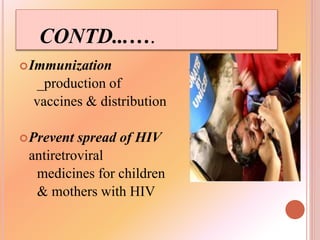
Immunization
_production of
vaccines & distribution
Prevent spread of HIV
antiretroviral
medicines for children
& mothers with HIV
CONTD….
Water
Sanitation
Hygiene
For clean accessible
water
Basic education &
 gender equality
_quality based
education for
boys & girls
_educational supplies
CONTD…..
CONTD……
Child protection from
_violence
_exploitation
_abuse
Countries with limited economic growth can still reduce child
mortality
Annual rate of reduction in under-five mortality, 2000–2015, and annual rate of change in
GDP, 2000–2014, by country
Annual reduction
in under-five
mortality rate
Source: World Bank, World Development Indicators (update of 22 December 2015),
and United Nations Inter-agency Group for Child Mortality Estimation, Levels
& Trends in Child Mortality: Report 2015.
GOBI CAMPAIGN
To encourage strategies for
child health revolution
Growth charts to monitor child
development
Oral rehydration
Breast feeding
Immunization
UNICEF IN HEALTH
In collaboration with WHO, FAO, UNDP,
& UNESCO
More attention on health aspects of mother
& child
Eradicate TB, malaria , venereal disease –
with WHO
Recently, idea of “Whole child” .
Country health programme
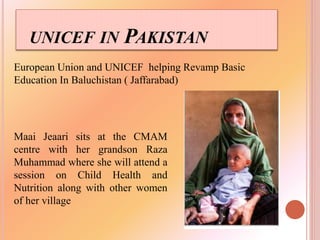
UNICEF IN PAKISTAN
European Union and UNICEF helping Revamp Basic
Education In Baluchistan ( Jaffarabad)
Maai Jeaari sits at the CMAM
centre with her grandson Raza
Muhammad where she will attend a
session on Child Health and
Nutrition along with other women
of her village
CONTRIBUTIONS
BCG vaccination programme
Penicillin plant- Pune
Triple vaccine plants
THANK YOU !!!

Unicef

  • 2.
    UNITED NATION INTERNATIONAL CHILDRENEMERGENCY FUND (UNICEF) Presented by: Hassan Ali Registration #: SP16-BAF-003
  • 3.
    FIRST WORLD WAR(1914-1918): After the end of 1st world war it was realized that how horrible and destructive was this war for the mankind and its roaming generations. SECOND WORLD WAR (1939-1945): The second world war took place which proceed more destructive and dangers for the life of common man on the world level.
  • 4.
    The united nationsorganization (UNO) is an international organization whose stated aims are facilitating cooperation in international law, international society, Economic development, special progress, human rights and the achieving of world peace. At the united nations (UN) conference in San Fransico in April 1945, representatives from 51 countries came together and drew up the UN charter. The charter was signed by 50 nations on 26 June 1945.
  • 5.
    Its mission isto maintain world peace, develop world’s problems and encourage respect for human rights. Mission
  • 7.
  • 8.
    ABOUT…… United Nations InternationalChildren’s Emergency Fund Formed by U.N.General Assembly on December 11, 1946 Becomes a permanent part of U.N in 1953 Renamed as U.N Children’s fund Headquarters in Newyork
  • 9.
    All children havea right to survive, thrive and fulfill their potential – to the benefit of a better world. BELIEVES
  • 10.
    GOALS Provide long termhumanitarian and development assistances to children & mothers in developing countries Emphasize developing community level services to promote health & well being of children
  • 11.
    ORGANIZATION  In 191countries through country programs & national committees  Guided by 36 member executive board  Head – executive director  Income- contribution by diff Govts & private donors  Established on 11 December 1946, by United Nations General Assembly.
  • 12.
    Resources for UNICEF TheUnited States provides the greatest annual contribution ($248 million in 2000), while combined funds from the United, Kingdom, Japan, Sweden Norway, the Netherlands, Denmark, Australia, Canada, and Italy ($335 million). One-third of UNICEF's resources are received through Private Sector Division partnerships with social organizations, celebrities, and businesses.
  • 13.
    Focus on Foodto Europe 1946 After World War II, In the winter of 1946–1947, millions of people in Europe were still without proper shelter, fuel, clothing or food. Children especially were suffering: In some affected areas, half of all babies were dying before their first birthday. UNICEF is created in December 1946 by the United Nations to provide food, clothing and health care to them.
  • 14.
    2017 Executive Board Africa Angola Botswana BurkinaFaso Cameroon Eritrea Ethiopia Libya Sierra Leone Eastern Europe Belarus Bosnia and Herzegovina Czechia Russian Federation Asia Bangladesh China India Iran (Islamic Republic of) Nepal Republic of Korea Saudi Arabia Latin America and Caribbean Antigua and Barbuda Colombia Cuba El Salvador Guatemala Western Europe and Others Canada Denmark France Germany Ireland Japan Luxembourg Norway Spain Sweden United Kingdom of Great Britain and Northern Ireland United States of America Members The Executive Board is made up of 36 Member States, elected to three-year terms by the Economic and Social Council, with the following regional allocation: Africa (8 seats), Asia (7), Eastern Europe (4), Latin America and Caribbean (5) and Western Europe and Others (12).
  • 15.
    FOCUS AREAS Child nutrition low cost protein rich food  With FAO, aided Applied Nutrition Programmes  Enriched food in endemic areas of nutritional deficiency.
  • 16.
    CONTD...…. Immunization _production of vaccines &distribution Prevent spread of HIV antiretroviral medicines for children & mothers with HIV
  • 17.
  • 18.
    Basic education & gender equality _quality based education for boys & girls _educational supplies CONTD…..
  • 19.
  • 20.
    Countries with limitedeconomic growth can still reduce child mortality Annual rate of reduction in under-five mortality, 2000–2015, and annual rate of change in GDP, 2000–2014, by country Annual reduction in under-five mortality rate Source: World Bank, World Development Indicators (update of 22 December 2015), and United Nations Inter-agency Group for Child Mortality Estimation, Levels & Trends in Child Mortality: Report 2015.
  • 23.
    GOBI CAMPAIGN To encouragestrategies for child health revolution Growth charts to monitor child development Oral rehydration Breast feeding Immunization
  • 24.
    UNICEF IN HEALTH Incollaboration with WHO, FAO, UNDP, & UNESCO More attention on health aspects of mother & child Eradicate TB, malaria , venereal disease – with WHO Recently, idea of “Whole child” . Country health programme
  • 25.
    UNICEF IN PAKISTAN EuropeanUnion and UNICEF helping Revamp Basic Education In Baluchistan ( Jaffarabad) Maai Jeaari sits at the CMAM centre with her grandson Raza Muhammad where she will attend a session on Child Health and Nutrition along with other women of her village
  • 26.
  • 27.

Editor's Notes

  • #17 Human immunodeficiency virus(HIV) AIDS, and HIV, are acronyms. AIDS stands for acquired immune deficiency syndrome. People who have AIDS have an increased susceptibility to life-threatening infections, cancers, and neurological disorders. HIV, or human immunodeficiency virus, causes AIDS. Dec 1, 2010 Antiretroviral drugs are medications for the treatment of infection by retroviruses, primarily HIV. Different classes of antiretroviral drugs act at different stages of the HIV life cycle. Combination of several (typically three or four) antiretroviral drugs is known as Highly Active Anti-Retroviral Therapy (HAART).