Jared Miller, Macy Nolan, Krysta
Beach, and Jenna Wilner
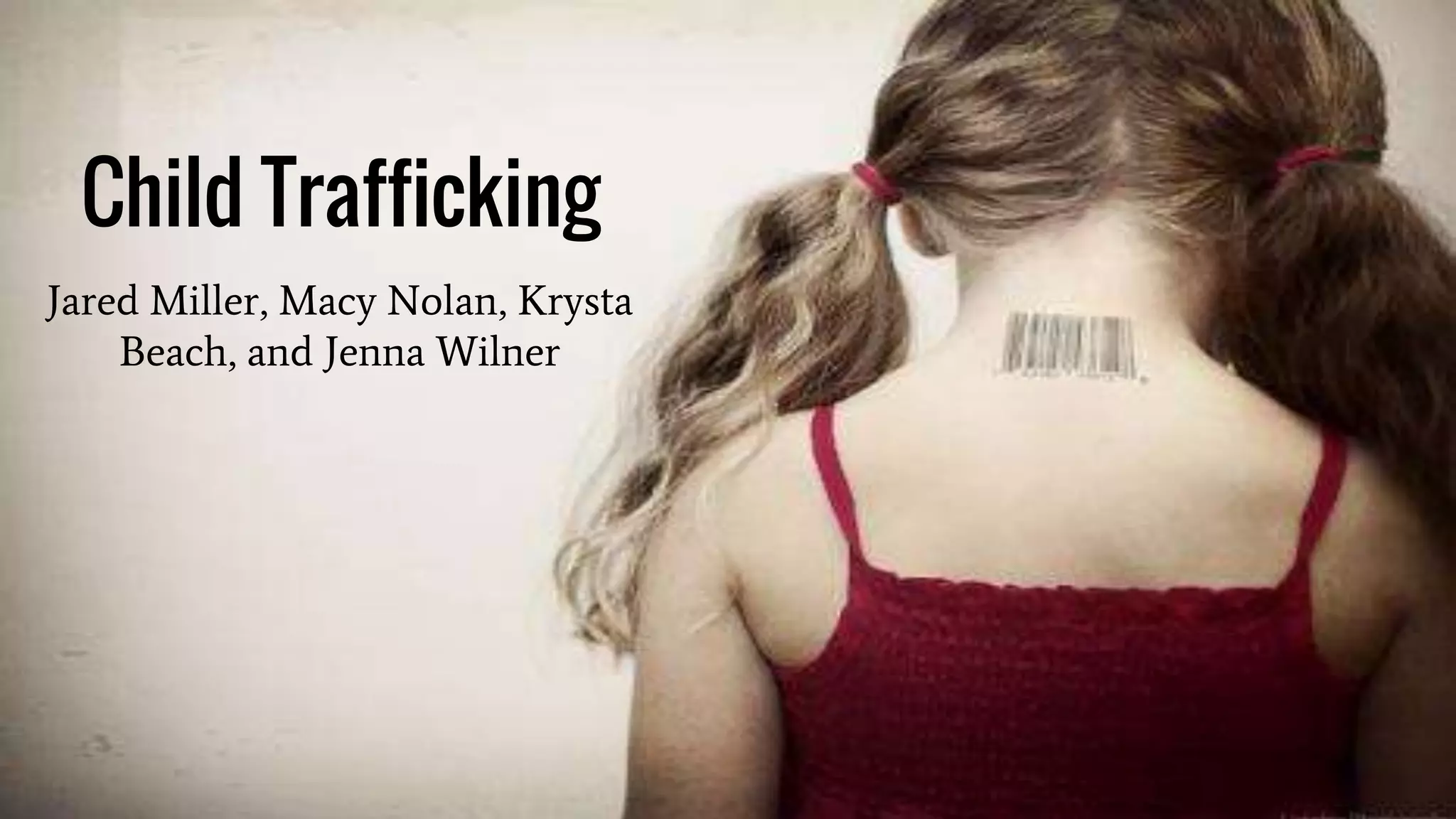
Child Trafficking
Inquiry Question
How can we help end child
trafficking?
T/F Question #1
T/F: 600,000 to 800,000 women, men, and children are
bought and sold across international borders every year for
forced labor or commercial sex.
ANSWER: TRUE
T/F Question #2
T/F: 30% of those victims are estimated to be children.
ANSWER: FALSE- 50% of those victims are estimated to be
children.
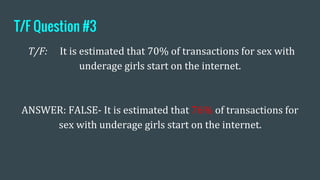
T/F Question #3
T/F: It is estimated that 70% of transactions for sex with
underage girls start on the internet.
ANSWER: FALSE- It is estimated that 76% of transactions for
sex with underage girls start on the internet.
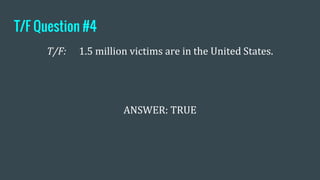
T/F Question #4
T/F: 1.5 million victims are in the United States.
ANSWER: TRUE
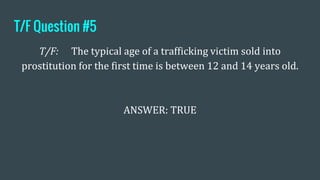
T/F Question #5
T/F: The typical age of a trafficking victim sold into
prostitution for the first time is between 12 and 14 years old.
ANSWER: TRUE
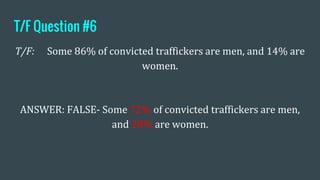
T/F Question #6
T/F: Some 86% of convicted traffickers are men, and 14% are
women.
ANSWER: FALSE- Some 72% of convicted traffickers are men,
and 28% are women.
T/F Question #7
T/F: 325,000 children are at risk for becoming victims of
sexual exploitation in the United States.
ANSWER: TRUE
T/F Question #8
T/F: 1 in 6 endangered runaways reported to the National
Center for Missing Exploited Children in 2013 were likely sex
trafficking victims.
ANSWER: TRUE
Video
Shyima Hall, a 24-year old girl from Egypt, was sold into slavery at 8 years-old and
eventually trafficked into the U.S.
http://live.huffingtonpost.com/r/segment/human-trafficking-survivor-speaks-
out/52d577bd02a76077a300088b
(end video at 7:40)
After Effects of Child Trafficking
Drug & Alcohol Dependencies
Depression & Anxiety
HIV & Other STDS
PTSD
Hypersexulaization
Shame & Humiliation
Complex Issues of Self Worth
Suicide Attempts & Self Injury
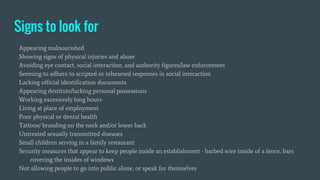
Signs to look for
Appearing malnourished
Showing signs of physical injuries and abuse
Avoiding eye contact, social interaction, and authority figures/law enforcement
Seeming to adhere to scripted or rehearsed responses in social interaction
Lacking official identification documents
Appearing destitute/lacking personal possessions
Working excessively long hours
Living at place of employment
Poor physical or dental health
Tattoos/ branding on the neck and/or lower back
Untreated sexually transmitted diseases
Small children serving in a family restaurant
Security measures that appear to keep people inside an establishment - barbed wire inside of a fence, bars
covering the insides of windows
Not allowing people to go into public alone, or speak for themselves
Situation 1 (Teacher)
A young girl consistently comes to class and she obviously has not showered or
brushed her teeth. She is fairly standoffish and she refuses to make eye contact with
other adults in the school. When it comes time to tell stories from her life, she panics
and either refuses to do it, or she acts out to be taken out of the class.
You can’t just jump to conclusions and act too abruptly so what do you do as a
teacher?
Situations 2 (Teacher)
A boy in your class is very jumpy and flinches whenever anyone even raises their hand
near him. He never talks about his home life and stays mostly to himself. One day his
guardian comes to school and walks into your class to take him home without
checking in or giving any notice. The boy seems concerned with the behavior of the
guardian.
What can you do as a teacher?
Situation 3 (Student)
A new kid comes to your class and is very shy. You become his only friend and he will
talk to you but he gets nervous when too many people try to hang out around him.
One day he tells you that he is scared to go home and he shows you a bruise on his
shoulder.
Do you wait it out and hope everything gets better for him or what do you do?
Situation 4 (Student)
A girl you hang out with at recess is always dirty and she is starting to smell and it is
noticeable. She seems to notice that she smells so she stays away from other students.
You ask her if she wants to take a bath but she tells you that her family won’t let her
do that, only the adults can take showers.
Can you tell the teacher that she needs help with that or is that her family's problem to
deal with?
Solutions
Help provide a living wage for parents to children do not have to work to support the family and can attend school instead
(children sometimes unknowingly go into these situations for money)
Lobbying governments to strengthen laws to prevent and respond to abuse
Work with organizations to change harmful societal norms that make children more vulnerable to exploitation
Supporting the training of professionals working with children
Educate children on stranger/danger and to be safe and smart
As a teacher:
All of the above
Show the child you care, be a friend
Watch for signs and report when necessary
Why is This Important?
“As parents, guardians, or educators of children, discussing an issue as vast, unsettling,
and frightening as human trafficking may be intimidating. However, it is important for
you to understand the vulnerabilities that youth have to trafficking, since it’s an issue
that affects communities across our nation and world. You are part of the solution for
preventing this abuse and exploitation.”
Child trafficking is a lot closer than we think!
http://www.krem.com/news/local/spokane-county/spokane-police-make-significant-
human-trafficking-arrests/66736159
Key Messages For Your Kids
Educate yourself on the issue, and learn the signs of a trafficked victim.
Don’t accept friend requests from people you don’t know on social media. Traffickers commonly use sites like
Twitter, Facebook, and Instagram to lure their victims.
Be aware of how traffickers recruit people, and pay attention to your surroundings.
Don’t reveal too much about yourself (i.e. your full name, address, school, or living situation) to people you don’t
know, whether on your social media sites or in person, no matter how friendly the person may be
Never agree to meet someone you don’t know without first consulting a trusted adult (i.e. parent, teacher, guidance
counselor).
If you feel uncomfortable or are hesitant about a situation, confide in an adult who you can help you make the best
choices.
Making a decision to leave a situation or relationship where you feel unsafe or are being harmed or threatened can be
hard and scary. If possible, talk to someone you trust, like a friend, family member, counselor, or youth worker.
Conclusion: How We Can Help End Child Trafficking
The fight to end child trafficking is an ongoing struggle. This issue is world wide,
however it can also be happening right in front of you without knowing. As future
teachers we need to educate our children on ways to prevent child trafficking and
avoid harmful situations. As child advocates we can join organizations to fight against
child trafficking, as well as give families and children support and resources to help
them at home. We can lobby to the government to better the laws and be a mandatory
reporter if needed. Being a teacher means advocating for children, in all ways possible.
Join the fight to end child trafficking!
Resources
http://arkofhopeforchildren.org/child-trafficking/child-trafficking-statistics
http://www.chestnuthilllocal.com/2014/08/26/sex-trafficking-victims-pa-treated-criminals/
https://love146.org/slavery/
https://www.unicefusa.org/stories/how-talk-your-kids-about-trafficking/29733
https://www.unodc.org/documents/data-and-analysis/glotip/GLOTIP_2014_full_report.pdf
http://live.huffingtonpost.com/r/segment/human-trafficking-survivor-speaks-out/52d577bd02a76077a300088b
https://www.wearethorn.org/child-trafficking-statistics/
http://www.unicef.org/ceecis/UNICEF_Child_Trafficking34-43.pdf

Child sex trafficking

  • 1.
    Jared Miller, MacyNolan, Krysta Beach, and Jenna Wilner Child Trafficking
  • 2.
    Inquiry Question How canwe help end child trafficking?
  • 3.
    T/F Question #1 T/F:600,000 to 800,000 women, men, and children are bought and sold across international borders every year for forced labor or commercial sex. ANSWER: TRUE
  • 4.
    T/F Question #2 T/F:30% of those victims are estimated to be children. ANSWER: FALSE- 50% of those victims are estimated to be children.
  • 5.
    T/F Question #3 T/F:It is estimated that 70% of transactions for sex with underage girls start on the internet. ANSWER: FALSE- It is estimated that 76% of transactions for sex with underage girls start on the internet.
  • 6.
    T/F Question #4 T/F:1.5 million victims are in the United States. ANSWER: TRUE
  • 7.
    T/F Question #5 T/F:The typical age of a trafficking victim sold into prostitution for the first time is between 12 and 14 years old. ANSWER: TRUE
  • 8.
    T/F Question #6 T/F:Some 86% of convicted traffickers are men, and 14% are women. ANSWER: FALSE- Some 72% of convicted traffickers are men, and 28% are women.
  • 9.
    T/F Question #7 T/F:325,000 children are at risk for becoming victims of sexual exploitation in the United States. ANSWER: TRUE
  • 10.
    T/F Question #8 T/F:1 in 6 endangered runaways reported to the National Center for Missing Exploited Children in 2013 were likely sex trafficking victims. ANSWER: TRUE
  • 11.
    Video Shyima Hall, a24-year old girl from Egypt, was sold into slavery at 8 years-old and eventually trafficked into the U.S. http://live.huffingtonpost.com/r/segment/human-trafficking-survivor-speaks- out/52d577bd02a76077a300088b (end video at 7:40)
  • 12.
    After Effects ofChild Trafficking Drug & Alcohol Dependencies Depression & Anxiety HIV & Other STDS PTSD Hypersexulaization Shame & Humiliation Complex Issues of Self Worth Suicide Attempts & Self Injury
  • 13.
    Signs to lookfor Appearing malnourished Showing signs of physical injuries and abuse Avoiding eye contact, social interaction, and authority figures/law enforcement Seeming to adhere to scripted or rehearsed responses in social interaction Lacking official identification documents Appearing destitute/lacking personal possessions Working excessively long hours Living at place of employment Poor physical or dental health Tattoos/ branding on the neck and/or lower back Untreated sexually transmitted diseases Small children serving in a family restaurant Security measures that appear to keep people inside an establishment - barbed wire inside of a fence, bars covering the insides of windows Not allowing people to go into public alone, or speak for themselves
  • 14.
    Situation 1 (Teacher) Ayoung girl consistently comes to class and she obviously has not showered or brushed her teeth. She is fairly standoffish and she refuses to make eye contact with other adults in the school. When it comes time to tell stories from her life, she panics and either refuses to do it, or she acts out to be taken out of the class. You can’t just jump to conclusions and act too abruptly so what do you do as a teacher?
  • 15.
    Situations 2 (Teacher) Aboy in your class is very jumpy and flinches whenever anyone even raises their hand near him. He never talks about his home life and stays mostly to himself. One day his guardian comes to school and walks into your class to take him home without checking in or giving any notice. The boy seems concerned with the behavior of the guardian. What can you do as a teacher?
  • 16.
    Situation 3 (Student) Anew kid comes to your class and is very shy. You become his only friend and he will talk to you but he gets nervous when too many people try to hang out around him. One day he tells you that he is scared to go home and he shows you a bruise on his shoulder. Do you wait it out and hope everything gets better for him or what do you do?
  • 17.
    Situation 4 (Student) Agirl you hang out with at recess is always dirty and she is starting to smell and it is noticeable. She seems to notice that she smells so she stays away from other students. You ask her if she wants to take a bath but she tells you that her family won’t let her do that, only the adults can take showers. Can you tell the teacher that she needs help with that or is that her family's problem to deal with?
  • 18.
    Solutions Help provide aliving wage for parents to children do not have to work to support the family and can attend school instead (children sometimes unknowingly go into these situations for money) Lobbying governments to strengthen laws to prevent and respond to abuse Work with organizations to change harmful societal norms that make children more vulnerable to exploitation Supporting the training of professionals working with children Educate children on stranger/danger and to be safe and smart As a teacher: All of the above Show the child you care, be a friend Watch for signs and report when necessary
  • 19.
    Why is ThisImportant? “As parents, guardians, or educators of children, discussing an issue as vast, unsettling, and frightening as human trafficking may be intimidating. However, it is important for you to understand the vulnerabilities that youth have to trafficking, since it’s an issue that affects communities across our nation and world. You are part of the solution for preventing this abuse and exploitation.” Child trafficking is a lot closer than we think! http://www.krem.com/news/local/spokane-county/spokane-police-make-significant- human-trafficking-arrests/66736159
  • 20.
    Key Messages ForYour Kids Educate yourself on the issue, and learn the signs of a trafficked victim. Don’t accept friend requests from people you don’t know on social media. Traffickers commonly use sites like Twitter, Facebook, and Instagram to lure their victims. Be aware of how traffickers recruit people, and pay attention to your surroundings. Don’t reveal too much about yourself (i.e. your full name, address, school, or living situation) to people you don’t know, whether on your social media sites or in person, no matter how friendly the person may be Never agree to meet someone you don’t know without first consulting a trusted adult (i.e. parent, teacher, guidance counselor). If you feel uncomfortable or are hesitant about a situation, confide in an adult who you can help you make the best choices. Making a decision to leave a situation or relationship where you feel unsafe or are being harmed or threatened can be hard and scary. If possible, talk to someone you trust, like a friend, family member, counselor, or youth worker.
  • 21.
    Conclusion: How WeCan Help End Child Trafficking The fight to end child trafficking is an ongoing struggle. This issue is world wide, however it can also be happening right in front of you without knowing. As future teachers we need to educate our children on ways to prevent child trafficking and avoid harmful situations. As child advocates we can join organizations to fight against child trafficking, as well as give families and children support and resources to help them at home. We can lobby to the government to better the laws and be a mandatory reporter if needed. Being a teacher means advocating for children, in all ways possible. Join the fight to end child trafficking!
  • 22.