UNITE FOR CHILDREN UNICEF IN INDIA
Who wants to be a millionaire?  When did UNICEF start working in India? 1956 1967 1947 1950
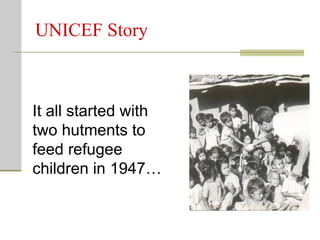
UNICEF Story It all started with two hutments to feed refugee children in  1947 …
 
Some milestones 1949: India’s first penicillin plant set up at Pimpri, near Pune. UNICEF provides equipment & technical assistance 1951: Five anti-tuberculosis centres established in Mumbai, Tamil Nadu & West Bengal 1963: Water supply schemes in India get a boost with assistance in the form of hardware material, equipment and transport from UNICEF 1971: UNICEF assists the Government of India in bringing emergency assistance to millions of refugees form East Pakistan (now Bangladesh) 1977 Community Health Volunteers Scheme is launched. New health workers serve as health guides to rural families
Some milestones contd… 1978: UNICEF supports Government of India’s efforts to produce a revolutionary new solution ‘Oral Rehydration Therapy’ to reduce infant mortality due to diarrhoeal diseases 1986: The Convention on the Rights of the Child is adopted at a historic summit of the South Asian Association for Regional Cooperation (SAARC) 1986: Government of India launches six national missions. UNICEF collaborates on the National Mission on Immunization, The National Mission for Drinking Water and the National Literacy Mission
Some milestones contd… 1999: A ‘super cyclone’ hits Orissa. UNICEF supports the State Government in coordinating relief operations for about 1.7 million children 2002: An experimental programme- IMNCI (Integrated Management of Neonatal and Childhood Illnesses) is launched by the Government of India 2005: UNICEF supports the first national consultation on children & young people affected by or vulnerable to HIV/AIDS
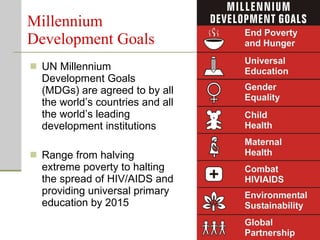
UN Millennium Development Goals (MDGs) are agreed to by all the world’s countries and all the world’s leading development institutions Range from halving extreme poverty to halting the spread of HIV/AIDS and providing universal primary education by 2015 Millennium Development Goals
What do YOU raise money for? UNICEF programmes- Child Health  Child Development and Nutrition  Child Environment  Elementary Education   Prevention of HIV/AIDS  Child Protection
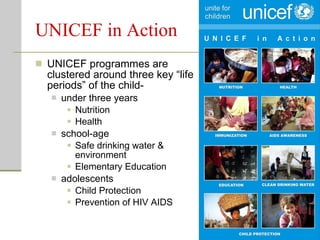
UNICEF in Action UNICEF programmes are clustered around three key “life periods” of the child- under three years Nutrition  Health school-age Safe drinking water & environment Elementary Education adolescents  Child Protection Prevention of HIV AIDS
UNICEF in Action Nutrition
Some facts.. Malnutrition is the underlying cause for the death of nearly 10 lakhs children in India every year One out every third malnourished child is an Indian
The journey of Naval Naval was a seriously sick and undernourished children from a village, in the tribal area of Guna district of Madhya Pradesh Today cuddled in his mother’s lap, two year old Naval looked quite comfortable  He was saved from dying of malnutrition in the  Nutrition Rehabilitation Centre (NRC)   The Centre, set up in October 2005 at Guna District Hospital had provided a second lease of life to more than 200 children in a short period of four months
UNICEF in Action on Nutrition Reduce and prevent malnutrition Improve the development of children under three years old, especially those in underprivileged groups Improve quality and efficiency of existing government programmes
UNICEF in Action Health
Some real statistics! 1 in 5 children dying before the age of five in the world is from India Infant mortality in India is 57 deaths per 1,000 live births 6,000 children die everyday due to preventable diseases like measles, diphtheria, diarrhea, polio and typhoid
Let me tell you the story of Madhu’s son There was no celebration at Madhu’s home when she delivered a child Her son weighed only 920 grams at birth! Madhu and her husband were worried that their son might not survive Did he?
The story continues… Madhu’s son survived!  Because the hospital in his village had the  Sick Newborn Care Unit  with modern life-saving equipment &  medically trained staff It took seven days & nights and finally the child showed progress
Time to win another chocolate! What do you think five years old Bholu said when he was asked this question- What would you like to be when you grow up?
Bholu’s Answer… “ALIVE!” Bholu had see his friends disappear one by one They all died before celebrating their fifth birthday due to preventable diseases like diptheria, measles, tetanus & whooping cough His only wish was to stay  ‘Alive”!
UNICEF in Action on Health Promote routine immunization to prevent children like Bholu’s friends from dying. Today, India is able to immunize 6 out of every 10 children born  Set up Sick Newborn care to save more lives like that of Madhu’s child Improve healthcare services Anganwadis-day care centers
UNICEF in Action  Education
Do you know… India is able to enroll more than 90% children in primary school.  But lakhs drop out!
This is the story of Ankita & Neetu Despite being intelligent children, they stopped going to school The reason was neither poverty nor gender bias It was very simple- They ‘hated’ going to school Ankita enjoyed Maths but could not cope with English Neetu was brilliant in History but poor in Maths Thankfully, they did not join lakhs of children who drop out of school every year They were helped by the innovative education model initiated by the state government & UNICEF – Quality Education Package
Quality Education Package Focus on four key areas: Teacher training  Using student assessment to provide learning Development and supply of essential teaching materials Involve community and parents Improvement of school environment and facilities
UNICEF in Action on Education Ensure all children go to schools and complete a full course of primary schooling (Sarva Shiksha Abhiyan)  Improve quality of education in government schools (Quality Education Package) Promote girl’s education Improve monitoring systems to ensure action at national, state, district and village level
UNICEF in Action  Child Protection
Some facts… 1.2 crore children in India do not go to school and work in hazardous conditions
Bridge Schools Asama Banu was born in Mirzapur, Uttar Pradesh Mirzapur is famous for its carpet industry and infamous for usage of child labour 10 year-old Asama worked for 12 hours in inhuman working conditions for Rs 10 per day! She was saved due to Government initiated and UNICEF supported National Child Labour Project bridge school In Bridge Schools, children who have never studied before are prepared Once children like Asama are ready, they are admitted to normal schools
UNICEF in Action on Child Protection To build a protective environment in which children can live and develop in the full respect of their fundamental rights Ensure working children go to school and stay there Promote Bridge Schools in areas with high child labour Prevent Child Sexual Abuse and trafficking
UNICEF in Action HIV/AIDS
Some facts… India is only third to South Africa in number of people living with HIV/AIDS Every year about 21,000 children are infected through mother to child transmission of HIV virus
PPTCT- Prevention of Parent To Child Transmission of HIV virus 25 years old Jyotika’s happiness knew no bounds when she discovered that she was pregnant She went for her first medical test and was shocked when doctor said that she was HIV positive She did not know much about HIV and AIDS but knew this much that it was serious One question worried her – will her child have the infection ? Jyotika was fortunate because she met Radha, who was rained by UNICEF to spread awareness about HIV/AIDS Jyotika was take to the treatment center and given a medicine called Nevirapine and proper medical Her child was born free of HIV infection
UNICEF in Action on HIV/AIDS Primary prevention in young people and women of childbearing age Prevention of transmission of HIV infection from mother to child Spread awareness about HIV/AIDS Protection, care and support for affected children
THANK YOU

Orientation

  • 1.
    UNITE FOR CHILDRENUNICEF IN INDIA
  • 2.
    Who wants tobe a millionaire? When did UNICEF start working in India? 1956 1967 1947 1950
  • 3.
    UNICEF Story Itall started with two hutments to feed refugee children in 1947 …
  • 4.
  • 5.
    Some milestones 1949:India’s first penicillin plant set up at Pimpri, near Pune. UNICEF provides equipment & technical assistance 1951: Five anti-tuberculosis centres established in Mumbai, Tamil Nadu & West Bengal 1963: Water supply schemes in India get a boost with assistance in the form of hardware material, equipment and transport from UNICEF 1971: UNICEF assists the Government of India in bringing emergency assistance to millions of refugees form East Pakistan (now Bangladesh) 1977 Community Health Volunteers Scheme is launched. New health workers serve as health guides to rural families
  • 6.
    Some milestones contd…1978: UNICEF supports Government of India’s efforts to produce a revolutionary new solution ‘Oral Rehydration Therapy’ to reduce infant mortality due to diarrhoeal diseases 1986: The Convention on the Rights of the Child is adopted at a historic summit of the South Asian Association for Regional Cooperation (SAARC) 1986: Government of India launches six national missions. UNICEF collaborates on the National Mission on Immunization, The National Mission for Drinking Water and the National Literacy Mission
  • 7.
    Some milestones contd…1999: A ‘super cyclone’ hits Orissa. UNICEF supports the State Government in coordinating relief operations for about 1.7 million children 2002: An experimental programme- IMNCI (Integrated Management of Neonatal and Childhood Illnesses) is launched by the Government of India 2005: UNICEF supports the first national consultation on children & young people affected by or vulnerable to HIV/AIDS
  • 8.
    UN Millennium DevelopmentGoals (MDGs) are agreed to by all the world’s countries and all the world’s leading development institutions Range from halving extreme poverty to halting the spread of HIV/AIDS and providing universal primary education by 2015 Millennium Development Goals
  • 9.
    What do YOUraise money for? UNICEF programmes- Child Health Child Development and Nutrition Child Environment Elementary Education  Prevention of HIV/AIDS Child Protection
  • 10.
    UNICEF in ActionUNICEF programmes are clustered around three key “life periods” of the child- under three years Nutrition Health school-age Safe drinking water & environment Elementary Education adolescents Child Protection Prevention of HIV AIDS
  • 11.
  • 12.
    Some facts.. Malnutritionis the underlying cause for the death of nearly 10 lakhs children in India every year One out every third malnourished child is an Indian
  • 13.
    The journey ofNaval Naval was a seriously sick and undernourished children from a village, in the tribal area of Guna district of Madhya Pradesh Today cuddled in his mother’s lap, two year old Naval looked quite comfortable He was saved from dying of malnutrition in the Nutrition Rehabilitation Centre (NRC) The Centre, set up in October 2005 at Guna District Hospital had provided a second lease of life to more than 200 children in a short period of four months
  • 14.
    UNICEF in Actionon Nutrition Reduce and prevent malnutrition Improve the development of children under three years old, especially those in underprivileged groups Improve quality and efficiency of existing government programmes
  • 15.
  • 16.
    Some real statistics!1 in 5 children dying before the age of five in the world is from India Infant mortality in India is 57 deaths per 1,000 live births 6,000 children die everyday due to preventable diseases like measles, diphtheria, diarrhea, polio and typhoid
  • 17.
    Let me tellyou the story of Madhu’s son There was no celebration at Madhu’s home when she delivered a child Her son weighed only 920 grams at birth! Madhu and her husband were worried that their son might not survive Did he?
  • 18.
    The story continues…Madhu’s son survived! Because the hospital in his village had the Sick Newborn Care Unit with modern life-saving equipment & medically trained staff It took seven days & nights and finally the child showed progress
  • 19.
    Time to winanother chocolate! What do you think five years old Bholu said when he was asked this question- What would you like to be when you grow up?
  • 20.
    Bholu’s Answer… “ALIVE!”Bholu had see his friends disappear one by one They all died before celebrating their fifth birthday due to preventable diseases like diptheria, measles, tetanus & whooping cough His only wish was to stay ‘Alive”!
  • 21.
    UNICEF in Actionon Health Promote routine immunization to prevent children like Bholu’s friends from dying. Today, India is able to immunize 6 out of every 10 children born Set up Sick Newborn care to save more lives like that of Madhu’s child Improve healthcare services Anganwadis-day care centers
  • 22.
    UNICEF in Action Education
  • 23.
    Do you know…India is able to enroll more than 90% children in primary school. But lakhs drop out!
  • 24.
    This is thestory of Ankita & Neetu Despite being intelligent children, they stopped going to school The reason was neither poverty nor gender bias It was very simple- They ‘hated’ going to school Ankita enjoyed Maths but could not cope with English Neetu was brilliant in History but poor in Maths Thankfully, they did not join lakhs of children who drop out of school every year They were helped by the innovative education model initiated by the state government & UNICEF – Quality Education Package
  • 25.
    Quality Education PackageFocus on four key areas: Teacher training Using student assessment to provide learning Development and supply of essential teaching materials Involve community and parents Improvement of school environment and facilities
  • 26.
    UNICEF in Actionon Education Ensure all children go to schools and complete a full course of primary schooling (Sarva Shiksha Abhiyan) Improve quality of education in government schools (Quality Education Package) Promote girl’s education Improve monitoring systems to ensure action at national, state, district and village level
  • 27.
    UNICEF in Action Child Protection
  • 28.
    Some facts… 1.2crore children in India do not go to school and work in hazardous conditions
  • 29.
    Bridge Schools AsamaBanu was born in Mirzapur, Uttar Pradesh Mirzapur is famous for its carpet industry and infamous for usage of child labour 10 year-old Asama worked for 12 hours in inhuman working conditions for Rs 10 per day! She was saved due to Government initiated and UNICEF supported National Child Labour Project bridge school In Bridge Schools, children who have never studied before are prepared Once children like Asama are ready, they are admitted to normal schools
  • 30.
    UNICEF in Actionon Child Protection To build a protective environment in which children can live and develop in the full respect of their fundamental rights Ensure working children go to school and stay there Promote Bridge Schools in areas with high child labour Prevent Child Sexual Abuse and trafficking
  • 31.
  • 32.
    Some facts… Indiais only third to South Africa in number of people living with HIV/AIDS Every year about 21,000 children are infected through mother to child transmission of HIV virus
  • 33.
    PPTCT- Prevention ofParent To Child Transmission of HIV virus 25 years old Jyotika’s happiness knew no bounds when she discovered that she was pregnant She went for her first medical test and was shocked when doctor said that she was HIV positive She did not know much about HIV and AIDS but knew this much that it was serious One question worried her – will her child have the infection ? Jyotika was fortunate because she met Radha, who was rained by UNICEF to spread awareness about HIV/AIDS Jyotika was take to the treatment center and given a medicine called Nevirapine and proper medical Her child was born free of HIV infection
  • 34.
    UNICEF in Actionon HIV/AIDS Primary prevention in young people and women of childbearing age Prevention of transmission of HIV infection from mother to child Spread awareness about HIV/AIDS Protection, care and support for affected children
  • 35.