Object Oriented Programming: 8
Basics of C++ Programming
Prof Neeraj Bhargava
Vaibhav Khanna
Department of Computer Science
School of Engineering and Systems Sciences
Maharshi Dayanand Saraswati University Ajmer
2
The Basics of a C++ Program
• Function: collection of statements; when
executed, accomplishes something
– May be predefined or standard
• Syntax: rules that specify which statements
(instructions) are legal
• Programming language: a set of rules,
symbols, and special words
• Semantic rule: meaning of the instruction
3
Comments
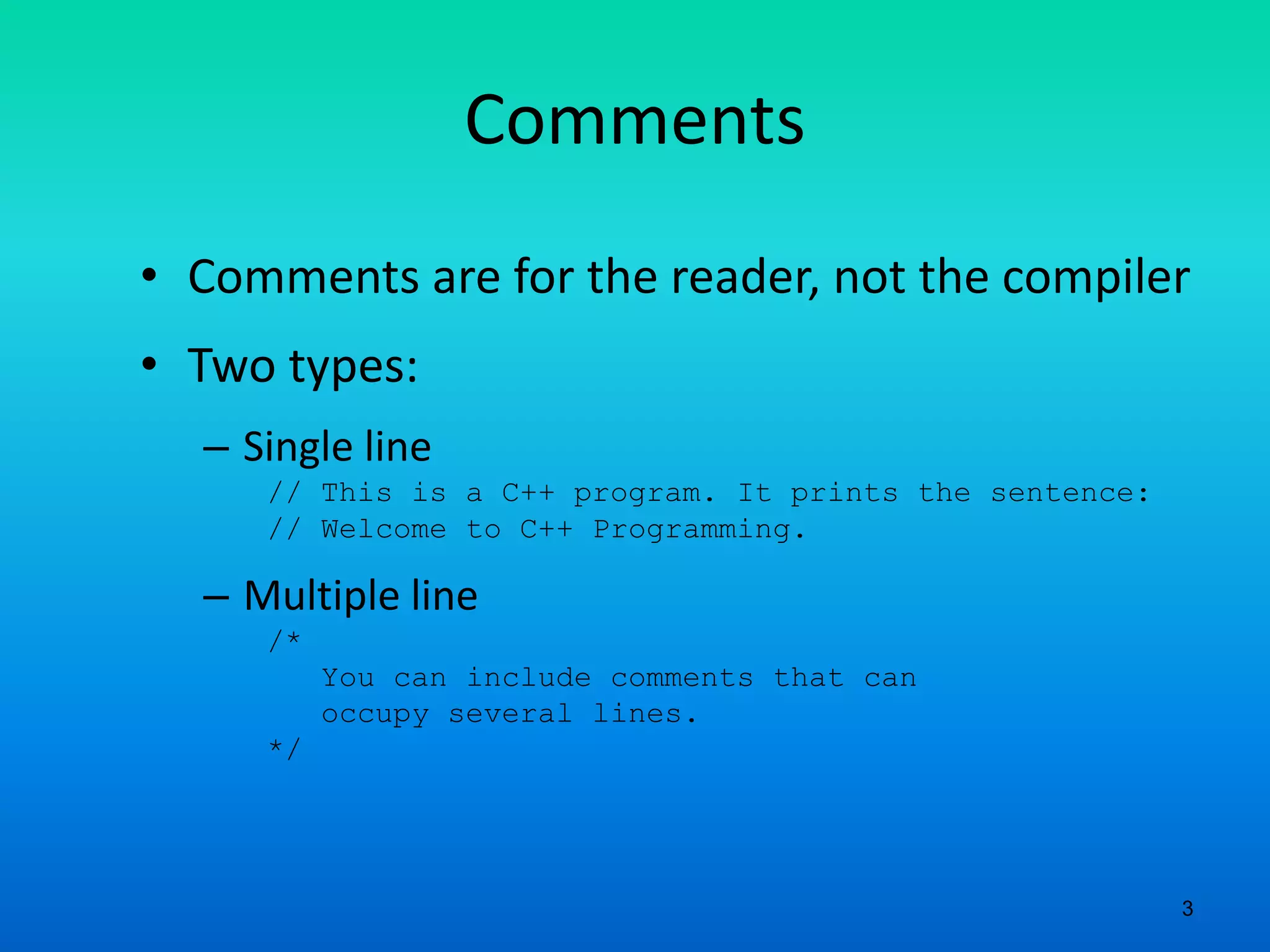
• Comments are for the reader, not the compiler
• Two types:
– Single line
// This is a C++ program. It prints the sentence:
// Welcome to C++ Programming.
– Multiple line
/*
You can include comments that can
occupy several lines.
*/
4
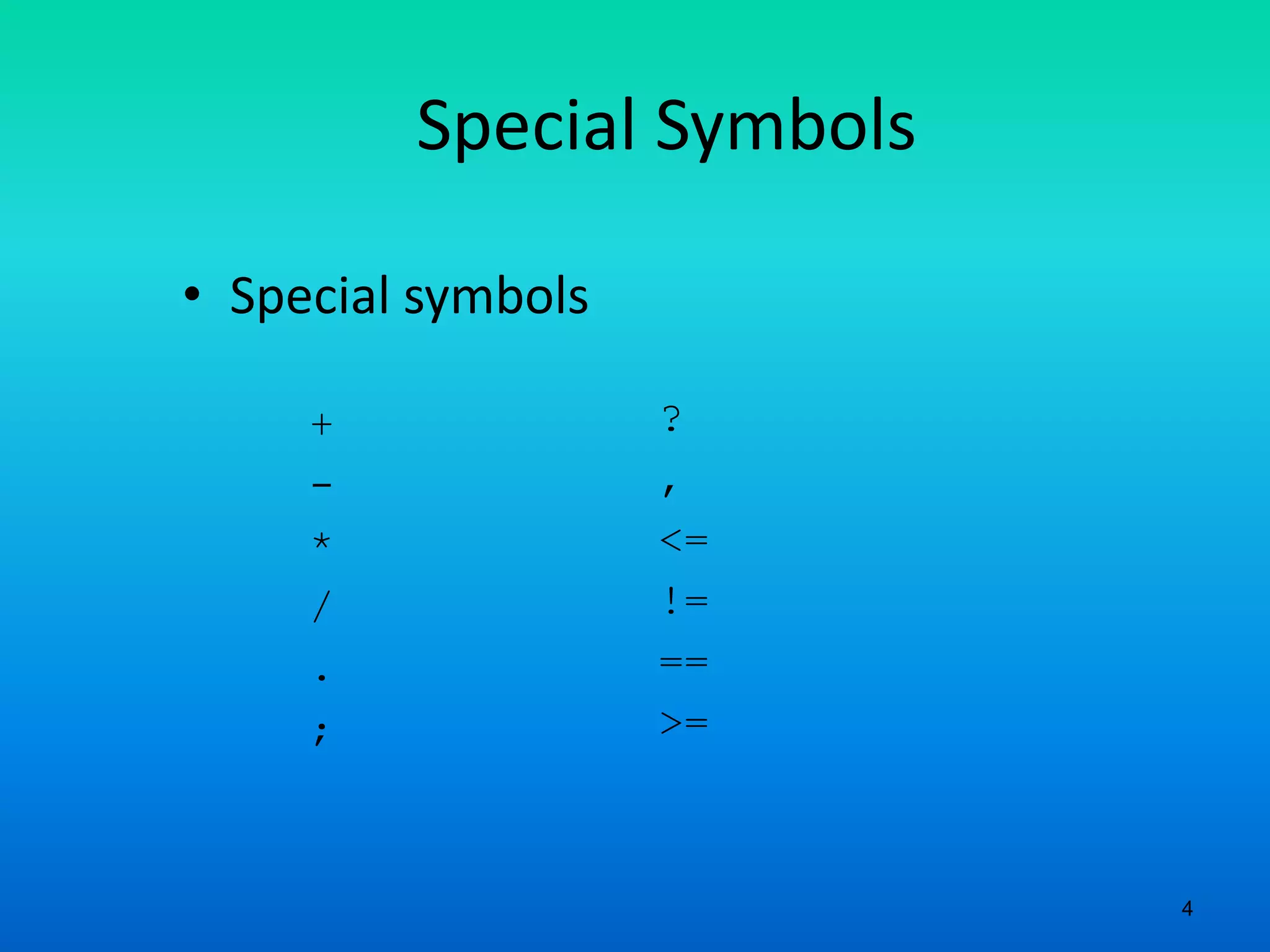
Special Symbols
• Special symbols
+
-
*
/
.
;
?
,
<=
!=
==
>=
5
Reserved Words (Keywords)
• Reserved words, keywords, or word symbols
– Include:
• int
• float
• double
• char
• const
• void
• return
6
Identifiers
• Consist of letters, digits, and the underscore
character (_)
• Must begin with a letter or underscore
• C++ is case sensitive
– NUMBER is not the same as number
• Two predefined identifiers are cout and cin
• Unlike reserved words, predefined identifiers
may be redefined, but it is not a good idea
7
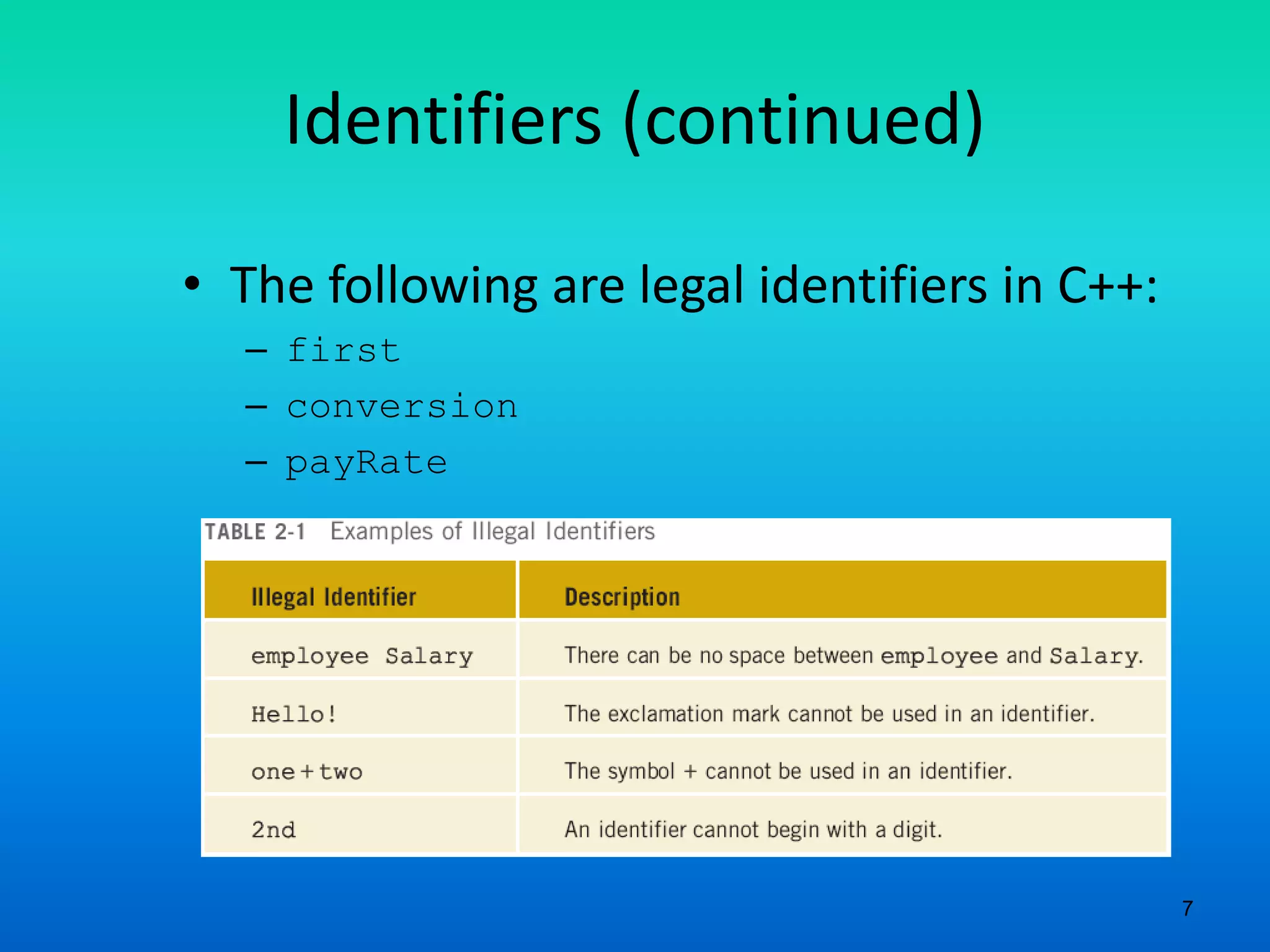
Identifiers (continued)
• The following are legal identifiers in C++:
– first
– conversion
– payRate
8
Whitespaces
• Every C++ program contains whitespaces
– Include blanks, tabs, and newline characters
• Used to separate special symbols, reserved
words, and identifiers
• Proper utilization of whitespaces is important
– Can be used to make the program readable
9
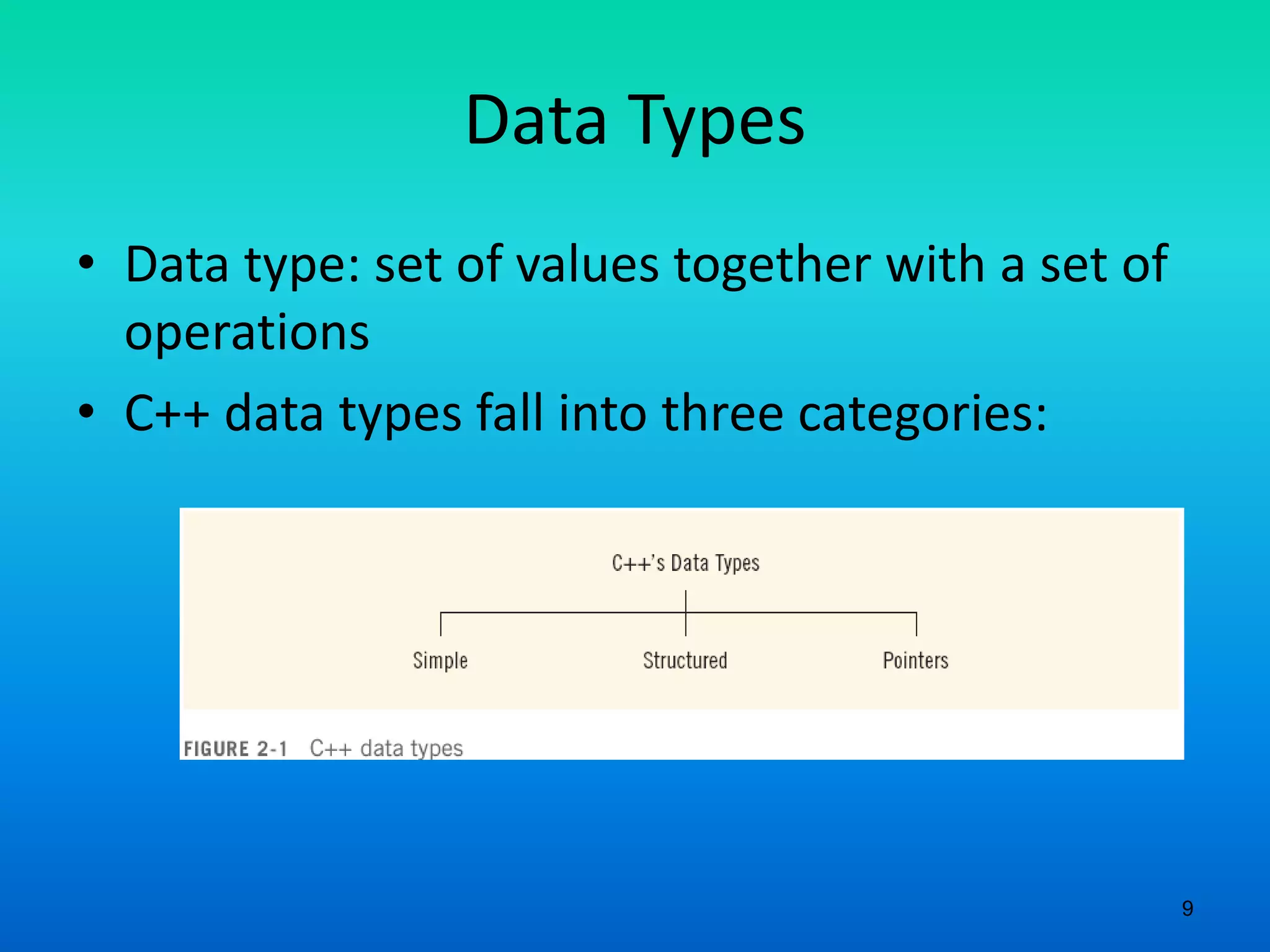
Data Types
• Data type: set of values together with a set of
operations
• C++ data types fall into three categories:
10
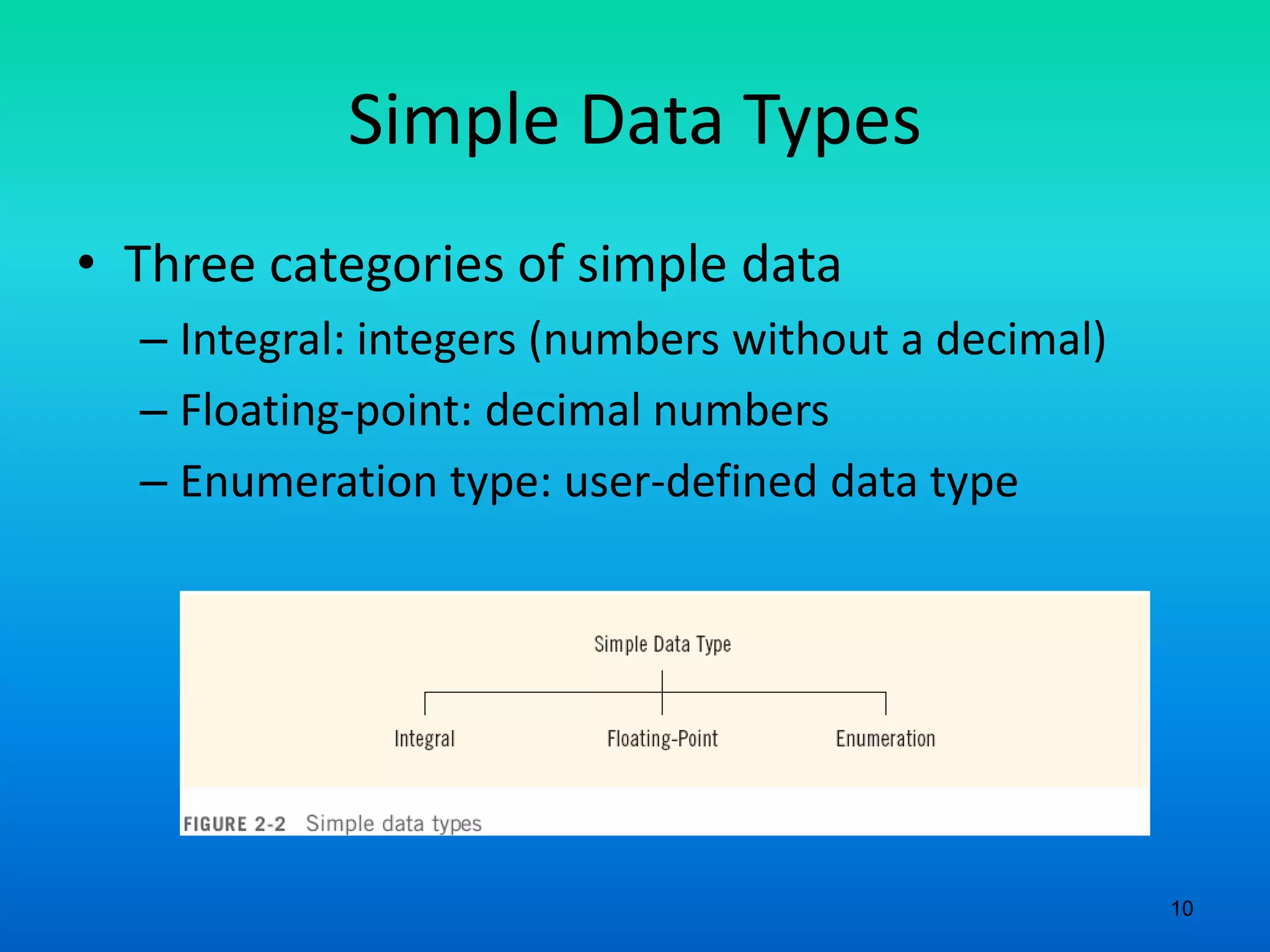
Simple Data Types
• Three categories of simple data
– Integral: integers (numbers without a decimal)
– Floating-point: decimal numbers
– Enumeration type: user-defined data type
11
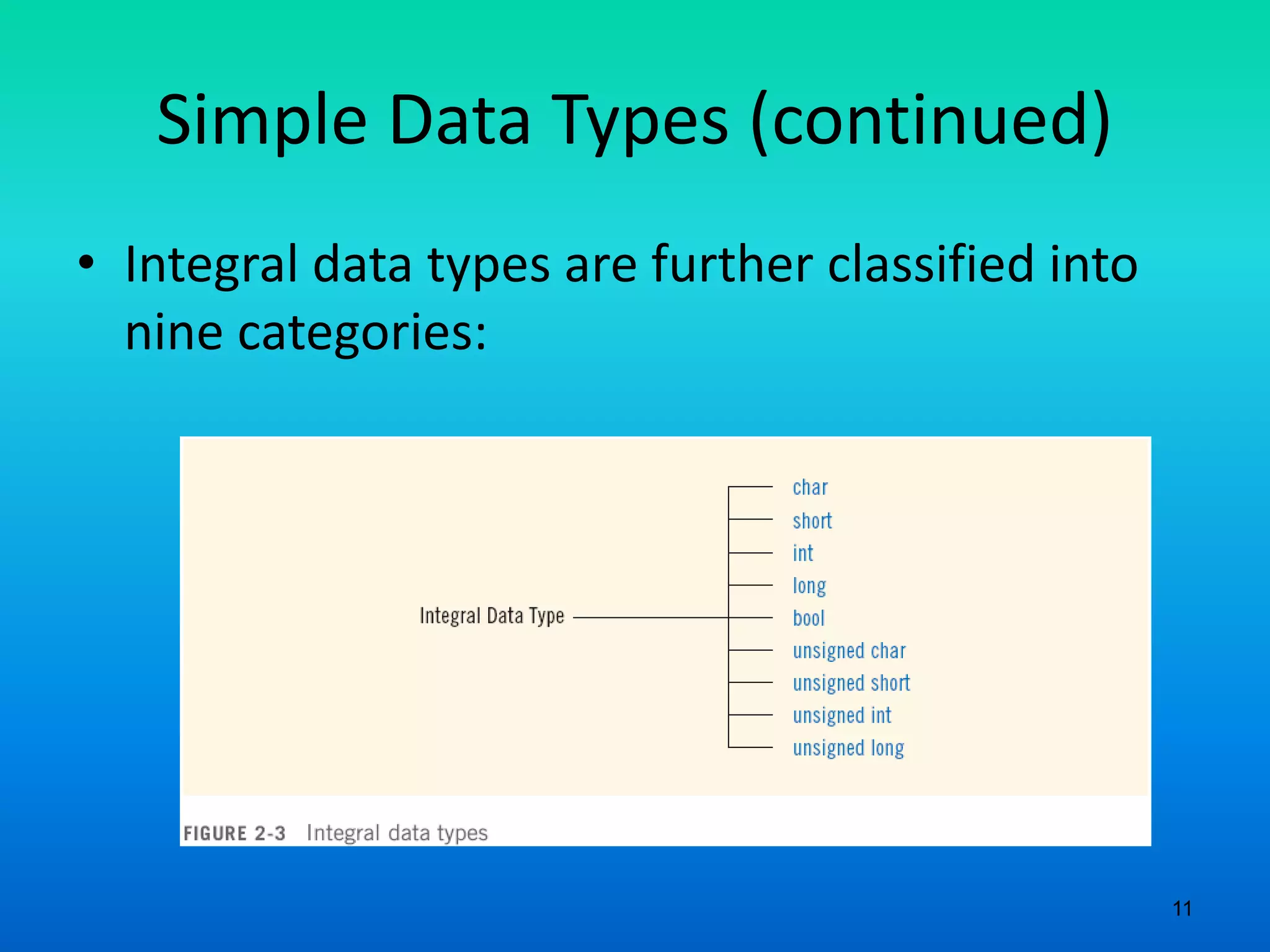
Simple Data Types (continued)
• Integral data types are further classified into
nine categories:
12
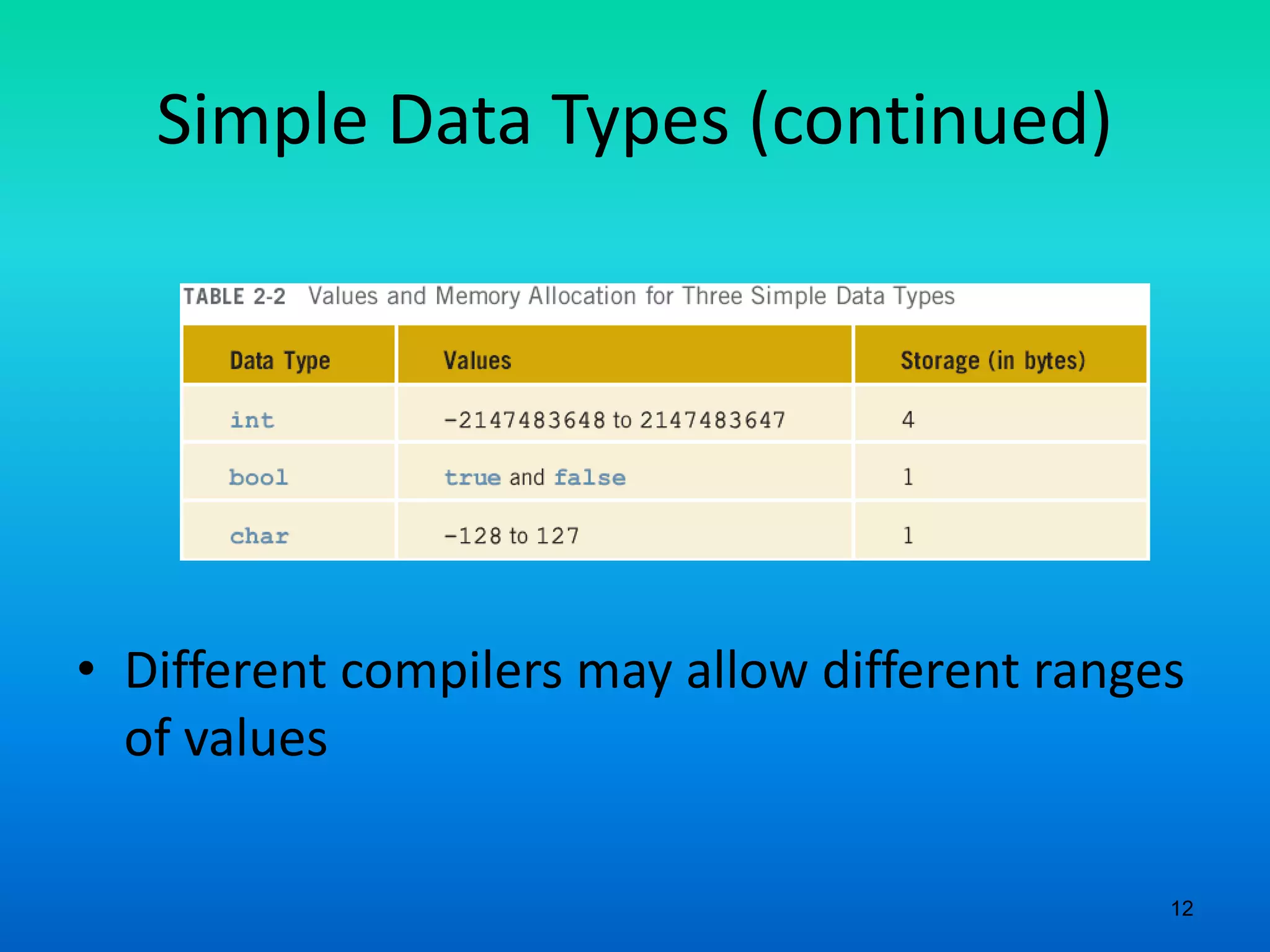
Simple Data Types (continued)
• Different compilers may allow different ranges
of values
13
int Data Type
• Examples:
-6728
0
78
+763
• Positive integers do not need a + sign
• No commas are used within an integer
– Commas are used for separating items in a list
14
bool Data Type
• bool type
– Two values: true and false
– Manipulate logical (Boolean) expressions
• true and false are called logical values
• bool, true, and false are reserved words
15
char Data Type
• The smallest integral data type
• Used for characters: letters, digits, and special
symbols
• Each character is enclosed in single quotes
– 'A', 'a', '0', '*', '+', '$', '&'
• A blank space is a character and is written '
', with a space left between the single quotes
16
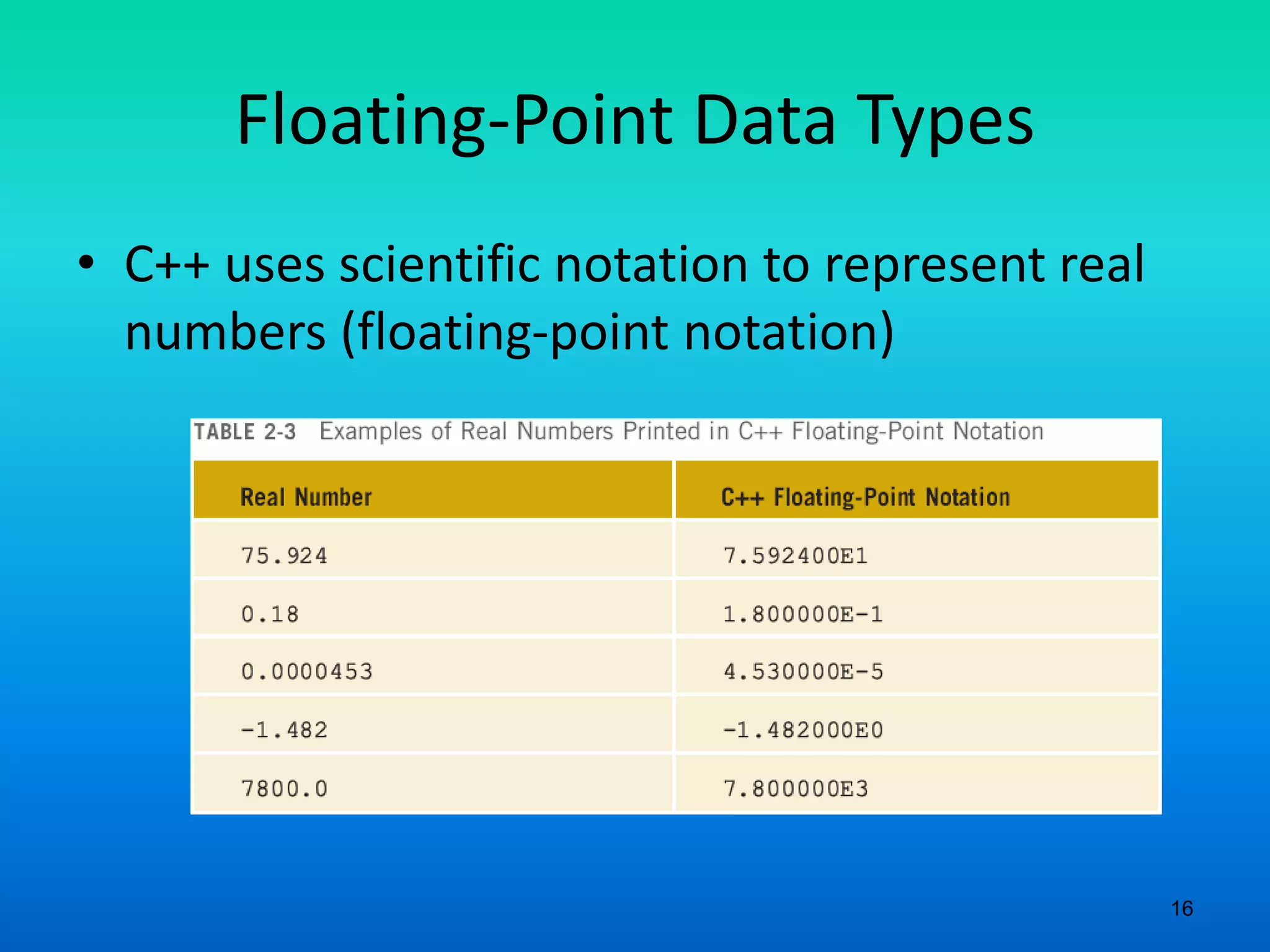
• C++ uses scientific notation to represent real
numbers (floating-point notation)
Floating-Point Data Types
17
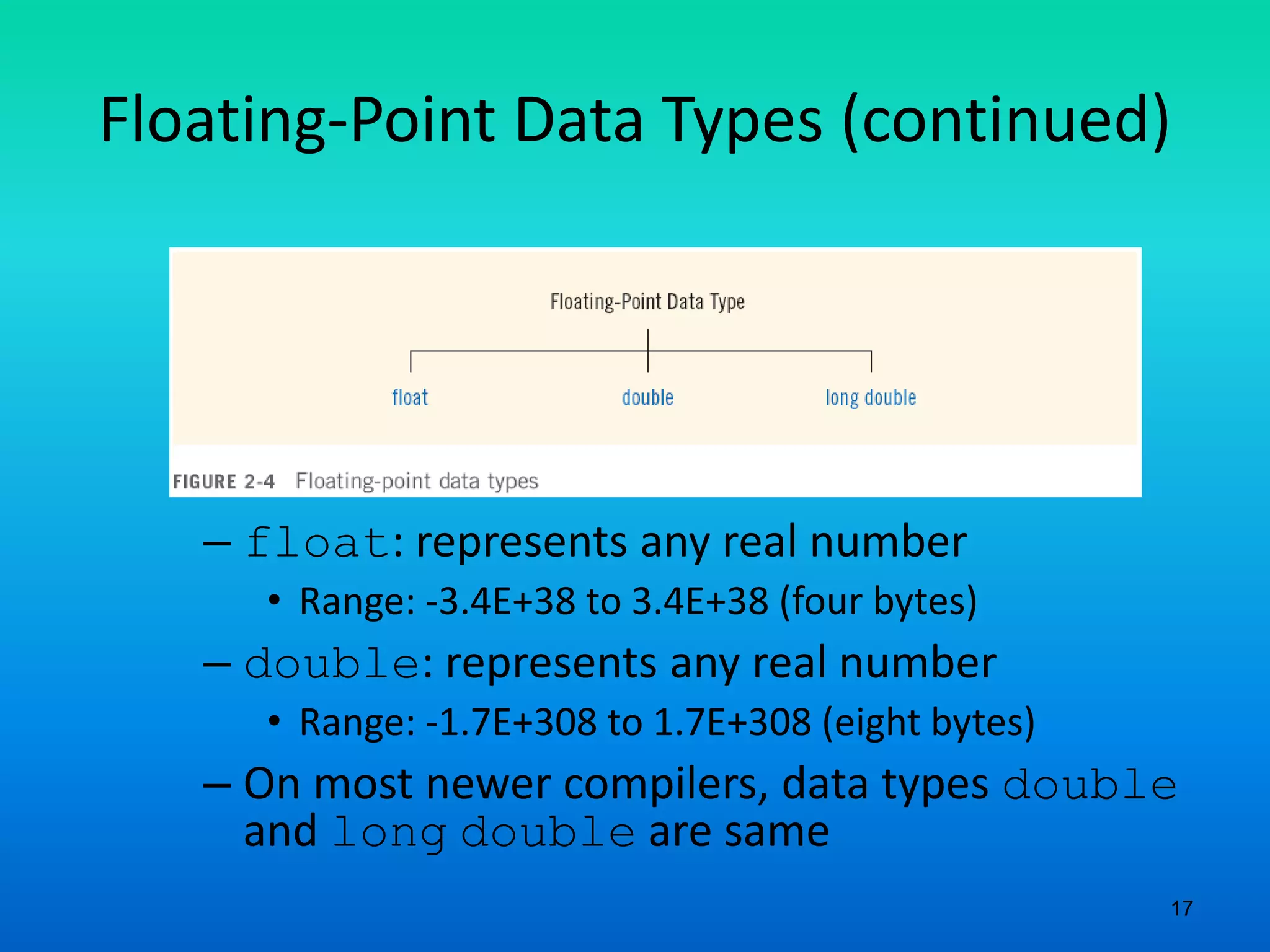
Floating-Point Data Types (continued)
– float: represents any real number
• Range: -3.4E+38 to 3.4E+38 (four bytes)
– double: represents any real number
• Range: -1.7E+308 to 1.7E+308 (eight bytes)
– On most newer compilers, data types double
and long double are same
18
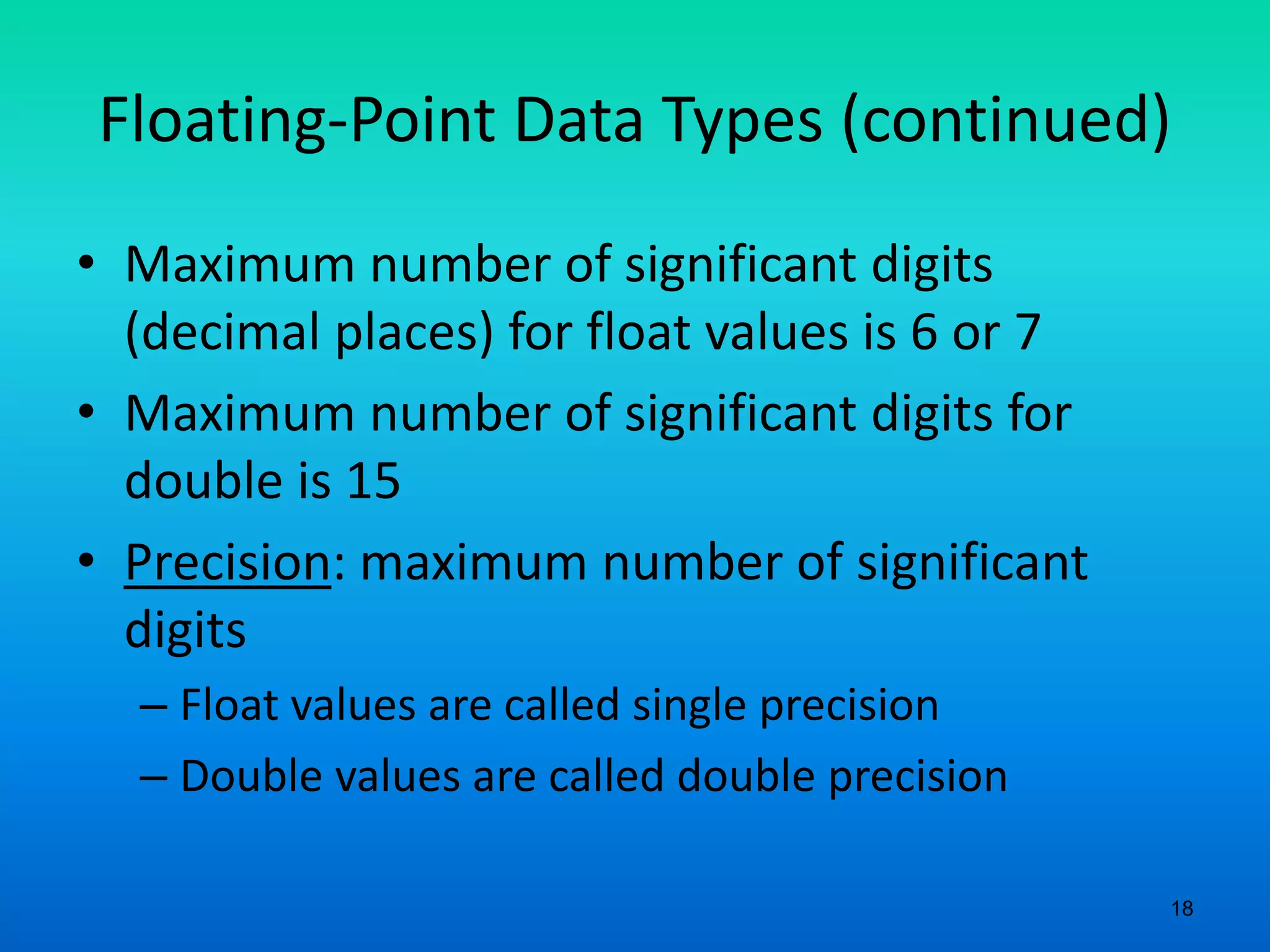
Floating-Point Data Types (continued)
• Maximum number of significant digits
(decimal places) for float values is 6 or 7
• Maximum number of significant digits for
double is 15
• Precision: maximum number of significant
digits
– Float values are called single precision
– Double values are called double precision
19
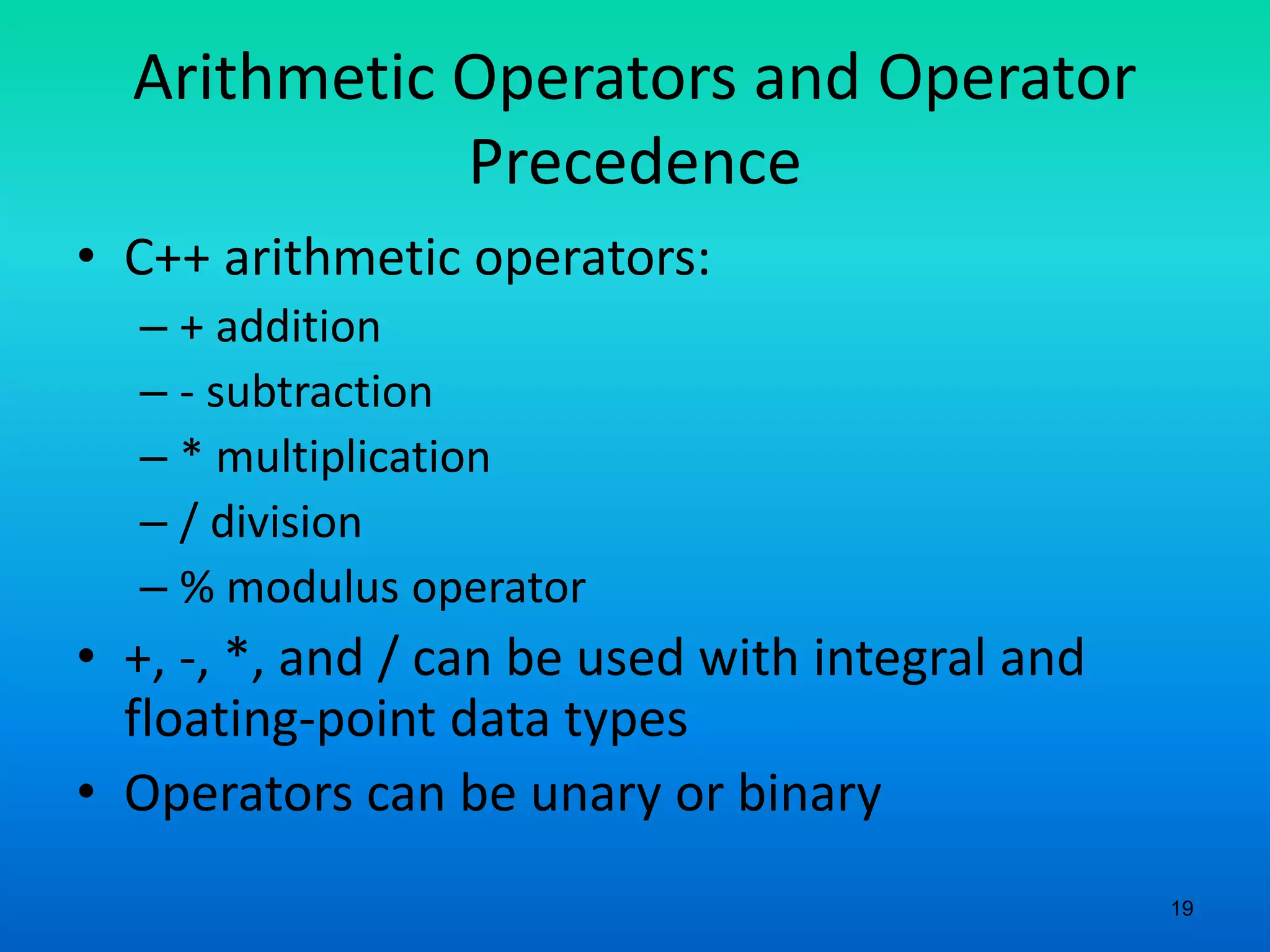
Arithmetic Operators and Operator
Precedence
• C++ arithmetic operators:
– + addition
– - subtraction
– * multiplication
– / division
– % modulus operator
• +, -, *, and / can be used with integral and
floating-point data types
• Operators can be unary or binary
20
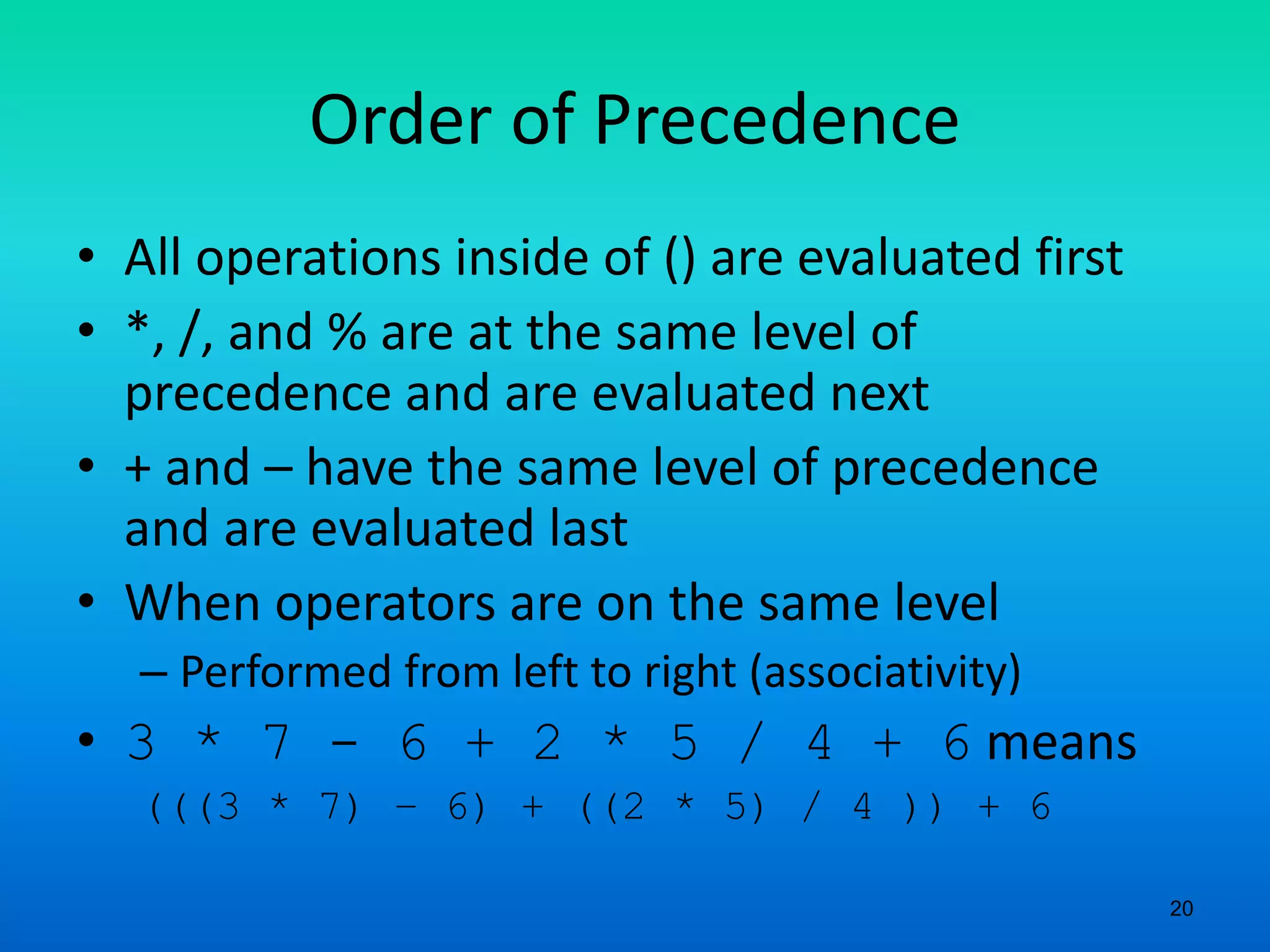
Order of Precedence
• All operations inside of () are evaluated first
• *, /, and % are at the same level of
precedence and are evaluated next
• + and – have the same level of precedence
and are evaluated last
• When operators are on the same level
– Performed from left to right (associativity)
• 3 * 7 - 6 + 2 * 5 / 4 + 6 means
(((3 * 7) – 6) + ((2 * 5) / 4 )) + 6
Assignment
• Discuss in detail the rules related to Identifiers
in C++
• What are the data types available in C++

Object oriented programming 8 basics of c++ programming

  • 1.
    Object Oriented Programming:8 Basics of C++ Programming Prof Neeraj Bhargava Vaibhav Khanna Department of Computer Science School of Engineering and Systems Sciences Maharshi Dayanand Saraswati University Ajmer
  • 2.
    2 The Basics ofa C++ Program • Function: collection of statements; when executed, accomplishes something – May be predefined or standard • Syntax: rules that specify which statements (instructions) are legal • Programming language: a set of rules, symbols, and special words • Semantic rule: meaning of the instruction
  • 3.
    3 Comments • Comments arefor the reader, not the compiler • Two types: – Single line // This is a C++ program. It prints the sentence: // Welcome to C++ Programming. – Multiple line /* You can include comments that can occupy several lines. */
  • 4.
    4 Special Symbols • Specialsymbols + - * / . ; ? , <= != == >=
  • 5.
    5 Reserved Words (Keywords) •Reserved words, keywords, or word symbols – Include: • int • float • double • char • const • void • return
  • 6.
    6 Identifiers • Consist ofletters, digits, and the underscore character (_) • Must begin with a letter or underscore • C++ is case sensitive – NUMBER is not the same as number • Two predefined identifiers are cout and cin • Unlike reserved words, predefined identifiers may be redefined, but it is not a good idea
  • 7.
    7 Identifiers (continued) • Thefollowing are legal identifiers in C++: – first – conversion – payRate
  • 8.
    8 Whitespaces • Every C++program contains whitespaces – Include blanks, tabs, and newline characters • Used to separate special symbols, reserved words, and identifiers • Proper utilization of whitespaces is important – Can be used to make the program readable
  • 9.
    9 Data Types • Datatype: set of values together with a set of operations • C++ data types fall into three categories:
  • 10.
    10 Simple Data Types •Three categories of simple data – Integral: integers (numbers without a decimal) – Floating-point: decimal numbers – Enumeration type: user-defined data type
  • 11.
    11 Simple Data Types(continued) • Integral data types are further classified into nine categories:
  • 12.
    12 Simple Data Types(continued) • Different compilers may allow different ranges of values
  • 13.
    13 int Data Type •Examples: -6728 0 78 +763 • Positive integers do not need a + sign • No commas are used within an integer – Commas are used for separating items in a list
  • 14.
    14 bool Data Type •bool type – Two values: true and false – Manipulate logical (Boolean) expressions • true and false are called logical values • bool, true, and false are reserved words
  • 15.
    15 char Data Type •The smallest integral data type • Used for characters: letters, digits, and special symbols • Each character is enclosed in single quotes – 'A', 'a', '0', '*', '+', '$', '&' • A blank space is a character and is written ' ', with a space left between the single quotes
  • 16.
    16 • C++ usesscientific notation to represent real numbers (floating-point notation) Floating-Point Data Types
  • 17.
    17 Floating-Point Data Types(continued) – float: represents any real number • Range: -3.4E+38 to 3.4E+38 (four bytes) – double: represents any real number • Range: -1.7E+308 to 1.7E+308 (eight bytes) – On most newer compilers, data types double and long double are same
  • 18.
    18 Floating-Point Data Types(continued) • Maximum number of significant digits (decimal places) for float values is 6 or 7 • Maximum number of significant digits for double is 15 • Precision: maximum number of significant digits – Float values are called single precision – Double values are called double precision
  • 19.
    19 Arithmetic Operators andOperator Precedence • C++ arithmetic operators: – + addition – - subtraction – * multiplication – / division – % modulus operator • +, -, *, and / can be used with integral and floating-point data types • Operators can be unary or binary
  • 20.
    20 Order of Precedence •All operations inside of () are evaluated first • *, /, and % are at the same level of precedence and are evaluated next • + and – have the same level of precedence and are evaluated last • When operators are on the same level – Performed from left to right (associativity) • 3 * 7 - 6 + 2 * 5 / 4 + 6 means (((3 * 7) – 6) + ((2 * 5) / 4 )) + 6
  • 21.
    Assignment • Discuss indetail the rules related to Identifiers in C++ • What are the data types available in C++