Introduction to C++
Language Datatypes
Lecture 5
1
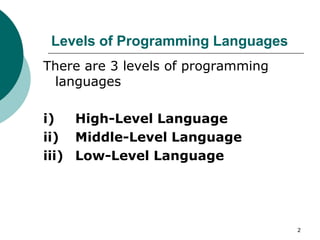
Levels of Programming Languages
There are 3 levels of programming
languages
i) High-Level Language
ii) Middle-Level Language
iii) Low-Level Language
2
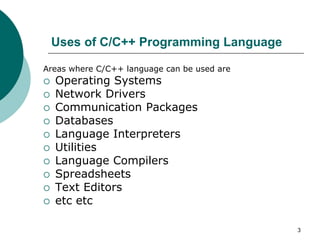
Uses of C/C++ Programming Language
Areas where C/C++ language can be used are
 Operating Systems
 Network Drivers
 Communication Packages
 Databases
 Language Interpreters
 Utilities
 Language Compilers
 Spreadsheets
 Text Editors
 etc etc
3
C/C++ Character Set
C/C++ character set comprises of
following characters
 A,B,C,….Z
 a,b,c,…...z
 0,1,2,……9
 , . ; : ? ! “ / ‘  | ~
 ( ) [ ] { } < >
 + - # % _ ^ = & *
4
White Space Characters
 The character that produces blank
space when printed is called a white
space character, e.g.
 Spaces
 Tabs
 New Lines
5
Data Transformation
 Programs transform data from one form to another
 Input data  Output data
 Stimulus  Response
 Programming languages store and process data in
various ways depending on the type of the data;
consequently, all data read, processed, or written
by a program must have a data type
 Two distinguishing characteristics of a programming
language are the data types it supports and the
operations on those data types
6
Data Handling
 Various types of data
 E.g. letters, numbers, symbols, etc.
 Data handling requires different data types
 Data Type: type of data that a variable
can hold and the operations that can be
performed on it.
 Logical to ask the computer to multiply a
float by an integer (1.5 x 5)
 Illogical to ask the computer to multiply a
float by a string (1.5 x FUI)
Constants & Variables
 Constants
 1, 56, 1.89, ’a’, ’Z’, ”BSSE”
 Variables
x = 5
y = 20
8
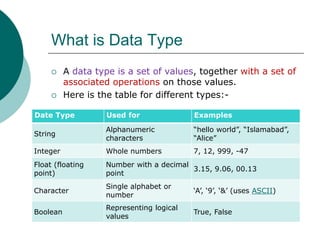
What is Data Type
 A data type is a set of values, together with a set of
associated operations on those values.
 Here is the table for different types:-
Date Type Used for Examples
String
Alphanumeric
characters
“hello world”, “Islamabad”,
“Alice”
Integer Whole numbers 7, 12, 999, -47
Float (floating
point)
Number with a decimal
point
3.15, 9.06, 00.13
Character
Single alphabet or
number
‘A’, ‘9’, ‘&’ (uses ASCII)
Boolean
Representing logical
values
True, False
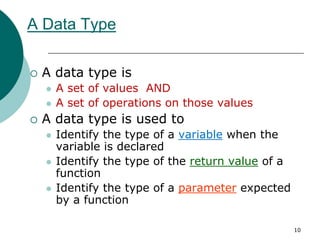
A Data Type
 A data type is
 A set of values AND
 A set of operations on those values
 A data type is used to
 Identify the type of a variable when the
variable is declared
 Identify the type of the return value of a
function
 Identify the type of a parameter expected
by a function
10
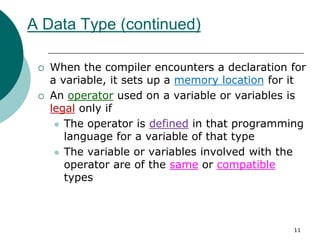
A Data Type (continued)
 When the compiler encounters a declaration for
a variable, it sets up a memory location for it
 An operator used on a variable or variables is
legal only if
 The operator is defined in that programming
language for a variable of that type
 The variable or variables involved with the
operator are of the same or compatible
types
11
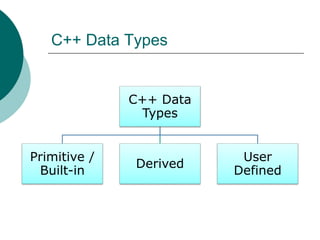
C++ Data Types
C++ Data
Types
Primitive /
Built-in
Derived
User
Defined
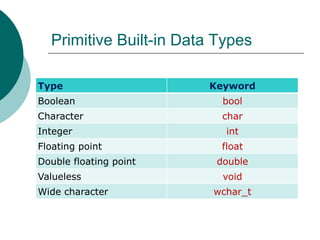
Primitive Built-in Data Types
Type Keyword
Boolean bool
Character char
Integer int
Floating point float
Double floating point double
Valueless void
Wide character wchar_t
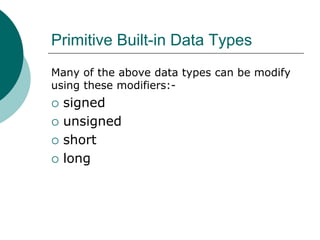
Primitive Built-in Data Types
Many of the above data types can be modify
using these modifiers:-
 signed
 unsigned
 short
 long
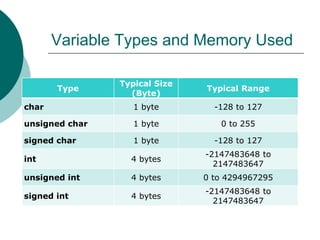
Variable Types and Memory Used
Type
Typical Size
(Byte)
Typical Range
char 1 byte -128 to 127
unsigned char 1 byte 0 to 255
signed char 1 byte -128 to 127
int 4 bytes
-2147483648 to
2147483647
unsigned int 4 bytes 0 to 4294967295
signed int 4 bytes
-2147483648 to
2147483647
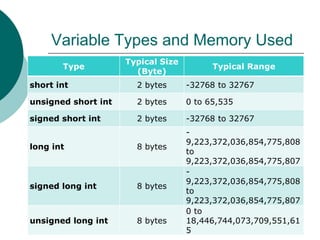
Variable Types and Memory Used
Type
Typical Size
(Byte)
Typical Range
short int 2 bytes -32768 to 32767
unsigned short int 2 bytes 0 to 65,535
signed short int 2 bytes -32768 to 32767
long int 8 bytes
-
9,223,372,036,854,775,808
to
9,223,372,036,854,775,807
signed long int 8 bytes
-
9,223,372,036,854,775,808
to
9,223,372,036,854,775,807
unsigned long int 8 bytes
0 to
18,446,744,073,709,551,61
5
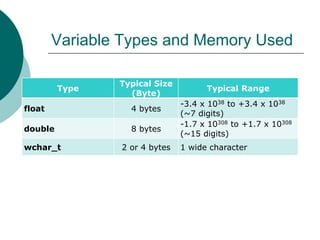
Variable Types and Memory Used
Type
Typical Size
(Byte)
Typical Range
float 4 bytes
-3.4 x 1038 to +3.4 x 1038
(~7 digits)
double 8 bytes
-1.7 x 10308 to +1.7 x 10308
(~15 digits)
wchar_t 2 or 4 bytes 1 wide character
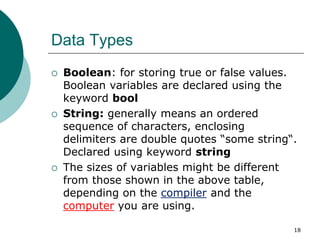
Data Types
 Boolean: for storing true or false values.
Boolean variables are declared using the
keyword bool
 String: generally means an ordered
sequence of characters, enclosing
delimiters are double quotes “some string“.
Declared using keyword string
 The sizes of variables might be different
from those shown in the above table,
depending on the compiler and the
computer you are using.
18
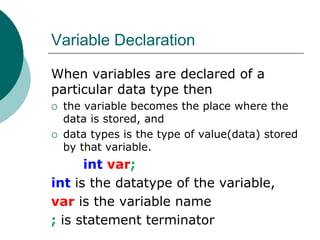
Variable Declaration
When variables are declared of a
particular data type then
 the variable becomes the place where the
data is stored, and
 data types is the type of value(data) stored
by that variable.
int var;
int is the datatype of the variable,
var is the variable name
; is statement terminator
Identifiers
Identifiers refer to the names of
 data types, constants, variables, and
functions
 Cannot be keywords
20
Rules for Constructing Identifiers in C++
 Can contain letters, digits and underscores,
capital letters A-Z, lowercase letters a-z,
digits 0-9, and the underscore character _
 Digit can not be the first character.
 First character must be a letter or
underscore
 Can not consist of an underscore alone.
 Usually only the first 32 characters are
significant.
21
Rules for Constructing Identifiers in C++
(contd.)
 May not be same as keyword or function
name etc.
 There can be no embedded blanks (spaces
are not allowed).
 Keywords cannot be used as identifiers
 Identifiers are case sensitive
22
Types of C/C++ Instructions
There are 4 types of C/C++ Instructions.
i) Type declaration Instructions
Variable types and definitions etc.
ii) Input/Output Instructions
Data Input, Data Display, Data Write
etc
iii) Control Instructions
Controls the sequence of execution of
the program instructions.
iv) Arithmetic Instructions
Arithmetic Operations etc
23

5-Lec - Datatypes.ppt

  • 1.
    Introduction to C++ LanguageDatatypes Lecture 5 1
  • 2.
    Levels of ProgrammingLanguages There are 3 levels of programming languages i) High-Level Language ii) Middle-Level Language iii) Low-Level Language 2
  • 3.
    Uses of C/C++Programming Language Areas where C/C++ language can be used are  Operating Systems  Network Drivers  Communication Packages  Databases  Language Interpreters  Utilities  Language Compilers  Spreadsheets  Text Editors  etc etc 3
  • 4.
    C/C++ Character Set C/C++character set comprises of following characters  A,B,C,….Z  a,b,c,…...z  0,1,2,……9  , . ; : ? ! “ / ‘ | ~  ( ) [ ] { } < >  + - # % _ ^ = & * 4
  • 5.
    White Space Characters The character that produces blank space when printed is called a white space character, e.g.  Spaces  Tabs  New Lines 5
  • 6.
    Data Transformation  Programstransform data from one form to another  Input data  Output data  Stimulus  Response  Programming languages store and process data in various ways depending on the type of the data; consequently, all data read, processed, or written by a program must have a data type  Two distinguishing characteristics of a programming language are the data types it supports and the operations on those data types 6
  • 7.
    Data Handling  Varioustypes of data  E.g. letters, numbers, symbols, etc.  Data handling requires different data types  Data Type: type of data that a variable can hold and the operations that can be performed on it.  Logical to ask the computer to multiply a float by an integer (1.5 x 5)  Illogical to ask the computer to multiply a float by a string (1.5 x FUI)
  • 8.
    Constants & Variables Constants  1, 56, 1.89, ’a’, ’Z’, ”BSSE”  Variables x = 5 y = 20 8
  • 9.
    What is DataType  A data type is a set of values, together with a set of associated operations on those values.  Here is the table for different types:- Date Type Used for Examples String Alphanumeric characters “hello world”, “Islamabad”, “Alice” Integer Whole numbers 7, 12, 999, -47 Float (floating point) Number with a decimal point 3.15, 9.06, 00.13 Character Single alphabet or number ‘A’, ‘9’, ‘&’ (uses ASCII) Boolean Representing logical values True, False
  • 10.
    A Data Type A data type is  A set of values AND  A set of operations on those values  A data type is used to  Identify the type of a variable when the variable is declared  Identify the type of the return value of a function  Identify the type of a parameter expected by a function 10
  • 11.
    A Data Type(continued)  When the compiler encounters a declaration for a variable, it sets up a memory location for it  An operator used on a variable or variables is legal only if  The operator is defined in that programming language for a variable of that type  The variable or variables involved with the operator are of the same or compatible types 11
  • 12.
    C++ Data Types C++Data Types Primitive / Built-in Derived User Defined
  • 13.
    Primitive Built-in DataTypes Type Keyword Boolean bool Character char Integer int Floating point float Double floating point double Valueless void Wide character wchar_t
  • 14.
    Primitive Built-in DataTypes Many of the above data types can be modify using these modifiers:-  signed  unsigned  short  long
  • 15.
    Variable Types andMemory Used Type Typical Size (Byte) Typical Range char 1 byte -128 to 127 unsigned char 1 byte 0 to 255 signed char 1 byte -128 to 127 int 4 bytes -2147483648 to 2147483647 unsigned int 4 bytes 0 to 4294967295 signed int 4 bytes -2147483648 to 2147483647
  • 16.
    Variable Types andMemory Used Type Typical Size (Byte) Typical Range short int 2 bytes -32768 to 32767 unsigned short int 2 bytes 0 to 65,535 signed short int 2 bytes -32768 to 32767 long int 8 bytes - 9,223,372,036,854,775,808 to 9,223,372,036,854,775,807 signed long int 8 bytes - 9,223,372,036,854,775,808 to 9,223,372,036,854,775,807 unsigned long int 8 bytes 0 to 18,446,744,073,709,551,61 5
  • 17.
    Variable Types andMemory Used Type Typical Size (Byte) Typical Range float 4 bytes -3.4 x 1038 to +3.4 x 1038 (~7 digits) double 8 bytes -1.7 x 10308 to +1.7 x 10308 (~15 digits) wchar_t 2 or 4 bytes 1 wide character
  • 18.
    Data Types  Boolean:for storing true or false values. Boolean variables are declared using the keyword bool  String: generally means an ordered sequence of characters, enclosing delimiters are double quotes “some string“. Declared using keyword string  The sizes of variables might be different from those shown in the above table, depending on the compiler and the computer you are using. 18
  • 19.
    Variable Declaration When variablesare declared of a particular data type then  the variable becomes the place where the data is stored, and  data types is the type of value(data) stored by that variable. int var; int is the datatype of the variable, var is the variable name ; is statement terminator
  • 20.
    Identifiers Identifiers refer tothe names of  data types, constants, variables, and functions  Cannot be keywords 20
  • 21.
    Rules for ConstructingIdentifiers in C++  Can contain letters, digits and underscores, capital letters A-Z, lowercase letters a-z, digits 0-9, and the underscore character _  Digit can not be the first character.  First character must be a letter or underscore  Can not consist of an underscore alone.  Usually only the first 32 characters are significant. 21
  • 22.
    Rules for ConstructingIdentifiers in C++ (contd.)  May not be same as keyword or function name etc.  There can be no embedded blanks (spaces are not allowed).  Keywords cannot be used as identifiers  Identifiers are case sensitive 22
  • 23.
    Types of C/C++Instructions There are 4 types of C/C++ Instructions. i) Type declaration Instructions Variable types and definitions etc. ii) Input/Output Instructions Data Input, Data Display, Data Write etc iii) Control Instructions Controls the sequence of execution of the program instructions. iv) Arithmetic Instructions Arithmetic Operations etc 23