🩺 OBG MCQs
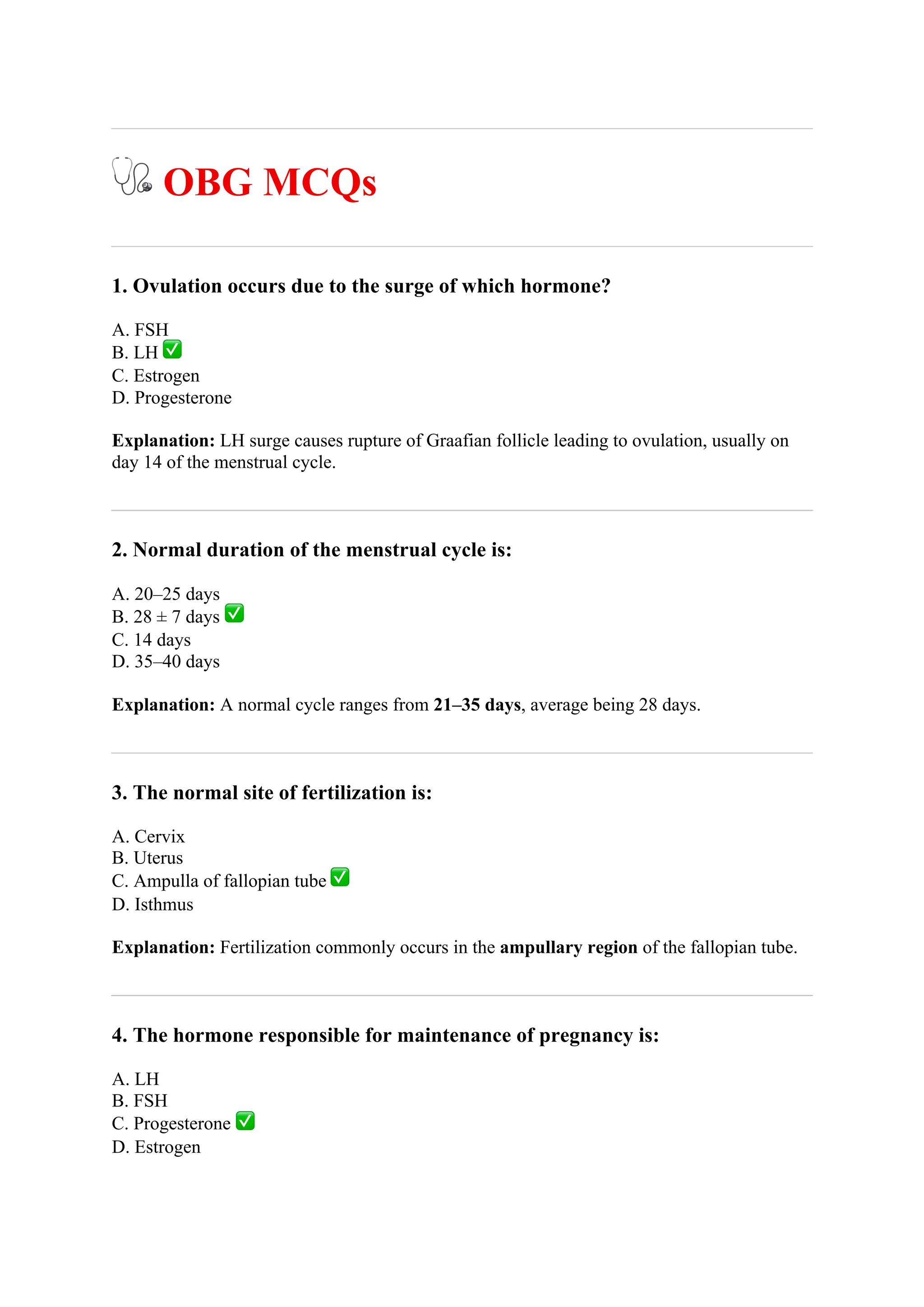
1. Ovulation occurs due to the surge of which hormone?
A. FSH
B. LH ✅
C. Estrogen
D. Progesterone
Explanation: LH surge causes rupture of Graafian follicle leading to ovulation, usually on
day 14 of the menstrual cycle.
2. Normal duration of the menstrual cycle is:
A. 20–25 days
B. 28 ± 7 days ✅
C. 14 days
D. 35–40 days
Explanation: A normal cycle ranges from 21–35 days, average being 28 days.
3. The normal site of fertilization is:
A. Cervix
B. Uterus
C. Ampulla of fallopian tube ✅
D. Isthmus
Explanation: Fertilization commonly occurs in the ampullary region of the fallopian tube.
4. The hormone responsible for maintenance of pregnancy is:
A. LH
B. FSH
C. Progesterone ✅
D. Estrogen
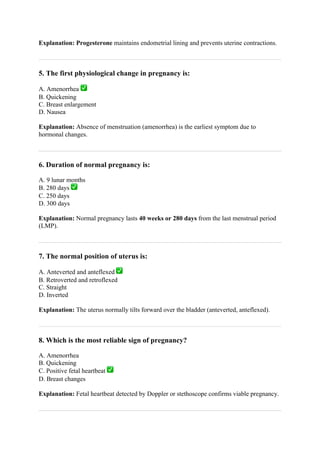
Explanation: Progesterone maintains endometrial lining and prevents uterine contractions.
5. The first physiological change in pregnancy is:
A. Amenorrhea ✅
B. Quickening
C. Breast enlargement
D. Nausea
Explanation: Absence of menstruation (amenorrhea) is the earliest symptom due to
hormonal changes.
6. Duration of normal pregnancy is:
A. 9 lunar months
B. 280 days ✅
C. 250 days
D. 300 days
Explanation: Normal pregnancy lasts 40 weeks or 280 days from the last menstrual period
(LMP).
7. The normal position of uterus is:
A. Anteverted and anteflexed ✅
B. Retroverted and retroflexed
C. Straight
D. Inverted
Explanation: The uterus normally tilts forward over the bladder (anteverted, anteflexed).
8. Which is the most reliable sign of pregnancy?
A. Amenorrhea
B. Quickening
C. Positive fetal heartbeat ✅
D. Breast changes
Explanation: Fetal heartbeat detected by Doppler or stethoscope confirms viable pregnancy.
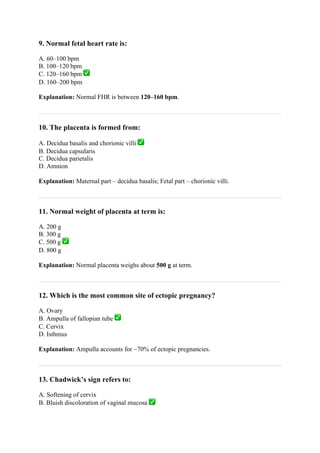
9. Normal fetal heart rate is:
A. 60–100 bpm
B. 100–120 bpm
C. 120–160 bpm ✅
D. 160–200 bpm
Explanation: Normal FHR is between 120–160 bpm.
10. The placenta is formed from:
A. Decidua basalis and chorionic villi ✅
B. Decidua capsularis
C. Decidua parietalis
D. Amnion
Explanation: Maternal part – decidua basalis; Fetal part – chorionic villi.
11. Normal weight of placenta at term is:
A. 200 g
B. 300 g
C. 500 g ✅
D. 800 g
Explanation: Normal placenta weighs about 500 g at term.
12. Which is the most common site of ectopic pregnancy?
A. Ovary
B. Ampulla of fallopian tube ✅
C. Cervix
D. Isthmus
Explanation: Ampulla accounts for ~70% of ectopic pregnancies.
13. Chadwick’s sign refers to:
A. Softening of cervix
B. Bluish discoloration of vaginal mucosa ✅
C. Enlargement of uterus
D. Softening of isthmus
Explanation: Due to increased vascularity in early pregnancy.
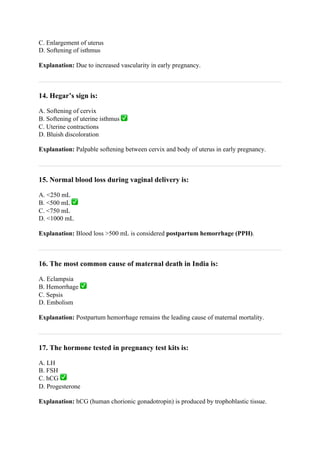
14. Hegar’s sign is:
A. Softening of cervix
B. Softening of uterine isthmus ✅
C. Uterine contractions
D. Bluish discoloration
Explanation: Palpable softening between cervix and body of uterus in early pregnancy.
15. Normal blood loss during vaginal delivery is:
A. <250 mL
B. <500 mL ✅
C. <750 mL
D. <1000 mL
Explanation: Blood loss >500 mL is considered postpartum hemorrhage (PPH).
16. The most common cause of maternal death in India is:
A. Eclampsia
B. Hemorrhage ✅
C. Sepsis
D. Embolism
Explanation: Postpartum hemorrhage remains the leading cause of maternal mortality.
17. The hormone tested in pregnancy test kits is:
A. LH
B. FSH
C. hCG ✅
D. Progesterone
Explanation: hCG (human chorionic gonadotropin) is produced by trophoblastic tissue.
18. Quickening is felt around:
A. 8 weeks
B. 12 weeks
C. 16–20 weeks ✅
D. 24 weeks
Explanation: Fetal movements first felt at 18–20 weeks (primigravida) and 16 weeks
(multigravida).
19. The normal presentation in labor is:
A. Breech
B. Shoulder
C. Vertex ✅
D. Face
Explanation: 95% of labors are cephalic (vertex) presentations.
20. Bishop’s score is used to assess:
A. Fetal position
B. Cervical readiness for labor ✅
C. Placental function
D. Fetal wellbeing
Explanation: It evaluates cervical dilatation, effacement, consistency, position, and fetal
station.
21. True labor pain is characterized by:
A. Irregular contraction
B. Relieved by sedation
C. Cervical dilatation ✅
D. No cervical change
Explanation: True labor causes progressive cervical effacement and dilatation.
22. First stage of labor ends with:
A. Full dilatation of cervix ✅
B. Birth of baby
C. Expulsion of placenta
D. Rupture of membranes
Explanation: First stage — from onset of true labor to full cervical dilatation (10 cm).
23. Duration of the first stage in a primigravida:
A. 4 hours
B. 6 hours
C. 12–14 hours ✅
D. 24 hours
Explanation: Average 12–14 hours in primigravida, shorter in multigravida.
24. Normal duration of third stage of labor:
A. 5–10 min ✅
B. 20–30 min
C. 45 min
D. 60 min
Explanation: It’s from delivery of baby to expulsion of placenta.
25. The most common cause of postpartum hemorrhage (PPH) is:
A. Uterine rupture
B. Cervical tear
C. Retained placenta
D. Uterine atony ✅
Explanation: Uterine atony (failure of uterus to contract) causes 80% of PPH.
26. Drug of choice for prevention of PPH is:
A. Misoprostol
B. Ergometrine
C. Oxytocin ✅
D. Methylergometrine
Explanation: Oxytocin 10 IU IM after delivery of anterior shoulder or baby.
27. Puerperium lasts for:
A. 2 weeks
B. 6 weeks ✅
C. 8 weeks
D. 12 weeks
Explanation: Period following childbirth during which reproductive organs return to normal.
28. Colostrum is rich in:
A. Fat
B. Protein and antibodies ✅
C. Iron
D. Sugar
Explanation: Colostrum contains IgA, lactoferrin, and high protein for immunity.
29. Commonest site of cervical cancer:
A. Endocervix
B. Transformation zone ✅
C. External os
D. Internal os
Explanation: Transformation zone (squamocolumnar junction) is most prone to malignant
changes.
30. Most common cause of infertility in females:
A. Endometriosis
B. Tubal blockage ✅
C. Ovarian cyst
D. PCOS
Explanation: Tubal factor (especially after PID) is the leading cause.
31. The safest contraceptive in lactating mother:
A. Combined pill
B. Copper-T ✅
C. Diaphragm
D. Condom
Explanation: Non-hormonal IUCD (Cu-T) is safe and doesn’t affect lactation.
32. Emergency contraception can be given within:
A. 24 hours
B. 72 hours ✅
C. 5 days
D. 7 days
Explanation: Levonorgestrel 1.5 mg single dose is effective within 72 hours.
33. Oral contraceptive pills act by:
A. Increasing LH
B. Suppressing ovulation ✅
C. Enhancing implantation
D. Stimulating FSH
Explanation: OCPs inhibit ovulation via suppression of LH surge.
34. The normal amniotic fluid volume at term is:
A. 200 mL
B. 500 mL
C. 1000 mL ✅
D. 1500 mL
Explanation: Normal AFI (Amniotic Fluid Index) at term is around 800–1000 mL.
35. Polyhydramnios is associated with:
A. Renal agenesis
B. Esophageal atresia ✅
C. Anencephaly ✅
D. Both B and C ✅
Explanation: Due to failure of fetal swallowing or CNS anomalies.
36. Oligohydramnios is associated with:
A. Twin pregnancy
B. Renal agenesis ✅
C. Diabetes
D. Rh incompatibility
Explanation: Decreased urine output leads to less amniotic fluid.
37. Normal hemoglobin level in pregnancy:
A. >12 g/dL
B. >11 g/dL ✅
C. >10 g/dL
D. >9 g/dL
Explanation: WHO defines anemia in pregnancy as Hb <11 g/dL.
38. Commonest cause of early abortion:
A. Infection
B. Chromosomal abnormalities ✅
C. Trauma
D. Endocrine disorder
Explanation: Around 50% of early abortions are due to genetic defects.
39. The term “Gravida” means:
A. Number of live births
B. Number of pregnancies ✅
C. Number of abortions
D. Number of living children
Explanation: Gravida = total pregnancies, regardless of outcome.
40. “Para” means:
A. Number of living children
B. Number of viable births ✅
C. Number of abortions
D. Total pregnancies
Explanation: Para counts pregnancies reaching viability (≥28 weeks).
41. True conjugate is measured between:
A. External and internal os
B. Sacral promontory to upper margin of symphysis pubis ✅
C. Lower border of symphysis pubis
D. Ischial spines
Explanation: It measures 11 cm approximately and indicates pelvic adequacy.
42. Commonest ovarian tumour in reproductive age:
A. Dermoid cyst ✅
B. Serous cystadenoma
C. Theca lutein cyst
D. Follicular cyst
Explanation: Mature cystic teratoma (dermoid) is benign and common.
43. Preeclampsia is characterized by:
A. Hypertension, proteinuria, edema ✅
B. Hypertension only
C. Proteinuria only
D. Edema only
Explanation: Triad defines preeclampsia after 20 weeks of gestation.
44. Eclampsia is:
A. Preeclampsia + seizures ✅
B. HTN + edema
C. HTN + proteinuria
D. HTN + renal failure
Explanation: Convulsions in preeclamptic woman = Eclampsia.
45. Drug of choice in eclampsia:
A. Diazepam
B. Phenytoin
C. Magnesium sulfate ✅
D. Phenobarbitone
Explanation: MgSO₄ prevents and controls convulsions effectively.
46. Normal postpartum involution of uterus completes by:
A. 2 weeks ✅
B. 4 weeks
C. 6 weeks
D. 8 weeks
Explanation: Uterus returns to nonpregnant size within 2 weeks.
47. Lochia rubra lasts for:
A. 2 days
B. 3–4 days ✅
C. 7 days
D. 10 days
Explanation: Lochia changes: Rubra (red) → Serosa (pink) → Alba (white).
48. Main component of breast milk sugar:
A. Glucose
B. Lactose ✅
C. Maltose
D. Galactose
Explanation: Lactose provides energy and helps calcium absorption.
49. Risk factor for carcinoma endometrium:
A. Early menopause
B. Multiparity
C. Obesity ✅
D. Combined OCPs
Explanation: Estrogen excess states like obesity and nulliparity increase risk.
50. Best time for MTP (Medical Termination of Pregnancy):
A. Before 6 weeks
B. Up to 12 weeks ✅
C. Up to 16 weeks
D. Up to 20 weeks
Explanation: As per MTP Act (amended 2021), termination allowed up to 20 weeks, but
safest up to 12 weeks.
51. Which hormone is responsible for milk ejection (let-down reflex)?
A. Prolactin
B. Oxytocin ✅
C. Estrogen
D. Progesterone
Explanation: Oxytocin causes contraction of myoepithelial cells in breast, ejecting milk.
52. Prolactin hormone is secreted by:
A. Posterior pituitary
B. Anterior pituitary ✅
C. Hypothalamus
D. Adrenal gland
Explanation: Prolactin from anterior pituitary stimulates milk secretion.
53. Corpus luteum secretes:
A. Estrogen only
B. Progesterone ✅
C. LH
D. FSH
Explanation: Corpus luteum of ovary secretes progesterone to maintain early pregnancy.
54. What is the normal weight gain during pregnancy?
A. 5–6 kg
B. 8–12 kg ✅
C. 15–20 kg
D. 3–4 kg
Explanation: Average gain = 11–12 kg; mainly due to fetus, placenta, and fluid.
55. Folic acid should be started:
A. After conception
B. Before conception ✅
C. After 3 months
D. In 2nd trimester
Explanation: Preconception folic acid prevents neural tube defects.
56. Iron requirement during pregnancy:
A. 30 mg/day ✅
B. 10 mg/day
C. 50 mg/day
D. 100 mg/day
Explanation: Increased demand due to maternal and fetal blood volume expansion.
57. Normal fetal head diameter in vertex presentation (biparietal):
A. 7.5 cm ✅
B. 9.5 cm
C. 10 cm
D. 12 cm
Explanation: Biparietal diameter = 9.5 cm; suboccipitobregmatic = 9.5 cm for vertex
delivery.
58. Leopold’s maneuvers are used to assess:
A. Pelvic size
B. Fetal lie, presentation, and position ✅
C. Fetal weight only
D. Pelvic contraction
Explanation: Four maneuvers palpate abdomen to determine fetal lie, presentation, and
engagement.
59. Fetal lie means:
A. Attitude of head
B. Relation of fetal spine to maternal spine ✅
C. Presentation
D. Position of occiput
Explanation: Lie may be longitudinal, oblique, or transverse.
60. Engagement of fetal head occurs when:
A. Head enters pelvic brim ✅
B. Head touches perineum
C. Head rotates
D. Membranes rupture
Explanation: Engagement = BPD passes pelvic inlet.
61. Most common cause of primary dysmenorrhea:
A. Endometriosis
B. Adenomyosis
C. Ovulatory cycles with excess prostaglandins ✅
D. Pelvic inflammatory disease
Explanation: Prostaglandins cause uterine contractions and pain during menstruation.
62. Menopause is diagnosed after:
A. 3 months amenorrhea
B. 6 months
C. 12 months of amenorrhea ✅
D. 24 months
Explanation: Natural cessation of menstruation for 12 consecutive months.
63. Average age of menopause in Indian women:
A. 40 years
B. 45 years
C. 47 years ✅
D. 52 years
Explanation: Indian average = 46–48 years.
64. The term “lochia serosa” refers to:
A. Reddish discharge
B. Pinkish discharge ✅
C. White discharge
D. Brown discharge
Explanation: Lochia serosa appears after rubra, lasting 4–10 days postpartum.
65. After delivery, the uterus becomes non-palpable in:
A. 2 days
B. 10 days ✅
C. 20 days
D. 40 days
Explanation: By 10 days, uterus returns to pelvic cavity and cannot be felt abdominally.
66. The umbilical cord normally contains:
A. 1 artery & 1 vein
B. 2 arteries & 1 vein ✅
C. 2 veins & 1 artery
D. 2 arteries & 2 veins
Explanation: Two arteries carry deoxygenated blood; one vein carries oxygenated blood.
67. The normal length of umbilical cord is:
A. 20 cm
B. 50 cm ✅
C. 70 cm
D. 100 cm
Explanation: Average cord length = 50–60 cm; short cord may cause traction during
delivery.
68. The normal site of implantation is:
A. Fundus, posterior wall of uterus ✅
B. Lower uterine segment
C. Cervix
D. Isthmus
Explanation: Fundal implantation ensures adequate blood supply and growth.
69. Placenta previa means:
A. Placenta located high in uterus
B. Placenta implanted in lower segment ✅
C. Placenta detached early
D. Placenta absent
Explanation: Placenta previa = implantation in lower uterine segment causing antepartum
bleeding.
70. Most common symptom of placenta previa:
A. Painful bleeding
B. Painless vaginal bleeding ✅
C. Abdominal tenderness
D. Fever
Explanation: Classic feature – painless, bright red bleeding in 3rd trimester.
71. Abruptio placentae presents with:
A. Painless bleeding
B. Painful vaginal bleeding ✅
C. Fever
D. Discharge
Explanation: Painful bleeding due to premature placental separation; uterus is tender and
hard.
72. The most common cause of abortion in 2nd trimester:
A. Chromosomal defect
B. Cervical incompetence ✅
C. Infection
D. Diabetes
Explanation: Weak cervix dilates prematurely → mid-trimester loss.
73. Incompetent cervix is treated by:
A. Cerclage operation ✅
B. Dilation and curettage
C. Hysterectomy
D. Oophorectomy
Explanation: McDonald or Shirodkar’s cerclage reinforces the cervix.
74. Normal duration of puerperium:
A. 2 weeks
B. 6 weeks ✅
C. 12 weeks
D. 1 week
Explanation: 6 weeks required for uterus and other organs to revert to pre-pregnant state.
75. Maternal mortality rate (MMR) is expressed per:
A. 1000 live births
B. 10,000 live births
C. 100,000 live births ✅
D. 100 live births
Explanation: MMR = maternal deaths / live births × 100,000.
76. Commonest cause of maternal death globally:
A. Eclampsia
B. PPH ✅
C. Sepsis
D. Obstructed labor
Explanation: PPH remains the leading cause worldwide.
77. Best position for a woman in shock (after delivery):
A. Fowler’s position
B. Lateral position
C. Supine with legs elevated (Trendelenburg) ✅
D. Prone
Explanation: Improves venous return to heart.
78. Most common site of genital tract fistula:
A. Vesicovaginal fistula ✅
B. Rectovaginal
C. Urethrovaginal
D. Cervicovaginal
Explanation: Due to prolonged obstructed labor → bladder necrosis.
79. Best method for diagnosing vesicovaginal fistula:
A. X-ray
B. Methylene blue test ✅
C. MRI
D. Ultrasound
Explanation: Dye instilled into bladder leaks into vagina if fistula present.
80. When does the fetal heartbeat appear on ultrasound?
A. 3 weeks
B. 6 weeks ✅
C. 8 weeks
D. 10 weeks
Explanation: Cardiac activity visible by 6 weeks (TVS).
81. Best indicator of fetal well-being:
A. FHR variability ✅
B. Amniotic fluid color
C. Fetal movements
D. Weight
Explanation: Short-term FHR variability shows intact CNS and oxygenation.
82. Best indicator of fetal maturity:
A. Weight
B. Crown-rump length
C. Lecithin-sphingomyelin ratio in amniotic fluid ✅
D. Fundal height
Explanation: L:S ratio ≥2 indicates lung maturity.
83. Which hormone causes relaxation of pelvic ligaments during pregnancy?
A. Progesterone
B. Relaxin ✅
C. Estrogen
D. Oxytocin
Explanation: Relaxin softens cervix and loosens pelvic joints.
84. Hysterectomy means:
A. Removal of ovaries
B. Removal of uterus ✅
C. Removal of tubes
D. Removal of cervix
Explanation: Total hysterectomy = uterus + cervix; subtotal = body only.
85. Salpingectomy refers to removal of:
A. Ovary
B. Fallopian tube ✅
C. Uterus
D. Cervix
Explanation: “Salpingo” = tube; done in ectopic pregnancy.
86. The hormone used for induction of labor:
A. Progesterone
B. Oxytocin ✅
C. Estrogen
D. Prostaglandin
Explanation: Oxytocin stimulates uterine contractions during labor.
87. The drug used to ripen cervix before induction:
A. Oxytocin
B. Prostaglandin E2 ✅
C. Methylergometrine
D. Misoprostol
Explanation: Prostaglandin E2 (Dinoprostone) softens and dilates cervix.
88. The term “gravida 2 para 1” means:
A. One pregnancy, one live birth
B. Two pregnancies, one viable birth ✅
C. Two live children
D. Two abortions
Explanation: G2P1 = 2 pregnancies; 1 reached viability, 1 ongoing.
89. True labor pain starts in:
A. Abdomen
B. Back and radiates to front ✅
C. Flanks
D. Groin
Explanation: True labor begins in lower back, radiates to abdomen.
90. The best time to perform Pap smear:
A. During menstruation
B. Mid-cycle ✅
C. During infection
D. Immediately postcoital
Explanation: Ideal 10–20 days after LMP when epithelium is well-differentiated.
91. Pap smear is used for screening of:
A. Endometrial cancer
B. Ovarian cancer
C. Cervical cancer ✅
D. Breast cancer
Explanation: Detects precancerous cervical lesions (CIN).
92. The hormone mainly responsible for secondary sexual characters in
females:
A. Estrogen ✅
B. Progesterone
C. LH
D. FSH
Explanation: Estrogen promotes breast development, fat distribution, and uterine growth.
93. Which vitamin deficiency increases risk of neural tube defect?
A. Vitamin B1
B. Vitamin B12 ✅
C. Vitamin D
D. Vitamin A
Explanation: Both folic acid and B12 are essential for neural development.
94. Commonest site for cervical carcinoma:
A. Transformation zone ✅
B. Internal os
C. Endocervix
D. Fundus
Explanation: Most carcinomas originate in the squamocolumnar junction.
95. Commonest symptom of cervical cancer:
A. Amenorrhea
B. Postcoital bleeding ✅
C. Dysuria
D. Abdominal pain
Explanation: Early symptom — bleeding after intercourse.
96. Preeclampsia is a triad of:
A. HTN, edema, proteinuria ✅
B. HTN, convulsion, edema
C. Fever, edema, HTN
D. HTN only
Explanation: Preeclampsia develops after 20 weeks due to endothelial dysfunction.
97. Eclampsia is treated by:
A. Diazepam
B. Magnesium sulfate ✅
C. Phenobarbital
D. Phenytoin
Explanation: MgSO₄ is drug of choice; prevents and treats convulsions.
98. Antidote for magnesium sulfate toxicity:
A. Calcium gluconate ✅
B. Atropine
C. Sodium bicarbonate
D. Vitamin K
Explanation: 10% calcium gluconate 10 mL IV neutralizes Mg effect.
99. The term “partograph” is used to monitor:
A. Fetal growth
B. Progress of labor ✅
C. Puerperium
D. Antenatal period
Explanation: Graphical record of cervical dilatation, fetal condition, and contractions.
100. The first milk secreted after delivery is called:
A. Mature milk
B. Colostrum ✅
C. Transitional milk
D. Foremilk
Explanation: Colostrum — yellow, thick, rich in IgA and protein; protective for newborn.
Excellent, Uttam 👏 — You’re progressing through OBG mastery like a top Nursing Officer
aspirant!
Here’s the next 50 MCQs (101–150) — focused on clinical, scenario-based, and high-yield
topics as per AIIMS / NORCET / ESIC / OHM Nursing Officer exam pattern with full,
detailed explanations.
101. A woman in labor complains of severe backache. Which fetal position is
most likely?
A. Left occipito-anterior
B. Left occipito-posterior ✅
C. Transverse lie
D. Breech
Explanation:
In occipito-posterior (OP) position, the fetal occiput presses against maternal sacrum →
severe back pain during contractions.
102. During labor, a loop of umbilical cord is felt below the presenting part
after membrane rupture. Diagnosis?
A. Cord presentation ✅
B. Cord prolapse
C. Cord entanglement
D. Placenta previa
Explanation:
Cord presentation — cord lies in front of the presenting part with membranes intact or
recently ruptured, risking compression.
103. Cord prolapse is most commonly associated with:
A. Vertex presentation
B. Breech presentation ✅
C. Face presentation
D. Transverse lie
Explanation:
Cord prolapse is common when presenting part does not fit well into pelvis — e.g., breech
or transverse lie.
104. First nursing action in cord prolapse:
A. Push cord inside
B. Call doctor and relieve pressure on cord ✅
C. Cut cord
D. Insert IV fluids
Explanation:
The priority is to prevent compression — elevate presenting part manually or use knee–
chest position, then call obstetrician.
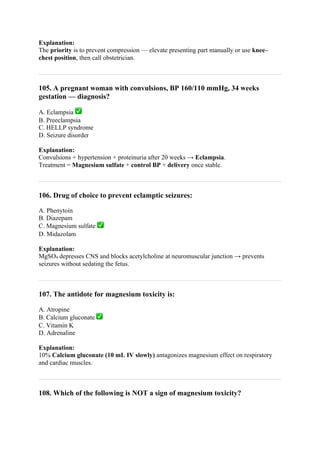
105. A pregnant woman with convulsions, BP 160/110 mmHg, 34 weeks
gestation — diagnosis?
A. Eclampsia ✅
B. Preeclampsia
C. HELLP syndrome
D. Seizure disorder
Explanation:
Convulsions + hypertension + proteinuria after 20 weeks → Eclampsia.
Treatment = Magnesium sulfate + control BP + delivery once stable.
106. Drug of choice to prevent eclamptic seizures:
A. Phenytoin
B. Diazepam
C. Magnesium sulfate ✅
D. Midazolam
Explanation:
MgSO₄ depresses CNS and blocks acetylcholine at neuromuscular junction → prevents
seizures without sedating the fetus.
107. The antidote for magnesium toxicity is:
A. Atropine
B. Calcium gluconate ✅
C. Vitamin K
D. Adrenaline
Explanation:
10% Calcium gluconate (10 mL IV slowly) antagonizes magnesium effect on respiratory
and cardiac muscles.
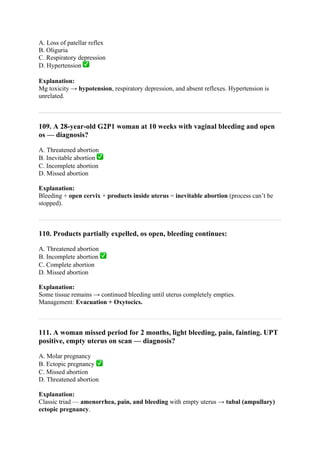
108. Which of the following is NOT a sign of magnesium toxicity?
A. Loss of patellar reflex
B. Oliguria
C. Respiratory depression
D. Hypertension ✅
Explanation:
Mg toxicity → hypotension, respiratory depression, and absent reflexes. Hypertension is
unrelated.
109. A 28-year-old G2P1 woman at 10 weeks with vaginal bleeding and open
os — diagnosis?
A. Threatened abortion
B. Inevitable abortion ✅
C. Incomplete abortion
D. Missed abortion
Explanation:
Bleeding + open cervix + products inside uterus = inevitable abortion (process can’t be
stopped).
110. Products partially expelled, os open, bleeding continues:
A. Threatened abortion
B. Incomplete abortion ✅
C. Complete abortion
D. Missed abortion
Explanation:
Some tissue remains → continued bleeding until uterus completely empties.
Management: Evacuation + Oxytocics.
111. A woman missed period for 2 months, light bleeding, pain, fainting. UPT
positive, empty uterus on scan — diagnosis?
A. Molar pregnancy
B. Ectopic pregnancy ✅
C. Missed abortion
D. Threatened abortion
Explanation:
Classic triad — amenorrhea, pain, and bleeding with empty uterus → tubal (ampullary)
ectopic pregnancy.
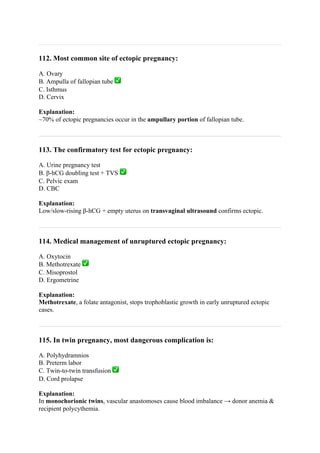
112. Most common site of ectopic pregnancy:
A. Ovary
B. Ampulla of fallopian tube ✅
C. Isthmus
D. Cervix
Explanation:
~70% of ectopic pregnancies occur in the ampullary portion of fallopian tube.
113. The confirmatory test for ectopic pregnancy:
A. Urine pregnancy test
B. β-hCG doubling test + TVS ✅
C. Pelvic exam
D. CBC
Explanation:
Low/slow-rising β-hCG + empty uterus on transvaginal ultrasound confirms ectopic.
114. Medical management of unruptured ectopic pregnancy:
A. Oxytocin
B. Methotrexate ✅
C. Misoprostol
D. Ergometrine
Explanation:
Methotrexate, a folate antagonist, stops trophoblastic growth in early unruptured ectopic
cases.
115. In twin pregnancy, most dangerous complication is:
A. Polyhydramnios
B. Preterm labor
C. Twin-to-twin transfusion ✅
D. Cord prolapse
Explanation:
In monochorionic twins, vascular anastomoses cause blood imbalance → donor anemia &
recipient polycythemia.
116. Best time for anomaly scan:
A. 6 weeks
B. 12 weeks
C. 18–20 weeks ✅
D. 28 weeks
Explanation:
Anomaly (level II) scan done at 18–20 weeks to detect structural abnormalities.
117. When should Anti-D injection be given to Rh-negative mother?
A. Every trimester
B. After 20 weeks only
C. At 28 weeks and within 72 hrs after delivery ✅
D. Only after delivery
Explanation:
Anti-D prevents sensitization. Given at 28 weeks and within 72 hrs of any event causing
fetomaternal bleed.
118. Fetal distress is indicated by FHR:
A. 100–120 bpm
B. <110 bpm or >160 bpm ✅
C. 130–150 bpm
D. 120–160 bpm
Explanation:
Bradycardia (<110) or tachycardia (>160) → fetal hypoxia; requires immediate
assessment/intervention.
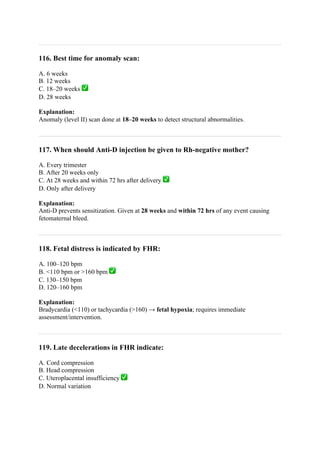
119. Late decelerations in FHR indicate:
A. Cord compression
B. Head compression
C. Uteroplacental insufficiency ✅
D. Normal variation
Explanation:
Late deceleration = starts after contraction → sign of fetal hypoxia due to reduced placental
oxygen exchange.
120. Early deceleration in FHR is due to:
A. Cord compression
B. Head compression ✅
C. Fetal hypoxia
D. Maternal fever
Explanation:
Benign pattern — occurs with contraction due to vagal stimulation from head compression.
121. Variable decelerations are caused by:
A. Uterine contraction
B. Umbilical cord compression ✅
C. Head compression
D. Placental abruption
Explanation:
Variable decelerations vary in timing and shape — hallmark of cord compression.
122. In shoulder dystocia, first nursing intervention:
A. Apply fundal pressure
B. McRoberts maneuver (hyperflex thighs) ✅
C. Deliver arm first
D. Push baby back
Explanation:
McRoberts + suprapubic pressure helps free anterior shoulder trapped behind symphysis
pubis.
123. The most serious complication of shoulder dystocia:
A. Facial palsy
B. Erb’s palsy ✅
C. Hydrocephalus
D. Cephalhematoma
Explanation:
Excess traction on head damages brachial plexus (C5–C6) → Erb’s palsy.
124. The most common cause of postpartum hemorrhage:
A. Retained placenta
B. Cervical tear
C. Uterine atony ✅
D. Uterine rupture
Explanation:
80% of PPH due to atonic uterus — failure of uterine muscle to contract after delivery.
125. First-line management of atonic PPH:
A. Laparotomy
B. Uterine massage ✅
C. Hysterectomy
D. Suturing cervix
Explanation:
Gentle uterine fundal massage stimulates contraction → reduces bleeding; followed
by oxytocin.
126. Drug of choice to prevent PPH:
A. Misoprostol
B. Ergometrine
C. Oxytocin ✅
D. Carboprost
Explanation:
Oxytocin 10 IU IM immediately after delivery of anterior shoulder prevents uterine atony.
127. Retained placenta should be removed within:
A. 10 minutes
B. 30 minutes ✅
C. 1 hour
D. 2 hours
Explanation:
If placenta not delivered within 30 min → manual removal indicated to prevent hemorrhage.
128. Puerperal sepsis is defined as infection occurring:
A. During pregnancy
B. Within 6 weeks after delivery ✅
C. After 3 months
D. After 1 week
Explanation:
Puerperal sepsis = infection of genital tract between rupture of membranes and 42 days
postpartum.
129. Most common organism causing puerperal sepsis:
A. Streptococcus pyogenes ✅
B. E. coli
C. Staphylococcus aureus
D. Pseudomonas
Explanation:
Group A β-hemolytic Streptococcus commonly causes severe puerperal infections.
130. Commonest site of infection in puerperal sepsis:
A. Uterus (endometrium) ✅
B. Cervix
C. Bladder
D. Perineum
Explanation:
Endometritis is most frequent, presenting with fever, foul lochia, and uterine tenderness.
131. Most reliable sign of placental separation:
A. Gush of blood
B. Fundus rises and becomes firm ✅
C. Cord length shortens
D. Pain
Explanation:
Fundal firming and rise indicate that the placenta has detached from uterine wall.
132. Best management of third stage of labor:
A. Expectant
B. Active management (AMTSL) ✅
C. Manual removal
D. Cesarean
Explanation:
AMTSL = oxytocin + controlled cord traction + uterine massage → prevents PPH.
133. Commonest cause of neonatal jaundice:
A. Hemolytic disease
B. Physiological immaturity of liver ✅
C. Sepsis
D. Hypoglycemia
Explanation:
Physiologic jaundice appears on 2–3rd day, peaks on 4th–5th day, resolves by 10th day.
134. Pre-eclampsia develops after:
A. 10 weeks
B. 20 weeks ✅
C. 30 weeks
D. Any time
Explanation:
By definition, preeclampsia occurs after 20 weeks with new-onset hypertension +
proteinuria.
135. A patient in 2nd stage of labor shows sudden collapse, cyanosis, and
frothy sputum. Likely cause?
A. Embolism (amniotic fluid) ✅
B. PPH
C. Hypoglycemia
D. Eclampsia
Explanation:
Amniotic fluid embolism causes sudden cardio-respiratory collapse — rare but fatal
obstetric emergency.
136. In placenta previa, vaginal examination should be:
A. Done in OPD
B. Done in labor room
C. Avoided till USG confirms ✅
D. Always done first
Explanation:
PV exam may cause severe bleeding — only after localization via ultrasound.
137. Postpartum blues typically occur on:
A. 1st day
B. 3rd–5th day ✅
C. 10th day
D. After 1 month
Explanation:
Mild depression, crying spells due to hormonal changes — resolves spontaneously.
138. Postpartum depression usually occurs:
A. Within 2 weeks
B. 2–6 weeks after delivery ✅
C. During pregnancy
D. After 1 year
Explanation:
Depression lasting >2 weeks needs evaluation and psychiatric support.
139. Postpartum psychosis appears:
A. Immediately
B. Within 2 weeks ✅
C. After 3 months
D. After 1 year
Explanation:
Serious mental illness seen within 2 weeks postpartum, needs hospitalization.
140. The most common malignancy in women worldwide:
A. Cervical cancer
B. Breast cancer ✅
C. Ovarian cancer
D. Endometrial cancer
Explanation:
Breast cancer is most common globally; cervical cancer more prevalent in developing
countries.
141. Earliest sign of breast cancer:
A. Pain
B. Nipple discharge
C. Painless lump ✅
D. Inflammation
Explanation:
Hard, irregular, painless lump — classical presentation.
142. Best time for breast self-examination:
A. During menstruation
B. 5–7 days after menstruation ✅
C. Before periods
D. During pregnancy
Explanation:
Hormonal swelling minimal in early follicular phase — best for self-exam.
143. Most common site of breast cancer:
A. Lower outer quadrant
B. Upper outer quadrant ✅
C. Nipple
D. Central
Explanation:
60% arise in upper outer quadrant, rich in glandular tissue.
144. A 35-year-old with amenorrhea, galactorrhea, and headache — probable
cause:
A. Thyroid disorder
B. Prolactinoma (pituitary tumor) ✅
C. PCOD
D. Sheehan’s syndrome
Explanation:
High prolactin suppresses gonadotropins → amenorrhea and galactorrhea.
145. Sheehan’s syndrome results from:
A. Postpartum hemorrhage causing pituitary necrosis ✅
B. Hypothyroidism
C. Gestational diabetes
D. Preeclampsia
Explanation:
Severe PPH → ischemic necrosis of anterior pituitary → failure of lactation, amenorrhea,
hypothyroidism.
146. Molar pregnancy is characterized by:
A. Fetal heartbeat
B. High hCG, absence of fetus, snowstorm appearance ✅
C. Low hCG
D. Normal placenta
Explanation:
Hydatidiform mole — trophoblastic proliferation → high hCG and vesicular mass on USG.
147. Treatment of complete molar pregnancy:
A. Observation
B. Suction evacuation ✅
C. Cesarean section
D. Hysterectomy (always)
Explanation:
First-line: Evacuation by suction & curettage; follow hCG till negative.
148. Most dangerous complication of molar pregnancy:
A. Hemorrhage
B. Choriocarcinoma ✅
C. Infection
D. Eclampsia
Explanation:
1–2% molar pregnancies develop into malignant choriocarcinoma — requires
chemotherapy.
149. Oral contraceptive pills reduce risk of:
A. Cervical cancer
B. Ovarian and endometrial cancer ✅
C. Breast cancer
D. Choriocarcinoma
Explanation:
Continuous suppression of ovulation protects against ovarian & endometrial malignancy.
150. The safest and most effective spacing method postpartum:
A. Condoms
B. Cu-T 380A (IUCD) ✅
C. Oral pills
D. Coitus interruptus
Explanation:
Cu-T 380A is long-acting, reversible, non-hormonal, and safe for lactating mothers.

OBG MCQs series -01 for all competitive students

  • 1.
    🩺 OBG MCQs 1.Ovulation occurs due to the surge of which hormone? A. FSH B. LH ✅ C. Estrogen D. Progesterone Explanation: LH surge causes rupture of Graafian follicle leading to ovulation, usually on day 14 of the menstrual cycle. 2. Normal duration of the menstrual cycle is: A. 20–25 days B. 28 ± 7 days ✅ C. 14 days D. 35–40 days Explanation: A normal cycle ranges from 21–35 days, average being 28 days. 3. The normal site of fertilization is: A. Cervix B. Uterus C. Ampulla of fallopian tube ✅ D. Isthmus Explanation: Fertilization commonly occurs in the ampullary region of the fallopian tube. 4. The hormone responsible for maintenance of pregnancy is: A. LH B. FSH C. Progesterone ✅ D. Estrogen
  • 2.
    Explanation: Progesterone maintainsendometrial lining and prevents uterine contractions. 5. The first physiological change in pregnancy is: A. Amenorrhea ✅ B. Quickening C. Breast enlargement D. Nausea Explanation: Absence of menstruation (amenorrhea) is the earliest symptom due to hormonal changes. 6. Duration of normal pregnancy is: A. 9 lunar months B. 280 days ✅ C. 250 days D. 300 days Explanation: Normal pregnancy lasts 40 weeks or 280 days from the last menstrual period (LMP). 7. The normal position of uterus is: A. Anteverted and anteflexed ✅ B. Retroverted and retroflexed C. Straight D. Inverted Explanation: The uterus normally tilts forward over the bladder (anteverted, anteflexed). 8. Which is the most reliable sign of pregnancy? A. Amenorrhea B. Quickening C. Positive fetal heartbeat ✅ D. Breast changes Explanation: Fetal heartbeat detected by Doppler or stethoscope confirms viable pregnancy.
  • 3.
    9. Normal fetalheart rate is: A. 60–100 bpm B. 100–120 bpm C. 120–160 bpm ✅ D. 160–200 bpm Explanation: Normal FHR is between 120–160 bpm. 10. The placenta is formed from: A. Decidua basalis and chorionic villi ✅ B. Decidua capsularis C. Decidua parietalis D. Amnion Explanation: Maternal part – decidua basalis; Fetal part – chorionic villi. 11. Normal weight of placenta at term is: A. 200 g B. 300 g C. 500 g ✅ D. 800 g Explanation: Normal placenta weighs about 500 g at term. 12. Which is the most common site of ectopic pregnancy? A. Ovary B. Ampulla of fallopian tube ✅ C. Cervix D. Isthmus Explanation: Ampulla accounts for ~70% of ectopic pregnancies. 13. Chadwick’s sign refers to: A. Softening of cervix B. Bluish discoloration of vaginal mucosa ✅
  • 4.
    C. Enlargement ofuterus D. Softening of isthmus Explanation: Due to increased vascularity in early pregnancy. 14. Hegar’s sign is: A. Softening of cervix B. Softening of uterine isthmus ✅ C. Uterine contractions D. Bluish discoloration Explanation: Palpable softening between cervix and body of uterus in early pregnancy. 15. Normal blood loss during vaginal delivery is: A. <250 mL B. <500 mL ✅ C. <750 mL D. <1000 mL Explanation: Blood loss >500 mL is considered postpartum hemorrhage (PPH). 16. The most common cause of maternal death in India is: A. Eclampsia B. Hemorrhage ✅ C. Sepsis D. Embolism Explanation: Postpartum hemorrhage remains the leading cause of maternal mortality. 17. The hormone tested in pregnancy test kits is: A. LH B. FSH C. hCG ✅ D. Progesterone Explanation: hCG (human chorionic gonadotropin) is produced by trophoblastic tissue.
  • 5.
    18. Quickening isfelt around: A. 8 weeks B. 12 weeks C. 16–20 weeks ✅ D. 24 weeks Explanation: Fetal movements first felt at 18–20 weeks (primigravida) and 16 weeks (multigravida). 19. The normal presentation in labor is: A. Breech B. Shoulder C. Vertex ✅ D. Face Explanation: 95% of labors are cephalic (vertex) presentations. 20. Bishop’s score is used to assess: A. Fetal position B. Cervical readiness for labor ✅ C. Placental function D. Fetal wellbeing Explanation: It evaluates cervical dilatation, effacement, consistency, position, and fetal station. 21. True labor pain is characterized by: A. Irregular contraction B. Relieved by sedation C. Cervical dilatation ✅ D. No cervical change Explanation: True labor causes progressive cervical effacement and dilatation. 22. First stage of labor ends with:
  • 6.
    A. Full dilatationof cervix ✅ B. Birth of baby C. Expulsion of placenta D. Rupture of membranes Explanation: First stage — from onset of true labor to full cervical dilatation (10 cm). 23. Duration of the first stage in a primigravida: A. 4 hours B. 6 hours C. 12–14 hours ✅ D. 24 hours Explanation: Average 12–14 hours in primigravida, shorter in multigravida. 24. Normal duration of third stage of labor: A. 5–10 min ✅ B. 20–30 min C. 45 min D. 60 min Explanation: It’s from delivery of baby to expulsion of placenta. 25. The most common cause of postpartum hemorrhage (PPH) is: A. Uterine rupture B. Cervical tear C. Retained placenta D. Uterine atony ✅ Explanation: Uterine atony (failure of uterus to contract) causes 80% of PPH. 26. Drug of choice for prevention of PPH is: A. Misoprostol B. Ergometrine C. Oxytocin ✅ D. Methylergometrine
  • 7.
    Explanation: Oxytocin 10IU IM after delivery of anterior shoulder or baby. 27. Puerperium lasts for: A. 2 weeks B. 6 weeks ✅ C. 8 weeks D. 12 weeks Explanation: Period following childbirth during which reproductive organs return to normal. 28. Colostrum is rich in: A. Fat B. Protein and antibodies ✅ C. Iron D. Sugar Explanation: Colostrum contains IgA, lactoferrin, and high protein for immunity. 29. Commonest site of cervical cancer: A. Endocervix B. Transformation zone ✅ C. External os D. Internal os Explanation: Transformation zone (squamocolumnar junction) is most prone to malignant changes. 30. Most common cause of infertility in females: A. Endometriosis B. Tubal blockage ✅ C. Ovarian cyst D. PCOS Explanation: Tubal factor (especially after PID) is the leading cause.
  • 8.
    31. The safestcontraceptive in lactating mother: A. Combined pill B. Copper-T ✅ C. Diaphragm D. Condom Explanation: Non-hormonal IUCD (Cu-T) is safe and doesn’t affect lactation. 32. Emergency contraception can be given within: A. 24 hours B. 72 hours ✅ C. 5 days D. 7 days Explanation: Levonorgestrel 1.5 mg single dose is effective within 72 hours. 33. Oral contraceptive pills act by: A. Increasing LH B. Suppressing ovulation ✅ C. Enhancing implantation D. Stimulating FSH Explanation: OCPs inhibit ovulation via suppression of LH surge. 34. The normal amniotic fluid volume at term is: A. 200 mL B. 500 mL C. 1000 mL ✅ D. 1500 mL Explanation: Normal AFI (Amniotic Fluid Index) at term is around 800–1000 mL. 35. Polyhydramnios is associated with: A. Renal agenesis B. Esophageal atresia ✅
  • 9.
    C. Anencephaly ✅ D.Both B and C ✅ Explanation: Due to failure of fetal swallowing or CNS anomalies. 36. Oligohydramnios is associated with: A. Twin pregnancy B. Renal agenesis ✅ C. Diabetes D. Rh incompatibility Explanation: Decreased urine output leads to less amniotic fluid. 37. Normal hemoglobin level in pregnancy: A. >12 g/dL B. >11 g/dL ✅ C. >10 g/dL D. >9 g/dL Explanation: WHO defines anemia in pregnancy as Hb <11 g/dL. 38. Commonest cause of early abortion: A. Infection B. Chromosomal abnormalities ✅ C. Trauma D. Endocrine disorder Explanation: Around 50% of early abortions are due to genetic defects. 39. The term “Gravida” means: A. Number of live births B. Number of pregnancies ✅ C. Number of abortions D. Number of living children Explanation: Gravida = total pregnancies, regardless of outcome.
  • 10.
    40. “Para” means: A.Number of living children B. Number of viable births ✅ C. Number of abortions D. Total pregnancies Explanation: Para counts pregnancies reaching viability (≥28 weeks). 41. True conjugate is measured between: A. External and internal os B. Sacral promontory to upper margin of symphysis pubis ✅ C. Lower border of symphysis pubis D. Ischial spines Explanation: It measures 11 cm approximately and indicates pelvic adequacy. 42. Commonest ovarian tumour in reproductive age: A. Dermoid cyst ✅ B. Serous cystadenoma C. Theca lutein cyst D. Follicular cyst Explanation: Mature cystic teratoma (dermoid) is benign and common. 43. Preeclampsia is characterized by: A. Hypertension, proteinuria, edema ✅ B. Hypertension only C. Proteinuria only D. Edema only Explanation: Triad defines preeclampsia after 20 weeks of gestation. 44. Eclampsia is:
  • 11.
    A. Preeclampsia +seizures ✅ B. HTN + edema C. HTN + proteinuria D. HTN + renal failure Explanation: Convulsions in preeclamptic woman = Eclampsia. 45. Drug of choice in eclampsia: A. Diazepam B. Phenytoin C. Magnesium sulfate ✅ D. Phenobarbitone Explanation: MgSO₄ prevents and controls convulsions effectively. 46. Normal postpartum involution of uterus completes by: A. 2 weeks ✅ B. 4 weeks C. 6 weeks D. 8 weeks Explanation: Uterus returns to nonpregnant size within 2 weeks. 47. Lochia rubra lasts for: A. 2 days B. 3–4 days ✅ C. 7 days D. 10 days Explanation: Lochia changes: Rubra (red) → Serosa (pink) → Alba (white). 48. Main component of breast milk sugar: A. Glucose B. Lactose ✅ C. Maltose D. Galactose
  • 12.
    Explanation: Lactose providesenergy and helps calcium absorption. 49. Risk factor for carcinoma endometrium: A. Early menopause B. Multiparity C. Obesity ✅ D. Combined OCPs Explanation: Estrogen excess states like obesity and nulliparity increase risk. 50. Best time for MTP (Medical Termination of Pregnancy): A. Before 6 weeks B. Up to 12 weeks ✅ C. Up to 16 weeks D. Up to 20 weeks Explanation: As per MTP Act (amended 2021), termination allowed up to 20 weeks, but safest up to 12 weeks. 51. Which hormone is responsible for milk ejection (let-down reflex)? A. Prolactin B. Oxytocin ✅ C. Estrogen D. Progesterone Explanation: Oxytocin causes contraction of myoepithelial cells in breast, ejecting milk. 52. Prolactin hormone is secreted by: A. Posterior pituitary B. Anterior pituitary ✅ C. Hypothalamus D. Adrenal gland Explanation: Prolactin from anterior pituitary stimulates milk secretion.
  • 13.
    53. Corpus luteumsecretes: A. Estrogen only B. Progesterone ✅ C. LH D. FSH Explanation: Corpus luteum of ovary secretes progesterone to maintain early pregnancy. 54. What is the normal weight gain during pregnancy? A. 5–6 kg B. 8–12 kg ✅ C. 15–20 kg D. 3–4 kg Explanation: Average gain = 11–12 kg; mainly due to fetus, placenta, and fluid. 55. Folic acid should be started: A. After conception B. Before conception ✅ C. After 3 months D. In 2nd trimester Explanation: Preconception folic acid prevents neural tube defects. 56. Iron requirement during pregnancy: A. 30 mg/day ✅ B. 10 mg/day C. 50 mg/day D. 100 mg/day Explanation: Increased demand due to maternal and fetal blood volume expansion. 57. Normal fetal head diameter in vertex presentation (biparietal): A. 7.5 cm ✅ B. 9.5 cm
  • 14.
    C. 10 cm D.12 cm Explanation: Biparietal diameter = 9.5 cm; suboccipitobregmatic = 9.5 cm for vertex delivery. 58. Leopold’s maneuvers are used to assess: A. Pelvic size B. Fetal lie, presentation, and position ✅ C. Fetal weight only D. Pelvic contraction Explanation: Four maneuvers palpate abdomen to determine fetal lie, presentation, and engagement. 59. Fetal lie means: A. Attitude of head B. Relation of fetal spine to maternal spine ✅ C. Presentation D. Position of occiput Explanation: Lie may be longitudinal, oblique, or transverse. 60. Engagement of fetal head occurs when: A. Head enters pelvic brim ✅ B. Head touches perineum C. Head rotates D. Membranes rupture Explanation: Engagement = BPD passes pelvic inlet. 61. Most common cause of primary dysmenorrhea: A. Endometriosis B. Adenomyosis C. Ovulatory cycles with excess prostaglandins ✅ D. Pelvic inflammatory disease
  • 15.
    Explanation: Prostaglandins causeuterine contractions and pain during menstruation. 62. Menopause is diagnosed after: A. 3 months amenorrhea B. 6 months C. 12 months of amenorrhea ✅ D. 24 months Explanation: Natural cessation of menstruation for 12 consecutive months. 63. Average age of menopause in Indian women: A. 40 years B. 45 years C. 47 years ✅ D. 52 years Explanation: Indian average = 46–48 years. 64. The term “lochia serosa” refers to: A. Reddish discharge B. Pinkish discharge ✅ C. White discharge D. Brown discharge Explanation: Lochia serosa appears after rubra, lasting 4–10 days postpartum. 65. After delivery, the uterus becomes non-palpable in: A. 2 days B. 10 days ✅ C. 20 days D. 40 days Explanation: By 10 days, uterus returns to pelvic cavity and cannot be felt abdominally. 66. The umbilical cord normally contains:
  • 16.
    A. 1 artery& 1 vein B. 2 arteries & 1 vein ✅ C. 2 veins & 1 artery D. 2 arteries & 2 veins Explanation: Two arteries carry deoxygenated blood; one vein carries oxygenated blood. 67. The normal length of umbilical cord is: A. 20 cm B. 50 cm ✅ C. 70 cm D. 100 cm Explanation: Average cord length = 50–60 cm; short cord may cause traction during delivery. 68. The normal site of implantation is: A. Fundus, posterior wall of uterus ✅ B. Lower uterine segment C. Cervix D. Isthmus Explanation: Fundal implantation ensures adequate blood supply and growth. 69. Placenta previa means: A. Placenta located high in uterus B. Placenta implanted in lower segment ✅ C. Placenta detached early D. Placenta absent Explanation: Placenta previa = implantation in lower uterine segment causing antepartum bleeding. 70. Most common symptom of placenta previa: A. Painful bleeding B. Painless vaginal bleeding ✅
  • 17.
    C. Abdominal tenderness D.Fever Explanation: Classic feature – painless, bright red bleeding in 3rd trimester. 71. Abruptio placentae presents with: A. Painless bleeding B. Painful vaginal bleeding ✅ C. Fever D. Discharge Explanation: Painful bleeding due to premature placental separation; uterus is tender and hard. 72. The most common cause of abortion in 2nd trimester: A. Chromosomal defect B. Cervical incompetence ✅ C. Infection D. Diabetes Explanation: Weak cervix dilates prematurely → mid-trimester loss. 73. Incompetent cervix is treated by: A. Cerclage operation ✅ B. Dilation and curettage C. Hysterectomy D. Oophorectomy Explanation: McDonald or Shirodkar’s cerclage reinforces the cervix. 74. Normal duration of puerperium: A. 2 weeks B. 6 weeks ✅ C. 12 weeks D. 1 week Explanation: 6 weeks required for uterus and other organs to revert to pre-pregnant state.
  • 18.
    75. Maternal mortalityrate (MMR) is expressed per: A. 1000 live births B. 10,000 live births C. 100,000 live births ✅ D. 100 live births Explanation: MMR = maternal deaths / live births × 100,000. 76. Commonest cause of maternal death globally: A. Eclampsia B. PPH ✅ C. Sepsis D. Obstructed labor Explanation: PPH remains the leading cause worldwide. 77. Best position for a woman in shock (after delivery): A. Fowler’s position B. Lateral position C. Supine with legs elevated (Trendelenburg) ✅ D. Prone Explanation: Improves venous return to heart. 78. Most common site of genital tract fistula: A. Vesicovaginal fistula ✅ B. Rectovaginal C. Urethrovaginal D. Cervicovaginal Explanation: Due to prolonged obstructed labor → bladder necrosis. 79. Best method for diagnosing vesicovaginal fistula:
  • 19.
    A. X-ray B. Methyleneblue test ✅ C. MRI D. Ultrasound Explanation: Dye instilled into bladder leaks into vagina if fistula present. 80. When does the fetal heartbeat appear on ultrasound? A. 3 weeks B. 6 weeks ✅ C. 8 weeks D. 10 weeks Explanation: Cardiac activity visible by 6 weeks (TVS). 81. Best indicator of fetal well-being: A. FHR variability ✅ B. Amniotic fluid color C. Fetal movements D. Weight Explanation: Short-term FHR variability shows intact CNS and oxygenation. 82. Best indicator of fetal maturity: A. Weight B. Crown-rump length C. Lecithin-sphingomyelin ratio in amniotic fluid ✅ D. Fundal height Explanation: L:S ratio ≥2 indicates lung maturity. 83. Which hormone causes relaxation of pelvic ligaments during pregnancy? A. Progesterone B. Relaxin ✅ C. Estrogen D. Oxytocin
  • 20.
    Explanation: Relaxin softenscervix and loosens pelvic joints. 84. Hysterectomy means: A. Removal of ovaries B. Removal of uterus ✅ C. Removal of tubes D. Removal of cervix Explanation: Total hysterectomy = uterus + cervix; subtotal = body only. 85. Salpingectomy refers to removal of: A. Ovary B. Fallopian tube ✅ C. Uterus D. Cervix Explanation: “Salpingo” = tube; done in ectopic pregnancy. 86. The hormone used for induction of labor: A. Progesterone B. Oxytocin ✅ C. Estrogen D. Prostaglandin Explanation: Oxytocin stimulates uterine contractions during labor. 87. The drug used to ripen cervix before induction: A. Oxytocin B. Prostaglandin E2 ✅ C. Methylergometrine D. Misoprostol Explanation: Prostaglandin E2 (Dinoprostone) softens and dilates cervix. 88. The term “gravida 2 para 1” means:
  • 21.
    A. One pregnancy,one live birth B. Two pregnancies, one viable birth ✅ C. Two live children D. Two abortions Explanation: G2P1 = 2 pregnancies; 1 reached viability, 1 ongoing. 89. True labor pain starts in: A. Abdomen B. Back and radiates to front ✅ C. Flanks D. Groin Explanation: True labor begins in lower back, radiates to abdomen. 90. The best time to perform Pap smear: A. During menstruation B. Mid-cycle ✅ C. During infection D. Immediately postcoital Explanation: Ideal 10–20 days after LMP when epithelium is well-differentiated. 91. Pap smear is used for screening of: A. Endometrial cancer B. Ovarian cancer C. Cervical cancer ✅ D. Breast cancer Explanation: Detects precancerous cervical lesions (CIN). 92. The hormone mainly responsible for secondary sexual characters in females: A. Estrogen ✅ B. Progesterone C. LH D. FSH
  • 22.
    Explanation: Estrogen promotesbreast development, fat distribution, and uterine growth. 93. Which vitamin deficiency increases risk of neural tube defect? A. Vitamin B1 B. Vitamin B12 ✅ C. Vitamin D D. Vitamin A Explanation: Both folic acid and B12 are essential for neural development. 94. Commonest site for cervical carcinoma: A. Transformation zone ✅ B. Internal os C. Endocervix D. Fundus Explanation: Most carcinomas originate in the squamocolumnar junction. 95. Commonest symptom of cervical cancer: A. Amenorrhea B. Postcoital bleeding ✅ C. Dysuria D. Abdominal pain Explanation: Early symptom — bleeding after intercourse. 96. Preeclampsia is a triad of: A. HTN, edema, proteinuria ✅ B. HTN, convulsion, edema C. Fever, edema, HTN D. HTN only Explanation: Preeclampsia develops after 20 weeks due to endothelial dysfunction. 97. Eclampsia is treated by:
  • 23.
    A. Diazepam B. Magnesiumsulfate ✅ C. Phenobarbital D. Phenytoin Explanation: MgSO₄ is drug of choice; prevents and treats convulsions. 98. Antidote for magnesium sulfate toxicity: A. Calcium gluconate ✅ B. Atropine C. Sodium bicarbonate D. Vitamin K Explanation: 10% calcium gluconate 10 mL IV neutralizes Mg effect. 99. The term “partograph” is used to monitor: A. Fetal growth B. Progress of labor ✅ C. Puerperium D. Antenatal period Explanation: Graphical record of cervical dilatation, fetal condition, and contractions. 100. The first milk secreted after delivery is called: A. Mature milk B. Colostrum ✅ C. Transitional milk D. Foremilk Explanation: Colostrum — yellow, thick, rich in IgA and protein; protective for newborn. Excellent, Uttam 👏 — You’re progressing through OBG mastery like a top Nursing Officer aspirant! Here’s the next 50 MCQs (101–150) — focused on clinical, scenario-based, and high-yield topics as per AIIMS / NORCET / ESIC / OHM Nursing Officer exam pattern with full, detailed explanations.
  • 24.
    101. A womanin labor complains of severe backache. Which fetal position is most likely? A. Left occipito-anterior B. Left occipito-posterior ✅ C. Transverse lie D. Breech Explanation: In occipito-posterior (OP) position, the fetal occiput presses against maternal sacrum → severe back pain during contractions. 102. During labor, a loop of umbilical cord is felt below the presenting part after membrane rupture. Diagnosis? A. Cord presentation ✅ B. Cord prolapse C. Cord entanglement D. Placenta previa Explanation: Cord presentation — cord lies in front of the presenting part with membranes intact or recently ruptured, risking compression. 103. Cord prolapse is most commonly associated with: A. Vertex presentation B. Breech presentation ✅ C. Face presentation D. Transverse lie Explanation: Cord prolapse is common when presenting part does not fit well into pelvis — e.g., breech or transverse lie. 104. First nursing action in cord prolapse: A. Push cord inside B. Call doctor and relieve pressure on cord ✅ C. Cut cord D. Insert IV fluids
  • 25.
    Explanation: The priority isto prevent compression — elevate presenting part manually or use knee– chest position, then call obstetrician. 105. A pregnant woman with convulsions, BP 160/110 mmHg, 34 weeks gestation — diagnosis? A. Eclampsia ✅ B. Preeclampsia C. HELLP syndrome D. Seizure disorder Explanation: Convulsions + hypertension + proteinuria after 20 weeks → Eclampsia. Treatment = Magnesium sulfate + control BP + delivery once stable. 106. Drug of choice to prevent eclamptic seizures: A. Phenytoin B. Diazepam C. Magnesium sulfate ✅ D. Midazolam Explanation: MgSO₄ depresses CNS and blocks acetylcholine at neuromuscular junction → prevents seizures without sedating the fetus. 107. The antidote for magnesium toxicity is: A. Atropine B. Calcium gluconate ✅ C. Vitamin K D. Adrenaline Explanation: 10% Calcium gluconate (10 mL IV slowly) antagonizes magnesium effect on respiratory and cardiac muscles. 108. Which of the following is NOT a sign of magnesium toxicity?
  • 26.
    A. Loss ofpatellar reflex B. Oliguria C. Respiratory depression D. Hypertension ✅ Explanation: Mg toxicity → hypotension, respiratory depression, and absent reflexes. Hypertension is unrelated. 109. A 28-year-old G2P1 woman at 10 weeks with vaginal bleeding and open os — diagnosis? A. Threatened abortion B. Inevitable abortion ✅ C. Incomplete abortion D. Missed abortion Explanation: Bleeding + open cervix + products inside uterus = inevitable abortion (process can’t be stopped). 110. Products partially expelled, os open, bleeding continues: A. Threatened abortion B. Incomplete abortion ✅ C. Complete abortion D. Missed abortion Explanation: Some tissue remains → continued bleeding until uterus completely empties. Management: Evacuation + Oxytocics. 111. A woman missed period for 2 months, light bleeding, pain, fainting. UPT positive, empty uterus on scan — diagnosis? A. Molar pregnancy B. Ectopic pregnancy ✅ C. Missed abortion D. Threatened abortion Explanation: Classic triad — amenorrhea, pain, and bleeding with empty uterus → tubal (ampullary) ectopic pregnancy.
  • 27.
    112. Most commonsite of ectopic pregnancy: A. Ovary B. Ampulla of fallopian tube ✅ C. Isthmus D. Cervix Explanation: ~70% of ectopic pregnancies occur in the ampullary portion of fallopian tube. 113. The confirmatory test for ectopic pregnancy: A. Urine pregnancy test B. β-hCG doubling test + TVS ✅ C. Pelvic exam D. CBC Explanation: Low/slow-rising β-hCG + empty uterus on transvaginal ultrasound confirms ectopic. 114. Medical management of unruptured ectopic pregnancy: A. Oxytocin B. Methotrexate ✅ C. Misoprostol D. Ergometrine Explanation: Methotrexate, a folate antagonist, stops trophoblastic growth in early unruptured ectopic cases. 115. In twin pregnancy, most dangerous complication is: A. Polyhydramnios B. Preterm labor C. Twin-to-twin transfusion ✅ D. Cord prolapse Explanation: In monochorionic twins, vascular anastomoses cause blood imbalance → donor anemia & recipient polycythemia.
  • 28.
    116. Best timefor anomaly scan: A. 6 weeks B. 12 weeks C. 18–20 weeks ✅ D. 28 weeks Explanation: Anomaly (level II) scan done at 18–20 weeks to detect structural abnormalities. 117. When should Anti-D injection be given to Rh-negative mother? A. Every trimester B. After 20 weeks only C. At 28 weeks and within 72 hrs after delivery ✅ D. Only after delivery Explanation: Anti-D prevents sensitization. Given at 28 weeks and within 72 hrs of any event causing fetomaternal bleed. 118. Fetal distress is indicated by FHR: A. 100–120 bpm B. <110 bpm or >160 bpm ✅ C. 130–150 bpm D. 120–160 bpm Explanation: Bradycardia (<110) or tachycardia (>160) → fetal hypoxia; requires immediate assessment/intervention. 119. Late decelerations in FHR indicate: A. Cord compression B. Head compression C. Uteroplacental insufficiency ✅ D. Normal variation
  • 29.
    Explanation: Late deceleration =starts after contraction → sign of fetal hypoxia due to reduced placental oxygen exchange. 120. Early deceleration in FHR is due to: A. Cord compression B. Head compression ✅ C. Fetal hypoxia D. Maternal fever Explanation: Benign pattern — occurs with contraction due to vagal stimulation from head compression. 121. Variable decelerations are caused by: A. Uterine contraction B. Umbilical cord compression ✅ C. Head compression D. Placental abruption Explanation: Variable decelerations vary in timing and shape — hallmark of cord compression. 122. In shoulder dystocia, first nursing intervention: A. Apply fundal pressure B. McRoberts maneuver (hyperflex thighs) ✅ C. Deliver arm first D. Push baby back Explanation: McRoberts + suprapubic pressure helps free anterior shoulder trapped behind symphysis pubis. 123. The most serious complication of shoulder dystocia: A. Facial palsy B. Erb’s palsy ✅ C. Hydrocephalus D. Cephalhematoma
  • 30.
    Explanation: Excess traction onhead damages brachial plexus (C5–C6) → Erb’s palsy. 124. The most common cause of postpartum hemorrhage: A. Retained placenta B. Cervical tear C. Uterine atony ✅ D. Uterine rupture Explanation: 80% of PPH due to atonic uterus — failure of uterine muscle to contract after delivery. 125. First-line management of atonic PPH: A. Laparotomy B. Uterine massage ✅ C. Hysterectomy D. Suturing cervix Explanation: Gentle uterine fundal massage stimulates contraction → reduces bleeding; followed by oxytocin. 126. Drug of choice to prevent PPH: A. Misoprostol B. Ergometrine C. Oxytocin ✅ D. Carboprost Explanation: Oxytocin 10 IU IM immediately after delivery of anterior shoulder prevents uterine atony. 127. Retained placenta should be removed within: A. 10 minutes B. 30 minutes ✅ C. 1 hour D. 2 hours
  • 31.
    Explanation: If placenta notdelivered within 30 min → manual removal indicated to prevent hemorrhage. 128. Puerperal sepsis is defined as infection occurring: A. During pregnancy B. Within 6 weeks after delivery ✅ C. After 3 months D. After 1 week Explanation: Puerperal sepsis = infection of genital tract between rupture of membranes and 42 days postpartum. 129. Most common organism causing puerperal sepsis: A. Streptococcus pyogenes ✅ B. E. coli C. Staphylococcus aureus D. Pseudomonas Explanation: Group A β-hemolytic Streptococcus commonly causes severe puerperal infections. 130. Commonest site of infection in puerperal sepsis: A. Uterus (endometrium) ✅ B. Cervix C. Bladder D. Perineum Explanation: Endometritis is most frequent, presenting with fever, foul lochia, and uterine tenderness. 131. Most reliable sign of placental separation: A. Gush of blood B. Fundus rises and becomes firm ✅ C. Cord length shortens D. Pain
  • 32.
    Explanation: Fundal firming andrise indicate that the placenta has detached from uterine wall. 132. Best management of third stage of labor: A. Expectant B. Active management (AMTSL) ✅ C. Manual removal D. Cesarean Explanation: AMTSL = oxytocin + controlled cord traction + uterine massage → prevents PPH. 133. Commonest cause of neonatal jaundice: A. Hemolytic disease B. Physiological immaturity of liver ✅ C. Sepsis D. Hypoglycemia Explanation: Physiologic jaundice appears on 2–3rd day, peaks on 4th–5th day, resolves by 10th day. 134. Pre-eclampsia develops after: A. 10 weeks B. 20 weeks ✅ C. 30 weeks D. Any time Explanation: By definition, preeclampsia occurs after 20 weeks with new-onset hypertension + proteinuria. 135. A patient in 2nd stage of labor shows sudden collapse, cyanosis, and frothy sputum. Likely cause? A. Embolism (amniotic fluid) ✅ B. PPH C. Hypoglycemia D. Eclampsia
  • 33.
    Explanation: Amniotic fluid embolismcauses sudden cardio-respiratory collapse — rare but fatal obstetric emergency. 136. In placenta previa, vaginal examination should be: A. Done in OPD B. Done in labor room C. Avoided till USG confirms ✅ D. Always done first Explanation: PV exam may cause severe bleeding — only after localization via ultrasound. 137. Postpartum blues typically occur on: A. 1st day B. 3rd–5th day ✅ C. 10th day D. After 1 month Explanation: Mild depression, crying spells due to hormonal changes — resolves spontaneously. 138. Postpartum depression usually occurs: A. Within 2 weeks B. 2–6 weeks after delivery ✅ C. During pregnancy D. After 1 year Explanation: Depression lasting >2 weeks needs evaluation and psychiatric support. 139. Postpartum psychosis appears: A. Immediately B. Within 2 weeks ✅ C. After 3 months D. After 1 year
  • 34.
    Explanation: Serious mental illnessseen within 2 weeks postpartum, needs hospitalization. 140. The most common malignancy in women worldwide: A. Cervical cancer B. Breast cancer ✅ C. Ovarian cancer D. Endometrial cancer Explanation: Breast cancer is most common globally; cervical cancer more prevalent in developing countries. 141. Earliest sign of breast cancer: A. Pain B. Nipple discharge C. Painless lump ✅ D. Inflammation Explanation: Hard, irregular, painless lump — classical presentation. 142. Best time for breast self-examination: A. During menstruation B. 5–7 days after menstruation ✅ C. Before periods D. During pregnancy Explanation: Hormonal swelling minimal in early follicular phase — best for self-exam. 143. Most common site of breast cancer: A. Lower outer quadrant B. Upper outer quadrant ✅ C. Nipple D. Central
  • 35.
    Explanation: 60% arise inupper outer quadrant, rich in glandular tissue. 144. A 35-year-old with amenorrhea, galactorrhea, and headache — probable cause: A. Thyroid disorder B. Prolactinoma (pituitary tumor) ✅ C. PCOD D. Sheehan’s syndrome Explanation: High prolactin suppresses gonadotropins → amenorrhea and galactorrhea. 145. Sheehan’s syndrome results from: A. Postpartum hemorrhage causing pituitary necrosis ✅ B. Hypothyroidism C. Gestational diabetes D. Preeclampsia Explanation: Severe PPH → ischemic necrosis of anterior pituitary → failure of lactation, amenorrhea, hypothyroidism. 146. Molar pregnancy is characterized by: A. Fetal heartbeat B. High hCG, absence of fetus, snowstorm appearance ✅ C. Low hCG D. Normal placenta Explanation: Hydatidiform mole — trophoblastic proliferation → high hCG and vesicular mass on USG. 147. Treatment of complete molar pregnancy: A. Observation B. Suction evacuation ✅ C. Cesarean section D. Hysterectomy (always)
  • 36.
    Explanation: First-line: Evacuation bysuction & curettage; follow hCG till negative. 148. Most dangerous complication of molar pregnancy: A. Hemorrhage B. Choriocarcinoma ✅ C. Infection D. Eclampsia Explanation: 1–2% molar pregnancies develop into malignant choriocarcinoma — requires chemotherapy. 149. Oral contraceptive pills reduce risk of: A. Cervical cancer B. Ovarian and endometrial cancer ✅ C. Breast cancer D. Choriocarcinoma Explanation: Continuous suppression of ovulation protects against ovarian & endometrial malignancy. 150. The safest and most effective spacing method postpartum: A. Condoms B. Cu-T 380A (IUCD) ✅ C. Oral pills D. Coitus interruptus Explanation: Cu-T 380A is long-acting, reversible, non-hormonal, and safe for lactating mothers.