By Kyle. J
Manico
CONTENT OVERVIEW

 • Obesity going global video
 • How obesity is measured


 • Top 10 fatty's
 • Health issues of obesity


 • Why do we keep growing wider
 • Obesity rates doubled since the 1980’s
WHY DO WE KEEP GROWING WIDER?

Modernization
 Urbanization
  Globalization of food
    Less physical activity jobs
     Technology advancements
      Increase use of automated transport
TOP 10 FATT Y'S

Females            Males
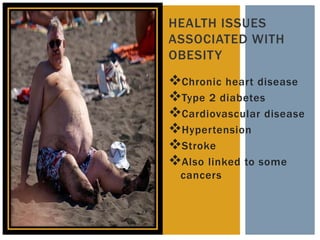
HEALTH ISSUES
ASSOCIATED WITH
OBESITY
Chronic heart disease
Type 2 diabetes
Cardiovascular disease
Hypertension
Stroke
Also linked to some
  cancers
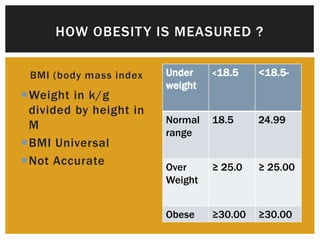
HOW OBESIT Y IS MEASURED ?

 BMI (body mass index   Under    <18.5    <18.5-
                        weight
Weight in k/g
 divided by height in
                        Normal   18.5     24.99
 M
                        range
BMI Universal
Not Accurate           Over     ≥ 25.0   ≥ 25.00
                        Weight


                        Obese    ≥30.00   ≥30.00
RATES HAVE DOUBLED SENSE 1980’S

                Obesity has spread
                Men 5% to 10%
                Women 8% to 14%
                Heaviest Developed
                Slimmest Developed
                Change now!
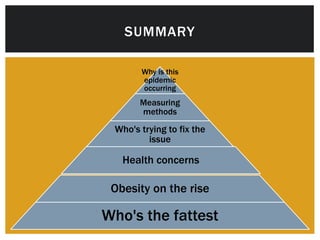
SUMMARY

       Why is this
       epidemic
       occurring
       Measuring
       methods

 Who's trying to fix the
         issue

   Health concerns

 Obesity on the rise

Who's the fattest
SOURCES

1. Overweight and Obesity. (2011 , march 3). Retrieved February
   13, 2012, from Center for Disease control and Prevention:
   http://www.cdc.gov/obesity/causes/health.html
2. Streib, L. (2007, February 8). Worlds fattest countries.
   Retrieved February 12, 2012, from Forbes:
   http://www.forbes.com/2007/02/07/worlds -fattest-countries-
   forbeslife-cx_ls_0208worldfat_2.html
3. Sturm, R. (2002). Objective analysis Effective Solutions.
   Retrieved February 12, 2012, from The health risk of obesity:
   http://www.rand.org/pubs/research_briefs/RB4549/index1 .ht
   ml
4. world health organization. (2012, April 2). World Health
   Organization. Retrieved February 10, 2012, from BMI database:
   http://apps.who.int/bmi/index.jsp?introPage=intro_3.html

Obesity around the world

  • 1.
  • 2.
    CONTENT OVERVIEW •Obesity going global video • How obesity is measured • Top 10 fatty's • Health issues of obesity • Why do we keep growing wider • Obesity rates doubled since the 1980’s
  • 3.
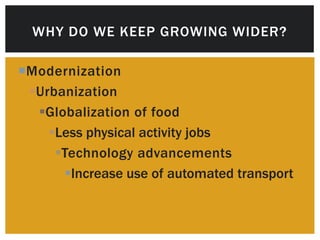
    WHY DO WEKEEP GROWING WIDER? Modernization Urbanization Globalization of food Less physical activity jobs Technology advancements Increase use of automated transport
  • 4.
    TOP 10 FATTY'S Females Males
  • 5.
    HEALTH ISSUES ASSOCIATED WITH OBESITY Chronicheart disease Type 2 diabetes Cardiovascular disease Hypertension Stroke Also linked to some cancers
  • 6.
    HOW OBESIT YIS MEASURED ? BMI (body mass index Under <18.5 <18.5- weight Weight in k/g divided by height in Normal 18.5 24.99 M range BMI Universal Not Accurate Over ≥ 25.0 ≥ 25.00 Weight Obese ≥30.00 ≥30.00
  • 7.
    RATES HAVE DOUBLEDSENSE 1980’S Obesity has spread Men 5% to 10% Women 8% to 14% Heaviest Developed Slimmest Developed Change now!
  • 8.
    SUMMARY Why is this epidemic occurring Measuring methods Who's trying to fix the issue Health concerns Obesity on the rise Who's the fattest
  • 9.
    SOURCES 1. Overweight andObesity. (2011 , march 3). Retrieved February 13, 2012, from Center for Disease control and Prevention: http://www.cdc.gov/obesity/causes/health.html 2. Streib, L. (2007, February 8). Worlds fattest countries. Retrieved February 12, 2012, from Forbes: http://www.forbes.com/2007/02/07/worlds -fattest-countries- forbeslife-cx_ls_0208worldfat_2.html 3. Sturm, R. (2002). Objective analysis Effective Solutions. Retrieved February 12, 2012, from The health risk of obesity: http://www.rand.org/pubs/research_briefs/RB4549/index1 .ht ml 4. world health organization. (2012, April 2). World Health Organization. Retrieved February 10, 2012, from BMI database: http://apps.who.int/bmi/index.jsp?introPage=intro_3.html

Editor's Notes

  • #3 Content overview of all the topics discussed in my research paper and this PowerPoint to give a overview of the world wide obesity epidemic.
  • #4 Although advancements in society and technology are extremely beneficial to society as a whole and no excuse not for exercising and eating rite it is significantly linked to the huge growth in obesity rates. Today people can do basically thing they need to behind a computer screen from shopping for groceries, to earning a degree, technology has enabled society to exert minimal physical activity to accomplish everyday tasks.
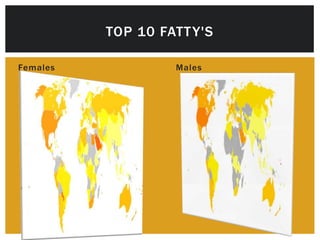
  • #5 Lightest yellow having the least amount of adults with bmi’s over 30 % to the darker being the highest and grey no data.1. Nauru 95 % 2. Micronesia 92% 3. cook islands 92 % 4. Tonga 92 percent 5. Niue 84 percent 6.samoa 83 7. palau 81 8. united states 9. kiribati 77 10. dominica 76 Naura is a a small island in the south pacific they traditionally hold many fattening ceremonies, also with the counties limitation on agricultural variety, they have diets lacking lean fish and fruits.
  • #6 Obesity is at all time highs around the world. 1 billion adults are overweight and 300 million of whom are over weight. Heart disease is a leading cause of death and obesity is a great contributor though that statistic. Other issues that have been found to be caused by obesity are chronic musculosektal problems, skin problems, infertility, respiratory difficulties and osteoarthritis.
  • #7 When determine ones body fat content for athletes and fit individuals, using methods such as skin fold test, Bioelectric impedance analysis, anthropometric, hydrostatic weighing, Dexa scan are much more accurate methods that determine that account for muscle mass.
  • #8 A small amount of country&apos;s are shown to have not been packing on the pounds over the years, including central Africa and south Asia and this is most likely due to its economic situations of having large access to food. Obesity is responsible for around 3 million death worldwide each year, this is now an epidemic. The richer countries have used to medical techniques and medicine to regulate blood pressure and cholesterol over recent years but this does not mean we are healthier. Simple things such as limiting large amounts of sodium content in prepared foods or banning trans fats could have a very positive effect on this issue. Medicine can only due so much, people needs to start living better lives.
  • #9 All theses 6 areas were covered in this presentation, together they should provide you with a bester understand of not only the seriousness of obesity but as well as its effects around the world, First step is awareness and now its time to make change with the clearly alarming statistics that are set before us.