A (20 minutes)
introduction to
    Oauth.
Roadmap

   Defining Oauth
   Why Oauth?
   Background
   Terminology
   Workflow
   Live Example
   References
   Q&A
Defining Oauth


 ”Oauth provides a method for users to
 grant third-party access to their resources
 without sharing their passwords. It also
                       passwords
 provides a way to grant limited access (in
 scope, duration, etc …)”
Why Oauth?

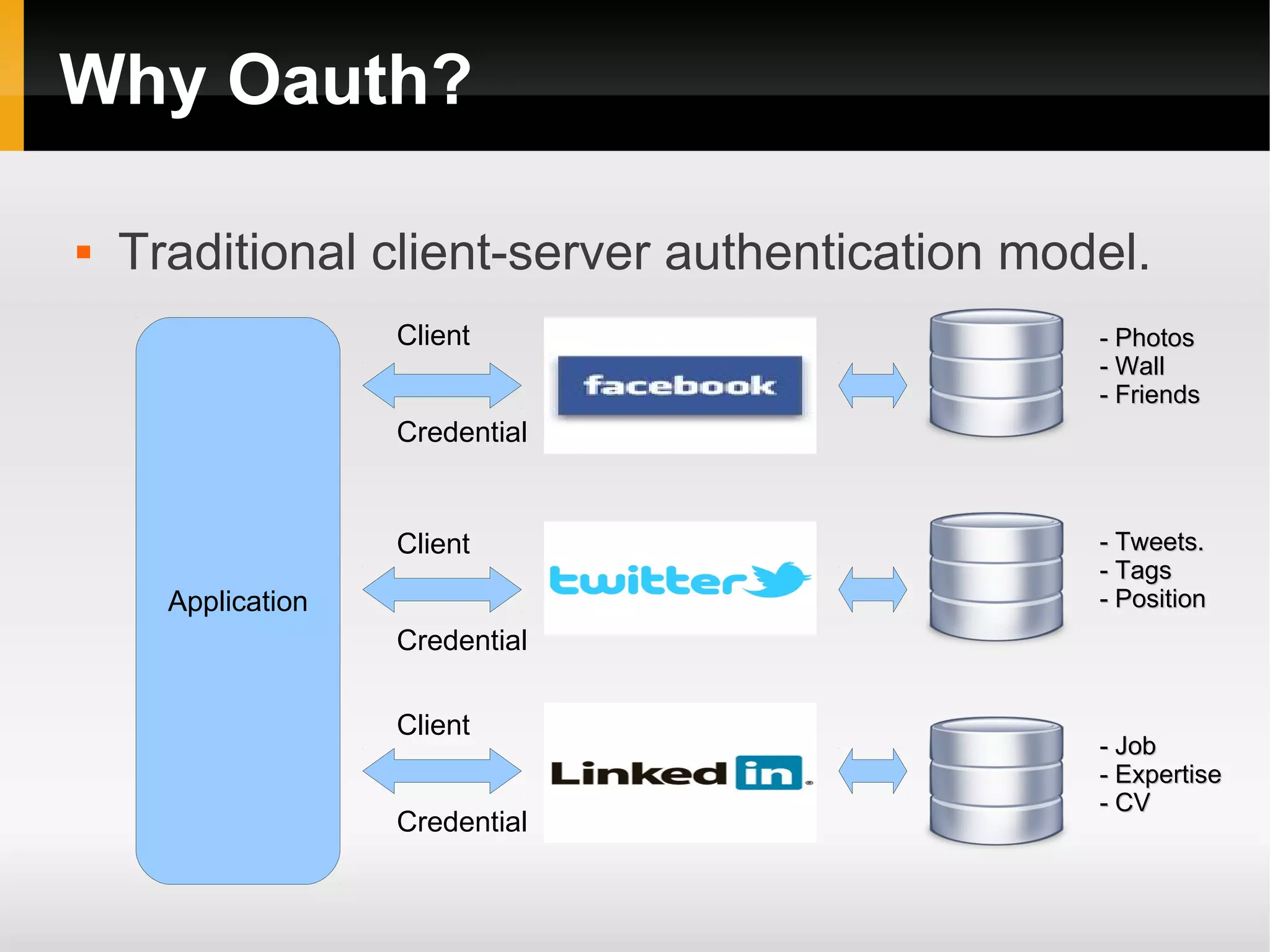
   Traditional client-server authentication model.
                    Client                      - Photos
                                                - Wall
                                                - Friends
                    Credential


                    Client                      - Tweets.
                                                - Tags
      Application                               - Position
                    Credential

                    Client
                                                - Job
                                                - Expertise
                                                - CV
                    Credential
Why Oauth?

   Issues with traditional client-service auth model
       Users share their credentials (password) with
        the application for each service
       Application needs as many credentials as
        services
       Once the application get the user password
        there is no way to invalid the access to the
        user's resources … unless user changes his
        password
       Application has the same privileges as the user.
Background

   Based on well-established practices of many
    propietary industry protocols.
       Google AuthSub
       Yahoo BBAuth
       Flickr API

   Focused on website services but also desktop
    applications, mobile devices or set-top boxes.
Background

   OpenID 2006 Blaine Cook descentralized
    digital idetification standard.
   OpenAuth 2006 Chris Messina no sharing
    password and login agnostic.
   OpenAuth Google 2007
   AOL's implements OpenAuth protocol 2007
   OauthCore 1.0 Revision 2009
   Oauth Core 1.0 RFC 2010
   Present-Future … OAuth 2.0 Draft
    http://tools.ietf.org/html/draft-ietf-oauth-v2-26
Terminology

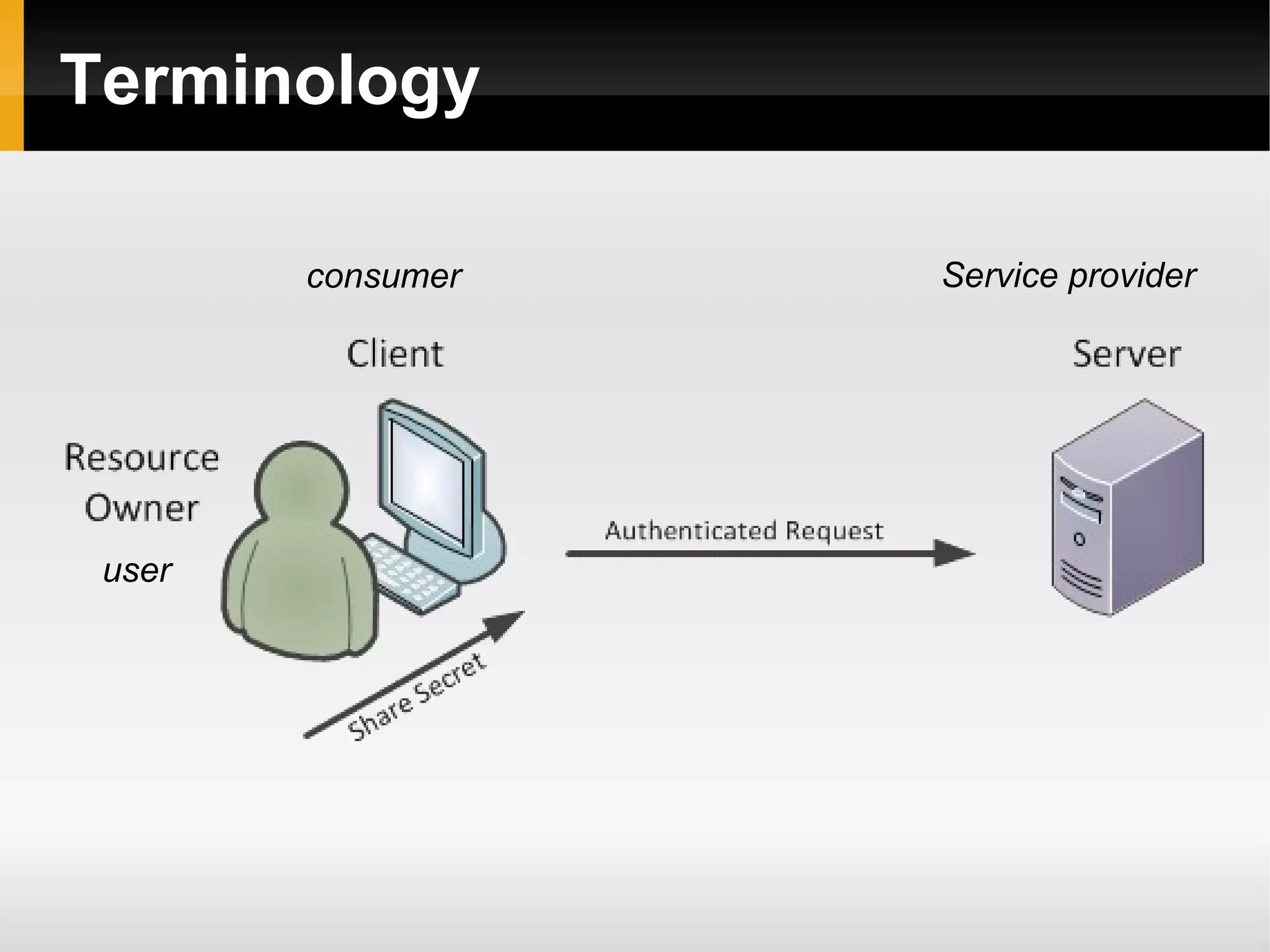
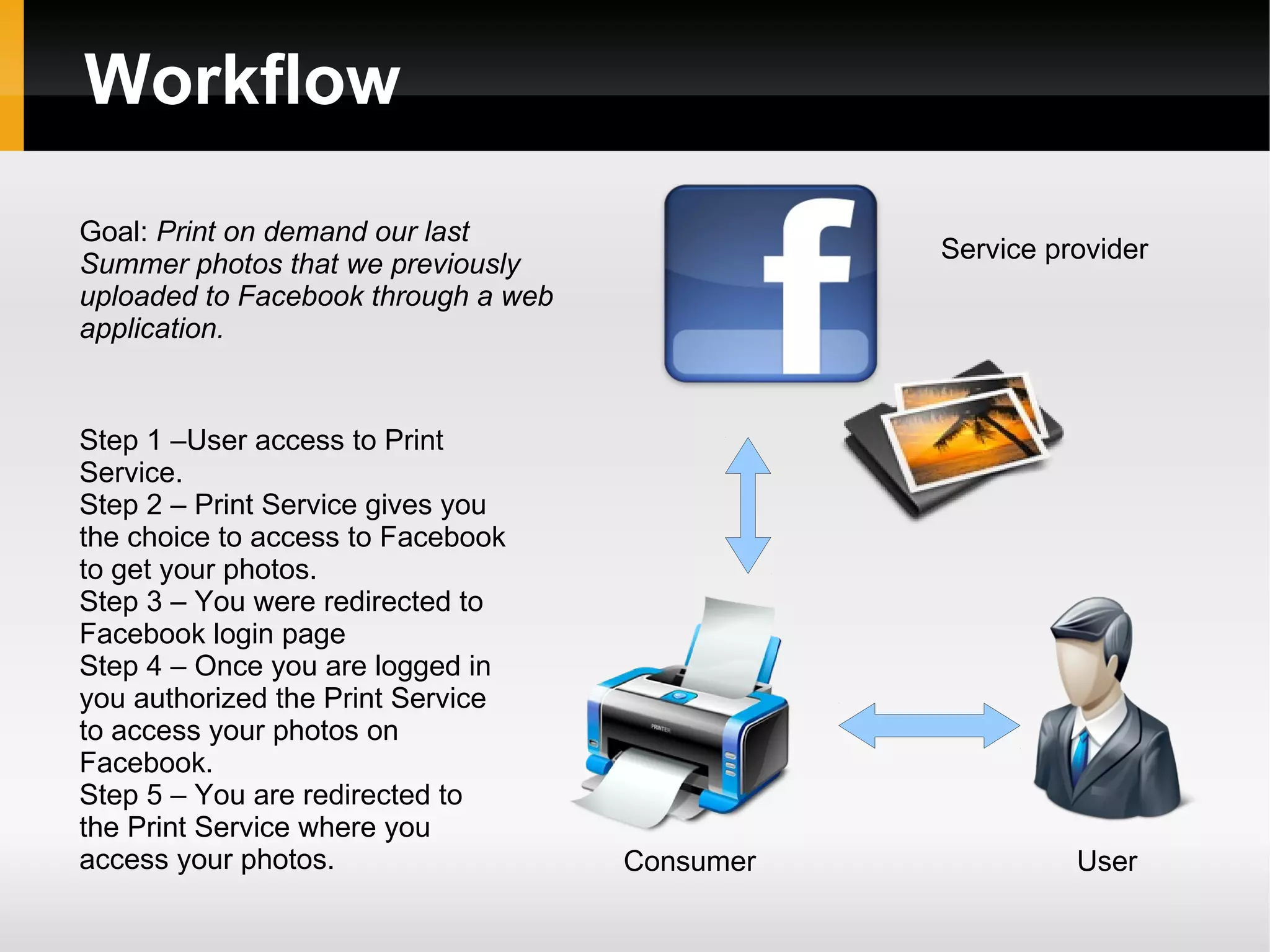
        consumer   Service provider


 user
Workflow
Goal: Print on demand our last
                                              Service provider
Summer photos through a web
application that we previously
uploaded to Facebook.


Step 1 –User access to Print
Service.
Step 2 – Print Service gives you
the choice to access to Facebook
to get your photos.
Step 3 – You were redirected to
Facebook login page
Step 4 – Once you are logged in
you authorized the Print Service
to access your photos on
Facebook.
Step 5 – You are redirected to
the Print Service where you
access your photos.                Consumer             User
Workflow

   Redirection-based authorization.
    Credentials types.
       Get temporary credentials
       Obtain authorization from the resources
        owner.
       Get token credentials (request token +
        secret).
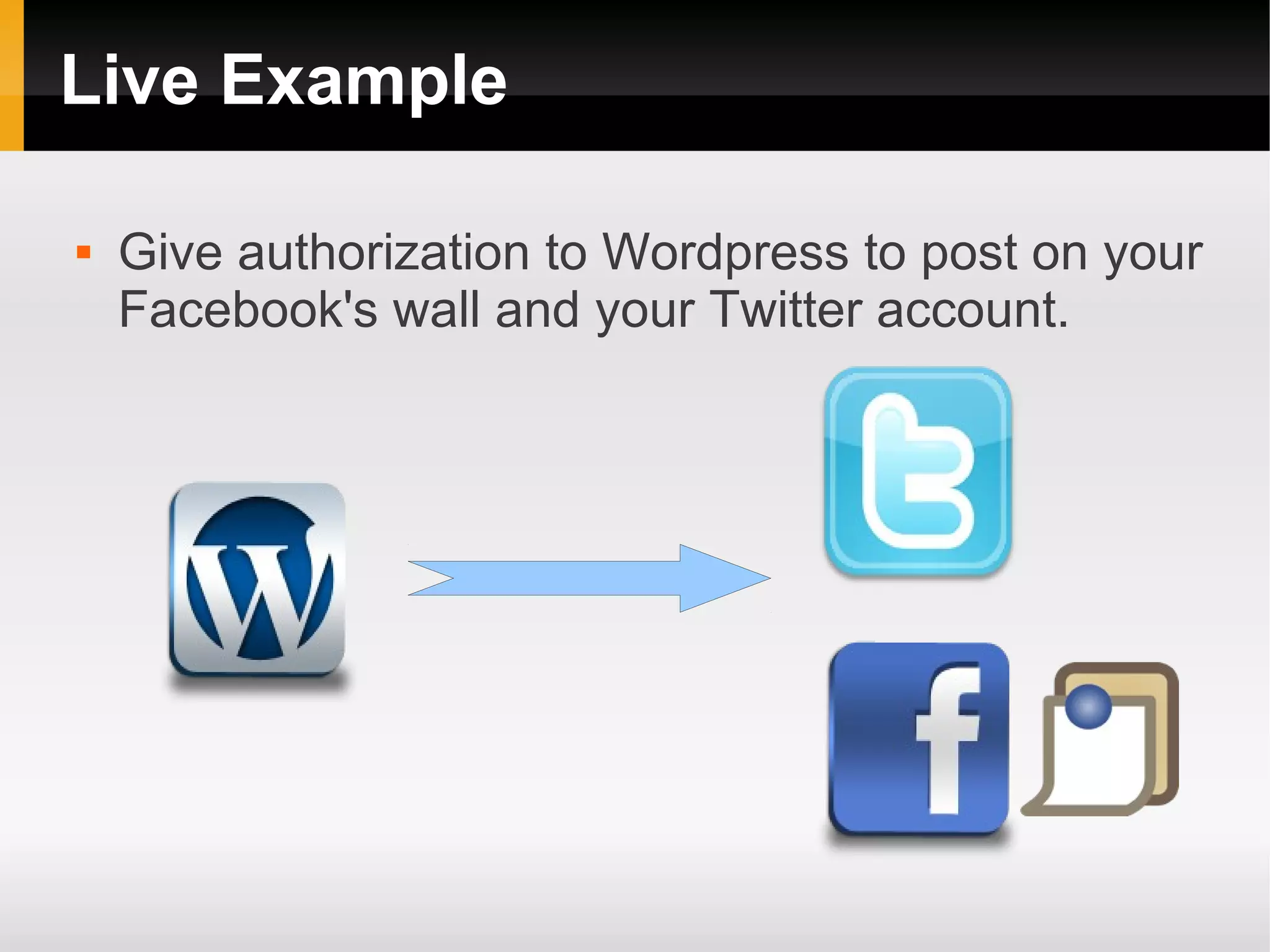
Live Example

   Give authorization to Wordpress to post on your
    Facebook's wall and your Twitter account.
References

   Official page. http://oauth.net/
   Beginner's guide to Oauth
    http://oauth.net/documentation/getting-started/
   Google Oauth
    https://developers.google.com/accounts/
   Getting Started with OAuth 2.0 by Ryan Boyd
   Programming Social Applications: Building Viral
    Experiences with OpenSocial, OAuth, OpenID,
    and Distributed Web Frameworks by Jonathan
    LeBlanc
Q&A

OAuth

  • 1.
  • 2.
    Roadmap  Defining Oauth  Why Oauth?  Background  Terminology  Workflow  Live Example  References  Q&A
  • 3.
    Defining Oauth ”Oauthprovides a method for users to grant third-party access to their resources without sharing their passwords. It also passwords provides a way to grant limited access (in scope, duration, etc …)”
  • 4.
    Why Oauth?  Traditional client-server authentication model. Client - Photos - Wall - Friends Credential Client - Tweets. - Tags Application - Position Credential Client - Job - Expertise - CV Credential
  • 5.
    Why Oauth?  Issues with traditional client-service auth model  Users share their credentials (password) with the application for each service  Application needs as many credentials as services  Once the application get the user password there is no way to invalid the access to the user's resources … unless user changes his password  Application has the same privileges as the user.
  • 6.
    Background  Based on well-established practices of many propietary industry protocols.  Google AuthSub  Yahoo BBAuth  Flickr API  Focused on website services but also desktop applications, mobile devices or set-top boxes.
  • 7.
    Background  OpenID 2006 Blaine Cook descentralized digital idetification standard.  OpenAuth 2006 Chris Messina no sharing password and login agnostic.  OpenAuth Google 2007  AOL's implements OpenAuth protocol 2007  OauthCore 1.0 Revision 2009  Oauth Core 1.0 RFC 2010  Present-Future … OAuth 2.0 Draft http://tools.ietf.org/html/draft-ietf-oauth-v2-26
  • 8.
    Terminology consumer Service provider user
  • 9.
    Workflow Goal: Print ondemand our last Service provider Summer photos through a web application that we previously uploaded to Facebook. Step 1 –User access to Print Service. Step 2 – Print Service gives you the choice to access to Facebook to get your photos. Step 3 – You were redirected to Facebook login page Step 4 – Once you are logged in you authorized the Print Service to access your photos on Facebook. Step 5 – You are redirected to the Print Service where you access your photos. Consumer User
  • 10.
    Workflow  Redirection-based authorization. Credentials types.  Get temporary credentials  Obtain authorization from the resources owner.  Get token credentials (request token + secret).
  • 11.
    Live Example  Give authorization to Wordpress to post on your Facebook's wall and your Twitter account.
  • 12.
    References  Official page. http://oauth.net/  Beginner's guide to Oauth http://oauth.net/documentation/getting-started/  Google Oauth https://developers.google.com/accounts/  Getting Started with OAuth 2.0 by Ryan Boyd  Programming Social Applications: Building Viral Experiences with OpenSocial, OAuth, OpenID, and Distributed Web Frameworks by Jonathan LeBlanc
  • 13.