
INTRODUCTION
 INFERTILITY - one year of unprotected intercourse
without conception
 SUBFERTILITY- couples who conceive after 12
months of attempted impregnation.
 FECUNDABILITY - probability of achieving
pregnancy within a single menstrual cycle
 FECUNDITY - probability of achieving a live birth
within a single cycle.

 It is sole cause in 20% of infertile couple
 Contributing factor in 20-40% couples
 Female infertility in 40-55%
PREVALENCE

SPERMATOGENESIS
• During embryogenesis, there are approximately
300 thousand spermatogonia in each gonad.
• Each undergoes mitotic division, and by
puberty 600 million in each testis.
4

Sperm production takes place in seminiferous tubules
within testis.
Spermatogenesis takes about 75 days
Adult males produce 100-200 million sperm each day.
Under the effect of LH, Leydig cells produce
testosterone (which along with FSH, stimulates
spermatogenesis).
Maturation of sperms takes place in epididymis.
Transport of sperms – vas deferens 5

Physiology of Semen after
Ejaculation
1. Liquefaction
2. Capacitation
3. Acrosome reaction
4. Cortical reaction
6
7
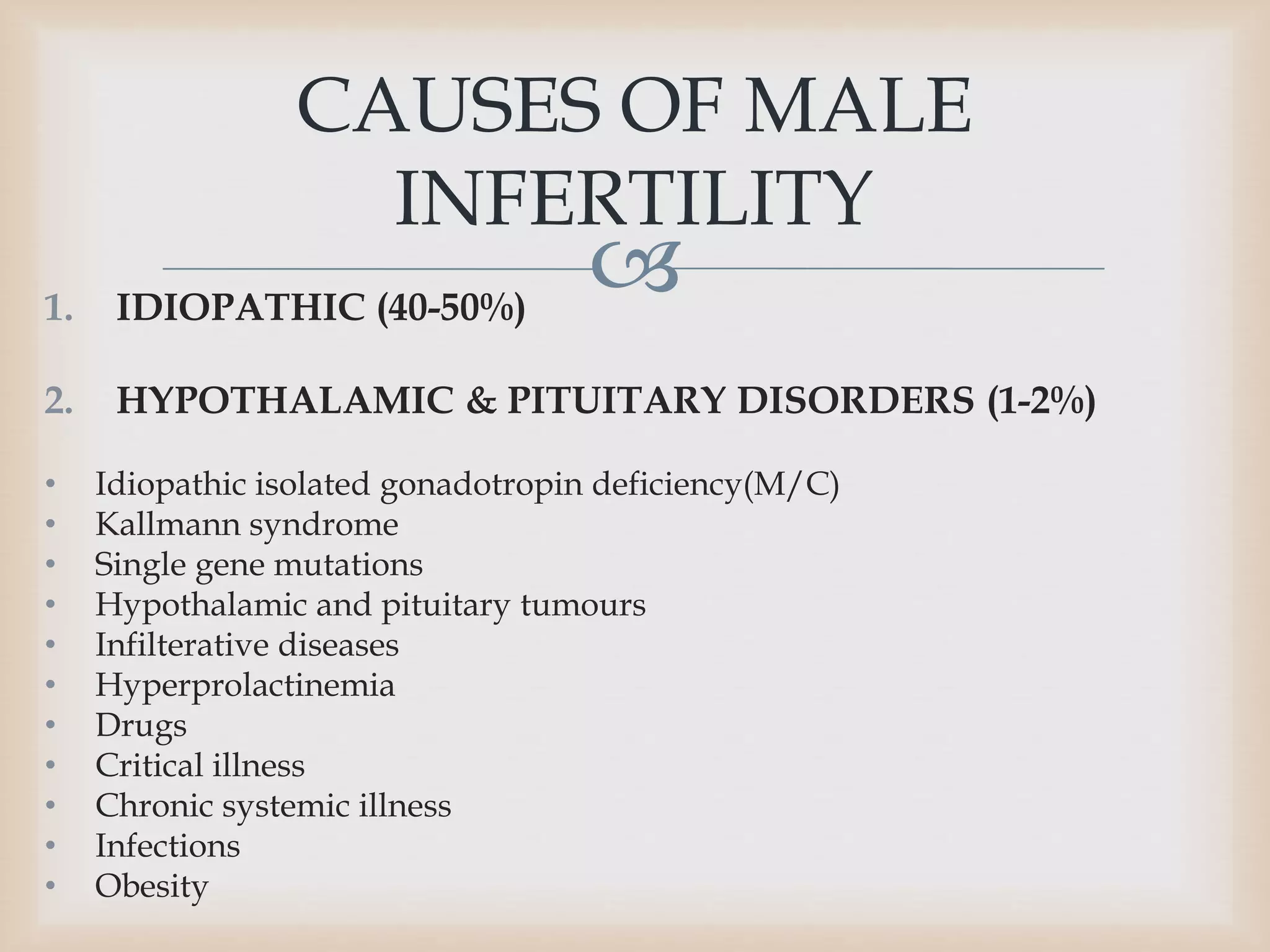
1. IDIOPATHIC (40-50%)
2. HYPOTHALAMIC & PITUITARY DISORDERS (1-2%)
• Idiopathic isolated gonadotropin deficiency(M/C)
• Kallmann syndrome
• Single gene mutations
• Hypothalamic and pituitary tumours
• Infilterative diseases
• Hyperprolactinemia
• Drugs
• Critical illness
• Chronic systemic illness
• Infections
• Obesity
CAUSES OF MALE
INFERTILITY

2. PRIMARY GONADAL DISORDERS (30-40%)
• Klinefelter syndrome
• Y chromosome deletions
• Single gene mutations
• Cryptorchidism
• Varicoceles
• Infections
• Drugs
• Radiation
• Environmental Gonadotoxins
• Chronic illness
CAUSES

3. SPERM TRANSPORT DISORDERS (10-20%)
• Epididymal obstruction or dysfunction
• CBAVD
• Infections
• Vasectomy, herniorraphy
• Kartagener syndrome
• Young syndrome
• Ejaculatory dysfunction
CAUSES

Kallman syndrome
GnRH deficiency +
HYPOTHALAMIC PITUITARY
DISORDERS
Red-green blindness
Anosmia
Cleft palate
Neurosensory
hearing loss
Synkinesis
Renal anomalies

 Klinefelter syndrome:
47XXY and other forms & no. of CAG repeats
• Small firm testes
• FSH & LH and Testosterone
• Cryptorchidism
• Long arms & legs
• Psychosocial abnormalities
• Pulmonary diseases
• Mediastinal germ cell tumors, breast cancer
PRIMARY GONADAL DISORDERS

 Y chromosome deletions: 20% men with infertility
• Severe oligospermia & azoospermia
• Genetic counselling offered before ICSI, as these
deletions are transmitted to sons.
 Single gene mutations & polymorphism:
No. of CAG repeats inversely proportional to sperm
concentration & fertility
PRIMARY GONADAL DISORDERS
 Cryptorchidism: Failure of testicular descent.
An androgen dependent process.
FSH levels raised. LH normal
Risk of tumors
 Varicoceles: Dilatation of pampiniform plexus of spermatic veins.
More common on left side.
No causal relationship with infertility
 Radiation: 0.015 Gy (15 rads) supress spermatogenesis
> 6 Gy permanent azoospermia
PRIMARY GONADAL DISORDERS

 Epididymal dysfunction: Intrauterine exposure to
DES. Causes isolated asthenospermia
 CBAVD: Congenital bilateral absence of the vas
deferens related to CFTR gene mutations. 1-2% of
infertile men
 Kartagener syndrome: Recurrent sinus infection,
bronchiectasis, situs inversus, male infertility.
SPERM TRANSPORT DISORDERS

 Goals are to Identify-
• Specific cause & correct it
• Individuals who can be offered IUI & ART
• Individuals with genetic abnormality that may affect
offspring conceived by ART
• Adoption & donor sperm options for those who are
not candidate for ART
• Underlying Medical condition
MALE INFERTILITY EVALUATION
 Time to start evaluation : When pregnancy fails to occur after 1 yr of
regular unprotected intercourse.
 Earlier evaluation for men with any obvious infertility factor.
 HISTORY:
• Duration of infertility & previous fertility
• Coital frequency & sexual dysfunction
• h/o previous evaluation & t/t
• Childhood illness
• Previous surgical & medical illness
• Past episodes of STI
• Exposure to gonadotoxins & heat
• Medications & allergies
• Occupation & addictions
MALE INFERTILITY EVALUATION

 PHYSICAL EXAMINATION:
• Examination of penis, location of urethral meatus
• Palpation of testes & size
• Presence & consistency of vas & epididymis
• Secondary sexual characteristics, habitus, hair &
breast development
• Digital rectal examination
MALE INFERTILITY EVALUATION

 Collection method: After a defined period of
abstinence of 2-3 days.
 Semen may be collected in a clean container by
masturbation or via intercourse using silastic
condom that does not contain spermicidal agents.
 Sample should be examined within an hour of
collection.
 If abnormal, repeat it after 4 weeks.
SEMEN ANALYSIS

 Volume 1.5-5 ml
 pH >7.2
 Viscosity < 3 (scale 0-4)
 Sperm concentration >20 million/ml
 Total sperm number >40million/ejaculate
 Percent motility > 50%
 Forward progression >2 (scale 0-4)
 Normal morphology >14%
 Round cells < 5 million/ml
 Sperm agglutination <2 (scale 0-3)
Normal Reference Values (WHO)

 Volume 1.5 ml (1.4 – 1.7)
 Sperm concentration 15 million/ml (12 - 16)
 Total sperm number 39 million/ejac (33-46)
 Total motility 40% (38 - 42)
 Progressive motility 32% (31 - 34)
 Normal morphology 4% (3 - 4)
 Vitality 58% (55 - 63)
To assess prognosis for achieving pregnancies with their
partner
Lower Reference Limits

 The lower limit is 1.5 ml
 pH : 7.2 or higher (Alkaline)
 CBAVD or Bliateral Ejaculatory duct block – acidic
pH
 High volumes >5ml
Indicate inflammation of accessory glands
Ejaculate volume & pH
 Azoospermia : Complete absence of sperm on microscopic
examination in ejaculate.
• 1-3% male population, 10-15% male infertility
• To confirm diagnosis semen is centrifuged & pellet examined
1. OBSTRUCTIVE: blockage in ductal system ( CBAVD, scrotal or
inguinal surgery)
2. NON OBSTRUCTIVE: primary testicular failure,
endocrinopathies that suppress spermatogenesis.
 Oligospermia : sperm density < 15 million/ml. Severe when < 5
million/ml
Sperm Concentration & Total Sperm
Count

 % of total sperm exhibiting any motion
 Total motile sperm count = total sperm count & % of
progressively motile sperm
 Asthenospermia : Poor sperm motility. Suggests
anti sperm antibodies, genital tract infections, partial
obstruction of ejaculatory duct, varicoceles,
vasectomy reversal, prolonged abstinence
Motility, Total motile count, Vitality

 Viable non-motile sperm- Kartagener syndrome
 Vitality test- to differentiate viable non motile sperm
from dead sperm for ICSI
Motility, Total motile count & Vitality

 Teratospermia : > 70% abnormal morphology.
Varicocele, primary & secondary testicular failure
 Necrospermia : dead sperm
Sperm Morphology

 > 5million/ml round cells (round spermatid,
spermatocytes)
 Leucocytospermia > 1million leucocytes/ml. Semen
culture for Mycoplasma, ureaplasma, Chlamydia.
Round cells & leukocytospermia

 To evaluate attachment to zona pellucida, penetration of
the oocyte, release of acrosomal enzymes.
 Sperm autoantibodies (PCT)
 Sperm penetration assay
 Human Zona Binding Assay
 Computer Assisted Sperm Analysis
 Acrosome reaction
 Biochemical test
 Sperm Chromatin Structure & DNA
SPECIALIZED TEST
 Indications:
• Abnormal semen analysis
• Sexual dysfunction
• Specific endocrinopathy
 Tests :
• Serum FSH
• Total testosterone
• Serum Free Testosterone
• LH
• PRL, TSH
• Serum estradiol
Endocrine Evaluation

Disorder FSH LH Free Ts
Hypogonadotropic
hypogonadism
low low low
Abnormal spermatogenesis N/high N N
Testicular Failure High High N/low

 Physical examination
 TRUS (trans rectal ultrasound for duct obstruction)
 Trans scrotal Ultrasound
 Renal Scan
 Testis Biopsy in azoospermic men
 Vasogram
Urologic evaluation

 Y chromosome deletions
 Chromosomal anomalies
 CFTR gene mutations (CABVD)
Genetic Evaluation
 Hypogonadotropic Hypogonadism:
• Hyperprolactinoma- Dopamine agonists
• Congenital hypogonadotropic hypogonadism- hCG or
exogenous testosterone
• Adult onset hypogonadotropin hypogonadism- hCG 2000-5000
IU 3 times per week.
Start alone with hCG (as LH) as
1. hCG stimulate Leydig cells to produce testosterone
2. hCG alone can stimulate spermatogenesis
3. Annual costs lower than hMG (both FSH & LH)
MEDICAL TREATMENT

• Non-responders - hCG & hMG or pure FSH (75-100
IU 3 times weekly)
• Hypogonadotropin hypogonadism unrelated to
cause- Portable programmable pulsatile infusion
pump s/c.

 Eugonadotropin Hypogonadism
Severe oligospermia
Low Sr. testosterone
T/t by aromatase inhibitor (Testolactone 50-100 mg BD
Anastrazole 1 mg OD)
 Hypergonadotropic Hypogonadism
Insemination with donor sperm
IVF with ICSI with preliminary genetic evaluation
 Erectile dysfunction
Sildenafil- 25-100mg 1hr before intercourse
 Retrograde Ejaculation-
• Sympathomimetics, pseudoephidrine, ephedrine
• IVF & IUI & ICSI
 Leucocytospermia-
• Antibiotics (doxycycline, erythromycin, cotrimoxazole)
 Idiopathic Male Infertility-
• Androgen therapy
• Exogenous FSH
• Clomiphene citrate (25 mg)/Tamoxifen (20 mg)
 Indications :
• Oligospermia,
• Asthenospermia,
• Premature or retrograde ejaculation,
• Sperm autoantibodies & cervical factors,
• Unexplained infertility
• Hypospadias
• HIV positive
 Advantages :
1. Overcome limitation of decreased sperm density or motility. Better than
Cervical insemination
2. With washed sperm concentrate delivers more no. of sperms
3. IUI yields better results than cervical insemination.
ARTIFICIAL INSEMINATION

 Types:
1. IUI
2. Intracervical
3. Pericervical & Vaginal
4. DIPI (Direct intraperitoneal insemination)
ARTIFICIAL INSEMINATION

 Cycle fecundity 3-10% infertile partner sperm
9-30% donor sperm
 Processed motile sperm count at least 1 million
 Best results when no. of TOTAL MOTILE SPERMS > 10 million
 Success rates
• Highest > 14% sperm have normal morphology
• Intermediate 4-14%
• Poor <4% (advised IVF & ICSI)
INTRAUTERINE INSEMINATION
 INDICATIONS :
1. Azoospermia
2. Immunological factors not correctable
3. Genetic disease in husband
Donor Sperm

1. Vasovasostomy & vasoepididymostomy- In
vasectomized men
2. Transurethral resection of the ejaculatory ducts- in
men with Ejaculatory duct obstruction (1-5% of
infertile men)
3. Varicocele repair- In men with varicoceles (20-45%
of infertile men)
4. Orchipexy – In cryptorchidism
5. Vibratory stimulation & Electroejaculation – In
neurological dysfunctions
SURGICAL TREATMENT

Assisted Reproductive Techniques
 IVF-ET – In vitro fertilization & embryo transfer
 GIFT – Gamete intra fallopian transfer
 ZIFT – Zygote intra fallopian transfer
 POST – Peritoneal oocyte & sperm transfer
 TET – Tubal embryo transfer zone
 SUZI – Subzonal insemination
 ICSI – Intracytoplasmic sperm injection
 AH – Assisted Hatching
 IVM – In vitro maturation of oocyte
 PGD – Preimplantation genetic diagnosis

1. NON OBSTRUCTIVE AZOOSPERMIA:
 TESE – Testicular sperm extraction
 Micro-TESE – Microdissection testicular sperm extraction
2. OBSTRUCTIVE AZOOSPERMIA :
 MESA – Microsurgical Epididymal Sperm Aspiration
 PESA – Percutaneous epididymal sperm aspiration
Sperm Retrieval Techniques
Seminar on male infertility

Seminar on male infertility

  • 2.
     INTRODUCTION  INFERTILITY -one year of unprotected intercourse without conception  SUBFERTILITY- couples who conceive after 12 months of attempted impregnation.  FECUNDABILITY - probability of achieving pregnancy within a single menstrual cycle  FECUNDITY - probability of achieving a live birth within a single cycle.
  • 3.
      It issole cause in 20% of infertile couple  Contributing factor in 20-40% couples  Female infertility in 40-55% PREVALENCE
  • 4.
     SPERMATOGENESIS • During embryogenesis,there are approximately 300 thousand spermatogonia in each gonad. • Each undergoes mitotic division, and by puberty 600 million in each testis. 4
  • 5.
     Sperm production takesplace in seminiferous tubules within testis. Spermatogenesis takes about 75 days Adult males produce 100-200 million sperm each day. Under the effect of LH, Leydig cells produce testosterone (which along with FSH, stimulates spermatogenesis). Maturation of sperms takes place in epididymis. Transport of sperms – vas deferens 5
  • 6.
     Physiology of Semenafter Ejaculation 1. Liquefaction 2. Capacitation 3. Acrosome reaction 4. Cortical reaction 6
  • 7.
  • 8.
    1. IDIOPATHIC (40-50%) 2.HYPOTHALAMIC & PITUITARY DISORDERS (1-2%) • Idiopathic isolated gonadotropin deficiency(M/C) • Kallmann syndrome • Single gene mutations • Hypothalamic and pituitary tumours • Infilterative diseases • Hyperprolactinemia • Drugs • Critical illness • Chronic systemic illness • Infections • Obesity CAUSES OF MALE INFERTILITY
  • 9.
     2. PRIMARY GONADALDISORDERS (30-40%) • Klinefelter syndrome • Y chromosome deletions • Single gene mutations • Cryptorchidism • Varicoceles • Infections • Drugs • Radiation • Environmental Gonadotoxins • Chronic illness CAUSES
  • 10.
     3. SPERM TRANSPORTDISORDERS (10-20%) • Epididymal obstruction or dysfunction • CBAVD • Infections • Vasectomy, herniorraphy • Kartagener syndrome • Young syndrome • Ejaculatory dysfunction CAUSES
  • 11.
     Kallman syndrome GnRH deficiency+ HYPOTHALAMIC PITUITARY DISORDERS Red-green blindness Anosmia Cleft palate Neurosensory hearing loss Synkinesis Renal anomalies
  • 12.
      Klinefelter syndrome: 47XXYand other forms & no. of CAG repeats • Small firm testes • FSH & LH and Testosterone • Cryptorchidism • Long arms & legs • Psychosocial abnormalities • Pulmonary diseases • Mediastinal germ cell tumors, breast cancer PRIMARY GONADAL DISORDERS
  • 13.
      Y chromosomedeletions: 20% men with infertility • Severe oligospermia & azoospermia • Genetic counselling offered before ICSI, as these deletions are transmitted to sons.  Single gene mutations & polymorphism: No. of CAG repeats inversely proportional to sperm concentration & fertility PRIMARY GONADAL DISORDERS
  • 14.
     Cryptorchidism: Failureof testicular descent. An androgen dependent process. FSH levels raised. LH normal Risk of tumors  Varicoceles: Dilatation of pampiniform plexus of spermatic veins. More common on left side. No causal relationship with infertility  Radiation: 0.015 Gy (15 rads) supress spermatogenesis > 6 Gy permanent azoospermia PRIMARY GONADAL DISORDERS
  • 15.
      Epididymal dysfunction:Intrauterine exposure to DES. Causes isolated asthenospermia  CBAVD: Congenital bilateral absence of the vas deferens related to CFTR gene mutations. 1-2% of infertile men  Kartagener syndrome: Recurrent sinus infection, bronchiectasis, situs inversus, male infertility. SPERM TRANSPORT DISORDERS
  • 17.
      Goals areto Identify- • Specific cause & correct it • Individuals who can be offered IUI & ART • Individuals with genetic abnormality that may affect offspring conceived by ART • Adoption & donor sperm options for those who are not candidate for ART • Underlying Medical condition MALE INFERTILITY EVALUATION
  • 18.
     Time tostart evaluation : When pregnancy fails to occur after 1 yr of regular unprotected intercourse.  Earlier evaluation for men with any obvious infertility factor.  HISTORY: • Duration of infertility & previous fertility • Coital frequency & sexual dysfunction • h/o previous evaluation & t/t • Childhood illness • Previous surgical & medical illness • Past episodes of STI • Exposure to gonadotoxins & heat • Medications & allergies • Occupation & addictions MALE INFERTILITY EVALUATION
  • 19.
      PHYSICAL EXAMINATION: •Examination of penis, location of urethral meatus • Palpation of testes & size • Presence & consistency of vas & epididymis • Secondary sexual characteristics, habitus, hair & breast development • Digital rectal examination MALE INFERTILITY EVALUATION
  • 20.
      Collection method:After a defined period of abstinence of 2-3 days.  Semen may be collected in a clean container by masturbation or via intercourse using silastic condom that does not contain spermicidal agents.  Sample should be examined within an hour of collection.  If abnormal, repeat it after 4 weeks. SEMEN ANALYSIS
  • 22.
      Volume 1.5-5ml  pH >7.2  Viscosity < 3 (scale 0-4)  Sperm concentration >20 million/ml  Total sperm number >40million/ejaculate  Percent motility > 50%  Forward progression >2 (scale 0-4)  Normal morphology >14%  Round cells < 5 million/ml  Sperm agglutination <2 (scale 0-3) Normal Reference Values (WHO)
  • 23.
      Volume 1.5ml (1.4 – 1.7)  Sperm concentration 15 million/ml (12 - 16)  Total sperm number 39 million/ejac (33-46)  Total motility 40% (38 - 42)  Progressive motility 32% (31 - 34)  Normal morphology 4% (3 - 4)  Vitality 58% (55 - 63) To assess prognosis for achieving pregnancies with their partner Lower Reference Limits
  • 24.
      The lowerlimit is 1.5 ml  pH : 7.2 or higher (Alkaline)  CBAVD or Bliateral Ejaculatory duct block – acidic pH  High volumes >5ml Indicate inflammation of accessory glands Ejaculate volume & pH
  • 25.
     Azoospermia :Complete absence of sperm on microscopic examination in ejaculate. • 1-3% male population, 10-15% male infertility • To confirm diagnosis semen is centrifuged & pellet examined 1. OBSTRUCTIVE: blockage in ductal system ( CBAVD, scrotal or inguinal surgery) 2. NON OBSTRUCTIVE: primary testicular failure, endocrinopathies that suppress spermatogenesis.  Oligospermia : sperm density < 15 million/ml. Severe when < 5 million/ml Sperm Concentration & Total Sperm Count
  • 26.
      % oftotal sperm exhibiting any motion  Total motile sperm count = total sperm count & % of progressively motile sperm  Asthenospermia : Poor sperm motility. Suggests anti sperm antibodies, genital tract infections, partial obstruction of ejaculatory duct, varicoceles, vasectomy reversal, prolonged abstinence Motility, Total motile count, Vitality
  • 27.
      Viable non-motilesperm- Kartagener syndrome  Vitality test- to differentiate viable non motile sperm from dead sperm for ICSI Motility, Total motile count & Vitality
  • 28.
      Teratospermia :> 70% abnormal morphology. Varicocele, primary & secondary testicular failure  Necrospermia : dead sperm Sperm Morphology
  • 29.
      > 5million/mlround cells (round spermatid, spermatocytes)  Leucocytospermia > 1million leucocytes/ml. Semen culture for Mycoplasma, ureaplasma, Chlamydia. Round cells & leukocytospermia
  • 30.
      To evaluateattachment to zona pellucida, penetration of the oocyte, release of acrosomal enzymes.  Sperm autoantibodies (PCT)  Sperm penetration assay  Human Zona Binding Assay  Computer Assisted Sperm Analysis  Acrosome reaction  Biochemical test  Sperm Chromatin Structure & DNA SPECIALIZED TEST
  • 31.
     Indications: • Abnormalsemen analysis • Sexual dysfunction • Specific endocrinopathy  Tests : • Serum FSH • Total testosterone • Serum Free Testosterone • LH • PRL, TSH • Serum estradiol Endocrine Evaluation
  • 32.
     Disorder FSH LHFree Ts Hypogonadotropic hypogonadism low low low Abnormal spermatogenesis N/high N N Testicular Failure High High N/low
  • 33.
      Physical examination TRUS (trans rectal ultrasound for duct obstruction)  Trans scrotal Ultrasound  Renal Scan  Testis Biopsy in azoospermic men  Vasogram Urologic evaluation
  • 34.
      Y chromosomedeletions  Chromosomal anomalies  CFTR gene mutations (CABVD) Genetic Evaluation
  • 35.
     Hypogonadotropic Hypogonadism: •Hyperprolactinoma- Dopamine agonists • Congenital hypogonadotropic hypogonadism- hCG or exogenous testosterone • Adult onset hypogonadotropin hypogonadism- hCG 2000-5000 IU 3 times per week. Start alone with hCG (as LH) as 1. hCG stimulate Leydig cells to produce testosterone 2. hCG alone can stimulate spermatogenesis 3. Annual costs lower than hMG (both FSH & LH) MEDICAL TREATMENT
  • 36.
     • Non-responders -hCG & hMG or pure FSH (75-100 IU 3 times weekly) • Hypogonadotropin hypogonadism unrelated to cause- Portable programmable pulsatile infusion pump s/c.
  • 37.
      Eugonadotropin Hypogonadism Severeoligospermia Low Sr. testosterone T/t by aromatase inhibitor (Testolactone 50-100 mg BD Anastrazole 1 mg OD)  Hypergonadotropic Hypogonadism Insemination with donor sperm IVF with ICSI with preliminary genetic evaluation  Erectile dysfunction Sildenafil- 25-100mg 1hr before intercourse
  • 38.
     Retrograde Ejaculation- •Sympathomimetics, pseudoephidrine, ephedrine • IVF & IUI & ICSI  Leucocytospermia- • Antibiotics (doxycycline, erythromycin, cotrimoxazole)  Idiopathic Male Infertility- • Androgen therapy • Exogenous FSH • Clomiphene citrate (25 mg)/Tamoxifen (20 mg)
  • 39.
     Indications : •Oligospermia, • Asthenospermia, • Premature or retrograde ejaculation, • Sperm autoantibodies & cervical factors, • Unexplained infertility • Hypospadias • HIV positive  Advantages : 1. Overcome limitation of decreased sperm density or motility. Better than Cervical insemination 2. With washed sperm concentrate delivers more no. of sperms 3. IUI yields better results than cervical insemination. ARTIFICIAL INSEMINATION
  • 40.
      Types: 1. IUI 2.Intracervical 3. Pericervical & Vaginal 4. DIPI (Direct intraperitoneal insemination) ARTIFICIAL INSEMINATION
  • 41.
      Cycle fecundity3-10% infertile partner sperm 9-30% donor sperm  Processed motile sperm count at least 1 million  Best results when no. of TOTAL MOTILE SPERMS > 10 million  Success rates • Highest > 14% sperm have normal morphology • Intermediate 4-14% • Poor <4% (advised IVF & ICSI) INTRAUTERINE INSEMINATION
  • 42.
     INDICATIONS : 1.Azoospermia 2. Immunological factors not correctable 3. Genetic disease in husband Donor Sperm
  • 43.
     1. Vasovasostomy &vasoepididymostomy- In vasectomized men 2. Transurethral resection of the ejaculatory ducts- in men with Ejaculatory duct obstruction (1-5% of infertile men) 3. Varicocele repair- In men with varicoceles (20-45% of infertile men) 4. Orchipexy – In cryptorchidism 5. Vibratory stimulation & Electroejaculation – In neurological dysfunctions SURGICAL TREATMENT
  • 44.
     Assisted Reproductive Techniques IVF-ET – In vitro fertilization & embryo transfer  GIFT – Gamete intra fallopian transfer  ZIFT – Zygote intra fallopian transfer  POST – Peritoneal oocyte & sperm transfer  TET – Tubal embryo transfer zone  SUZI – Subzonal insemination  ICSI – Intracytoplasmic sperm injection  AH – Assisted Hatching  IVM – In vitro maturation of oocyte  PGD – Preimplantation genetic diagnosis
  • 45.
     1. NON OBSTRUCTIVEAZOOSPERMIA:  TESE – Testicular sperm extraction  Micro-TESE – Microdissection testicular sperm extraction 2. OBSTRUCTIVE AZOOSPERMIA :  MESA – Microsurgical Epididymal Sperm Aspiration  PESA – Percutaneous epididymal sperm aspiration Sperm Retrieval Techniques

Editor's Notes

  • #9 Hth & pit tumors like craniopharyngioma & macroadenoma. Infilterative dis like sarcoidosis, histiocytosis hemochromatosis. Drugs like gnrh analogs for prostate cancer, androgen, opiates estrogen Obesity caause increase aromatase activity leading to conversion into estrogen
  • #10 Infections like orchitis leprosy tb Drugs like antiandrogens cimetidine Gonadotoxins smoking pesticides Chrnic illness like cancer renal insufficiency
  • #11 Infections like gonorrhea chlamydia tb Ejaculatory dysfunction like spinal cord diseases autonomic dysfunction
  • #15 As left spermatic vein is longer & joins left renal vein at right angle. Hypoxia stasis delayed removal of toxins increaseed temp likely responsible
  • #26 normal semen production. Mechanical blockage. Post infection, vasectomy, congenital
  • #32 Abnml sperm analysis i.e sperm conc <10mill/ml, decrs libido Sr estradiol in pt wid severe oligo
  • #34 Testes small in testicular failure, epididymal fullness in obstruction, CBAVD , spermatic cord palpation for varicocele Renal scan to detect renal agenesis in men wid vasal agenesis
  • #36 Cong hypog hypogonadism t/t can induce sec sex charact but not initiate or support normal spermatogenesis
  • #42 Cycle fecundity is probability of pregnancy per cycle
  • #43 Success declines with increasing maternal age.>35, family ho early menopause, chemo/radiation With poor ovarian reserve reduced success with Ivf & poor chance with IUI
  • #44 Risk of multiple ovulation, hyperstimulation higher, costs poor quality sperm with exogenous gonadotropin
  • #51 Neurological dysfunctions due to diabetes spinal cord injuries demyelinating diseases
  • #52 Art encompasses all procedures that involve manipulation of gametes & embryos outside the body