ORGANIZATION AND
MANAGEMENT
Quarter 1 – Module 1
The Meaning, Functions,
Types and Theories of
Management
By : Regina M. Silverio
ONHS –shs
Learning Objectives
At the end of this module, the learner will be able to:
1. discuss the meaning, functions, types and theories of
management.
2. identify and explain the various functions and theories
of management.
3. to appreciate the value of management and its concept
in dealing with real life scenarios.
The Meaning, Functions,
Types and Theories of
Management
Definition and Function of Management
Management is the process of coordinating and overseeing the work performance of
individuals working together in organization, so that they could efficiently and effectively
accomplish their chosen aims or goals.
It is also defined as the process of designing and maintaining an environment for
efficiently accomplishing selected aims.
Management Functions
1. Planning
 it is the primary functions of management that involves the setting
of organizational goals, establishing useful strategies, identifying
the tasks to be performed and when it should be done in order to
achieve both the short-term and long-term goals of the company.
2. Organization
 it is the act of transforming all the plans into realization and it
involves the assigning and coordination of specific task and
resources to the various groups that will enables them to contribute
for the immediate attainment of the company objectives.
3. Staffing
 involves the manning of various job position in the organization
structure through the process of proper and fair recruitment,
selection, appraisal and development of the personnel that will
support the organization’s success in achieving their goals.
4. Leading or Directing
 deals with providing clear instructions and guiding the employees
regarding the tasks that they are required to do and encourage a
positive attitude towards work that will motivates them to perform
well towards the realization of the company’s aims.
5. Controlling
 is the task wherein setting of standards of performance are
made and comparing it with the actual performance of the
individual or groups, to ensure that the jobs are done in
accordance to the plans and if not, necessary corrections must
have to be made.
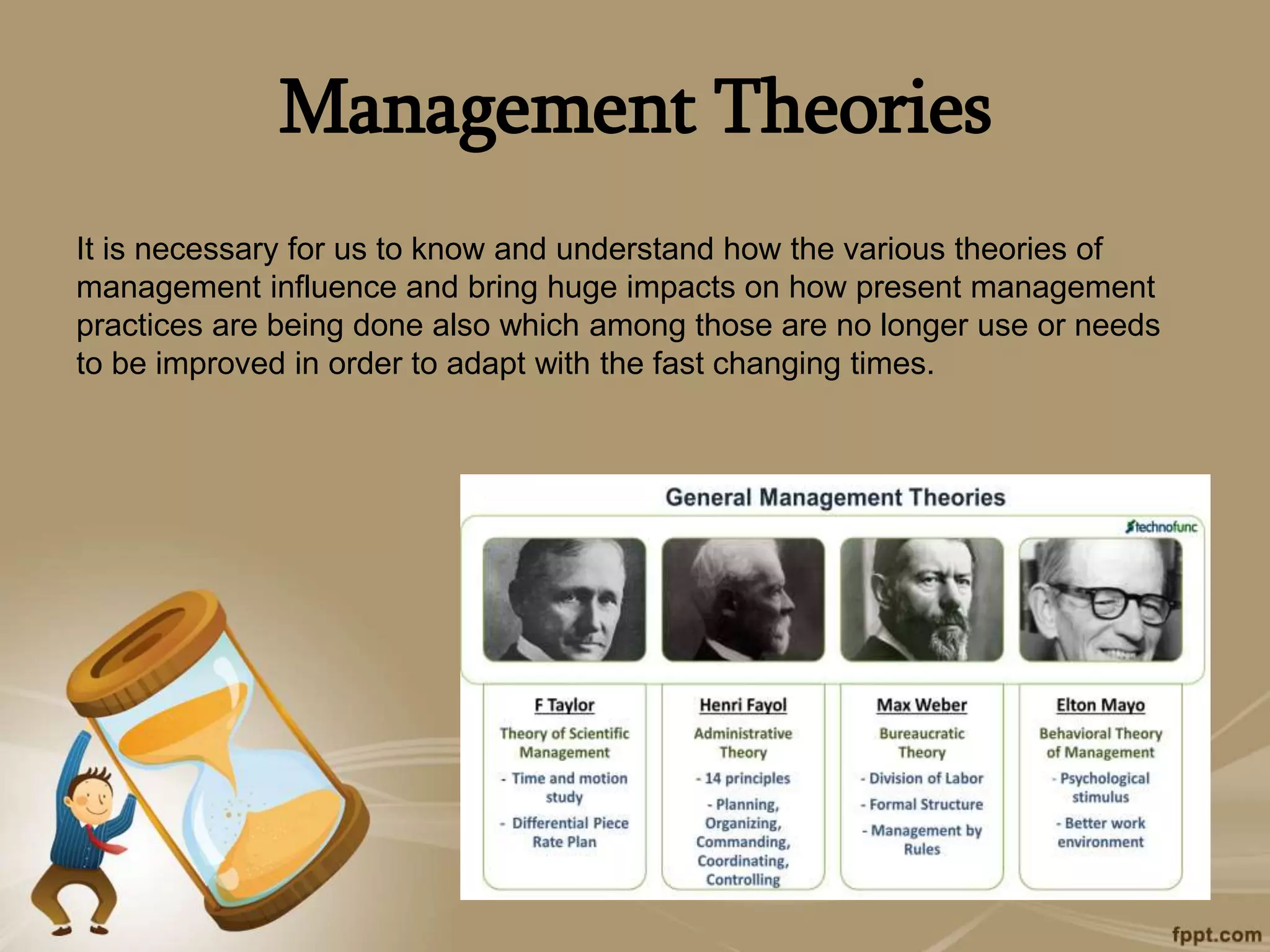
Management Theories
It is necessary for us to know and understand how the various theories of
management influence and bring huge impacts on how present management
practices are being done also which among those are no longer use or needs
to be improved in order to adapt with the fast changing times.
SCIENTIFIC MANAGEMENT THEORY
This management theory makes use of the step by step, scientific methods for finding the
single best way for doing a job. Frederick W. Taylor (1856-1915) is known as the
Father of Scientific Management.
While working in a steel company in Pennsylvania in the United States , as a mechanical Engineer, he
could not help but notice the worker’s mistakes and inefficiencies in doing their routine jobs, their lack
of enthusiasm, and the discrepancy between their abilities and aptitudes and their job assignments;
thus resulting in low output. Because of these observations, he tried to identify clear guidelines for the
improvement of their productivity.
Taylor’s Scientific Management Principles are as
follows:
1. Develop a science for each element of an individual’s work to replace the
old rule of thumb method.
2. Scientifically select and then train, teach, and develop the worker.
3. Heartily cooperate with the workers so as to ensure that all work is done in
accordance with the principles of the science that has been developed.
4. Divide work and responsibility almost equally between management and
workers.
General Administrative Theory
The General Administrative Theory concentrates on the manager’s functions
and what makes up good management practice or implementation. Henri
Fayol ( 1841-1925) and Max Weber (1864-1920) are the personalities most
commonly associated with it.
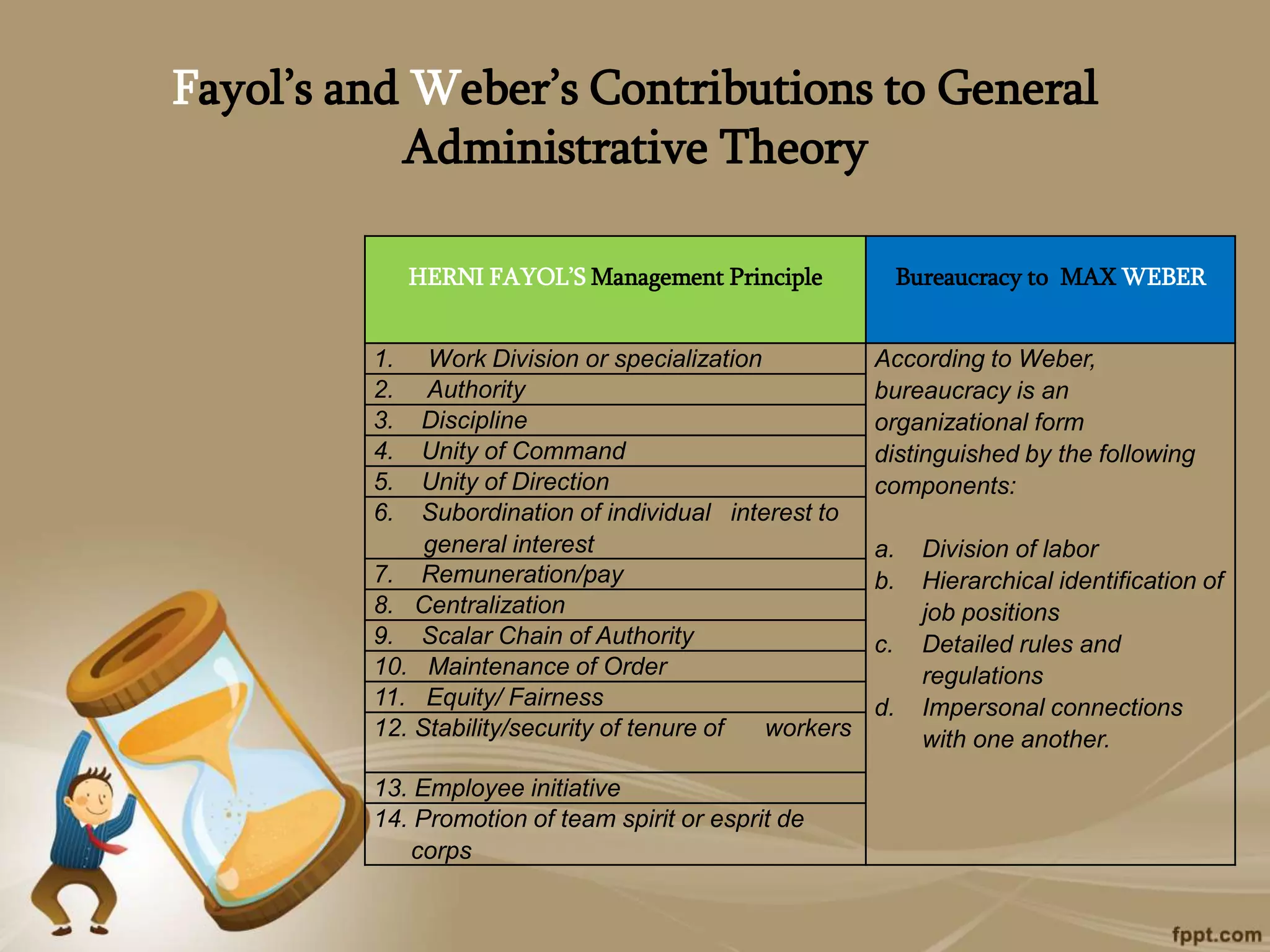
Fayol’s and Weber’s Contributions to General
Administrative Theory
HERNI FAYOL’S Management Principle Bureaucracy to MAX WEBER
1. Work Division or specialization According to Weber,
bureaucracy is an
organizational form
distinguished by the following
components:
a. Division of labor
b. Hierarchical identification of
job positions
c. Detailed rules and
regulations
d. Impersonal connections
with one another.
2. Authority
3. Discipline
4. Unity of Command
5. Unity of Direction
6. Subordination of individual interest to
general interest
7. Remuneration/pay
8. Centralization
9. Scalar Chain of Authority
10. Maintenance of Order
11. Equity/ Fairness
12. Stability/security of tenure of workers
13. Employee initiative
14. Promotion of team spirit or esprit de
corps
Total Quality Management
Total Quality Management is a management philosophy that focuses on the
satisfaction of customers. Their needs, and expectations. Quality experts W.
Edwards Deming (1900-1993) and Joseph M. Juran (1904-2008) introduced
this customer-oriented idea in the 1950s; however, the concept had few
supporters.
Total Quality Management
Focus on customer satisfaction both
external and internal
- this theory give emphasis on how to meet the needs and
demands of the external customers in terms of providing
quality products and services and at the same time the
internal which are the employees through providing
continuous development and rewards system.
Total Quality Management
• Promotes the continuous improvement in the quality
of both the products and services as well as the
people
• -this means that constant improvement of the products
through continuous market research are being
considered to be able to meet the increasing demand
of the customers and for the employees, by providing
them with various seminars and trainings that will
further develop their skills and abilities as well their
performance that will contribute to the company’s
competitive edge in terms of its profitability and
sustainability.
ORGANIZATIONAL BEHAVIOR (OB) APPROACH
Supported by Robert Owen, Mary Parker Follett, Hugo
Munsterberg and Chester Barnard
1. Focus on analyzing and understanding the behavior
of people within their groups and at work .
- this is a very important task for the managers to
consider in order to create an organizational
culture that encourage continuous growth and
development among their people and influences
and shapes their behaviors in a manner that will
contribute in the realization of the organizational
objectives.
ORGANIZATIONAL BEHAVIOR (OB) APPROACH
2. Recognize the psycho-social aspects of every
employees
-this theory also give emphasis on the various needs
of every individual and how their behavior affects
their way in dealing with other people so that
manager can initiate actions and make crucial
decisions that will help satisfying those needs and
enables them to perform well on their jobs and be
more productive to support the company’s goals.
ORGANIZATIONAL BEHAVIOR (OB) APPROACH
3. Promotes human relations that helps people to
learn how to get along well with others
- If every individual understand each other it will
be easy for them to cooperate and to work
harmoniously with one another towards the
attainment of organizational goals. Also if the
employee feels the sense of belongingness and
importance within the group as well as with the
organization they worked in, it boosts their morale
and they are likely to become more productive.
FAST LEARNING
REVIEW
Who is considered as the Father
of Scientific Management? Give
one of his contributions to
scientific management.
What do the acronyms TQM and
OB stands for?

Organization and Management: Function & Theories of Management

  • 1.
    ORGANIZATION AND MANAGEMENT Quarter 1– Module 1 The Meaning, Functions, Types and Theories of Management By : Regina M. Silverio ONHS –shs
  • 2.
    Learning Objectives At theend of this module, the learner will be able to: 1. discuss the meaning, functions, types and theories of management. 2. identify and explain the various functions and theories of management. 3. to appreciate the value of management and its concept in dealing with real life scenarios.
  • 3.
    The Meaning, Functions, Typesand Theories of Management
  • 4.
    Definition and Functionof Management Management is the process of coordinating and overseeing the work performance of individuals working together in organization, so that they could efficiently and effectively accomplish their chosen aims or goals. It is also defined as the process of designing and maintaining an environment for efficiently accomplishing selected aims.
  • 5.
    Management Functions 1. Planning it is the primary functions of management that involves the setting of organizational goals, establishing useful strategies, identifying the tasks to be performed and when it should be done in order to achieve both the short-term and long-term goals of the company. 2. Organization  it is the act of transforming all the plans into realization and it involves the assigning and coordination of specific task and resources to the various groups that will enables them to contribute for the immediate attainment of the company objectives.
  • 6.
    3. Staffing  involvesthe manning of various job position in the organization structure through the process of proper and fair recruitment, selection, appraisal and development of the personnel that will support the organization’s success in achieving their goals. 4. Leading or Directing  deals with providing clear instructions and guiding the employees regarding the tasks that they are required to do and encourage a positive attitude towards work that will motivates them to perform well towards the realization of the company’s aims.
  • 7.
    5. Controlling  isthe task wherein setting of standards of performance are made and comparing it with the actual performance of the individual or groups, to ensure that the jobs are done in accordance to the plans and if not, necessary corrections must have to be made.
  • 8.
    Management Theories It isnecessary for us to know and understand how the various theories of management influence and bring huge impacts on how present management practices are being done also which among those are no longer use or needs to be improved in order to adapt with the fast changing times.
  • 9.
    SCIENTIFIC MANAGEMENT THEORY Thismanagement theory makes use of the step by step, scientific methods for finding the single best way for doing a job. Frederick W. Taylor (1856-1915) is known as the Father of Scientific Management. While working in a steel company in Pennsylvania in the United States , as a mechanical Engineer, he could not help but notice the worker’s mistakes and inefficiencies in doing their routine jobs, their lack of enthusiasm, and the discrepancy between their abilities and aptitudes and their job assignments; thus resulting in low output. Because of these observations, he tried to identify clear guidelines for the improvement of their productivity.
  • 10.
    Taylor’s Scientific ManagementPrinciples are as follows: 1. Develop a science for each element of an individual’s work to replace the old rule of thumb method. 2. Scientifically select and then train, teach, and develop the worker. 3. Heartily cooperate with the workers so as to ensure that all work is done in accordance with the principles of the science that has been developed. 4. Divide work and responsibility almost equally between management and workers.
  • 11.
    General Administrative Theory TheGeneral Administrative Theory concentrates on the manager’s functions and what makes up good management practice or implementation. Henri Fayol ( 1841-1925) and Max Weber (1864-1920) are the personalities most commonly associated with it.
  • 12.
    Fayol’s and Weber’sContributions to General Administrative Theory HERNI FAYOL’S Management Principle Bureaucracy to MAX WEBER 1. Work Division or specialization According to Weber, bureaucracy is an organizational form distinguished by the following components: a. Division of labor b. Hierarchical identification of job positions c. Detailed rules and regulations d. Impersonal connections with one another. 2. Authority 3. Discipline 4. Unity of Command 5. Unity of Direction 6. Subordination of individual interest to general interest 7. Remuneration/pay 8. Centralization 9. Scalar Chain of Authority 10. Maintenance of Order 11. Equity/ Fairness 12. Stability/security of tenure of workers 13. Employee initiative 14. Promotion of team spirit or esprit de corps
  • 13.
    Total Quality Management TotalQuality Management is a management philosophy that focuses on the satisfaction of customers. Their needs, and expectations. Quality experts W. Edwards Deming (1900-1993) and Joseph M. Juran (1904-2008) introduced this customer-oriented idea in the 1950s; however, the concept had few supporters.
  • 14.
    Total Quality Management Focuson customer satisfaction both external and internal - this theory give emphasis on how to meet the needs and demands of the external customers in terms of providing quality products and services and at the same time the internal which are the employees through providing continuous development and rewards system.
  • 15.
    Total Quality Management •Promotes the continuous improvement in the quality of both the products and services as well as the people • -this means that constant improvement of the products through continuous market research are being considered to be able to meet the increasing demand of the customers and for the employees, by providing them with various seminars and trainings that will further develop their skills and abilities as well their performance that will contribute to the company’s competitive edge in terms of its profitability and sustainability.
  • 16.
    ORGANIZATIONAL BEHAVIOR (OB)APPROACH Supported by Robert Owen, Mary Parker Follett, Hugo Munsterberg and Chester Barnard 1. Focus on analyzing and understanding the behavior of people within their groups and at work . - this is a very important task for the managers to consider in order to create an organizational culture that encourage continuous growth and development among their people and influences and shapes their behaviors in a manner that will contribute in the realization of the organizational objectives.
  • 17.
    ORGANIZATIONAL BEHAVIOR (OB)APPROACH 2. Recognize the psycho-social aspects of every employees -this theory also give emphasis on the various needs of every individual and how their behavior affects their way in dealing with other people so that manager can initiate actions and make crucial decisions that will help satisfying those needs and enables them to perform well on their jobs and be more productive to support the company’s goals.
  • 18.
    ORGANIZATIONAL BEHAVIOR (OB)APPROACH 3. Promotes human relations that helps people to learn how to get along well with others - If every individual understand each other it will be easy for them to cooperate and to work harmoniously with one another towards the attainment of organizational goals. Also if the employee feels the sense of belongingness and importance within the group as well as with the organization they worked in, it boosts their morale and they are likely to become more productive.
  • 19.
  • 20.
    Who is consideredas the Father of Scientific Management? Give one of his contributions to scientific management.
  • 21.
    What do theacronyms TQM and OB stands for?