96
beauty+ NUTRITION
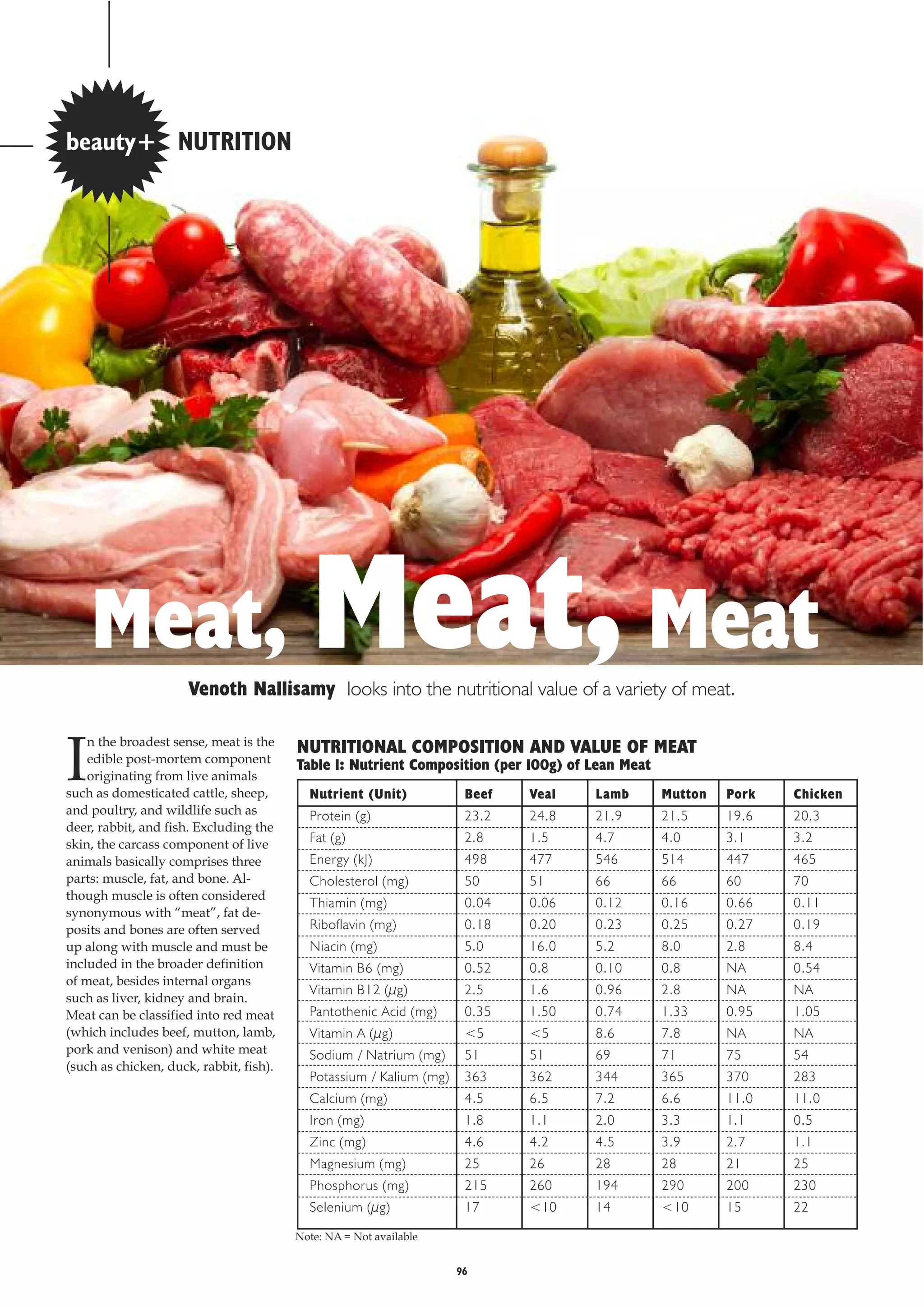
Meat, Meat, Meat
Venoth Nallisamy looks into the nutritional value of a variety of meat.
I
n the broadest sense, meat is the
edible post-mortem component
originating from live animals
such as domesticated cattle, sheep,
and poultry, and wildlife such as
deer, rabbit, and fish. Excluding the
skin, the carcass component of live
animals basically comprises three
parts: muscle, fat, and bone. Al-
though muscle is often considered
synonymous with “meat”, fat de-
posits and bones are often served
up along with muscle and must be
included in the broader definition
of meat, besides internal organs
such as liver, kidney and brain.
Meat can be classified into red meat
(which includes beef, mutton, lamb,
pork and venison) and white meat
(such as chicken, duck, rabbit, fish).
NUTRITIONAL COMPOSITION AND VALUE OF MEAT
Table 1: Nutrient Composition (per 100g) of Lean Meat
Nutrient (Unit) Beef Veal Lamb Mutton Pork Chicken
Protein (g) 23.2 24.8 21.9 21.5 19.6 20.3
Fat (g) 2.8 1.5 4.7 4.0 3.1 3.2
Energy (kJ) 498 477 546 514 447 465
Cholesterol (mg) 50 51 66 66 60 70
Thiamin (mg) 0.04 0.06 0.12 0.16 0.66 0.11
Riboflavin (mg) 0.18 0.20 0.23 0.25 0.27 0.19
Niacin (mg) 5.0 16.0 5.2 8.0 2.8 8.4
Vitamin B6 (mg) 0.52 0.8 0.10 0.8 NA 0.54
Vitamin B12 (µg) 2.5 1.6 0.96 2.8 NA NA
Pantothenic Acid (mg) 0.35 1.50 0.74 1.33 0.95 1.05
Vitamin A (µg) <5 <5 8.6 7.8 NA NA
Sodium / Natrium (mg) 51 51 69 71 75 54
Potassium / Kalium (mg) 363 362 344 365 370 283
Calcium (mg) 4.5 6.5 7.2 6.6 11.0 11.0
Iron (mg) 1.8 1.1 2.0 3.3 1.1 0.5
Zinc (mg) 4.6 4.2 4.5 3.9 2.7 1.1
Magnesium (mg) 25 26 28 28 21 25
Phosphorus (mg) 215 260 194 290 200 230
Selenium (µg) 17 <10 14 <10 15 22
Note: NA = Not available
97
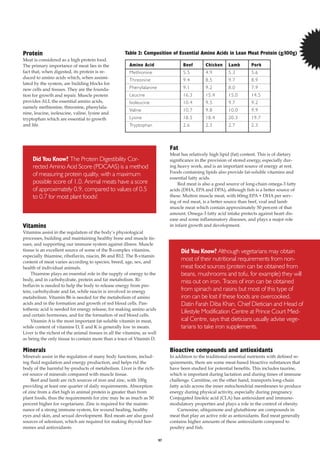
Protein
Meat is considered as a high protein food.
The primary importance of meat lies in the
fact that, when digested, its protein is re-
duced to amino acids which, when assimi-
lated by the system, are building blocks for
new cells and tissues. They are the founda-
tion for growth and repair. Muscle protein
provides ALL the essential amino acids,
namely methionine, threonine, phenylala-
nine, leucine, isoleucine, valine, lysine and
tryptophan which are essential to growth
and life.
Table 2: Composition of Essential Amino Acids in Lean Meat Protein (g/100g)
Amino Acid Beef Chicken Lamb Pork
Methionine 5.5 4.9 5.3 5.6
Threonine 9.4 8.5 9.7 8.9
Phenylalanine 9.1 9.2 8.0 7.9
Leucine 16.3 15.4 15.0 14.5
Isoleucine 10.4 9.5 9.7 9.2
Valine 10.7 9.8 10.0 9.9
Lysine 18.5 18.4 20.3 19.7
Tryptophan 2.6 2.3 2.7 2.3
Did You Know? The Protein Digestibility Cor-
rected Amino Acid Score (PDCAAS) is a method
of measuring protein quality, with a maximum
possible score of 1.0. Animal meats have a score
of approximately 0.9, compared to values of 0.5
to 0.7 for most plant foods!
Fat
Meat has relatively high lipid (fat) content. This is of dietary
significance in the provision of stored energy, especially dur-
ing heavy work, and is an important source of energy at rest.
Foods containing lipids also provide fat-soluble vitamins and
essential fatty acids.
Red meat is also a good source of long-chain omega-3 fatty
acids (DHA, EPA and DPA), although fish is a better source of
these. Mutton muscle meat, with 60mg EPA + DHA per serv-
ing of red meat, is a better source than beef, veal and lamb
muscle meat which contain approximately 50 percent of that
amount. Omega-3 fatty acid intake protects against heart dis-
ease and some inflammatory diseases, and plays a major role
in infant growth and development.
Bioactive compounds and antioxidants
In addition to the traditional essential nutrients with defined re-
quirements, there are some meat-based bioactive substances that
have been studied for potential benefits. This includes taurine,
which is important during lactation and during times of immune
challenge. Carnitine, on the other hand, transports long-chain
fatty acids across the inner mitochondrial membranes to produce
energy during physical activity, especially during pregnancy.
Conjugated linoleic acid (CLA) has antioxidant and immuno-
modulatory properties and plays a role in the control of obesity.
Carnosine, ubiquinone and glutathione are compounds in
meat that play an active role as antioxidants. Red meat generally
contains higher amounts of these antioxidants compared to
poultry and fish.
Vitamins
Vitamins assist in the regulation of the body’s physiological
processes, building and maintaining healthy bone and muscle tis-
sues, and supporting our immune system against illness. Muscle
tissue is an excellent source of some of the B-complex vitamins,
especially thiamine, riboflavin, niacin, B6 and B12. The B-vitamin
content of meat varies according to species, breed, age, sex, and
health of individual animals.
Thiamine plays an essential role in the supply of energy to the
body, and in carbohydrate, protein and fat metabolism. Ri-
boflavin is needed to help the body to release energy from pro-
tein, carbohydrate and fat, while niacin is involved in energy
metabolism. Vitamin B6 is needed for the metabolism of amino
acids and in the formation and growth of red blood cells. Pan-
tothenic acid is needed for energy release, for making amino acids
and certain hormones, and for the formation of red blood cells.
Vitamin A is the most important fat-soluble vitamin in meat,
while content of vitamins D, E and K is generally low in meats.
Liver is the richest of the animal tissues in all the vitamins, as well
as being the only tissue to contain more than a trace of Vitamin D.
Minerals
Minerals assist in the regulation of many body functions, includ-
ing fluid regulation and energy production, and helps rid the
body of the harmful by-products of metabolism. Liver is the rich-
est source of minerals compared with muscle tissue.
Beef and lamb are rich sources of iron and zinc, with 100g
providing at least one quarter of daily requirements. Absorption
of zinc from a diet high in animal protein is greater than from
plant foods, thus the requirements for zinc may be as much as 50
percent higher for vegetarians. Zinc is required for the mainte-
nance of a strong immune system, for wound healing, healthy
eyes and skin, and sexual development. Red meats are also good
sources of selenium, which are required for making thyroid hor-
mones and antioxidants.
Did You Know? Although vegetarians may obtain
most of their nutritional requirements from non-
meat food sources (protein can be obtained from
beans, mushrooms and tofu, for example) they will
miss out on iron. Traces of iron can be obtained
from spinach and raisins but most of this type of
iron can be lost if these foods are overcooked.
Datin Farah Diba Khan, Chief Dietician and Head of
Lifestyle Modification Centre at Prince Court Med-
ical Centre, says that dieticians usually advise vege-
tarians to take iron supplements.
98
TIPS FOR COOKING HEALTHIER MEAT
a) Smaller servings. Choose three-ounce servings. Start with four-
ounces of raw meat to end up with a three-ounce cooked serving.
This will account for cooking losses.
b) Use the “loin/round” rule of thumb for beef and “loin/leg” for pork,
lamb, and veal. Cuts with these words on the label are usually lean
choices.
c) Reduce intake of internal organ meats which are very high in fat and
cholesterol.
d) Tenderise lean cuts of meat by cooking them slowly in liquid or
marinating them before cooking. Pounding and grinding can also help.
e) Keep your meat selections lean. Trim all visible fat and let the
remainder drip off during cooking. Broil, grill, bake or microwave
meat. Buy skinless poultry or remove skin before cooking, to
reduce fat content by about 50 percent. When roasting, it is fine to
cook with the skin and remove the fat before eating for tastier meat.
f) Remove fat from stews and soups by chilling them and skimming
the hardened fat from the top.
g) Don’t fry. The batter or breading on fried meat acts like a sponge –
soaking up fat.
h) Malaysians are known to cook gravy with high saturated fat such as
coconut milk. A healthier way is to cook with low-fat milk or yogurt,
or using herbs and spices.
Fish – What makes it so special?
Fish is an excellent source of high quality protein, particularly the
essential amino acids lysine and methionine. A three-ounce
cooked serving of most fish provides about one-third of the aver-
age daily recommended amount of protein. The protein in
seafood is also easier to digest because it has less connective tis-
sue than red meats and poultry.
Fish is considered a low calorie food when compared to other
meats. Even the fattier fish like mackerel, herring and salmon con-
tain approximately 200 kcal or less in a three-ounce cooked serv-
ing, thus you can consume fewer calories to meet your daily
protein needs. This why fish is a good choice for diets designed to
help you maintain an ideal weight.
Fish is considered low in both total fat and saturated fat. Ma-
rine lipids contain the omega-3 fatty acids EPA and DHA with
well-documented beneficial health effects, such as lowering the
risk for heart disease. Omega-3 fatty acids can make blood less
likely to clot and block blood vessels, and their consumption may
also decrease levels of blood fats. Most fish also contain fewer
than 160 kcals per three-ounce cooked serving. ‘Malaysian’ fish
such as bawal and ikan merah are also healthy choices.
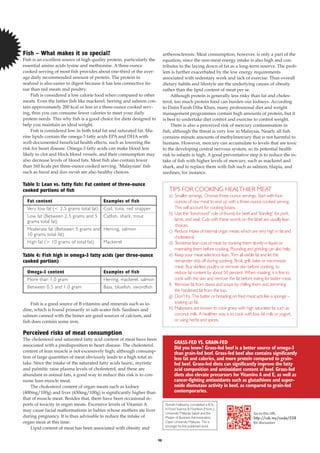
Table 3: Lean vs. fatty fish: Fat content of three-ounce
cooked portions of fish
Fat content Examples of fish
Very low fat (< 2.5 grams total fat) Cod, tuna, red snapper
Low fat (Between 2.5 grams and 5 Catfish, shark, trout
grams total fat)
Moderate fat (Between 5 grams and Herring, salmon
10 grams total fat)
High fat (> 10 grams of total fat) Mackerel
Table 4: Fish high in omega-3 fatty acids (per three-ounce
cooked portion)
Omega-3 content Examples of fish
More than 1.0 gram Herring, mackerel, salmon
Between 0.5 and 1.0 gram Bass, bluefish, swordfish
Fish is a good source of B vitamins and minerals such as io-
dine, which is found primarily in salt-water fish. Sardines and
salmon canned with the bones are good sources of calcium, and
fish does contain some iron.
Perceived risks of meat consumption
The cholesterol and saturated fatty acid content of meat have been
associated with a predisposition to heart disease. The cholesterol
content of lean muscle is not excessively high, although consump-
tion of large quantities of meat obviously leads to a high total in-
take. Since the intake of the saturated fatty acids lauric, myristic
and palmitic raise plasma levels of cholesterol, and these are
abundant in animal fats, a good way to reduce this risk is to con-
sume lean muscle meat.
The cholesterol content of organ meats such as kidney
(400mg/100g) and liver (430mg/100g) is significantly higher than
that of muscle meat. Besides that, there have been occasional re-
ports of toxicity in organ meats. Excessive levels of Vitamin A
may cause facial malformations in babies whose mothers ate liver
during pregnancy. It is thus advisable to reduce the intake of
organ meat at this time.
Lipid content of meat has been associated with obesity and
artherosclerosis. Meat consumption, however, is only a part of the
equation, since the non-meat energy intake is also high and con-
tributes to the laying down of fat as a long-term reserve. The prob-
lem is further exacerbated by the low energy requirements
associated with sedentary work and lack of exercise. Thus overall
dietary habits and lifestyle are the underlying causes of obesity
rather than the lipid content of meat per se.
Although protein is generally less risky than fat and choles-
terol, too much protein food can burden our kidneys. According
to Datin Farah Diba Khan, many professional diet and weight
management programmes contain high amounts of protein, but it
is best to undertake diet control and exercise to control weight.
There is also a perceived risk of mercury contamination in
fish, although the threat is very low in Malaysia. Nearly all fish
contains minute amounts of methylmercury that is not harmful to
humans. However, mercury can accumulate to levels that are toxic
to the developing central nervous system, so its potential health
risk to infants is high. A good preventative step is to reduce the in-
take of fish with higher levels of mercury, such as mackerel and
shark, and to replace them with fish such as salmon, tilapia, and
sardines, for instance.
GRASS-FED VS. GRAIN-FED
Did you know? Grass-fed beef is a better source of omega-3
than grain-fed beef. Grass-fed beef also contains significantly
less fat and calories, and more protein compared to grain-
fed beef. Grass-fed diets can significantly improve the fatty
acid composition and antioxidant content of beef. Grass-fed
diets also elevate precursors for Vitamins A and E, as well as
cancer-fighting antioxidants such as glutathione and super-
oxide dismutase activity in beef, as compared to grain-fed
contemporaries.
Venoth Nallisamy, completed a B.Sc.
in Food Science & Nutrition (Hons.),
University Malaysia Sabah and the
Master of Business Administration,
Open University Malaysia. This is
amongst his first published work.
Go to this URL
http://csb.my/node/538
for discussionor discussionf
http://csb.m
o this URLo tG
ion
y/node/538b.m
URL

nutrition_Layout 1

  • 1.
    96 beauty+ NUTRITION Meat, Meat,Meat Venoth Nallisamy looks into the nutritional value of a variety of meat. I n the broadest sense, meat is the edible post-mortem component originating from live animals such as domesticated cattle, sheep, and poultry, and wildlife such as deer, rabbit, and fish. Excluding the skin, the carcass component of live animals basically comprises three parts: muscle, fat, and bone. Al- though muscle is often considered synonymous with “meat”, fat de- posits and bones are often served up along with muscle and must be included in the broader definition of meat, besides internal organs such as liver, kidney and brain. Meat can be classified into red meat (which includes beef, mutton, lamb, pork and venison) and white meat (such as chicken, duck, rabbit, fish). NUTRITIONAL COMPOSITION AND VALUE OF MEAT Table 1: Nutrient Composition (per 100g) of Lean Meat Nutrient (Unit) Beef Veal Lamb Mutton Pork Chicken Protein (g) 23.2 24.8 21.9 21.5 19.6 20.3 Fat (g) 2.8 1.5 4.7 4.0 3.1 3.2 Energy (kJ) 498 477 546 514 447 465 Cholesterol (mg) 50 51 66 66 60 70 Thiamin (mg) 0.04 0.06 0.12 0.16 0.66 0.11 Riboflavin (mg) 0.18 0.20 0.23 0.25 0.27 0.19 Niacin (mg) 5.0 16.0 5.2 8.0 2.8 8.4 Vitamin B6 (mg) 0.52 0.8 0.10 0.8 NA 0.54 Vitamin B12 (µg) 2.5 1.6 0.96 2.8 NA NA Pantothenic Acid (mg) 0.35 1.50 0.74 1.33 0.95 1.05 Vitamin A (µg) <5 <5 8.6 7.8 NA NA Sodium / Natrium (mg) 51 51 69 71 75 54 Potassium / Kalium (mg) 363 362 344 365 370 283 Calcium (mg) 4.5 6.5 7.2 6.6 11.0 11.0 Iron (mg) 1.8 1.1 2.0 3.3 1.1 0.5 Zinc (mg) 4.6 4.2 4.5 3.9 2.7 1.1 Magnesium (mg) 25 26 28 28 21 25 Phosphorus (mg) 215 260 194 290 200 230 Selenium (µg) 17 <10 14 <10 15 22 Note: NA = Not available
  • 2.
    97 Protein Meat is consideredas a high protein food. The primary importance of meat lies in the fact that, when digested, its protein is re- duced to amino acids which, when assimi- lated by the system, are building blocks for new cells and tissues. They are the founda- tion for growth and repair. Muscle protein provides ALL the essential amino acids, namely methionine, threonine, phenylala- nine, leucine, isoleucine, valine, lysine and tryptophan which are essential to growth and life. Table 2: Composition of Essential Amino Acids in Lean Meat Protein (g/100g) Amino Acid Beef Chicken Lamb Pork Methionine 5.5 4.9 5.3 5.6 Threonine 9.4 8.5 9.7 8.9 Phenylalanine 9.1 9.2 8.0 7.9 Leucine 16.3 15.4 15.0 14.5 Isoleucine 10.4 9.5 9.7 9.2 Valine 10.7 9.8 10.0 9.9 Lysine 18.5 18.4 20.3 19.7 Tryptophan 2.6 2.3 2.7 2.3 Did You Know? The Protein Digestibility Cor- rected Amino Acid Score (PDCAAS) is a method of measuring protein quality, with a maximum possible score of 1.0. Animal meats have a score of approximately 0.9, compared to values of 0.5 to 0.7 for most plant foods! Fat Meat has relatively high lipid (fat) content. This is of dietary significance in the provision of stored energy, especially dur- ing heavy work, and is an important source of energy at rest. Foods containing lipids also provide fat-soluble vitamins and essential fatty acids. Red meat is also a good source of long-chain omega-3 fatty acids (DHA, EPA and DPA), although fish is a better source of these. Mutton muscle meat, with 60mg EPA + DHA per serv- ing of red meat, is a better source than beef, veal and lamb muscle meat which contain approximately 50 percent of that amount. Omega-3 fatty acid intake protects against heart dis- ease and some inflammatory diseases, and plays a major role in infant growth and development. Bioactive compounds and antioxidants In addition to the traditional essential nutrients with defined re- quirements, there are some meat-based bioactive substances that have been studied for potential benefits. This includes taurine, which is important during lactation and during times of immune challenge. Carnitine, on the other hand, transports long-chain fatty acids across the inner mitochondrial membranes to produce energy during physical activity, especially during pregnancy. Conjugated linoleic acid (CLA) has antioxidant and immuno- modulatory properties and plays a role in the control of obesity. Carnosine, ubiquinone and glutathione are compounds in meat that play an active role as antioxidants. Red meat generally contains higher amounts of these antioxidants compared to poultry and fish. Vitamins Vitamins assist in the regulation of the body’s physiological processes, building and maintaining healthy bone and muscle tis- sues, and supporting our immune system against illness. Muscle tissue is an excellent source of some of the B-complex vitamins, especially thiamine, riboflavin, niacin, B6 and B12. The B-vitamin content of meat varies according to species, breed, age, sex, and health of individual animals. Thiamine plays an essential role in the supply of energy to the body, and in carbohydrate, protein and fat metabolism. Ri- boflavin is needed to help the body to release energy from pro- tein, carbohydrate and fat, while niacin is involved in energy metabolism. Vitamin B6 is needed for the metabolism of amino acids and in the formation and growth of red blood cells. Pan- tothenic acid is needed for energy release, for making amino acids and certain hormones, and for the formation of red blood cells. Vitamin A is the most important fat-soluble vitamin in meat, while content of vitamins D, E and K is generally low in meats. Liver is the richest of the animal tissues in all the vitamins, as well as being the only tissue to contain more than a trace of Vitamin D. Minerals Minerals assist in the regulation of many body functions, includ- ing fluid regulation and energy production, and helps rid the body of the harmful by-products of metabolism. Liver is the rich- est source of minerals compared with muscle tissue. Beef and lamb are rich sources of iron and zinc, with 100g providing at least one quarter of daily requirements. Absorption of zinc from a diet high in animal protein is greater than from plant foods, thus the requirements for zinc may be as much as 50 percent higher for vegetarians. Zinc is required for the mainte- nance of a strong immune system, for wound healing, healthy eyes and skin, and sexual development. Red meats are also good sources of selenium, which are required for making thyroid hor- mones and antioxidants. Did You Know? Although vegetarians may obtain most of their nutritional requirements from non- meat food sources (protein can be obtained from beans, mushrooms and tofu, for example) they will miss out on iron. Traces of iron can be obtained from spinach and raisins but most of this type of iron can be lost if these foods are overcooked. Datin Farah Diba Khan, Chief Dietician and Head of Lifestyle Modification Centre at Prince Court Med- ical Centre, says that dieticians usually advise vege- tarians to take iron supplements.
  • 3.
    98 TIPS FOR COOKINGHEALTHIER MEAT a) Smaller servings. Choose three-ounce servings. Start with four- ounces of raw meat to end up with a three-ounce cooked serving. This will account for cooking losses. b) Use the “loin/round” rule of thumb for beef and “loin/leg” for pork, lamb, and veal. Cuts with these words on the label are usually lean choices. c) Reduce intake of internal organ meats which are very high in fat and cholesterol. d) Tenderise lean cuts of meat by cooking them slowly in liquid or marinating them before cooking. Pounding and grinding can also help. e) Keep your meat selections lean. Trim all visible fat and let the remainder drip off during cooking. Broil, grill, bake or microwave meat. Buy skinless poultry or remove skin before cooking, to reduce fat content by about 50 percent. When roasting, it is fine to cook with the skin and remove the fat before eating for tastier meat. f) Remove fat from stews and soups by chilling them and skimming the hardened fat from the top. g) Don’t fry. The batter or breading on fried meat acts like a sponge – soaking up fat. h) Malaysians are known to cook gravy with high saturated fat such as coconut milk. A healthier way is to cook with low-fat milk or yogurt, or using herbs and spices. Fish – What makes it so special? Fish is an excellent source of high quality protein, particularly the essential amino acids lysine and methionine. A three-ounce cooked serving of most fish provides about one-third of the aver- age daily recommended amount of protein. The protein in seafood is also easier to digest because it has less connective tis- sue than red meats and poultry. Fish is considered a low calorie food when compared to other meats. Even the fattier fish like mackerel, herring and salmon con- tain approximately 200 kcal or less in a three-ounce cooked serv- ing, thus you can consume fewer calories to meet your daily protein needs. This why fish is a good choice for diets designed to help you maintain an ideal weight. Fish is considered low in both total fat and saturated fat. Ma- rine lipids contain the omega-3 fatty acids EPA and DHA with well-documented beneficial health effects, such as lowering the risk for heart disease. Omega-3 fatty acids can make blood less likely to clot and block blood vessels, and their consumption may also decrease levels of blood fats. Most fish also contain fewer than 160 kcals per three-ounce cooked serving. ‘Malaysian’ fish such as bawal and ikan merah are also healthy choices. Table 3: Lean vs. fatty fish: Fat content of three-ounce cooked portions of fish Fat content Examples of fish Very low fat (< 2.5 grams total fat) Cod, tuna, red snapper Low fat (Between 2.5 grams and 5 Catfish, shark, trout grams total fat) Moderate fat (Between 5 grams and Herring, salmon 10 grams total fat) High fat (> 10 grams of total fat) Mackerel Table 4: Fish high in omega-3 fatty acids (per three-ounce cooked portion) Omega-3 content Examples of fish More than 1.0 gram Herring, mackerel, salmon Between 0.5 and 1.0 gram Bass, bluefish, swordfish Fish is a good source of B vitamins and minerals such as io- dine, which is found primarily in salt-water fish. Sardines and salmon canned with the bones are good sources of calcium, and fish does contain some iron. Perceived risks of meat consumption The cholesterol and saturated fatty acid content of meat have been associated with a predisposition to heart disease. The cholesterol content of lean muscle is not excessively high, although consump- tion of large quantities of meat obviously leads to a high total in- take. Since the intake of the saturated fatty acids lauric, myristic and palmitic raise plasma levels of cholesterol, and these are abundant in animal fats, a good way to reduce this risk is to con- sume lean muscle meat. The cholesterol content of organ meats such as kidney (400mg/100g) and liver (430mg/100g) is significantly higher than that of muscle meat. Besides that, there have been occasional re- ports of toxicity in organ meats. Excessive levels of Vitamin A may cause facial malformations in babies whose mothers ate liver during pregnancy. It is thus advisable to reduce the intake of organ meat at this time. Lipid content of meat has been associated with obesity and artherosclerosis. Meat consumption, however, is only a part of the equation, since the non-meat energy intake is also high and con- tributes to the laying down of fat as a long-term reserve. The prob- lem is further exacerbated by the low energy requirements associated with sedentary work and lack of exercise. Thus overall dietary habits and lifestyle are the underlying causes of obesity rather than the lipid content of meat per se. Although protein is generally less risky than fat and choles- terol, too much protein food can burden our kidneys. According to Datin Farah Diba Khan, many professional diet and weight management programmes contain high amounts of protein, but it is best to undertake diet control and exercise to control weight. There is also a perceived risk of mercury contamination in fish, although the threat is very low in Malaysia. Nearly all fish contains minute amounts of methylmercury that is not harmful to humans. However, mercury can accumulate to levels that are toxic to the developing central nervous system, so its potential health risk to infants is high. A good preventative step is to reduce the in- take of fish with higher levels of mercury, such as mackerel and shark, and to replace them with fish such as salmon, tilapia, and sardines, for instance. GRASS-FED VS. GRAIN-FED Did you know? Grass-fed beef is a better source of omega-3 than grain-fed beef. Grass-fed beef also contains significantly less fat and calories, and more protein compared to grain- fed beef. Grass-fed diets can significantly improve the fatty acid composition and antioxidant content of beef. Grass-fed diets also elevate precursors for Vitamins A and E, as well as cancer-fighting antioxidants such as glutathione and super- oxide dismutase activity in beef, as compared to grain-fed contemporaries. Venoth Nallisamy, completed a B.Sc. in Food Science & Nutrition (Hons.), University Malaysia Sabah and the Master of Business Administration, Open University Malaysia. This is amongst his first published work. Go to this URL http://csb.my/node/538 for discussionor discussionf http://csb.m o this URLo tG ion y/node/538b.m URL