PRESSURE
SORE/ULCER
Presented by:
Dr. JAYARAM PANDEY
RESIDENT,GENERAL
SURGERY
Introduction
Pressure ulcers are localized areas of
tissue necrosis that tend to develop
when soft tissue is compressed
between a bony prominence and an
external surface for a prolonged
period of time.
Introduction
Failure to provide appropriate pressure
ulcer care may expose providers to
significant liability; legal judgments
against nursing homes in excess of fifty
million dollars have occurred when
patients develop an ulcer.
The consequences of pressure-induced skin
injury range from nonblanchable erythema of
intact skin to deep ulcers extending down to the
bone. The ulcer imposes a significant burden
not only on the patient, but the entire health care
system.
Anatomy
Largest organ of the body
Weighs 6-8 pounds
Varied thickness
Elastic
Function
 Protection
 Transmits sensations
 Regulates body temperature
 Excretes waste
 Prevents excessive loss of body fluids
Physiology
Three major levels
 Epidermis
 Dermis
 Subcutaneous tissue
Epidermis
Thickness <1mm
Avascular
Keratinocytes
Melanocytes
Langerhans cells
Dermis
Middle layer
Hair follicles, blood vessels, nerve
endings, sweat glands
Fibroblasts
Subcutaneous Tissue
Innermost layer
Mechanical and thermal insulation
Limited bloody supply
Aging and the Skin
Fewer sweat glands
Atrophy & thinning of all layers
Collagen/elastin fibers degenerate
Atherosclerosis of cutaneous vessels
Decrease in sebaceous glands
Decrease in immune response
Less elasticity
Changes in thermoregulation
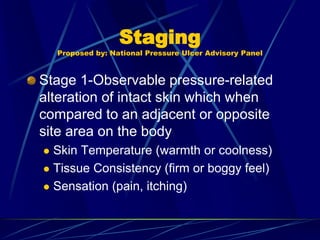
Staging
Proposed by: National Pressure Ulcer Advisory Panel
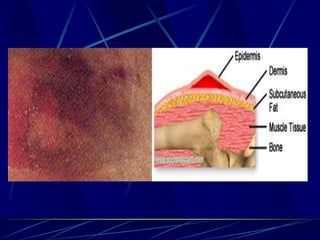
Stage 1-Observable pressure-related
alteration of intact skin which when
compared to an adjacent or opposite
site area on the body
 Skin Temperature (warmth or coolness)
 Tissue Consistency (firm or boggy feel)
 Sensation (pain, itching)
Stage 1 cont…
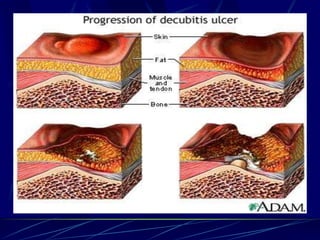
The ulcer appears as a defined area of
persistent redness in lightly pigmented skin;
in darker skin tones the ulcer may appear with
persistent red, blue, or purple hues.
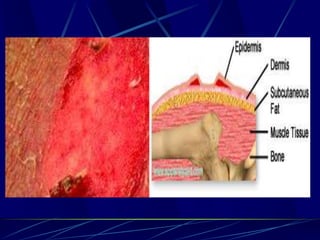
Stage 2
Characterized by a partial thickness skin loss
involving the epidermis and/or dermis. The
ulcer is superficial and presents clinically as
an abrasion, blister, or shallow crater.
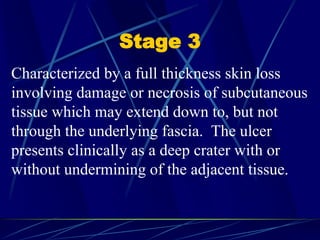
Stage 3
Characterized by a full thickness skin loss
involving damage or necrosis of subcutaneous
tissue which may extend down to, but not
through the underlying fascia. The ulcer
presents clinically as a deep crater with or
without undermining of the adjacent tissue.
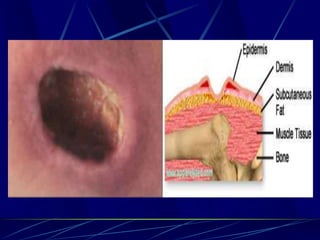
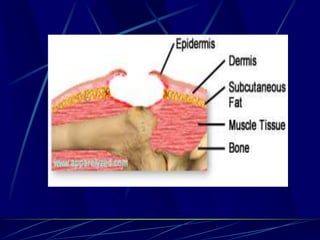
Stage 4
Characterized by a full thickness skin loss with
extensive destruction, tissue necrosis, or damage
to the muscle, bone, or supporting structures.
Staging cont…
Pressure ulcers covered by eschar are not stageable.
Controversy exists over the staging and
implications of “deep purple lesions,” particularly
when localized over the heals. These lesions are
believed to be indicative of deep tissue injury.
Epidemiology
Prevalence rate for pressure ulcers have
ranged in most studies from 3-14%, and
incidence rates from 1 to 8 during the period
of hospitalization. However, the rates may be
considerably higher in select groups of
hospital patients.
Pathogenesis
Development of a pressure ulcer is a complex
process that requires the application of external
forces to the skin. However, external forces
alone are not sufficient to cause an ulcer; their
interaction with host-specific factors culminates
in tissue damage.
External Factors
Pressure
Shearing forces
Friction
Moisture
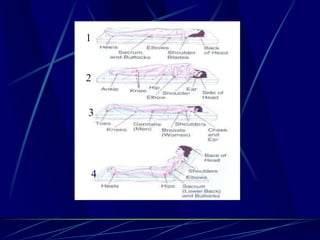
Pressure
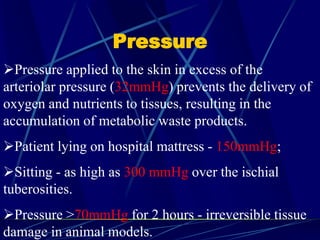
Pressure applied to the skin in excess of the
arteriolar pressure (32mmHg) prevents the delivery of
oxygen and nutrients to tissues, resulting in the
accumulation of metabolic waste products.
Patient lying on hospital mattress - 150mmHg;
Sitting - as high as 300 mmHg over the ischial
tuberosities.
Pressure >70mmHg for 2 hours - irreversible tissue
damage in animal models.
Pressure cont…
Tissues vary in their susceptibility to pressure-induced injury;
muscle is the most susceptible, followed by subcutaneous fat
and then dermis.
Thus, extensive deep tissue damage may occur with little or no
evidence of superficial tissue injury. A deep necrotic wound
may be the first evidence of pressure-induced injury, rather
than a gradual progression of an ulcer from stages 1 through 4.
1
2
3
4
Shearing Forces
Shearing forces occur when patients are placed on an
incline.
Deeper tissues, including muscle and subcutaneous
fat, are pulled downwards by gravity, while the
superficial epidermis and dermis remain fixed through
contact with the external surface.
The result is stretching and angulation of local blood
vessels and lymphatics.
Friction
Occurs when patients are dragged across an external
surface. This results in an abrasion with damage to
the most superficial layer of skin. Friction is most
likely to result in stage 2 pressure ulcers since it does
not cause the necrotic changes associated with deep
tissue injury; limited contribution to the development
of stage 3 and 4 ulcers.
Moisture
Exposure to moisture in the form of
perspiration, feces, or urine may lead to skin
maceration and predispose to superficial
ulceration.
Host Factors
Immobility
Incontinence
Nutritional status
Skin perfusion
Neurologic diseases
Other factors
Immobility
Immobility is one of the most important host
factors that contributes to pressure ulcer
development. Immobility may be permanent or
transient.
Incontinence
Urinary incontinence is frequently cited as a
predisposing factor for pressure ulcers. Some
studies suggest that incontinent patients have up
to a five-fold higher risk for pressure ulcer
development.
Nutritional Status
The role of nutritional status in the development of
pressure ulcers is uncertain. Animal studies have
found that more severe pressure-induced skin
destruction occurred in malnourished animals than in
well nourished animals exposed to similar amounts
of pressure.
In addition, cross-sectional studies have suggested
that patients with pressure ulcers are more likely to
have hypoalbuminemia.
Skin Perfusion
Contributing factors to the development of tissue ischemia
have been postulated to include hypotension, dehydration,
vasomotor failure, and vasoconstriction secondary to
shock, heart failure, or medications. When vital organs
such as the kidneys and gastrointestinal tract are not
receiving adequate perfusion, it is likely that blood flow to
the skin will also be decreased, which increases the risk
for the development of pressure ulcers.
Neurologic Diseases
Neurologic diseases such as dementia, delirium,
spinal cord injury, and neuropathy are important
contributors to pressure ulcer development.
 Sensory loss is also common, suggesting that
patients may not perceive pain or discomfort
arising from prolonged pressure.
Motor deficits – percieve pain or pressure but
cannot move
Other Factors
Other factors identified in some studies are:
older age, oedema , body weight. Specific
diagnoses that have been associated with ulcer
development include the presence of dry skin,
recent lower extremity fractures, diabetes, and
cardiovascular disease.
Identification of
Patients At Risk
Knowledge of factors contributing to the
pathogenesis of pressure ulcers allow the
identification of patients at risk for ulcer
development. Preventive interventions may
then be targeted to those specific patients.
Identification cont….
Assessment of risk for pressure ulcer development is not a
one time activity. Patients should be reassessed
periodically, particularly when there is a change in health
status.
Braden Scale
The Braden scale rates patients in six subscales:
• sensory perception
• moisture
• activity
• mobility
• nutrition
• friction and shear
using scores ranging from 1 to 3 or 4. The maximum total score is 23; a
score of 18 or less indicates high-risk.
Clinical Manifestation
and Diagnosis
Pressure ulcers are usually easy to identify by their
appearance and location overlying a bony prominence.
The exception may be stage 1 ulcers, which can be
difficult to recognize, particularly in patients with
darkly pigmented skin. They also may be confused
with other conditions that cause erythema such as
cellulitis.
Clinical Manifestation
cont….
Eschar often covers deep ulcers, making it difficult to
determine whether lesions are stage 3 or 4. In addition,
the extent of stage 4 ulcers is often underestimated due
to undermining and fistula formation; a relatively
small superficial skin defect may mask extensive deep
tissue necrosis.
Complications
Pressure ulcers may be associated with both medical and
psychosocial complications. The medical complications
can be life threatening and are more common with stage 3
and 4 ulcers.
Psychosocial consequences are not often considered.
However, patients with pressure ulcers may suffer pain
and feel stigmatized by the development of chronic skin
ulcer. This could result in depression, social isolation, and
decrements in overall health-related quality of life.
Infections
Infection is common among patients with pressure
ulcers occasionally leading to bacteremia, sepsis, and
death.
Pressure ulcers may also pose a risk to other
hospitalized patients by serving as a reservoir for
resistant organisms such as methicillin-resistant
Staphylococcus aureus, vancomycin-resistant
enterococci, and multiply-resistant gram negative
bacilli.
Other Complications
Sinus tracts may develop that communicate with the deep
viscera including the bowel or bladder.
Heterotrophic calcification also occasionally occurs.
The chronic inflammatory state arising from the ulcer may
result in systemic amyloidosis.
Cellulitis and Osteomyelitis
Squamous cell carcinoma occasionally develops in a
pressure ulcer and should always be considered in patients
with a non-healing wound.
Healing Process
Three stages
 Inflammation
 Proliferative (regenerative)
 Maturation (remodelling)
Inflammation
Vasoconstriction for hemostasis
Vasodilation follows
 Increases vessel permeability
 Leakage of plasma and leukocytes
Inflammation
Neutrophils clean up wound
Macrophages
 digest bacteria
 digest necrotic tissue
 digest dead neutrophils
 release growth factors
Inflammation
Clinical signs & symptoms
 Local erythema
 Warmth
 Edema
 Pain or tenderness
 Increased wound drainage
Proliferative
Granulation tissue by collagen synthesis
and angiogenesis
Wound contraction by myofibroblasts
Epithelization
 Requires moist wound surface
Clinical signs & symptoms
 Beefy red
 Bright pink granules
Maturation
Fibroblasts decrease
Collagen re-organizes
Vascularization decreases
May take up to 2 years to complete
Clinical signs & symptoms
 Scar tissue softens
 Becomes thinner and paler
Prevention
A comprehensive history and physical examination
can identify potentially correctable predisposing
factors for patients who are determined to be at risk
of developing pressure ulcers. Specific
interventions may then be initiated depending upon
the measured level of risk and the patient’s
individual needs.
Pressure Relief
Patient positioning
Pressure reducing devices
Patient Positioning
Regular turning schedule of 2 hours is
recommended
Patient should be placed at a 30 degree
angle to avoid direct pressure over the
greater trochanter
Pillows or foam wedges may need to be
placed between the ankles and knees
Patient Positioning
cont..
The heels require particular attention;
pillows may be placed under the lower
legs to elevate the heels, or special heel
protectors can be used
Elevation of the head of the bed should
be limited to minimize exposure to
shear forces
Pressure Reducing
Devices
Static devices consist of overlays and
mattresses that are made of or contain
gel, foam, air, or water
Dynamic support systems use a power
source to alternate air currents in order
to regulate or redistribute pressure
against the body
Other Interventions
Patients immobilized from a hip fracture
or stroke may benefit from physical
therapy
Severe spasticity may be relieved with
muscle relaxant drugs or a nerve block
Medications contributing to immobility
(eg. sedatives) should be stopped

Other Interventions
cont…
Proper skin care should be provided,
including cleansings at regular intervals
and minimizing exposure to moisture
Massage over bony prominences
should be avoided
Patients should not be dragged in bed
Adequate nutrition should be provided
Efficacy
A survey of pressure ulcer experts indicated that 62%
disagreed with the statement “all pressure ulcers are
preventable”.

It is easy to understand why some failures will occur
considering that a single bed-bound patient must be
repositioned over 4000 times a year.
Good preventive care may result in significant cost
savings. One study in an ICU found that they were
able to save $700 per patient.
Treatment
Wound should be evaluated for stage,
size, sinus tracts, necrotic tissue,
exudate, and presence of granulation
Photographs of all wounds should be
considered
Adequate pain relief
Treatment
Dressings
Debridement
Local antibiotic
Dressing Categories
Gauze dressing
Transparent film
Hydrogels
Hydrocolloids
Alginate
Gauze Dressing
Filler for dead space
Absorber
Cleansing material (patting not rubbing)
Carrier for medication
NOT for WET-TO-DRY dressings!!!
Transparent Film
Stage 1
Shallow wounds with minimal exudate
Waterproof site
May protect from friction and shear
Promotes autolytic debridement
Hydrogels
Stage 2, 3
Light exudate
Limited absorptive capability
Easy to apply and remove
Does not leave residue in wounds
Hydrocolloids
Stage 2, 3, 4
Small to moderate exudate
May prevent contamination
Moderate to heavy exudate
Moisture may also reduce pain to
nerves
Alginate
Stage 2, 3, 4
High capacity for absorption
Interacts with wound fluids to form a gel
creating a moist wound environment
Apply within wound borders
Wound Debridement
Mechanical
Sharp
Enzymatic
Autolytic
Mechanical
Debridement
Includes the use of wet-to-dry dressings, hydrotherapy,
wound irrigation, and scrubbing the wound with gauze.
Best for wounds that contain thick exudate, slough, or
loose necrotic tissue. Wet-to-dry dressings will remove
both nonviable and viable tissues.
Moistening the dressing before removal should be avoided
since it will limit the debriding effects.
Sharp Debridement
Involves the use of a scalpel or scissors in the
operating room or at the bedside.
This is the most rapid form of debridement; it is
indicated when there is evidence of cellulitis or sepsis
and is also used to remove thick eschar and extensive
necrotic tissue.
Enzymatic Debridement
Uses the topical application of agents such as
collagenase, papain, fibrinolysin, and
deoxyribonuclease which is effective in promoting the
growth of granulation tissue.
These agents are particularly useful in long-term care
settings and in patients who may not tolerate surgery.
Autolytic Debridement
Uses an occlusive dressing to cover a wound so that
necrotic tissue is digested by enzymes normally present in
wound tissue.
This often works best on wounds with minimal exudate
and should not be used in the presence of infection.
Debridement should stop once necrotic tissue has been
removed and granulation tissue is present.
Surgery
Necessary in some patients, particularly in those
whose quality of life would be improved
Direct closure of the wound
Skin grafts
Skin flaps
Musculocutaneous flaps
Free flaps
Duration of Wound
Healing
Stage 1: 1-7 days
Stage 2: 5-90 days
Stage 3: 30-180 days
Stage 4: 180-360 days

PRESSURE_ULCERS.ppt

  • 1.
    PRESSURE SORE/ULCER Presented by: Dr. JAYARAMPANDEY RESIDENT,GENERAL SURGERY
  • 2.
    Introduction Pressure ulcers arelocalized areas of tissue necrosis that tend to develop when soft tissue is compressed between a bony prominence and an external surface for a prolonged period of time.
  • 3.
    Introduction Failure to provideappropriate pressure ulcer care may expose providers to significant liability; legal judgments against nursing homes in excess of fifty million dollars have occurred when patients develop an ulcer.
  • 4.
    The consequences ofpressure-induced skin injury range from nonblanchable erythema of intact skin to deep ulcers extending down to the bone. The ulcer imposes a significant burden not only on the patient, but the entire health care system.
  • 5.
    Anatomy Largest organ ofthe body Weighs 6-8 pounds Varied thickness Elastic Function  Protection  Transmits sensations  Regulates body temperature  Excretes waste  Prevents excessive loss of body fluids
  • 6.
    Physiology Three major levels Epidermis  Dermis  Subcutaneous tissue
  • 7.
  • 8.
    Dermis Middle layer Hair follicles,blood vessels, nerve endings, sweat glands Fibroblasts
  • 9.
    Subcutaneous Tissue Innermost layer Mechanicaland thermal insulation Limited bloody supply
  • 10.
    Aging and theSkin Fewer sweat glands Atrophy & thinning of all layers Collagen/elastin fibers degenerate Atherosclerosis of cutaneous vessels Decrease in sebaceous glands Decrease in immune response Less elasticity Changes in thermoregulation
  • 11.
    Staging Proposed by: NationalPressure Ulcer Advisory Panel Stage 1-Observable pressure-related alteration of intact skin which when compared to an adjacent or opposite site area on the body  Skin Temperature (warmth or coolness)  Tissue Consistency (firm or boggy feel)  Sensation (pain, itching)
  • 12.
    Stage 1 cont… Theulcer appears as a defined area of persistent redness in lightly pigmented skin; in darker skin tones the ulcer may appear with persistent red, blue, or purple hues.
  • 14.
    Stage 2 Characterized bya partial thickness skin loss involving the epidermis and/or dermis. The ulcer is superficial and presents clinically as an abrasion, blister, or shallow crater.
  • 16.
    Stage 3 Characterized bya full thickness skin loss involving damage or necrosis of subcutaneous tissue which may extend down to, but not through the underlying fascia. The ulcer presents clinically as a deep crater with or without undermining of the adjacent tissue.
  • 18.
    Stage 4 Characterized bya full thickness skin loss with extensive destruction, tissue necrosis, or damage to the muscle, bone, or supporting structures.
  • 21.
    Staging cont… Pressure ulcerscovered by eschar are not stageable. Controversy exists over the staging and implications of “deep purple lesions,” particularly when localized over the heals. These lesions are believed to be indicative of deep tissue injury.
  • 22.
    Epidemiology Prevalence rate forpressure ulcers have ranged in most studies from 3-14%, and incidence rates from 1 to 8 during the period of hospitalization. However, the rates may be considerably higher in select groups of hospital patients.
  • 23.
    Pathogenesis Development of apressure ulcer is a complex process that requires the application of external forces to the skin. However, external forces alone are not sufficient to cause an ulcer; their interaction with host-specific factors culminates in tissue damage.
  • 24.
  • 25.
    Pressure Pressure applied tothe skin in excess of the arteriolar pressure (32mmHg) prevents the delivery of oxygen and nutrients to tissues, resulting in the accumulation of metabolic waste products. Patient lying on hospital mattress - 150mmHg; Sitting - as high as 300 mmHg over the ischial tuberosities. Pressure >70mmHg for 2 hours - irreversible tissue damage in animal models.
  • 26.
    Pressure cont… Tissues varyin their susceptibility to pressure-induced injury; muscle is the most susceptible, followed by subcutaneous fat and then dermis. Thus, extensive deep tissue damage may occur with little or no evidence of superficial tissue injury. A deep necrotic wound may be the first evidence of pressure-induced injury, rather than a gradual progression of an ulcer from stages 1 through 4.
  • 27.
  • 28.
    Shearing Forces Shearing forcesoccur when patients are placed on an incline. Deeper tissues, including muscle and subcutaneous fat, are pulled downwards by gravity, while the superficial epidermis and dermis remain fixed through contact with the external surface. The result is stretching and angulation of local blood vessels and lymphatics.
  • 29.
    Friction Occurs when patientsare dragged across an external surface. This results in an abrasion with damage to the most superficial layer of skin. Friction is most likely to result in stage 2 pressure ulcers since it does not cause the necrotic changes associated with deep tissue injury; limited contribution to the development of stage 3 and 4 ulcers.
  • 30.
    Moisture Exposure to moisturein the form of perspiration, feces, or urine may lead to skin maceration and predispose to superficial ulceration.
  • 31.
    Host Factors Immobility Incontinence Nutritional status Skinperfusion Neurologic diseases Other factors
  • 32.
    Immobility Immobility is oneof the most important host factors that contributes to pressure ulcer development. Immobility may be permanent or transient.
  • 33.
    Incontinence Urinary incontinence isfrequently cited as a predisposing factor for pressure ulcers. Some studies suggest that incontinent patients have up to a five-fold higher risk for pressure ulcer development.
  • 34.
    Nutritional Status The roleof nutritional status in the development of pressure ulcers is uncertain. Animal studies have found that more severe pressure-induced skin destruction occurred in malnourished animals than in well nourished animals exposed to similar amounts of pressure. In addition, cross-sectional studies have suggested that patients with pressure ulcers are more likely to have hypoalbuminemia.
  • 35.
    Skin Perfusion Contributing factorsto the development of tissue ischemia have been postulated to include hypotension, dehydration, vasomotor failure, and vasoconstriction secondary to shock, heart failure, or medications. When vital organs such as the kidneys and gastrointestinal tract are not receiving adequate perfusion, it is likely that blood flow to the skin will also be decreased, which increases the risk for the development of pressure ulcers.
  • 36.
    Neurologic Diseases Neurologic diseasessuch as dementia, delirium, spinal cord injury, and neuropathy are important contributors to pressure ulcer development.  Sensory loss is also common, suggesting that patients may not perceive pain or discomfort arising from prolonged pressure. Motor deficits – percieve pain or pressure but cannot move
  • 37.
    Other Factors Other factorsidentified in some studies are: older age, oedema , body weight. Specific diagnoses that have been associated with ulcer development include the presence of dry skin, recent lower extremity fractures, diabetes, and cardiovascular disease.
  • 38.
    Identification of Patients AtRisk Knowledge of factors contributing to the pathogenesis of pressure ulcers allow the identification of patients at risk for ulcer development. Preventive interventions may then be targeted to those specific patients.
  • 39.
    Identification cont…. Assessment ofrisk for pressure ulcer development is not a one time activity. Patients should be reassessed periodically, particularly when there is a change in health status.
  • 40.
    Braden Scale The Bradenscale rates patients in six subscales: • sensory perception • moisture • activity • mobility • nutrition • friction and shear using scores ranging from 1 to 3 or 4. The maximum total score is 23; a score of 18 or less indicates high-risk.
  • 41.
    Clinical Manifestation and Diagnosis Pressureulcers are usually easy to identify by their appearance and location overlying a bony prominence. The exception may be stage 1 ulcers, which can be difficult to recognize, particularly in patients with darkly pigmented skin. They also may be confused with other conditions that cause erythema such as cellulitis.
  • 42.
    Clinical Manifestation cont…. Eschar oftencovers deep ulcers, making it difficult to determine whether lesions are stage 3 or 4. In addition, the extent of stage 4 ulcers is often underestimated due to undermining and fistula formation; a relatively small superficial skin defect may mask extensive deep tissue necrosis.
  • 43.
    Complications Pressure ulcers maybe associated with both medical and psychosocial complications. The medical complications can be life threatening and are more common with stage 3 and 4 ulcers. Psychosocial consequences are not often considered. However, patients with pressure ulcers may suffer pain and feel stigmatized by the development of chronic skin ulcer. This could result in depression, social isolation, and decrements in overall health-related quality of life.
  • 45.
    Infections Infection is commonamong patients with pressure ulcers occasionally leading to bacteremia, sepsis, and death. Pressure ulcers may also pose a risk to other hospitalized patients by serving as a reservoir for resistant organisms such as methicillin-resistant Staphylococcus aureus, vancomycin-resistant enterococci, and multiply-resistant gram negative bacilli.
  • 46.
    Other Complications Sinus tractsmay develop that communicate with the deep viscera including the bowel or bladder. Heterotrophic calcification also occasionally occurs. The chronic inflammatory state arising from the ulcer may result in systemic amyloidosis. Cellulitis and Osteomyelitis Squamous cell carcinoma occasionally develops in a pressure ulcer and should always be considered in patients with a non-healing wound.
  • 47.
    Healing Process Three stages Inflammation  Proliferative (regenerative)  Maturation (remodelling)
  • 48.
    Inflammation Vasoconstriction for hemostasis Vasodilationfollows  Increases vessel permeability  Leakage of plasma and leukocytes
  • 49.
    Inflammation Neutrophils clean upwound Macrophages  digest bacteria  digest necrotic tissue  digest dead neutrophils  release growth factors
  • 50.
    Inflammation Clinical signs &symptoms  Local erythema  Warmth  Edema  Pain or tenderness  Increased wound drainage
  • 51.
    Proliferative Granulation tissue bycollagen synthesis and angiogenesis Wound contraction by myofibroblasts Epithelization  Requires moist wound surface Clinical signs & symptoms  Beefy red  Bright pink granules
  • 52.
    Maturation Fibroblasts decrease Collagen re-organizes Vascularizationdecreases May take up to 2 years to complete Clinical signs & symptoms  Scar tissue softens  Becomes thinner and paler
  • 53.
    Prevention A comprehensive historyand physical examination can identify potentially correctable predisposing factors for patients who are determined to be at risk of developing pressure ulcers. Specific interventions may then be initiated depending upon the measured level of risk and the patient’s individual needs.
  • 54.
  • 55.
    Patient Positioning Regular turningschedule of 2 hours is recommended Patient should be placed at a 30 degree angle to avoid direct pressure over the greater trochanter Pillows or foam wedges may need to be placed between the ankles and knees
  • 56.
    Patient Positioning cont.. The heelsrequire particular attention; pillows may be placed under the lower legs to elevate the heels, or special heel protectors can be used Elevation of the head of the bed should be limited to minimize exposure to shear forces
  • 57.
    Pressure Reducing Devices Static devicesconsist of overlays and mattresses that are made of or contain gel, foam, air, or water Dynamic support systems use a power source to alternate air currents in order to regulate or redistribute pressure against the body
  • 58.
    Other Interventions Patients immobilizedfrom a hip fracture or stroke may benefit from physical therapy Severe spasticity may be relieved with muscle relaxant drugs or a nerve block Medications contributing to immobility (eg. sedatives) should be stopped
  • 59.
    Other Interventions cont… Proper skincare should be provided, including cleansings at regular intervals and minimizing exposure to moisture Massage over bony prominences should be avoided Patients should not be dragged in bed Adequate nutrition should be provided
  • 60.
    Efficacy A survey ofpressure ulcer experts indicated that 62% disagreed with the statement “all pressure ulcers are preventable”. It is easy to understand why some failures will occur considering that a single bed-bound patient must be repositioned over 4000 times a year. Good preventive care may result in significant cost savings. One study in an ICU found that they were able to save $700 per patient.
  • 61.
    Treatment Wound should beevaluated for stage, size, sinus tracts, necrotic tissue, exudate, and presence of granulation Photographs of all wounds should be considered Adequate pain relief
  • 62.
  • 63.
    Dressing Categories Gauze dressing Transparentfilm Hydrogels Hydrocolloids Alginate
  • 64.
    Gauze Dressing Filler fordead space Absorber Cleansing material (patting not rubbing) Carrier for medication NOT for WET-TO-DRY dressings!!!
  • 65.
    Transparent Film Stage 1 Shallowwounds with minimal exudate Waterproof site May protect from friction and shear Promotes autolytic debridement
  • 66.
    Hydrogels Stage 2, 3 Lightexudate Limited absorptive capability Easy to apply and remove Does not leave residue in wounds
  • 67.
    Hydrocolloids Stage 2, 3,4 Small to moderate exudate May prevent contamination Moderate to heavy exudate Moisture may also reduce pain to nerves
  • 68.
    Alginate Stage 2, 3,4 High capacity for absorption Interacts with wound fluids to form a gel creating a moist wound environment Apply within wound borders
  • 69.
  • 70.
    Mechanical Debridement Includes the useof wet-to-dry dressings, hydrotherapy, wound irrigation, and scrubbing the wound with gauze. Best for wounds that contain thick exudate, slough, or loose necrotic tissue. Wet-to-dry dressings will remove both nonviable and viable tissues. Moistening the dressing before removal should be avoided since it will limit the debriding effects.
  • 71.
    Sharp Debridement Involves theuse of a scalpel or scissors in the operating room or at the bedside. This is the most rapid form of debridement; it is indicated when there is evidence of cellulitis or sepsis and is also used to remove thick eschar and extensive necrotic tissue.
  • 72.
    Enzymatic Debridement Uses thetopical application of agents such as collagenase, papain, fibrinolysin, and deoxyribonuclease which is effective in promoting the growth of granulation tissue. These agents are particularly useful in long-term care settings and in patients who may not tolerate surgery.
  • 73.
    Autolytic Debridement Uses anocclusive dressing to cover a wound so that necrotic tissue is digested by enzymes normally present in wound tissue. This often works best on wounds with minimal exudate and should not be used in the presence of infection. Debridement should stop once necrotic tissue has been removed and granulation tissue is present.
  • 77.
    Surgery Necessary in somepatients, particularly in those whose quality of life would be improved Direct closure of the wound Skin grafts Skin flaps Musculocutaneous flaps Free flaps
  • 78.
    Duration of Wound Healing Stage1: 1-7 days Stage 2: 5-90 days Stage 3: 30-180 days Stage 4: 180-360 days