03/11/2025 3
Surveillance
• FromFrench “surveiller”: is to watch over with
great attention
• Term from infectious disease epidemiology
– adopted for nutrition at 1974 World Food
Conference
4.
03/11/2025 4
Nutritional Surveillance
•System organized to monitor the food & nutrition
situation of a country/region within a country on a
continuous & regular basis
• Concerned with data on populations, not individuals
• On going data collection; regular & timely collection,
analysis & repotting of nutrition-relevant data
• ICN (1992) called for the international agencies to
establish a global nutritional surveillance system
- National systems are needed
- Information from the national systems must be compatible; allow
international comparisons
5.
03/11/2025 5
Nutritional Surveillance…
Methods
•Active surveillance: done by the group running the program
– Advantage: Takes time & other resources
– Limitations: More reliable & in accordance with the need
• Passive surveillance: data collected indirectly from on going
programs
– Strength: Lesser cost, time, personnel
– Limitations: Data less reliable & less relevant to the program
• Sentinel surveillance
6.
03/11/2025 6
Nutritional Surveillance……
•Objectives of nutritional surveillance
- Describe the nutritional status of the population,
particularly those at risk
- Analyze cases & associated factors
- Promote government decisions on nutritional
emergencies & national planning
- Prediction of future nutritional problems
- Monitoring & evaluation of nutrition programs
7.
03/11/2025 7
Applications ofNutritional Surveillance
1.Early warning & intervention
2.Policy and program Planning
3.Monitoring and Evaluation
4.Advocacy
8.
03/11/2025 8
1. Timelywarning & intervention
– To prevent short term critical reductions in food
consumption
– to identify problems in the food systems
– Information distributed to decision makers
9.
03/11/2025 9
The Earlywarning signs(EWS)
• The Early Warning (EW) system is designed to provide
assessments of food prospects within the country & to detect
(as early as possible) the likelihood of deterioration in food
security or, in worse case scenarios, impending disaster.
• This includes data on :
– Crop assessments
– Epidemic outbreaks
– Nutritional status of vulnerable groups
– livestock conditions
– Impact of precipitation on crops & livestock
– Market situation
– Magnitude of food shortages & measures taken for mitigation.
10.
03/11/2025 10
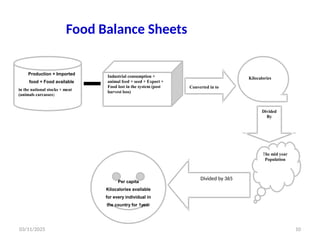
Food BalanceSheets
Production + Imported
food + Food available
in the national stocks + meat
(animals carcasses)
Industrial consumption +
animal feed + seed + Export +
Food lost in the system (post
harvest loss)
Converted in to
Per capita
Kilocalories available
for every individual in
the country for 1year
Kilocalories
Divided
By
The mid year
Population
Divided by 365
11.
03/11/2025 11
Role ofEarly Warning Systems in Decision Making
Processes
• It is of little use to look at an EWS in isolation from
their use in the decision making process
• To be effective:
– it must be able to trigger a timely response/intervening before the
point of destitution is reached, to protect livelihoods before lives are
threatened.
– In other words, the EW/response system must be geared to protect
future capacity to subsist as well as able to ensure current
consumption.
• Thus, the EWS must be sensitive to changes in food
security status before famine threatens & able to
detect localized pockets of acute food stress.
12.
03/11/2025 12
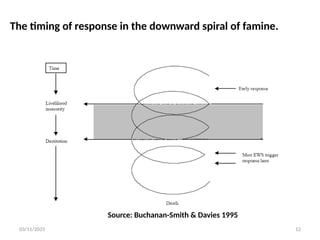
The timingof response in the downward spiral of famine.
Source: Buchanan-Smith & Davies 1995
13.
03/11/2025 13
Factors Affectingthe Take-up of Early Warning Information
• Ownership of Early Warning Information
• A Clear & Consistent Early Warning Message
• Interpreting Early Warning Information
**The challenge is how to translate early warning data into food
aid requirements
14.
03/11/2025 14
Application cont’d
2.Policy & program planning
• Provide continuous analysis, integration, and
interpretation of data from multiple sources, ensuring a
systematic flow of sectoral information.
–Demographic and Health Surveys (DHS)
–Multiple Indicator Cluster Survey (MICS)
–National Nutrition Surveys
–WHO/FAO Projections
• Assess policies & programs and supports high-level
decision making
• Enhance nutritional effects of development policies
15.
03/11/2025 15
3. Monitoring& evaluation
• Political and managerial decision-makers are
interested in the outcomes and effects of food
and nutrition programs
• To rationalize & maximize effectiveness of Food &
nutrition programs by measuring performance
16.
03/11/2025 16
4. Advocacy
-To assess &/ or monitor indicators related to
nutritional status by advocates
- Basis for directing funds towards particular
nutritional problems
• advocates seek to increase the flow of resources to support
food and nutrition activities that will allow them to achieve
their goals.
• helps advocates set priorities for dealing with problems
and serves as evidence to support those advocates' claims.
– Policy or program proposals made by the advocates
will be strengthened and a favorable outcome is more
likely.
17.
03/11/2025 17
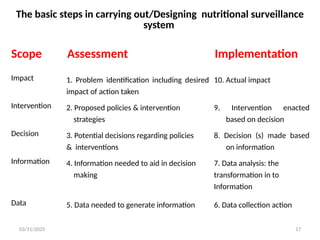
The basicsteps in carrying out/Designing nutritional surveillance
system
Scope Assessment Implementation
Impact 1. Problem identification including desired
impact of action taken
10. Actual impact
Intervention 2. Proposed policies & intervention
strategies
9. Intervention enacted
based on decision
Decision 3. Potential decisions regarding policies
& interventions
8. Decision (s) made based
on information
Information 4. Information needed to aid in decision
making
7. Data analysis: the
transformation in to
Information
Data 5. Data needed to generate information 6. Data collection action
18.
03/11/2025 18
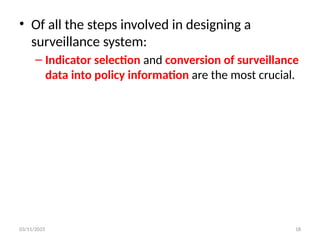
• Ofall the steps involved in designing a
surveillance system:
– Indicator selection and conversion of surveillance
data into policy information are the most crucial.
19.
03/11/2025 19
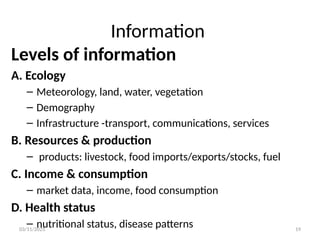
Information
Levels ofinformation
A. Ecology
– Meteorology, land, water, vegetation
– Demography
– Infrastructure -transport, communications, services
B. Resources & production
– products: livestock, food imports/exports/stocks, fuel
C. Income & consumption
– market data, income, food consumption
D. Health status
– nutritional status, disease patterns
20.
03/11/2025 20
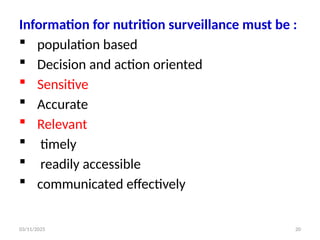
Information fornutrition surveillance must be :
population based
Decision and action oriented
Sensitive
Accurate
Relevant
timely
readily accessible
communicated effectively
21.
03/11/2025 21
Indicators ofnutritional surveillance
The indicators can be
• Measures of resources (eg, farming systems or
access to services)
• outcomes (eg, nutritional status, morbidity, or
mortality)
• factors that link resources to outcomes (eg,
food production, food intake, or household
expenditures)
22.
03/11/2025 22
Characteristics ofindicators
• The indicators should be:
– relevant
– sensitive
– specific
– cost-effective
– appropriate for trends analysis
• For action-oriented NS systems, cutoff points and action-triggering levels must
be chosen to determine how extensive the problem being assessed must be
before society demands that action be taken. It is determined by:
• Available resources
• cost effectiveness
• political awareness
23.
03/11/2025 23
Cut-off pointsand trigger levels
• Cut-off point: a value that marks the boundary
of acceptability (e.g. < -2SD W/A)
• Trigger level: percent of observations below a
cut-off point required to initiate action (e.g. %
children < 5 y with W/A < -2SD greater than
10%)
• Need to use the most sensitive indicators (in
terms of triggering action) that are feasible
24.
03/11/2025 24
Indicators usedin nutrition monitoring
Food crises
Food stocks (food balance sheets)
Production patterns
Market prices
Fall In body weights
Rainfall pattern
Household food security
Employment levels
Market prices
Changes in real income & purchasing power
Dietary energy supply
Poverty rate (percentage living on less than a $1 a day)
25.
03/11/2025 25
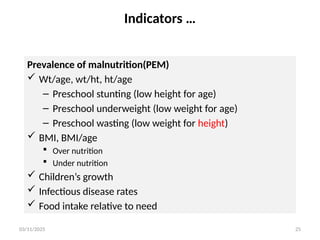
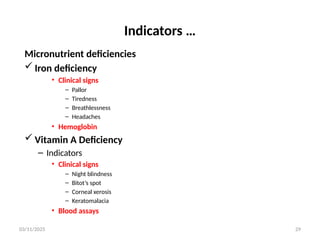
Indicators …
Prevalenceof malnutrition(PEM)
Wt/age, wt/ht, ht/age
– Preschool stunting (low height for age)
– Preschool underweight (low weight for age)
– Preschool wasting (low weight for height)
BMI, BMI/age
Over nutrition
Under nutrition
Children’s growth
Infectious disease rates
Food intake relative to need
03/11/2025 28
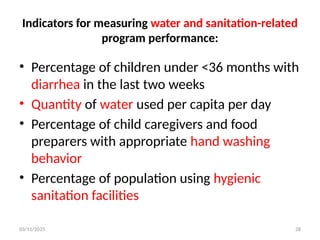
Indicators formeasuring water and sanitation-related
program performance:
• Percentage of children under <36 months with
diarrhea in the last two weeks
• Quantity of water used per capita per day
• Percentage of child caregivers and food
preparers with appropriate hand washing
behavior
• Percentage of population using hygienic
sanitation facilities
03/11/2025 30
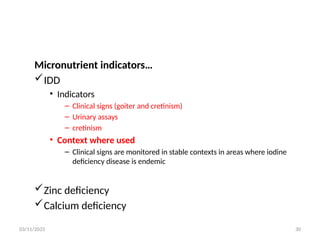
Micronutrient indicators…
IDD
•Indicators
– Clinical signs (goiter and cretinism)
– Urinary assays
– cretinism
• Context where used
– Clinical signs are monitored in stable contexts in areas where iodine
deficiency disease is endemic
Zinc deficiency
Calcium deficiency
31.
03/11/2025 31
Challenges ofnutrition surveillance systems
• Sustainability?
• Institutional issues?
• Linking information to action ?
32.
03/11/2025 32
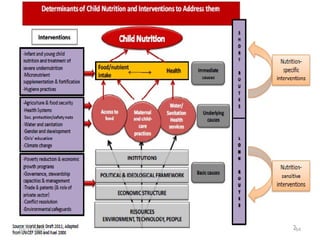
Nutritional intervention
•Aim is to reduce malnutrition and its
consequences
• Intervening effectively to improve nutrition
requires understanding the causes of
malnutrition (UNICEF Framework)
03/11/2025 34
Should Combinedifferent approaches like:
• Bottom up – Triple A Cycle
• Top-down
– Supplementation programs
– Fortification
– Food relief programs
Interventions…
35.
03/11/2025 35
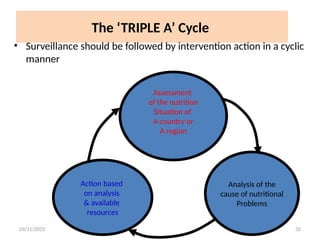
The ‘TRIPLEA’ Cycle
• Surveillance should be followed by intervention action in a cyclic
manner
Assessment
of the nutrition
Situation of
A country or
A region
Action based
on analysis
& available
resources
Analysis of the
cause of nutritional
Problems
36.
03/11/2025 36
Should Befully integrated!!!
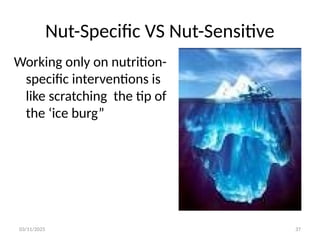
• Strategies that tackle only immediate causes of
malnutrition need to be Repeated often to have
sustainable effect and should be Enhanced by
activities which address the underlying or basic cause
of malnutrition
Interventions…
Con’t…
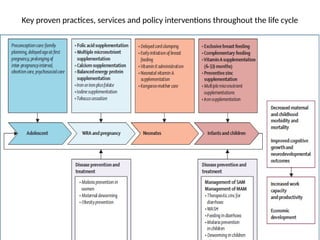
Proven Nut-specific andNut-sensitive interventions
Benefits ‘’during the life course’’
Reduce
o childhood mortality and morbidity
o Obesity and NCDs
Increase
o Cognitive, motor, socio emotional development
o School performance and learning capacity
o Adult stature
o Work capacity and productivity
03/11/2025 38
39.
03/11/2025
Evidence-based interventions toaddress under
nutrition
Breastfeeding promotion reduce
o Deaths by 9.1% at 36 months of age
Appropriate complementary feeding
o More effective at reducing stunting
Supplementation with vitamin A and zinc
o Could reduce deaths in children by about 10%
Appropriate management of severe acute malnutrition
o Reduce deaths due to SAM by 55% 39
40.
The 2013 Lancet’sSeries on Maternal and Child nutrition
Re-evaluate
o The problems of maternal and child under nutrition
o Growing problems of overweight and obesity for women
and children in low-income and middle-income (LMIC)
Many of these countries are said to have the ‘’double
burden of malnutrition’’
03/11/2025 40
41.
Con’t…
03/11/2025 41
Newevidence also strengthens the case for a continued
focus on the crucial 1000 day window during pregnancy
and the first 2 years of life
It also shows the importance of intervening early in
pregnancy and even before conception
o Because many women do not access nutrition-
promoting services until month 5 or 6 month of
pregnancy
42.
Con’t…
03/11/2025 42
• Growinginterest in adolescent health as an entry point to
improve the health of women and children
Maternal overweight and obesity are associated with
maternal morbidity, preterm birth, and increased infant
mortality
43.
03/11/2025
proven interventions: Recentevidences
Nutrition-specific interventions across the lifecycle
Address the immediate determinants of fetal and child
nutrition
If 10 proven nutrition-specific interventions were scaled-up
from existing population coverage to 90%
o Nearly 15% of deaths of children younger than 5 years could be
reduced
o Prevalence of stunting could be reduced by 20.3%
o Severe wasting by 61.4%
43
44.
Con’t…
The top 10Identified Nutrition specific interventions
1. Maternal dietary supplementation
2. Micronutrient supplementation or fortification
3. Breastfeeding and complementary feeding
4. Dietary supplementation for children
5. Adolescent health
6. preconception nutrition
03/11/2025 44
45.
Con’t…
7. Dietary diversification
8.Treatment of severe acute malnutrition
9. Disease prevention and management
10. Nutrition interventions in emergencies
03/11/2025 45
46.
Con’t…
03/11/2025 46
Themaximum effect on reduction of mortality is noted
with:
Management of acute malnutrition
infant and young child nutrition package
o Promotion of breastfeeding
o Promotion of complementary feeding
o Micronutrient supplementation
Nutrition-sensitive interventions andprogrammes
An approach that tackles the underlying determinants of
under nutrition by promoting:
Agriculture and food security
Access to and consumption of nutritious foods
Improving social protection and care practices
Ensuring access to health care
03/11/2025 48
49.
03/11/2025 49
Nutrition sensitiveinterventions...
• Developmental / Livelihoods Approaches
– Are systems approaches that addresses the
root/underline causes of development failure
50.
03/11/2025 50
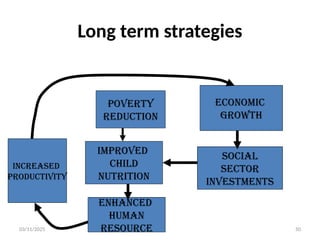
Long termstrategies
Poverty
Reduction
Improved
Child
Nutrition
Enhanced
Human
Resource
Social
Sector
Investments
Increased
productivity
Economic
Growth
51.
Con’t…
Delivery platforms/Channel's for nutrition-specific
interventions potentially increasing their scale, coverage,
and effectiveness
Helps to reach the needy (nutritionally vulnerable) and
poor segment of the community
03/11/2025 51
52.
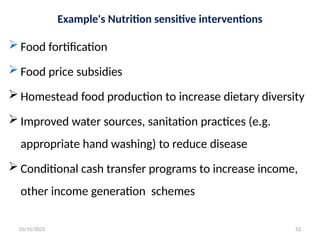
Example's Nutrition sensitiveinterventions
Food fortification
Food price subsidies
Homestead food production to increase dietary diversity
Improved water sources, sanitation practices (e.g.
appropriate hand washing) to reduce disease
Conditional cash transfer programs to increase income,
other income generation schemes
03/11/2025 52
53.
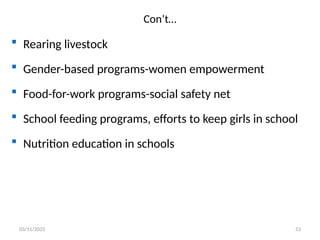
Con’t…
Rearing livestock
Gender-based programs-women empowerment
Food-for-work programs-social safety net
School feeding programs, efforts to keep girls in school
Nutrition education in schools
03/11/2025 53
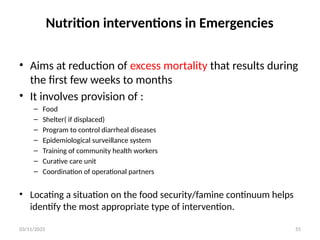
03/11/2025 55
Nutrition interventionsin Emergencies
• Aims at reduction of excess mortality that results during
the first few weeks to months
• It involves provision of :
– Food
– Shelter( if displaced)
– Program to control diarrheal diseases
– Epidemiological surveillance system
– Training of community health workers
– Curative care unit
– Coordination of operational partners
• Locating a situation on the food security/famine continuum helps
identify the most appropriate type of intervention.
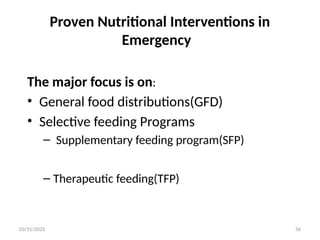
56.
03/11/2025 56
Proven NutritionalInterventions in
Emergency
The major focus is on:
• General food distributions(GFD)
• Selective feeding Programs
– Supplementary feeding program(SFP)
– Therapeutic feeding(TFP)
57.
03/11/2025 57
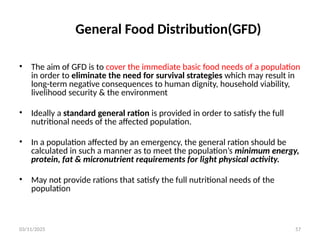
General FoodDistribution(GFD)
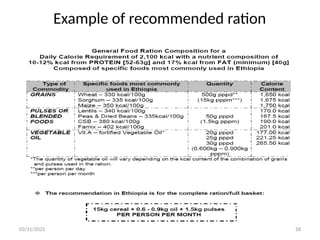
• The aim of GFD is to cover the immediate basic food needs of a population
in order to eliminate the need for survival strategies which may result in
long-term negative consequences to human dignity, household viability,
livelihood security & the environment
• Ideally a standard general ration is provided in order to satisfy the full
nutritional needs of the affected population.
• In a population affected by an emergency, the general ration should be
calculated in such a manner as to meet the population’s minimum energy,
protein, fat & micronutrient requirements for light physical activity.
• May not provide rations that satisfy the full nutritional needs of the
population
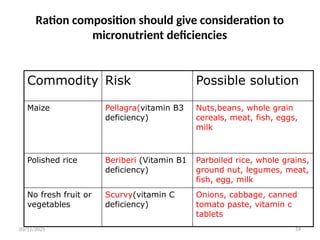
Ration composition shouldgive consideration to
micronutrient deficiencies
Commodity Risk Possible solution
Maize Pellagra(vitamin B3
deficiency)
Nuts,beans, whole grain
cereals, meat, fish, eggs,
milk
Polished rice Beriberi (Vitamin B1
deficiency)
Parboiled rice, whole grains,
ground nut, legumes, meat,
fish, egg, milk
No fresh fruit or
vegetables
Scurvy(vitamin C
deficiency)
Onions, cabbage, canned
tomato paste, vitamin c
tablets
03/11/2025 59
60.
03/11/2025 60
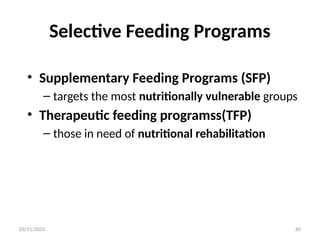
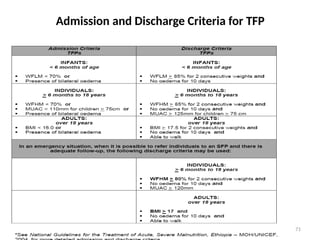
Selective FeedingPrograms
• Supplementary Feeding Programs (SFP)
– targets the most nutritionally vulnerable groups
• Therapeutic feeding programss(TFP)
– those in need of nutritional rehabilitation
61.
03/11/2025 61
Supplementary FeedingPrograms
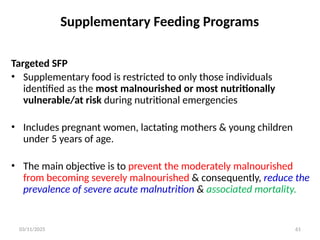
Targeted SFP
• Supplementary food is restricted to only those individuals
identified as the most malnourished or most nutritionally
vulnerable/at risk during nutritional emergencies
• Includes pregnant women, lactating mothers & young children
under 5 years of age.
• The main objective is to prevent the moderately malnourished
from becoming severely malnourished & consequently, reduce the
prevalence of severe acute malnutrition & associated mortality.
62.
03/11/2025 62
Blanket SFP
•Supplementary food is distributed as a temporary measure to all
vulnerable members of a population at-risk of becoming
malnourished without identifying the most malnourished.
• The general objective of a blanket SFP is to prevent widespread
malnutrition & mortality.
Supplementary Feeding Programs
63.
03/11/2025 63
Therapeutic FeedingProgram
• Provide a rehabilitative diet together with medical treatment for
diseases & complications associated with the presence of severe
acute malnutrition.
• The specific aim is to reduce mortality among acutely severely
malnourished individuals & to restore health through
rehabilitating them.
• Administered through the following venues:
– Therapeutic Feeding Center (TFC)
– Nutrition Rehabilitation Unit (NRU) at a hospital or health
facility
– Community-Based Therapeutic Care (CTC/OTP) program
64.
03/11/2025 64
TFCs
• Traditionally,the management of SAM in
emergencies includes setting up TFCs
• the focus has been on the attainment of
acceptable minimum standards of mortality
• Recovery and clinical outcomes in TFCs
managed by experienced agencies has been
positive
65.
03/11/2025 65
critical limitationsof TFCS
• Difficult to establish
• expensive to operate
• very limited coverage
• Do not build on the capacity of the community and can
undermine traditional coping strategies
• Mothers or caregivers are often required to stay longer in the
TFC which has tremendous opportunity costs and disrupts
family life.
• lead to the spread of cross infection, an important cause of
increased morbidity and mortality in an already weakened
population.
66.
03/11/2025 66
Community TherapeuticCare (CTC)
• is a new approach to managing acute malnutrition in
emergencies and beyond.
• provide rapid, effective, low cost assistance that is least
disruptive to affected communities
• builds a foundation to link relief and development interventions
for long-term solutions to food insecurity and threats to public
health.
• aims to treat the majority of the severely malnourished at home
• build local capacity to better manage care of acutely
malnourished children, and address repeated cycles of relief and
recovery.
67.
03/11/2025 67
Emergency Nutritionalintervention
MUAC in all children
6- 59 months
MUAC < 13.5 Cm
MUAC > = 13.5 Cm
Not referred unless at
high risk
Refer to the central
WFH assessment
WFH > 80%
( > = - 2 z score)
WFH 70- 79%
( < - 2 Z score)
WFH < 70%
( < - 3 Z score
Not admitted to
feeding programs
Not admitted to feeding
programs ( if there is very
high rate of mal nutrition
blanket supplementary
feeding
Targeted
Supplementar
y feeding
Program
( S FP)
Therapeutic
feeding
Program ( TFC)
03/11/2025 69
Cont..
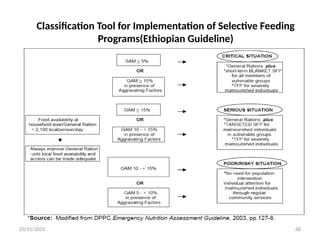
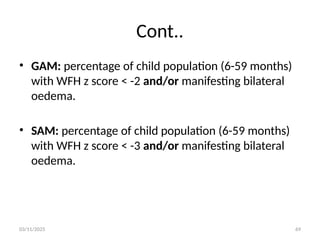
• GAM:percentage of child population (6-59 months)
with WFH z score < -2 and/or manifesting bilateral
oedema.
• SAM: percentage of child population (6-59 months)
with WFH z score < -3 and/or manifesting bilateral
oedema.
70.
03/11/2025 70
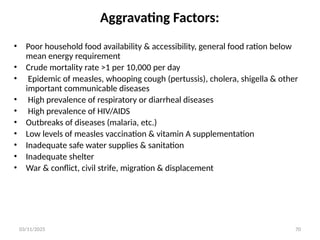
Aggravating Factors:
•Poor household food availability & accessibility, general food ration below
mean energy requirement
• Crude mortality rate >1 per 10,000 per day
• Epidemic of measles, whooping cough (pertussis), cholera, shigella & other
important communicable diseases
• High prevalence of respiratory or diarrheal diseases
• High prevalence of HIV/AIDS
• Outbreaks of diseases (malaria, etc.)
• Low levels of measles vaccination & vitamin A supplementation
• Inadequate safe water supplies & sanitation
• Inadequate shelter
• War & conflict, civil strife, migration & displacement






![CTEV [ clubfoot] DR ARUN LAL ,DR MOHAMED ASHRAF travancore medical college k...](https://cdn.slidesharecdn.com/ss_thumbnails/ctevclubfootdrarunlaldrmohamedashraftravancoremedicalcollegekollamkeralaindia-260208063247-18fc466c-thumbnail.jpg?width=640&height=640&fit=bounds)


