Nutrition Information System for
Sudan
Dr. Kazuko Yoshizawa
Nutrition Advisor for S/FMOH, WHO Sudan
Ms. Durria Mohamed Osman
Information, Documentation and Research
PHC, FMOH
Jan. 17, 2006
WHO Khartoum
Objective
• To give situation analysis
• To explore possible networking with different
sections of WHO, MOH and other UN agencies
for revitalization and strengthening of the
government nutrition and food security and the
response mechanism.
Background
• Nutrition and food security information system
(surveys and surveillance) and the response
mechanism used to exist, which were lead by the
government but not functioning now.
• UNICEF, WFP, FAO and NGOs are conducting
surveys and surveillance covering different
regions of the country and collecting information
for the programme, mostly for acute malnutrition.
Contd.
• Prevalence of chronic malnutrition in children
under 5 is 43% and acute malnutrition is16% for
North Sudan while they were 45% and 21%
respectively among the same age group for
Southern Sudan (MICS 2000, personal contact with
FMOH).
• Prevalence of micronutrient deficiency diseases
are high (iodine, VA, iron/folic acid)
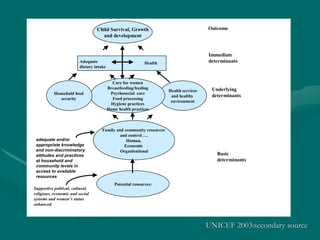
Child Survival, Growth
and development
Adequate
dietary intake
Health
Outcome
Immediate
determinants
Health services
and healthy
environment
Care for women
Breastfeeding/feeding
Psychosocial care
Food processing
Hygiene practices
Home health practices
Household food
security
Underlying
determinants
Family and community resources
and control ….
Human,
Economic
Organisational
Potential resources:
Basic
determinants
Supportive political, cultural,
religious, economic and social
systems and women’s status
enhanced.
adequate and/or
appropriate knowledge
and non-discriminatory
attitudes and practices
at household and
community levels in
access to available
resources
UNICEF 2003:secondary source
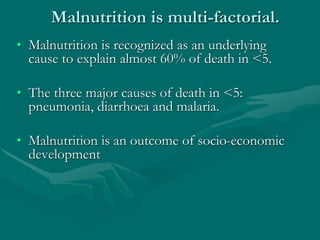
Malnutrition is multi-factorial.
• Malnutrition is recognized as an underlying
cause to explain almost 60% of death in <5.
• The three major causes of death in <5:
pneumonia, diarrhoea and malaria.
• Malnutrition is an outcome of socio-economic
development
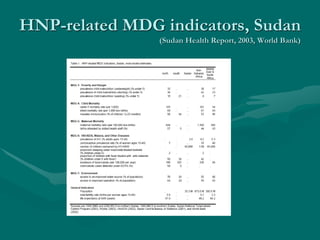
HNP-related MDG indicators, Sudan
(Sudan Health Report, 2003, World Bank)
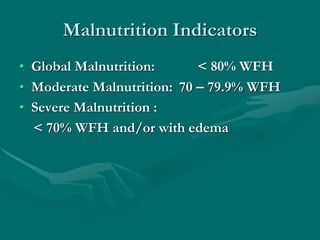
Malnutrition Indicators
• Global Malnutrition: < 80% WFH
• Moderate Malnutrition: 70 – 79.9% WFH
• Severe Malnutrition :
< 70% WFH and/or with edema
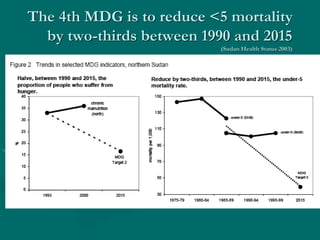
The 4th MDG is to reduce <5 mortality
by two-thirds between 1990 and 2015
(Sudan Health Status 2003)
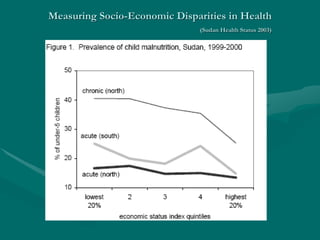
Measuring Socio-Economic Disparities in Health
(Sudan Health Status 2003)
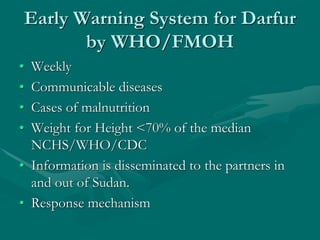
Early Warning System for Darfur
by WHO/FMOH
• Weekly
• Communicable diseases
• Cases of malnutrition
• Weight for Height <70% of the median
NCHS/WHO/CDC
• Information is disseminated to the partners in
and out of Sudan.
• Response mechanism
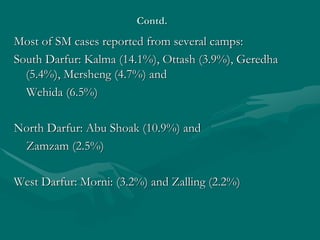
Contd.
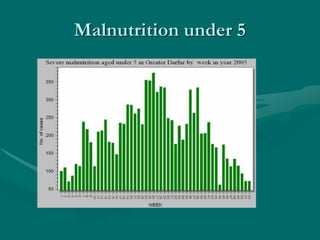
Most of SM cases reported from several camps:
South Darfur: Kalma (14.1%), Ottash (3.9%), Geredha
(5.4%), Mersheng (4.7%) and
Wehida (6.5%)
North Darfur: Abu Shoak (10.9%) and
Zamzam (2.5%)
West Darfur: Morni: (3.2%) and Zalling (2.2%)
Malnutrition under 5
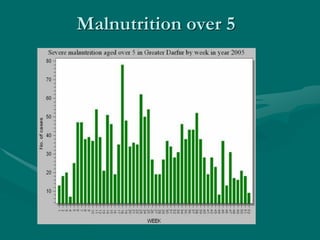
Malnutrition over 5
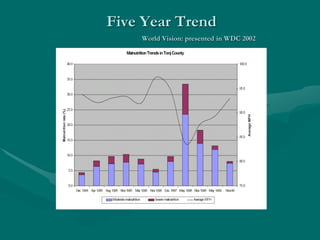
Five Year Trend
World Vision: presented in WDC 2002
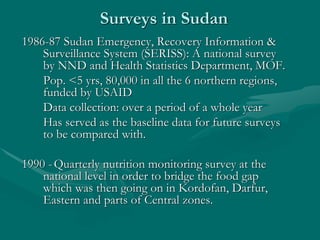
Surveys in Sudan
1986-87 Sudan Emergency, Recovery Information &
Surveillance System (SERISS): A national survey
by NND and Health Statistics Department, MOF.
Pop. <5 yrs, 80,000 in all the 6 northern regions,
funded by USAID
Data collection: over a period of a whole year
Has served as the baseline data for future surveys
to be compared with.
1990 -Quarterly nutrition monitoring survey at the
national level in order to bridge the food gap
which was then going on in Kordofan, Darfur,
Eastern and parts of Central zones.
Contd.
1992 A community based nut surveillance for early
earning purpose was introduced. Objective: the
timely and appropriate intervention: To meet this
objective, data analysis at the provincial level.
Monitoring of nutritional status of children and
mothers. The programme was expanding is
expanded at the health area. Functioning in
Kassala, Sennar and N. Kordofan
Micronutrient prevalence survey (IDD, VAD, IDA)
are conducted in some parts of the country.
Questions were added to the quarterly monitoring
surveys to cover micronutrient deficiencies as well.
Contd.
• 1989-90 Demographic Survey
• 1999 Safety Motherhood Survey
• 2000 Multiple Indicator Cluster Survey
Response
• In response to the drought of 1983, 1984 and
1985, the government established a Relief and
Rehabilitation Commission (RRC) for policies,
plans and programme to rehabilitate the affected
areas by coordinating national and international
efforts.
Cont.
• EWU was set up within the RRC.
• Food Security Unit was set up in MOAP.
• Khartoum MOH set up an emergency preparedness
unit for natural and man-made disasters to info
collection and to response within the health sector.
Experiences 2005 in WHO/MOH: night blindness in WN,
goiter for treatment in SD, no buffer stock of
supplement of lipidol
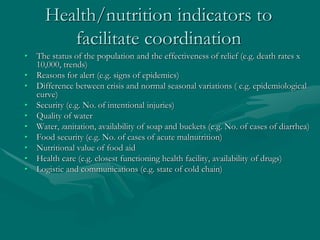
Health/nutrition indicators to
facilitate coordination
• The status of the population and the effectiveness of relief (e.g. death rates x
10,000, trends)
• Reasons for alert (e.g. signs of epidemics)
• Difference between crisis and normal seasonal variations ( e.g. epidemiological
curve)
• Security (e.g. No. of intentional injuries)
• Quality of water
• Water, sanitation, availability of soap and buckets (e.g. No. of cases of diarrhea)
• Food security (e.g. No. of cases of acute malnutrition)
• Nutritional value of food aid
• Health care (e.g. closest functioning health facility, availability of drugs)
• Logistic and communications (e.g. state of cold chain)
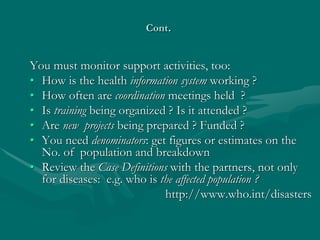
Cont.
You must monitor support activities, too:
• How is the health information system working ?
• How often are coordination meetings held ?
• Is training being organized ? Is it attended ?
• Are new projects being prepared ? Funded ?
• You need denominators: get figures or estimates on the
No. of population and breakdown
• Review the Case Definitions with the partners, not only
for diseases: e.g. who is the affected population ?
http://www.who.int/disasters
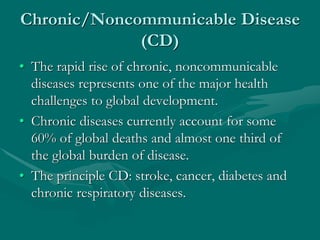
Chronic/Noncommunicable Disease
(CD)
• The rapid rise of chronic, noncommunicable
diseases represents one of the major health
challenges to global development.
• Chronic diseases currently account for some
60% of global deaths and almost one third of
the global burden of disease.
• The principle CD: stroke, cancer, diabetes and
chronic respiratory diseases.
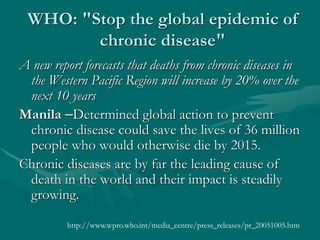
WHO: "Stop the global epidemic of
chronic disease"
A new report forecasts that deaths from chronic diseases in
the Western Pacific Region will increase by 20% over the
next 10 years
Manila –Determined global action to prevent
chronic disease could save the lives of 36 million
people who would otherwise die by 2015.
Chronic diseases are by far the leading cause of
death in the world and their impact is steadily
growing.
http://www.wpro.who.int/media_centre/press_releases/pr_20051005.htm
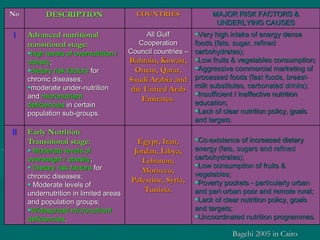
No DESCRIPTION COUNTRIES MAJOR RISK FACTORS &
UNDERLYING CAUSES
I Advanced nutritional
transitional stage:
▪high levels of overnutrition /
obesity;
▪dietary risk factors for
chronic diseases;
▪moderate under-nutrition
and micronutrient
deficiencies in certain
population sub-groups.
All Gulf
Cooperation
Council countries –
Bahrain, Kuwait,
Oman, Qatar,
Saudi Arabia and
the United Arab
Emirates.
▪Very high intake of energy dense
foods (fats, sugar, refined
carbohydrates);
▪Low fruits & vegetables consumption;
▪Aggressive commercial marketing of
processed foods (fast foods, breast-
milk substitutes, carbonated drinks);
▪Insufficient / ineffective nutrition
education;
▪Lack of clear nutrition policy, goals
and targets.
II Early Nutrition
Transitional stage:
▪ Moderate levels of
overweight / obesity;
▪ Dietary risk factors for
chronic diseases;
▪ Moderate levels of
undernutrition in limited areas
and population groups;
▪Widespread micronutrient
deficiencies.
Egypt, Iran,
Jordan, Libya,
Lebanon,
Morocco,
Palestine, Syria,
Tunisia.
▪Co-existence of increased dietary
energy (fats, sugars and refined
carbohydrates);
▪Low consumption of fruits &
vegetables;
▪Poverty pockets - particularly urban
and peri-urban poor and remote rural;
▪Lack of clear nutrition policy, goals
and targets;
▪Uncoordinated nutrition programmes.
Bagchi 2005 in Cairo
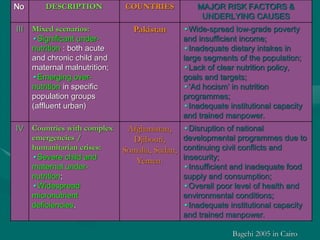
No DESCRIPTION COUNTRIES MAJOR RISK FACTORS &
UNDERLYING CAUSES
III Mixed scenarios:
•Significant under-
nutrition : both acute
and chronic child and
maternal malnutrition;
•Emerging over-
nutrition in specific
population groups
(affluent urban)
Pakistan •Wide-spread low-grade poverty
and insufficient income;
•Inadequate dietary intakes in
large segments of the population;
•Lack of clear nutrition policy,
goals and targets;
•‘Ad hocism’ in nutrition
programmes;
•Inadequate institutional capacity
and trained manpower.
IV Countries with complex
emergencies /
humanitarian crises:
•Severe child and
maternal under-
nutrition;
•Widespread
micronutrient
deficiencies.
Afghanistan,
Djibouti,
Somalia, Sudan,
Yemen.
•Disruption of national
developmental programmes due to
continuing civil conflicts and
insecurity;
•Insufficient and inadequate food
supply and consumption;
•Overall poor level of health and
environmental conditions;
•Inadequate institutional capacity
and trained manpower.
Bagchi 2005 in Cairo
Summary
• PEM and micronutrient deficiency disorders are
significant public health problems: acute and
chronic
• Some of the diet related non-communicable
diseases might be emerging soon among some
population (urban).
• There was no nutrition information system and
the response mechanism lead by the government.
Recommendation
• Revitalization and strengthening of the currently
and previously existing system by the
government.
Areas to cover for nutrition
information system in Sudan
• Malnutrition and food security
• Communicable disease
• Non-communicable disease
• Food safety and environment
• Socio-economic factors
Potential Opportunities
For Nutrition Information
• Liaise with Sections of Epidemiology, EWRS,
Statistics, Planning, GIS, IEC of WHO/MOH
• Liaise with/set up HIS
• Scaling up of the currently existing system in
other states
• Liaise with UN agencies and NGOs (Nut
Coordination Meeting; Darfur and non-Darfur)
Contd.
For Response mechanism
• Revitalization of previously existed a Relief and
Rehabilitation Commission
Rationale: resources, know-how and baseline
database are available
Needs: vision, appropriate technology and capacity
building