Nutrient
management
NA/2022-089
D.Nithin
NA/2022-090
D.Deepthi
• An adequate and balanced supply of plant
nutrients is a prerequisite to maximize crop
production.
• The major nutrients required by rice crop are
N,P,K
• Throughout the rice growing areas in India,N
is the most limiting factor .'N' is usually
deficient where rice is grown because the
same conditions of climate which favour rice
production cause a rapid turnover and loss of
'N' from the rice
• The requirement of 'p' is not as high as that of
'N' wide spread 'p' deficiency in rice to the
applied 'p' are observed in the country.
• Efficient use of fertilizers
FUE is low in rice crop .40% of applied 'N' and
26% 'p' alone are recovered by rice crop in
India. There is a need to increase the
efficiency of use of applied nutrients by
applying the right form, right quantity at the
right time and by right method.
Nitrogen Functions of N
1. N promotes rapid plant growth
2. improves grain yield
3. grain quality through higher tillering,
4. leaf area development,
5. grain formation, grain filling, and protein synthesis
• Nitrogen deficiency in rice hinders the synthesis of
chlorophyll and proteins, thus reducing
photosynthesis and affecting dry matter production
• N is lost through fertilizer as
1. Surface runoff, NH3 volatilization, leaching,
denotification.
2. Soil characteristics, weather conditions and
management practices the extent of losses .
Rate of application
• For Dwarf and semi dwarf varieties optimum 'N'
rates are 80-100kg/ha during kharif,100 -
120kg/ha during rabi.
Time of application
It depends on the
• Texture of soil
• Physiological stage of crop
• Other management practices
• Efficiency of applied 'N' is higher at active
tillering stage than at transplanting and reaches
a peak at PI ,Beyond PI ,the NUE decreases.
Therefore, top dressing is suitable at two times.
first split at tillering and second at panicle
initiation
• When more splits are desired, the period
between 3 weeks after tillering until to 2 weeks
beyond PI may be beneficial .
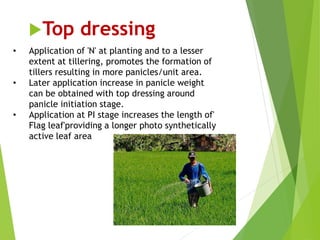
Top dressing
• Application of 'N' at planting and to a lesser
extent at tillering, promotes the formation of
tillers resulting in more panicles/unit area.
• Later application increase in panicle weight
can be obtained with top dressing around
panicle initiation stage.
• Application at PI stage increases the length of'
Flag leaf'providing a longer photo synthetically
active leaf area
Method of application of N
1. Right method of application
2. Optimization of split application of 'N' in
relation to growth stages
3. Deep placement of N fertilizer in reduced
4. Irrigation water is let in 24 -48 hrs later
Sources of N
• Ammonia containing or NH4 forming (eg.urea)
fertilizers can be used either for pre plant or top
dressing applications.
• NO3 sources have to be considered for top dressing
everthough it's effectiveness is usually somewhat
less compared to pure ammonium N sources .
Slow-release nitrogen fertilizers can help rice
crops grow better and reduce the amount of
chemicals used. Some examples of slow-
release nitrogen fertilizers include:
1. Urea-hydroxyapatite nanohybrids
2. These nanohybrids release nitrogen more
slowly than pure urea, and can be used at
a 50% lower concentration of urea to
achieve the same results.
3. Polymer-coated urea (PCU)
4. This fertilizer provides a sustained release
of nitrogen throughout the growth stages
of the rice plant.
Slow release compounds.
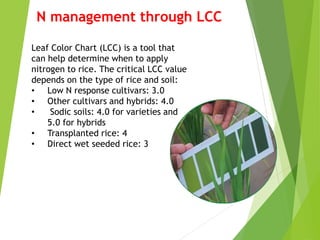
Leaf Color Chart (LCC) is a tool that
can help determine when to apply
nitrogen to rice. The critical LCC value
depends on the type of rice and soil:
• Low N response cultivars: 3.0
• Other cultivars and hybrids: 4.0
• Sodic soils: 4.0 for varieties and
5.0 for hybrids
• Transplanted rice: 4
• Direct wet seeded rice: 3
N management through LCC
Phosphorus recovery of p= 26%
Functions of P
Phosphorus is responsible for the development
of root, ripening, early flowering and
tolerance to specific biotic and abiotic stresses
in rice. Its deficiency will contribute to
maturity delays and rice vulnerability to
diseases increased.
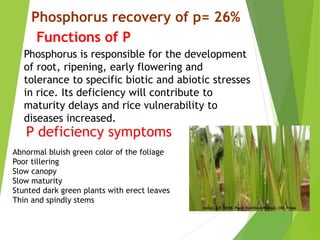
P deficiency symptoms
Abnormal bluish green color of the foliage
Poor tillering
Slow canopy
Slow maturity
Stunted dark green plants with erect leaves
Thin and spindly stems
Rates of application
• The application of 60kg p2o5/ha
for red soils and 80kg p2o5/ha for
black soils is adequate.
Time and method of application
• P fertilizers are best applied basally seeding in last
ploughing by broadcasting and incorporating in the
last puddle.
• The recommendation is 2kg DAP /40m2 of nursery.
• P slurry (ssp: puddled soil: water(1:3.5:5)
Potassium management
Time of application: recent studies have shown
that top dressing of k at maximum tillering and at
or before panicle initiation increased rice yields
especially in Sandy soils poor in potash holding
capacity.
Functions of k
Potassium (K) is an essential plant
nutrient that improves root growth
and plant vigor, helps prevent
lodging and enhances crop
resistance to pests and diseases.
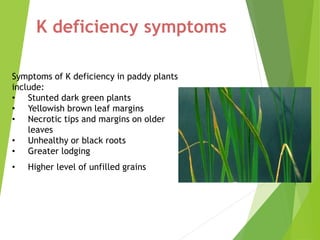
Symptoms of K deficiency in paddy plants
include:
• Stunted dark green plants
• Yellowish brown leaf margins
• Necrotic tips and margins on older
leaves
• Unhealthy or black roots
• Greater lodging
• Higher level of unfilled grains
K deficiency symptoms
Zinc-Functions and Deficiency
Zinc
Zinc is an essential micro nutrient for rice. Its
deficiency is associated with soils of high pH.
Unit increase in pH makes Zn1000 times less soluble.
Alkaline soils with high organic matter aggravate Zn
deficiency (If N & P is increased the uptake of zinc is
decreased)
Functions of zinc: -
 Probable connection with production of auxins.
 Activaton of many enzymatic reactions.
 Close involvement in N metabolism.
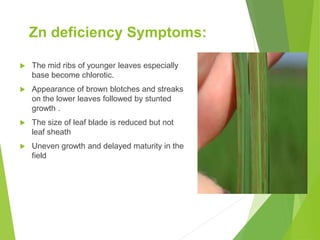
Zn deficiency Symptoms:
 The mid ribs of younger leaves especially
base become chlorotic.
 Appearance of brown blotches and streaks
on the lower leaves followed by stunted
growth .
 The size of leaf blade is reduced but not
leaf sheath
 Uneven growth and delayed maturity in the
field
Correction of Zn deficiency:
-
 Soil application @ 40-50 kg ZnSO4/ha. (For normal soils
once in 3 yrs.) (For saline soils once in every yr.)
 By dipping the seedlings in 2% suspension of ZnO is
both cheap and convenient.
 Seed coating is a new development and is at present
being used in limited scale in drilled or direct seeded rice
production.
Varietal tolerant to Zn deficiency IR8, 28, 30 & 34
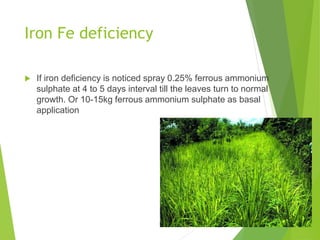
Iron Fe deficiency
 If iron deficiency is noticed spray 0.25% ferrous ammonium
sulphate at 4 to 5 days interval till the leaves turn to normal
growth. Or 10-15kg ferrous ammonium sulphate as basal
application
Biofertilizers
 Bio fertilizers are the living organisms capable of
fixing atmospheric nitrogen or making native soil
nutrients available to crops.
 Atmospheric nitrogen is fixed effectively by the
microorganisms either in symbiotic association with
plant system (Rhizobium, Azolla) or in associative
symbiosis (Azospirillum) or in free living system
(Azotobactor, phosphobacterium, blue green algae) or in
micorhizal symbiosis
 Free living organisms: Important amount fixing
atmospheric ‘N’ are BGA, Azolla, Azatobacter &
Rhizospirillum. Among them, BGA and Azolla can
survive only in lowland conditions.
Application of biofertilizer
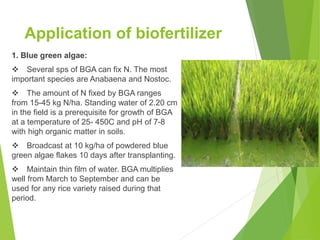
1. Blue green algae:
 Several sps of BGA can fix N. The most
important species are Anabaena and Nostoc.
 The amount of N fixed by BGA ranges
from 15-45 kg N/ha. Standing water of 2.20 cm
in the field is a prerequisite for growth of BGA
at a temperature of 25- 450C and pH of 7-8
with high organic matter in soils.
 Broadcast at 10 kg/ha of powdered blue
green algae flakes 10 days after transplanting.
 Maintain thin film of water. BGA multiplies
well from March to September and can be
used for any rice variety raised during that
period.
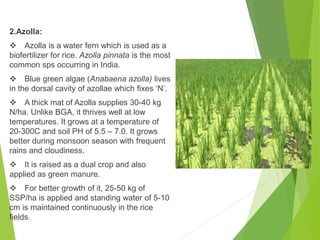
2.Azolla:
 Azolla is a water fern which is used as a
biofertilizer for rice. Azolla pinnata is the most
common sps occurring in India.
 Blue green algae (Anabaena azolla) lives
in the dorsal cavity of azollae which fixes ‘N’.
 A thick mat of Azolla supplies 30-40 kg
N/ha. Unlike BGA, it thrives well at low
temperatures. It grows at a temperature of
20-300C and soil PH of 5.5 – 7.0. It grows
better during monsoon season with frequent
rains and cloudiness.
 It is raised as a dual crop and also
applied as green manure.
 For better growth of it, 25-50 kg of
SSP/ha is applied and standing water of 5-10
cm is maintained continuously in the rice
fields.
 1. Dipping roots in Azospirillum slurry: Prepare the
slurry with 5 pockets (1000 g/ha of Azospirillum
inoculant) in 40 lit of water and dip the root portion of the
seedling for 15–30 minutes in bacterial suspension and
transplant the seedlings.
 2. Soil application of Azospirillum: Mix 10 pockets
(2000 g/ha of Azospirillum inoculant with 25kg FYM and
25 kg of soil and broadcast the mixture uniformly in the
main field before transplanting
INM
Plant nutrients can be supplied from different sources viz.,
organic manures, crop residues, biofertilizers and chemical
fertilizers. For better utilization of resources and to produce
crops with less expenditure, INM is the best approach. In
this, all the possible sources of nutrients are applied based
on economic consideration and the balance required for the
crop is supplemented with chemical fertilizers. Rice crop
residues add 17 kg N/ha. Application of organic matter in
any form reduces loss of N fertilisers and increases FUE.
Steps for increasing F.U.E.
 Apply right quantity at night time (i.e. split application) by right
method
 Adopt root zone placement of N fertilizers
 Follow balanced fertilization 80 kg N + 60 kg P2 O5 + 40 kg K2
O/ha (2:1.5:1) is very economical. Moderate response can be had with
a dose of 60-30-30 (2:1:1).
 Integrated/supplementary use of organic manures (including green
manures) and biofertilisers.
 By correcting micronutrient deficiencies (especially zn)
 By maintaining adequate plant population (400-450 panicles/m2)
 By following proper water management practices (continuous
submergence of not more than 2 cm depth)
 By adopting effective weed control and plant protection measures
Nutrient Management for
different Systems of rice of
cultivation
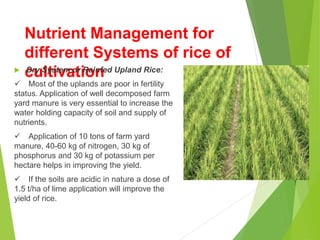
 Dry System or Rainfed Upland Rice:
 Most of the uplands are poor in fertility
status. Application of well decomposed farm
yard manure is very essential to increase the
water holding capacity of soil and supply of
nutrients.
 Application of 10 tons of farm yard
manure, 40-60 kg of nitrogen, 30 kg of
phosphorus and 30 kg of potassium per
hectare helps in improving the yield.
 If the soils are acidic in nature a dose of
1.5 t/ha of lime application will improve the
yield of rice.
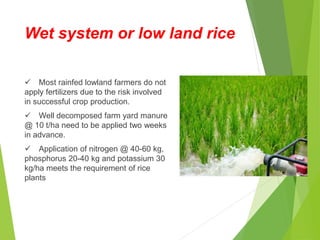
Wet system or low land rice
 Most rainfed lowland farmers do not
apply fertilizers due to the risk involved
in successful crop production.
 Well decomposed farm yard manure
@ 10 t/ha need to be applied two weeks
in advance.
 Application of nitrogen @ 40-60 kg,
phosphorus 20-40 kg and potassium 30
kg/ha meets the requirement of rice
plants
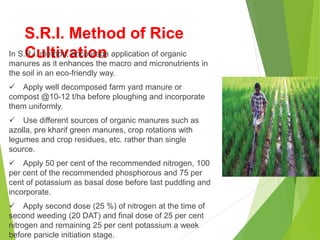
S.R.I. Method of Rice
Cultivation
In S.R.I. method, encourage application of organic
manures as it enhances the macro and micronutrients in
the soil in an eco-friendly way.
 Apply well decomposed farm yard manure or
compost @10-12 t/ha before ploughing and incorporate
them uniformly.
 Use different sources of organic manures such as
azolla, pre kharif green manures, crop rotations with
legumes and crop residues, etc. rather than single
source.
 Apply 50 per cent of the recommended nitrogen, 100
per cent of the recommended phosphorous and 75 per
cent of potassium as basal dose before last puddling and
incorporate.
 Apply second dose (25 %) of nitrogen at the time of
second weeding (20 DAT) and final dose of 25 per cent
nitrogen and remaining 25 per cent potassium a week
before panicle initiation stage.
Nutrient management for paddy -WPS Office.pptx

Nutrient management for paddy -WPS Office.pptx

  • 1.
  • 2.
    • An adequateand balanced supply of plant nutrients is a prerequisite to maximize crop production. • The major nutrients required by rice crop are N,P,K • Throughout the rice growing areas in India,N is the most limiting factor .'N' is usually deficient where rice is grown because the same conditions of climate which favour rice production cause a rapid turnover and loss of 'N' from the rice • The requirement of 'p' is not as high as that of 'N' wide spread 'p' deficiency in rice to the applied 'p' are observed in the country.
  • 3.
    • Efficient useof fertilizers FUE is low in rice crop .40% of applied 'N' and 26% 'p' alone are recovered by rice crop in India. There is a need to increase the efficiency of use of applied nutrients by applying the right form, right quantity at the right time and by right method. Nitrogen Functions of N 1. N promotes rapid plant growth 2. improves grain yield 3. grain quality through higher tillering, 4. leaf area development, 5. grain formation, grain filling, and protein synthesis
  • 4.
    • Nitrogen deficiencyin rice hinders the synthesis of chlorophyll and proteins, thus reducing photosynthesis and affecting dry matter production • N is lost through fertilizer as 1. Surface runoff, NH3 volatilization, leaching, denotification. 2. Soil characteristics, weather conditions and management practices the extent of losses . Rate of application • For Dwarf and semi dwarf varieties optimum 'N' rates are 80-100kg/ha during kharif,100 - 120kg/ha during rabi.
  • 5.
    Time of application Itdepends on the • Texture of soil • Physiological stage of crop • Other management practices • Efficiency of applied 'N' is higher at active tillering stage than at transplanting and reaches a peak at PI ,Beyond PI ,the NUE decreases. Therefore, top dressing is suitable at two times. first split at tillering and second at panicle initiation • When more splits are desired, the period between 3 weeks after tillering until to 2 weeks beyond PI may be beneficial .
  • 6.
    Top dressing • Applicationof 'N' at planting and to a lesser extent at tillering, promotes the formation of tillers resulting in more panicles/unit area. • Later application increase in panicle weight can be obtained with top dressing around panicle initiation stage. • Application at PI stage increases the length of' Flag leaf'providing a longer photo synthetically active leaf area
  • 7.
    Method of applicationof N 1. Right method of application 2. Optimization of split application of 'N' in relation to growth stages 3. Deep placement of N fertilizer in reduced 4. Irrigation water is let in 24 -48 hrs later Sources of N • Ammonia containing or NH4 forming (eg.urea) fertilizers can be used either for pre plant or top dressing applications. • NO3 sources have to be considered for top dressing everthough it's effectiveness is usually somewhat less compared to pure ammonium N sources .
  • 8.
    Slow-release nitrogen fertilizerscan help rice crops grow better and reduce the amount of chemicals used. Some examples of slow- release nitrogen fertilizers include: 1. Urea-hydroxyapatite nanohybrids 2. These nanohybrids release nitrogen more slowly than pure urea, and can be used at a 50% lower concentration of urea to achieve the same results. 3. Polymer-coated urea (PCU) 4. This fertilizer provides a sustained release of nitrogen throughout the growth stages of the rice plant. Slow release compounds.
  • 9.
    Leaf Color Chart(LCC) is a tool that can help determine when to apply nitrogen to rice. The critical LCC value depends on the type of rice and soil: • Low N response cultivars: 3.0 • Other cultivars and hybrids: 4.0 • Sodic soils: 4.0 for varieties and 5.0 for hybrids • Transplanted rice: 4 • Direct wet seeded rice: 3 N management through LCC
  • 10.
    Phosphorus recovery ofp= 26% Functions of P Phosphorus is responsible for the development of root, ripening, early flowering and tolerance to specific biotic and abiotic stresses in rice. Its deficiency will contribute to maturity delays and rice vulnerability to diseases increased. P deficiency symptoms Abnormal bluish green color of the foliage Poor tillering Slow canopy Slow maturity Stunted dark green plants with erect leaves Thin and spindly stems
  • 11.
    Rates of application •The application of 60kg p2o5/ha for red soils and 80kg p2o5/ha for black soils is adequate. Time and method of application • P fertilizers are best applied basally seeding in last ploughing by broadcasting and incorporating in the last puddle. • The recommendation is 2kg DAP /40m2 of nursery. • P slurry (ssp: puddled soil: water(1:3.5:5)
  • 12.
    Potassium management Time ofapplication: recent studies have shown that top dressing of k at maximum tillering and at or before panicle initiation increased rice yields especially in Sandy soils poor in potash holding capacity. Functions of k Potassium (K) is an essential plant nutrient that improves root growth and plant vigor, helps prevent lodging and enhances crop resistance to pests and diseases.
  • 13.
    Symptoms of Kdeficiency in paddy plants include: • Stunted dark green plants • Yellowish brown leaf margins • Necrotic tips and margins on older leaves • Unhealthy or black roots • Greater lodging • Higher level of unfilled grains K deficiency symptoms
  • 14.
    Zinc-Functions and Deficiency Zinc Zincis an essential micro nutrient for rice. Its deficiency is associated with soils of high pH. Unit increase in pH makes Zn1000 times less soluble. Alkaline soils with high organic matter aggravate Zn deficiency (If N & P is increased the uptake of zinc is decreased) Functions of zinc: -  Probable connection with production of auxins.  Activaton of many enzymatic reactions.  Close involvement in N metabolism.
  • 15.
    Zn deficiency Symptoms: The mid ribs of younger leaves especially base become chlorotic.  Appearance of brown blotches and streaks on the lower leaves followed by stunted growth .  The size of leaf blade is reduced but not leaf sheath  Uneven growth and delayed maturity in the field
  • 16.
    Correction of Zndeficiency: -  Soil application @ 40-50 kg ZnSO4/ha. (For normal soils once in 3 yrs.) (For saline soils once in every yr.)  By dipping the seedlings in 2% suspension of ZnO is both cheap and convenient.  Seed coating is a new development and is at present being used in limited scale in drilled or direct seeded rice production. Varietal tolerant to Zn deficiency IR8, 28, 30 & 34
  • 17.
    Iron Fe deficiency If iron deficiency is noticed spray 0.25% ferrous ammonium sulphate at 4 to 5 days interval till the leaves turn to normal growth. Or 10-15kg ferrous ammonium sulphate as basal application
  • 18.
    Biofertilizers  Bio fertilizersare the living organisms capable of fixing atmospheric nitrogen or making native soil nutrients available to crops.  Atmospheric nitrogen is fixed effectively by the microorganisms either in symbiotic association with plant system (Rhizobium, Azolla) or in associative symbiosis (Azospirillum) or in free living system (Azotobactor, phosphobacterium, blue green algae) or in micorhizal symbiosis  Free living organisms: Important amount fixing atmospheric ‘N’ are BGA, Azolla, Azatobacter & Rhizospirillum. Among them, BGA and Azolla can survive only in lowland conditions.
  • 19.
    Application of biofertilizer 1.Blue green algae:  Several sps of BGA can fix N. The most important species are Anabaena and Nostoc.  The amount of N fixed by BGA ranges from 15-45 kg N/ha. Standing water of 2.20 cm in the field is a prerequisite for growth of BGA at a temperature of 25- 450C and pH of 7-8 with high organic matter in soils.  Broadcast at 10 kg/ha of powdered blue green algae flakes 10 days after transplanting.  Maintain thin film of water. BGA multiplies well from March to September and can be used for any rice variety raised during that period.
  • 20.
    2.Azolla:  Azolla isa water fern which is used as a biofertilizer for rice. Azolla pinnata is the most common sps occurring in India.  Blue green algae (Anabaena azolla) lives in the dorsal cavity of azollae which fixes ‘N’.  A thick mat of Azolla supplies 30-40 kg N/ha. Unlike BGA, it thrives well at low temperatures. It grows at a temperature of 20-300C and soil PH of 5.5 – 7.0. It grows better during monsoon season with frequent rains and cloudiness.  It is raised as a dual crop and also applied as green manure.  For better growth of it, 25-50 kg of SSP/ha is applied and standing water of 5-10 cm is maintained continuously in the rice fields.
  • 21.
     1. Dippingroots in Azospirillum slurry: Prepare the slurry with 5 pockets (1000 g/ha of Azospirillum inoculant) in 40 lit of water and dip the root portion of the seedling for 15–30 minutes in bacterial suspension and transplant the seedlings.  2. Soil application of Azospirillum: Mix 10 pockets (2000 g/ha of Azospirillum inoculant with 25kg FYM and 25 kg of soil and broadcast the mixture uniformly in the main field before transplanting
  • 22.
    INM Plant nutrients canbe supplied from different sources viz., organic manures, crop residues, biofertilizers and chemical fertilizers. For better utilization of resources and to produce crops with less expenditure, INM is the best approach. In this, all the possible sources of nutrients are applied based on economic consideration and the balance required for the crop is supplemented with chemical fertilizers. Rice crop residues add 17 kg N/ha. Application of organic matter in any form reduces loss of N fertilisers and increases FUE.
  • 23.
    Steps for increasingF.U.E.  Apply right quantity at night time (i.e. split application) by right method  Adopt root zone placement of N fertilizers  Follow balanced fertilization 80 kg N + 60 kg P2 O5 + 40 kg K2 O/ha (2:1.5:1) is very economical. Moderate response can be had with a dose of 60-30-30 (2:1:1).  Integrated/supplementary use of organic manures (including green manures) and biofertilisers.  By correcting micronutrient deficiencies (especially zn)  By maintaining adequate plant population (400-450 panicles/m2)  By following proper water management practices (continuous submergence of not more than 2 cm depth)  By adopting effective weed control and plant protection measures
  • 24.
    Nutrient Management for differentSystems of rice of cultivation  Dry System or Rainfed Upland Rice:  Most of the uplands are poor in fertility status. Application of well decomposed farm yard manure is very essential to increase the water holding capacity of soil and supply of nutrients.  Application of 10 tons of farm yard manure, 40-60 kg of nitrogen, 30 kg of phosphorus and 30 kg of potassium per hectare helps in improving the yield.  If the soils are acidic in nature a dose of 1.5 t/ha of lime application will improve the yield of rice.
  • 25.
    Wet system orlow land rice  Most rainfed lowland farmers do not apply fertilizers due to the risk involved in successful crop production.  Well decomposed farm yard manure @ 10 t/ha need to be applied two weeks in advance.  Application of nitrogen @ 40-60 kg, phosphorus 20-40 kg and potassium 30 kg/ha meets the requirement of rice plants
  • 26.
    S.R.I. Method ofRice Cultivation In S.R.I. method, encourage application of organic manures as it enhances the macro and micronutrients in the soil in an eco-friendly way.  Apply well decomposed farm yard manure or compost @10-12 t/ha before ploughing and incorporate them uniformly.  Use different sources of organic manures such as azolla, pre kharif green manures, crop rotations with legumes and crop residues, etc. rather than single source.  Apply 50 per cent of the recommended nitrogen, 100 per cent of the recommended phosphorous and 75 per cent of potassium as basal dose before last puddling and incorporate.  Apply second dose (25 %) of nitrogen at the time of second weeding (20 DAT) and final dose of 25 per cent nitrogen and remaining 25 per cent potassium a week before panicle initiation stage.