Murdhani Taila
Created by:-
Swapnil Badgujar
Roll no. – 10
Objectives
Murdha taila
Shiroabhyanga
Shiroseka
Shiropichu
Shirobasti
Summary
References
Contents
MURDHA
TAILA
A.H Su.22
-
SHIROABHYANGA
►The patient, after obeying the natural urges, is to be
advised to sit in upright posture.
►Then the masseur should stand in the upright posture
behind the patient. First of all, suitable oil is to be made
warm and to be applied over vertex.
►The oil is to be spread by the fingers of the masseur to
the temporal and parietal parts. Again the oil is to be
poured in anterior and occipital parts respectively
considering the shape and size of the head.
CONT
..
01/01/2024 5
►After application of oil over the entire scalp, a gentle massage by the finger
pads is to be given. For that purpose the distal inter phalangeal joints are to be
flexed and pressure should be applied by the pads of fingers.
►The pressure should be increased sufficiently to grip the scalp and it is to be
moved over cranial bones. Small circular movements; mild hacking, pounding,
cupping strokes are to be performed as required.
CONT
..
• Duration :
If shirobhyanga is to be done for a disease of head or due to diseases
related to hair, it should be continued up to 20-30 minutes. For regular use, 5-7
minutes is sufficient for abhyanga.
Some important oils for shiro-abhyanga:
■ Chakra Taila: Kalka and kvatha of yashthimadhu, vidari, saral, devdaru, laghu
panchamula are to be taken in equal quantity and to be processed with chakra
taiIa.
■ Bhringaraja taila
■ Tila taila
CONT..
Sarshapa taila
Jyotishmati taila
Ghritakumari taila
Ashvagandha taila
Amla taila
Bramhi amla taila
Narikela taila
Chandana taila
INDICATIONS
- ---- - - = - - - - - - - :_ - - - - - --==-=----------- -
Raukshya
(dryness of
scalp}
)
Kandumaladi
(itching and
filthiness of
scalp}
)
Palitya
(premature
graying of hair}
) ) )
)
SHIROSEKA
9
Shiroseka : Sprinkling of a suitable
taila (or any sneha dravya) on the
forehead in a synchronized and
rhythmic manner is shiro seka.
Upakarna:
• Shirodhara table
• Ohara patra
• Varti
• Suitable oil - 5 It.
CONT
..
• Soft pillow covered with Rexin or leaf of banana plant
• Vessels
• Heater/stove/induction cook-oven
• Materials for talam {rasnadi churna - 5 gm., oil - 10ml.)
• Towels - 2
• Gauze - 1
• Cotton ear plugs - 2
• Attendants - 2
PURVAKARMA
After proper abhyanga all over the body or at least on the face, neck, shoulder
and chest, the patient is asked to lye on the shirodhara table. Eye pads are to be
tied properly with another gauze piece. Ear plugs are to be applied.
PRADHANA KARMA
• Patient is to be asked to lie on the shirodhara table in supine position with a pillow
under the neck. The gap between end part of wok and forehead should remain 4
anguli (1 anguli = 1.93 cm.). Oil is to be poured into the dhara patra and the
temperature of this oil (or other medicinal liquids) should be in between 38° C - 40°
C.
• A continuous flow of liquid should be maintained and the entire forehead should be
sprinkled by a rhythmical oscillation of dharapatra. A gentle massage following the
dhara over the forehead should be done in between tne process.
• The oil collected in the vessel placed beneath the droni should be re-heated and
poured again into dhara patra.
• Duration: It should be continued for 45-60 minutes for 4-7 days.
P
ASCHAT KARMA
■ Medicine of the head should be soaked properly with towel. Head should not
be washed immediately by other liquid.
■ Rasnadi churna is to be applied over head
■ Sarvanga dhara followed by abhyanga may be done simultaneously if needed
■ After one hour, patient may take bath with lukewarm water after proper taila
abhyanga over scalp.
PRECAUTIONS
1. Uniform flow of dhara is to be maintained.
2. Ohara should not fall outside the head.
3. The distance of 4 anguli is to be maintained between forehead and
wick.
4. The thickness of dhara should be as that of little finger.
5. Patient should not sleep during the procedure.
6. Eyes are to be protected from falling of oil.
SELECTION OF MEDICINE
Vata dosha– Tila taila
Pitta and Rakta – Ghrita
Kapha – Tila taila
Vata-Pitta-Rakta Or Vata and rakta condition-
Taila and ghee ( ghee should be half of the
amount of taila)
CONT...
•Takra may be used in Kapha condition. It, by
processing with other drugs, may be used in other
dosha conditions also
• Milk may be used in Pitta condition (e.g. in Pittaja
shiroroga).
•In Vataja shiroroga, milk processed with Vataghna
drugs; in Pittaja as well as raktaja shiroroga - ghee, are
to be used for parisheka.
CONT
..
Similarly dashamula siddha kshira, etc. may be selected considering the dosha
condition of the patient .
These substances when used as parisheka, the therapy simultaneously acts as
svedana to that person.
So it is also included under dravasveda.
The patients who cannot bear the expense of taila, ghee, kshira or other
medicines for parisheka, simple water may be used for parisheka - which is
commonly named as jaladhara.
TIME OF PROCEDURE
• The appropriate time for shirodhara is in between 7 a.m. and 10 a.m. Parisheka should not
be given at noon or night.
• The process may be continued upto maximum I ½ hours. First day it is to be given for 1
hour. Then every day the time may be increased by 5 minutes. Thus on seventh day, the
duration should be 1 ½ hours. After that, 5 minutes to be gradually decreased every day
so that on 14" day it comes to I hour.
• If parisheka is to be continued upto 21 days, then the duration of dhara should remain
constant from 7 to 15 days as 1½ hours. After that, gradual decrease of 5 minutes every
day is to be started so that on 21" day it comes to 1 hour.
• Parisheka therapy should not be extended beyond 21 days.
CONT
Materials used for shirah snana:
• Kvatha made of amlaki, sugandha bala, ushira, chandana, dashamula, billva, bala,
kutuki, etc. (100 gms. collectively) by adding 8 litres of water should be reduced to
6 litres for shirahsnana.
Materials for kaya-snana:
• Leaves of eranda or of panas (jackfruit) are to be processed with water and that
may be used for Kaya snana
• Bengal gram powder is to be applied for the removal of Sneha adhered to the
body
INDICATIONS
•Anidra (insomnia)
•Shirashula (headache)
•Mental agony and irritability
•Neurological disorders.
• Kshiradhara
•Takradhara
KSHIRADHARA
Kshiradhara or dugdhadhara: In this process kshira (milk) is used as dhara material.
Milk alone or by processing with other suitable drugs may be used for dhara purpose.
Upakarana:
Kshira -
2.5 litres - 3 litres (if only shirah seka is intended)
4 - 5 litres (for sarvanga dhara)
Other ingredients are as mentioned in shirodhara.
PREPARATION OF
MEDICINE
Yavakut (half dust) of the drugs like dashamula, yashthimadhu, ushira, hribera,
mustaka, chandana, masha, mudga or other suitable drugs as per the concerned
disease is to be taken in a cloth to make a pottali and this pottali is to be kept in
eight times of milk and 64 times of water in an earthen pot. Kvatha is to be made
by Ksirapaka vidhi. Now it may be used for dhara purpose.
Procedure : It is same as shirodhiara.
INDICATIONS
1. Vataja shiroroga
2. Pittaja shiroroga
3. Sarvanga daha
4. Santata jvara (stri-dugdha is used for this purpose in Kerala)
Precaution:
• The milk once used should not be preserved for the next day.
• Milk should be replaced every day.
Note: It may be used either in lukewarm condition (e.g. in Vataja diseases) or in cold
condit ion (e.g. in Pittaja disease).
TAKRADHARA
Takradhara: It is another variety of shirodhara where takra is used as dhara
material.
Preperation of medicine:
Upakarana:
Mustaka churna
Amlaki churna
Godugdha
Water
CONT
• Yavakuta is to be prepared from properly cleansed mustaka {100 gm.) and
should be taken in pottali.
• It is to be processed with 1½ litre of milk and 6 litre of water as kshirapaka
vidhi. When the total amount will be reduced to 1½ litre, it should be kept to
prepare curd from it.
• On the day of procedure, amlaki kvatha is to be prepared. For this, 400gm. of
amlaki is to be boiled in 6.5 litre of water and to be reduced to 1½ litre.
• Half of this amount (i.e. 800 ml.) is to be kept for shirah snana after therapy
and the rest is to be added with curd. The mixture is to be stirred well to
prepare takra.
CONT
..
Second procedure: Kvatha is to be prepared from dried amlaki (one year old). 1
kg. of amlaki is to be boiled with 3 litres of water and 500 ml. is to be left. It
should be added with 500ml. of takra for dhara purpose
Procedure : Same as shirodhara
NOTE
1. The amount of different ingredients mentioned above may differ from text to
text. The basic matter is that the physician should decide the amount of various
drugs in a suitable proportion according to the amount used in the therapy or
according to the concerned dosha.
2. In Kaphaja diseases, mustaka should be used to prepare takra.
3. In Pittaja diseases, yashthimadhu or similar drugs like sugandha bala, ushira,
chandana, billva, bala, etc. may be used instead of mustaka.
4. Argvadha is effective in psoriasis if used for preparation of takra. For anidra,
panchagandha powder is effective.
5. In psychiatric diseases, ushira, hribera, yashthimadhu, chandana may be used.
INDICATIONS
• Palitya (premature graying of hair)
• Shranti (fatigue)
• Shirahshula (headache)
• Oja-kshaya (immunity related diseases)
• Hastapada sphutana (psoriatic foot/fissure foot)
• Mutra raga (diseases of urinary system)
• Sandhishaithilya (looseness of joints)
• Hridroga (cardiac disease)
CONT
..
• Agnimandya (low power of digestion)
• Aruchi (anorexia)
• Karna roga(ear diseases)
• Netra roga (eye diseases)
• Manasika vyadhi (psychiatric illness)
• Anidra (insomnia)
• Prameha (diabetes)
• Prameha pidaka (skin infections in diabetic patients)
CONT
..
Note:
Takradhara is highly effective in Psoriasis.
Procedure: 100 gm. of drugs is to be boiled in 4 litres of water and I litre of milk.
it should be reduced to 1 litre. When it will cool down, curd is to be made from
it.
Next day, butter is to be taken out from this curd without mixing any water. The
takra (butter milk) thus obtained should be divided into two parts. One part is to
be kept for next day. The residual part is to be used for dhara purpose on that
day.
Time & Duration: From 7 a.m. to 8 a.m. & 5 p.m. to 6 p.m.
Takradhara: It may be followed for 7 to 21 days as per shirodhara method
CONT...
Taila dhara & ghrita dhara: Ghrita or oil may be used for dhara in the same manner
according to the diseases.
Indications:
1. Aruchi (loss of appetite)
2. To increase vocal clarity
3. Anidra (insomnia)
4. Daha (burning sensation over the body)
5. Nourishment of shukra, rakta dhatu
6. To increase life span
7. To increase mental stability
8. To increase strength
9. To increase lustre and smoothness of the skin
CONT
..
In Vata and Kapha Dasha, dhara should be given by tila taila, where as in Vata
Pitta-Rakta or Vata-Rakta association, taila and ghee are to be given in equal
quantity. If Kapha is associated, ghee should be added half of the amount of
taiIa.
Jaladhara: In the cases, where the patients can not afford Taila/Grita/Takra,
Jaladhara may be applied. Water added with some ingredients may be used as
dhara according to disease. Water is said as 'ashvasa kara' and so, it may be
applied (better if it is cold) in mental restlessness, insomnia, fatigue, etc.and it
produces good result. Though warm water is not good for eyes, it may be used
as dhara in aggravated Vata-Shleshma or considering the strength of disease
SHIRO PICHU
Shiro Pichu: Cotton gauze soaked with
oil/ghee placed over head is termed as
Shiro Pichu. This Pichu is to be applied on
vertex.
Upakarna:
• Suitable taila/ghee 50-100 ml
• Gauze or cotton
• Vessel 1
• Rasnadi churna 5 gm
• Soft towel 1
• Attendant 1
36
CONT
Purva karma: It will be better if the hair of the head is completely shaved.
Pradhana karma: First of all, abhyanga is to be done over head, shoulder and neck
of the patient. Then he/she is to be seated on a chair with arm. A cloth is to be tied
like a band upon the forehead and ears to prevent oozing of oil into the face. Then,
few gauge pieces of 6.5' X 6.5' size are to be placed one after another to make a
thickness about 2 cm. Slightly warm oil/ghee (around 40° C is to be poured into it
unless the gauze pieces becomes completely wet. This is to be kept for 30 to 90
minutes.
Paschat karma: The head is to be dried after this Pichu. Rasnadi churna is to be
applied. Patient may take bath after 45minutes to 1 hour.
Duration: It should be continued up to 7-14 days.
INDICATIONS
1. Keshapata (falling of hair)
2. Keshabhumi sphutana (psoriasis or such other diseases of scalp)
3. Palitya (premature greying of hair)
4. Vrana (wound)
5. Netrastambha (paralysis of eyelid)
6. Pakshaghata (hemiplegia)
7. Ardita (facial palsy)
8. Cerebellar dysfunction
9. Anidra (insomnia)
10. Various shiroroga.
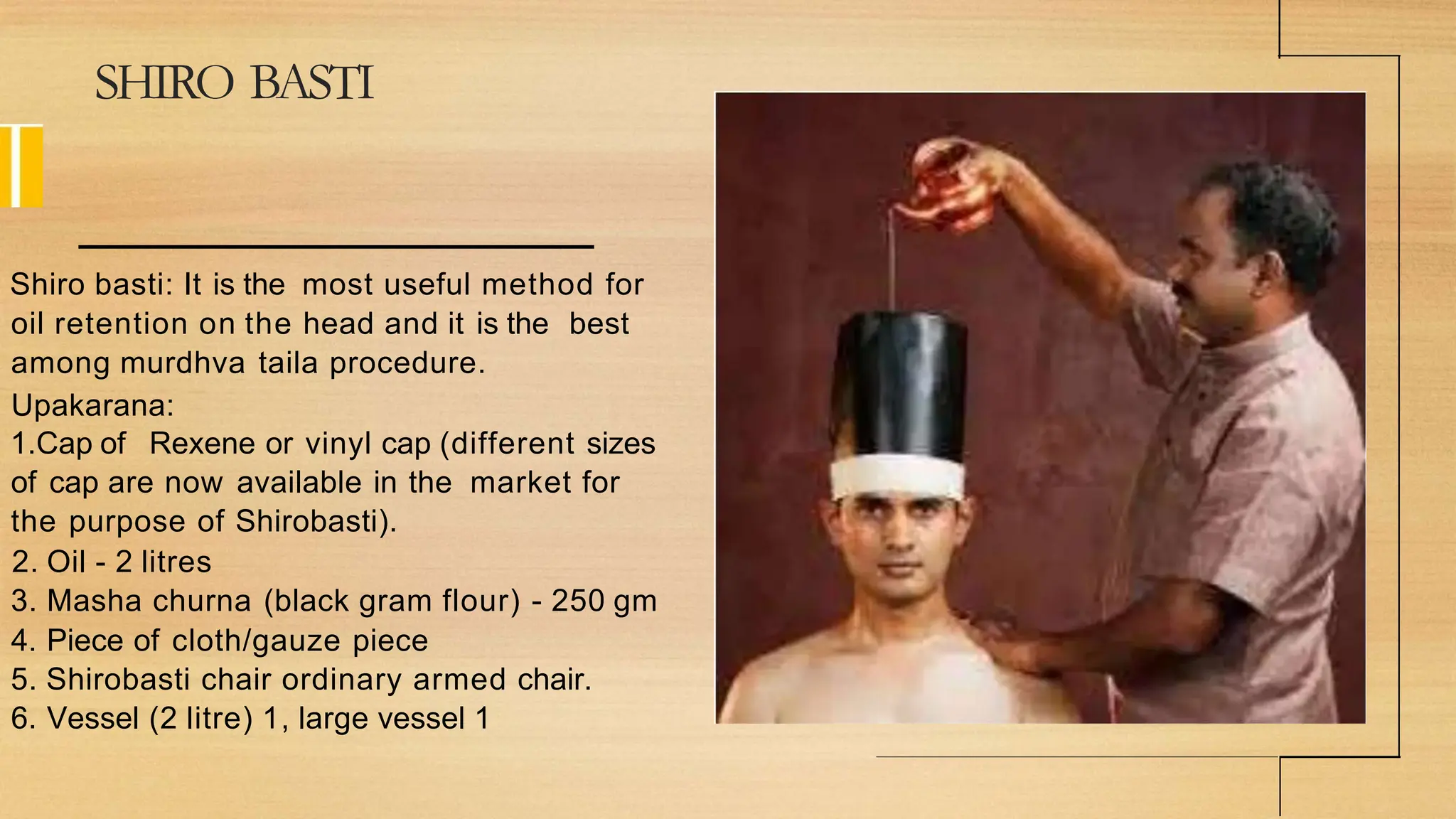
SHIRO BASTI
Shiro basti: It is the most useful method for
oil retention on the head and it is the best
among murdhva taila procedure.
Upakarana:
1.Cap of Rexene or vinyl cap (different sizes
of cap are now available in the market for
the purpose of Shirobasti).
2. Oil - 2 litres
3. Masha churna (black gram flour) - 250 gm
4. Piece of cloth/gauze piece
5. Shirobasti chair ordinary armed chair.
6. Vessel (2 litre) 1, large vessel 1
CONT
..
7. Oven for heating.
8. Hot water.
9. Dry towel or soak paper.
10. Spoons, sponges.
11. Spittoon
12. Soft towel 2
13. Attendant 2
01/01/2024
PURVA KARMA
39
First of all a cap is to be prepared for oil
retention. For this, a Rexene sheet (2 X 2
f) is to be taken.
The paste of masha is to be prepared by
mixing it with hot water to be anointed
on one side of a gauze piece of 1 metre X
6 cm size. For Rexene caps, this paste is
to be applied in the interior edge of the
cap to give it a cylindrical shape.
CONT...
If venyl cap is used, it may be used directly.
The patient should be advised to shave the hairs of his head.
The patient is then asked to be seated on the chair in straight posture.
The oil is to be heated by placing it on hot water.
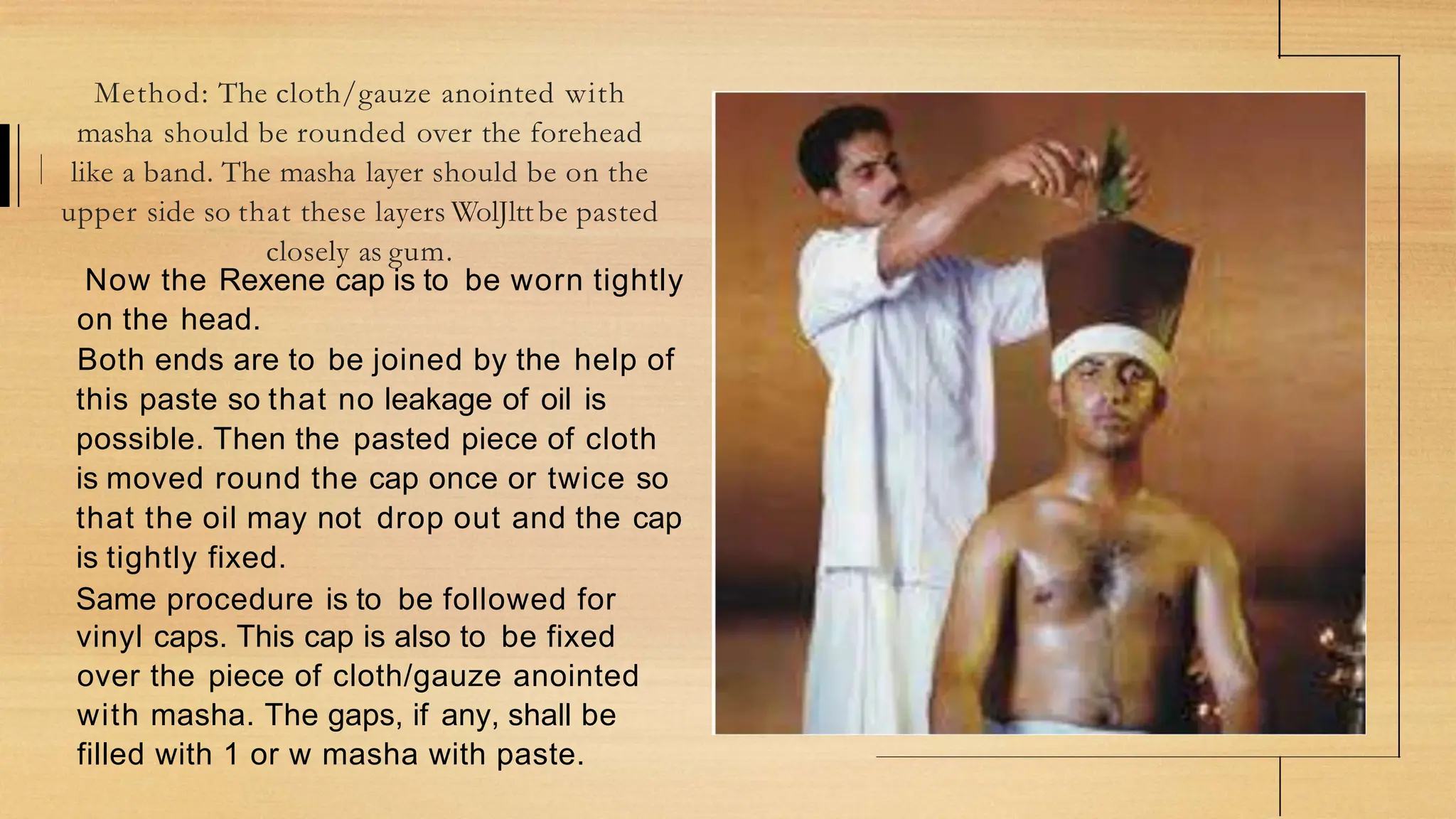
Method: The cloth/gauze anointed with
masha should be rounded over the forehead
like a band. The masha layer should be on the
upper side so that these layers WolJlttbe pasted
closely as gum.
Now the Rexene cap is to be worn tightly
on the head.
Both ends are to be joined by the help of
this paste so that no leakage of oil is
possible. Then the pasted piece of cloth
is moved round the cap once or twice so
that the oil may not drop out and the cap
is tightly fixed.
Same procedure is to be followed for
vinyl caps. This cap is also to be fixed
over the piece of cloth/gauze anointed
with masha. The gaps, if any, shall be
filled with 1 or w masha with paste.
CONT
..
• Again the piece of cloth/gauze shall be rounded over the cap twice.
Then, slightly warm oil taken in a pot is poured down with the right hand on
the dorsum of the left palm slowly from 8 cm above.
• The oil should remain two fingers high from the hair base. To maintain the
temperature, some oil is to be extracted with a spoon or sponge in regular
intervals with the replacement of the same but of higher temperature.
• The patient should not be allowed to bend his head;
otherwise the oil may fall down
PRECAUTIONS
1. The temperature of oil should properly be checked. Oil is not to be poured
directly but on the dorsum of the palm. Very hot oil is prohibited.
2. The patient is to be advised not to nod his head. During the therapy, he should
not talk, laugh or open his mouth. If the patient sneezes, the assistant will hold the
cap very carefully.
3. Leakage should be checked.
otherwise, leakage of oil may occur.
4. In case of readymade caps, proper size should be preferred; otherwise leakage
of oil may occur.
Time & Duration: Shirobasti is to be performed during the afternoon or evening.
Vagbhatta (Astanga Sangraha) has recommended Shirobasti even at night.
The duration is as follows:
Vataja diseases: 10,000 matra or 53 matra (1 matra = 19/30 seconds)
Pittaja diseases: 8,000 matra or 43 minutes
Kaphaja diseases: 6,000 matra or 31 minutes
Svastha: 1,000 matra or 5 - 6 minutes
Ordinarily, Shirobasti is advised for 5 - 7 days, but Sushruta has recommended it
for upto 21 days
P
ASCHAT KARMA
• Sneha in the cap is to be removed with the spoon or
sponge when secretion starts from face and nose.
• The head should be soaked properly with the help of a
towel. The shoulder, etc. is to be massaged again.
• The cap should be cleaned and preserved for the next use.
• Rasnadi Churna should be applied on the head of the patient.
• The dietetic and behavioural regimens are to be followed
as mentioned in sneha vidhi.
CONT
..
Change of medicine: Those patients who can afford may change the oil daily,
otherwise the same oil may be used for maximum three days.
Every day, some oil is lost, so some fresh oil is to be added, if necessary.
After three days, this oil is to be preserved New oil is to be used for the 4th to
the 6 day. Now, the preserved former oil may be mixed with this for the use of
7th day
INDICATIONS
so
1. Ardita (facial palsy)
2. Prasupti (loss of touch sensation)
3. Anidra (insomnia)
4. Nasa shosha (dryness in nose)
5. Mukha shosha (dryness in mouth)
6. Timira (cataract)
CONT
..
7. Shiroroga (diseases of the brain)
8. Darunaka (psoriasis of scalp)
9. Ardhavabhedaka (migraine)
10. Pakshaghata (hemiplegia)
11. Griva graha (cervical spondylosis)
12. Carpel tunnel syndrome
13. Cervical rediculopathy
OIL COMMONLY USED
1. Mashabaladi taila
2. Bala taila
3. Maha narayana taila
4. Madhyam narayana taila
5. Mahamasha taila
6. Nisinda taila
CONT
..
7. Rasna taila
8. Ashvagandha
taila
9. Nagabala taila
10. Prasarani taila
11. Mulakadya
taila
12. Lashuna taila
SUMMARY
1.State
Murdha taila
1.Describe
Shiroabhyanga
1.Elucidate
Shiropichu
REFERENCES
• Astanga Hridaya
• Principles and Practice of Panchakarma ,Dr Pulak kanti Kar
Thank you

10.Swapnil Badgujar- Murdhani taila.pptx

  • 1.
    Murdhani Taila Created by:- SwapnilBadgujar Roll no. – 10
  • 2.
  • 3.
  • 4.
    SHIROABHYANGA ►The patient, afterobeying the natural urges, is to be advised to sit in upright posture. ►Then the masseur should stand in the upright posture behind the patient. First of all, suitable oil is to be made warm and to be applied over vertex. ►The oil is to be spread by the fingers of the masseur to the temporal and parietal parts. Again the oil is to be poured in anterior and occipital parts respectively considering the shape and size of the head.
  • 5.
    CONT .. 01/01/2024 5 ►After applicationof oil over the entire scalp, a gentle massage by the finger pads is to be given. For that purpose the distal inter phalangeal joints are to be flexed and pressure should be applied by the pads of fingers. ►The pressure should be increased sufficiently to grip the scalp and it is to be moved over cranial bones. Small circular movements; mild hacking, pounding, cupping strokes are to be performed as required.
  • 6.
    CONT .. • Duration : Ifshirobhyanga is to be done for a disease of head or due to diseases related to hair, it should be continued up to 20-30 minutes. For regular use, 5-7 minutes is sufficient for abhyanga. Some important oils for shiro-abhyanga: ■ Chakra Taila: Kalka and kvatha of yashthimadhu, vidari, saral, devdaru, laghu panchamula are to be taken in equal quantity and to be processed with chakra taiIa. ■ Bhringaraja taila ■ Tila taila
  • 7.
    CONT.. Sarshapa taila Jyotishmati taila Ghritakumaritaila Ashvagandha taila Amla taila Bramhi amla taila Narikela taila Chandana taila
  • 8.
    INDICATIONS - ---- -- = - - - - - - - :_ - - - - - --==-=----------- - Raukshya (dryness of scalp} ) Kandumaladi (itching and filthiness of scalp} ) Palitya (premature graying of hair} ) ) ) )
  • 9.
    SHIROSEKA 9 Shiroseka : Sprinklingof a suitable taila (or any sneha dravya) on the forehead in a synchronized and rhythmic manner is shiro seka. Upakarna: • Shirodhara table • Ohara patra • Varti • Suitable oil - 5 It.
  • 10.
    CONT .. • Soft pillowcovered with Rexin or leaf of banana plant • Vessels • Heater/stove/induction cook-oven • Materials for talam {rasnadi churna - 5 gm., oil - 10ml.) • Towels - 2 • Gauze - 1 • Cotton ear plugs - 2 • Attendants - 2
  • 11.
    PURVAKARMA After proper abhyangaall over the body or at least on the face, neck, shoulder and chest, the patient is asked to lye on the shirodhara table. Eye pads are to be tied properly with another gauze piece. Ear plugs are to be applied.
  • 12.
    PRADHANA KARMA • Patientis to be asked to lie on the shirodhara table in supine position with a pillow under the neck. The gap between end part of wok and forehead should remain 4 anguli (1 anguli = 1.93 cm.). Oil is to be poured into the dhara patra and the temperature of this oil (or other medicinal liquids) should be in between 38° C - 40° C. • A continuous flow of liquid should be maintained and the entire forehead should be sprinkled by a rhythmical oscillation of dharapatra. A gentle massage following the dhara over the forehead should be done in between tne process. • The oil collected in the vessel placed beneath the droni should be re-heated and poured again into dhara patra. • Duration: It should be continued for 45-60 minutes for 4-7 days.
  • 13.
    P ASCHAT KARMA ■ Medicineof the head should be soaked properly with towel. Head should not be washed immediately by other liquid. ■ Rasnadi churna is to be applied over head ■ Sarvanga dhara followed by abhyanga may be done simultaneously if needed ■ After one hour, patient may take bath with lukewarm water after proper taila abhyanga over scalp.
  • 14.
    PRECAUTIONS 1. Uniform flowof dhara is to be maintained. 2. Ohara should not fall outside the head. 3. The distance of 4 anguli is to be maintained between forehead and wick. 4. The thickness of dhara should be as that of little finger. 5. Patient should not sleep during the procedure. 6. Eyes are to be protected from falling of oil.
  • 15.
    SELECTION OF MEDICINE Vatadosha– Tila taila Pitta and Rakta – Ghrita Kapha – Tila taila Vata-Pitta-Rakta Or Vata and rakta condition- Taila and ghee ( ghee should be half of the amount of taila)
  • 16.
    CONT... •Takra may beused in Kapha condition. It, by processing with other drugs, may be used in other dosha conditions also • Milk may be used in Pitta condition (e.g. in Pittaja shiroroga). •In Vataja shiroroga, milk processed with Vataghna drugs; in Pittaja as well as raktaja shiroroga - ghee, are to be used for parisheka.
  • 17.
    CONT .. Similarly dashamula siddhakshira, etc. may be selected considering the dosha condition of the patient . These substances when used as parisheka, the therapy simultaneously acts as svedana to that person. So it is also included under dravasveda. The patients who cannot bear the expense of taila, ghee, kshira or other medicines for parisheka, simple water may be used for parisheka - which is commonly named as jaladhara.
  • 18.
    TIME OF PROCEDURE •The appropriate time for shirodhara is in between 7 a.m. and 10 a.m. Parisheka should not be given at noon or night. • The process may be continued upto maximum I ½ hours. First day it is to be given for 1 hour. Then every day the time may be increased by 5 minutes. Thus on seventh day, the duration should be 1 ½ hours. After that, 5 minutes to be gradually decreased every day so that on 14" day it comes to I hour. • If parisheka is to be continued upto 21 days, then the duration of dhara should remain constant from 7 to 15 days as 1½ hours. After that, gradual decrease of 5 minutes every day is to be started so that on 21" day it comes to 1 hour. • Parisheka therapy should not be extended beyond 21 days.
  • 19.
    CONT Materials used forshirah snana: • Kvatha made of amlaki, sugandha bala, ushira, chandana, dashamula, billva, bala, kutuki, etc. (100 gms. collectively) by adding 8 litres of water should be reduced to 6 litres for shirahsnana. Materials for kaya-snana: • Leaves of eranda or of panas (jackfruit) are to be processed with water and that may be used for Kaya snana • Bengal gram powder is to be applied for the removal of Sneha adhered to the body
  • 20.
    INDICATIONS •Anidra (insomnia) •Shirashula (headache) •Mentalagony and irritability •Neurological disorders.
  • 21.
  • 22.
    KSHIRADHARA Kshiradhara or dugdhadhara:In this process kshira (milk) is used as dhara material. Milk alone or by processing with other suitable drugs may be used for dhara purpose. Upakarana: Kshira - 2.5 litres - 3 litres (if only shirah seka is intended) 4 - 5 litres (for sarvanga dhara) Other ingredients are as mentioned in shirodhara.
  • 23.
    PREPARATION OF MEDICINE Yavakut (halfdust) of the drugs like dashamula, yashthimadhu, ushira, hribera, mustaka, chandana, masha, mudga or other suitable drugs as per the concerned disease is to be taken in a cloth to make a pottali and this pottali is to be kept in eight times of milk and 64 times of water in an earthen pot. Kvatha is to be made by Ksirapaka vidhi. Now it may be used for dhara purpose. Procedure : It is same as shirodhiara.
  • 24.
    INDICATIONS 1. Vataja shiroroga 2.Pittaja shiroroga 3. Sarvanga daha 4. Santata jvara (stri-dugdha is used for this purpose in Kerala) Precaution: • The milk once used should not be preserved for the next day. • Milk should be replaced every day. Note: It may be used either in lukewarm condition (e.g. in Vataja diseases) or in cold condit ion (e.g. in Pittaja disease).
  • 25.
    TAKRADHARA Takradhara: It isanother variety of shirodhara where takra is used as dhara material. Preperation of medicine: Upakarana: Mustaka churna Amlaki churna Godugdha Water
  • 26.
    CONT • Yavakuta isto be prepared from properly cleansed mustaka {100 gm.) and should be taken in pottali. • It is to be processed with 1½ litre of milk and 6 litre of water as kshirapaka vidhi. When the total amount will be reduced to 1½ litre, it should be kept to prepare curd from it. • On the day of procedure, amlaki kvatha is to be prepared. For this, 400gm. of amlaki is to be boiled in 6.5 litre of water and to be reduced to 1½ litre. • Half of this amount (i.e. 800 ml.) is to be kept for shirah snana after therapy and the rest is to be added with curd. The mixture is to be stirred well to prepare takra.
  • 27.
    CONT .. Second procedure: Kvathais to be prepared from dried amlaki (one year old). 1 kg. of amlaki is to be boiled with 3 litres of water and 500 ml. is to be left. It should be added with 500ml. of takra for dhara purpose Procedure : Same as shirodhara
  • 28.
    NOTE 1. The amountof different ingredients mentioned above may differ from text to text. The basic matter is that the physician should decide the amount of various drugs in a suitable proportion according to the amount used in the therapy or according to the concerned dosha. 2. In Kaphaja diseases, mustaka should be used to prepare takra. 3. In Pittaja diseases, yashthimadhu or similar drugs like sugandha bala, ushira, chandana, billva, bala, etc. may be used instead of mustaka. 4. Argvadha is effective in psoriasis if used for preparation of takra. For anidra, panchagandha powder is effective. 5. In psychiatric diseases, ushira, hribera, yashthimadhu, chandana may be used.
  • 29.
    INDICATIONS • Palitya (prematuregraying of hair) • Shranti (fatigue) • Shirahshula (headache) • Oja-kshaya (immunity related diseases) • Hastapada sphutana (psoriatic foot/fissure foot) • Mutra raga (diseases of urinary system) • Sandhishaithilya (looseness of joints) • Hridroga (cardiac disease)
  • 30.
    CONT .. • Agnimandya (lowpower of digestion) • Aruchi (anorexia) • Karna roga(ear diseases) • Netra roga (eye diseases) • Manasika vyadhi (psychiatric illness) • Anidra (insomnia) • Prameha (diabetes) • Prameha pidaka (skin infections in diabetic patients)
  • 31.
    CONT .. Note: Takradhara is highlyeffective in Psoriasis. Procedure: 100 gm. of drugs is to be boiled in 4 litres of water and I litre of milk. it should be reduced to 1 litre. When it will cool down, curd is to be made from it. Next day, butter is to be taken out from this curd without mixing any water. The takra (butter milk) thus obtained should be divided into two parts. One part is to be kept for next day. The residual part is to be used for dhara purpose on that day. Time & Duration: From 7 a.m. to 8 a.m. & 5 p.m. to 6 p.m. Takradhara: It may be followed for 7 to 21 days as per shirodhara method
  • 32.
    CONT... Taila dhara &ghrita dhara: Ghrita or oil may be used for dhara in the same manner according to the diseases. Indications: 1. Aruchi (loss of appetite) 2. To increase vocal clarity 3. Anidra (insomnia) 4. Daha (burning sensation over the body) 5. Nourishment of shukra, rakta dhatu 6. To increase life span 7. To increase mental stability 8. To increase strength 9. To increase lustre and smoothness of the skin
  • 33.
    CONT .. In Vata andKapha Dasha, dhara should be given by tila taila, where as in Vata Pitta-Rakta or Vata-Rakta association, taila and ghee are to be given in equal quantity. If Kapha is associated, ghee should be added half of the amount of taiIa. Jaladhara: In the cases, where the patients can not afford Taila/Grita/Takra, Jaladhara may be applied. Water added with some ingredients may be used as dhara according to disease. Water is said as 'ashvasa kara' and so, it may be applied (better if it is cold) in mental restlessness, insomnia, fatigue, etc.and it produces good result. Though warm water is not good for eyes, it may be used as dhara in aggravated Vata-Shleshma or considering the strength of disease
  • 34.
    SHIRO PICHU Shiro Pichu:Cotton gauze soaked with oil/ghee placed over head is termed as Shiro Pichu. This Pichu is to be applied on vertex. Upakarna: • Suitable taila/ghee 50-100 ml • Gauze or cotton • Vessel 1 • Rasnadi churna 5 gm • Soft towel 1 • Attendant 1 36
  • 35.
    CONT Purva karma: Itwill be better if the hair of the head is completely shaved. Pradhana karma: First of all, abhyanga is to be done over head, shoulder and neck of the patient. Then he/she is to be seated on a chair with arm. A cloth is to be tied like a band upon the forehead and ears to prevent oozing of oil into the face. Then, few gauge pieces of 6.5' X 6.5' size are to be placed one after another to make a thickness about 2 cm. Slightly warm oil/ghee (around 40° C is to be poured into it unless the gauze pieces becomes completely wet. This is to be kept for 30 to 90 minutes. Paschat karma: The head is to be dried after this Pichu. Rasnadi churna is to be applied. Patient may take bath after 45minutes to 1 hour. Duration: It should be continued up to 7-14 days.
  • 36.
    INDICATIONS 1. Keshapata (fallingof hair) 2. Keshabhumi sphutana (psoriasis or such other diseases of scalp) 3. Palitya (premature greying of hair) 4. Vrana (wound) 5. Netrastambha (paralysis of eyelid) 6. Pakshaghata (hemiplegia) 7. Ardita (facial palsy) 8. Cerebellar dysfunction 9. Anidra (insomnia) 10. Various shiroroga.
  • 37.
    SHIRO BASTI Shiro basti:It is the most useful method for oil retention on the head and it is the best among murdhva taila procedure. Upakarana: 1.Cap of Rexene or vinyl cap (different sizes of cap are now available in the market for the purpose of Shirobasti). 2. Oil - 2 litres 3. Masha churna (black gram flour) - 250 gm 4. Piece of cloth/gauze piece 5. Shirobasti chair ordinary armed chair. 6. Vessel (2 litre) 1, large vessel 1
  • 38.
    CONT .. 7. Oven forheating. 8. Hot water. 9. Dry towel or soak paper. 10. Spoons, sponges. 11. Spittoon 12. Soft towel 2 13. Attendant 2 01/01/2024
  • 39.
    PURVA KARMA 39 First ofall a cap is to be prepared for oil retention. For this, a Rexene sheet (2 X 2 f) is to be taken. The paste of masha is to be prepared by mixing it with hot water to be anointed on one side of a gauze piece of 1 metre X 6 cm size. For Rexene caps, this paste is to be applied in the interior edge of the cap to give it a cylindrical shape.
  • 40.
    CONT... If venyl capis used, it may be used directly. The patient should be advised to shave the hairs of his head. The patient is then asked to be seated on the chair in straight posture. The oil is to be heated by placing it on hot water.
  • 41.
    Method: The cloth/gauzeanointed with masha should be rounded over the forehead like a band. The masha layer should be on the upper side so that these layers WolJlttbe pasted closely as gum. Now the Rexene cap is to be worn tightly on the head. Both ends are to be joined by the help of this paste so that no leakage of oil is possible. Then the pasted piece of cloth is moved round the cap once or twice so that the oil may not drop out and the cap is tightly fixed. Same procedure is to be followed for vinyl caps. This cap is also to be fixed over the piece of cloth/gauze anointed with masha. The gaps, if any, shall be filled with 1 or w masha with paste.
  • 42.
    CONT .. • Again thepiece of cloth/gauze shall be rounded over the cap twice. Then, slightly warm oil taken in a pot is poured down with the right hand on the dorsum of the left palm slowly from 8 cm above. • The oil should remain two fingers high from the hair base. To maintain the temperature, some oil is to be extracted with a spoon or sponge in regular intervals with the replacement of the same but of higher temperature. • The patient should not be allowed to bend his head; otherwise the oil may fall down
  • 43.
    PRECAUTIONS 1. The temperatureof oil should properly be checked. Oil is not to be poured directly but on the dorsum of the palm. Very hot oil is prohibited. 2. The patient is to be advised not to nod his head. During the therapy, he should not talk, laugh or open his mouth. If the patient sneezes, the assistant will hold the cap very carefully. 3. Leakage should be checked. otherwise, leakage of oil may occur. 4. In case of readymade caps, proper size should be preferred; otherwise leakage of oil may occur.
  • 44.
    Time & Duration:Shirobasti is to be performed during the afternoon or evening. Vagbhatta (Astanga Sangraha) has recommended Shirobasti even at night. The duration is as follows: Vataja diseases: 10,000 matra or 53 matra (1 matra = 19/30 seconds) Pittaja diseases: 8,000 matra or 43 minutes Kaphaja diseases: 6,000 matra or 31 minutes Svastha: 1,000 matra or 5 - 6 minutes Ordinarily, Shirobasti is advised for 5 - 7 days, but Sushruta has recommended it for upto 21 days
  • 45.
    P ASCHAT KARMA • Snehain the cap is to be removed with the spoon or sponge when secretion starts from face and nose. • The head should be soaked properly with the help of a towel. The shoulder, etc. is to be massaged again. • The cap should be cleaned and preserved for the next use. • Rasnadi Churna should be applied on the head of the patient. • The dietetic and behavioural regimens are to be followed as mentioned in sneha vidhi.
  • 46.
    CONT .. Change of medicine:Those patients who can afford may change the oil daily, otherwise the same oil may be used for maximum three days. Every day, some oil is lost, so some fresh oil is to be added, if necessary. After three days, this oil is to be preserved New oil is to be used for the 4th to the 6 day. Now, the preserved former oil may be mixed with this for the use of 7th day
  • 47.
    INDICATIONS so 1. Ardita (facialpalsy) 2. Prasupti (loss of touch sensation) 3. Anidra (insomnia) 4. Nasa shosha (dryness in nose) 5. Mukha shosha (dryness in mouth) 6. Timira (cataract)
  • 48.
    CONT .. 7. Shiroroga (diseasesof the brain) 8. Darunaka (psoriasis of scalp) 9. Ardhavabhedaka (migraine) 10. Pakshaghata (hemiplegia) 11. Griva graha (cervical spondylosis) 12. Carpel tunnel syndrome 13. Cervical rediculopathy
  • 49.
    OIL COMMONLY USED 1.Mashabaladi taila 2. Bala taila 3. Maha narayana taila 4. Madhyam narayana taila 5. Mahamasha taila 6. Nisinda taila
  • 50.
    CONT .. 7. Rasna taila 8.Ashvagandha taila 9. Nagabala taila 10. Prasarani taila 11. Mulakadya taila 12. Lashuna taila
  • 51.
  • 52.
    REFERENCES • Astanga Hridaya •Principles and Practice of Panchakarma ,Dr Pulak kanti Kar
  • 53.