• Religion is a collection of cultural
  systems, belief systems, and worldviews that
  relate humanity
  to spirituality and, sometimes, to moral values.
  Many religions have narratives, symbols,
   traditions and sacred histories that are
  intended to give meaning to life or to explain
  the origin of life or the universe. They tend to
  derive morality, ethics, religious laws or a
  preferred lifestyle from their ideas about the
  cosmos and human nature.
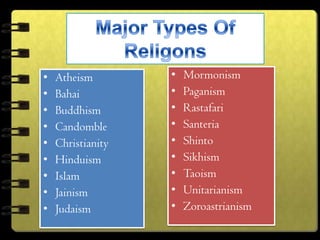
•   Atheism        •   Mormonism
•   Bahai          •   Paganism
•   Buddhism       •   Rastafari
•   Candomble      •   Santeria
•   Christianity   •   Shinto
•   Hinduism       •   Sikhism
•   Islam          •   Taoism
•   Jainism        •   Unitarianism
•   Judaism        •   Zoroastrianism
• Atheism is, in a broad sense, the rejection
  of belief in the existence of deities. In a
  narrower sense, atheism is specifically the
  position that there are no deities. Most
  inclusively, atheism is simply the absence of
  belief that any deities exist. Atheism is
  contrasted with theism, which in its most
  general form is the belief that at least one deity
  exists.
• Three core principles establish
  a basis for Bahá'í teachings and
  doctrine: the unity of
  God, the unity of religion, and
  the unity of humankind. From
  these postulates stems the
  belief that God periodically
  reveals his will through divine
  messengers, whose purpose is
  to transform the character of
  humankind and
  develop, within those who
  respond, moral and spiritual
  qualities. Religion is thus seen
  as orderly, unified, and
  progressive from age to age.
• Buddhism is a religion and philosophy indigenous to
  the Indian subcontinent and encompasses a variety of
  traditions, beliefs, and practices largely based on
  teachings attributed to Siddhartha Gautama, who is
  commonly known as the Buddha (the awakened one).
  The Buddha lived and taught in the eastern part
  of Indian subcontinent some time between the 6th and
  4th centuries BCE. He is recognized by Buddhists as
  an awakened or enlightened teacher who shared his
  insights to help sentient beings end ignorance, craving
  , and suffering , by recognizing dependent
  origination and sunyata, and attain Nirvana.
• Candomblé is an African-originated or Afro-
  Brazilian religion, practiced chiefly in Brazil by
  saint people.
• Candomblé is a polytheistic religion and worships
  a number of gods, derived from African deities:
• the Orishas of Yoruba and Ketashi mythology
• the Voduns of the Ewe and Fon (Jeje nation); and
• the Nkisis (Minkisi) of the Bantu (Angola nation
  and Congo).
• Tabela Orixas-Voduns-Nkisis
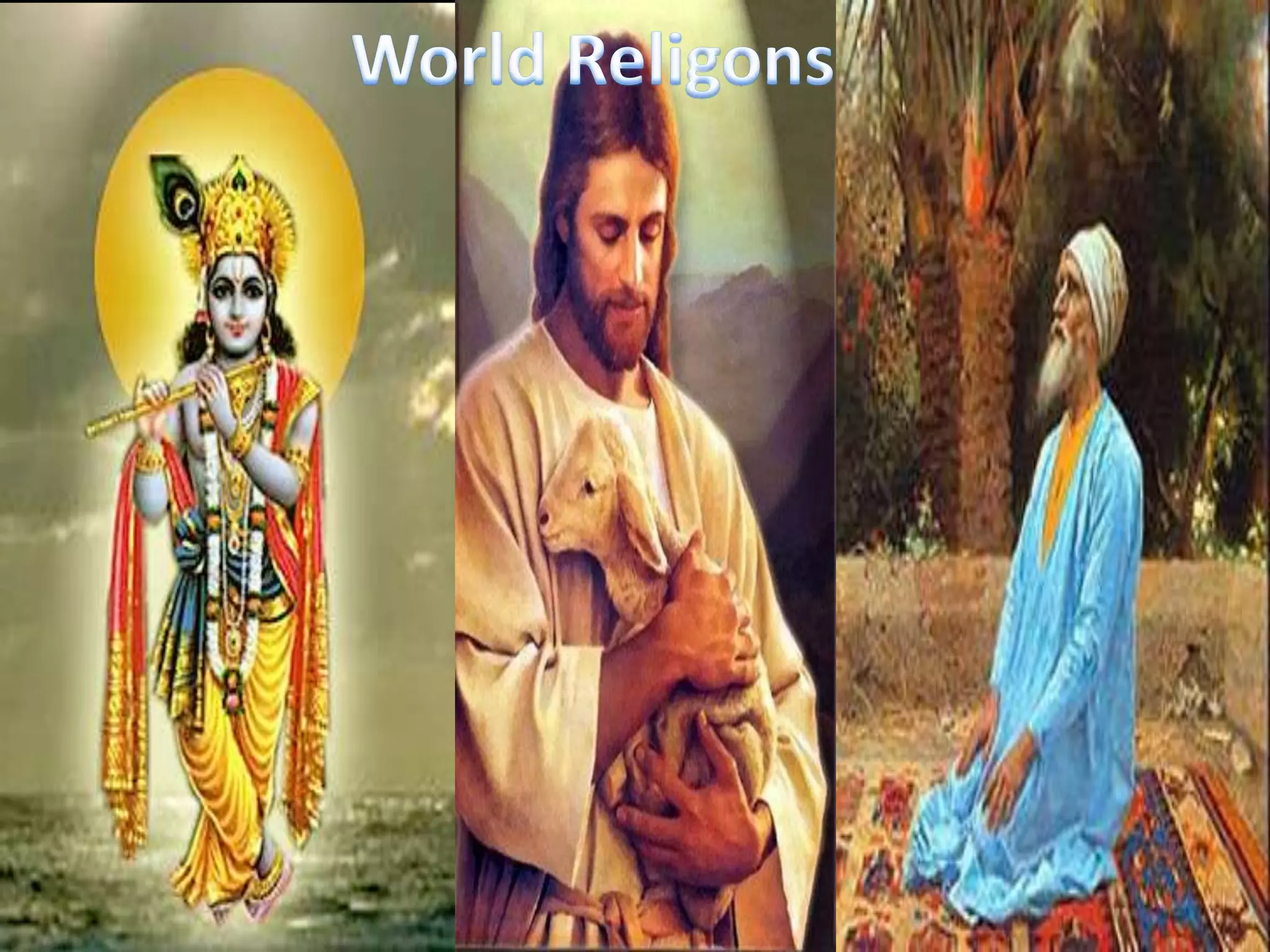
• Christians generally believe
  Jesus is the Son of God, God
  having become human and
  the savior of humanity. Because
  of this, Christians commonly
  refer to Jesus as Christ
  or Messiah. Jesus' ministry, sacr
  ificial death, and
  subsequent resurrection, are
  often referred to as
  the Gospel message ("good
  news").
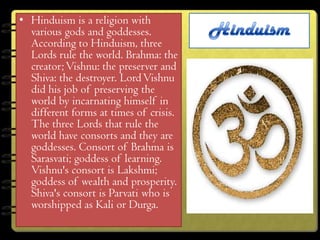
• Hinduism is a religion with
  various gods and goddesses.
  According to Hinduism, three
  Lords rule the world. Brahma: the
  creator; Vishnu: the preserver and
  Shiva: the destroyer. Lord Vishnu
  did his job of preserving the
  world by incarnating himself in
  different forms at times of crisis.
  The three Lords that rule the
  world have consorts and they are
  goddesses. Consort of Brahma is
  Sarasvati; goddess of learning.
  Vishnu's consort is Lakshmi;
  goddess of wealth and prosperity.
  Shiva's consort is Parvati who is
  worshipped as Kali or Durga.
• Muslims believe that God
  is one and incomparable and
  the purpose of existence is to
  love and serve God. Muslims
  also believe that Islam is the
  complete and universal version
  of a primordial faith that was
  revealed at many times and
  places before, including
  through Abraham
  , Moses and Jesus, whom they
  consider prophets.
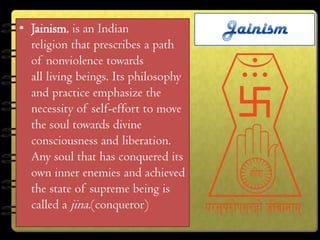
• Jainism, is an Indian
  religion that prescribes a path
  of nonviolence towards
  all living beings. Its philosophy
  and practice emphasize the
  necessity of self-effort to move
  the soul towards divine
  consciousness and liberation.
  Any soul that has conquered its
  own inner enemies and achieved
  the state of supreme being is
  called a jina.(conqueror)
• Judaism is the religion
  , philosophy, and way of life
  of the Jewish
  people. A monotheistic religi
  on originating in the Hebrew
  Bible and explored in later
  texts such as
  the Talmud, Judaism is
  considered by religious Jews
  to be the expression of the
  covenantal relationship God
  developed with the Children
  of Israel.
• Mormonism is a form of
  Christian primitivism that
  shares a common set of
  beliefs with the rest of the
  Latter Day Saint
  movement, including use
  of, and belief
  in, the Bible, as well as
  other religious
  texts including the Book of
  Mormon and Doctrine
  and Covenants.
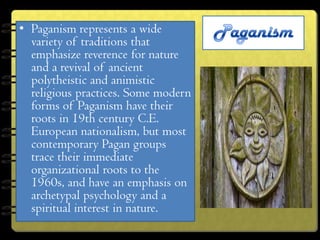
• Paganism represents a wide
  variety of traditions that
  emphasize reverence for nature
  and a revival of ancient
  polytheistic and animistic
  religious practices. Some modern
  forms of Paganism have their
  roots in 19th century C.E.
  European nationalism, but most
  contemporary Pagan groups
  trace their immediate
  organizational roots to the
  1960s, and have an emphasis on
  archetypal psychology and a
  spiritual interest in nature.
• The Rastafarian movement       • Garvey encouraged pride in
  began with the teachings         being black and worked to
  of Marcus Garvey (1887-          reverse the mindset of
  1940), a black Jamaican who      inferiority that centuries of
  led a "Back to Africa"           enslavement had ingrained
  movement. He taught that         on the minds of blacks.
  Africans are the true            Garvey is regarded as a
  Israelites and have been         second John the Baptist and
  exiled to Jamaica and other      famously prophesied in
  parts of the world as divine     1927, "Look to Africa, for
  punishment.                      there a king shall be
                                   crowned."
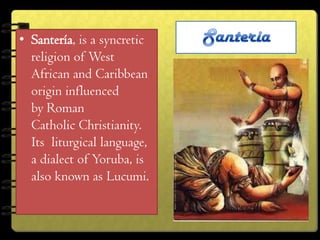
• Santería, is a syncretic
  religion of West
  African and Caribbean
  origin influenced
  by Roman
  Catholic Christianity.
  Its liturgical language,
  a dialect of Yoruba, is
  also known as Lucumi.
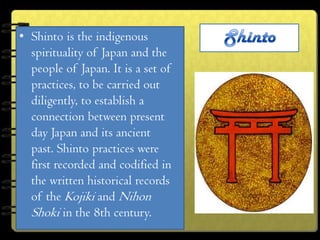
• Shinto is the indigenous
  spirituality of Japan and the
  people of Japan. It is a set of
  practices, to be carried out
  diligently, to establish a
  connection between present
  day Japan and its ancient
  past. Shinto practices were
  first recorded and codified in
  the written historical records
  of the Kojiki and Nihon
  Shoki in the 8th century.
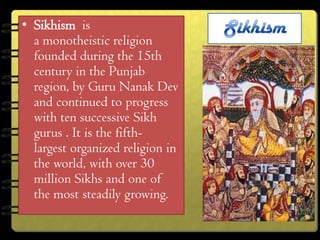
• Sikhism is
  a monotheistic religion
  founded during the 15th
  century in the Punjab
  region, by Guru Nanak Dev
  and continued to progress
  with ten successive Sikh
  gurus . It is the fifth-
  largest organized religion in
  the world, with over 30
  million Sikhs and one of
  the most steadily growing.
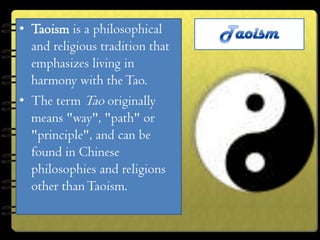
• Taoism is a philosophical
  and religious tradition that
  emphasizes living in
  harmony with the Tao.
• The term Tao originally
  means "way", "path" or
  "principle", and can be
  found in Chinese
  philosophies and religions
  other than Taoism.
• Unitarianism is
  a Christian theological move
  ment, named for its
  understanding of God as
  one person, in direct contrast
  to Trinitarianism which
  defines God as
  three persons coexisting cons
  ubstantially as one in
  being. Thus, Unitarians
  adhere to strict
  monotheism, and maintain
  that Jesus was a great man
  and a prophet of God, but
  not God himself.
• Zoroastrianism is
  a religion and philosophy
  based on the teachings of
  prophet Zoroaster and was
  formerly among the world's
  largest religions. It was
  probably founded some time
  before the 6th century BCE
  in Greater Iran.
• By Yeshasv
  Bhargava and Tejasv
  Bhargava

World religions

  • 2.
    • Religion isa collection of cultural systems, belief systems, and worldviews that relate humanity to spirituality and, sometimes, to moral values. Many religions have narratives, symbols, traditions and sacred histories that are intended to give meaning to life or to explain the origin of life or the universe. They tend to derive morality, ethics, religious laws or a preferred lifestyle from their ideas about the cosmos and human nature.
  • 3.
    Atheism • Mormonism • Bahai • Paganism • Buddhism • Rastafari • Candomble • Santeria • Christianity • Shinto • Hinduism • Sikhism • Islam • Taoism • Jainism • Unitarianism • Judaism • Zoroastrianism
  • 4.
    • Atheism is,in a broad sense, the rejection of belief in the existence of deities. In a narrower sense, atheism is specifically the position that there are no deities. Most inclusively, atheism is simply the absence of belief that any deities exist. Atheism is contrasted with theism, which in its most general form is the belief that at least one deity exists.
  • 5.
    • Three coreprinciples establish a basis for Bahá'í teachings and doctrine: the unity of God, the unity of religion, and the unity of humankind. From these postulates stems the belief that God periodically reveals his will through divine messengers, whose purpose is to transform the character of humankind and develop, within those who respond, moral and spiritual qualities. Religion is thus seen as orderly, unified, and progressive from age to age.
  • 6.
    • Buddhism isa religion and philosophy indigenous to the Indian subcontinent and encompasses a variety of traditions, beliefs, and practices largely based on teachings attributed to Siddhartha Gautama, who is commonly known as the Buddha (the awakened one). The Buddha lived and taught in the eastern part of Indian subcontinent some time between the 6th and 4th centuries BCE. He is recognized by Buddhists as an awakened or enlightened teacher who shared his insights to help sentient beings end ignorance, craving , and suffering , by recognizing dependent origination and sunyata, and attain Nirvana.
  • 7.
    • Candomblé isan African-originated or Afro- Brazilian religion, practiced chiefly in Brazil by saint people. • Candomblé is a polytheistic religion and worships a number of gods, derived from African deities: • the Orishas of Yoruba and Ketashi mythology • the Voduns of the Ewe and Fon (Jeje nation); and • the Nkisis (Minkisi) of the Bantu (Angola nation and Congo). • Tabela Orixas-Voduns-Nkisis
  • 8.
    • Christians generallybelieve Jesus is the Son of God, God having become human and the savior of humanity. Because of this, Christians commonly refer to Jesus as Christ or Messiah. Jesus' ministry, sacr ificial death, and subsequent resurrection, are often referred to as the Gospel message ("good news").
  • 9.
    • Hinduism isa religion with various gods and goddesses. According to Hinduism, three Lords rule the world. Brahma: the creator; Vishnu: the preserver and Shiva: the destroyer. Lord Vishnu did his job of preserving the world by incarnating himself in different forms at times of crisis. The three Lords that rule the world have consorts and they are goddesses. Consort of Brahma is Sarasvati; goddess of learning. Vishnu's consort is Lakshmi; goddess of wealth and prosperity. Shiva's consort is Parvati who is worshipped as Kali or Durga.
  • 10.
    • Muslims believethat God is one and incomparable and the purpose of existence is to love and serve God. Muslims also believe that Islam is the complete and universal version of a primordial faith that was revealed at many times and places before, including through Abraham , Moses and Jesus, whom they consider prophets.
  • 11.
    • Jainism, isan Indian religion that prescribes a path of nonviolence towards all living beings. Its philosophy and practice emphasize the necessity of self-effort to move the soul towards divine consciousness and liberation. Any soul that has conquered its own inner enemies and achieved the state of supreme being is called a jina.(conqueror)
  • 12.
    • Judaism isthe religion , philosophy, and way of life of the Jewish people. A monotheistic religi on originating in the Hebrew Bible and explored in later texts such as the Talmud, Judaism is considered by religious Jews to be the expression of the covenantal relationship God developed with the Children of Israel.
  • 13.
    • Mormonism isa form of Christian primitivism that shares a common set of beliefs with the rest of the Latter Day Saint movement, including use of, and belief in, the Bible, as well as other religious texts including the Book of Mormon and Doctrine and Covenants.
  • 14.
    • Paganism representsa wide variety of traditions that emphasize reverence for nature and a revival of ancient polytheistic and animistic religious practices. Some modern forms of Paganism have their roots in 19th century C.E. European nationalism, but most contemporary Pagan groups trace their immediate organizational roots to the 1960s, and have an emphasis on archetypal psychology and a spiritual interest in nature.
  • 15.
    • The Rastafarianmovement • Garvey encouraged pride in began with the teachings being black and worked to of Marcus Garvey (1887- reverse the mindset of 1940), a black Jamaican who inferiority that centuries of led a "Back to Africa" enslavement had ingrained movement. He taught that on the minds of blacks. Africans are the true Garvey is regarded as a Israelites and have been second John the Baptist and exiled to Jamaica and other famously prophesied in parts of the world as divine 1927, "Look to Africa, for punishment. there a king shall be crowned."
  • 16.
    • Santería, isa syncretic religion of West African and Caribbean origin influenced by Roman Catholic Christianity. Its liturgical language, a dialect of Yoruba, is also known as Lucumi.
  • 17.
    • Shinto isthe indigenous spirituality of Japan and the people of Japan. It is a set of practices, to be carried out diligently, to establish a connection between present day Japan and its ancient past. Shinto practices were first recorded and codified in the written historical records of the Kojiki and Nihon Shoki in the 8th century.
  • 18.
    • Sikhism is a monotheistic religion founded during the 15th century in the Punjab region, by Guru Nanak Dev and continued to progress with ten successive Sikh gurus . It is the fifth- largest organized religion in the world, with over 30 million Sikhs and one of the most steadily growing.
  • 19.
    • Taoism isa philosophical and religious tradition that emphasizes living in harmony with the Tao. • The term Tao originally means "way", "path" or "principle", and can be found in Chinese philosophies and religions other than Taoism.
  • 20.
    • Unitarianism is a Christian theological move ment, named for its understanding of God as one person, in direct contrast to Trinitarianism which defines God as three persons coexisting cons ubstantially as one in being. Thus, Unitarians adhere to strict monotheism, and maintain that Jesus was a great man and a prophet of God, but not God himself.
  • 21.
    • Zoroastrianism is a religion and philosophy based on the teachings of prophet Zoroaster and was formerly among the world's largest religions. It was probably founded some time before the 6th century BCE in Greater Iran.
  • 22.
    • By Yeshasv Bhargava and Tejasv Bhargava

Editor's Notes