Number Patterns
Presented by Connor Winchester
What types of number
patters can you think
of?
Give some examples of a number pattern
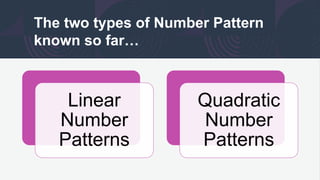
The two types of Number Pattern
known so far…
Linear
Number
Patterns
Quadratic
Number
Patterns
What are
key
points
about
these…
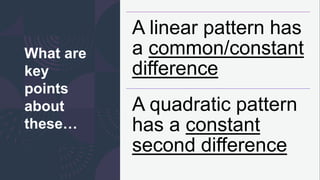
A linear pattern has
a common/constant
difference
A quadratic pattern
has a constant
second difference
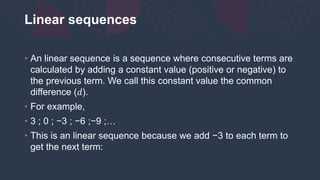
Linear sequences
• An linear sequence is a sequence where consecutive terms are
calculated by adding a constant value (positive or negative) to
the previous term. We call this constant value the common
difference (𝑑).
• For example,
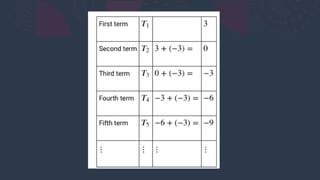
• 3 ; 0 ; −3 ; −6 ;−9 ;…
• This is an linear sequence because we add −3 to each term to
get the next term:
Try this one out:
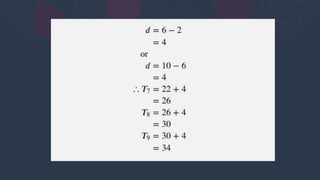
• Find the common difference and write down the next 3 terms of
the sequence.
• 2 ; 6 ; 10 ; 14 ; 18 ; 22 ; …
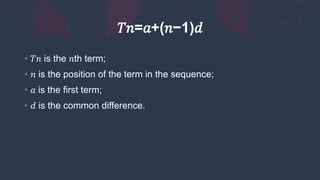
𝑇𝑛=𝑎+(𝑛−1)𝑑
• 𝑇𝑛 is the 𝑛th term;
• 𝑛 is the position of the term in the sequence;
• 𝑎 is the first term;
• 𝑑 is the common difference.
Quadratic sequence
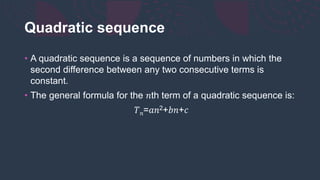
• A quadratic sequence is a sequence of numbers in which the
second difference between any two consecutive terms is
constant.
• The general formula for the 𝑛th term of a quadratic sequence is:
𝑇𝑛=𝑎𝑛2+𝑏𝑛+𝑐
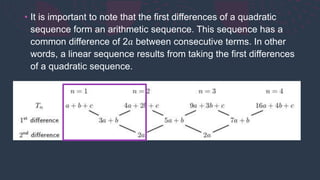
• It is important to note that the first differences of a quadratic
sequence form an arithmetic sequence. This sequence has a
common difference of 2𝑎 between consecutive terms. In other
words, a linear sequence results from taking the first differences
of a quadratic sequence.
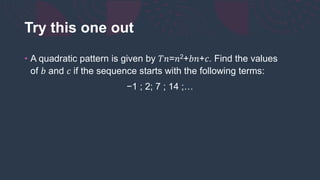
Try this one out
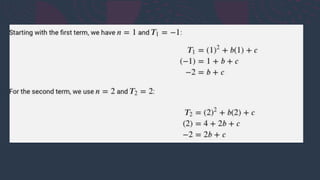
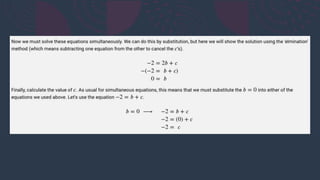
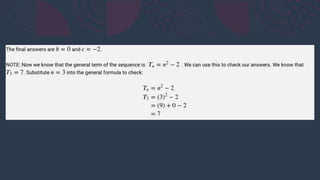
• A quadratic pattern is given by 𝑇𝑛=𝑛2+𝑏𝑛+𝑐. Find the values
of 𝑏 and 𝑐 if the sequence starts with the following terms:
−1 ; 2; 7 ; 14 ;…
Additional Activities/ Reading
• Further reading, listening or viewing activities related to this
topic are available on the following web links:
• https://www.youtube.com/watch?v=UuceRRQGk8E
• (Linear sequences – nth term)
• https://www.youtube.com/watch?v=FfCq7bGAFoY
• (Quadratic sequences – nth term)

Number Patterns 1 Lesson

  • 1.
  • 2.
    What types ofnumber patters can you think of? Give some examples of a number pattern
  • 3.
    The two typesof Number Pattern known so far… Linear Number Patterns Quadratic Number Patterns
  • 4.
    What are key points about these… A linearpattern has a common/constant difference A quadratic pattern has a constant second difference
  • 5.
    Linear sequences • Anlinear sequence is a sequence where consecutive terms are calculated by adding a constant value (positive or negative) to the previous term. We call this constant value the common difference (𝑑). • For example, • 3 ; 0 ; −3 ; −6 ;−9 ;… • This is an linear sequence because we add −3 to each term to get the next term:
  • 7.
    Try this oneout: • Find the common difference and write down the next 3 terms of the sequence. • 2 ; 6 ; 10 ; 14 ; 18 ; 22 ; …
  • 9.
    𝑇𝑛=𝑎+(𝑛−1)𝑑 • 𝑇𝑛 isthe 𝑛th term; • 𝑛 is the position of the term in the sequence; • 𝑎 is the first term; • 𝑑 is the common difference.
  • 10.
    Quadratic sequence • Aquadratic sequence is a sequence of numbers in which the second difference between any two consecutive terms is constant. • The general formula for the 𝑛th term of a quadratic sequence is: 𝑇𝑛=𝑎𝑛2+𝑏𝑛+𝑐
  • 11.
    • It isimportant to note that the first differences of a quadratic sequence form an arithmetic sequence. This sequence has a common difference of 2𝑎 between consecutive terms. In other words, a linear sequence results from taking the first differences of a quadratic sequence.
  • 12.
    Try this oneout • A quadratic pattern is given by 𝑇𝑛=𝑛2+𝑏𝑛+𝑐. Find the values of 𝑏 and 𝑐 if the sequence starts with the following terms: −1 ; 2; 7 ; 14 ;…
  • 16.
    Additional Activities/ Reading •Further reading, listening or viewing activities related to this topic are available on the following web links: • https://www.youtube.com/watch?v=UuceRRQGk8E • (Linear sequences – nth term) • https://www.youtube.com/watch?v=FfCq7bGAFoY • (Quadratic sequences – nth term)