Lesson 2.2
Finding the nth term
Writing the RULE for a Linear Sequence
Homework: lesson 2.2/1-8
Objectives
• Use inductive reasoning to find a pattern
• Create a rule for finding any term/value in
the sequence
• Use your rule to predict any term in the
sequence
Function Rule:
The rule that gives the nth term for a sequence.
n = term number (location of a value in the sequence)
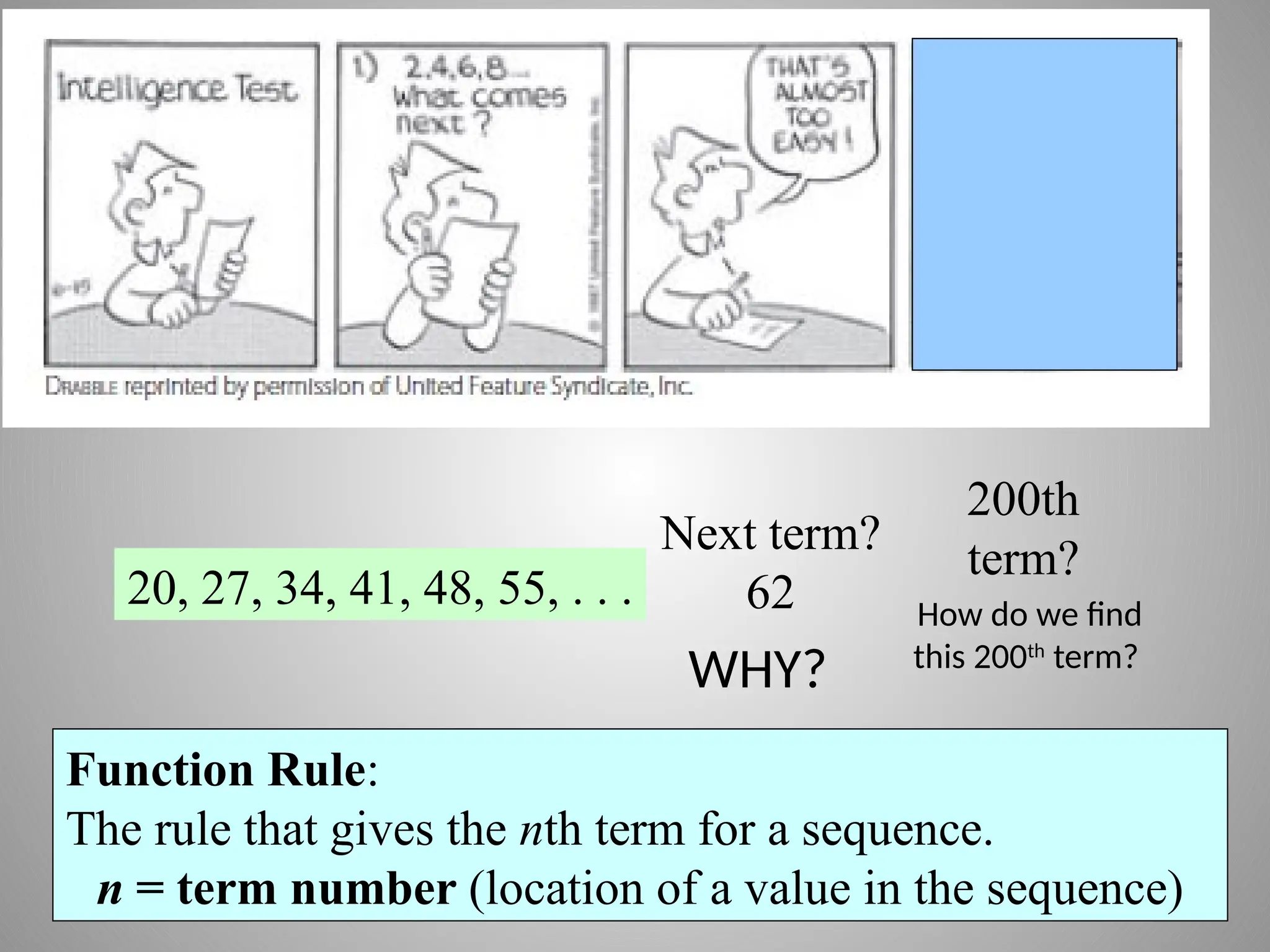
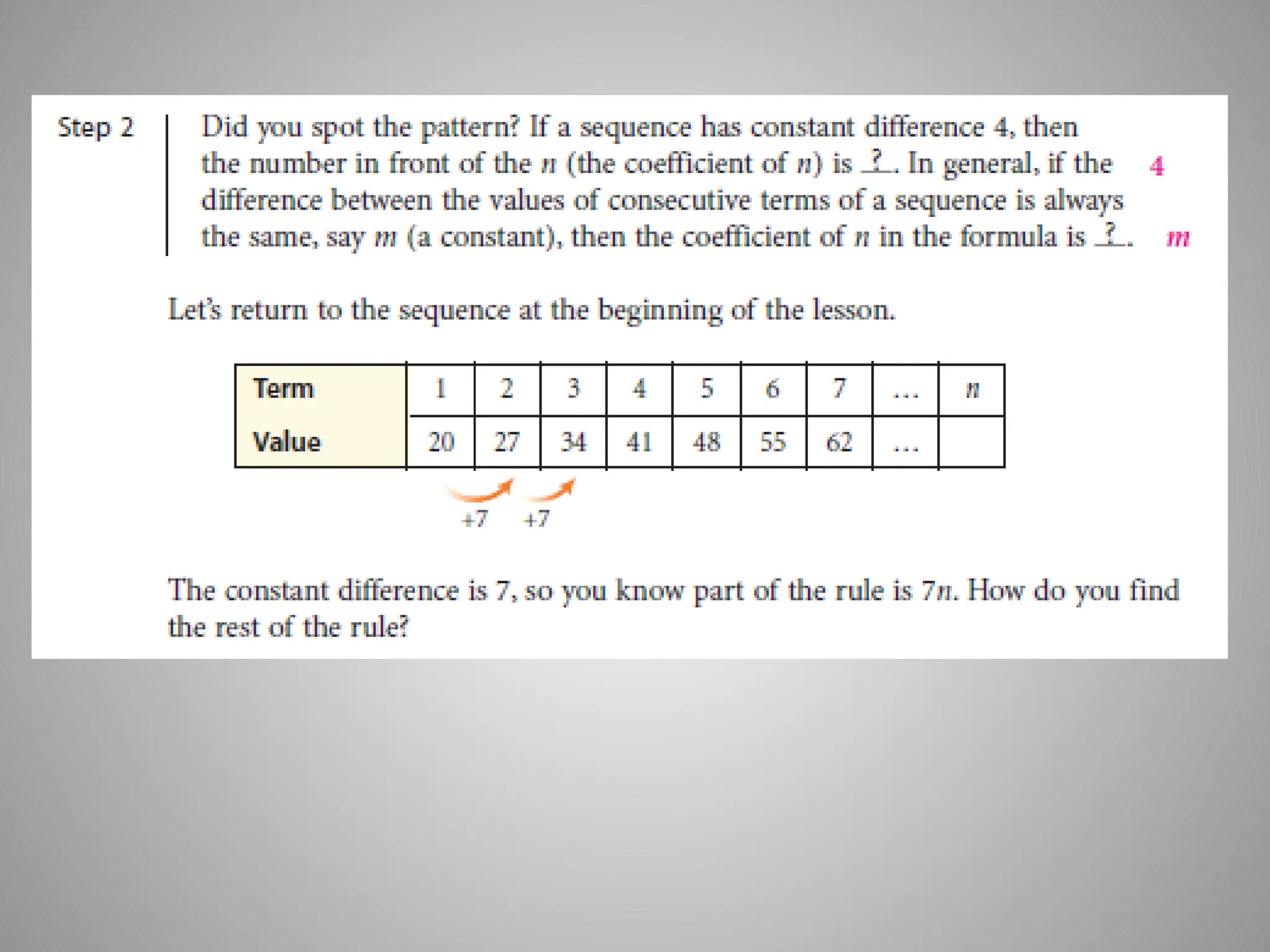
20, 27, 34, 41, 48, 55, . . .
Next term?
62
200th
term?
WHY?
How do we find
this 200th
term?
n = 200
7n+13 => 7(200)+13
= 1413
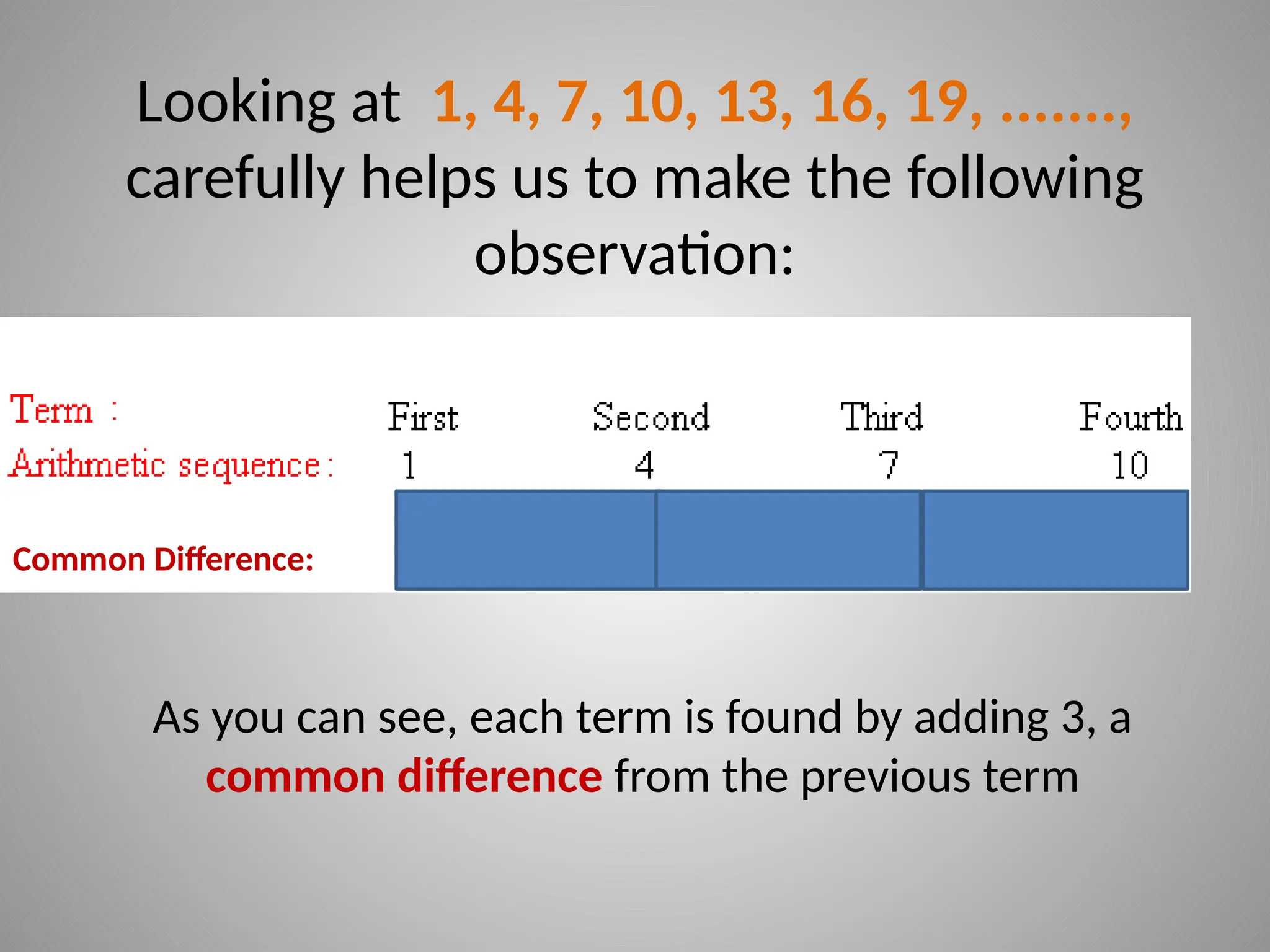
Looking at 1, 4, 7, 10, 13, 16, 19, .......,
carefully helps us to make the following
observation:
As you can see, each term is found by adding 3, a
common difference from the previous term
Common Difference:
Looking at 70, 62, 54, 46, 38, ... carefully helps
us to make the following observation:
This time, to find each term, we subtract 8,
a common difference from the previous
term
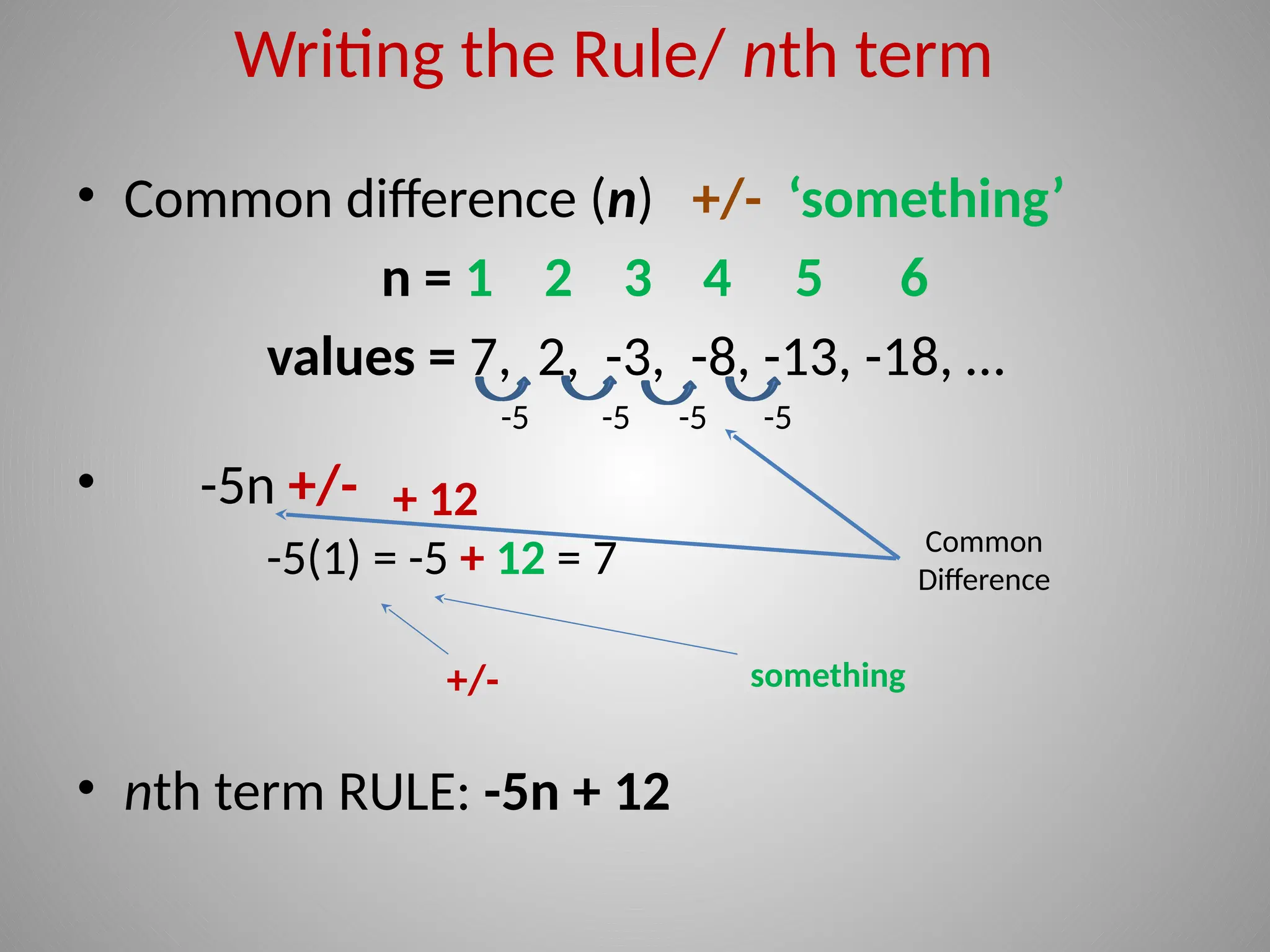
• Common difference (n) +/- ‘something’
n = 1 2 3 4 5 6
values = 7, 2, -3, -8, -13, -18, …
-5 -5 -5 -5
• -5n +/-
-5(1) = -5 + 12 = 7
• nth term RULE: -5n + 12
Common
Difference
+/- something
Writing the Rule/ nth term
+ 12
Finding the nth Term
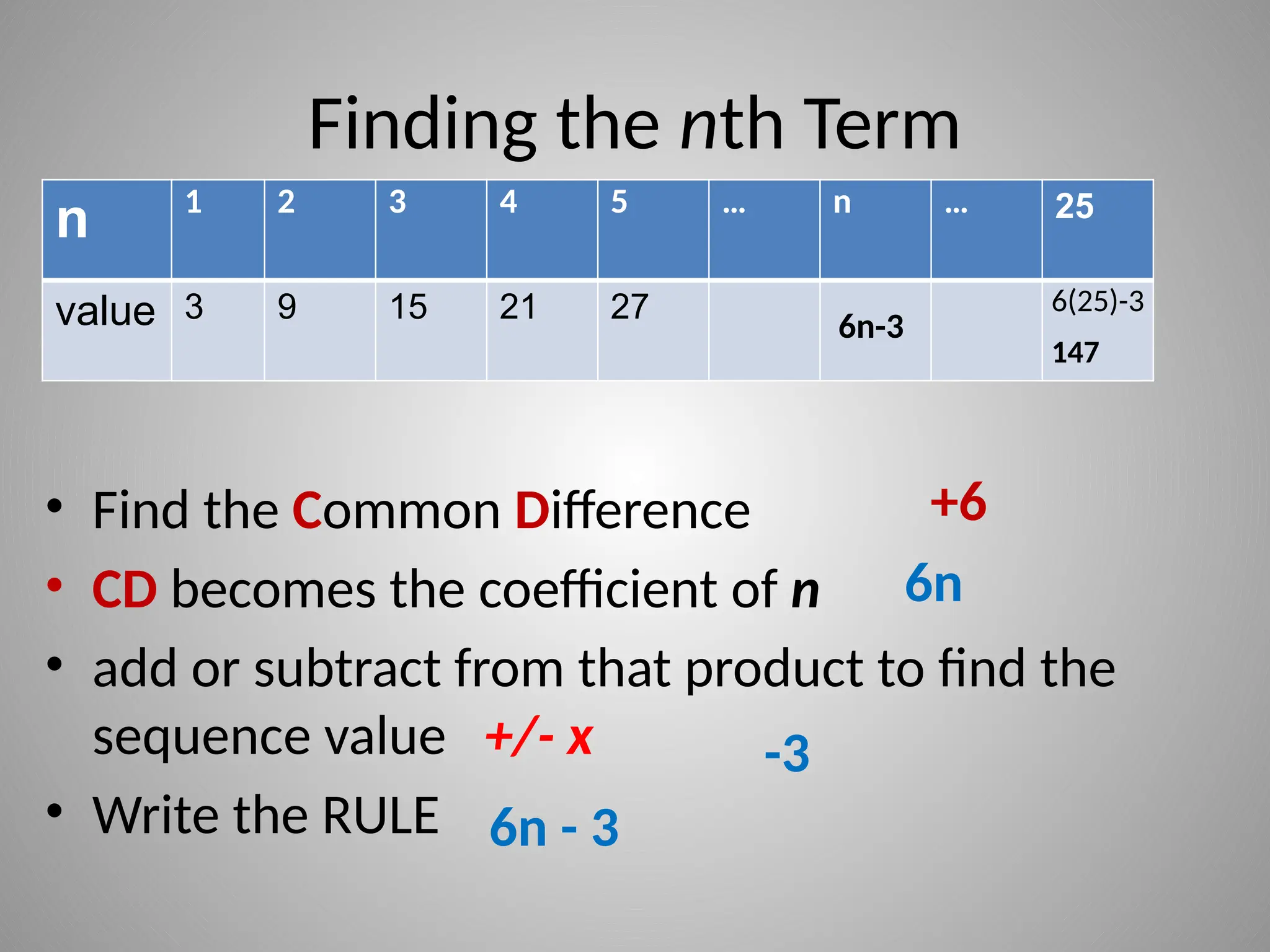
• Find the Common Difference
• CD becomes the coefficient of n
• add or subtract from that product to find the
sequence value +/- x
• Write the RULE
n 1 2 3 4 5 … n … 25
value 3 9 15 21 27
+6
6n
-3
6n - 3
6n-3
6(25)-3
147
Use the Rule to complete the pattern
n 1 2 3 4 5
n-3 -2 -1 0 1 2
n 1 2 3 4 5
2n+1 3 5 7 9 11
n 1 2 3 4 5
-4n+5 1 -3 -7 -11 -15
What pattern do
you see
consistently
emerging from all
these rules?
Are these examples
of linear or
nonlinear patterns?
Common
difference
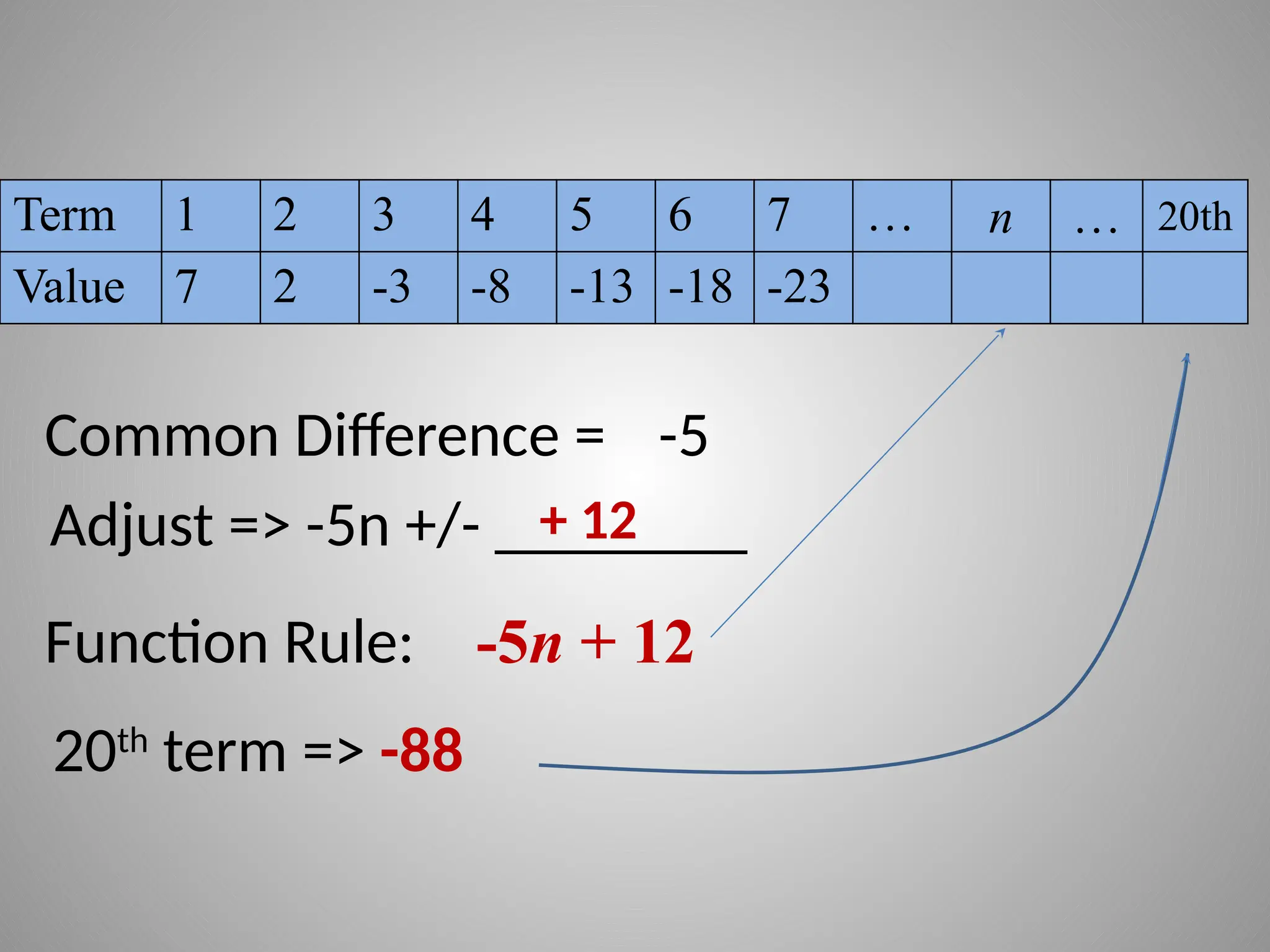
Term 1 2 3 4 5 6 7 … n … 20th
Value 7 2 -3 -8 -13 -18 -23
Function Rule: -5n + 12
20th
term => -88
Common Difference = -5
Adjust => -5n +/- ________
+ 12
Use the pattern to find the rule & the
missing term
n 1 2 3 4 5 .. 54
6n 6 12 18 24 30 324
+6 +6 +6 +6
RULE: 6n+ _?__
Common difference = 6
n=1 6(1)+
🡪 _?__ = 6
n=2 6(2)+
🡪 ? =12
? = 0
RULE: 6n
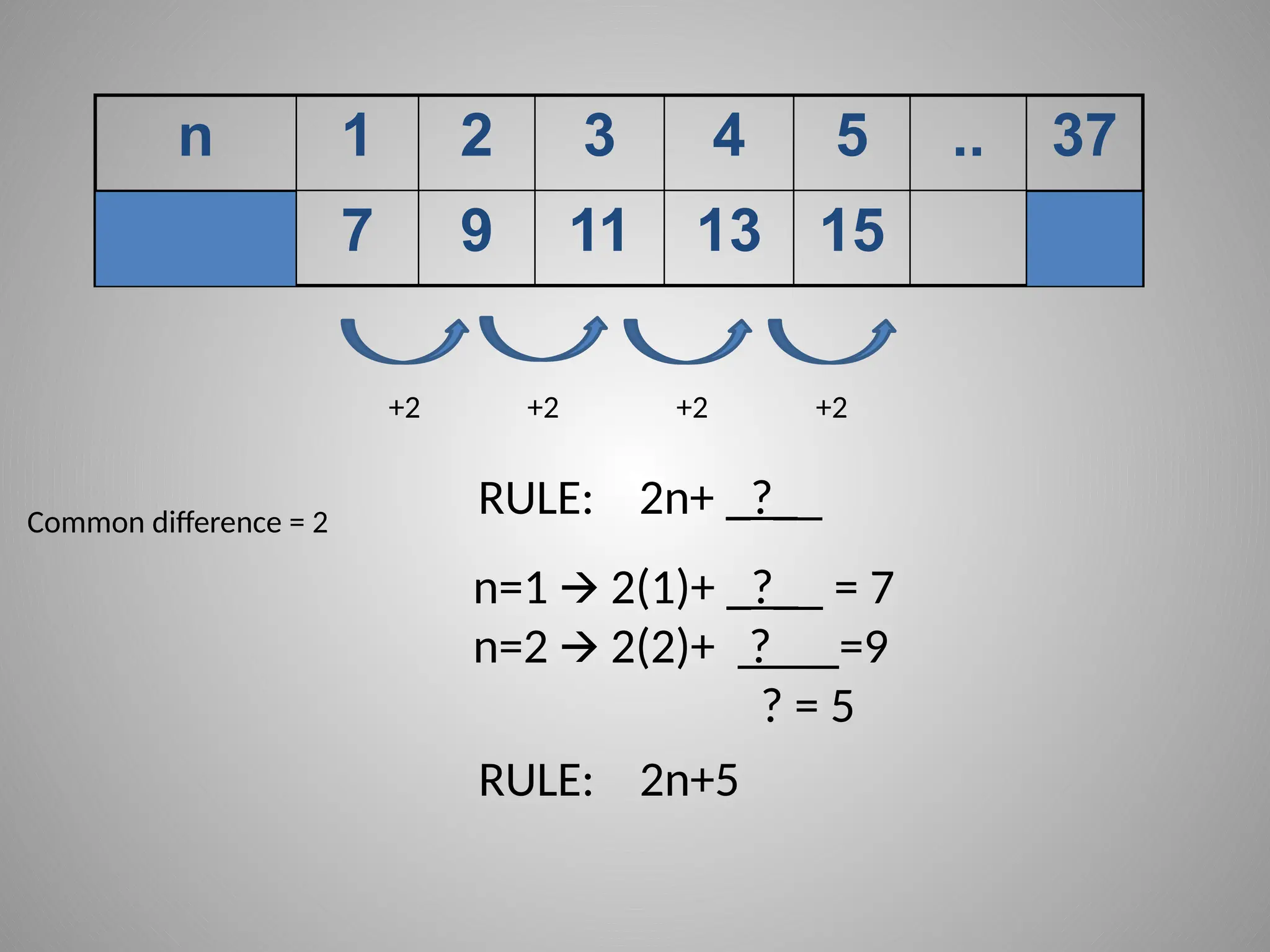
n 1 2 3 4 5 .. 37
2x+5 7 9 11 13 15 79
+2 +2 +2 +2
RULE: 2n+ _?__
Common difference = 2
n=1 2(1)+
🡪 _?__ = 7
n=2 2(2)+
🡪 ? =9
? = 5
RULE: 2n+5
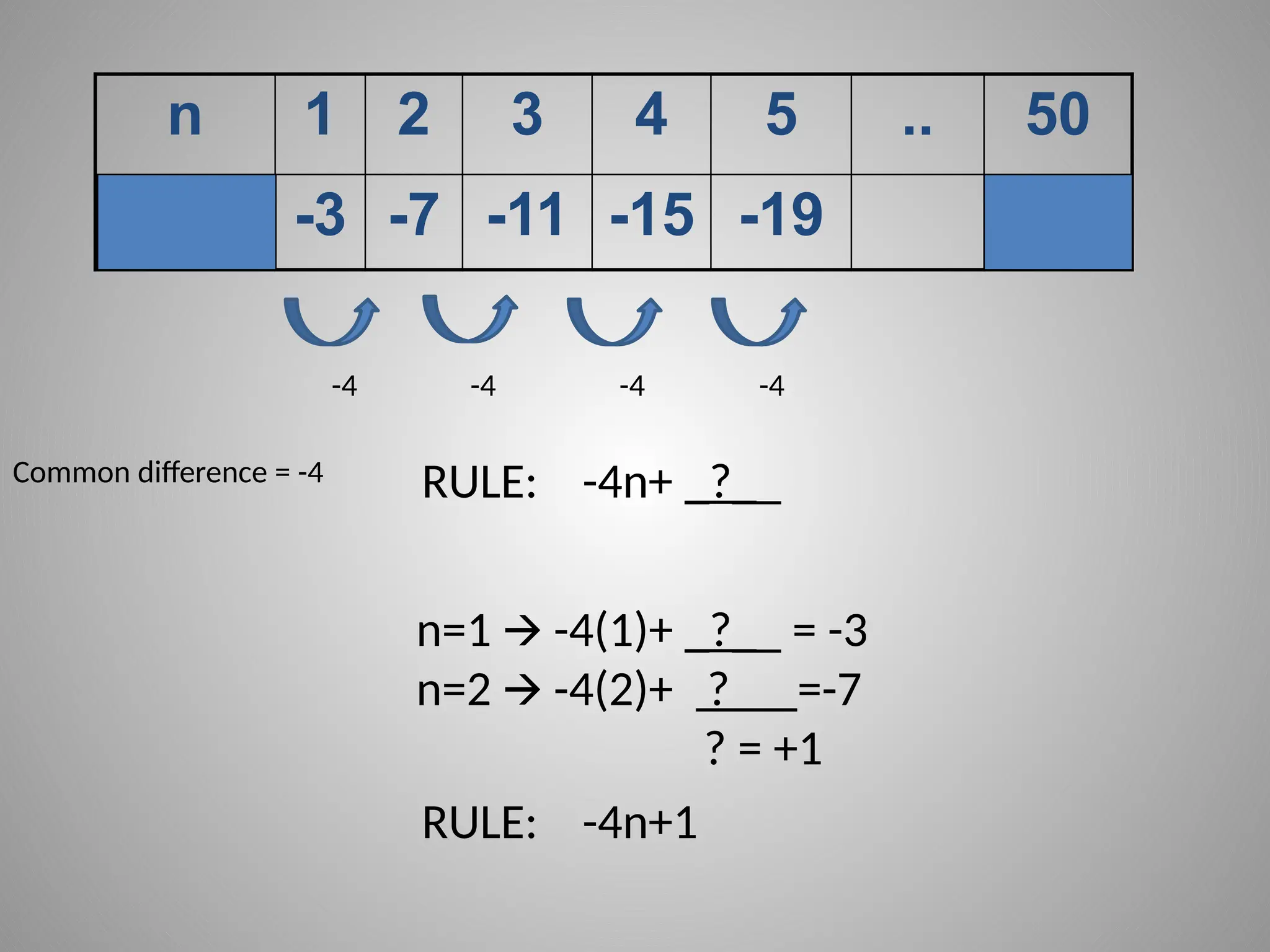
n 1 2 3 4 5 .. 50
-4n+1 -3 -7 -11 -15 -19 199
-4 -4 -4 -4
RULE: -4n+ _?__
Common difference = -4
n=1 -4(1)+
🡪 _?__ = -3
n=2 -4(2)+
🡪 ? =-7
? = +1
RULE: -4n+1
Use a table to find the number of squares
in the next shape in the pattern.
n n 50
# of squares
1
5
2
8
3
11 3n+2 152
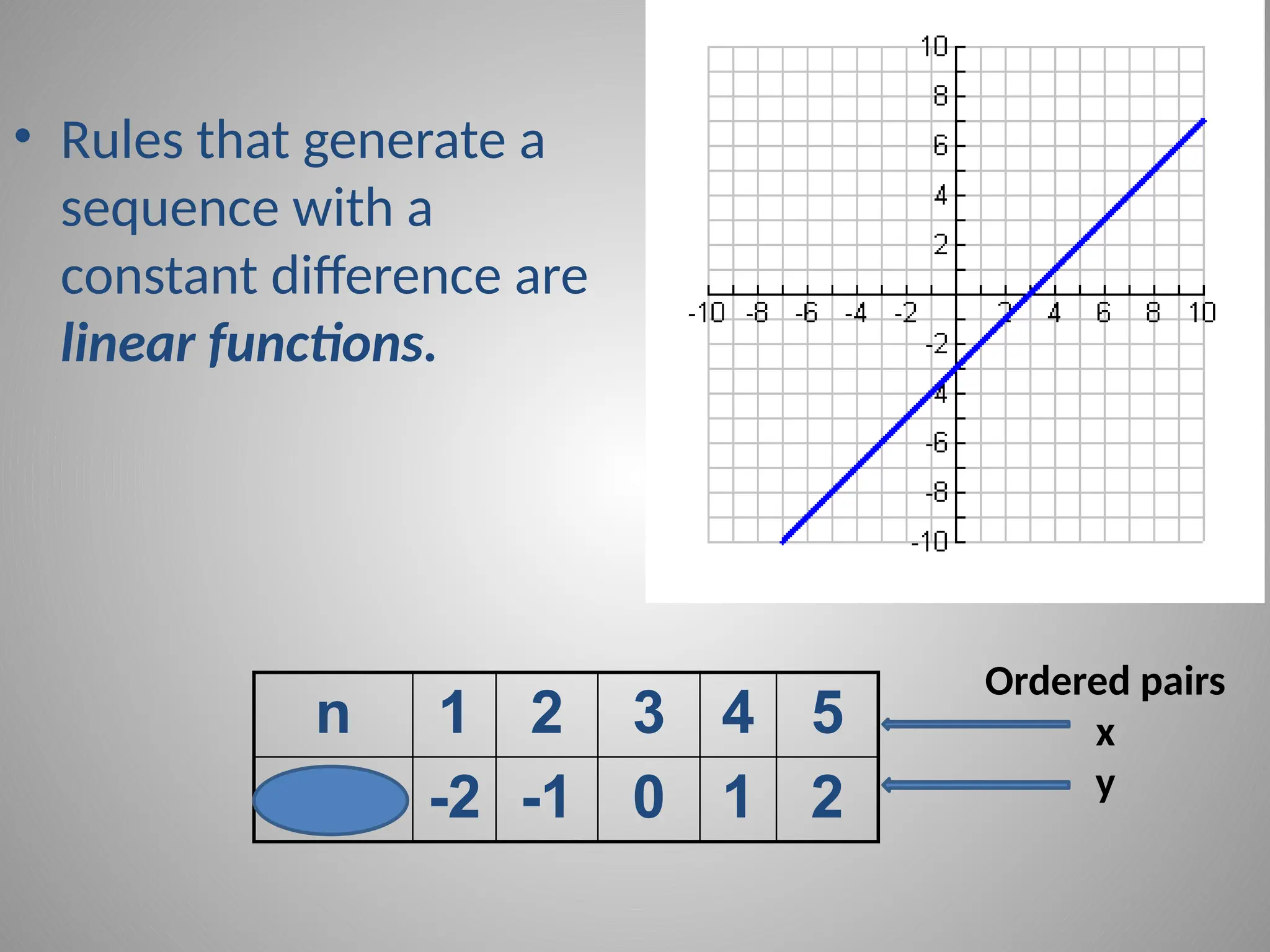
• Rules that generate a
sequence with a
constant difference are
linear functions.
n 1 2 3 4 5
n-3 -2 -1 0 1 2
Ordered pairs
x
y
Rules for sequences can be expressed using
function notation.
f (n) = −5n + 12
In this case, function f takes an input value n,
multiplies it by −5, and adds 12 to produce an
output value.
n 1 2 3 4 5
f(n) -3 -1 3 11 27
n 1 2 3 4 5
f(n) 9 6 3 0 -3
n 1 2 3 4 5
f(n) -8 -4 0 4 8
n 1 2 3 4 5
f(n) -2 -1 1 4 8
IS THE PATTERN LINEAR?
NO YES; cd=-3
YES; cd=+4 NO
-5
-33
-28
-23
-18
-13
-8
-3
2
-5n + 7
+3
21
19
16
13
10
7
4
1
3n – 2
-2
-11
-9
-7
-5
-3
-1
1
3
-2n + 5
+4
29
25
21
17
13
9
5
1
4n – 3
+1
3
2
1
0
-1
-2
-3
-4
n – 5
Difference
8
7
6
5
4
3
2
1
n
Copy and complete the table
Term
Function Rule
Coefficient
• Find the next term in an Arithmetic and
Geometric sequence
• Arithmetic Sequence
• Formed by adding a fixed number to a previous
term
• Geometric Sequence
• Formed by multiplying by a fixed number to a
previous term
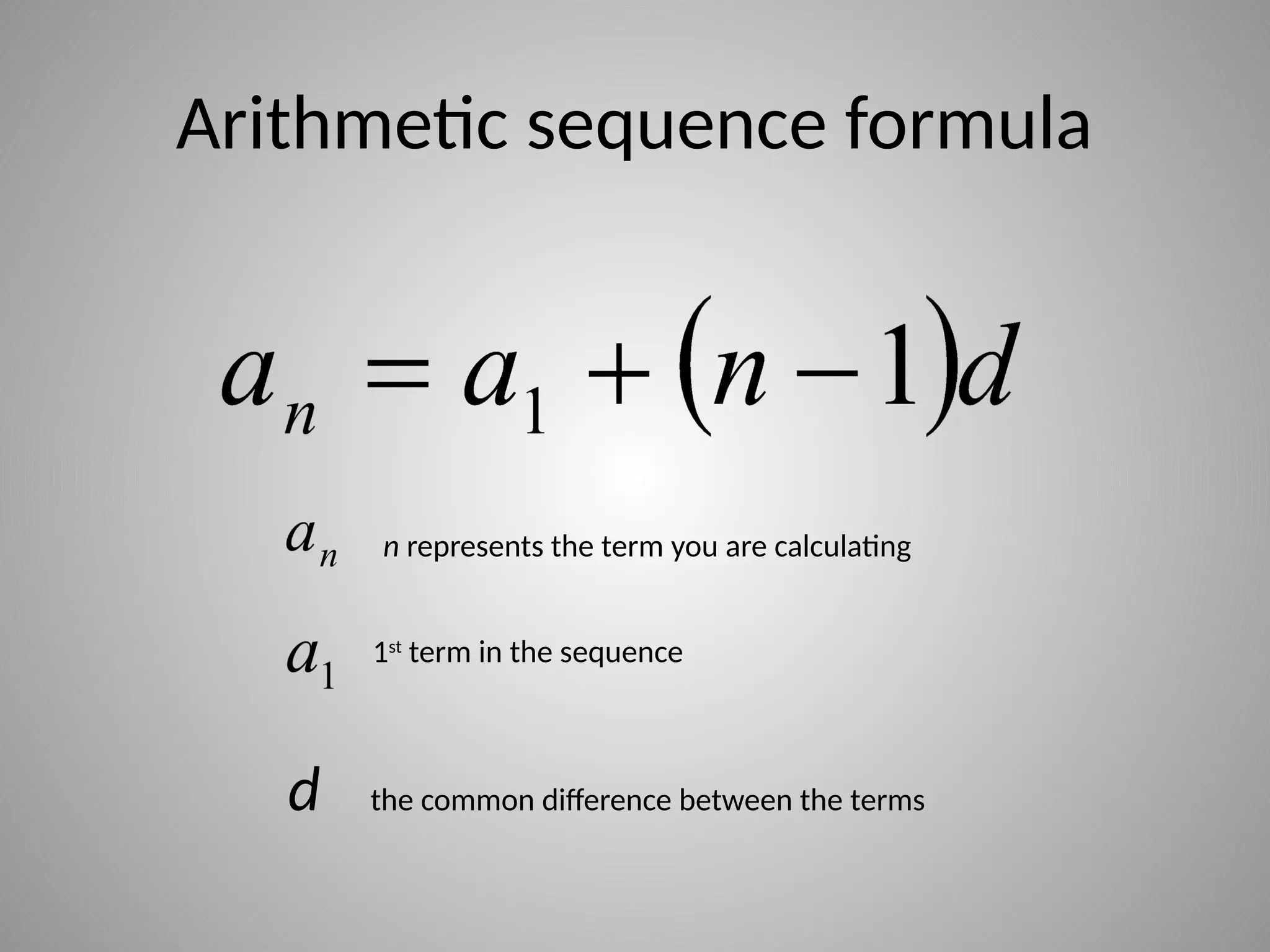
Arithmetic sequence formula
n represents the term you are calculating
1st
term in the sequence
d the common difference between the terms

Finding the nth term.........................................

  • 1.
    Lesson 2.2 Finding thenth term Writing the RULE for a Linear Sequence Homework: lesson 2.2/1-8
  • 2.
    Objectives • Use inductivereasoning to find a pattern • Create a rule for finding any term/value in the sequence • Use your rule to predict any term in the sequence
  • 3.
    Function Rule: The rulethat gives the nth term for a sequence. n = term number (location of a value in the sequence) 20, 27, 34, 41, 48, 55, . . . Next term? 62 200th term? WHY? How do we find this 200th term?
  • 7.
    n = 200 7n+13=> 7(200)+13 = 1413
  • 8.
    Looking at 1,4, 7, 10, 13, 16, 19, ......., carefully helps us to make the following observation: As you can see, each term is found by adding 3, a common difference from the previous term Common Difference:
  • 9.
    Looking at 70,62, 54, 46, 38, ... carefully helps us to make the following observation: This time, to find each term, we subtract 8, a common difference from the previous term
  • 10.
    • Common difference(n) +/- ‘something’ n = 1 2 3 4 5 6 values = 7, 2, -3, -8, -13, -18, … -5 -5 -5 -5 • -5n +/- -5(1) = -5 + 12 = 7 • nth term RULE: -5n + 12 Common Difference +/- something Writing the Rule/ nth term + 12
  • 11.
    Finding the nthTerm • Find the Common Difference • CD becomes the coefficient of n • add or subtract from that product to find the sequence value +/- x • Write the RULE n 1 2 3 4 5 … n … 25 value 3 9 15 21 27 +6 6n -3 6n - 3 6n-3 6(25)-3 147
  • 12.
    Use the Ruleto complete the pattern n 1 2 3 4 5 n-3 -2 -1 0 1 2 n 1 2 3 4 5 2n+1 3 5 7 9 11 n 1 2 3 4 5 -4n+5 1 -3 -7 -11 -15 What pattern do you see consistently emerging from all these rules? Are these examples of linear or nonlinear patterns? Common difference
  • 13.
    Term 1 23 4 5 6 7 … n … 20th Value 7 2 -3 -8 -13 -18 -23 Function Rule: -5n + 12 20th term => -88 Common Difference = -5 Adjust => -5n +/- ________ + 12
  • 14.
    Use the patternto find the rule & the missing term n 1 2 3 4 5 .. 54 6n 6 12 18 24 30 324 +6 +6 +6 +6 RULE: 6n+ _?__ Common difference = 6 n=1 6(1)+ 🡪 _?__ = 6 n=2 6(2)+ 🡪 ? =12 ? = 0 RULE: 6n
  • 15.
    n 1 23 4 5 .. 37 2x+5 7 9 11 13 15 79 +2 +2 +2 +2 RULE: 2n+ _?__ Common difference = 2 n=1 2(1)+ 🡪 _?__ = 7 n=2 2(2)+ 🡪 ? =9 ? = 5 RULE: 2n+5
  • 16.
    n 1 23 4 5 .. 50 -4n+1 -3 -7 -11 -15 -19 199 -4 -4 -4 -4 RULE: -4n+ _?__ Common difference = -4 n=1 -4(1)+ 🡪 _?__ = -3 n=2 -4(2)+ 🡪 ? =-7 ? = +1 RULE: -4n+1
  • 17.
    Use a tableto find the number of squares in the next shape in the pattern. n n 50 # of squares 1 5 2 8 3 11 3n+2 152
  • 18.
    • Rules thatgenerate a sequence with a constant difference are linear functions. n 1 2 3 4 5 n-3 -2 -1 0 1 2 Ordered pairs x y
  • 19.
    Rules for sequencescan be expressed using function notation. f (n) = −5n + 12 In this case, function f takes an input value n, multiplies it by −5, and adds 12 to produce an output value.
  • 20.
    n 1 23 4 5 f(n) -3 -1 3 11 27 n 1 2 3 4 5 f(n) 9 6 3 0 -3 n 1 2 3 4 5 f(n) -8 -4 0 4 8 n 1 2 3 4 5 f(n) -2 -1 1 4 8 IS THE PATTERN LINEAR? NO YES; cd=-3 YES; cd=+4 NO
  • 22.
    -5 -33 -28 -23 -18 -13 -8 -3 2 -5n + 7 +3 21 19 16 13 10 7 4 1 3n– 2 -2 -11 -9 -7 -5 -3 -1 1 3 -2n + 5 +4 29 25 21 17 13 9 5 1 4n – 3 +1 3 2 1 0 -1 -2 -3 -4 n – 5 Difference 8 7 6 5 4 3 2 1 n Copy and complete the table Term Function Rule Coefficient
  • 24.
    • Find thenext term in an Arithmetic and Geometric sequence • Arithmetic Sequence • Formed by adding a fixed number to a previous term • Geometric Sequence • Formed by multiplying by a fixed number to a previous term
  • 26.
    Arithmetic sequence formula nrepresents the term you are calculating 1st term in the sequence d the common difference between the terms