Asterisk Open Source PBX  Presented by: WebKul India
Agenda Introduction to VoIP Benefits Challenges CODECS Session Initiation Protocol Asterisk PBX Demonstration
What is VoIP? Based on packet switching technology using Internet as transport Opposed to the traditional circuit switching technology, which dominates the Public Switched Telephone Network (PSTN) Driven by low cost; flat-rate billing So why haven’t we switch to VoIP??
VoIP: Benefits Integration of Data & Voice Simplification Less equipment management Network Efficiently Save on Bandwidth (silence suppression) Cost Reduction  Bypass PSTN toll fees
VoIP: Quality of Voice Quality of CODEC  give good quality low delay Echo cancellation 2 wire -> 4 wire PBX (hybrid circuit used for conversion) if delay > 10mS echo is notice Delay Total Delay ( > 200mS one-way; talkers overlap ) Jitter ( variable packet arrival ) Delay Management Prioritize (RSVP) Packet replay (Jitter buffer) Segmenting data packets (exit router faster)
VoIP: CODECS Codecs supported by * G.723 – 6.4kbps G.729 – 8kbps G.711 – 64kbps
VoIP: Protocols RTP (Real Time Protocol) SIP (Session Initiation Protocol) SDP (Session Description Protocol)
What is Voice over IP (VoIP)? Internet/ Private IP Network ) ) ) 1010101000010100101010101010010101010100101010001001 IP Packet 1010101000010100101010101010010101010100101010001001 IP Packet 1010101000010100101010101010010101010100101010001001 1010101000010100101010101010010101010100101010001001 ( ( (
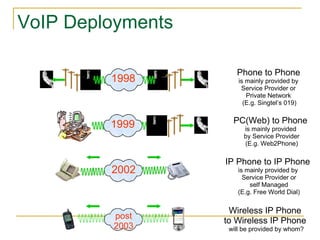
VoIP Deployments Phone to Phone   is mainly provided by  Service Provider or  Private Network  (E.g. Singtel’s 019) 1998 IP Phone to IP Phone  is mainly provided by  Service Provider or self Managed (E.g. Free World Dial) 2002 post 2003 PC(Web) to Phone  is mainly provided  by Service Provider (E.g. Web2Phone) 1999 Wireless IP Phone  to Wireless IP Phone  will be provided by whom?
Asterisk: Call Logic Example A user dials 3001, which is extension for Voicemail Central. The user is define in context => local extensions.conf [local] exten => 3001,1,Voicemailmain2 A sip user (4001) dials 1001 which is an analog phone (Zap/1), and drop in voicemail if unavailable (no one answers for 30 secs) sip.conf [4001] Username=4001 Context=from-sip … extensions.conf [from-sip] exten => 1001,1,Dial(Zap/1,30 ) exten => 1001,2,Voicemail2(u1001)
SIP — the Session Initiation Protocol SIP is a signalling protocol – it does not carry the ‘meat’ of conversations SIP finds people, sets up calls, and rings phones SIP allows callers to agree on data format (codecs, etc.) Kinds of SIP servers : Proxy/Redirect (relays requests) Registrar (keeps lists of users and where they/their phones are, so they can be called) Asterisk does both (discussed later)
Asterisk: Demo  2 Asterisk servers 4 Sip clients , 4 local phones (2 in each server) IAX2 trunk between servers  Both will act as sip proxies Server A is connected to PSTN via FXO Using ENUM for least cost routing

Asterisk Voip

  • 1.
    Asterisk Open SourcePBX Presented by: WebKul India
  • 2.
    Agenda Introduction toVoIP Benefits Challenges CODECS Session Initiation Protocol Asterisk PBX Demonstration
  • 3.
    What is VoIP?Based on packet switching technology using Internet as transport Opposed to the traditional circuit switching technology, which dominates the Public Switched Telephone Network (PSTN) Driven by low cost; flat-rate billing So why haven’t we switch to VoIP??
  • 4.
    VoIP: Benefits Integrationof Data & Voice Simplification Less equipment management Network Efficiently Save on Bandwidth (silence suppression) Cost Reduction Bypass PSTN toll fees
  • 5.
    VoIP: Quality ofVoice Quality of CODEC give good quality low delay Echo cancellation 2 wire -> 4 wire PBX (hybrid circuit used for conversion) if delay > 10mS echo is notice Delay Total Delay ( > 200mS one-way; talkers overlap ) Jitter ( variable packet arrival ) Delay Management Prioritize (RSVP) Packet replay (Jitter buffer) Segmenting data packets (exit router faster)
  • 6.
    VoIP: CODECS Codecssupported by * G.723 – 6.4kbps G.729 – 8kbps G.711 – 64kbps
  • 7.
    VoIP: Protocols RTP(Real Time Protocol) SIP (Session Initiation Protocol) SDP (Session Description Protocol)
  • 8.
    What is Voiceover IP (VoIP)? Internet/ Private IP Network ) ) ) 1010101000010100101010101010010101010100101010001001 IP Packet 1010101000010100101010101010010101010100101010001001 IP Packet 1010101000010100101010101010010101010100101010001001 1010101000010100101010101010010101010100101010001001 ( ( (
  • 9.
    VoIP Deployments Phoneto Phone is mainly provided by Service Provider or Private Network (E.g. Singtel’s 019) 1998 IP Phone to IP Phone is mainly provided by Service Provider or self Managed (E.g. Free World Dial) 2002 post 2003 PC(Web) to Phone is mainly provided by Service Provider (E.g. Web2Phone) 1999 Wireless IP Phone to Wireless IP Phone will be provided by whom?
  • 10.
    Asterisk: Call LogicExample A user dials 3001, which is extension for Voicemail Central. The user is define in context => local extensions.conf [local] exten => 3001,1,Voicemailmain2 A sip user (4001) dials 1001 which is an analog phone (Zap/1), and drop in voicemail if unavailable (no one answers for 30 secs) sip.conf [4001] Username=4001 Context=from-sip … extensions.conf [from-sip] exten => 1001,1,Dial(Zap/1,30 ) exten => 1001,2,Voicemail2(u1001)
  • 11.
    SIP — theSession Initiation Protocol SIP is a signalling protocol – it does not carry the ‘meat’ of conversations SIP finds people, sets up calls, and rings phones SIP allows callers to agree on data format (codecs, etc.) Kinds of SIP servers : Proxy/Redirect (relays requests) Registrar (keeps lists of users and where they/their phones are, so they can be called) Asterisk does both (discussed later)
  • 12.
    Asterisk: Demo 2 Asterisk servers 4 Sip clients , 4 local phones (2 in each server) IAX2 trunk between servers Both will act as sip proxies Server A is connected to PSTN via FXO Using ENUM for least cost routing