Rural Sanitation Programme
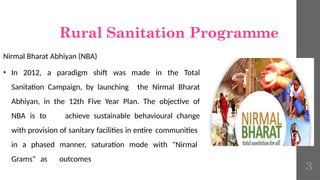
NirmalBharat Abhiyan (NBA)
• In 2012, a paradigm shift was made in the Total
Sanitation Campaign, by launching the Nirmal Bharat
Abhiyan, in the 12th Five Year Plan. The objective of
NBA is to achieve sustainable behavioural change
with provision of sanitary facilities in entire communities
in a phased manner, saturation mode with "Nirmal
Grams" as outcomes
3
4.
Rural Sanitation Programme
SwachhBharat Mission
• Swachh Bharat Abhiyan or Swachh Bharat Mission is a national
campaign by the government of India to clean streets, roads
and infrastructure of the country. The campaign was
officially launched by Prime Minister of India on 2nd Oct, 2014,
at Rajghat, New Delhi. It aims to eradicate open defecation
by year 2019, by constructing 12 million toilets in rural India.
Mission has two sub-missions, namely, Swachh Bharat
Mission Urban. and Swachh Bharat Mission Gramin. 4
5.
Swachh Bharat MissionGramin
(SBM-G)
The Mission in rural India will mean improving the level of cleanliness in rural areas
through solid and liquid waste management and making gram panchayats free of open
defecation, clean and sanitized.
The programme includes the key components of earlier sanitation schemes. The
key objectives of the programme are as follows:
(a)Bring about an improvement in the general quality of life in the rural
areas, by
promoting cleanliness, hygiene and eliminating open defecation;
(b)Accelerate sanitation coverage in rural area to achieve the vision of Swachh
Bharat
by 2nd October 2019; 5
6.
Swachh Bharat Mission
Gramin(SBM-G)
c) Motivate Communities and Panchayati Raj Institutions to adopt sustainable
sanitation practices and facilities through awareness creation and health
education;
d) Encourage cost effective and appropriate technologies for ecologically safe
and
sustainable sanitation; and
e) Develop wherever required, community managed sanitation systems focusing on
scientific solid & liquid waste management systems for overall cleanliness in
the rural areas.
6
7.
Swachh Bharat MissionGramin
(SBM-G)
• The key components of SBM-G include, start up activities including preparation of
state plan; construction of household toilets; construction of community
sanitary complexes; and capacity building of functionaries etc.
• Under the programme, construction of toilets in government schools and anganwadi
centres will be done by the Ministry of Human Resource Development and
Ministry of Women and Child Development respectively.
• Rural School sanitation focusing on separate toilets for girls and boys is a major
intervention which shall be implemented under the programmes of the
Department
of School Education 7
8.
Swachh Bharat MissionGramin
(SBM-G)
• A duly completed household sanitary toilet shall comprise of toilet unit including a
substructure which is sanitary (that safely confines human faeces and eliminates the
need of human handling before it is fully decomposed), a super structure, with
water facility and hand wash unit for cleaning and hand washing
• The Mission aims that all rural families have access to toilets
• Incentives for construction of household toilets will be available for below poverty
line households, and above poverty line households restricted to SCs/STs, small and
marginal farmers, landless labourers, physically handicapped and women headed
families 8
9.
NATIONAL URBAN
HEALTH MISSION
•NUHM seeks to improve the health
status of the urban
population particularly slum
dwellers and other vulnerable
section by facilitating their access to
quality health care
• NUHM would cover all state capitals,
district headquarters and about
779 other cities/towns with a
population of 50,000 and above (as
per census 2011) in a phased
manner
• Cities and towns below 50,000
population will be covered by NRHM.
9
10.
NATIONAL URBAN
HEALTH MISSION
TheNUHM will focus on
• 1. Urban poor population living in listed and unlisted slums;
• 2. All other vulnerable population such as homeless, ragpickers, street children,
rickshaw pullers, construction and brick and lime-kiln workers, sex workers
and other temporary migrants;
• 3. Public health thrust on sanitation, clean drinking water, vector control etc.; and
• 4. Strengthening public health capacity of urban local bodies.
www.LastBenchPharmacist.in
10
11.
NATIONAL URBAN
HEALTH MISSION
TheNUHM would encourage the effective participation of the community in
planning and management of health care services.
• It would promote a community health volunteer - Accredited Social Health Activist
(ASHA) or Link Worker (LW) in urban poor settlement (one ASHA for 1000-
2500 urban poor population covering about 200 to 500 households);
ensure the participation by creation of community-based institutions like Mahila
Arogya Samiti (MAS) (50- 100 households) and Rogi Kalyan Samitis.
• The NUHM would provide annual grant of Rs. 5000/- to MAS every year 11
12.
Essential services tobe
rendered by the ASHA
i. Active promoter of good health practices and enjoying community support.
ii. Facilitate awareness on essential RCH services, sexuality, gender equality, age at
marriage/pregnancy; motivation on contraception adoption, medical
termination of pregnancy, sterilization, spacing methods. Early registration of
pregnancies,
pregnancy care, clean and safe delivery, nutritional care during pregnancy,
identification of danger signs during pregnancy; counselling on immunization,
ANC, PNC etc., act as a depot holder for oral re-hydration therapy (ORS), Iron Folic
Acid Tablet (IFA), chloroquine, oral pills and condoms, etc.; identification of target
beneficiaries and support the ANM in conducting regular monthly outreach
sessions and tracking service coverage 12
13.
Essential services tobe
rendered by the ASHA
iii. Facilitate access to health related services available at the Anganwadi/Primary
Urban Health Centres/Urban Local Body (ULBs) and other services being provided
by the ULB/State/Central Government.
iv. Formation and promotion of Mahila Arogya Samitis in her community.
v. Arrange escort/accompany pregnant women and children requiring treatment to
the nearest Urban Primary Health Centre, secondary/tertiary level health
care facility.
13
14.
Essential services tobe
rendered by the ASHA
vi. Reinforcement of community action for immunization, prevention of water borne and
other communicable diseases like TB (DOTS), Malaria, Chikungunya and Japanese
Encephalitis.
vii. Carrying out preventive and promotive health activities with AWW/Mahila Arogya
Samiti.
viii. Maintenance of necessary information and records about births and deaths,
immunization, antenatal services in her assigned locality as also about any unusual
health problem or disease outbreak in the slum, and share it with the ANM in
charge of the area. 14
15.
Impact level targetsof
NUHM
1.Reduce IMR by 40% (in urban areas) - National Urban IMR down to 20 per 1000
live births by 2017. 40% reduction in USMR and IMR. Achieve universal immunization
in all urban areas
2.Reduce MMR by 50%. 50% reduction in MMR (among urban population of the
state country). 100% ANC coverage (in urban areas)
3. Achieve universal access to reproductive health including 100% institutional delivery
4. Achieve replacement level fertility
5. Achieve all targets of disease control programmes
15
• Health promotionin the school is considered one of the important activities for the
school children.
• The concept of Health Promoting School is developed to promote learning and
health and to highlight the importance of health
• teaching among teachers, community, and leaders.
• The school curriculum includes basic health related matters from
primary school onwards to sensitize children about health. If implemented properly
the Health Promoting Schools will enhance children to develop decision making
skills.
Introduction
18
19.
Health Promoting Schoolsfocus on:
• Empowering and caring for oneself and others
• Making healthy decisions and taking control over life’s circumstances
• Creating conditions that are conducive to health (through
policies, physical/social
services,
• Building capacities for peace, shelter, education, food, income, a stable ecosystem,
equity, social justice and sustainable development
• Preventing leading causes of death, disease and disability i.e. tobacco use, HIV/STDs,
sedentary lifestyle, drugs and alcohol, violence and injuries, unhealthy nutrition
• Influencing health-related behaviours i.e. knowledge, beliefs, skills, attitudes, values
and support. 19
20.
• Why becomea Health Promoting School?
• Young people today grow up in an environment that increasingly encourages negative
risk-taking behaviour through negative role models, peer influence, ambiguous role
expectations and social /media influence amongst other factors. Young people develop
these risk behaviours in varying degrees which may impede their educational progress.
20
21.
• For youngpeople, education and health are inextricably connected; therefore efforts to
improve school performance also need to include improving the health status
of children and adolescents.
• The most serious and threatening health problems in society today relate primarily to
personal decision-making and lifestyle. The behaviours and lifestyles that lead to
these preventable health problems are almost always developed and/or sustained
during the early years of life, especially school years.
Health Promotion in School
21
22.
• The schoolis uniquely placed to respond to students’ basic needs for health
education. After the home, the school has the greatest capacity to intervene
to benefit each student. Research indicates that healthier students are better
learners.
• Intervention strategies within the school are effective in reducing a number of risk
behaviours as well as reinforcing and maintaining positive health behaviours
for most students
Health Promotion in School
22
23.
. The conceptsof health education and health promotion in relation to schools
Healthy School Policies
These are clearly defined in documents or in accepted practices that promote health and
wellbeing. Many policies promote health and well-being e.g., policies that enable healthy
food practices to occur at school; policies which discourage bullying.
Health Promotion in School
23
24.
• The physicalenvironment refers to the buildings, grounds and equipment in and
surrounding the school such as: the building design and location; the provision
of natural light and adequate shade; the creation of space for physical activity
and facilities for learning and healthy eating
The School’s Physical Environment
24
25.
• The socialenvironment of the school is a combination of the quality of
the relationships among and between staff and students.
• It is influenced by the relationships with parents and the wider community.
• It is about building quality connections among and between all the key stakeholders
.
The School’s Social Environment
25
26.
Individual Health Skillsand Action Competencies
• This refers to both the formal and informal curriculum and associated activities,
where students gain age-related knowledge, understandings, skills and
experiences, which enable them to build competencies in taking action to
improve the health and well-being of themselves and others in their
community and that enhances their learning outcomes
26
27.
Community Links
• Communitylinks are the connections between the school and the students’ families,
plus the connection between the school and key local groups and
individuals. Appropriate consultation and participation with these stakeholders
enhances the health promoting school and provides students and staff with a context
and support for their actions
Health Services
• These are the local and regional school-based or school-linked services, which have a
responsibility for child and adolescent health care and promotion through the
provision of direct services to students including those with special needs.
27
28.
Considerations for Implementation
•Health education activities should enhance
the
promotion and disease prevention program. Materials developed for
overall goal of the health
health
education programs must be culturally appropriate and tailored to the target
populations to ensure cultural competence. In rural communities, this means
addressing cultural and linguistic differences, and addressing potential barriers to
health promotion and disease prevention in rural areas.
28
29.
How can healthcareservices be provided in
rural schools?
School Nurses
• School nurses provide health services in some rural schools. They work with parents,
teachers, and other health professionals to provide a plan for the health needs of
the school. School nurses provide services for students with special health needs,
such as prescription medications, asthma inhalers, and catheters so that
those students can attend school.
29
30.
They also providehealth promotion activities and education including:
• Fitness and nutrition education
• Tobacco use prevention
• Sexually transmitted disease prevention
• Teen pregnancy prevention
• Hearing and vision screenings
• In rural schools, nurses often fill multiple roles including clinician, administrator,
record keeper, and grant writer.
Health promotion activities
30
31.
• What healtheducation and prevention programs can be implemented in a rural
school to improve students' knowledge of how to maintain their own health?
• There are many health education programs that rural schools can implement to
improve students' knowledge of how to maintain their own health. For example,
in South Dakota, the Harvest of the Month Program encourages schoolchildren
to make healthy eating choices by tasting different fruits and vegetables.
31
32.
• Students inthe program can sample new foods and are encouraged to make
healthy food choices at school and at home. Exposing young children to a variety
of nutritious foods in a positive setting will help them improve life-long healthy
food behaviors.
• CATCH is a popular health education program that introduces healthy eating and
physical activity options during the school day as well as encourages
positive behaviors outside of school.
32
33.
How can ruralschools work to address and prevent Adverse Childhood Experiences (ACEs)?
• Adverse childhood experiences can have great impacts on children's growth and development.
A National Survey of Children's Health (NSCH) data brief, Rural/Urban Differences in Children's
Health, states that, compared to children from urban areas, children from large and small rural
areas were more likely to experience the following ACEs in 2017-2018: parental divorce, living
with someone who engaged in alcohol or other substance misuse
• ACEs can cause mental, emotional, and physical health issues for impacted children and are
likely to impact their health as adults. According to the data brief, depression, behavior
problems, and anxiety were all more prevalent in children aged 3-17 who were from large and
small rural areas than those from urban locations.
33